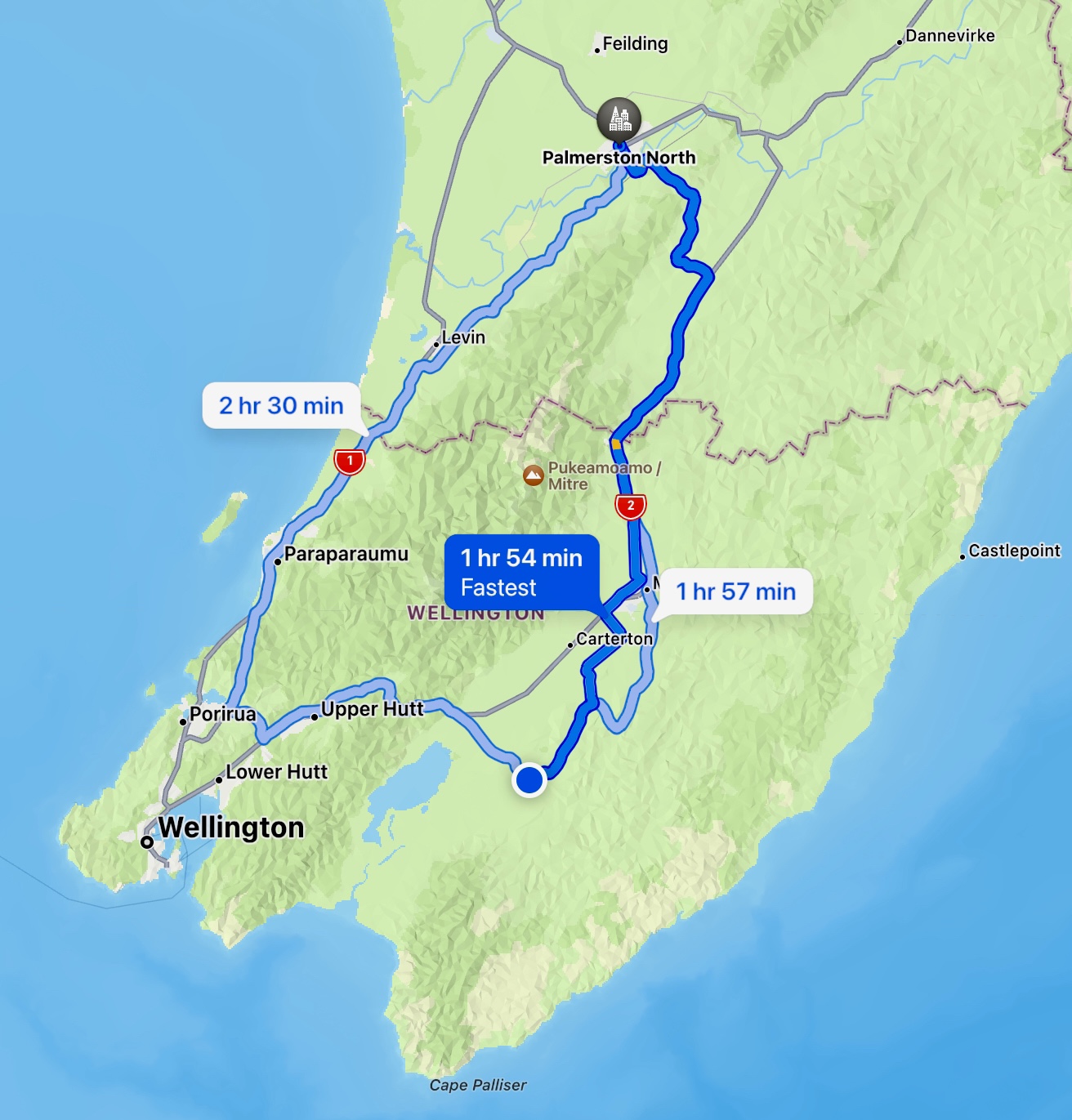
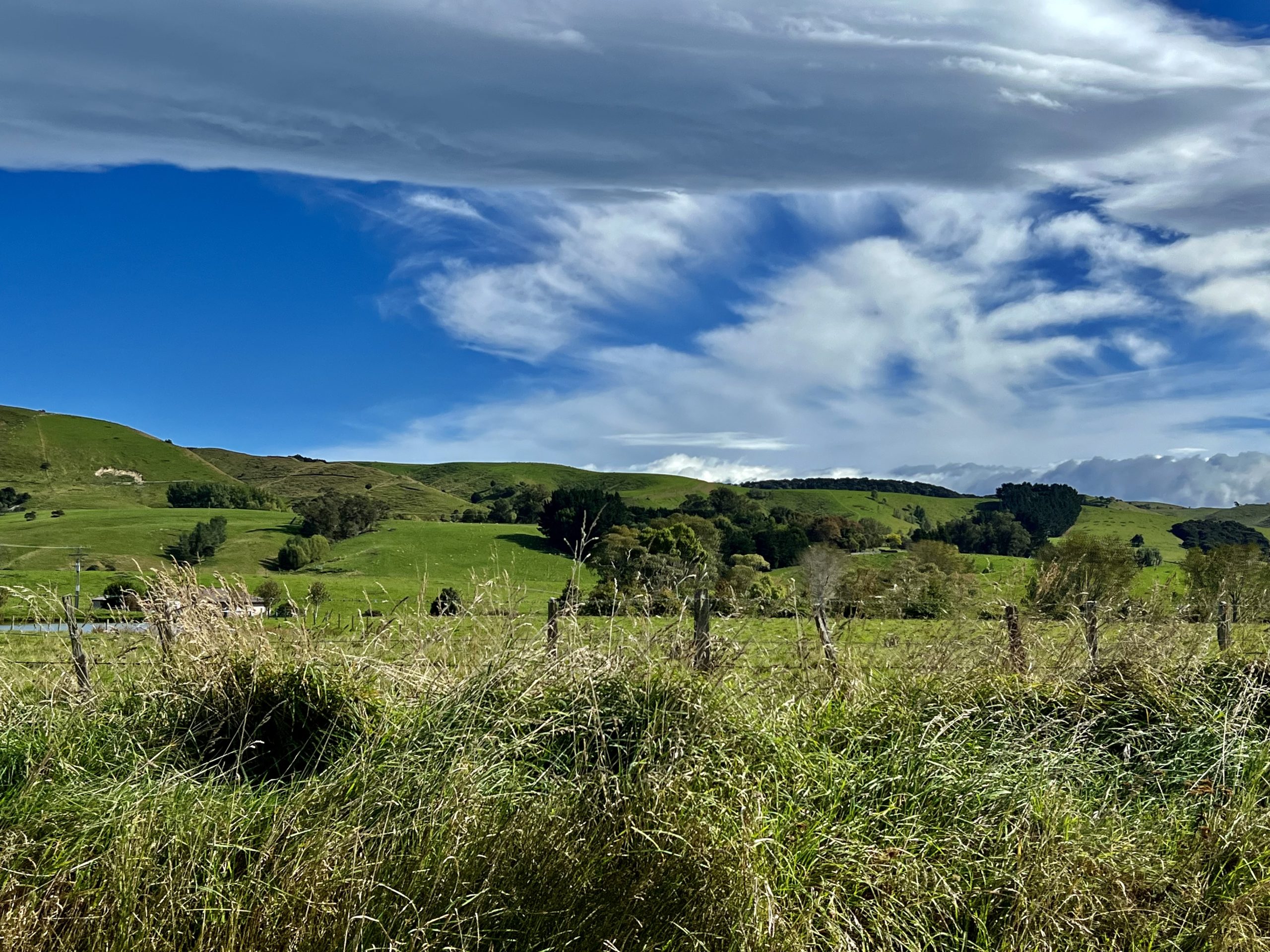
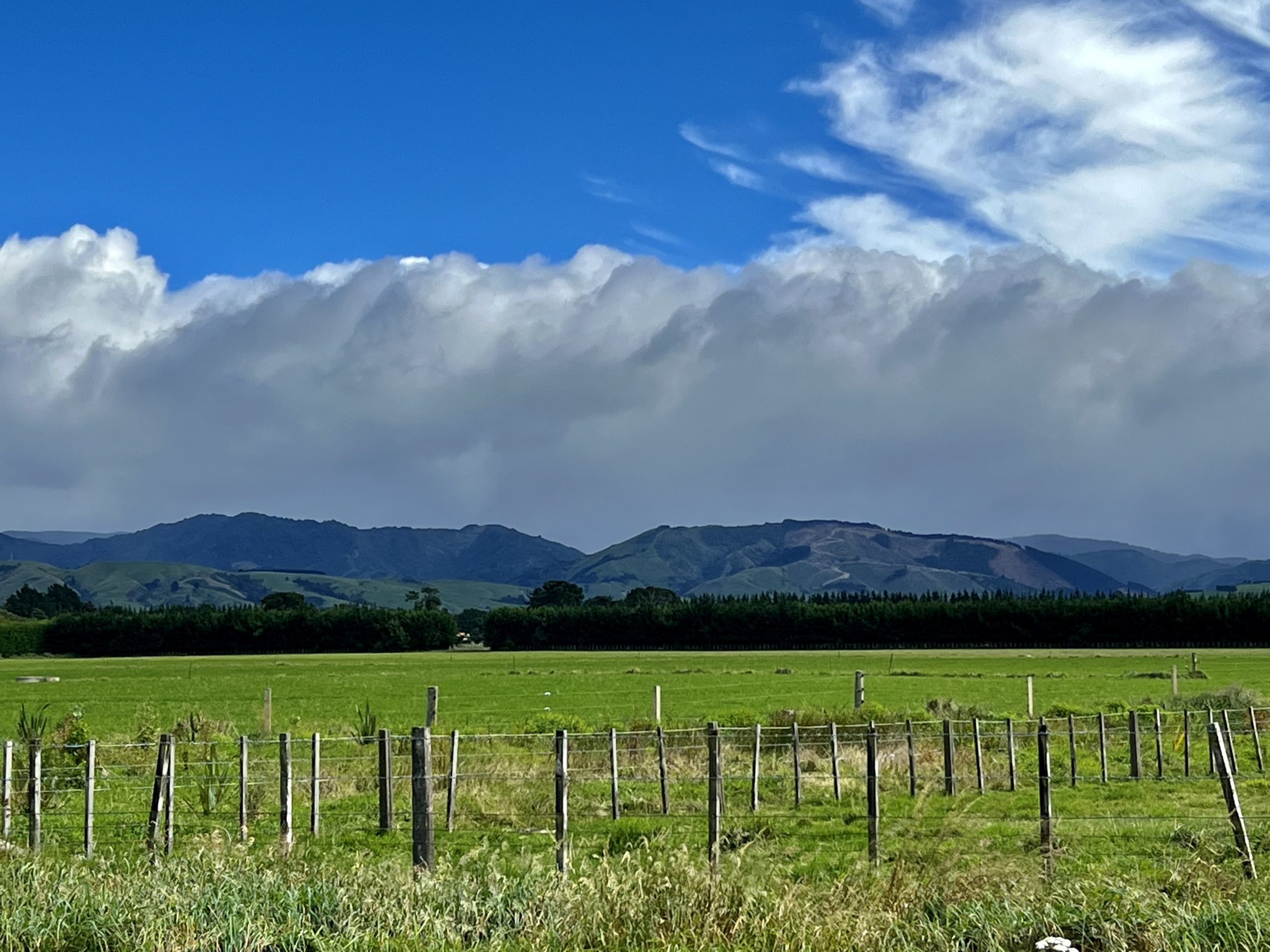
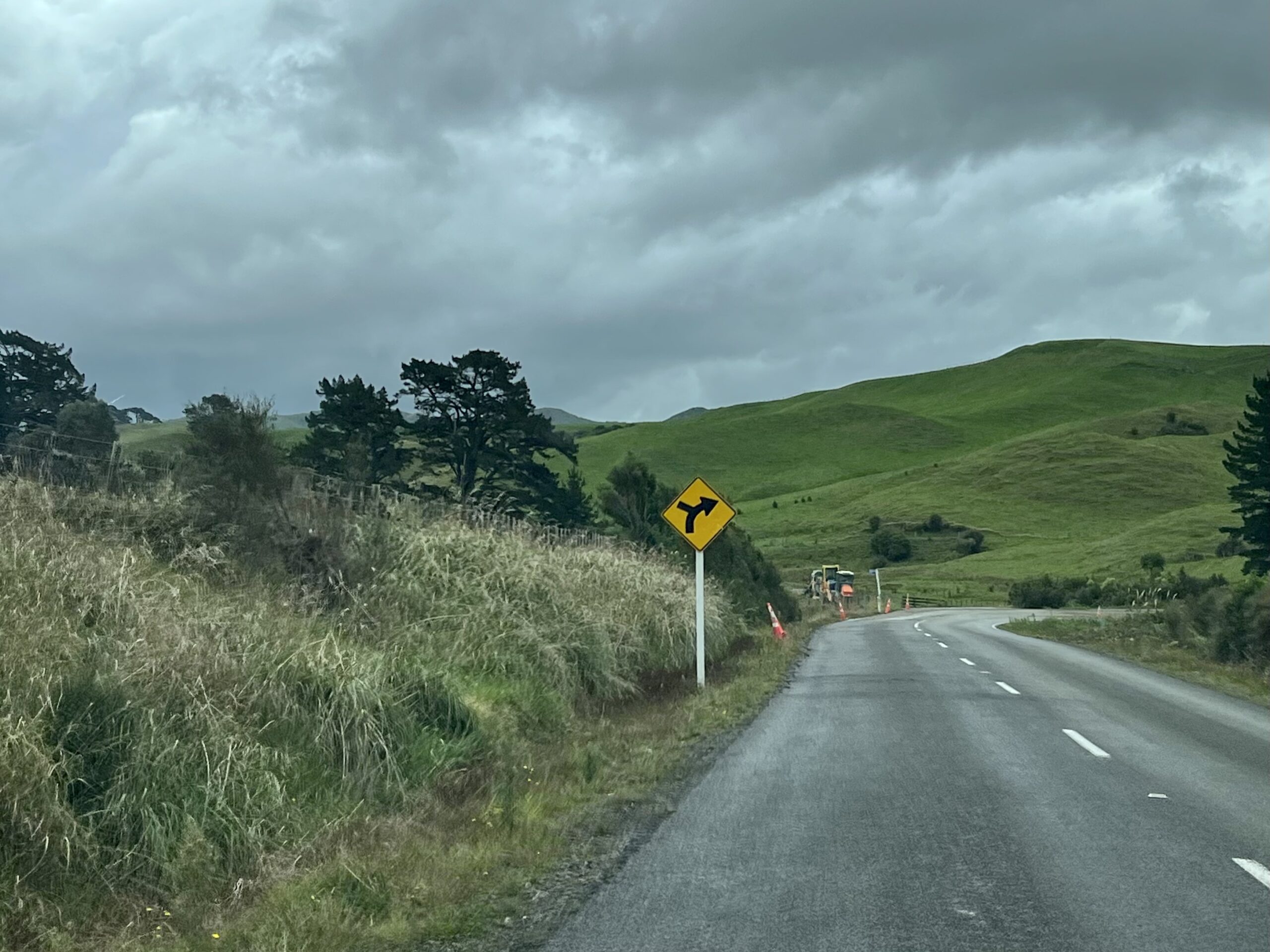
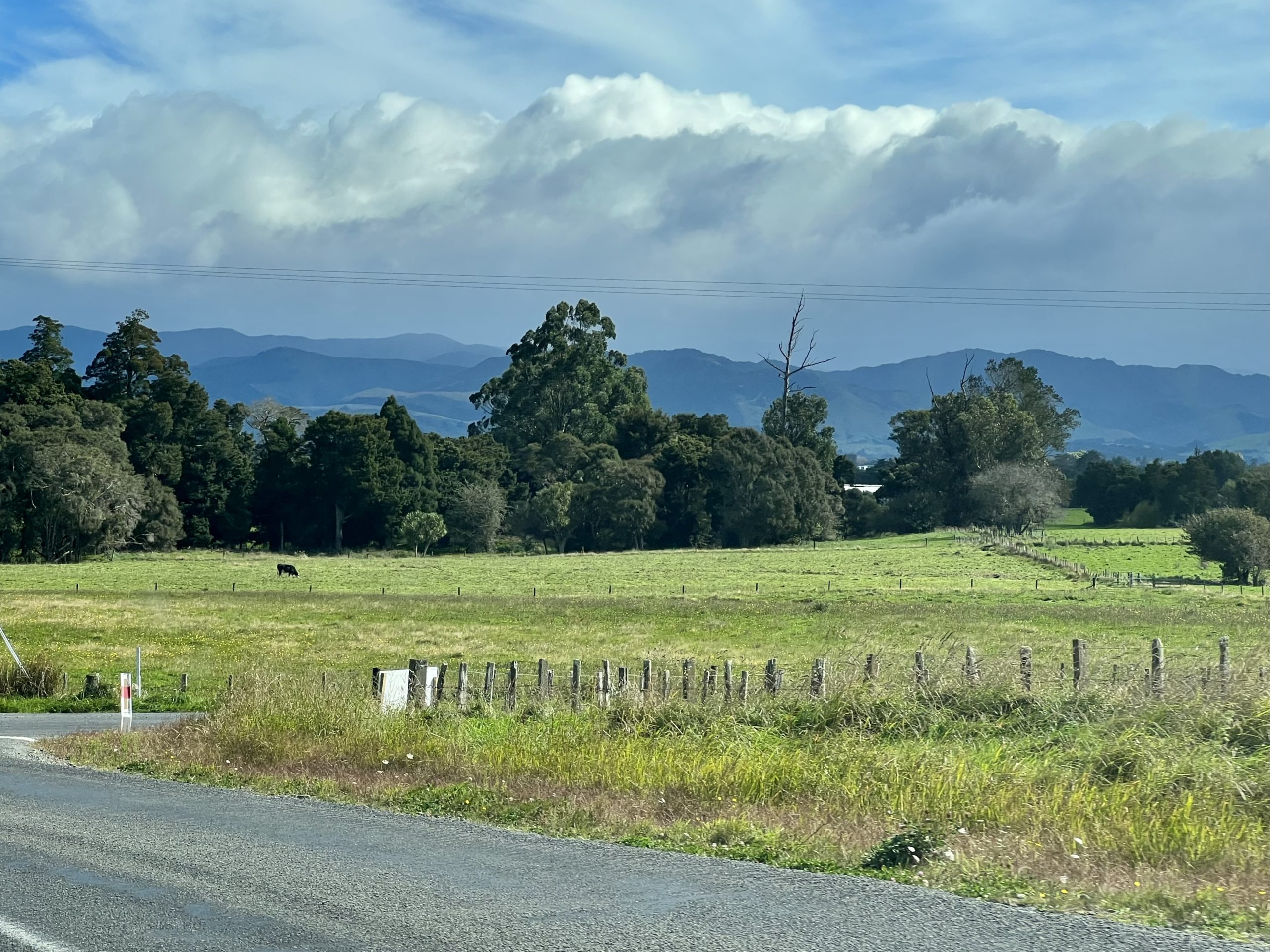
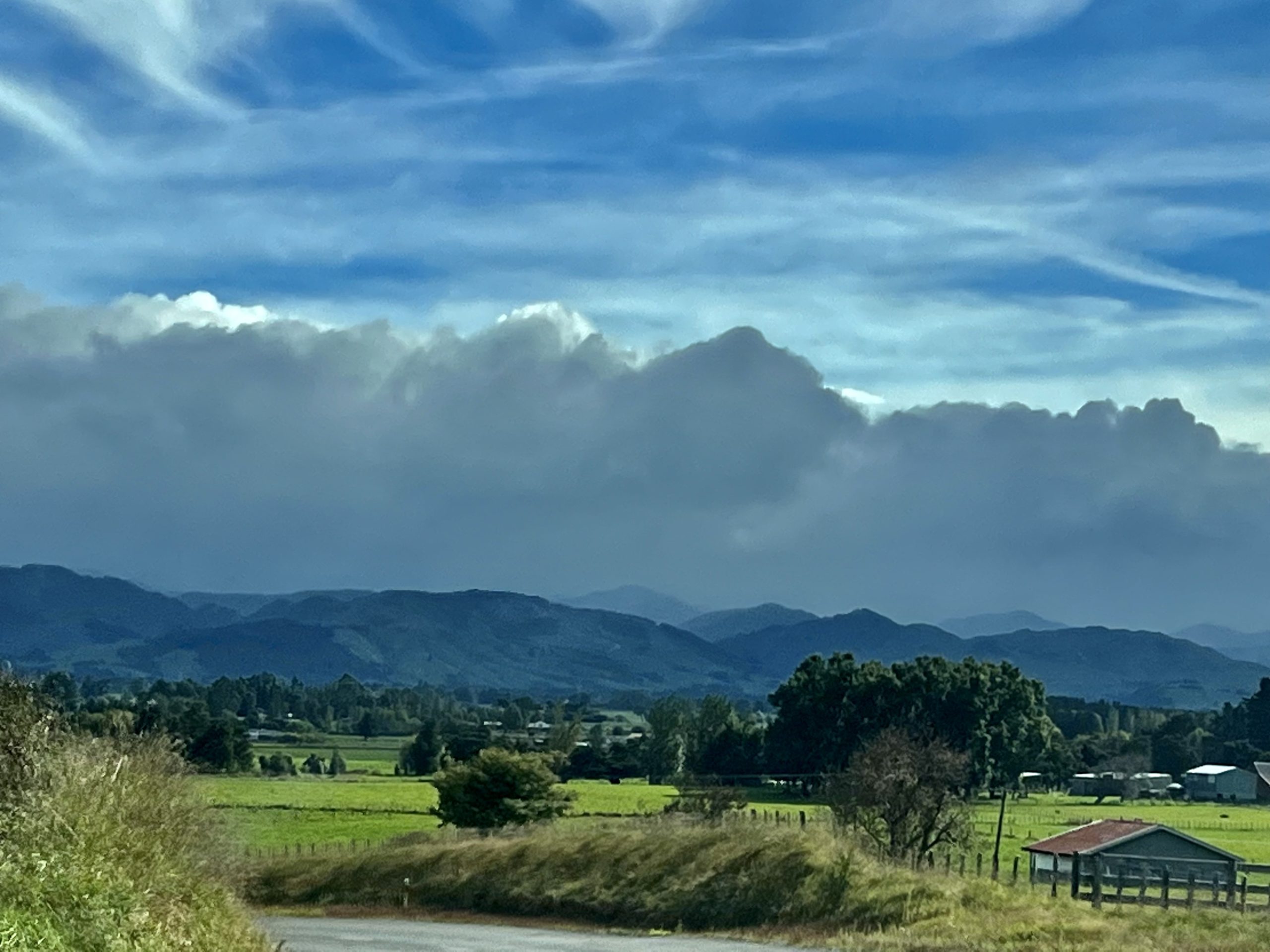
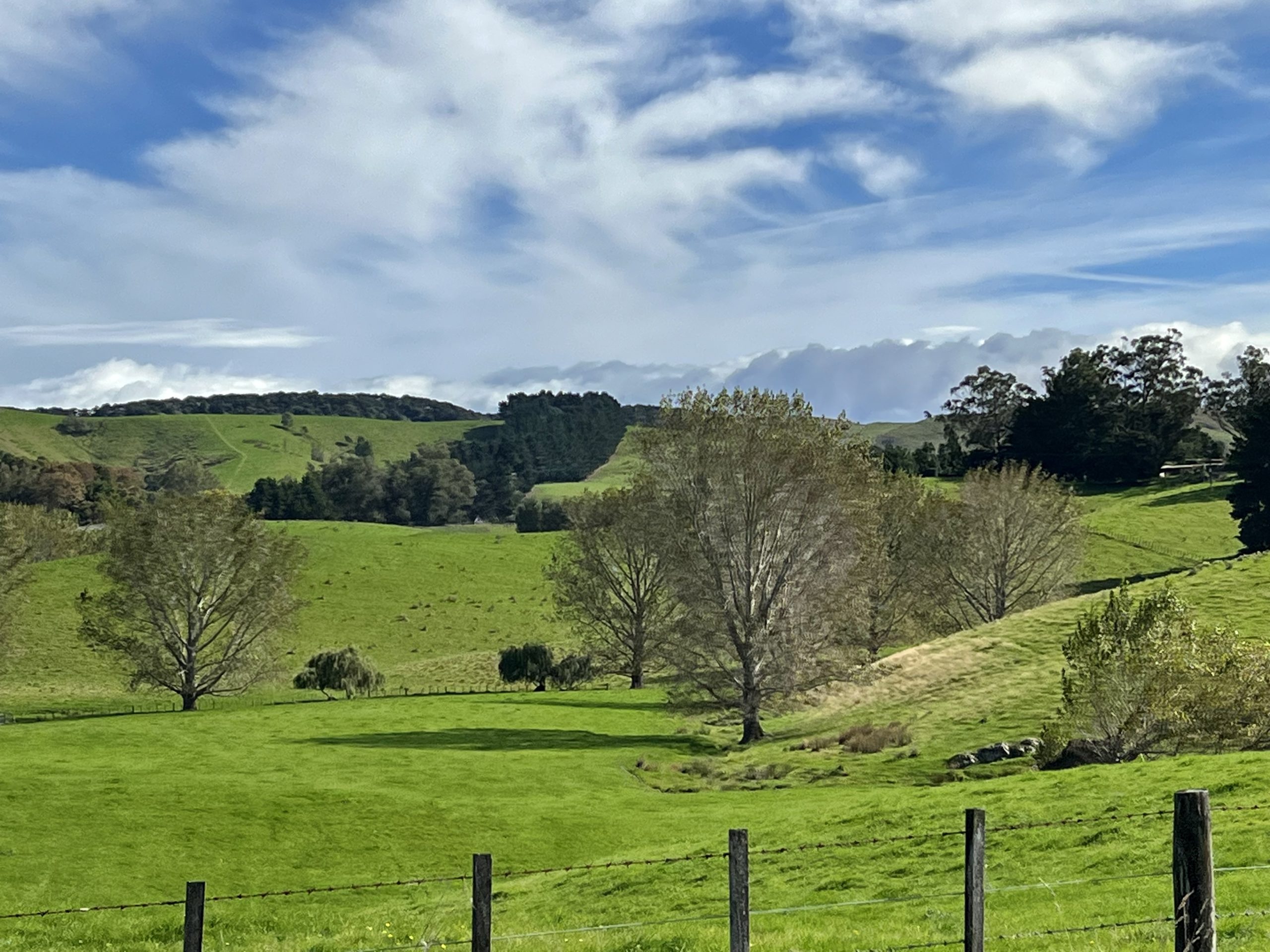
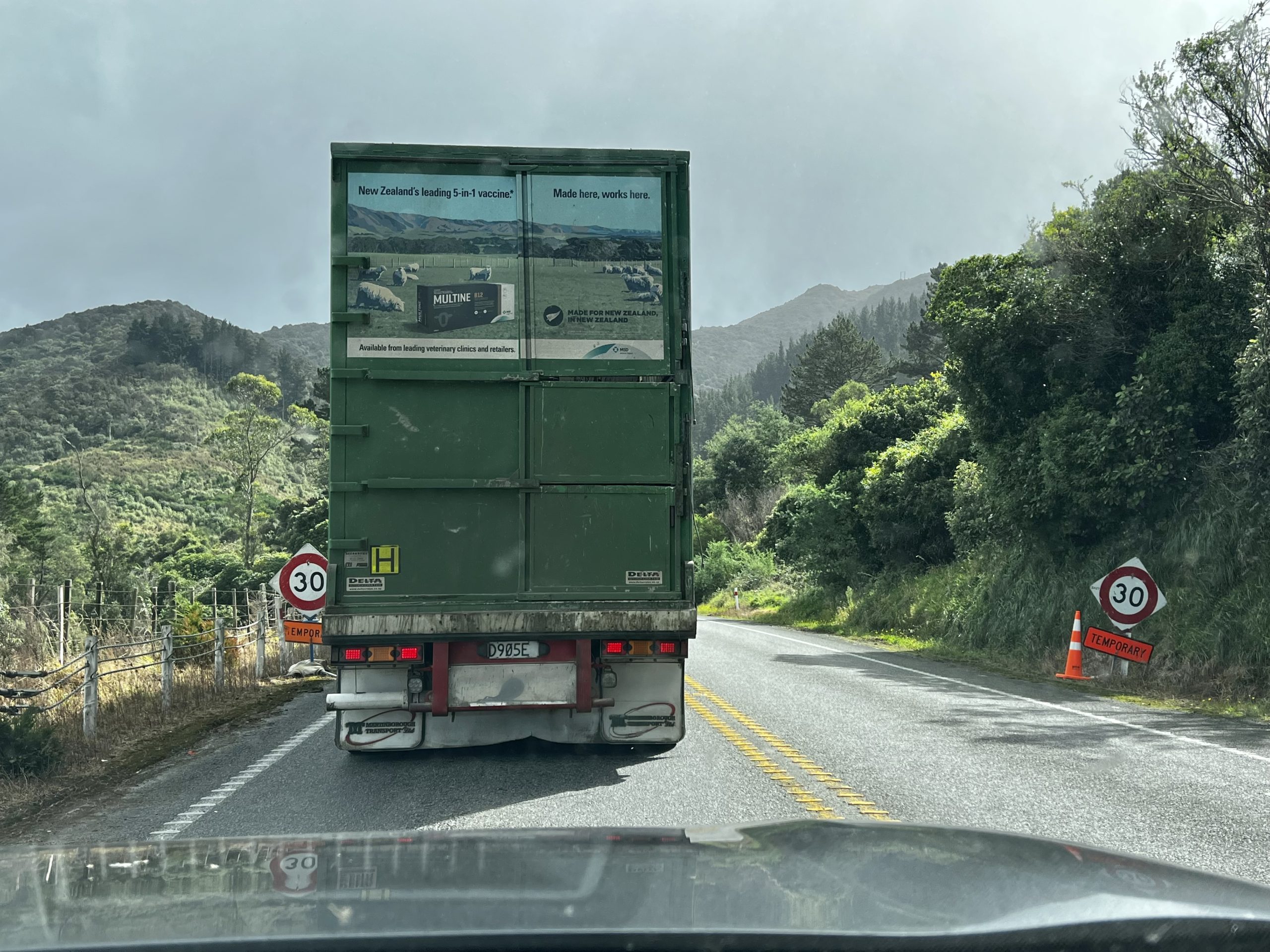
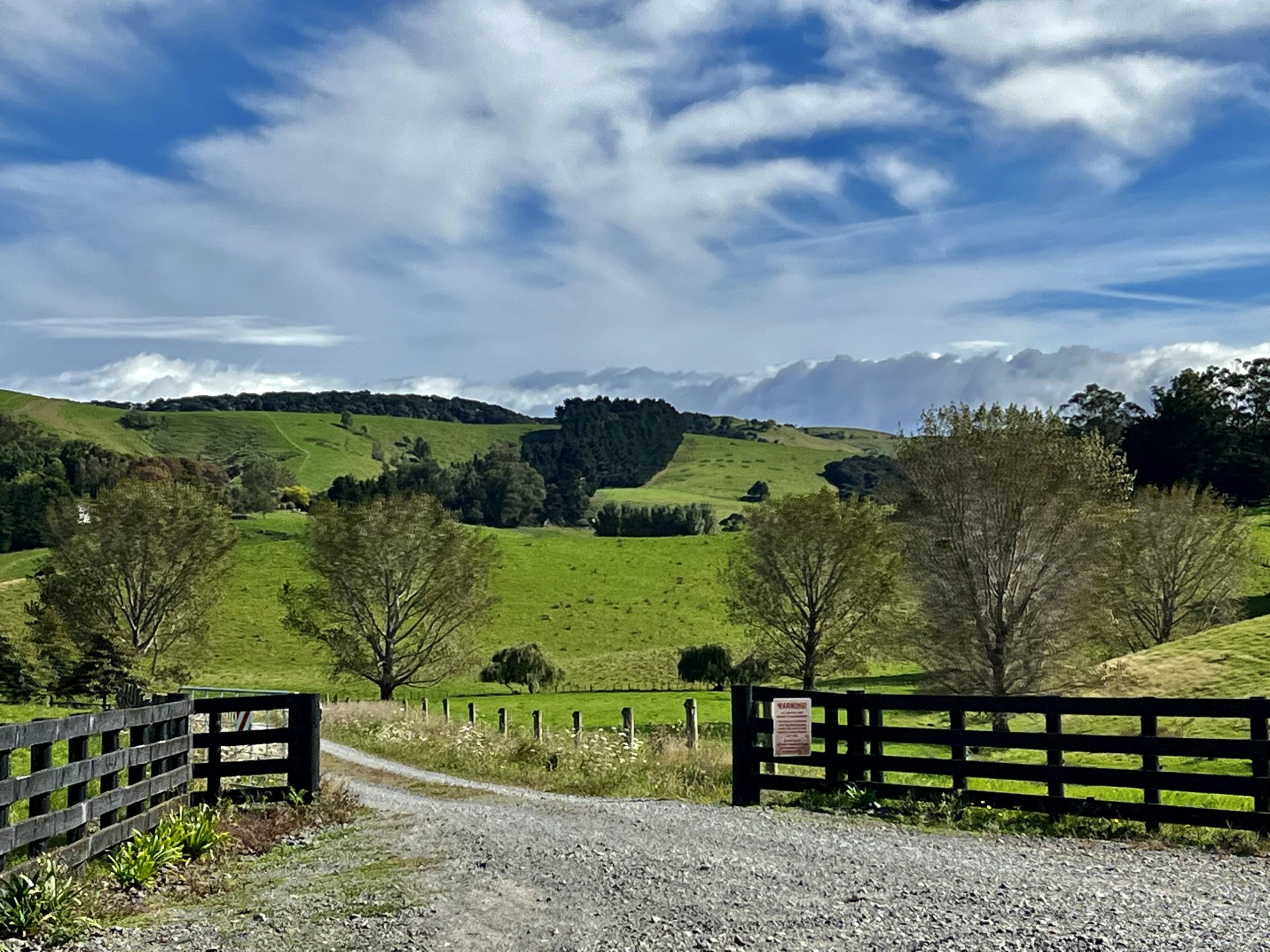
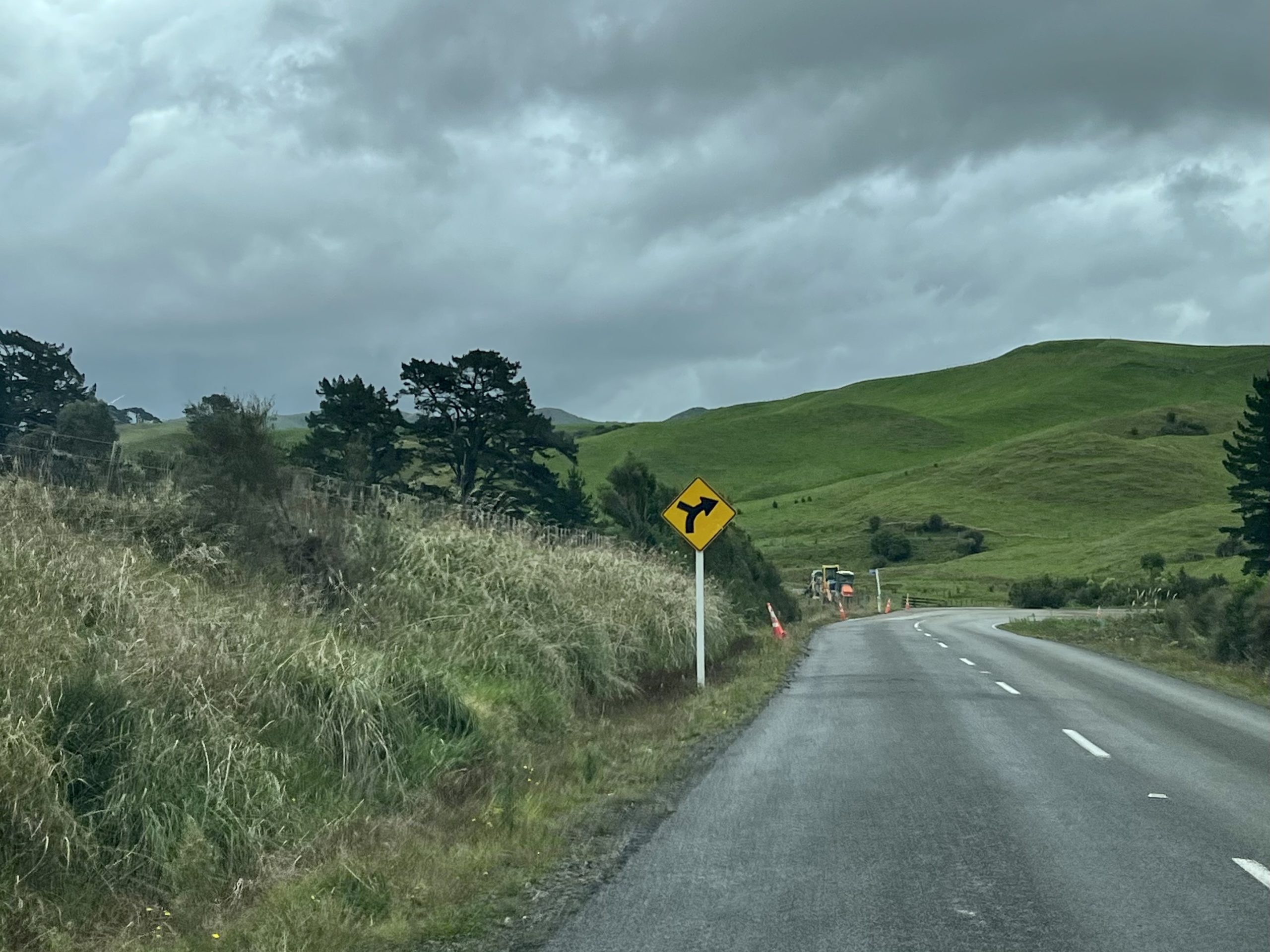
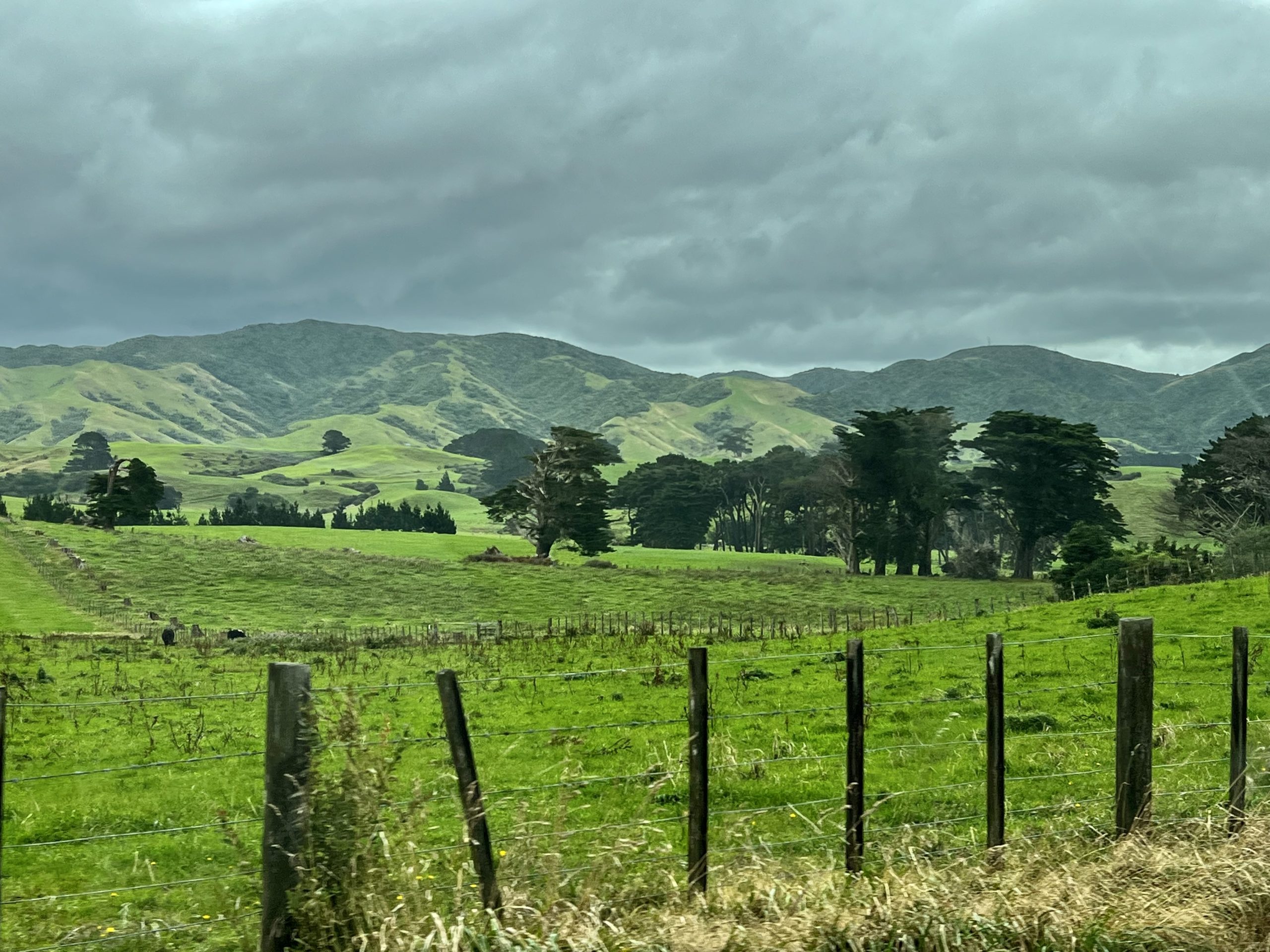
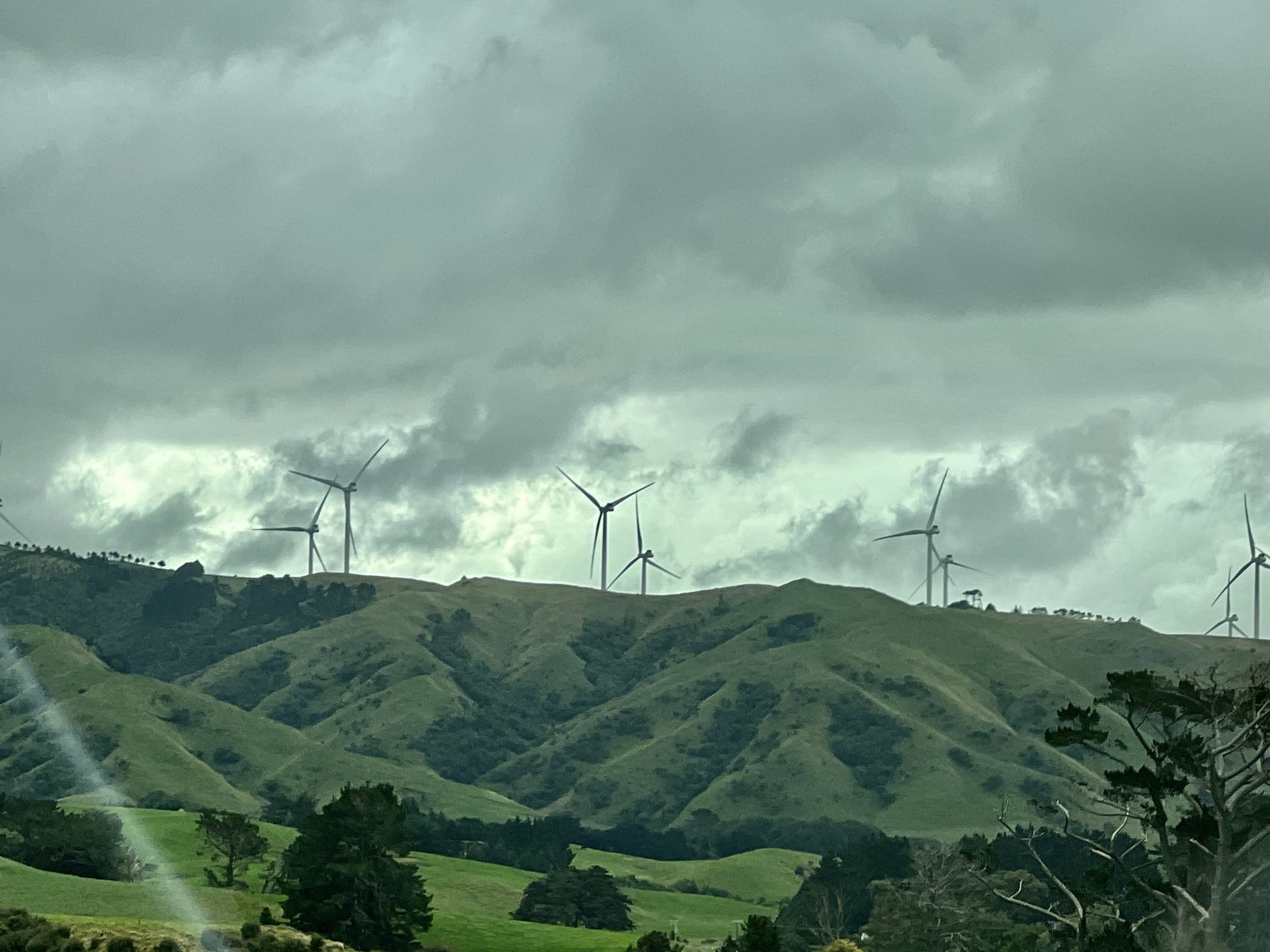
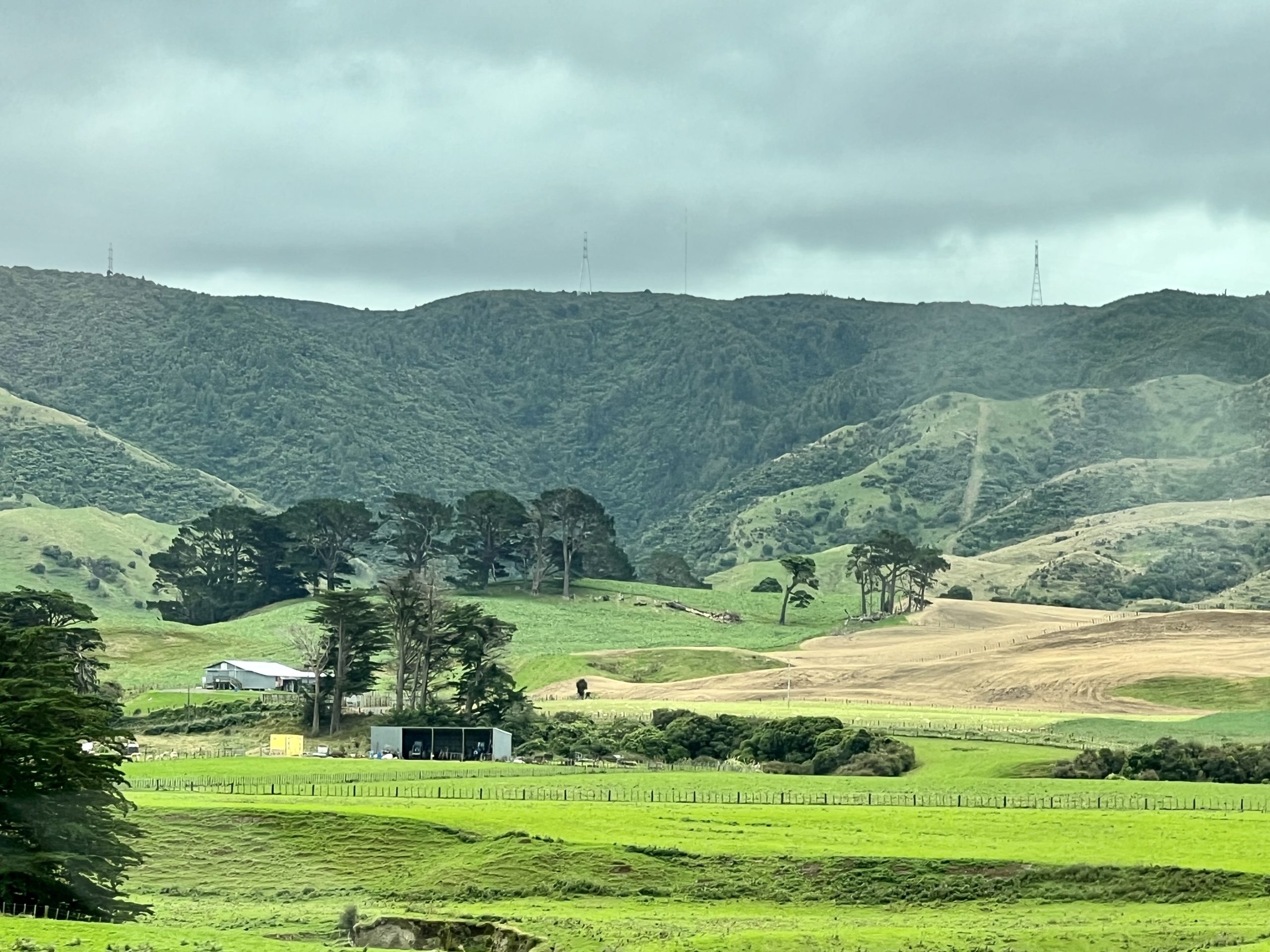
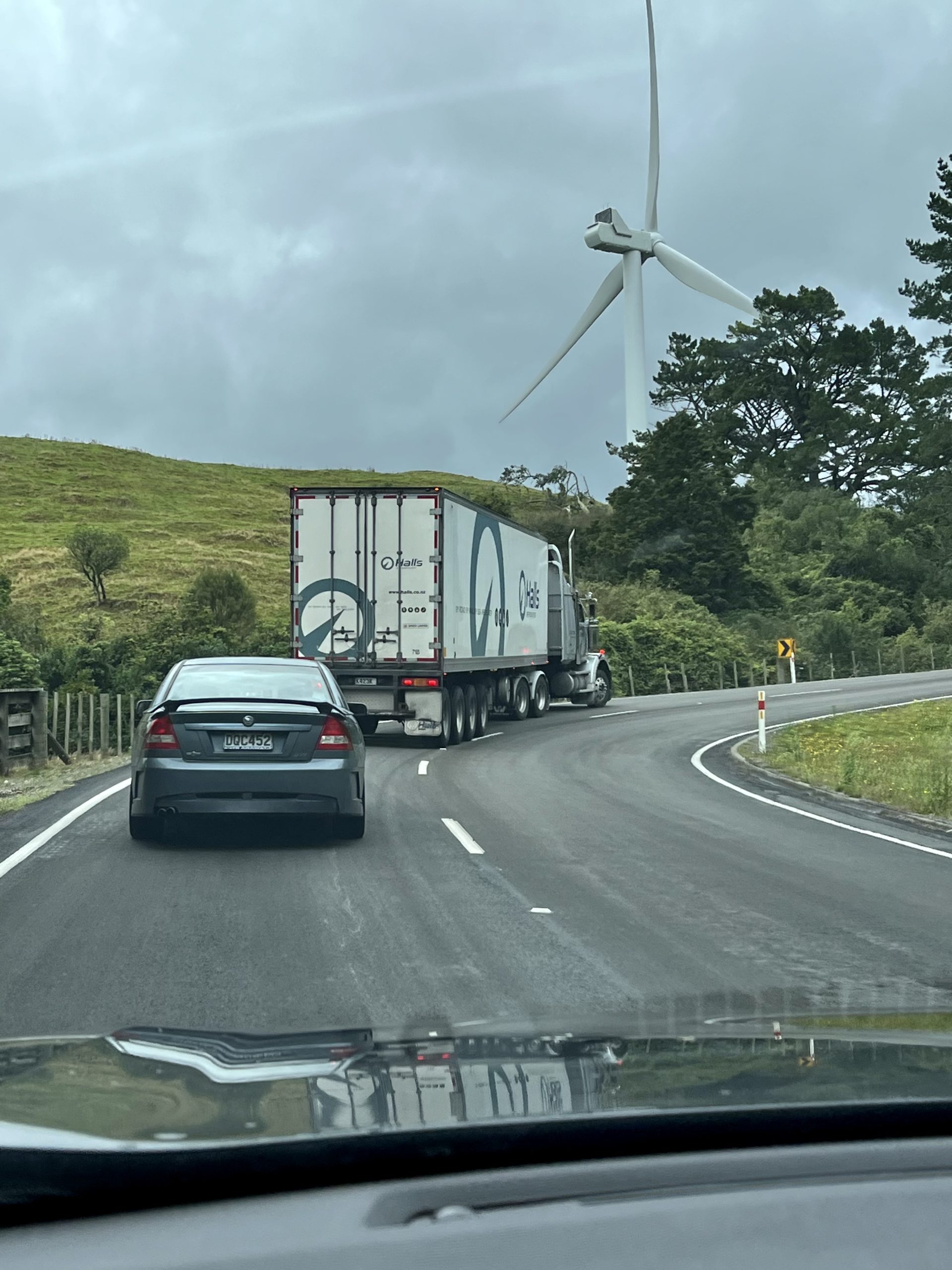
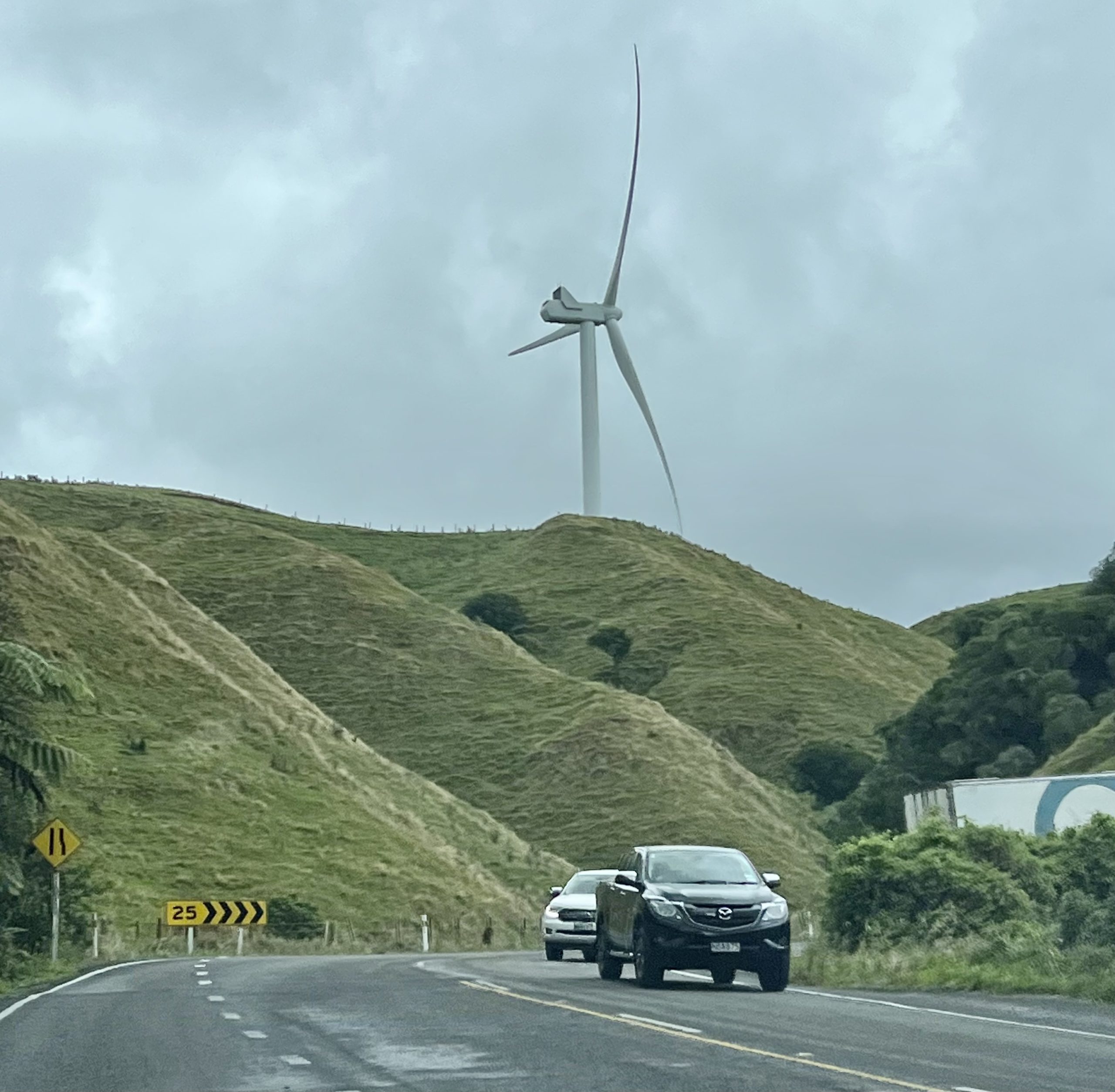
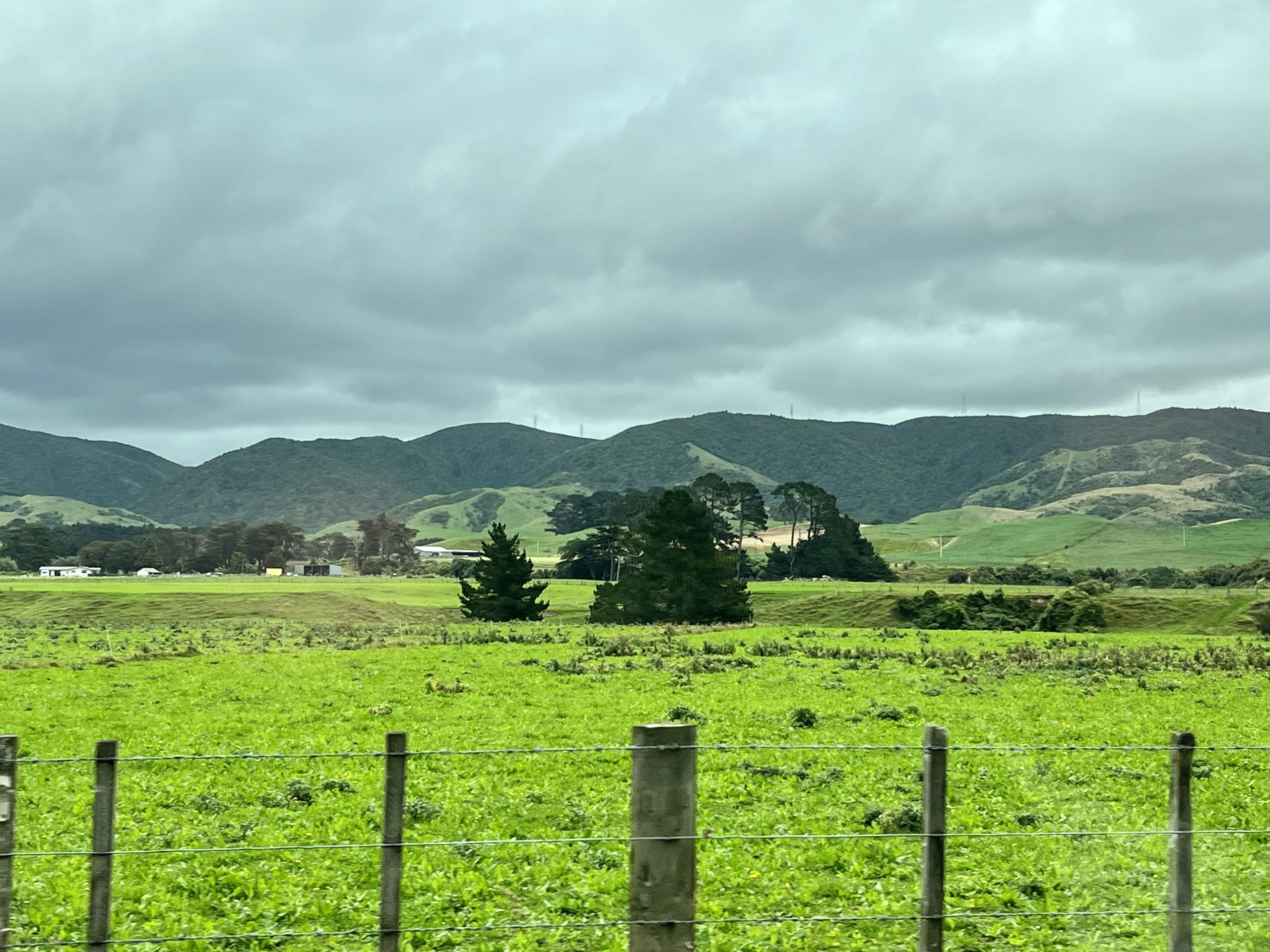
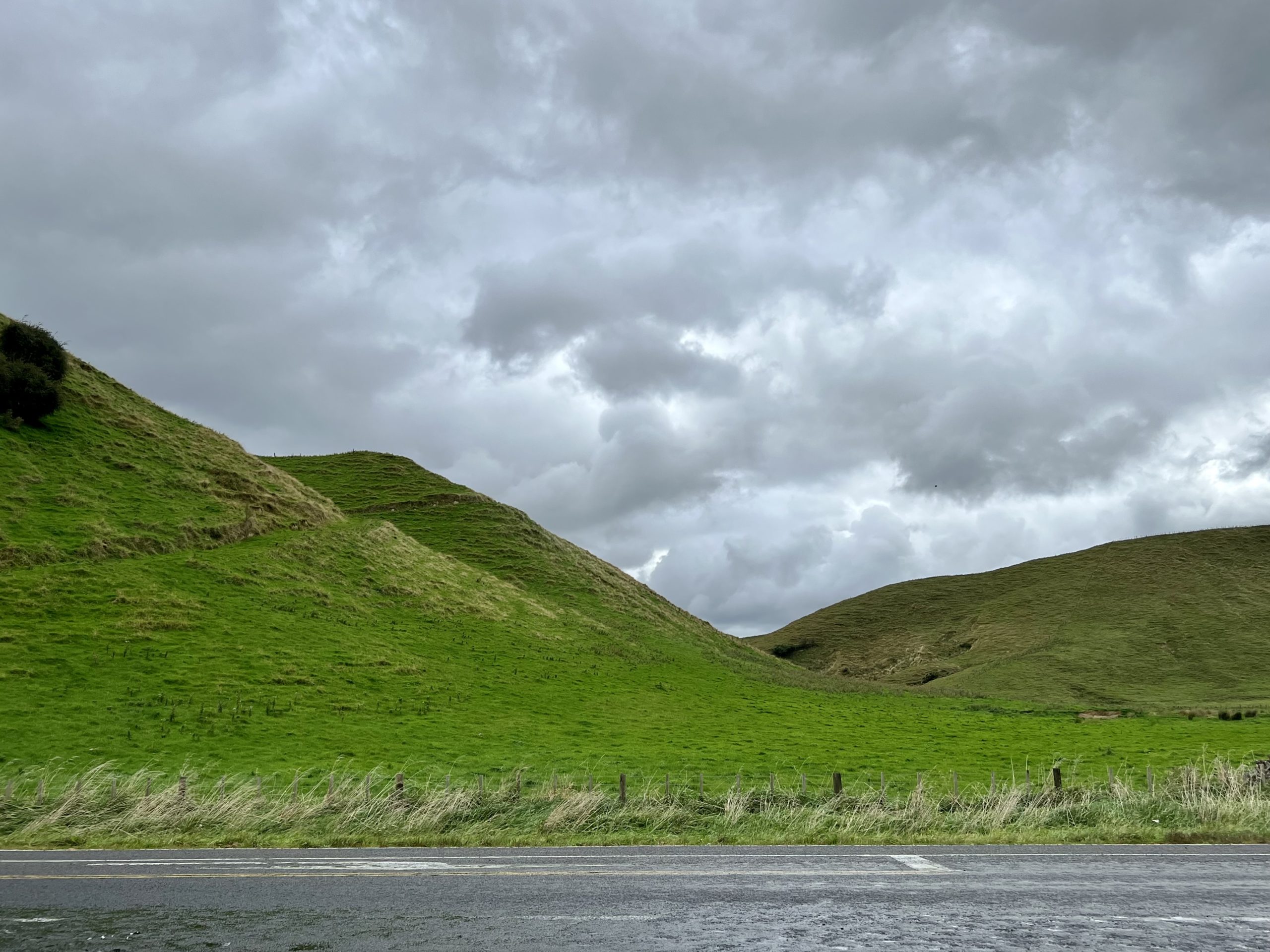
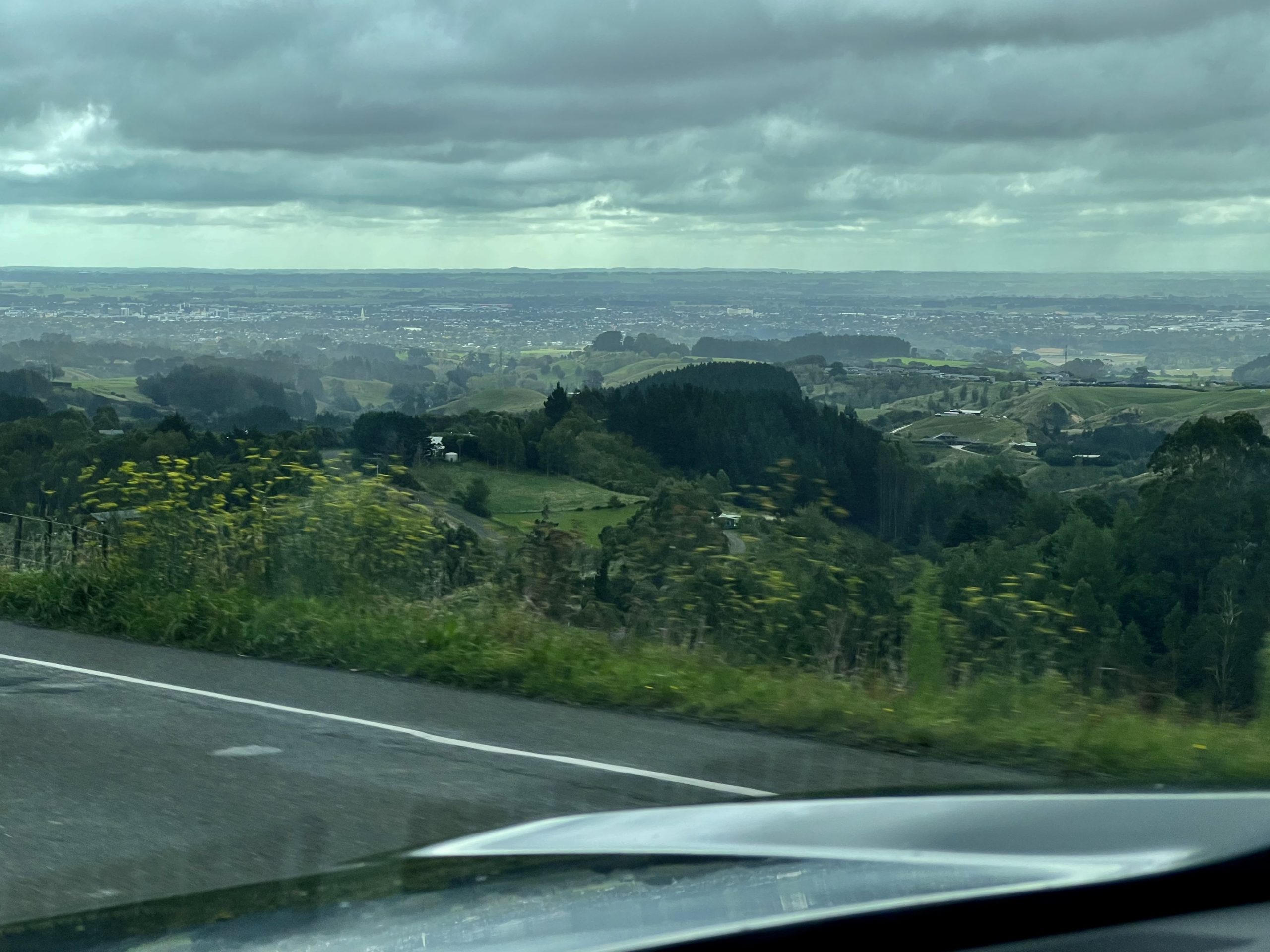
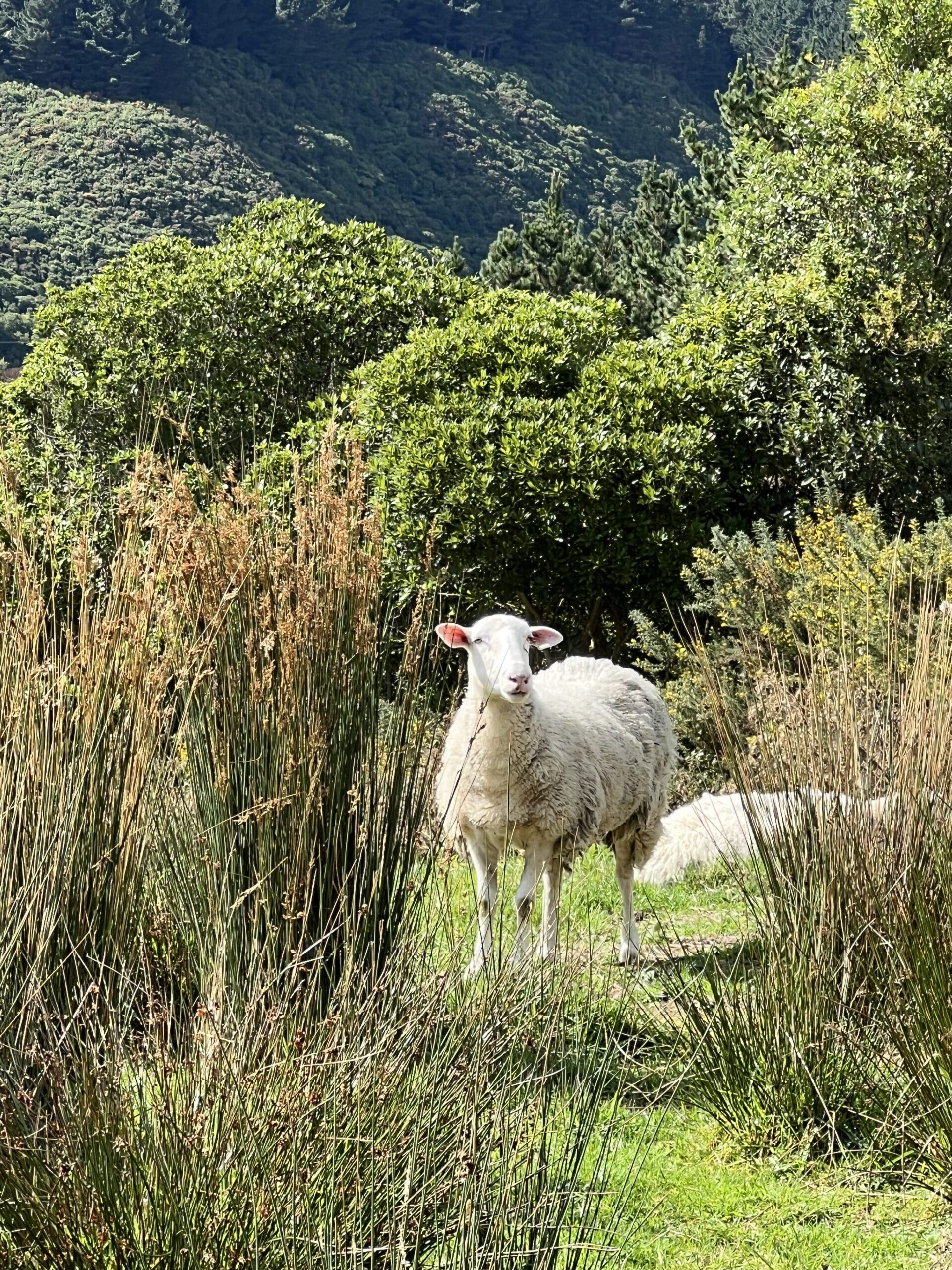
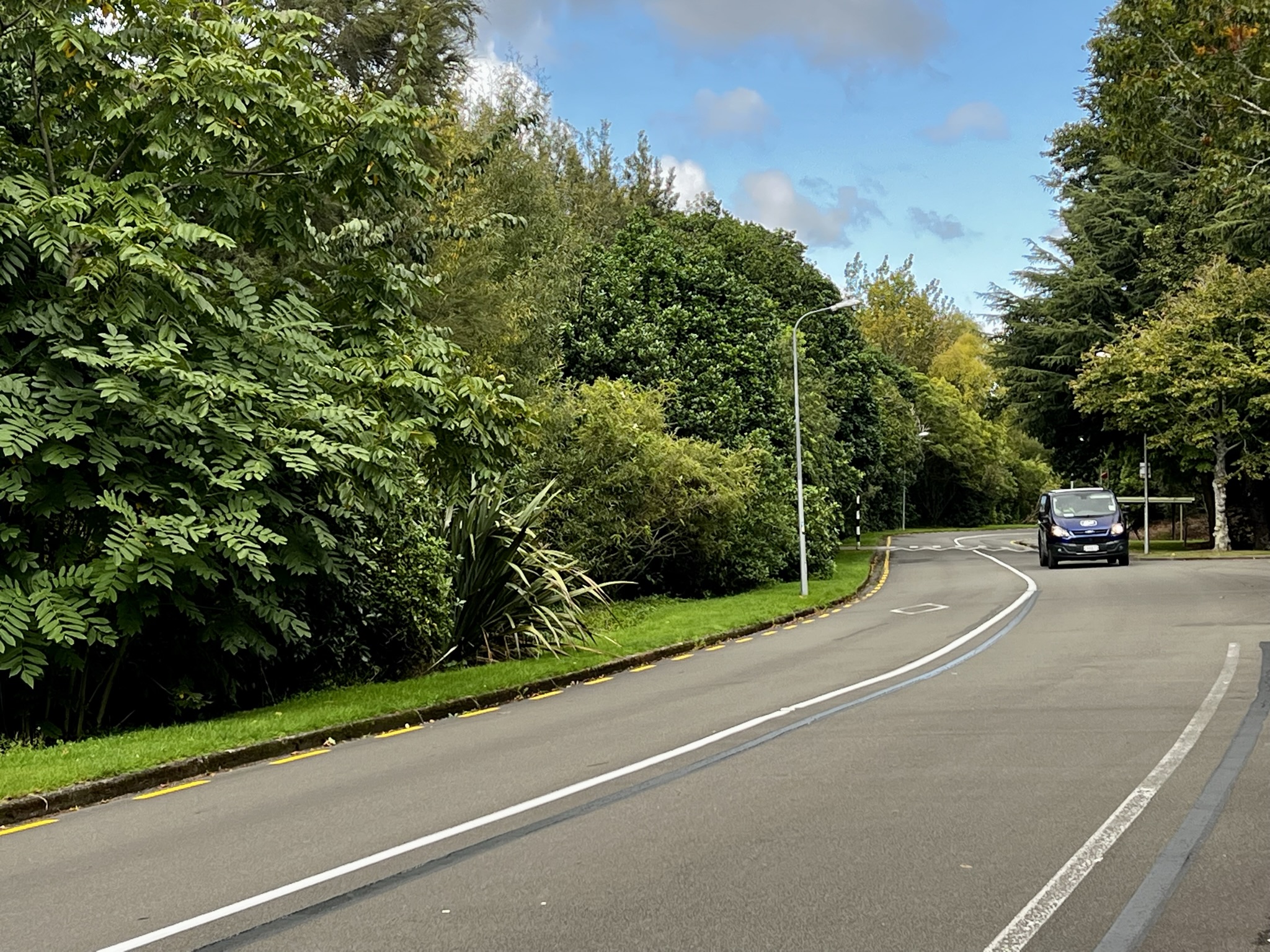
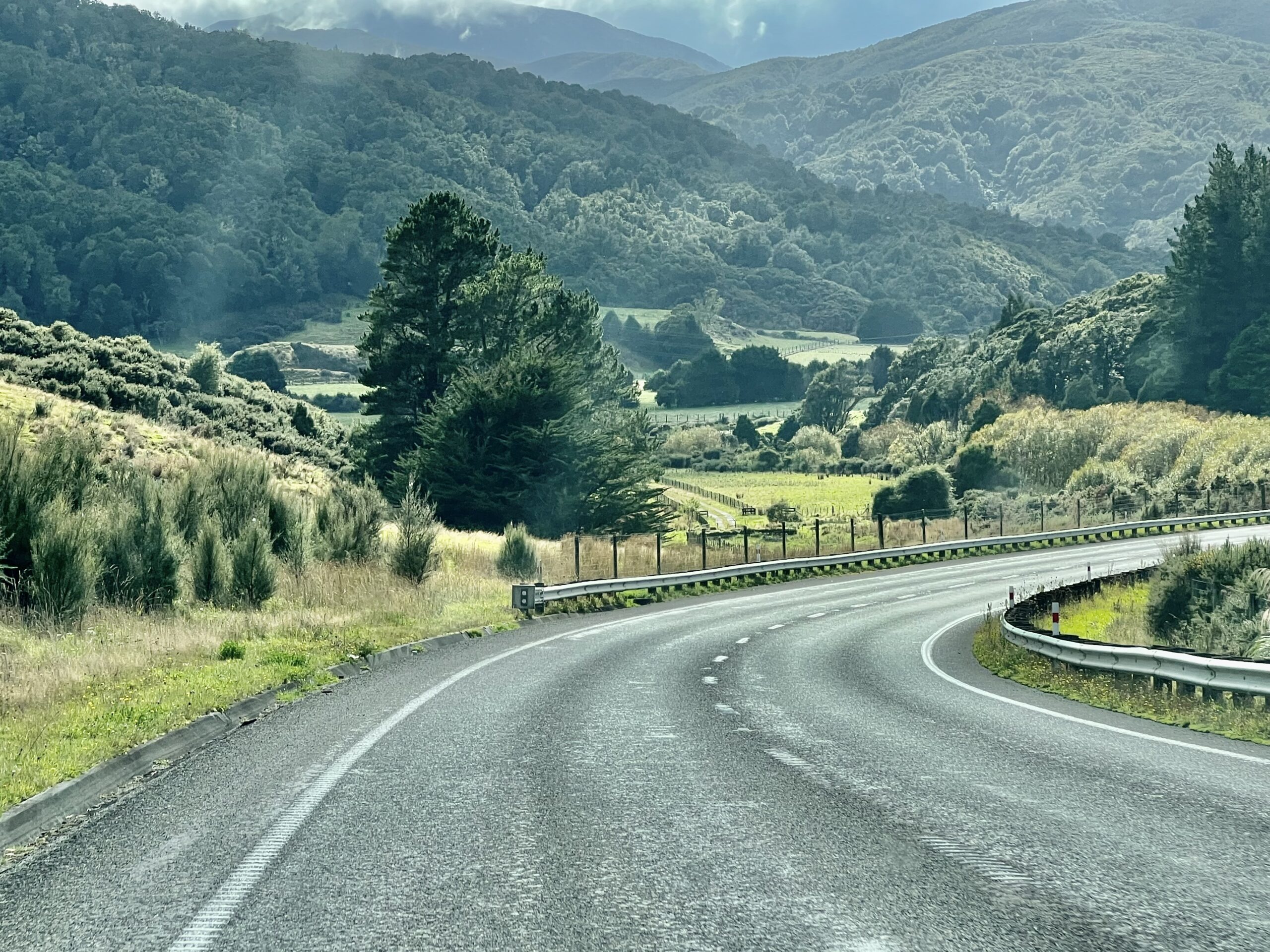
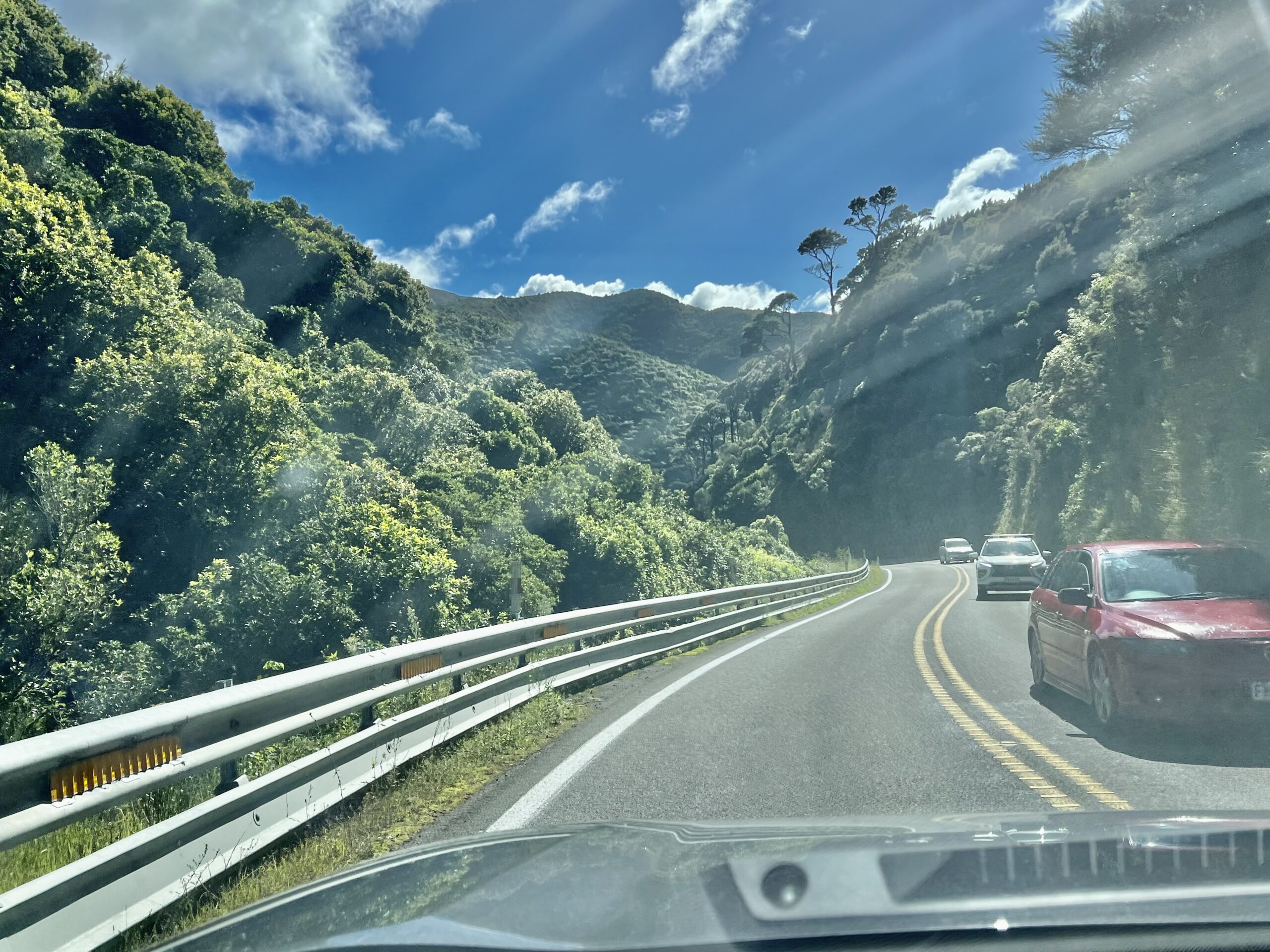
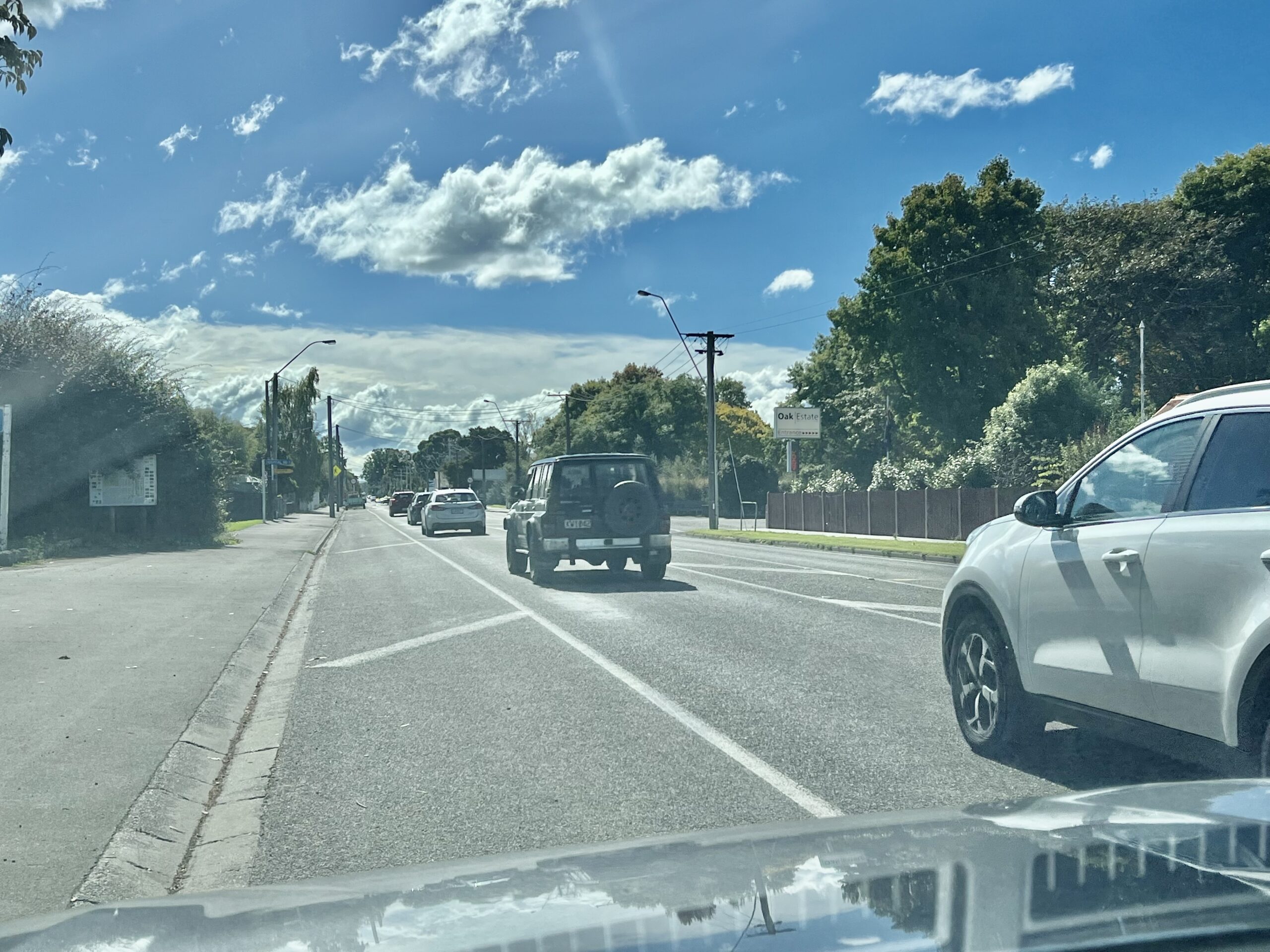
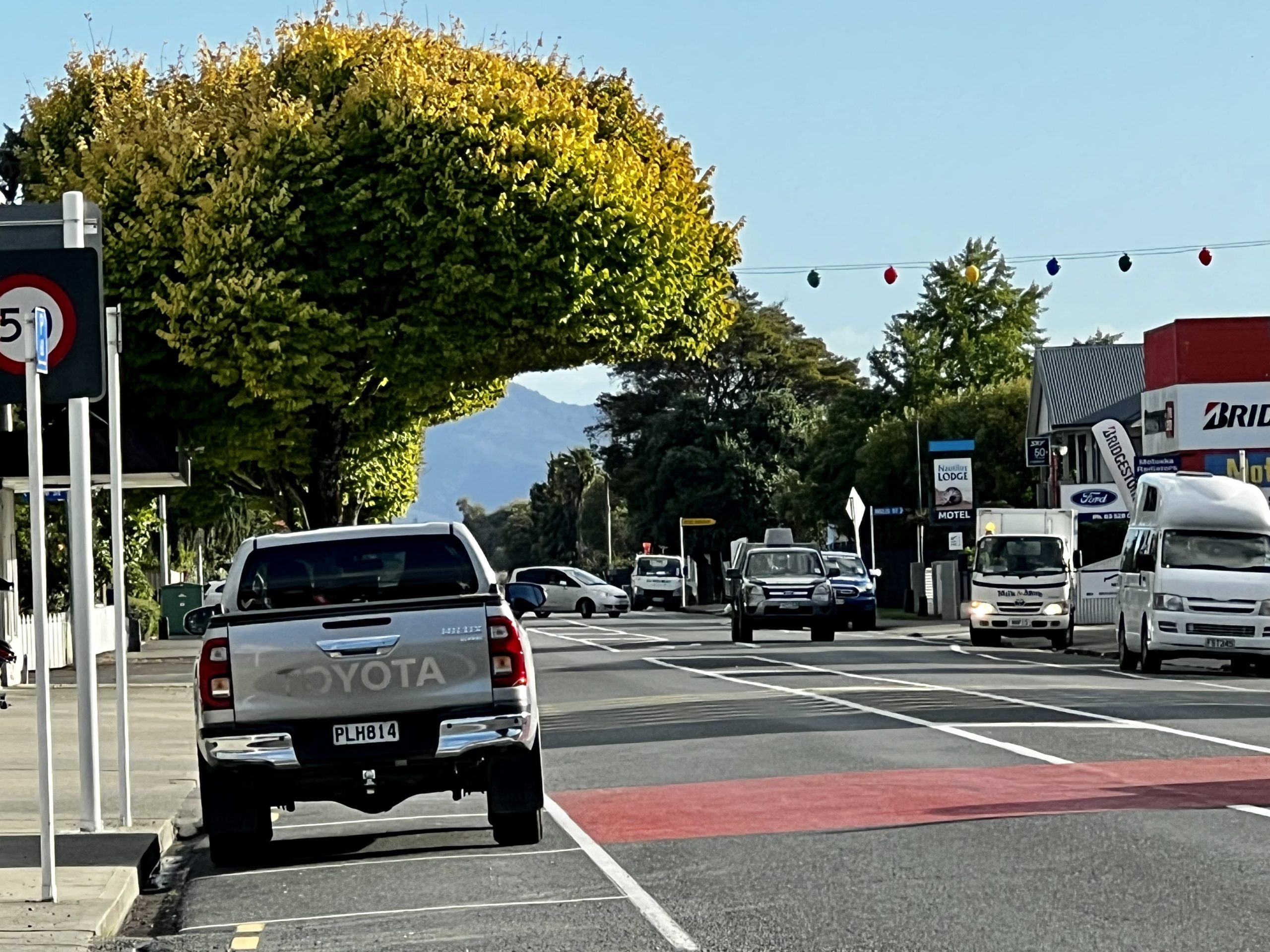
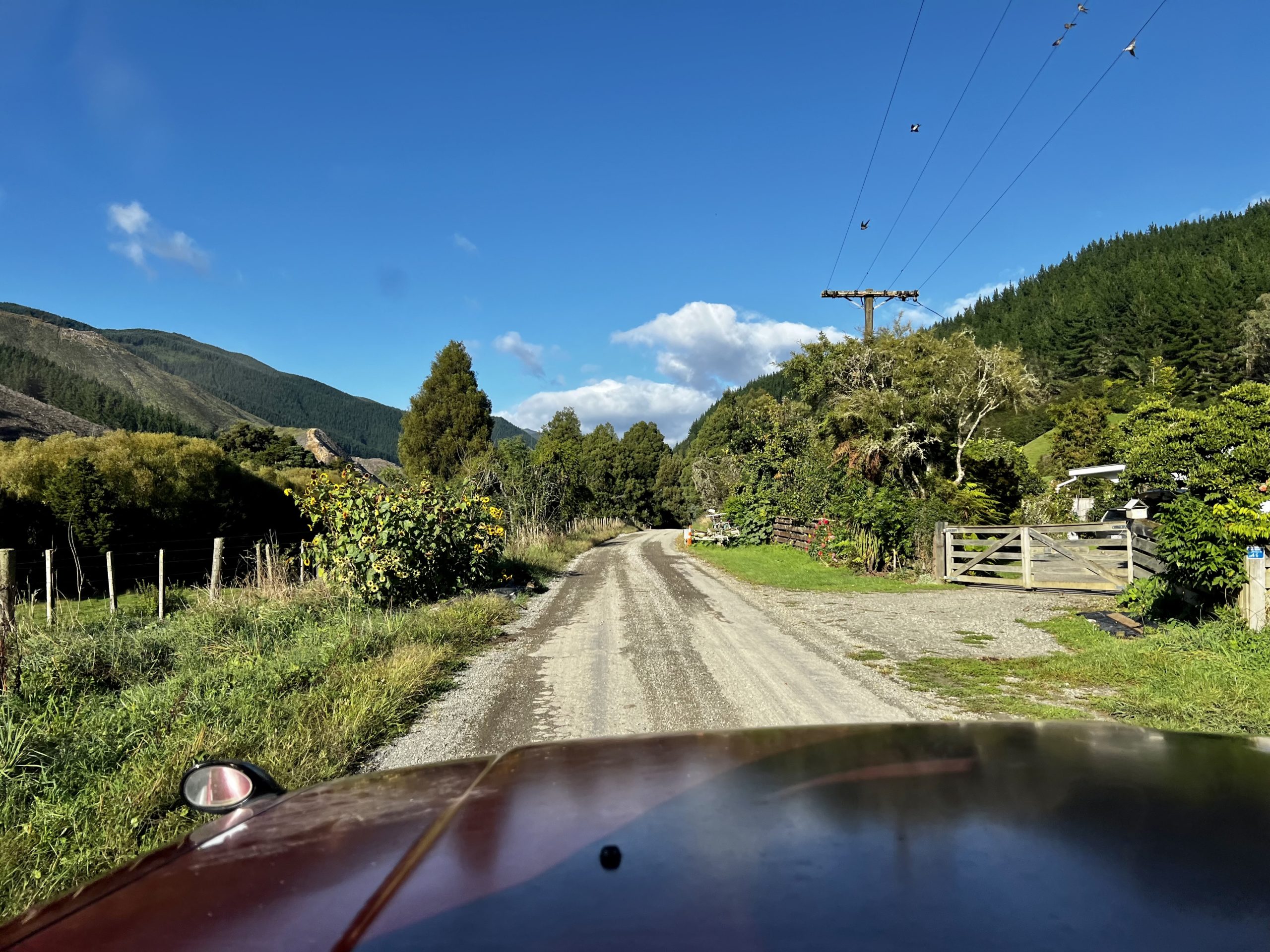
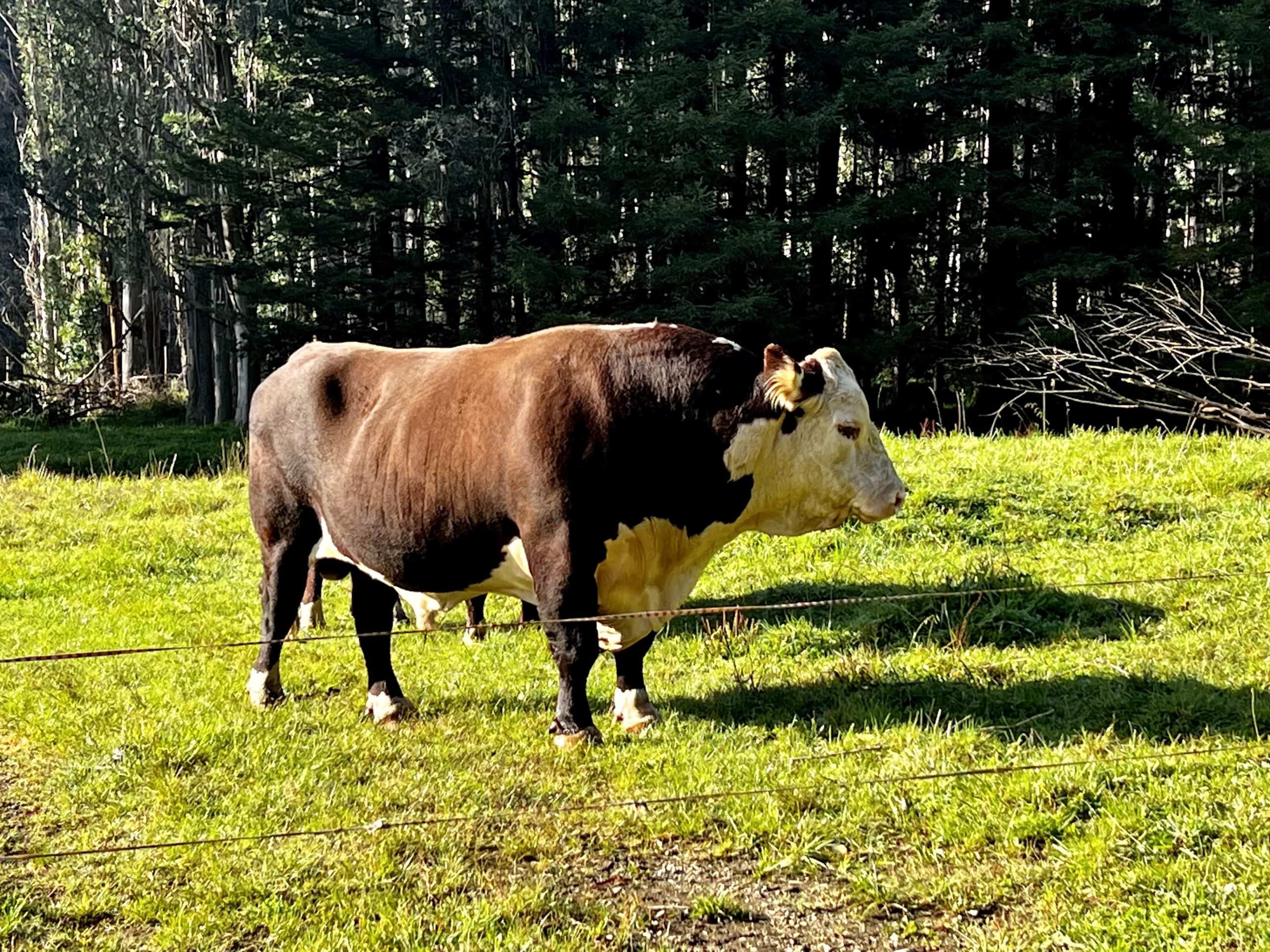
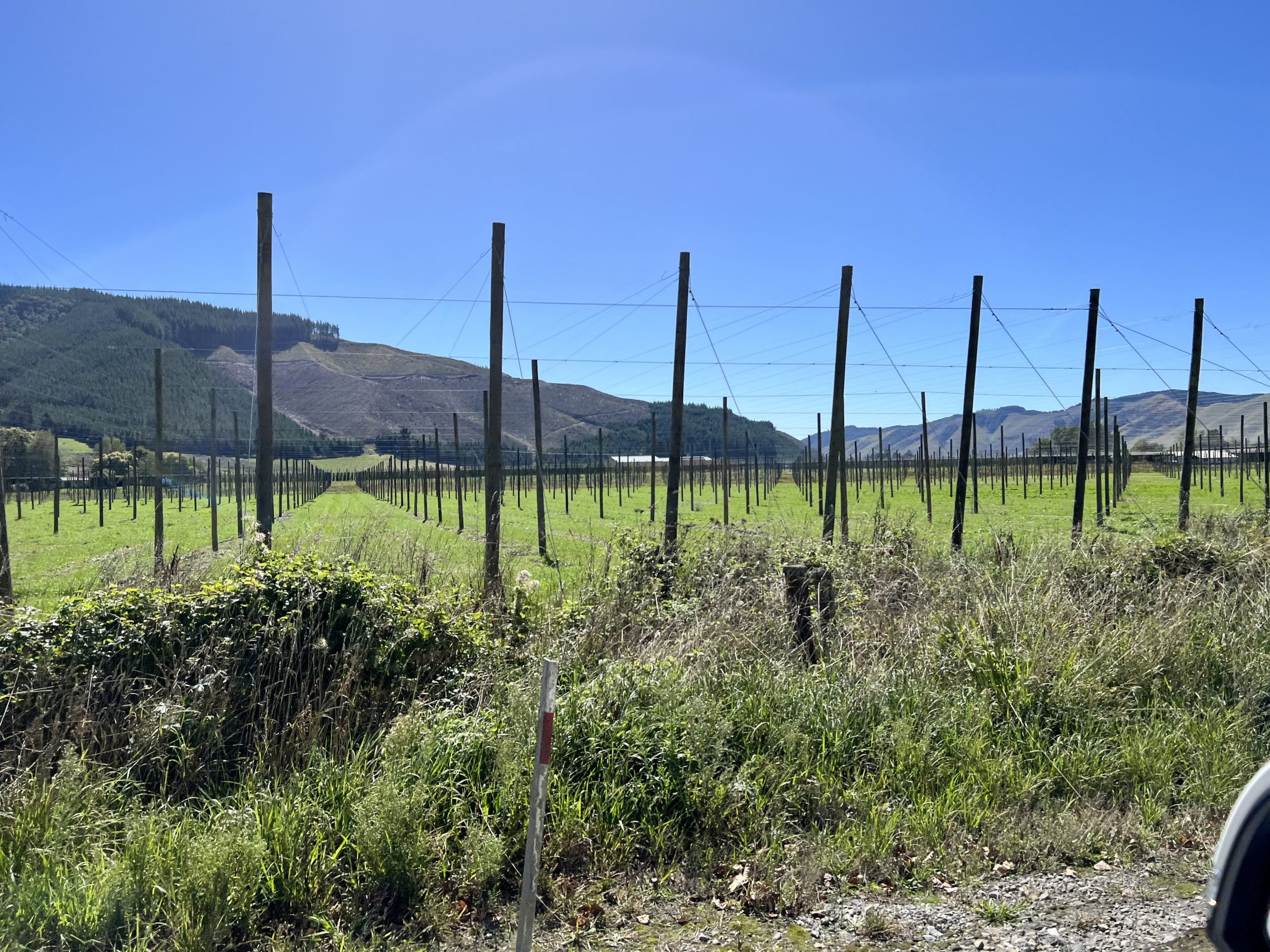
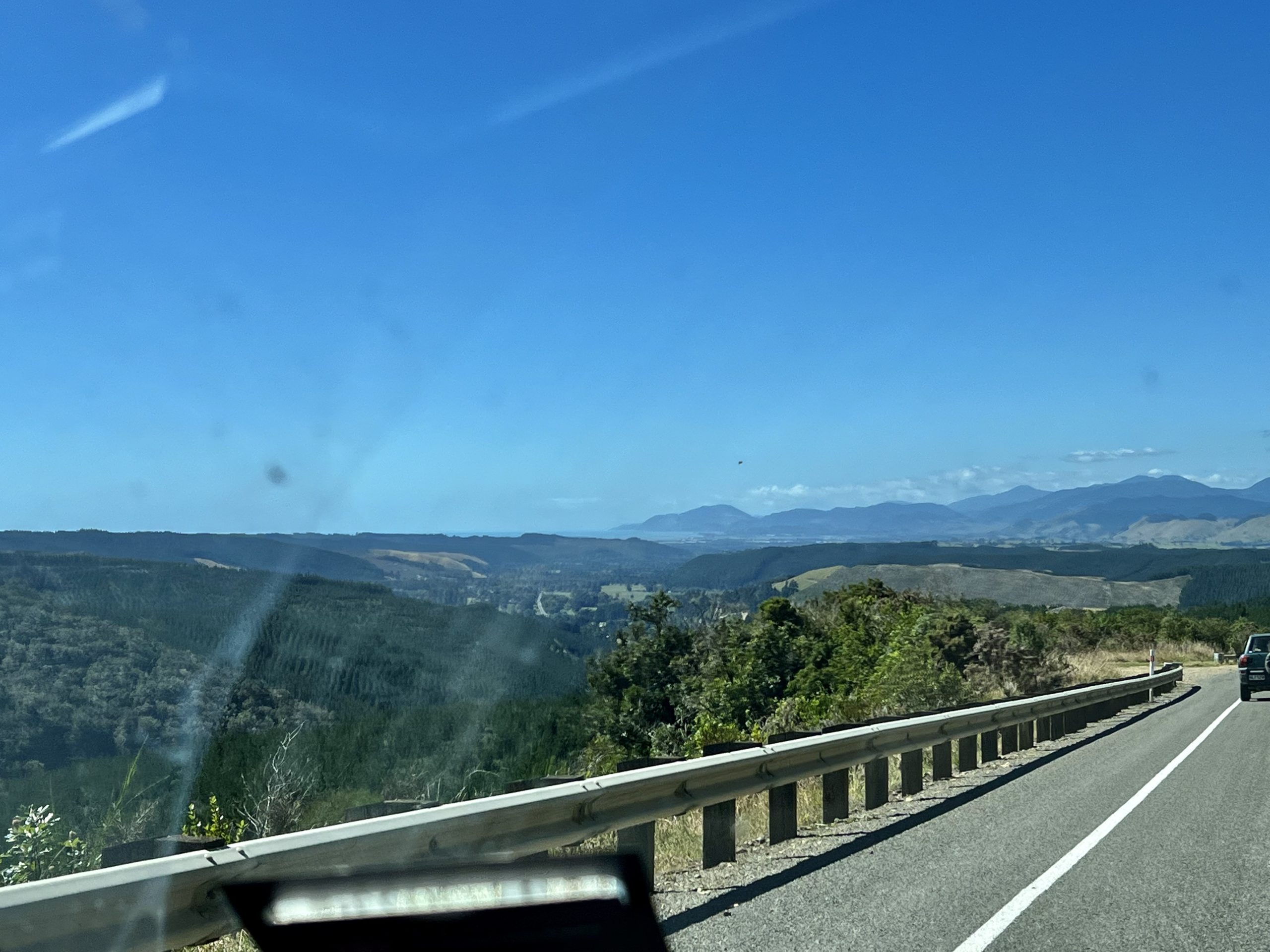
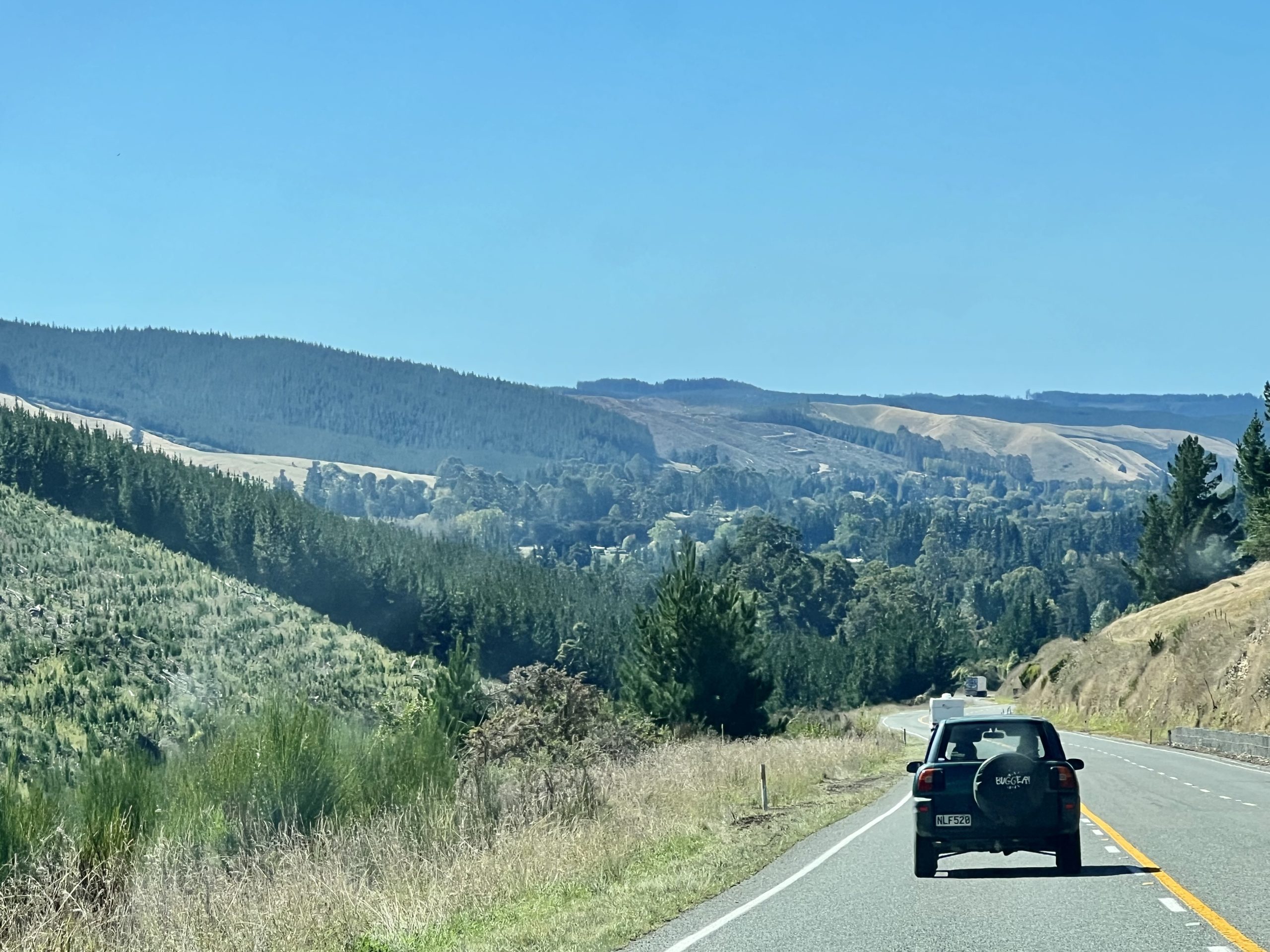
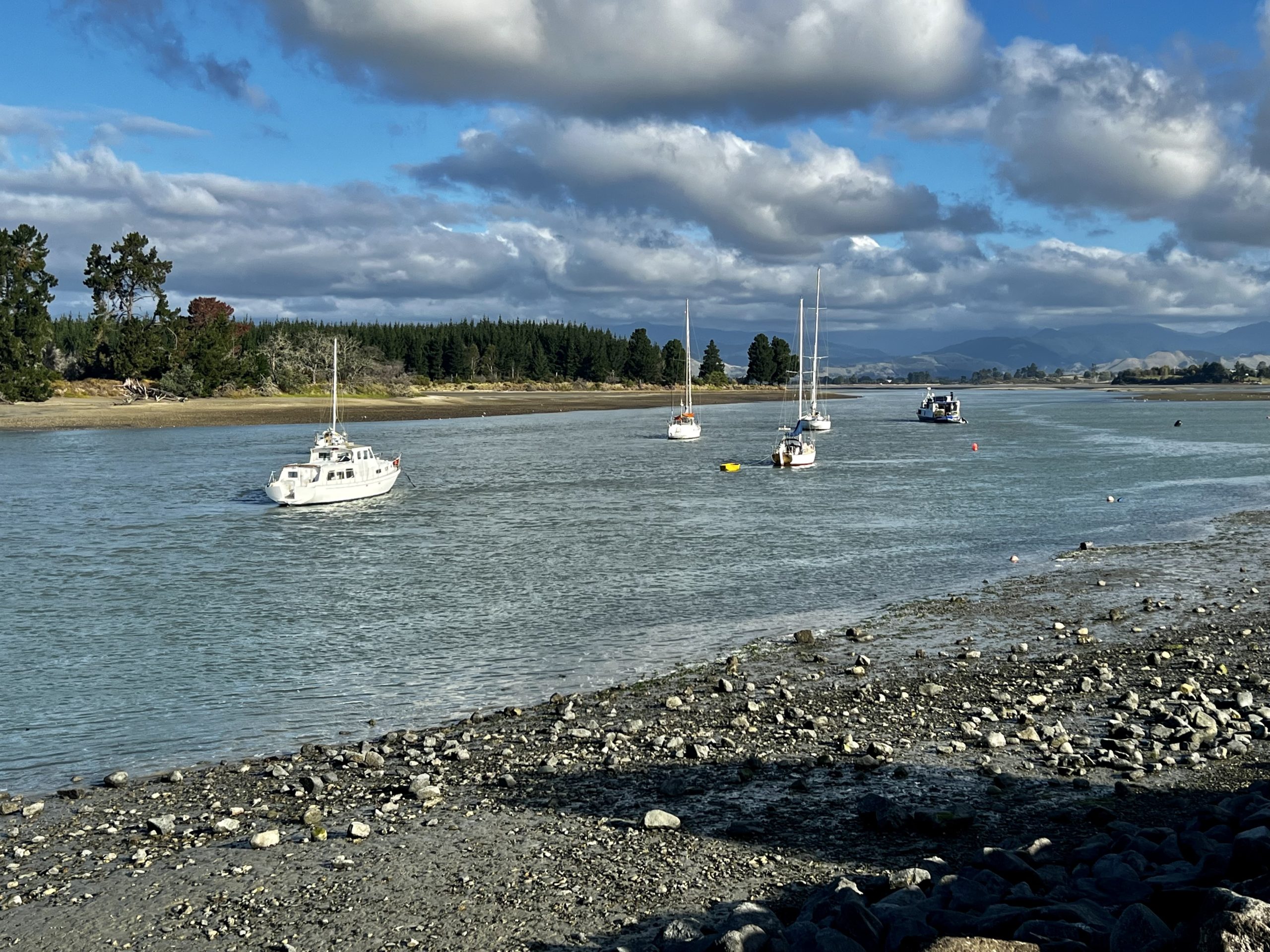
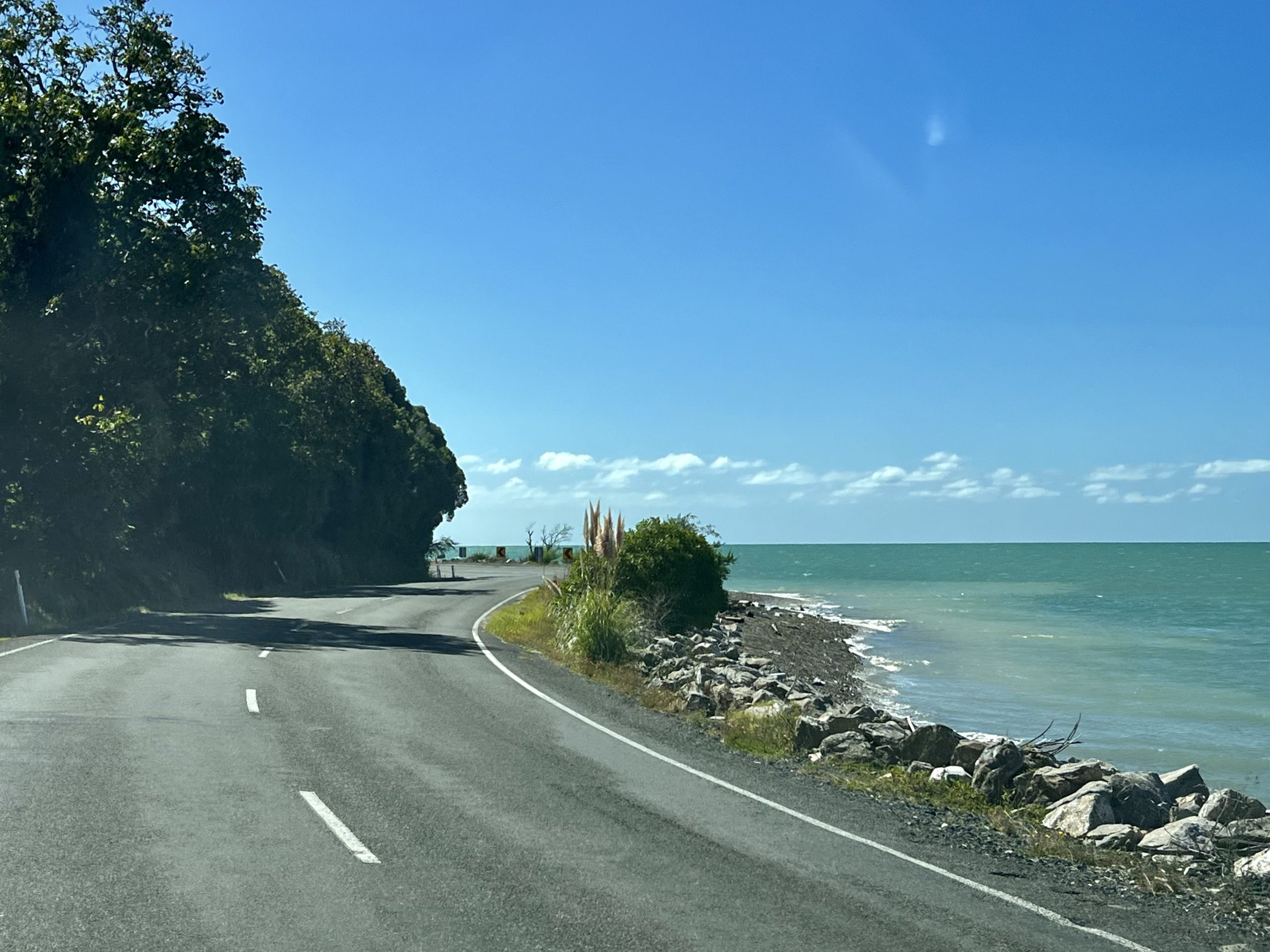
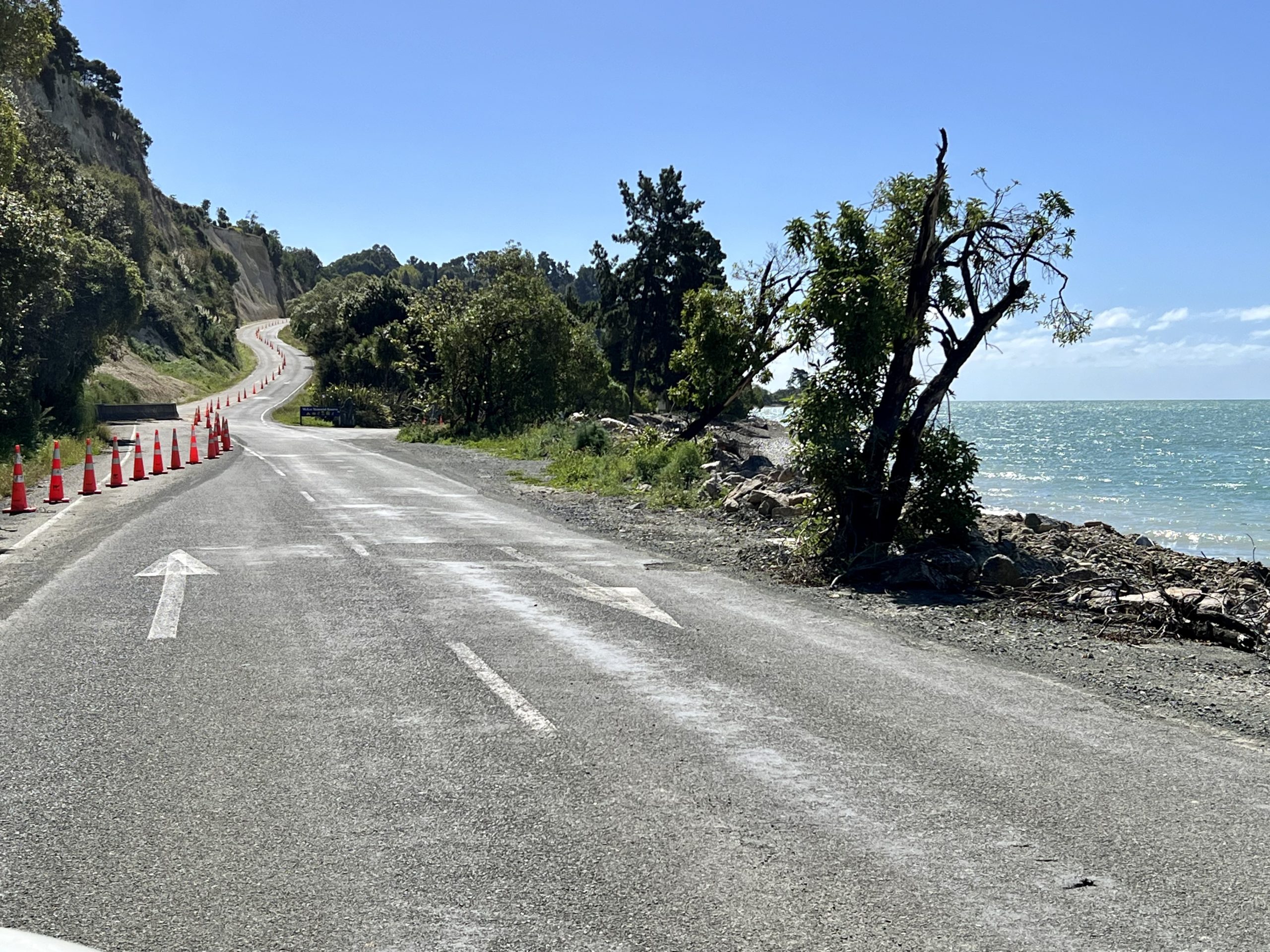
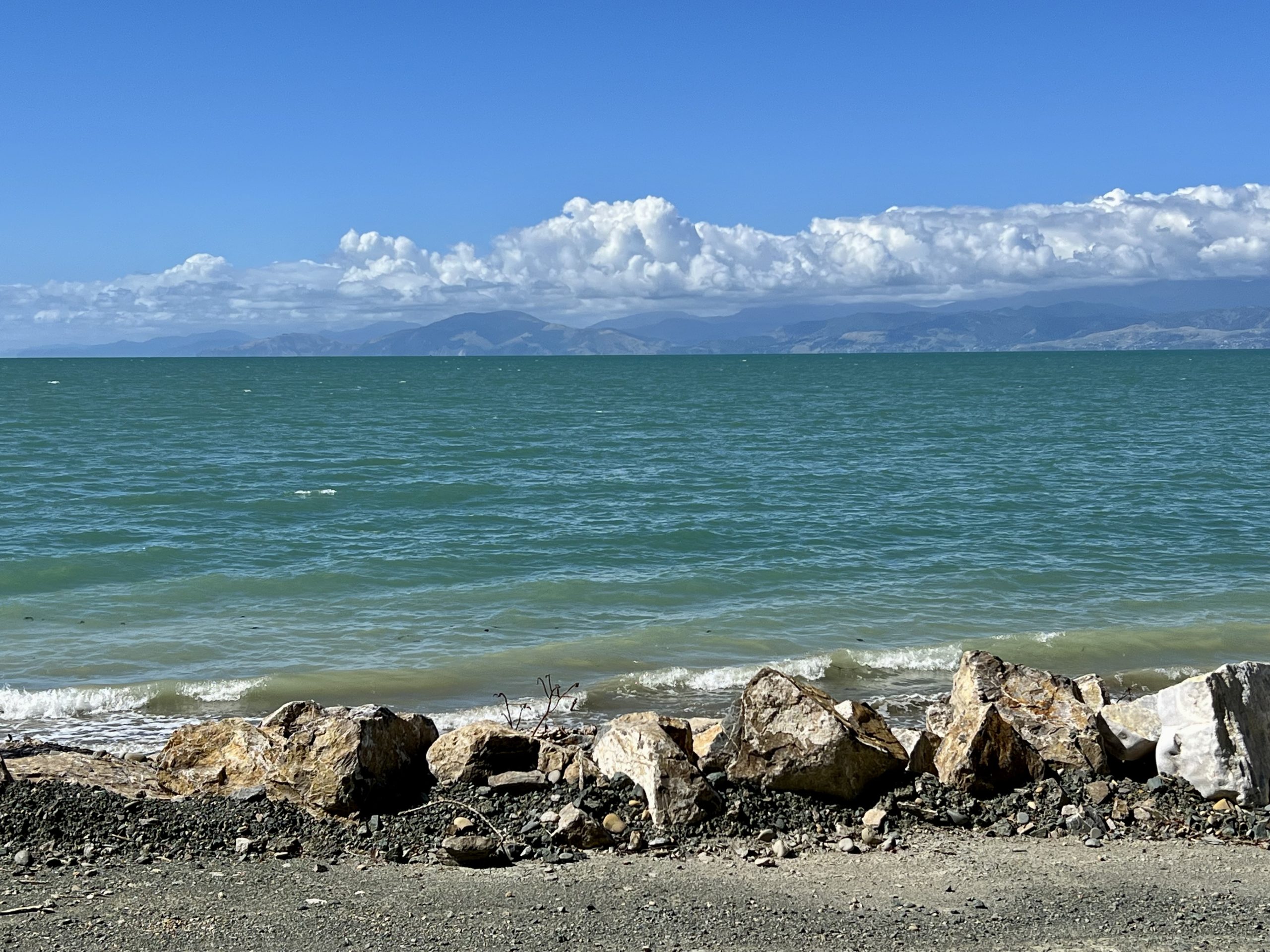
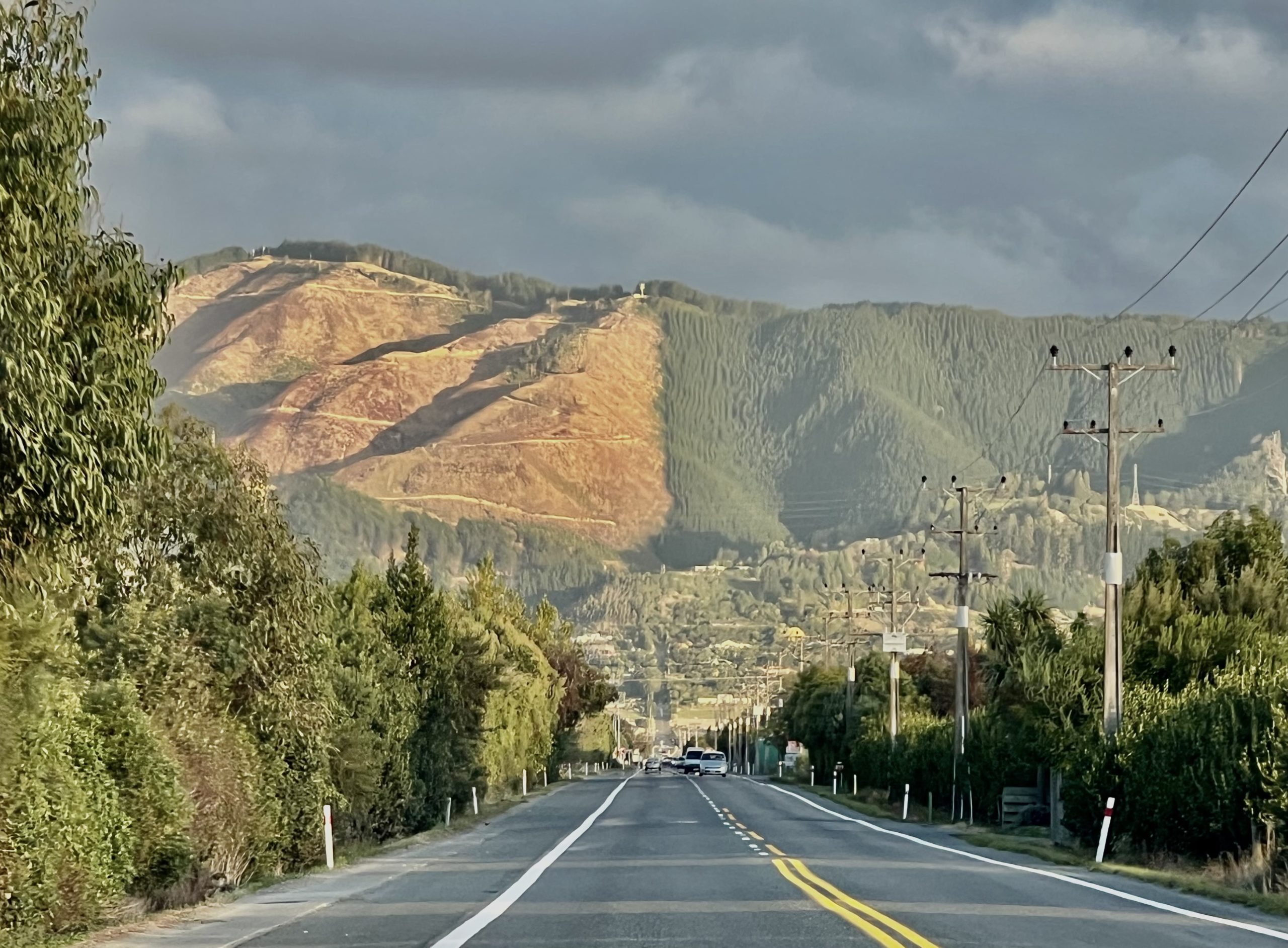
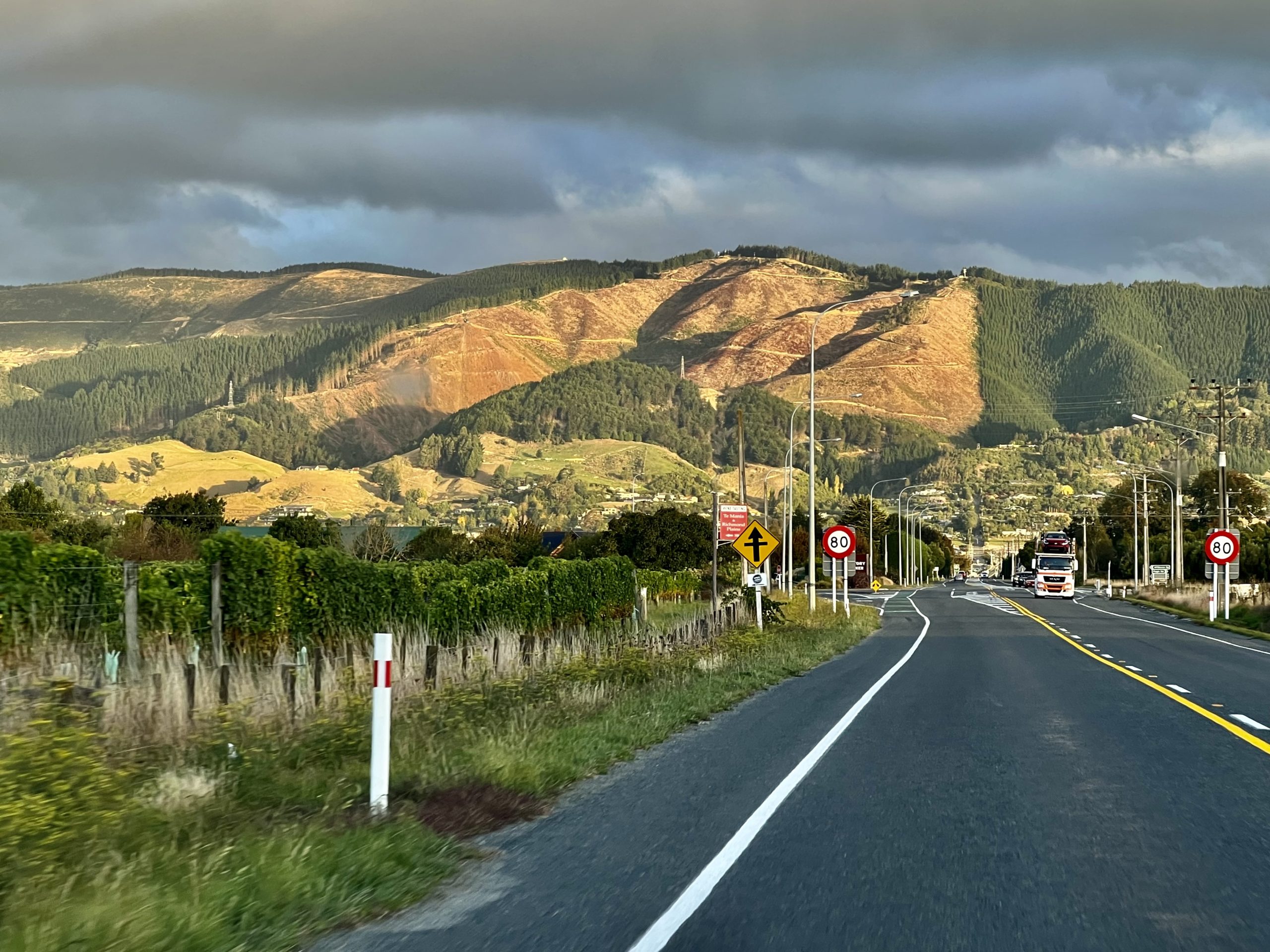
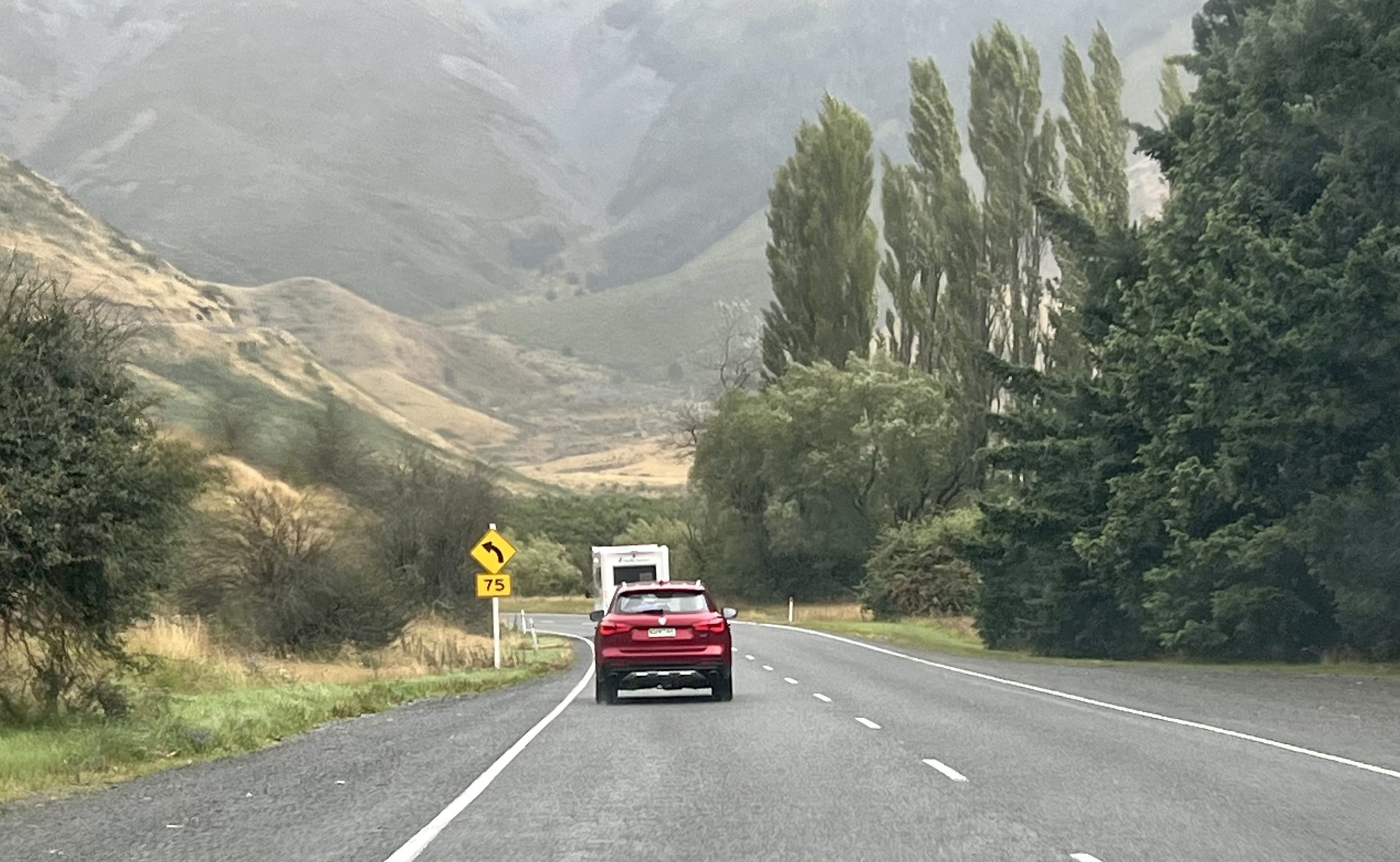
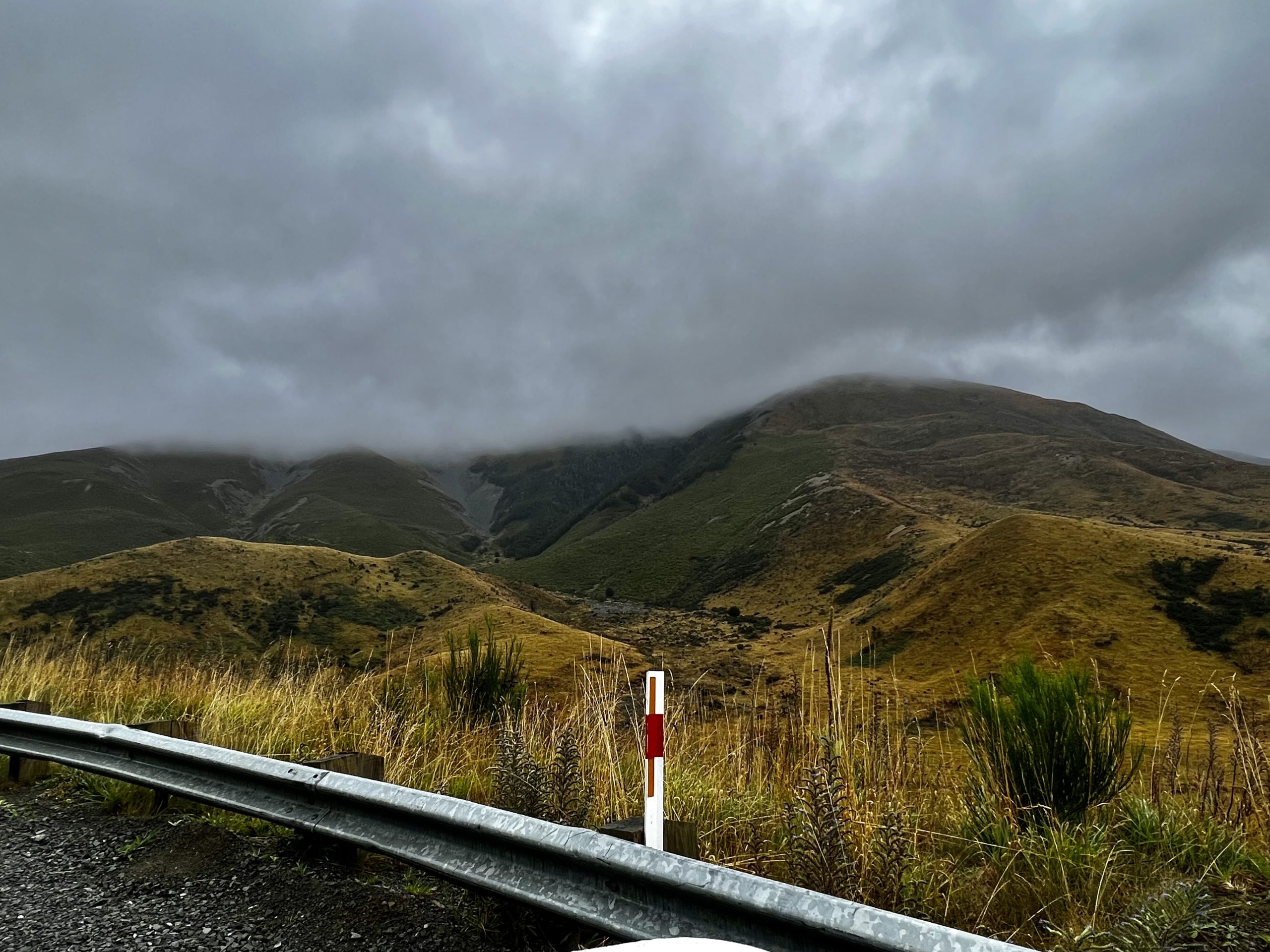
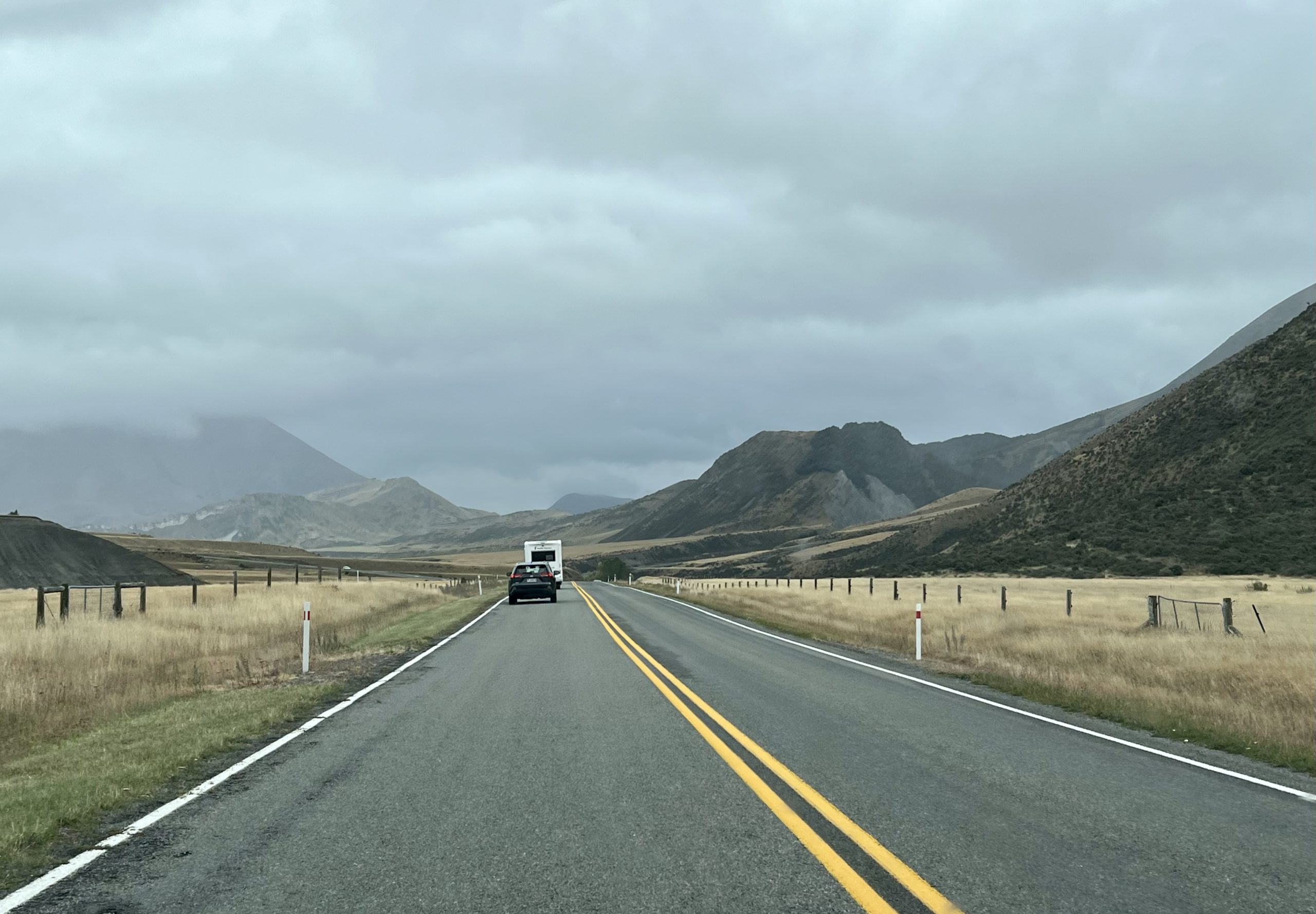
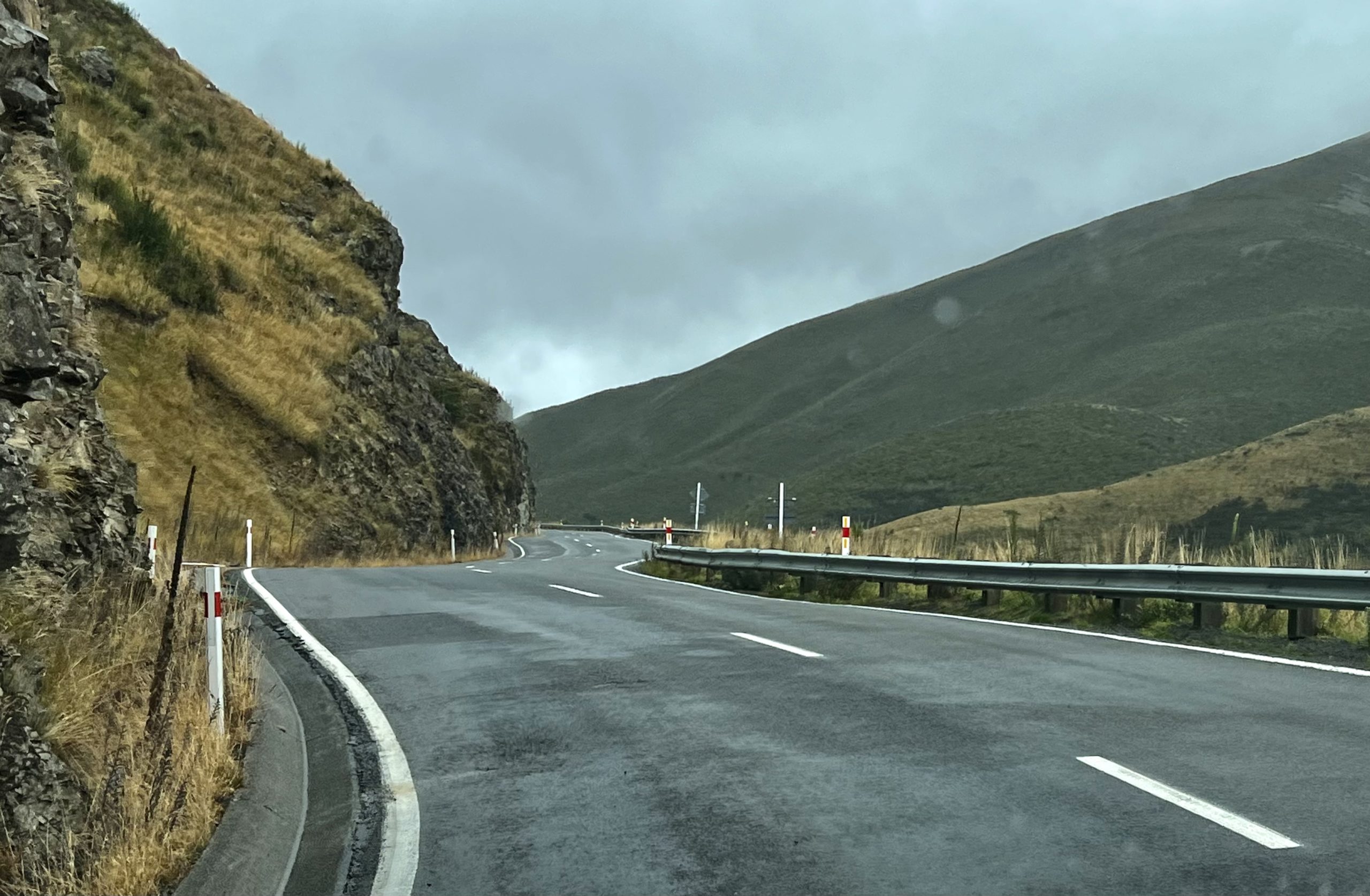
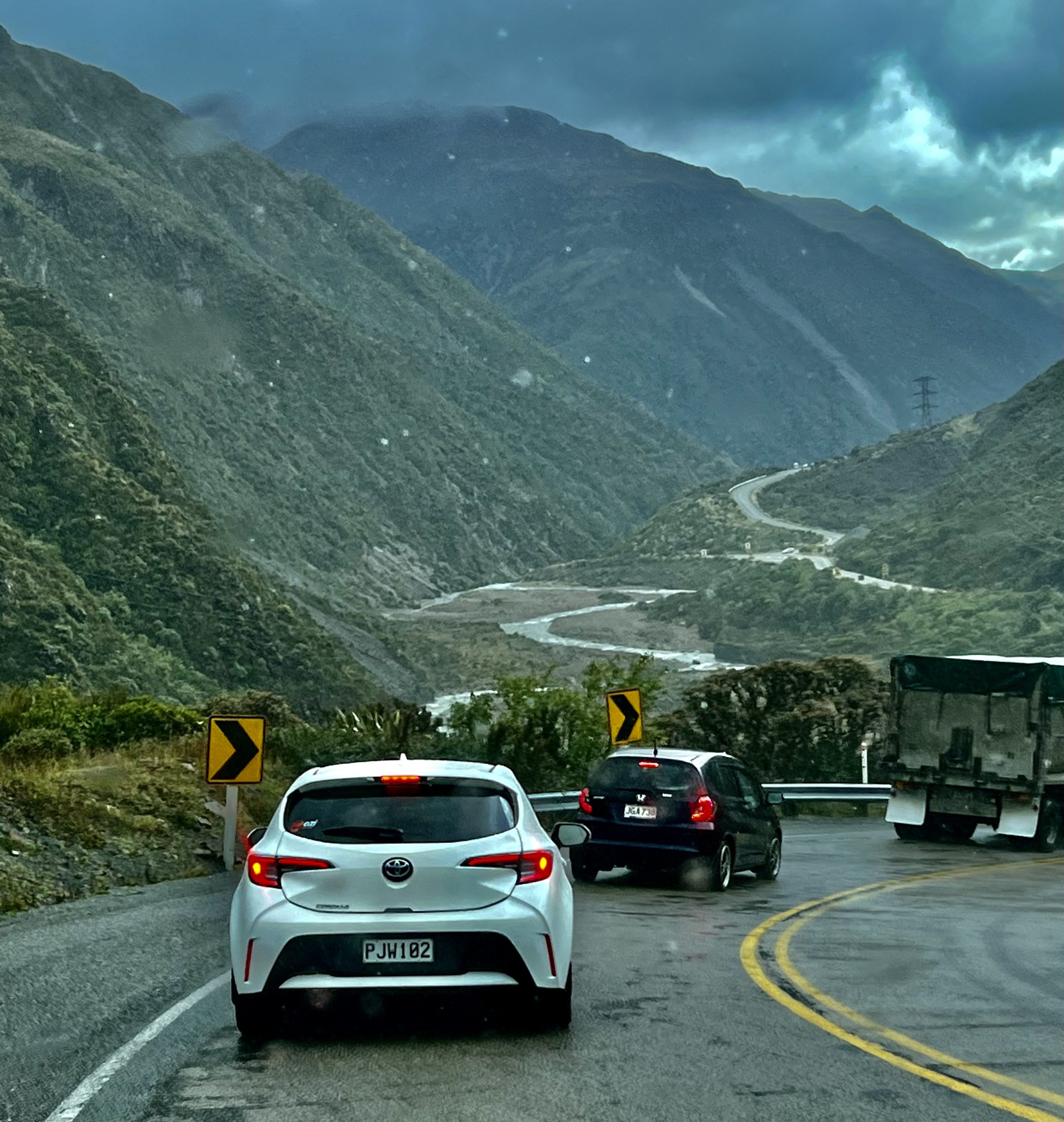
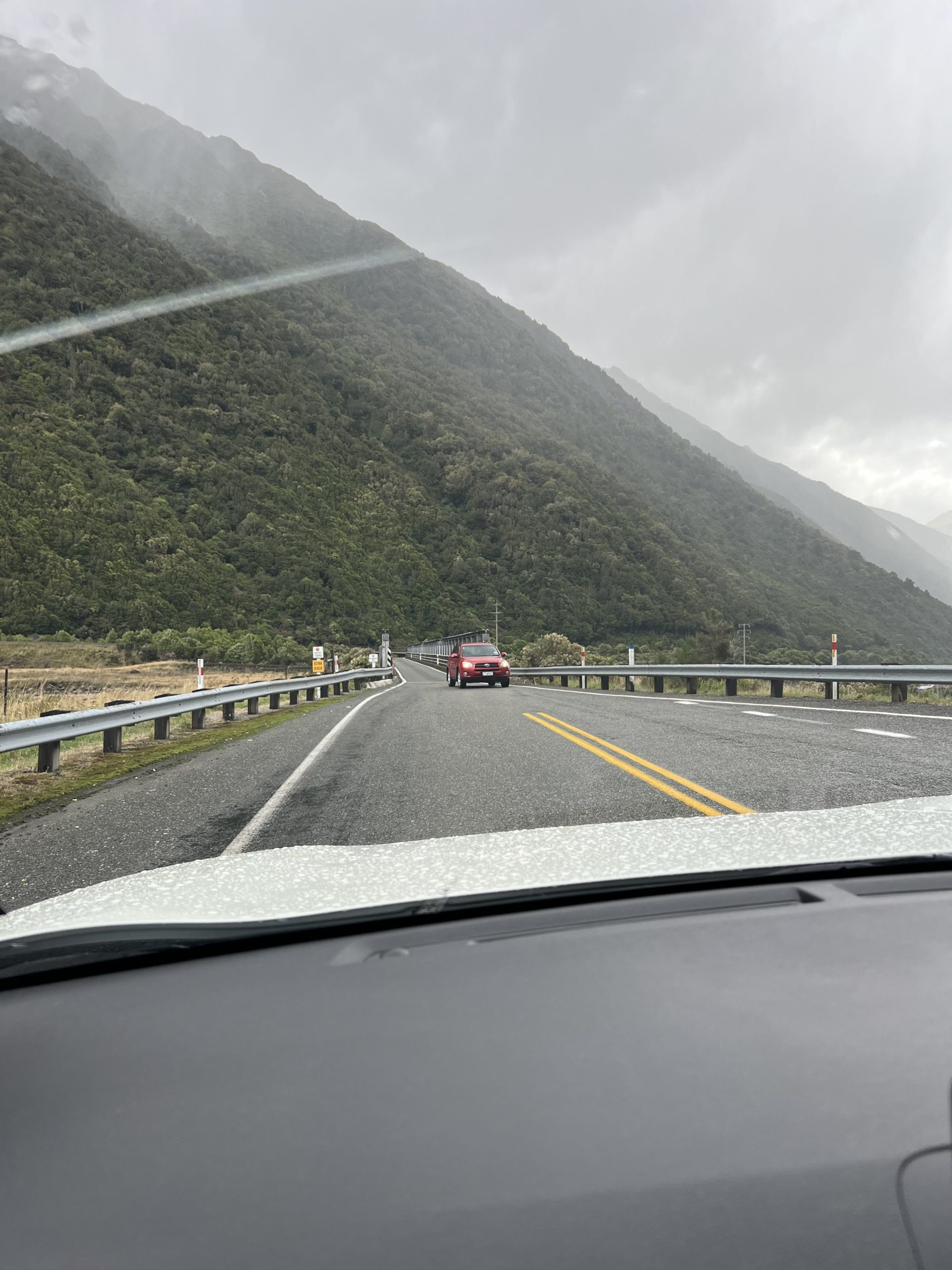
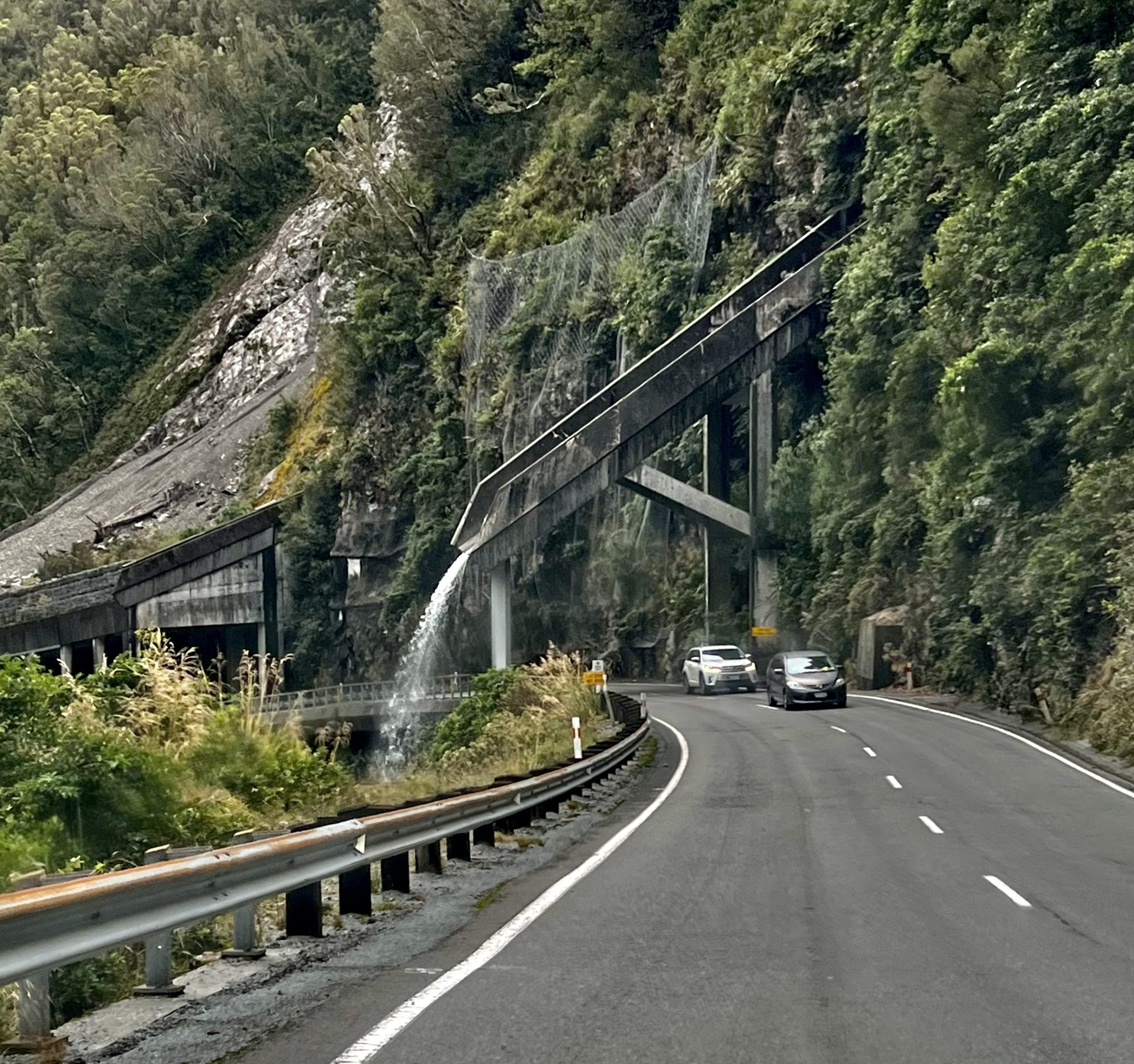
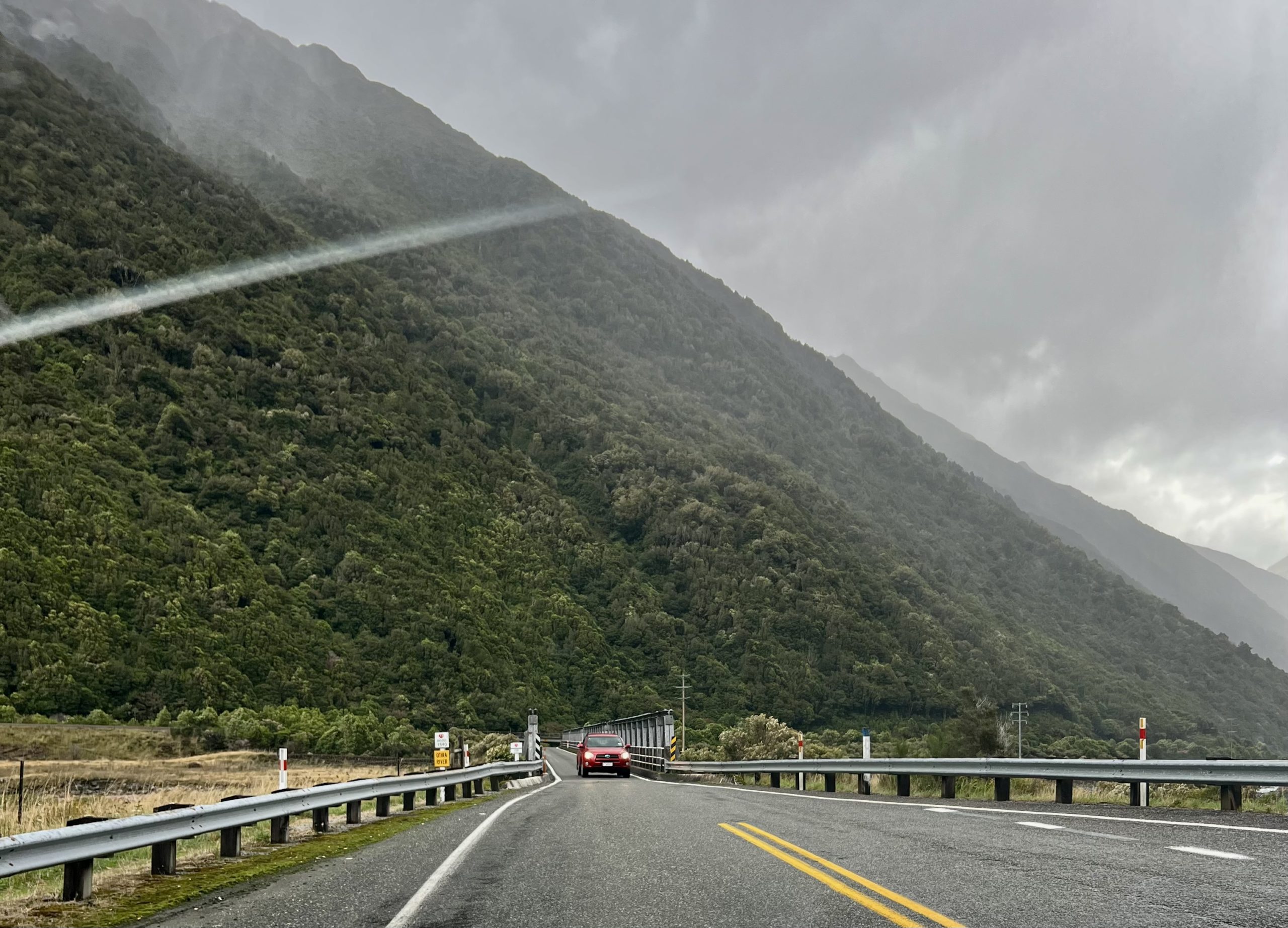
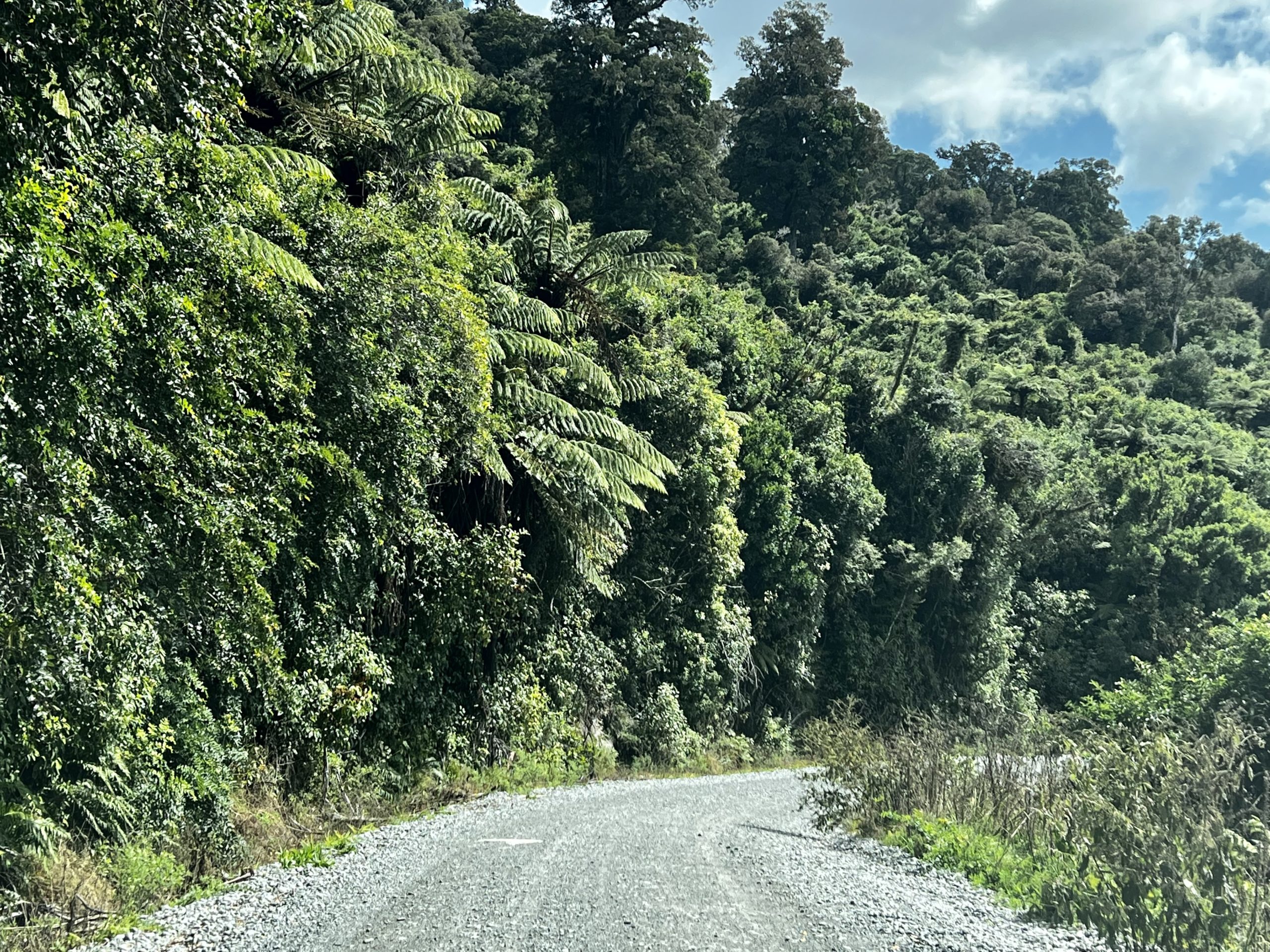
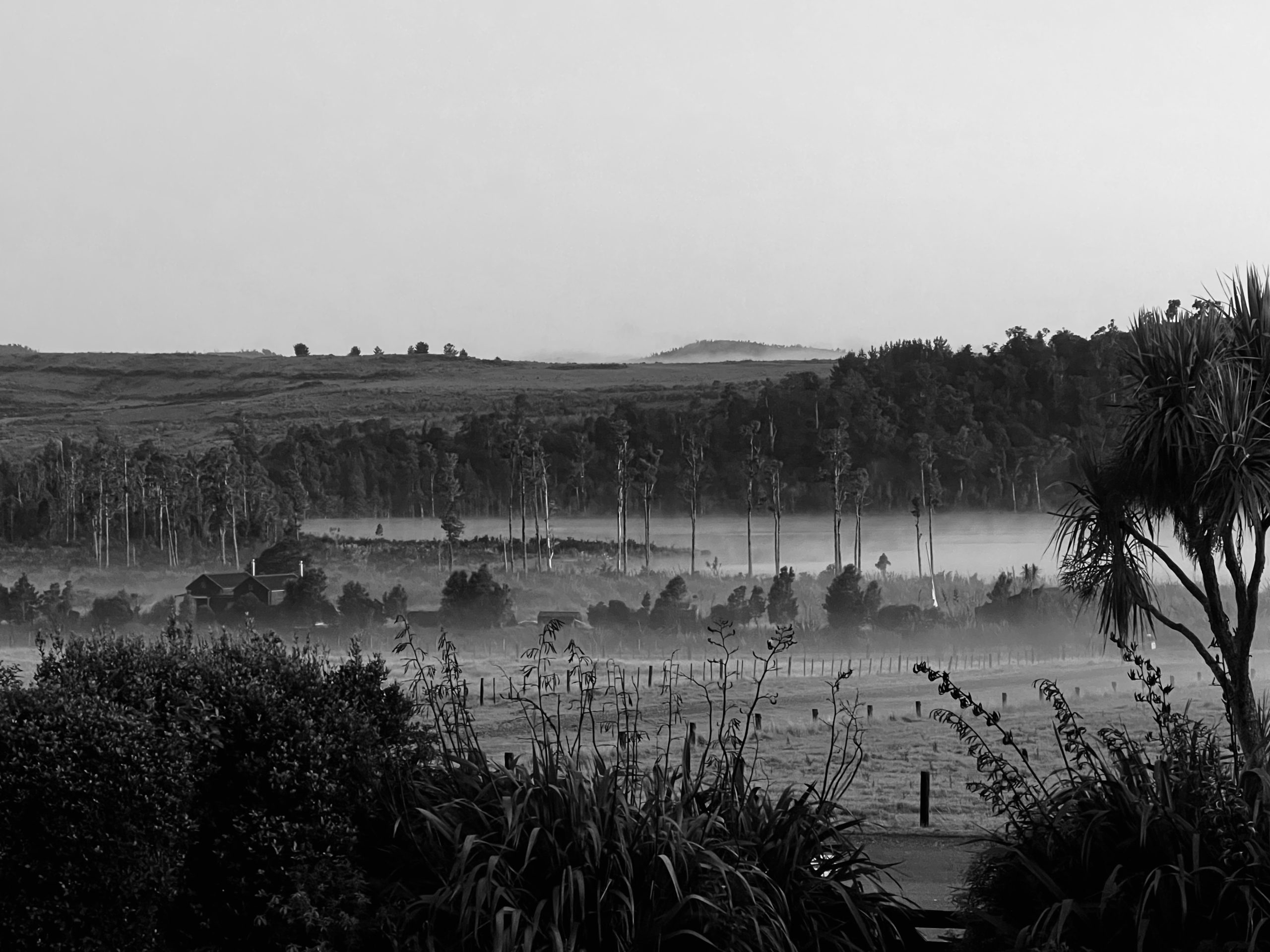
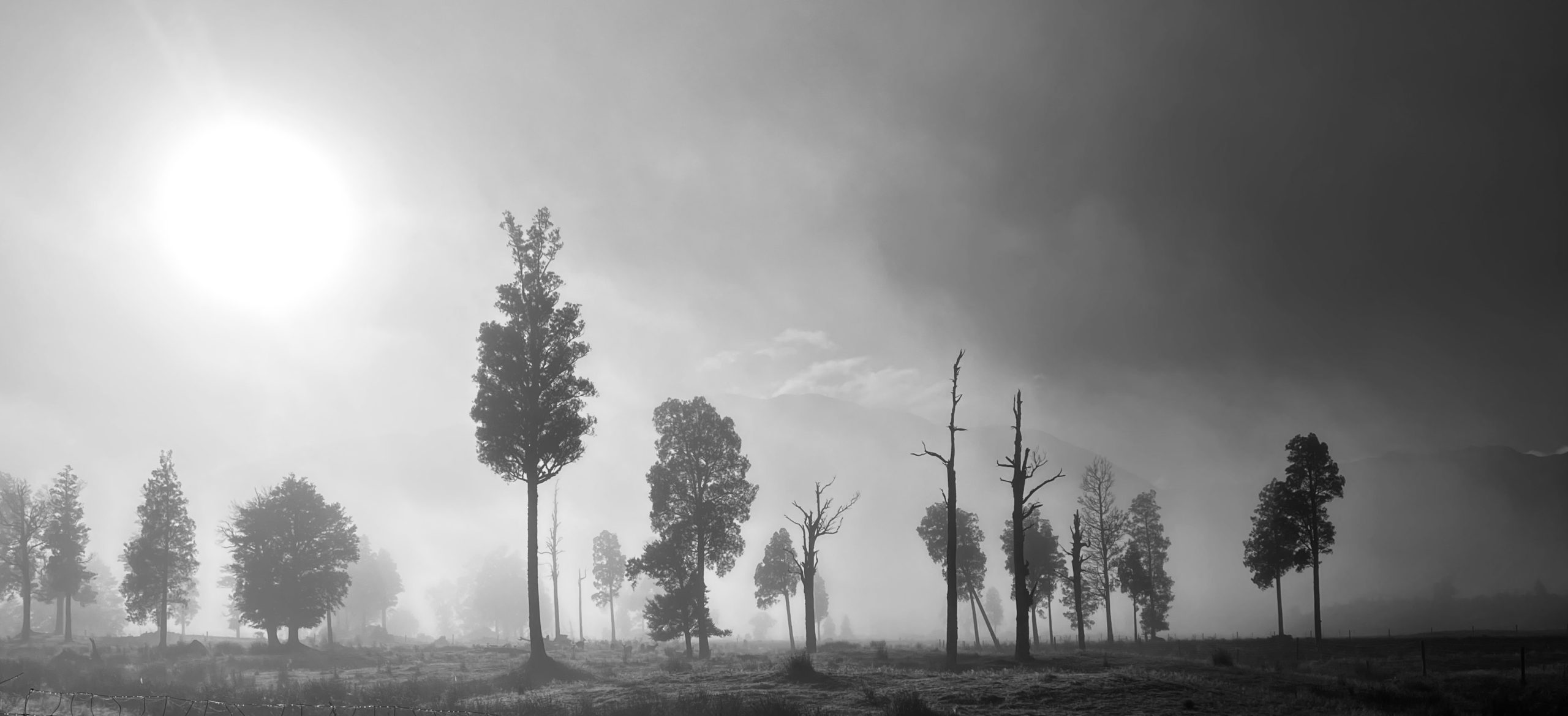
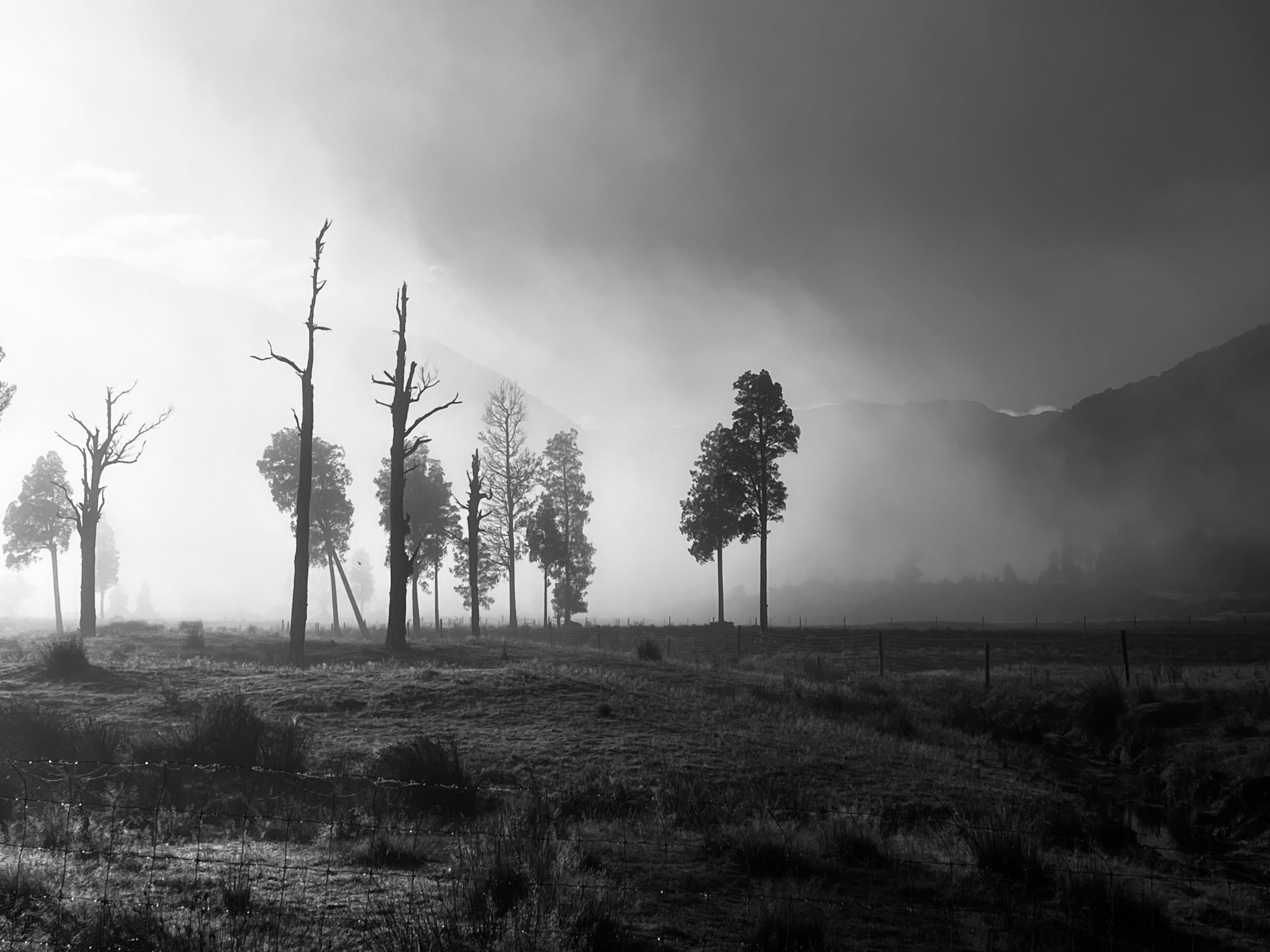
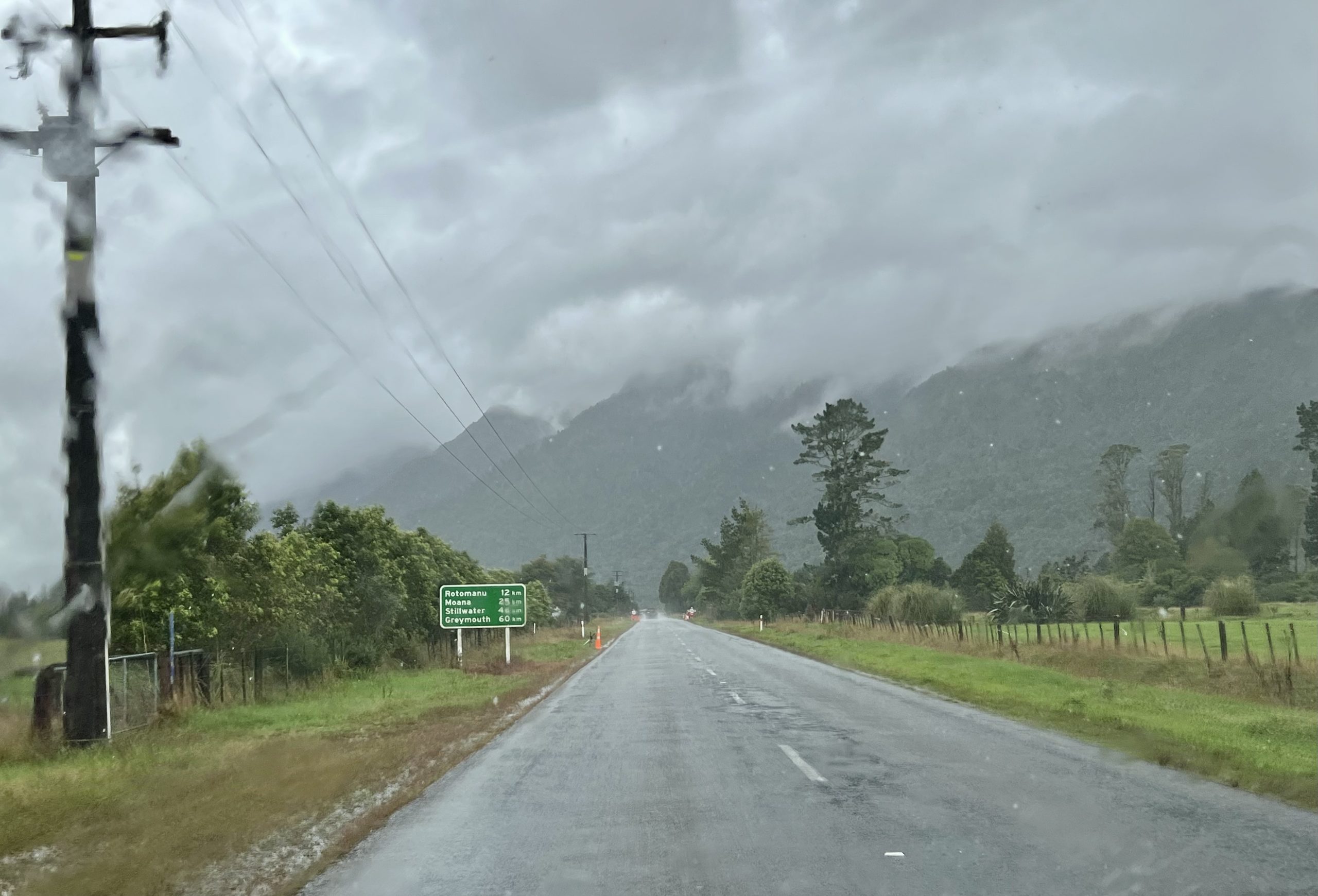
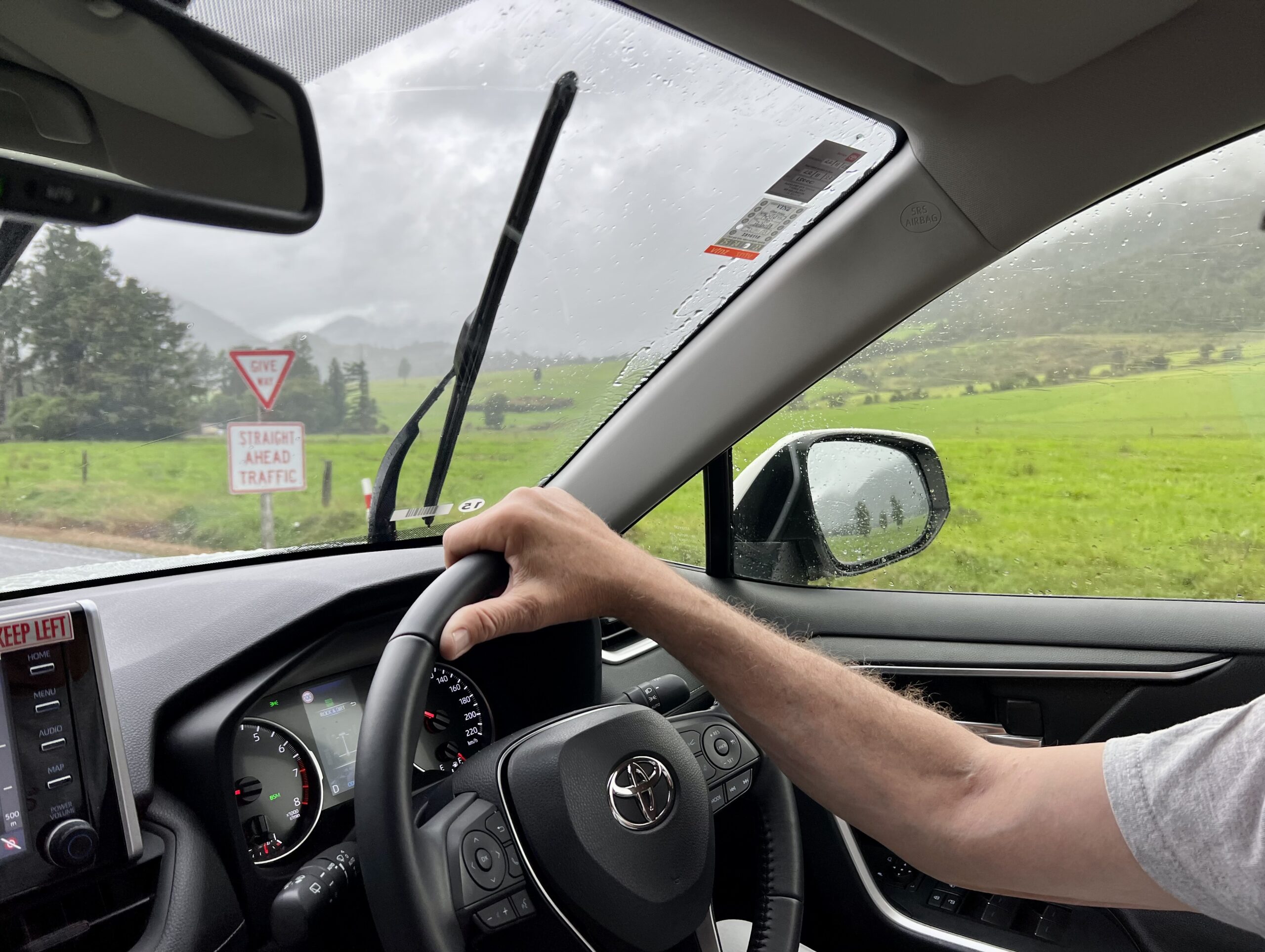
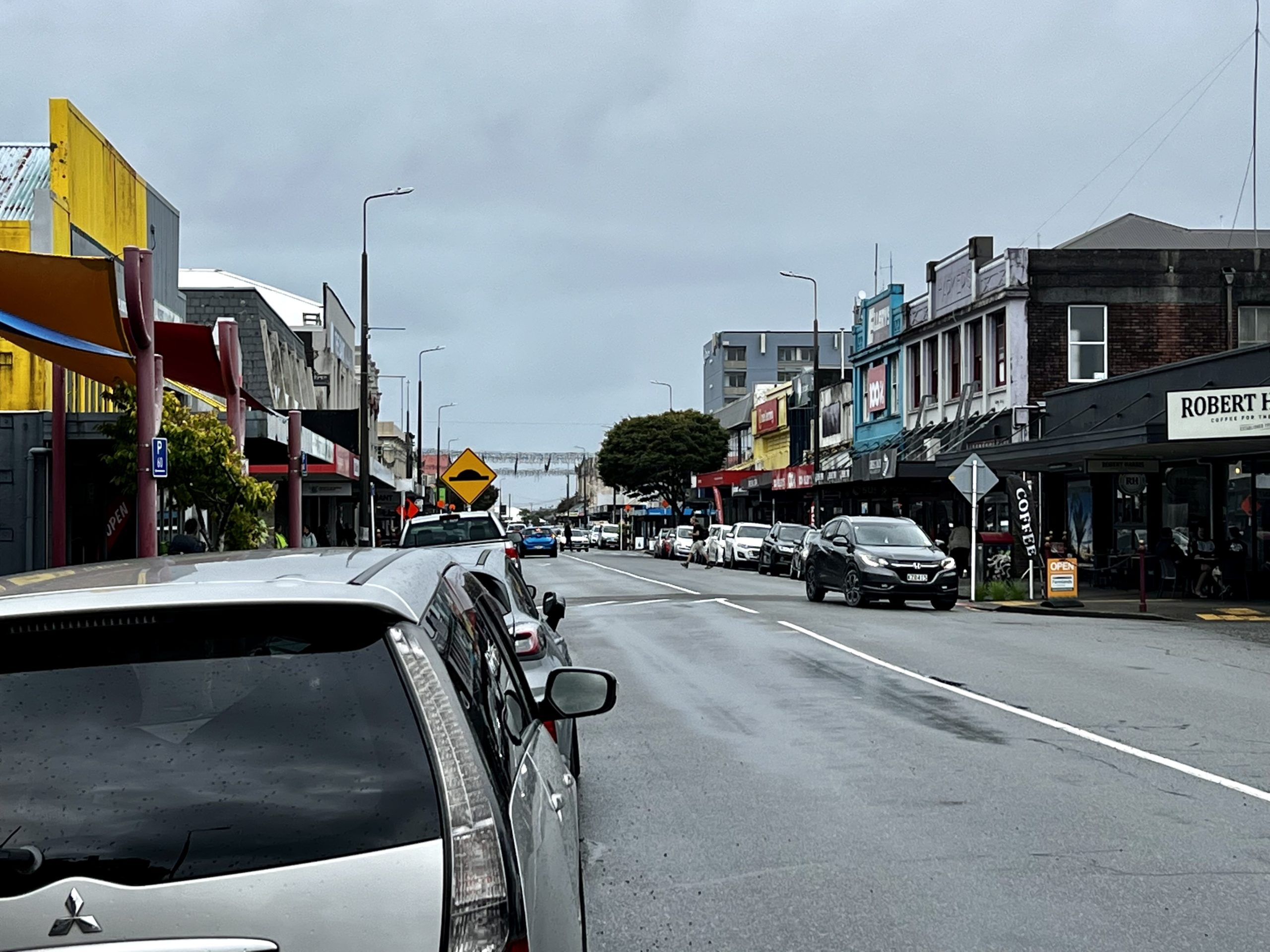
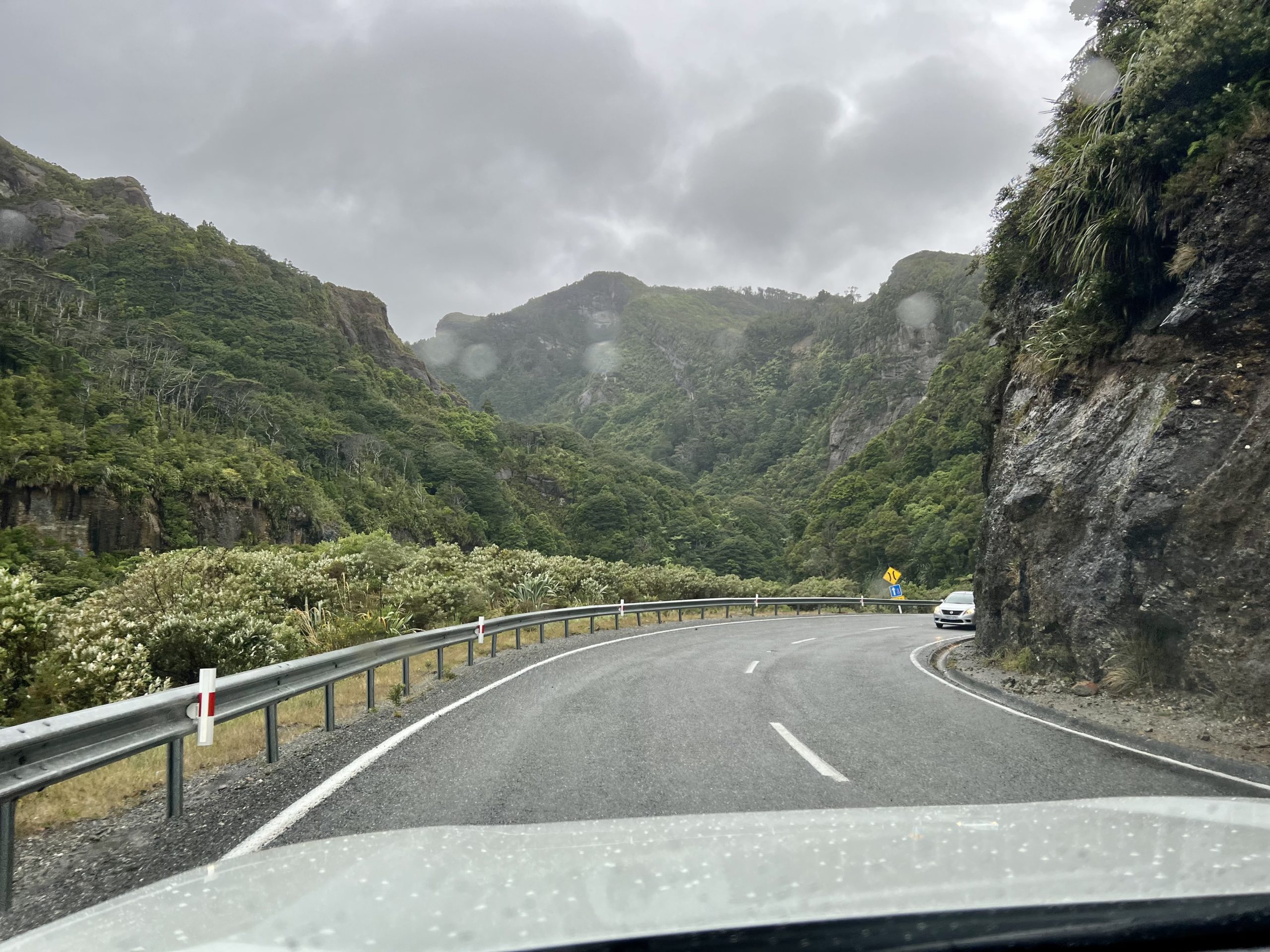
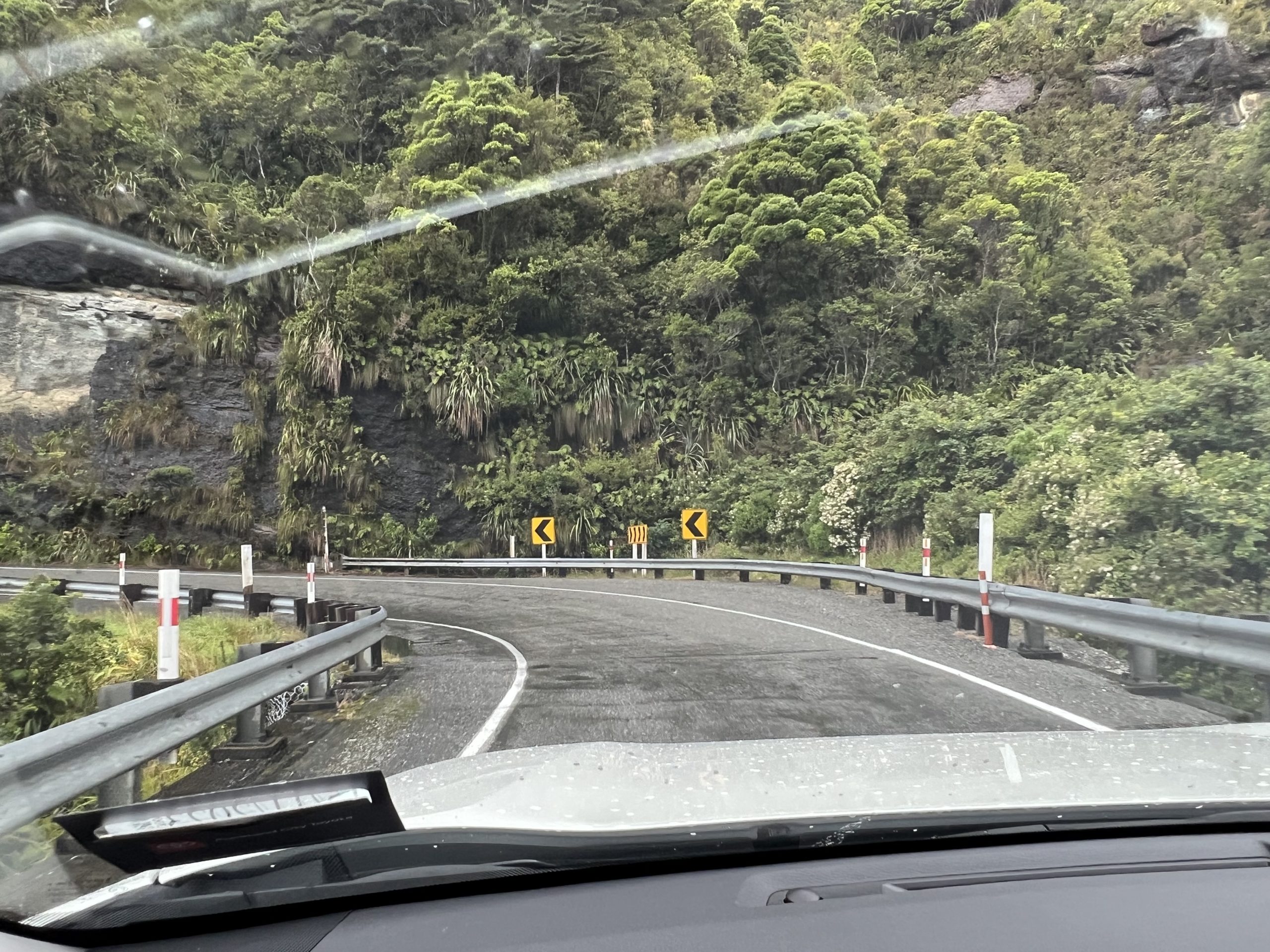
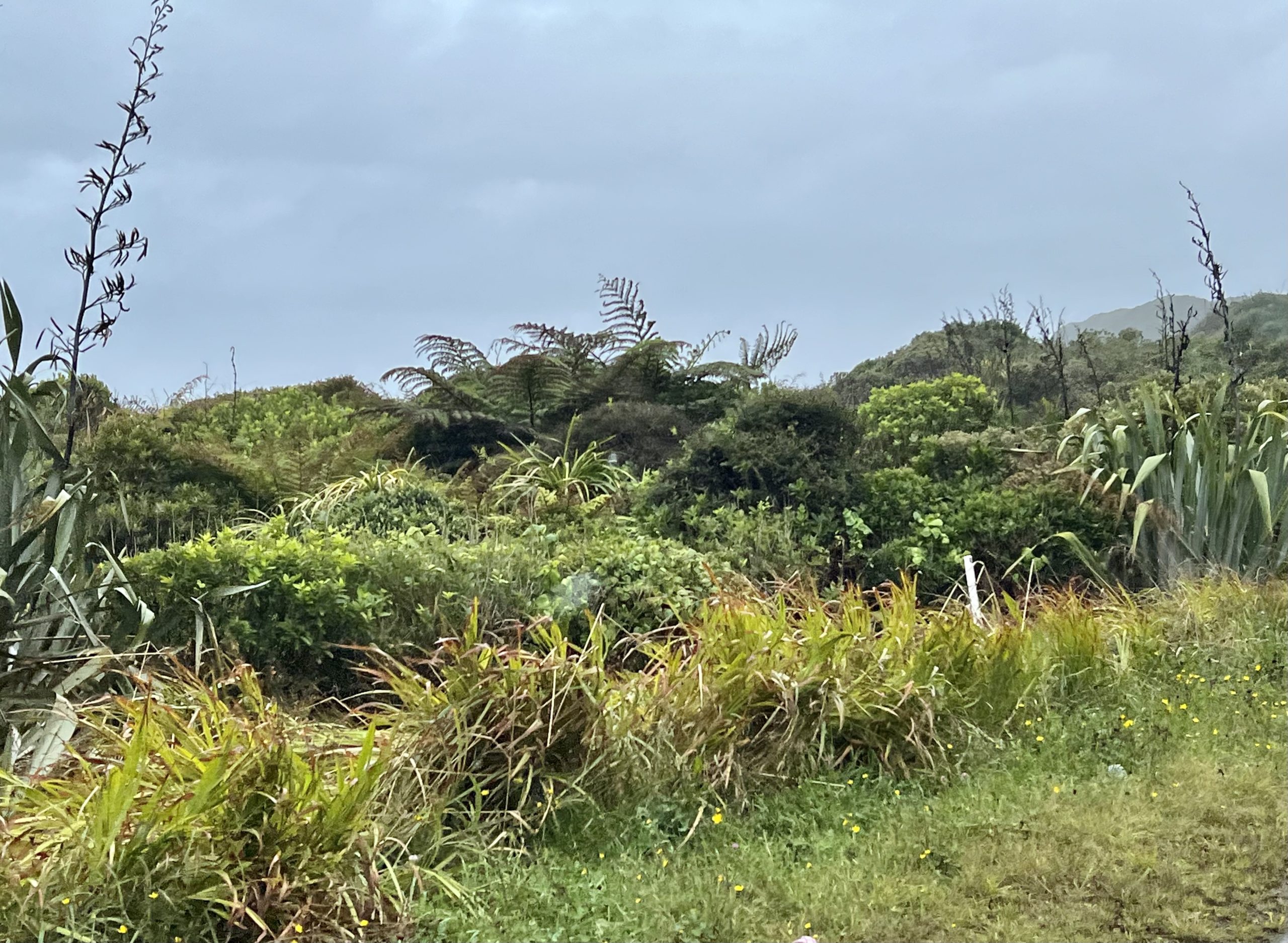
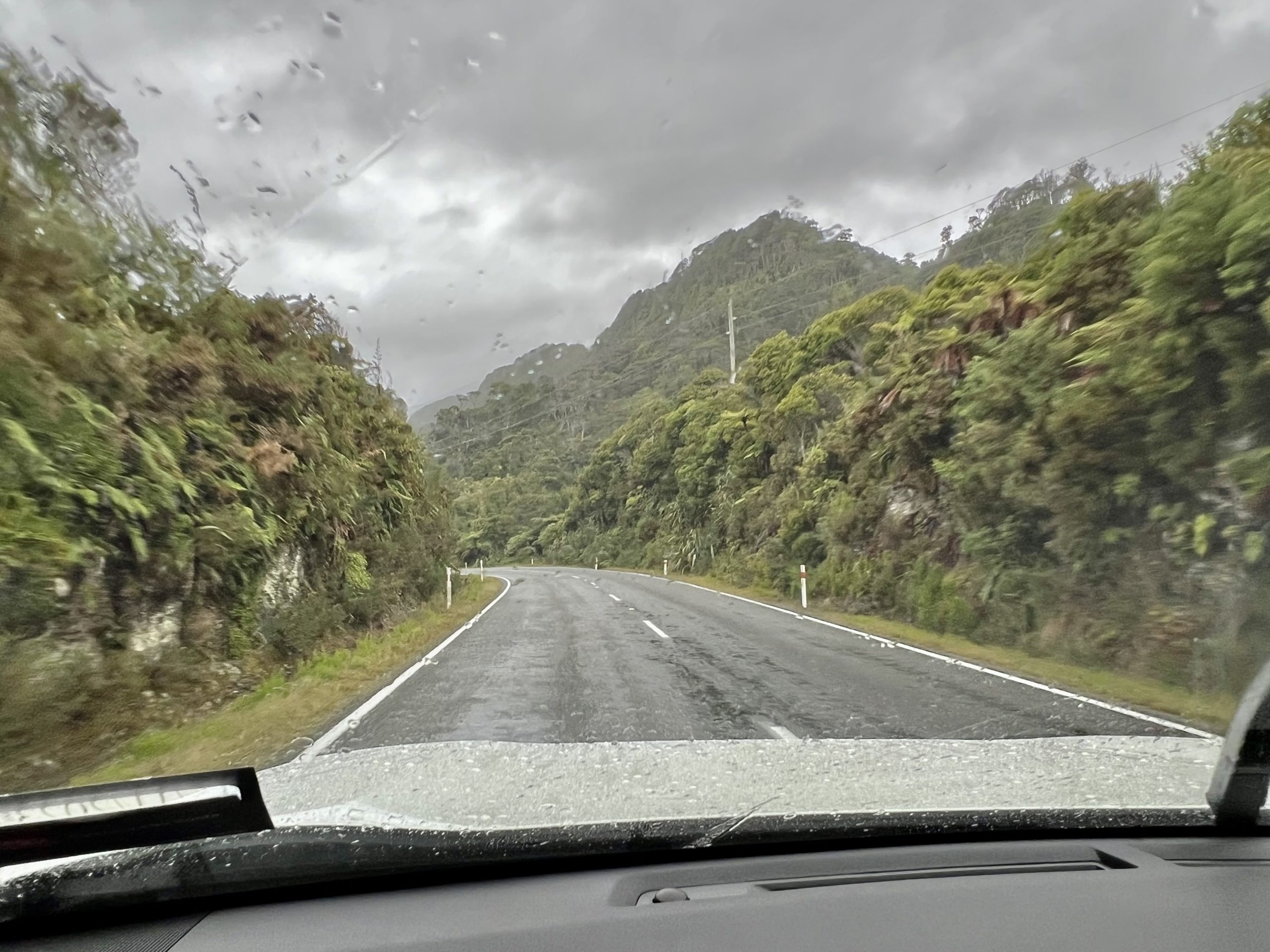
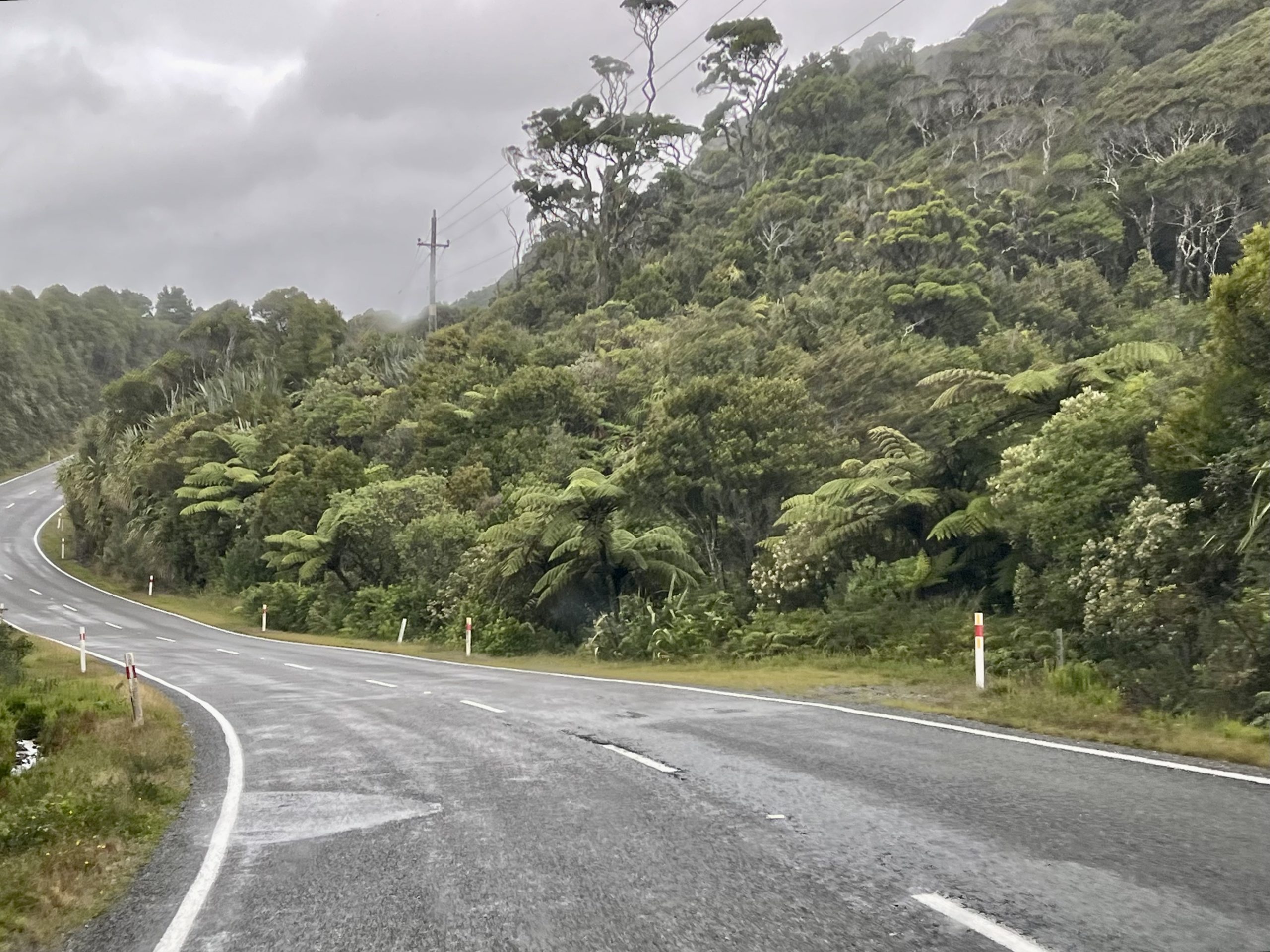
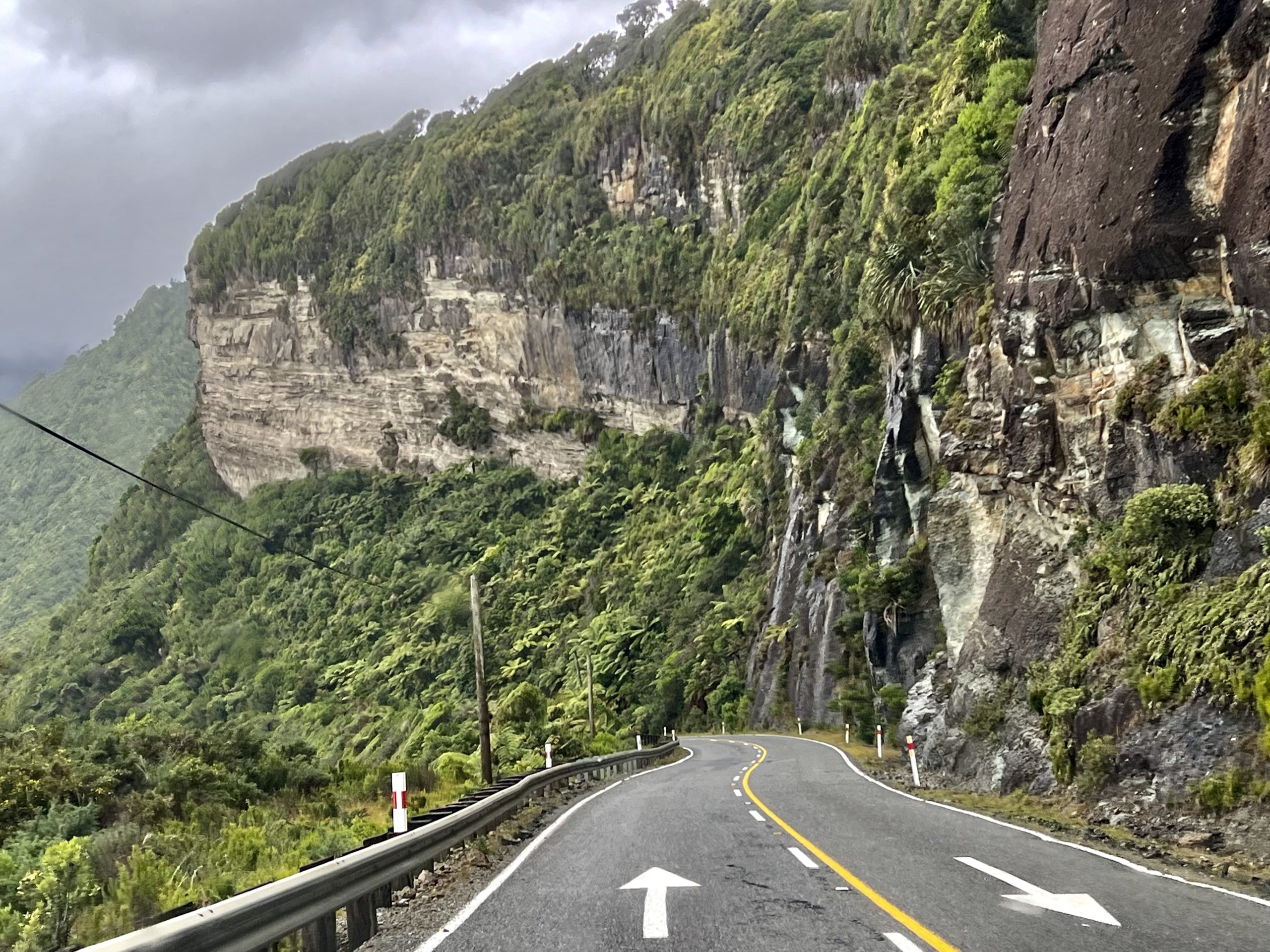
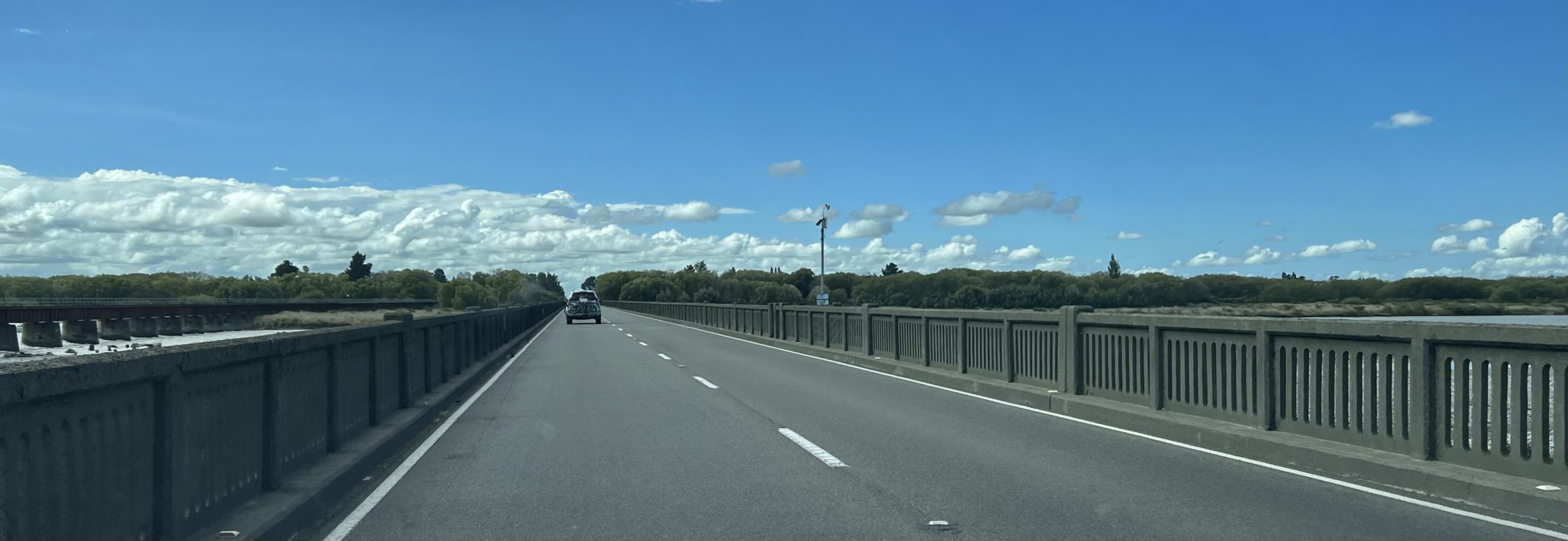
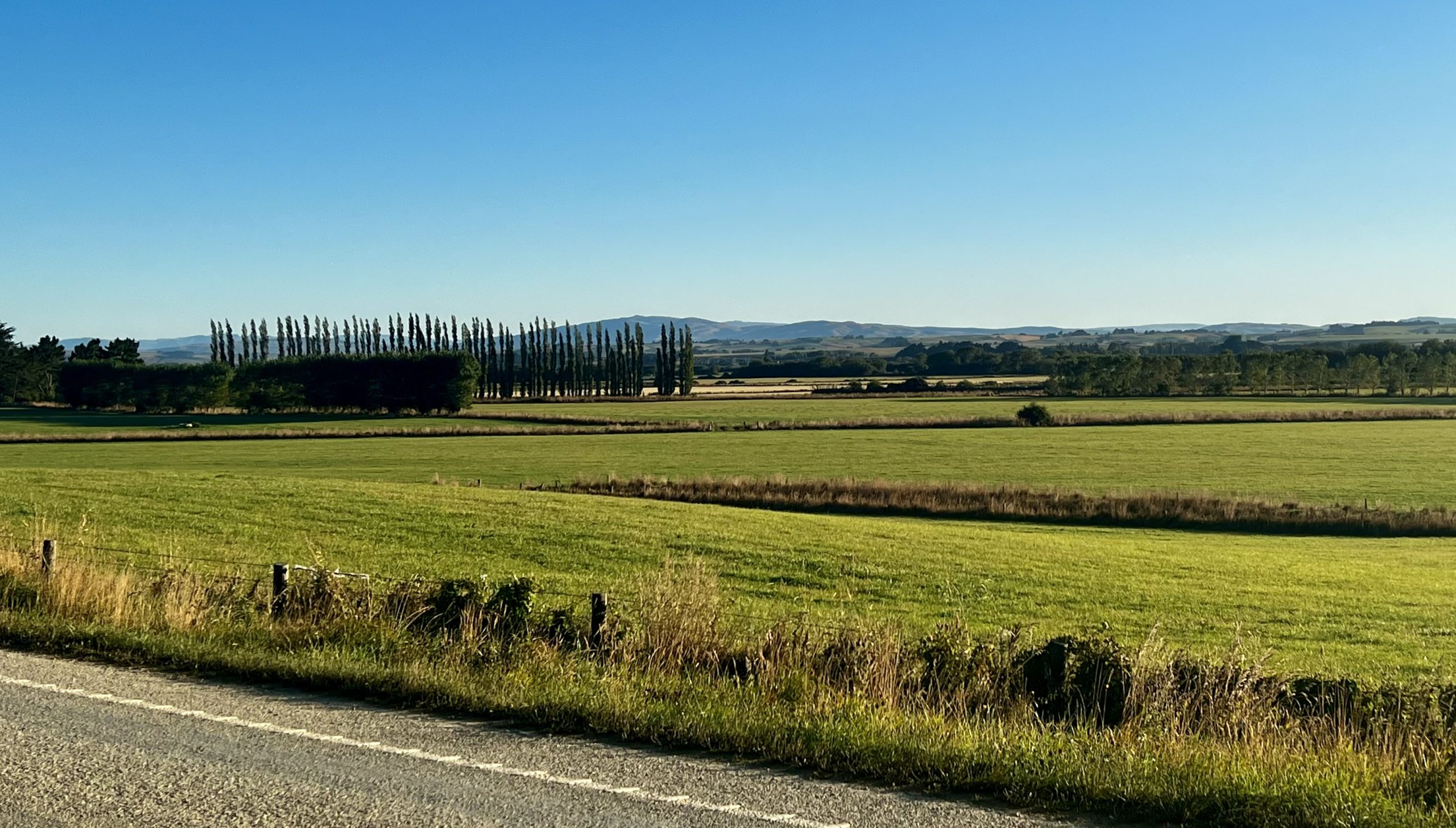
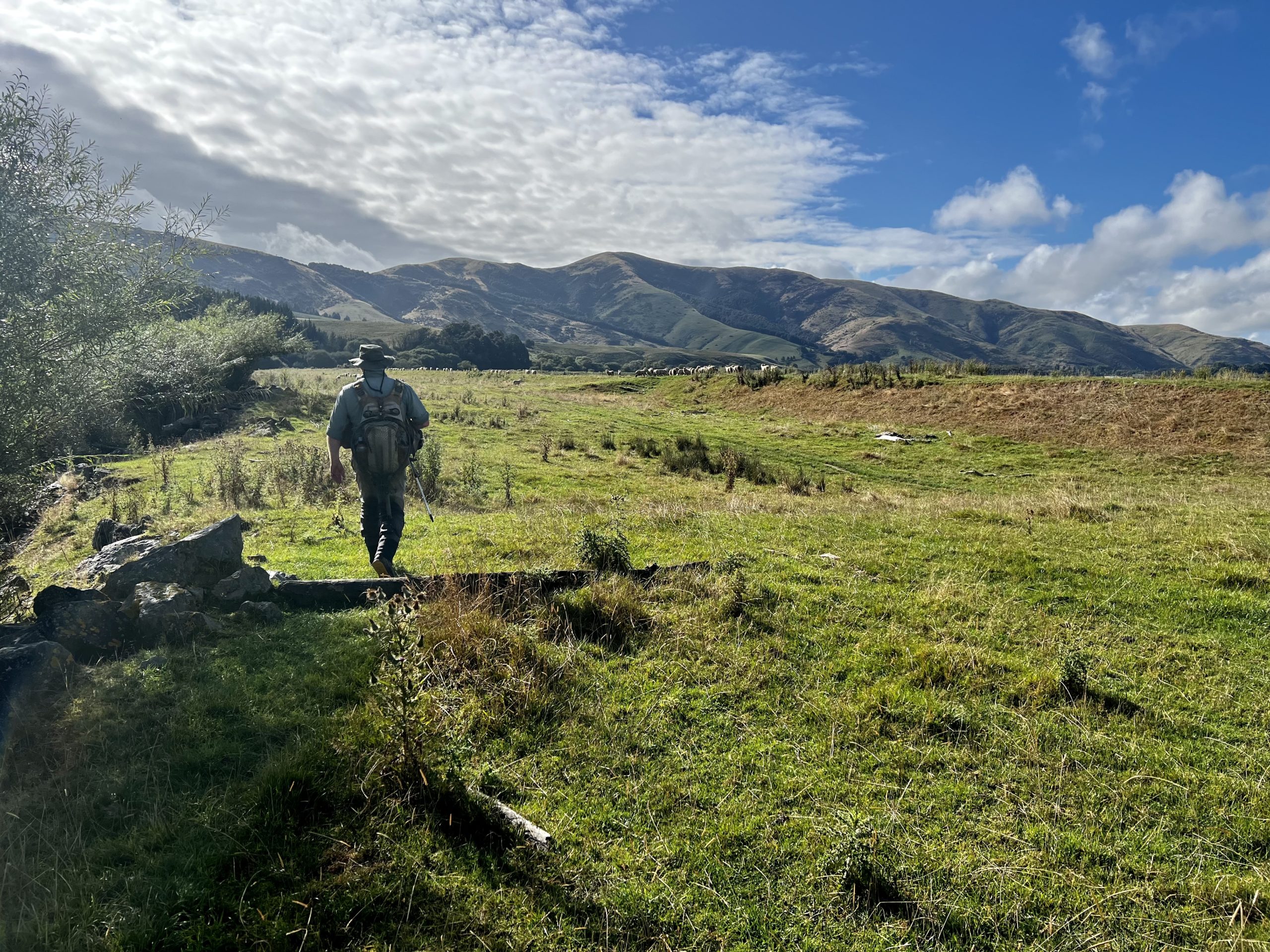
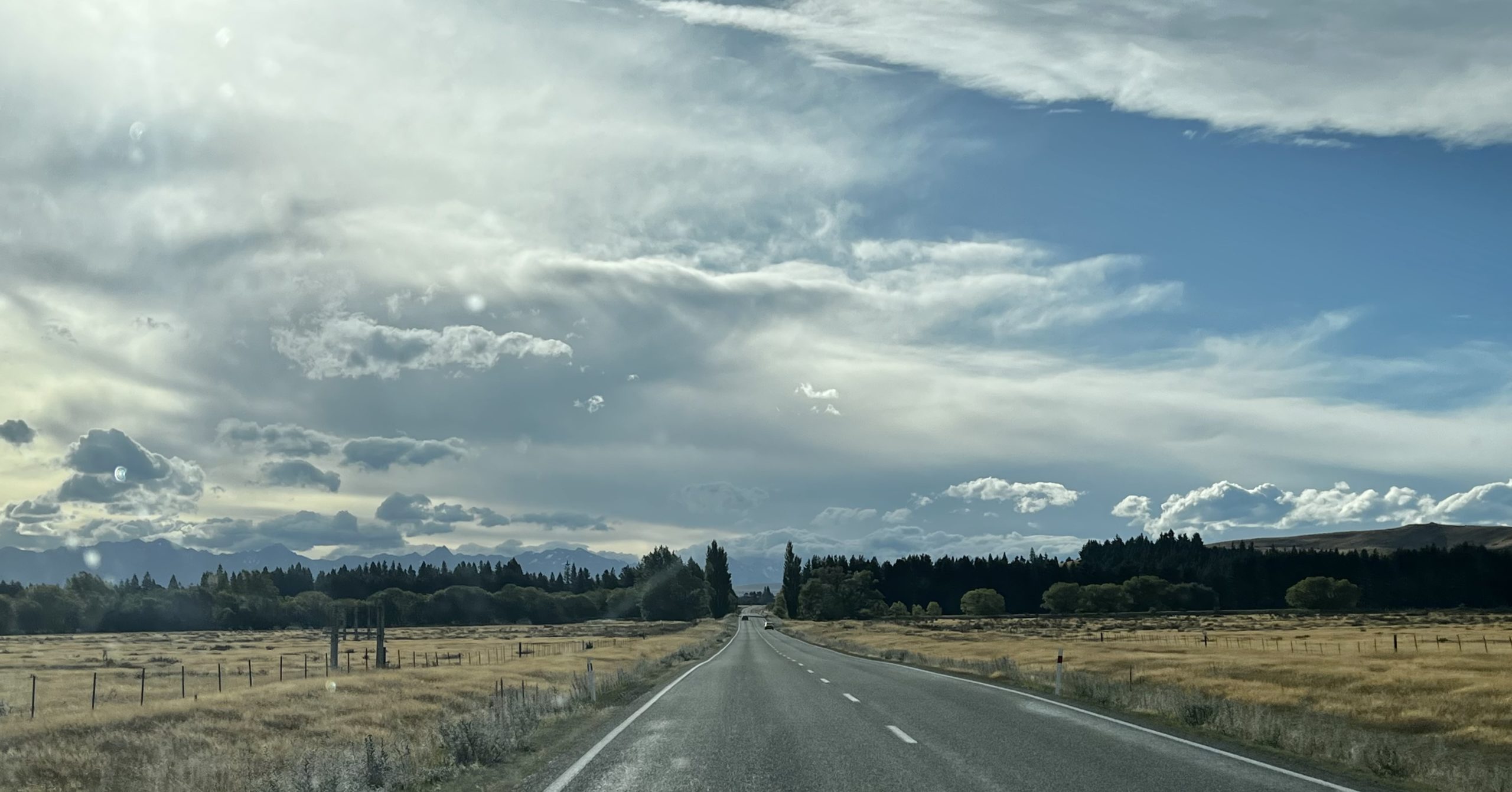
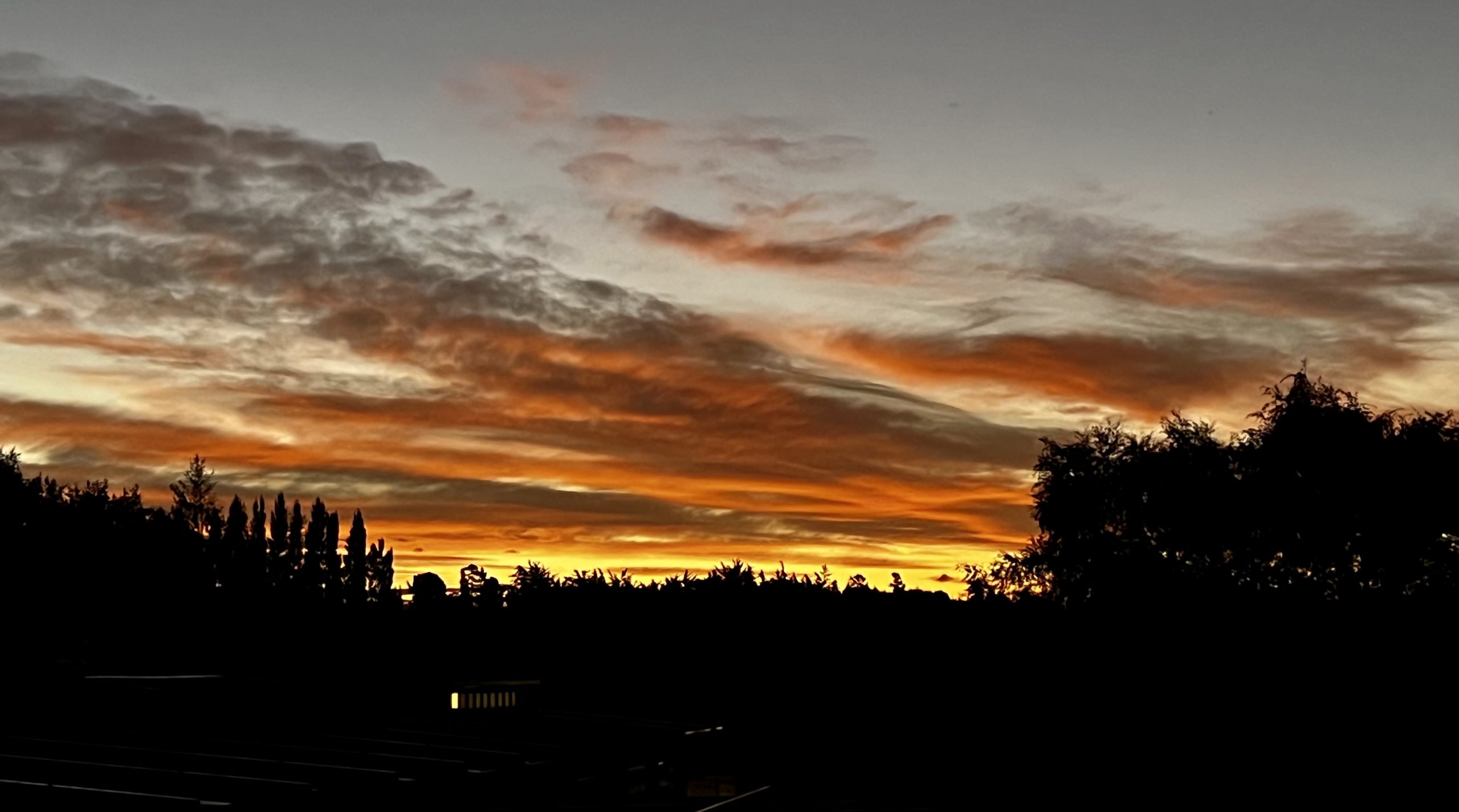
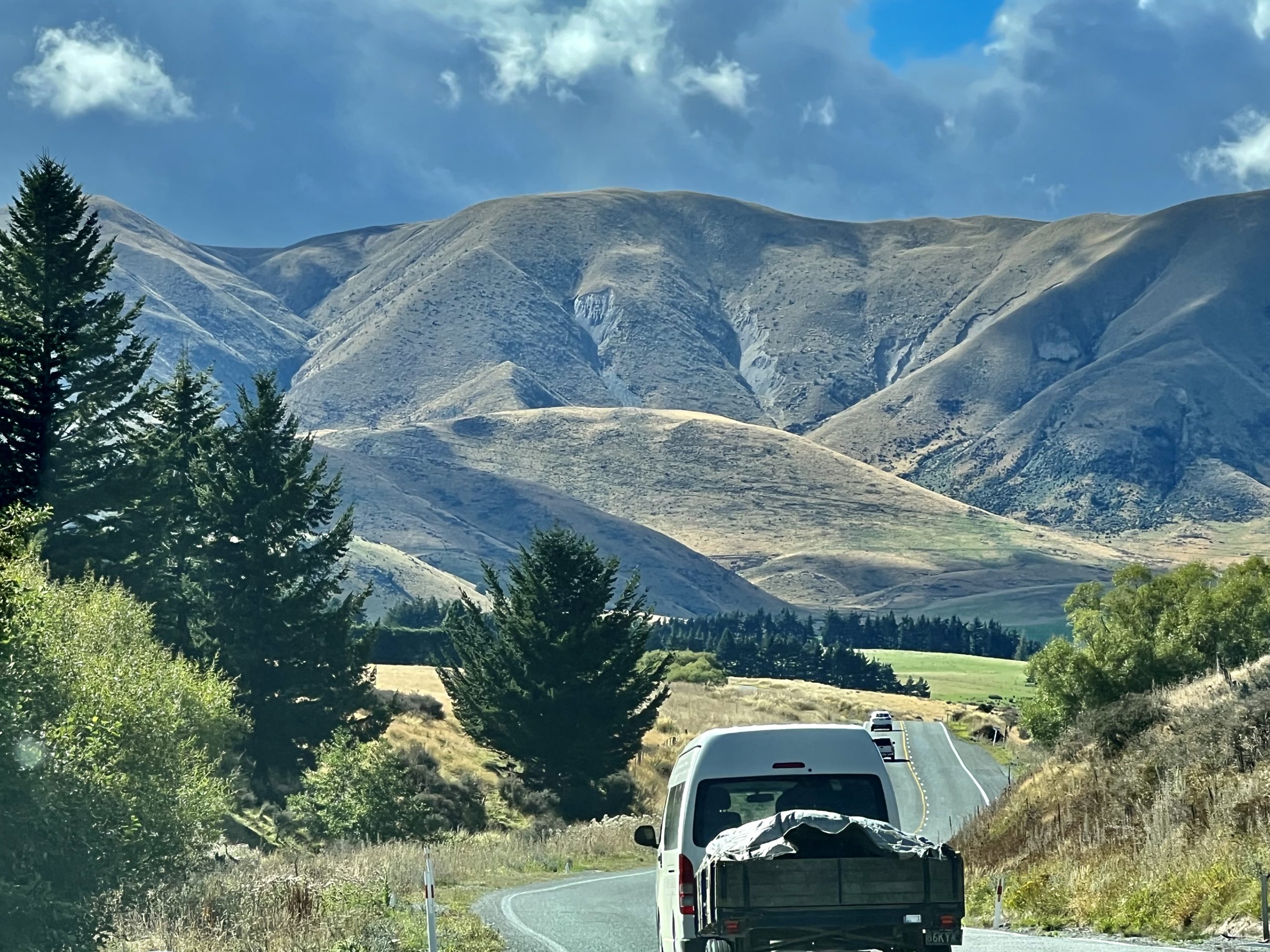
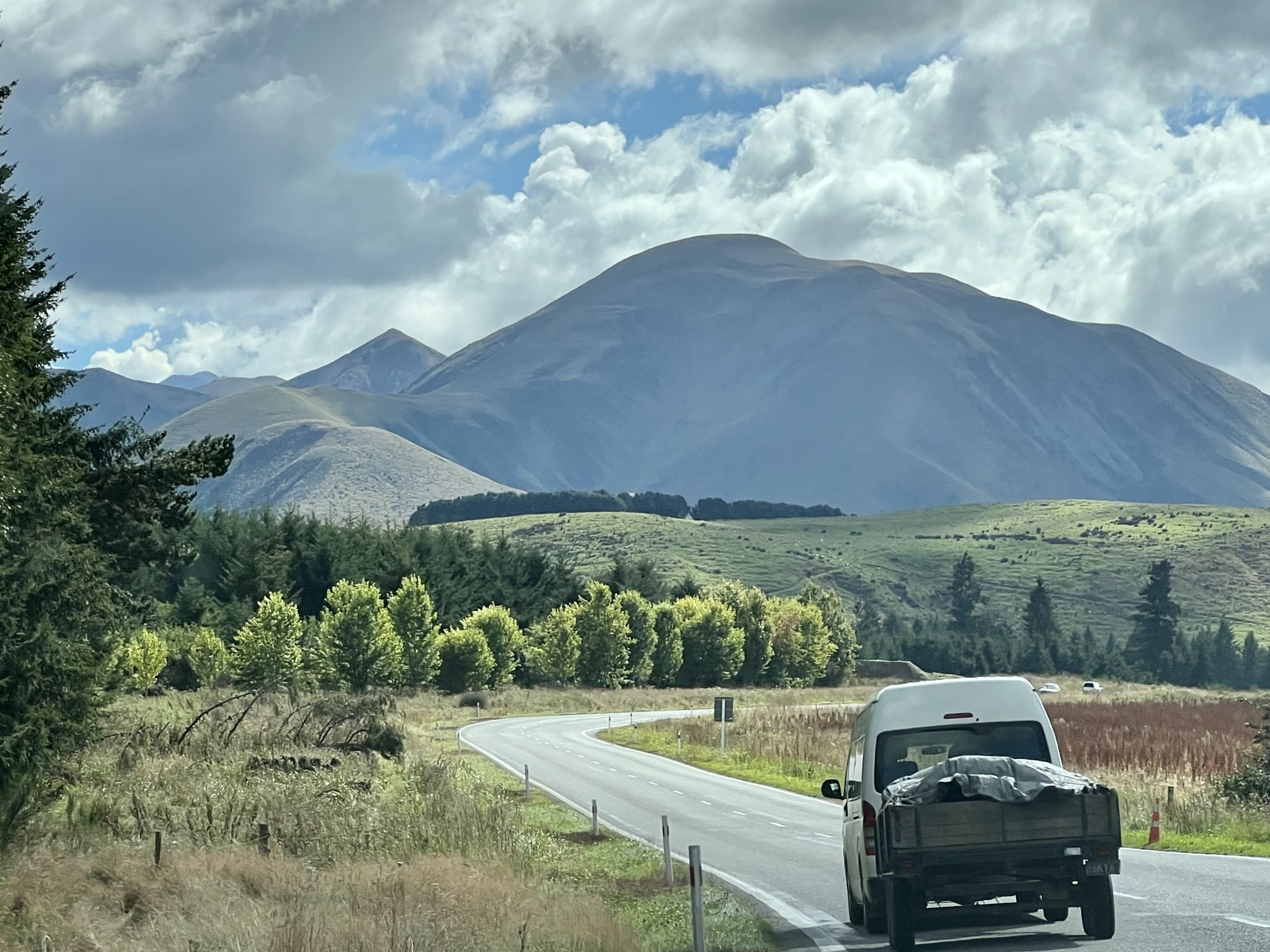
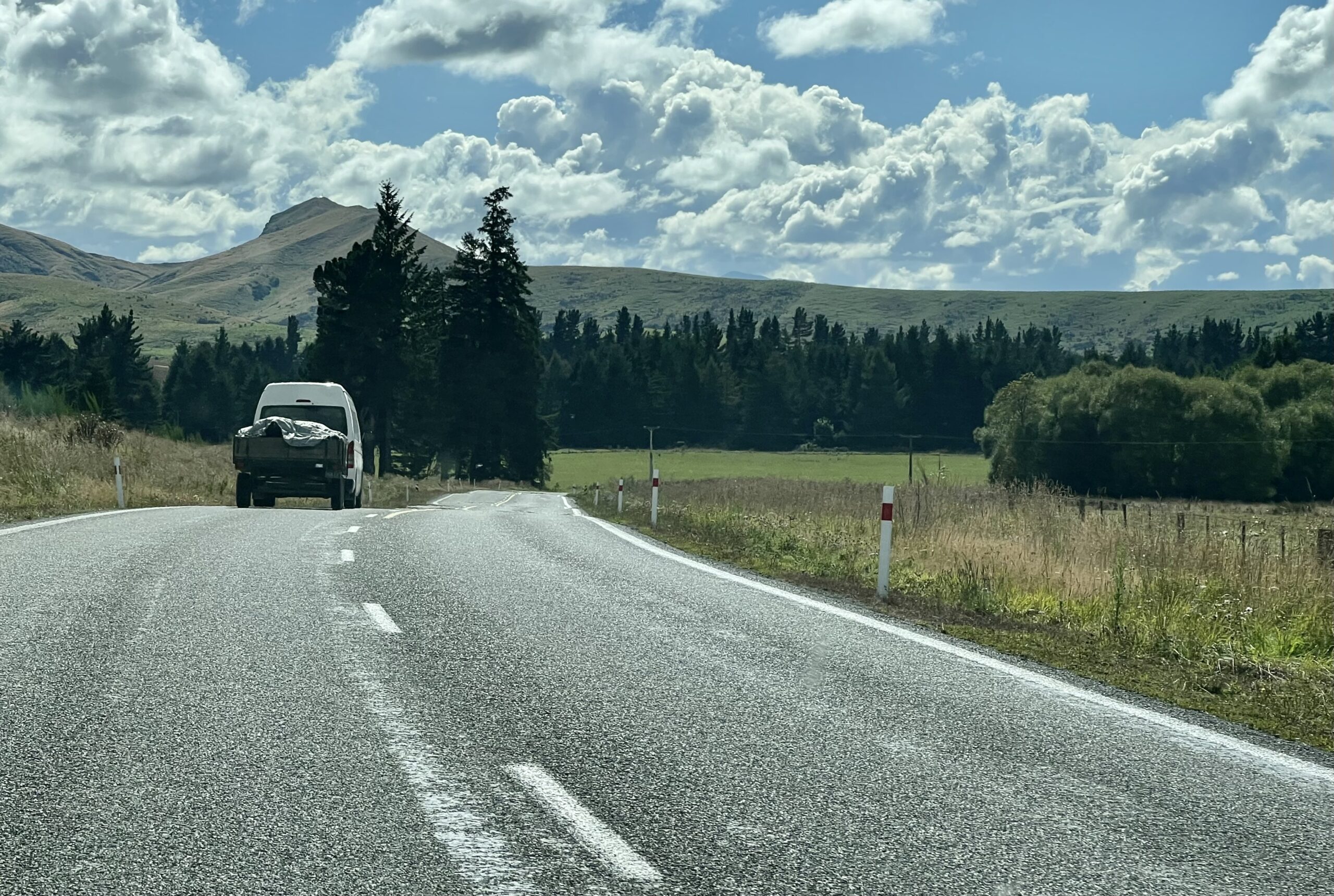
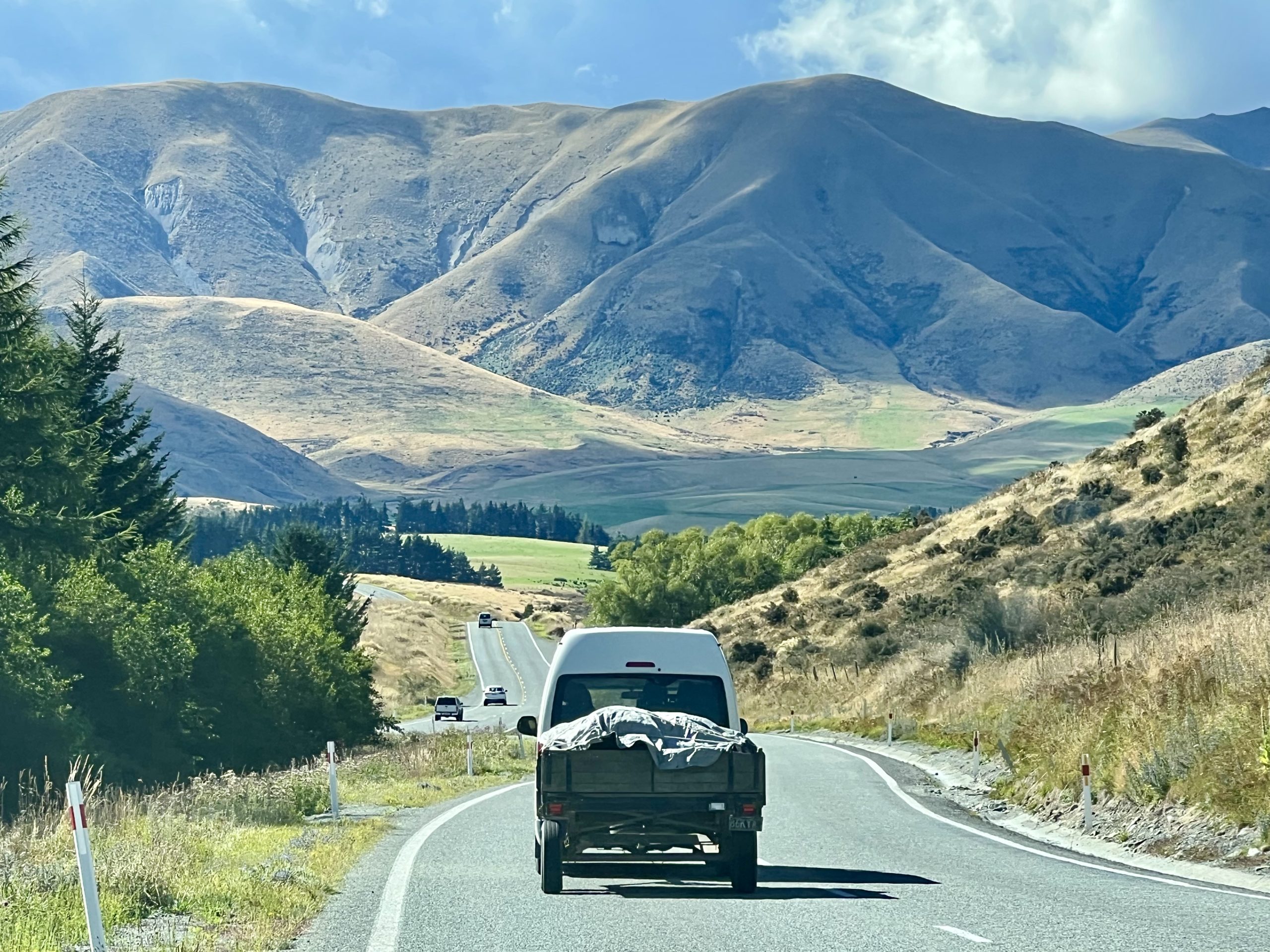
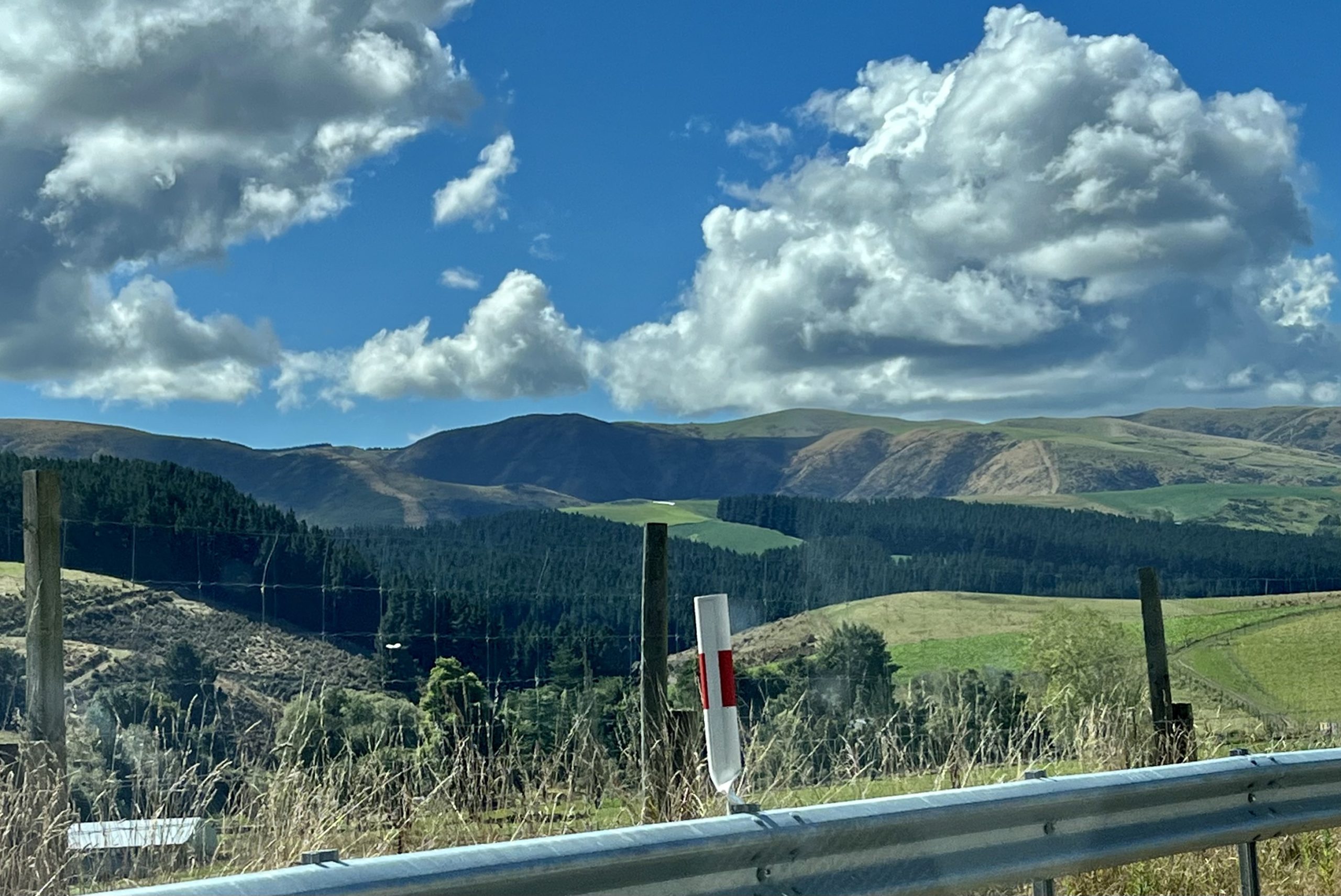
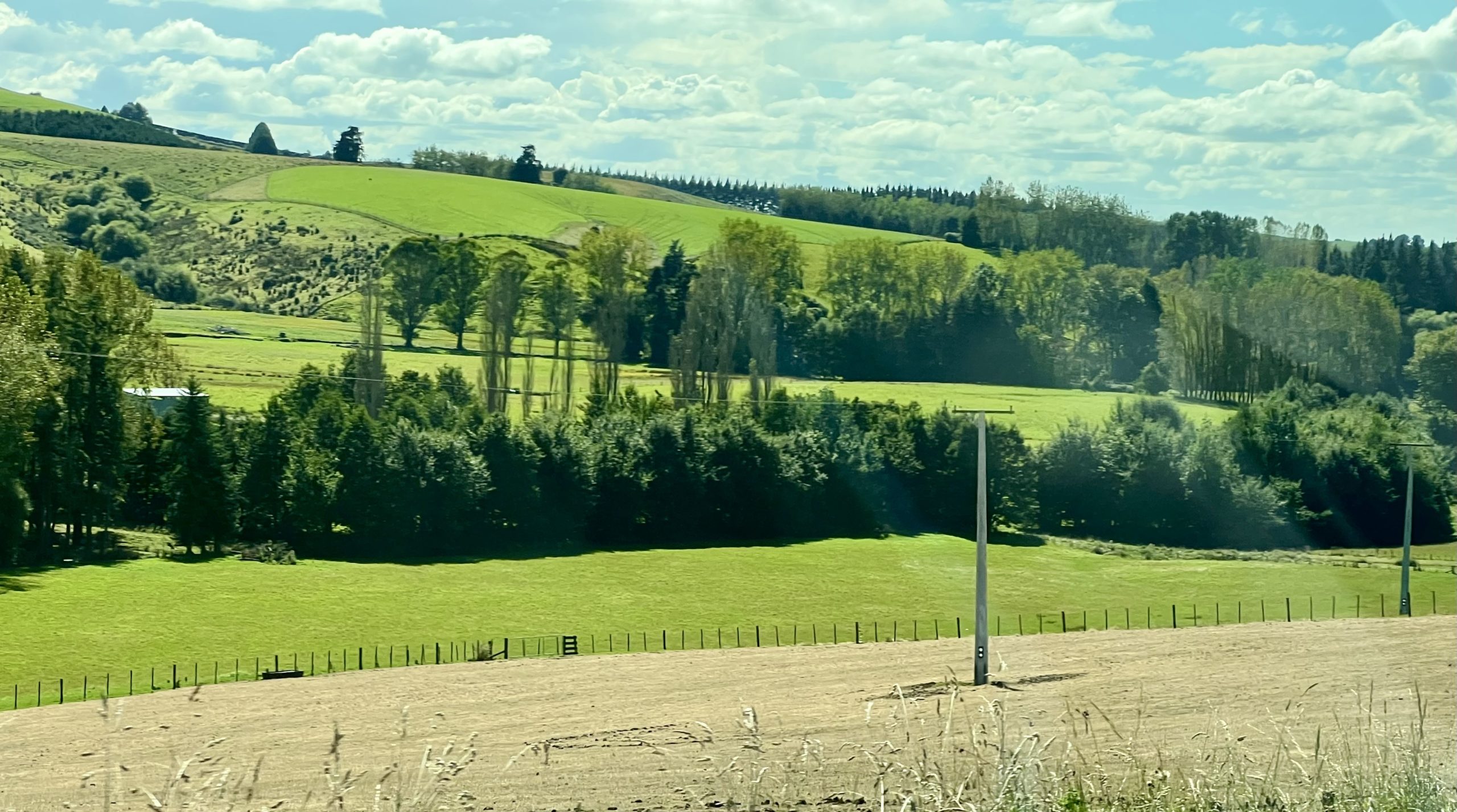
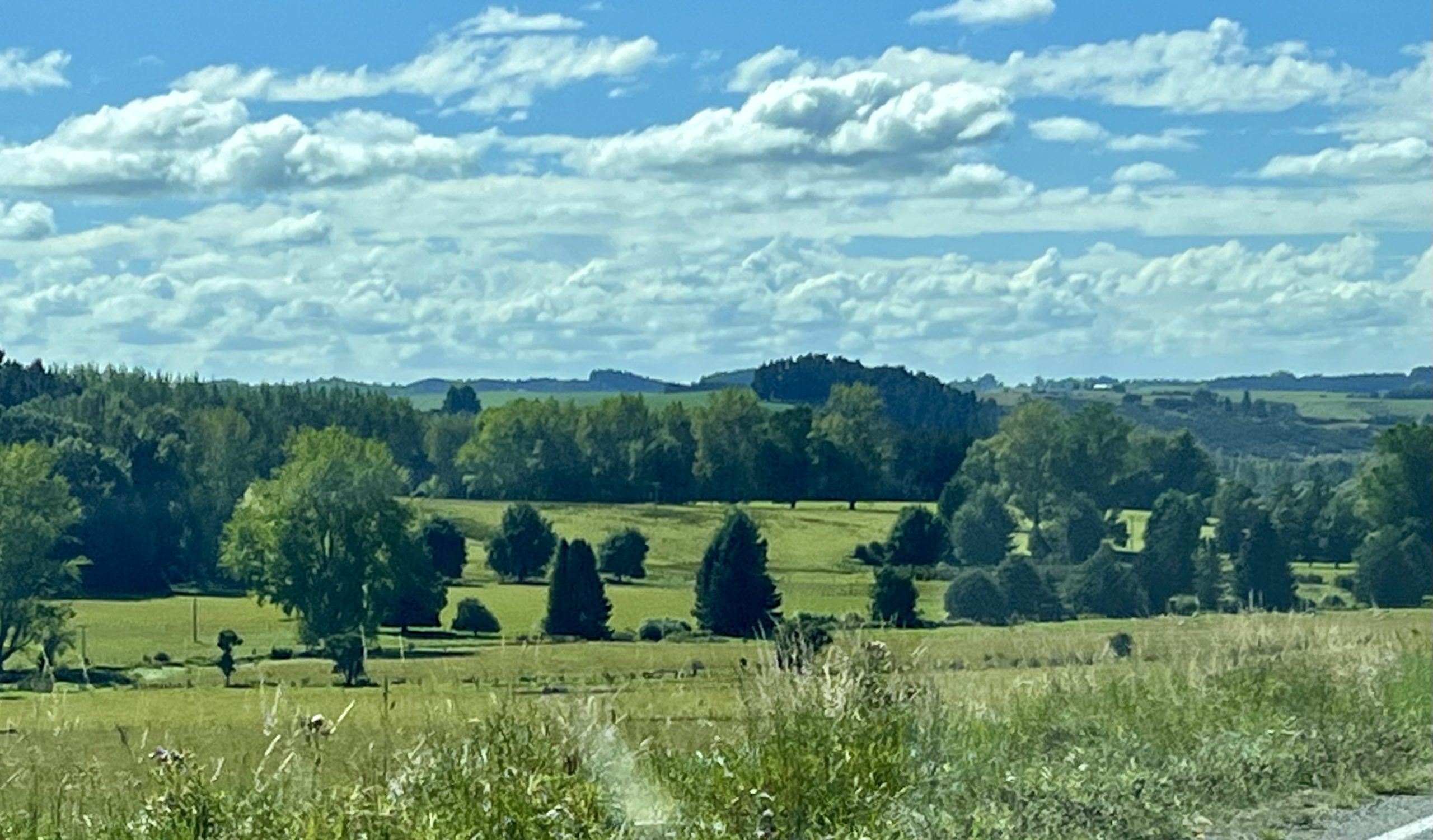
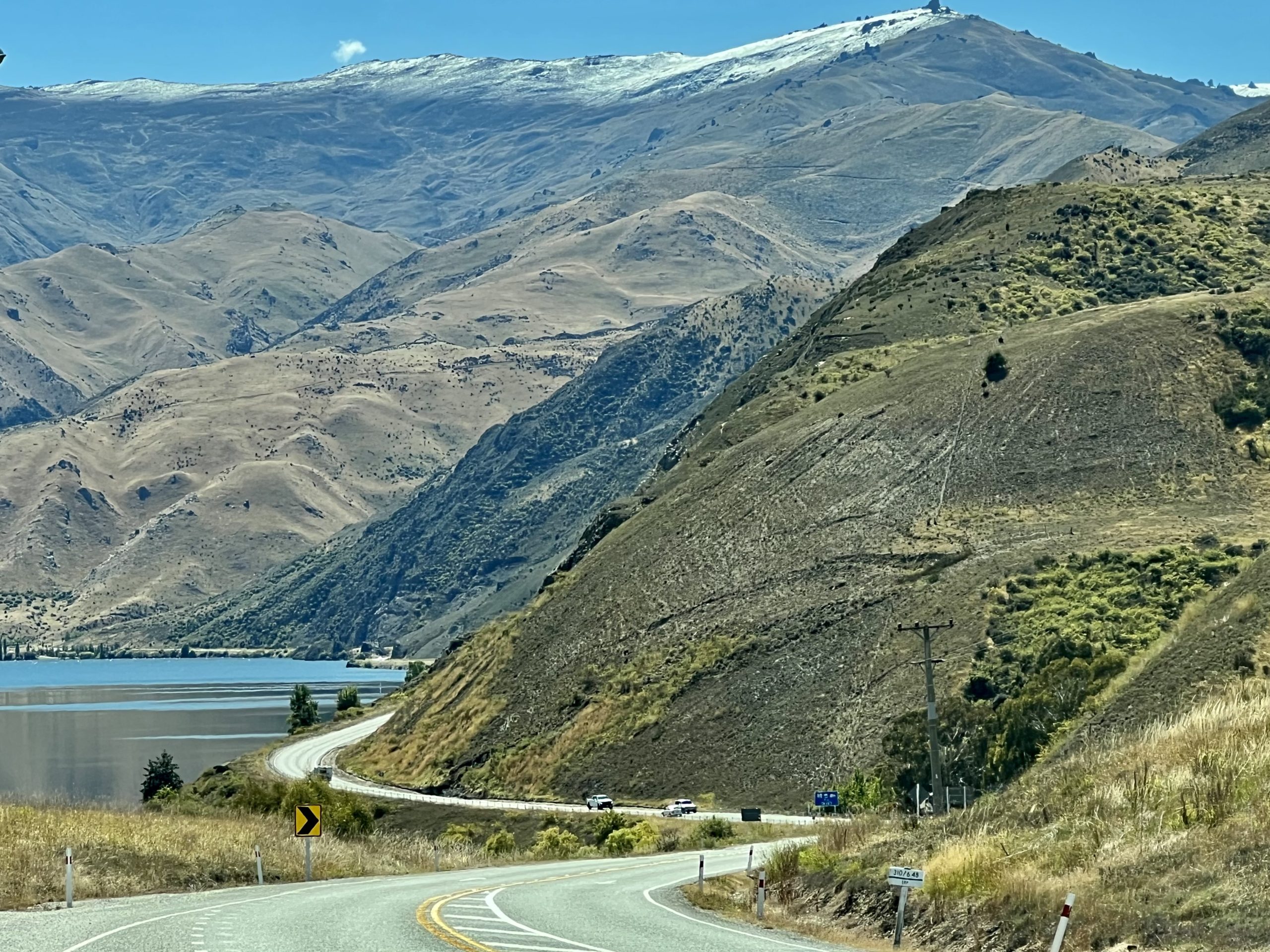
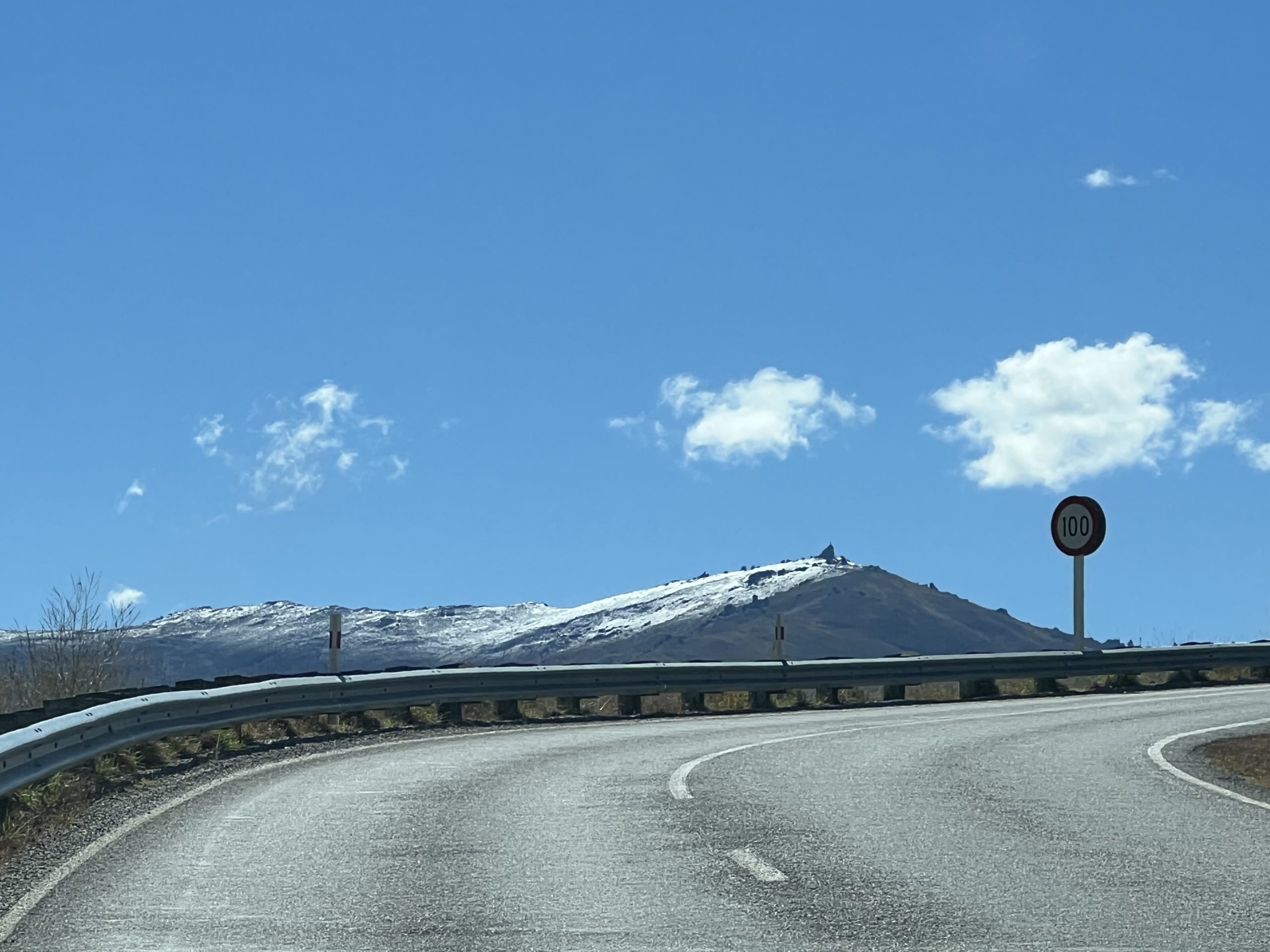
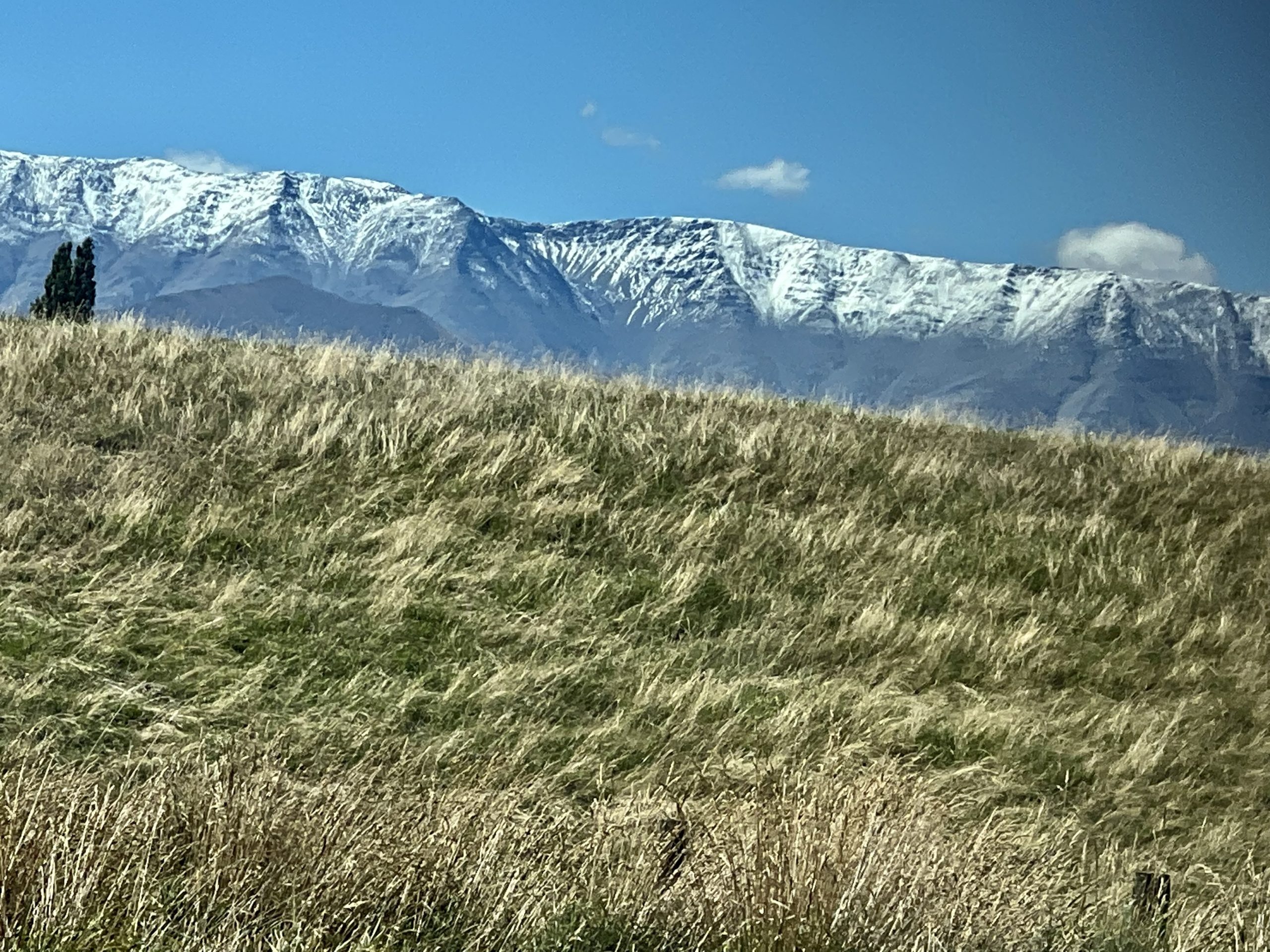
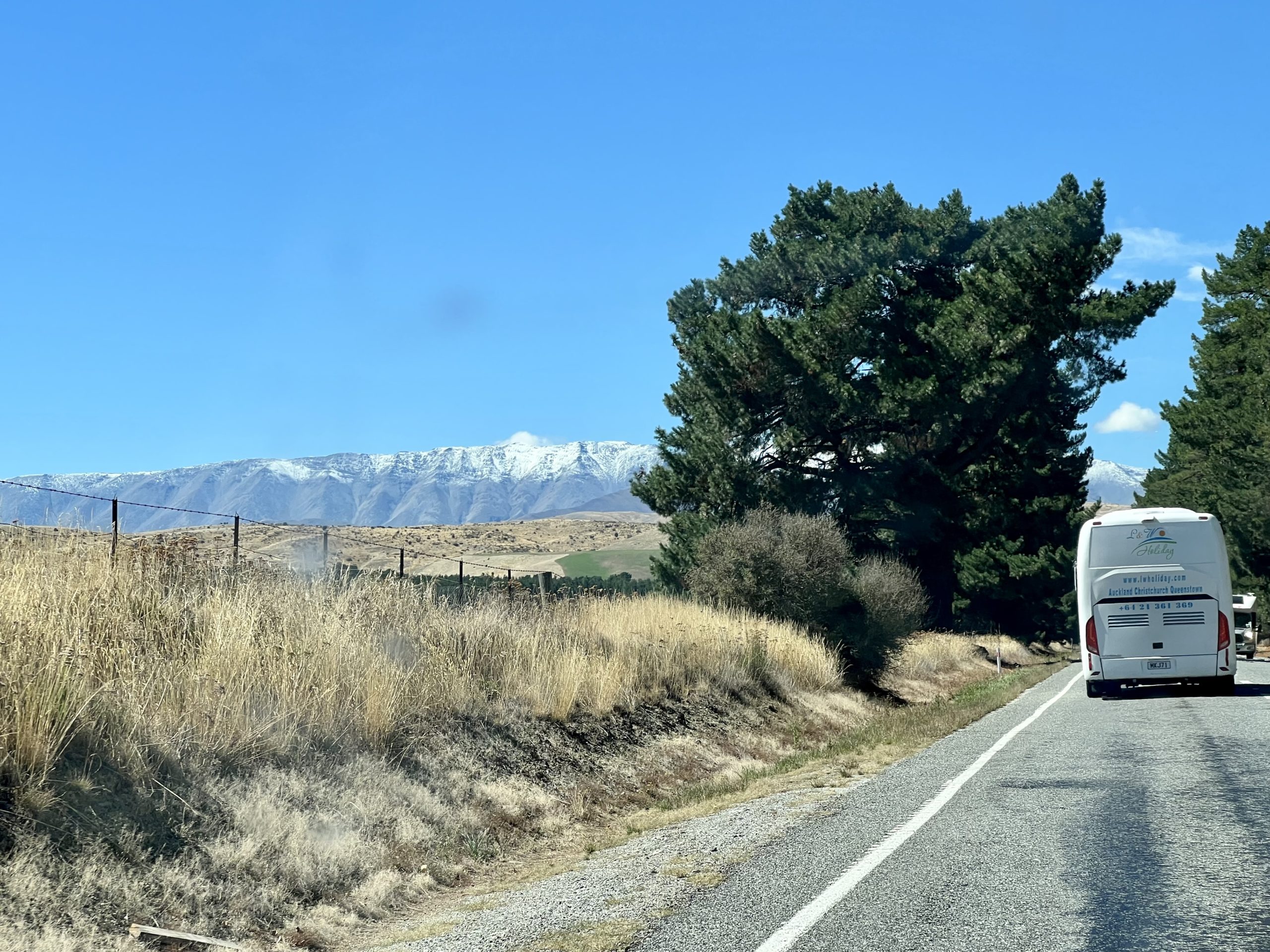
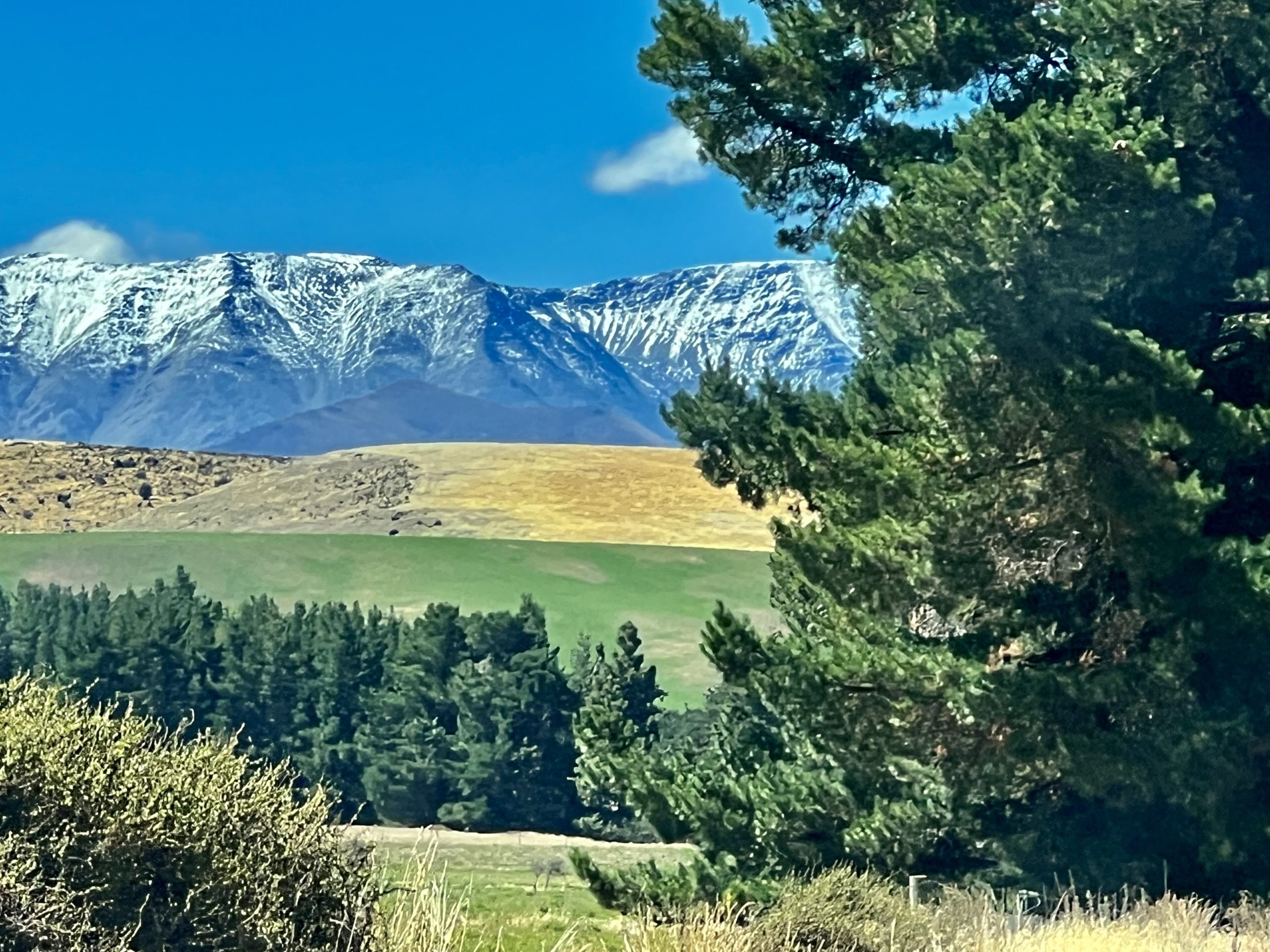
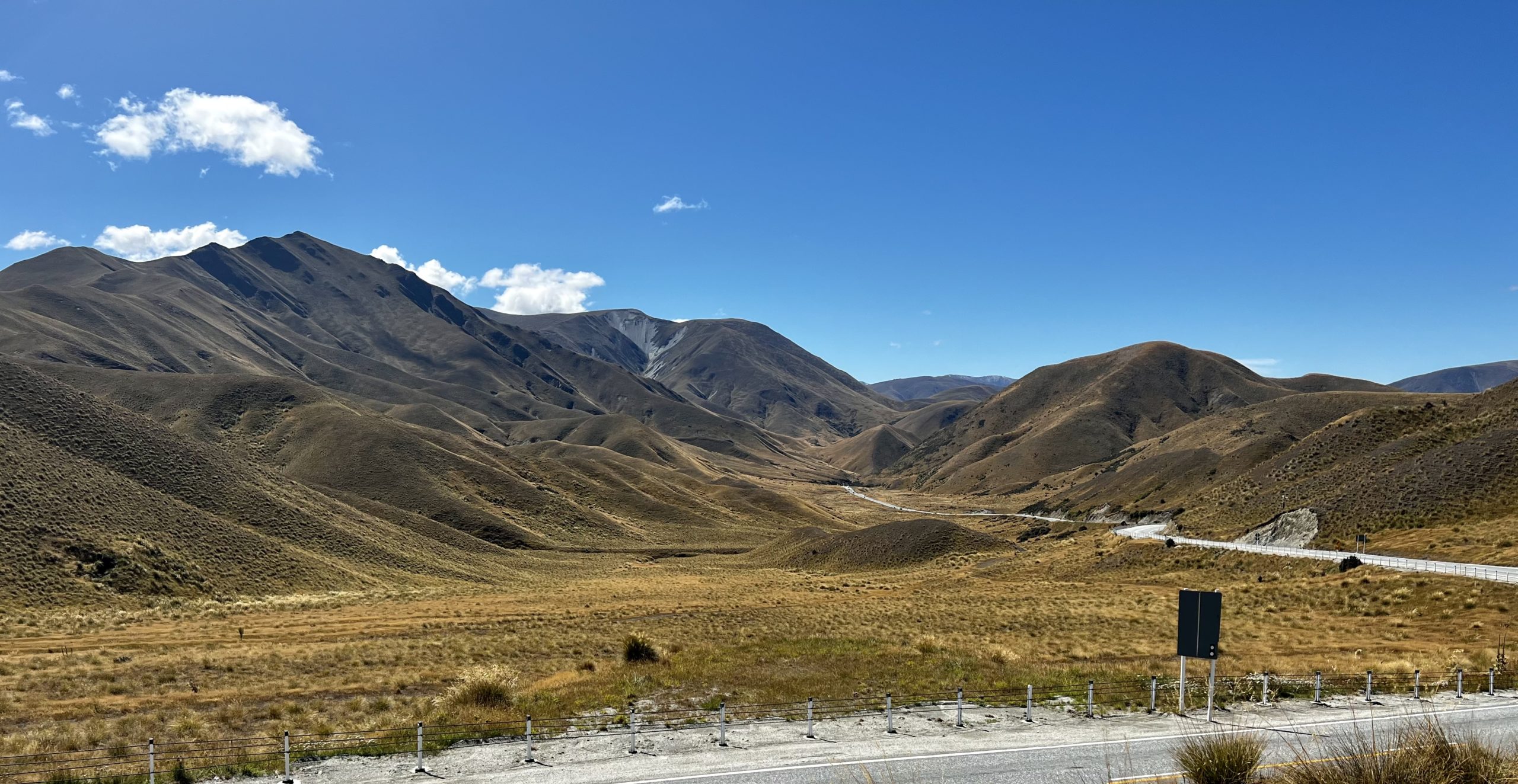
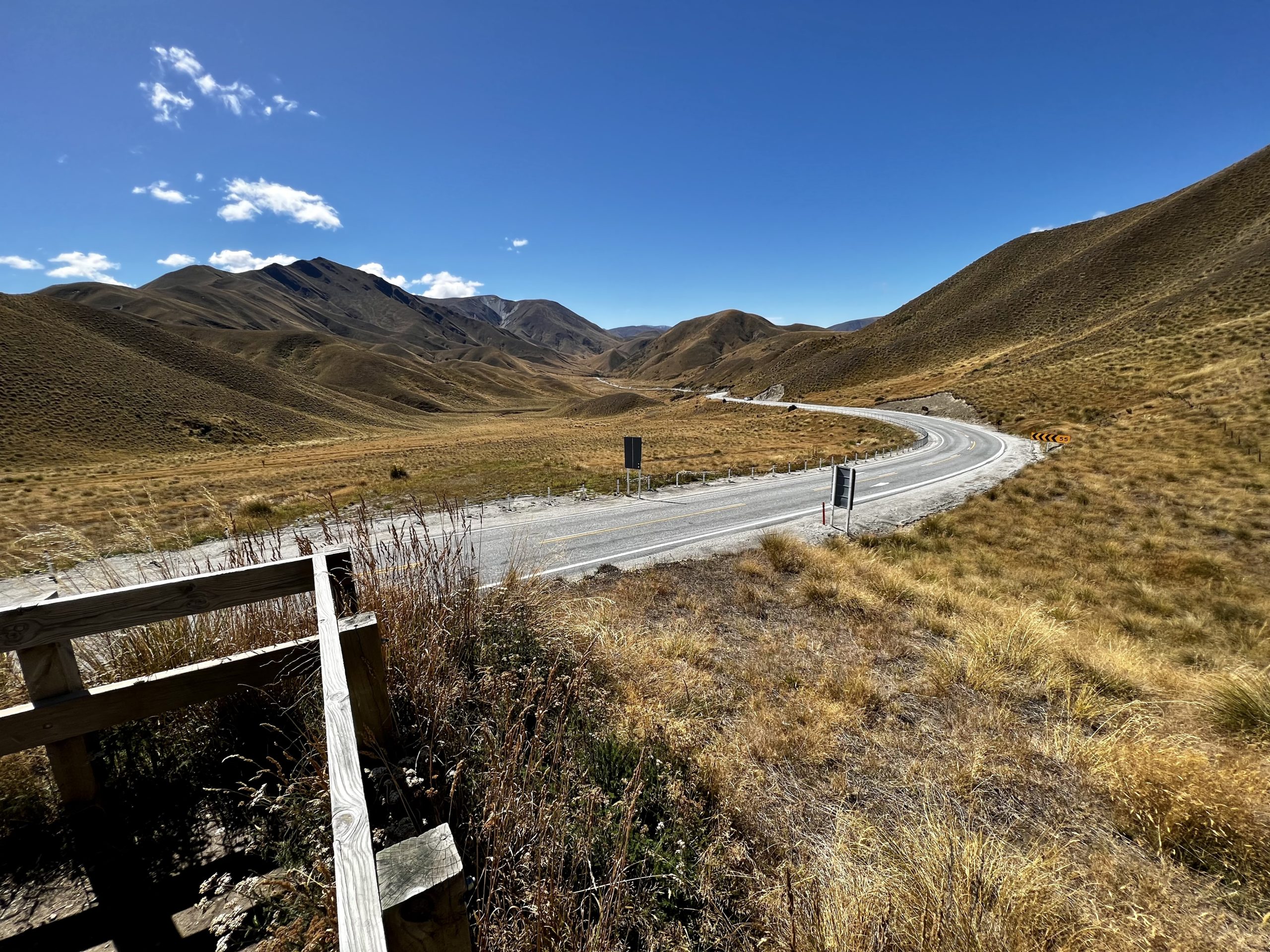
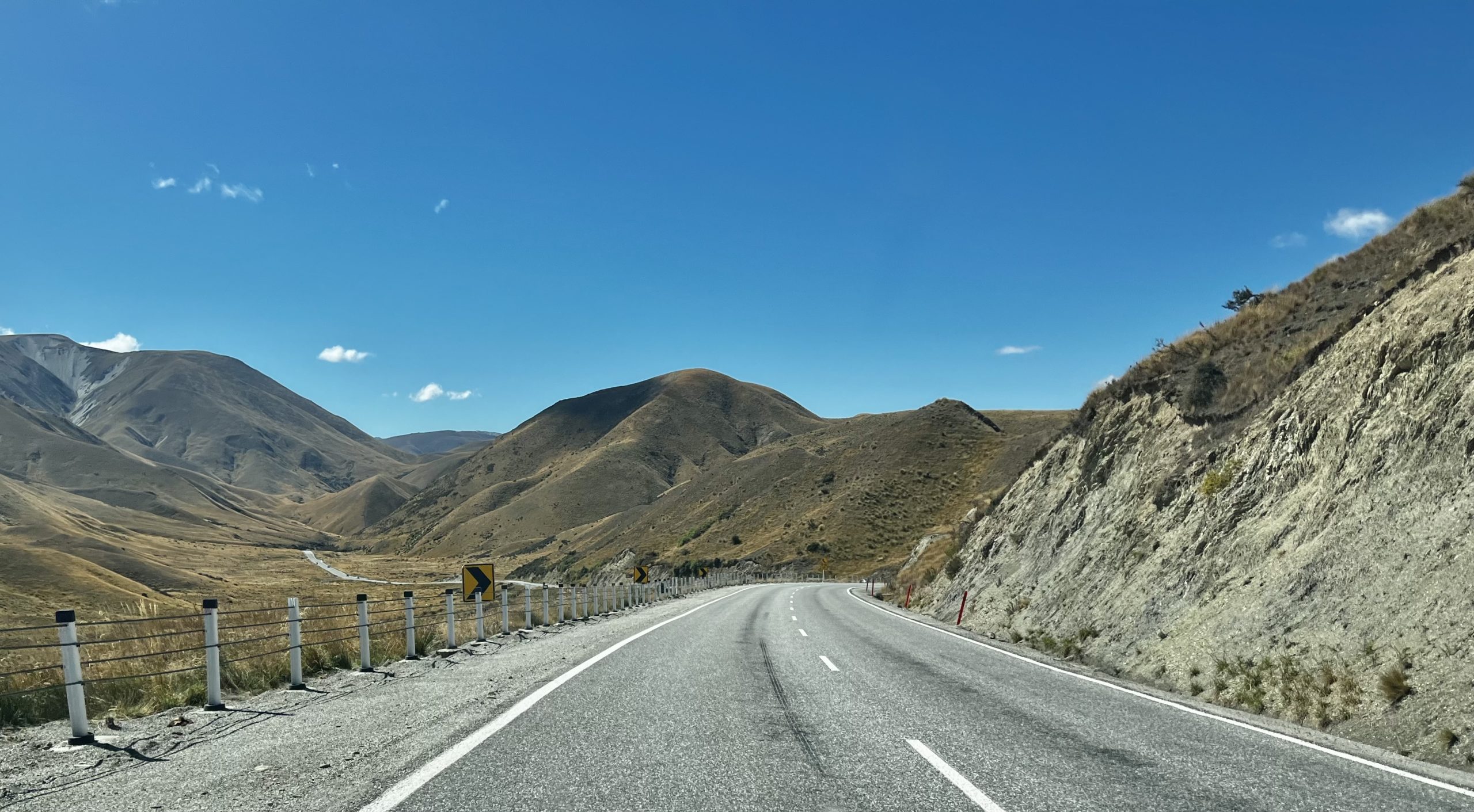
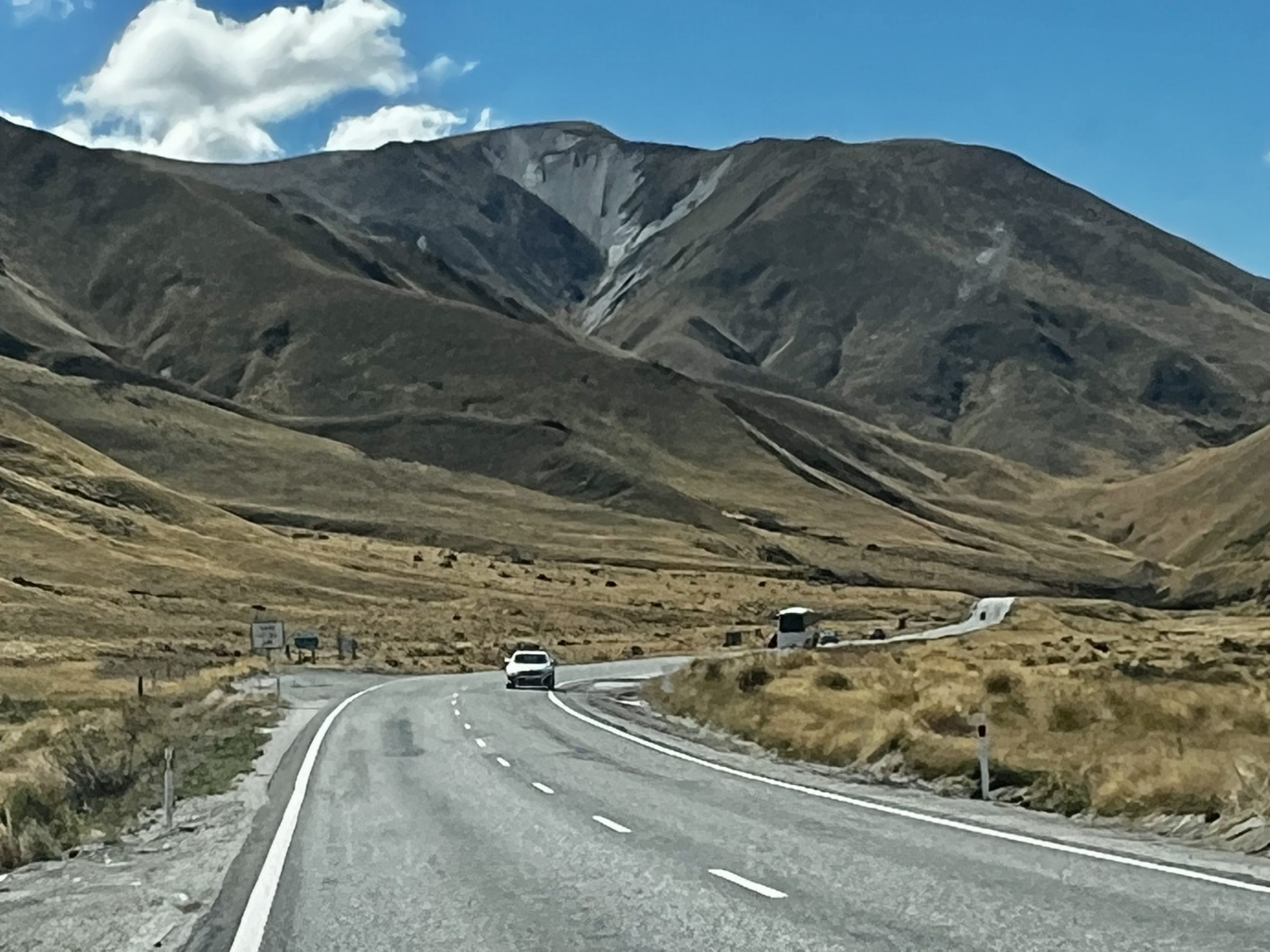
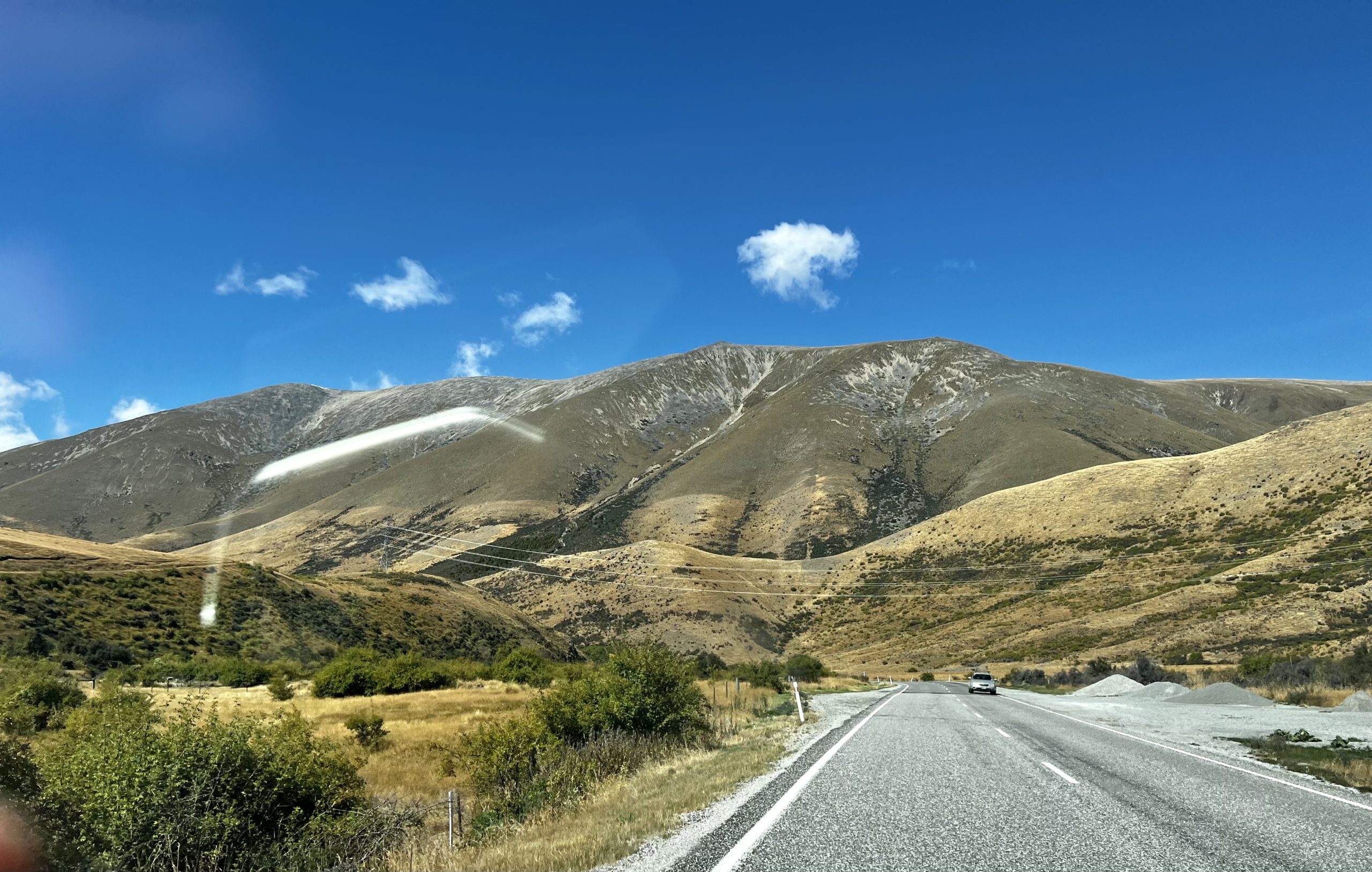
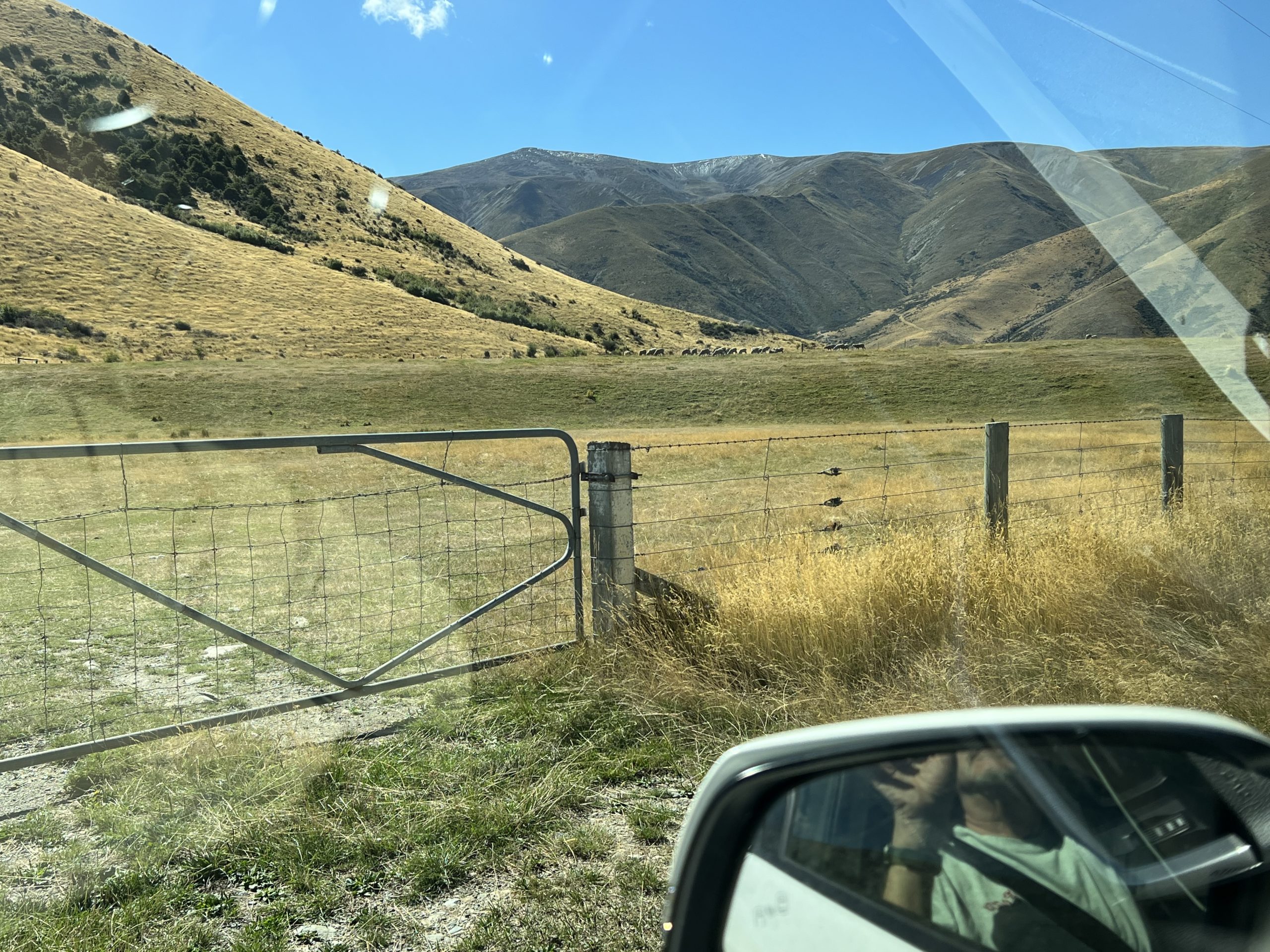
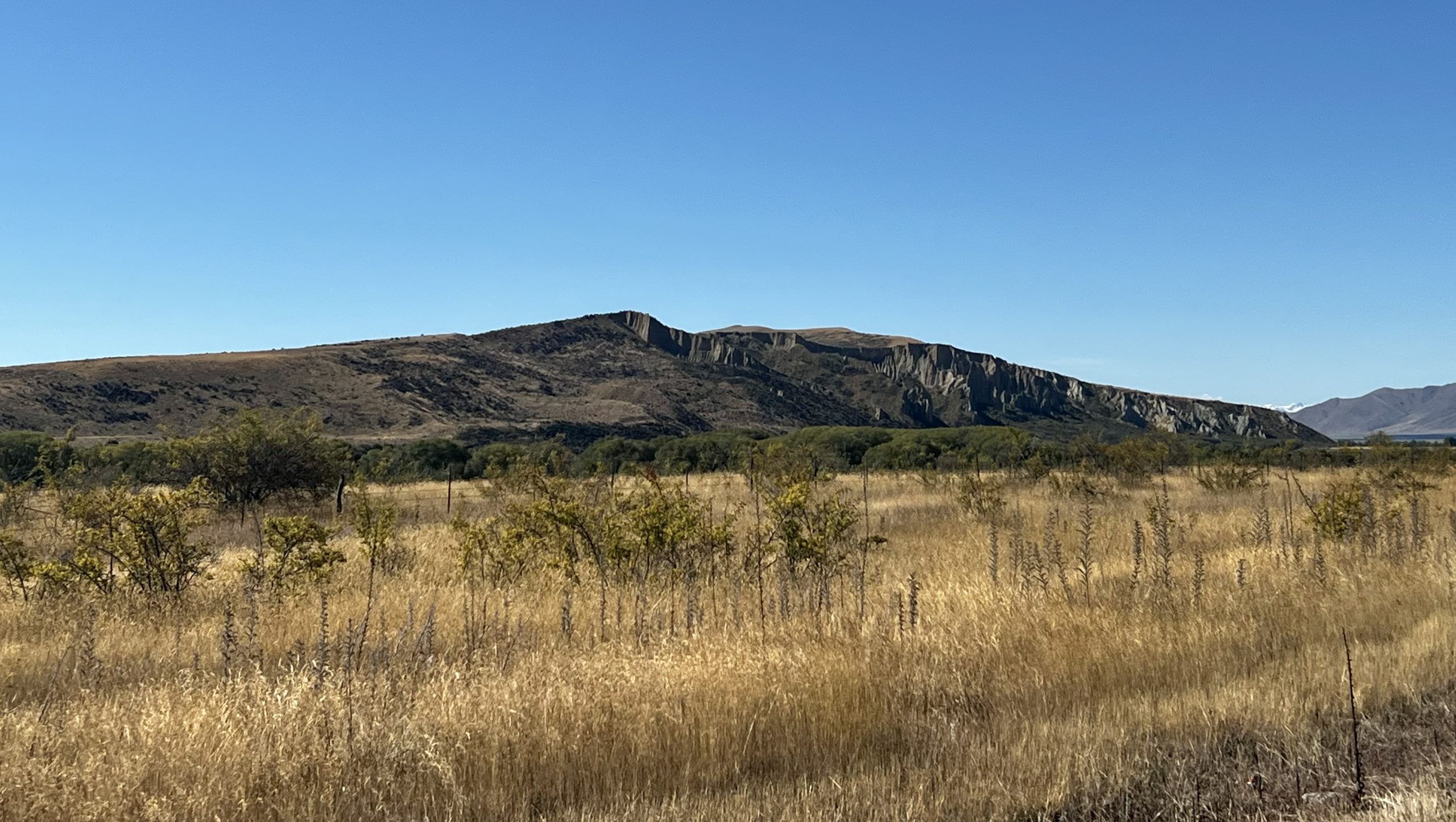
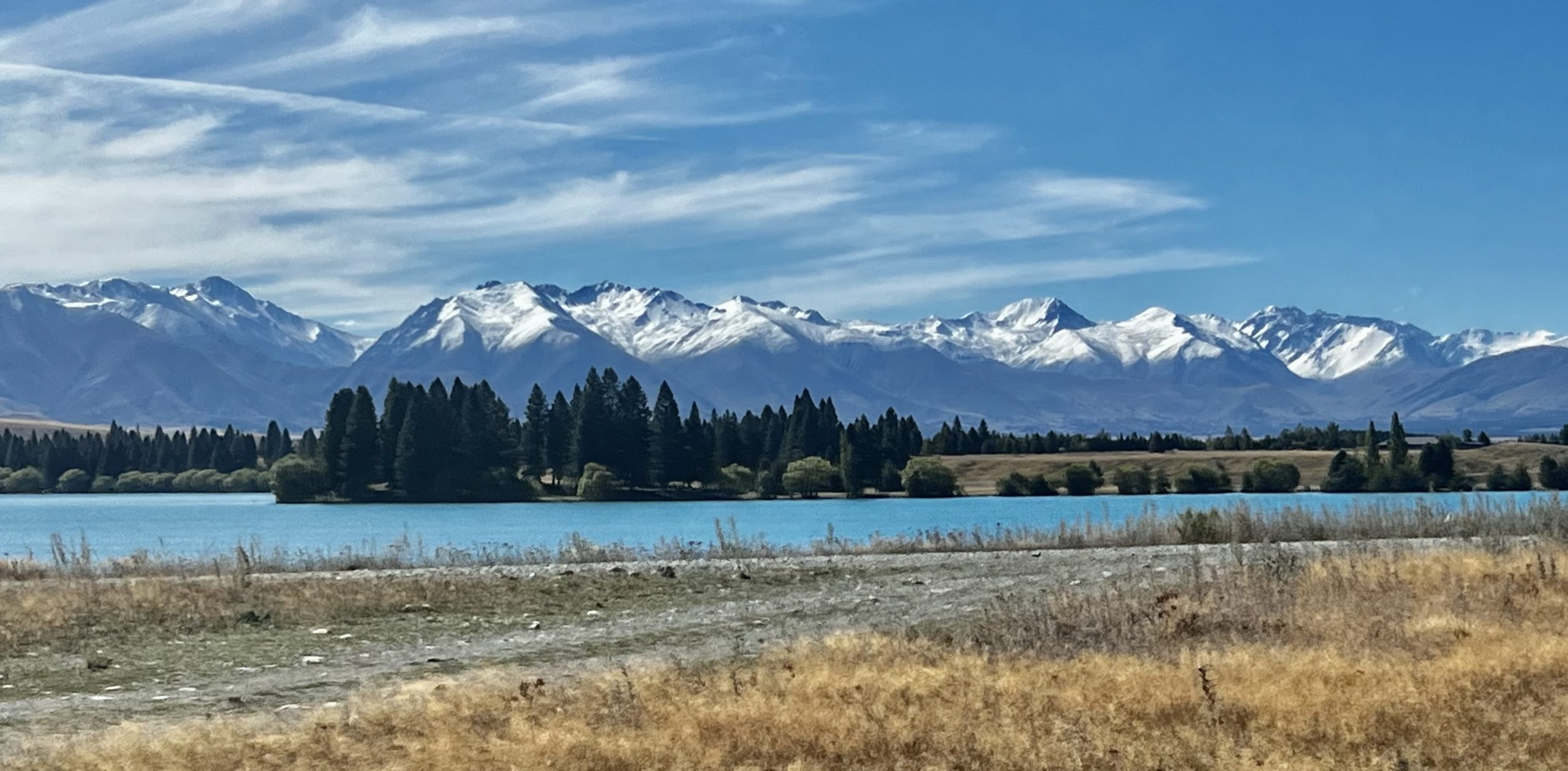
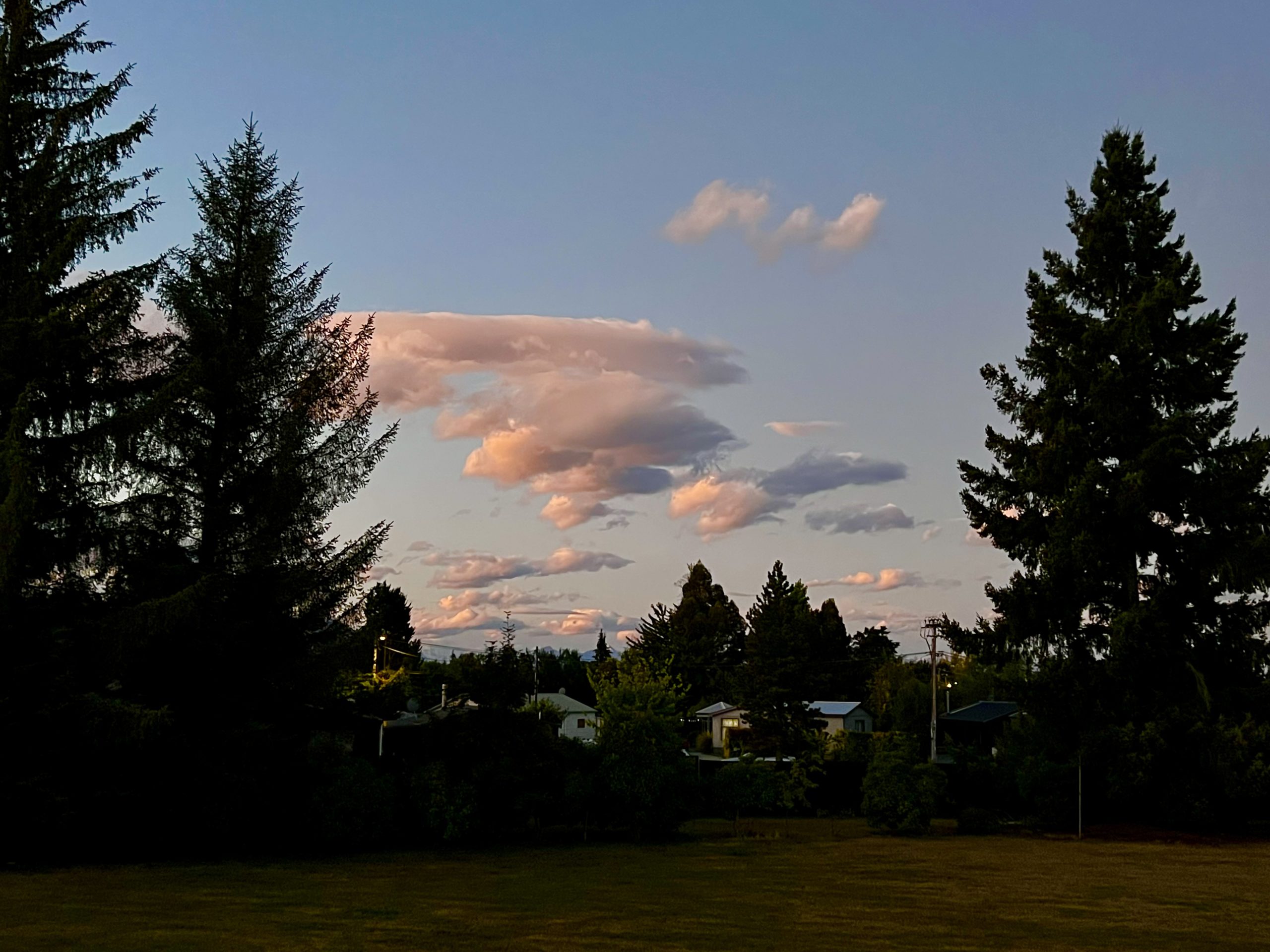
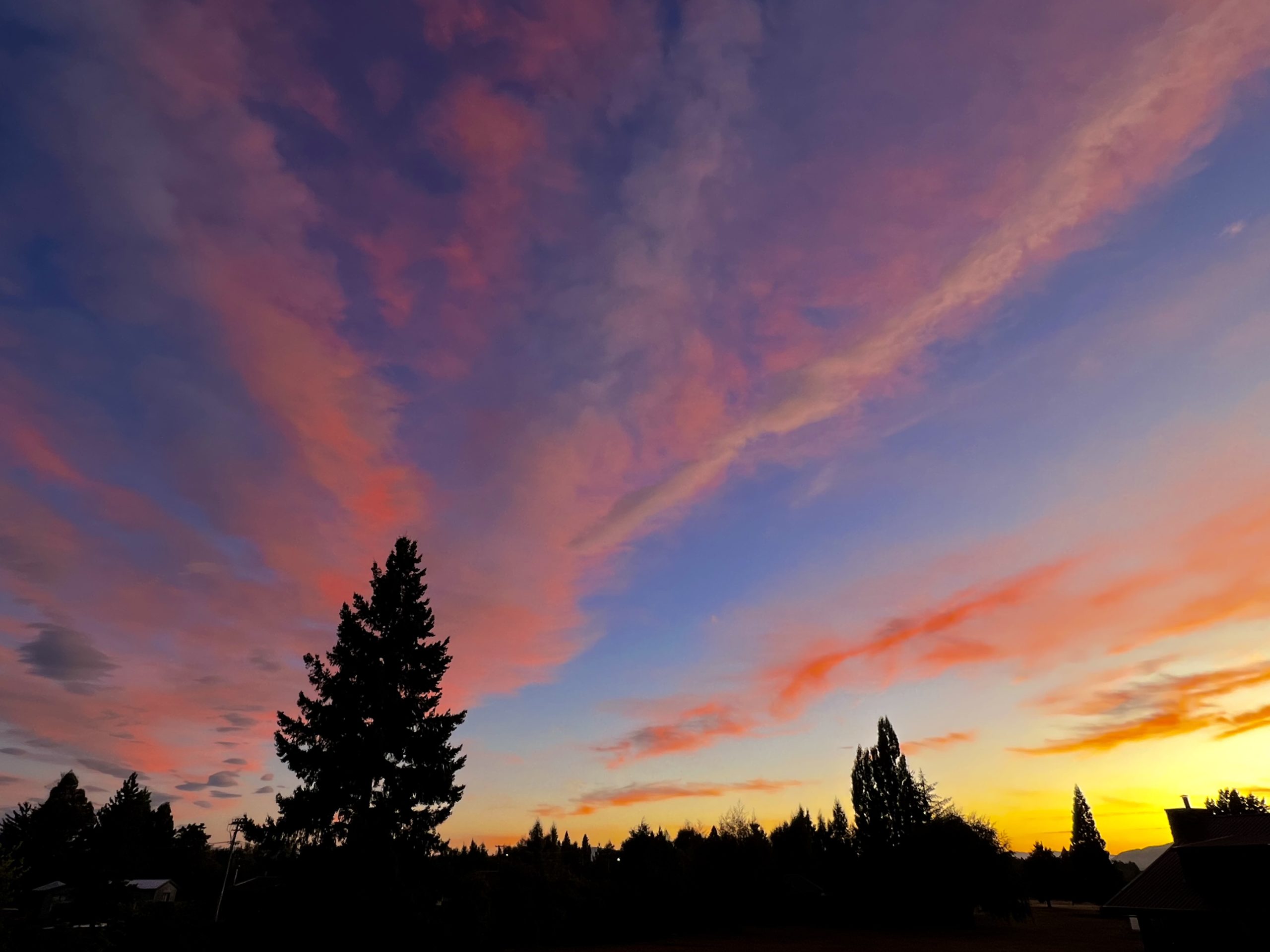
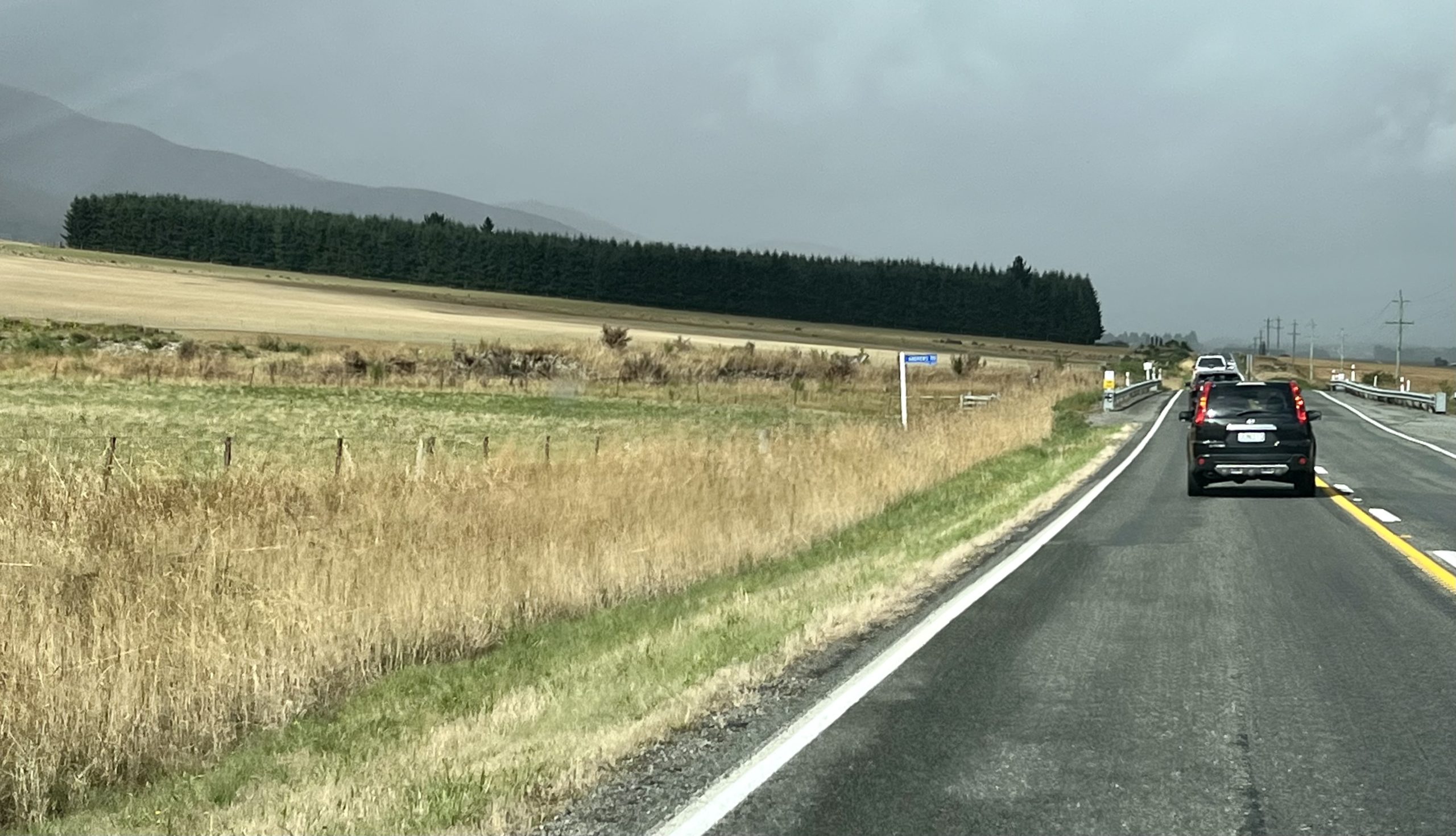
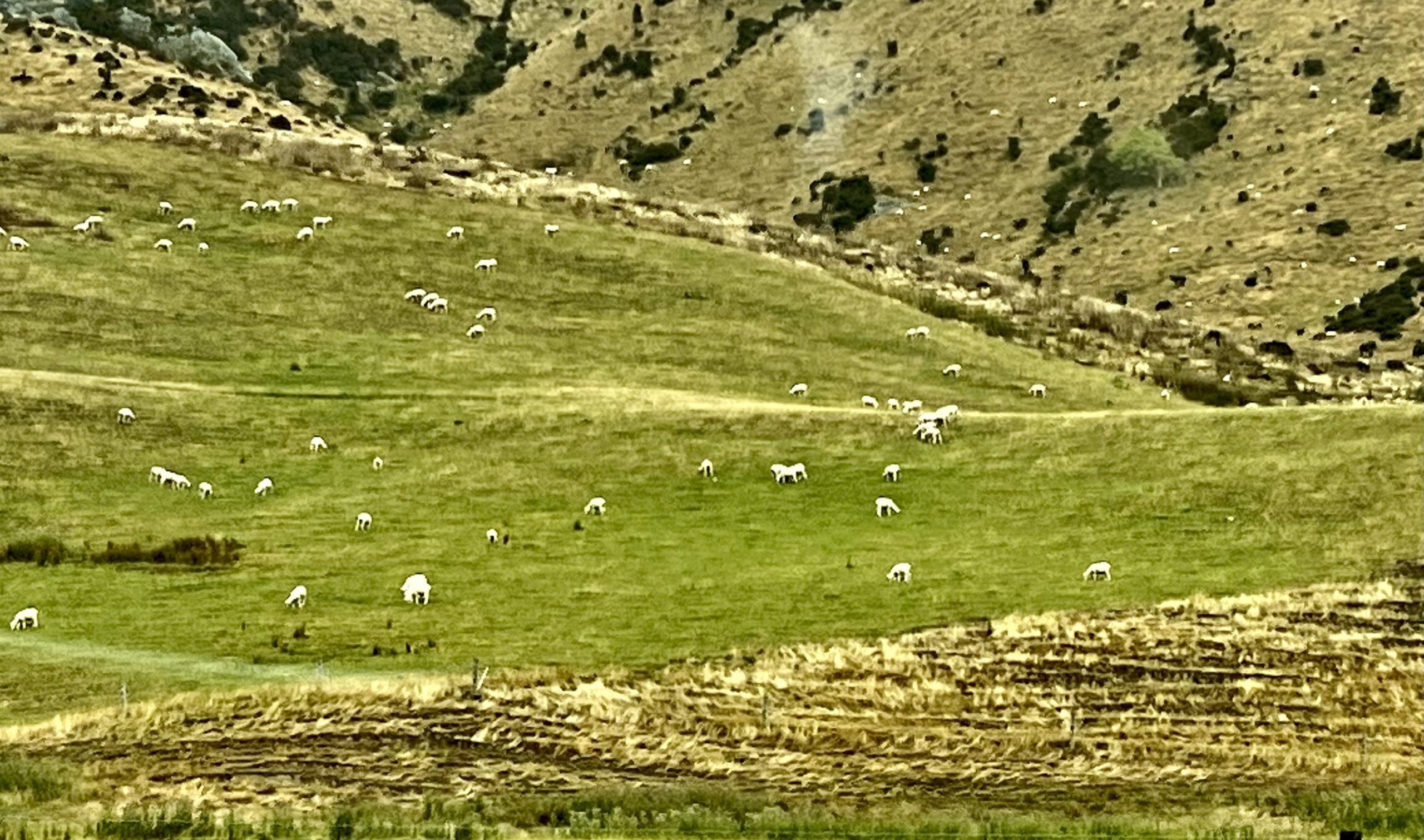
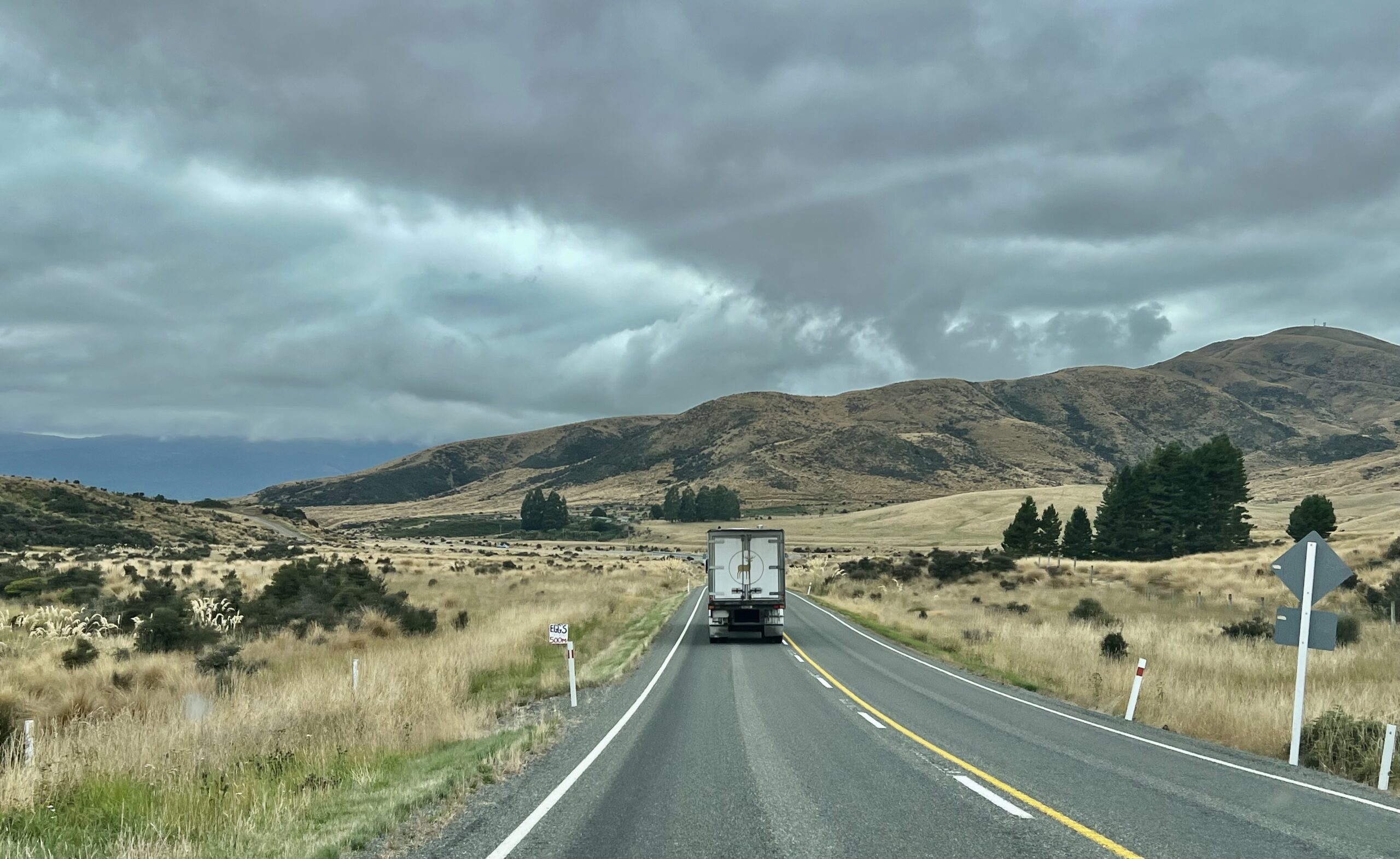
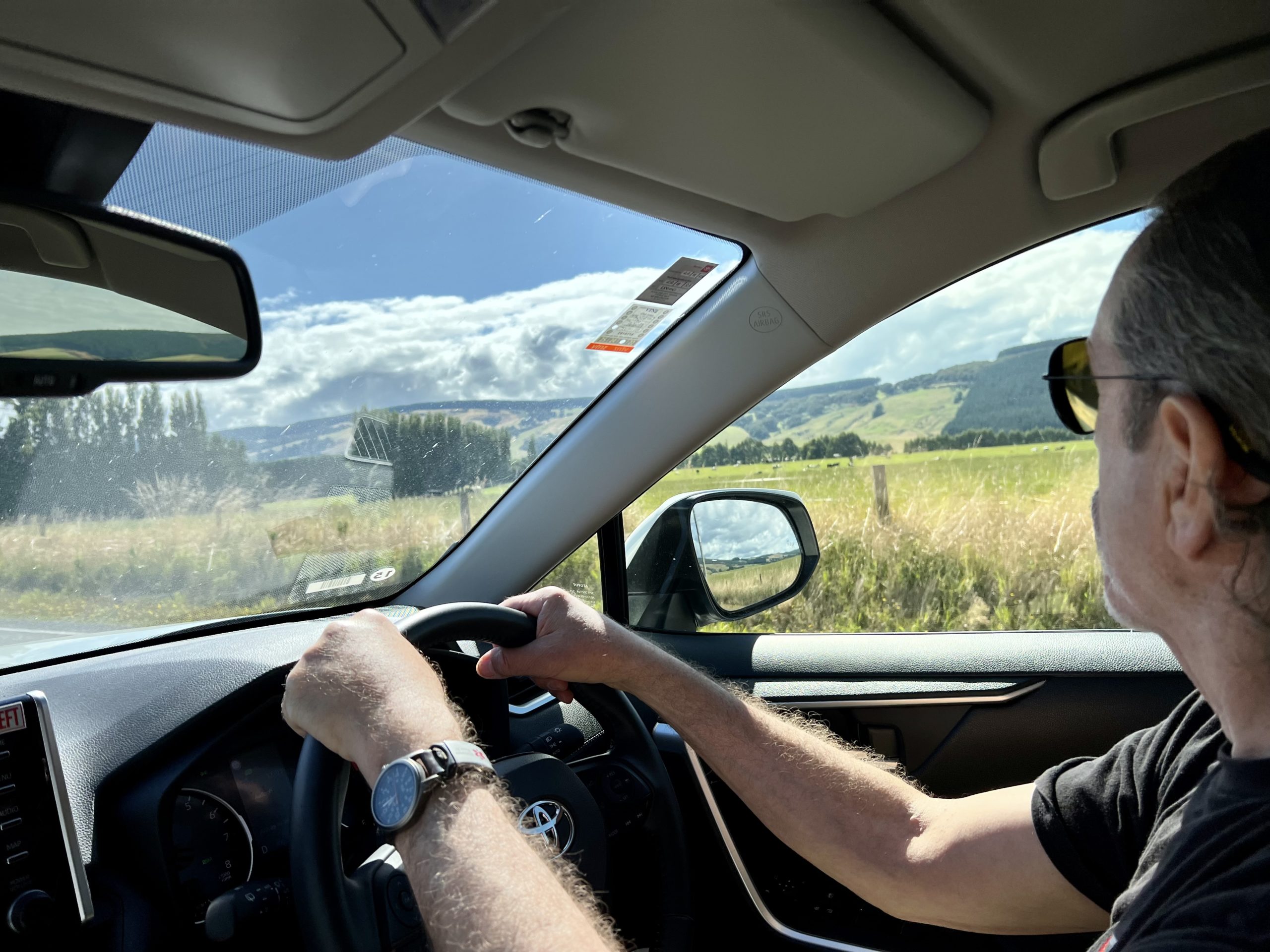
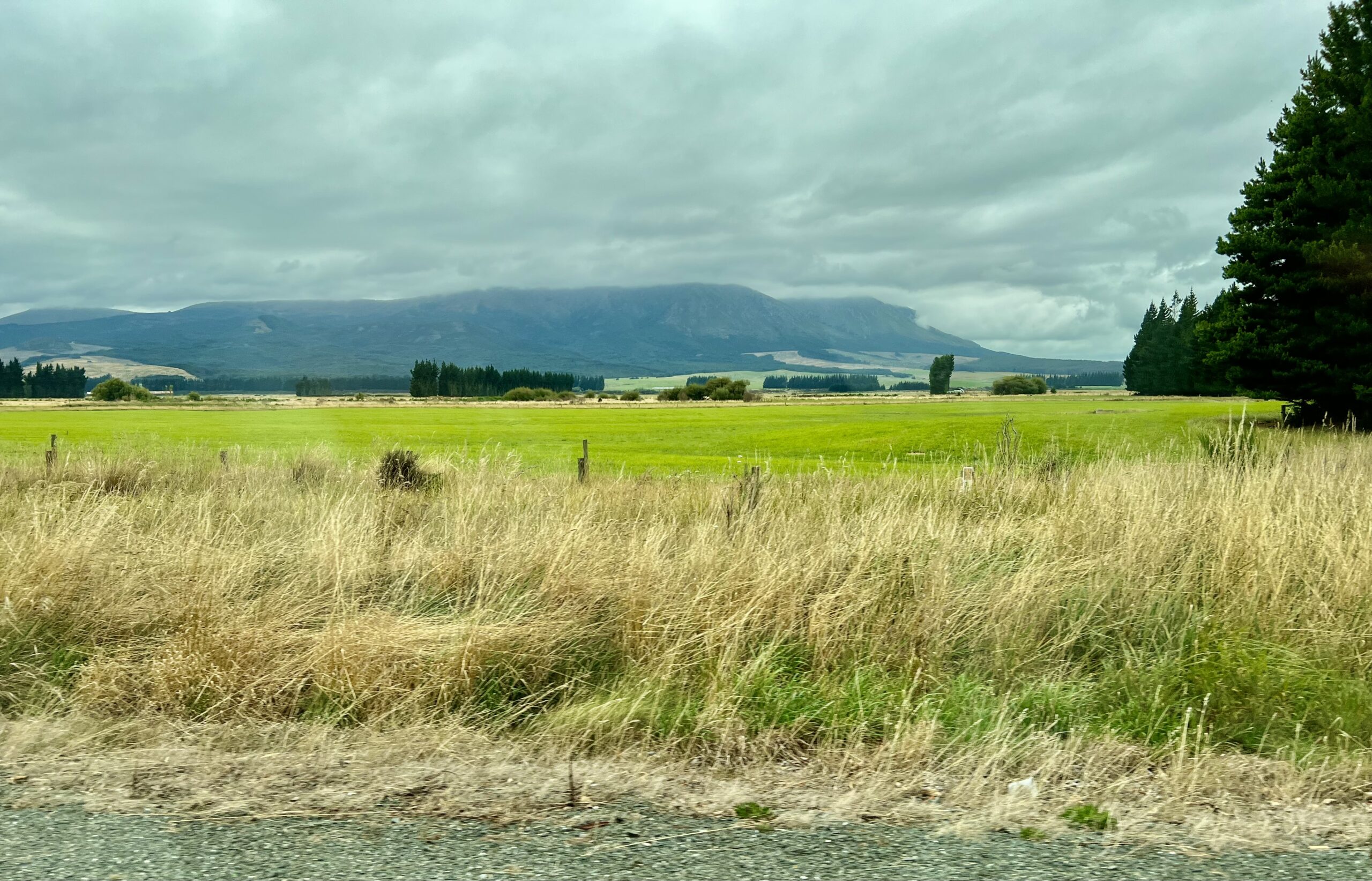
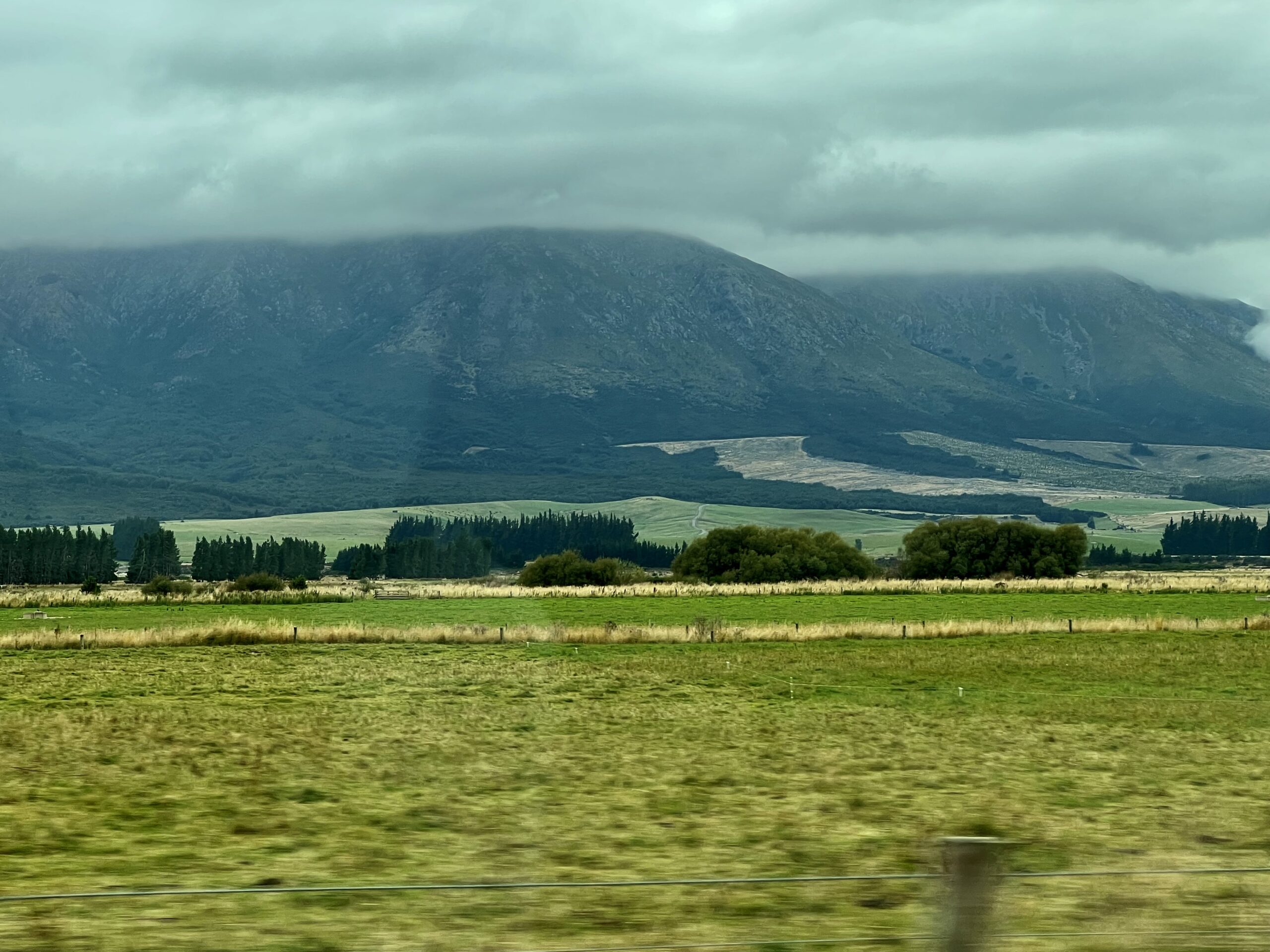
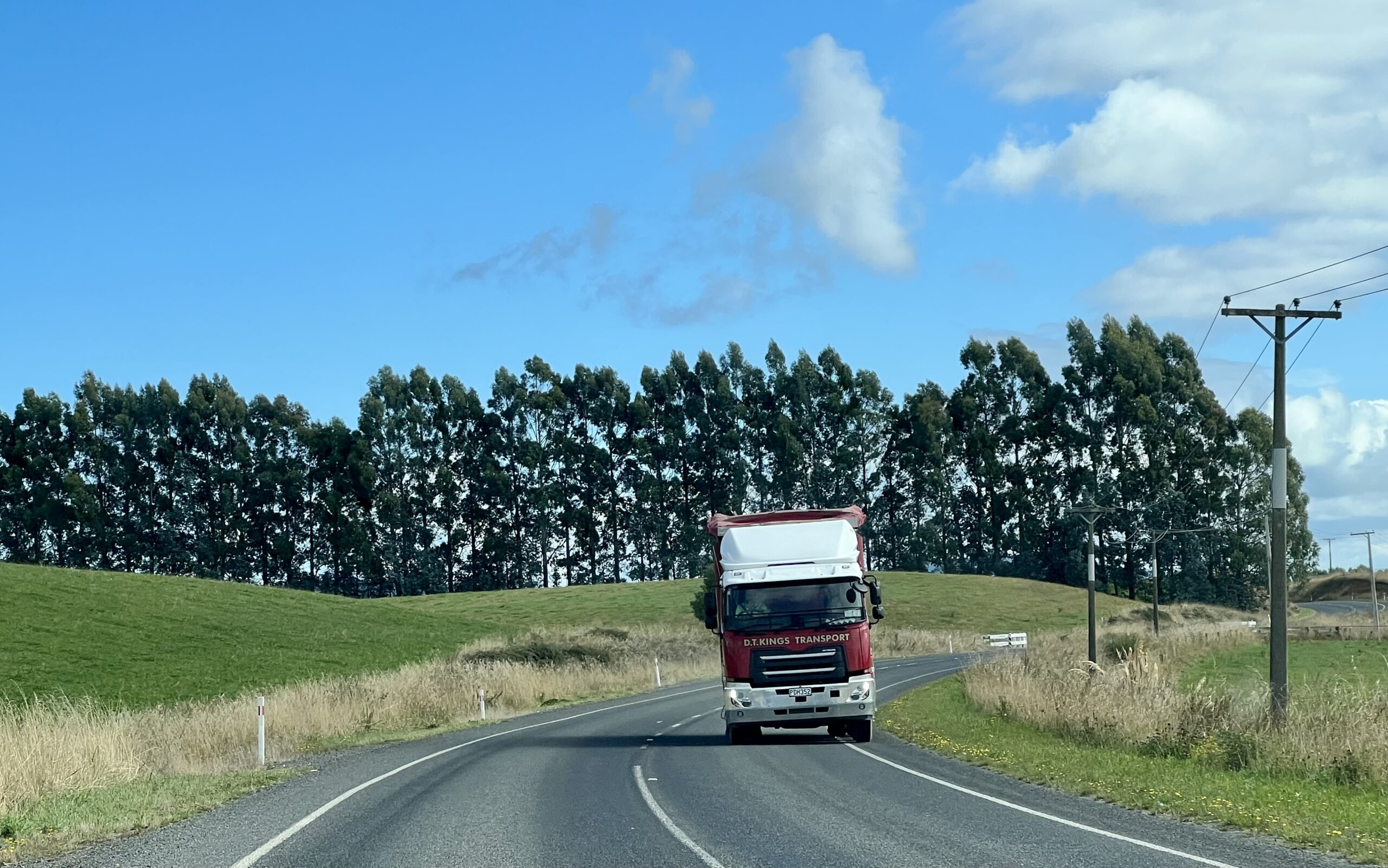
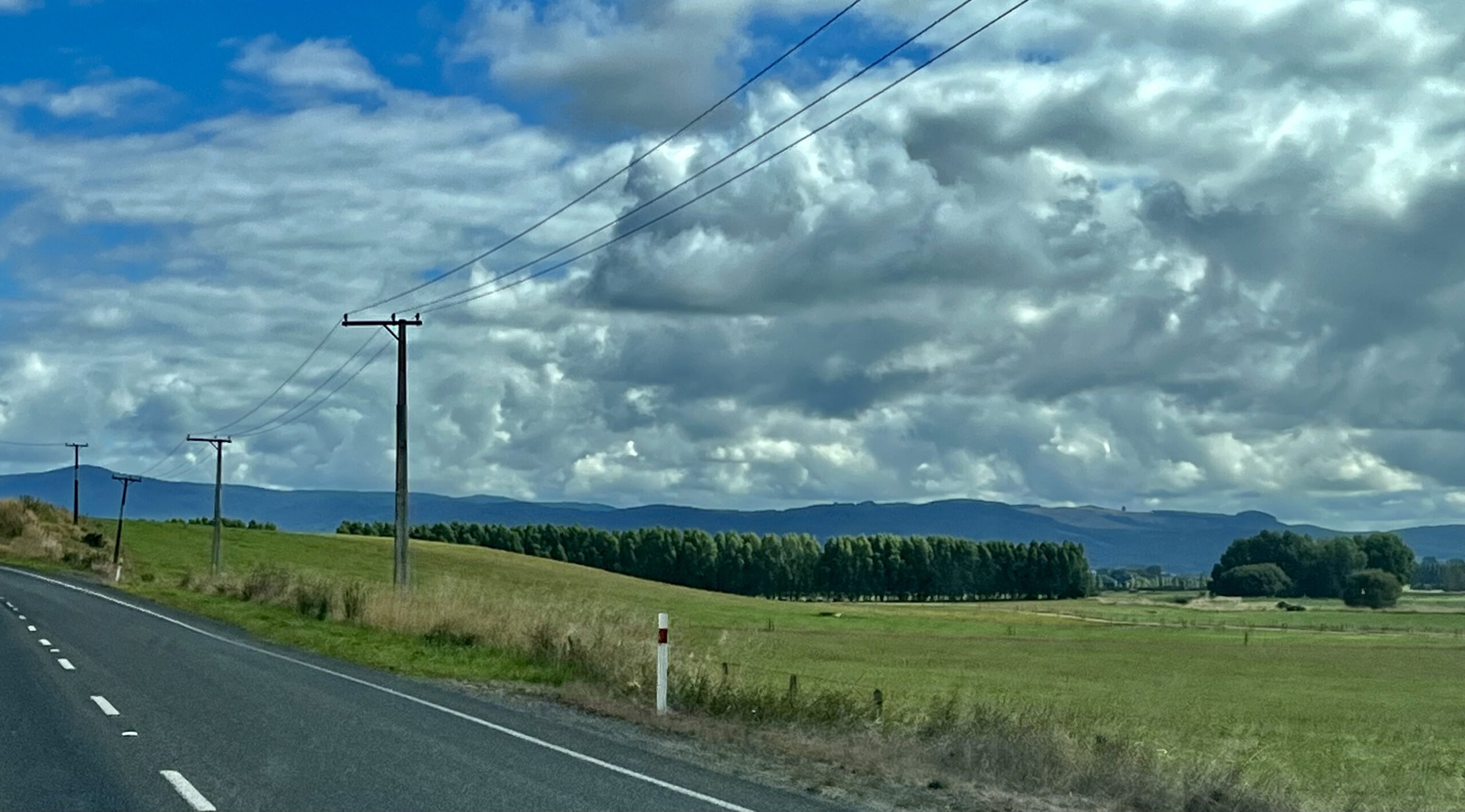
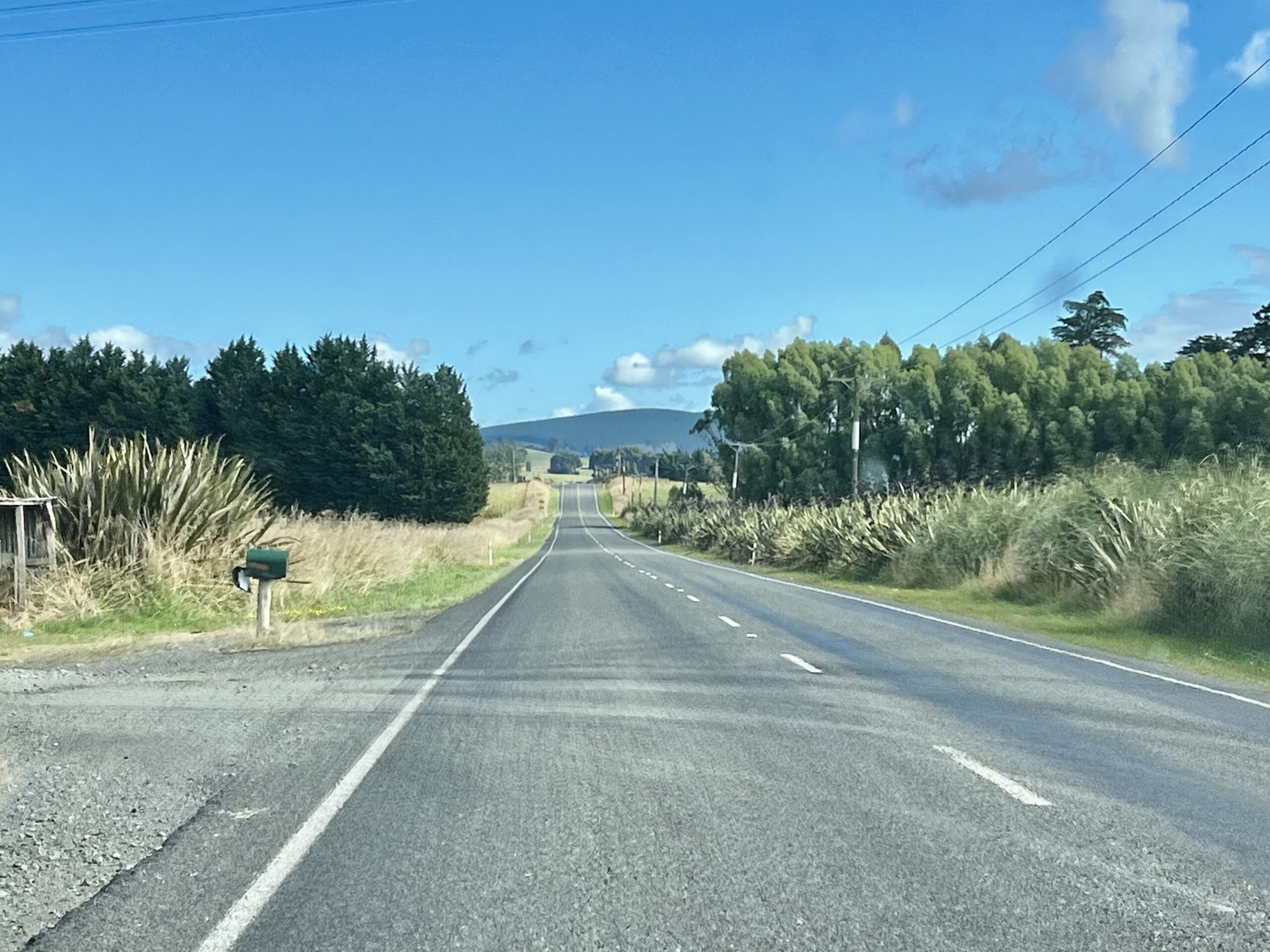
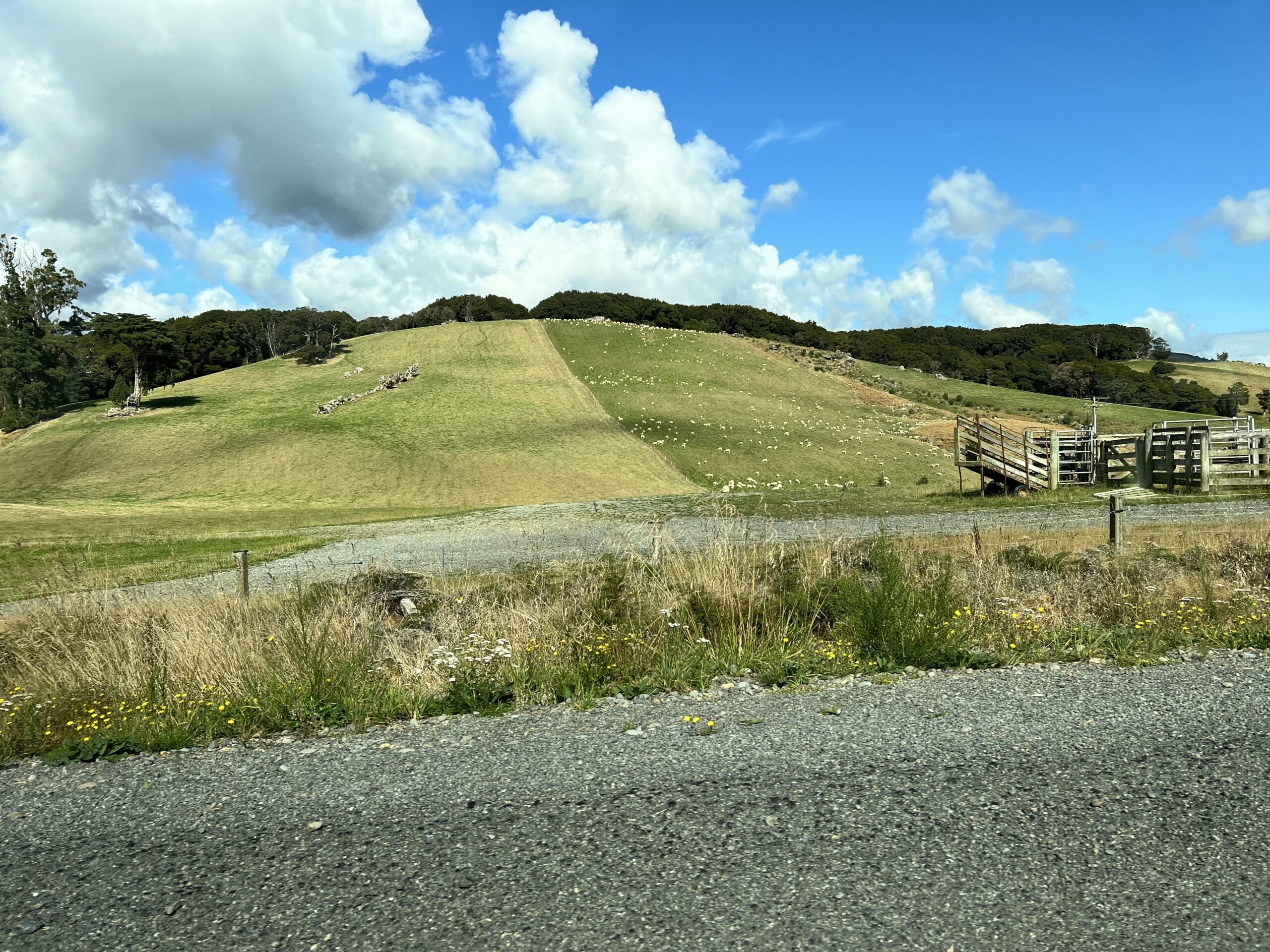
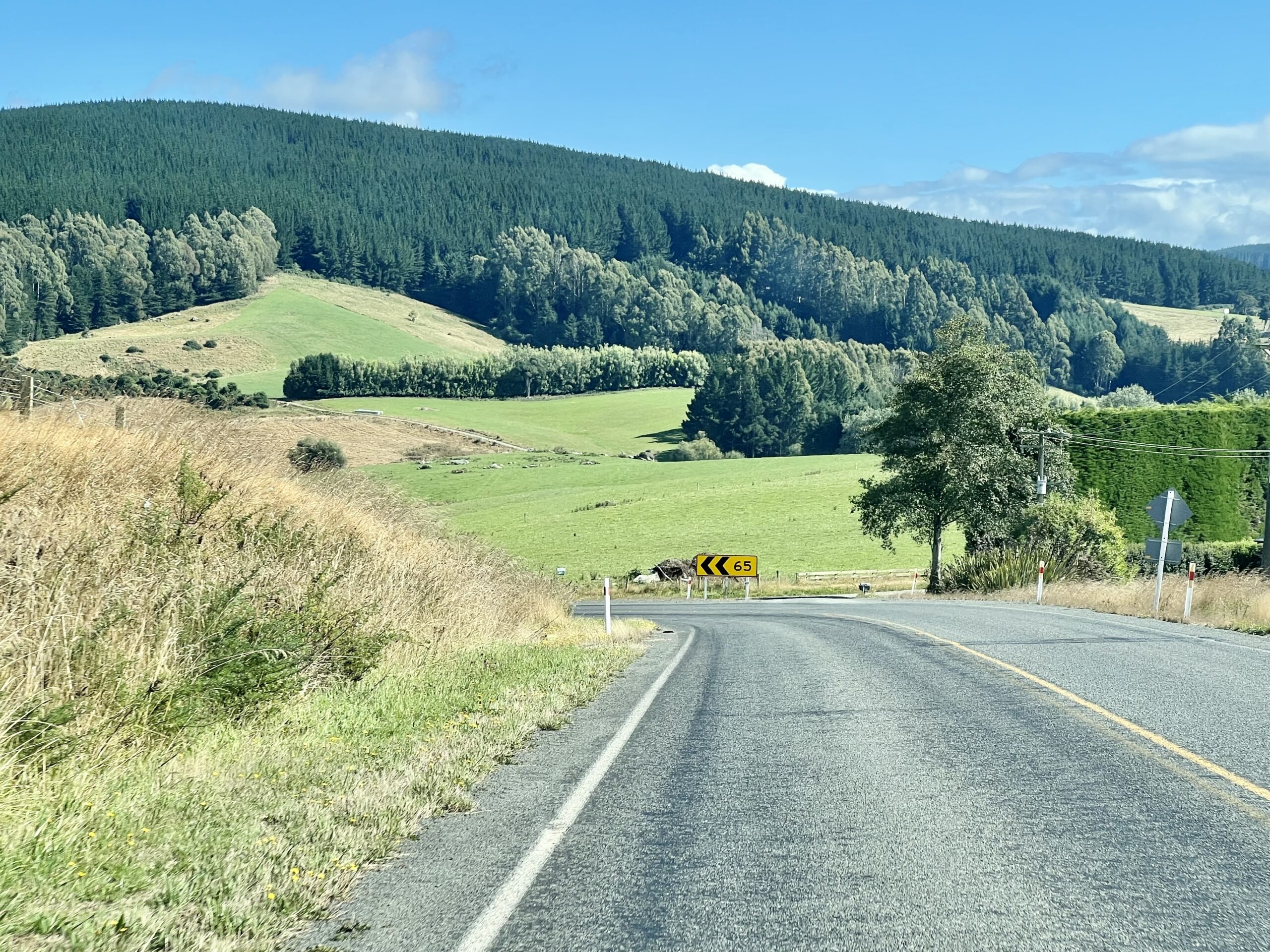
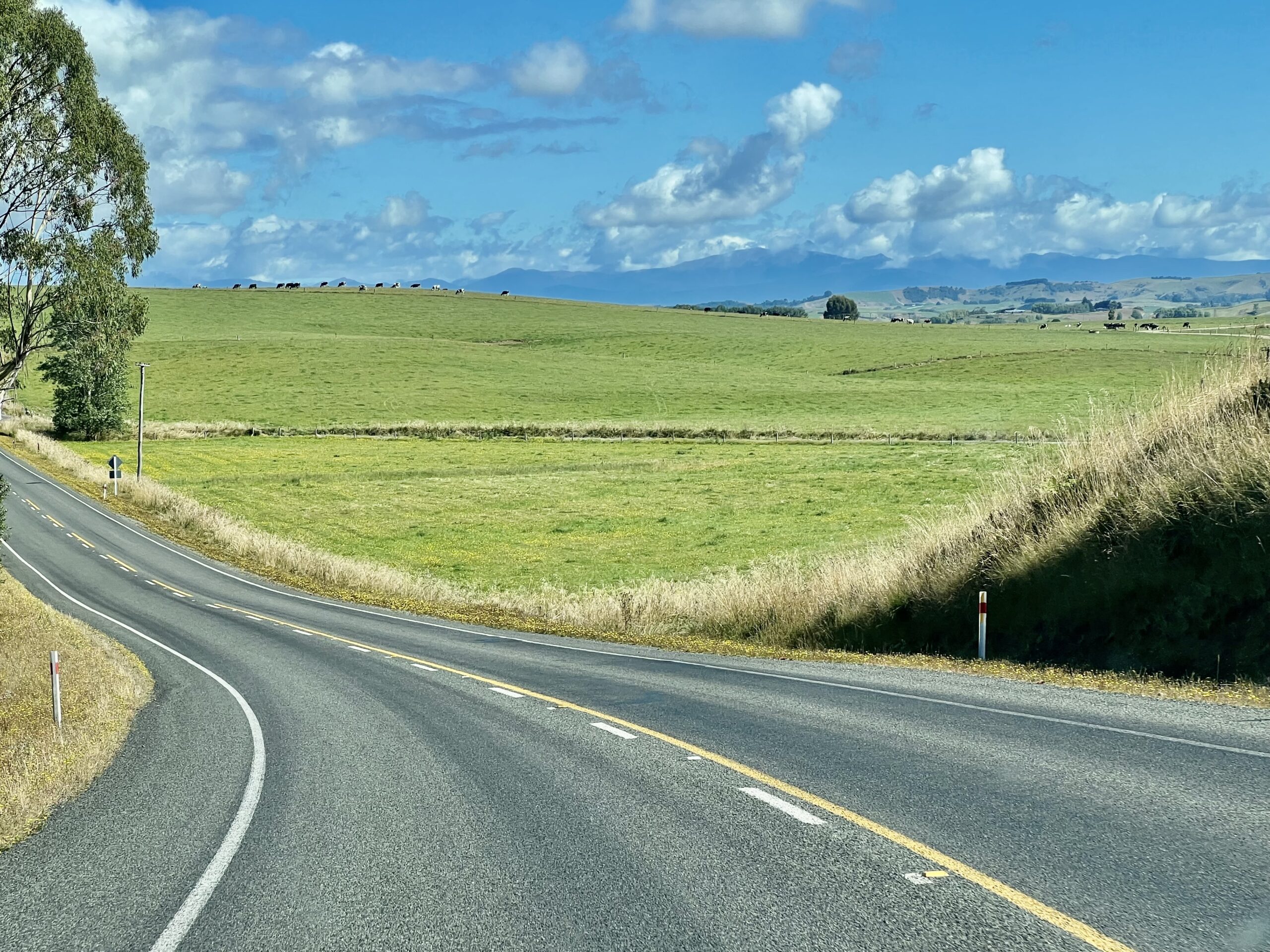
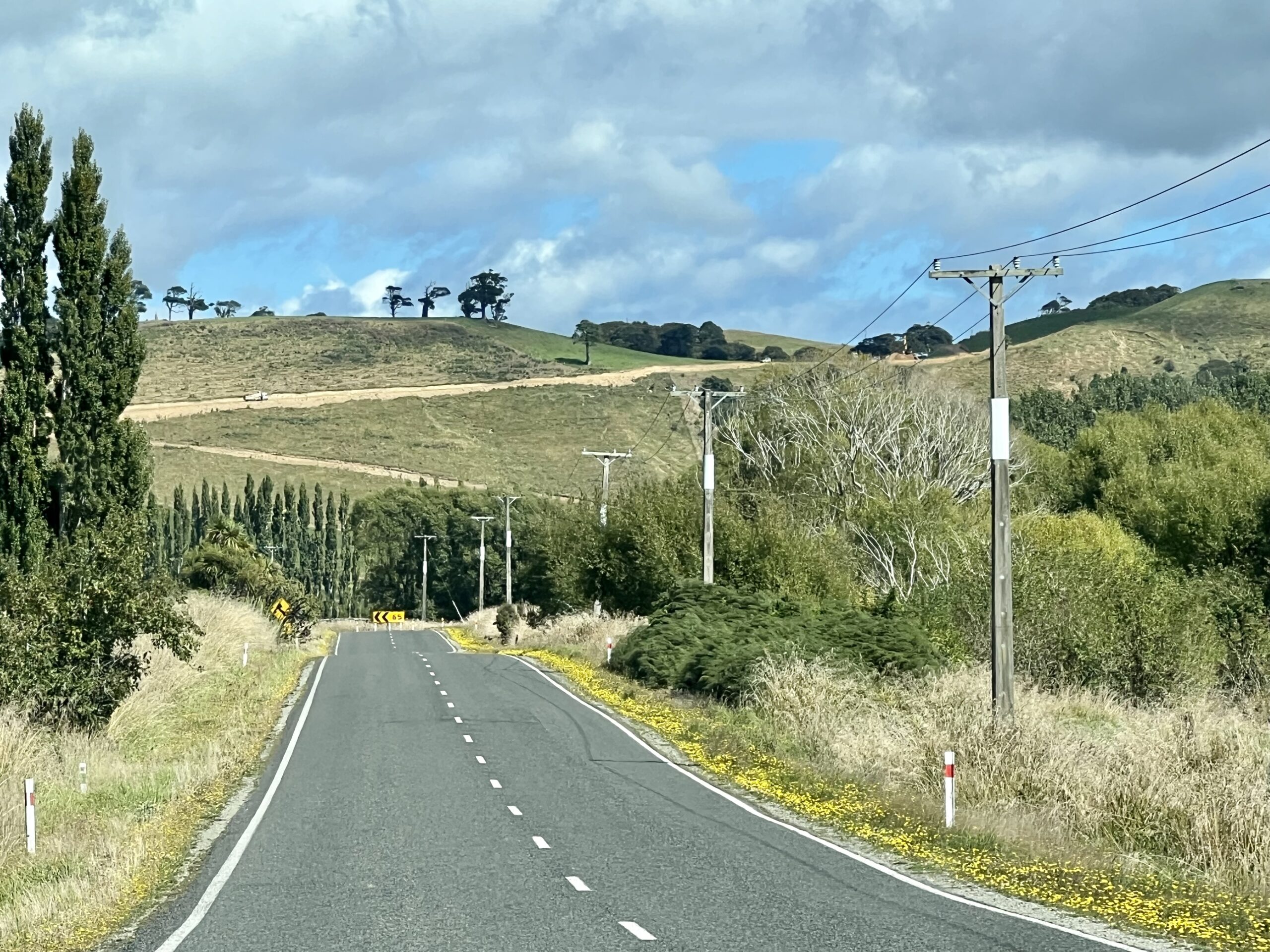
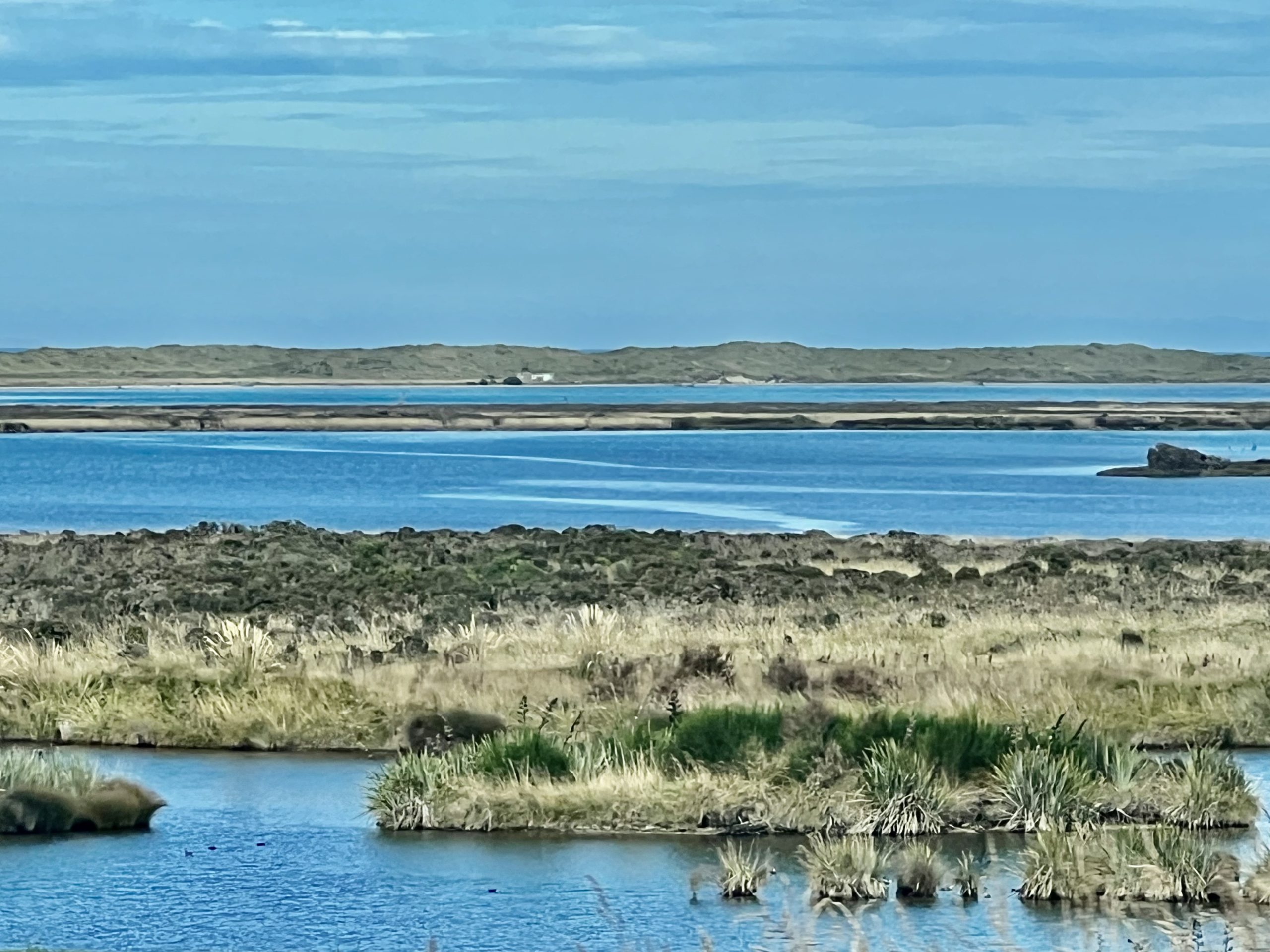
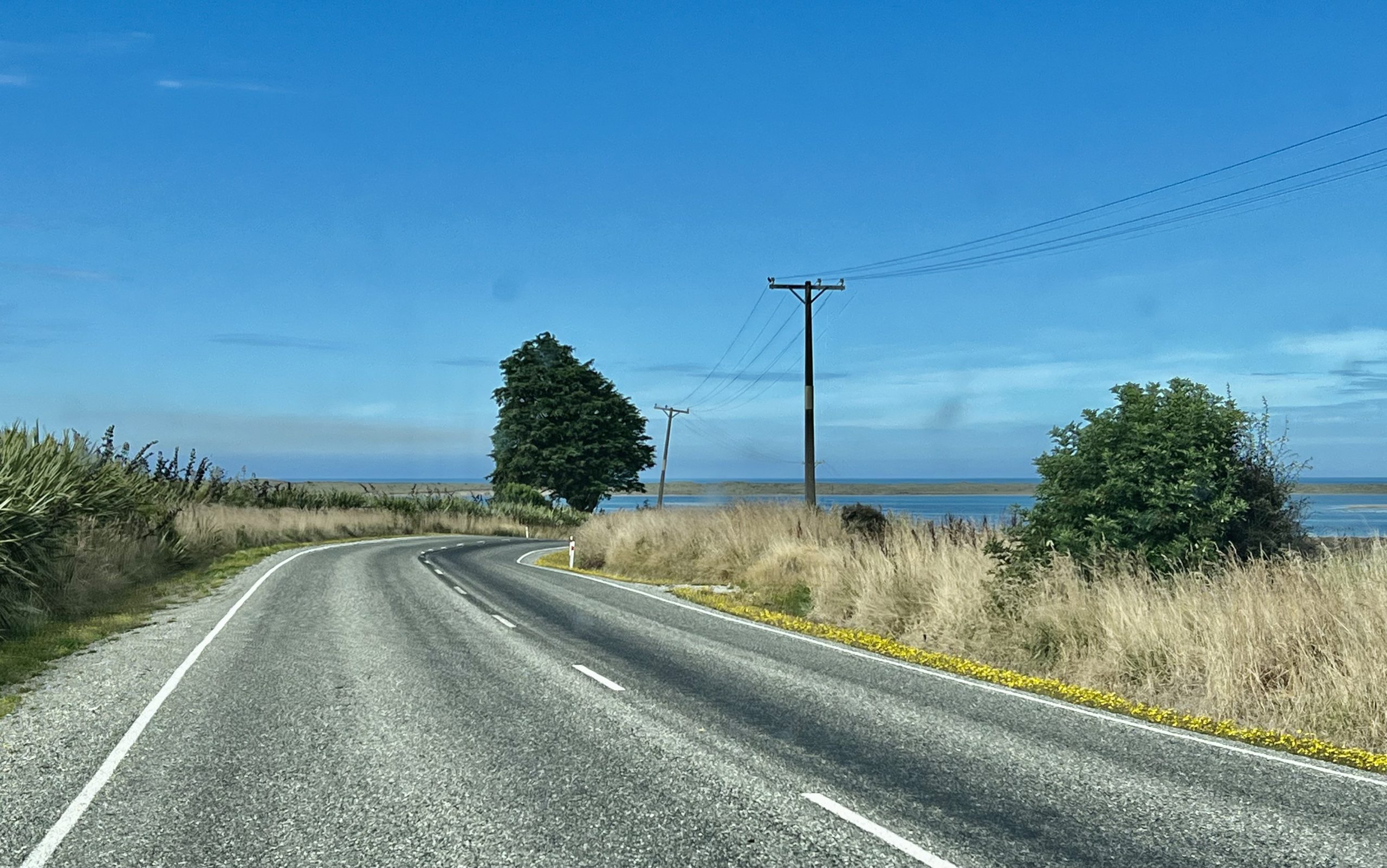
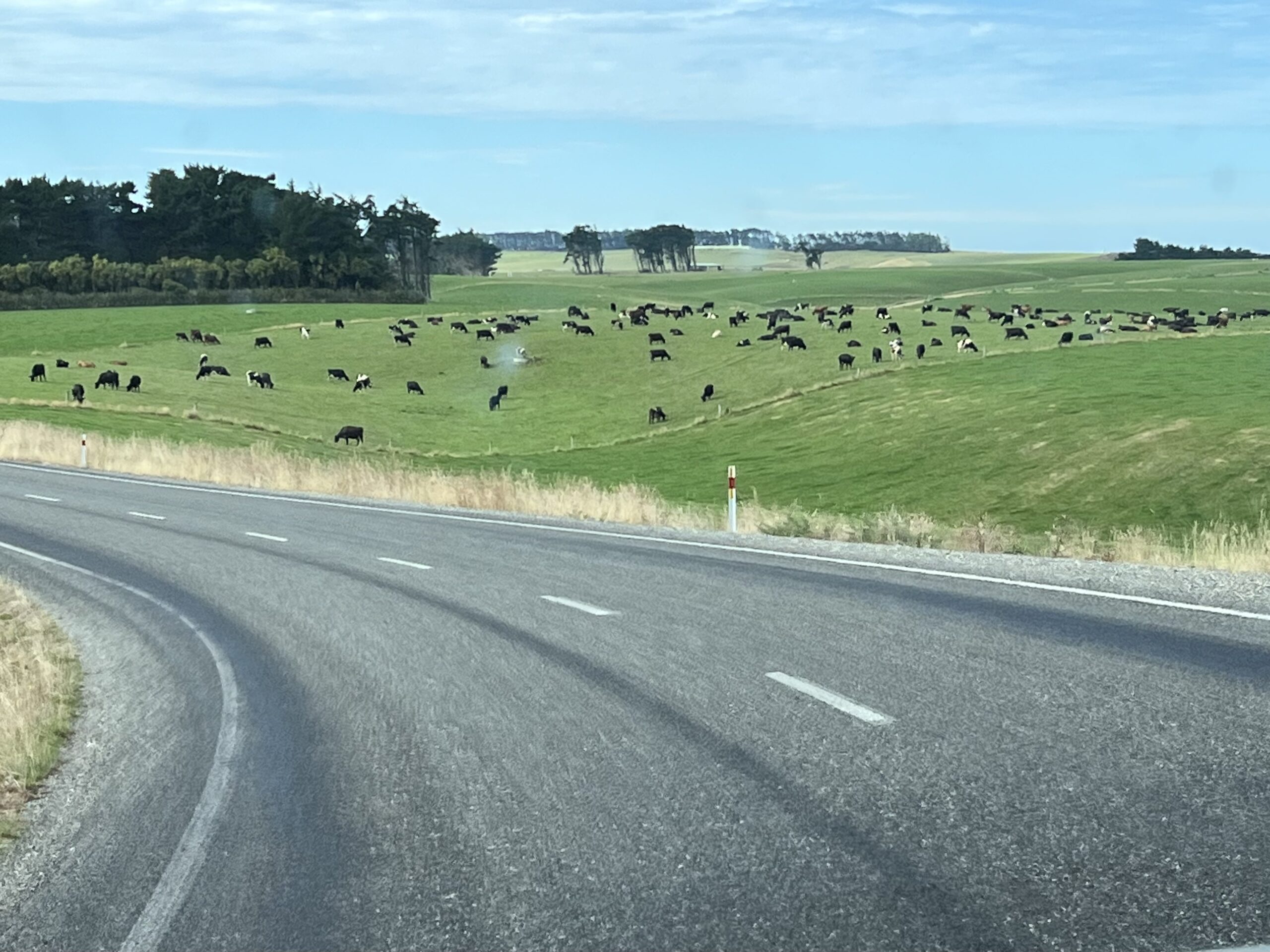
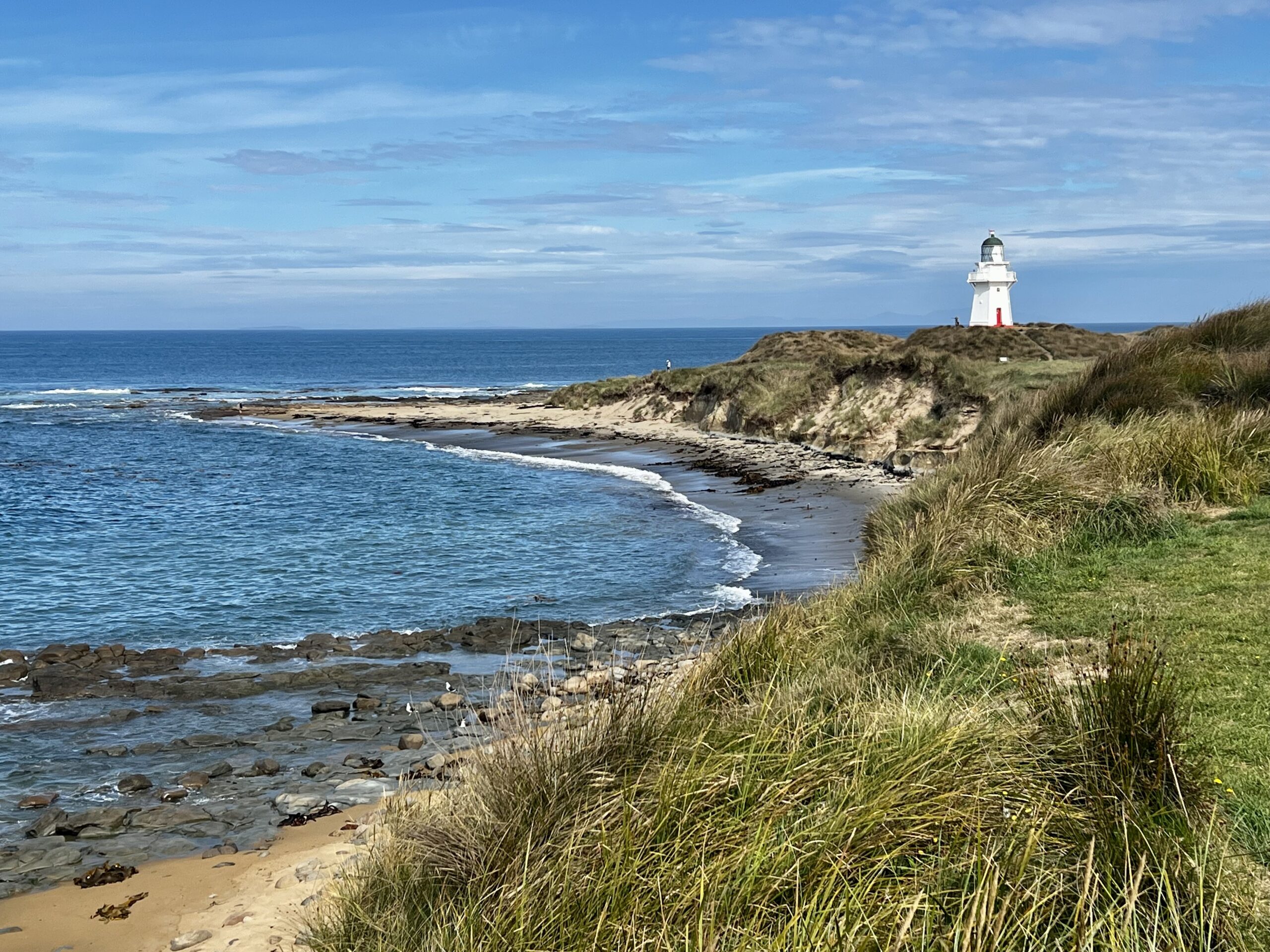
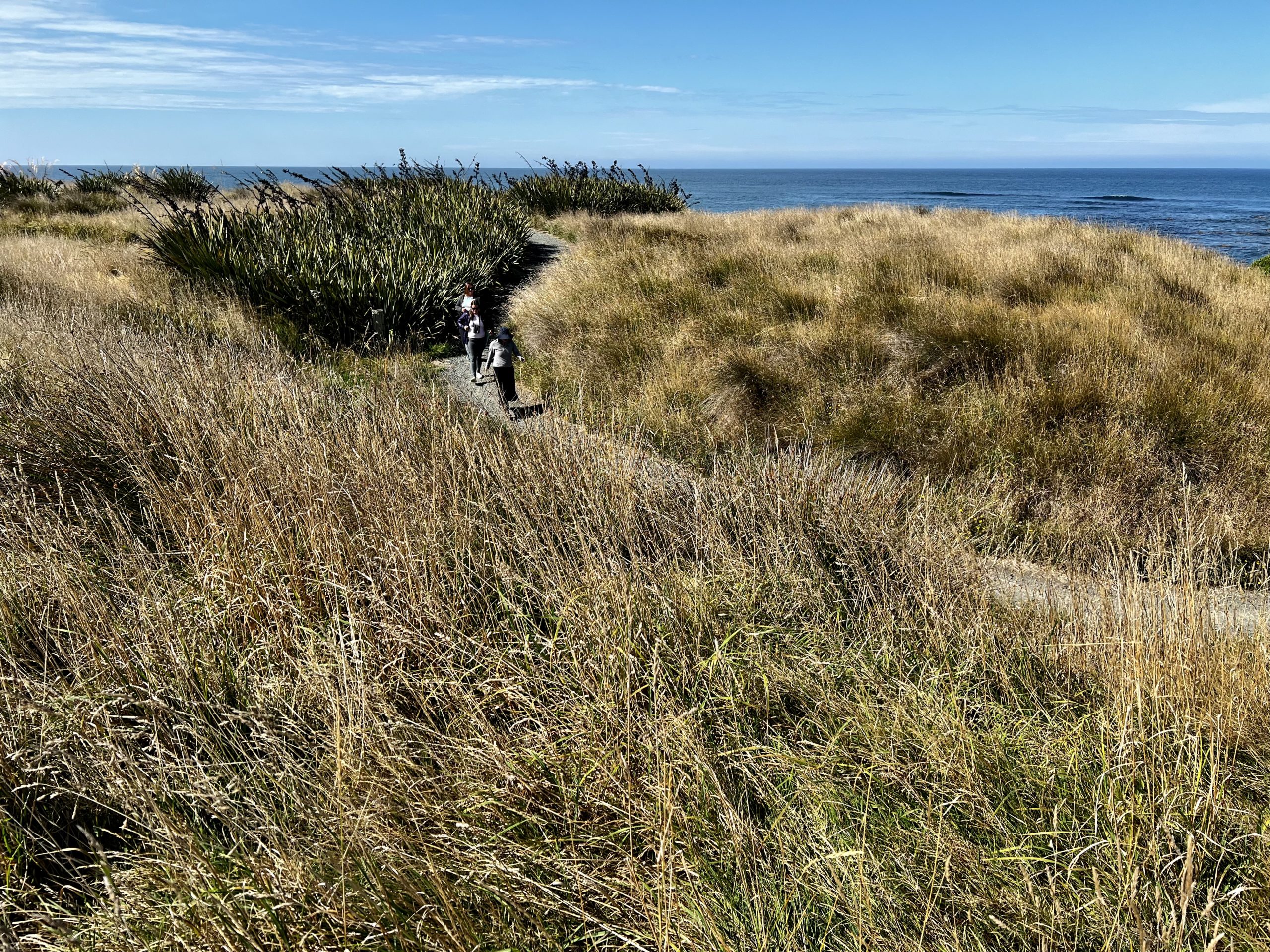
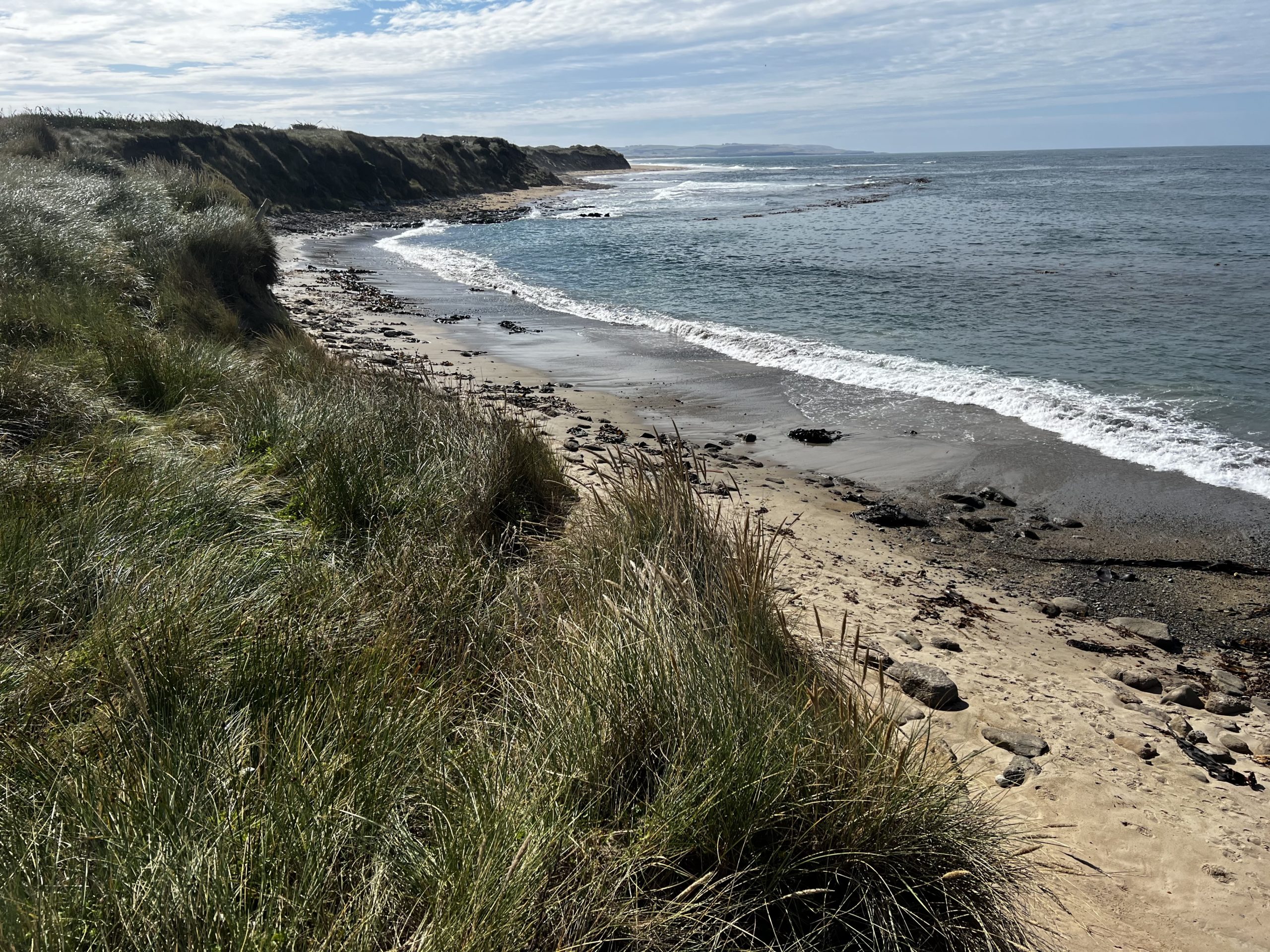
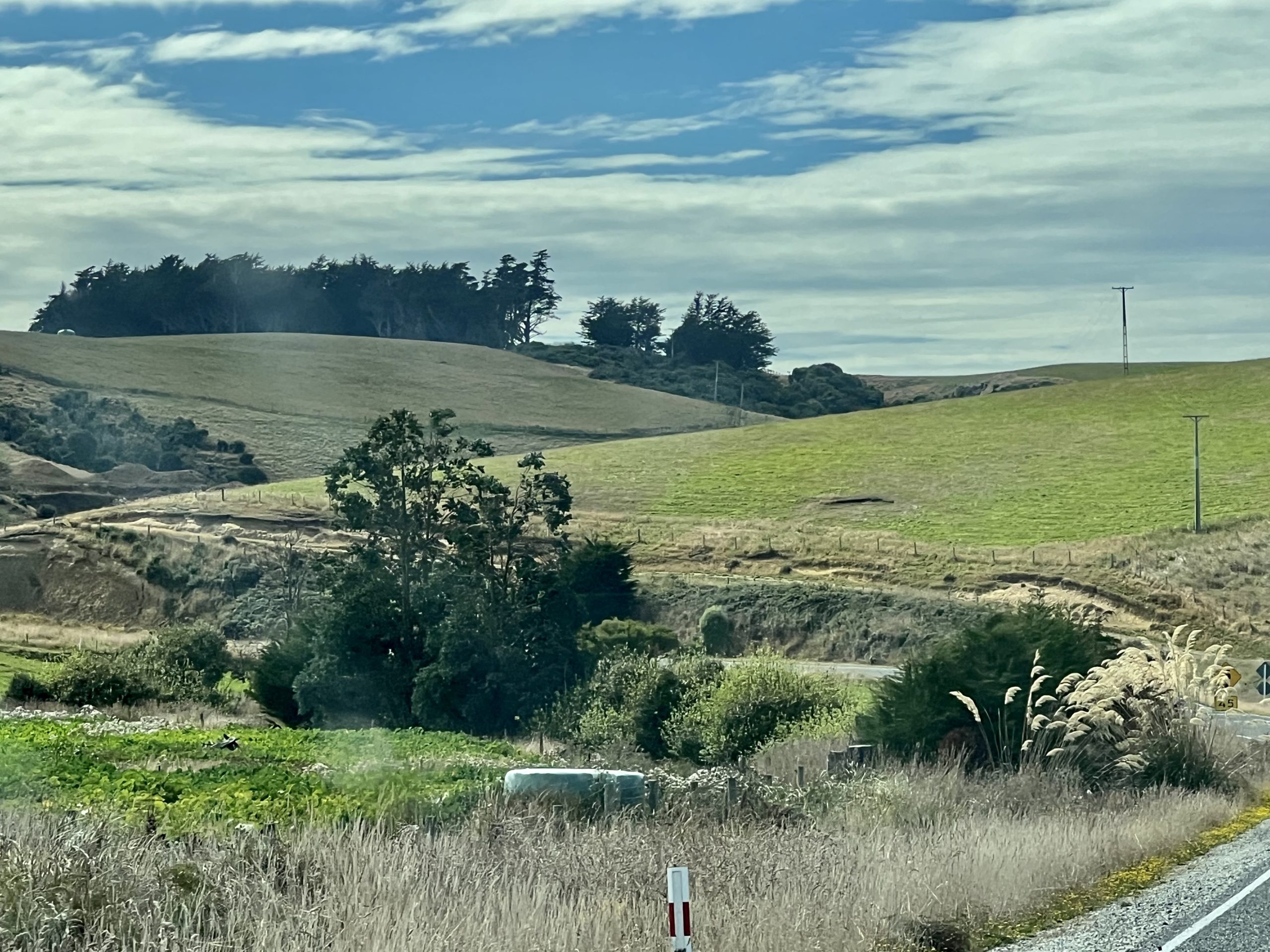
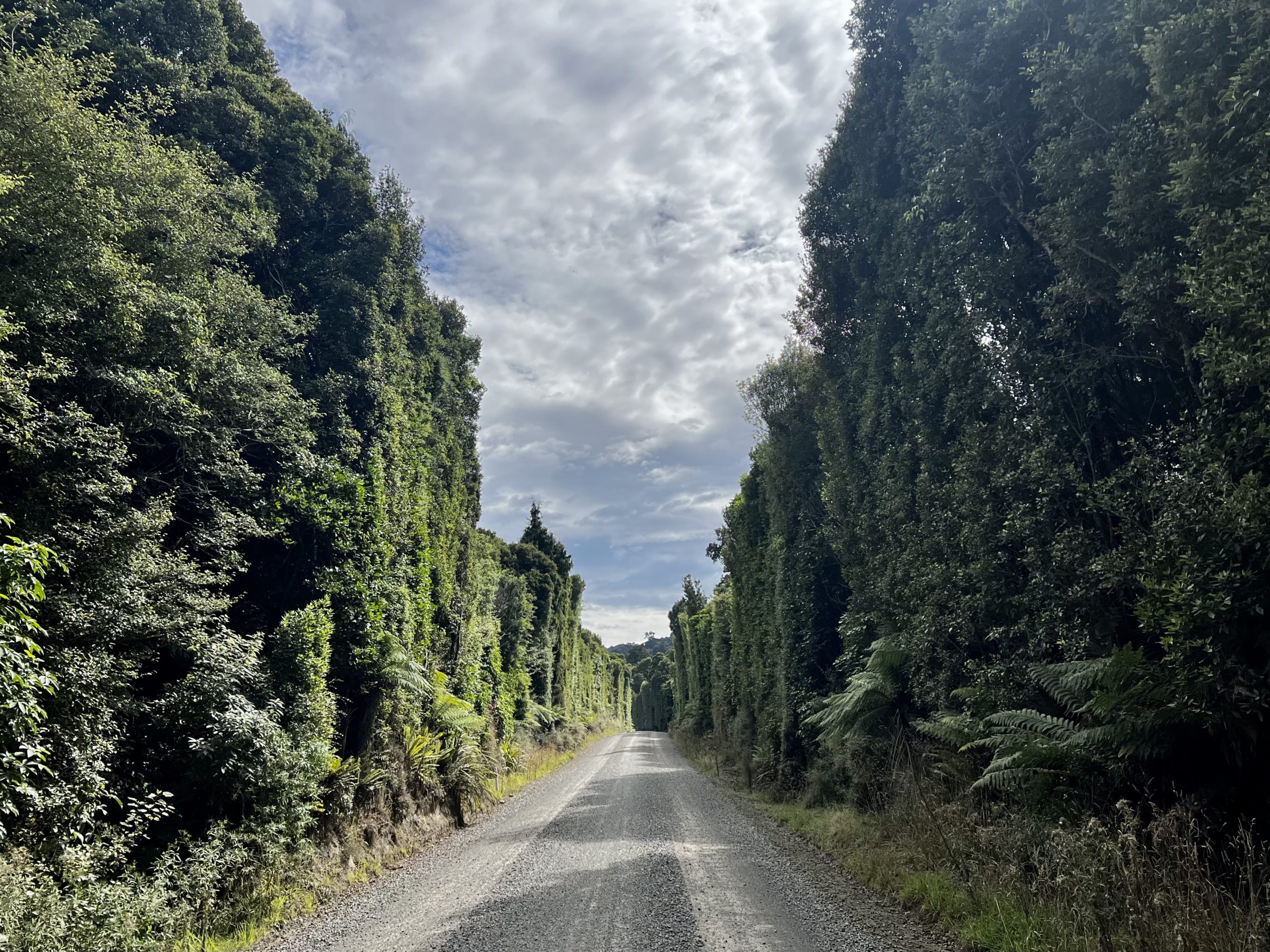
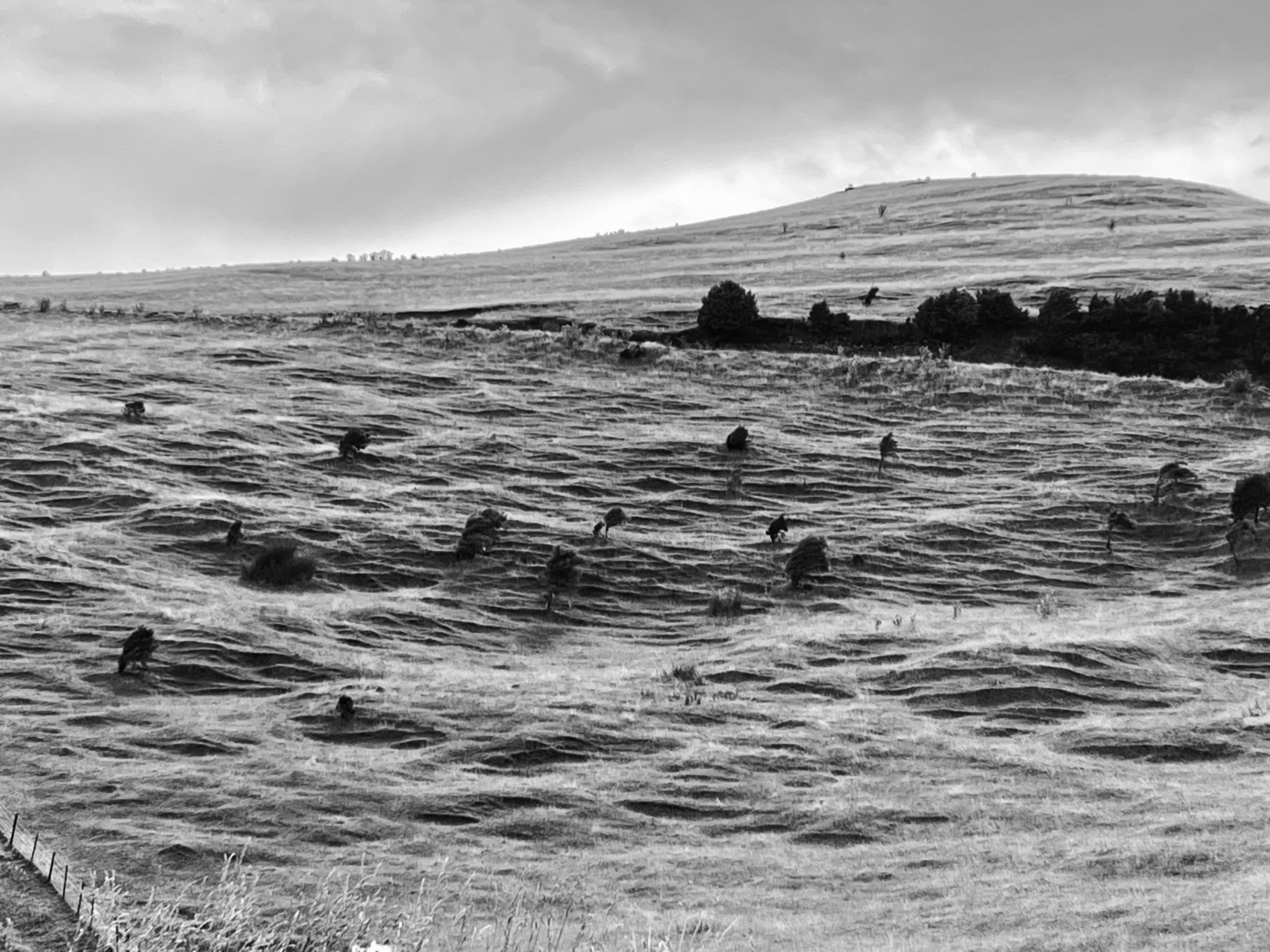
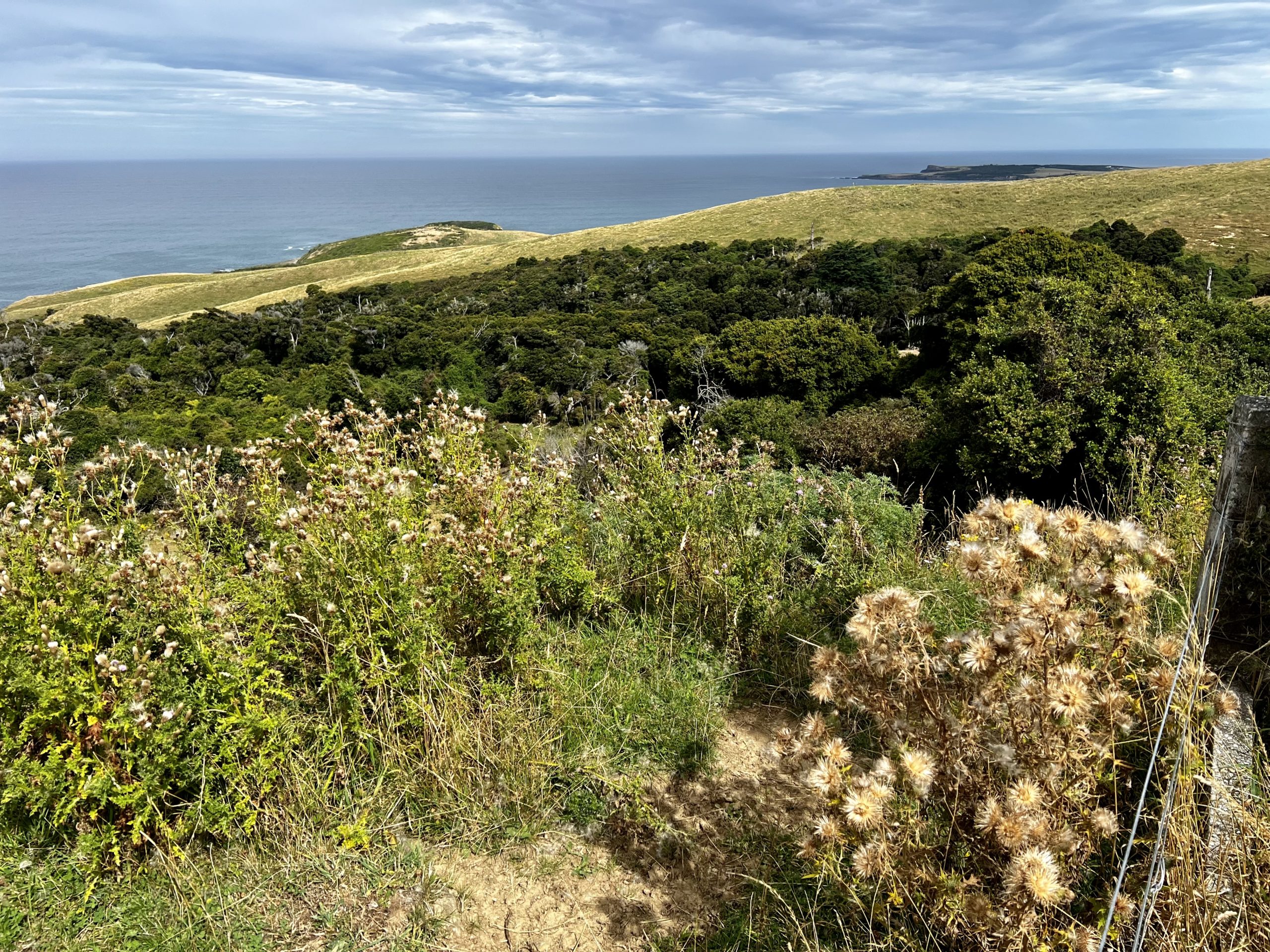
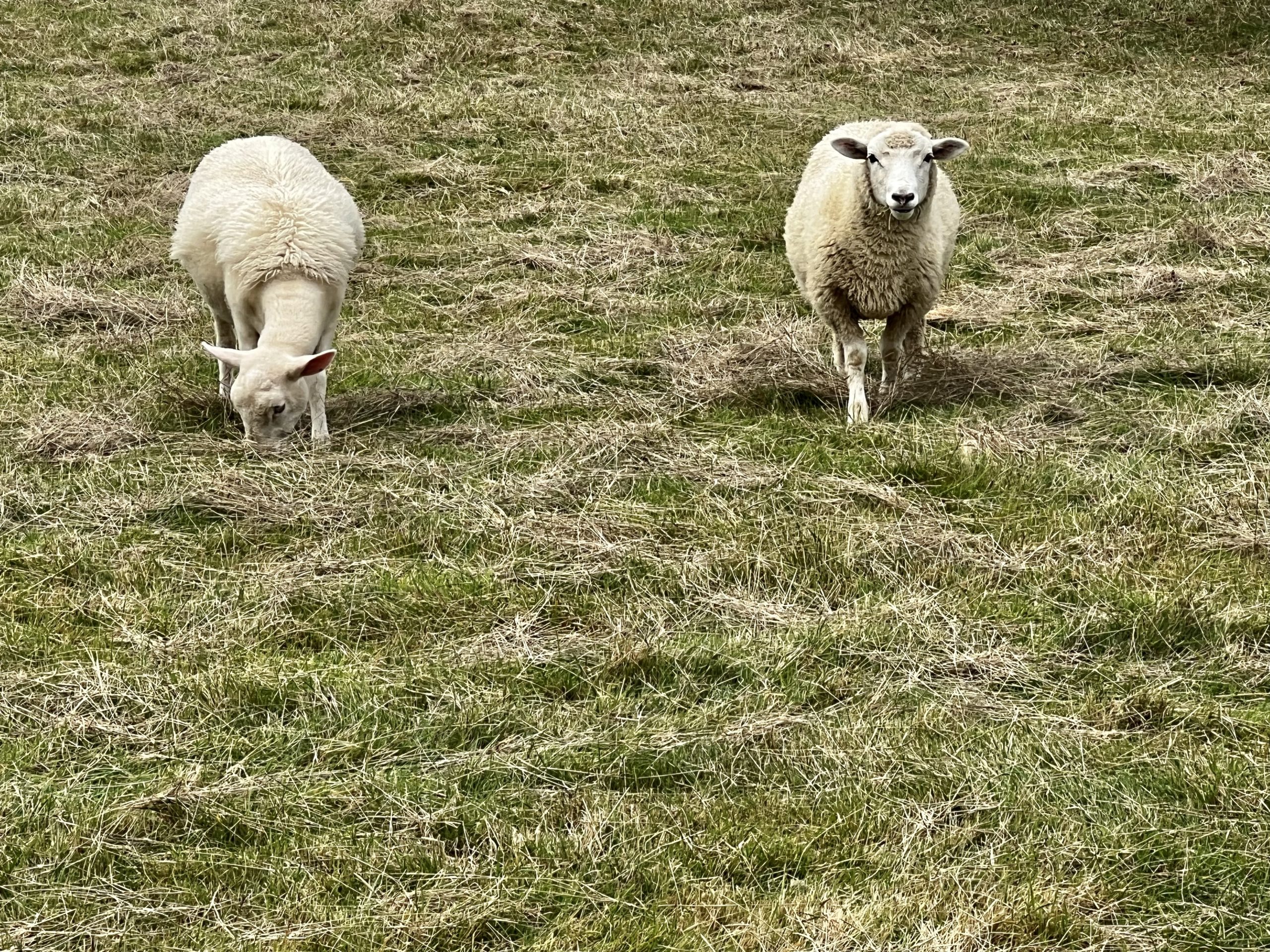
When you travel the roads in New Zealand, you find few motorways, what we Californians call freeways. Most are more like Highway 1 on the coast of San Mateo or Marin counties. When you do find a new multilane motorway, for some reason the speed limit drops to 50 kph (31 mph). And that is after you have driven winding two-lane country roads with speed limits of 80 to 100 kph. Also, don’t expect to go from point A to point B in a straight line. This is good because you travel through scenic landscapes that embrace planted forests, bush (wild vegetation) with tree ferns popping through, grazing sheep and dairy cattle, and even a few horses. Hills present themselves with mountains in the background. And the hills are not rolling and uniform as you might see in Marin County. The hills here are in all shapes and forms, often striped with the trails made on the steep slopes by erosion and sheep. The shapes and vegetation are so unusual that you expect to encounter some mystical creature popping through an opening in the landscape. And clouds do not lose out to the beauty of the land below. They too are in massive shapes and sizes that flow over you. Makes for dramatic views during the day and at sunset.
Roundabouts rule here. You encounter very few stop signs or stop lights once you leave larger urban areas.
If you are dyslexic, like Robert, be sure to travel with someone who is not, like Bonnie. Robert can deal with names like Twizel and Te Ano. But, when it comes to names like Paraparaumu and Pukeamoamo, he is lost. Too many syllables!
On the Way from Martinborough
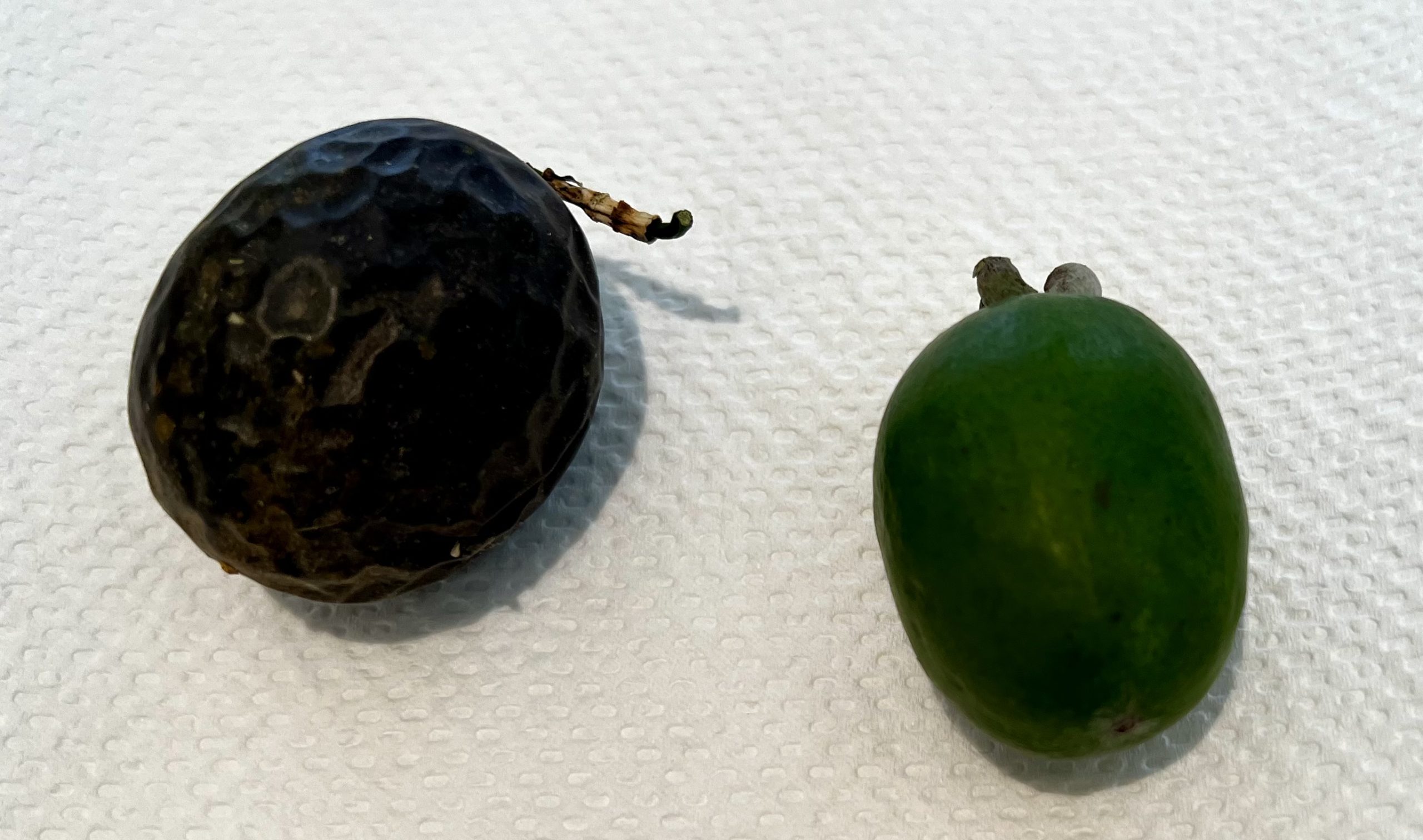
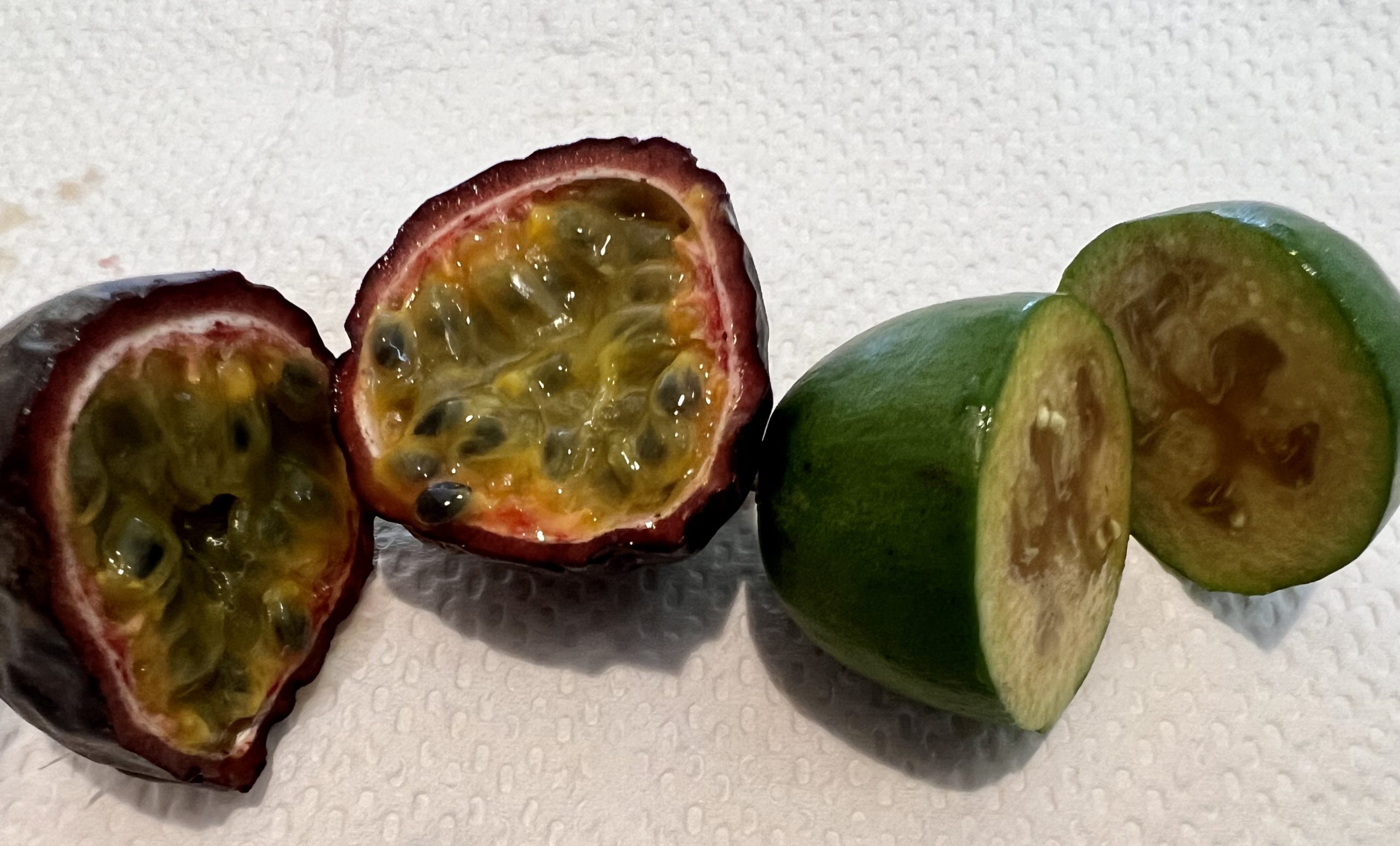
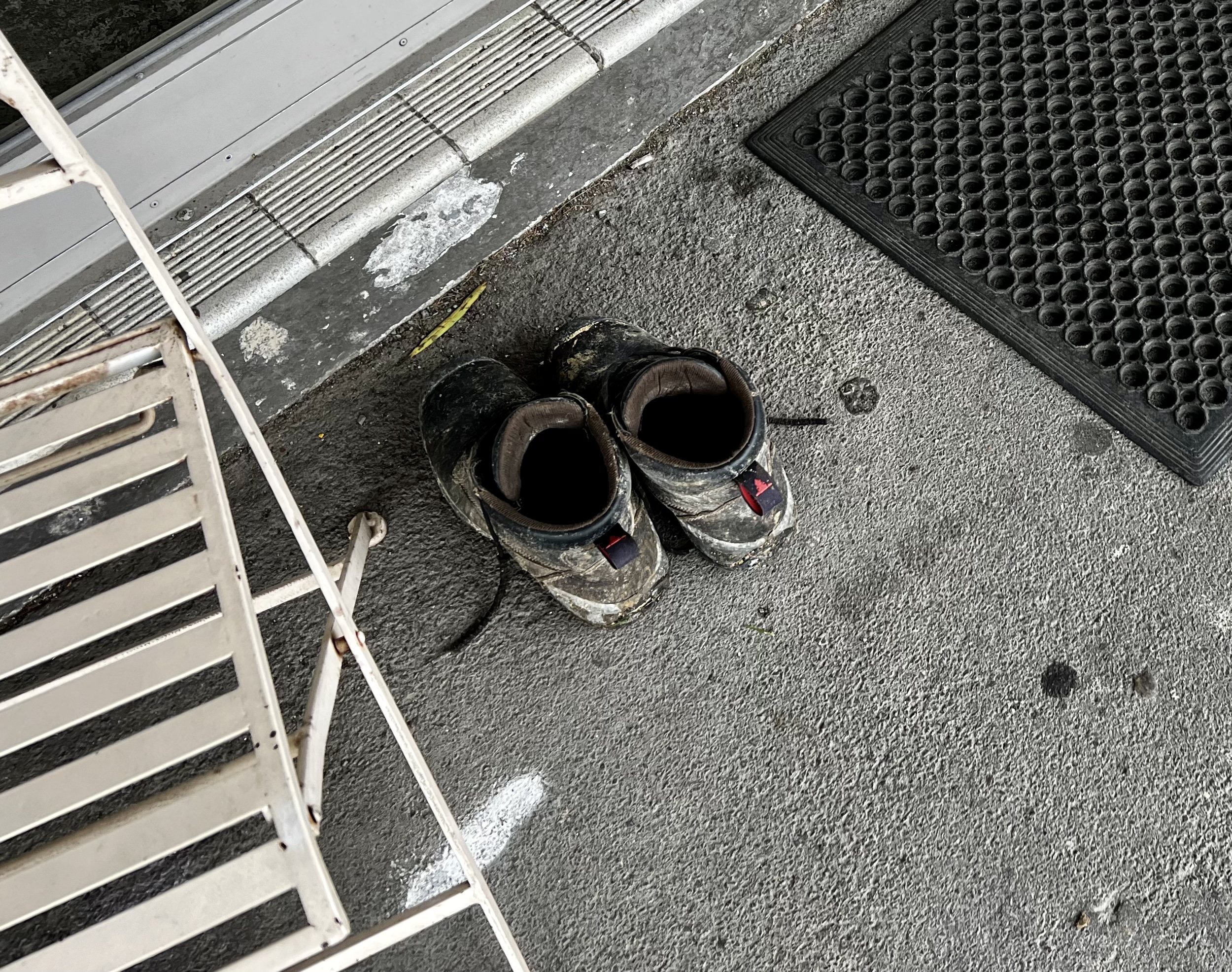
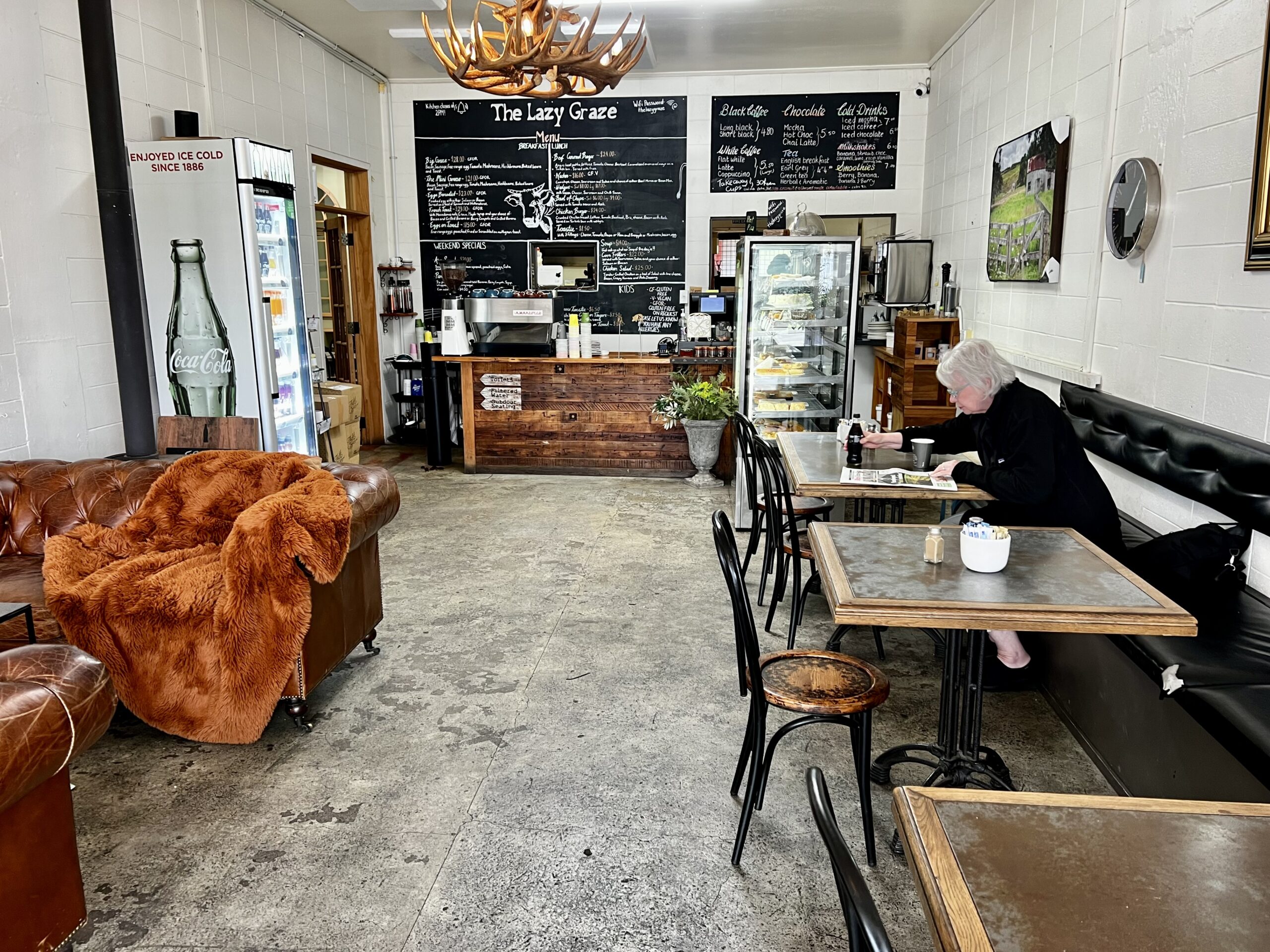
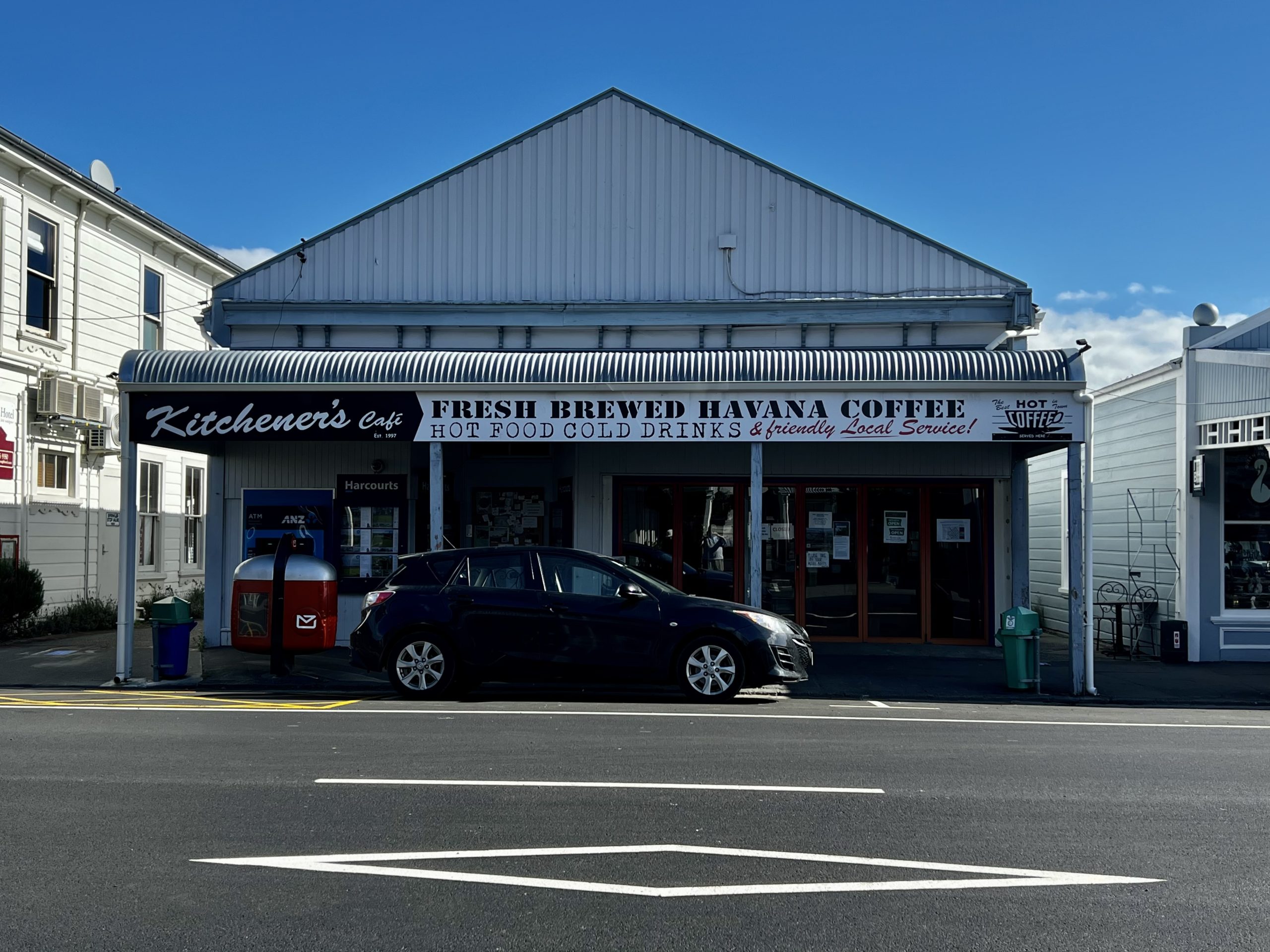
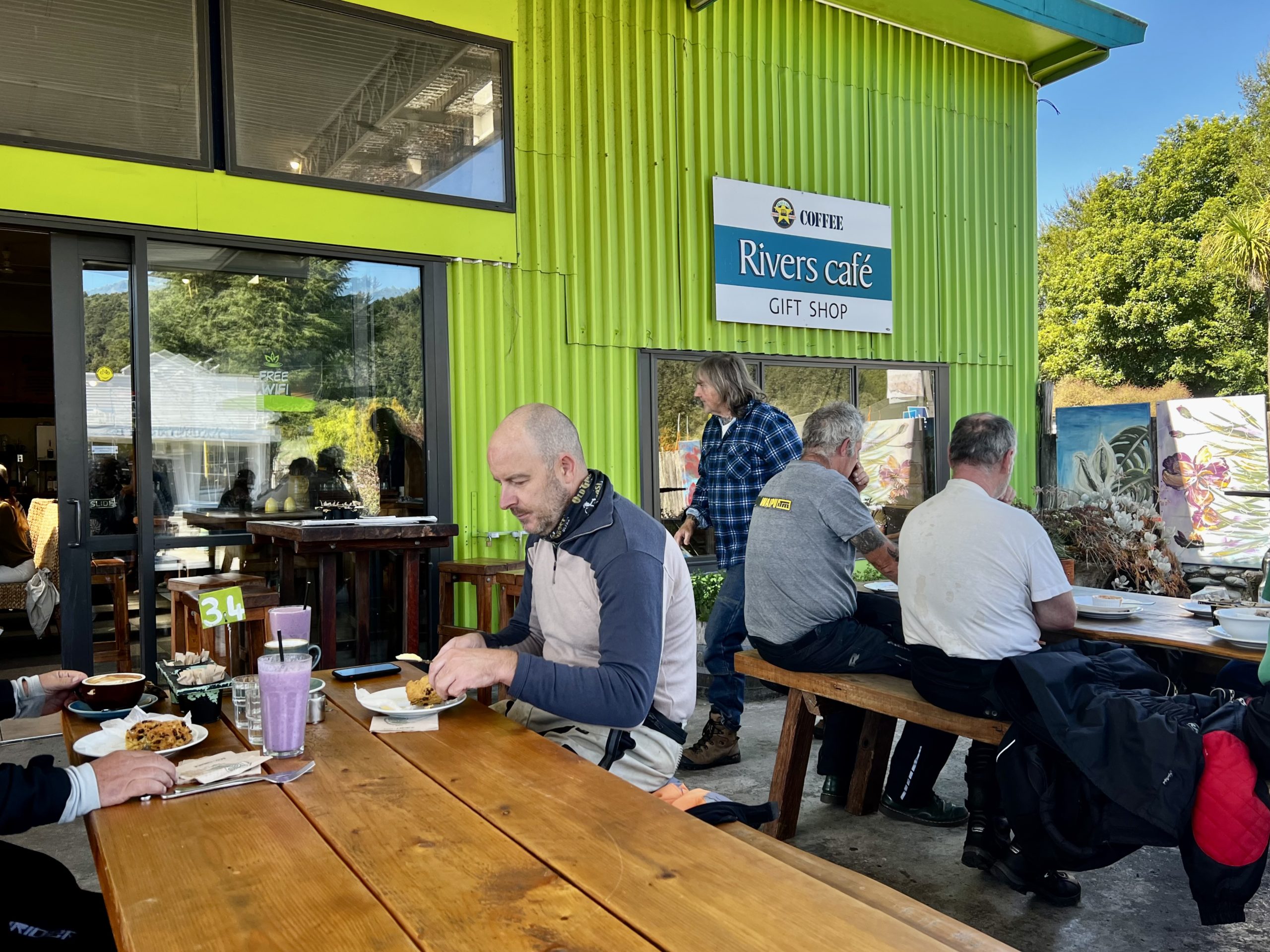
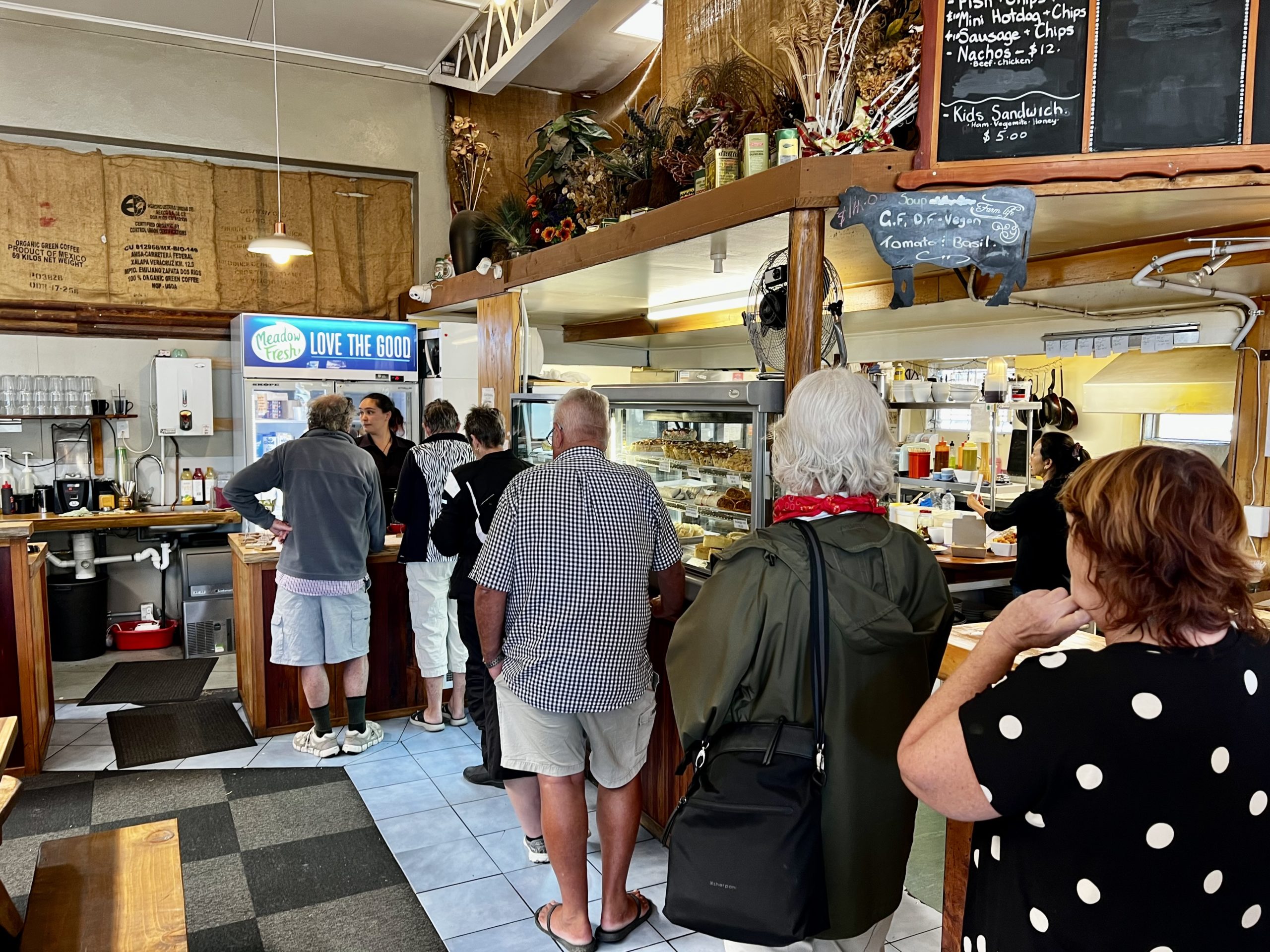
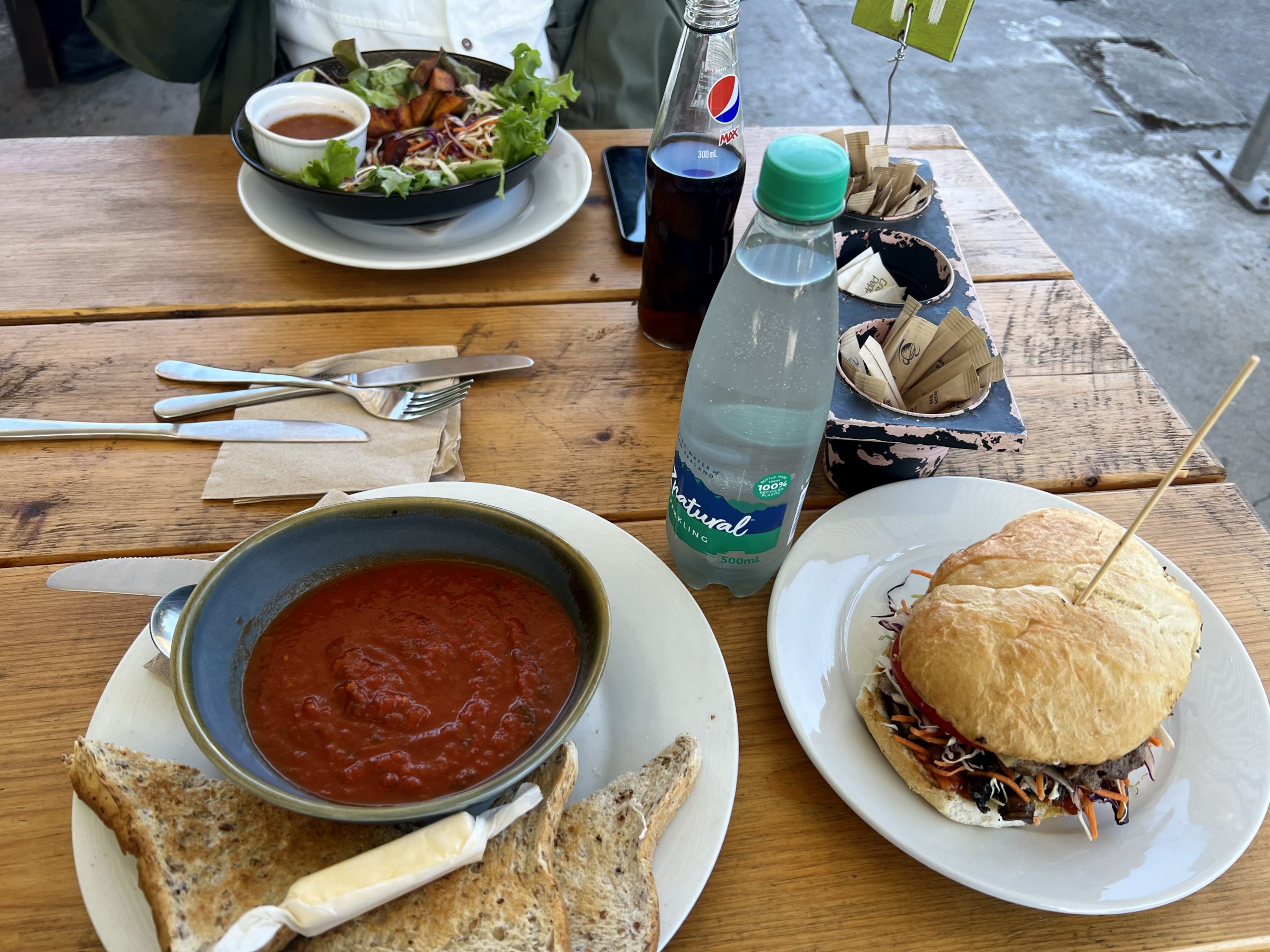
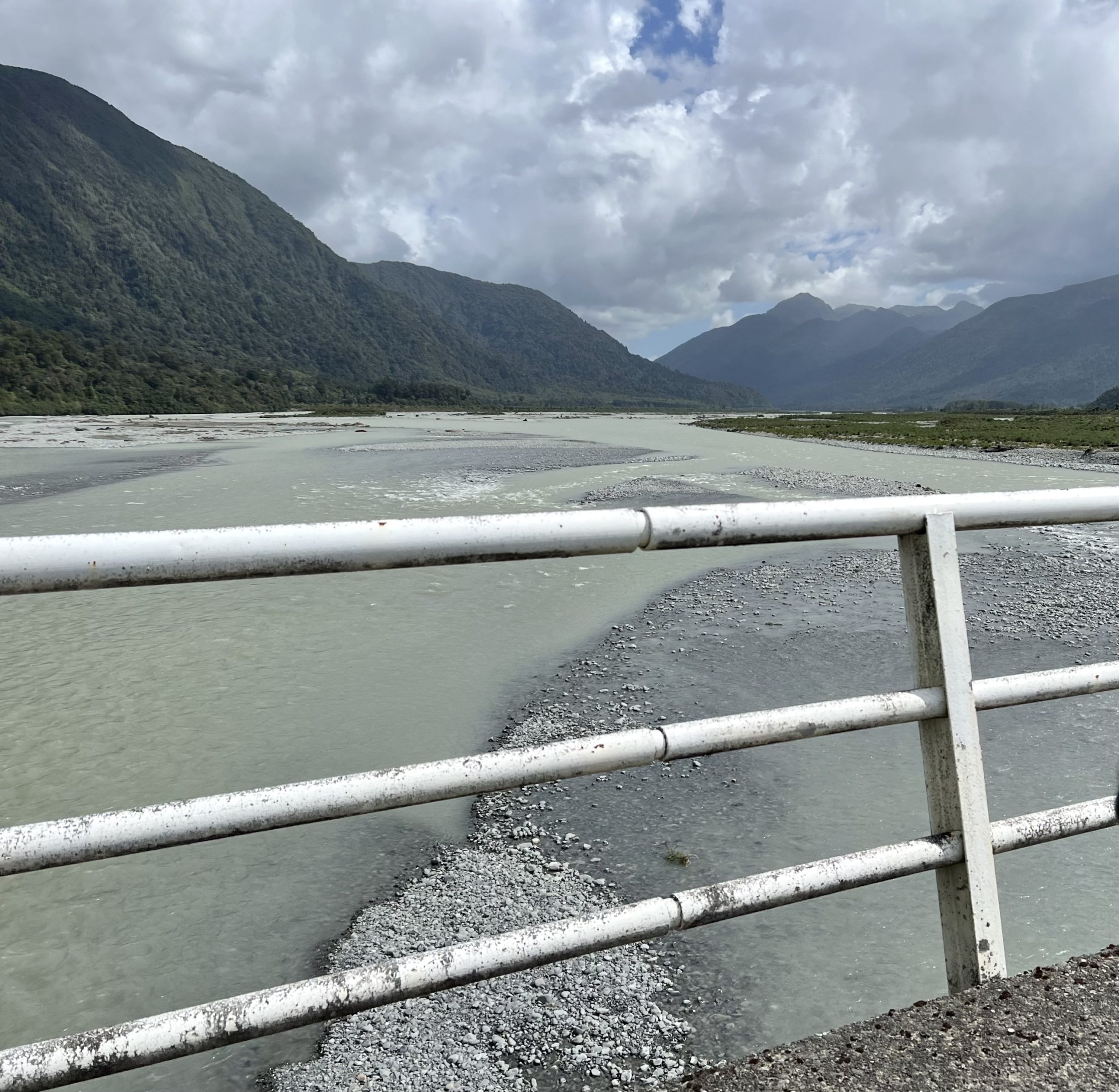
David Coplon gave us two types of fruit to sample – passion fruit and feijoa what we know as pineapple guava. Both very good, the passionfruit especially.Stopped for lunch along the way.Customers leave muddy boots outside the door of shops and cafes.The only cafe we found along the way. But it had good Wi-Fi so we hung out for awhile.One large terraced river flood plain
Accommodations
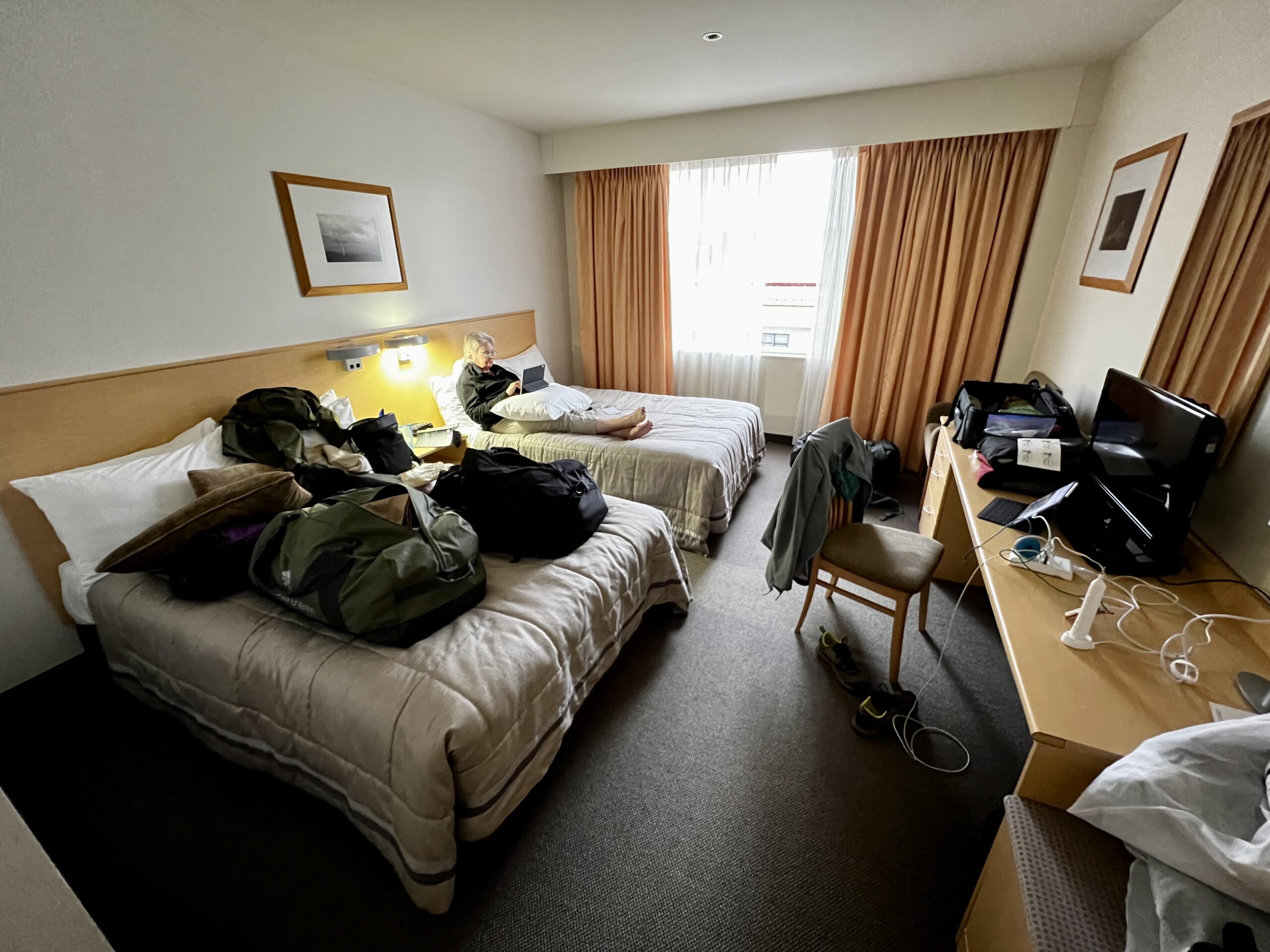
Palmerston North Hotel
Family
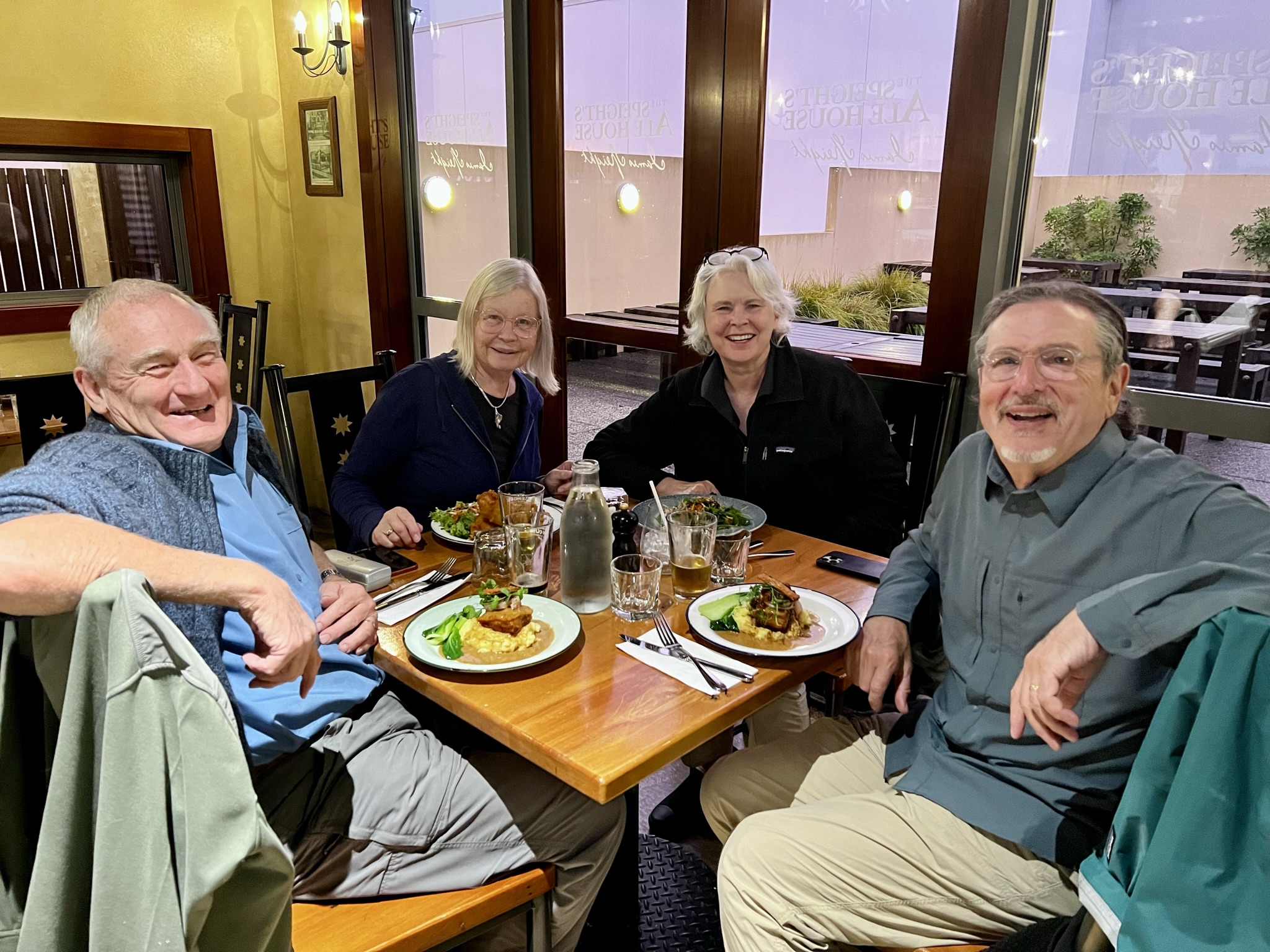
Palmerston North, a town of 90,000, is not a glamorous tourist destination. A major tourist attraction here is the rugby museum. Palmerston is a hard-working place, with a variety of corporate headquarters and Massey University.
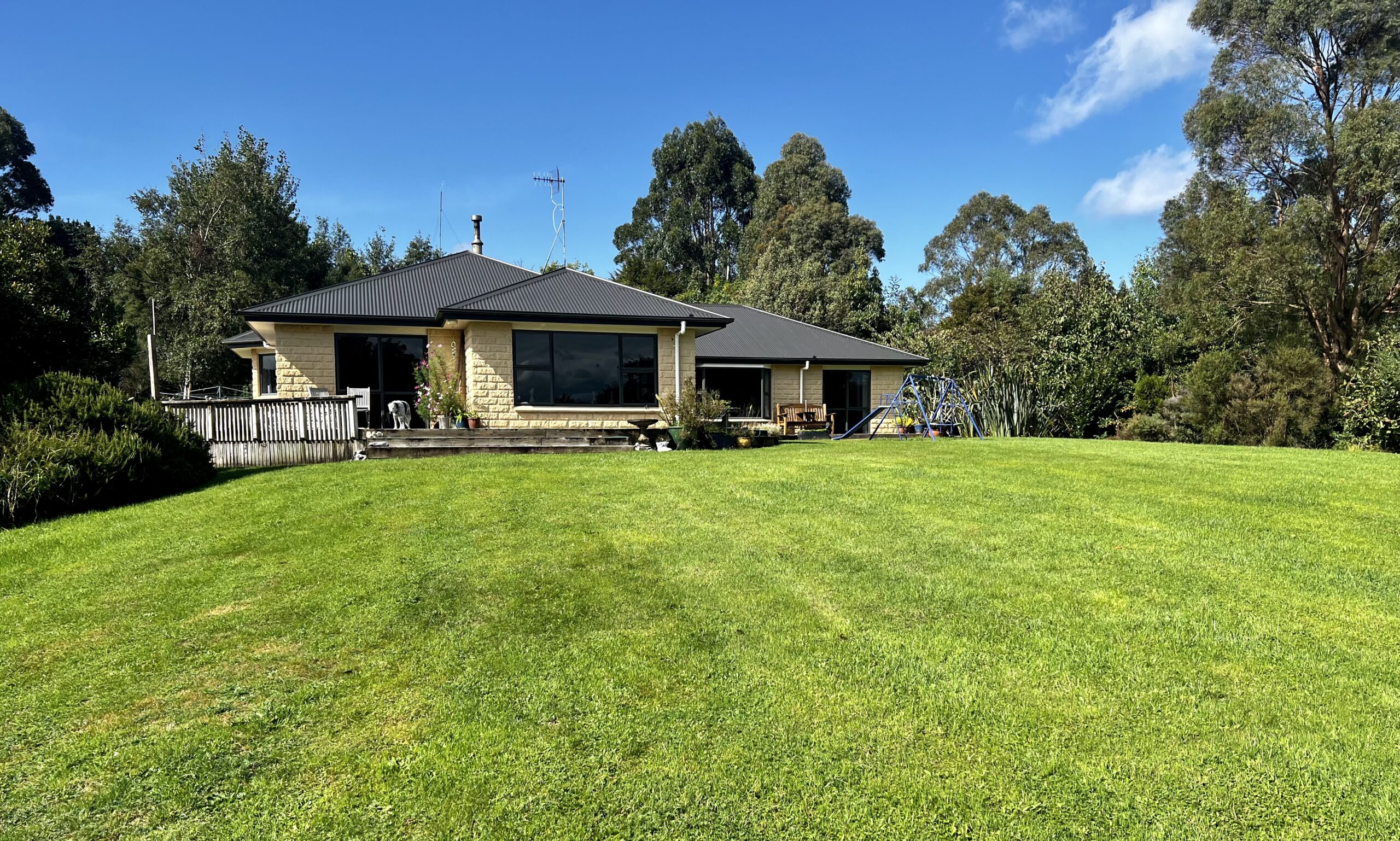
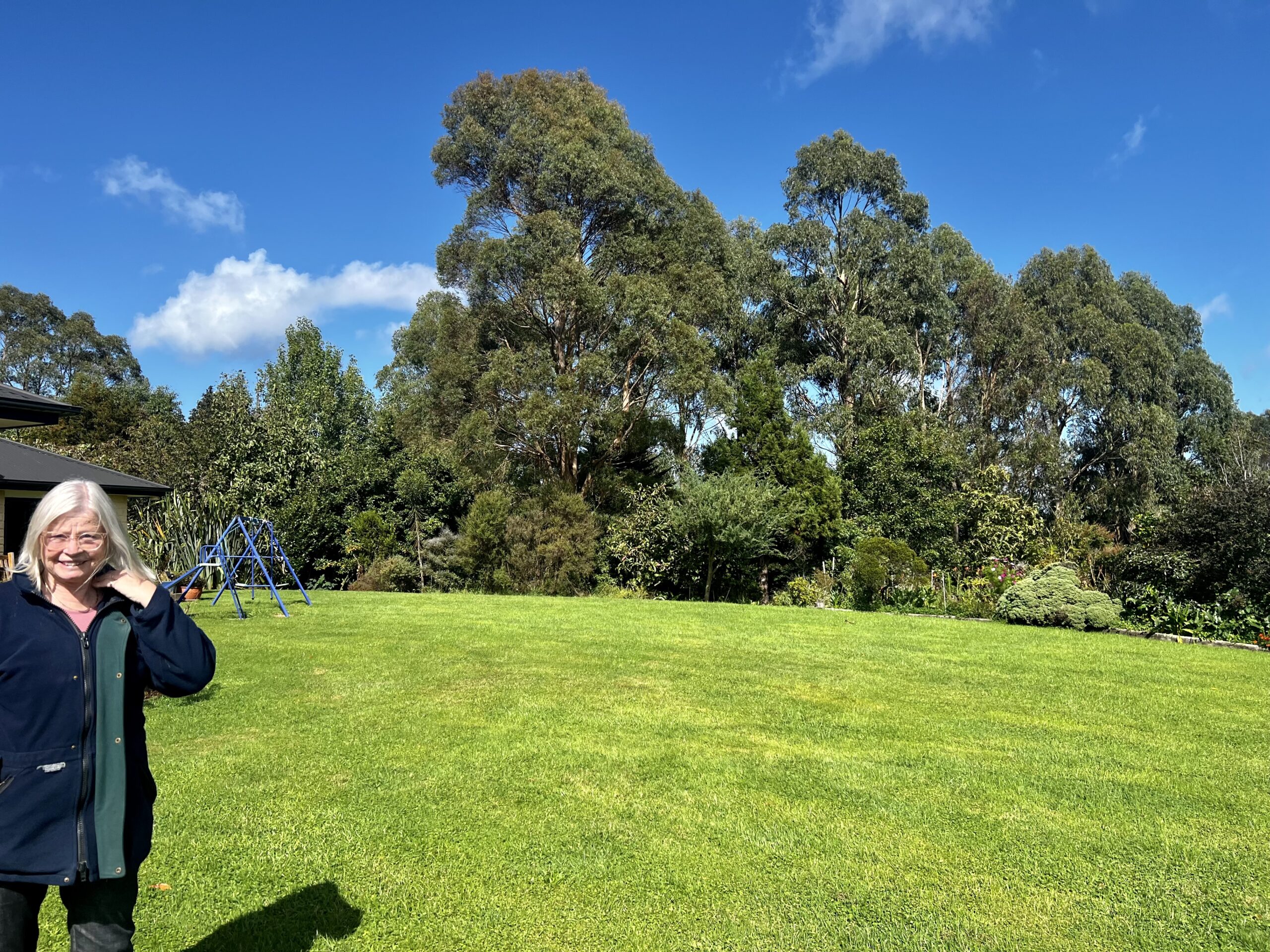
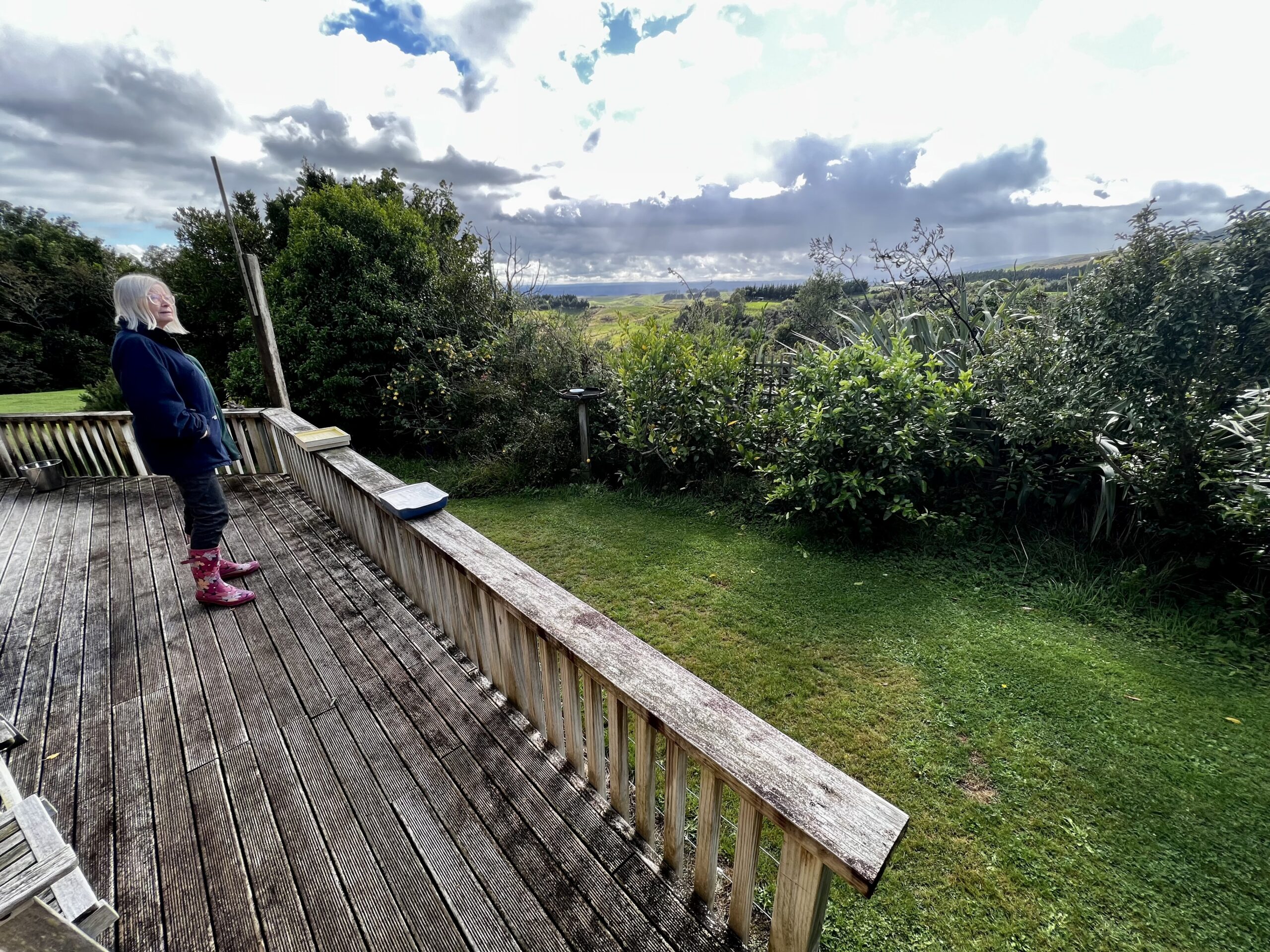
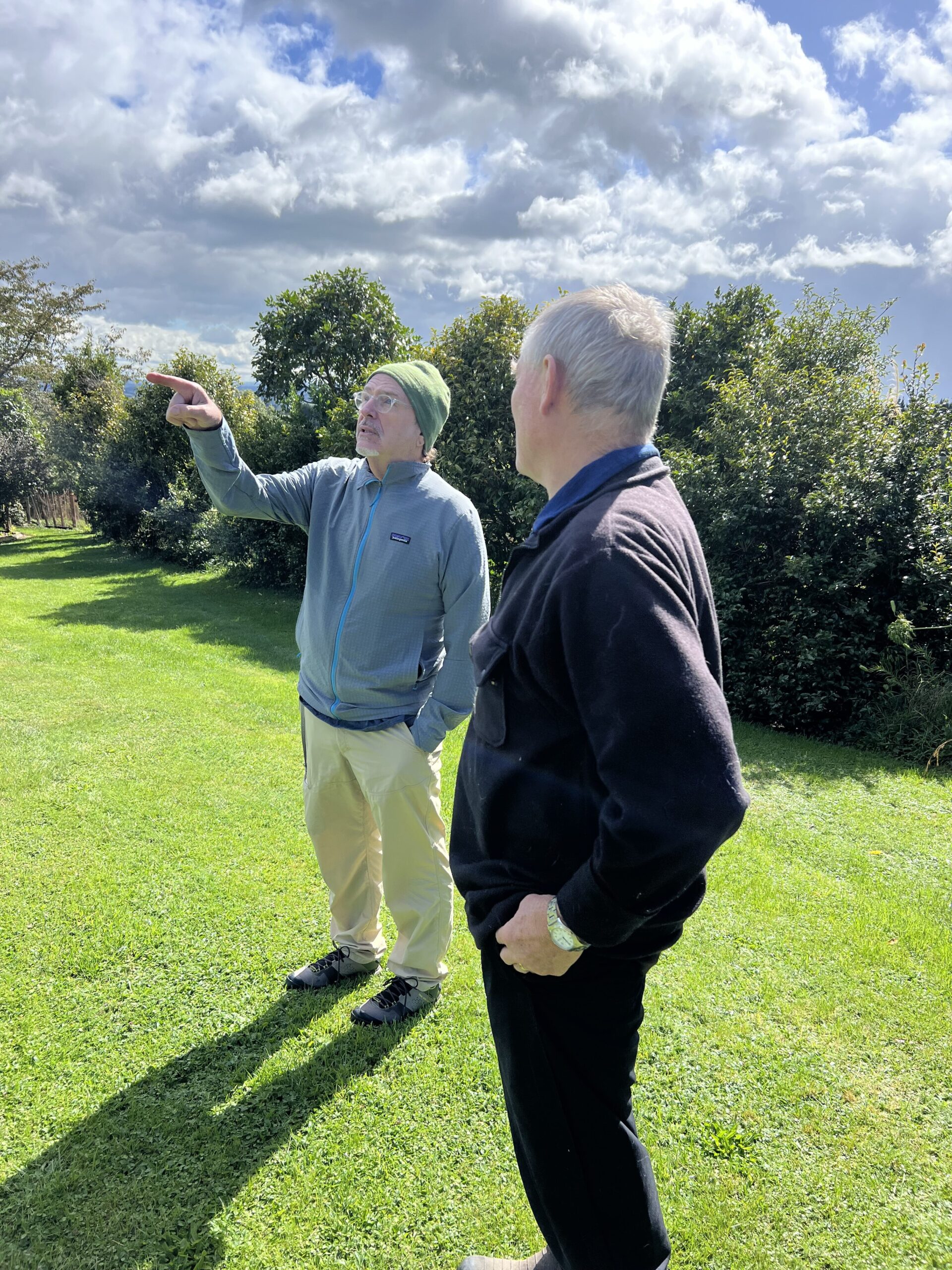
The reason to head to Palmy was to visit Bonnie’s younger “sister” Nicky. On this visit Bonnie and Nicky reignited a relationship that had been smoldering for more than fifty years. Nicky and her husband Clel live on the outskirts of town on ten acres that they have transformed from bare scrub into a lush Eden, with dense planting of trees and shrubs. The vegetable patch and small orchard keep them self-sufficient for many months of the year. Nicky’s background in botany and Clel’s in geology contribute to the success of this venture. The spacious house, which they designed, looks out over miles of rural landscape and wind turbines. Both Nicky and Clel have taught at university level, but now they garden, volunteer, hang out with grandchildren, and pamper their elderly dog.
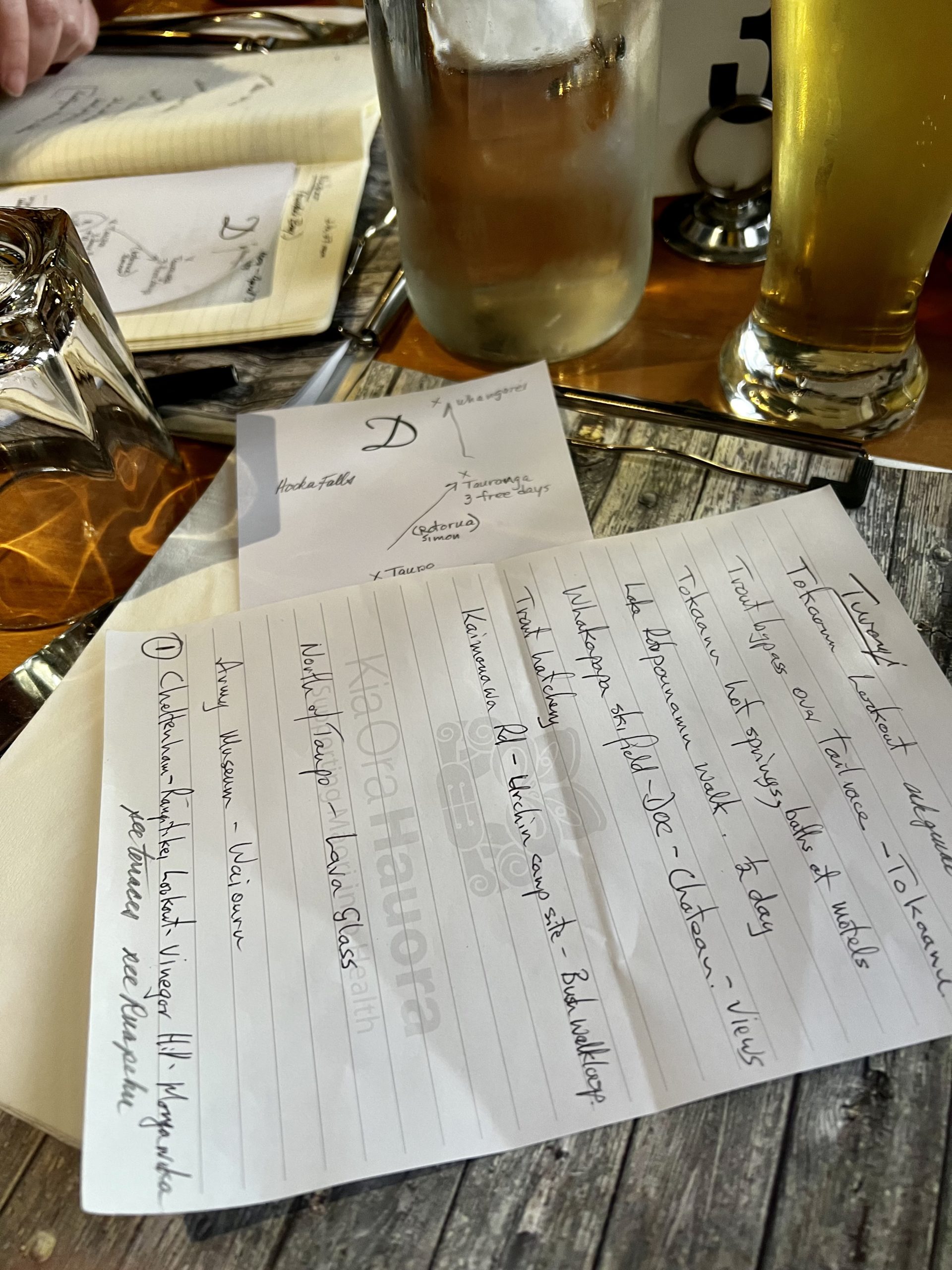
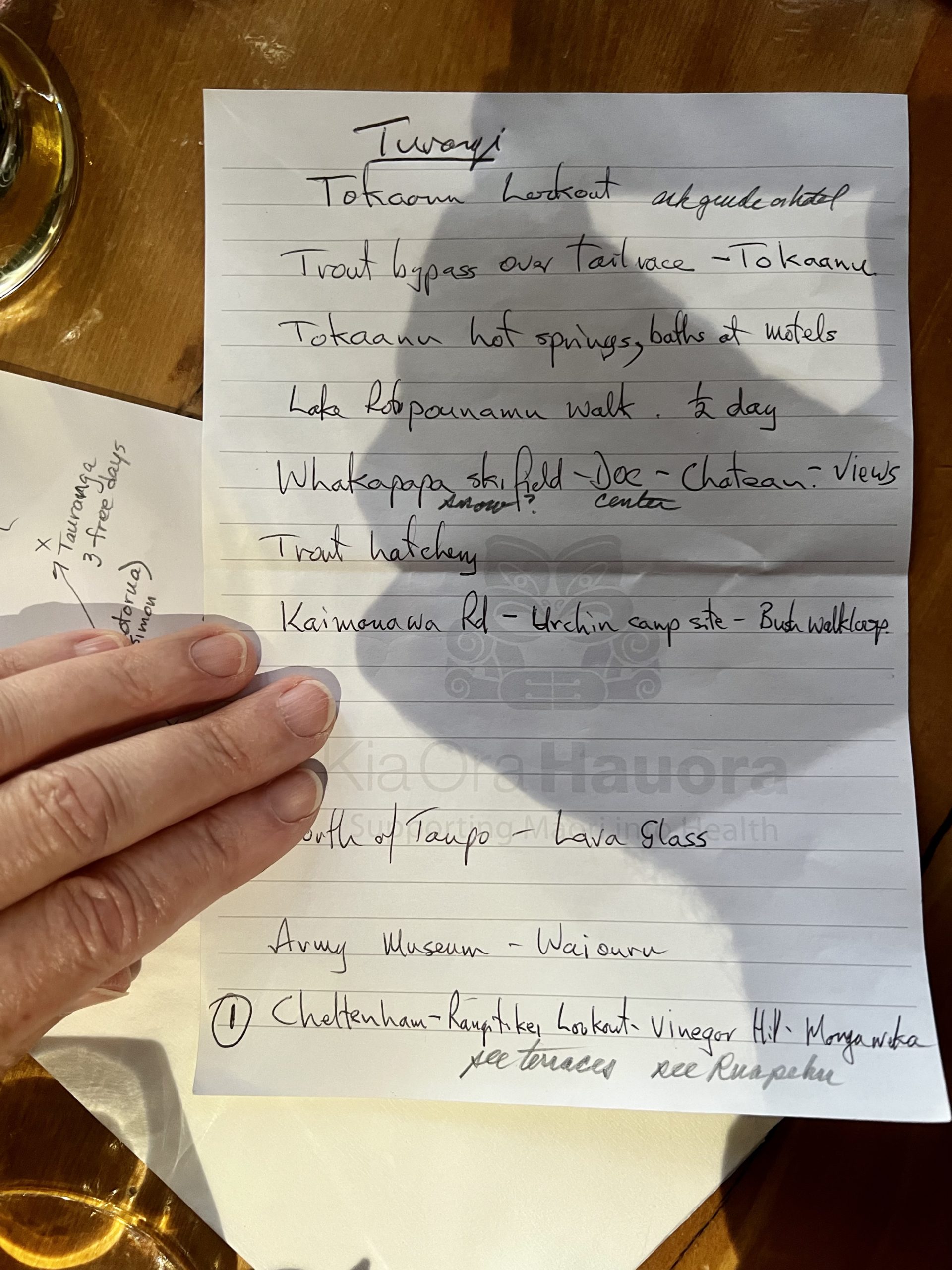
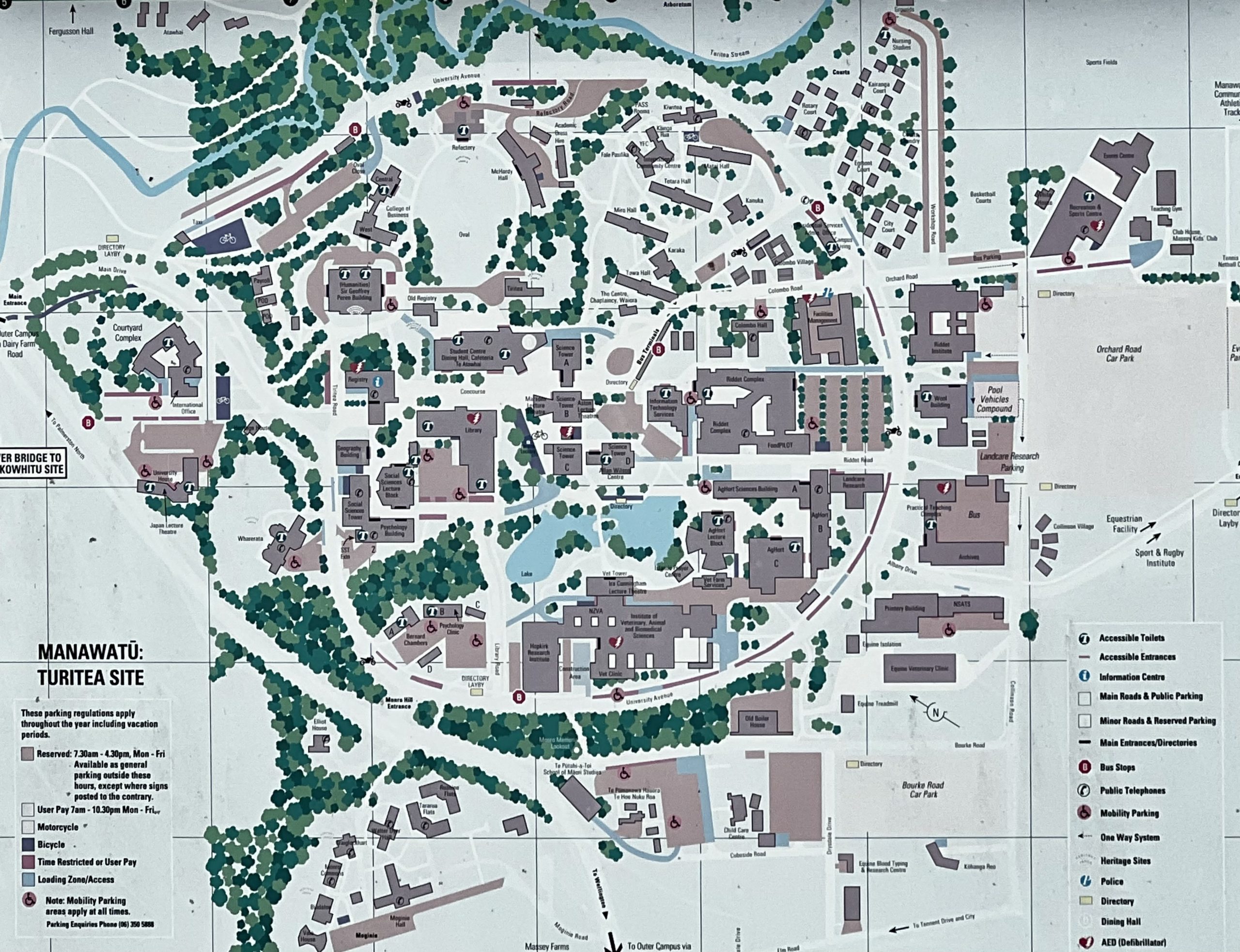
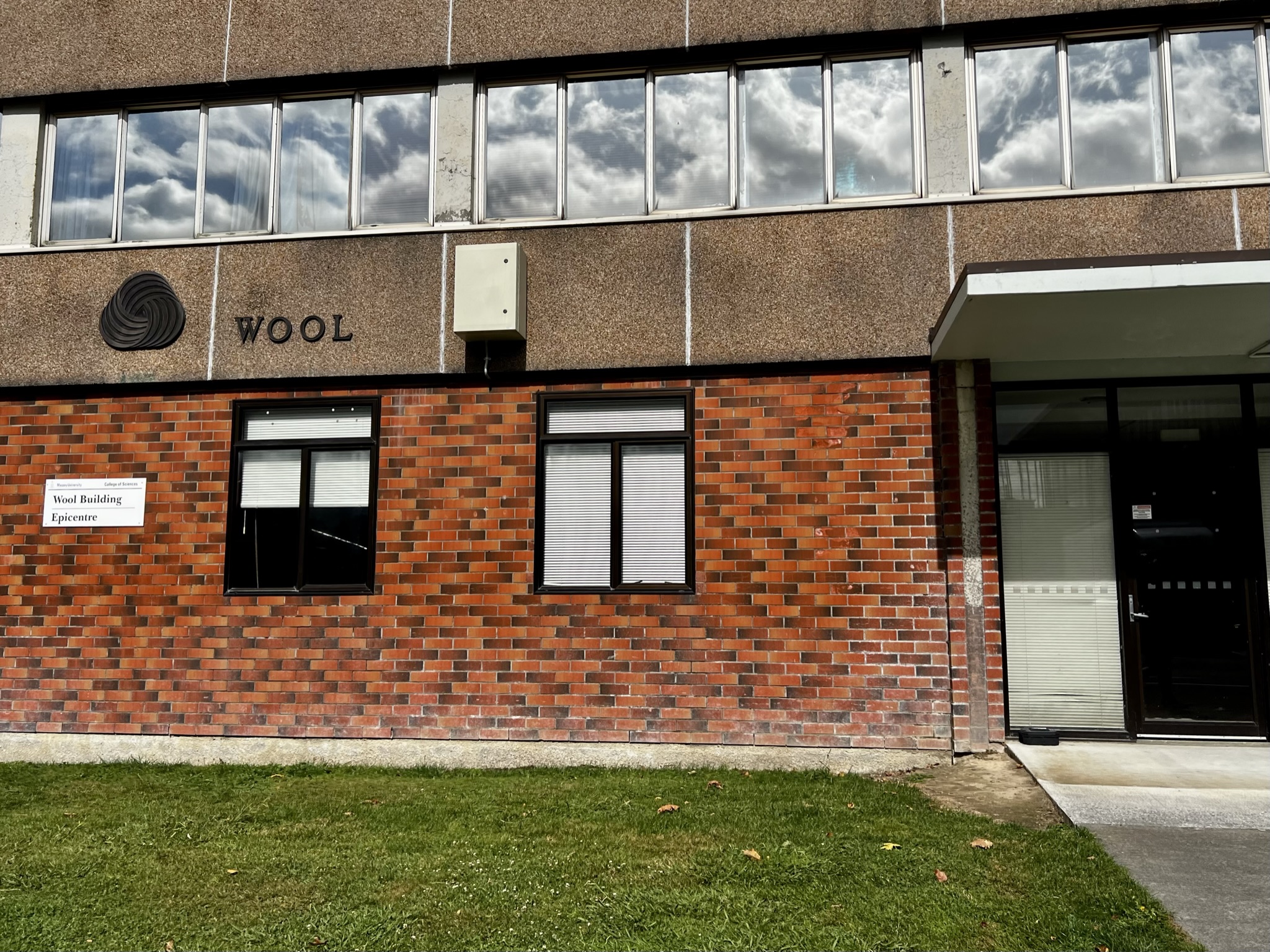
After giving us a tour of Massey University, Clel was enthusiastic about making a list of sights for us to see on the next stretch of our trip. These leaned heavily toward geomorphology, such as lookout points for river terraces and volcanic peaks. Both Bonnie and Robert know their basic geology. New Zealand is a young country geologically, which means the landforms have not had enough time to be eroded into smoother shapes. Unusual shapes with sharp edges appear everywhere in the landscape.
Clel, Bonnie’s “sister” Nicky, Bonnie, RobertClel’s notes for us on what to see on our way to Taupo
The Homestead
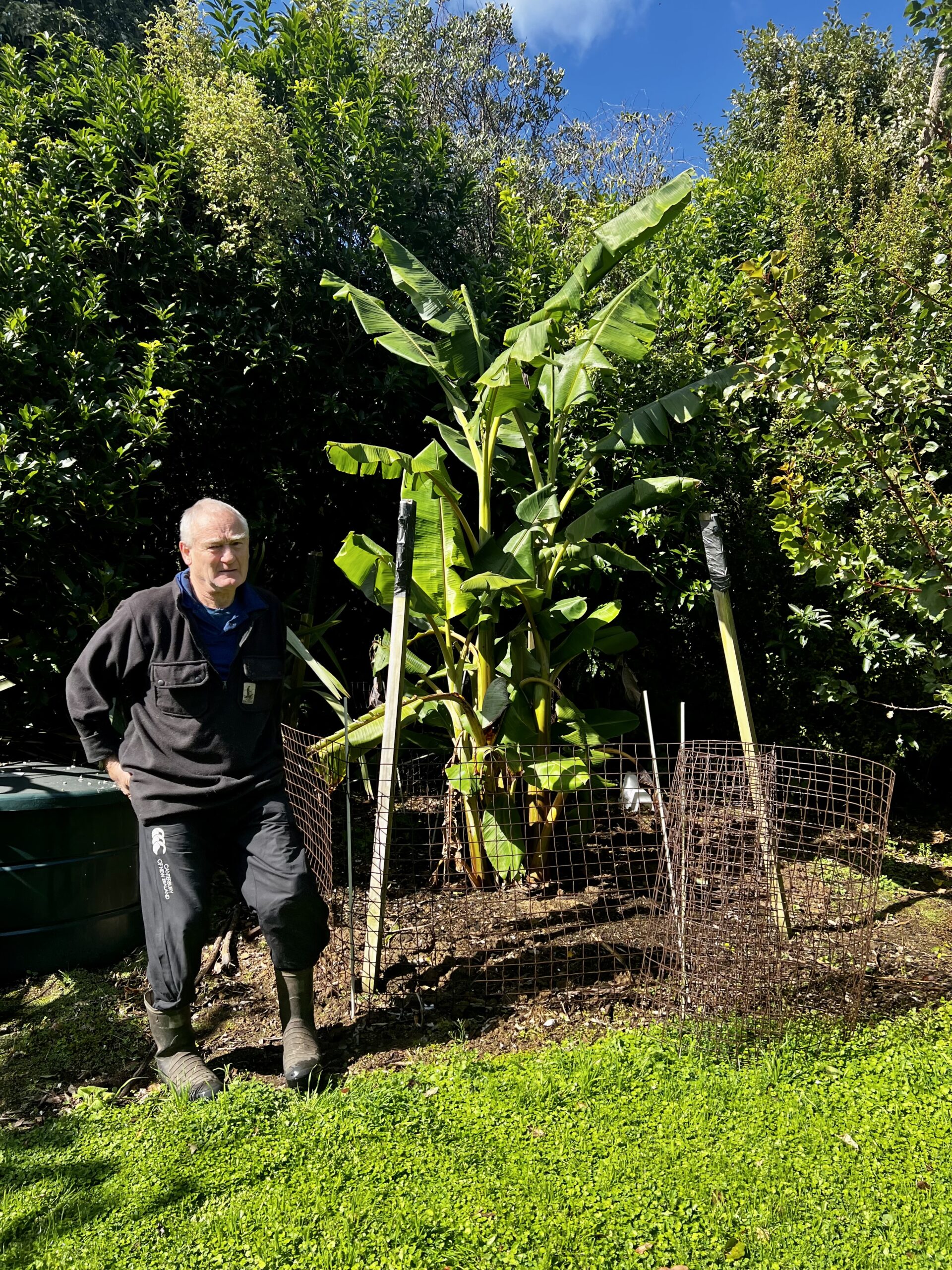
Their new banana tree!Curious neighbors
Massey University
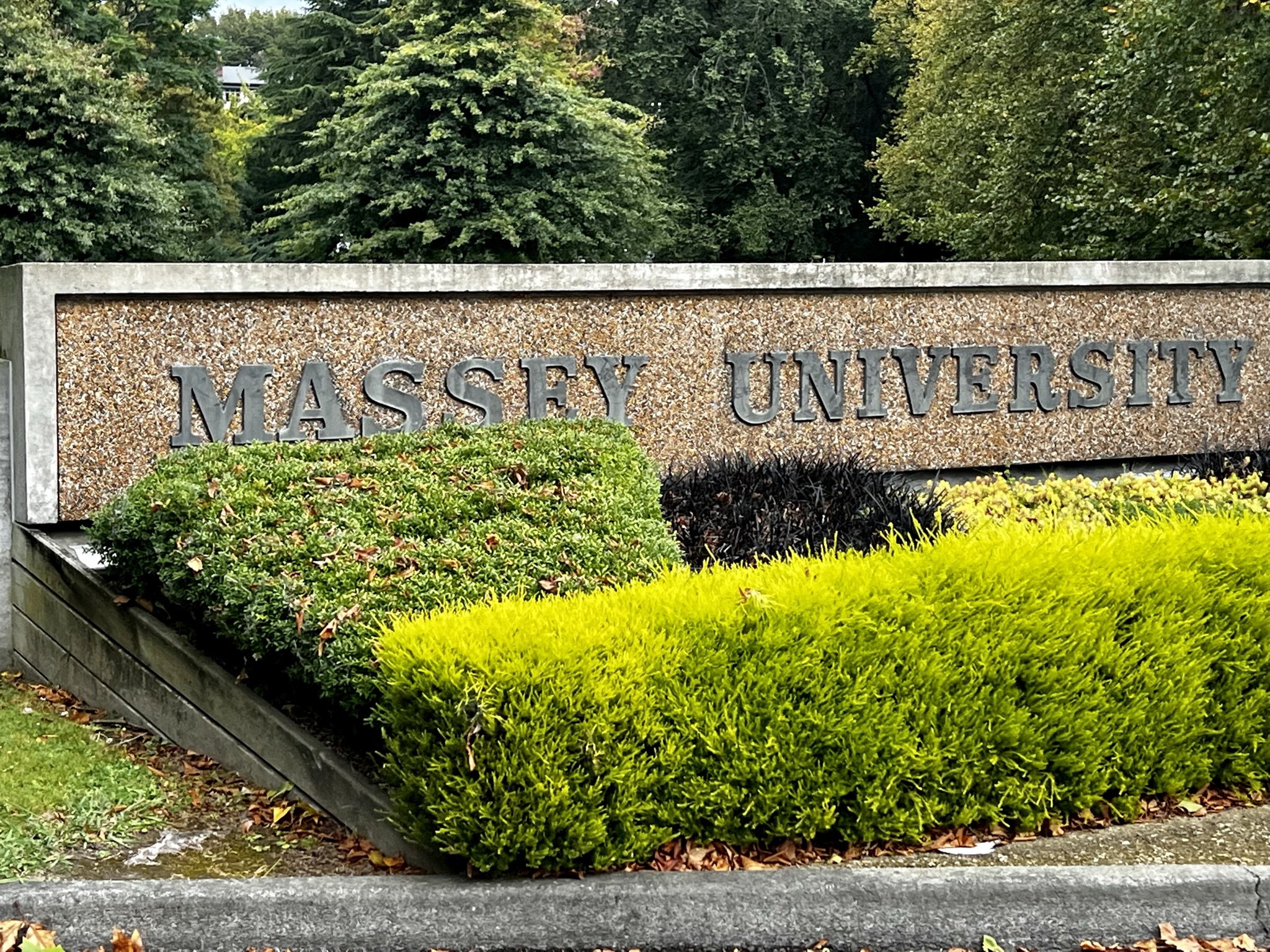
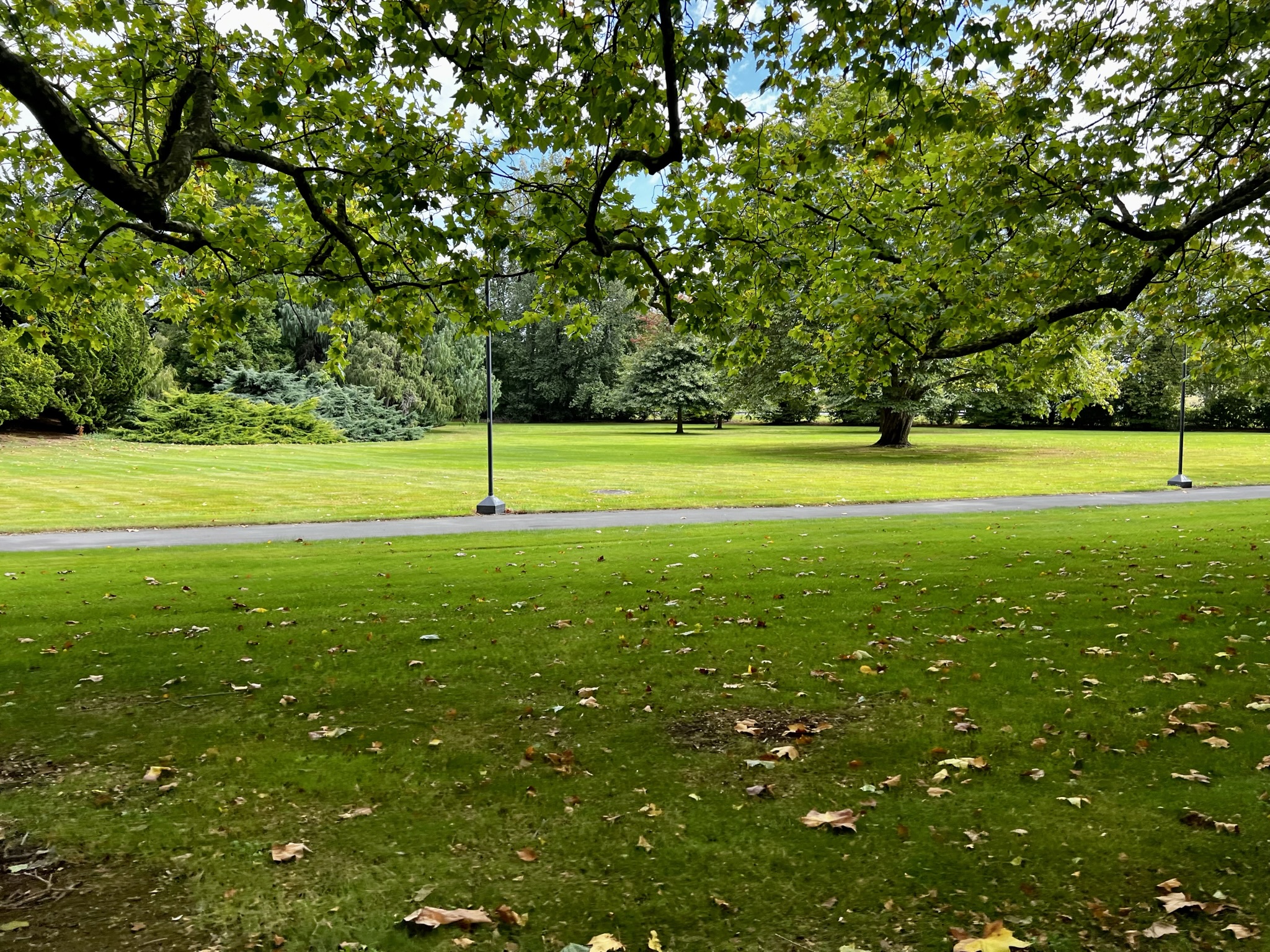
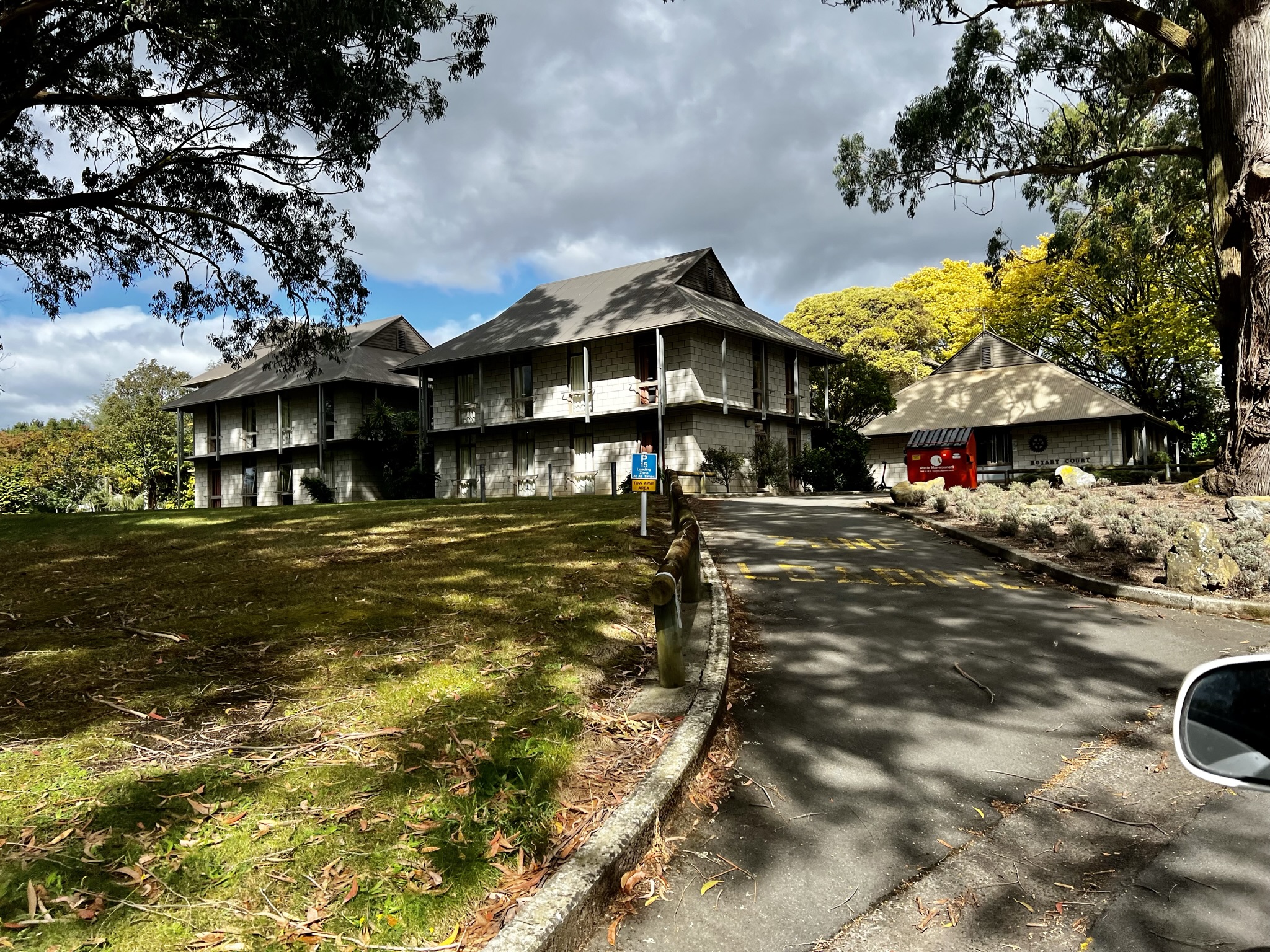
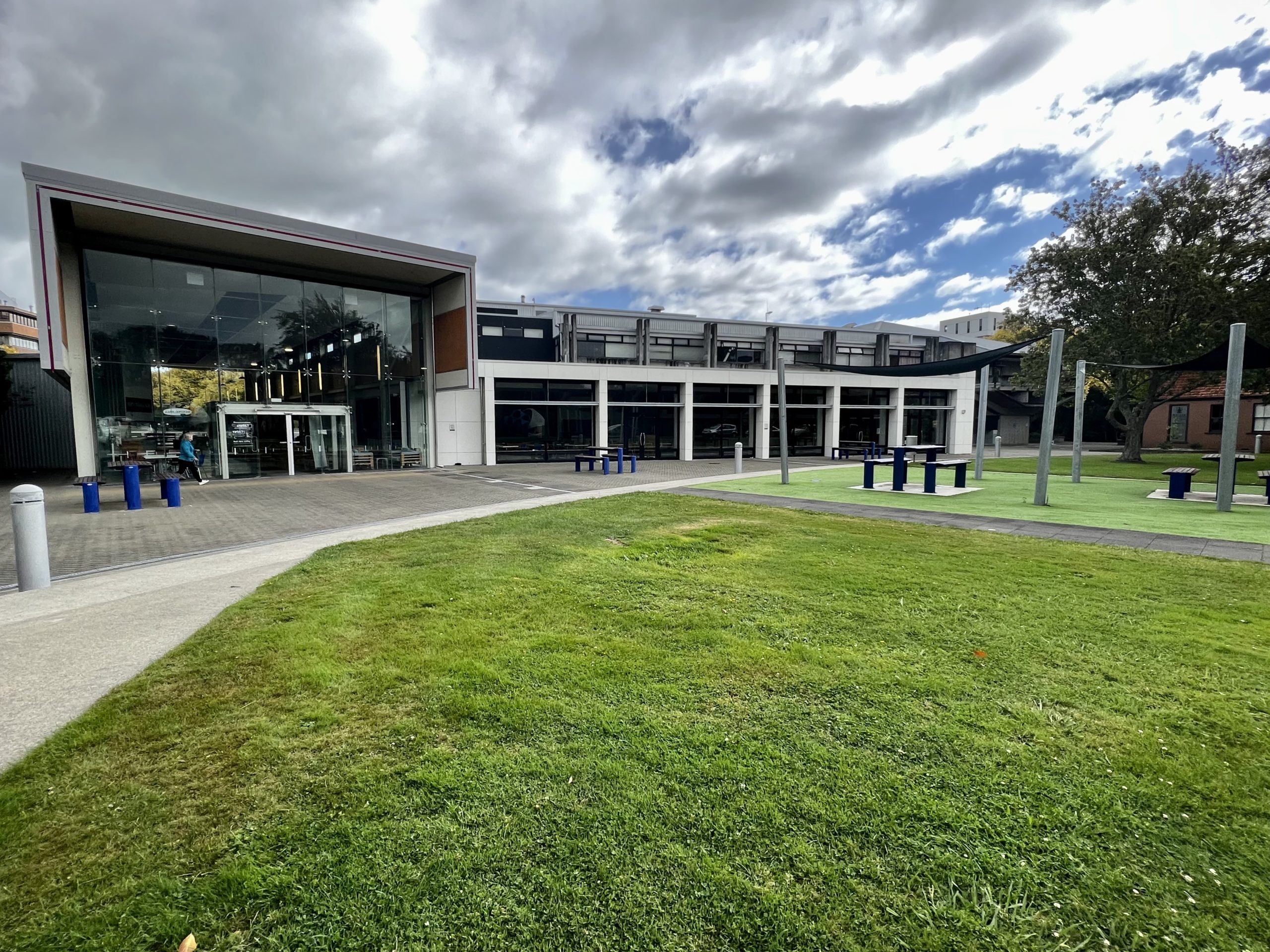
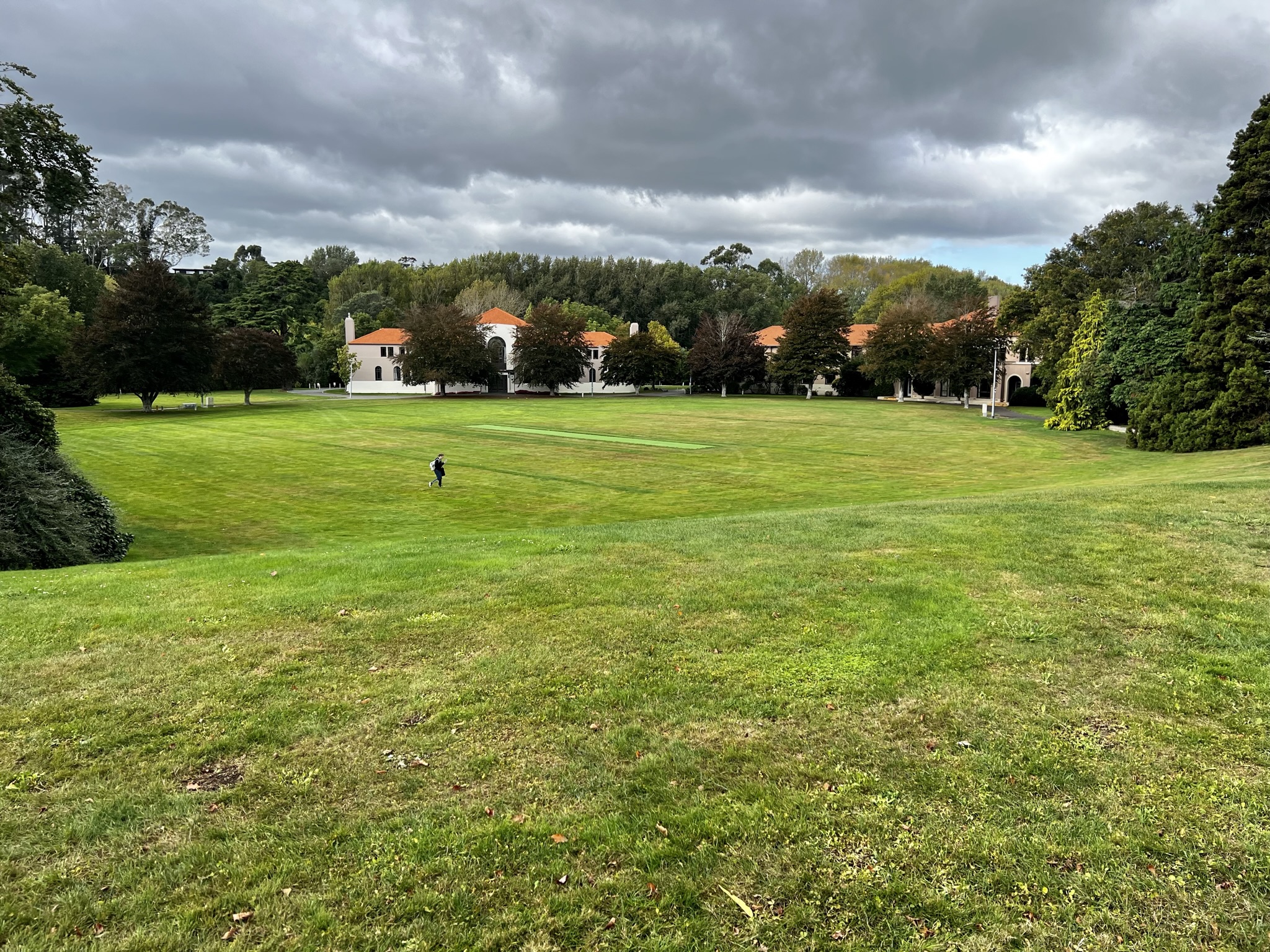
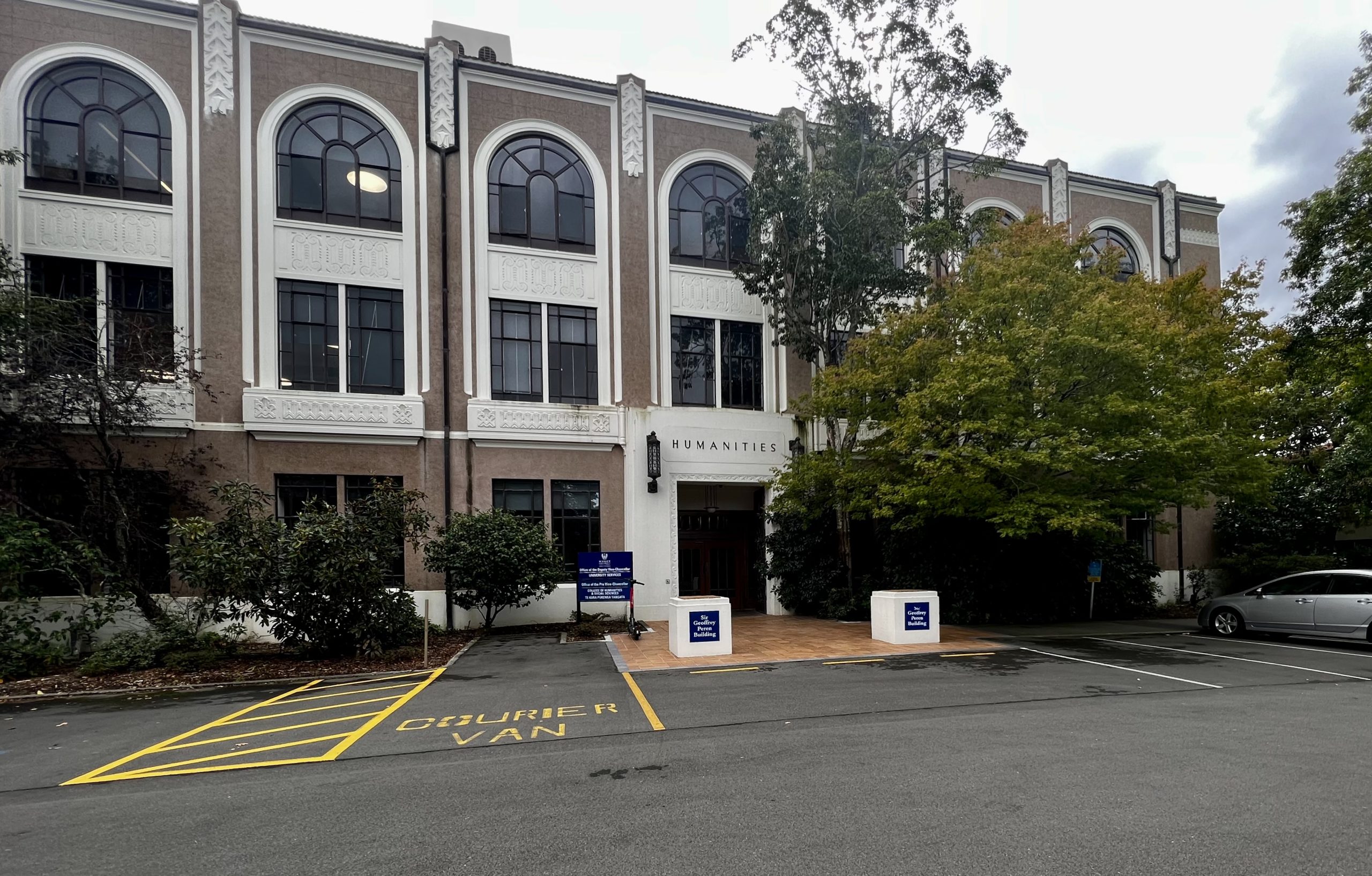
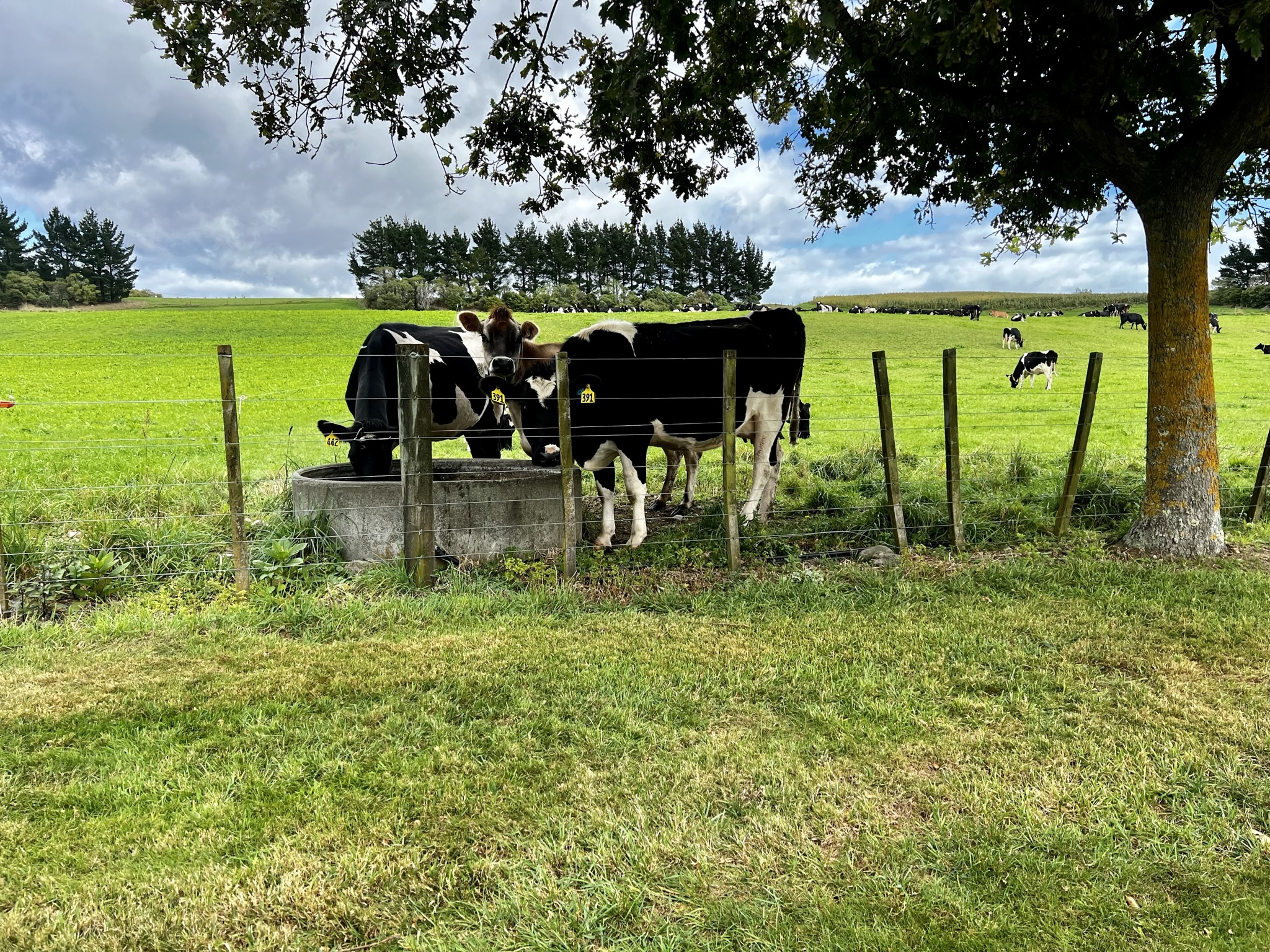
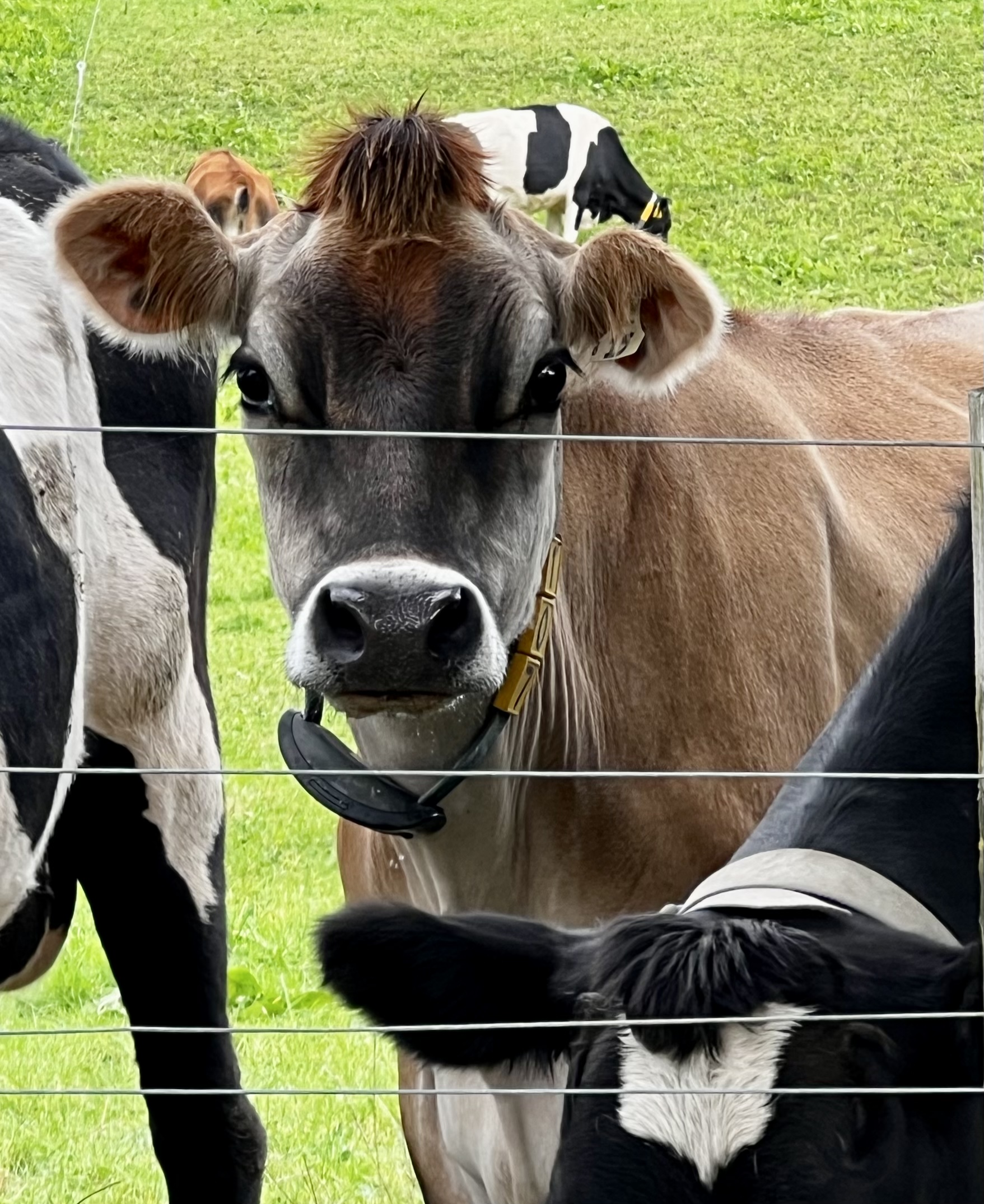
Massey University is the UC Davis of New Zealand. Agriculture and veterinary science rule. The exceptionally pretty, park-like campus is spread over an extensive property, where beautiful cows with electronic collars munch near classroom buildings. Many students bring their horses to the campus. About 9,000 students attend the main campus. Massey agreed to begin a distance-learning program in 1960 when none of the other NZ universities wanted to tackle it. Now, of course, this has grown into an enormous success for the university. And many private research facilities, especially in food science, are sited next to the university. Glaxo, now GlaxoSmithKline began in a suburban of Palmy.
Massey University main campusStudent housing
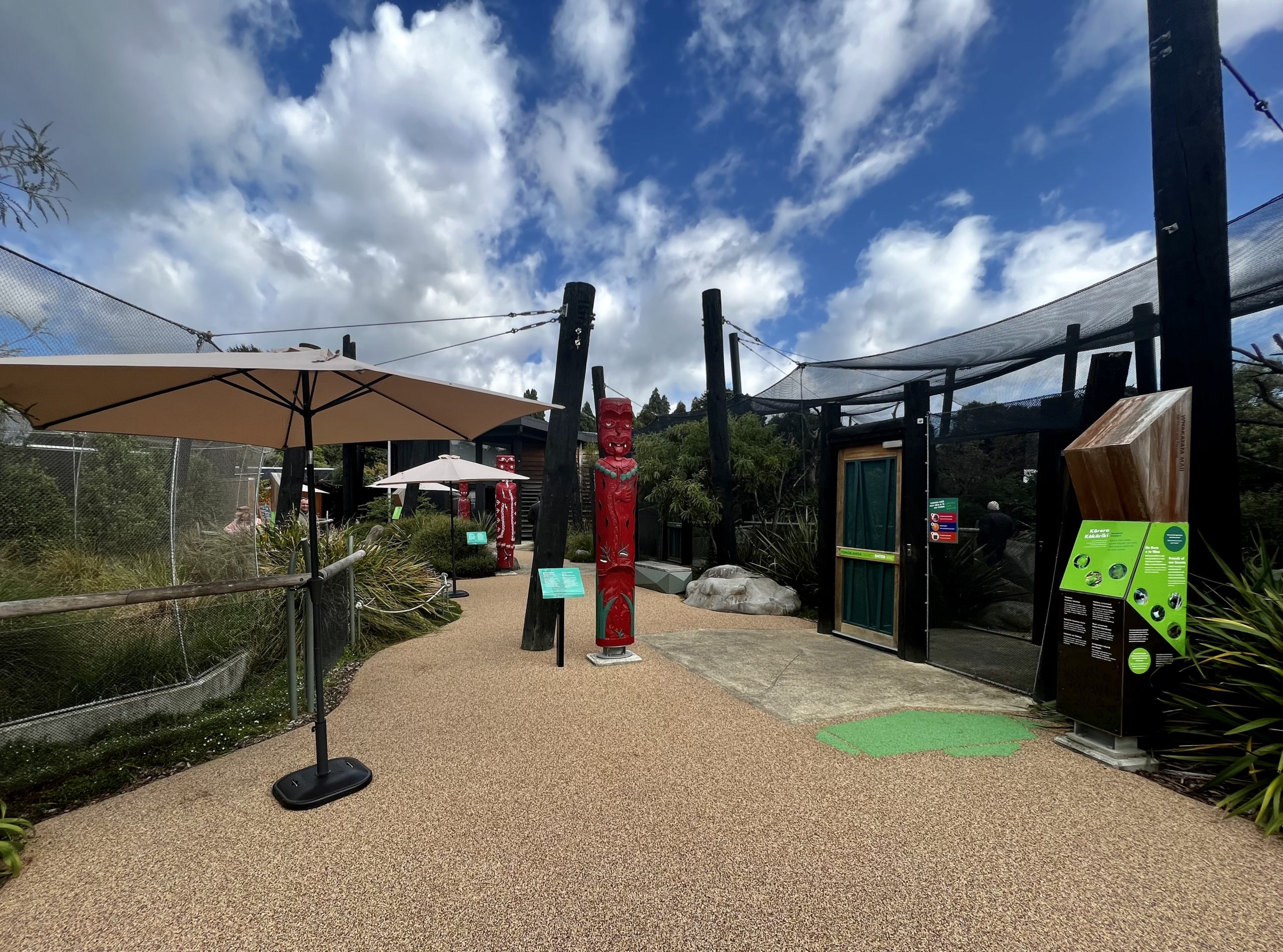
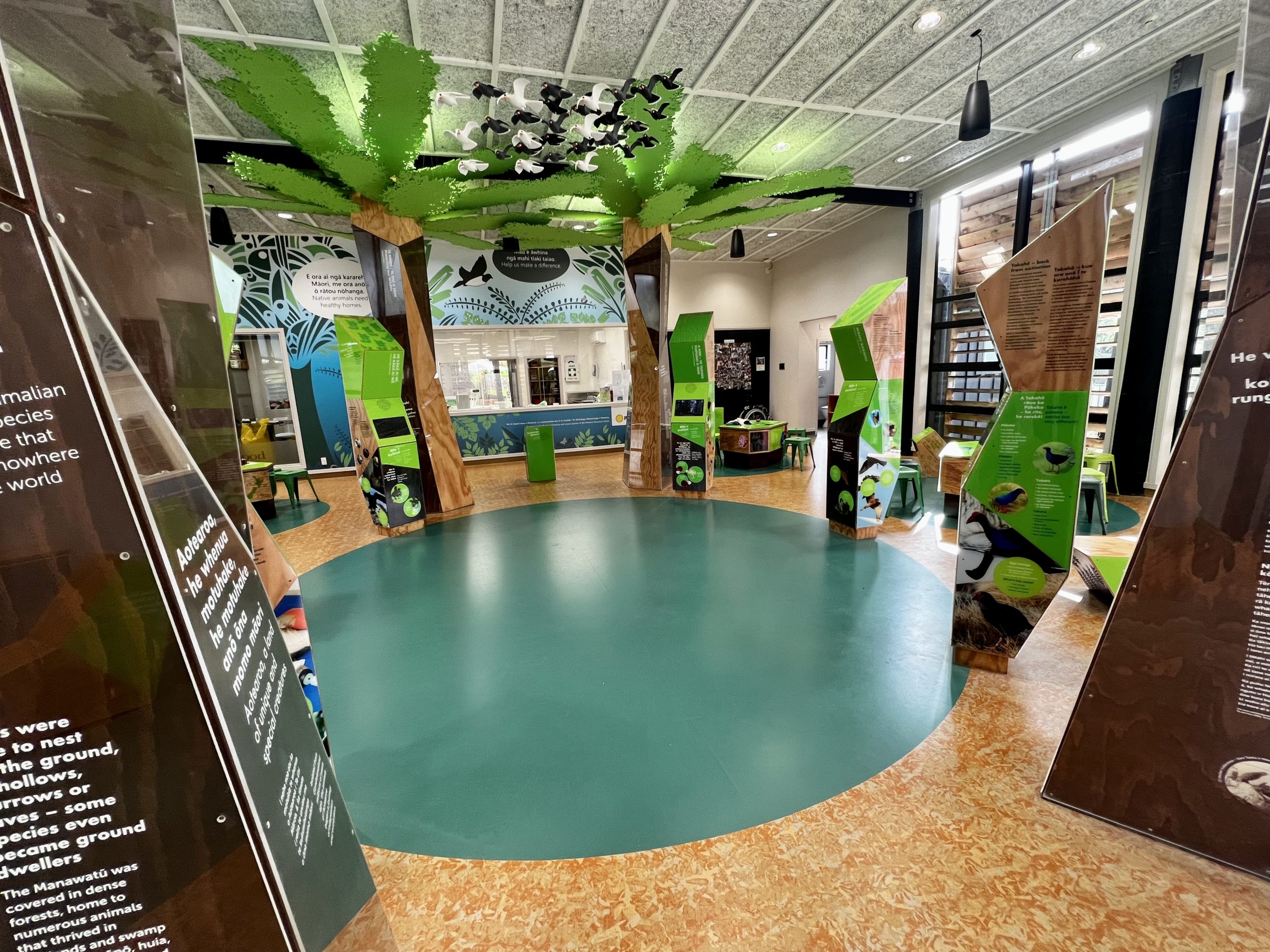
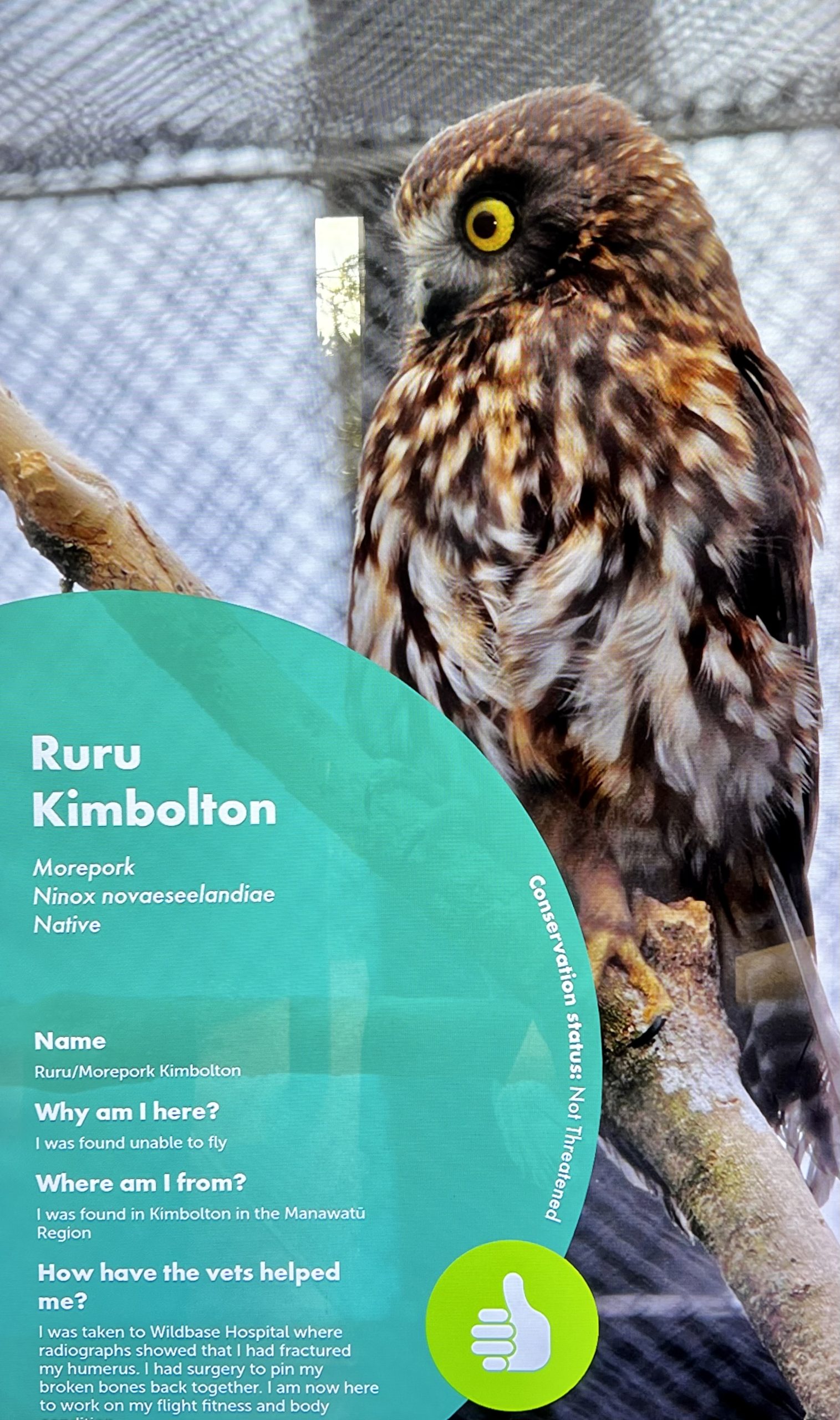
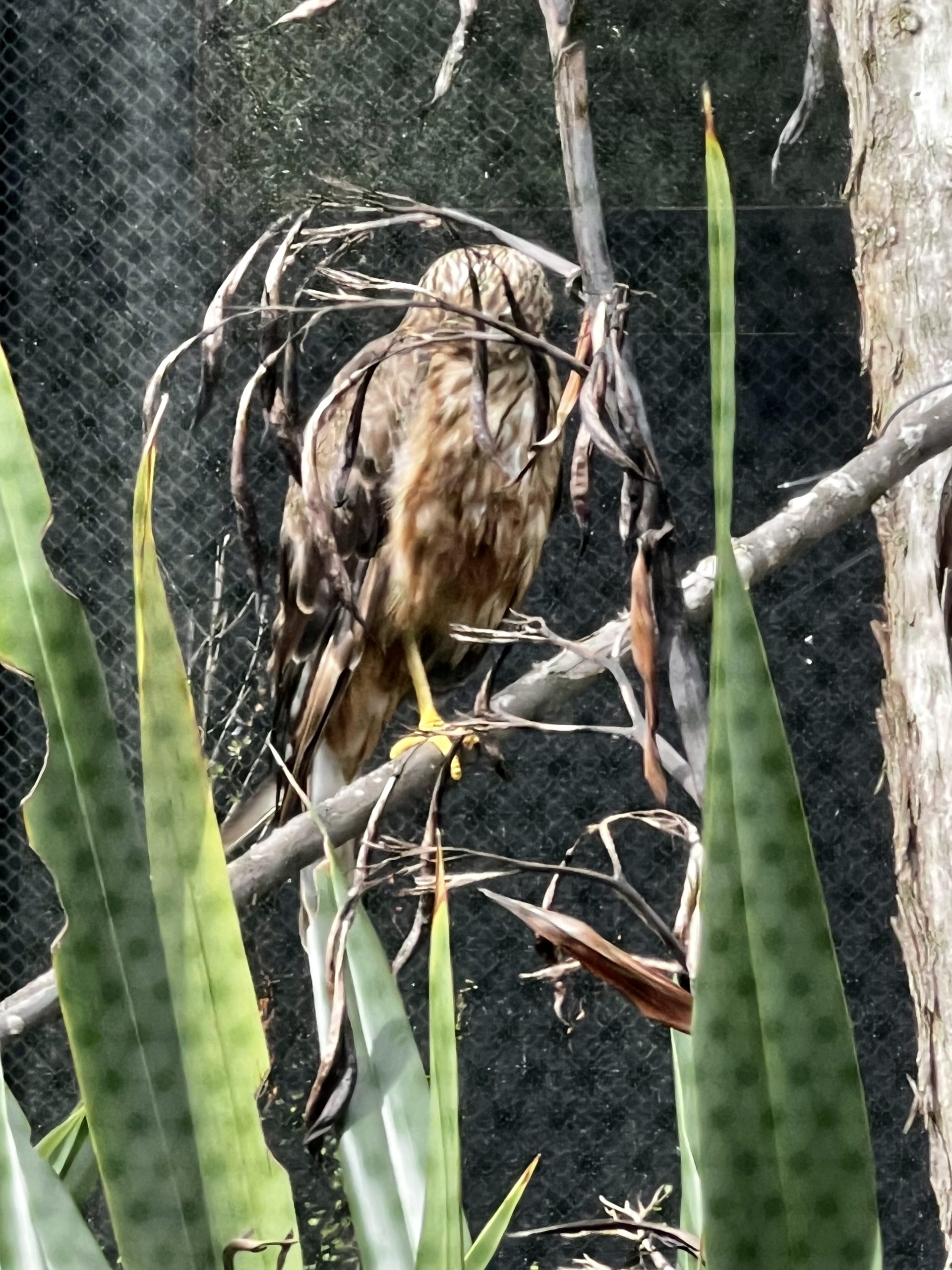
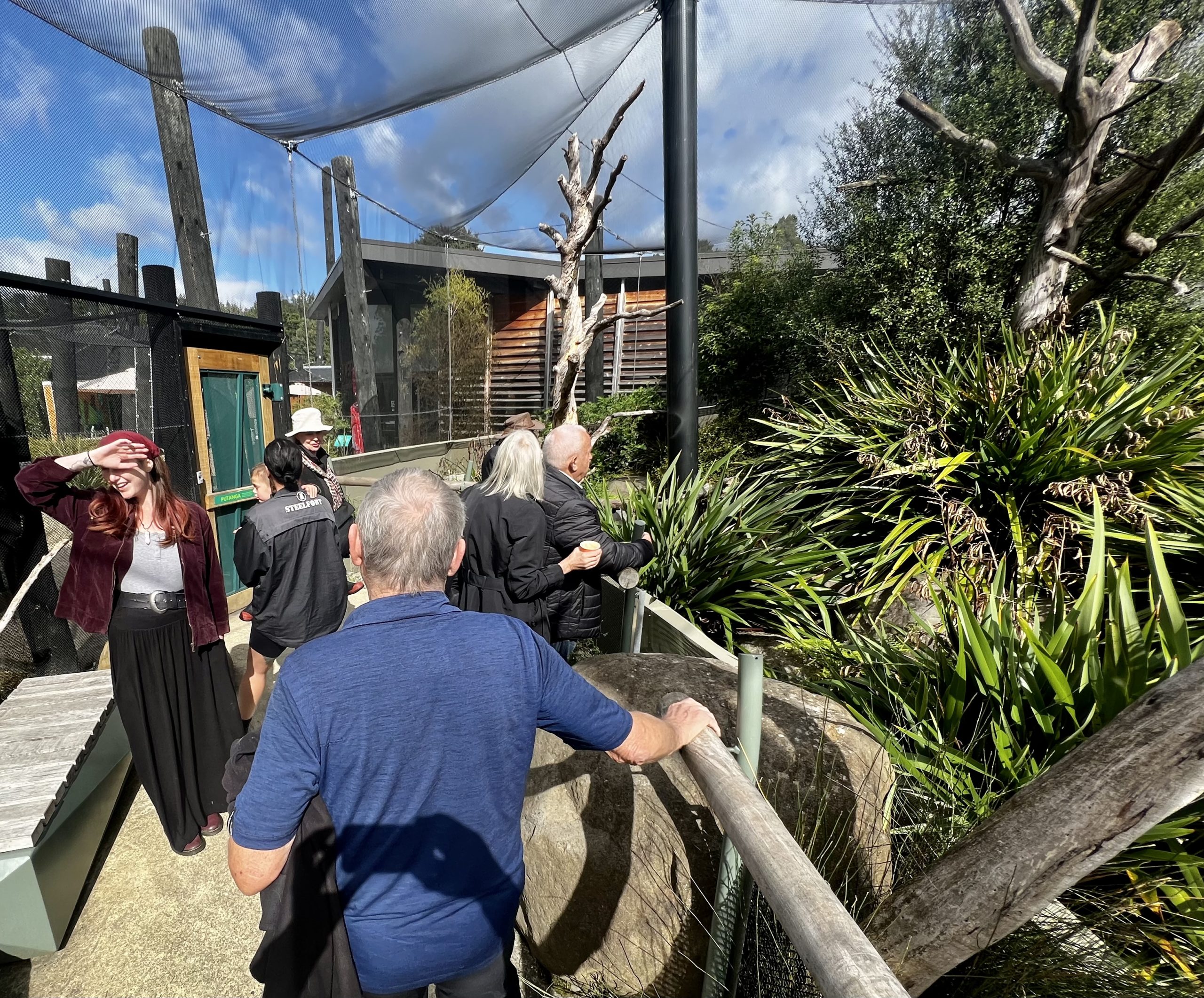
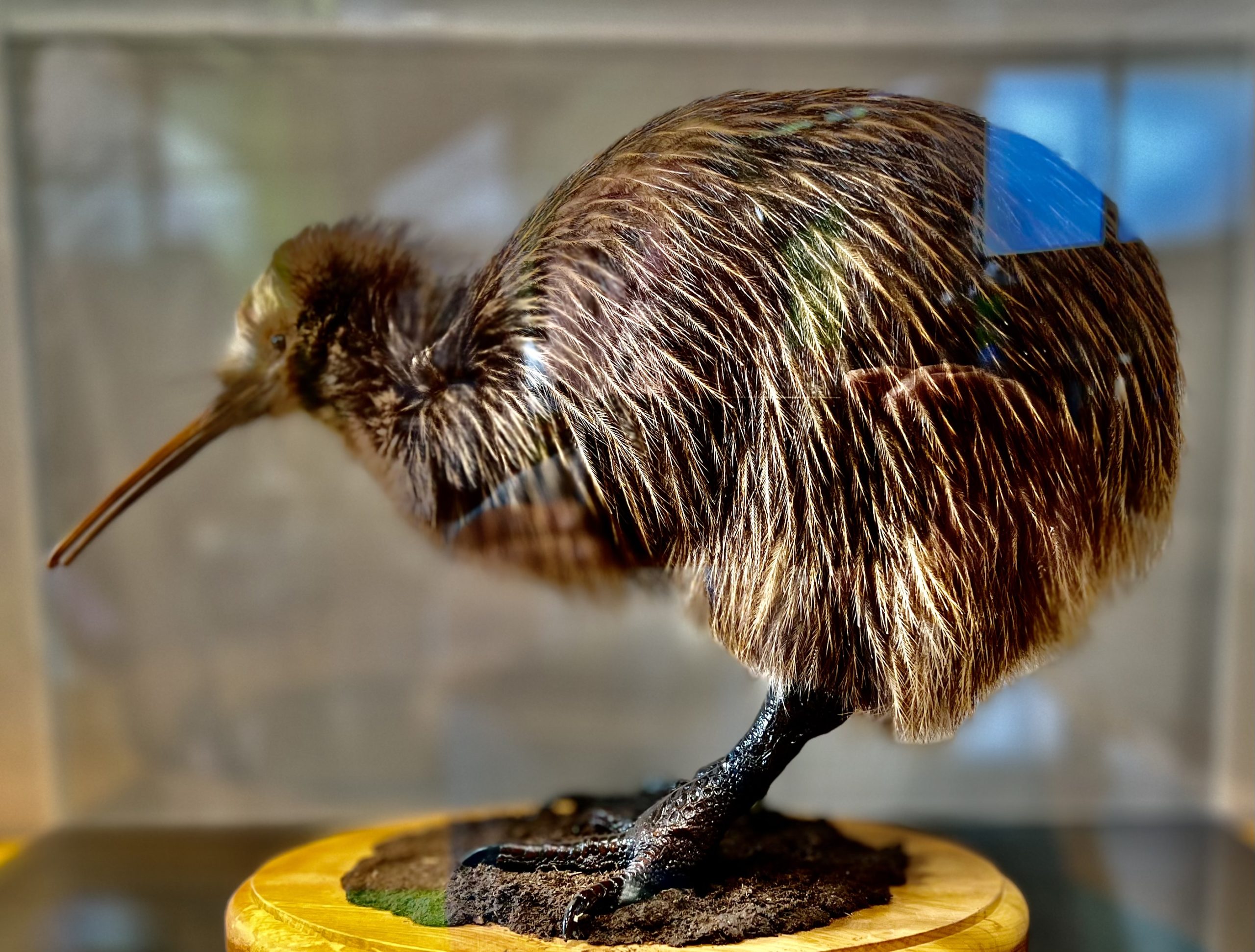
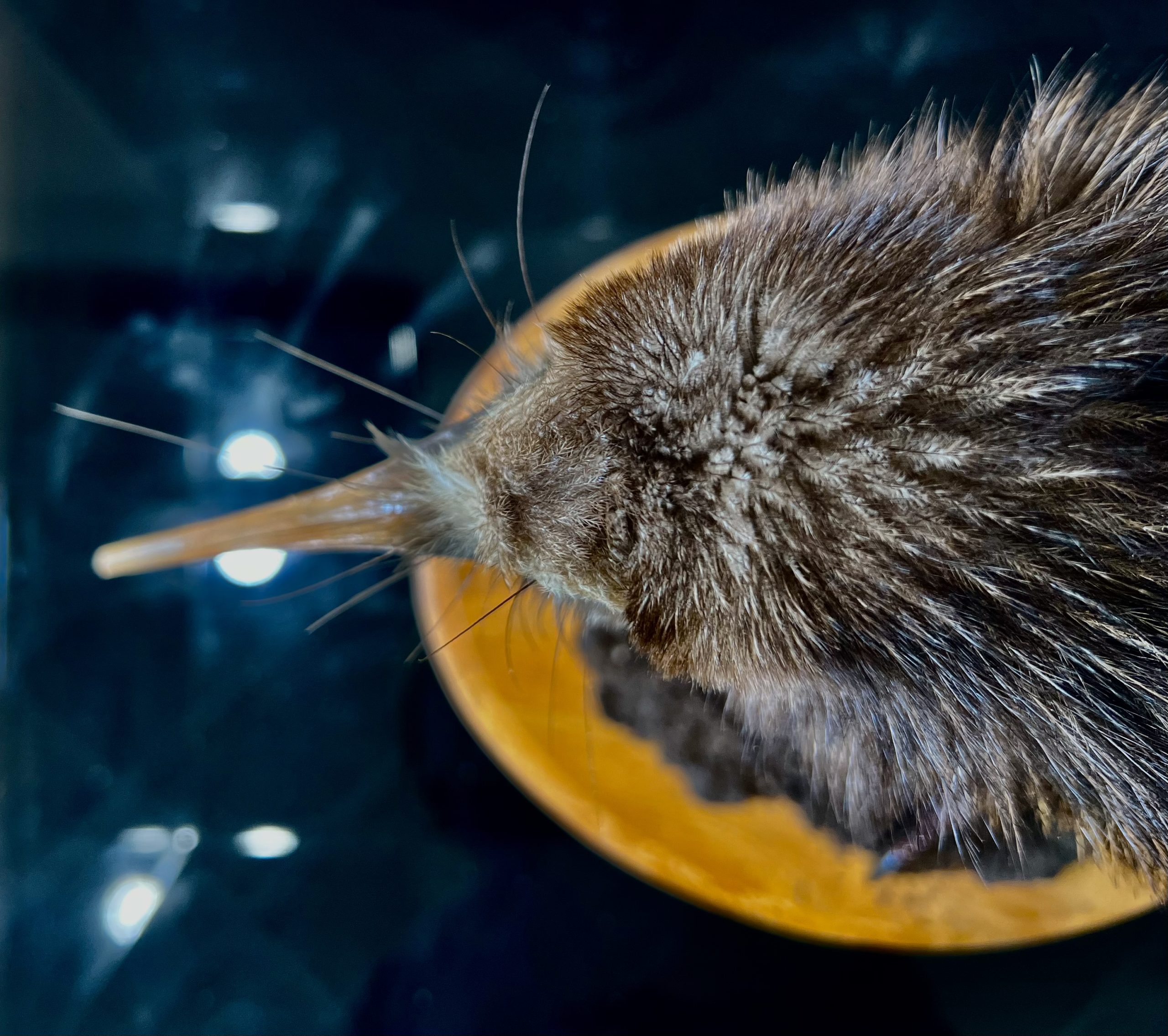
Wildlife Recovery Refuge
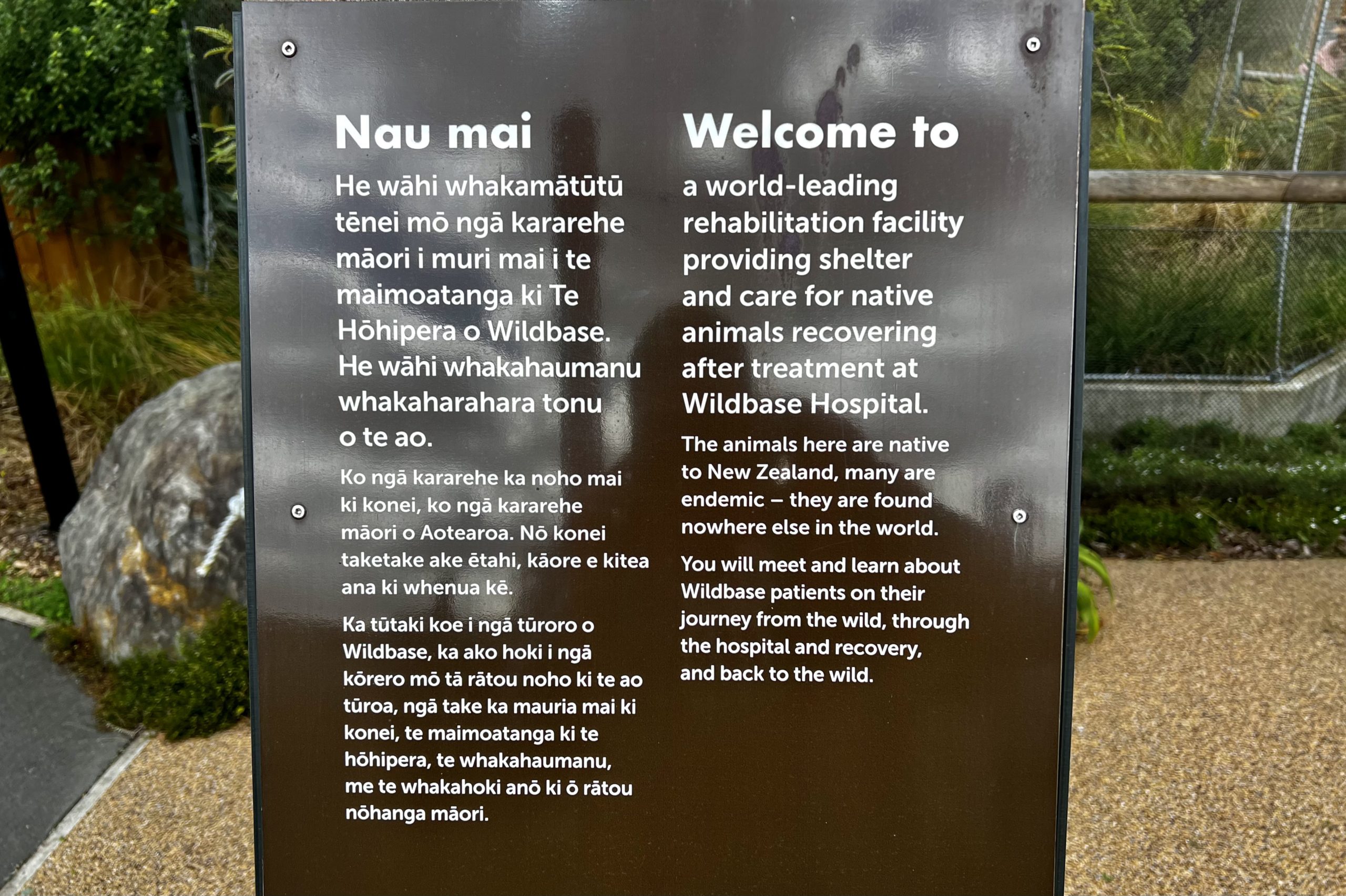
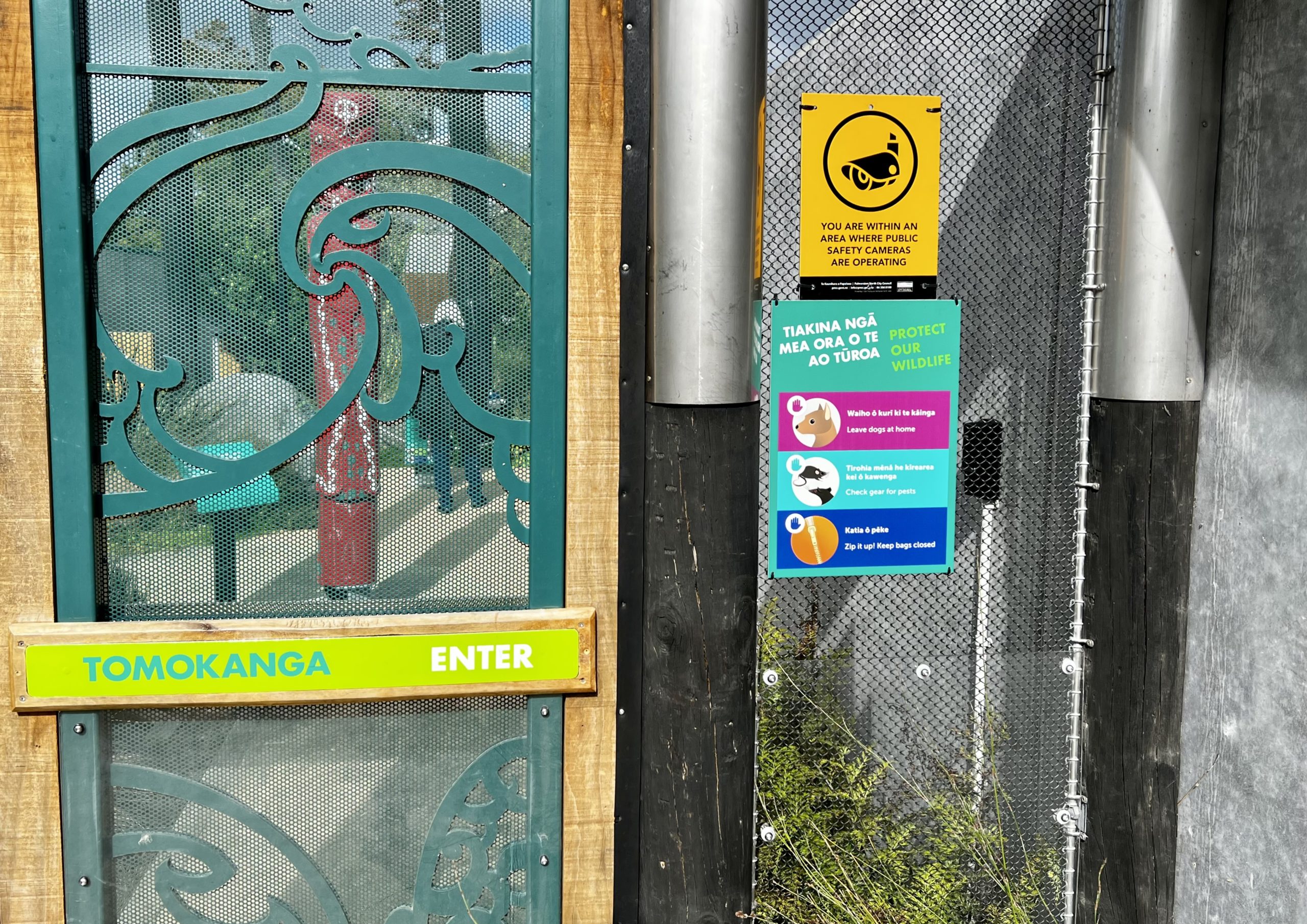
Clel took us to this small but very informative refuge center. Very nice. Volunteer run.
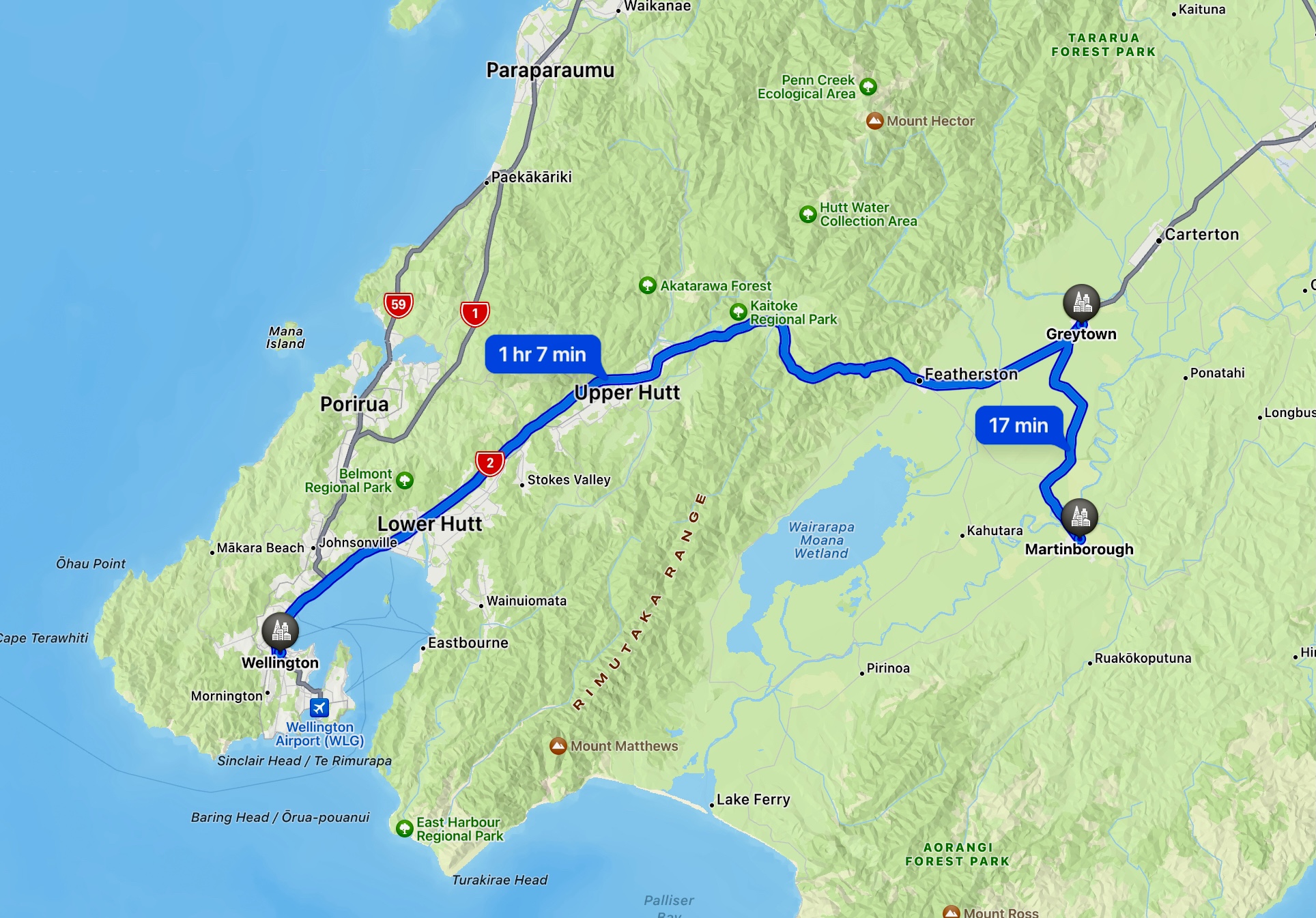
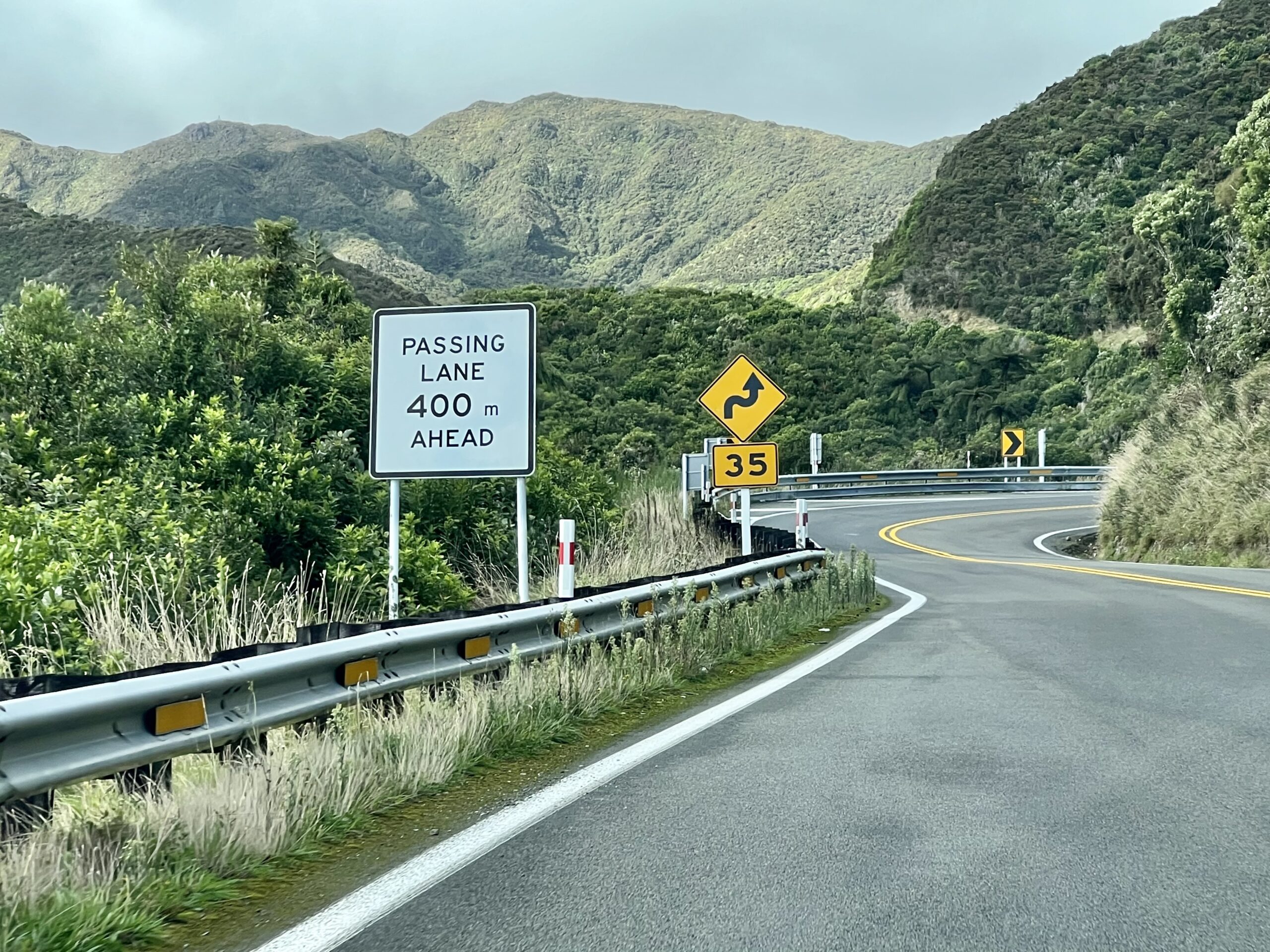
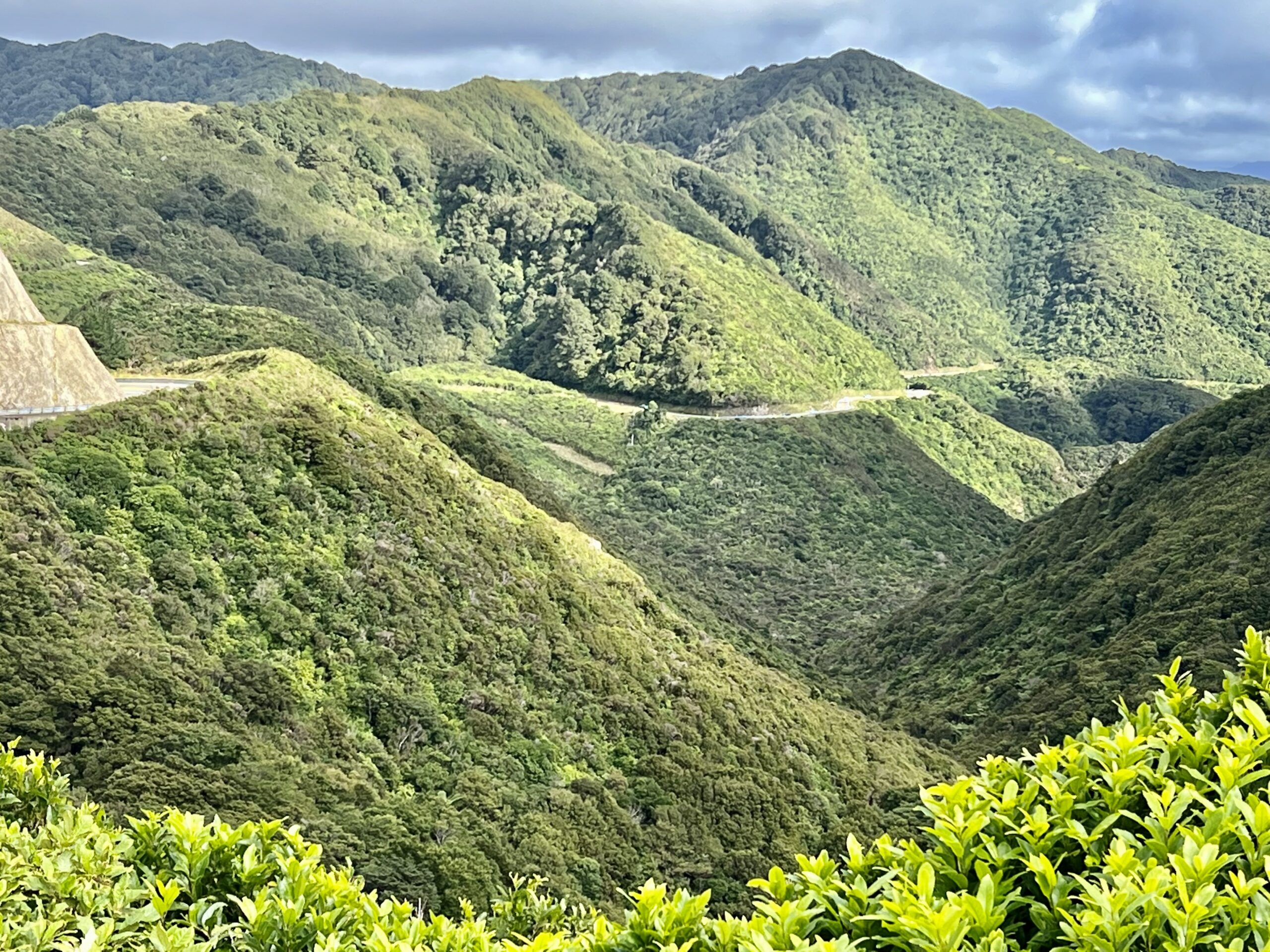
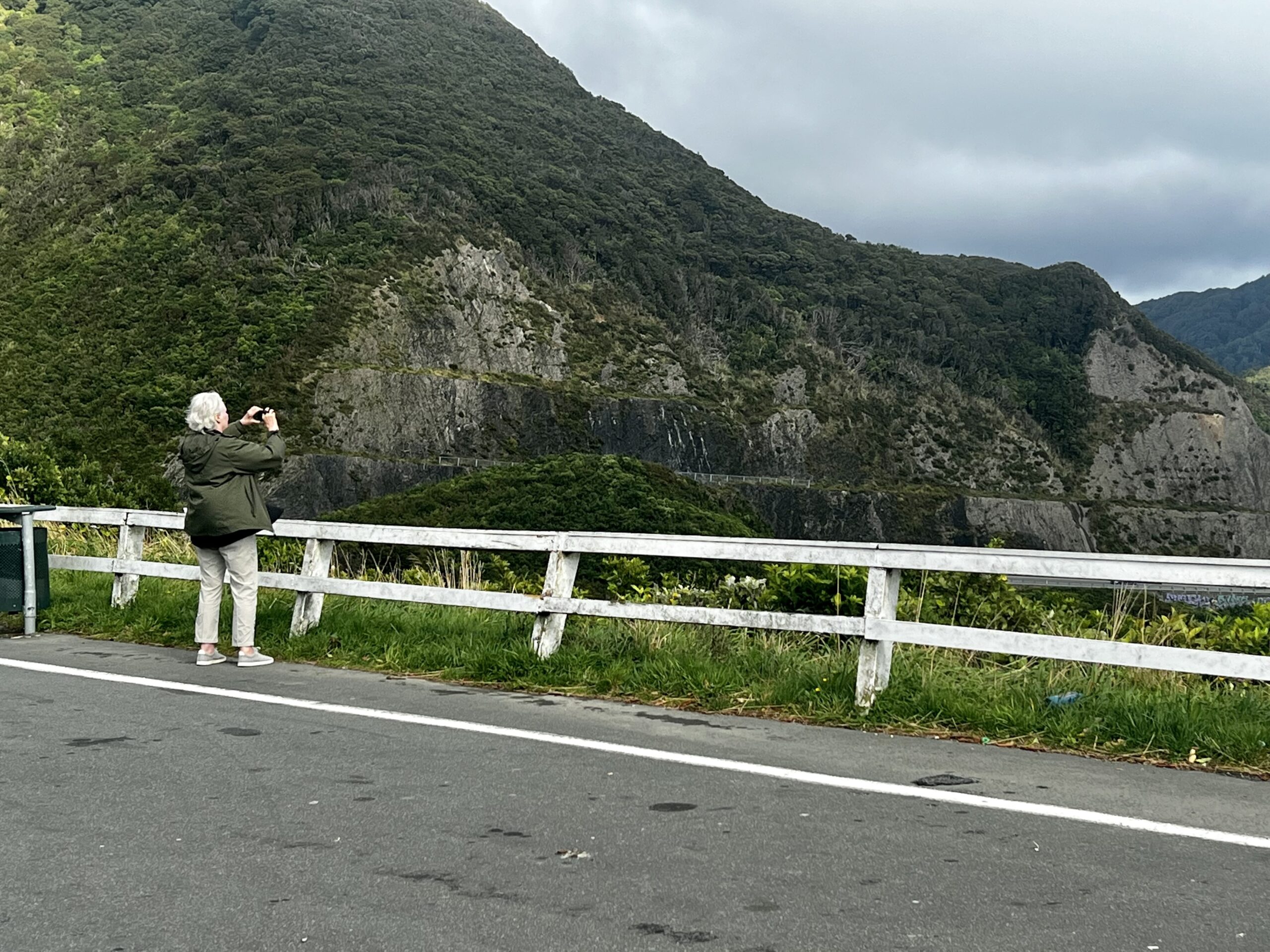
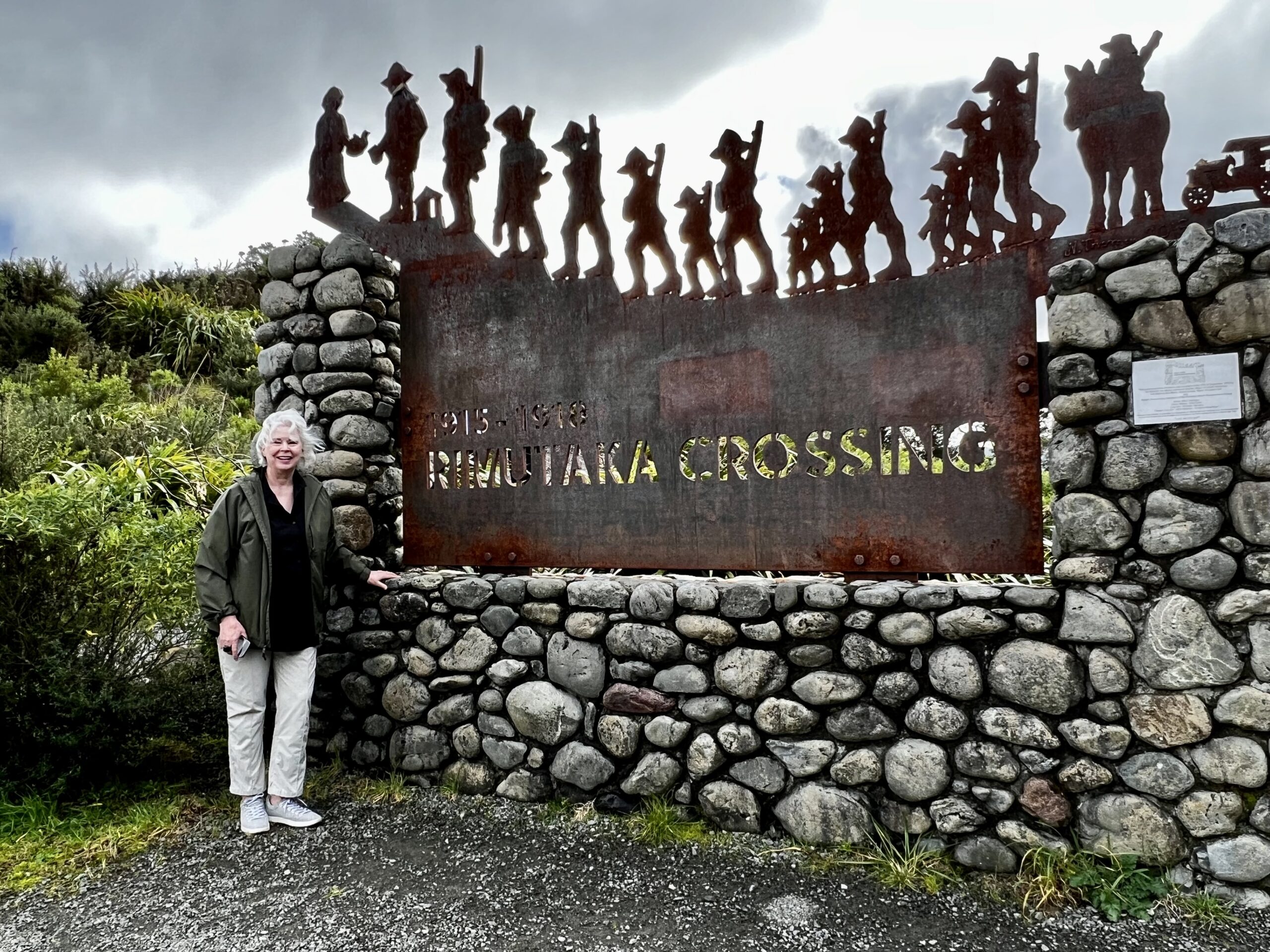
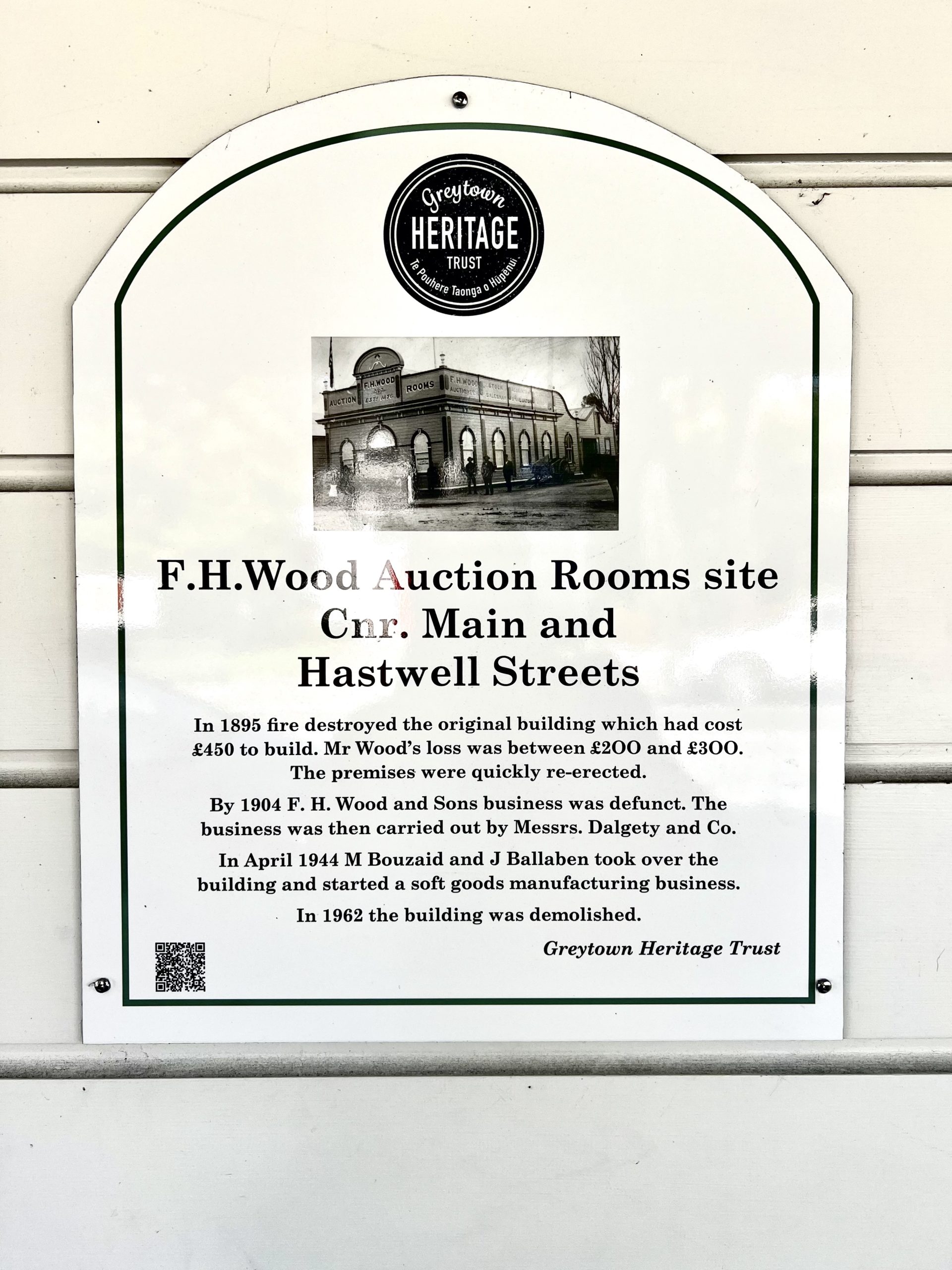
The one road over the hill from Wellington is daunting.At this historic marker we read that recruits for WWI gathered near Greytown, then spent three days hiking over these mountains to Wellington before shipping out to Europe.These hillsides are even more stunning than when Bonnie lived here. The gorse shrub that covered them provided a nursery for the trees that now dominate.
Accommodations and Grounds
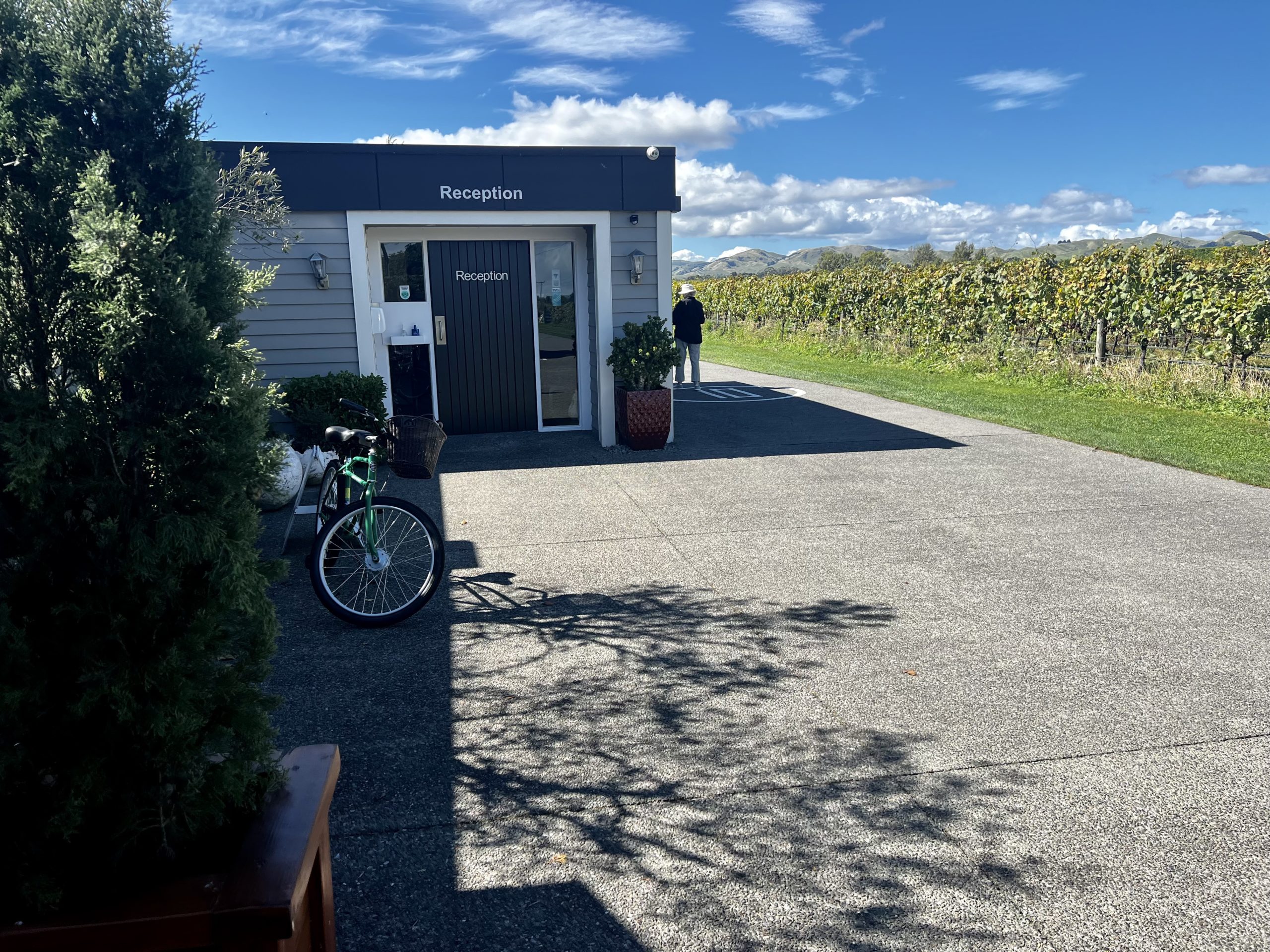
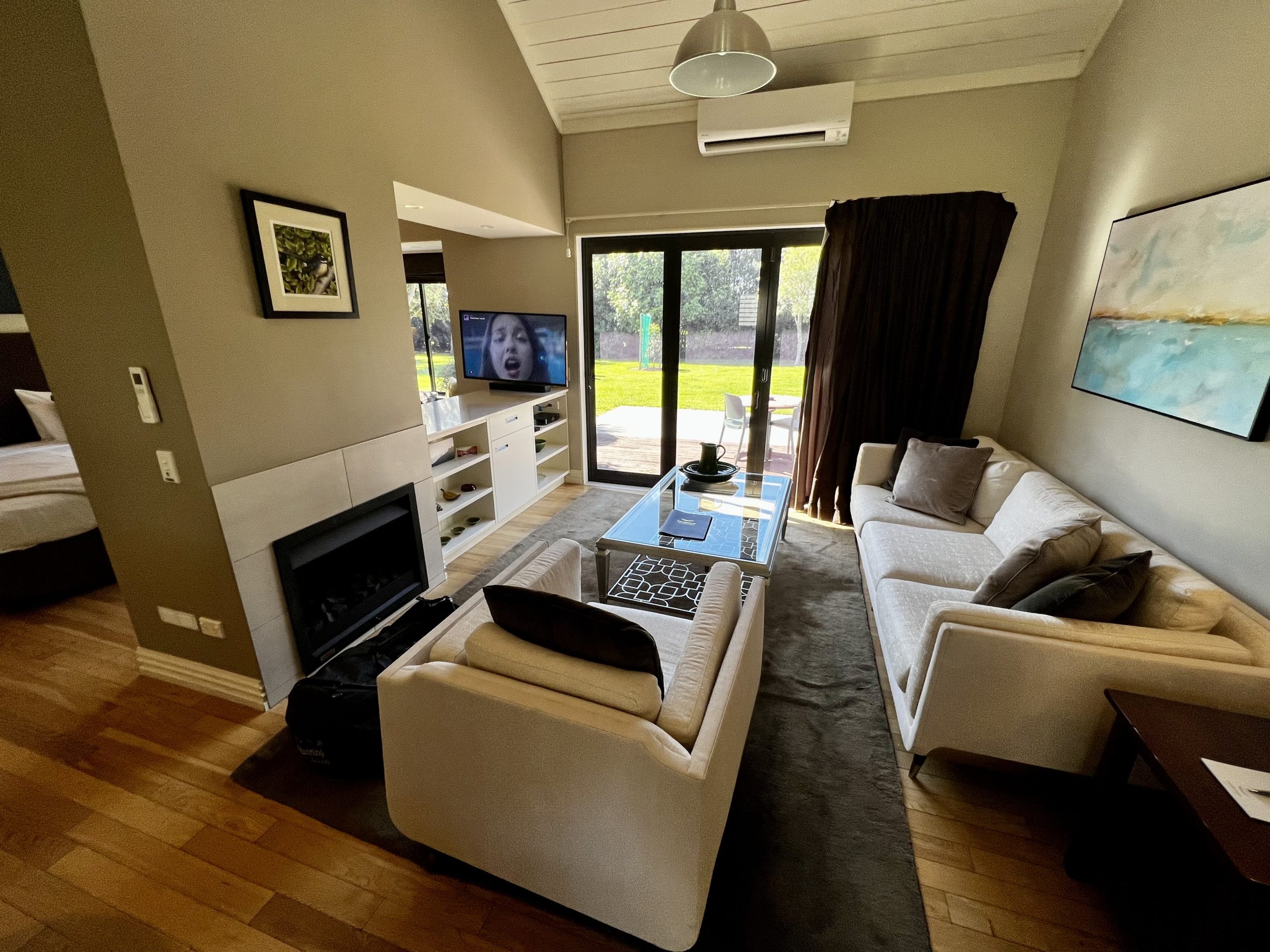
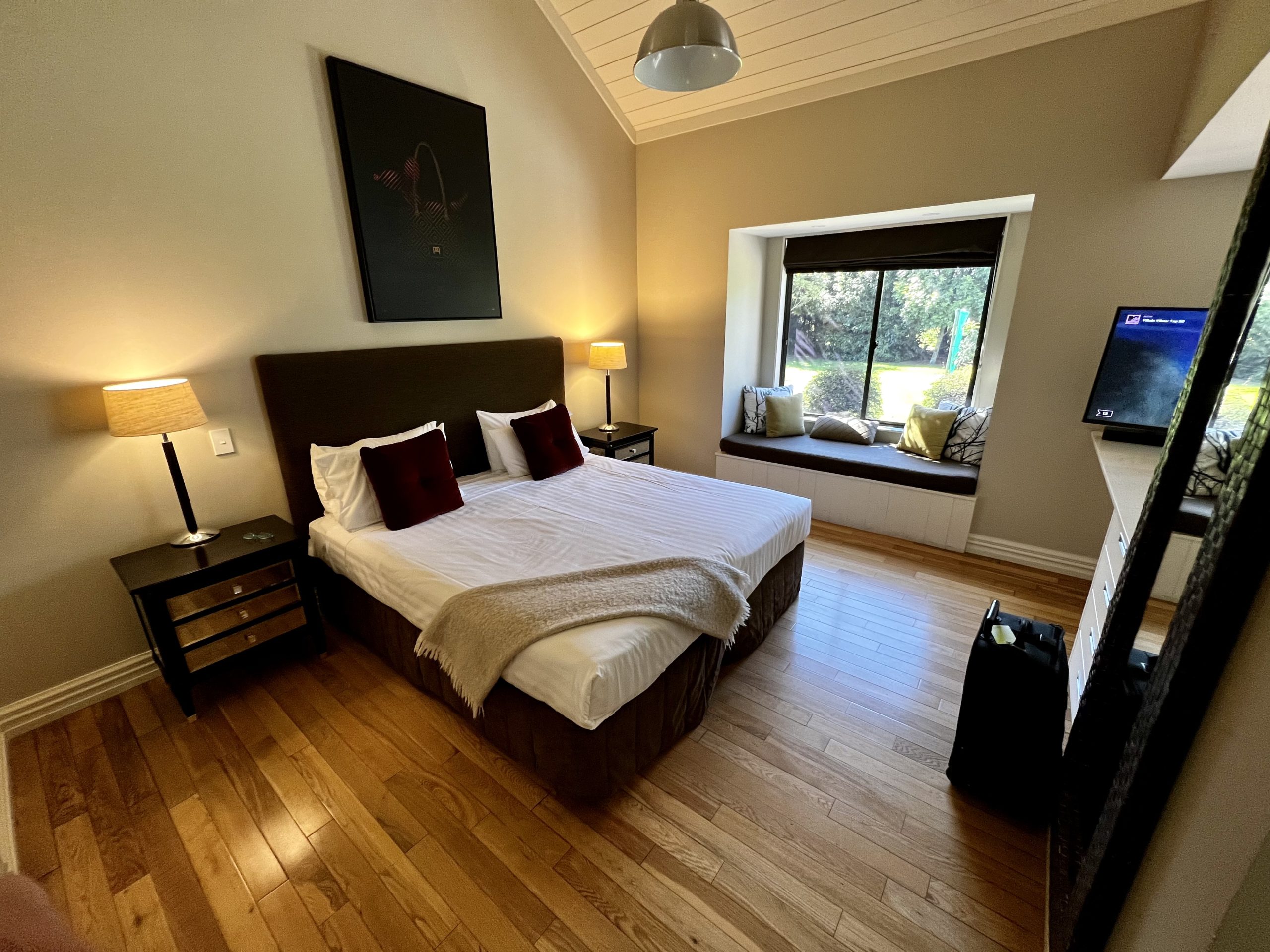
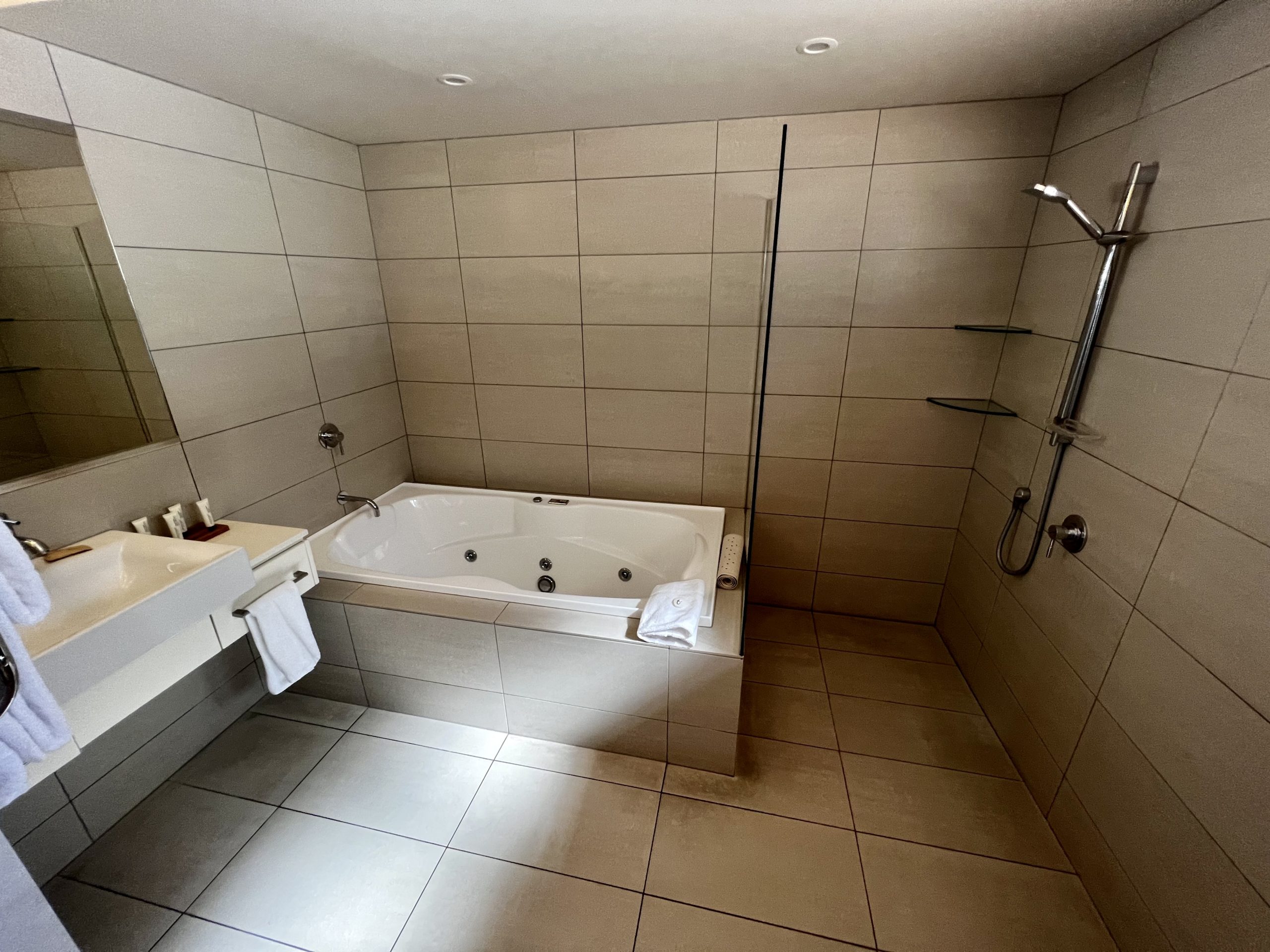
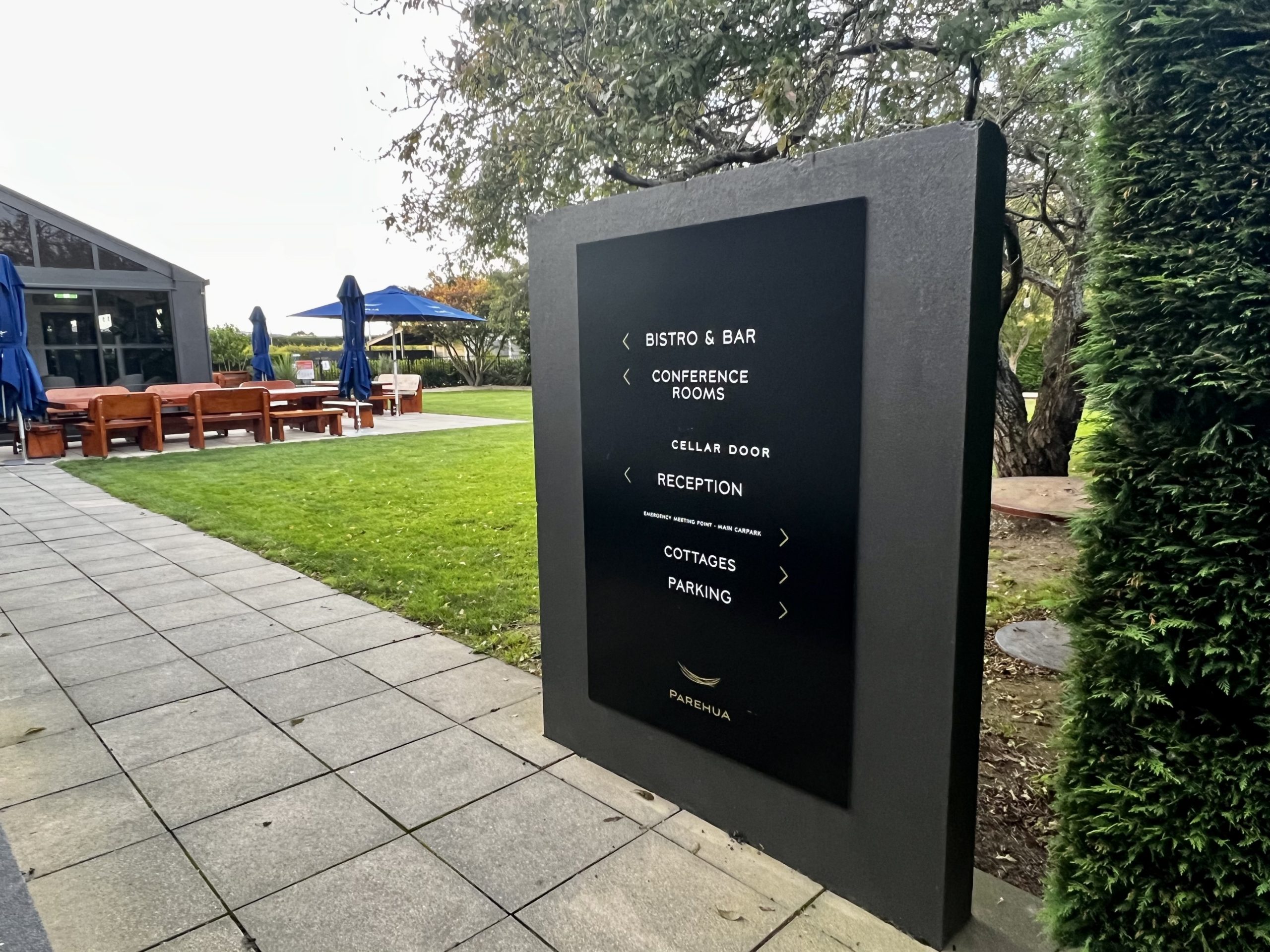
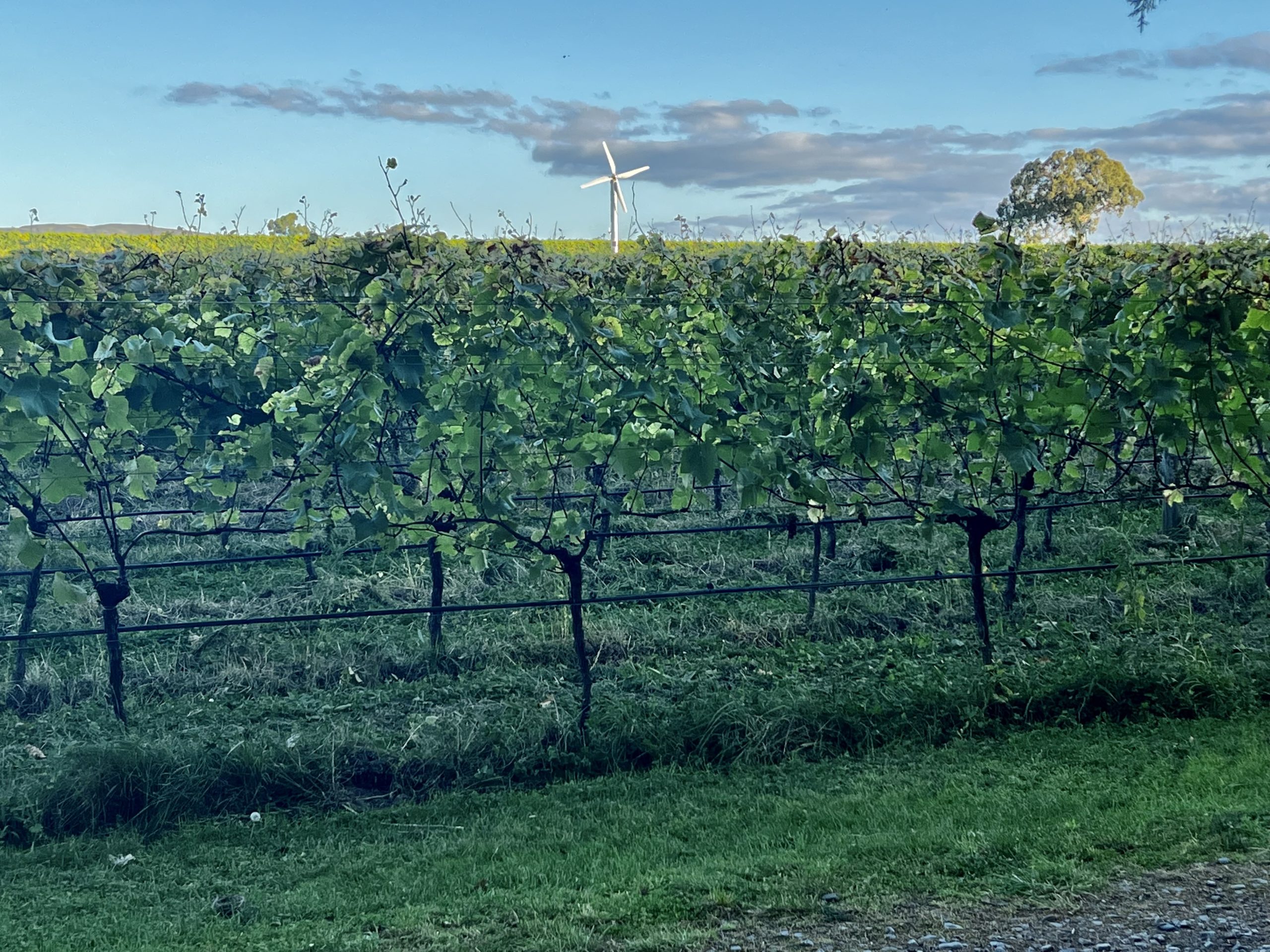
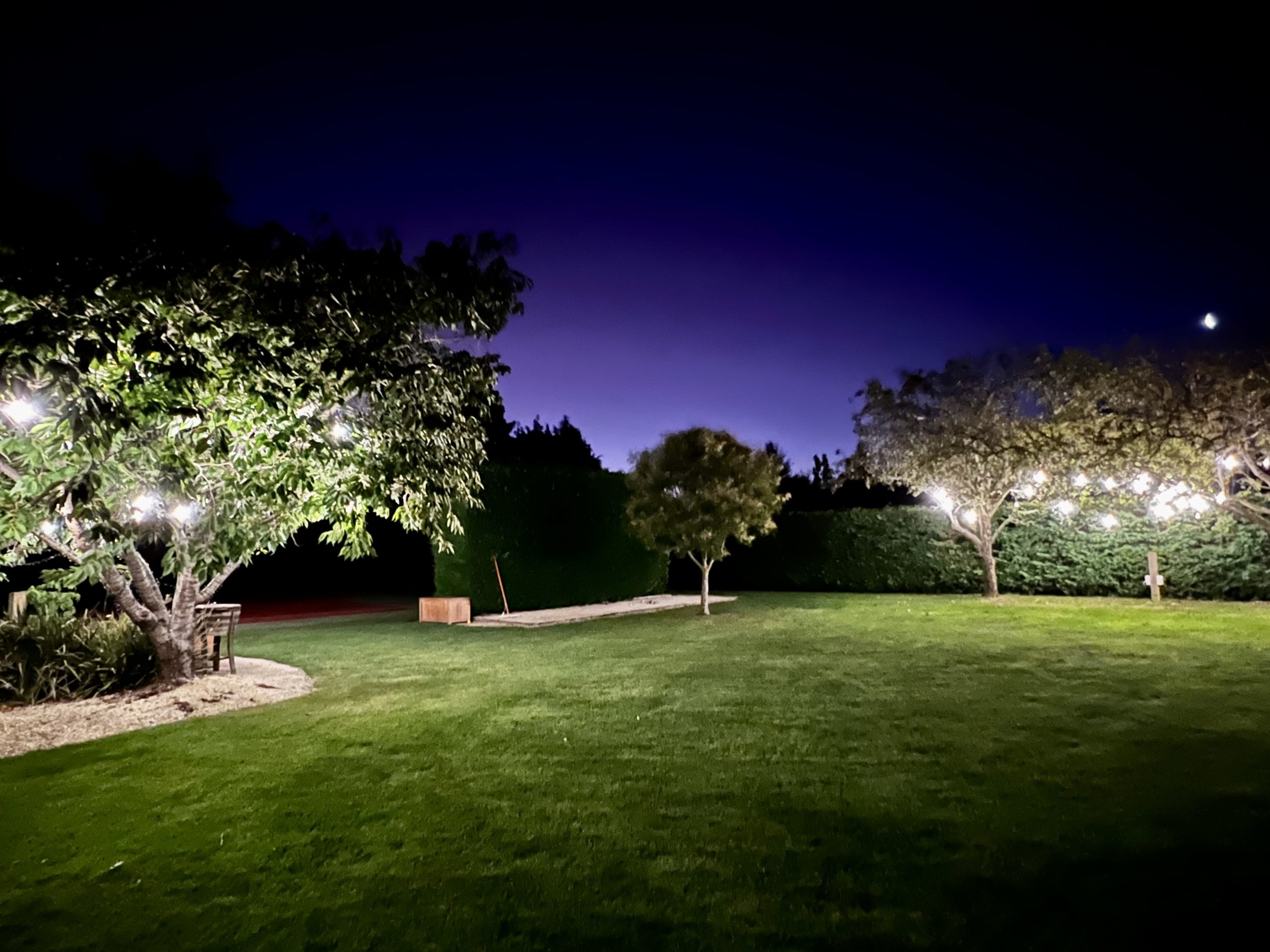
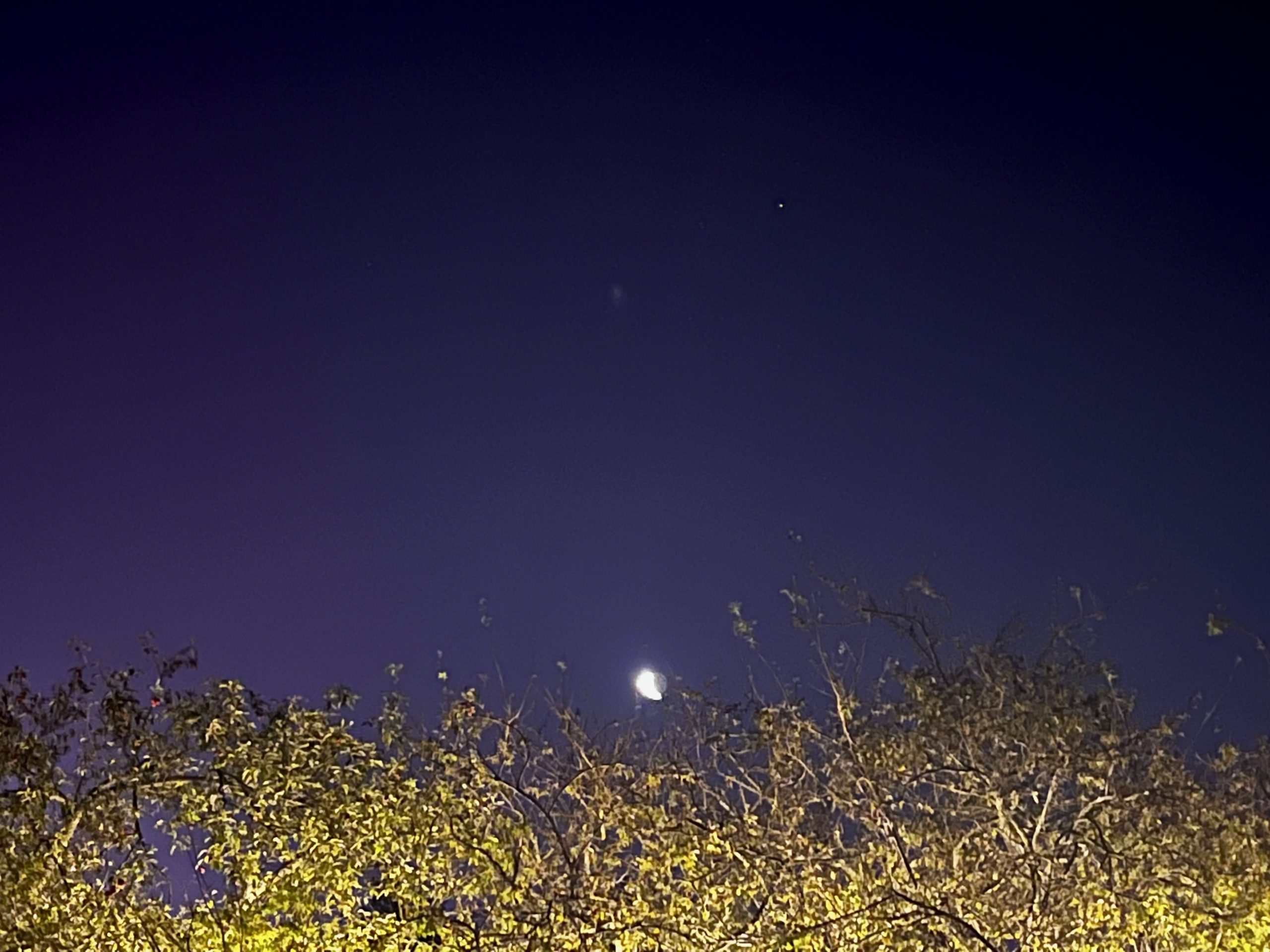
Very nice cottages set within the vineyards of Martinborough. We unpacked in an elegant and comfortable cottage and ate a first-rate dinner at the resort the first evening. The grounds are lush with vegetation and voluptuous hedges that intermittently line the drives and walkways. Stargazing at night is undisturbed by unneeded lighting. In January 2023, this area in the South Wairarapa was certified as an International Dark Sky Reserve, one of only twenty-one worldwide.
At our resort cottage near MartinboroughThey wrote this especially for Bonnie.
Bonnie in Greytown
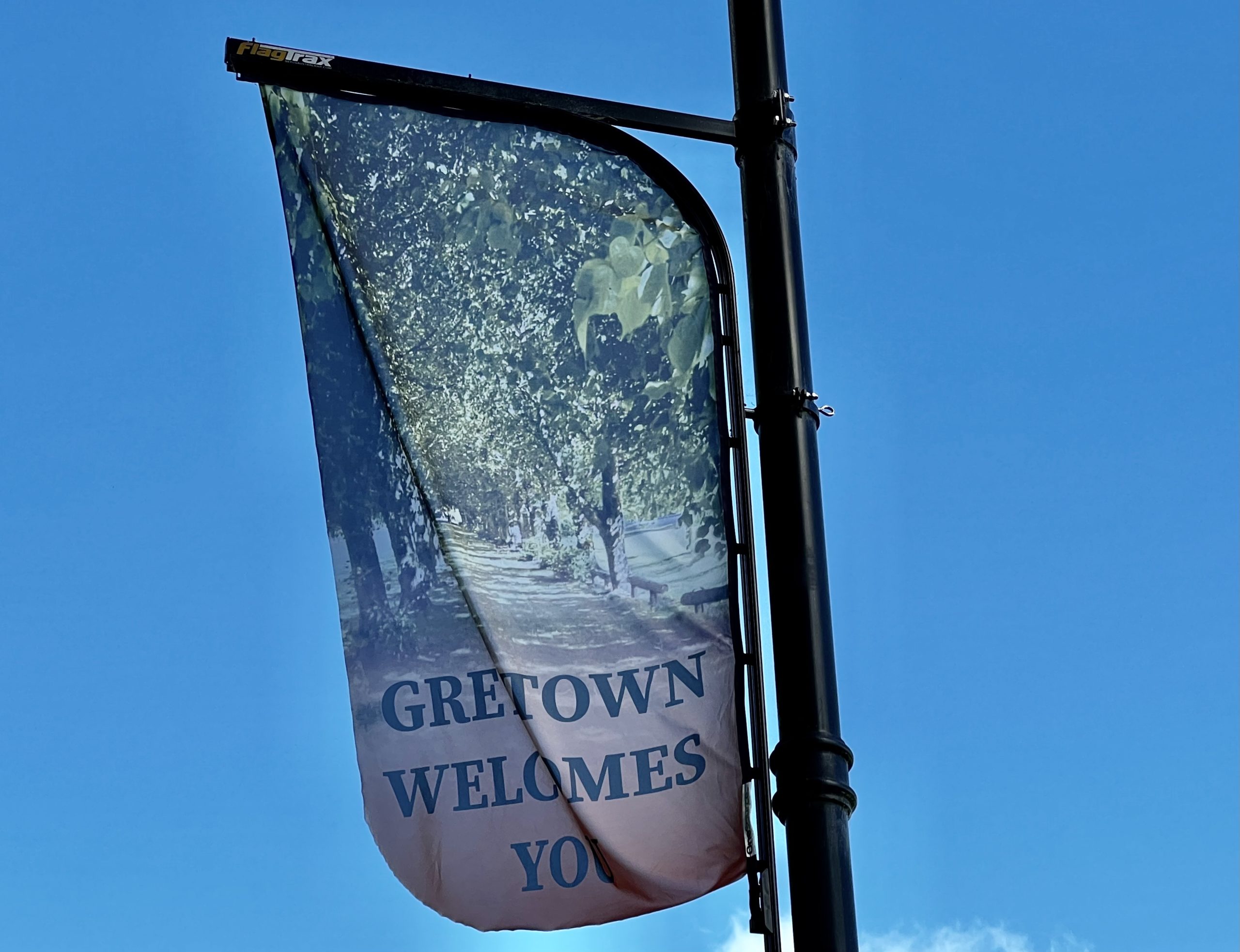
So much to say about Greytown. When Bonnie arrived as an exchange student in 1966, this town of 2,000 was dusty, and the Main Street looked like a ghost town. The two-hour drive over the mountains from Wellington was too arduous and scary to do often. Basic shopping required a trip to a slightly larger town farther north. Fields around the town were filled with Romney-cross sheep. The best thing happening in town was Kuranui College, the new high school, which had great teachers and a hard-driving principal. Before Kuranui, local students went to boarding schools. Now they came by bus daily from three surrounding small towns, often with very long drives. Bonnie’s friend Gary had the longest bus ride in New Zealand—an hour and a half each way. He bonded with the bus driver, our math teacher, Mr. Spooner.
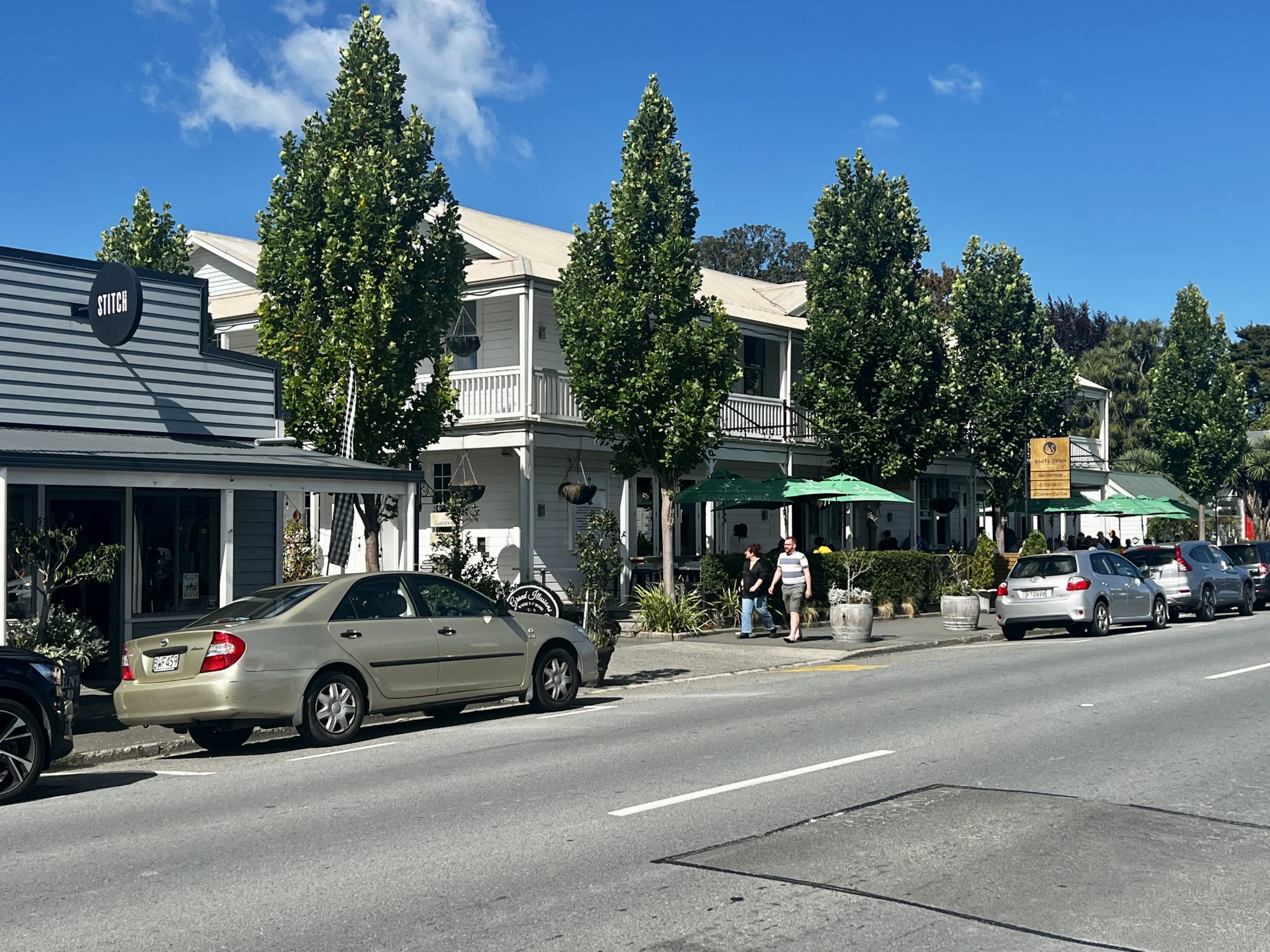
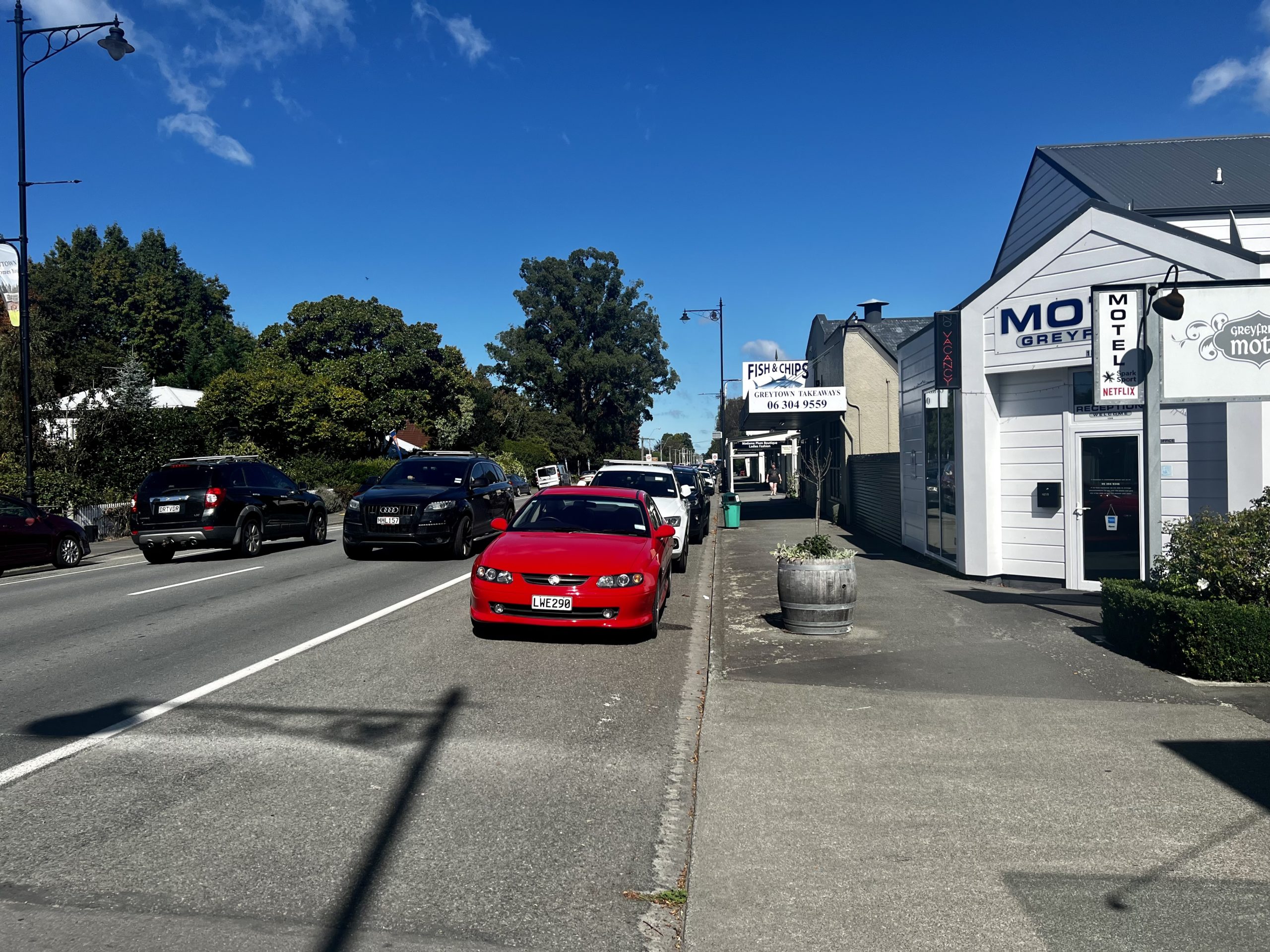
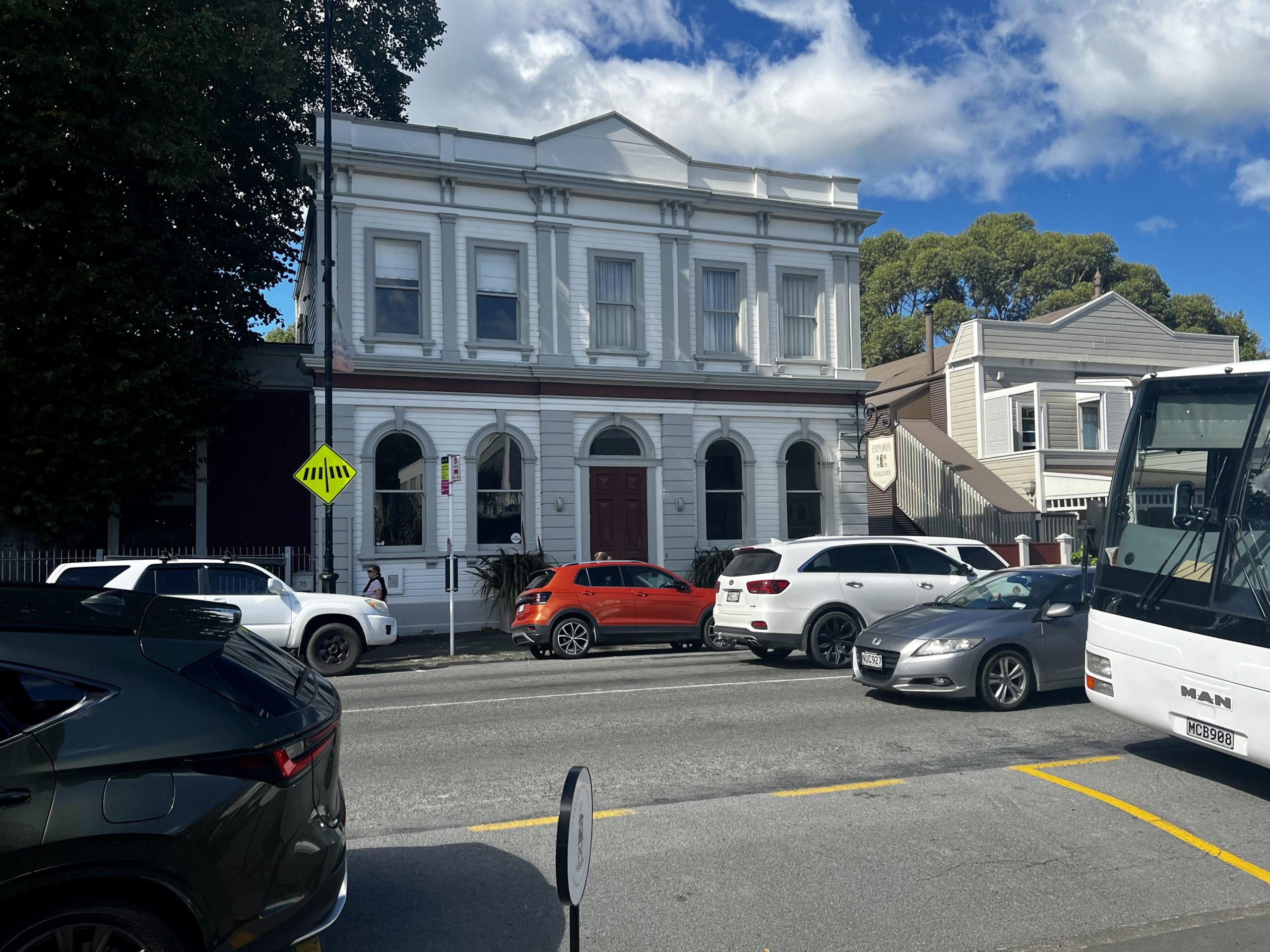
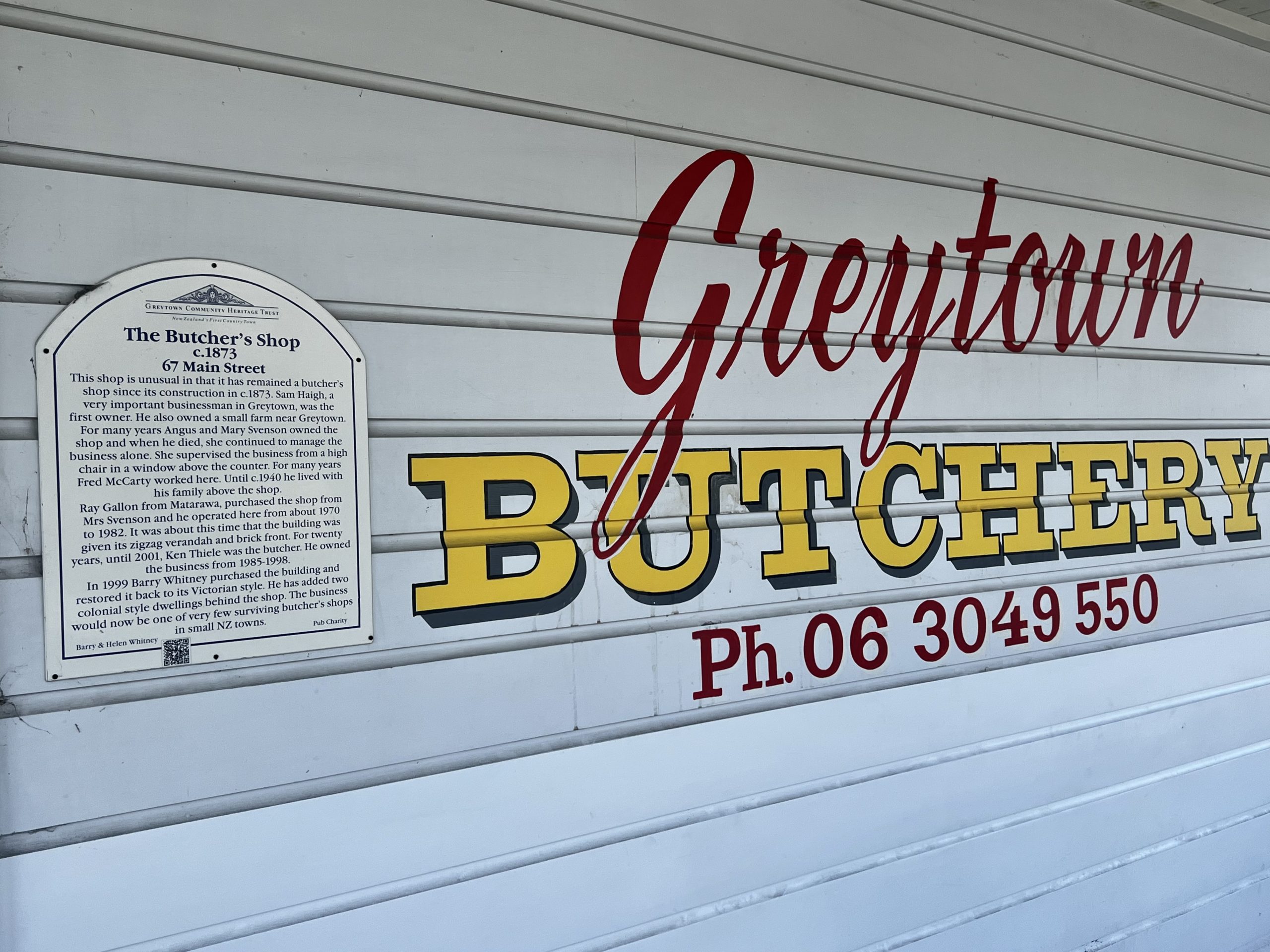
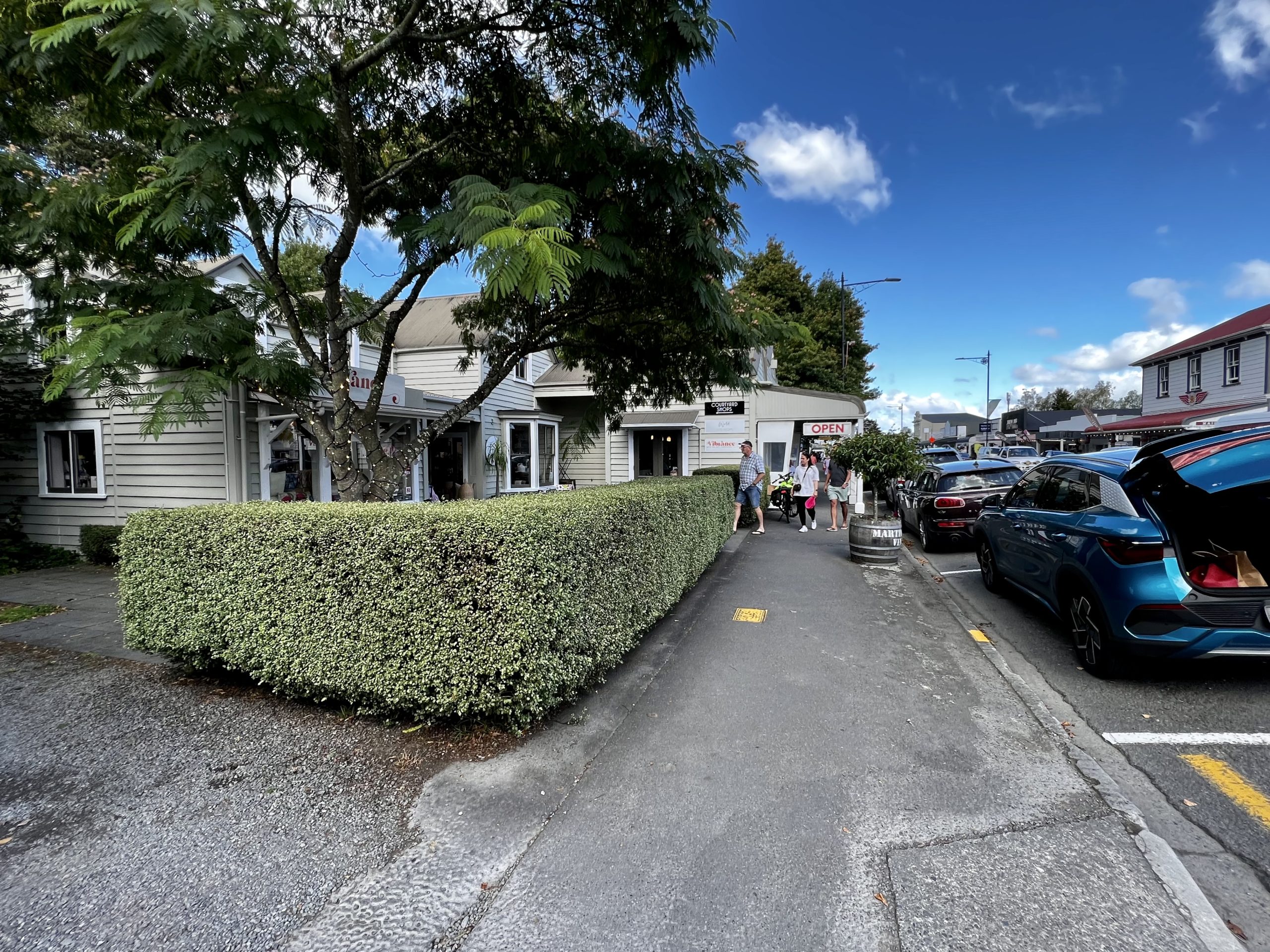
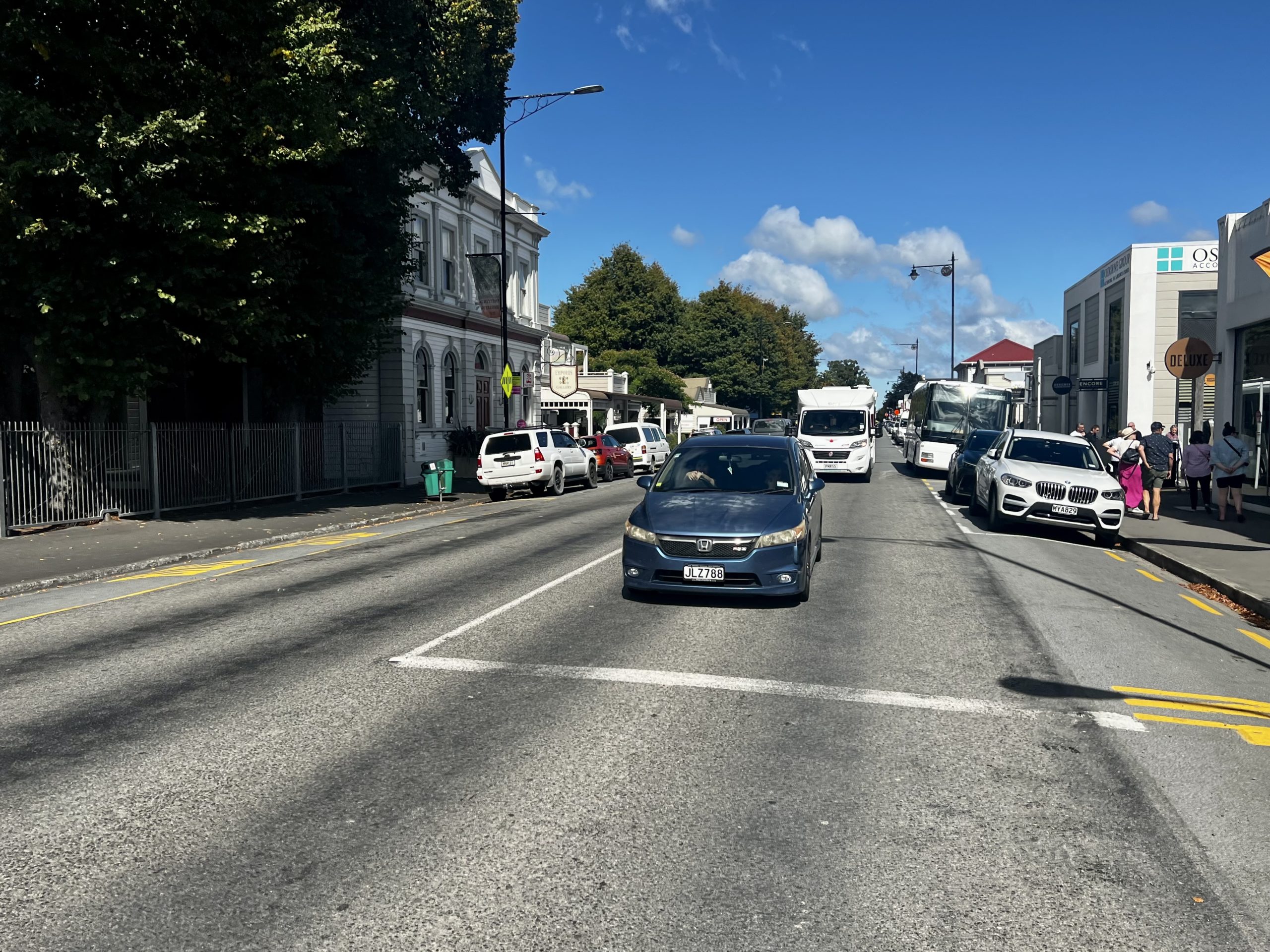
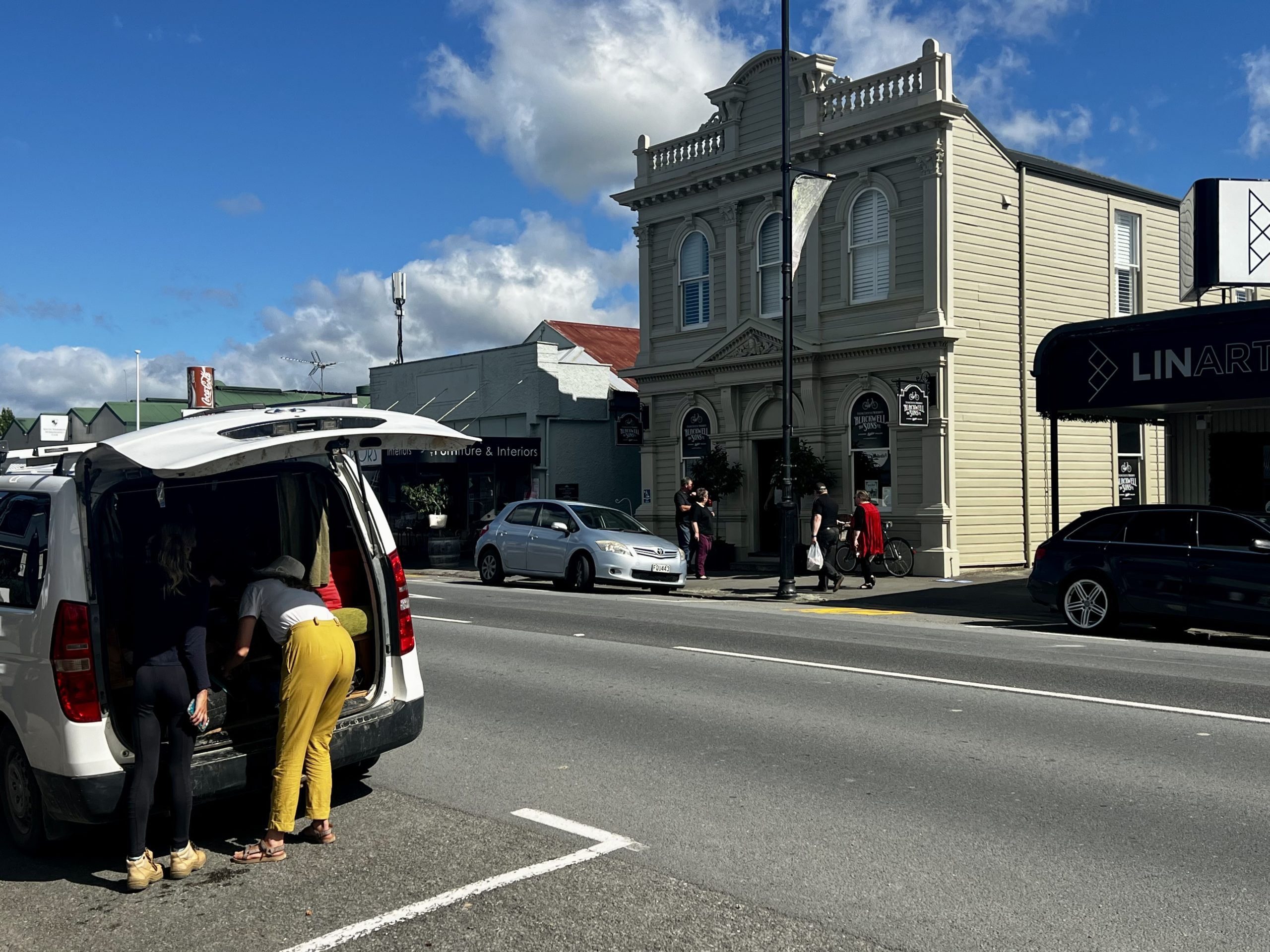
Greytown today is nearly unrecognizable. It has added only a few hundred people, but Main Street is super stylish and bustling with cafes, hotels, and high-end shops. We have not seen anything like this elsewhere in New Zealand. The Victorian buildings are restored and labeled with historic plaques. Greytown could easily compete with St. Helena in the Napa Valley for title of most fashionable little tourist town. As the road over the mountains from Wellington was improved and the drive became easier and faster, Greytown became a popular weekend destination, first for gay men. Now they are eclipsed by white-haired heterosexual couples with money to spend.
For Bonnie, the year in Greytown was terrific. Great family, great school, great best friend. The rural setting was an abrupt change from suburban Chicago but not a bad one. Her New Zealand family took her on ambitious trips throughout the country, got her outfitted in a school uniform, arranged tennis parties for friends on the grass court in the yard, hosted girlfriends for the weekend, invited other exchange students in the region for an American Thanksgiving dinner, answered her endless questions about the country, and addicted her to daily afternoon tea.
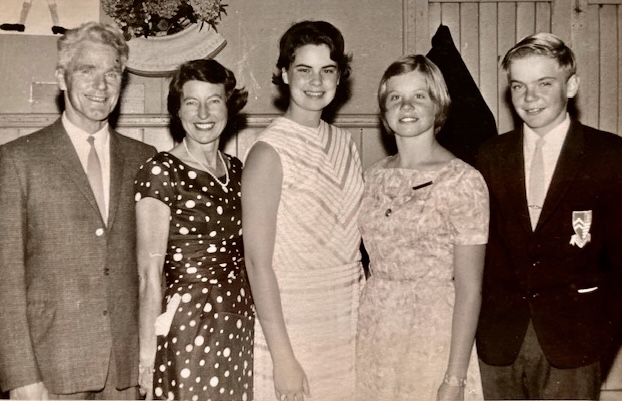
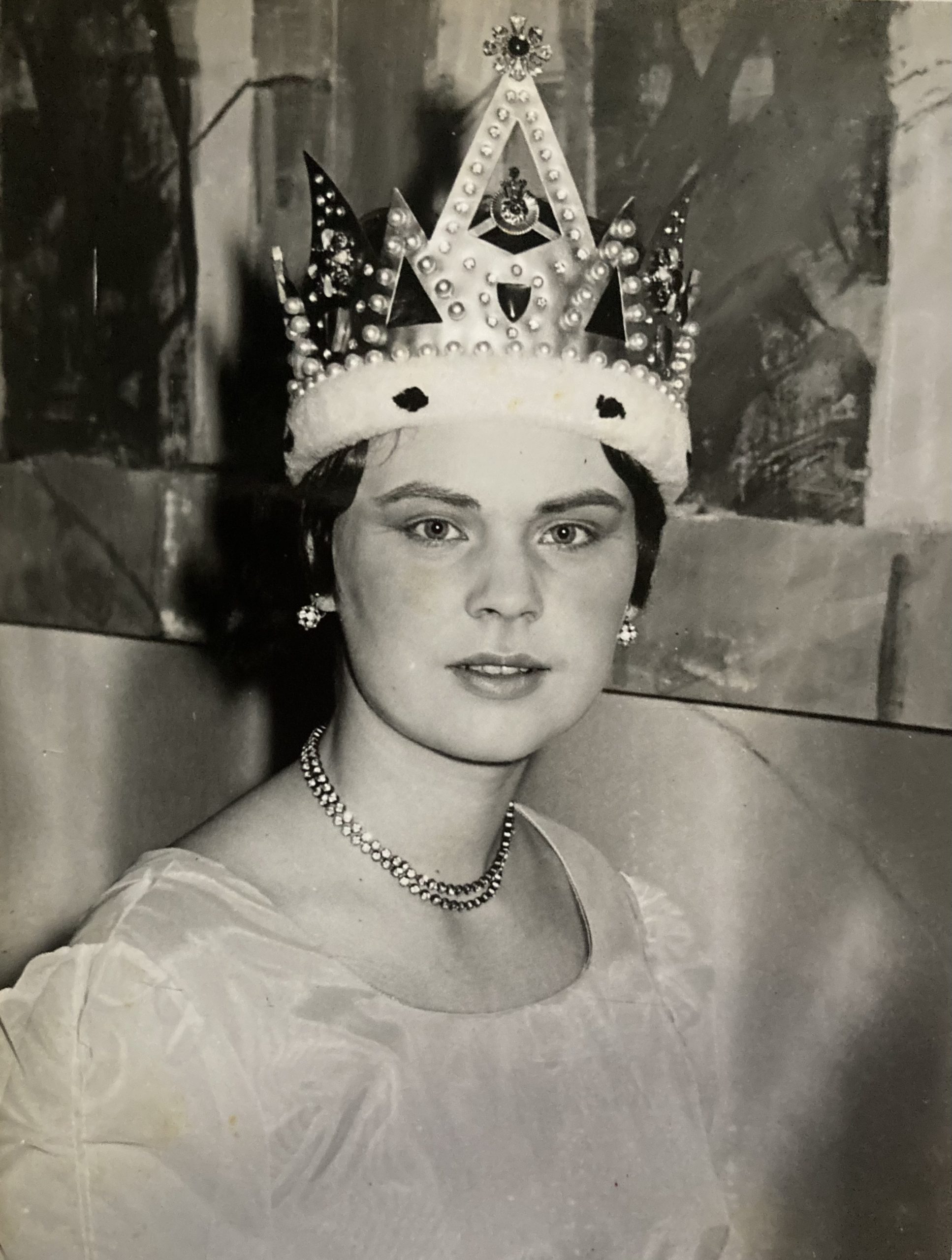
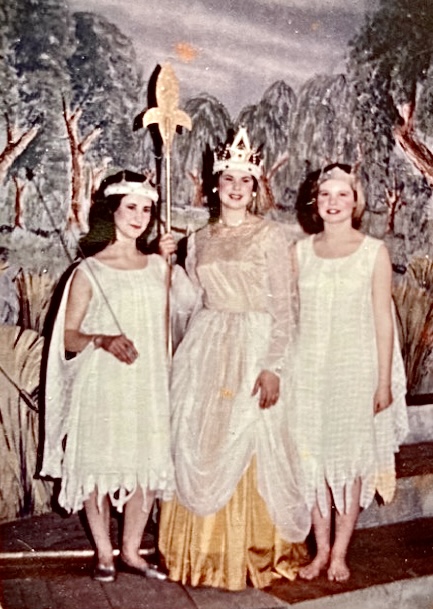
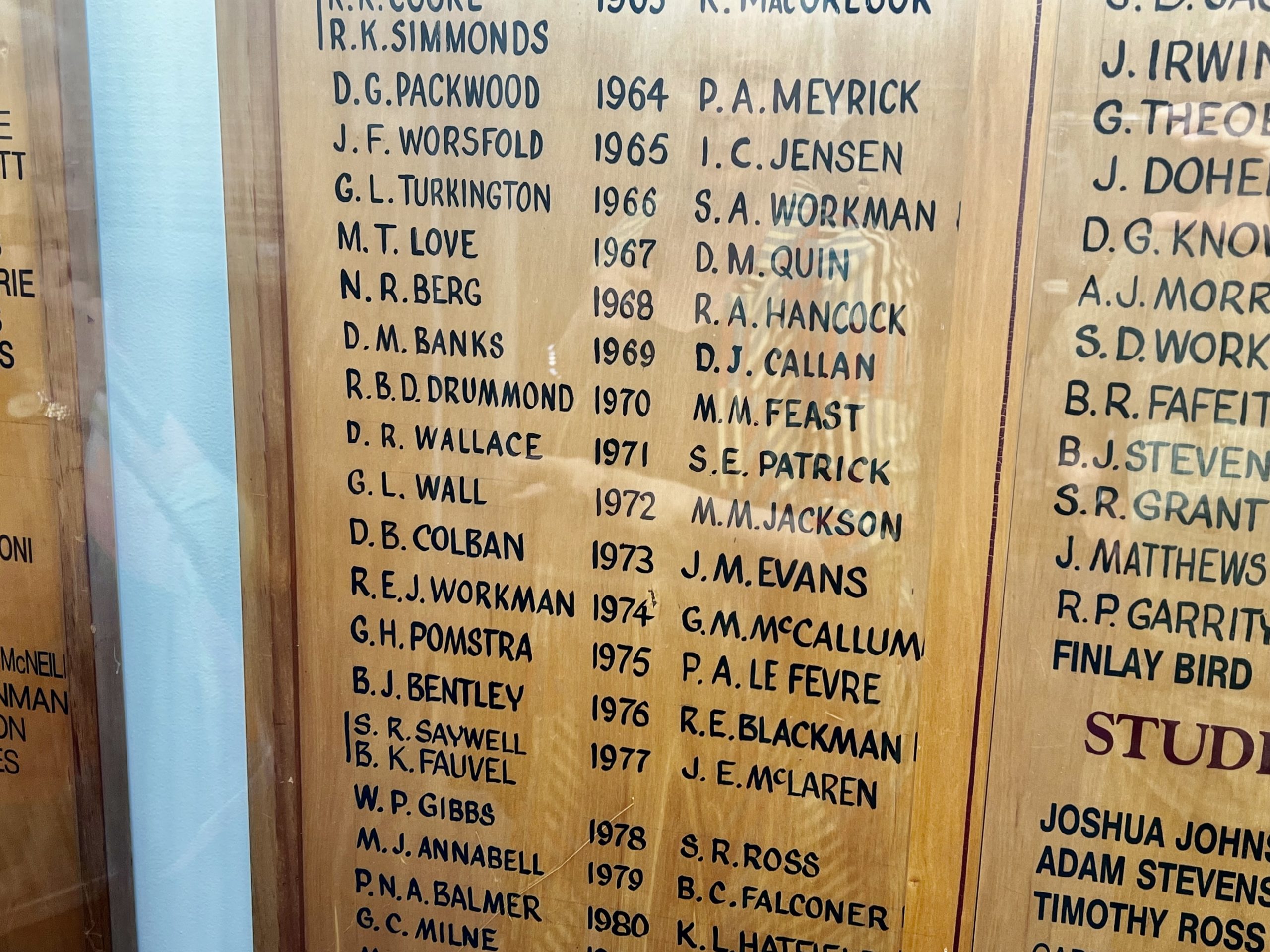
Bonnie’s New Zealand family: dad Douglas, a doctor; mum Zena, star mother; Bonnie; younger sister Nicky, great student and competitive swimmer; brother David, budding surfer and later Head Boy at KuranuiBonnie as Queen of the Fairies in the Gilbert and Sullivan operetta Iolanthe
An Afternoon with Di!
Di is part of Bonnie’s extended family in New Zealand. It was an intense experience to spend a half day with her in person, not on Instagram, catching up on family news, old classmates, and Greytown. After a long lunch we went to Kuranui for a tour of the school. Di picked up a master key, and we explored the old and new buildings, talked to teachers, and met the principal.
After a long, interesting career in education, Di currently works three days a week for the Department of Education targeting students who “don’t like school.” During the pandemic lockdown, despite stops by the police, she drove all over the region to visit students, often delivering paper workbooks to students without computers. She is the mother of Bonnie’s “nephew” Simon who has stayed with us several times in San Francisco. Di is also approved by the government as an “officiant” for weddings and funerals. She does weddings only occasionally, but Bonnie loves to see them on Instagram.
Di gave us great insight on the push to use more Māori language and customs. She is an enthusiastic advocate. She explained that people are switching to Māori names for places such as Wellington, despite the grumpy reluctance of some in our generation. And we all need to correct our pronunciation. Bonnie included. The sloppy old Kiwi version, omitting syllables here and there and mushing vowel sounds, is no longer acceptable. As an employee of the Department of Education, she takes an exam next week, demonstrating that she can perform a Māori greeting ceremony (such as for a professional meeting), a farewell ceremony, and two songs, and can handle Māori vocabulary. A teacher at the high school gives classes on these things for students and teachers. Di says she can follow the gist of meetings conducted in Māori, which is impressive. She pointed out to us that there in no plural in Māori. So we need to correct our blog to remove any “Māoris” and switch them to “the Māori.”
Sister-in-laws Di and Bonnie A Greytown cafe Bonnie follows on Facebook
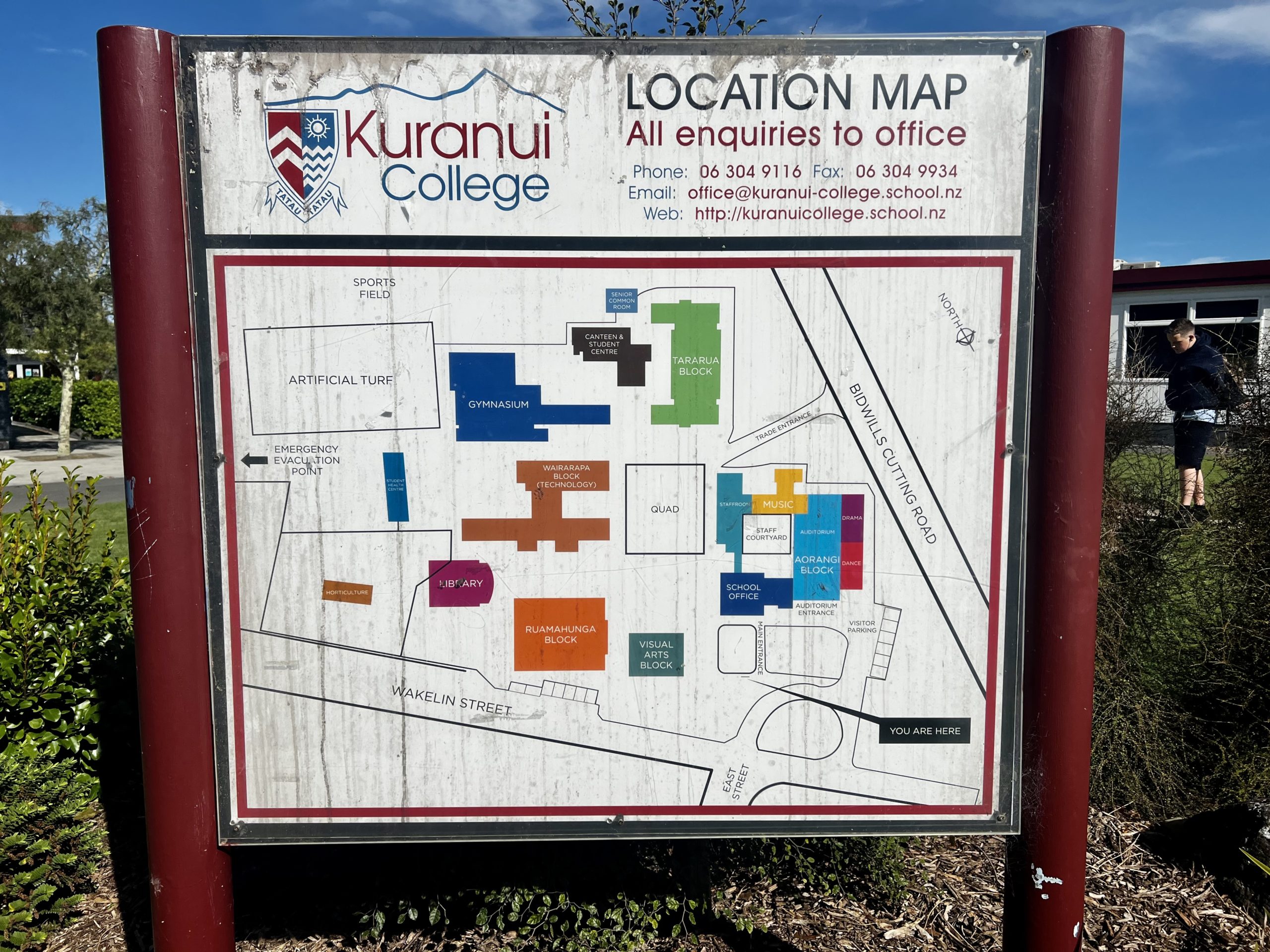
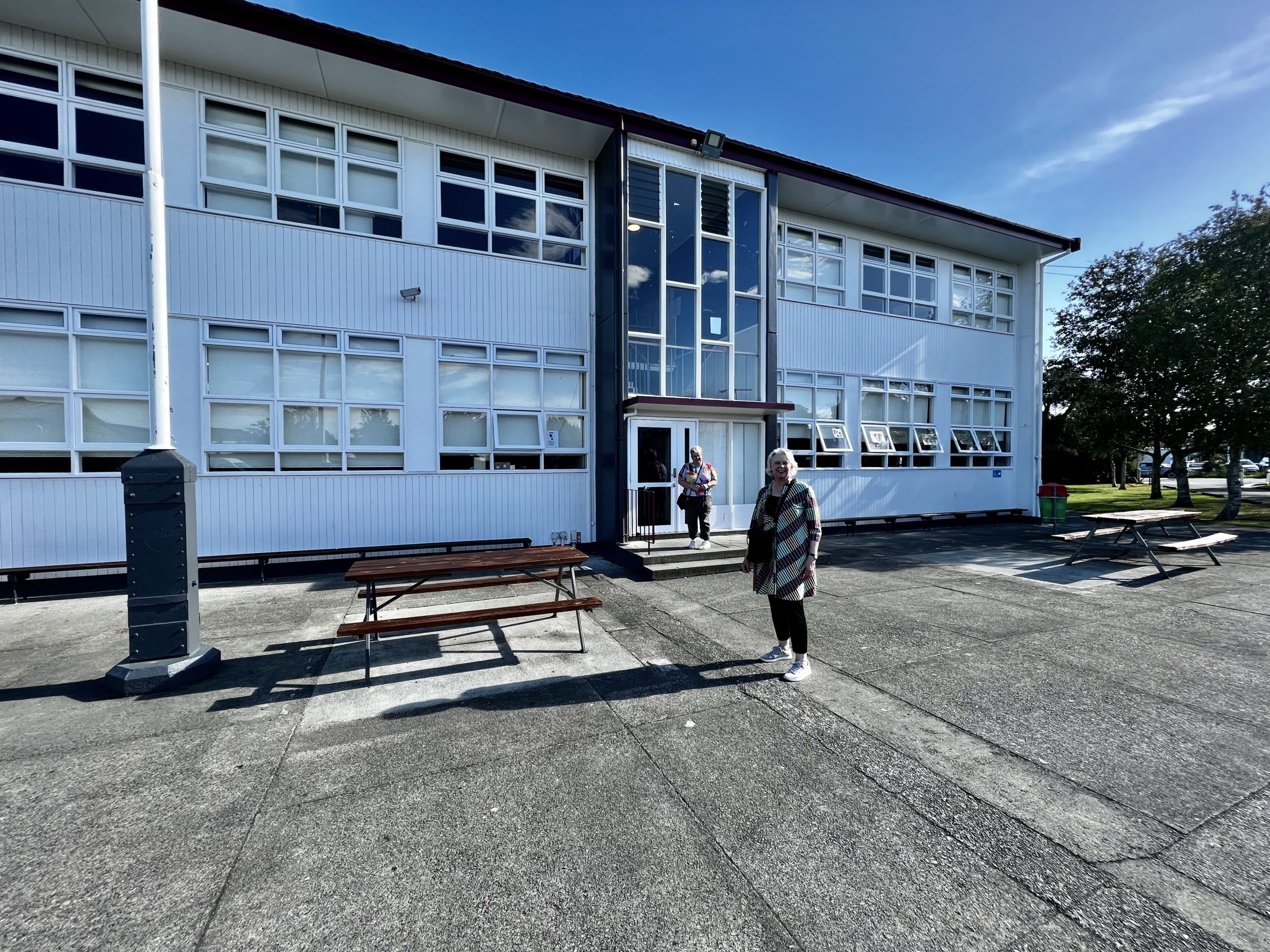
Kuranui College
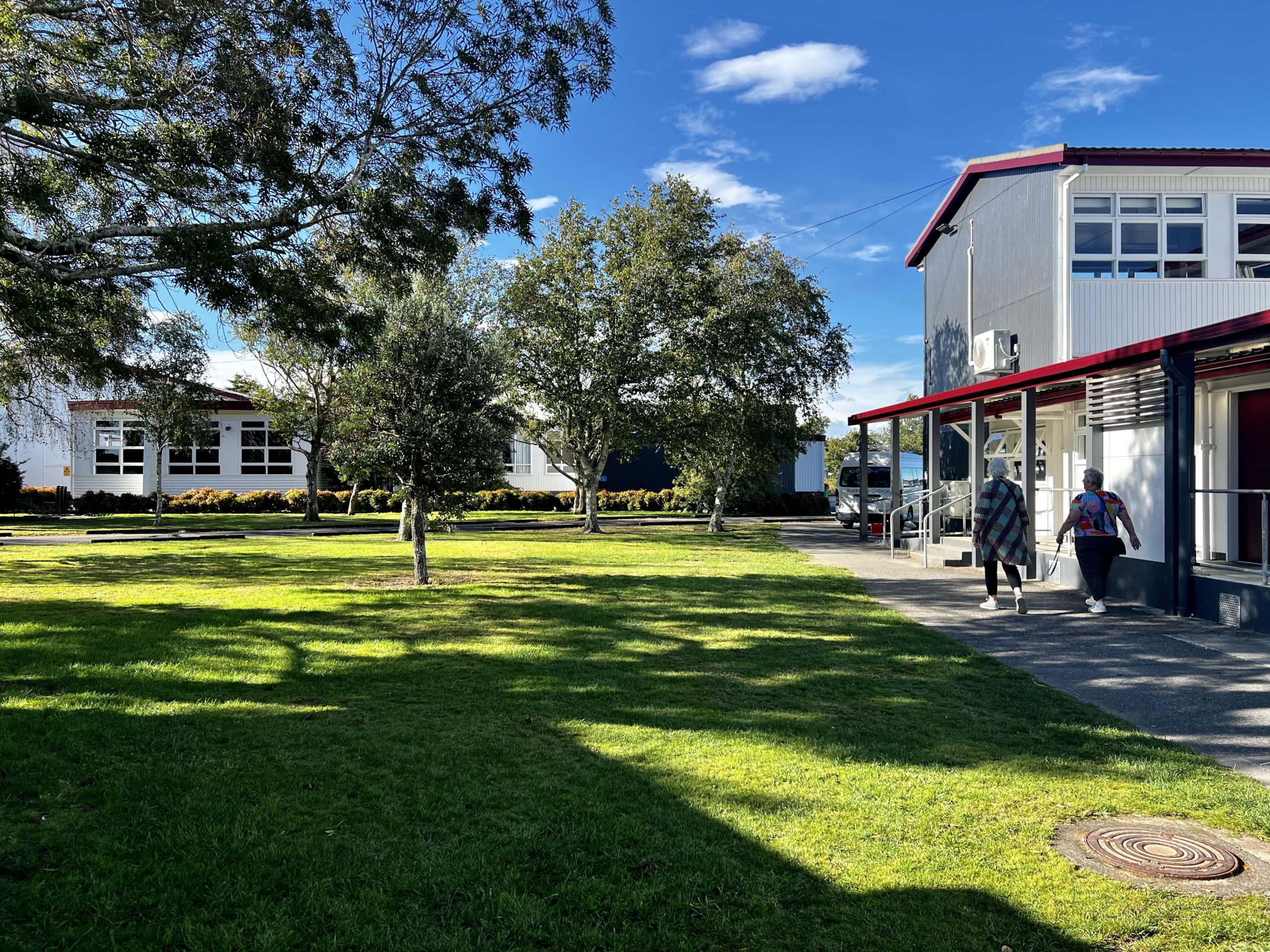
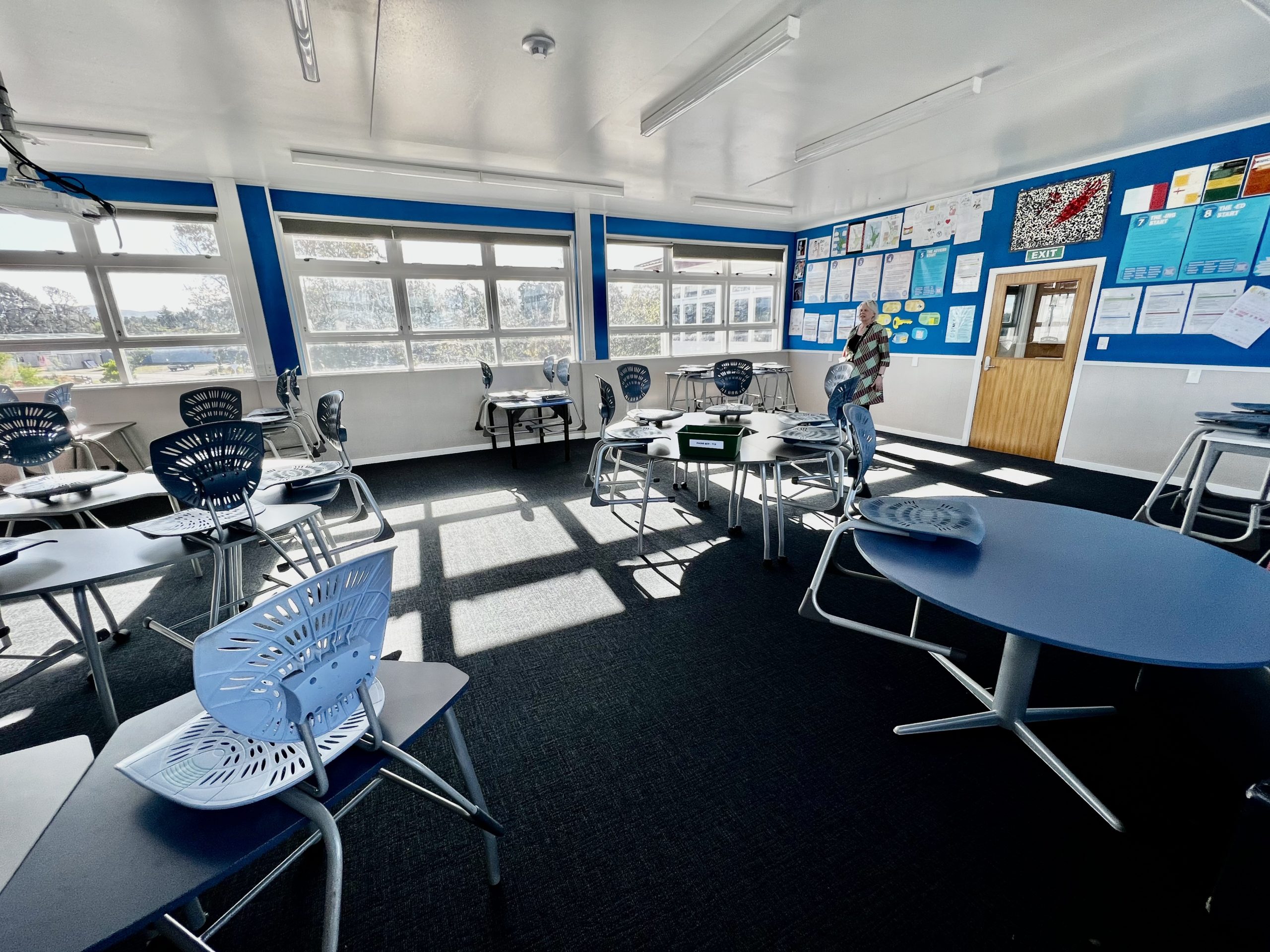
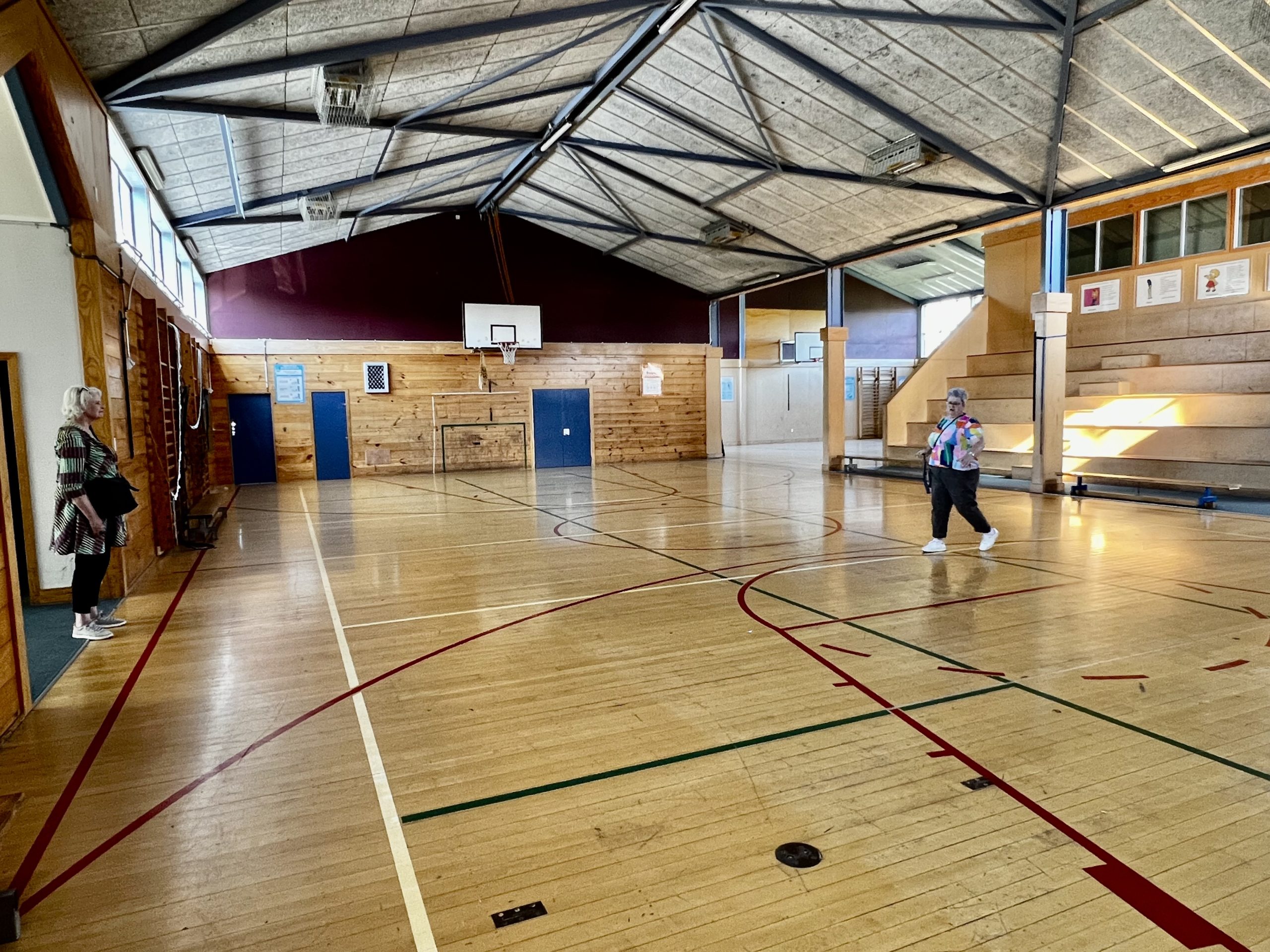
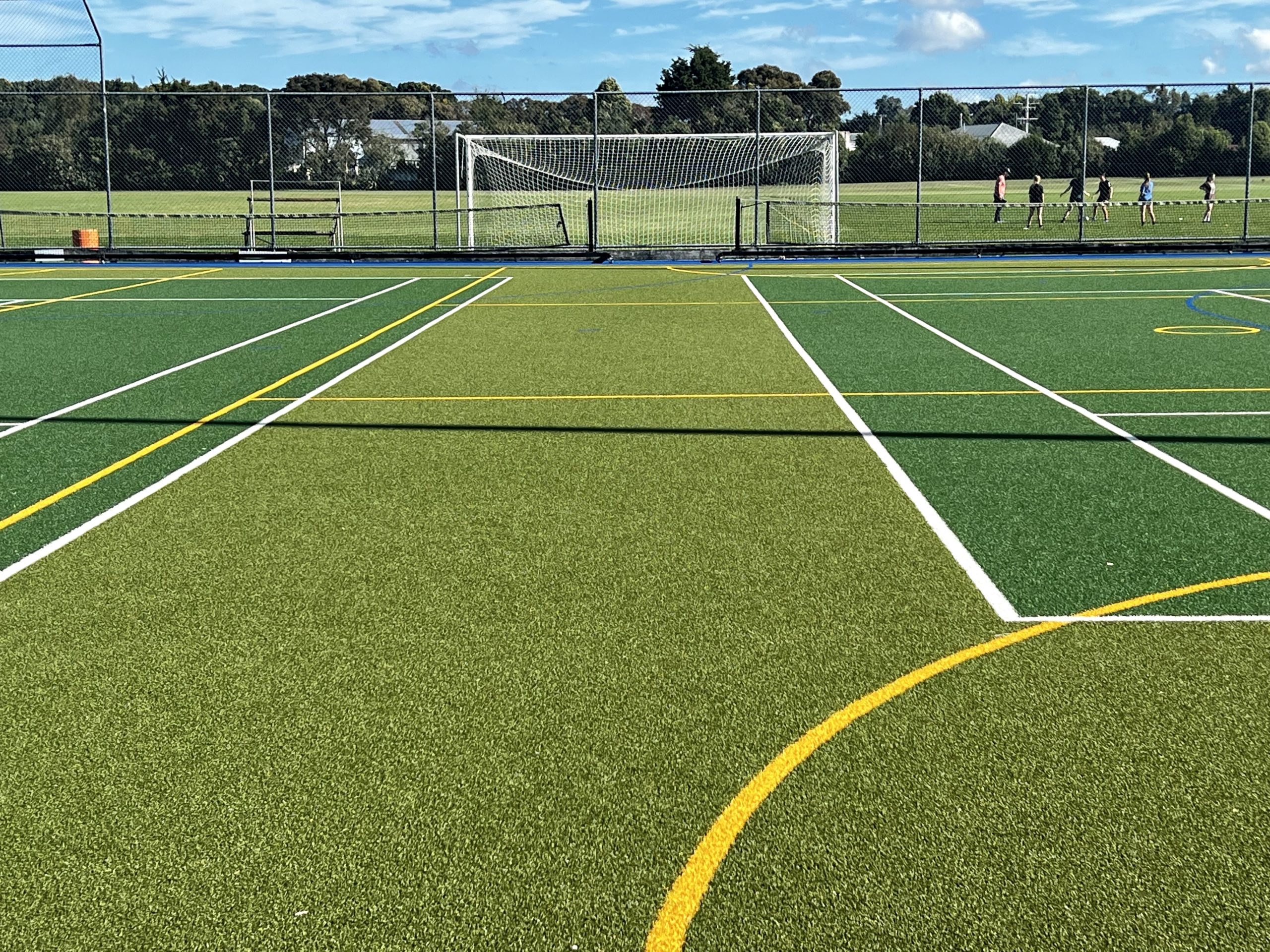
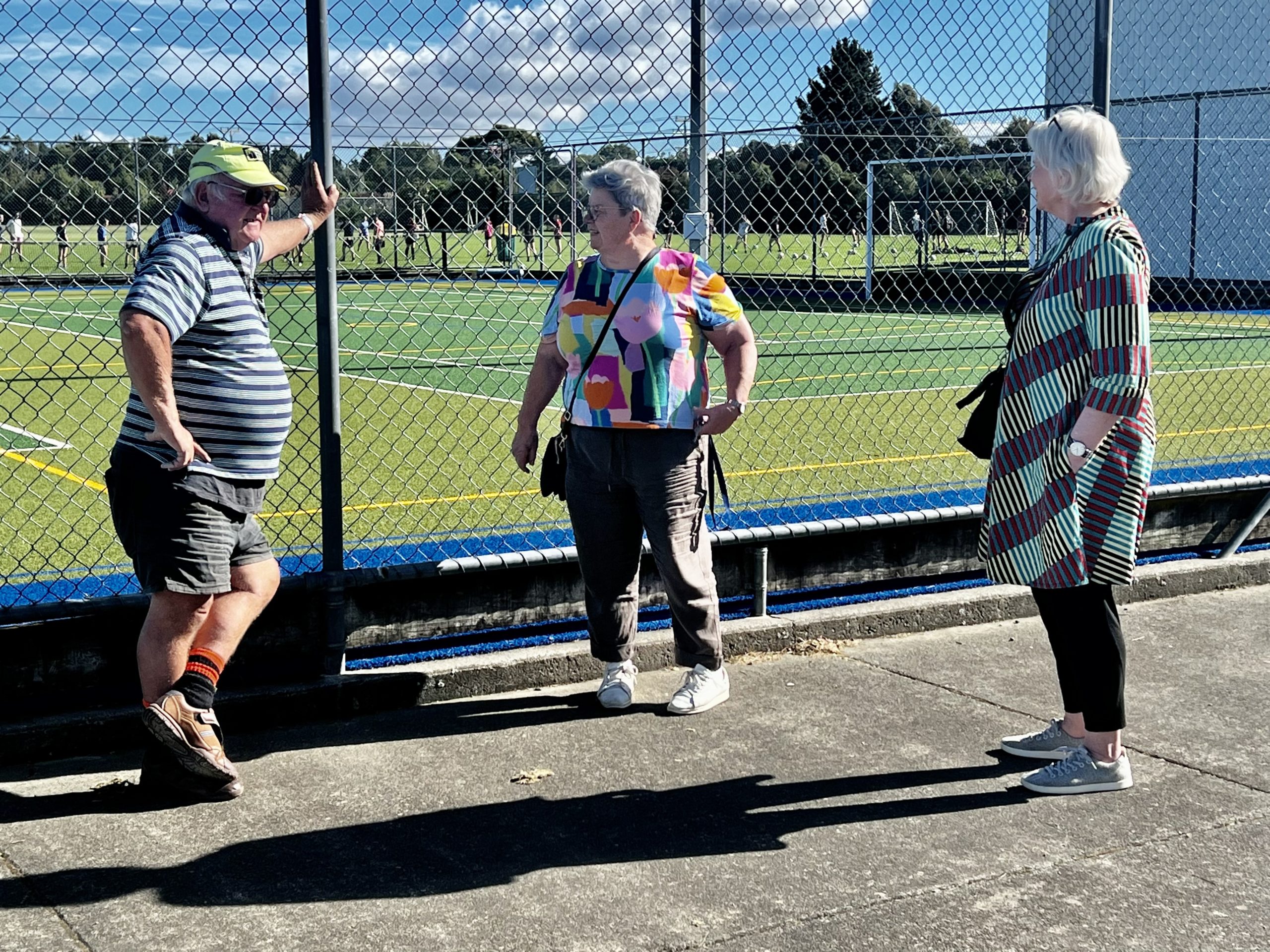
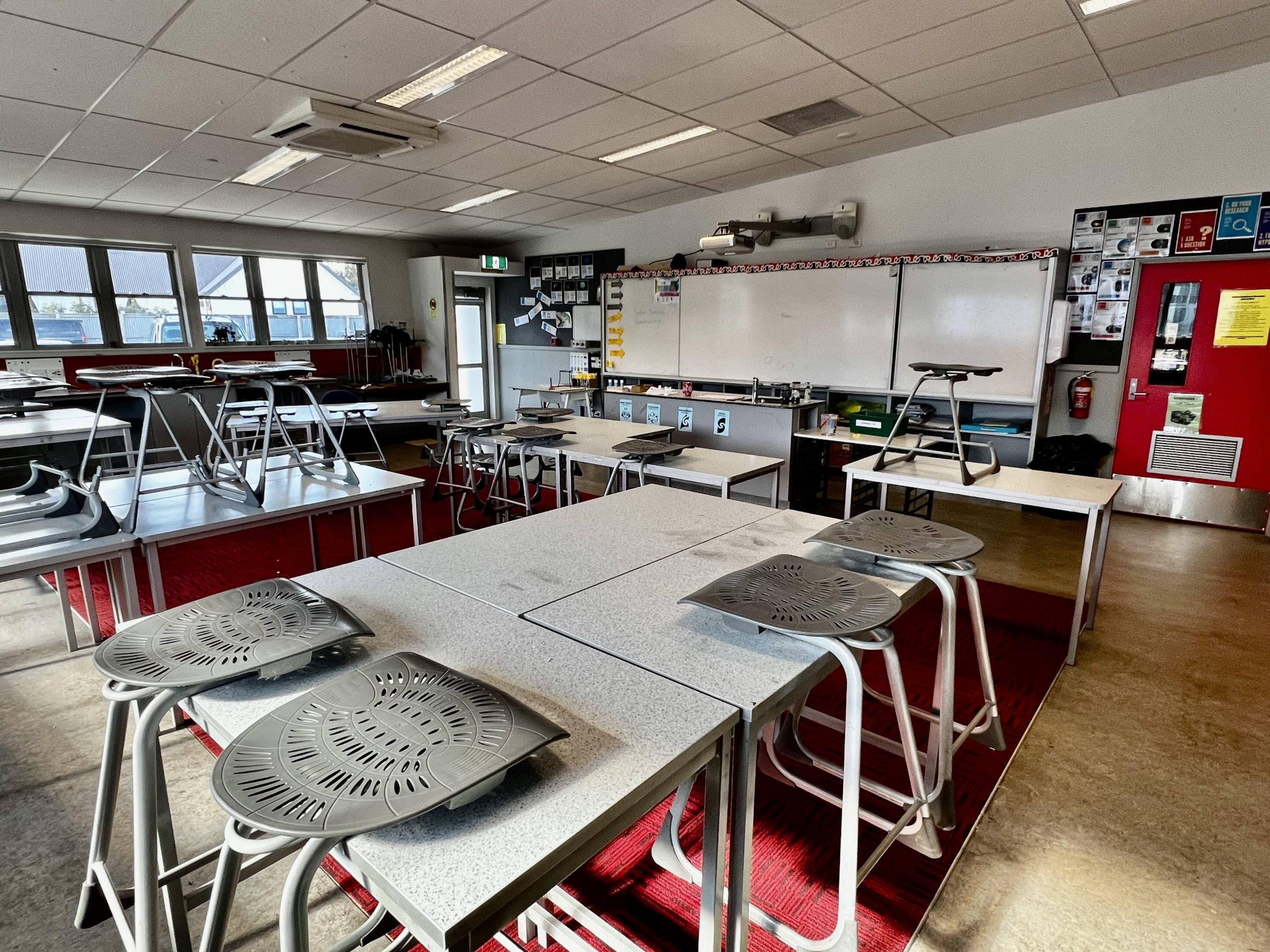
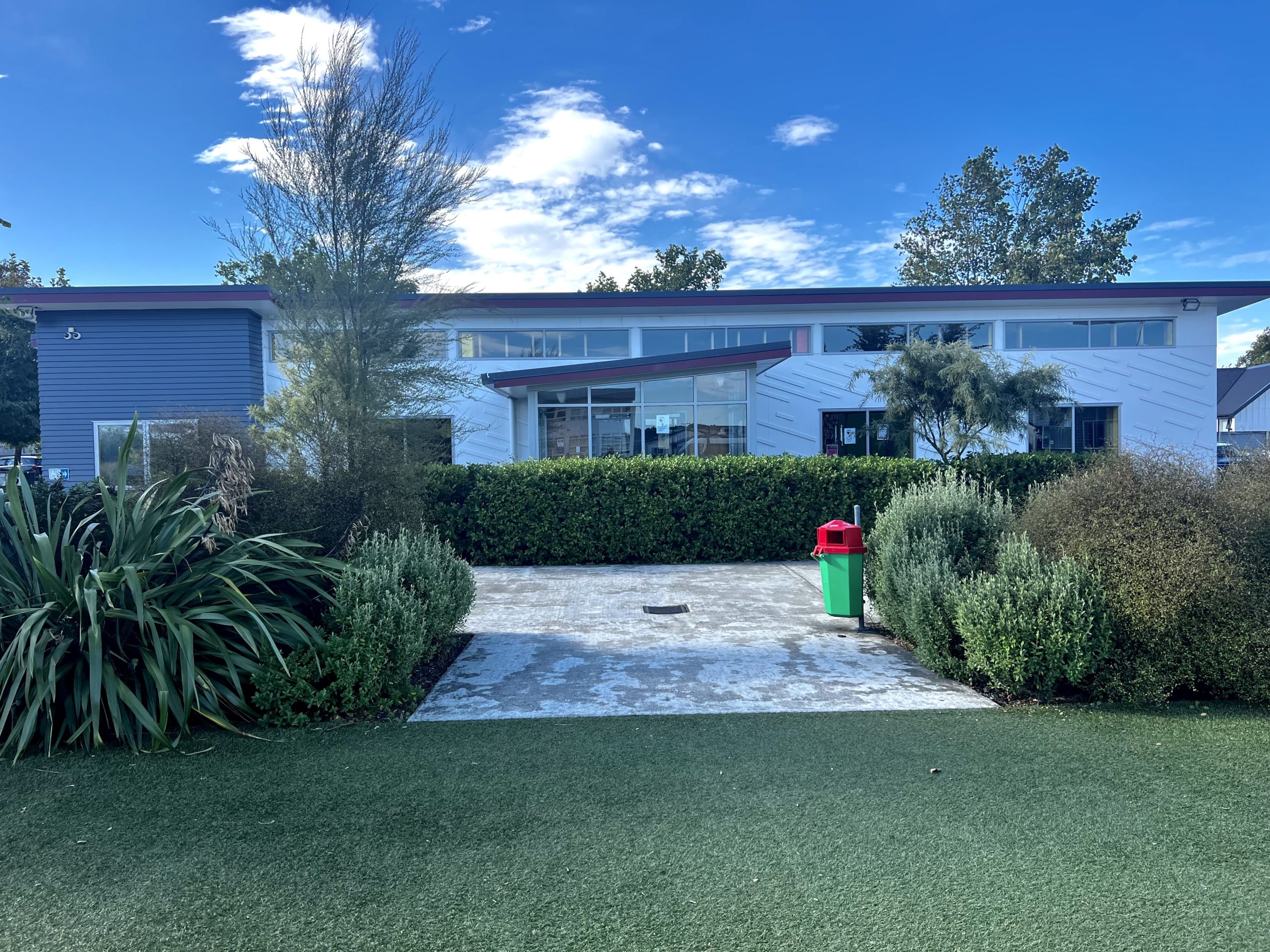
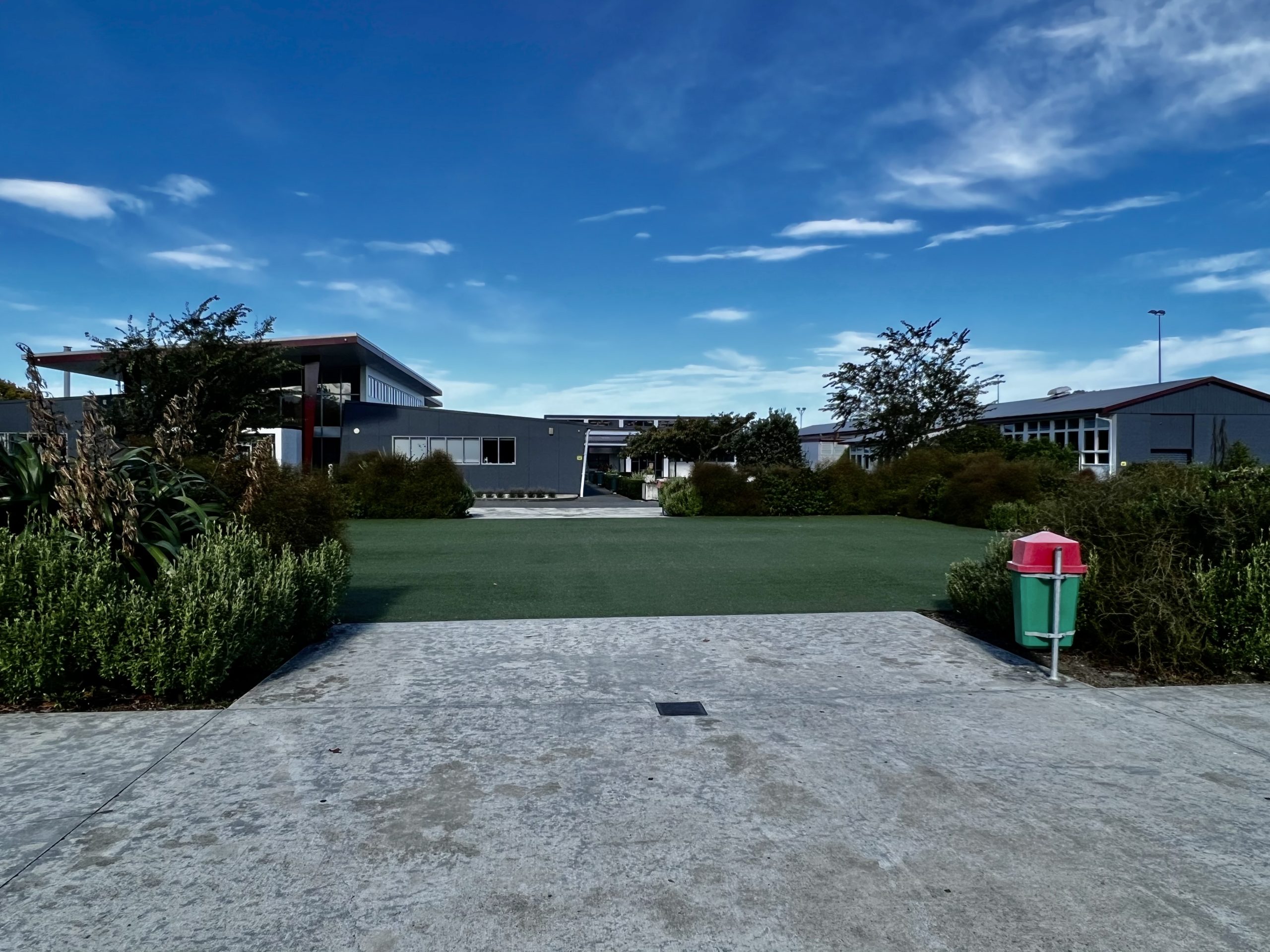
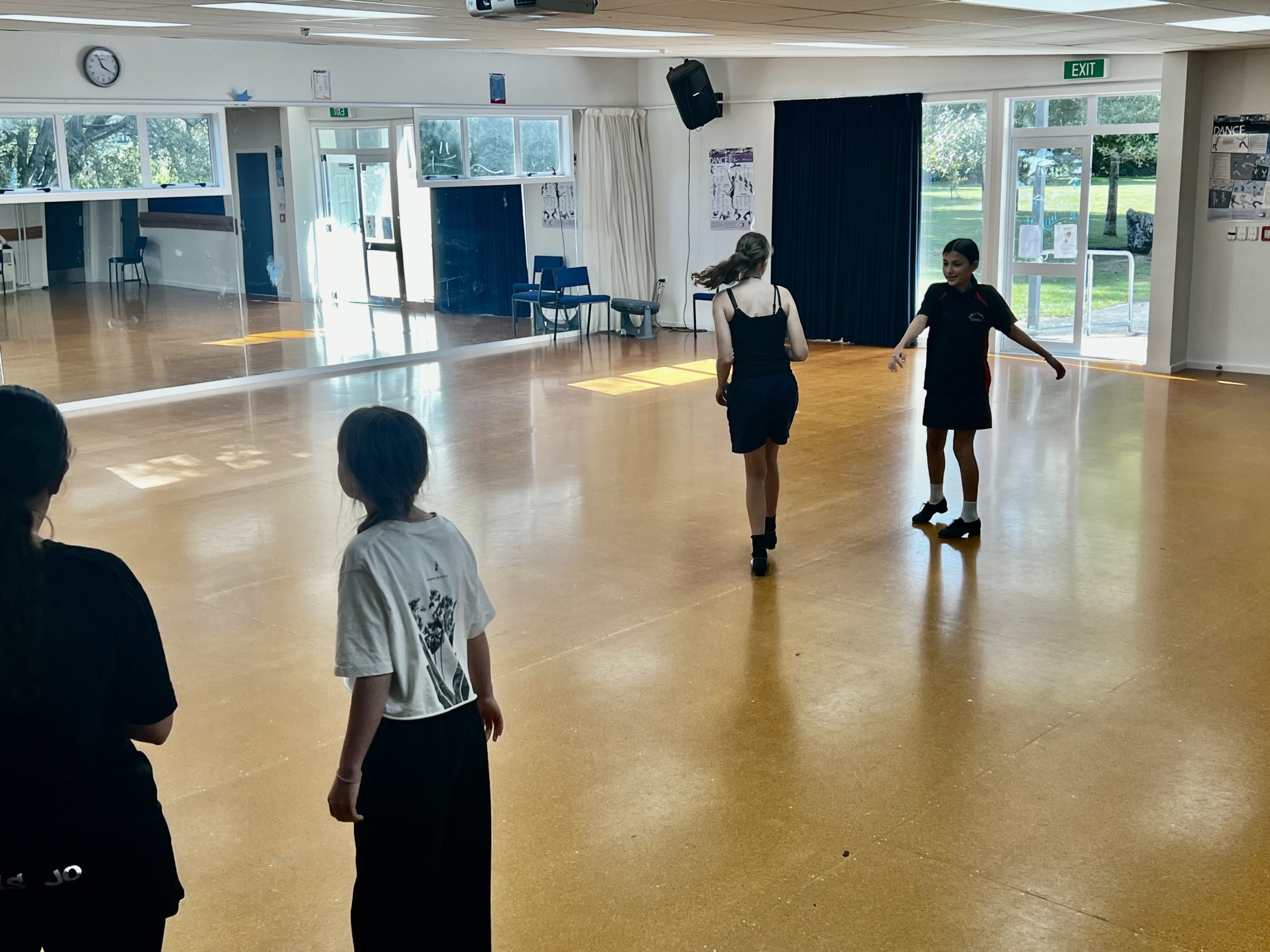
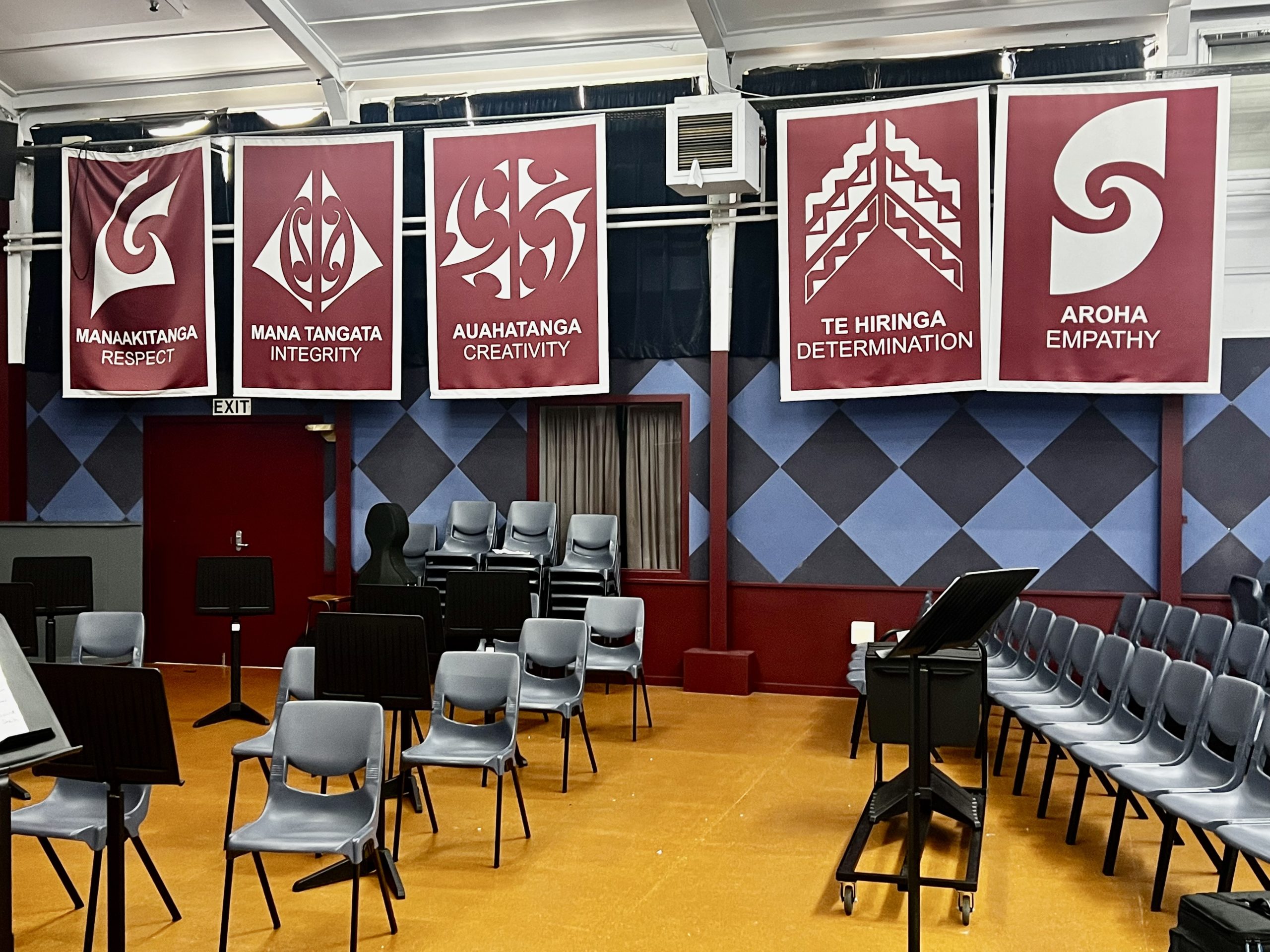
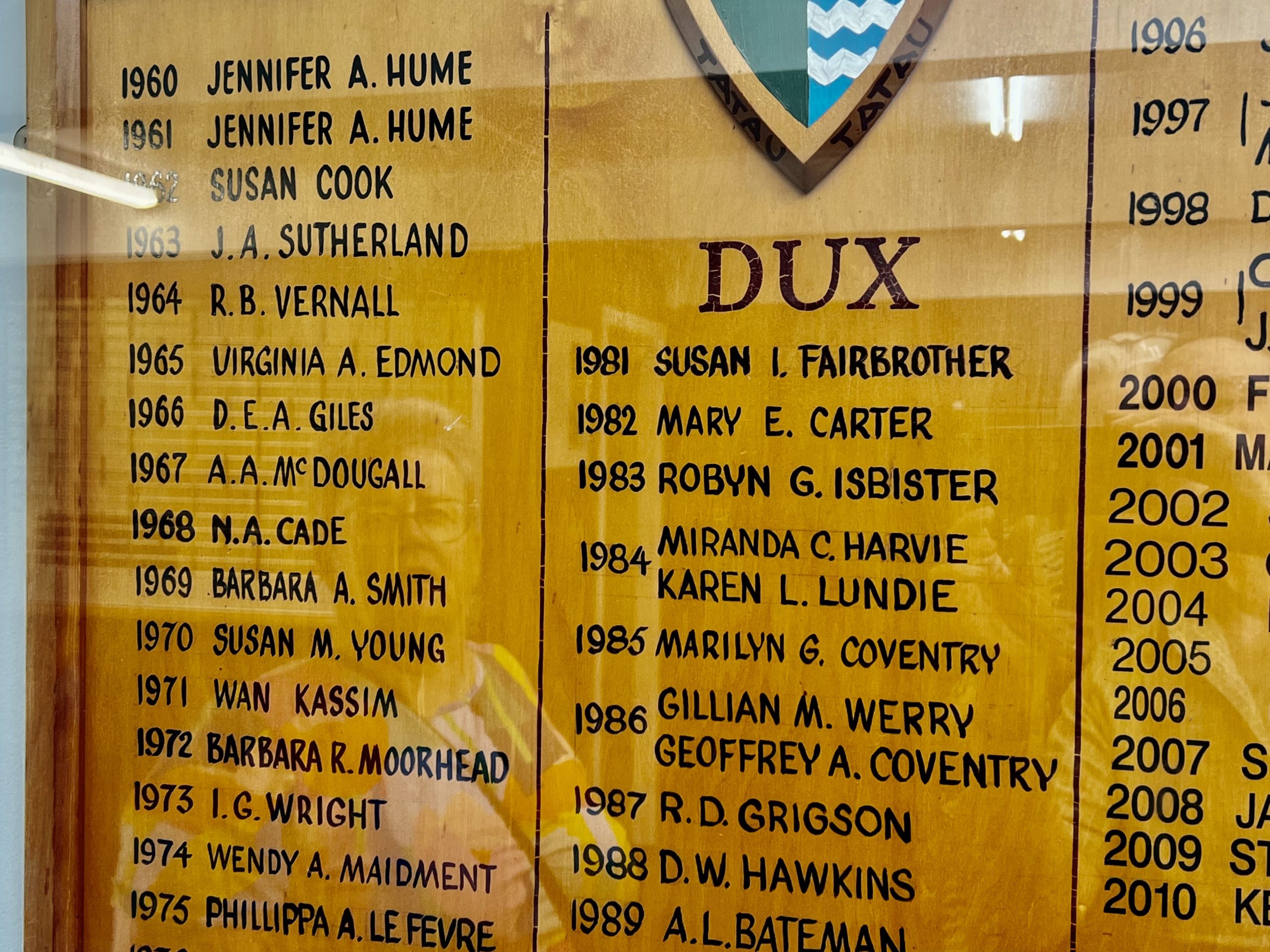
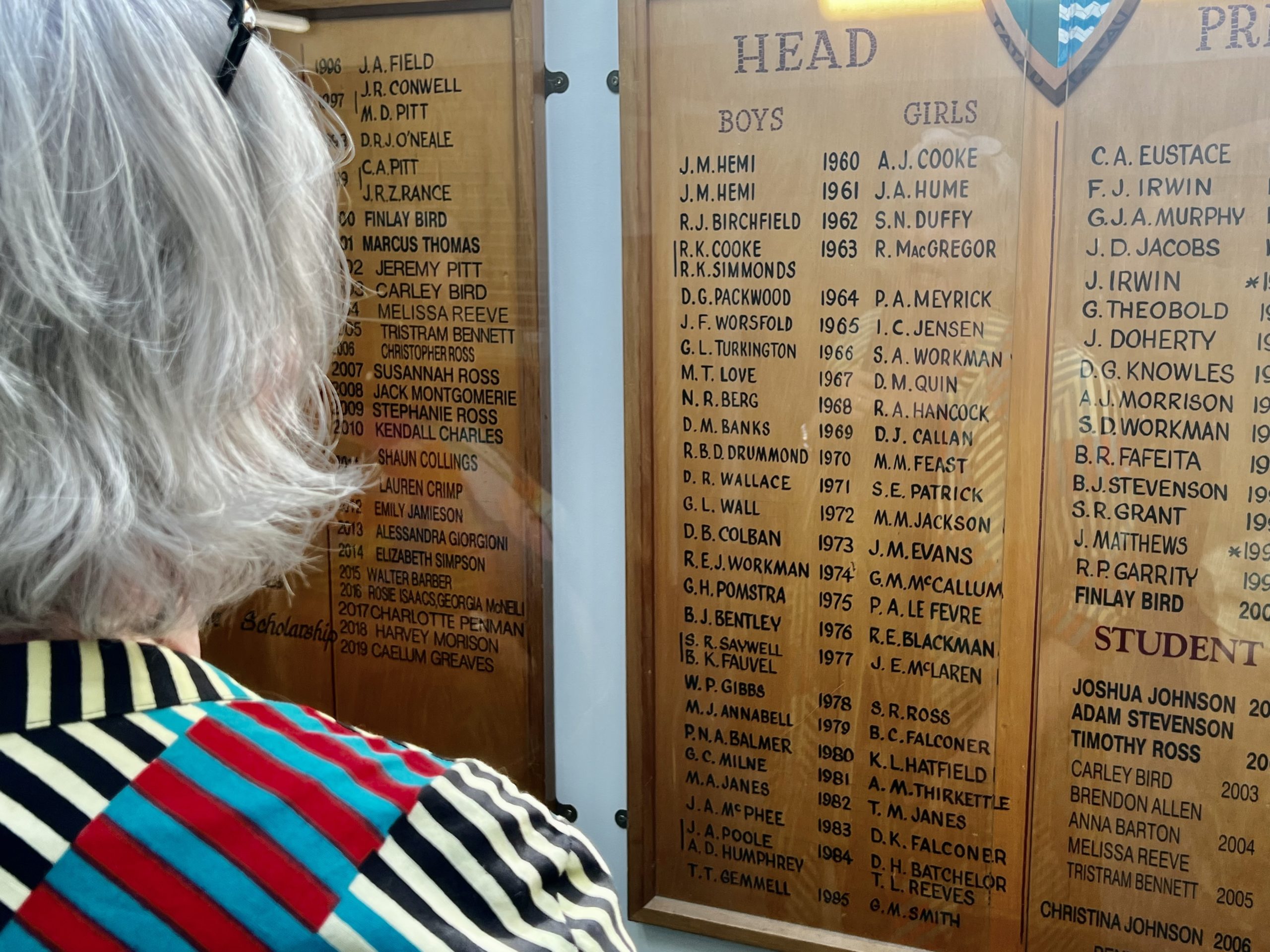
Bonnie’s classes in English, geography, and history were in this building.Sports fields are abundant. Bonnie played tennis every day at lunchtime.Dance studio1966 Bonnie’s best friend Ann Workman was Head Girl.1966 Bonnie’s friend David Giles was top student. He continued by becoming the youngest university department chair in Australia, in a department of econometrics.
Greytown
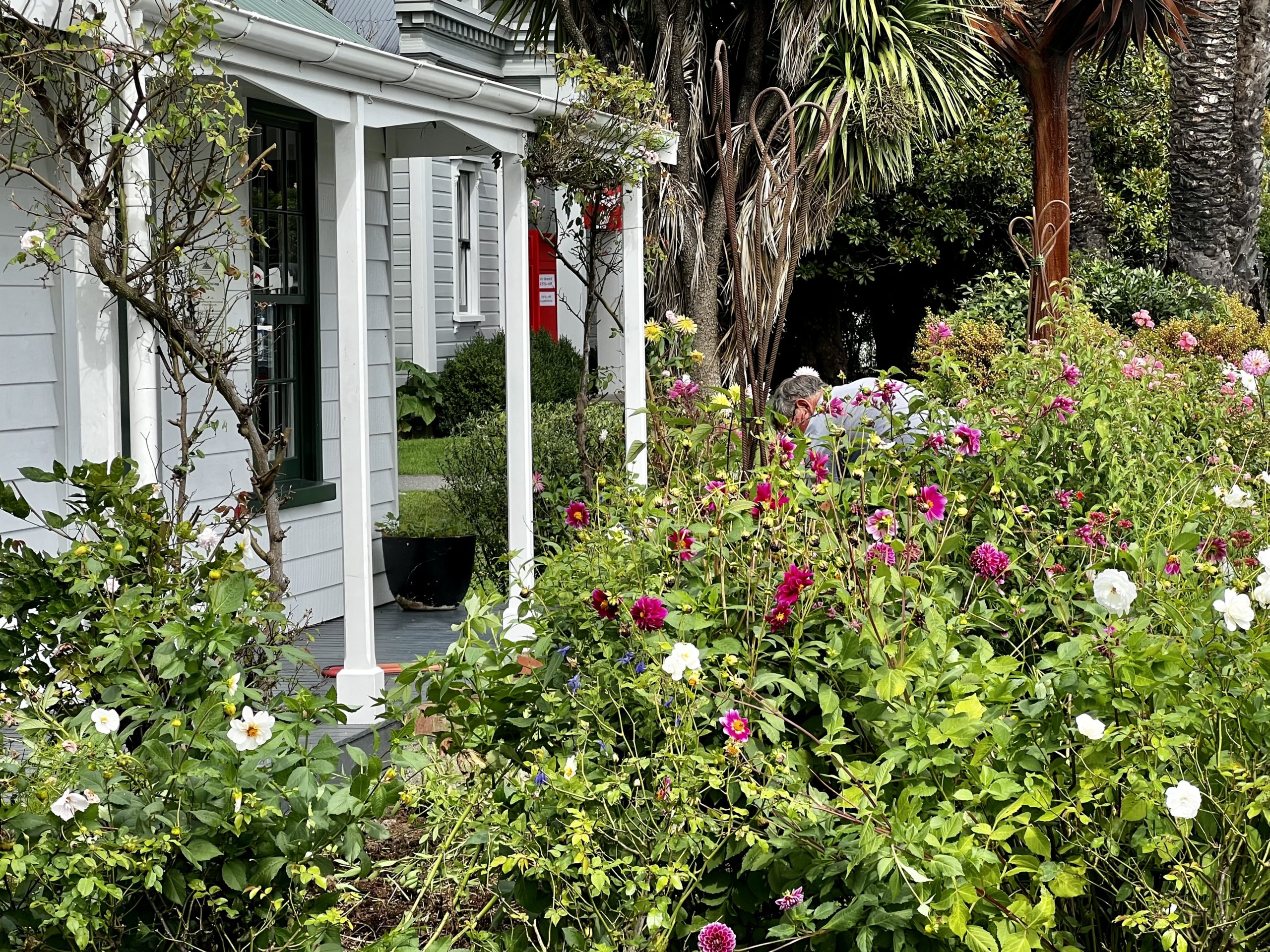
Your grocery cart?The English garden tradition is evident throughout New Zealand.
An Eye on Fashion
Always sneakers. And many tiered dresses in gingham.
Poppies Vineyard
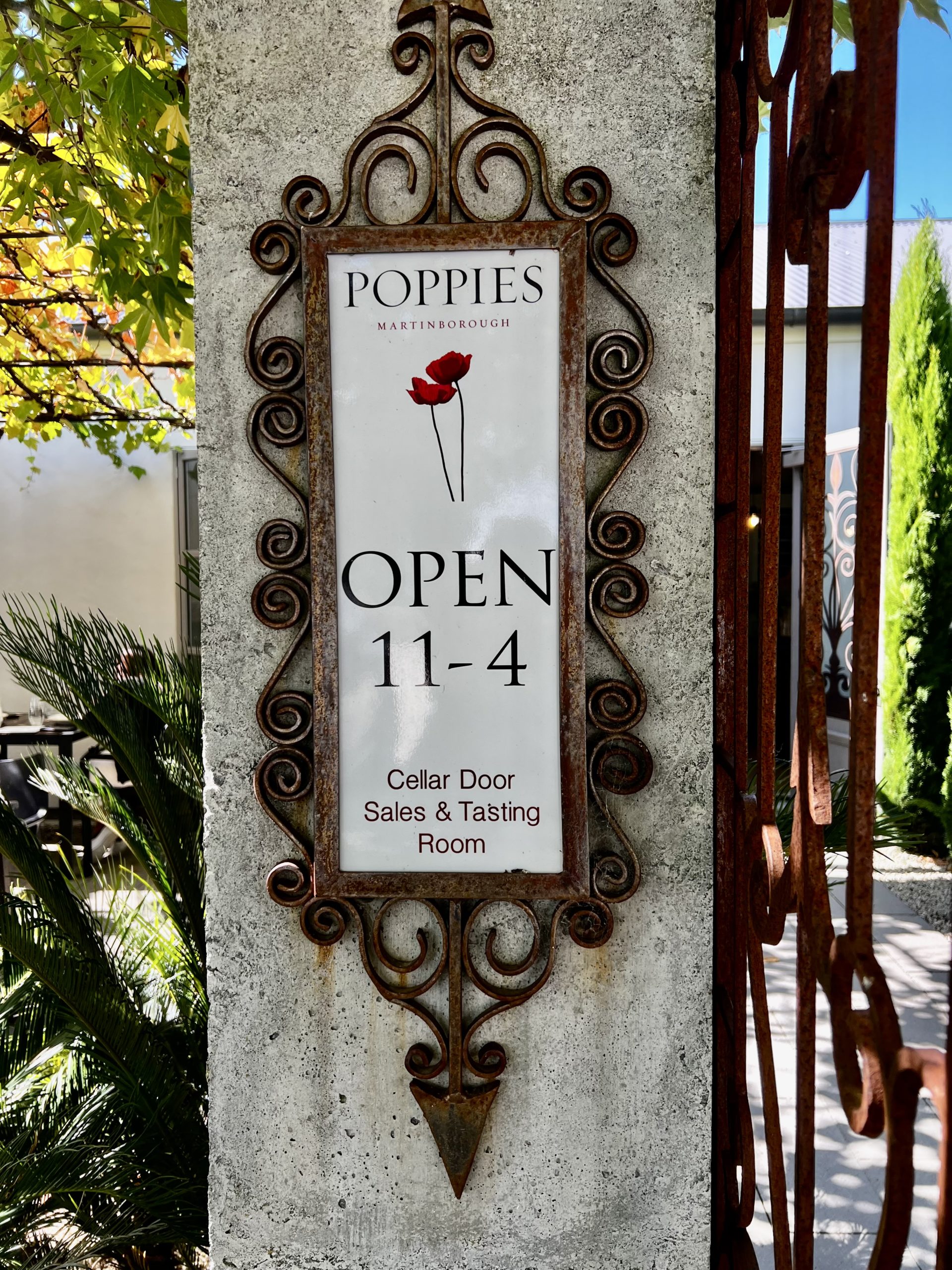
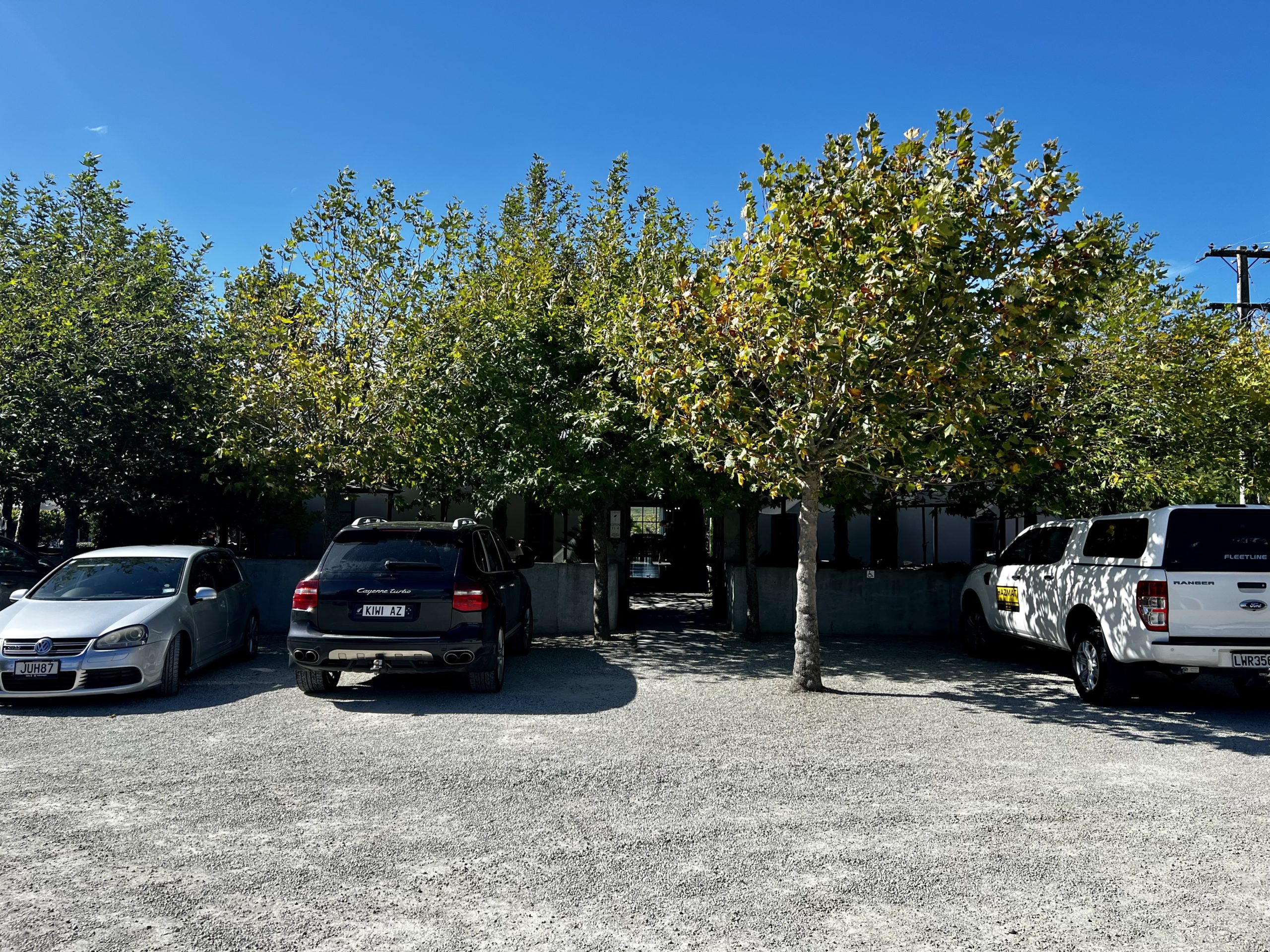
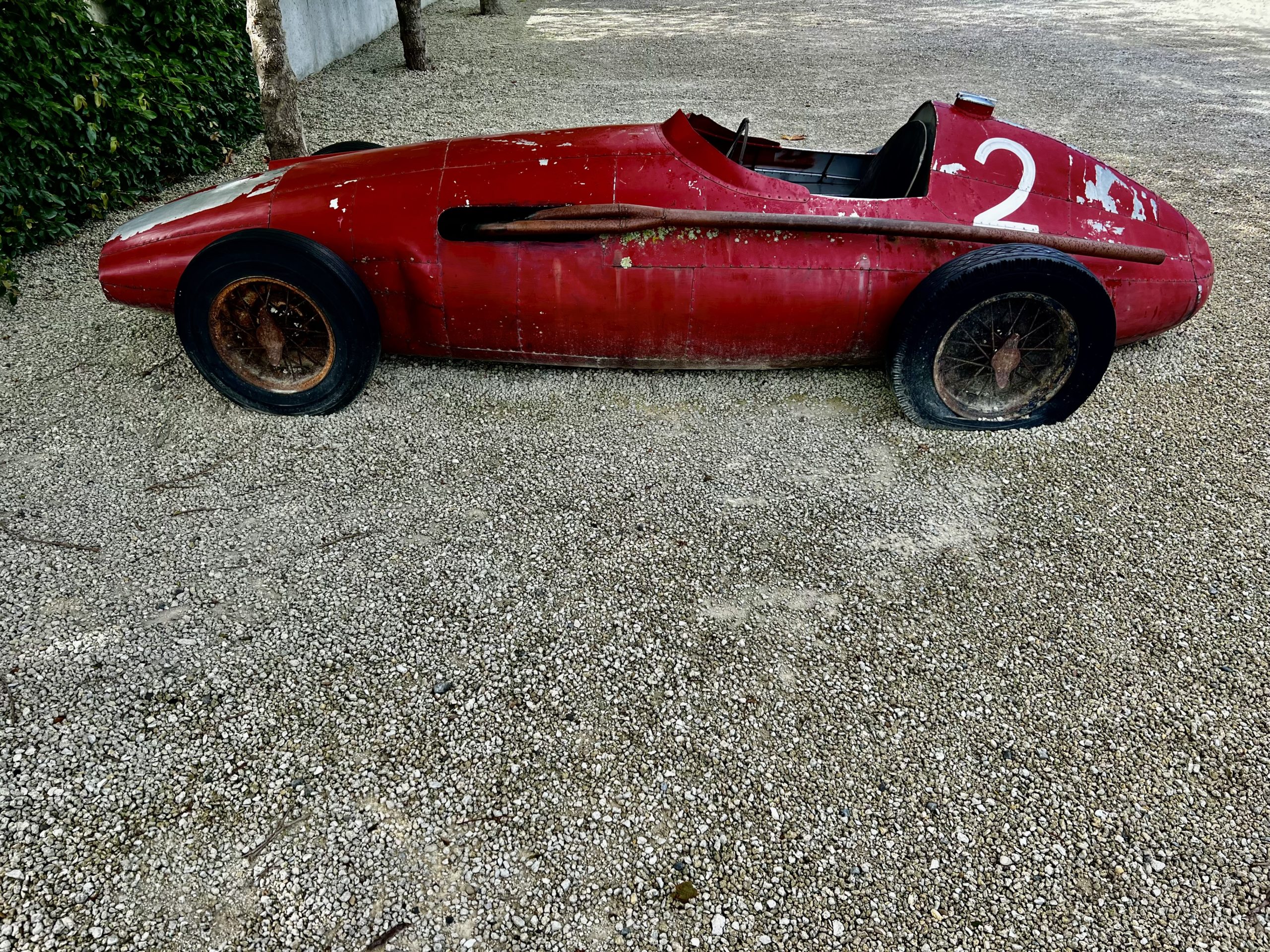
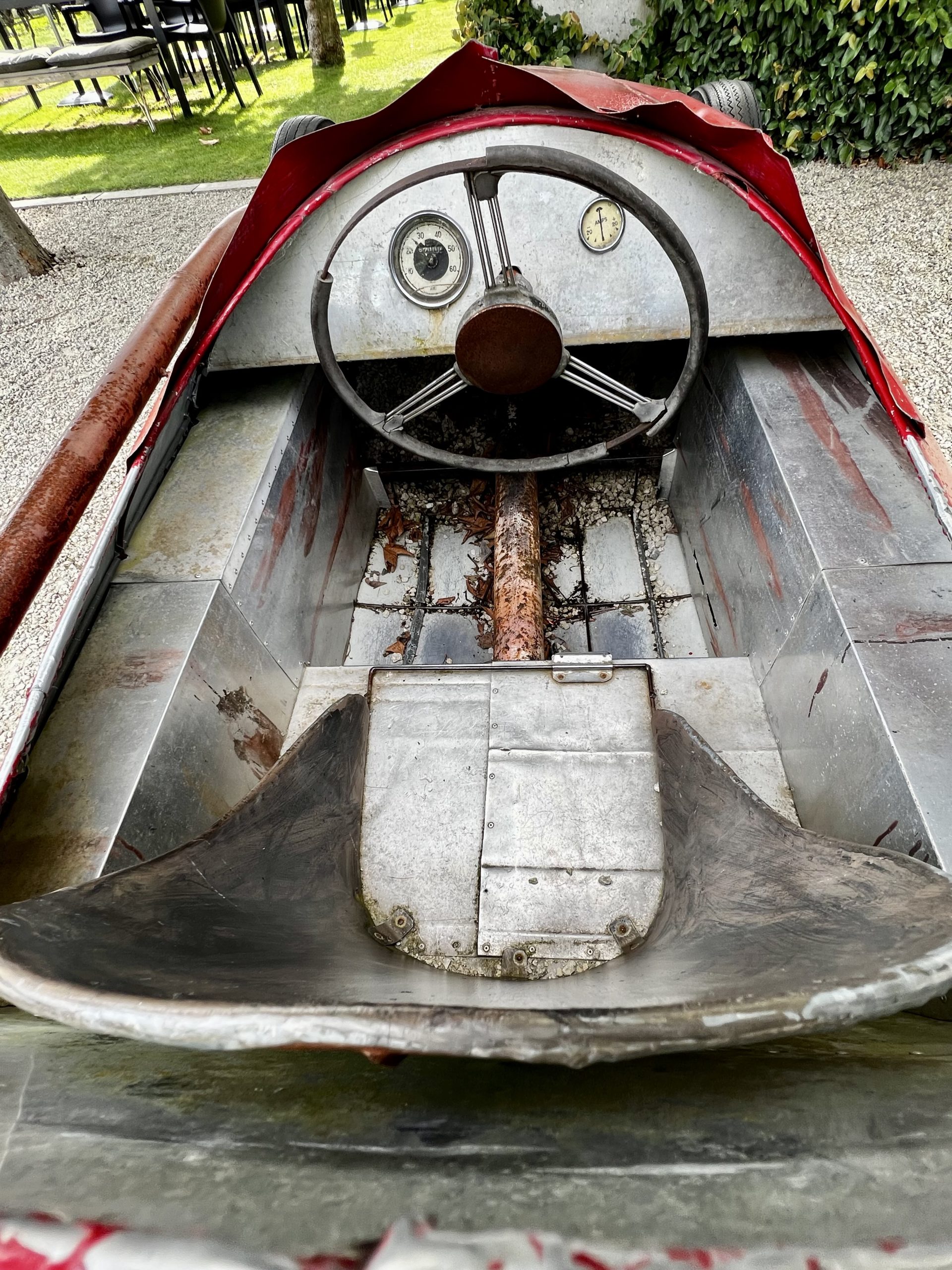
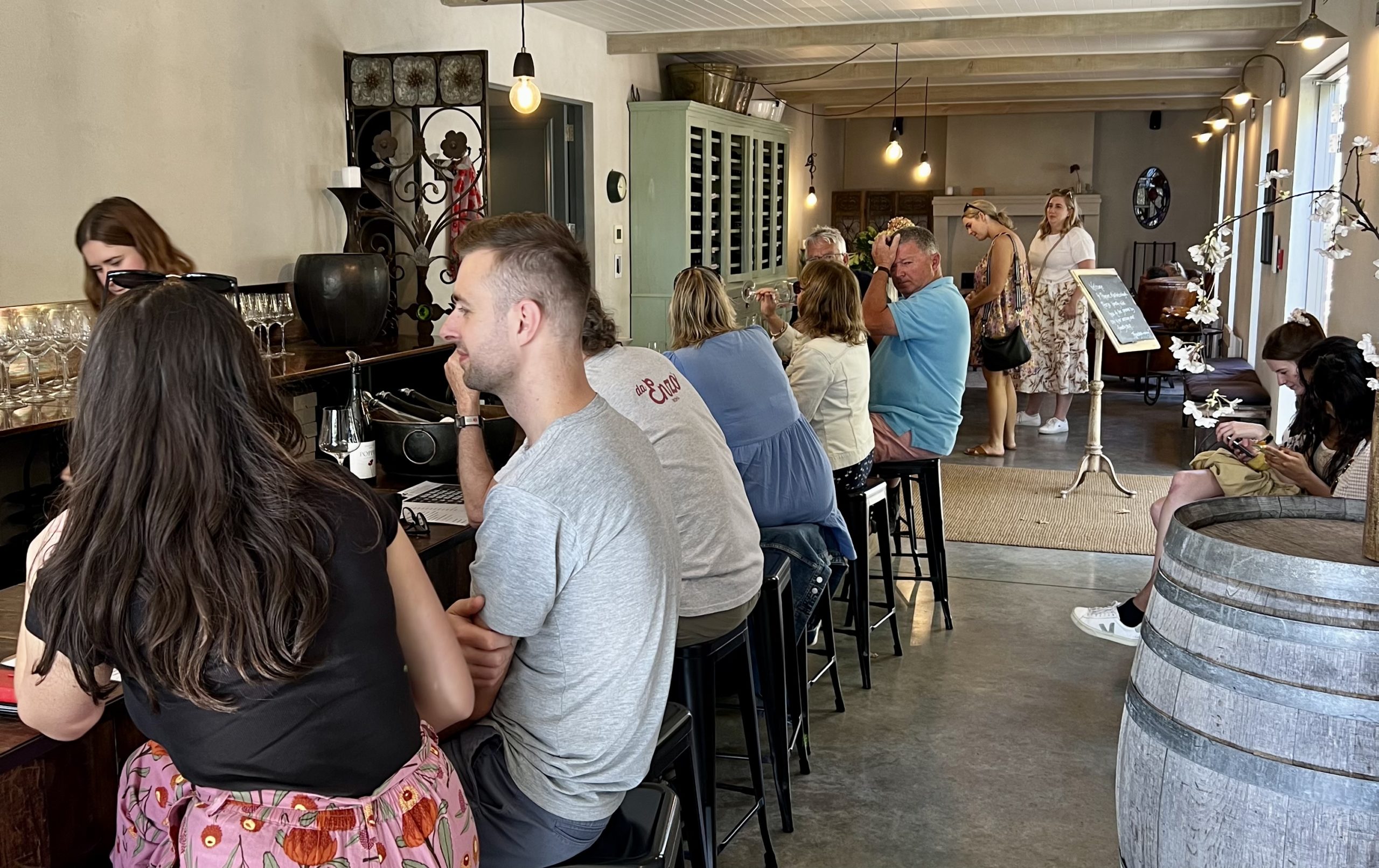
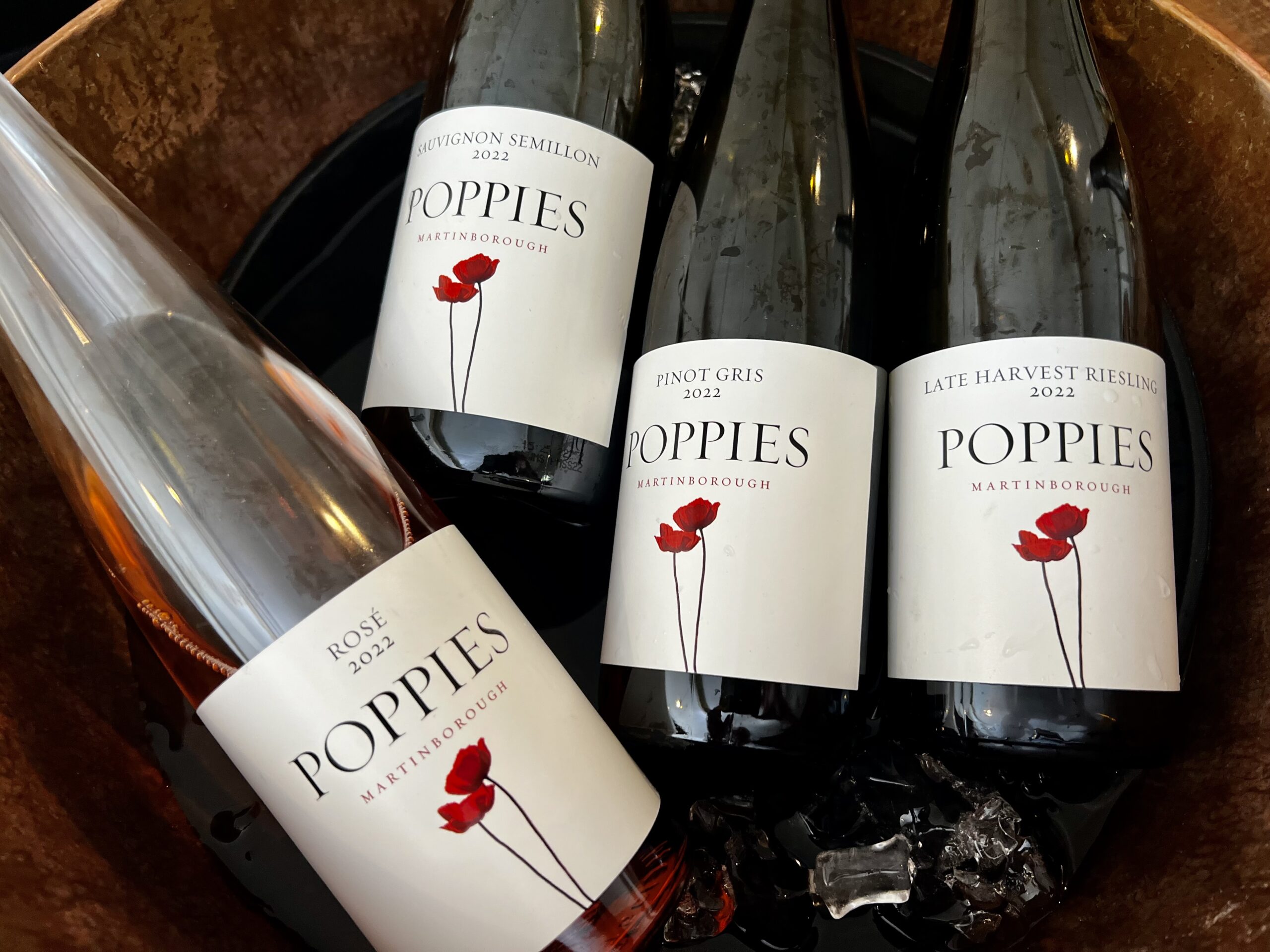
When we asked for advice on wine tasting on Sunday afternoon, the receptionist at the resort recommended three wineries from nearly forty around Martinborough. We stopped first at Poppies and that was a mistake. Their lovely tasting consisted of four wines plus a few others we choose. Their demeanor was impeccable, and they had great observations about each wine. We were impressed especially by the rose and pinot gris. The setting was beautiful and comfortable. Because we thoroughly enjoyed the experience at Poppies, the next two vineyards did not measure up—too commercial and too rushed. We went back to Poppies the next day and ordered wine to ship home. The Formula One racing car in the parking lot was a welding exercise by the fellow who did all the ironwork at the vineyard.
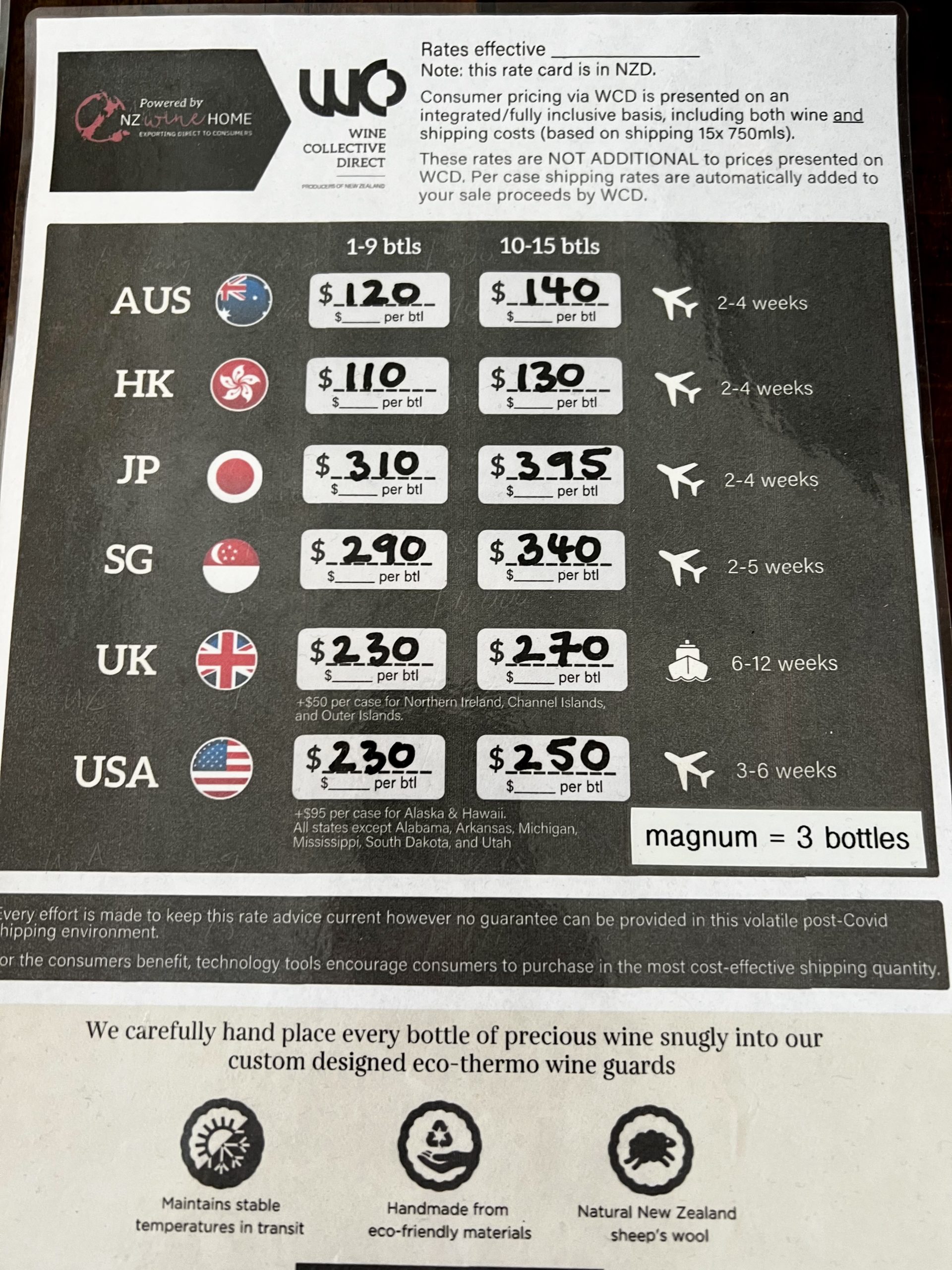
Shipping costs in NZ dollars
Martinborough
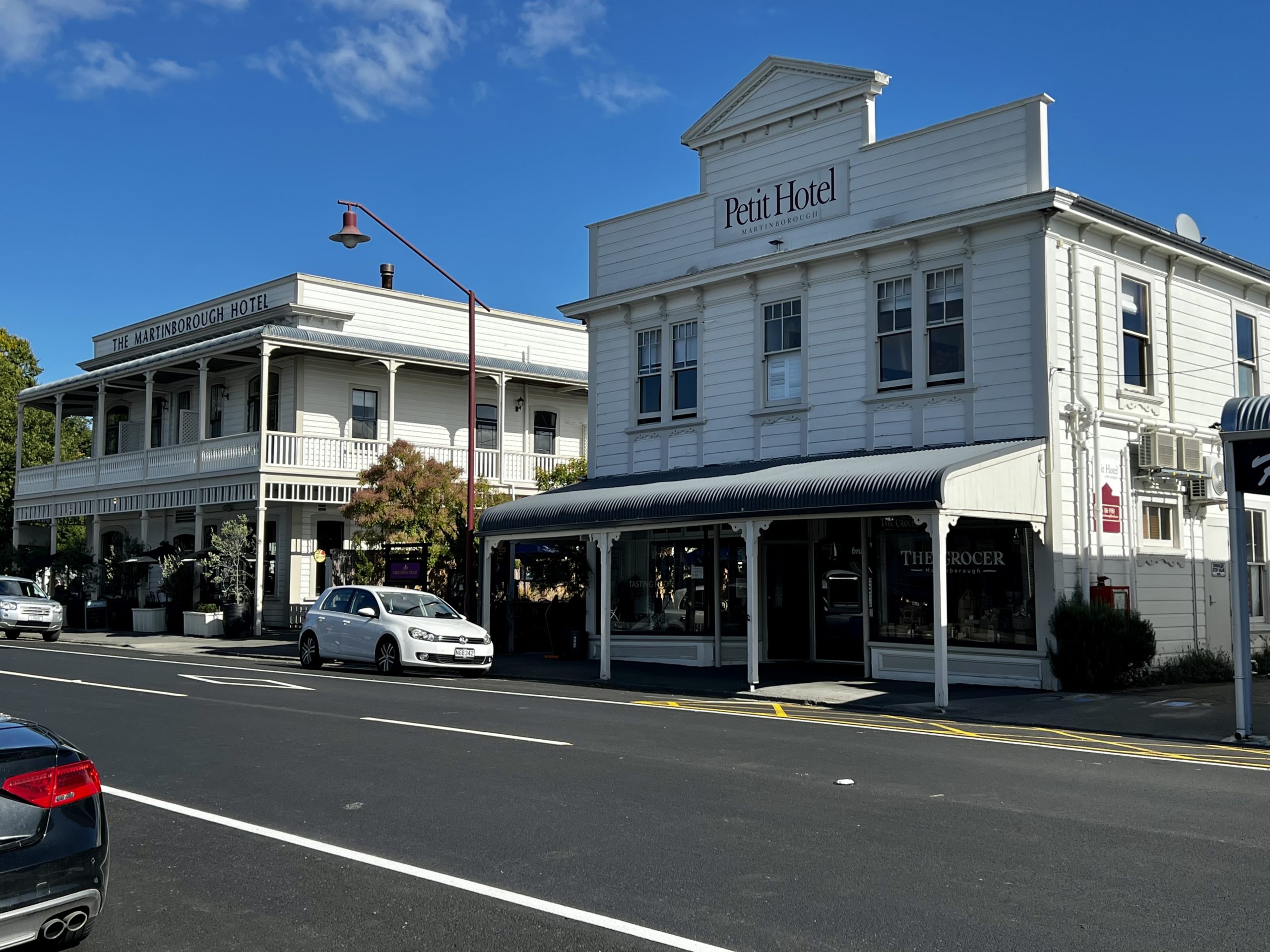
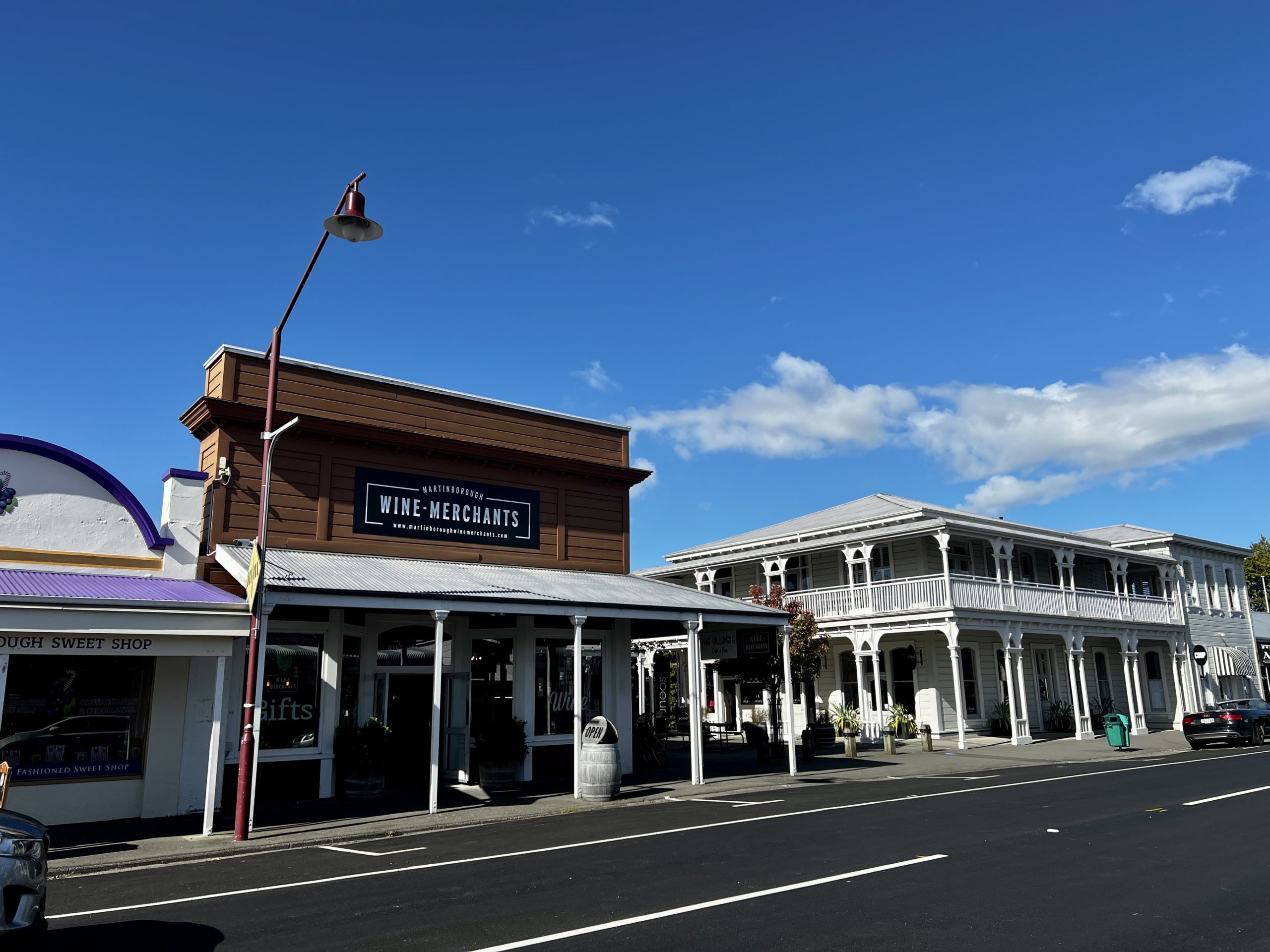
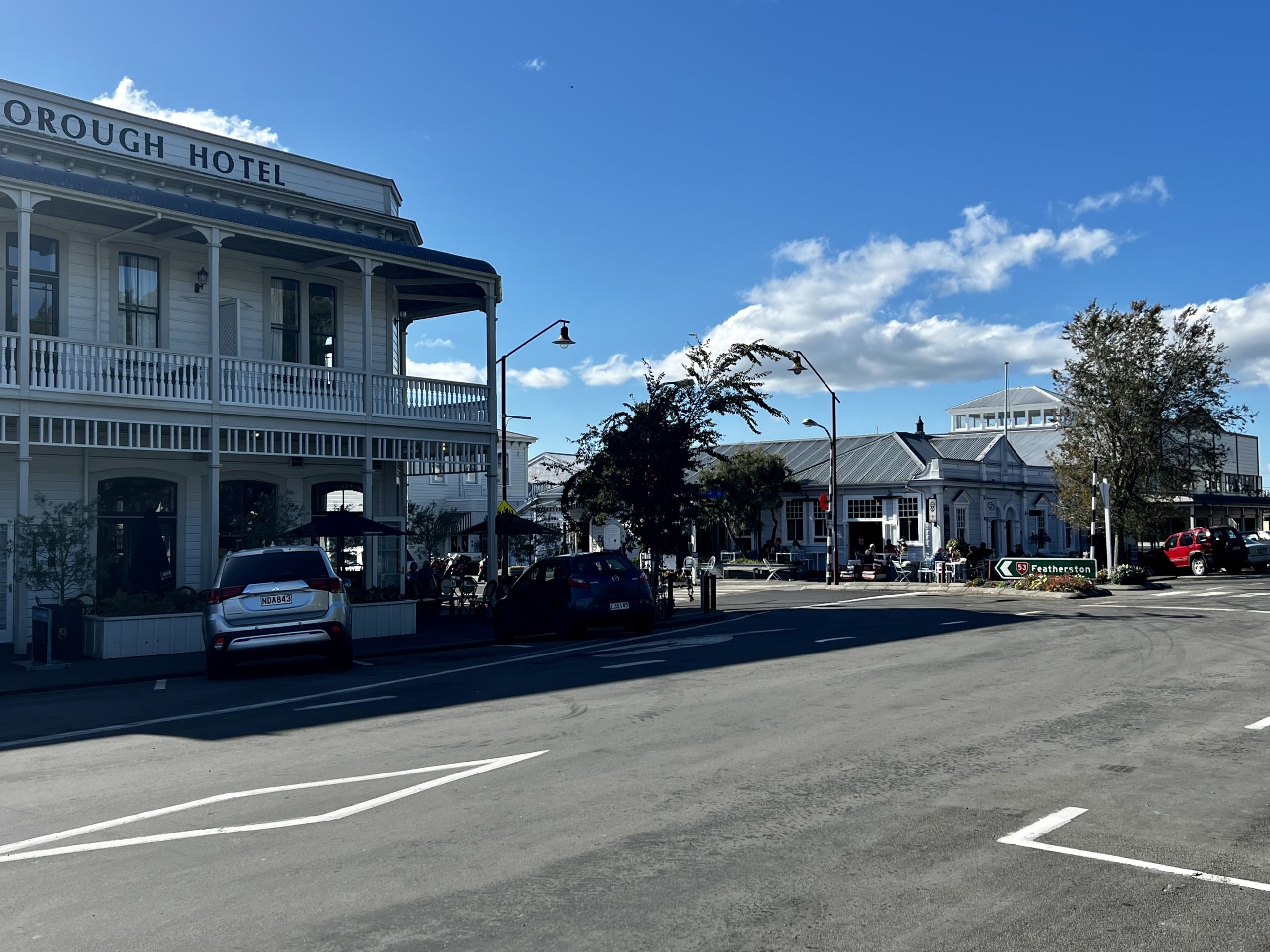
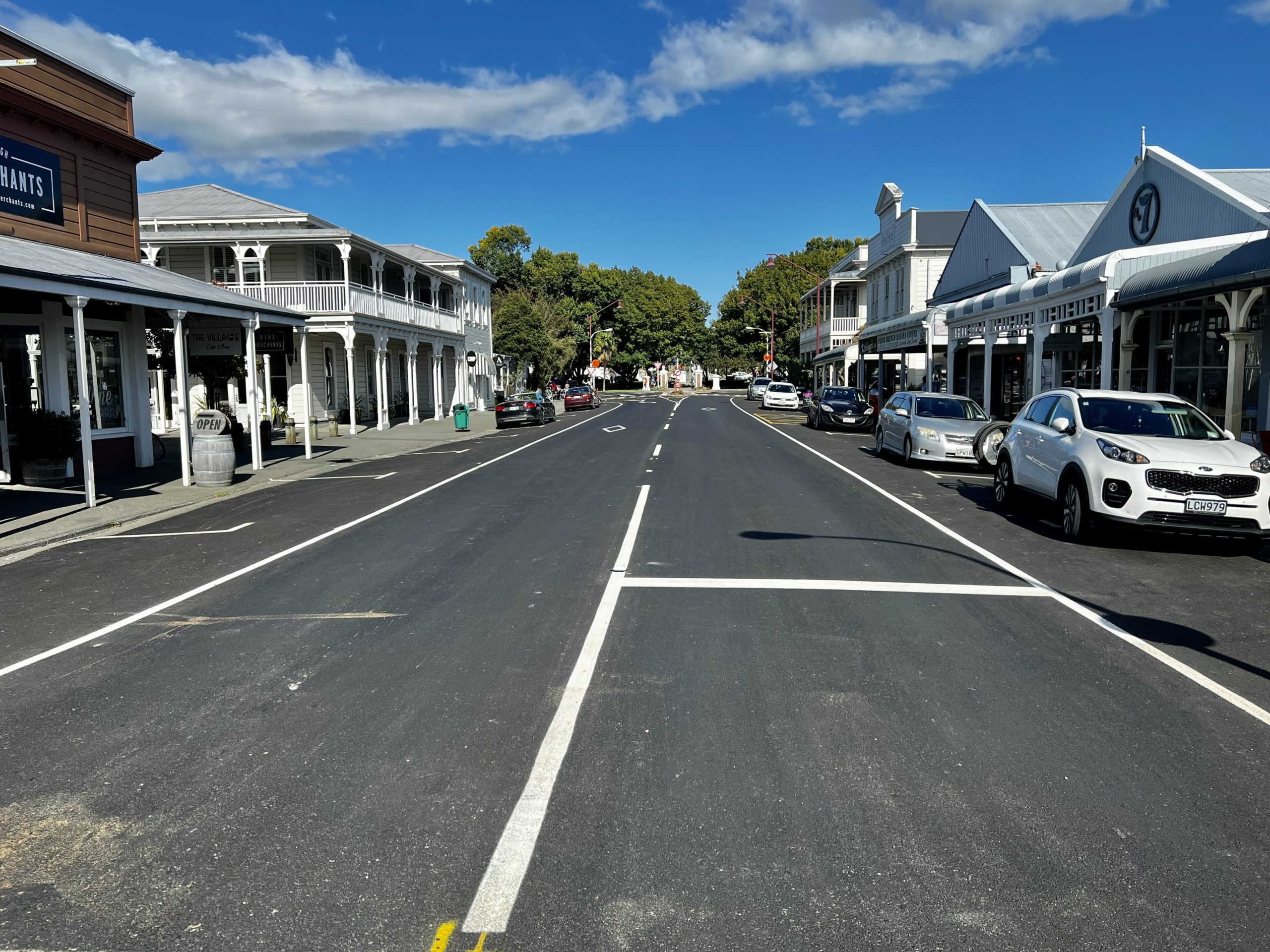
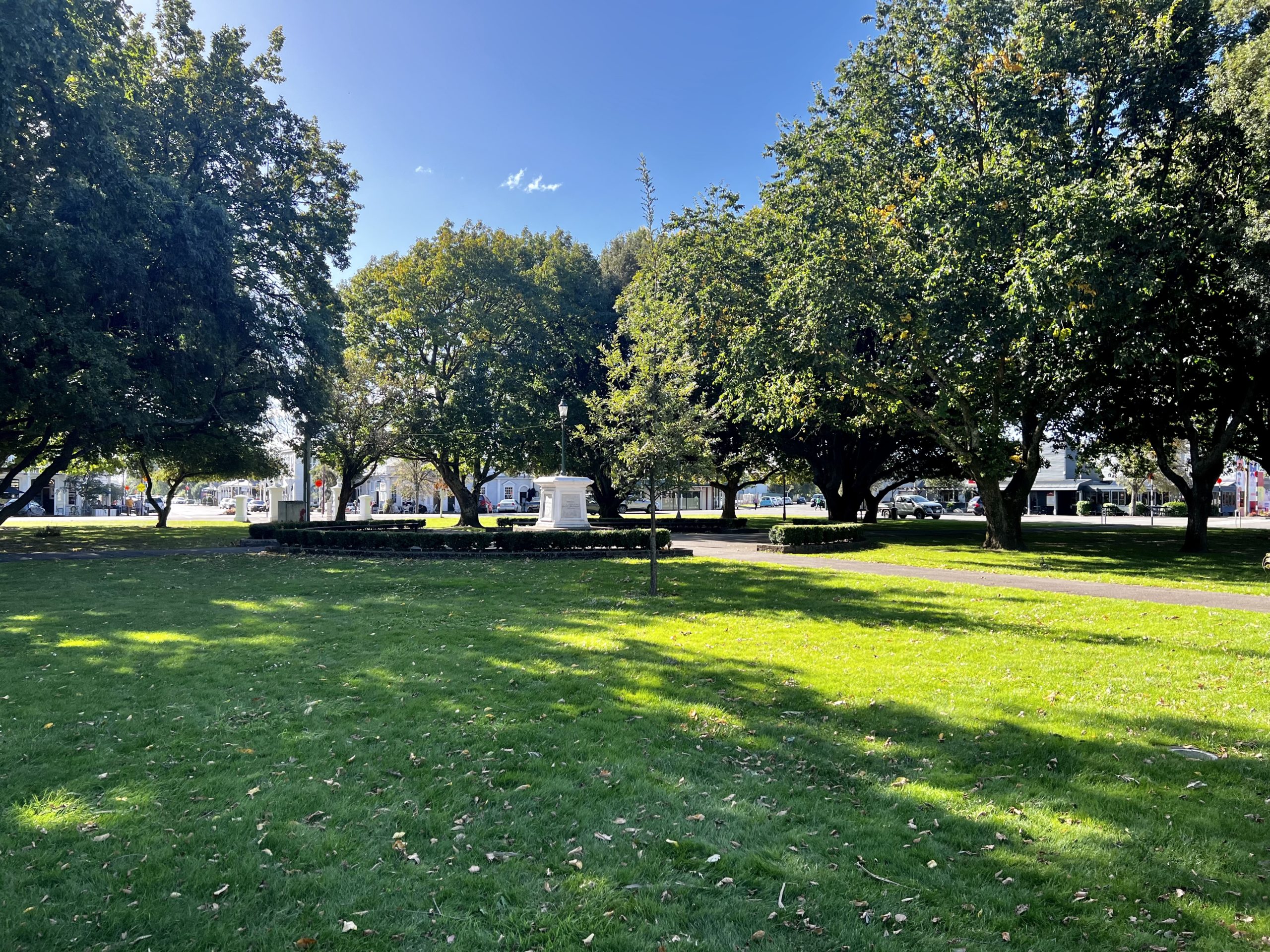
The town square looked sleepy when we visited on Sunday afternoon, even though the hotel restaurant was fully booked for that night and the following night. But Martinborough, originally a sheep town, is now known for spectacular wines, especially pinot noir. Vineyards vary in size but are larger than in Napa Valley. Martinborough has 38 wineries covering 39,000 acres (15,783 hectares); Napa Valley has 400 vineyards covering 43,000 acres (17,400 hectares).
A few of Bonnie’s classmates lived in Martinborough and took the bus to school in Greytown. During covid, the director of Avatar, James Cameron, gave up his house in Malibu and moved his family to this area full time. They have a large property with a produce farm about thirty minutes farther into the countryside.
Sheep were first imported from Australia to New Zealand into this region. The broad Wairarapa valley, including Martinborough and Greytown, was ideal for sheep farming, and giant sheep stations were established here. In the days before refrigerated shipping for meat, sheep were raised for wool, which was sent back to England. Wool is no longer a lucrative product, especially with synthetics taking over in carpets, so sheep farming is focused on the meat market. Think racks of lamb at Costco. In fact, New Zealand is now breeding some sheep that shed their wool. Many sheep have been replaced by dairy cattle, beef cattle, and grapes.
Food, Wine, and Beer
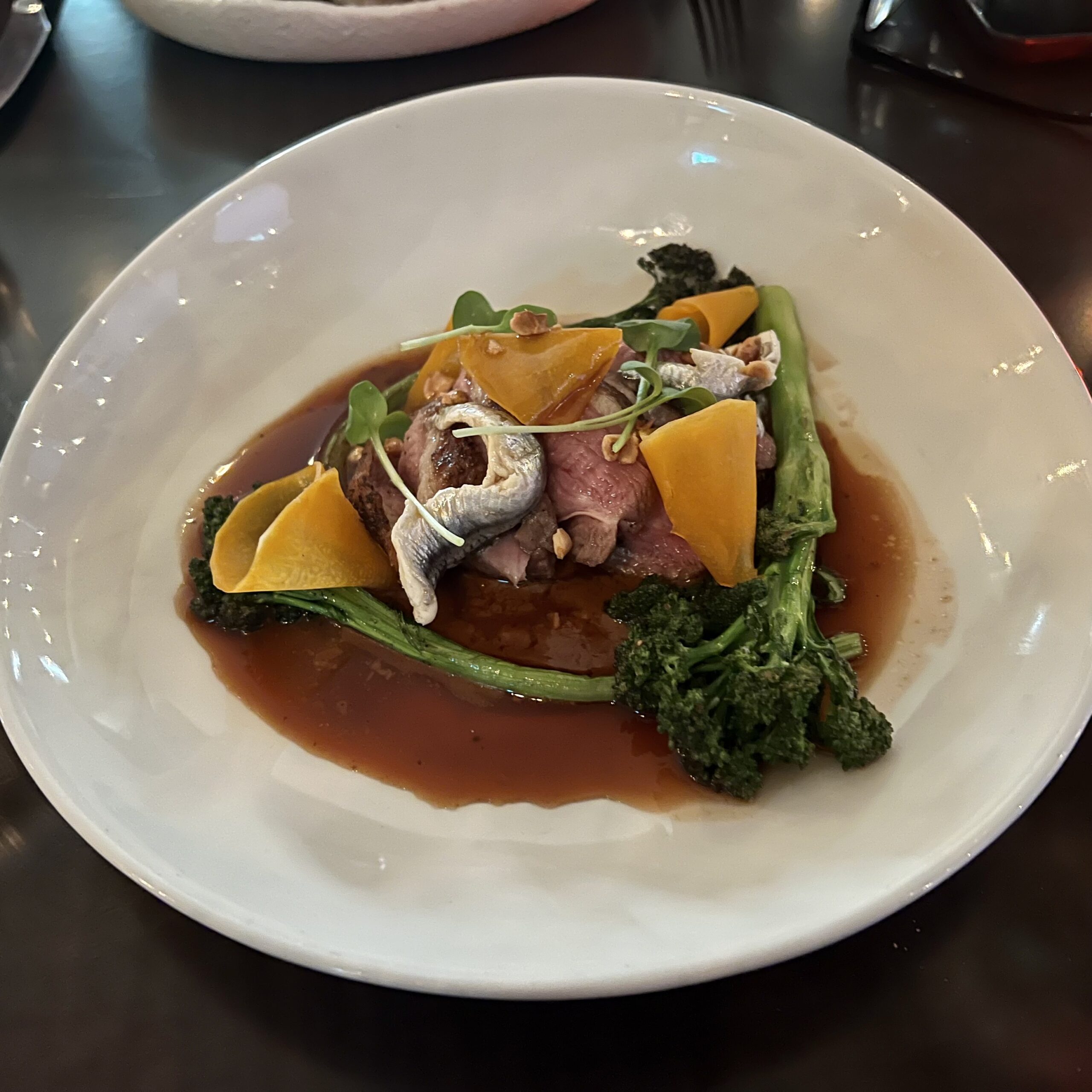
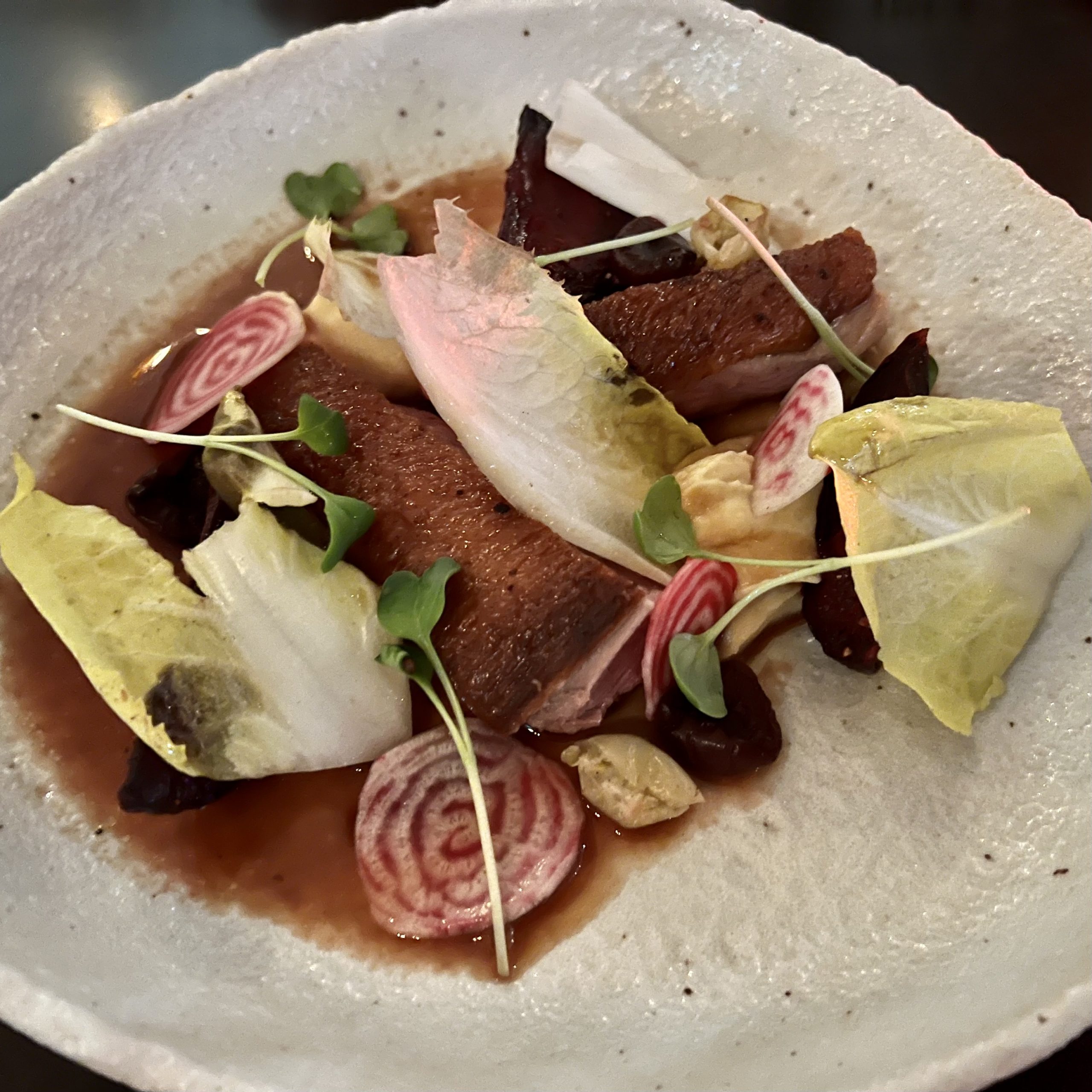
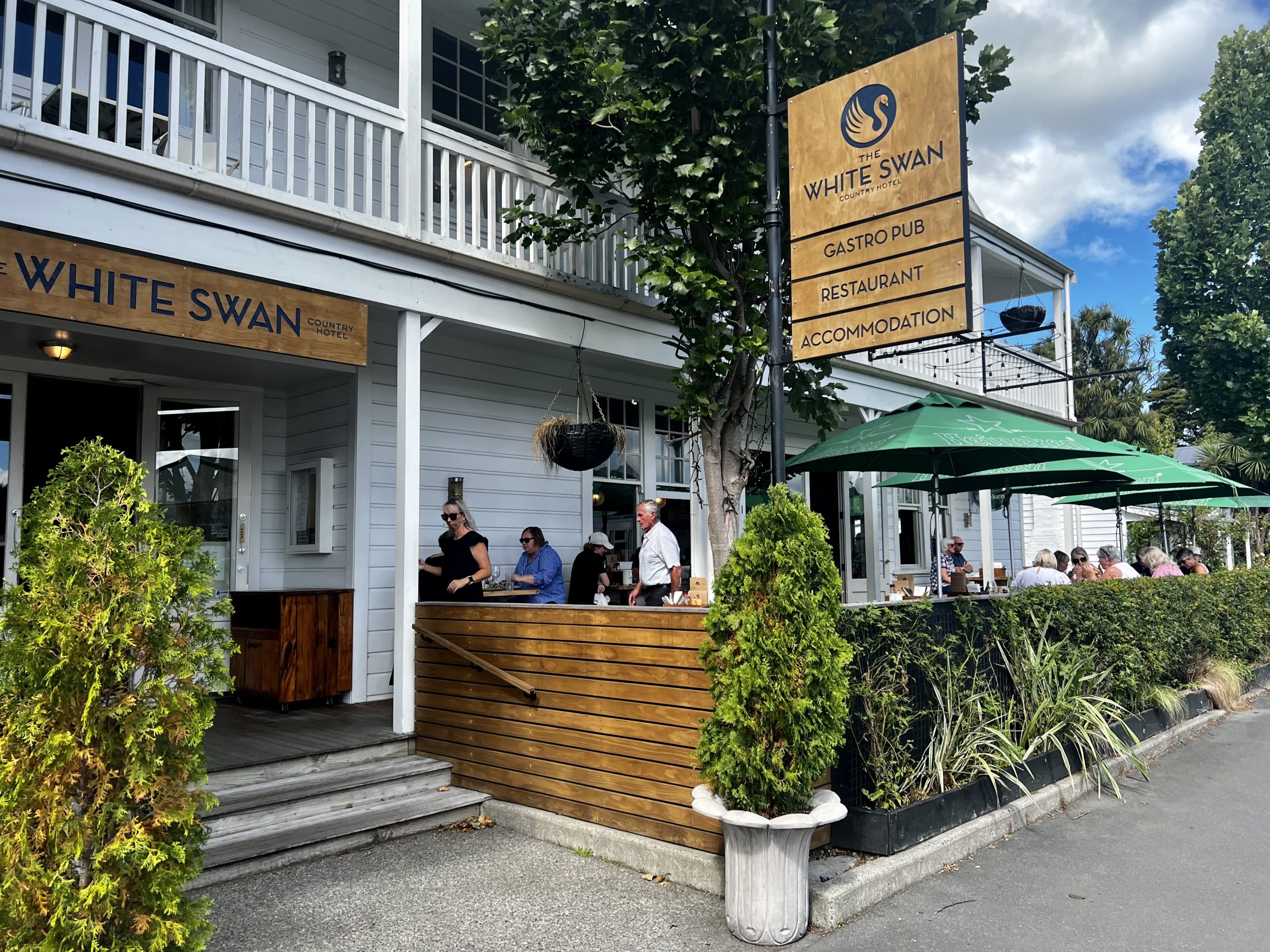
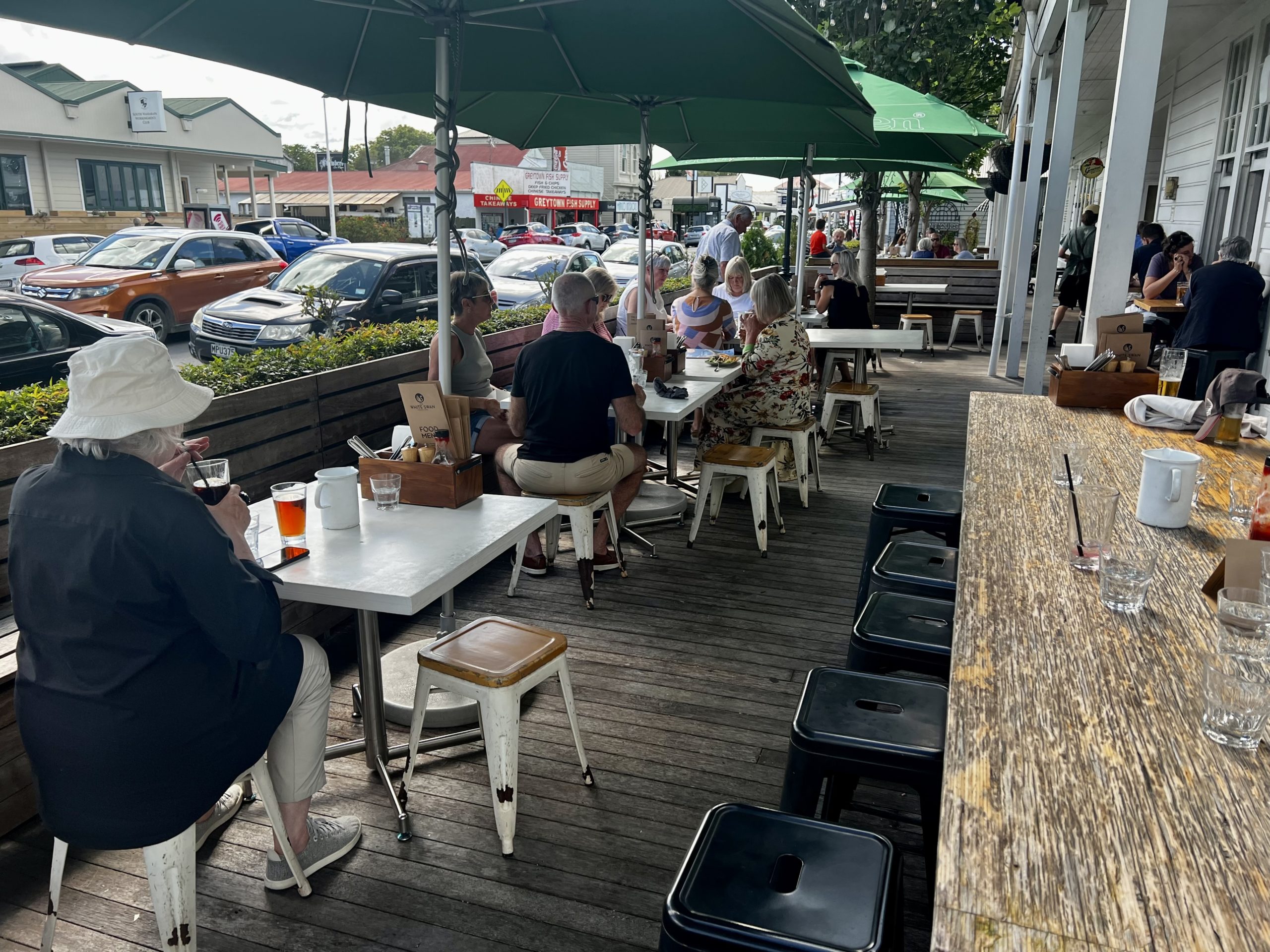
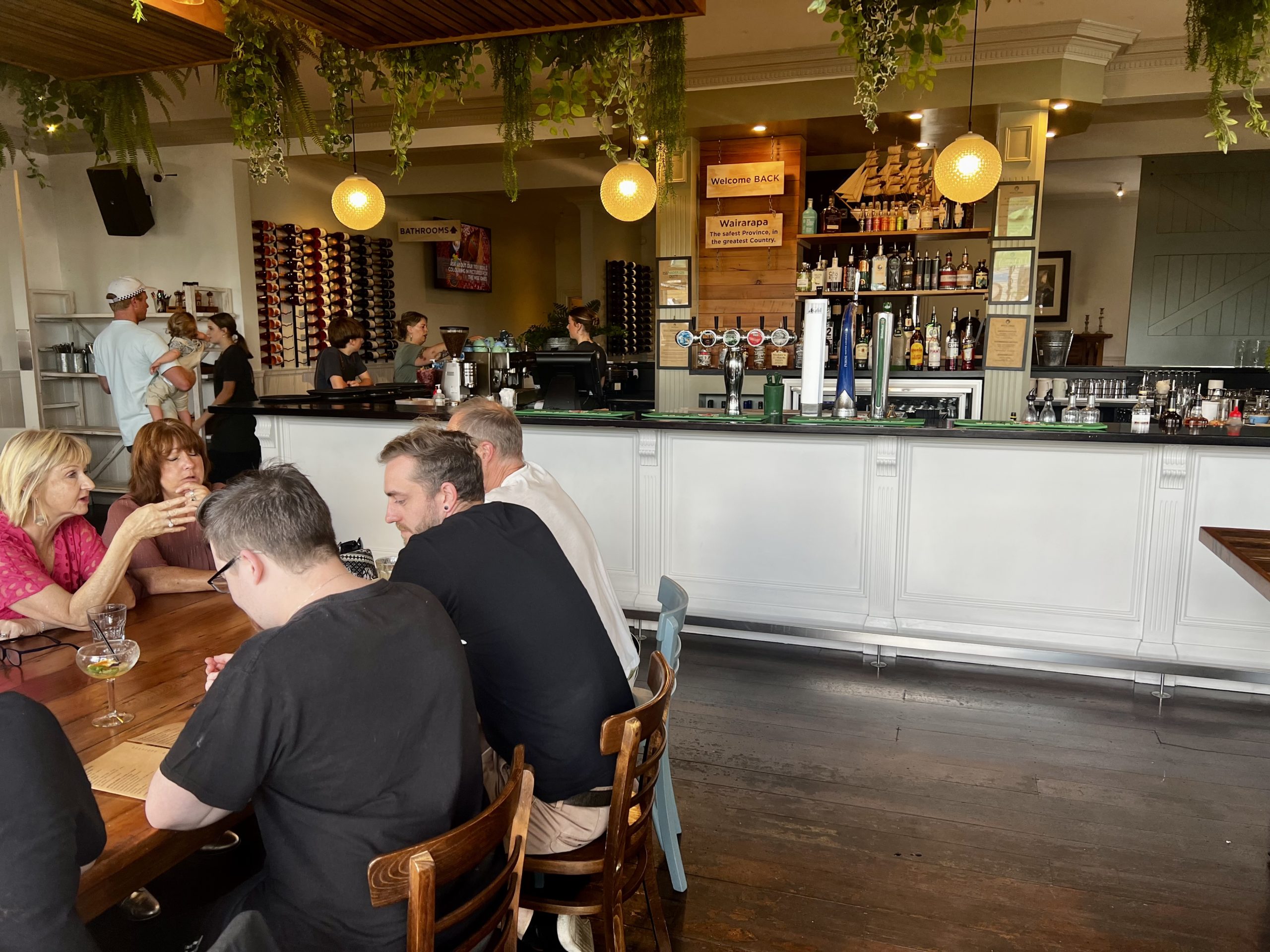
The deck at the White Swan Hotel in Greytown is a great social spot.
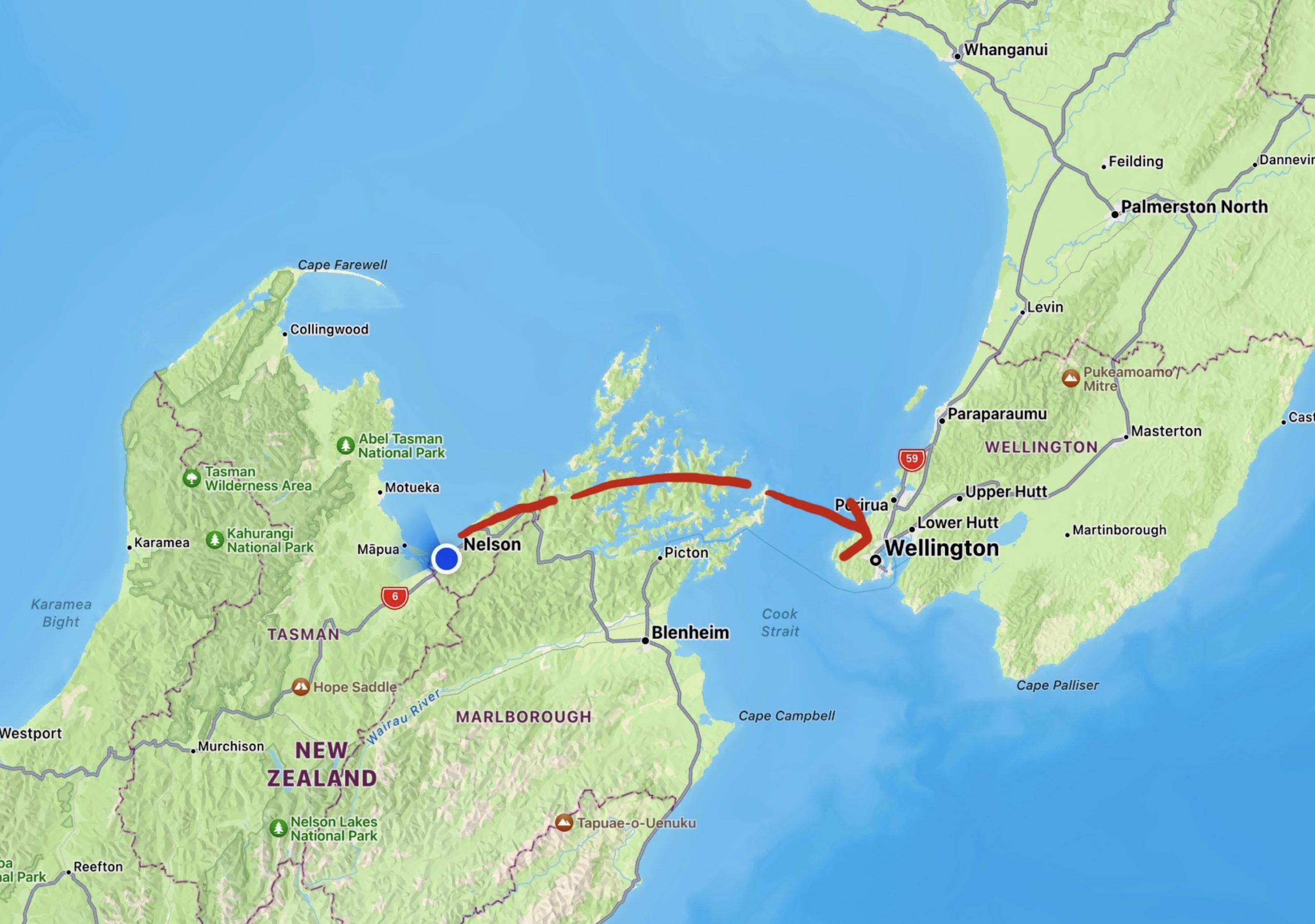
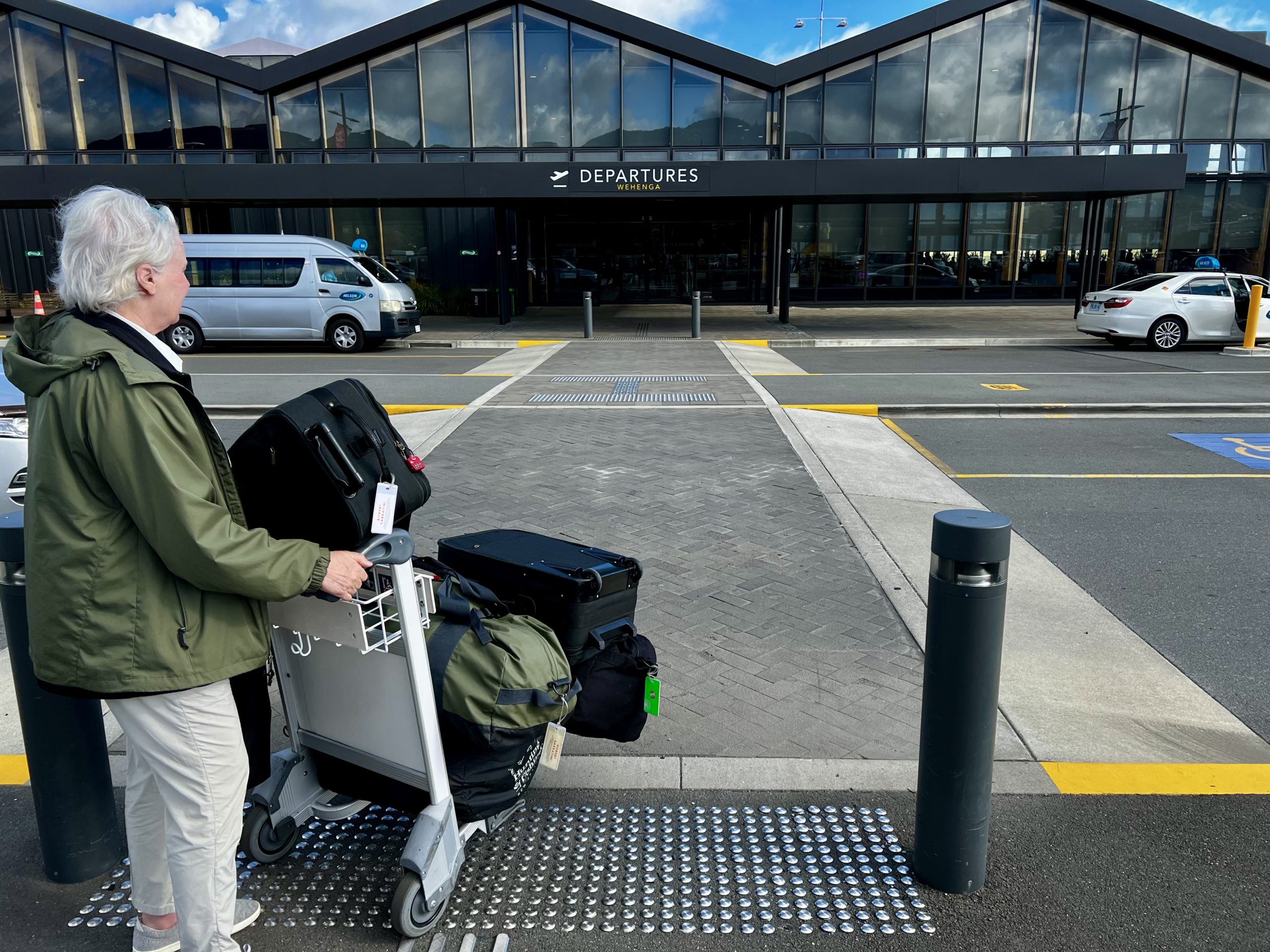
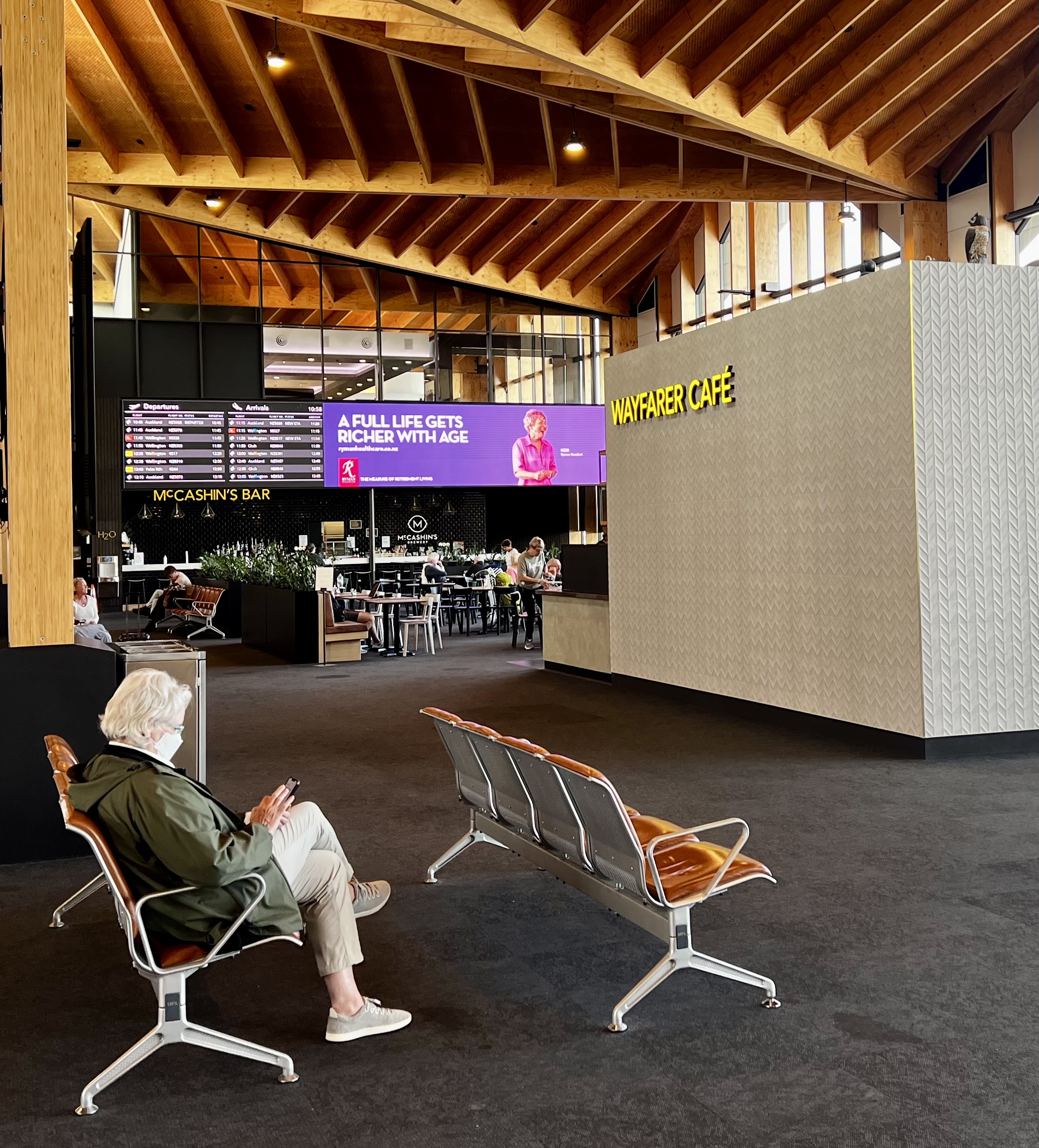
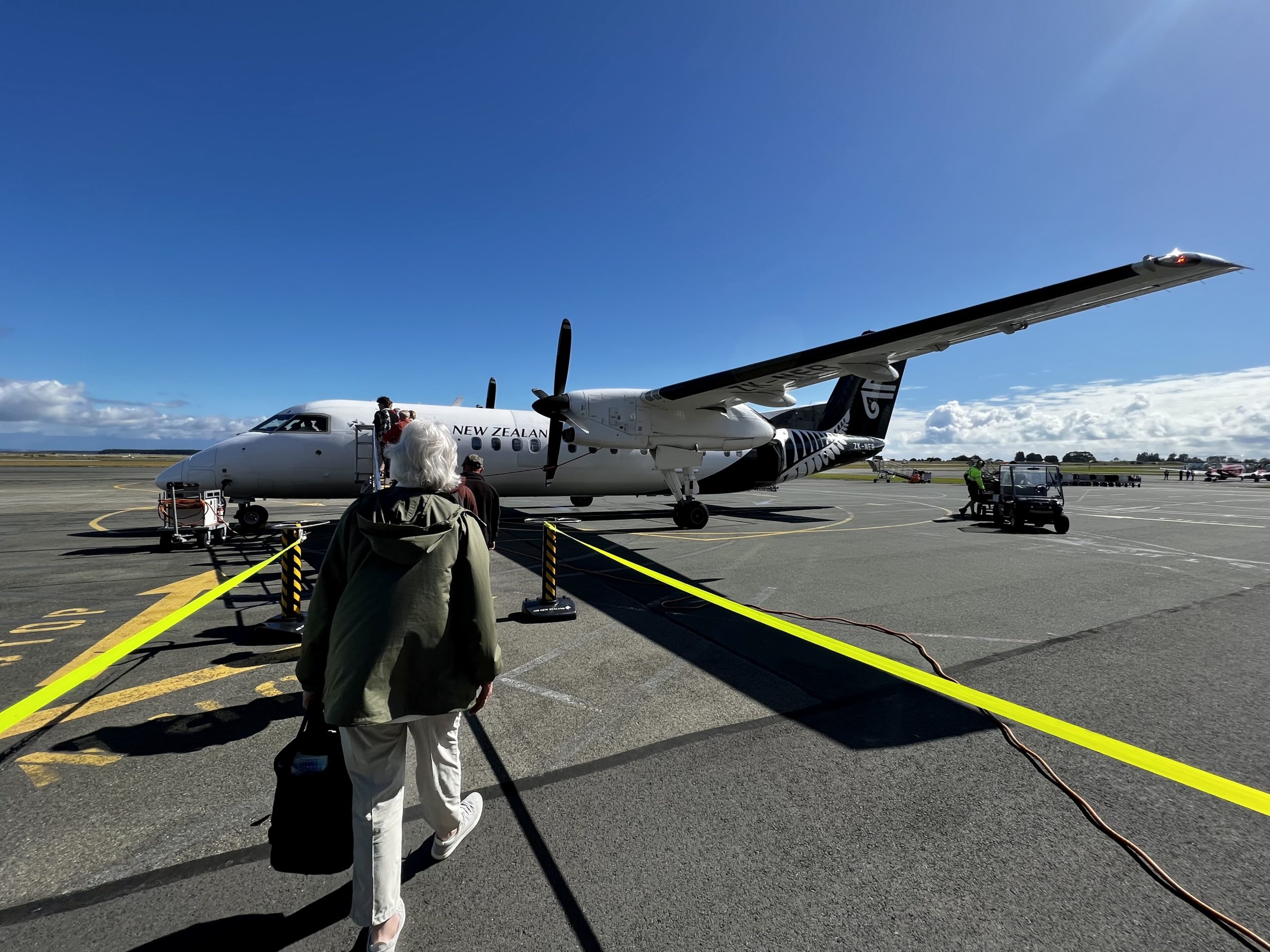
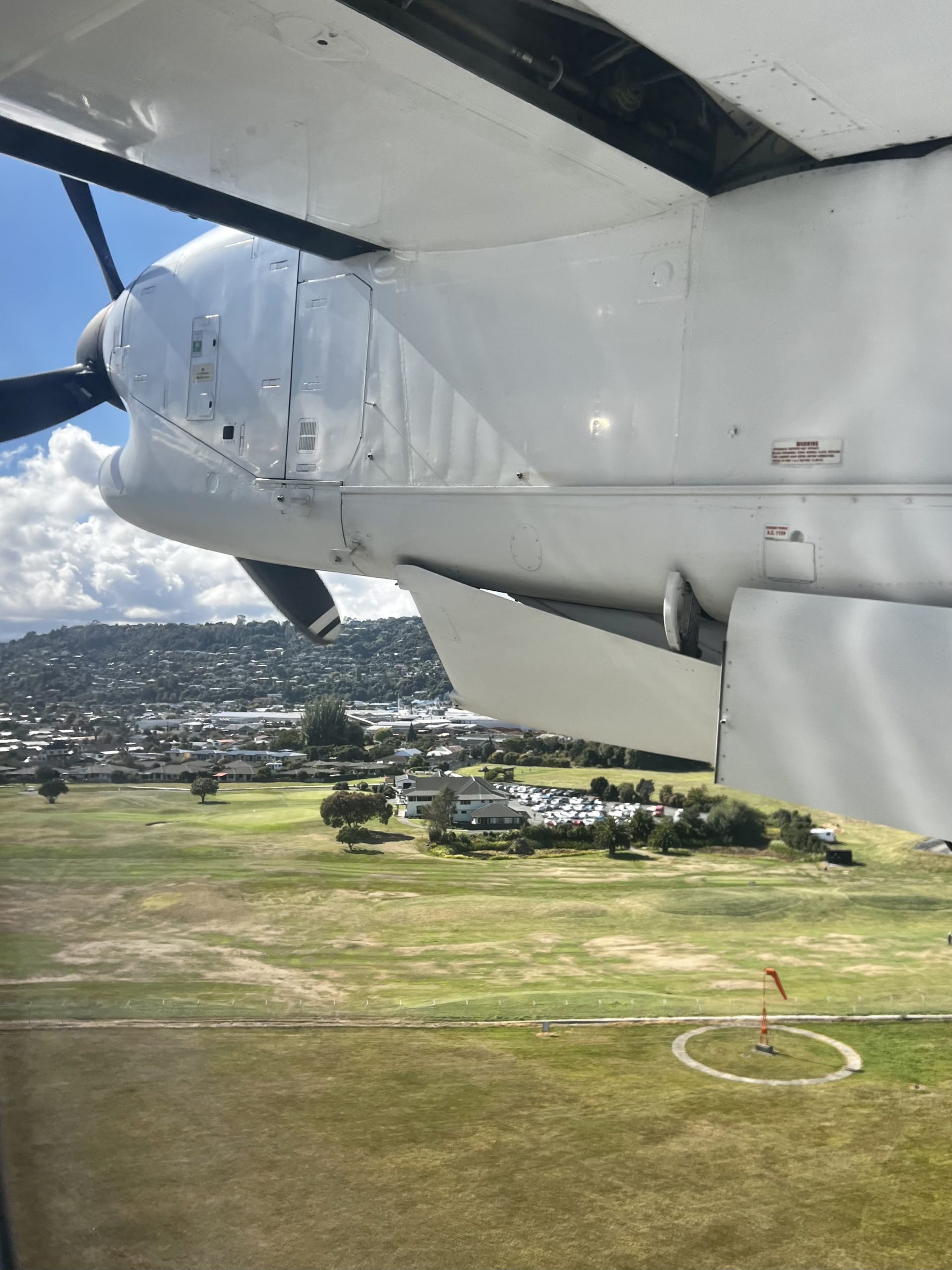
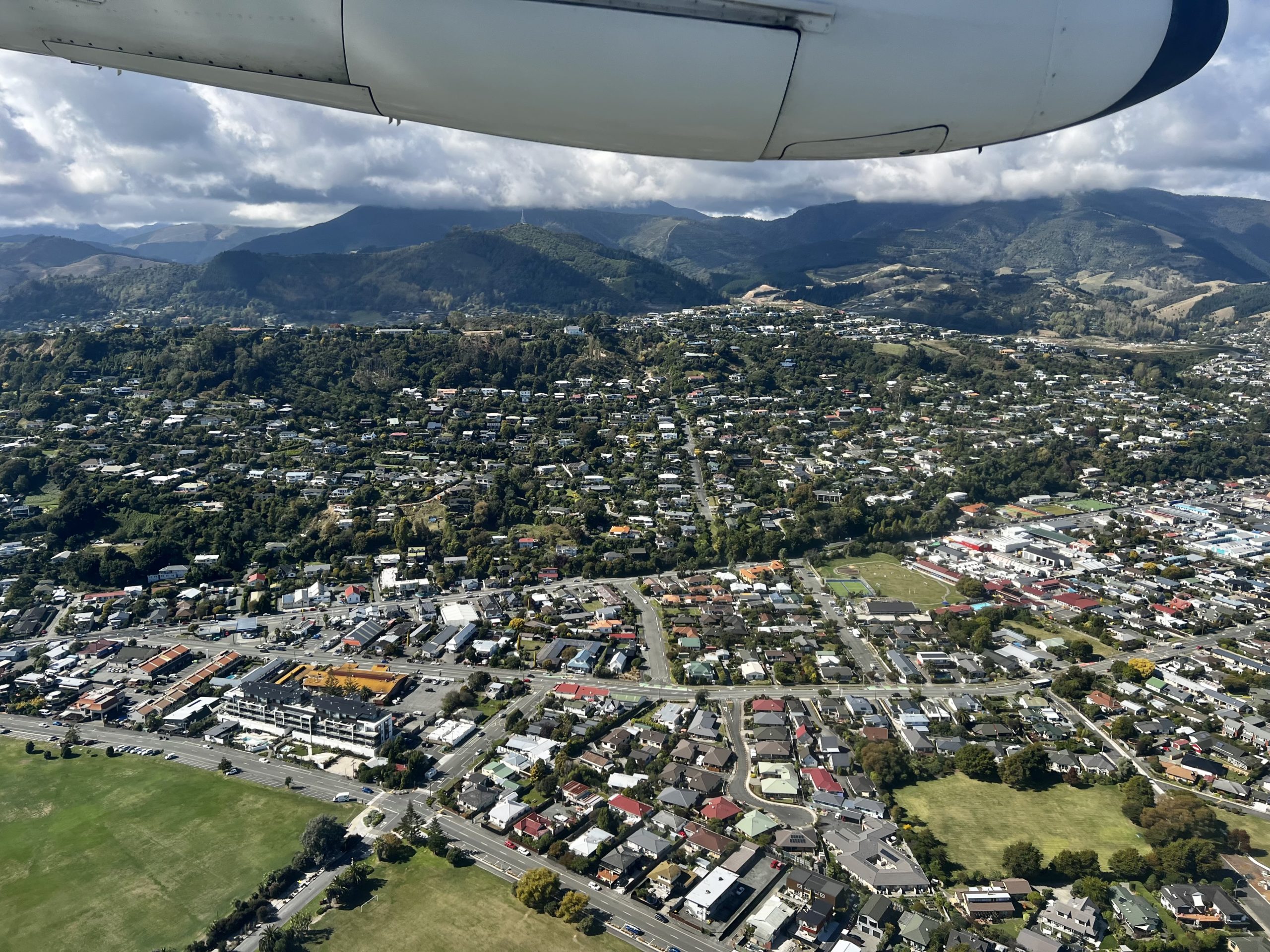
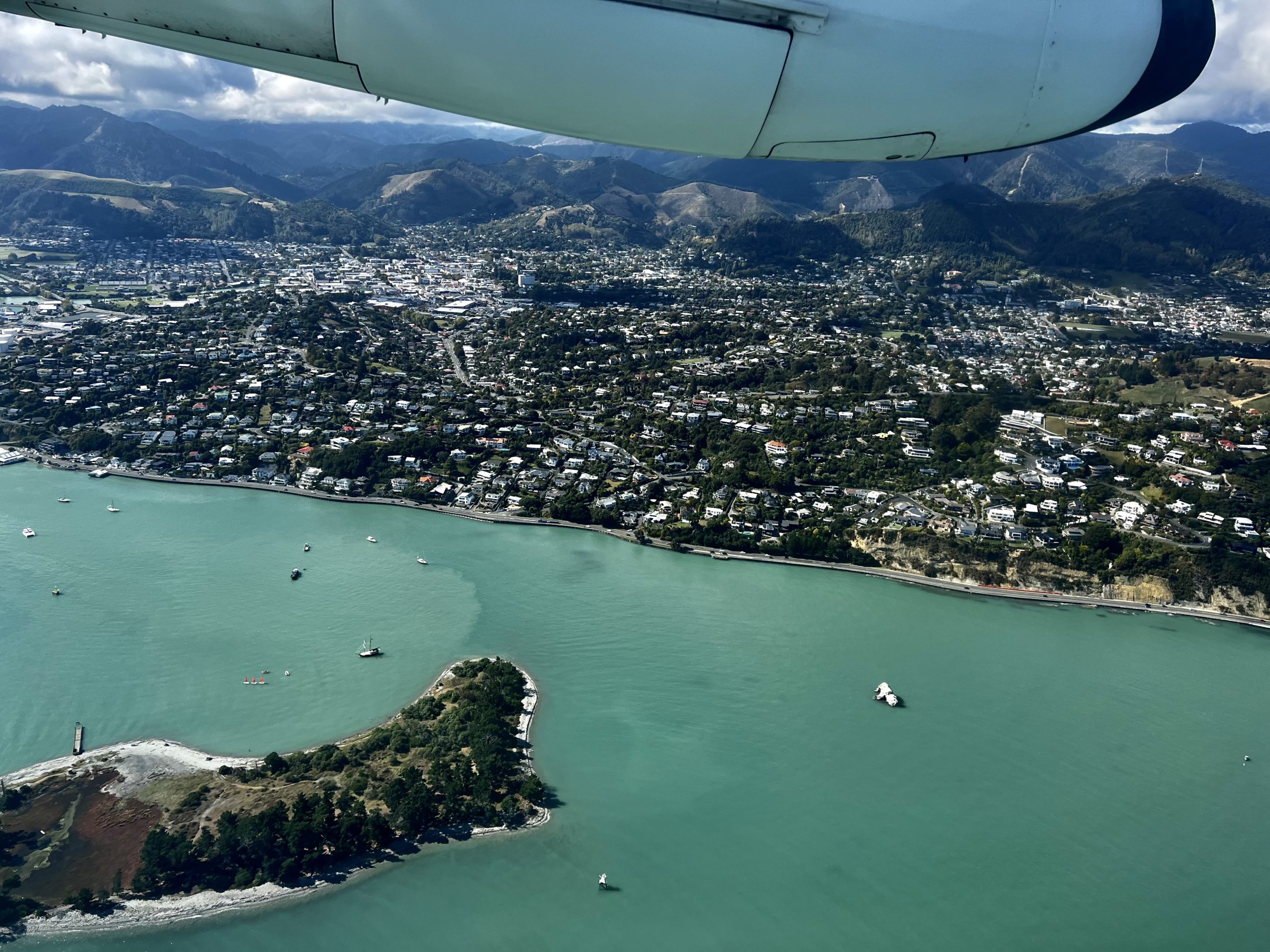
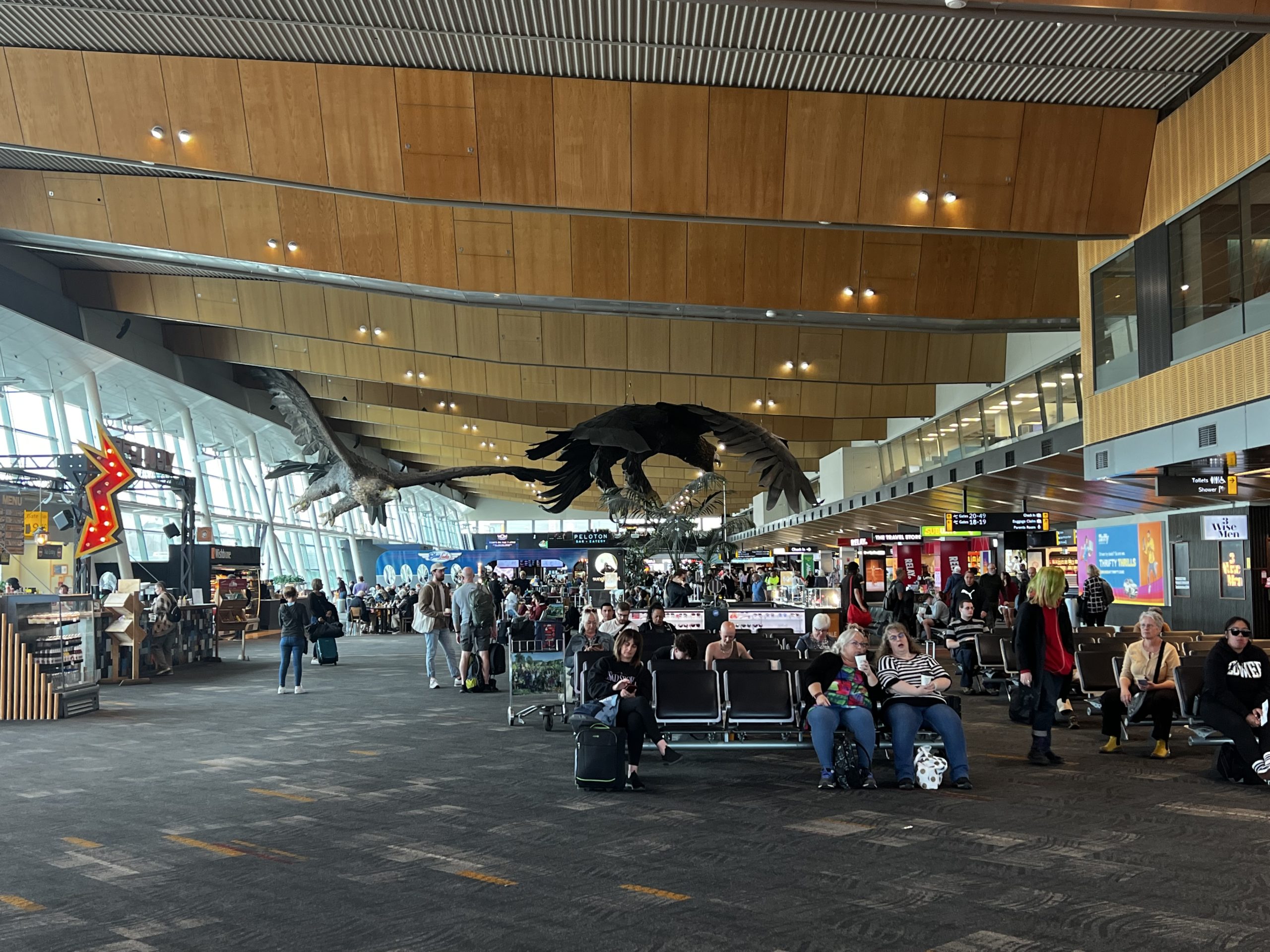
We left from the small but nicely designed Nelson airport, about a ten-minute drive from the motel. It has one departure gate. We boarded a prop plane for about fifty people, and the flight to Wellington took all of thirty minutes. Many people take the ferry to the North Island, but the crossing is notoriously rough and ferries are often cancelled.
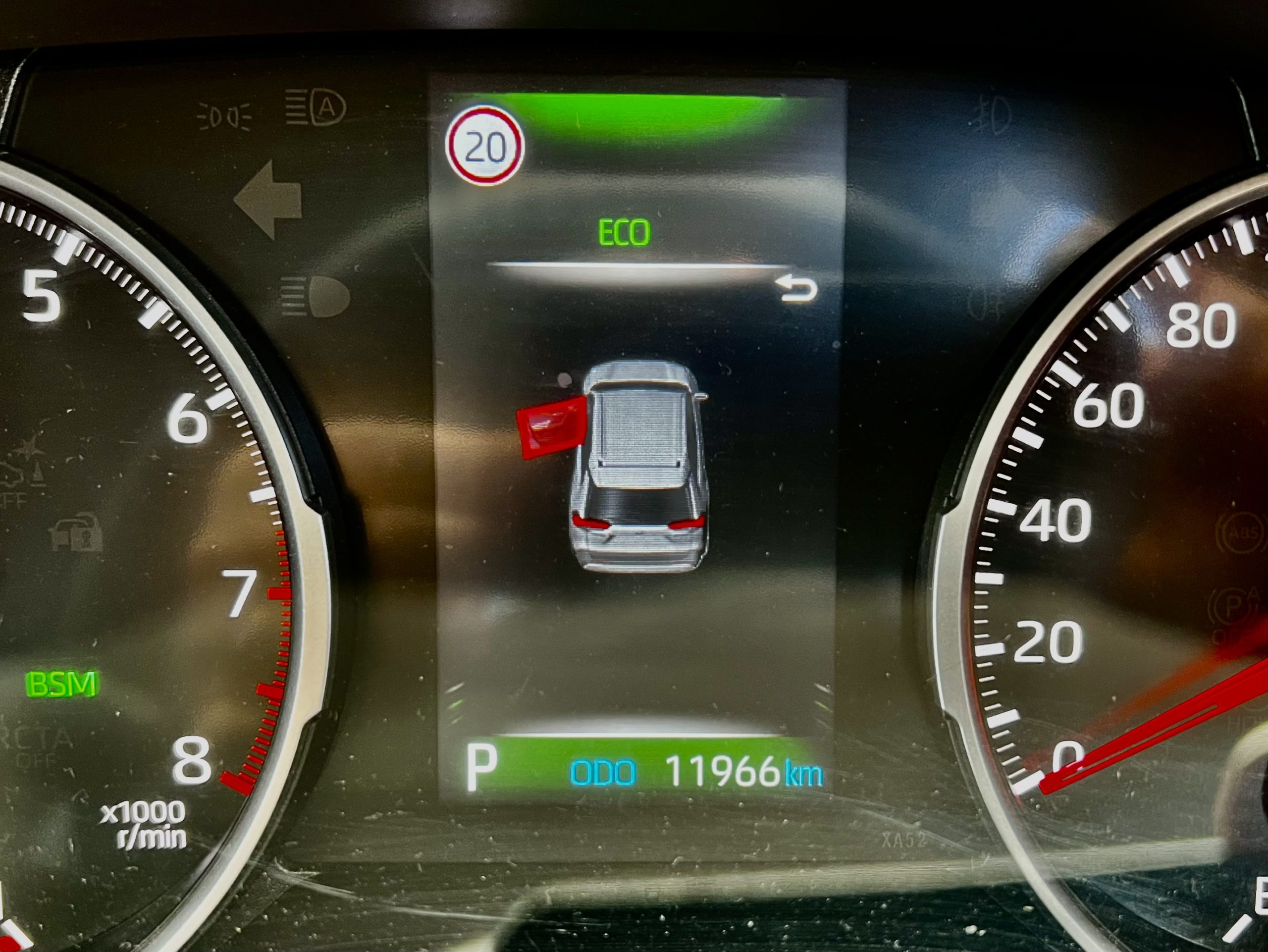
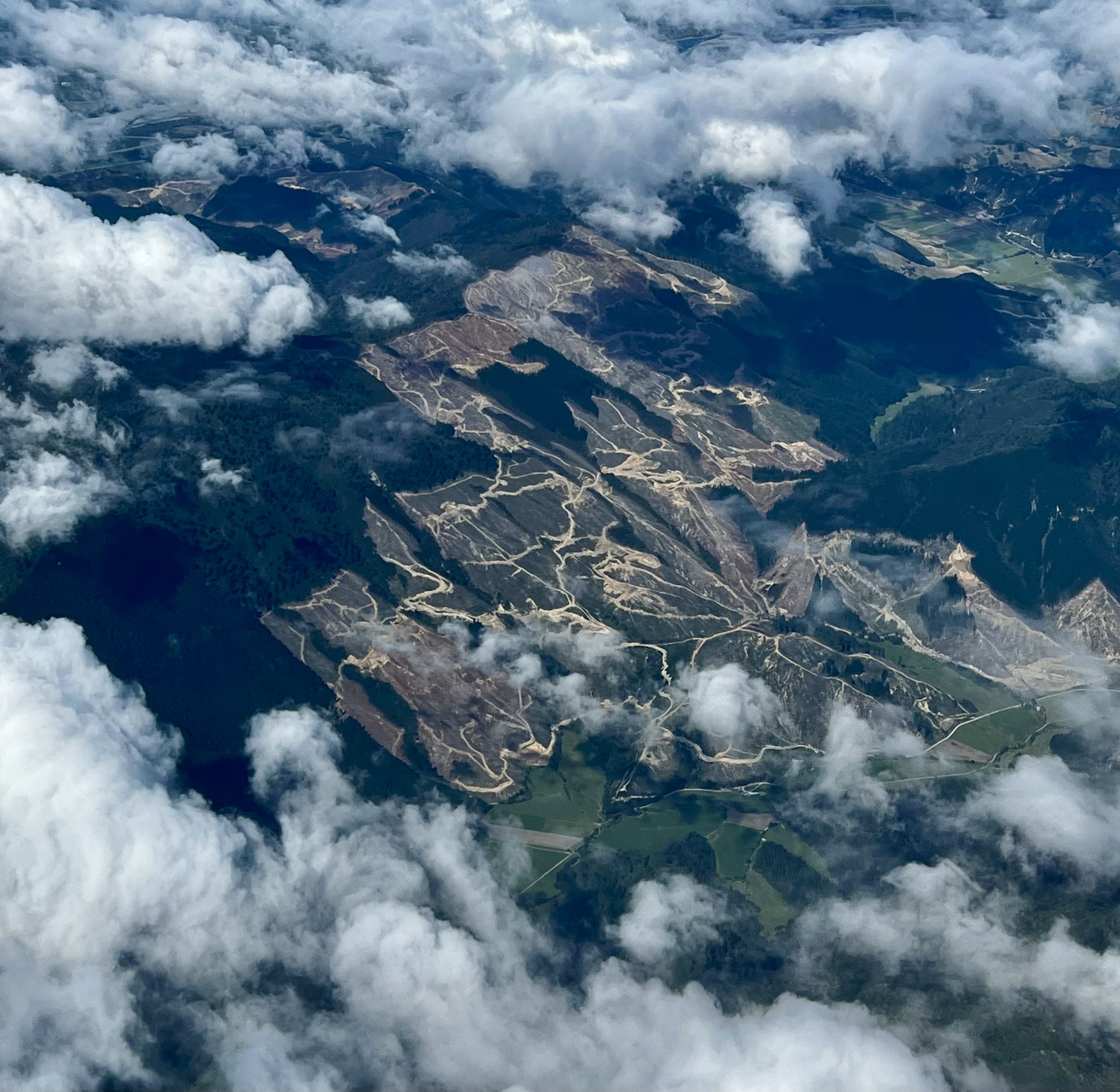
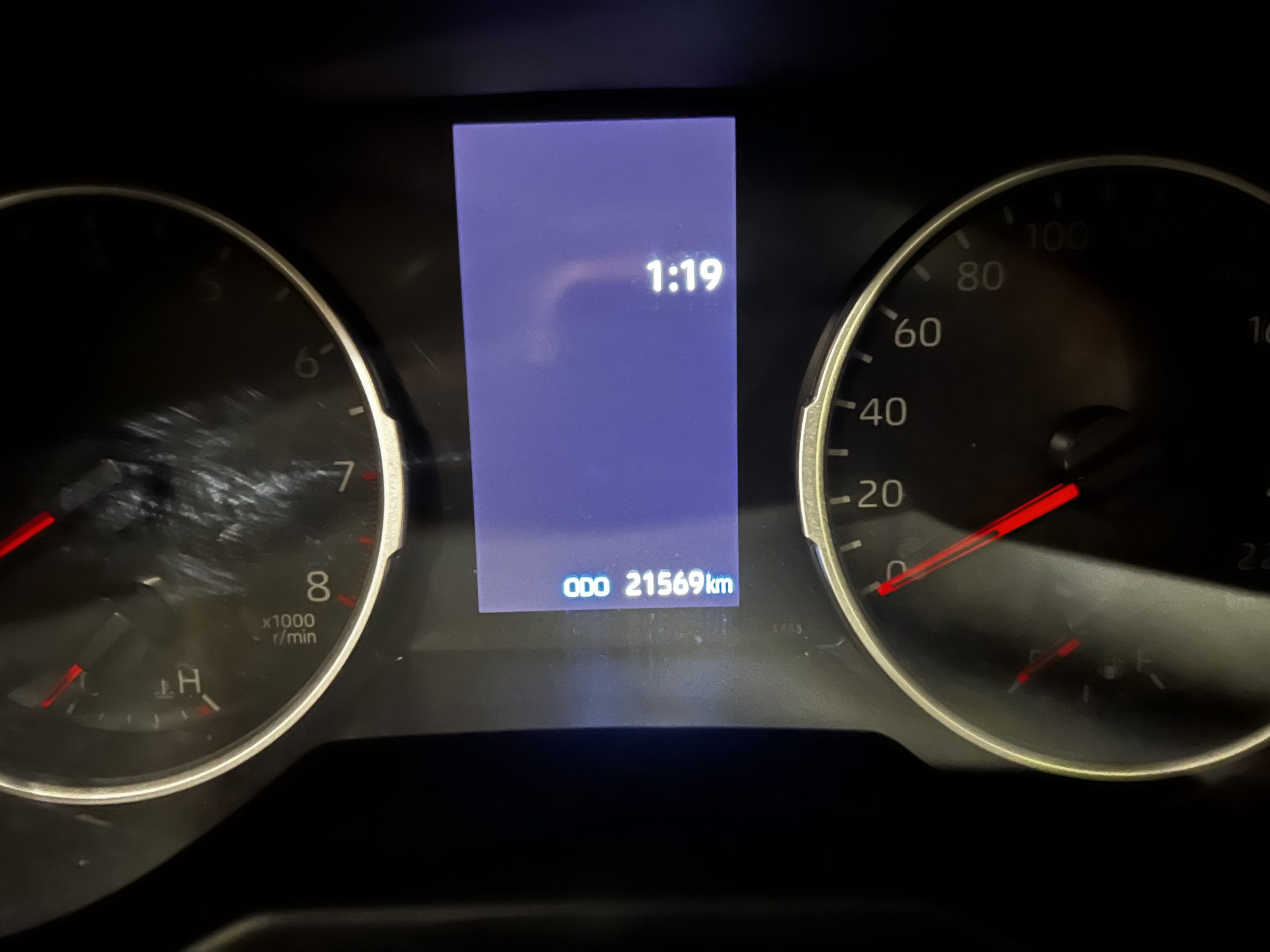
Turned in the rental car. Total of 2,814 kilometers (1,749 miles)Large areas of clear-cut forest viewed from the planeWellington airportHad to wait for a RAV4. The trunks of other cars were too small for all the luggage Robert packed!
The City
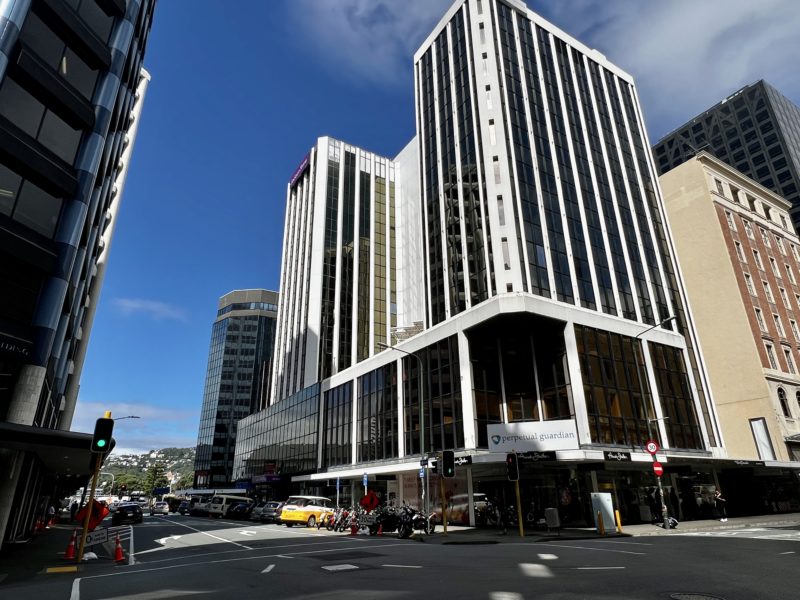
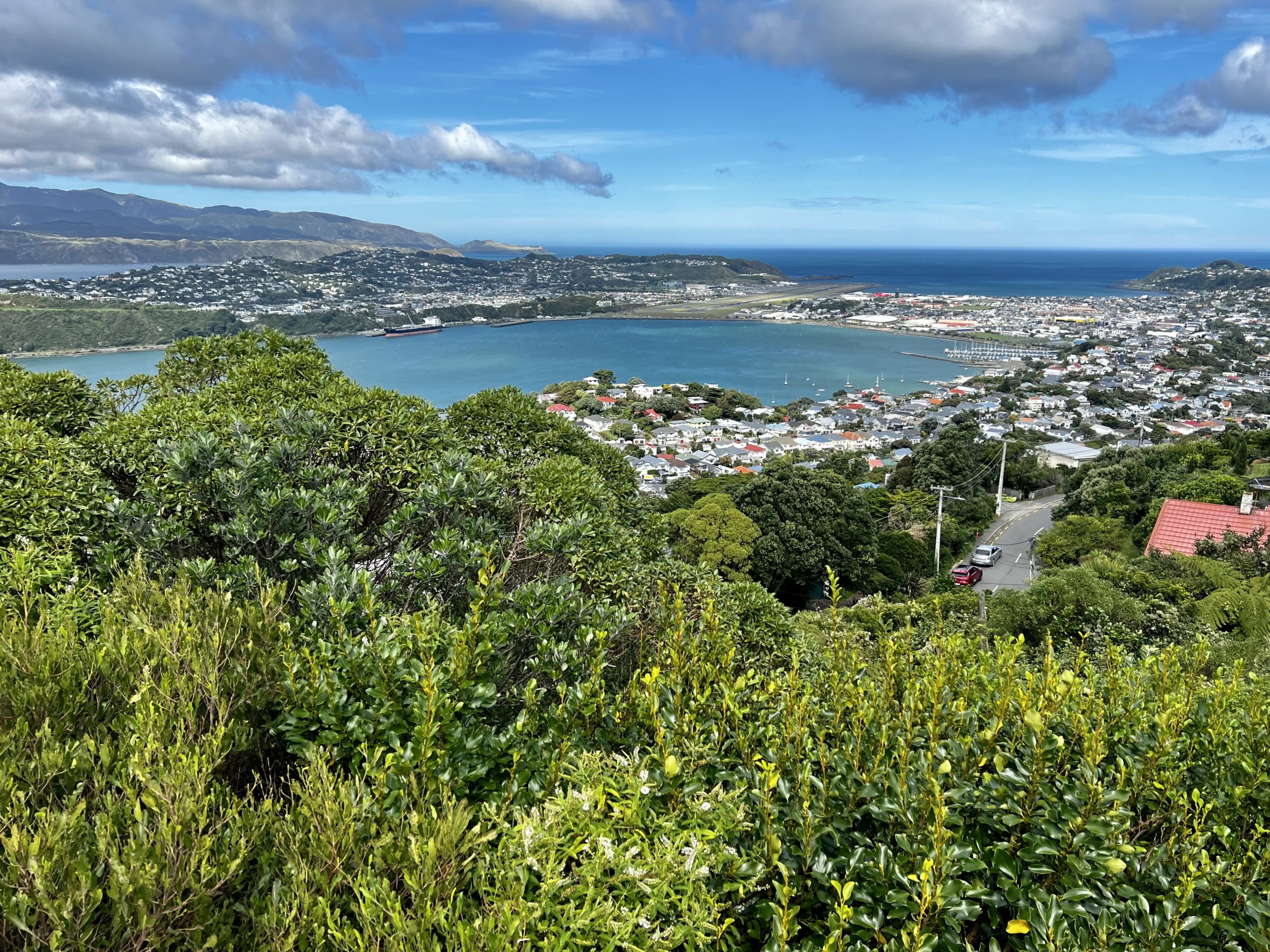
Wellington, the capitol city and cultural center of New Zealand, is set on dramatic steep hills that plunge into bays. It is far more hilly than San Francisco. Many houses dotted on the forested hillsides seem nearly impossible to reach. In fact there are 400 privately owned cable cars. Some were built by owners to get construction materials to the site and then kept for daily use. Others were built by small groups of neighbors.
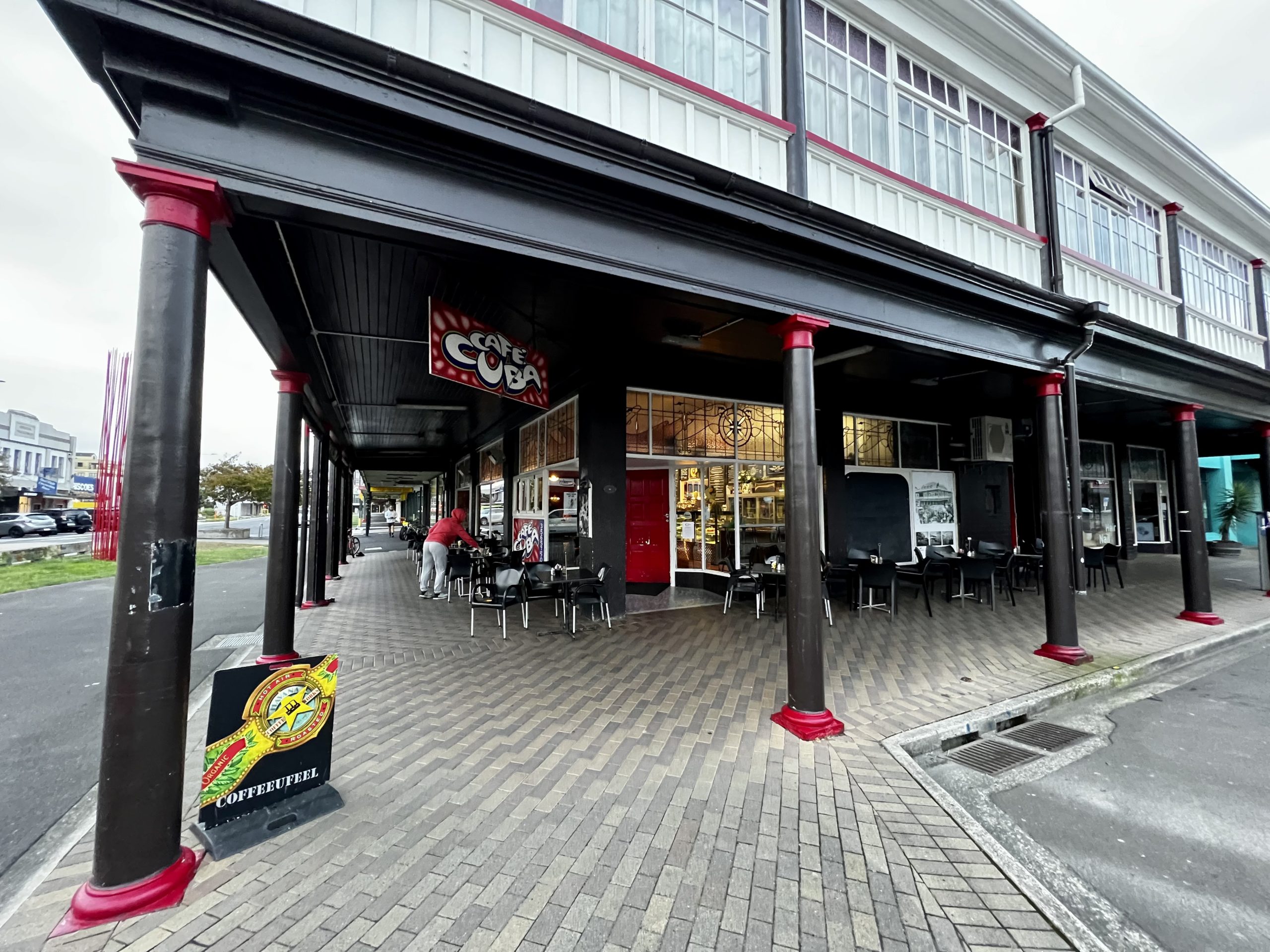
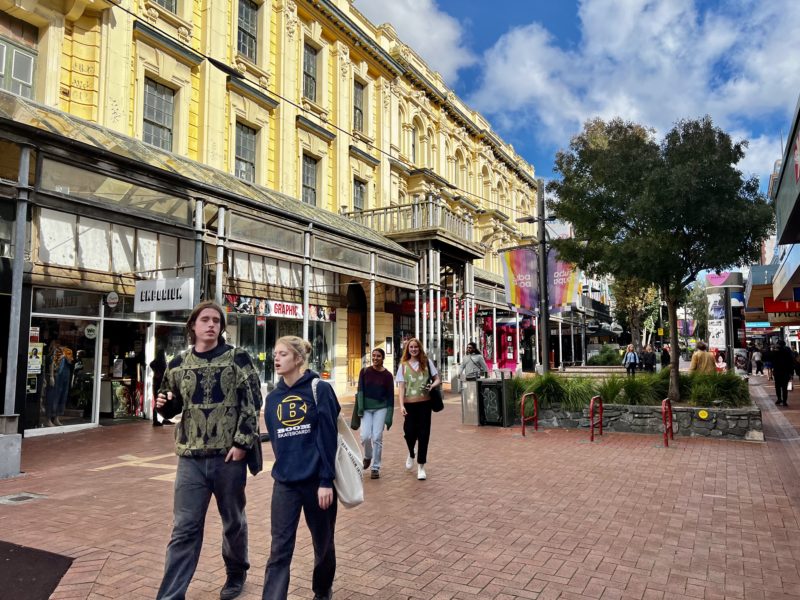
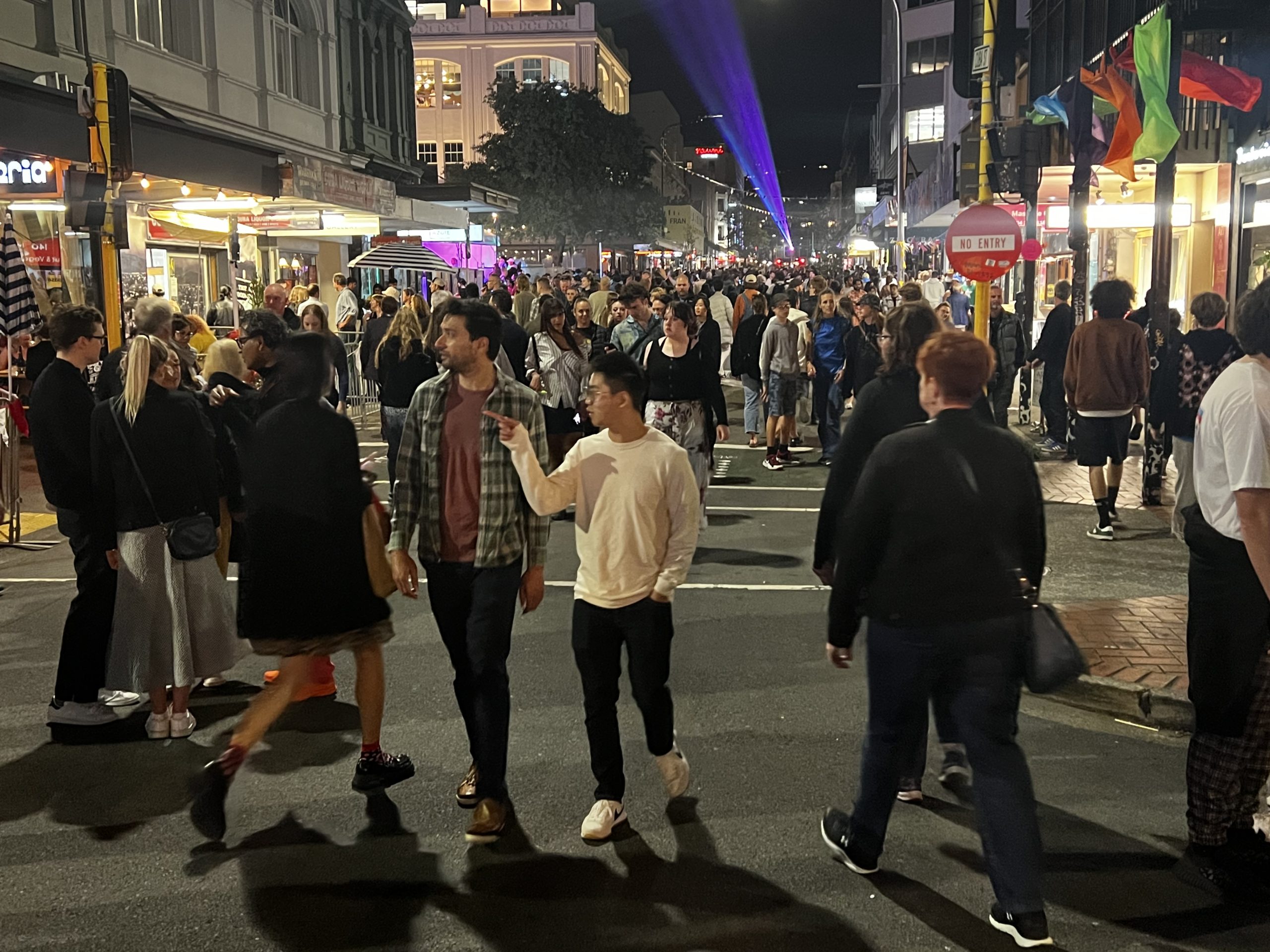
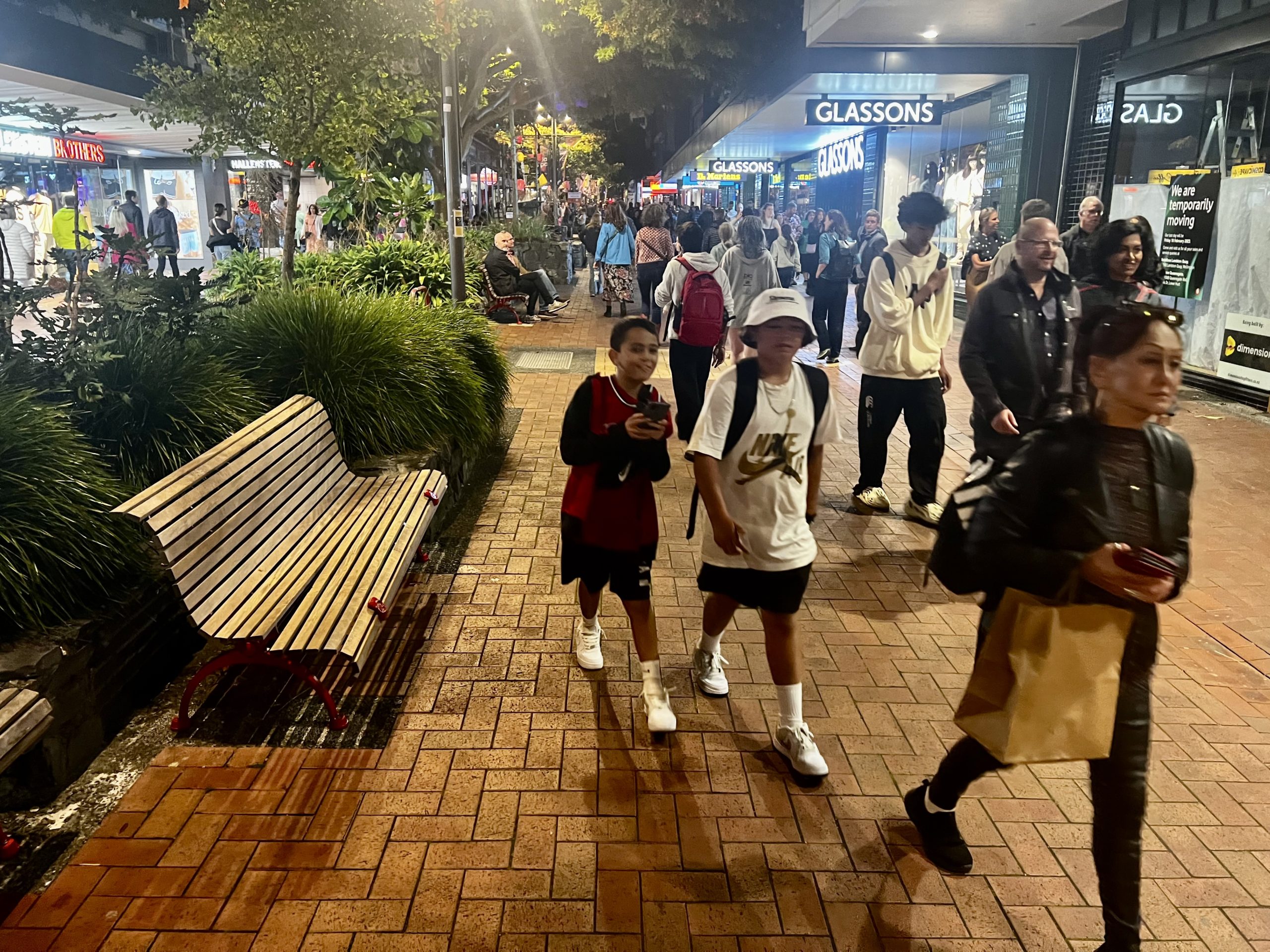
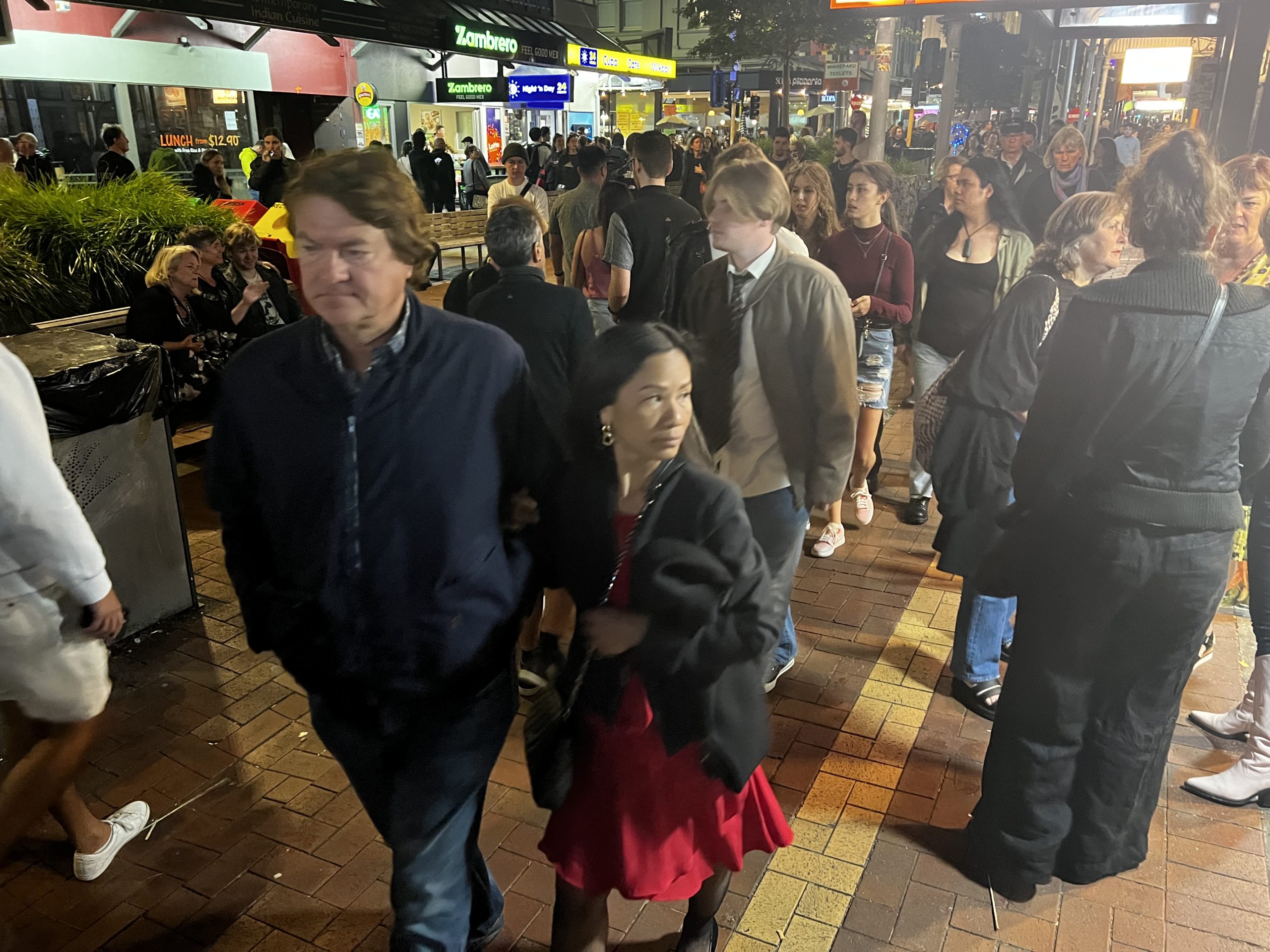
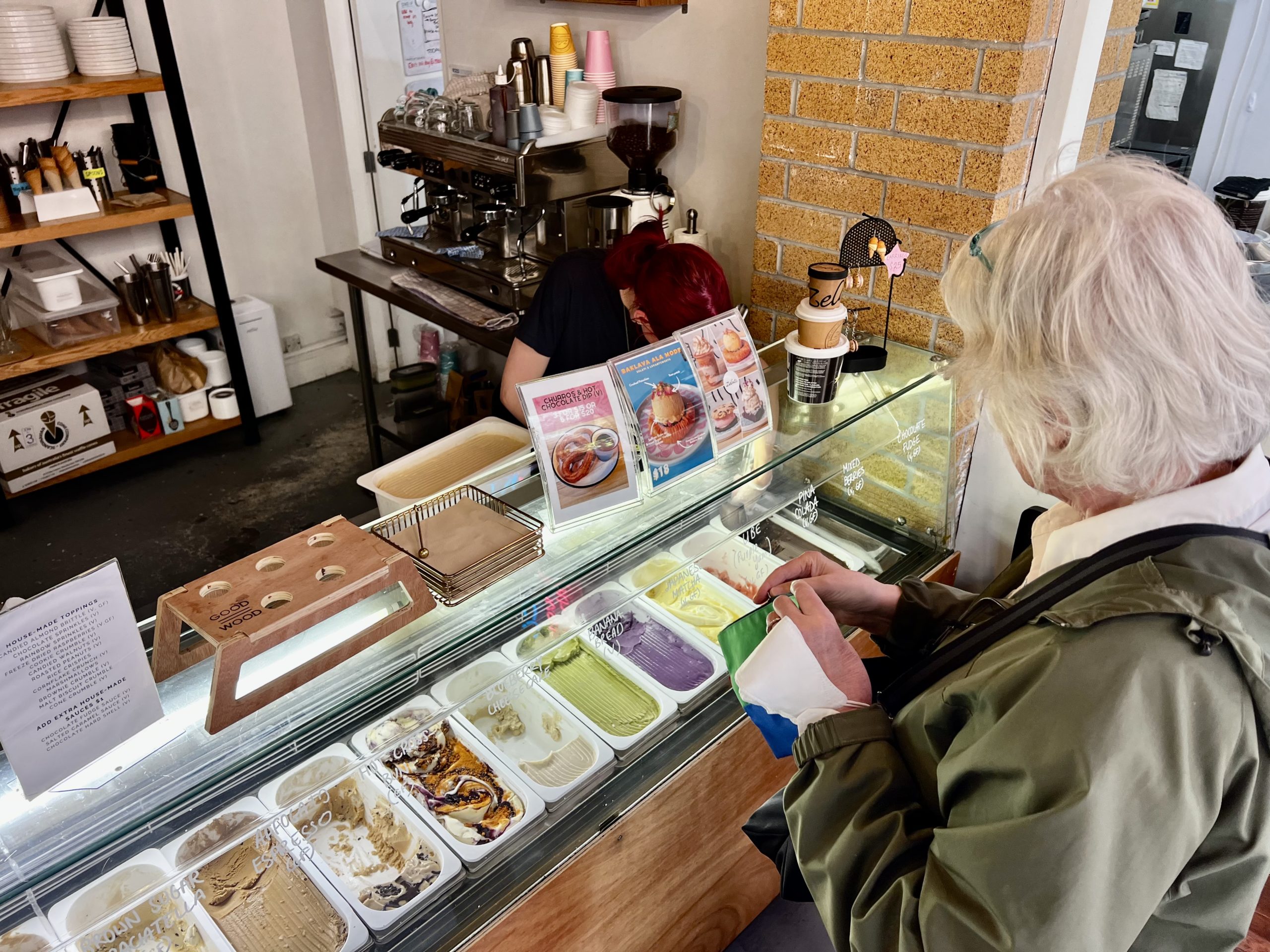
Although Wellington’s downtown has a big-city feel, its population is only 212,000. If you include the suburbs, the number climbs to 400,000. Still small. In 2017-18 Deutsche Bank ranked Wellington number one in the world for livability. It claims to be the world’s windiest city, and we experienced a bit of the reason why. New Zealand is riddled with earthquake faults, and Wellington especially has been shaped by quakes that raised land several feet above the waterline to form part of the downtown and the port. The climate is similar to San Francisco. On this trip we discovered Cuba Street, a busy pedestrian retail strip filled with young people that has a touch of the Haight. Bonnie found several choices for vegan gelato there. Nearby Robert shopped, comparing Icebreaker clothes at a couple of stores we remembered from our past trip.
Accommodations
Strolling
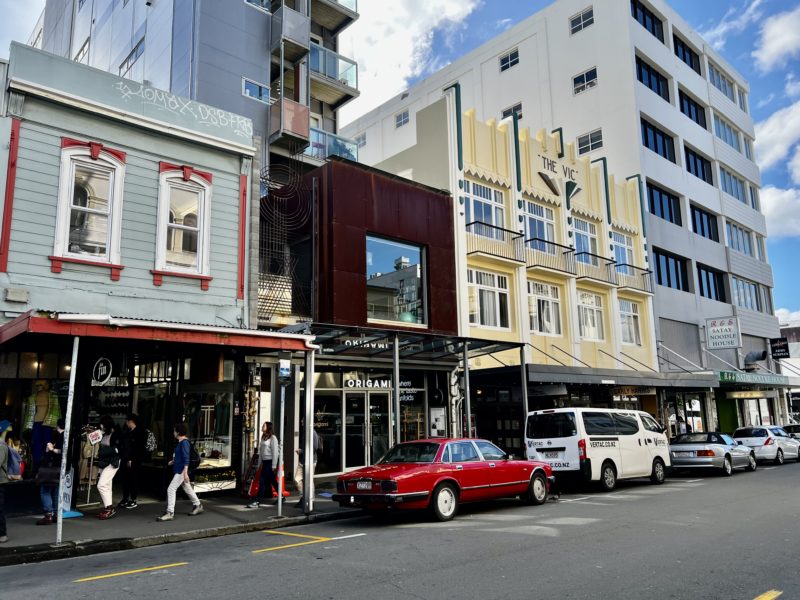
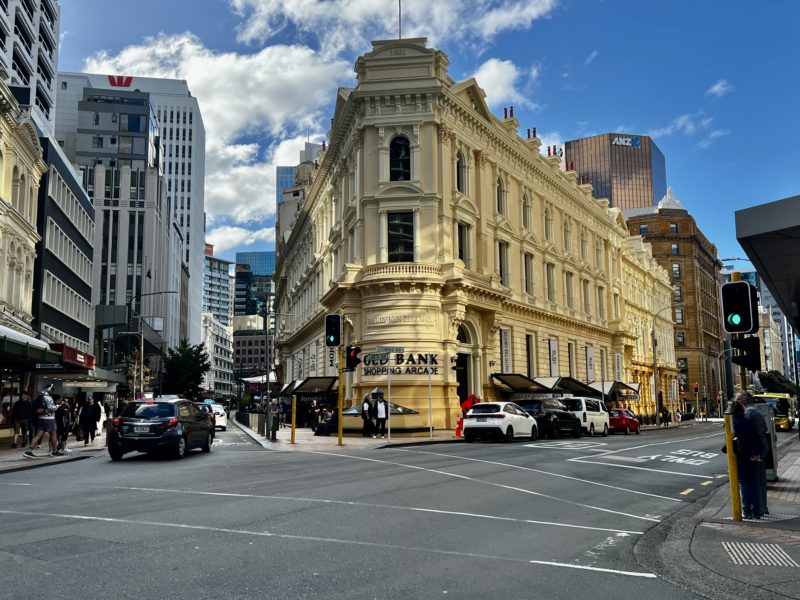
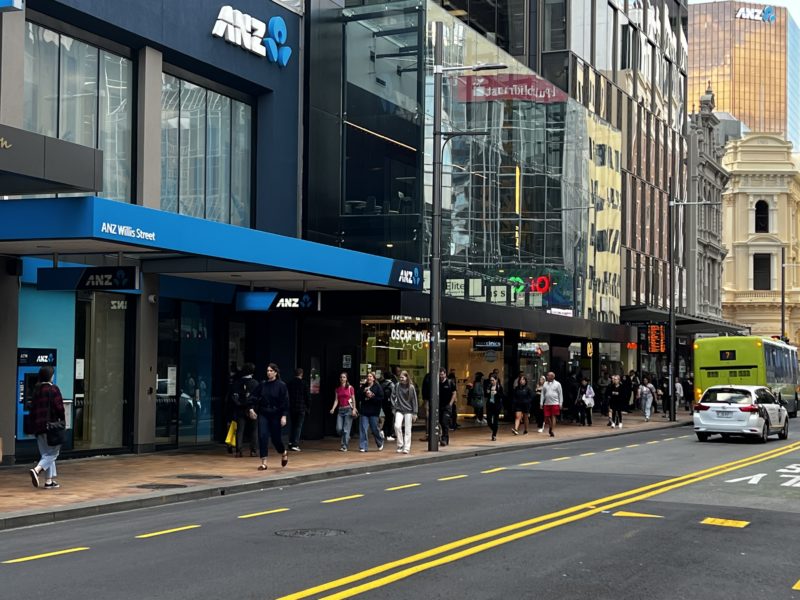
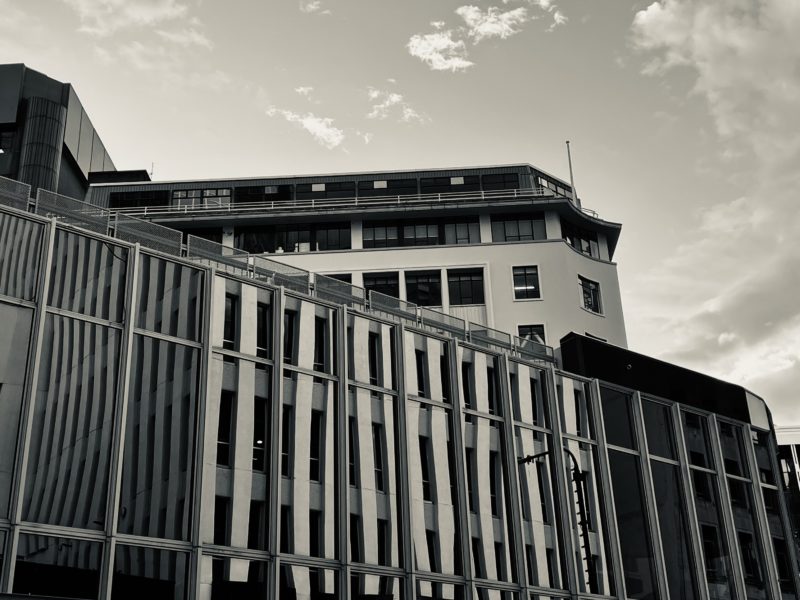
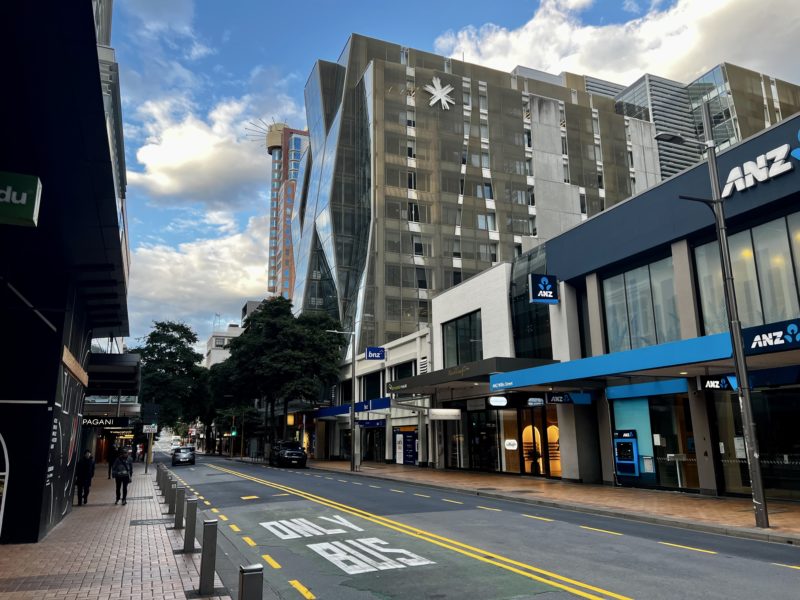
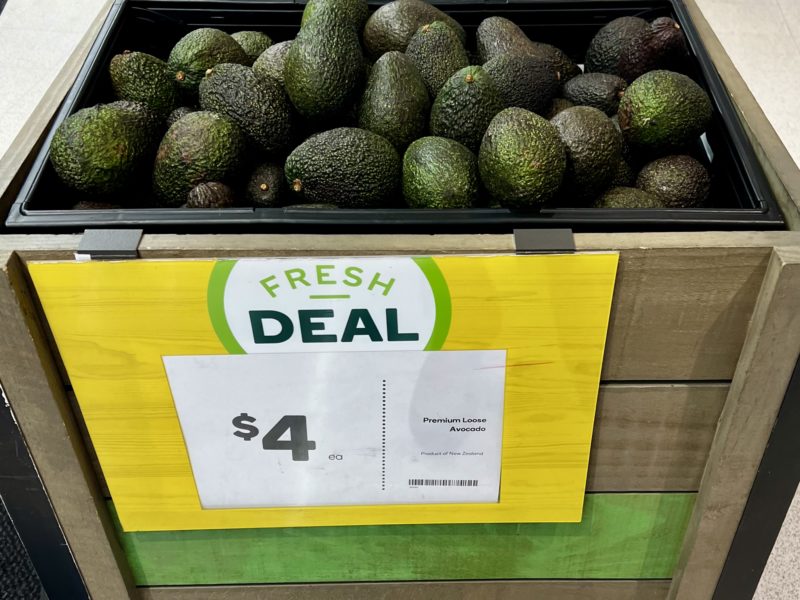
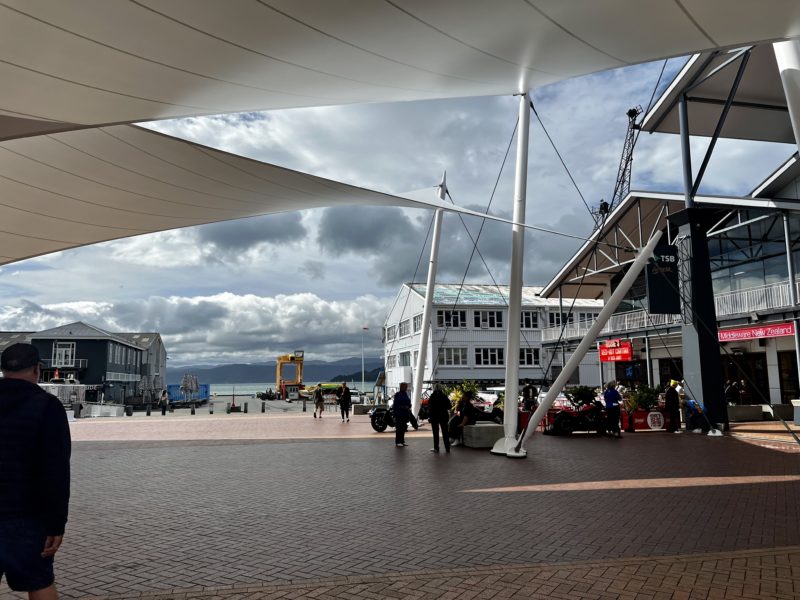
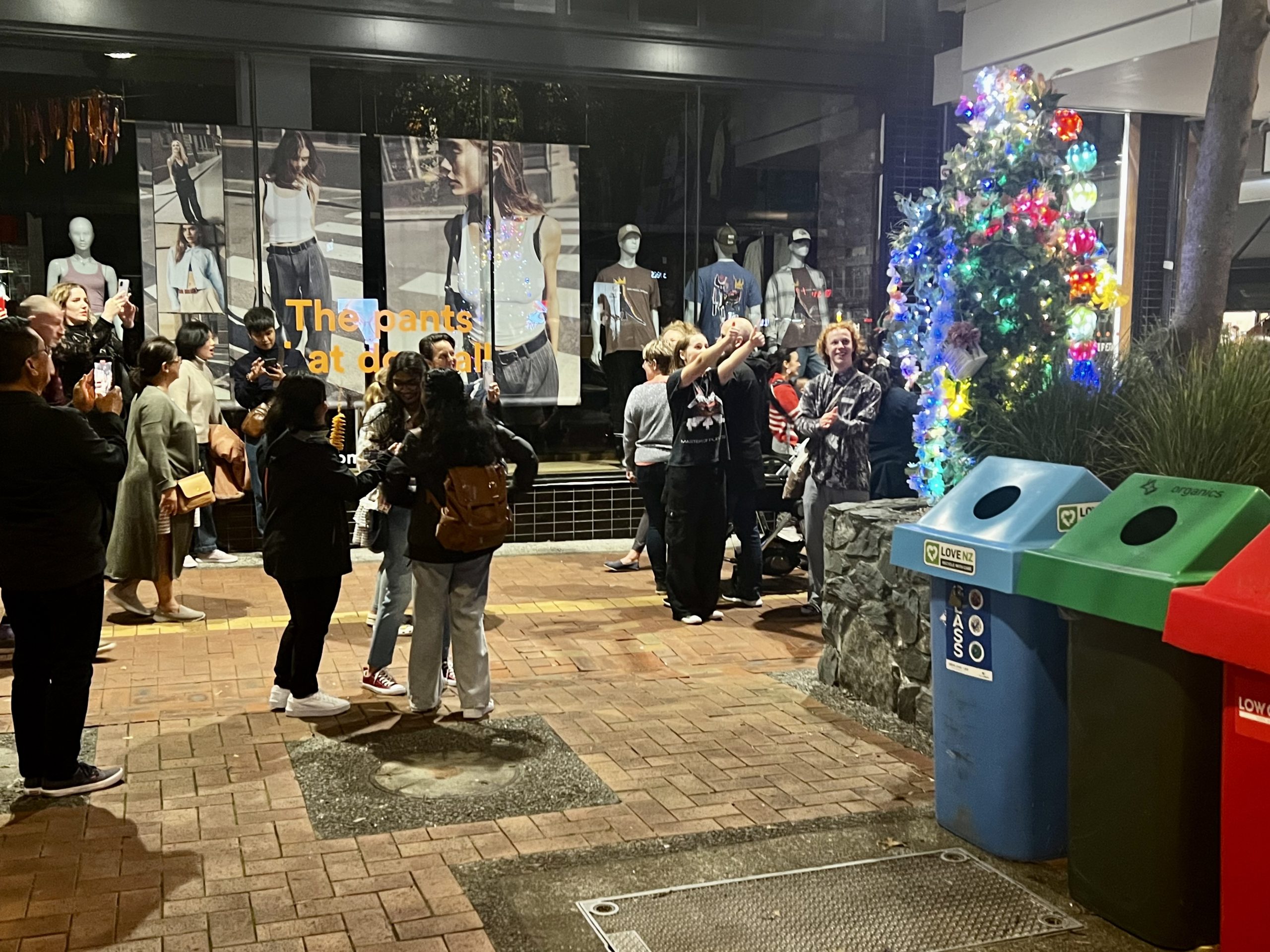
Cuba Street—maybe not a sibling, but at least a cousin to Haight StreetCollage of old and new architectureLambton Quay, the longtime main shopping street, begins on the left.Avocados at $2.50 US eachSection of Wellington waterfront renovated for the publicAnnual Cuba Street Fair
Cable Car
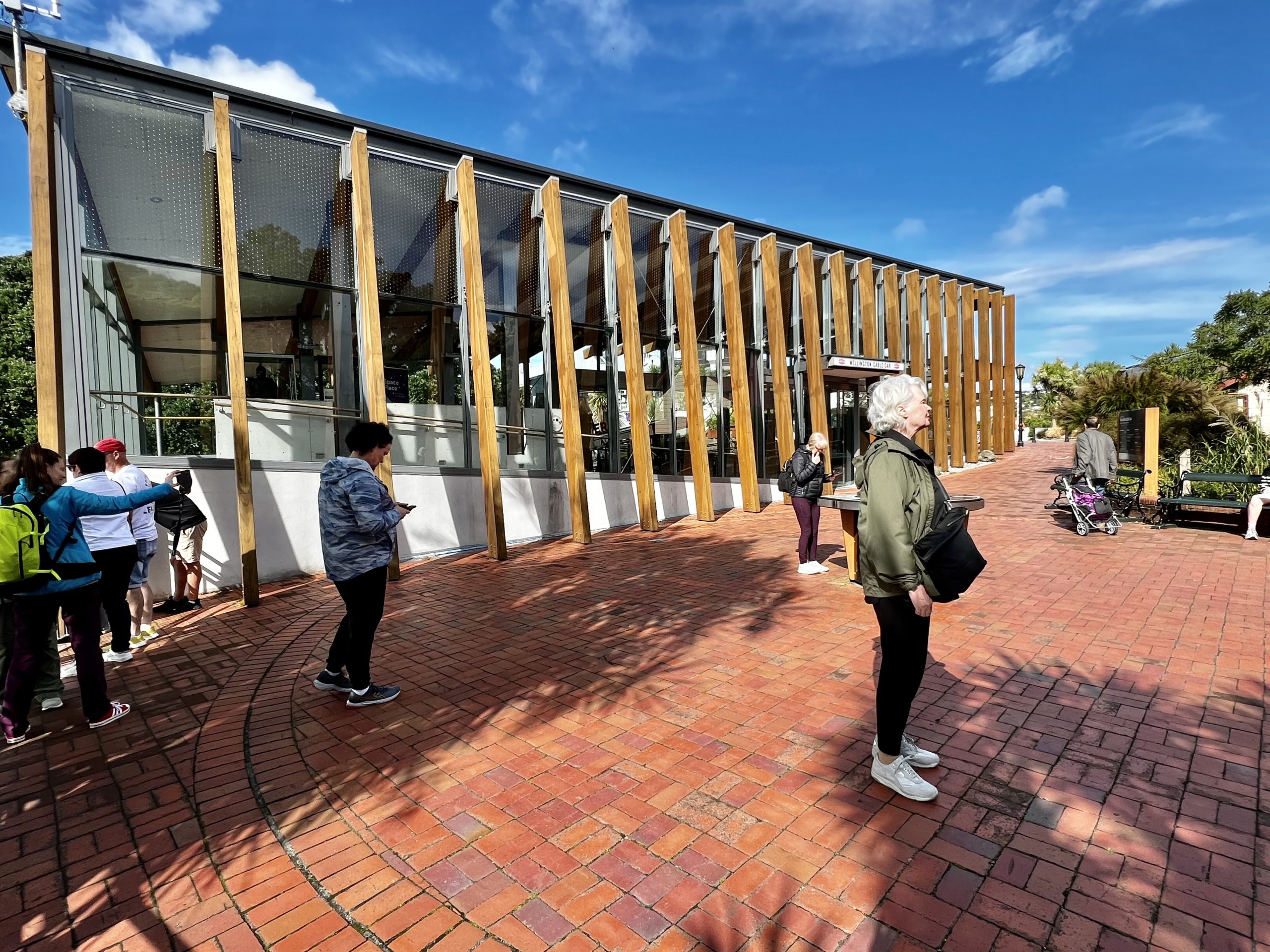
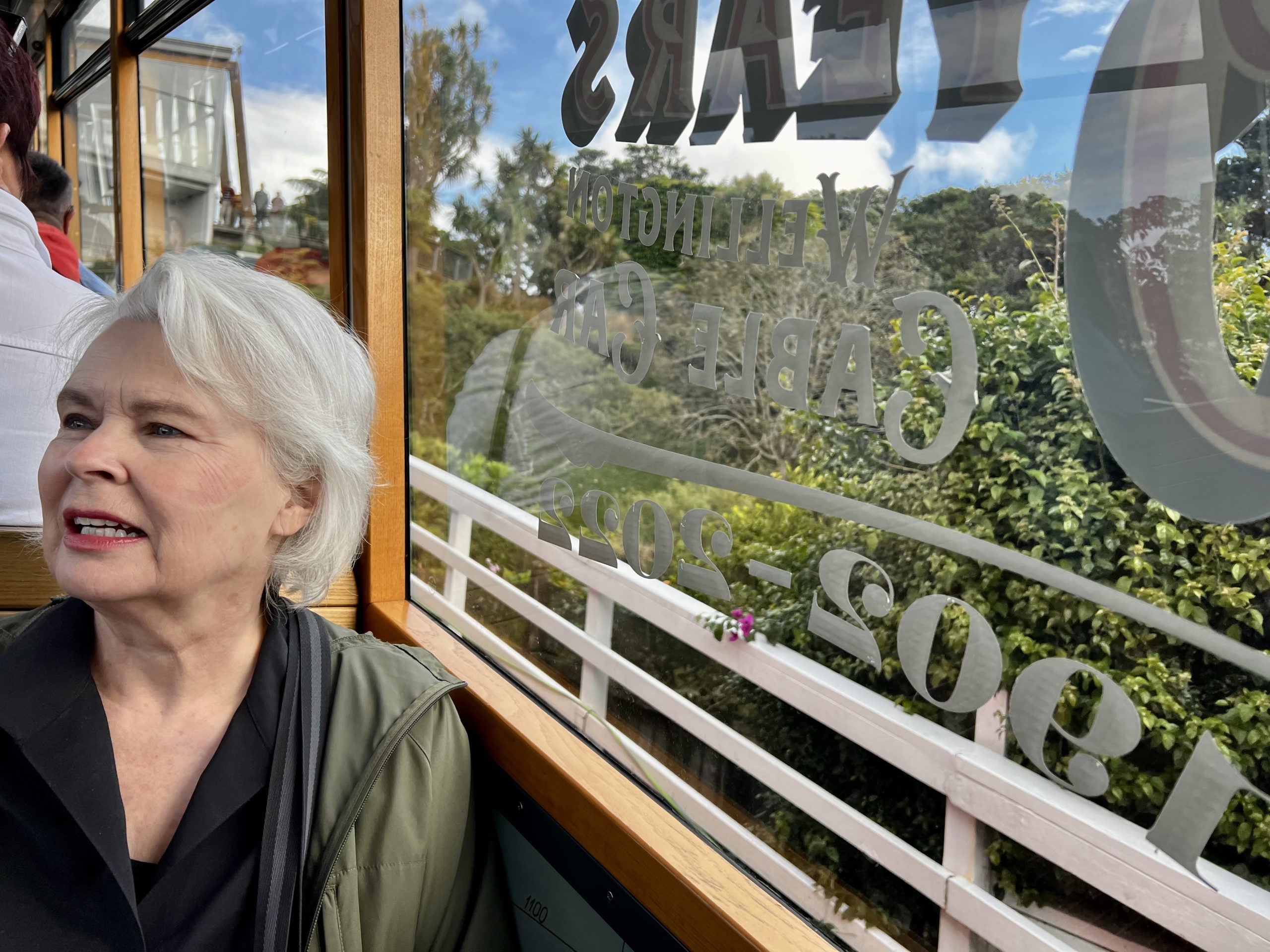
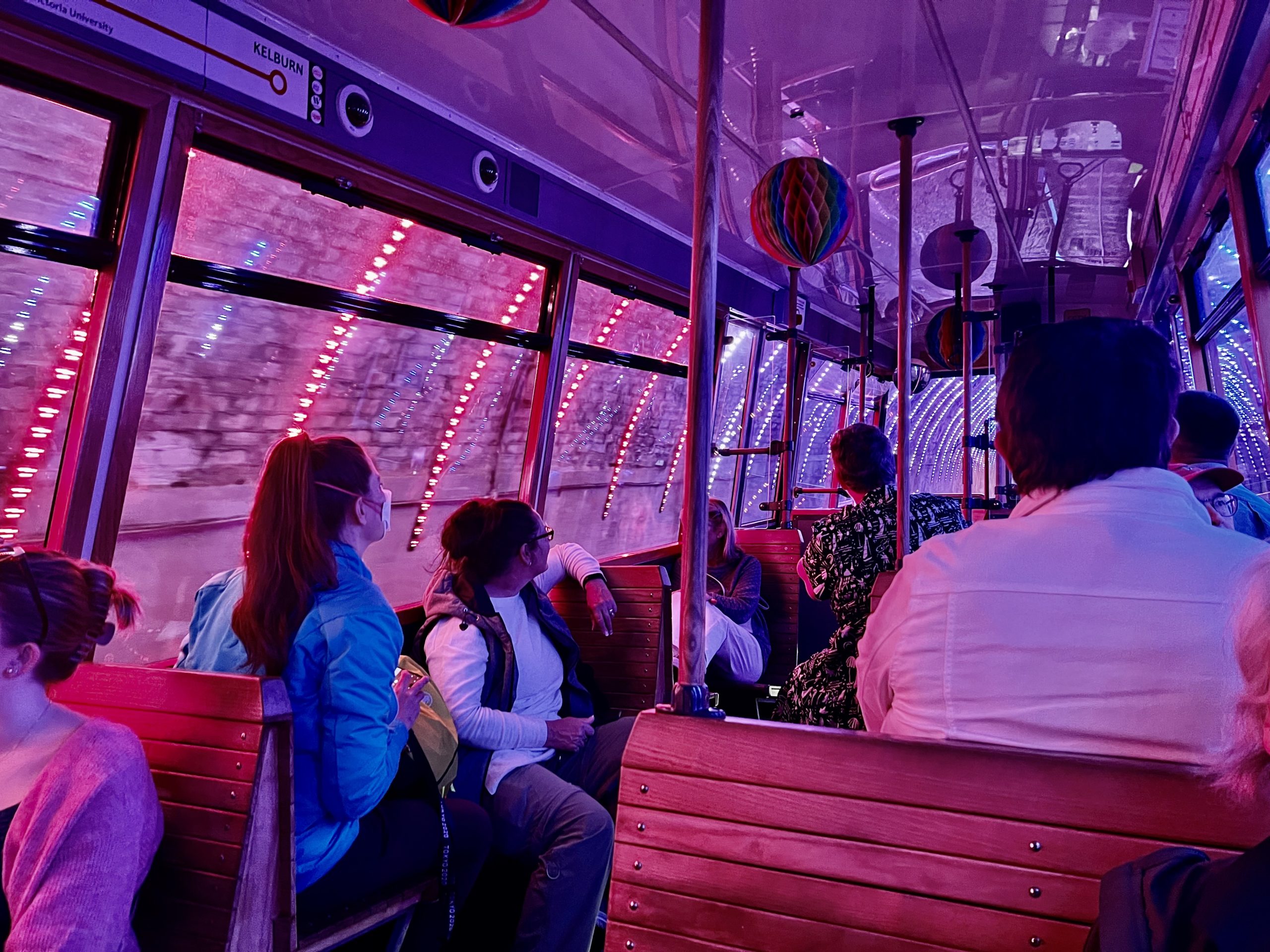
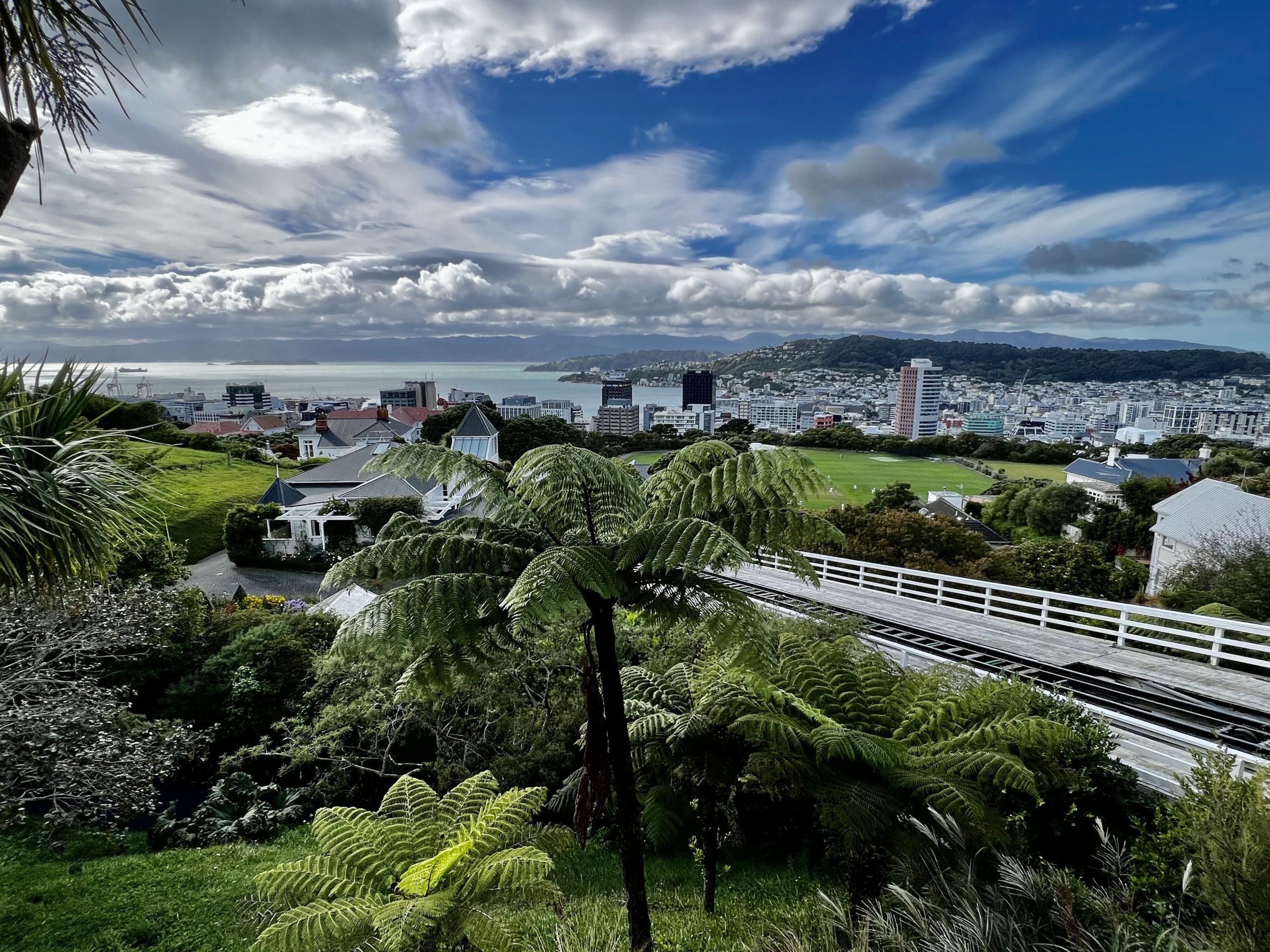
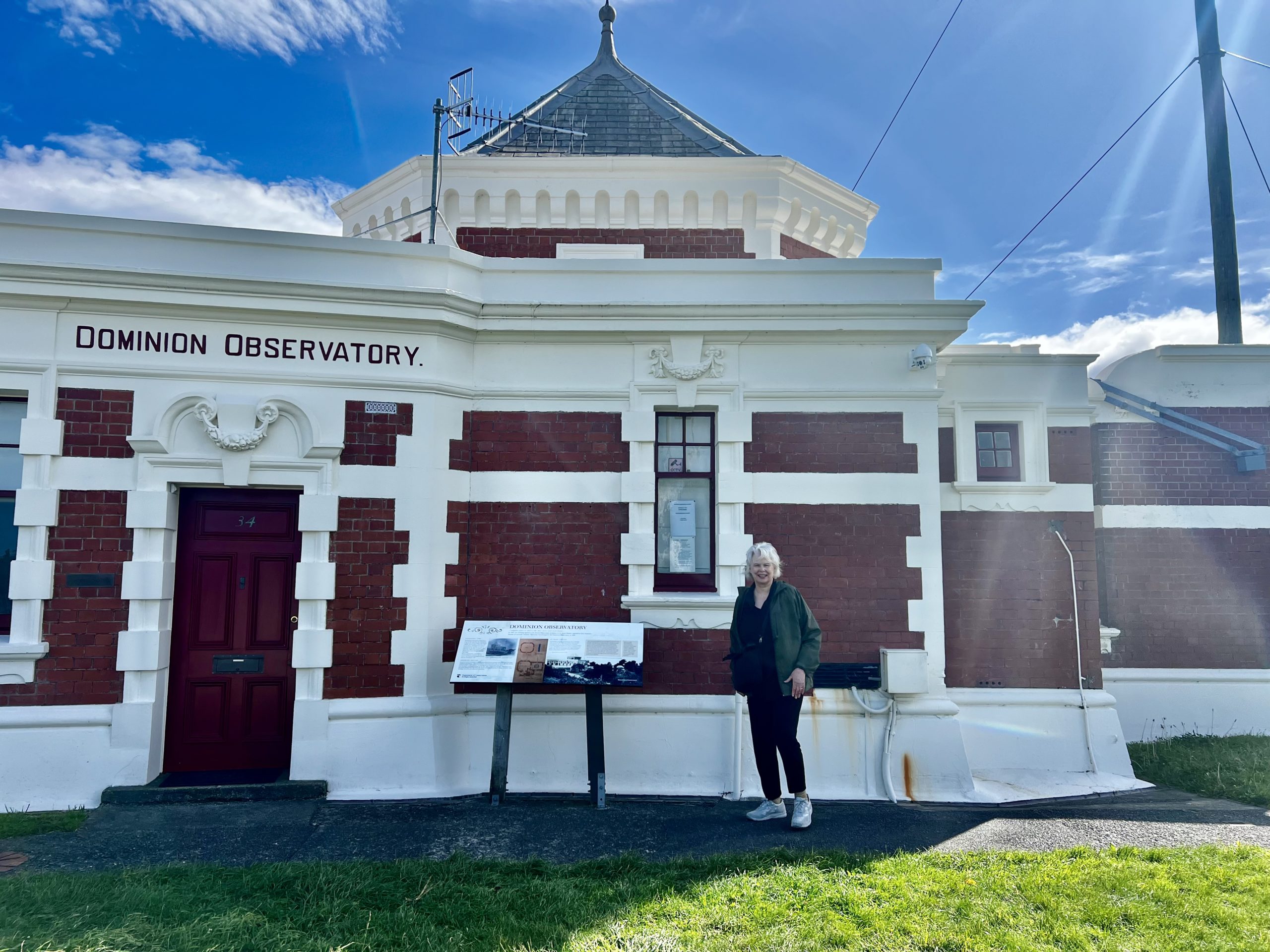
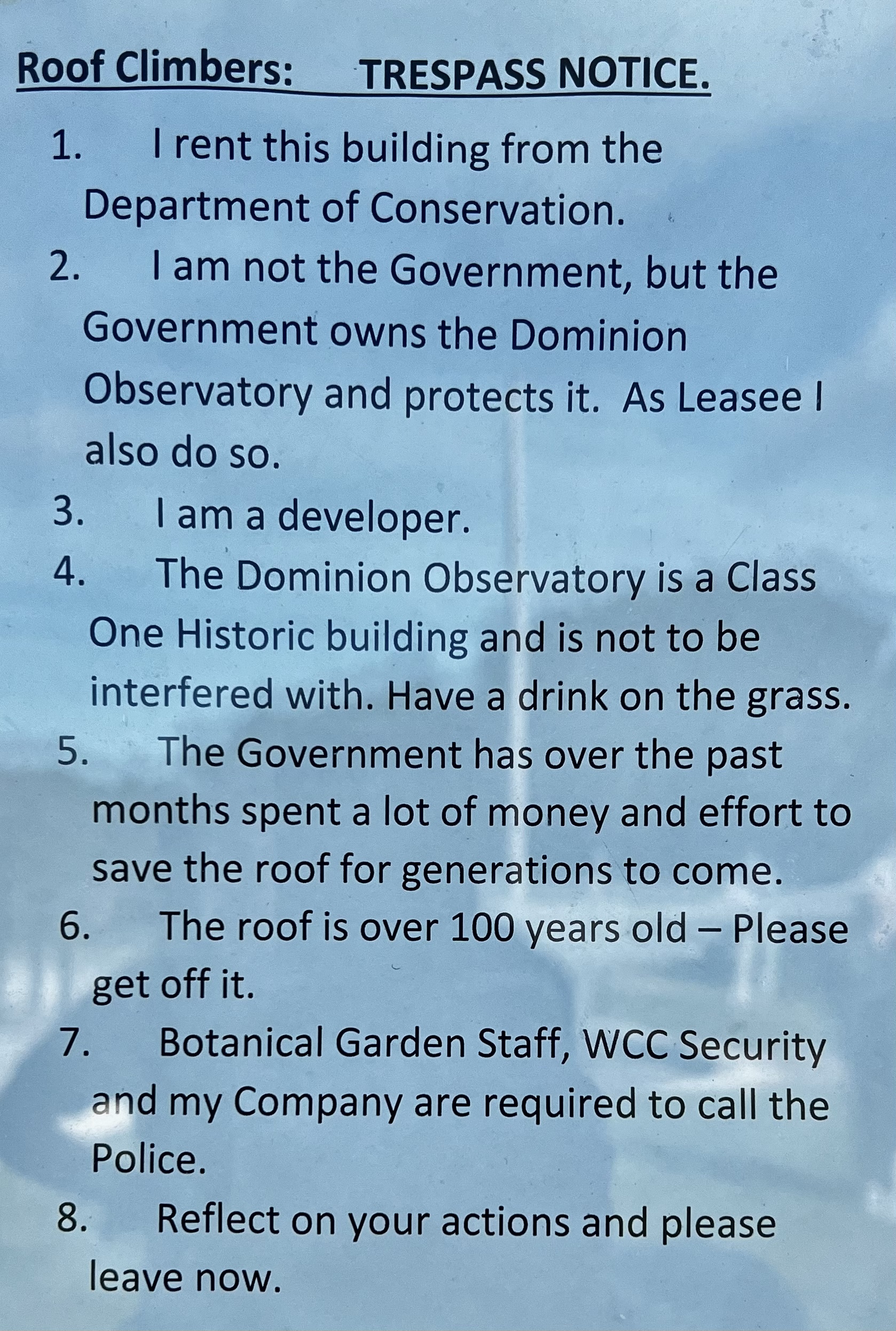
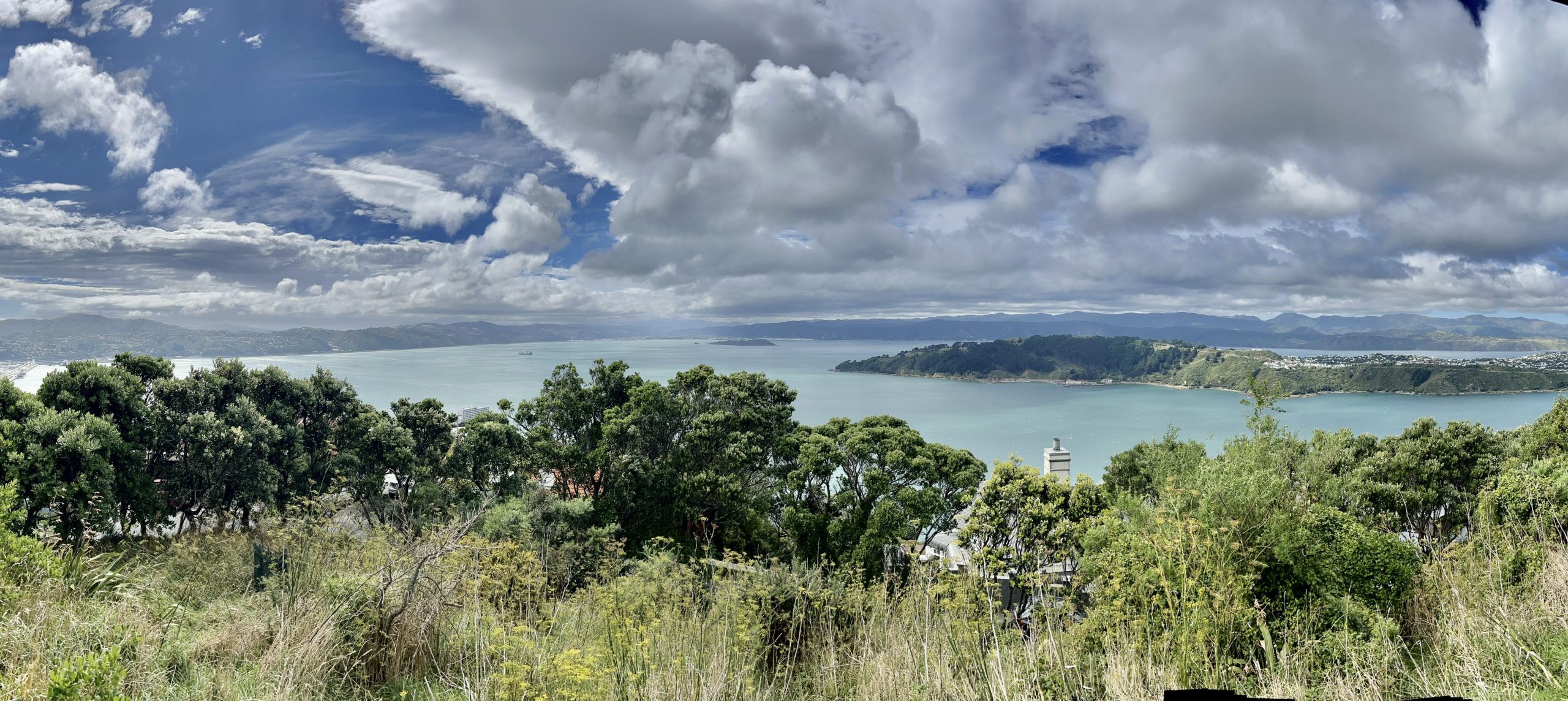
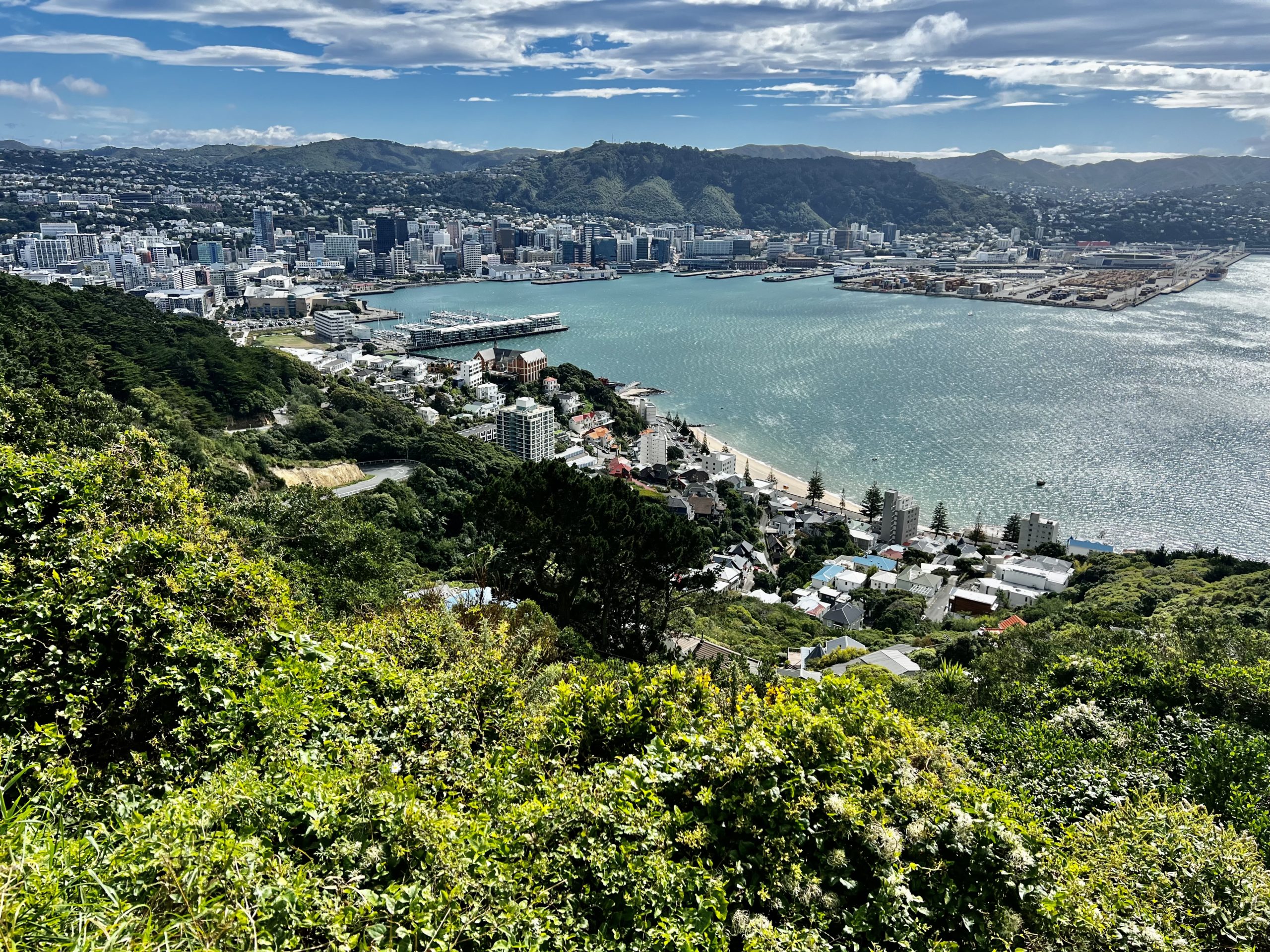
The Wellington cable car, built in 1898, starts in the middle of the long, main retail street, Lambton Quay, climbs a steep incline, stops twice near the university, and finally ends at the top of hill. Here you can get a terrific view of the city, visit the small cable car museum, have coffee at the cafe, see one of the first observatories in the area, stroll through the hilly botanical garden, or take a walking path back down. The cable car was built to promote a new suburb with direct connections to the downtown, but it is now an iconic Wellington landmark.
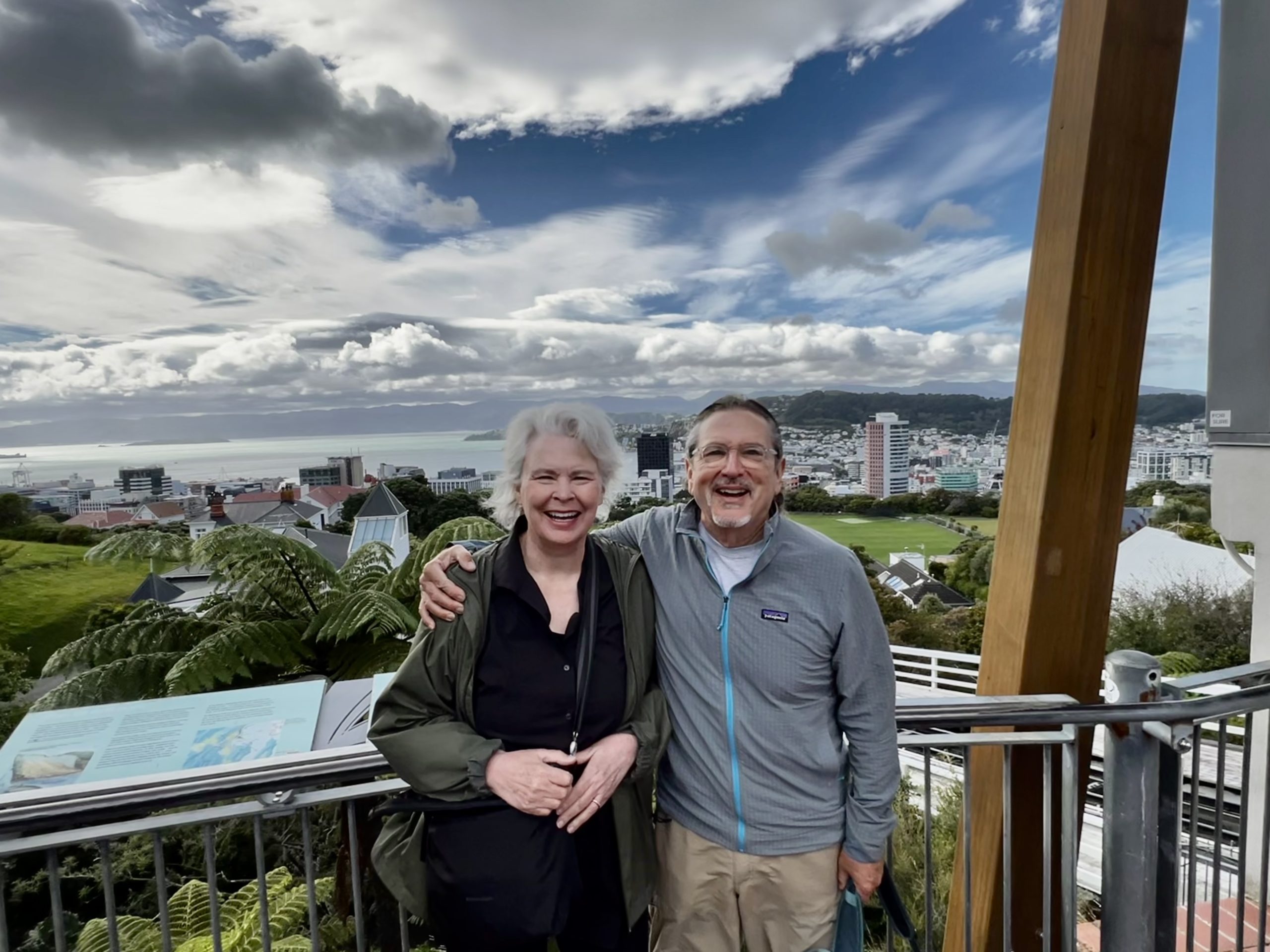
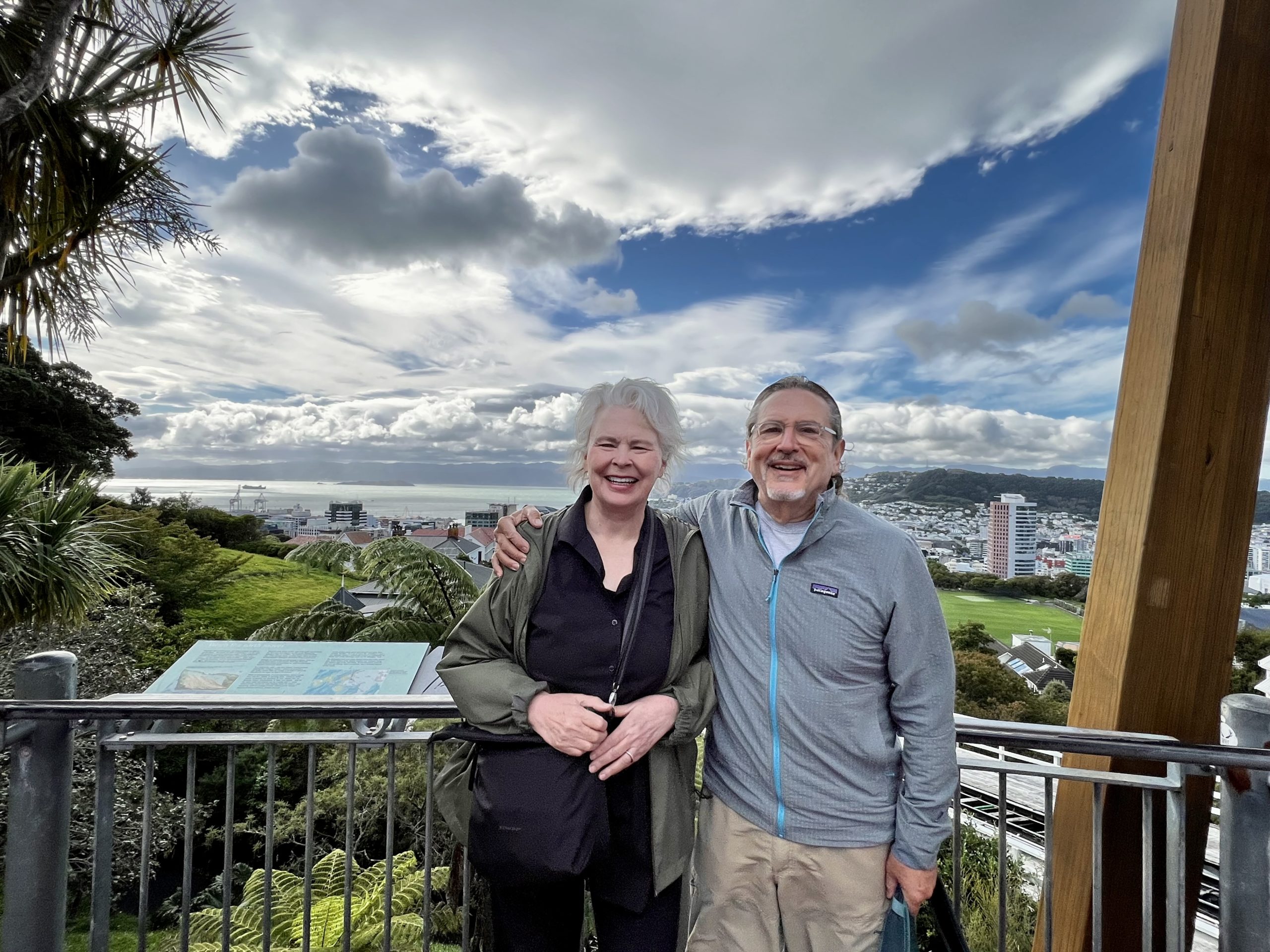
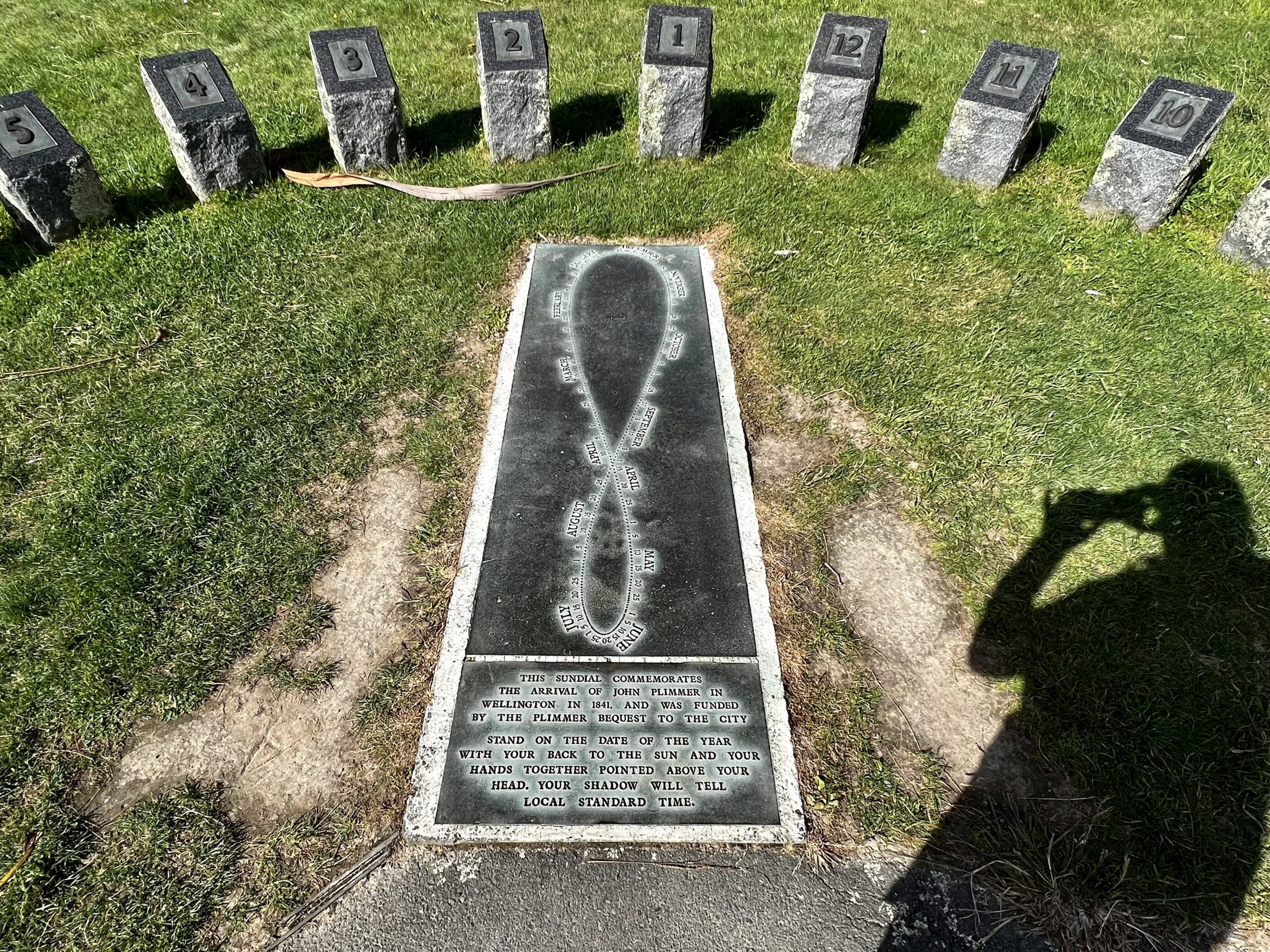
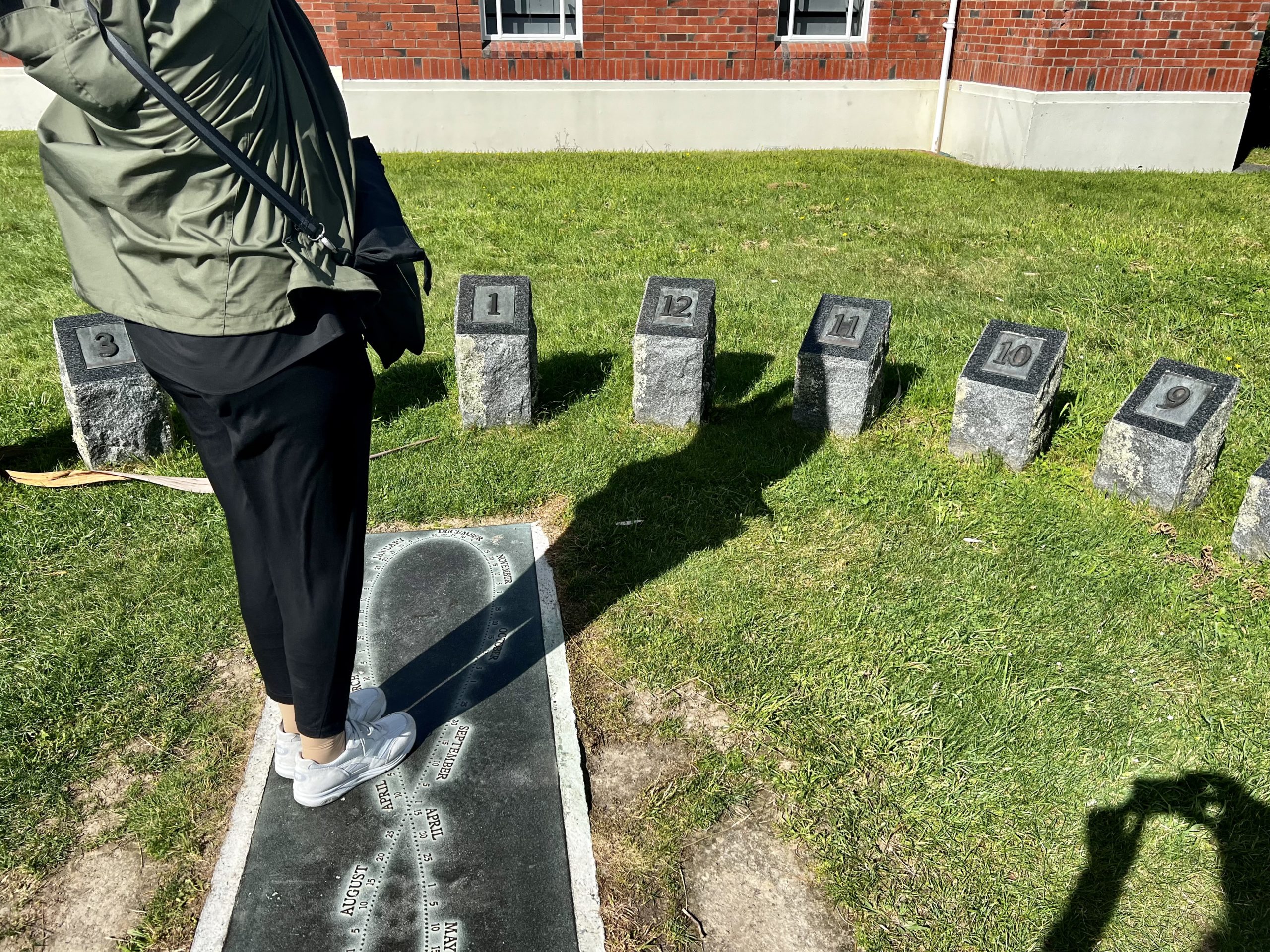
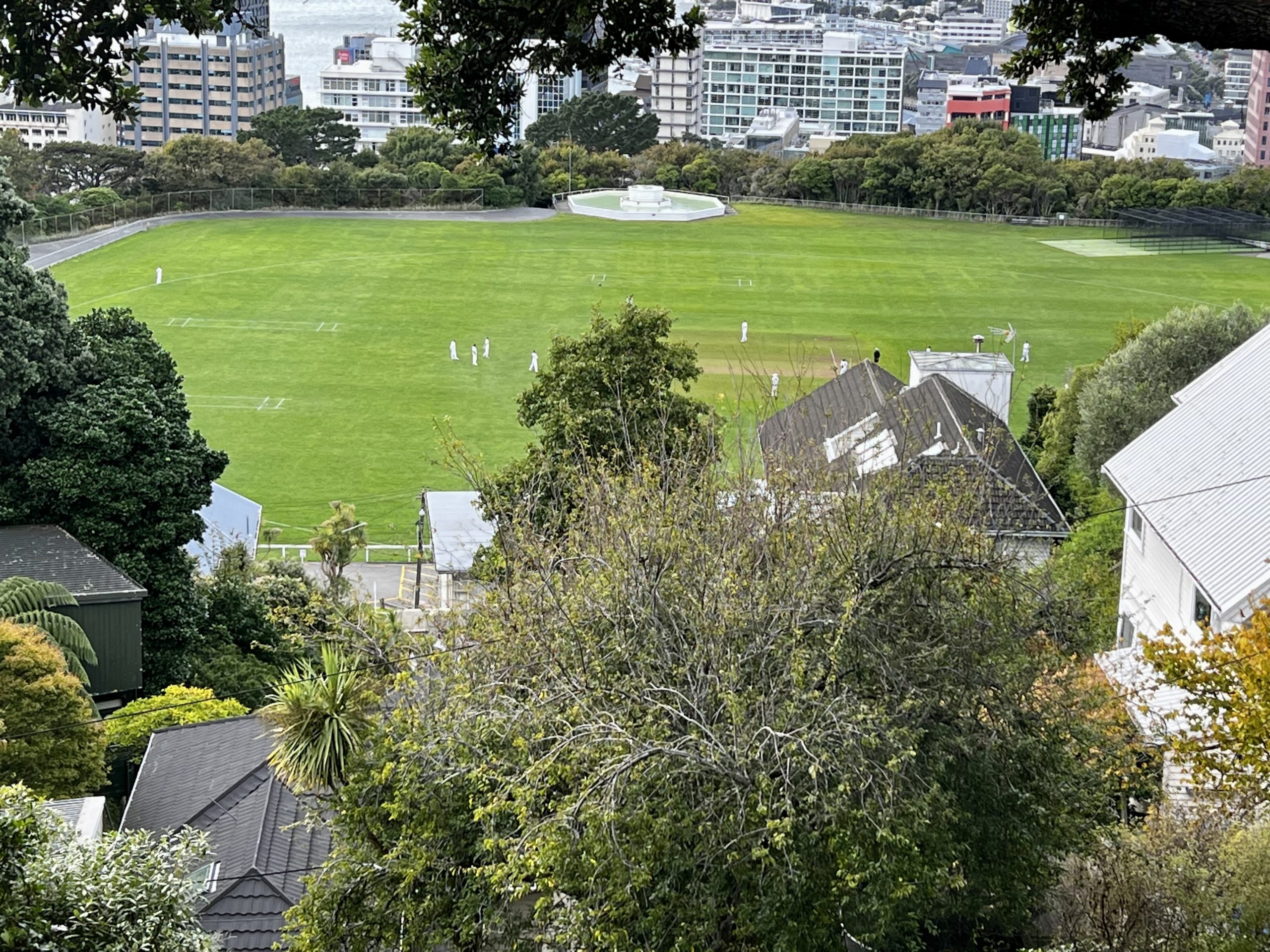
At the top of the cable carView from the top of the cable carHuman sundial accurate within a few minutes!Wellington botanic gardenMarkers for a pathway in the botanic gardenCricket field near the university. So big.
Weta Workshop and Mount Victoria
We assume you have heard of Lord of the Rings and The Hobbit. Ha! So have the Kiwis. They refer to it all the time. Although filming began more than two decades ago, most Kiwis are still eager to point out filming locations throughout the country, let you know if they were extras, made costumes, supervised helicopters, or have close friends who did. Everyone seems to have some connection to the films.
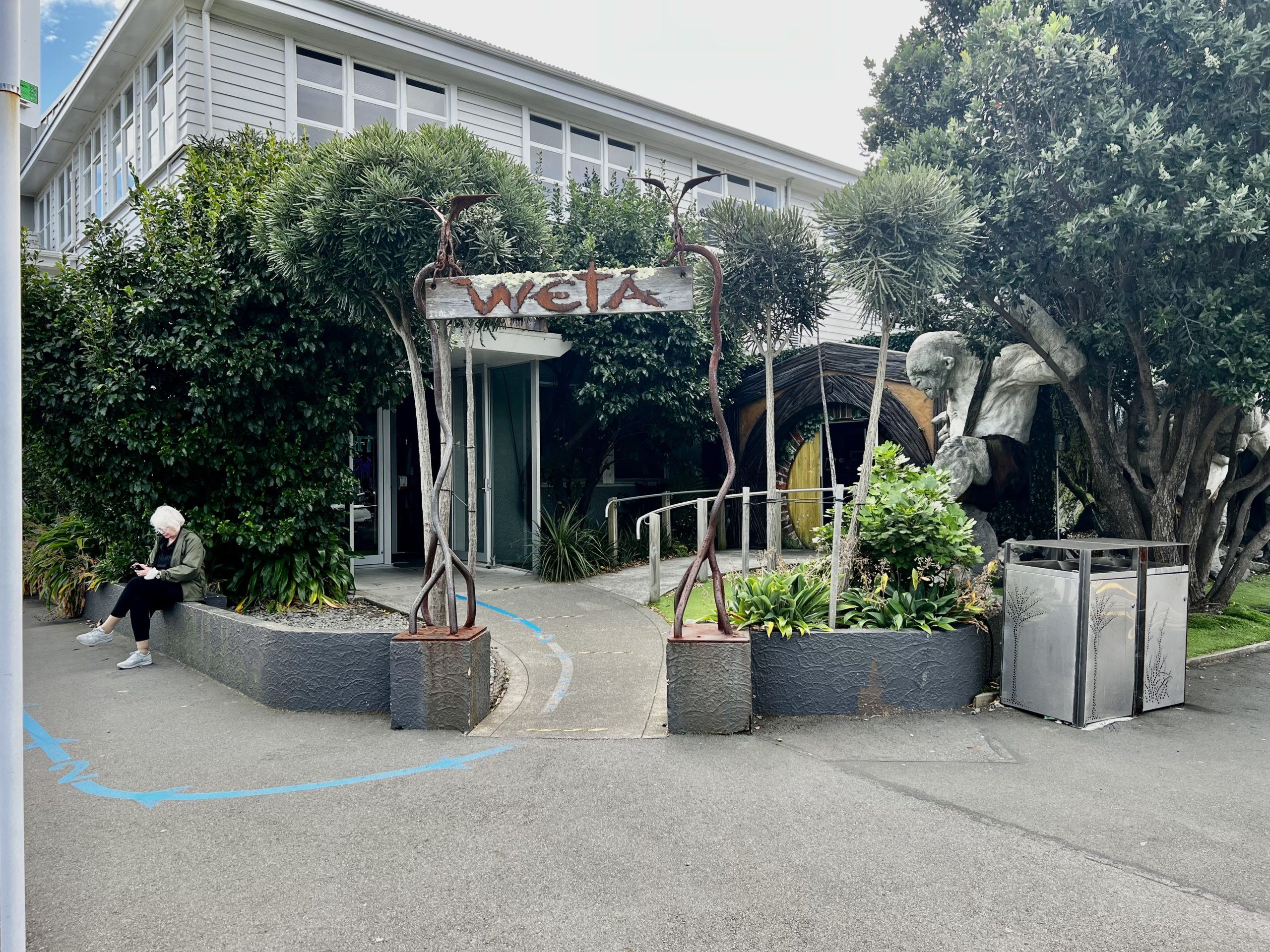
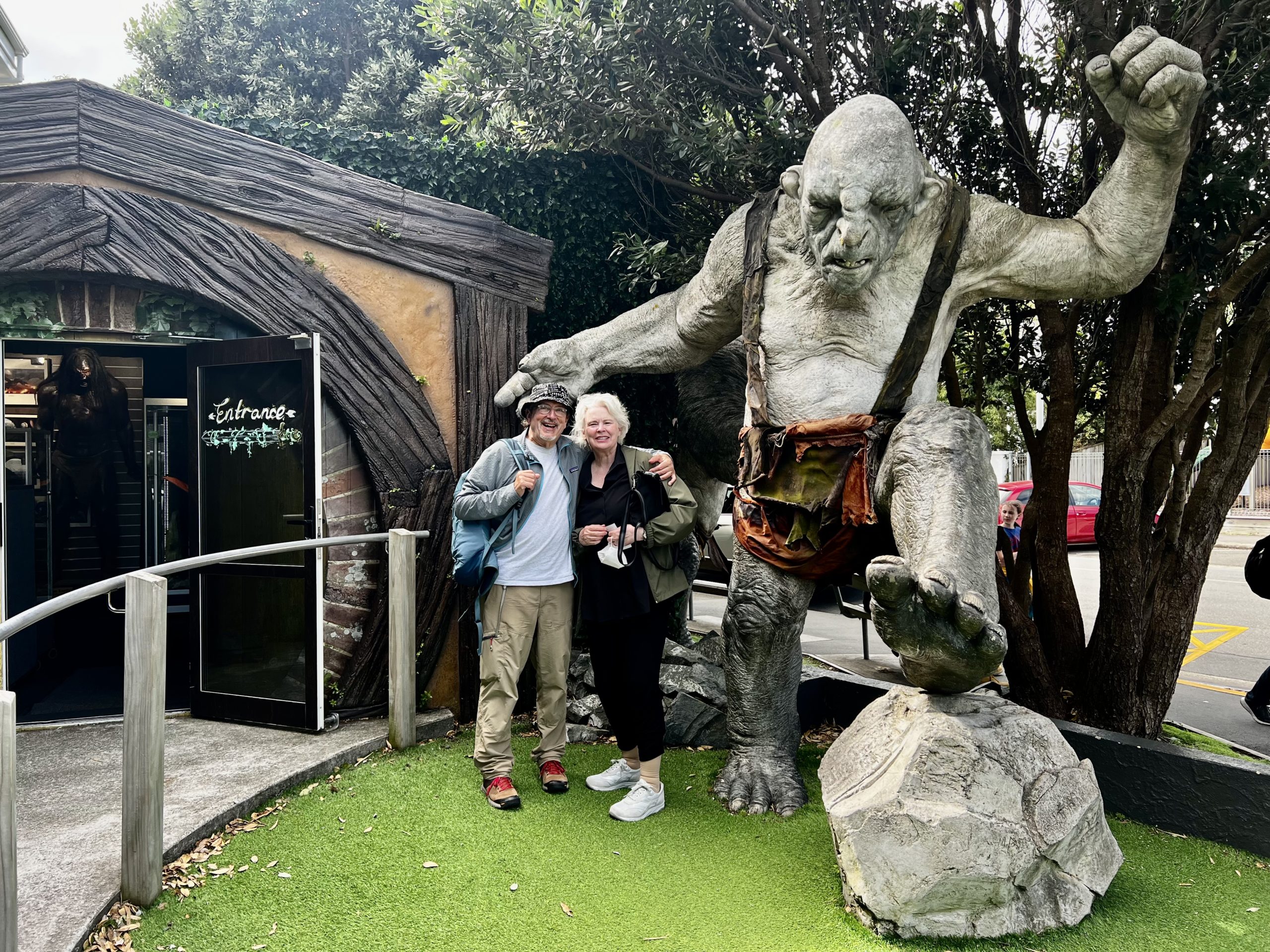
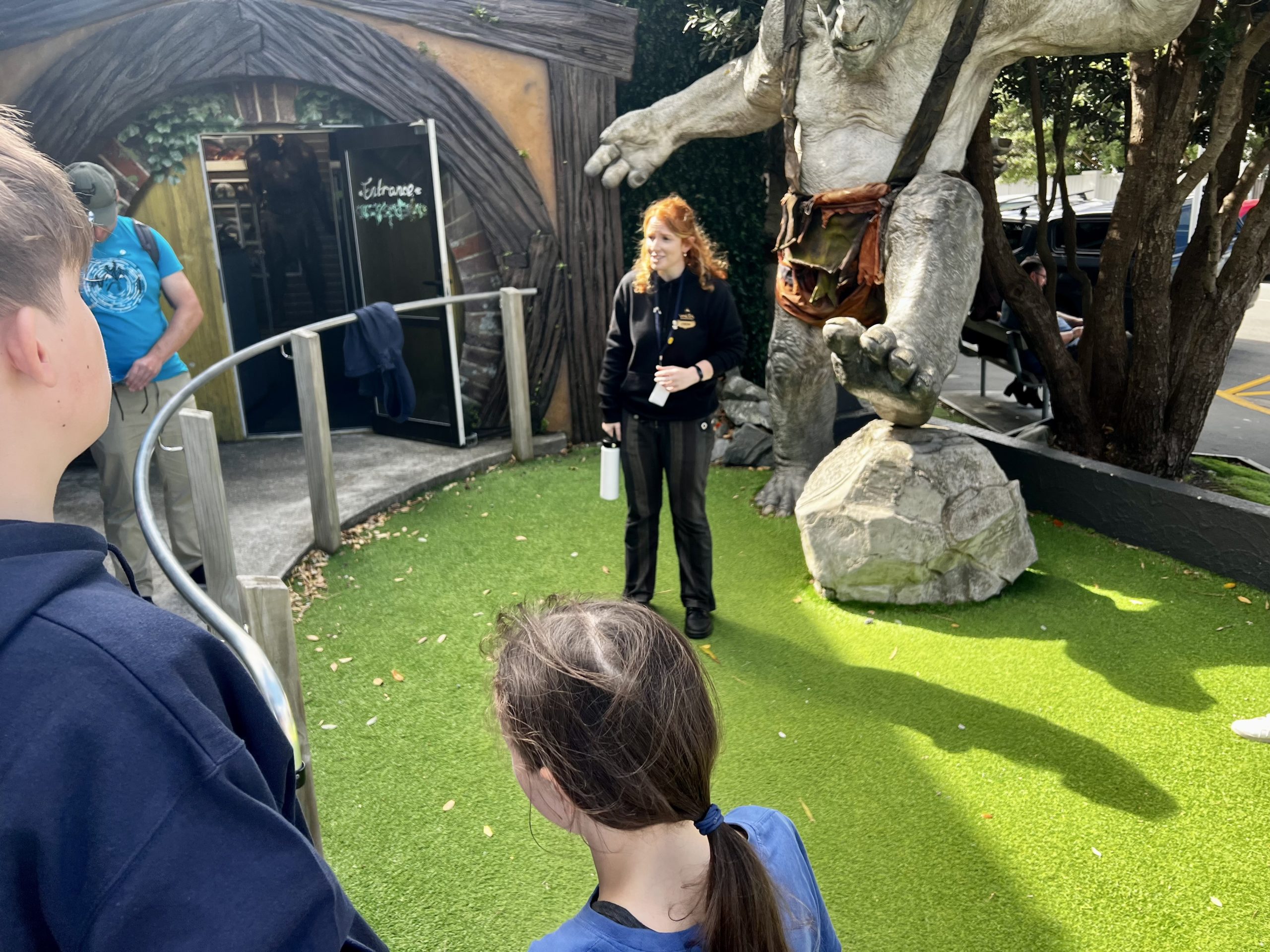
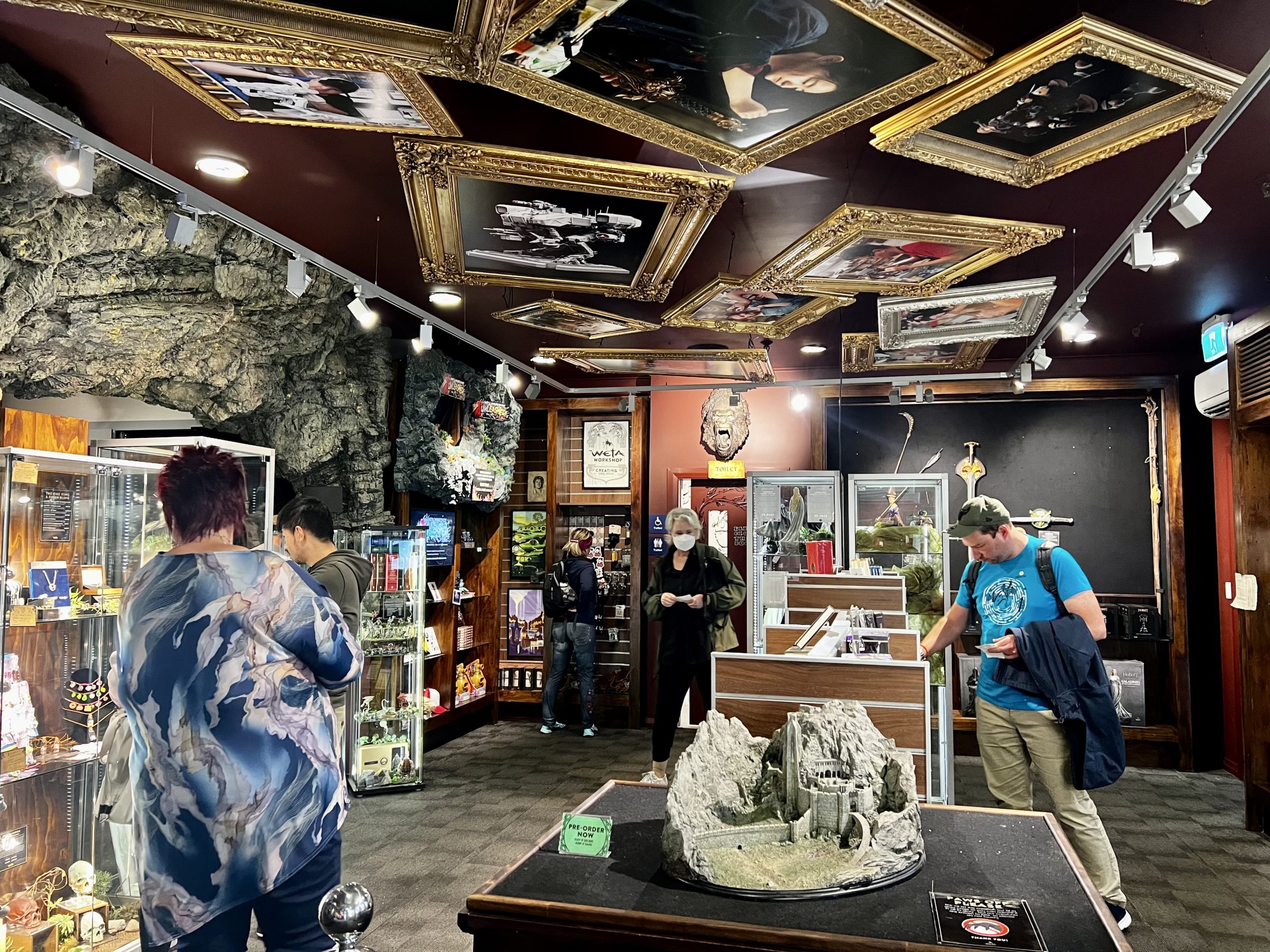
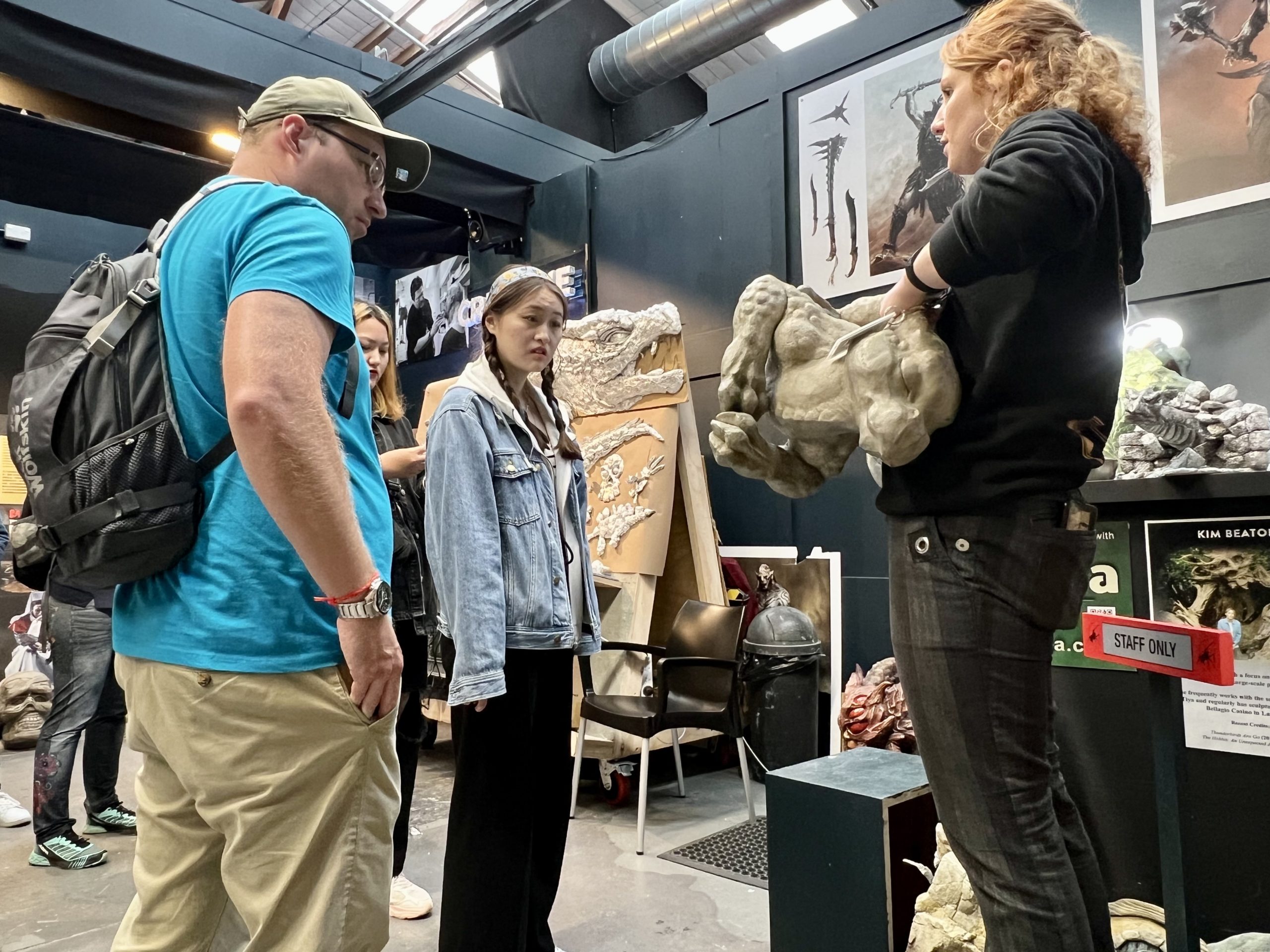
Because Lord of the Rings is so central to Kiwi culture, we made reservations to tour Weta Workshop where they make costumes, creatures, props, and backgrounds for many films and commercials. They are like Industrial Light and Magic for George Lucas and Star Wars in the Bay Area. The workshop is located in a nondescript warehouse in a residential neighborhood that also has three large sound stages built by the director Peter Jackson and also used by James Cameron for Avatar. The creative couple who started Weta in the 1980s worked with Peter Jackson on a few projects before Lord of the Rings and The Hobbit. One early project, they state proudly, used the most fake blood ever in one scene of a horror movie. They describe the other early project, Meet the Feebles, as the Muppets on crack. Good Kiwi humor.
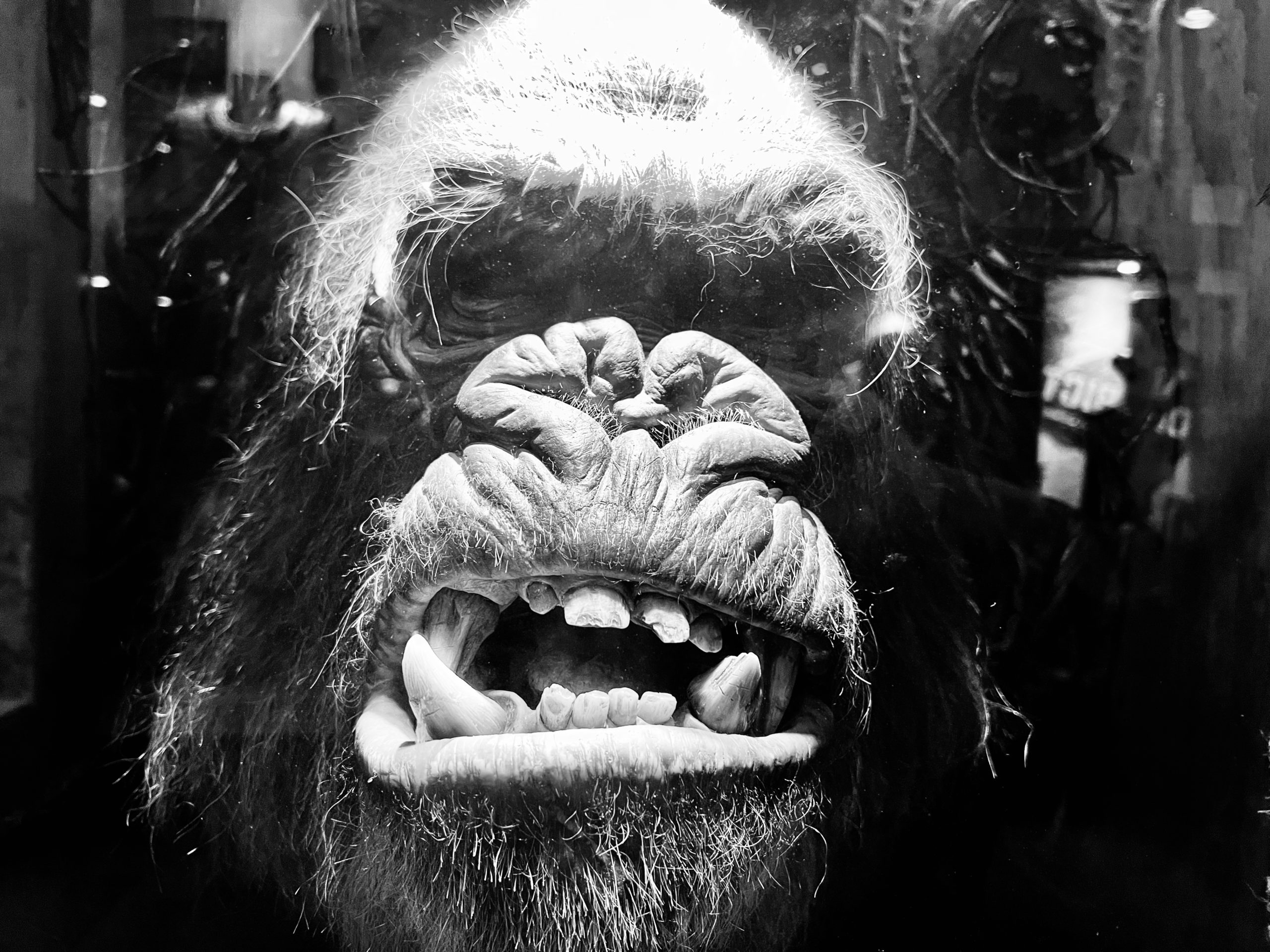
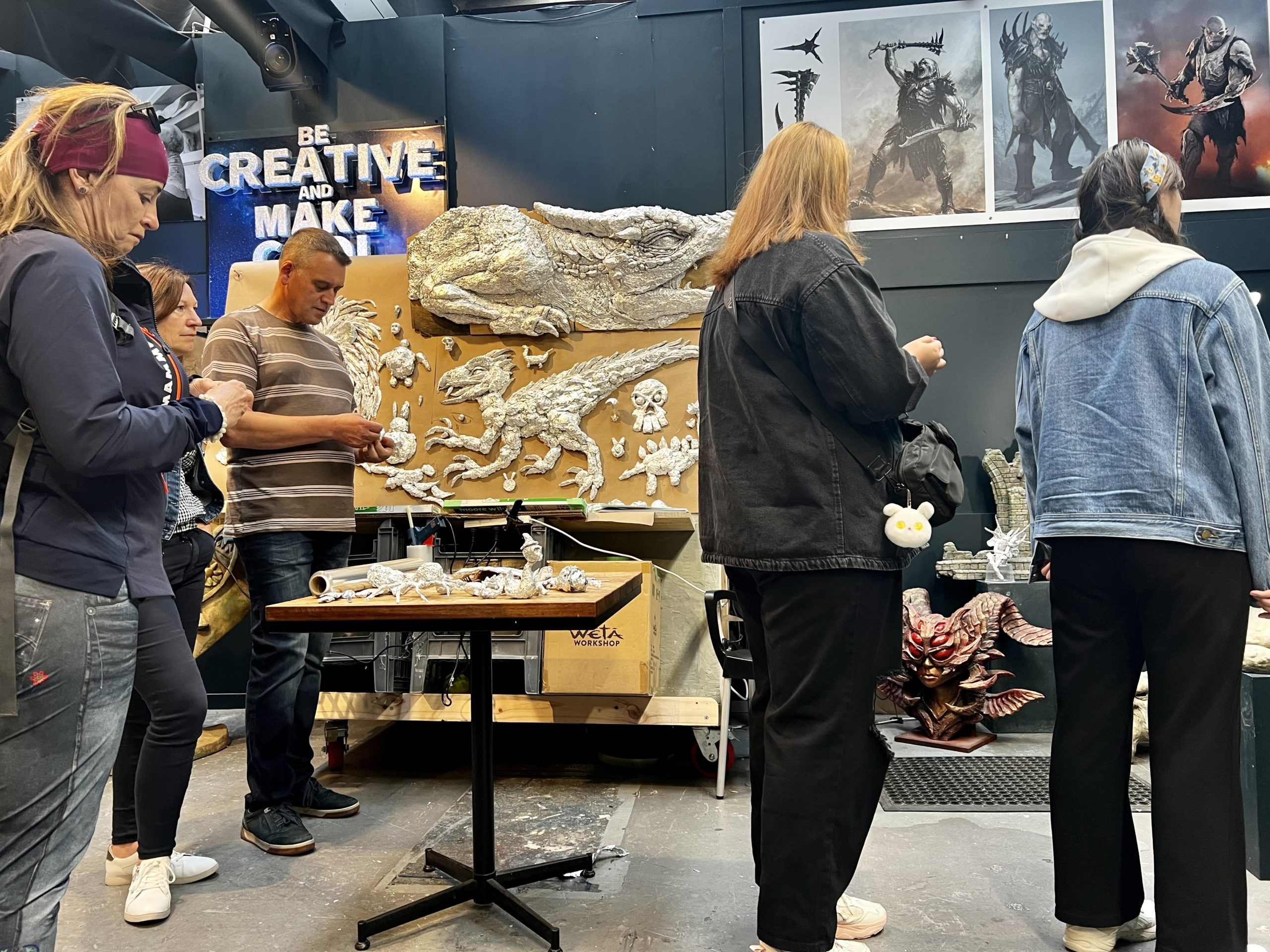
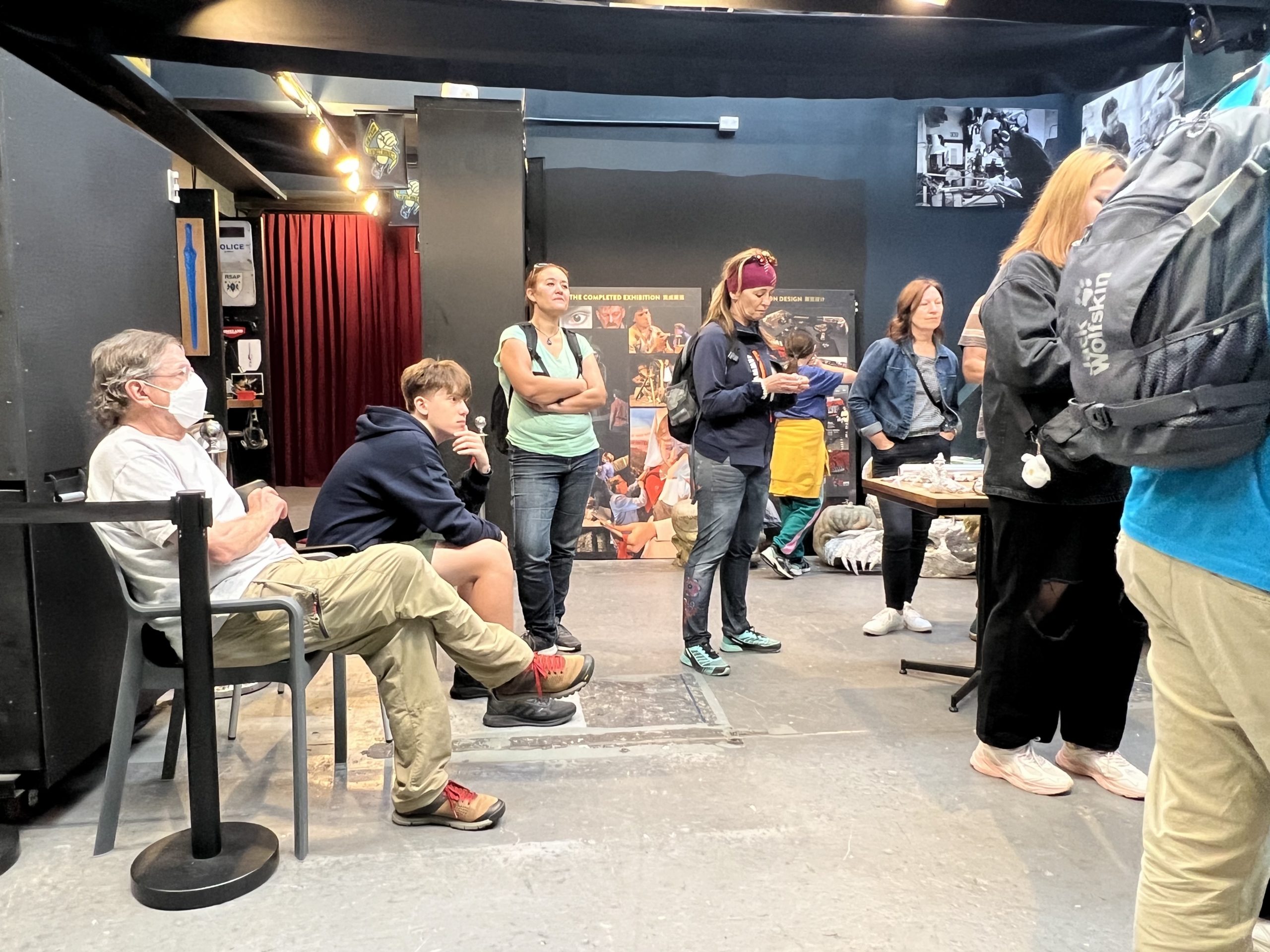
The tour was down home and not highly polished. A good thing. The enthusiastic tour guide took us through several rooms filled with examples of their work, like puppets, creatures, swords, and sci-fi robots, and we peeped through big windows to see workbenches and equipment. Some of the workshop equipment looked familiar to Bonnie from the Exploratorium shop. No photography was allowed until the last room because the prior rooms had materials for movies currently filming. At one remarkable stop, the guide showed us chainmail armor for Lord of the Rings made by slicing black pvc pipe to make tiny circles, cutting a slit in each, joining them to three others, and gluing them whole again! Two people did this for two years to make enough chainmail for all the actors, and they ended up with no fingerprints. Since then, the studio has figured out less hand-intensive means to make chainmail. The workshop also specializes in making swords, both real ones made by a masters swordsmith and realistic looking props for action scenes. Bonnie was a bit disconcerted by how much workshop production is devoted to weapons and armor. Robert was not. All in all, the work they do is very creative and very labor intensive. In two rooms people were demonstrating their skills—sculpting and sewing small creatures. Both have their own businesses for private commissions in addition to working at Weta, something the studio encourages. You do not see this at Disney. The tour is worth a visit.
Weta is the name of giant flightless crickets found in New Zealand. Among the heaviest insects in the world. Or spelled without the macron accent marks as we have done here, weta means excrement in the Maori language. More humor?
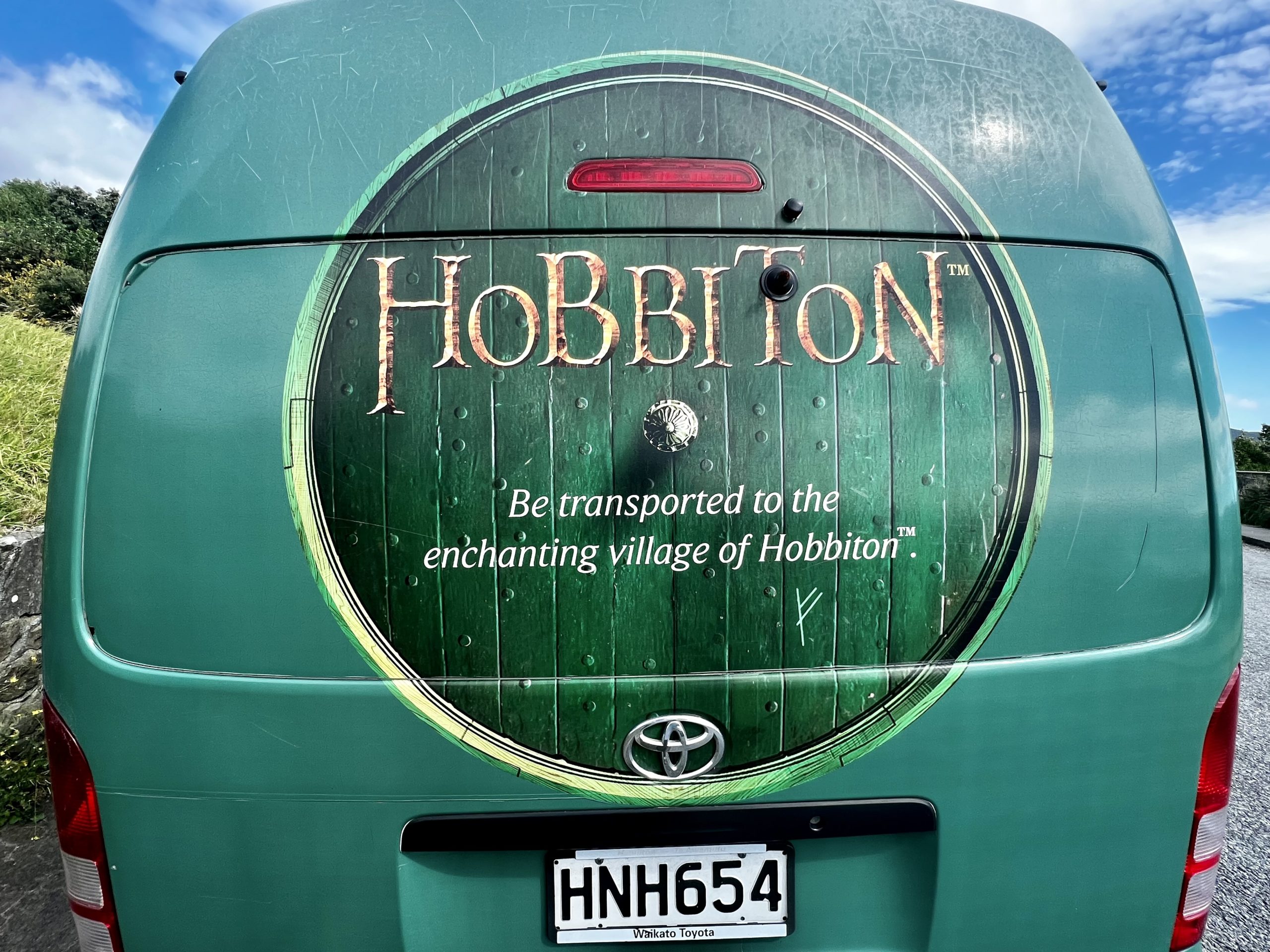
The van driver who took us to Weta made a detour up Mount VIctoria for terrific views of Wellington.Entrance to Weta storeThe tour begins.The Cave, the WETA store, has many collectibles for sale.Watching a Weta sculptor
Observations
Sports teams are everywhere in NZ and many people, of all ages, belong to one. Several teams were staying in our Wellington hotel for the weekend, but I was most curious about the mature women in groups of five or six all dressed in colorful matching shirts, a bit like bowling outfits. I was guessing they played lawn bowls. But no. I asked one woman outside for a smoke who said they did Leisure Marching. When I looked puzzled she said, “You know. When some of the girls get too old for regular Marching, they do Leisure Marching.” I was still puzzled, so I tried YouTube. Indeed, this was the weekend of the national championships, where small teams march in complex formations to music, like our college marching bands. Amazing.
Possums are invasive creatures in the New Zealand landscape, but their soft fur is valued for fabric. A mix of merino wool, possum, and a touch of nylon is terrific for scarves, sweaters, and hats. Warm and cosy. A mix that includes silk is incredibly soft although pricey. Our friend Diana says the silk mix is in demand by designers in Paris and Milan.
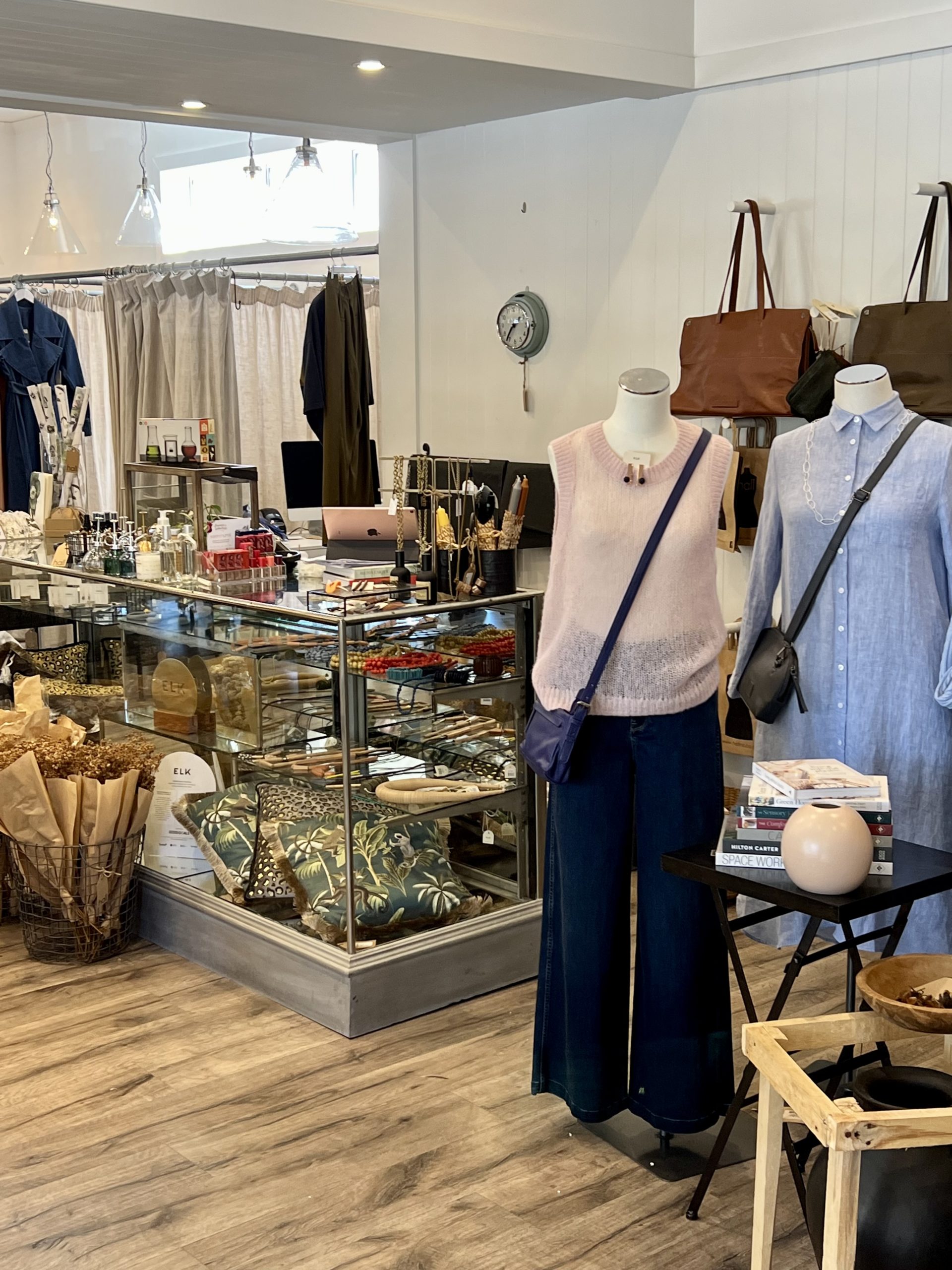
On our last trip we weren’t tempted to shop except for a few Icebreaker clothing items. For us Americans, products weren’t exciting and store displays were dull. New Zealand has wonderful materials, craftsmanship, and heritage imagery, but we thought they needed creative product designers and graphic designers to make things like wool sweaters and greenstone jewelry more tempting. We seldom saw an unusual color or design. Overall, graphic design has improved noticeably. The best clothing design is now at the outdoor clothing stores. But we still haven’t been tempted to buy sweaters.
New Zealand is a safe place. In many towns the locals sheepishly admit that they don’t lock their cars or houses.
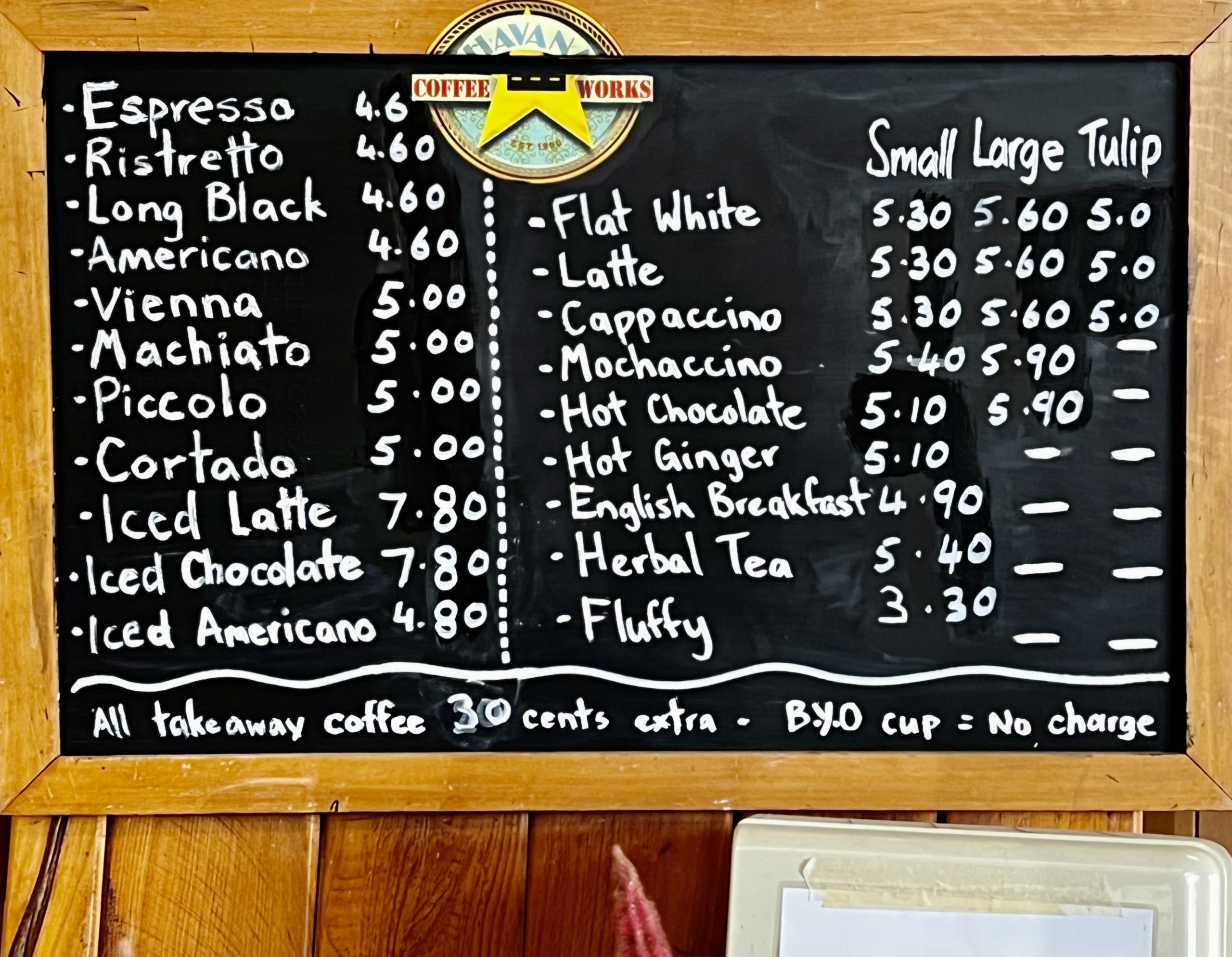
Robert can tell you about “flat white” coffee. His regular morning drink here.
Tattoos. Yes. On occasion you see a woman with a traditional Māori tattoo on her lower lip and chin. If you can read the symbolism, you can identify her iwi (tribe), status, and history. But as in California, most tattoos, and there are lots, diverge a long way from Māori traditions.
Food, Wine, and Beer
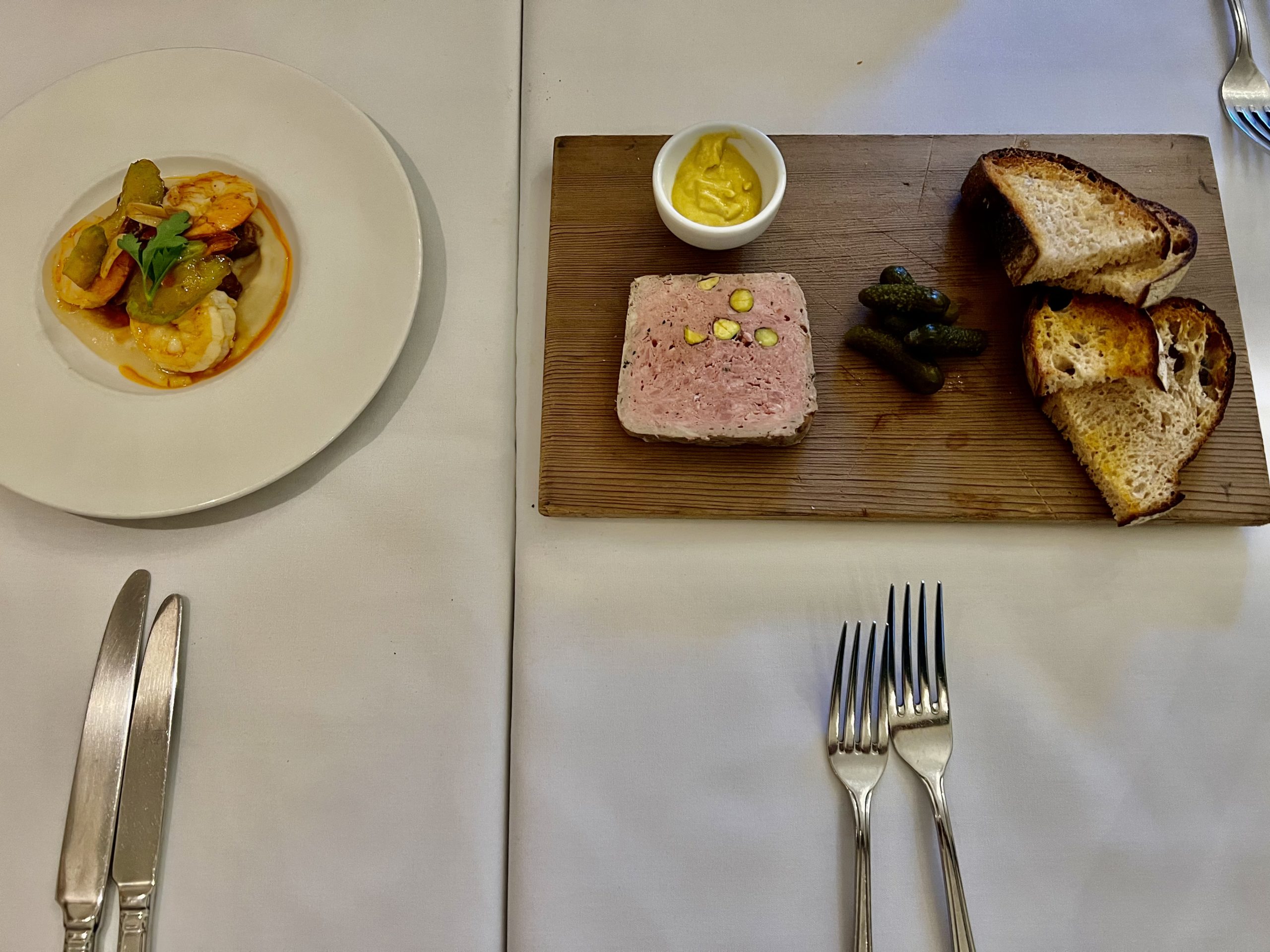
Dinner with David Coplon, partner of Robert’s cousin Adele. More Sabbatini cousin connections even in New Zealand.We had an elegant dinner with David at Adele’s favorite restaurant in Wellington. Great conversation and insights from David who has lived in New Zealand since the 1970s.Bonnie’s mocktail
A few more observations about fishing guides in New Zealand. The guides tend to repeat themselves, often in whole sentences once or twice. They have also been known to spell out words. All of this is in response to Robert saying: Say again please. Or, How do you spell that? We obviously need more time to hone in on the Kiwi accent!
Some guides (not Charles) assume you know much more than you do. One guide would point to a spot in the water and then admonish you for going directly to it without going quite a bit downstream first to stay out of the line of sight of the fish. Trout have a 280 degree cone of vision. Once you have gone far enough to be beyond their vision, you slowly make your way forward to a distance where you can comfortably cast to the trout. Noise or ripples in the water can alert the fish of your presence. If you are using a wading staff, use one with a rubber tip. Some guides (not Charles) remind Robert of the nuns who taught at St. Matthew grammar school. All of the nuns shared common goals for teaching, but their methods varied wildly. Some would gently guide you in spelling. Others would go to great lengths to show their disappointment and sometimes anger at how you behaved in class. Some combined the two. Very confusing to a kid of ten. Very confusing to a guy of seventy-three.
Lake Brunner
14 – 16 March 2023
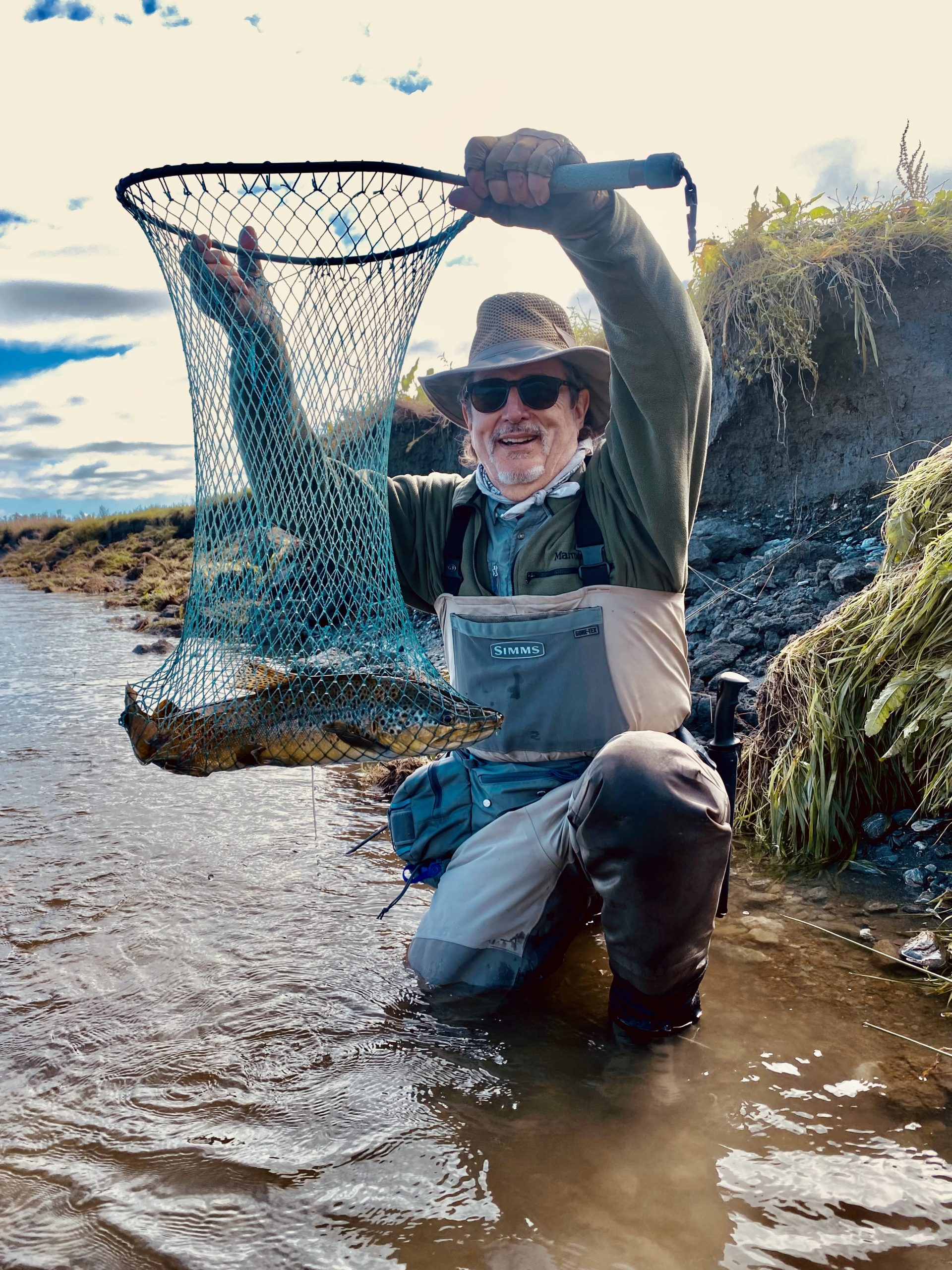
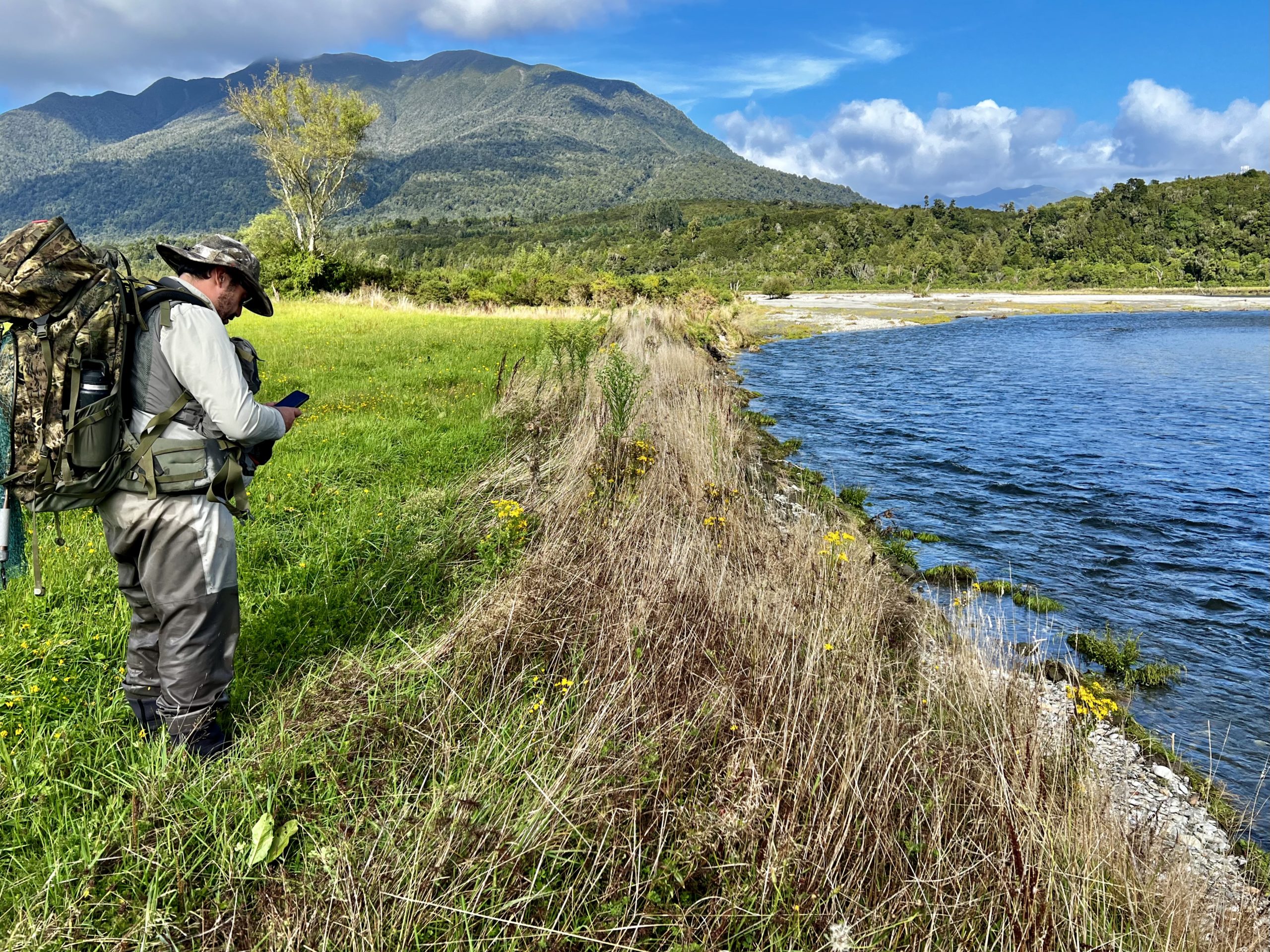
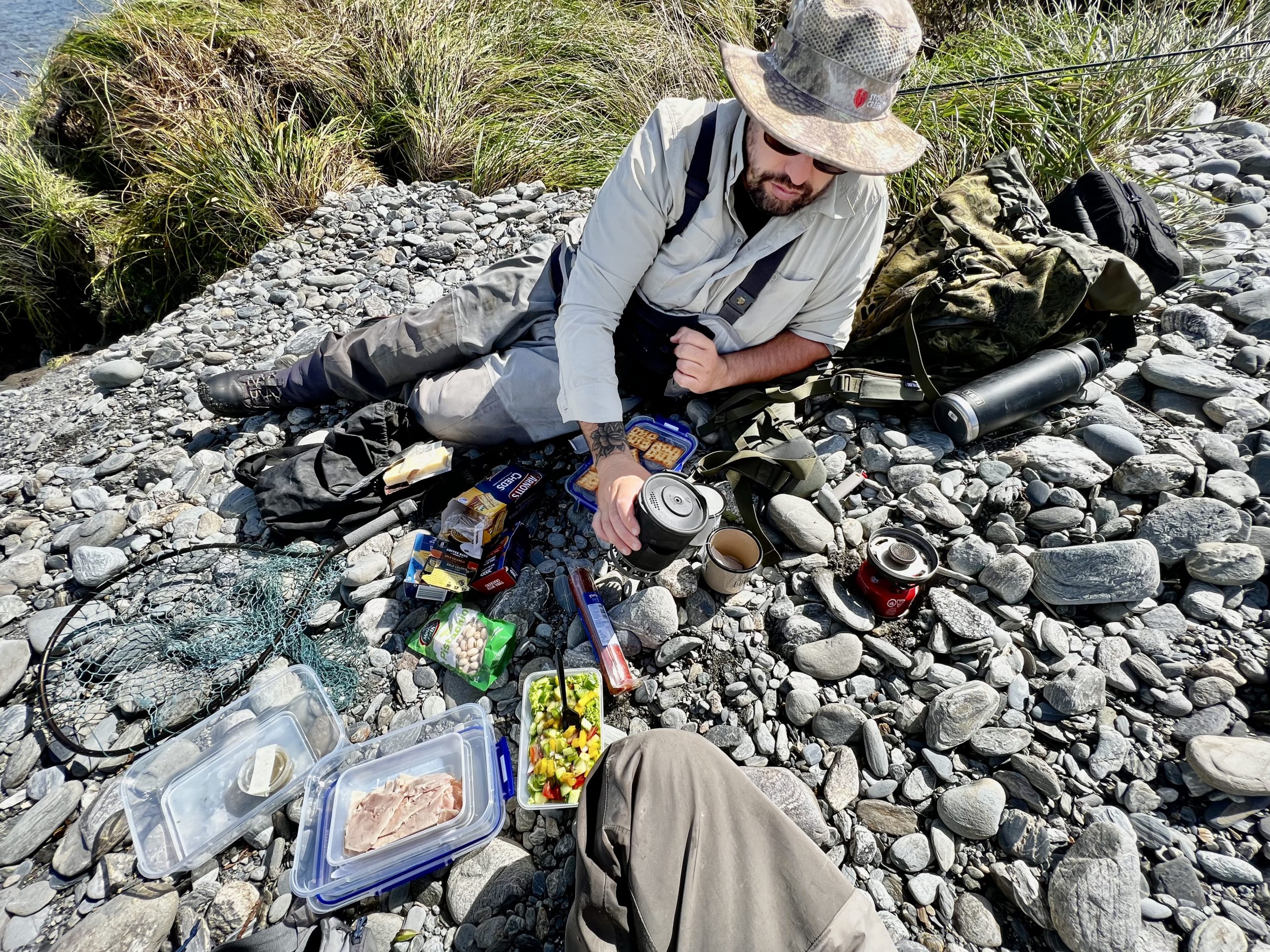
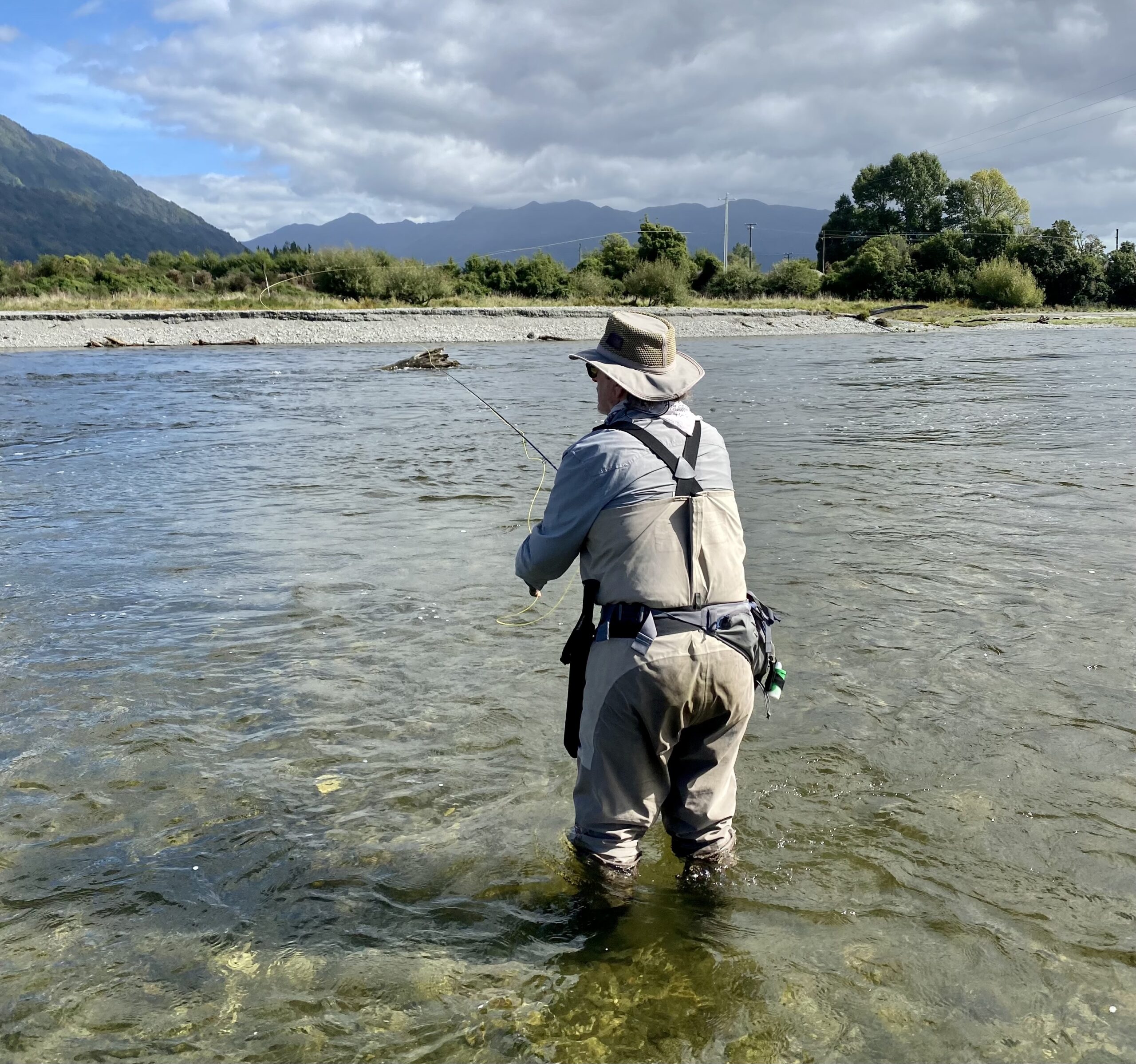
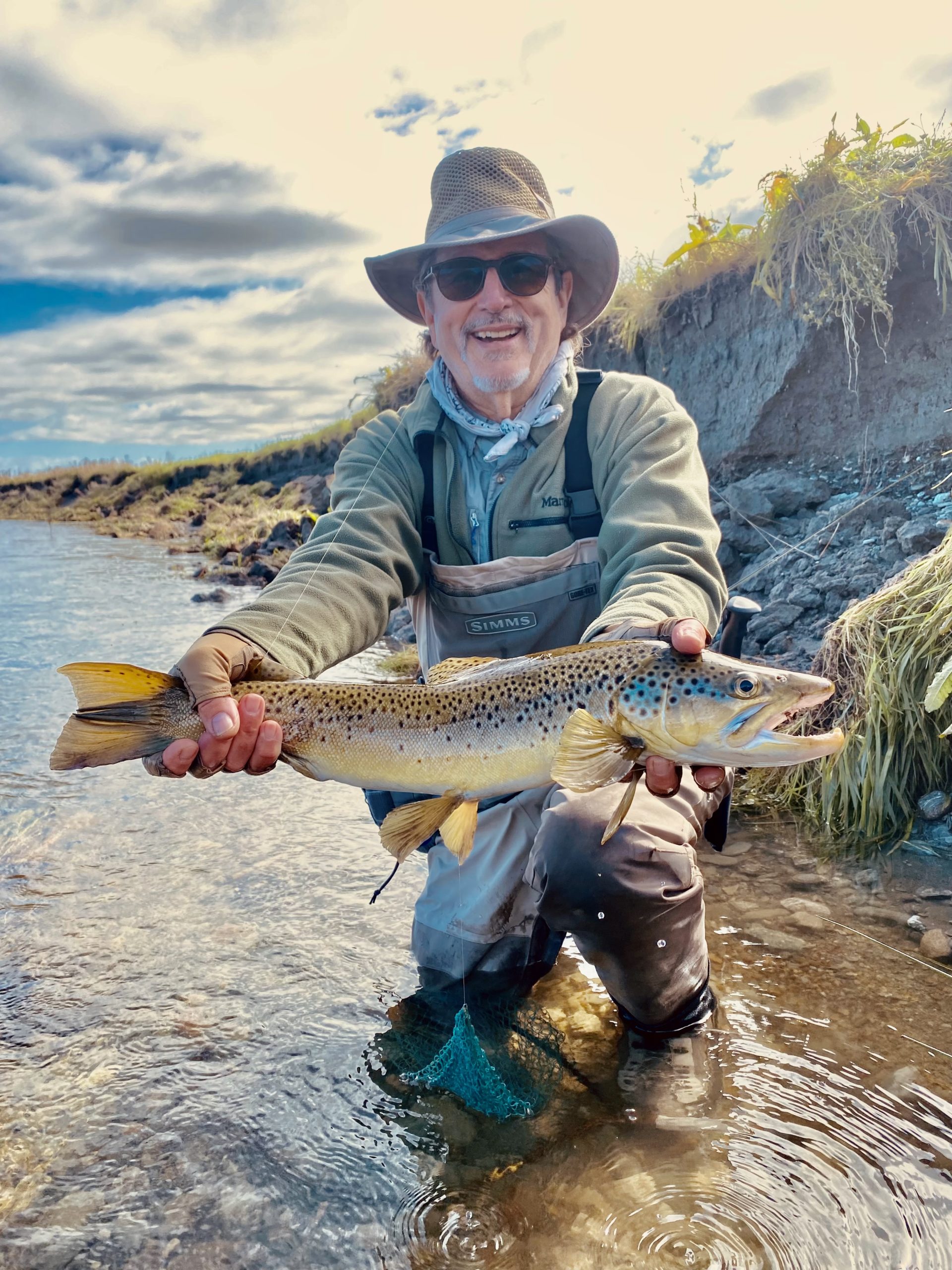
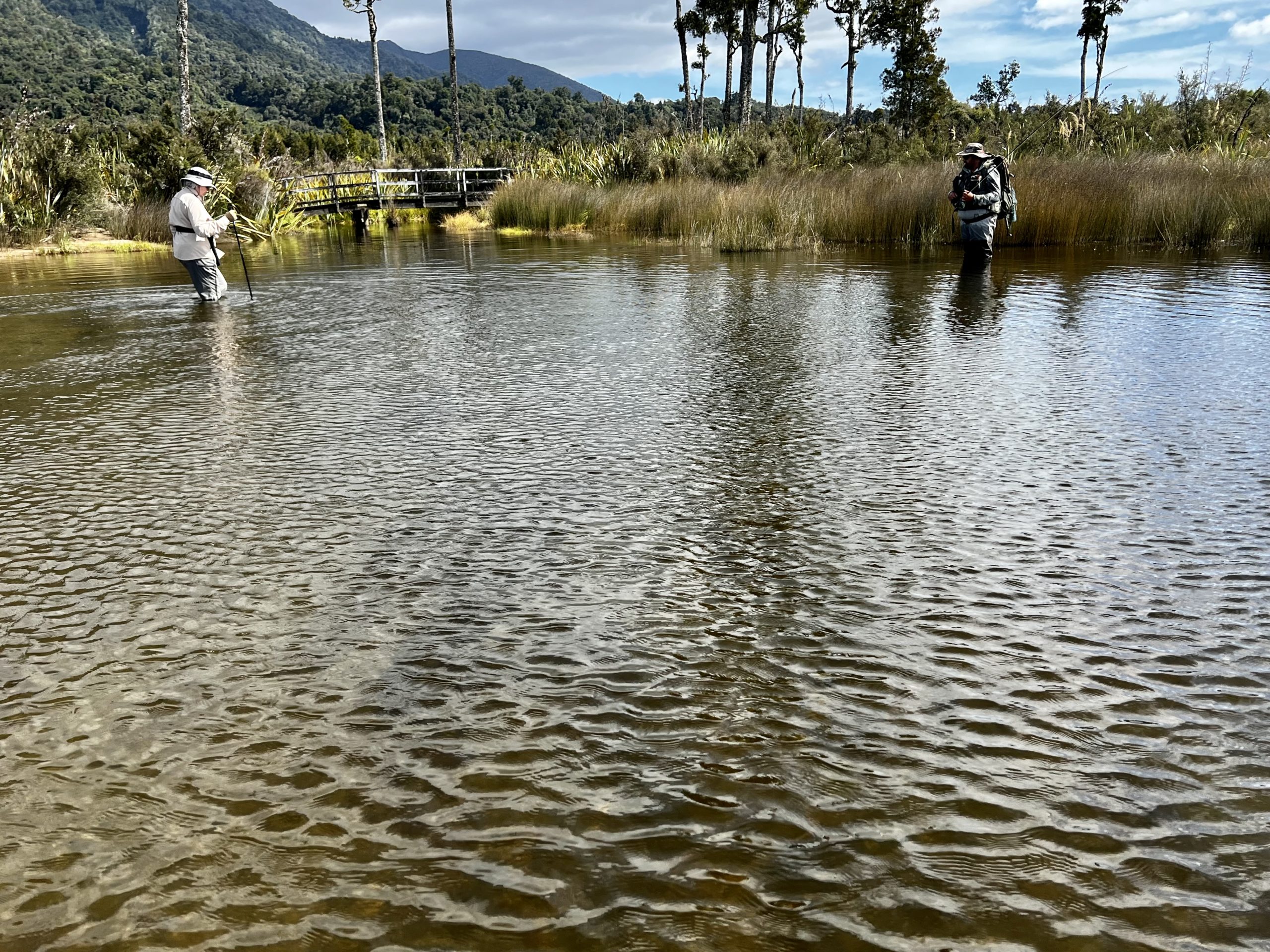
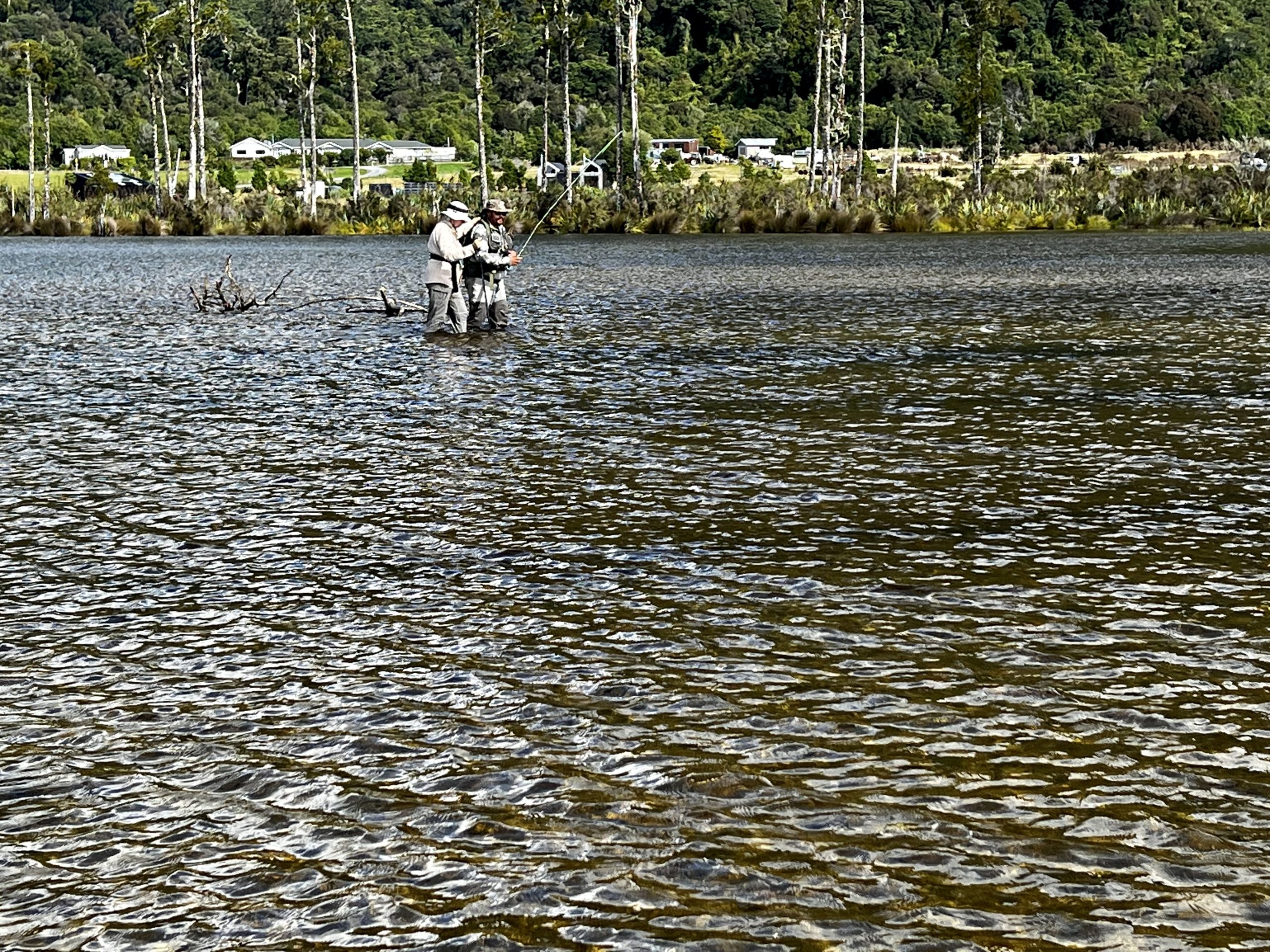
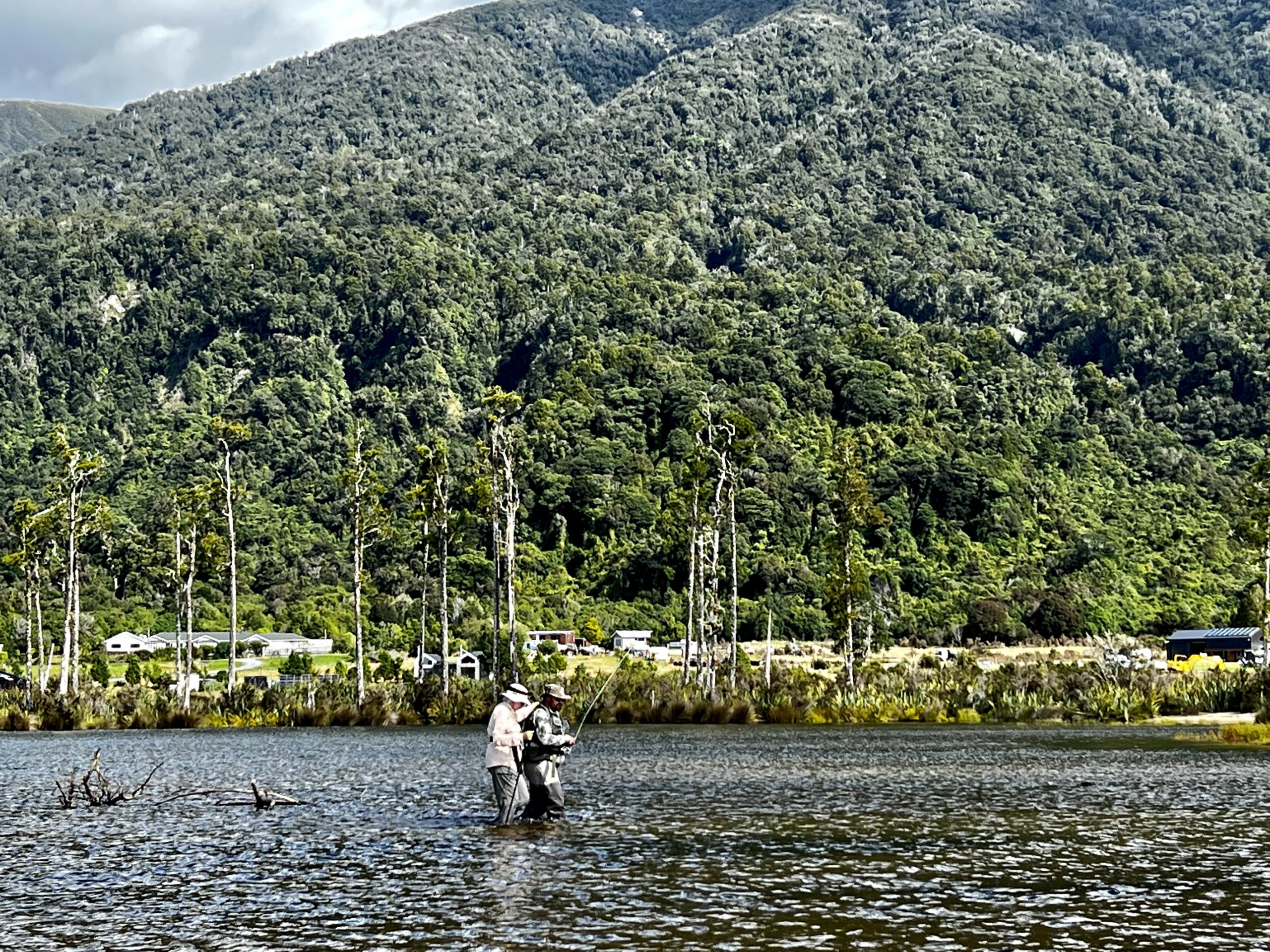
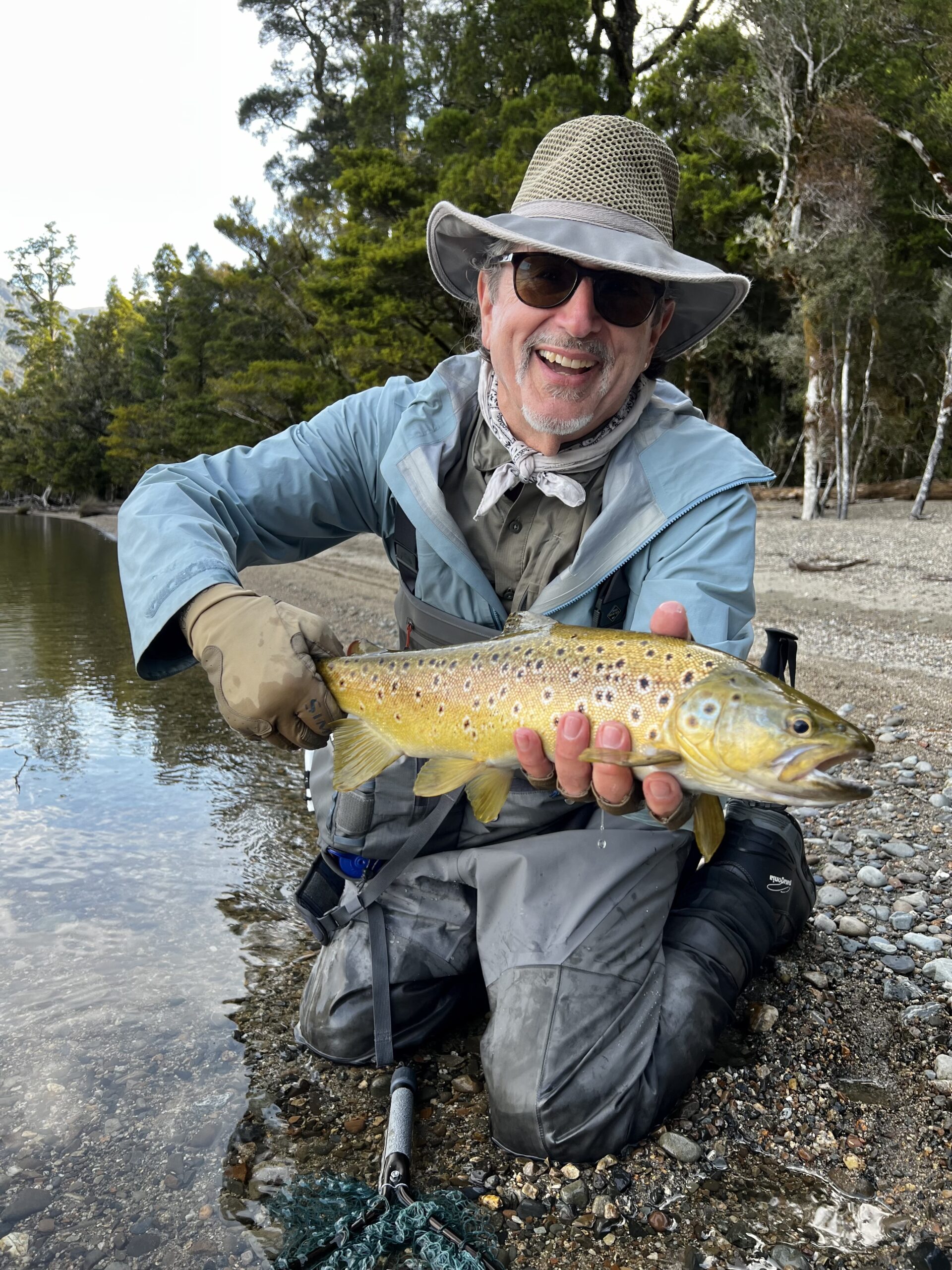
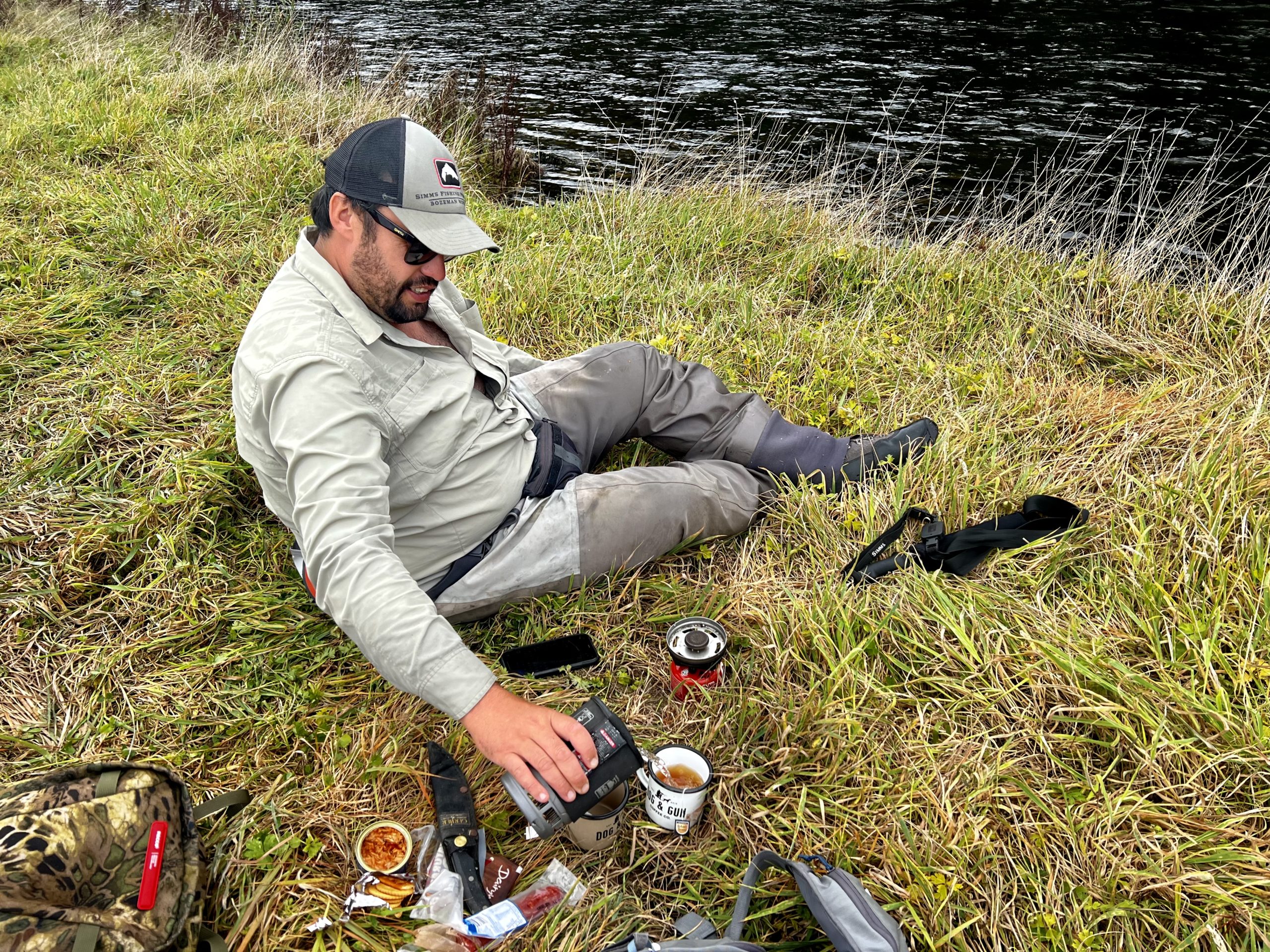
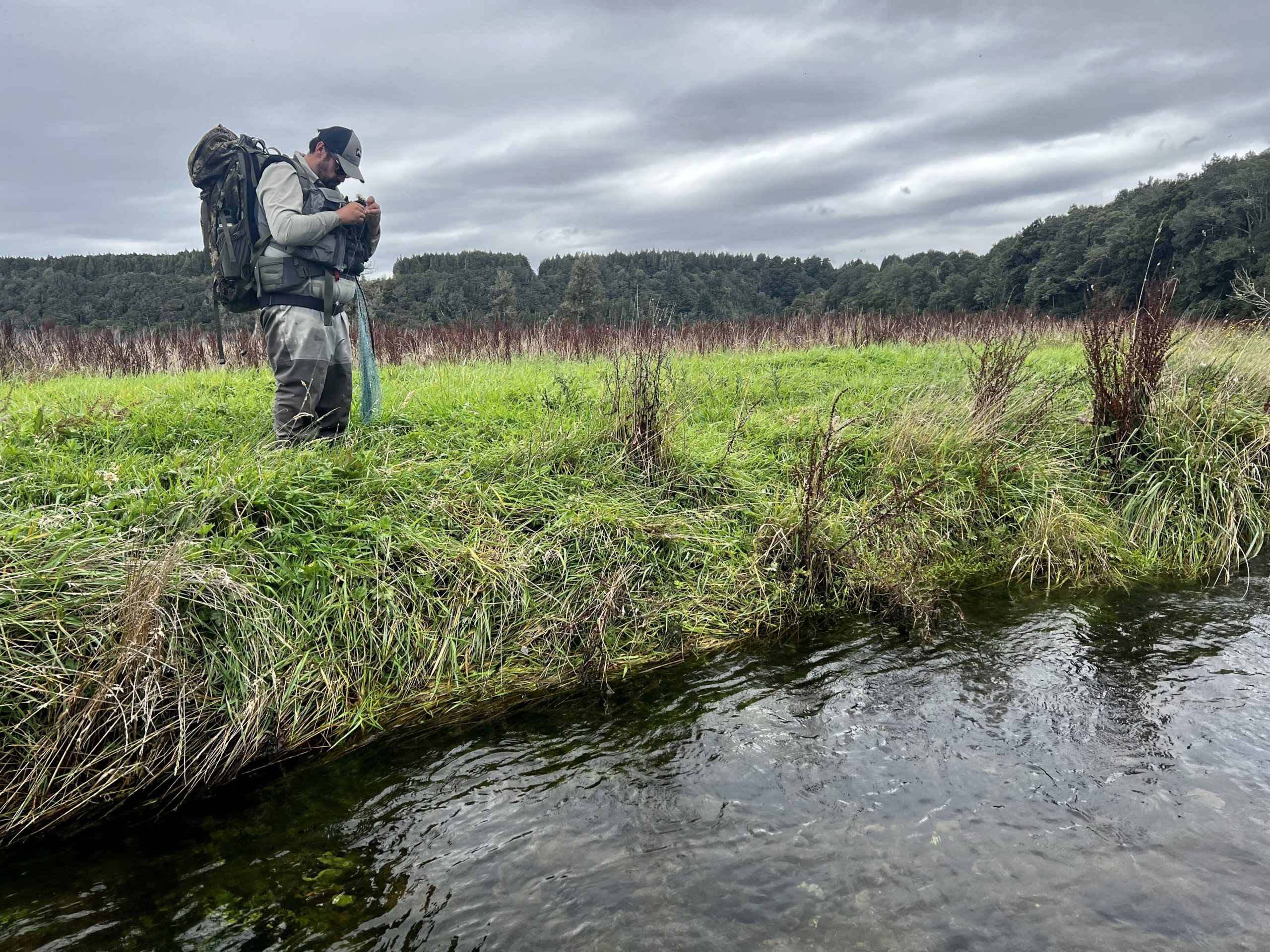
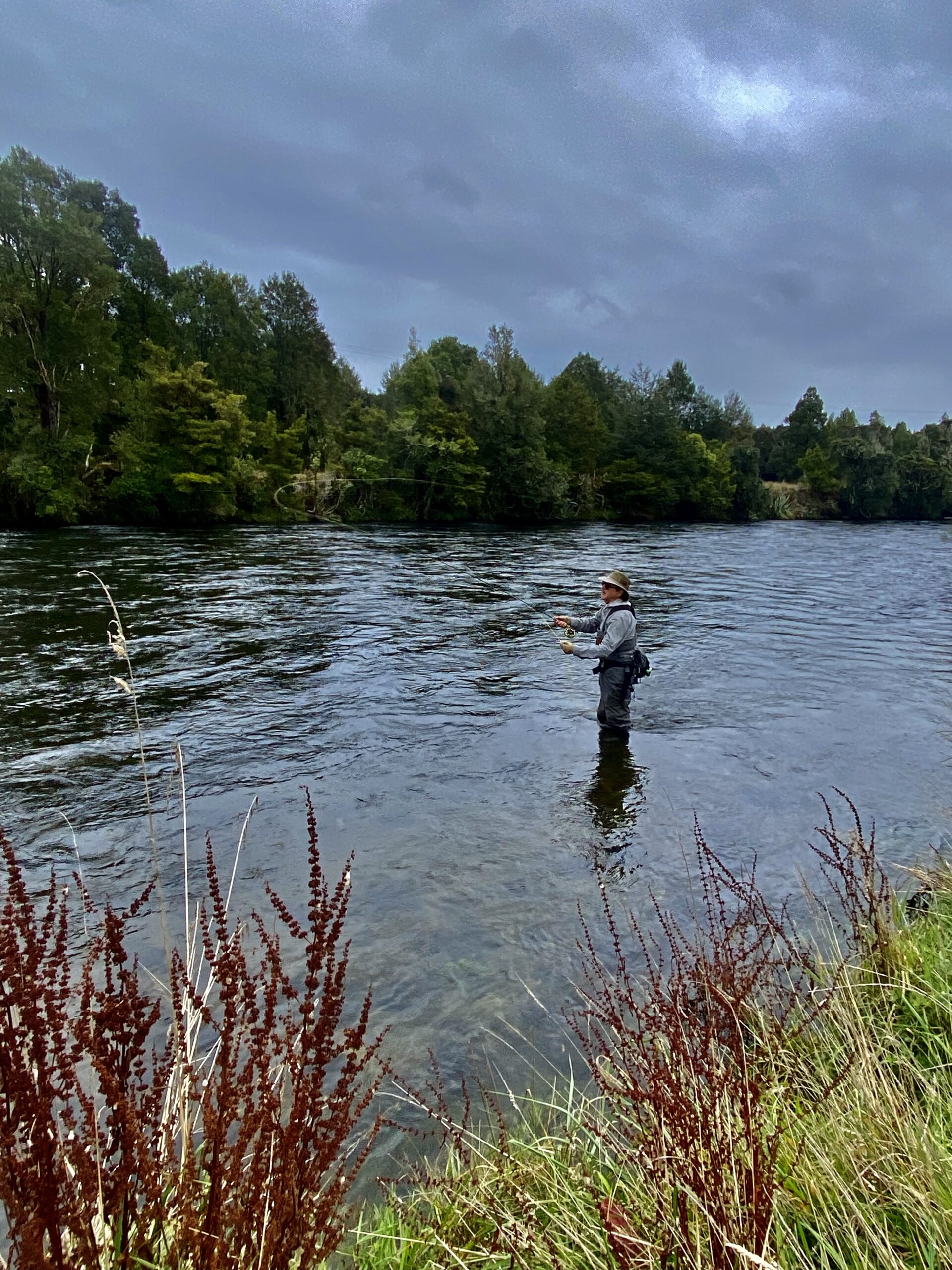
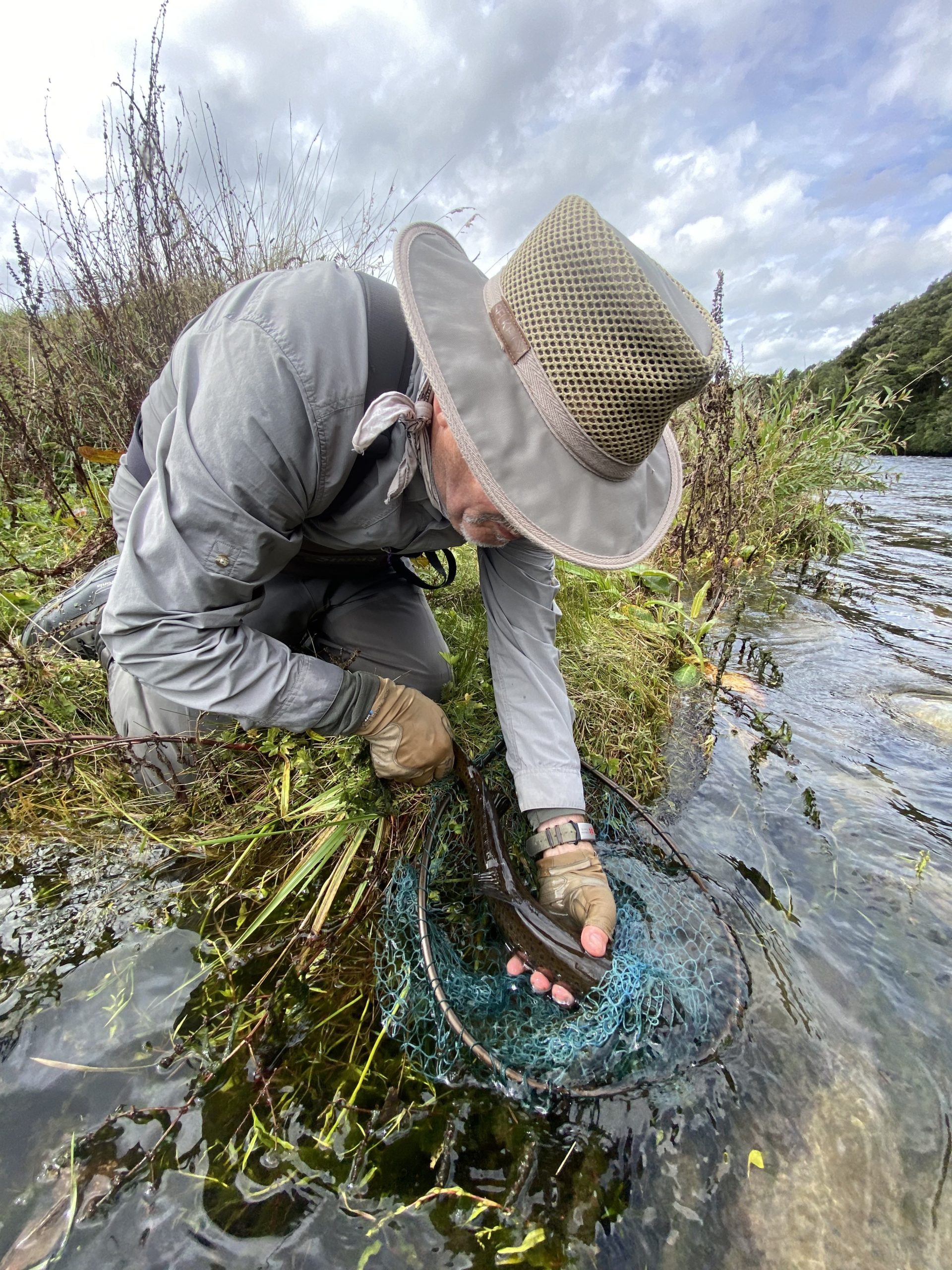
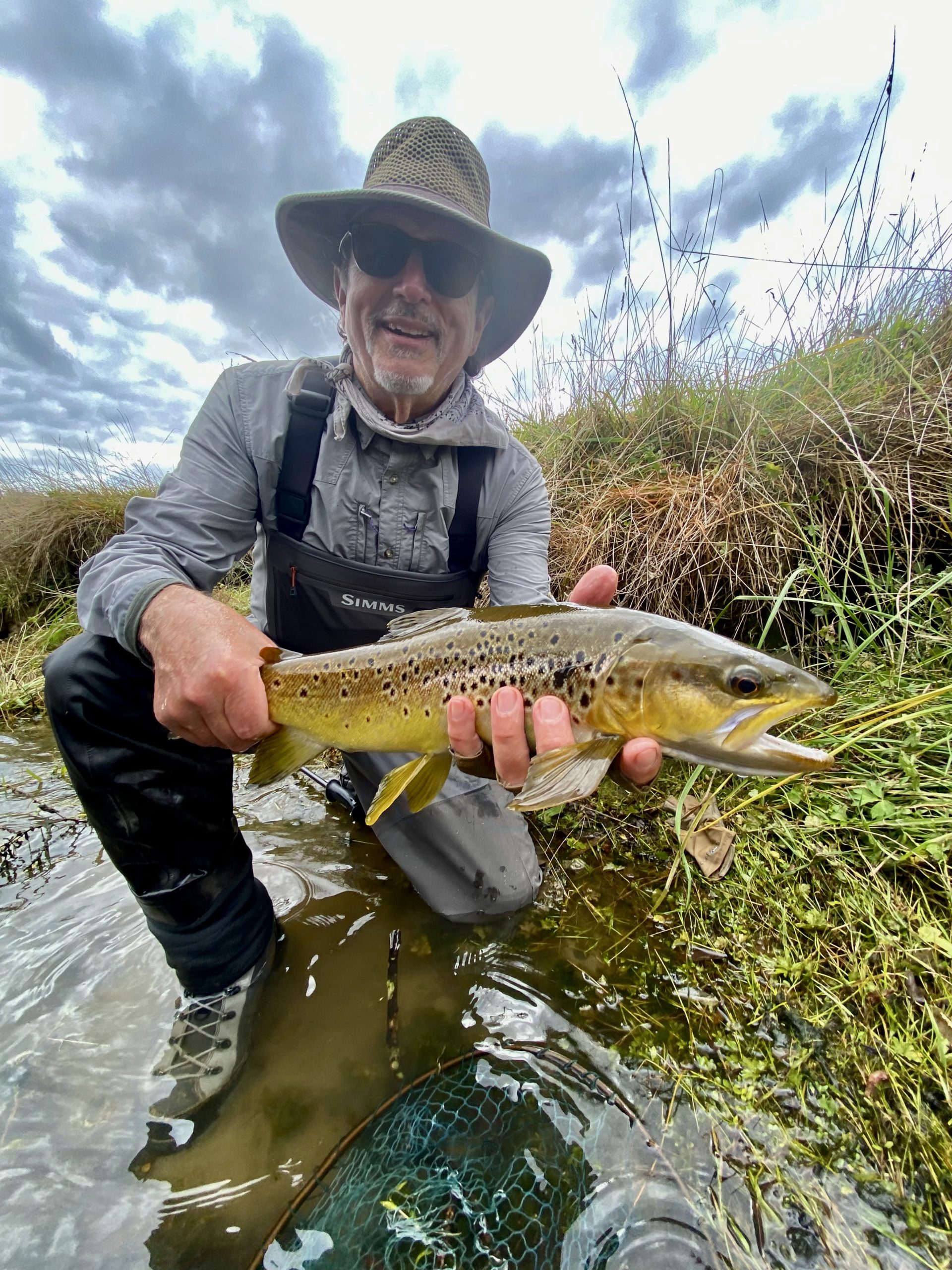
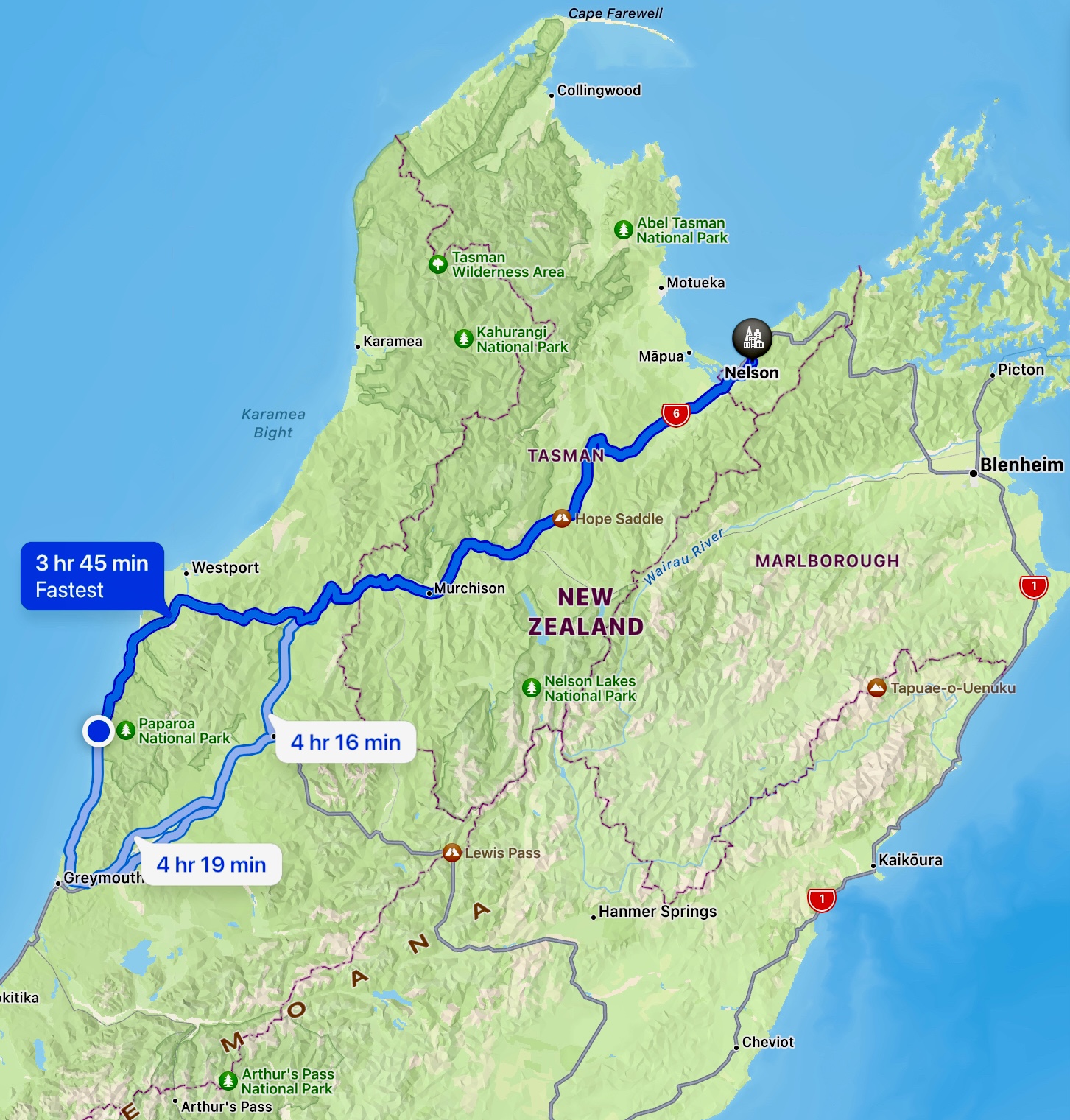
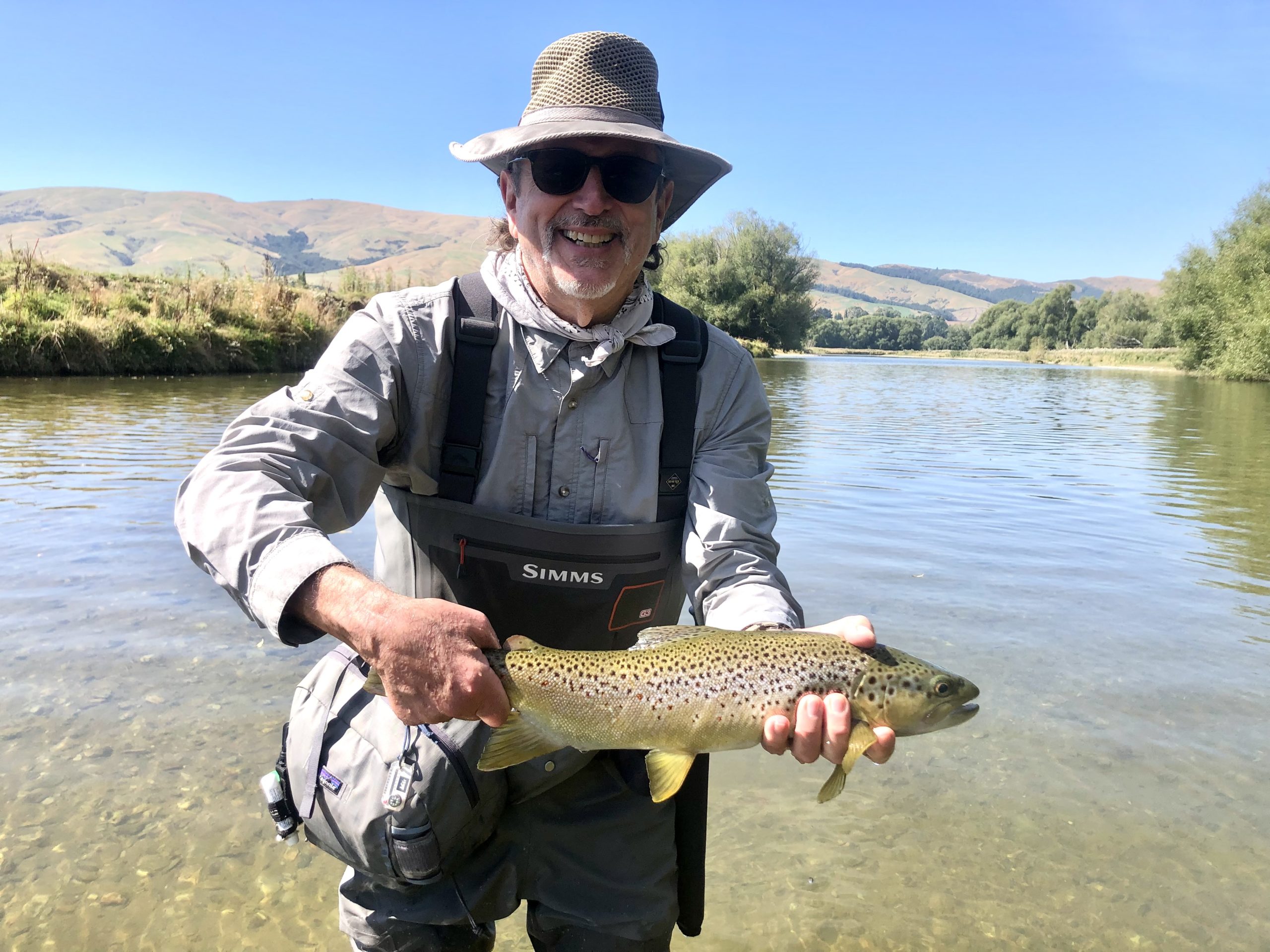
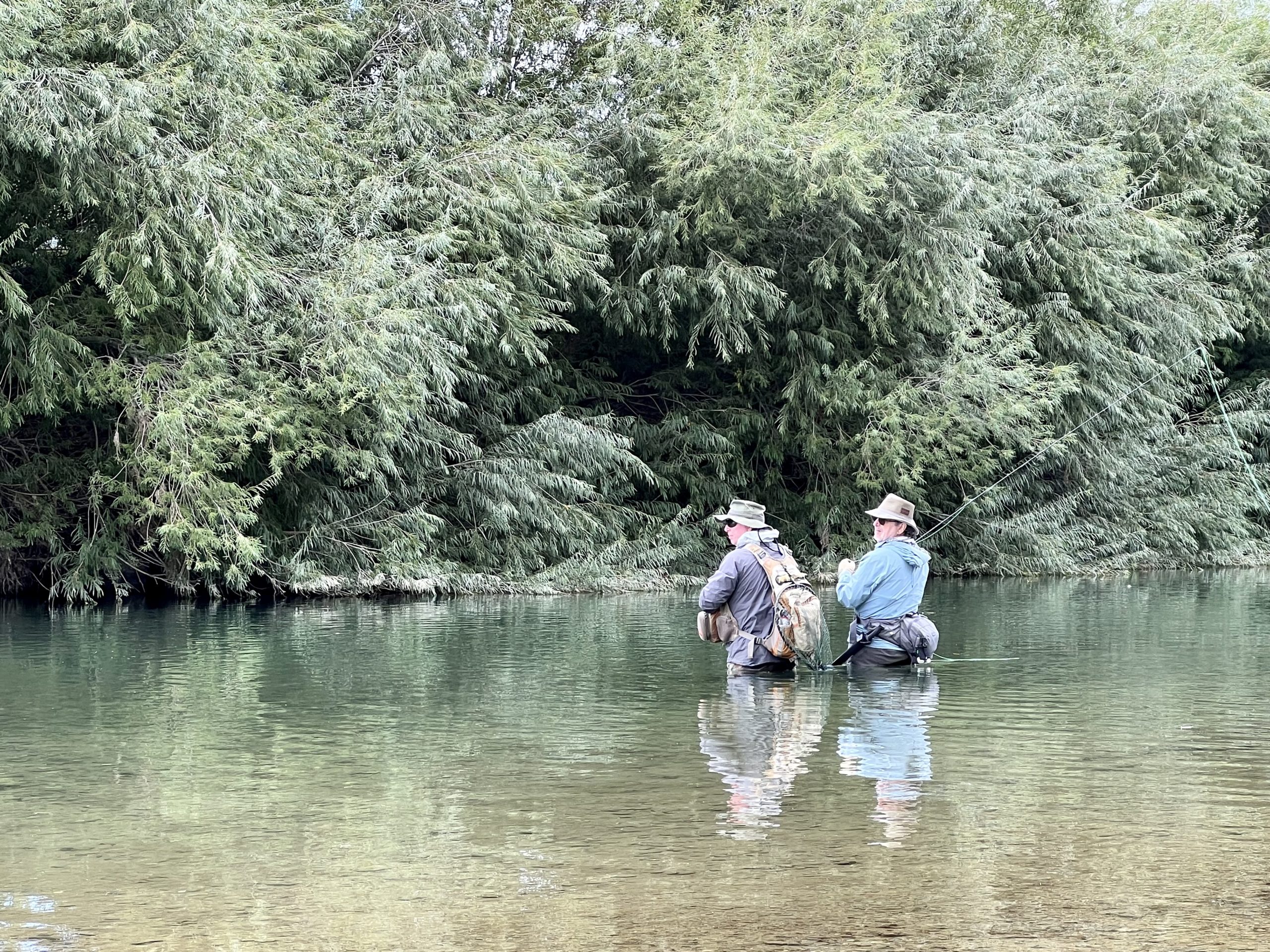
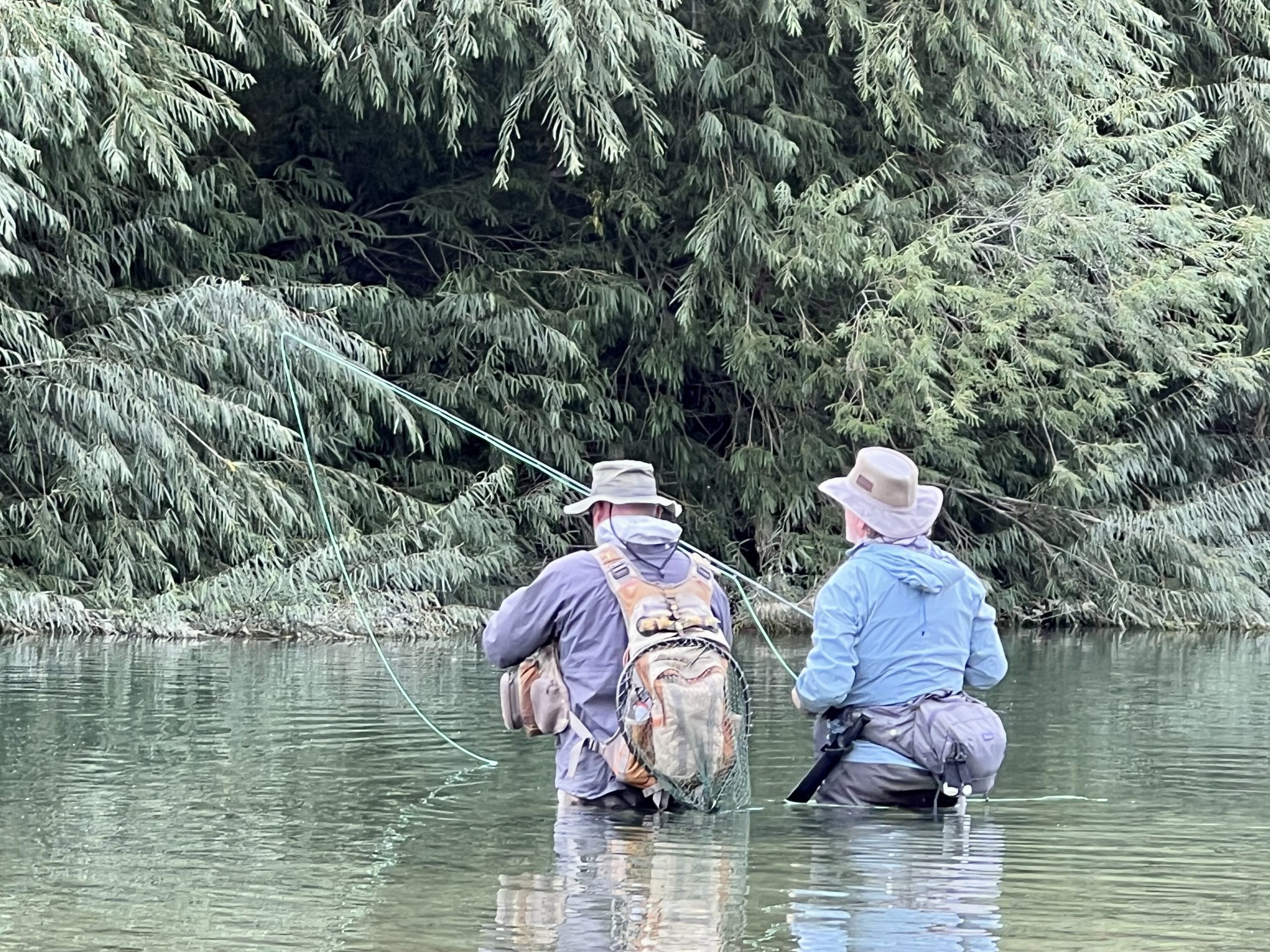
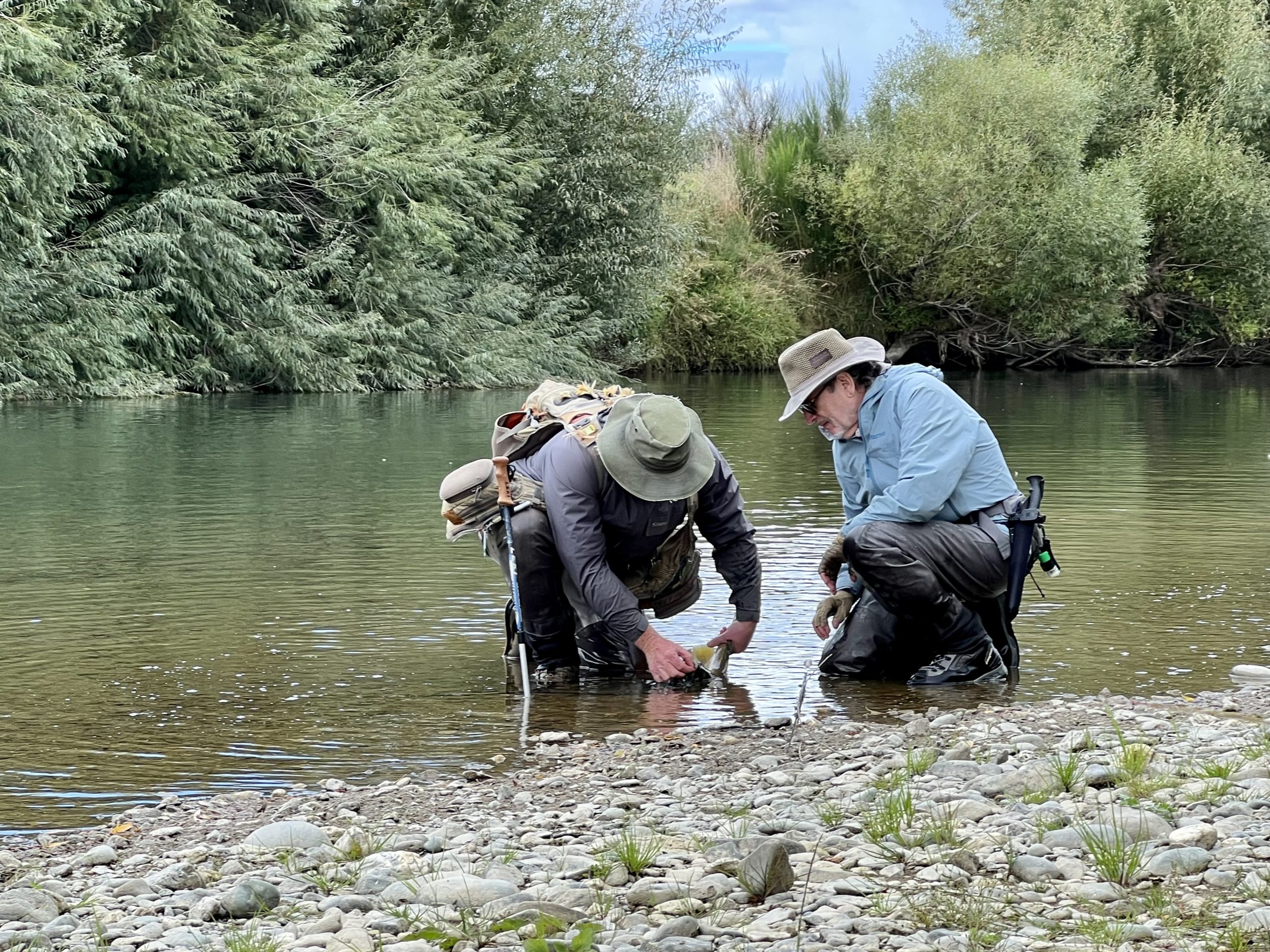
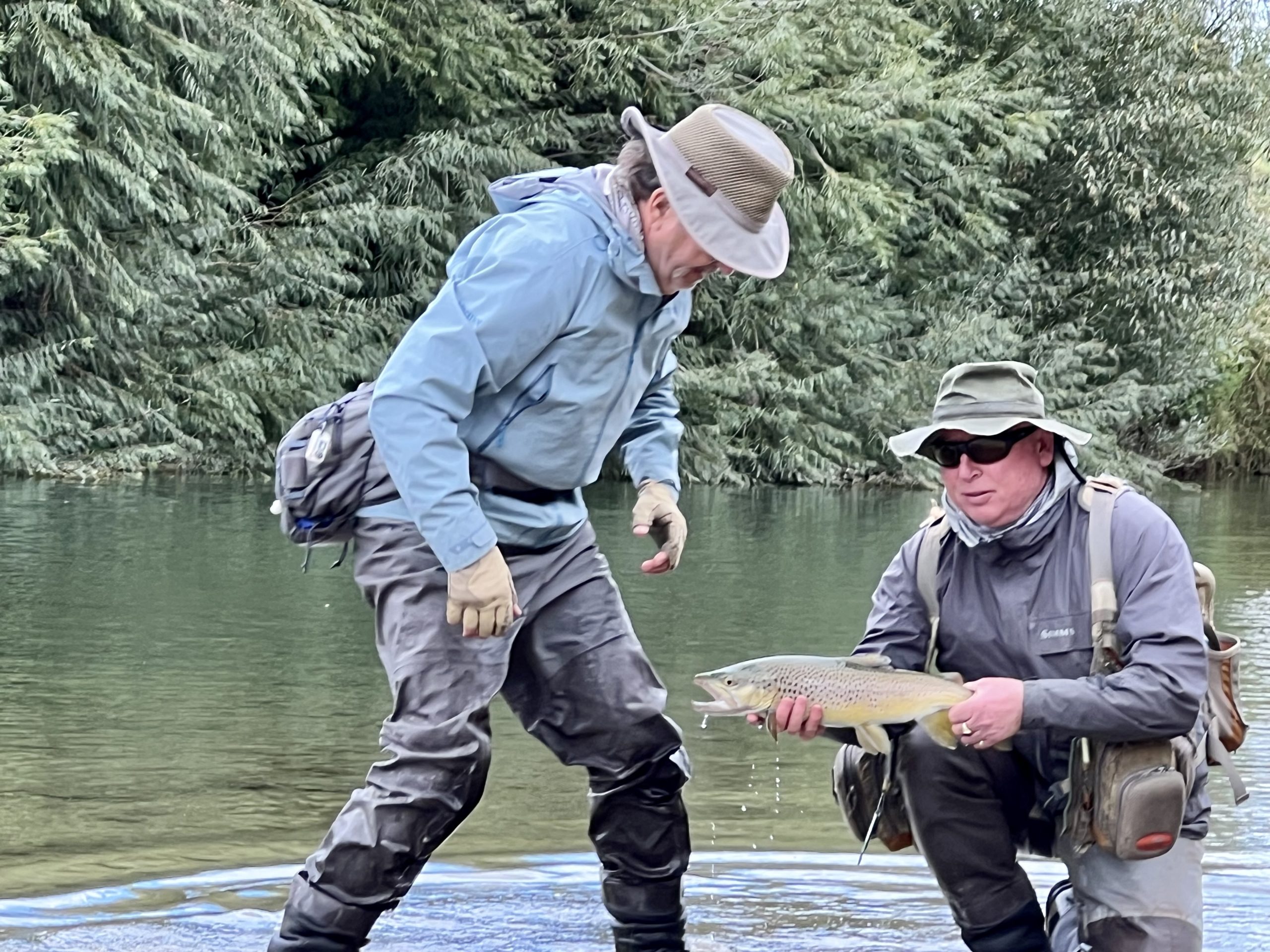
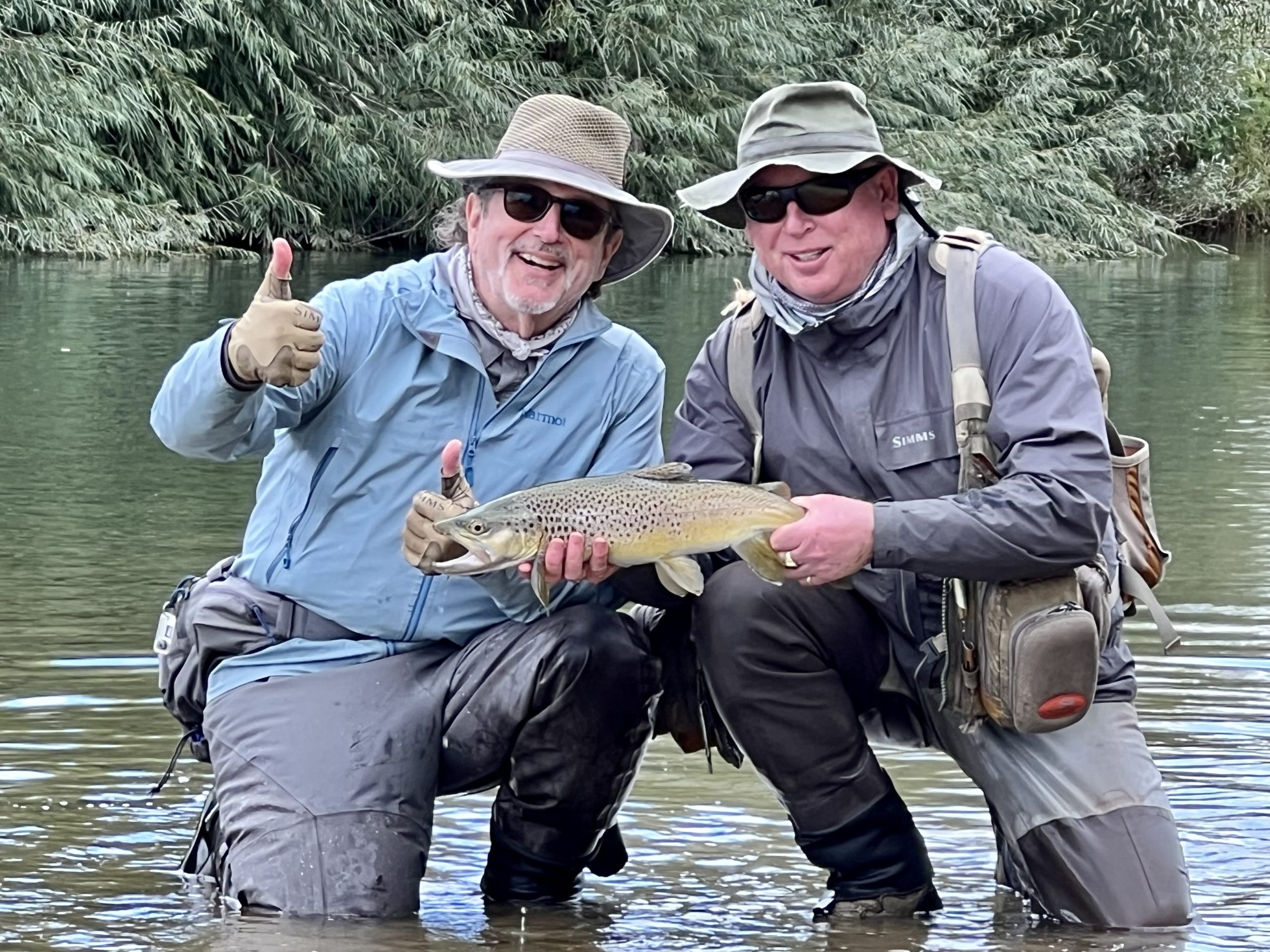
Our guide at Lake Brunner was Charles Smith. He came from the east coast of the South Island—about a four-hour trip. Charles was scouting a deer hunt for some clients but broke out to spend three days to guide us. He stayed at the Lake Brunner Lodge for two nights. While not fishing, he hunts and guides hunting trips, many using helicopters for multiple day excursions in the bush. He also helps a friend prepare videos for his YouTube series Gin-Clear Travel. His mom is Filipino and he and Robert talked a lot about foods their families favor. Charles also likes his coffee. So much so that he packs a stove, a pot, and coffee for one or two stops during the fishing day. That worked out great for Robert too. Salami and cheese seem to be his go-to lunch. He was very patient and encouraging, and guided Robert to his first four-pound brown trout ever! He was Bonnie’s favorite guide so far. He was very attentive to Bonnie’s unsteady footing when wading through the water, and after nearly every cast she made he exclaimed “Perfect.” At thirty-three years old, he has decades of great guiding ahead of him.
Charles and Robert
Lower Crooked River – Day One
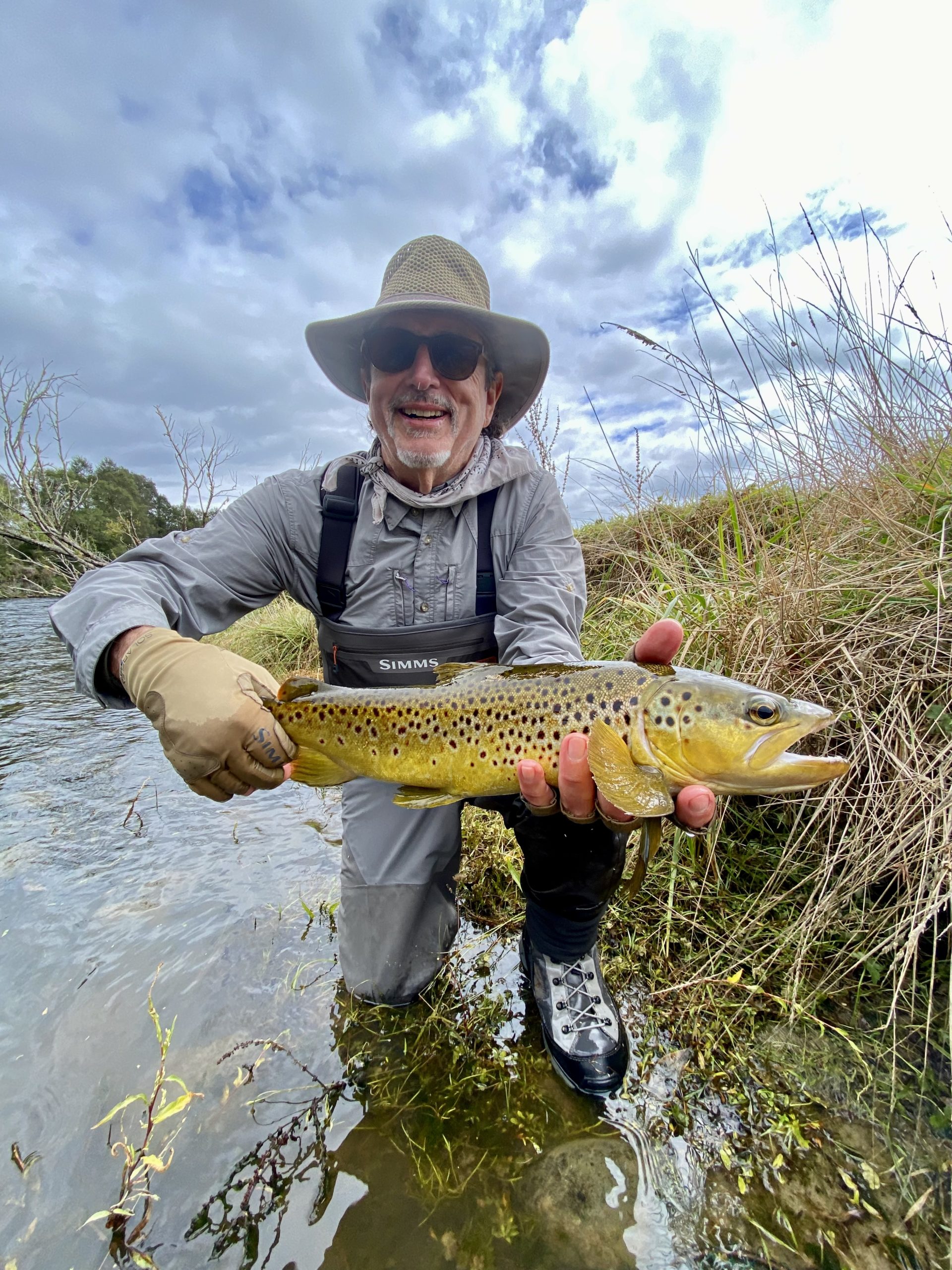
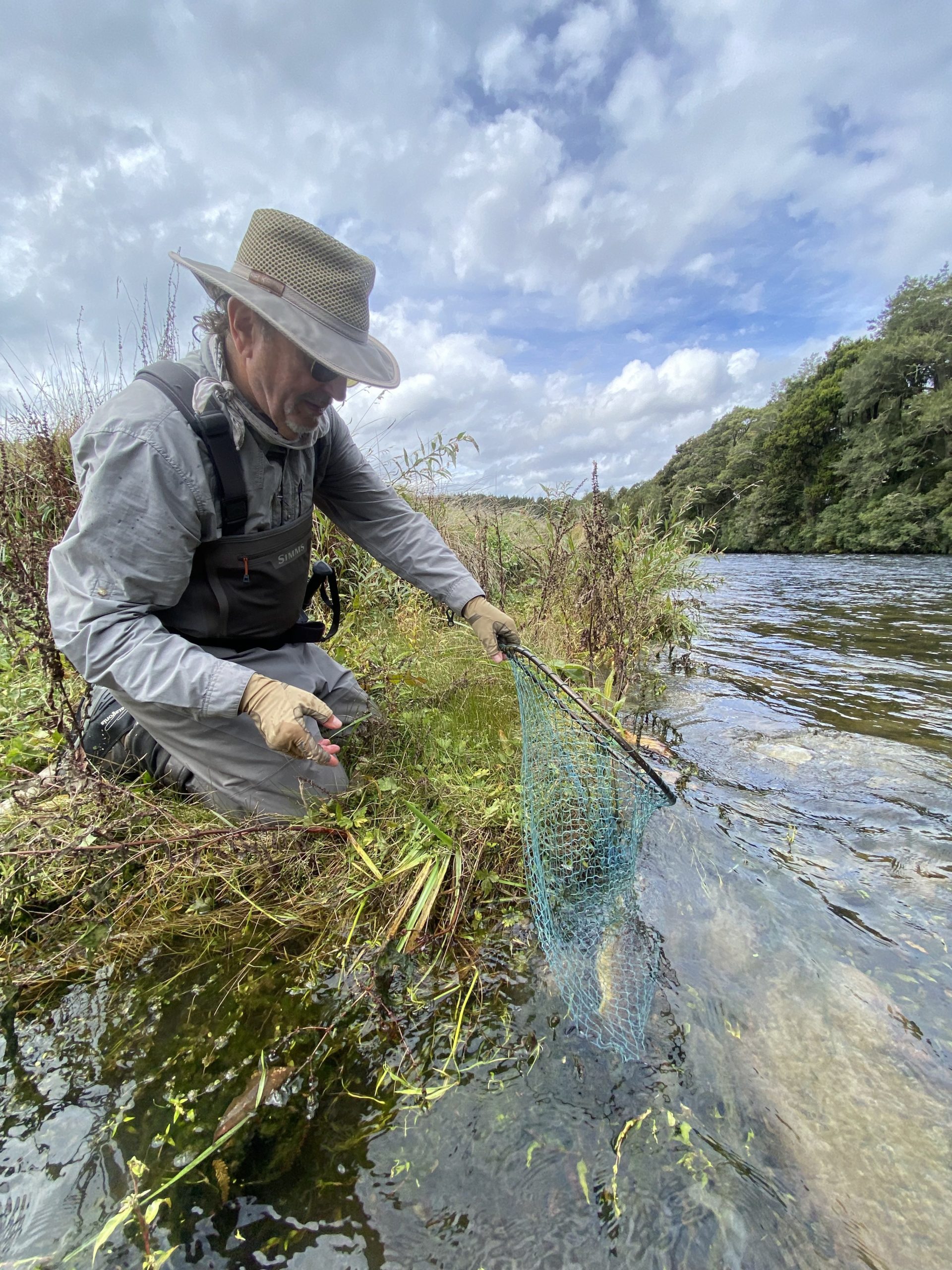
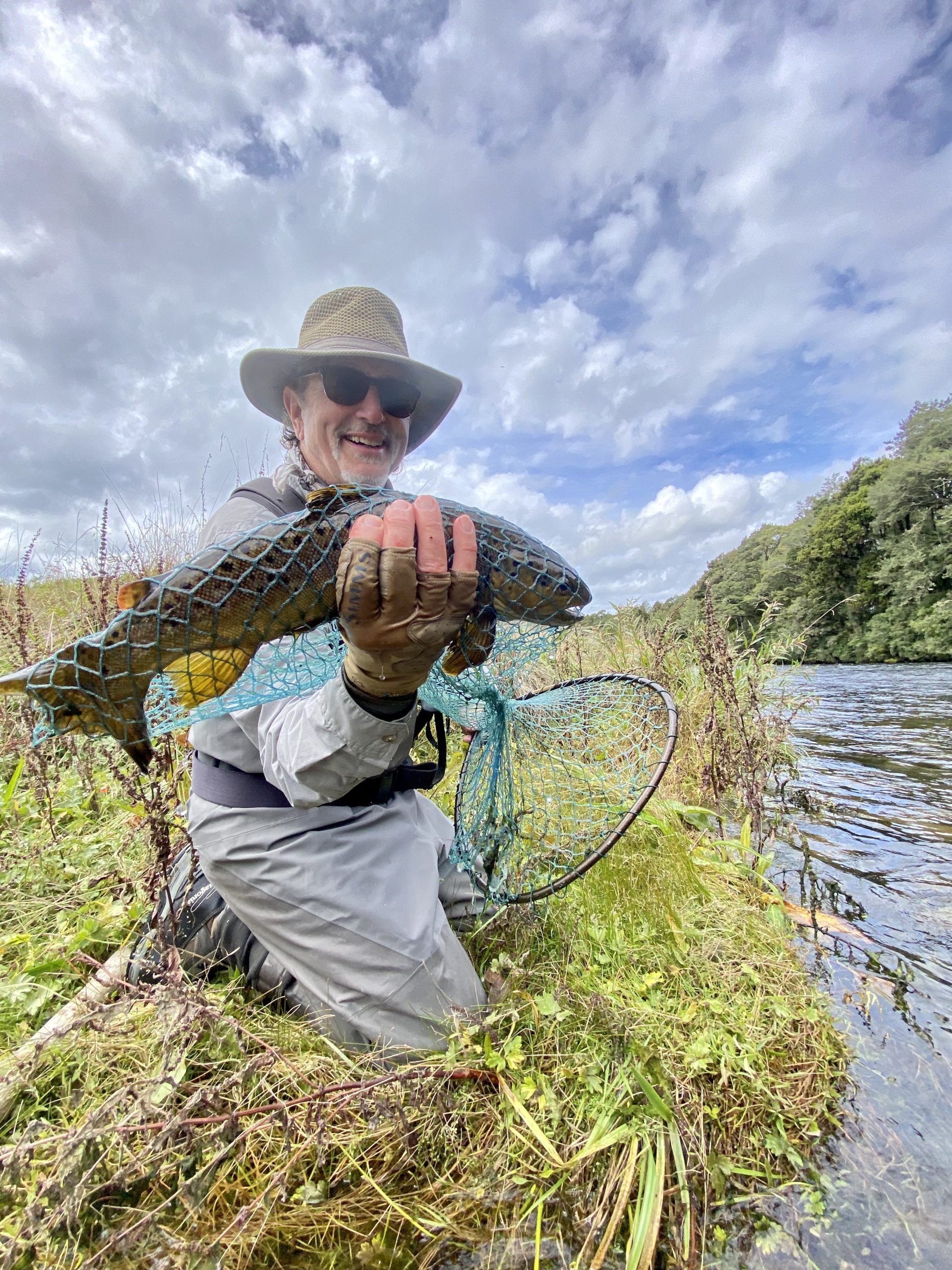
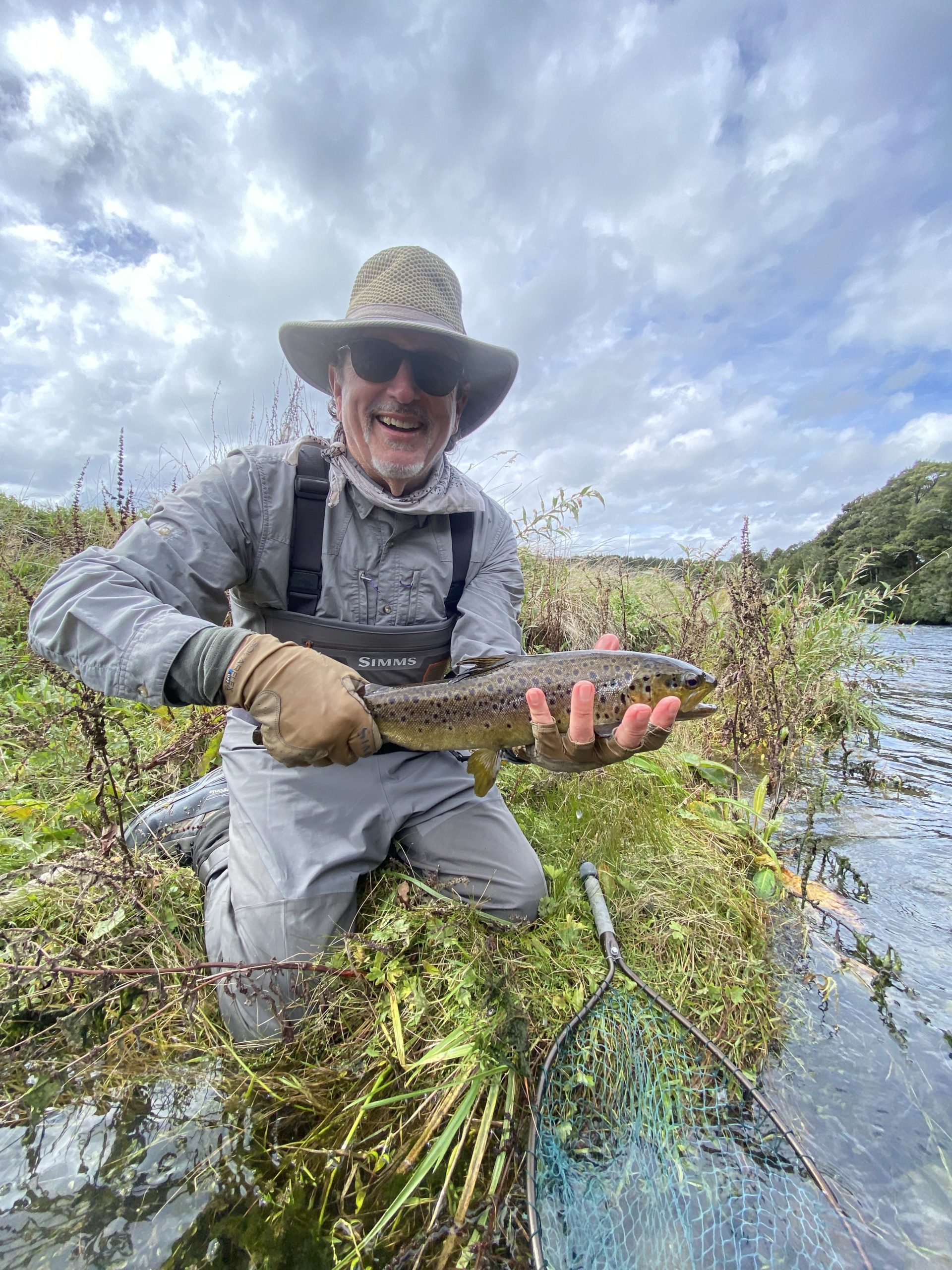
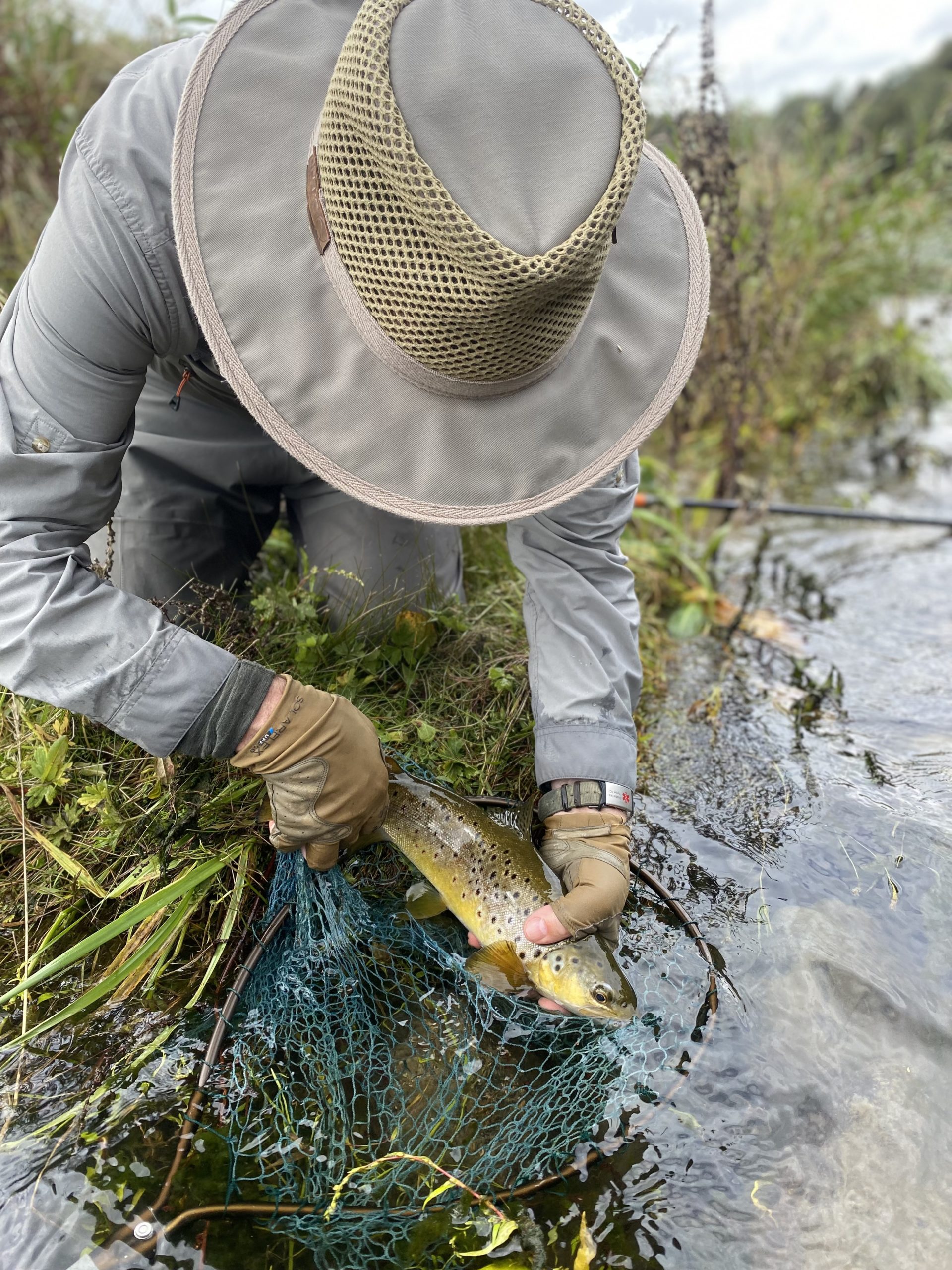
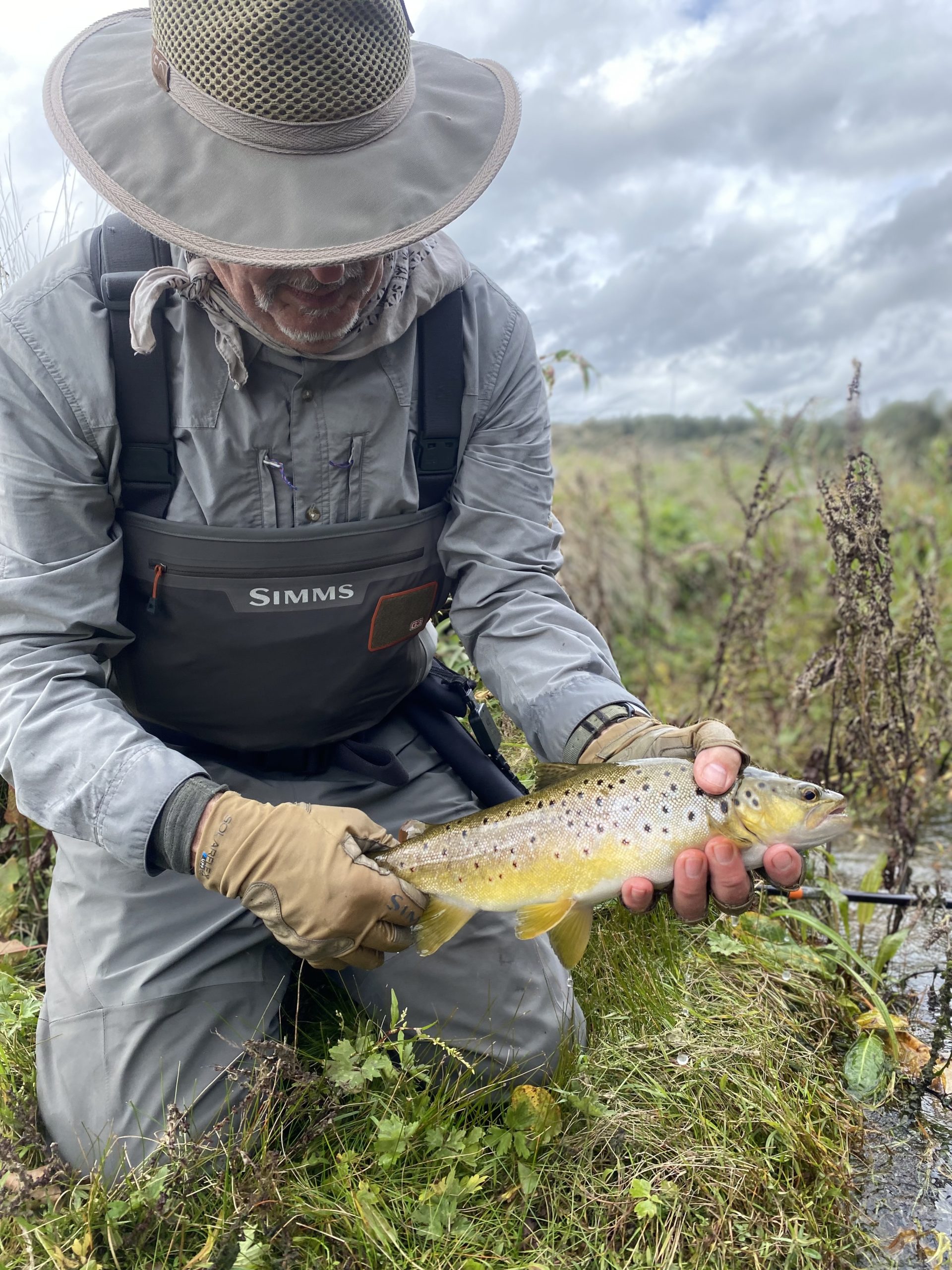
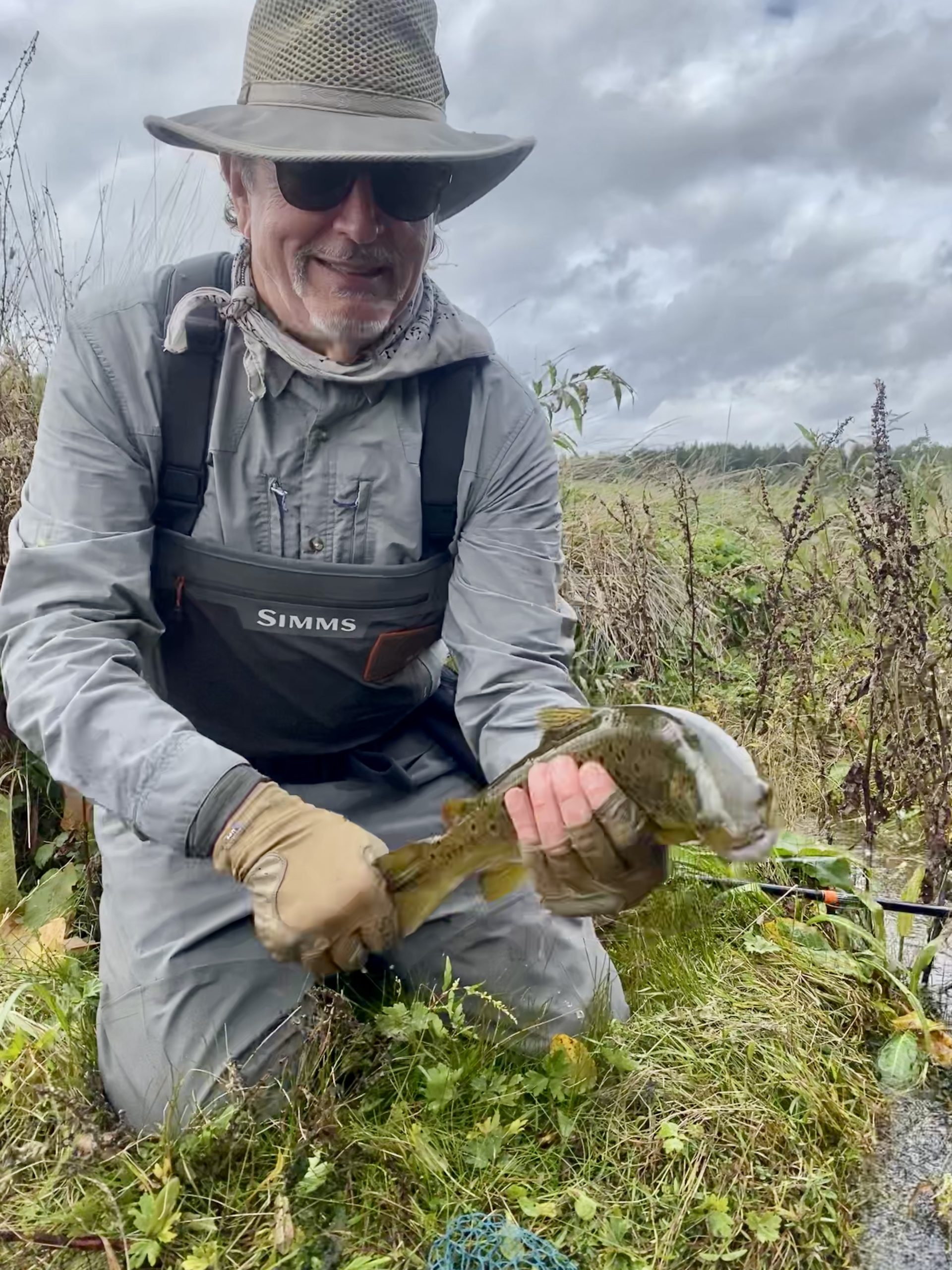
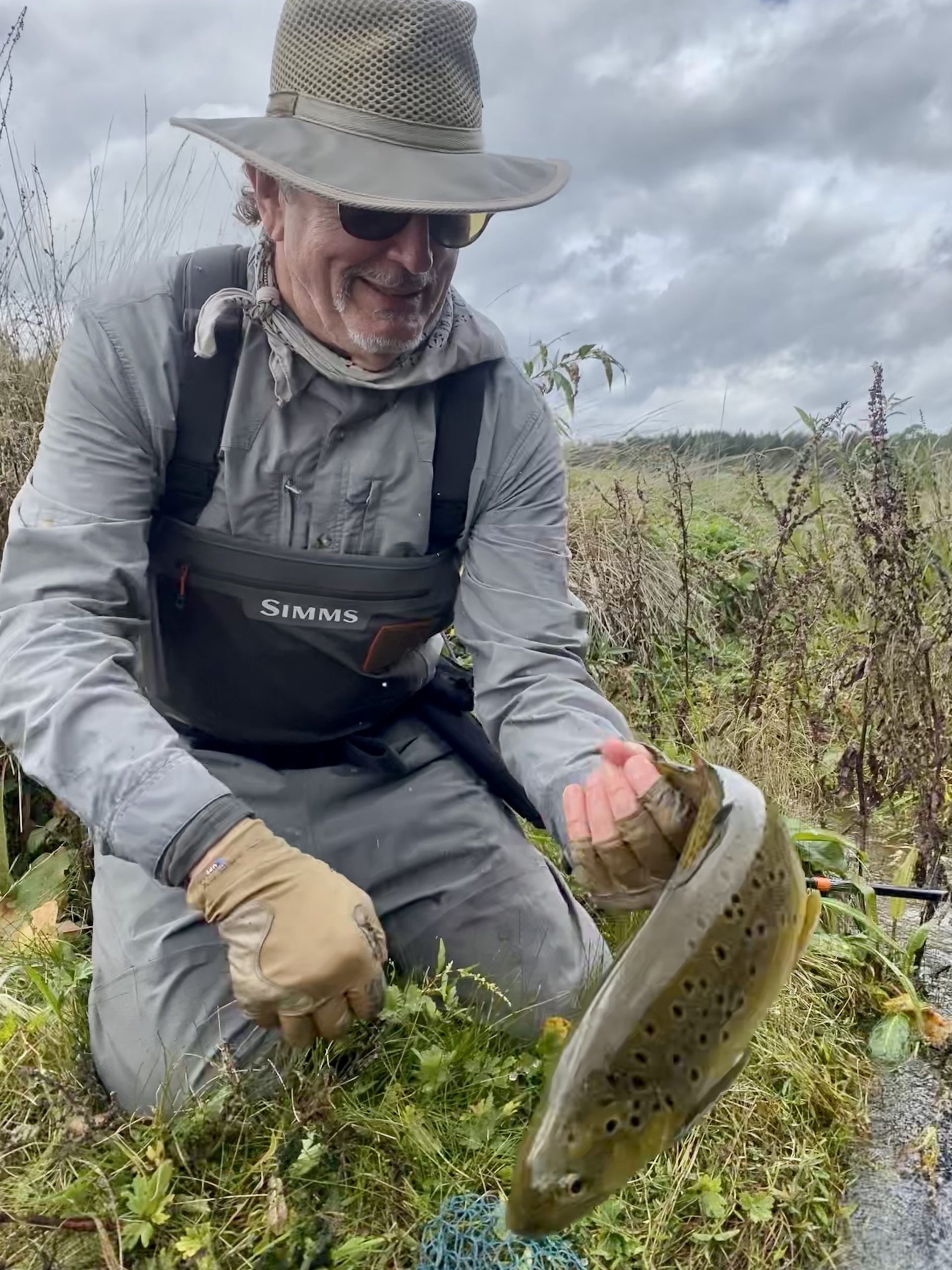
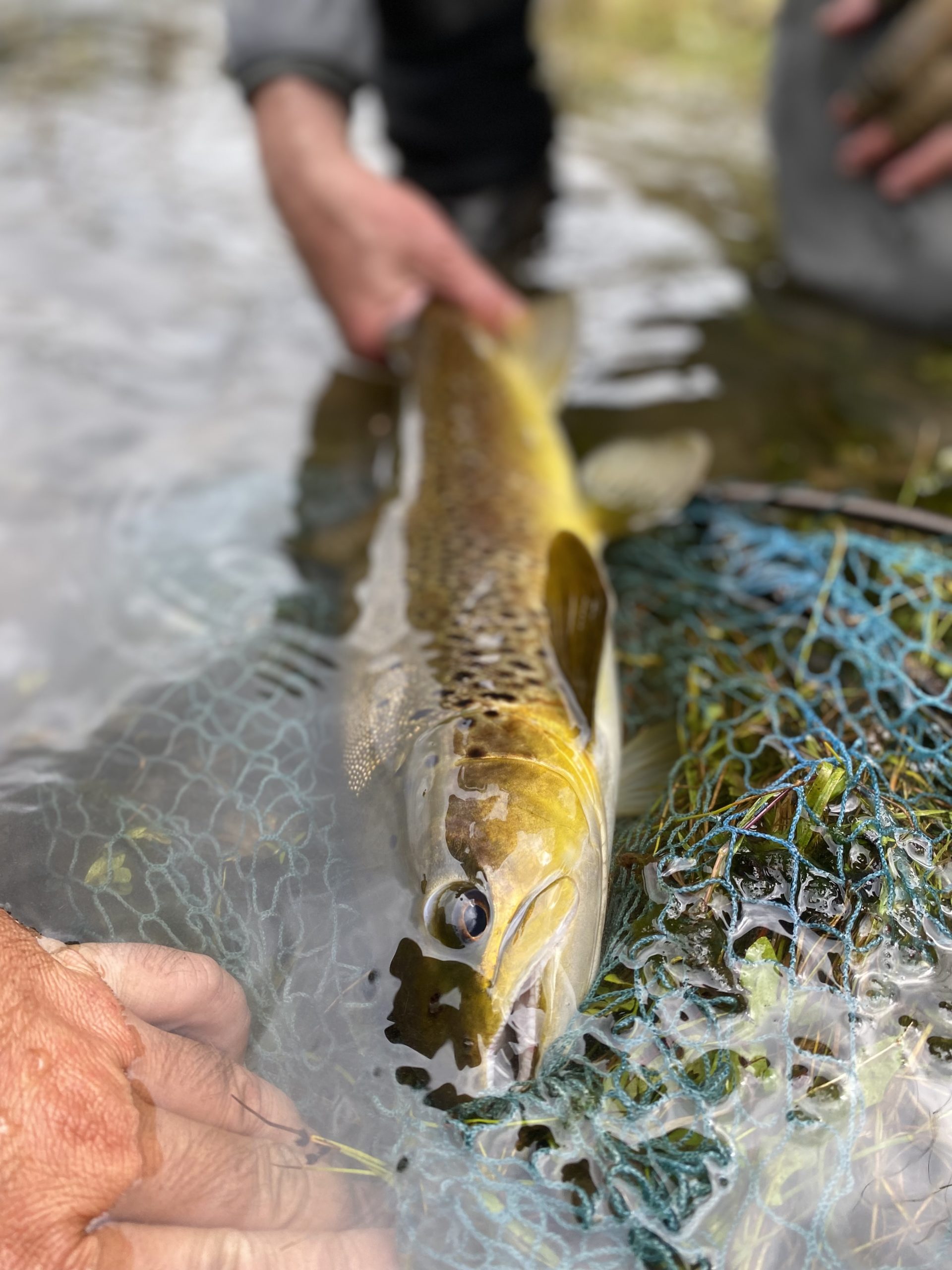
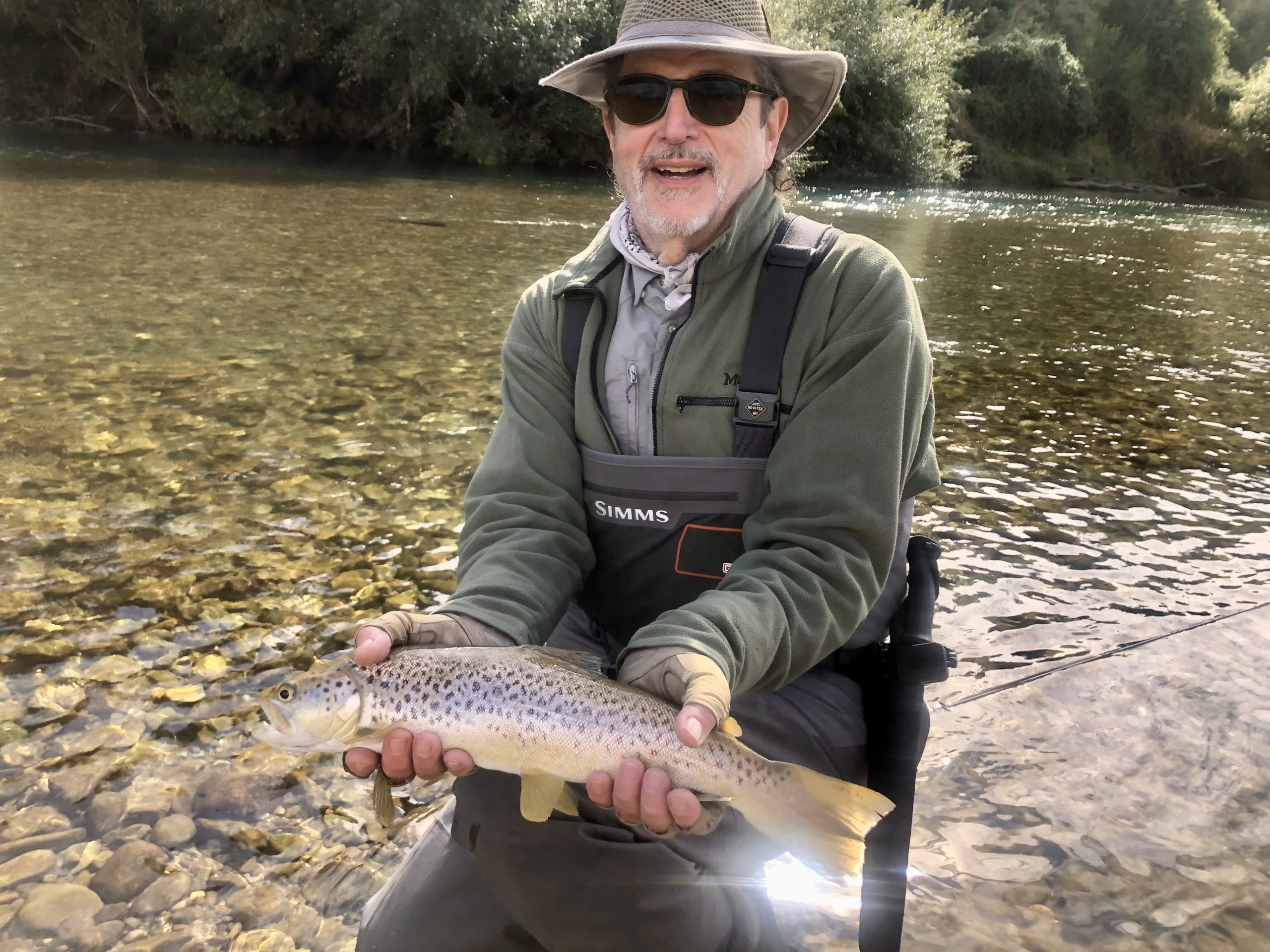
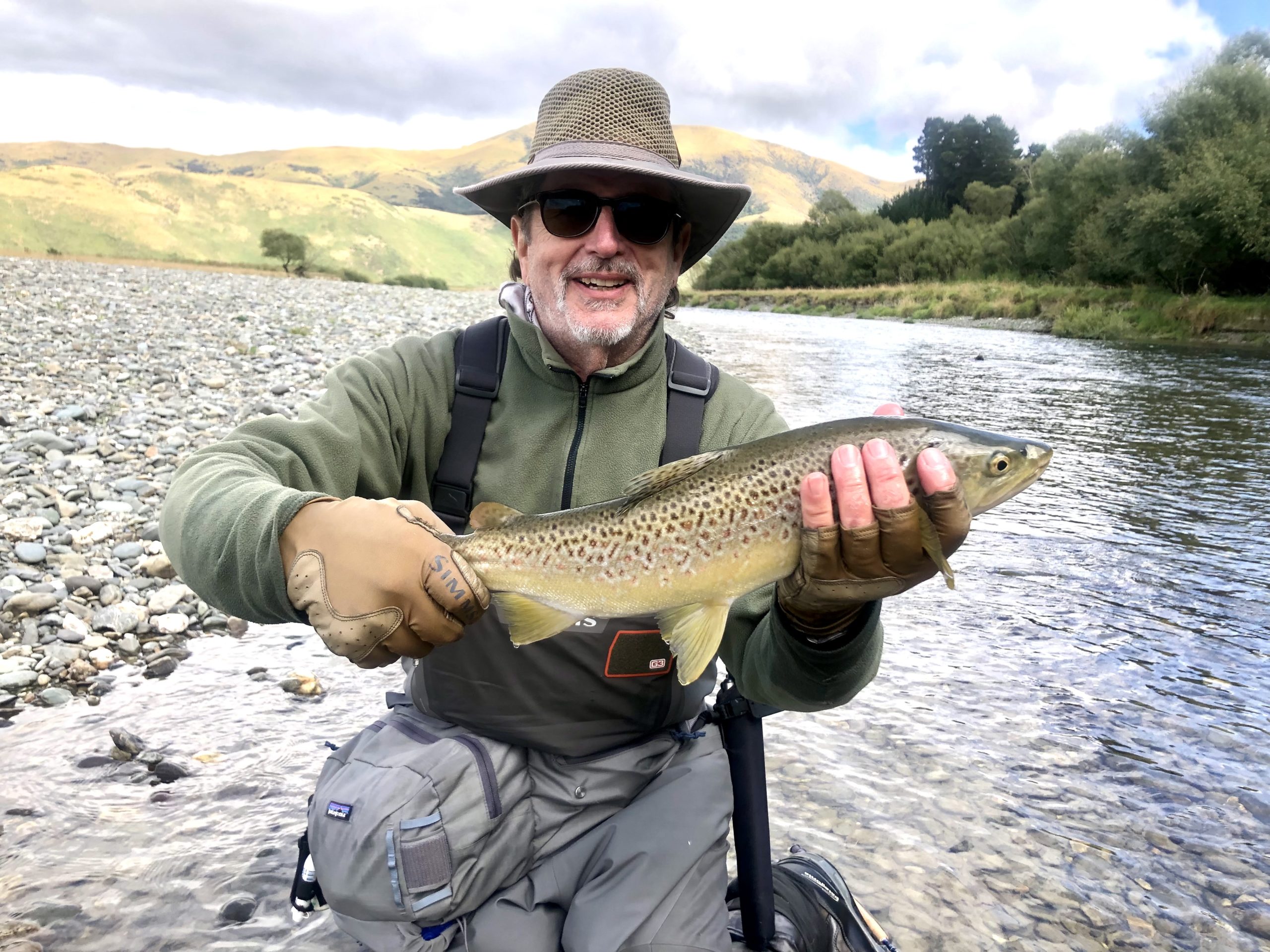
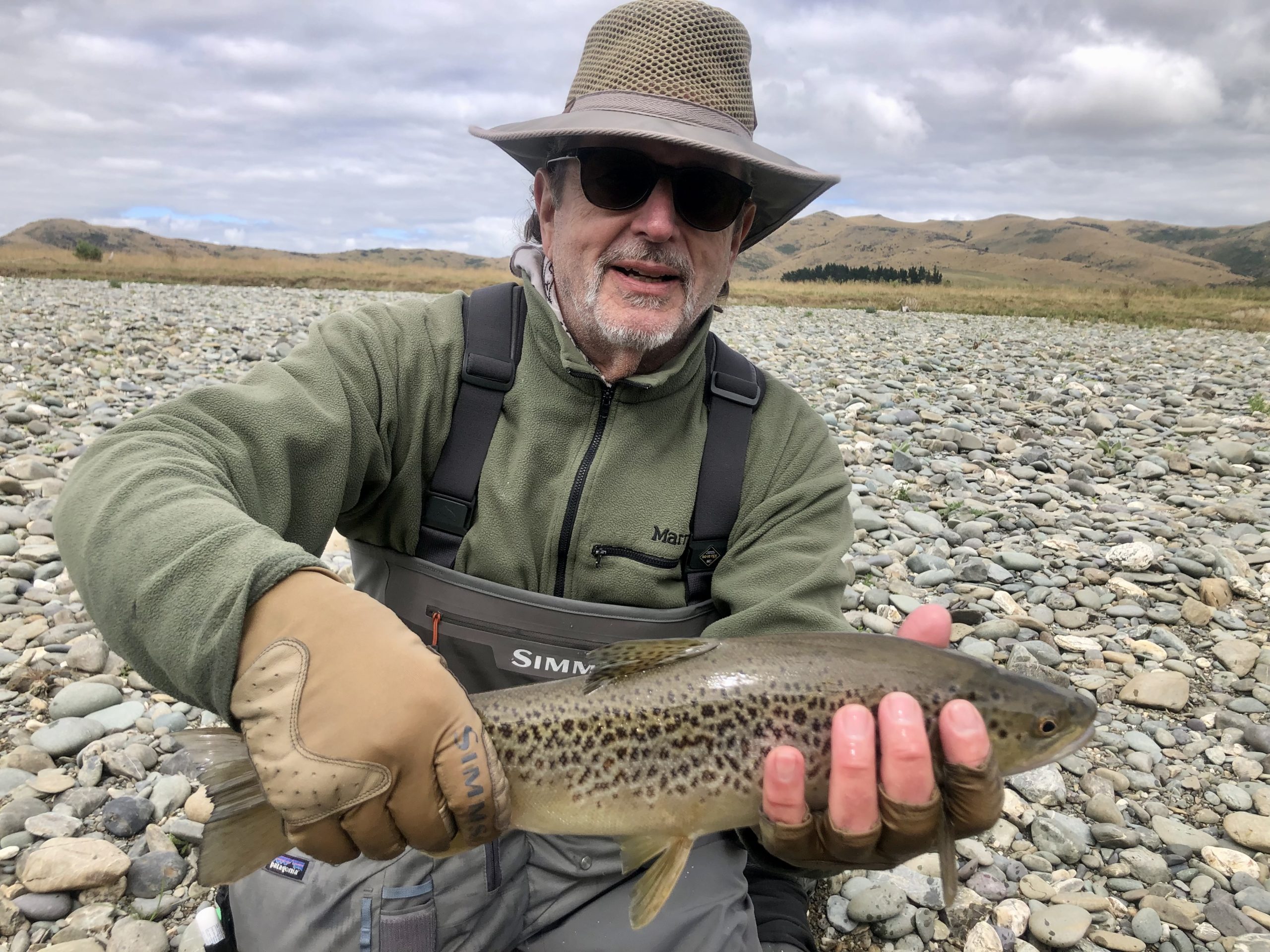
Good day. 3.0, 3.5, and 4.0 pound brown trout. Two on a dry and one on a nymph. Used the new 6 wt. rod. Walked about 5.4 miles.
Haupiri River – Day Two Morning – Robert’s Birthday!
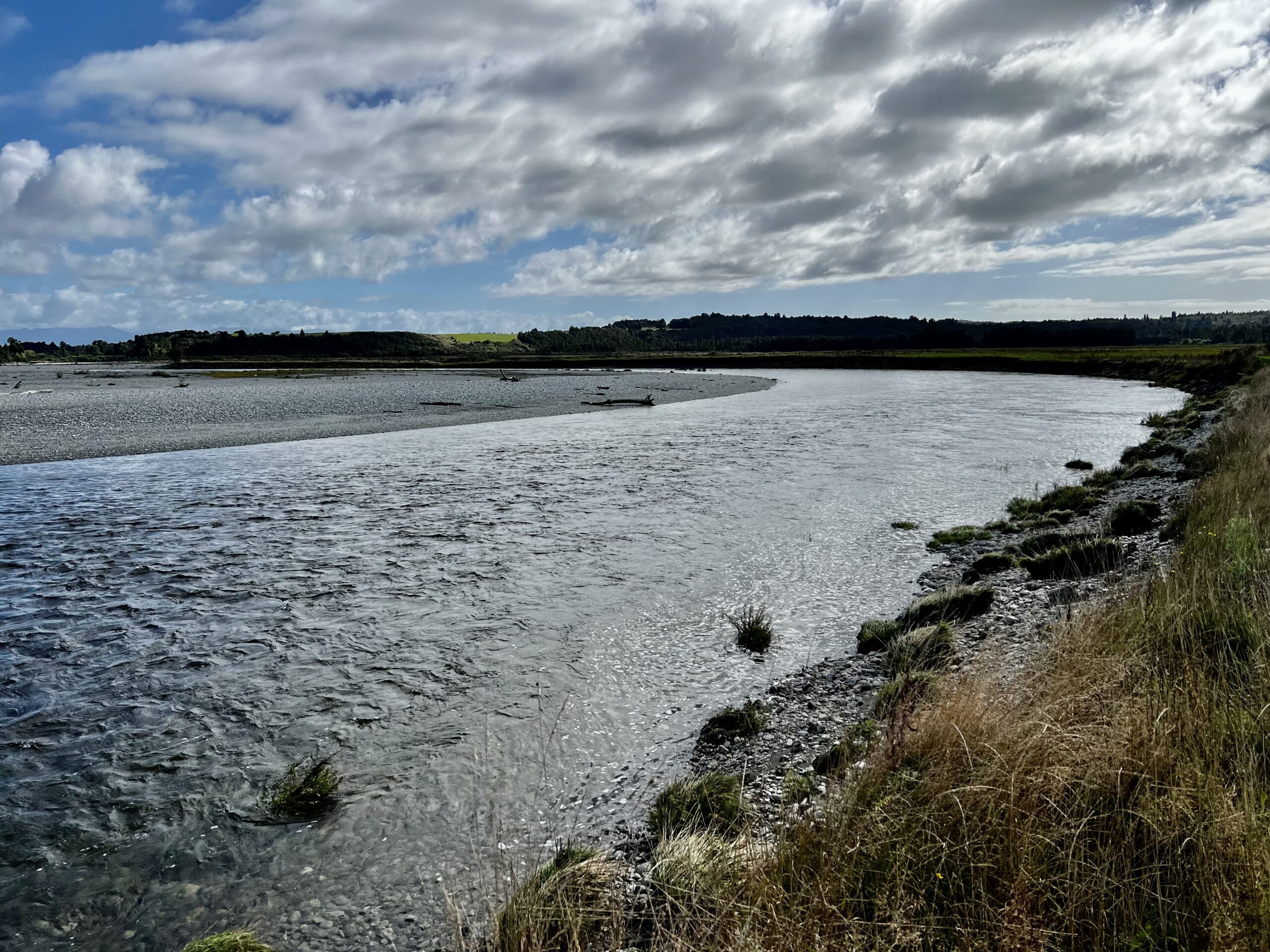
Beautiful river. Gin-clear water. Reminded Robert of some rivers in the lower Sierra. No fish
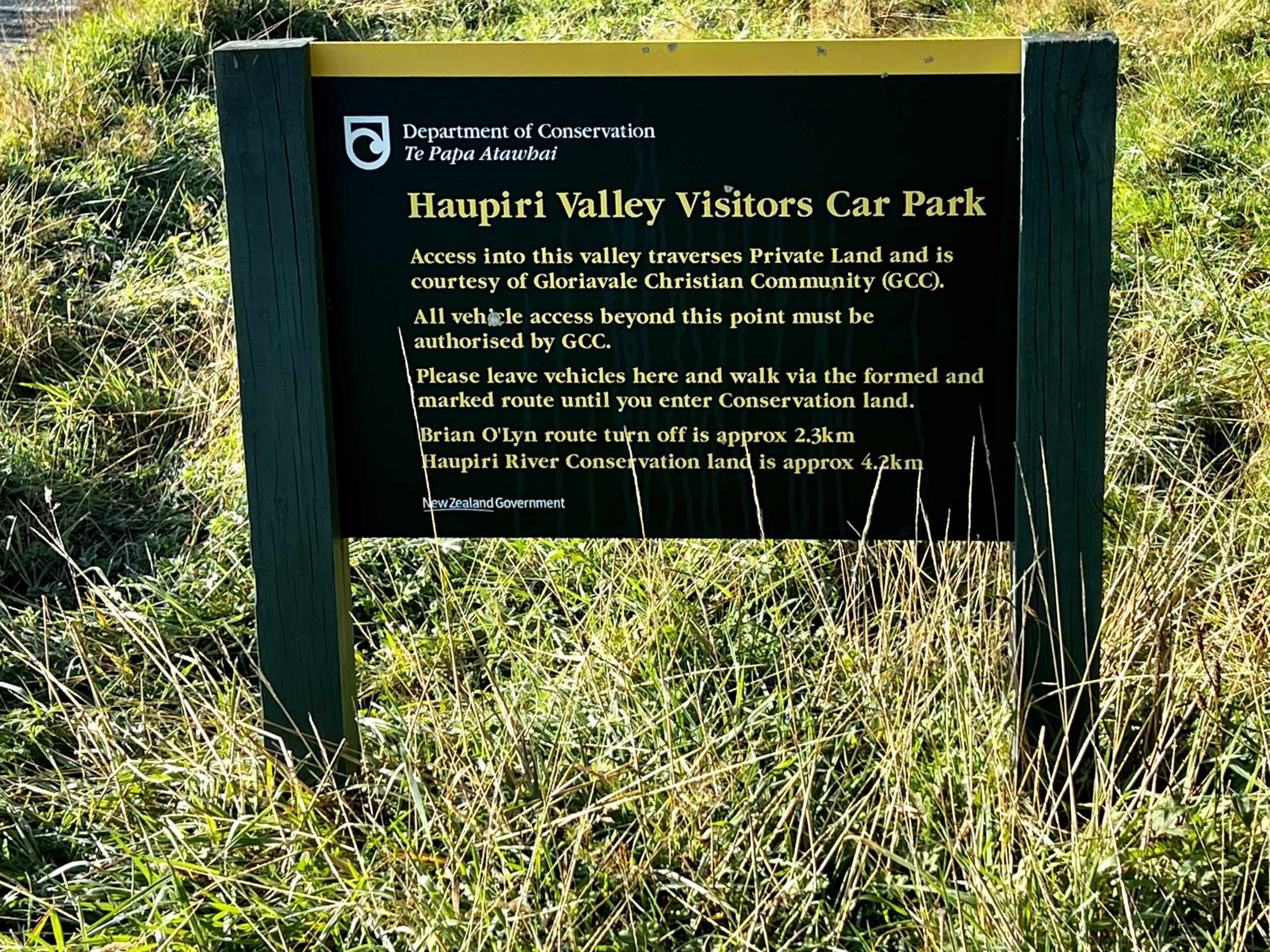
See our other post on Lake Brunner regarding the Gloriavale cult.
Lake Brunner – Day Two Afternoon
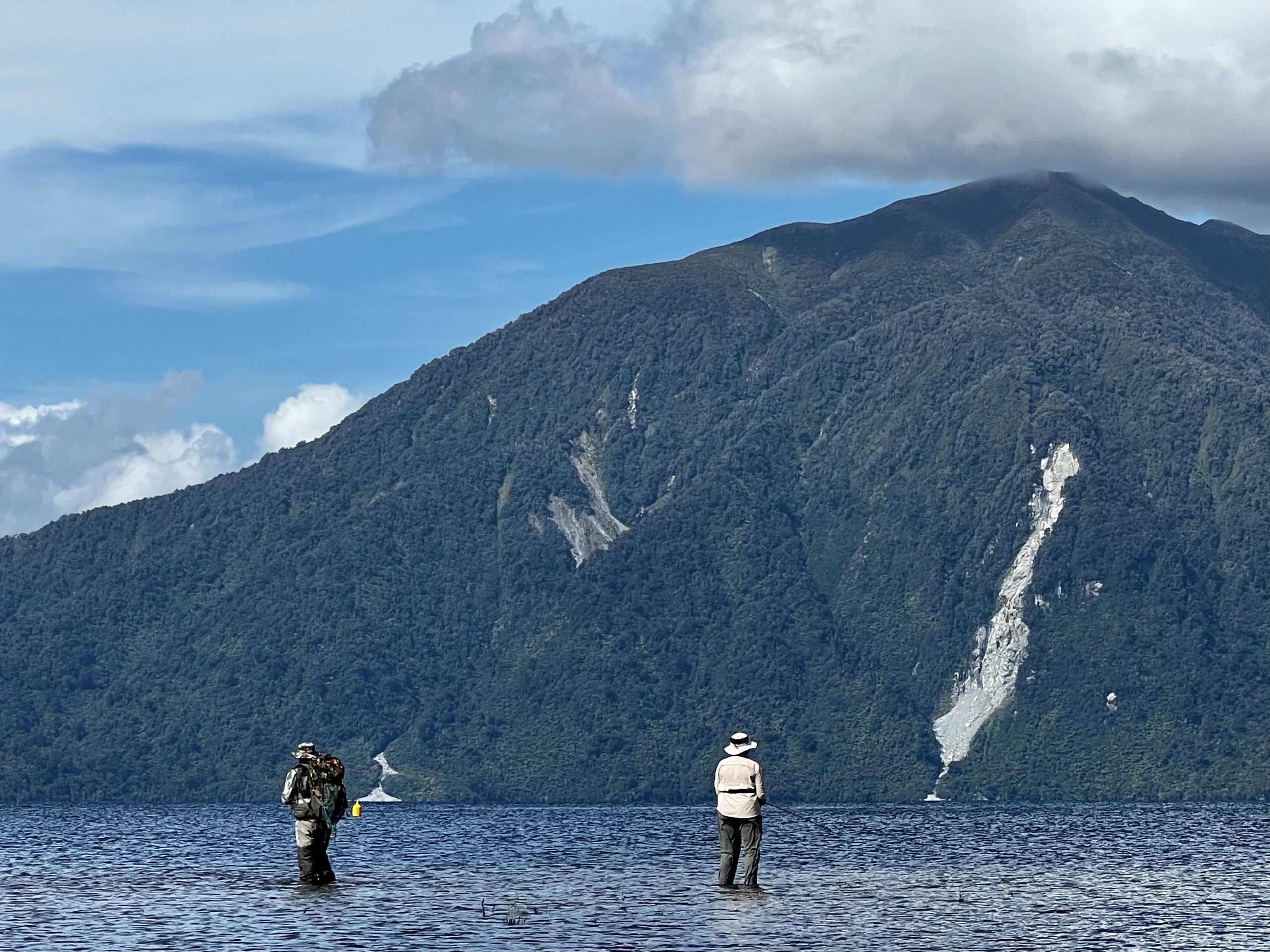
We split the day and returned to the lodge for lunch with Bonnie who then joined Robert and Charles in the afternoon to fish Lake Brunner. We entered the lake from the shore and worked our away around the lake edge. Did not spot many fish. Bonnie returned to the lodge after a couple of hours, while Robert and Charles continued around the bank and stayed out late. Perseverance paid off with a 2.75 pound brown trout. Beautiful colors.
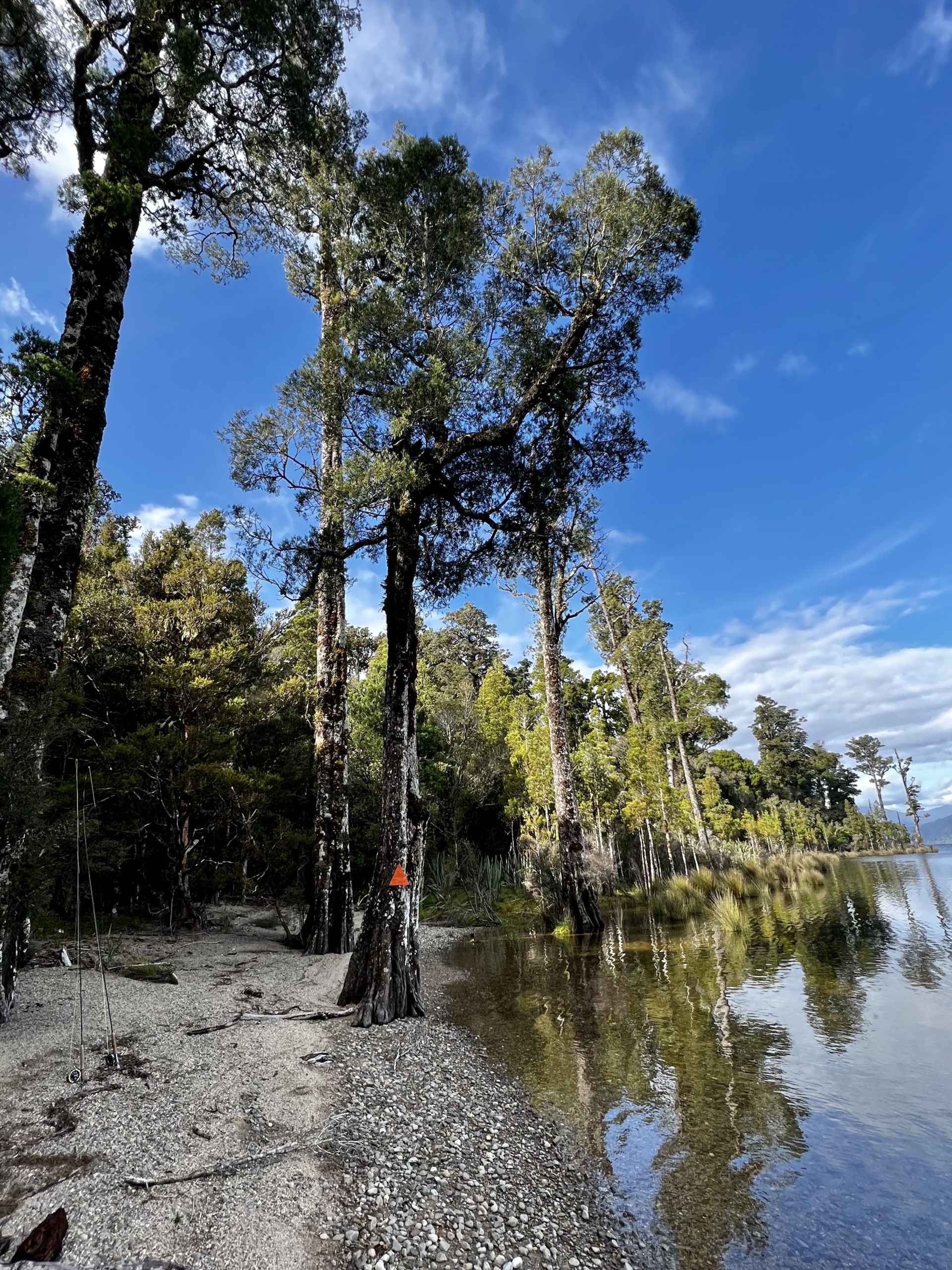
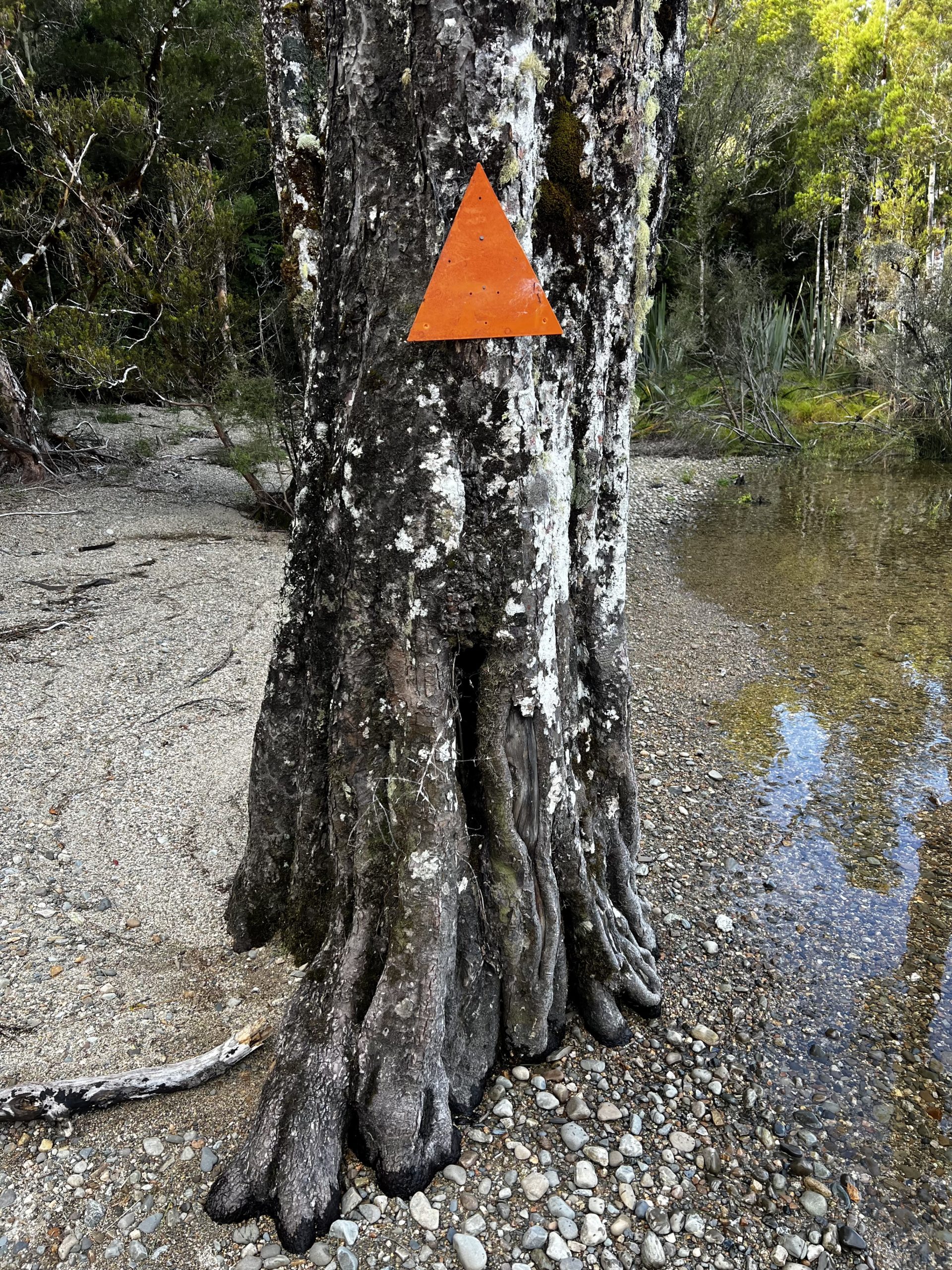
Trail marker.
Arnold River – Day Three
Good day fishing. Four out of the five strikes landed. All in the 2.5-pound range. All blind casting with a dry and one or two nymphs/midges; bottom of the two unweighted.
Town of Moana on the wayOn the wayCoffee for CharlesVideo! Fishing with Charles
Nelson
20 – 22 March 2023
Our guide in Nelson was Aaron Ford. He has been guiding for sixteen years, here in New Zealand, in Mexico, and in Alaska. Self taught and ruthless when it comes to getting to a better lie for trout. He will work his way through overgrown vegetation and cross rivers as he pursues his trout. To say he is passionate that Robert do things right is an understatement. He is avid that Robert take a trout on a dry fly but is known to go to nymphs if the weather and the hatches don’t provide the right conditions. When not fishing, he works for a native plant company.
Aaron is a strong believer in New Zealand with a bit of Kiwi skepticism about government and big business—something we have heard throughout our travels. Robert brought up the inconsistency of New Zealand promoting itself as a green country but still spraying for weed control. Aaron became quite emotionally defensive about how the US goes about it compared to New Zealand. His perspective is that while NZ uses a Monsanto chemical for controlling weeds, they do it selectively and not in concert with genetically modified plants. He believes that the US has completely depleted any nutrients from the soil because it has been too dependent on chemical interventions. So much so, that he thinks any produce from a supermarket in the US has no nutritional value whatsoever. Robert decided not to debate the issue. Aaron also does not believe that girardia can be spread by domestic and wild animals. He drank directly from the river and claims he has never been sick. Robert passed on this debate too.
Motueka River – Day One
Mixed weather today. The clouds came in and out making it difficult to sight fish. We did see a few. Spooked one, lost another on a slow strike, and landed two—one at 2.5 pounds and the other at 1.5. The smaller one was landed on a very slow retrieve when Robert thought the indicator had hit a rock. Aaron knew otherwise and was amused to see Robert realizing he actually had a fish. Turns out the midge had hooked the fish’s fin after the fish ejected it from its mouth. Robert got a lot more instruction on casting. Learning more and more with each guide.
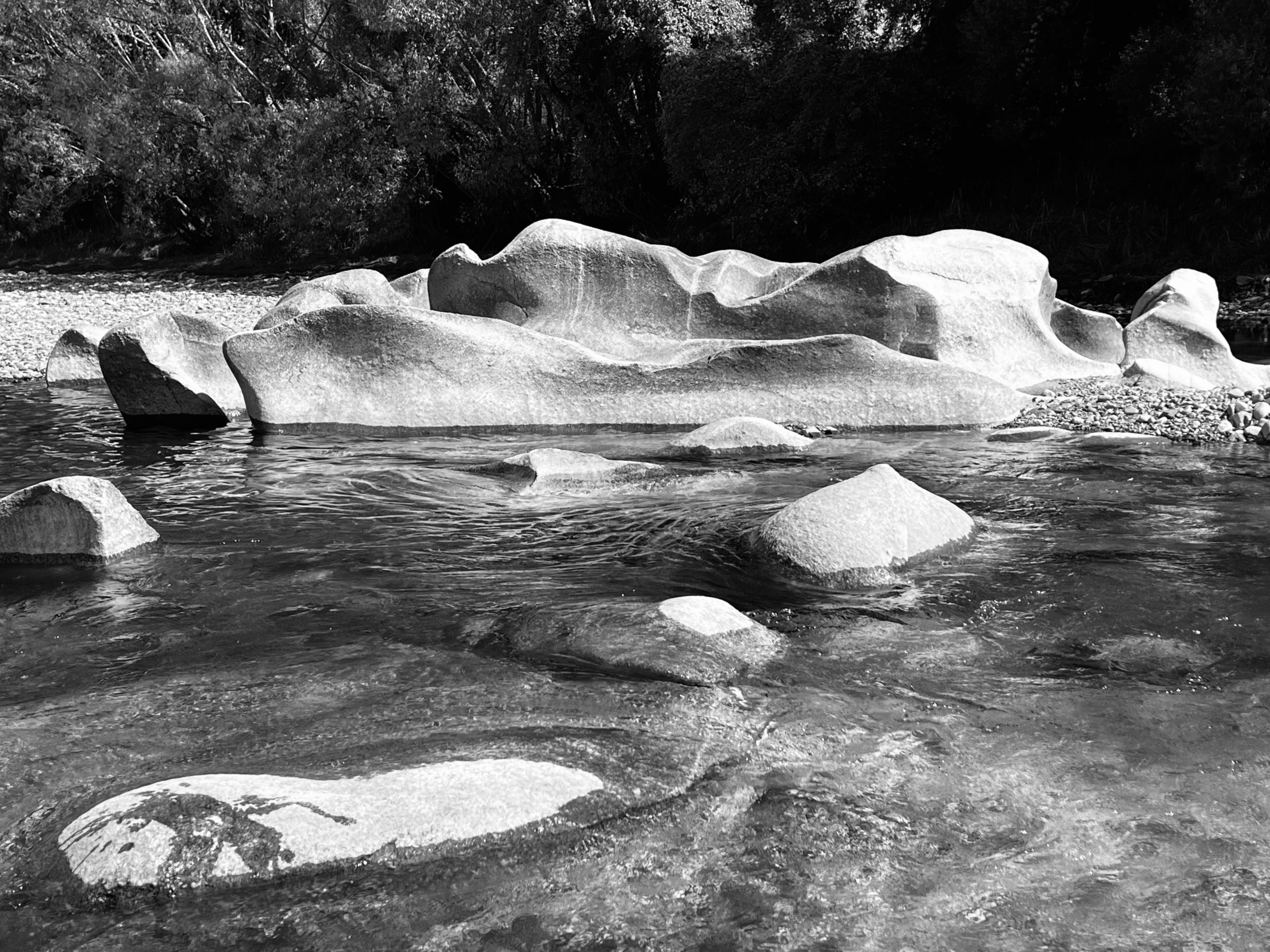
Henry Moore inspired?
Riuwaka River – Day Two
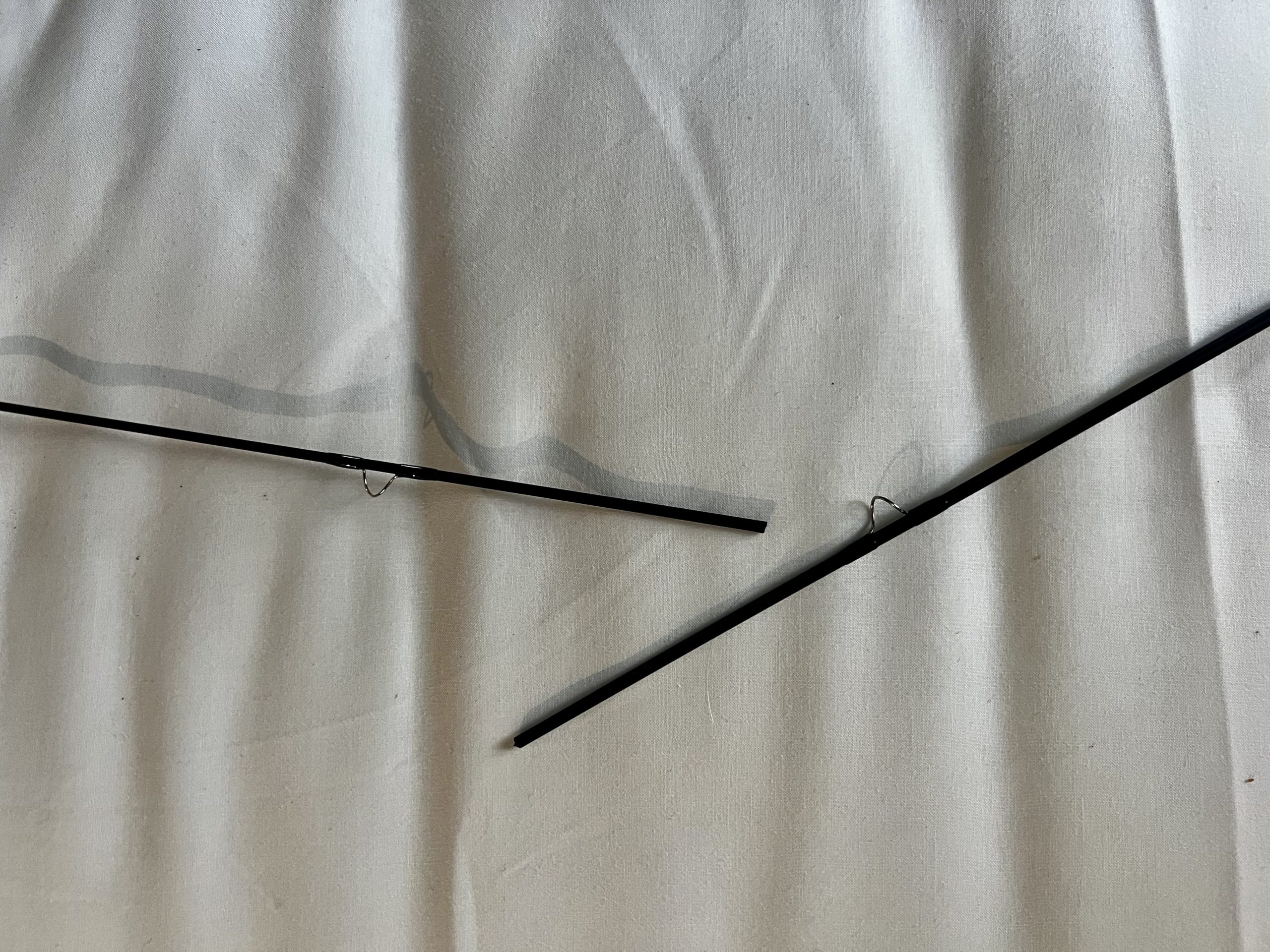
The weather cooperated more today. A bit more sunshine. Robert and the guide fished one river today on its upper, middle, and lower reaches. The river flows behind properties filled with kiwis and apples along with some private homes. This river is much more reminiscent of waters Robert has fished in California and Oregon. We sighted a few fish but did not land much until later in the day. Had four fish strike on midges and dries. One lost because Robert did not strip in the line fast enough. The other lost because Robert was too slow at setting the hook. The two that made it to the net were about 2.75 and 5 pounds, the largest to date! Unfortunately, the last fish cost Robert his new 6 wt. rod when it broke at the tip.
We did not bother him. He did not bother us.Kiwis almost ready to harvestBroken rod tipJust shy of five pounds
Riuwaka River – Day Three
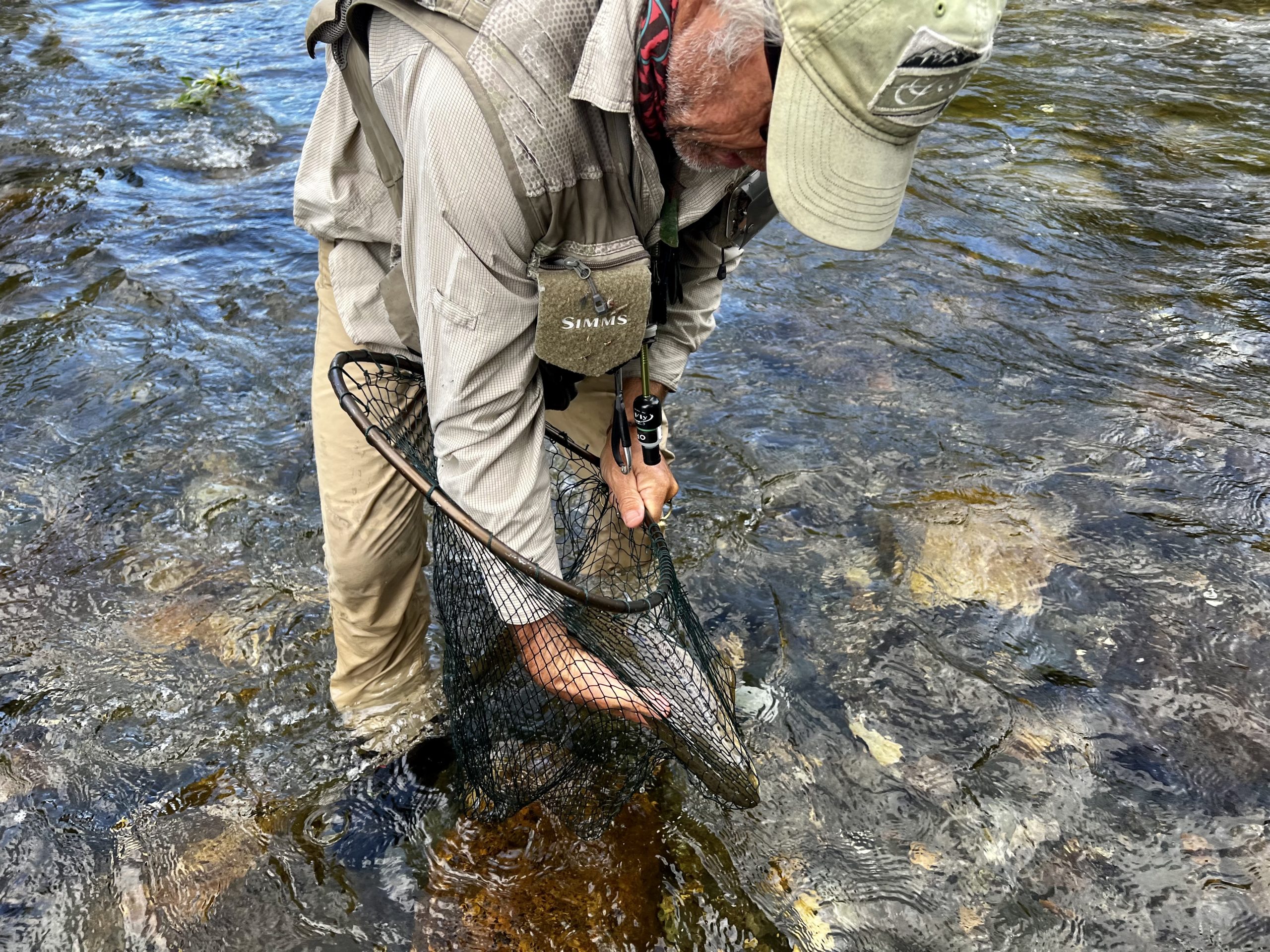
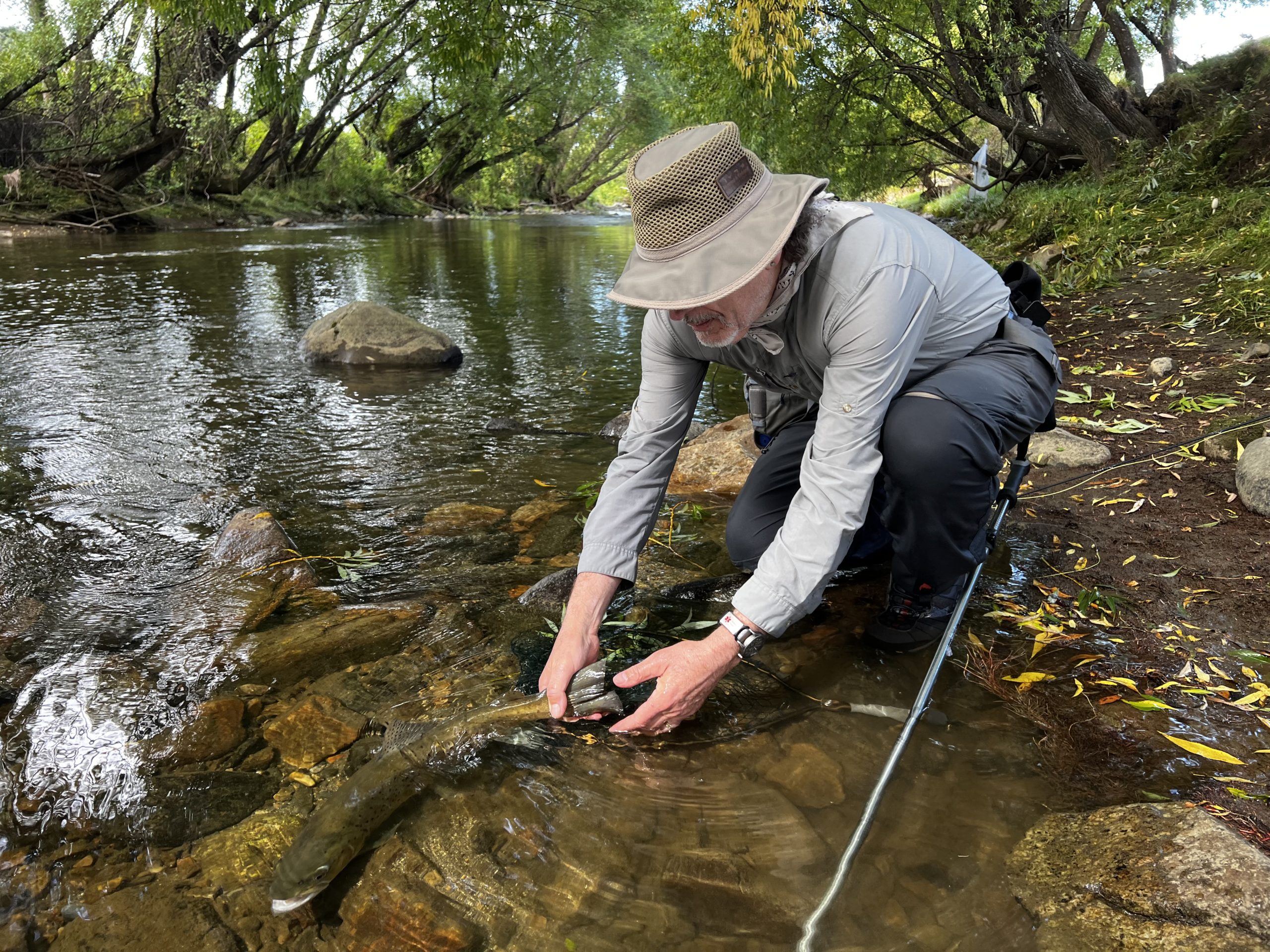
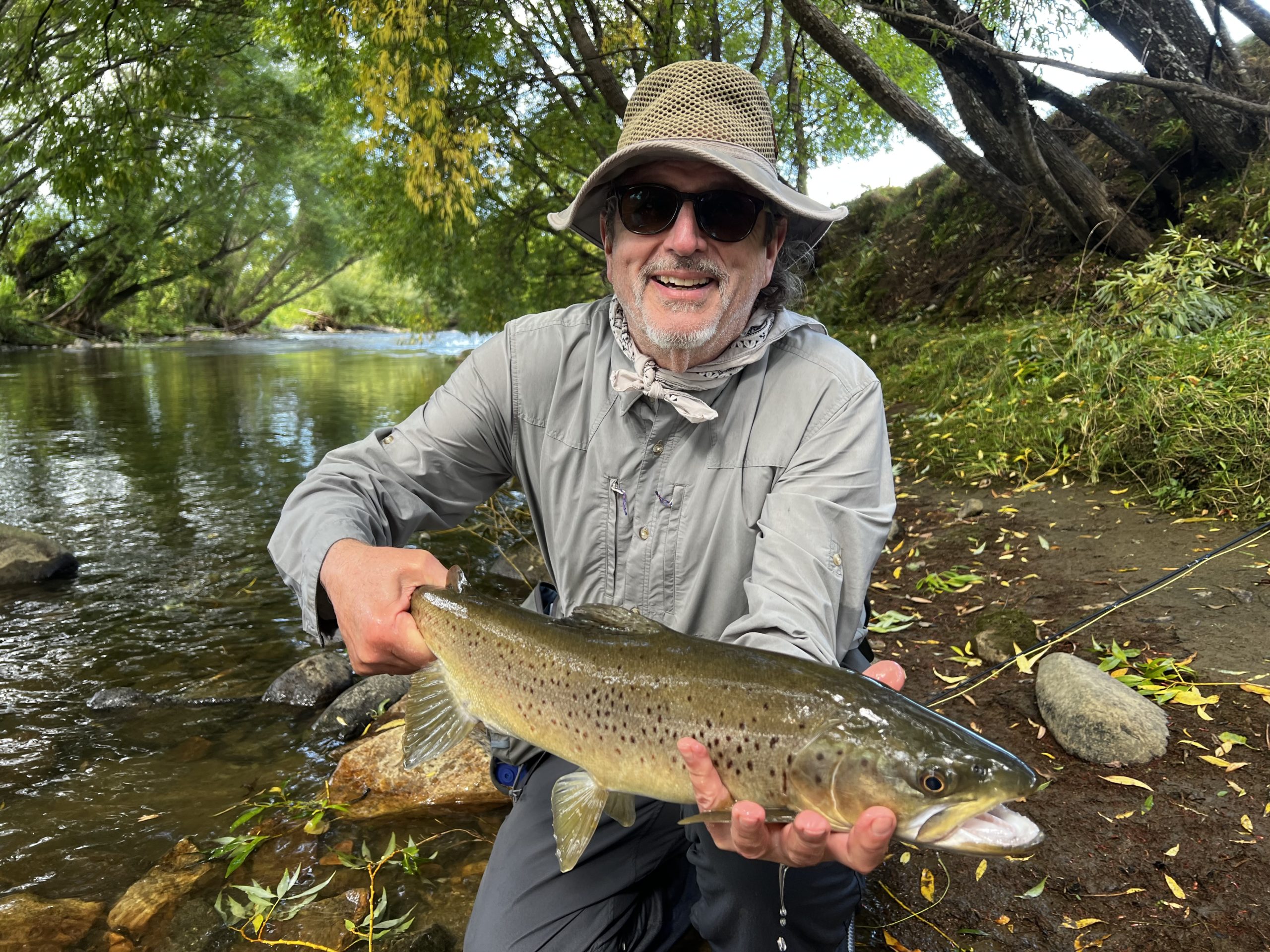
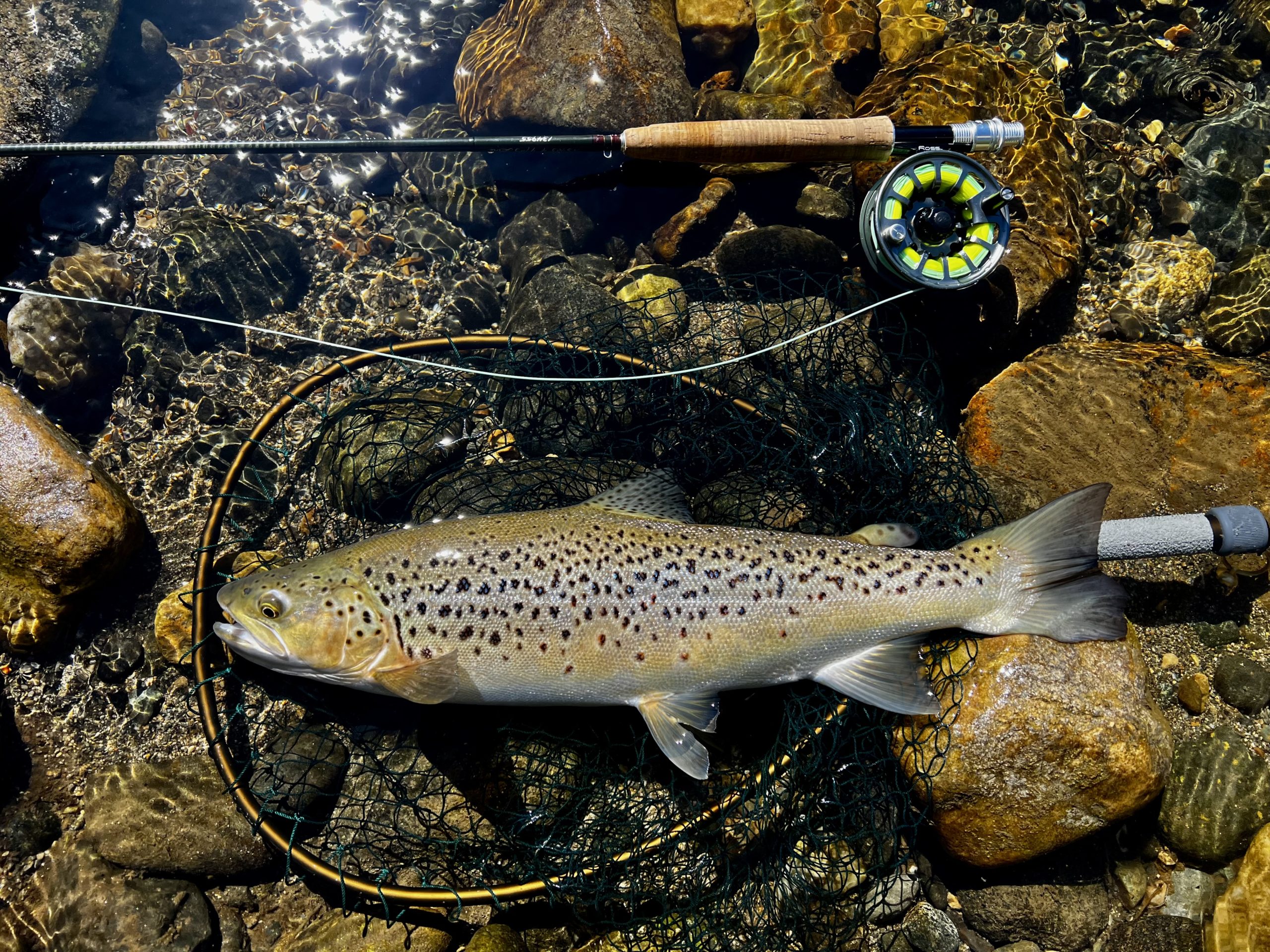
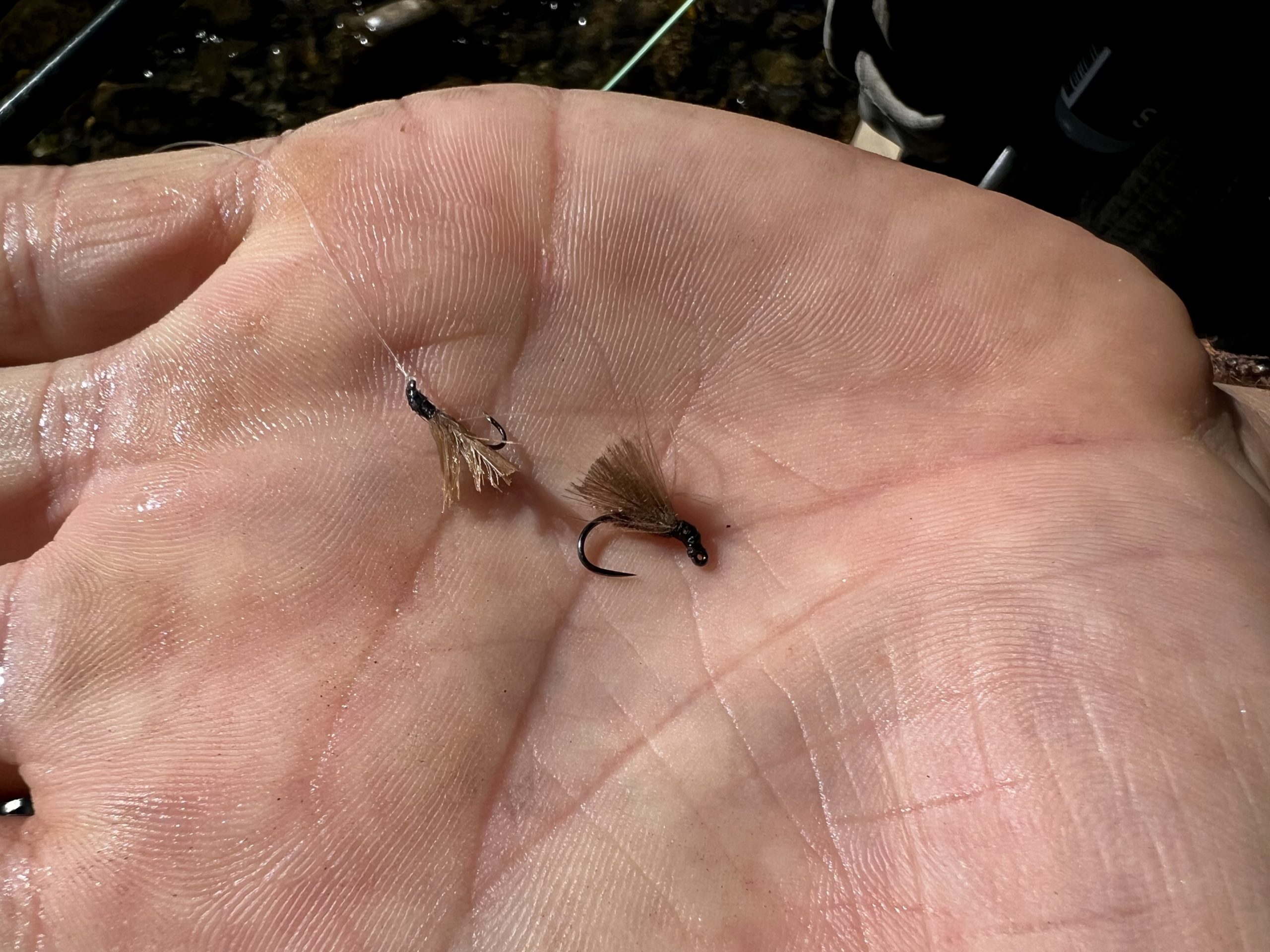
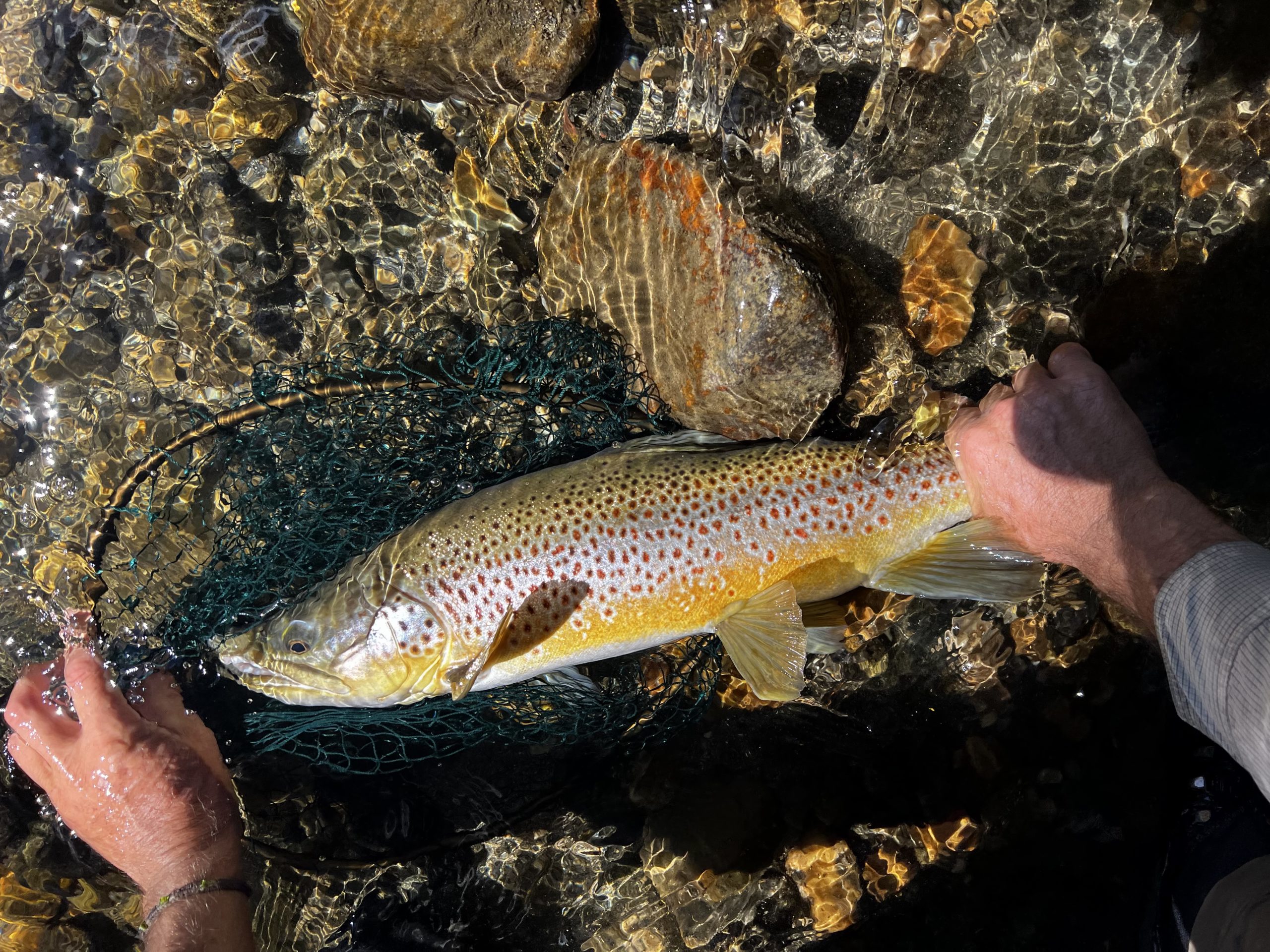
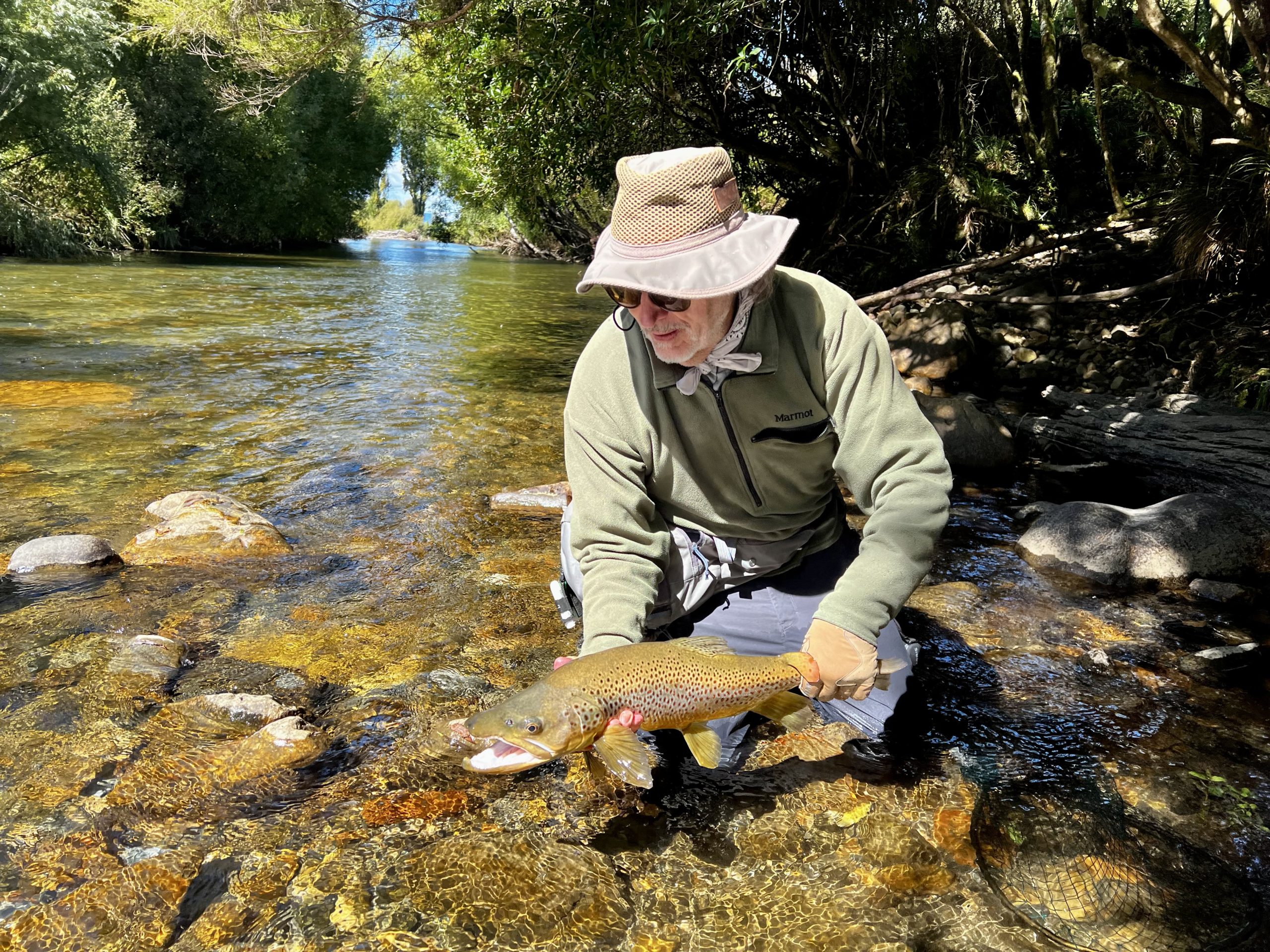
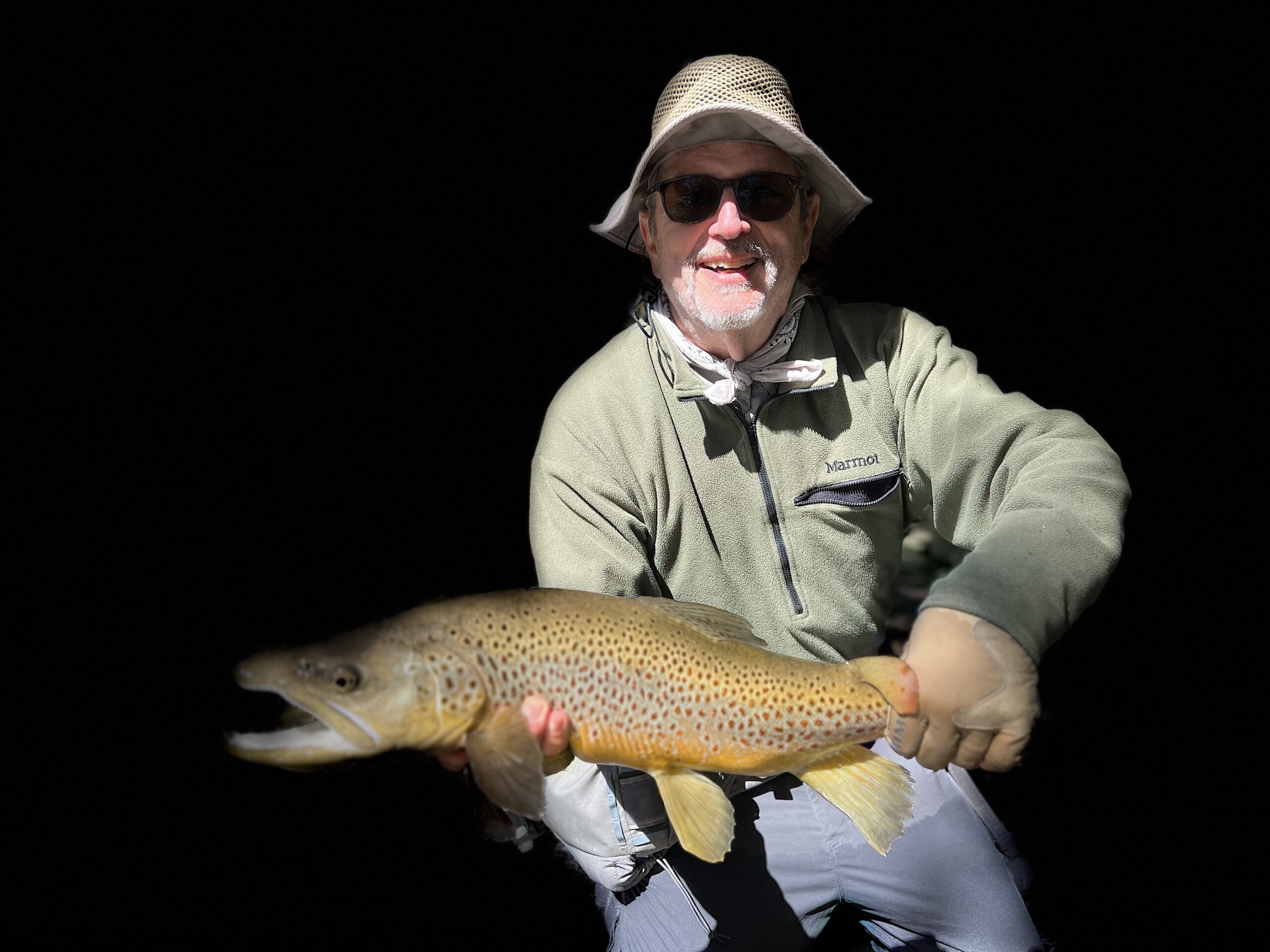
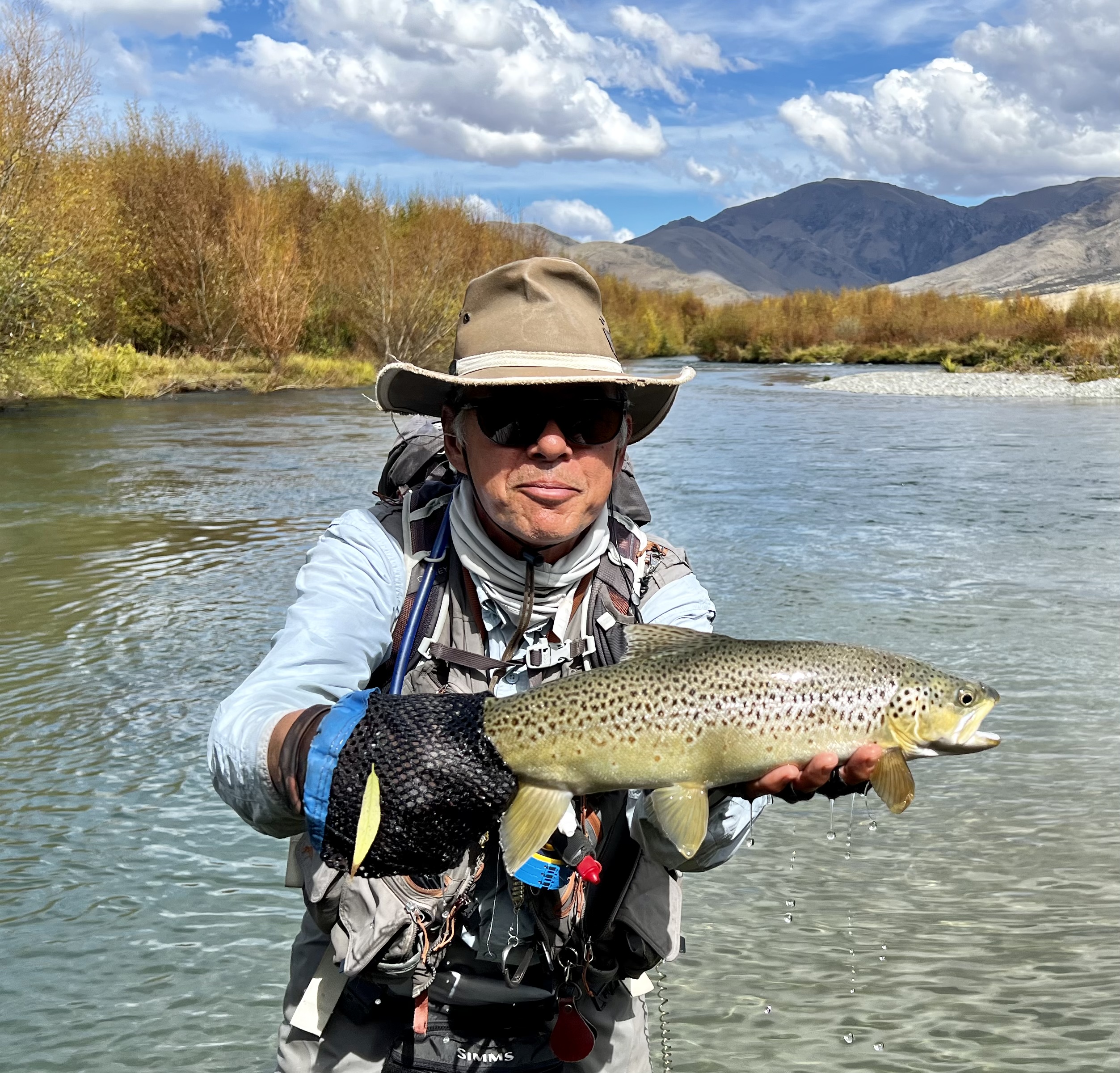
Because we had some luck on this river yesterday, we decided to return to the spot and work upriver. It was slow in the morning as we bushwhacked our way through the overgrown vegetation. By doing so, we accessed areas that had not been fished for a while. Robert fished his 5 wt rod. By the end of the day, Robert and Aaron did very well. Out of seven strikes, Robert landed four brown trout: 3, 4, 5 , and 6 pounds. By far the largest trout Robert has caught to date! Aaron said it was a good day. All caught on dry flies tied by Aaron-CDCs. He cut one of them back after he observed the fish weren’t taking the fuller version. Robert is still intrigued that these large fish will be in just two feet of water gently slurping flies that float by.
Six pounds!New Zealand is full of surprises. It is legal to drink and drive if you are not drunk. Go figure.
Postscript
23 March 2023
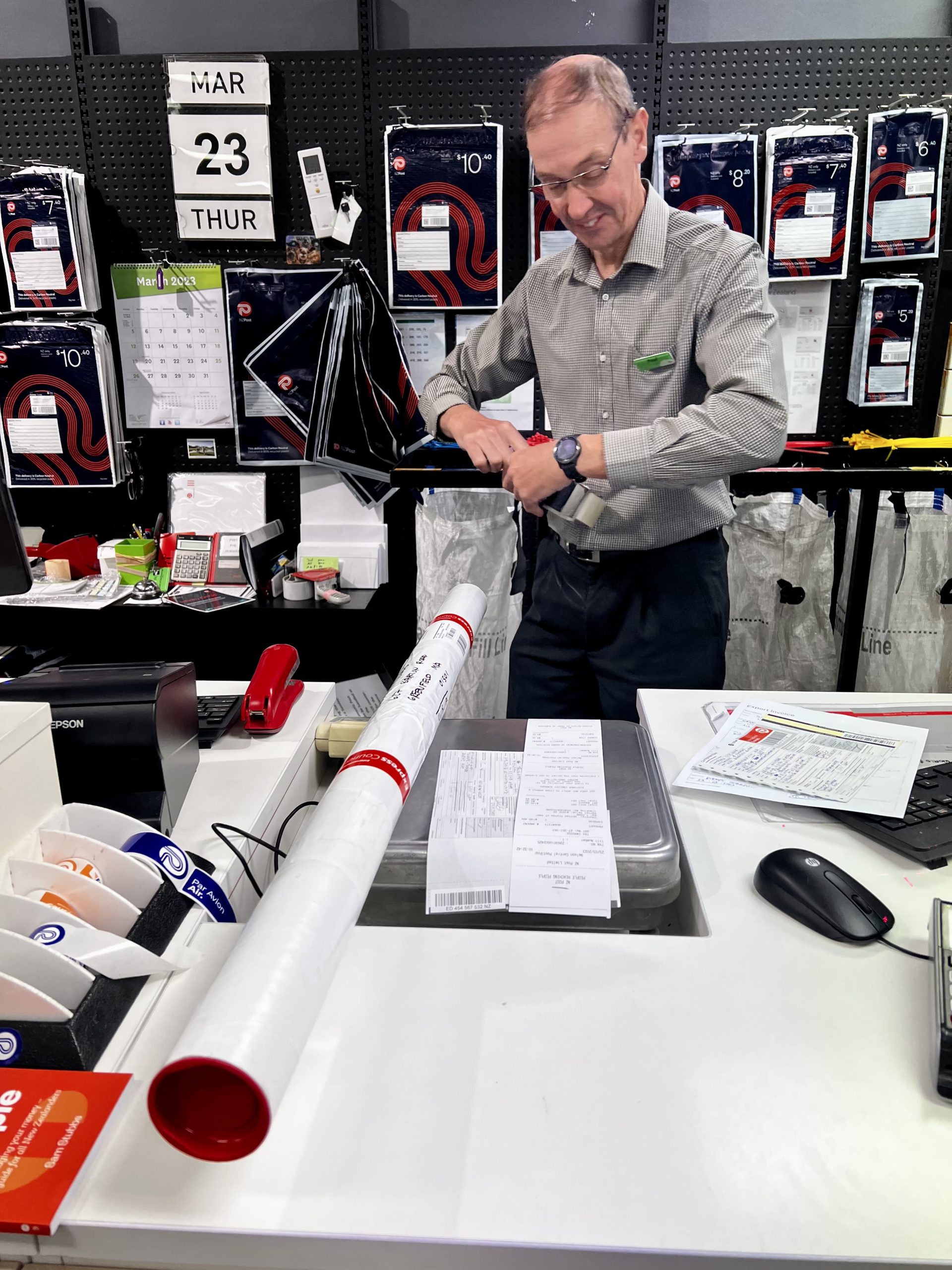
Robert went to the NZ Post to ship his broken rod back to the US for repair along with an additional rod tip. The gentleman at the counter was extremely helpful.
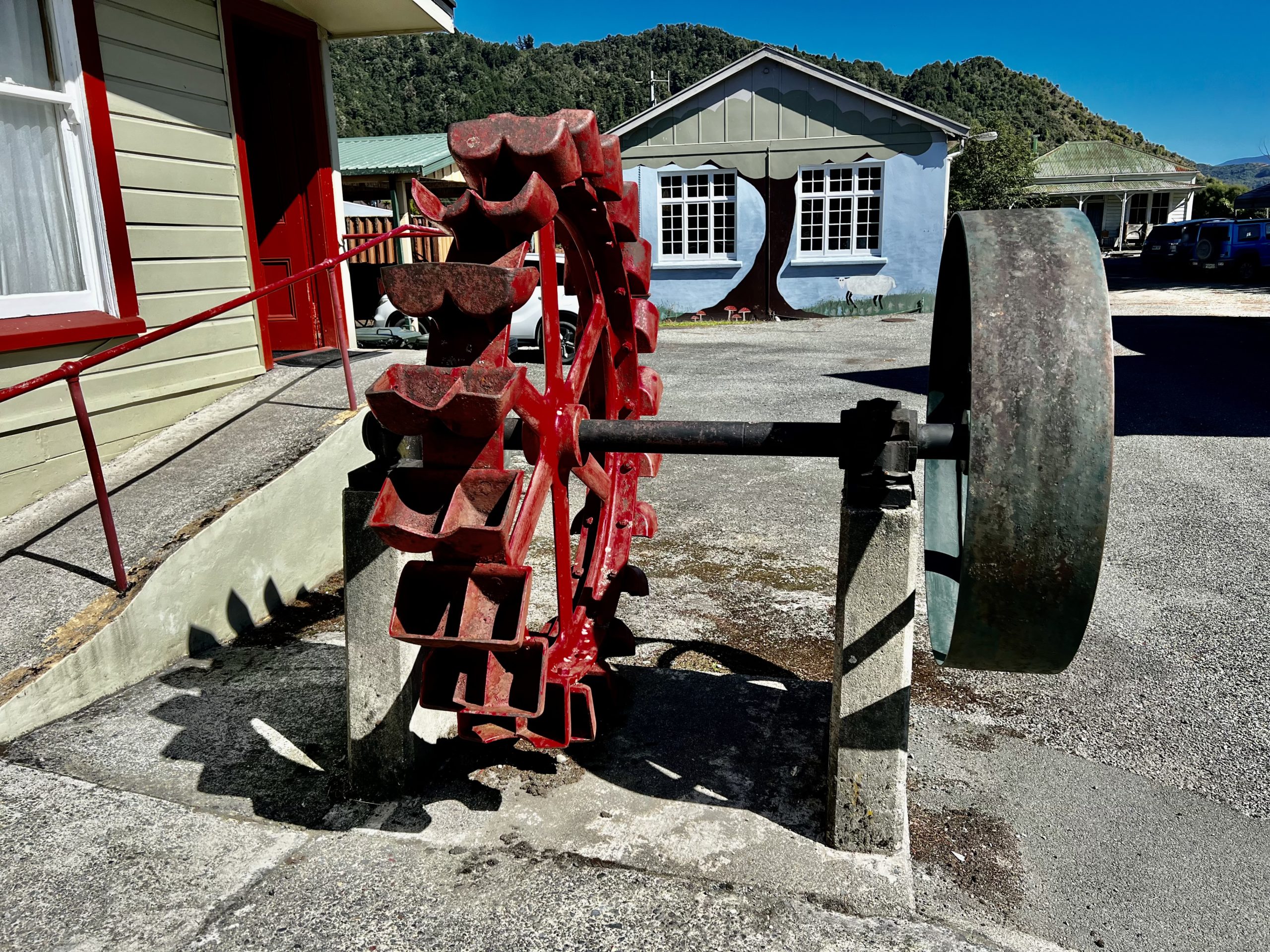
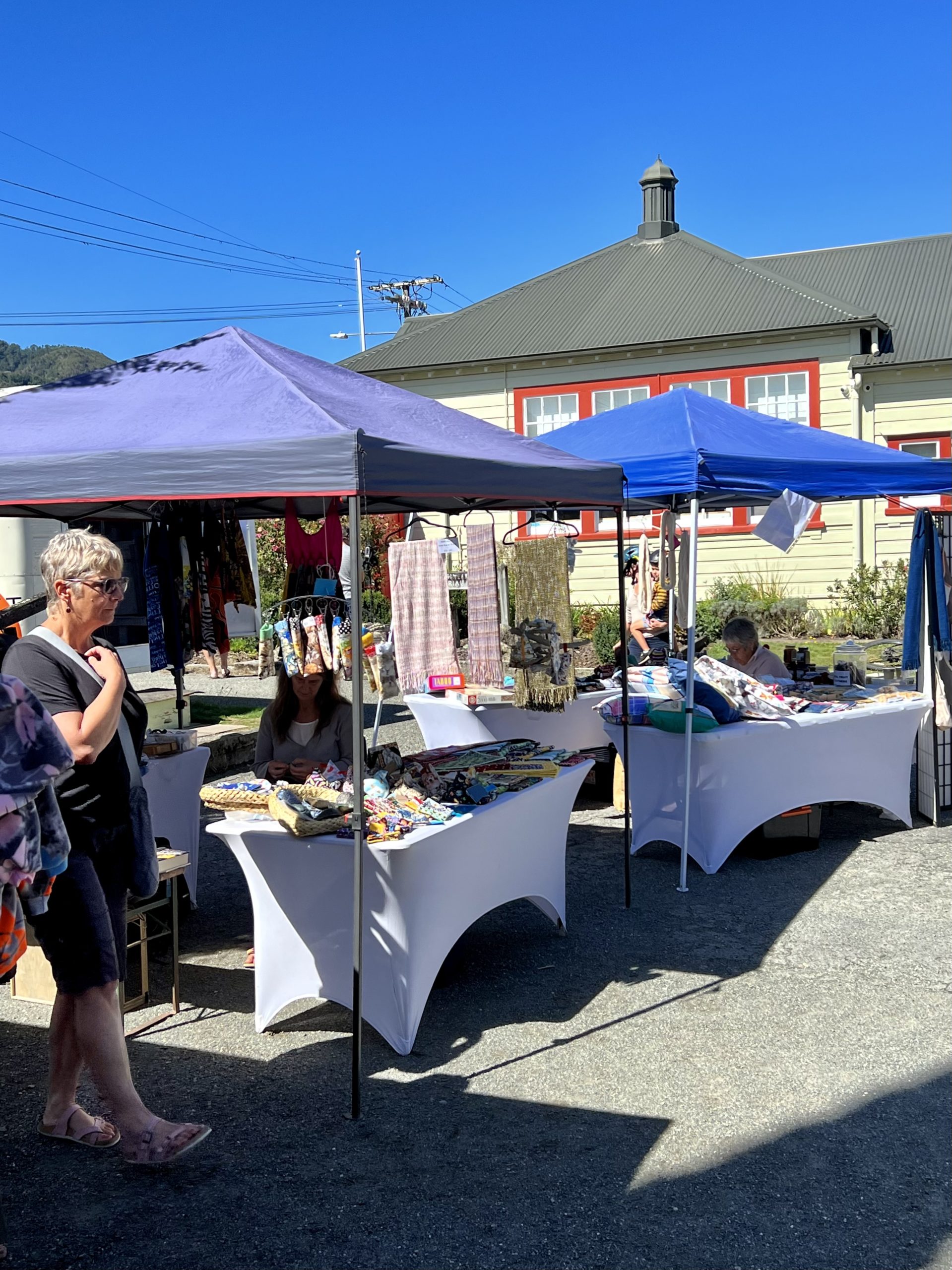
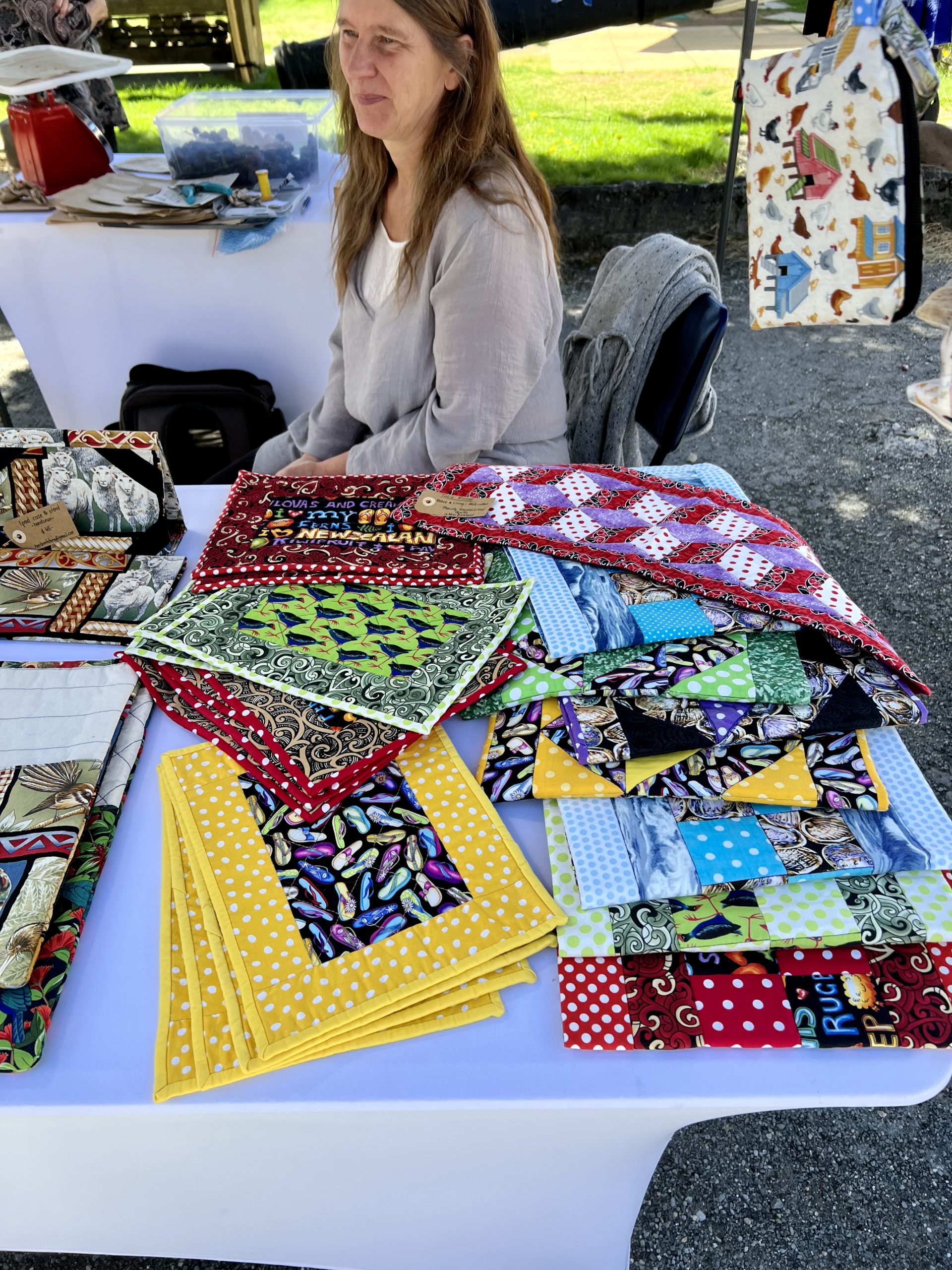
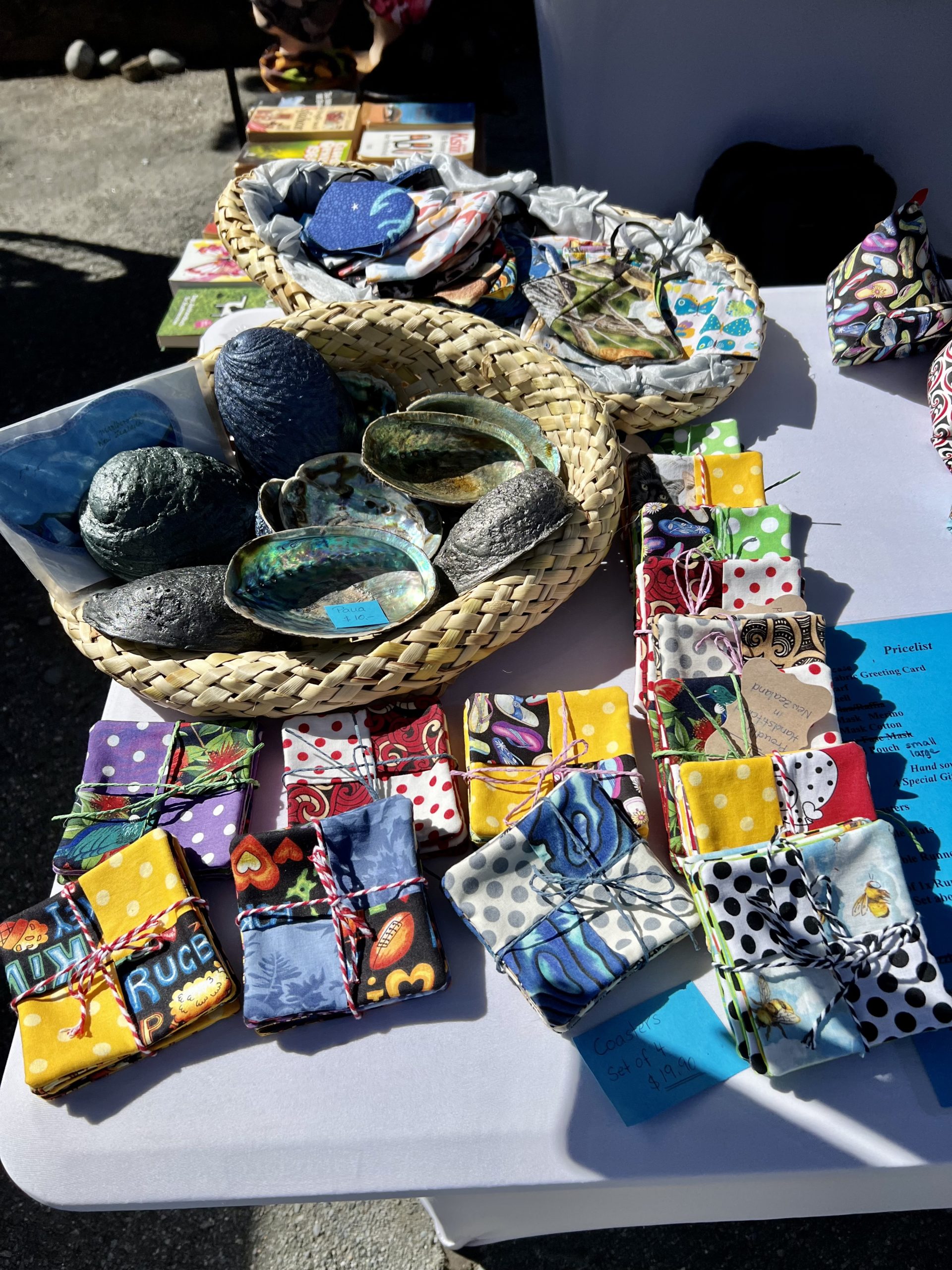
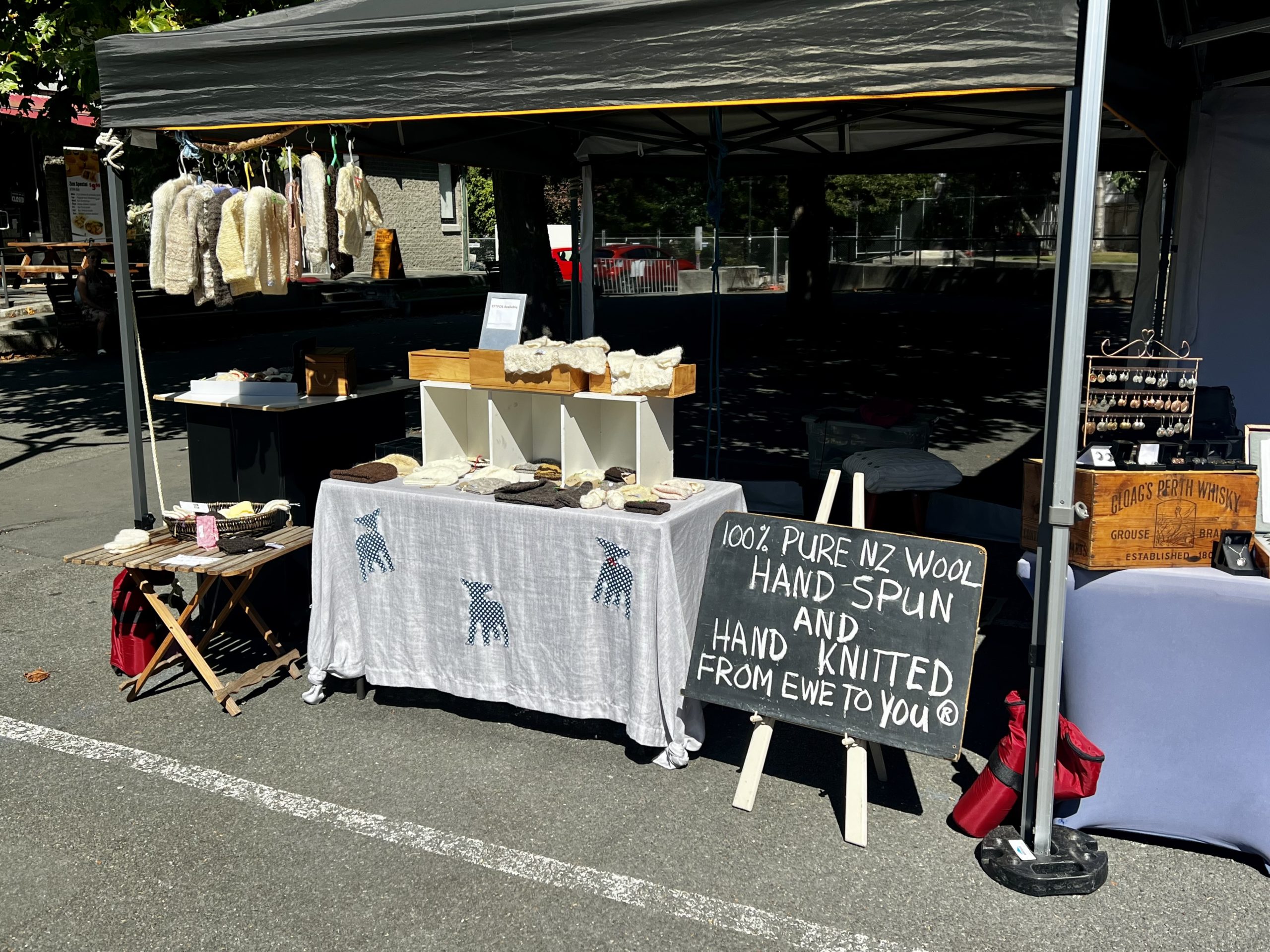
The rivers were muddy because of the recent rains.Jimmy Walsh- a Pelton wheel!Emily Colegrove: the only quilting I have seen. Knitting is much more popular here where wool is abundant.Small crafts market in Murchison. Reminded Robert of weekend trips with Jane and Carolyn in Massachusetts and Rhode Island. Stopped here for lunch too.First sighting of vineyards!
Accommodations
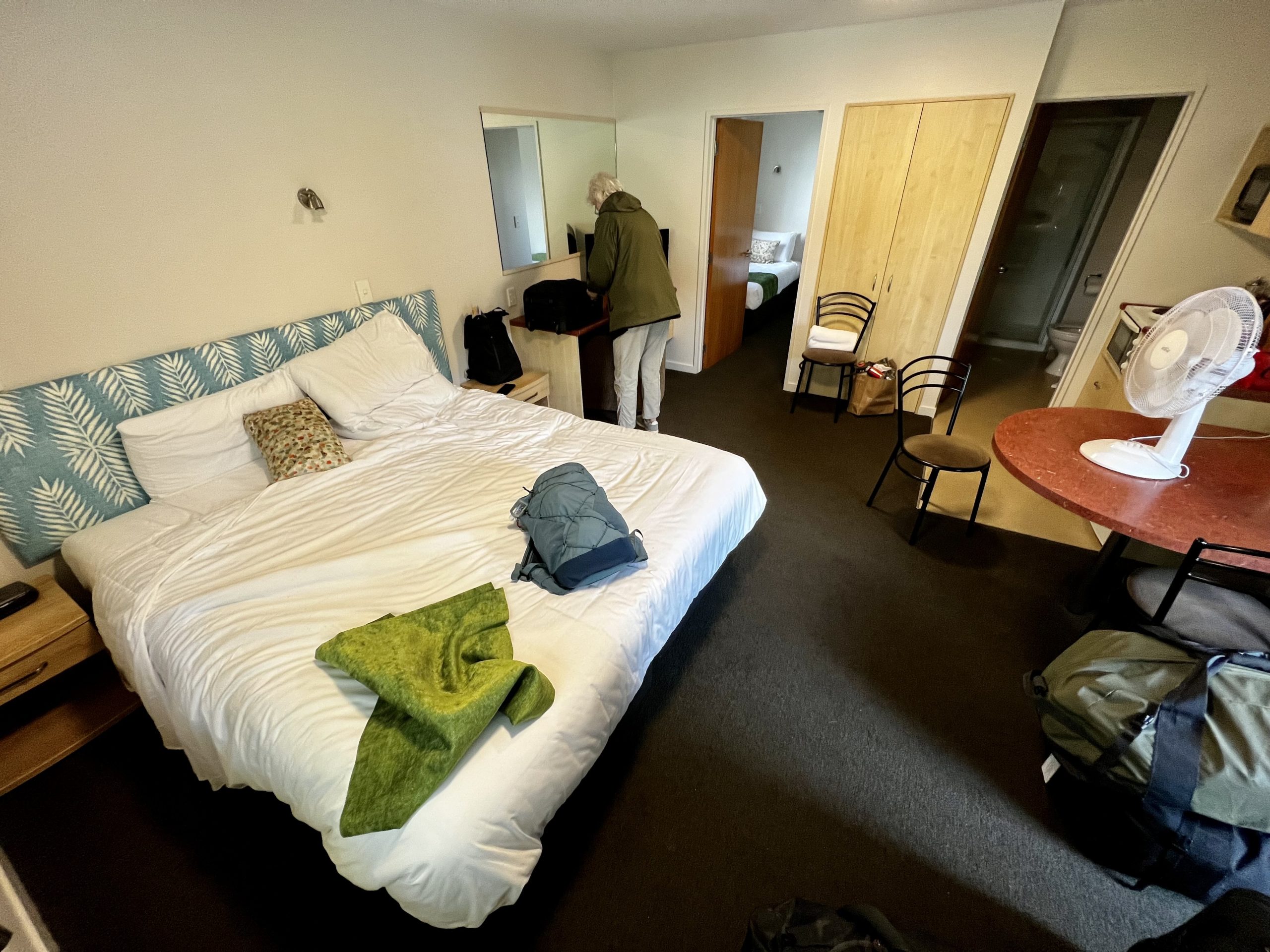
Bella Vista again. Hard-working proprietor. Very nice guy. Only seven minutes from the airport but ten minutes by car to the central retail area of Nelson. Too far for Bonnie to walk so she had to get brave and drive herself on the left side of the road.
Strolling and Exploring
Established in 1841 and becoming a city by royal charter in 1858, Nelson is the oldest city on the South Island and the second oldest in all of New Zealand. It was settled by the Māori in the early 1300s. While first unsuccessfully settled by a London-based company, Nelson went through both prosperous and lean times in its growth and relationship with the Māori. Today, it appears to be a prosperous economic hub and is known for arts and crafts. Many of the new houses on the surrounding slopes look impressive.
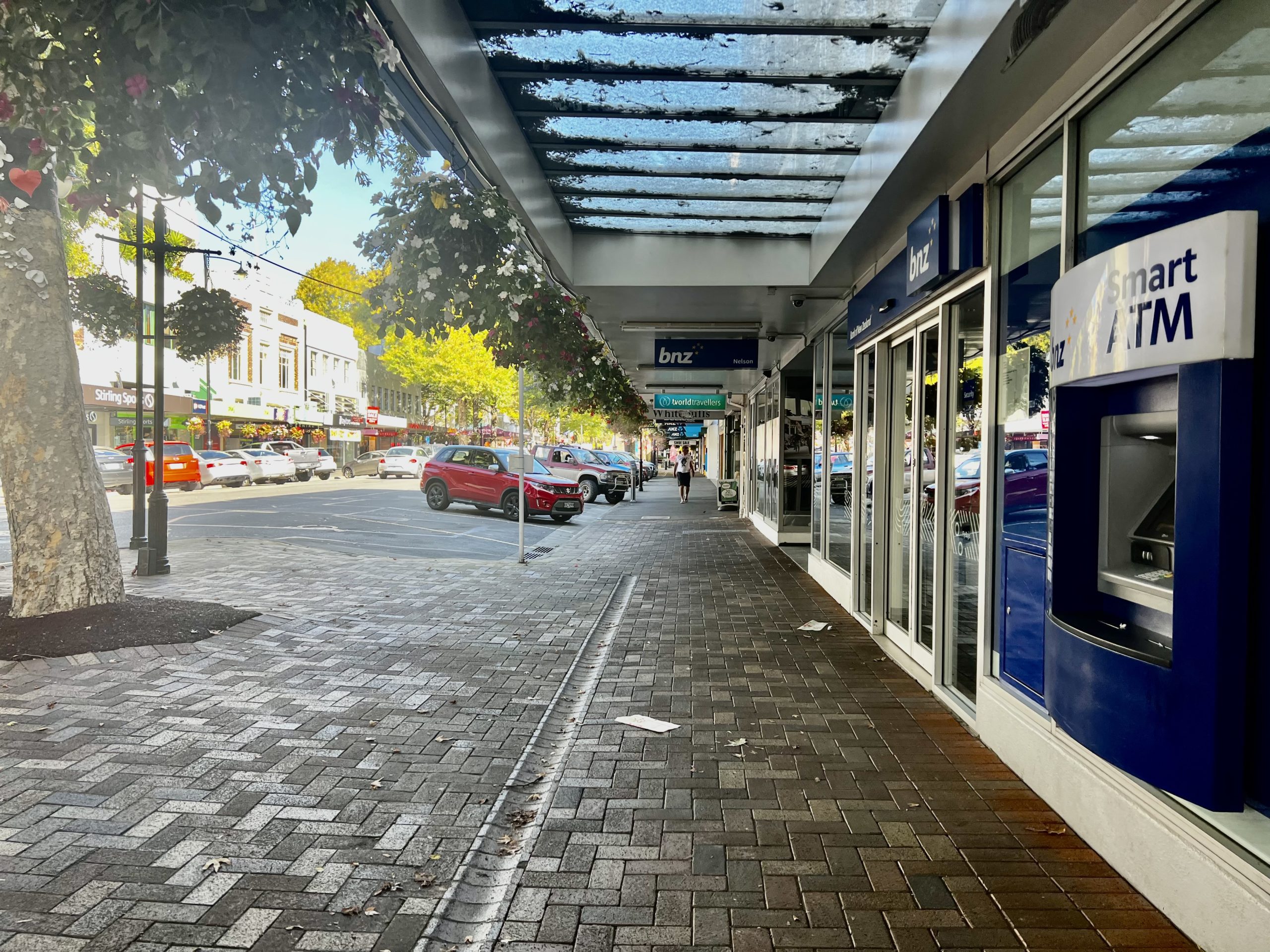
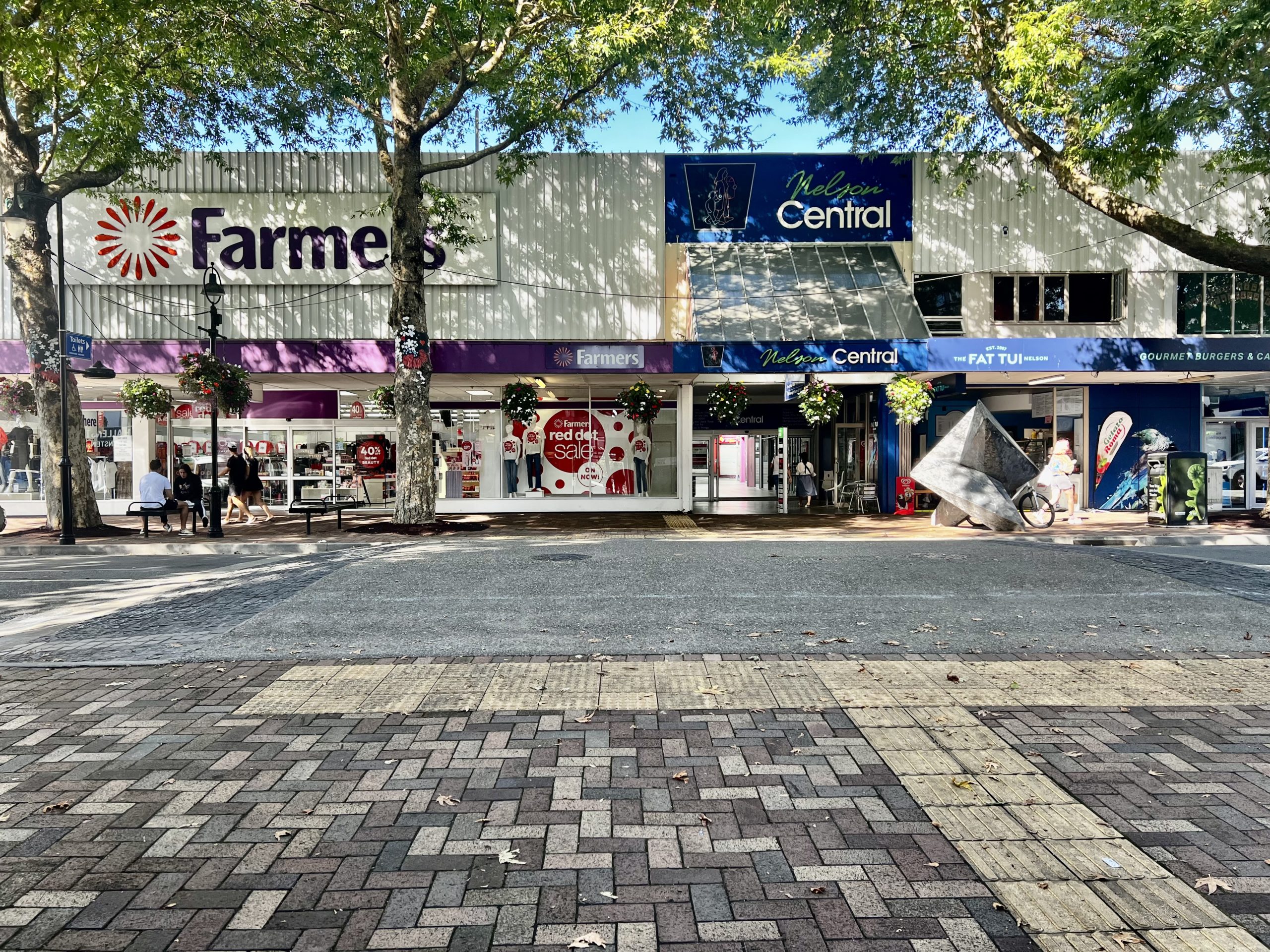
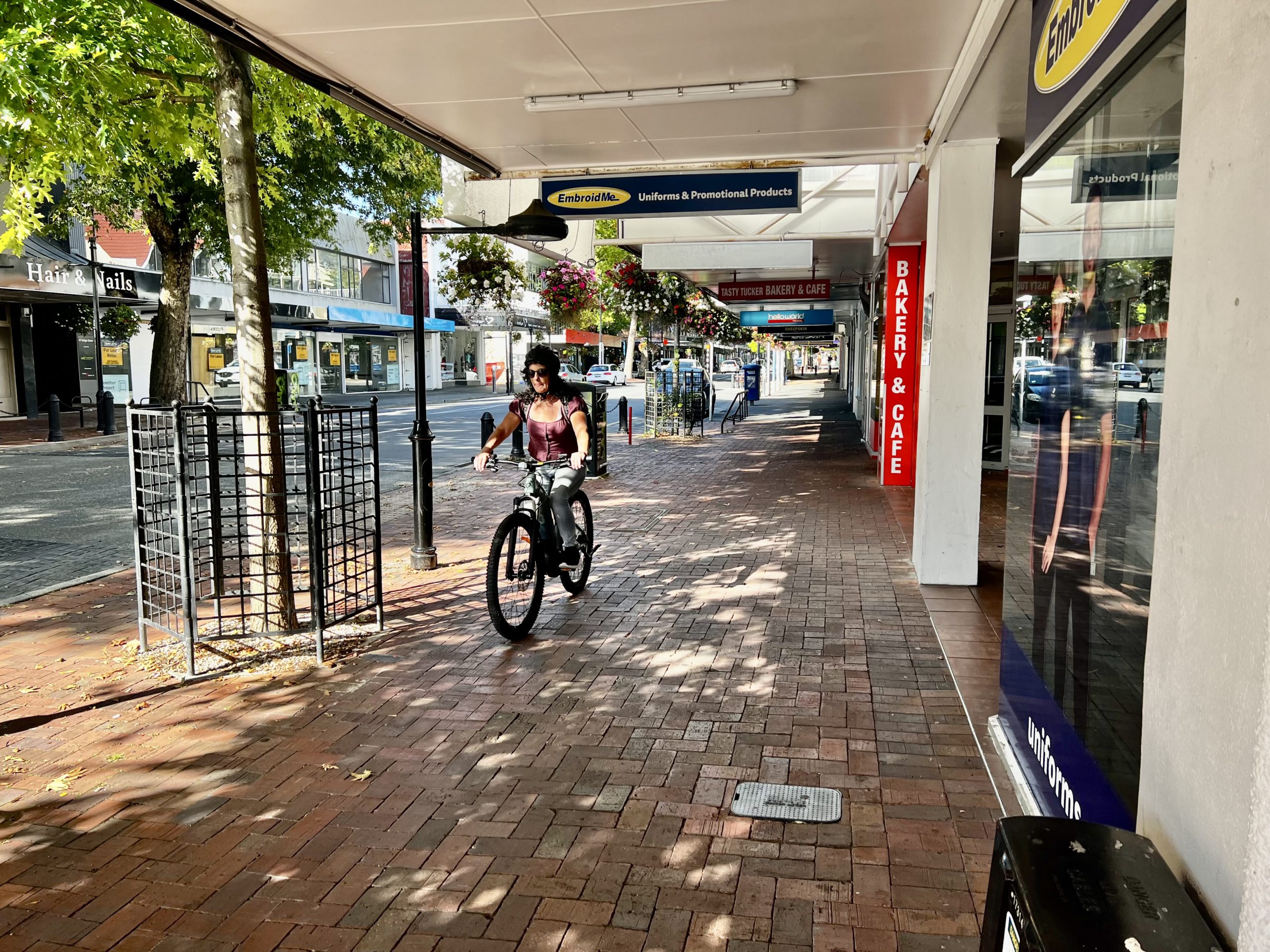
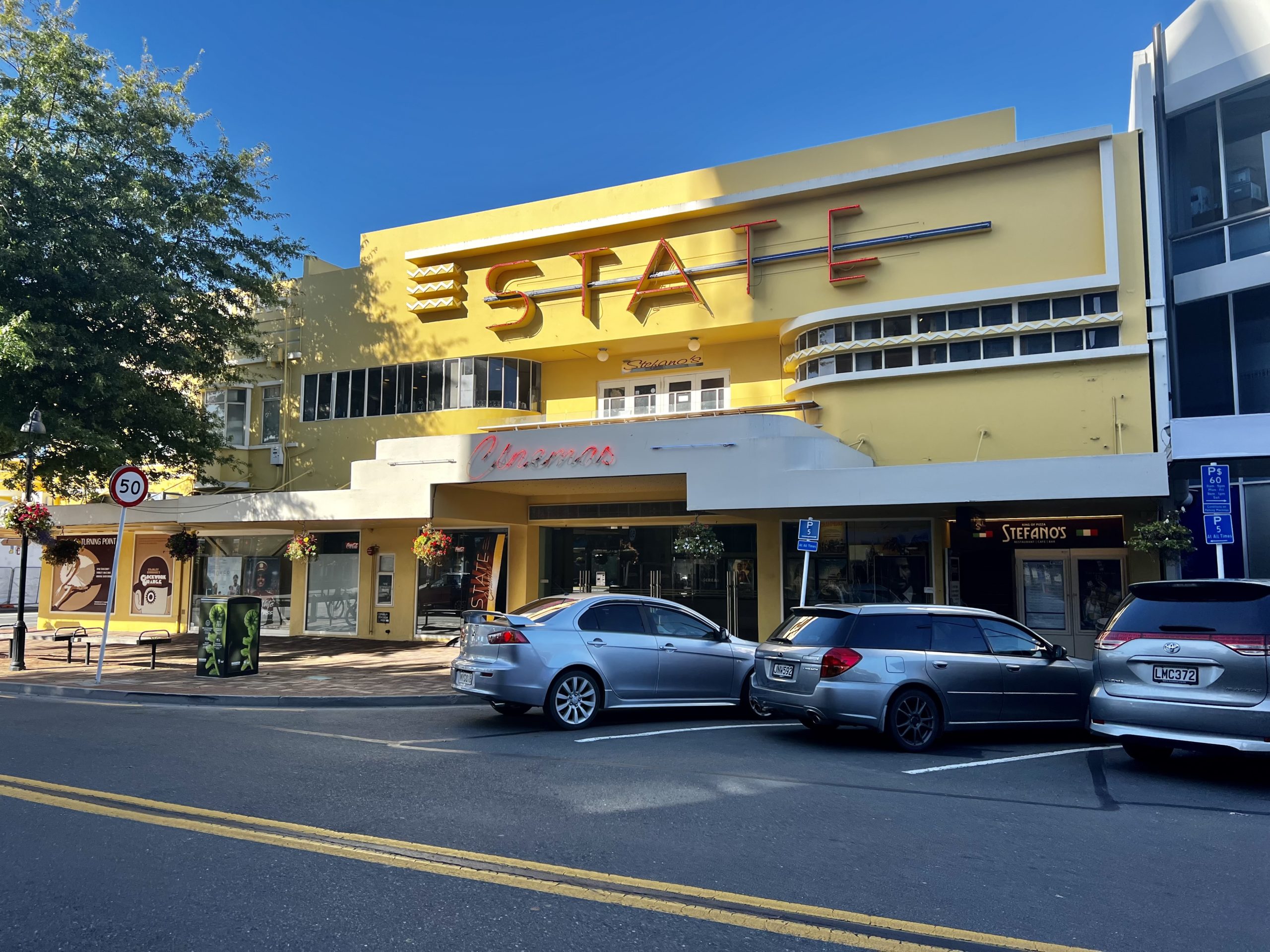
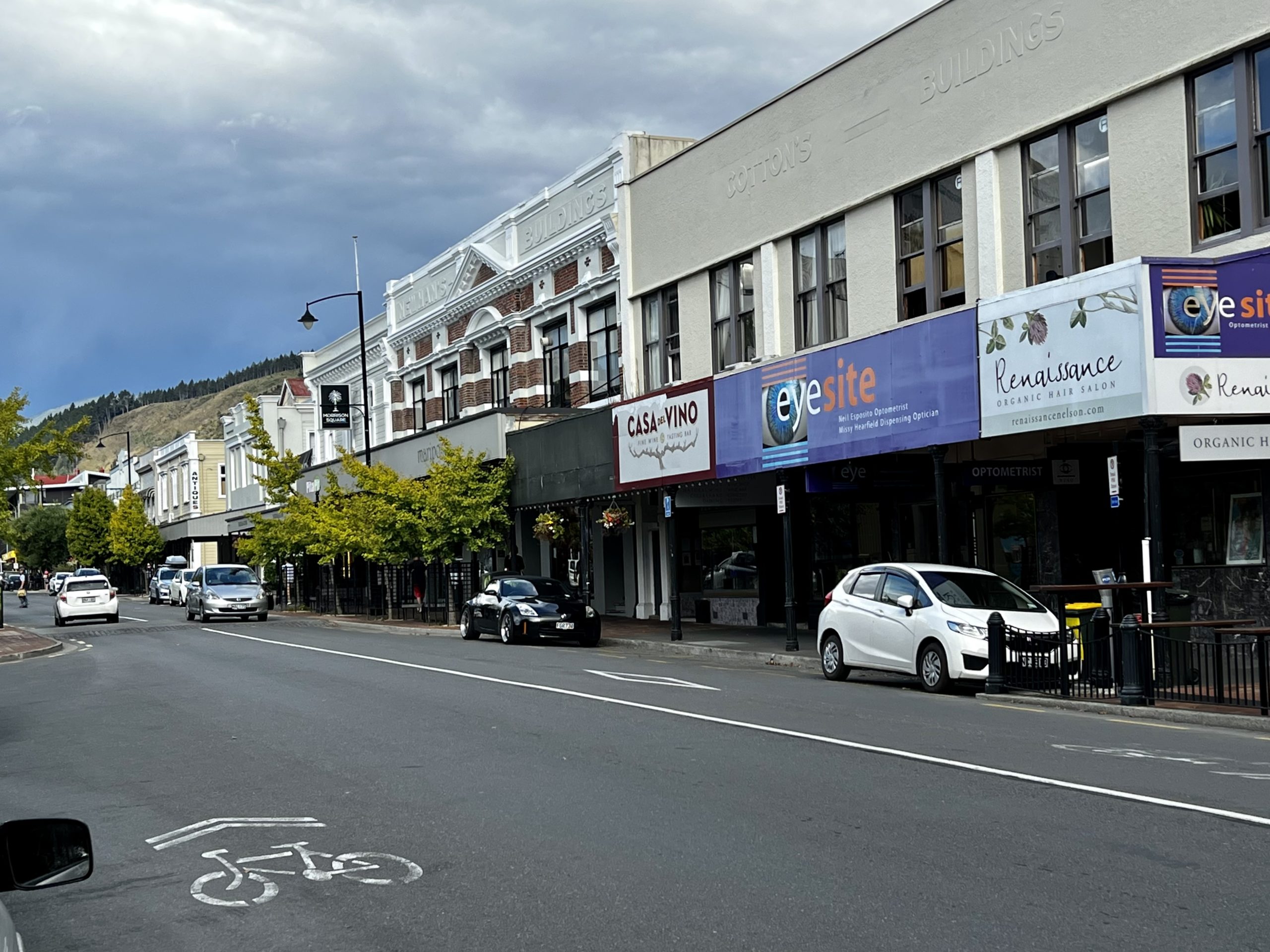
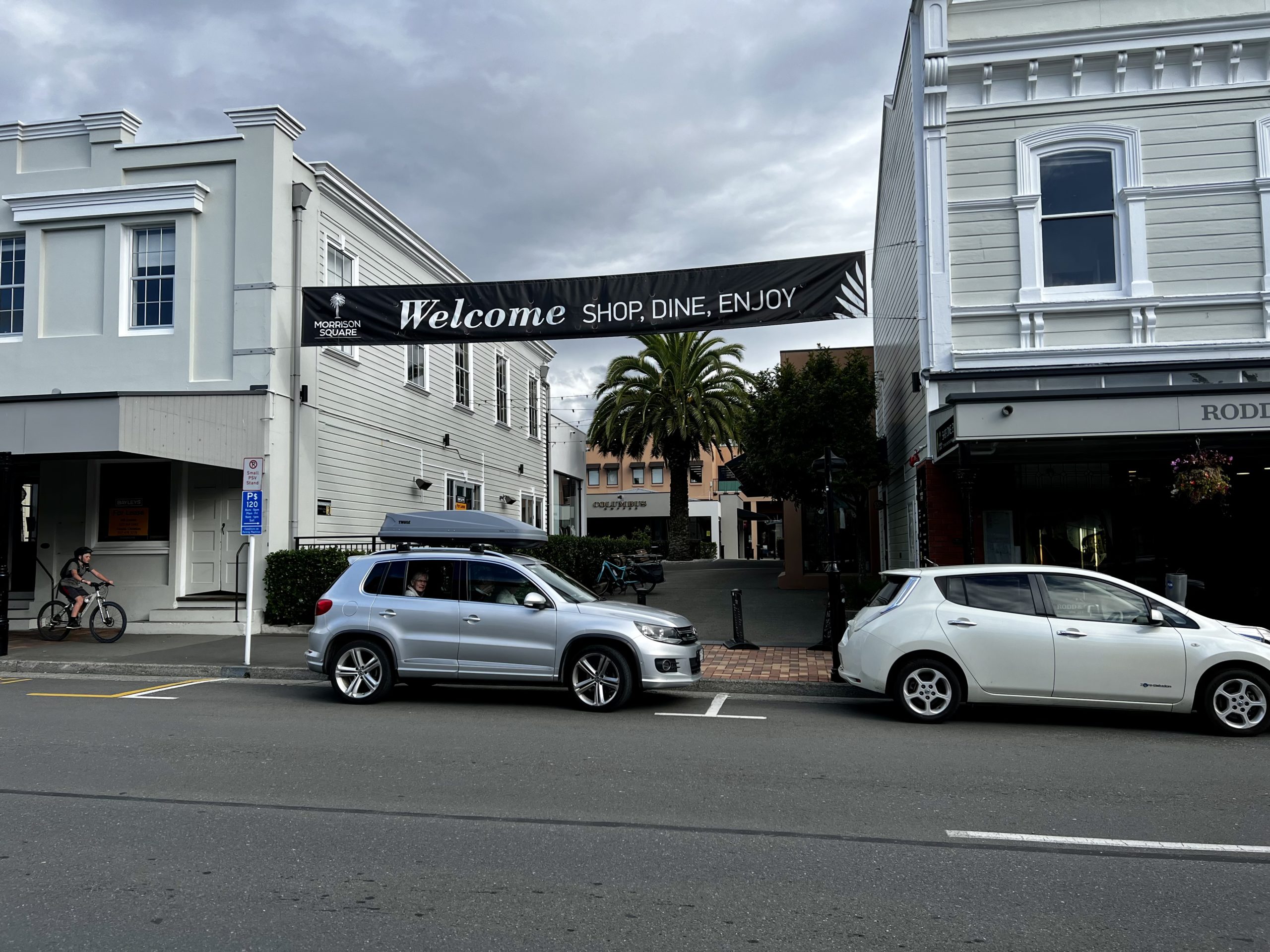
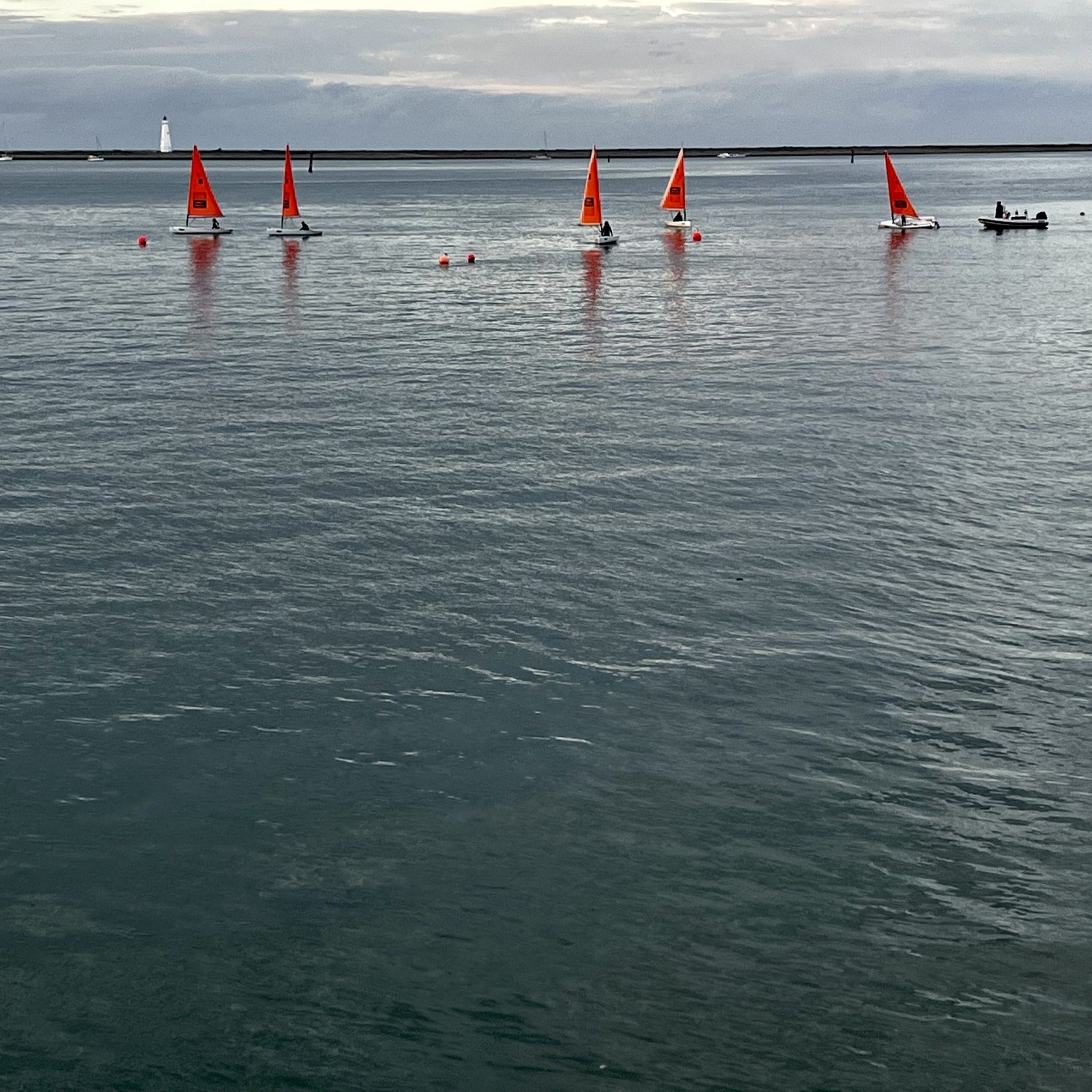
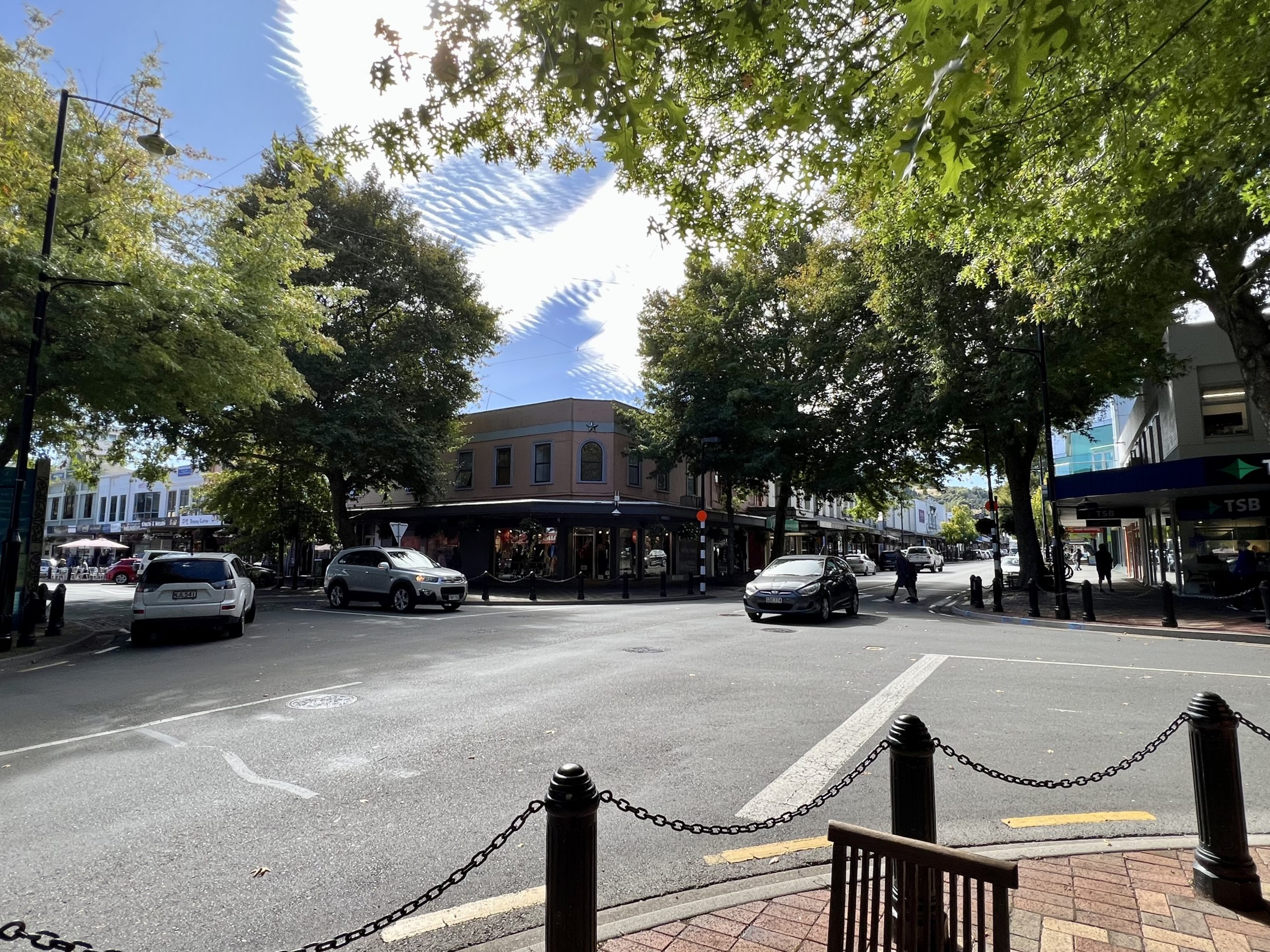
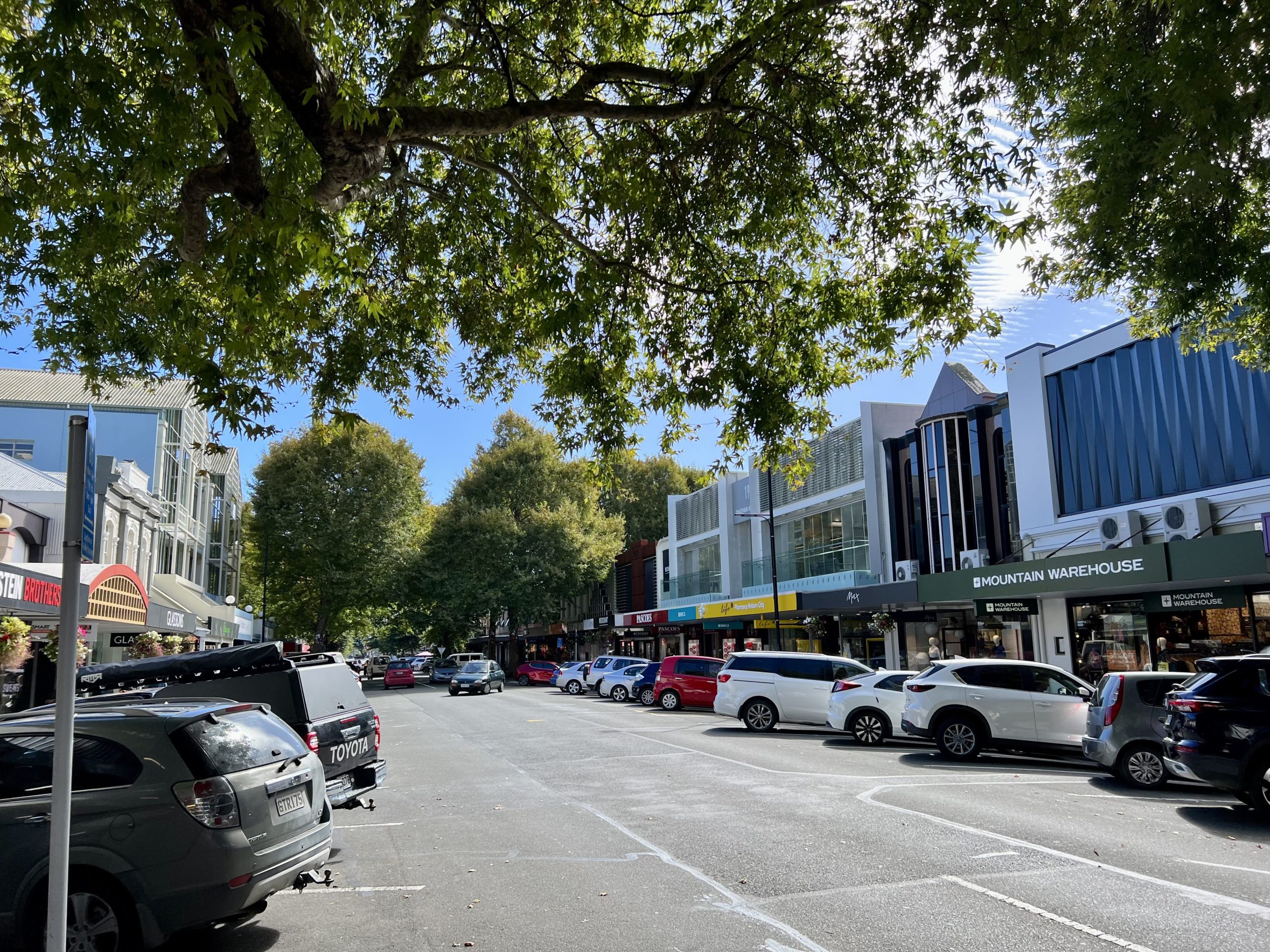
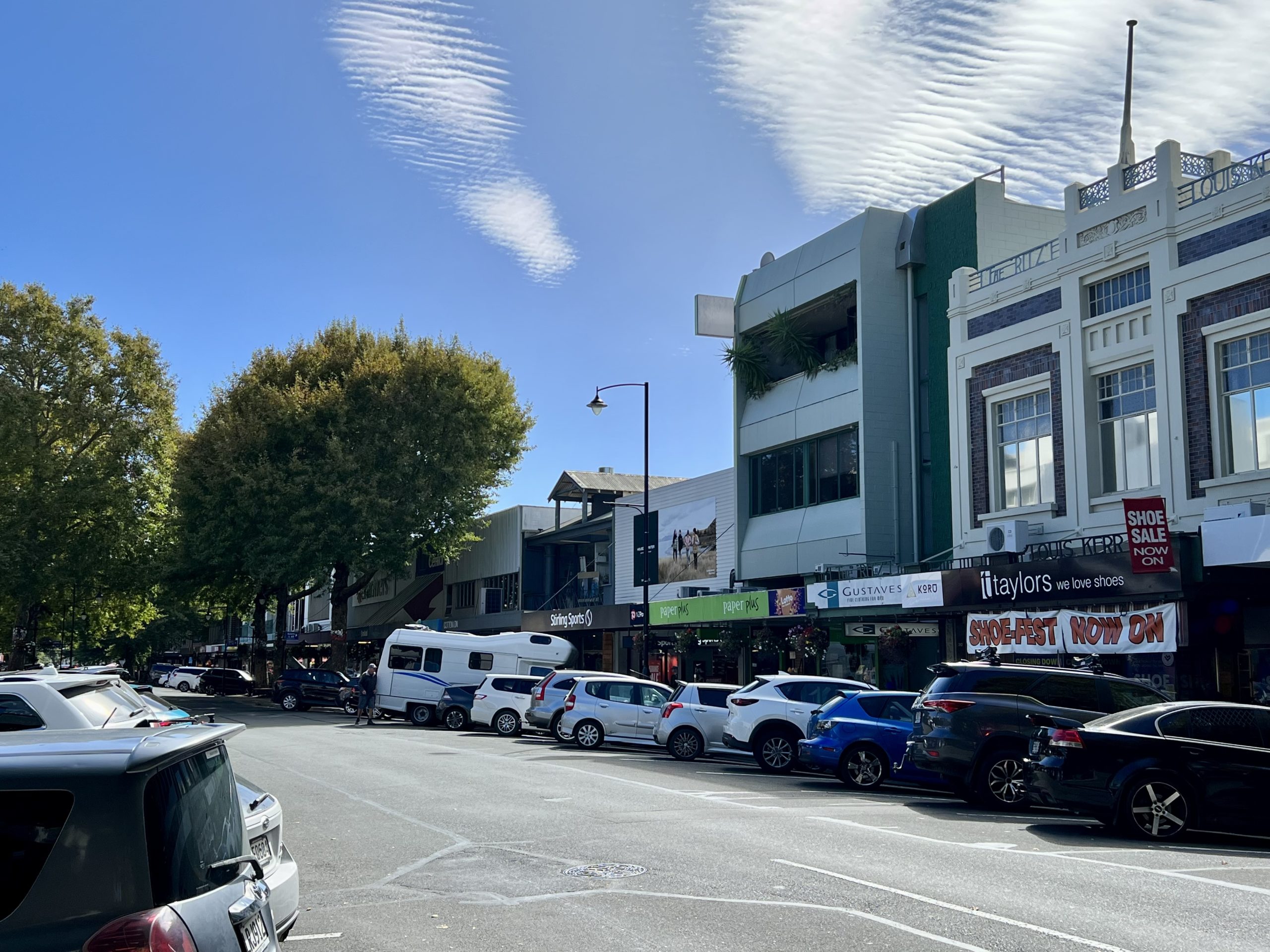
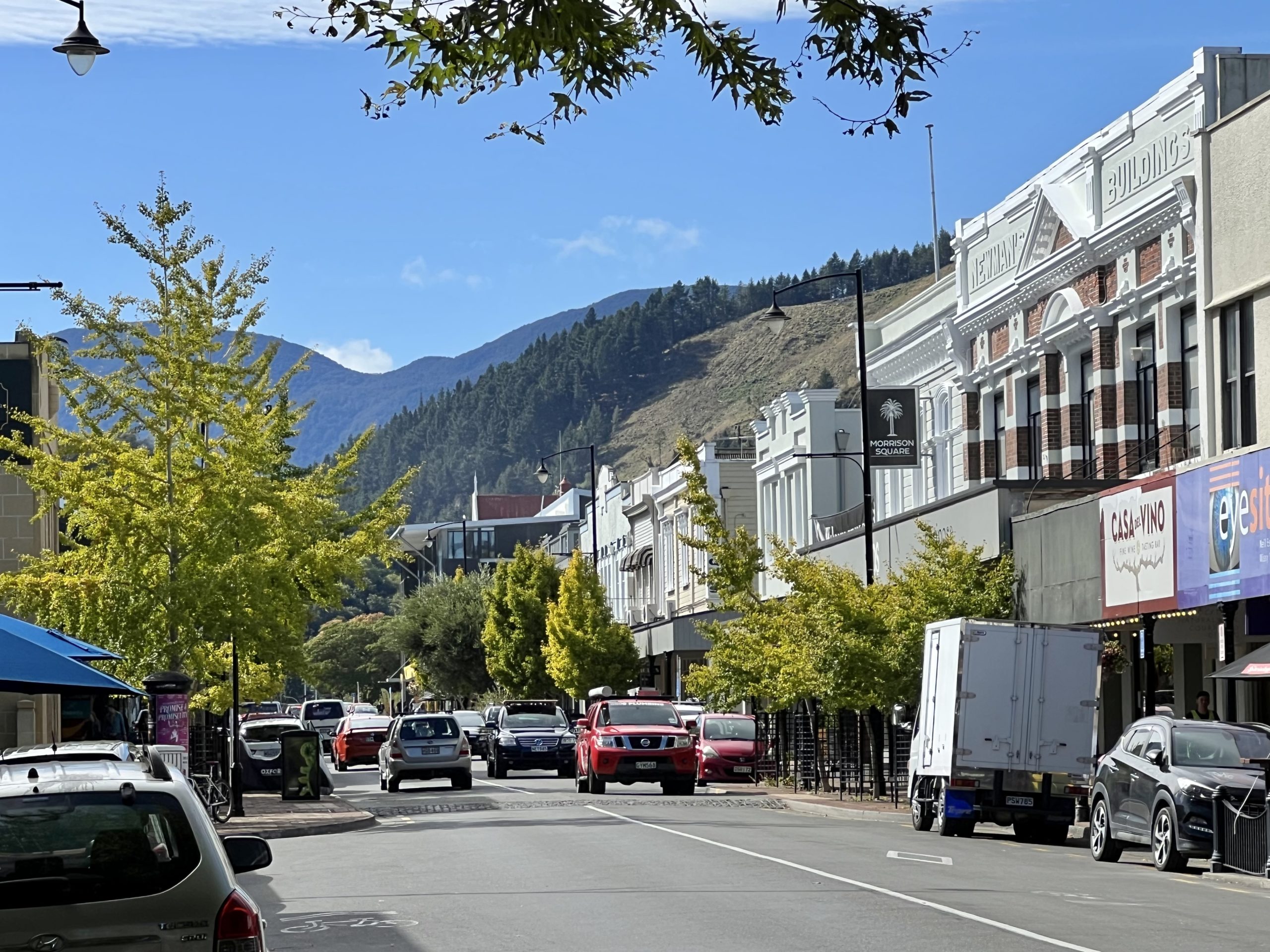
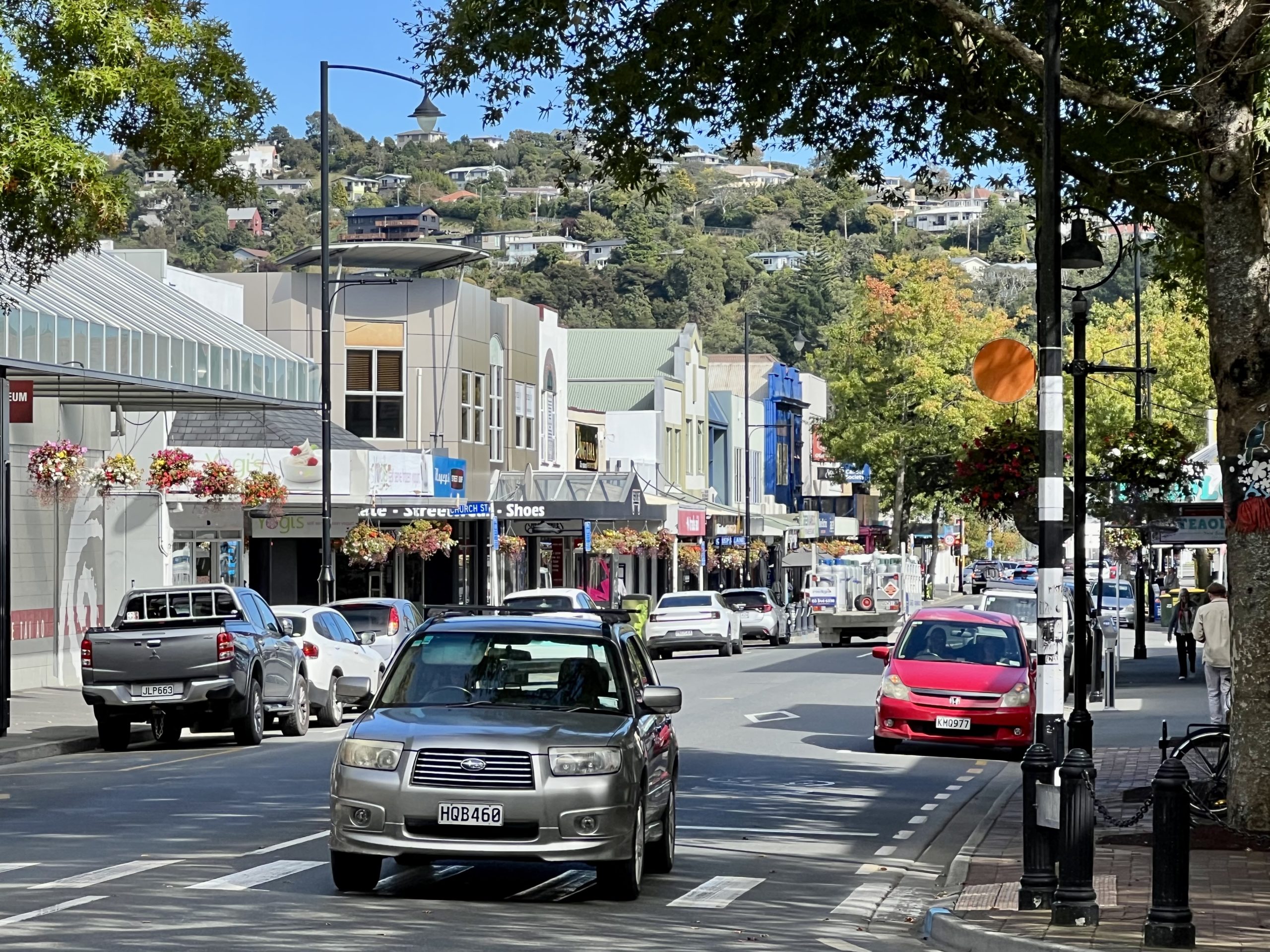
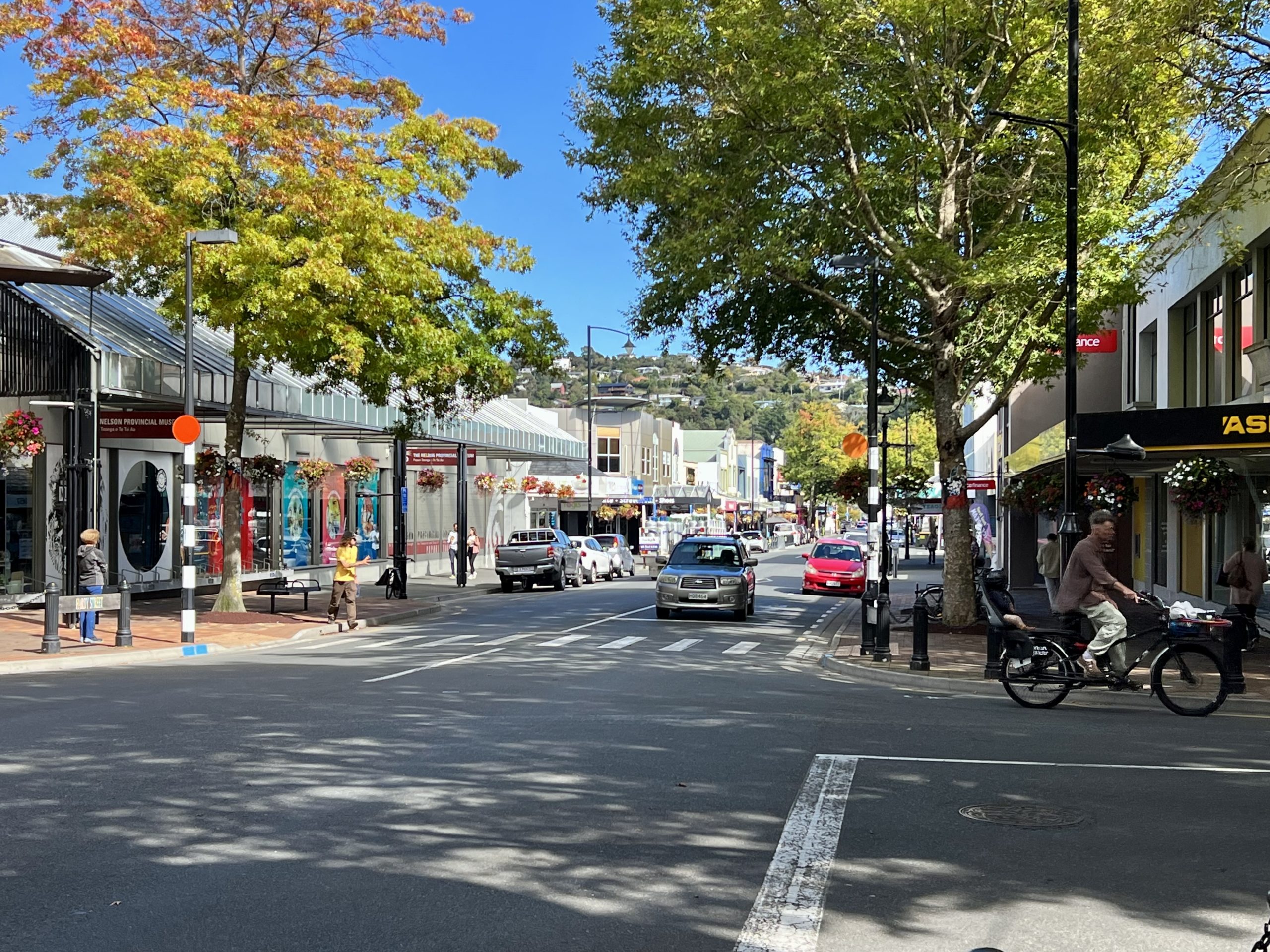
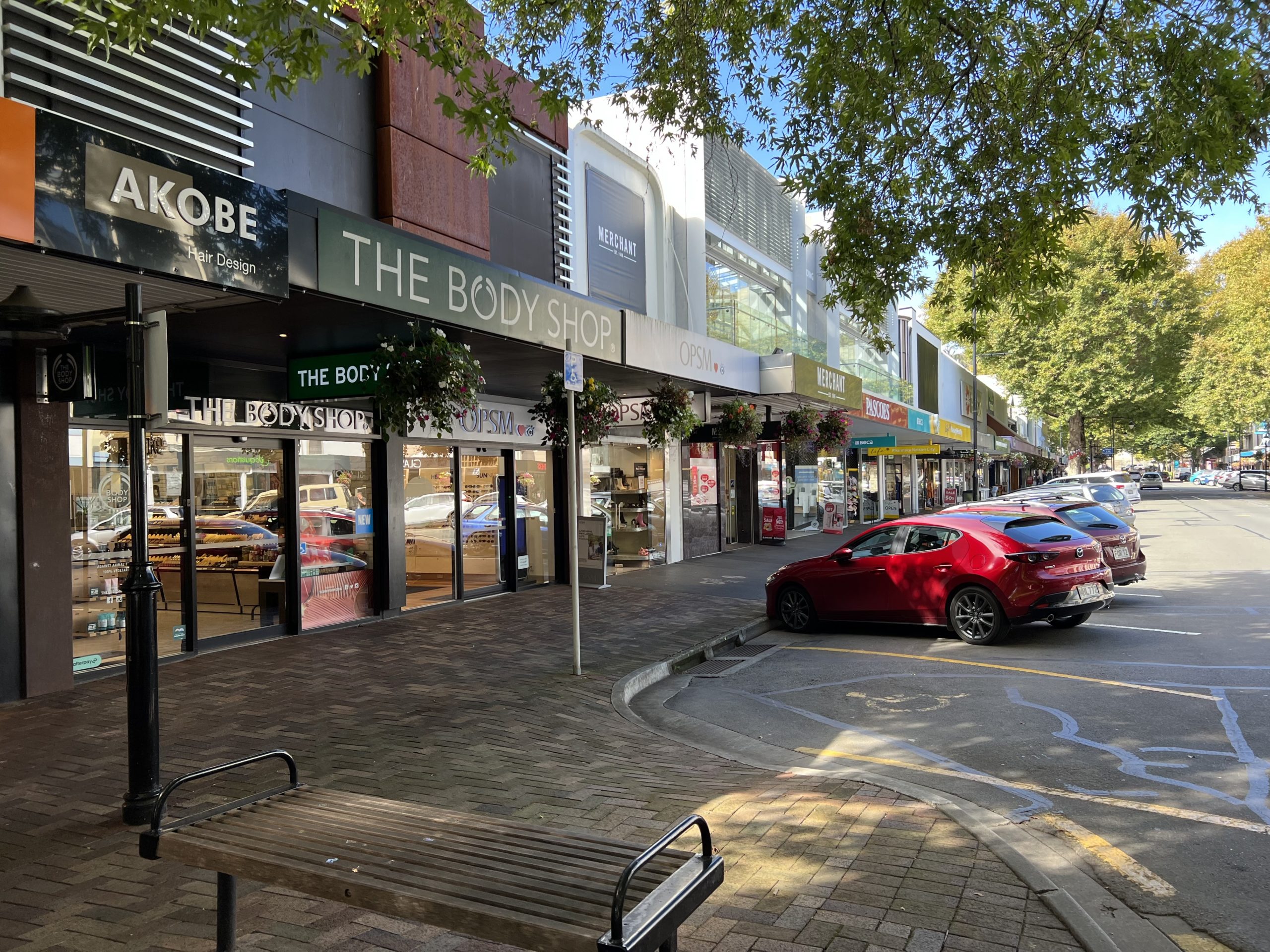
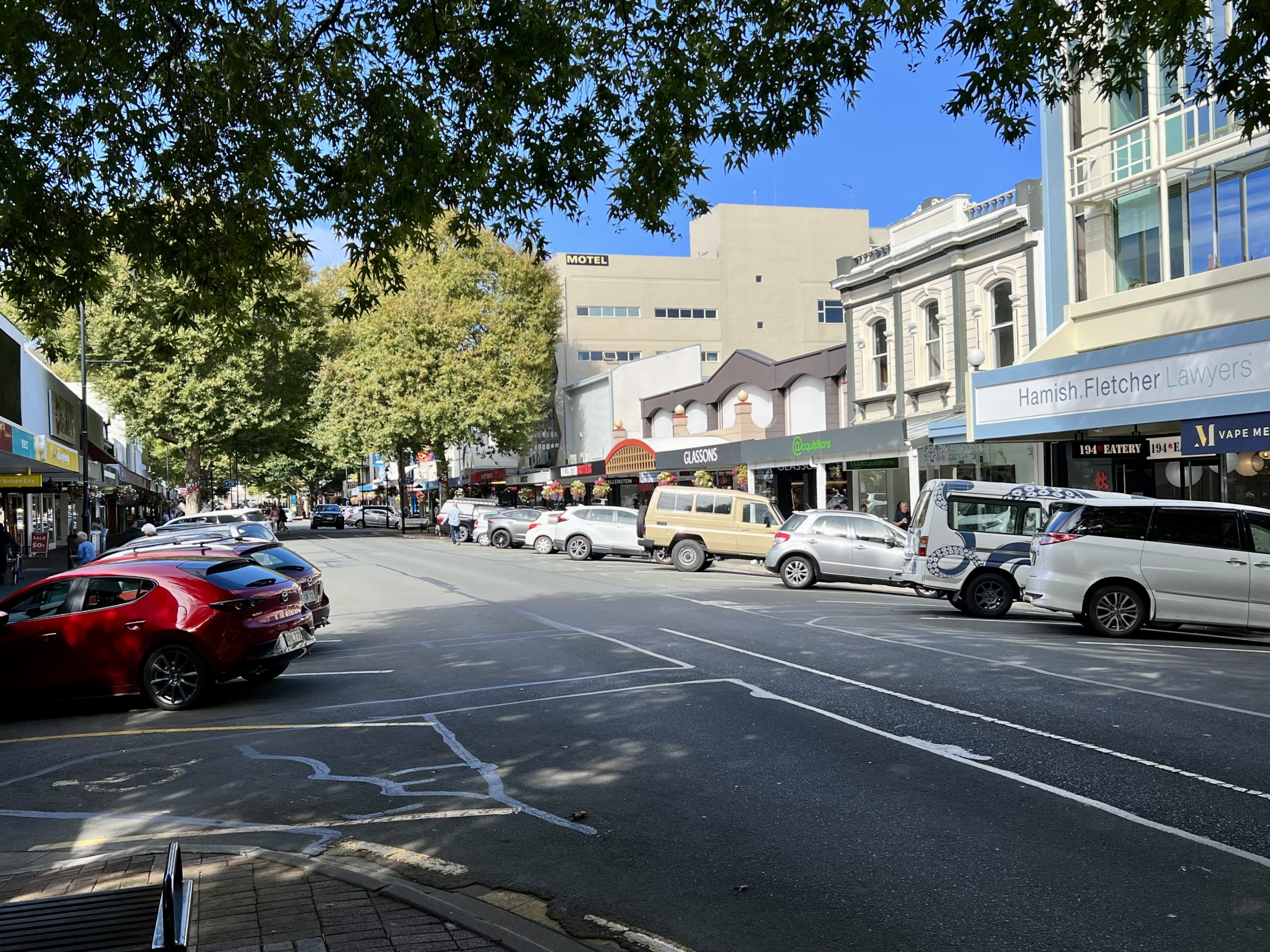
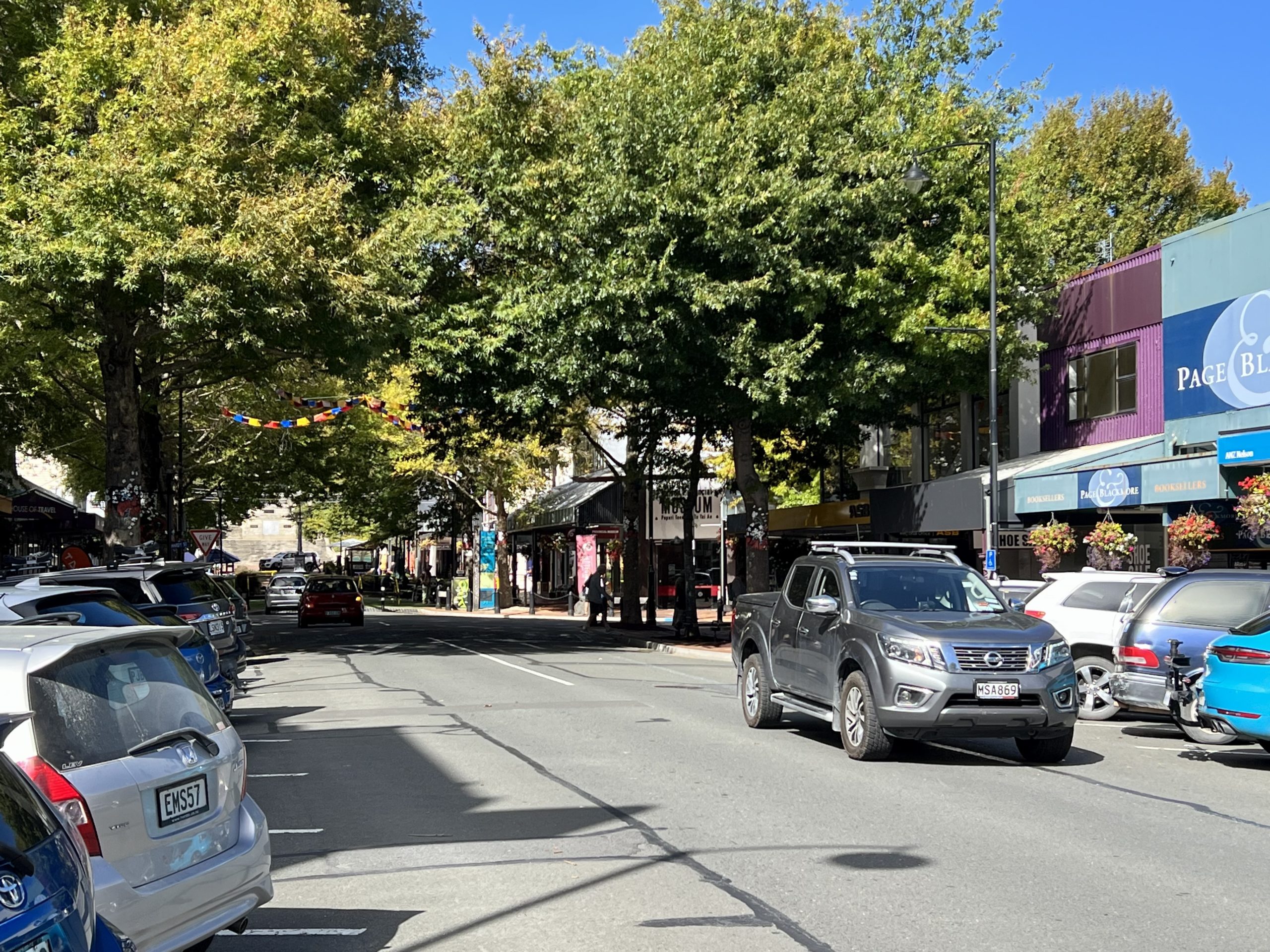
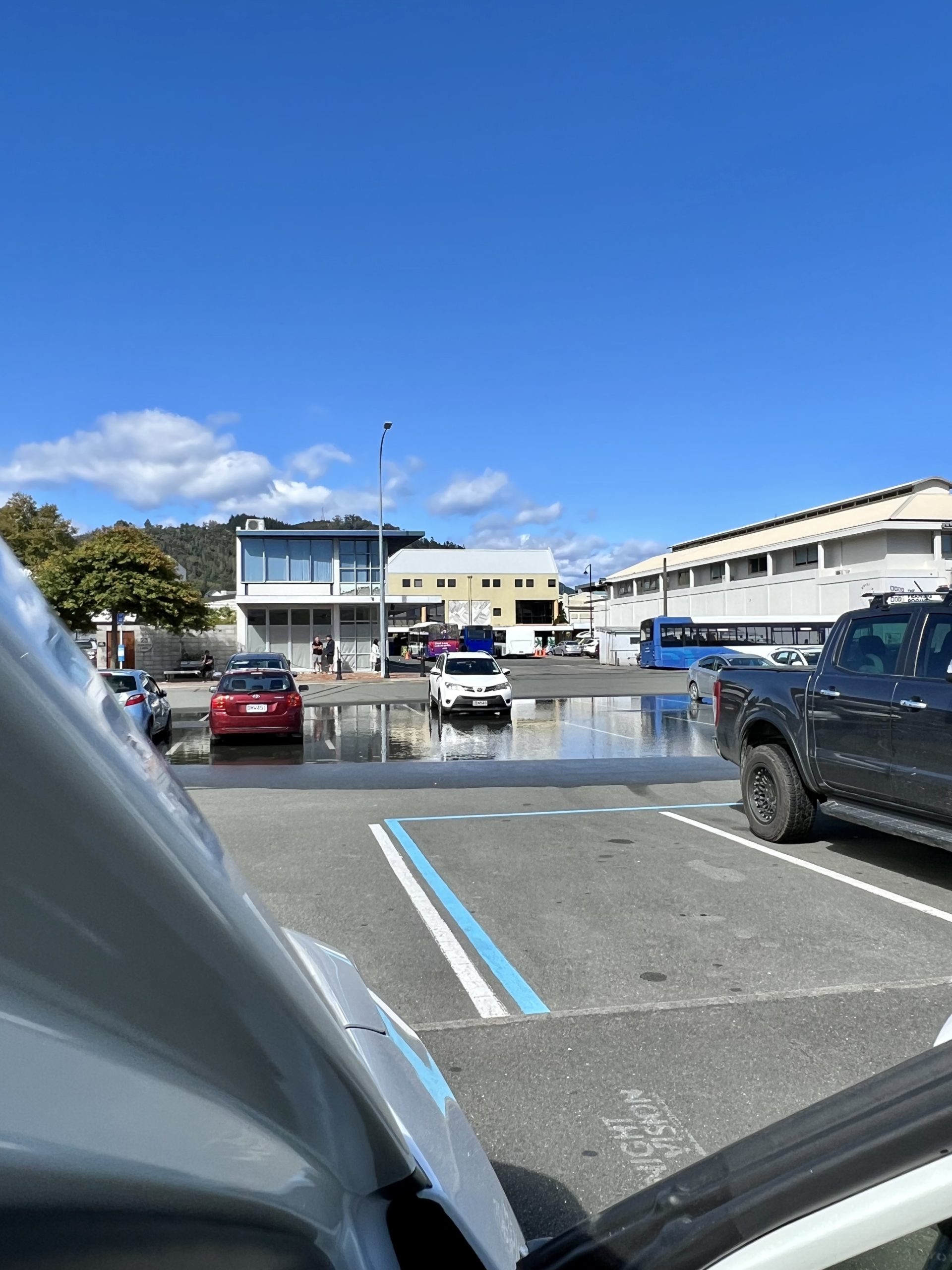
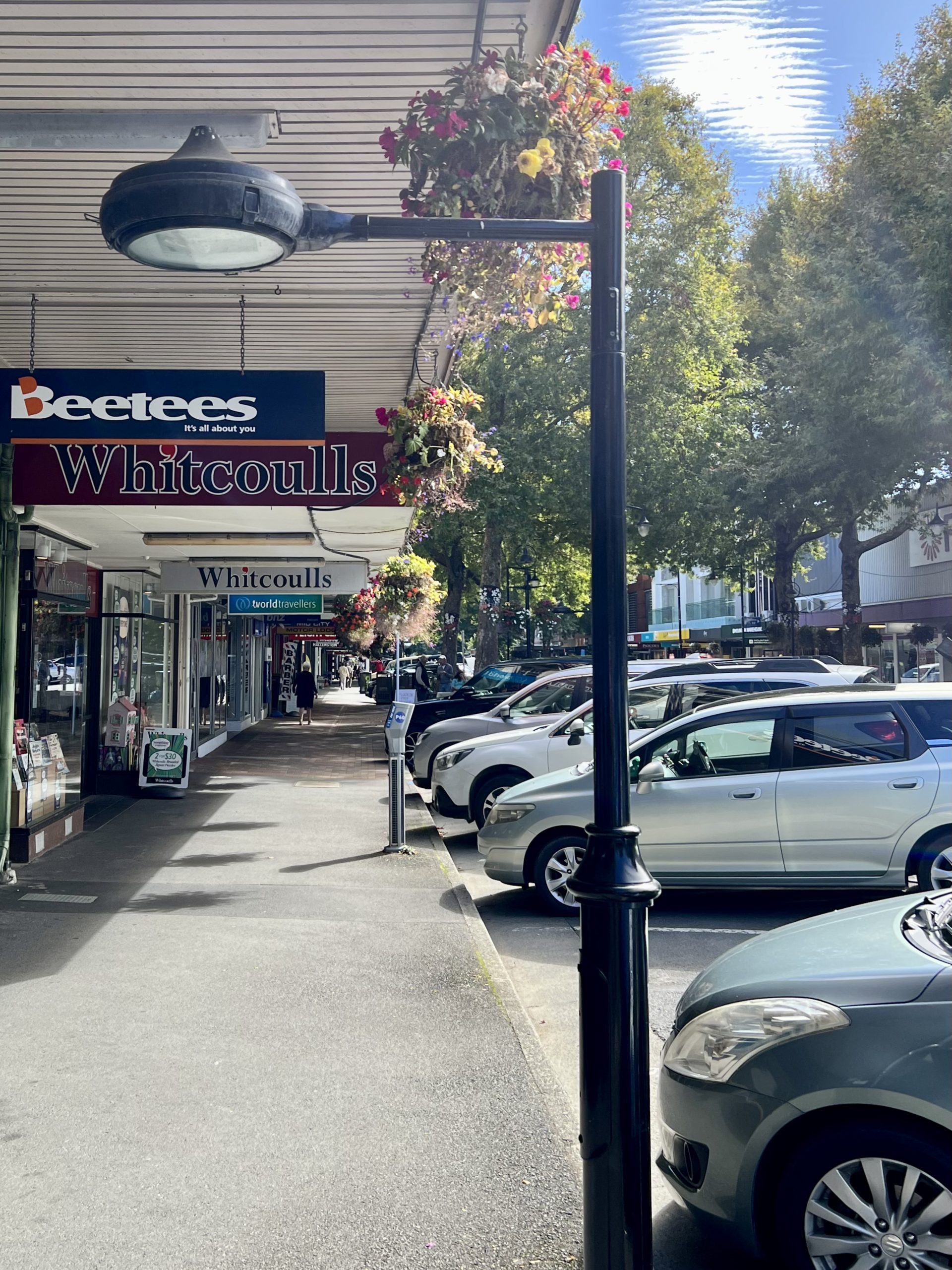
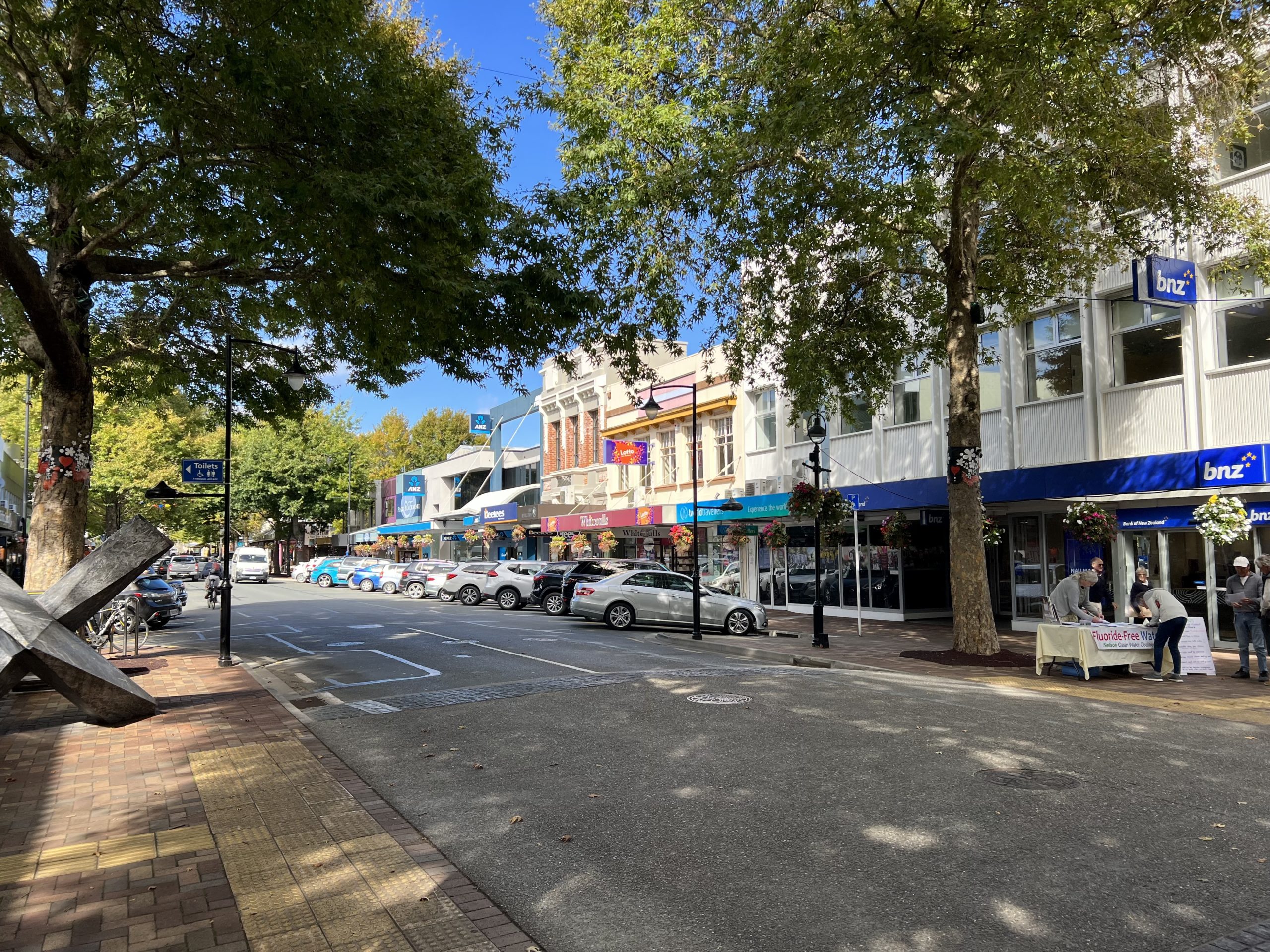
We did not know what we would find in Nelson. Its urban population is only 51,000 with just 4,000 more in the surrounding territory. We expected a quaint small town with a few blocks of retail. Not the case. All the major New Zealand outdoor clothing brands are here: MacPac, Mountain Warehouse, Kathmandu, etc. The canopied retail area is immense, covering many blocks with large areas for parking inside the blocks. Some retail shops face the parking areas so that they do not appear as back-of-house environments. We’re not sure how the economics of the city work with so much retail and the modest population size, but it seems to be fine. Unfortunately, the downtown is pretty dead at night. There are a few restaurants and bars, but not enough to keep the place lively after 5:00 pm. The large working port area is barely two miles from the downtown. It has a few upscale eateries on the water along with sailboat races of very small boats before the sun sets. In Nelson Bonnie made it to her first post-covid movie on one of Robert’s fishing days. She and a handful of other white-haired people saw Bill Nighy in Living. She also visited the jeweler that did all the jewelry for Lord of the Rings and found a terrific bookstore.
Great movie theaterFill up for the return rental
A Drive in the Countryside
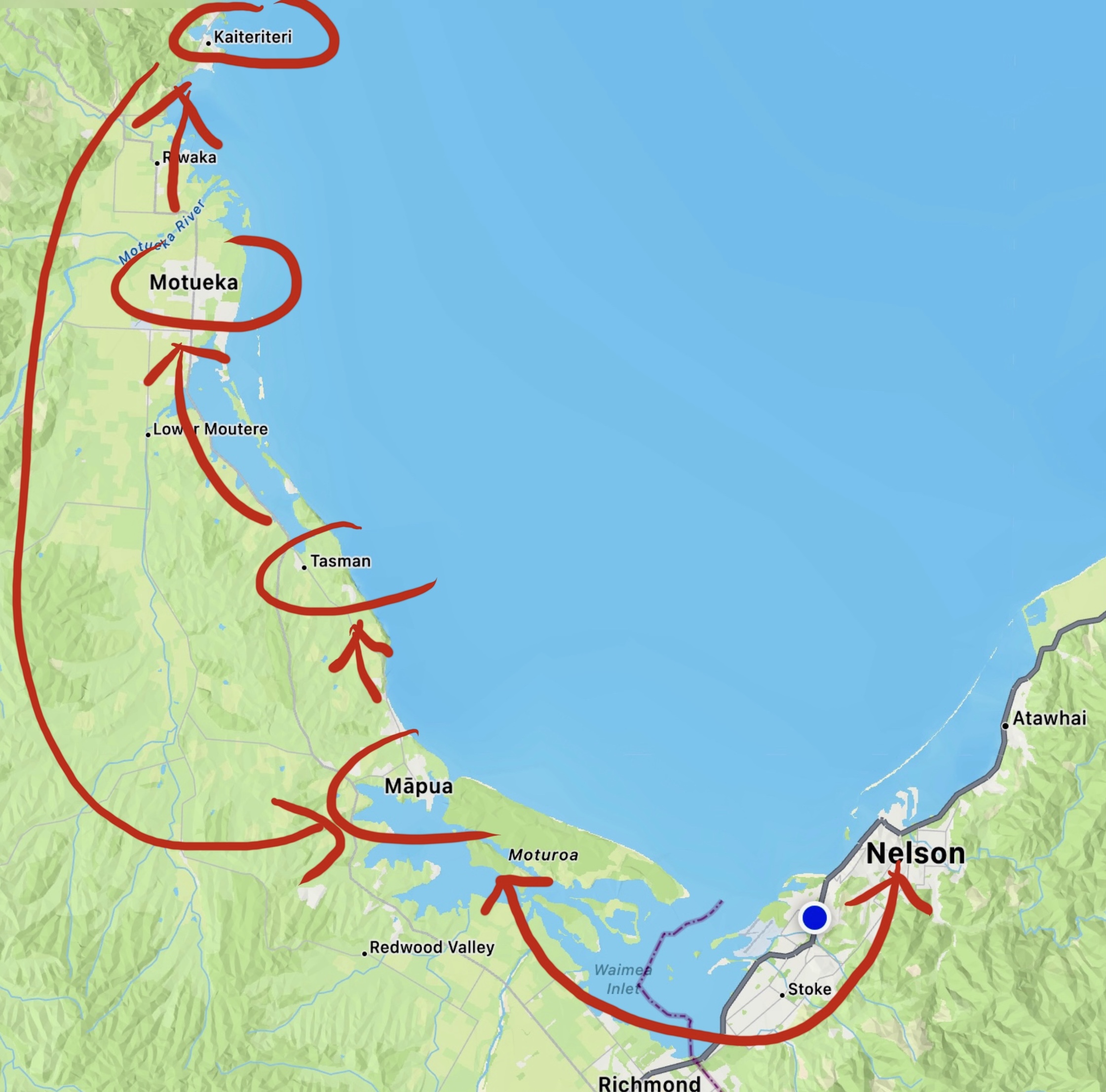
We decided that rather than spending a day making the arduous drive east to Marlborough to see the big famous wineries, we would head west to drive the roads along Tasman Bay. We took roughly the route the fly fishing guide used each day with Robert. It was a delightful route with many small places to stop.
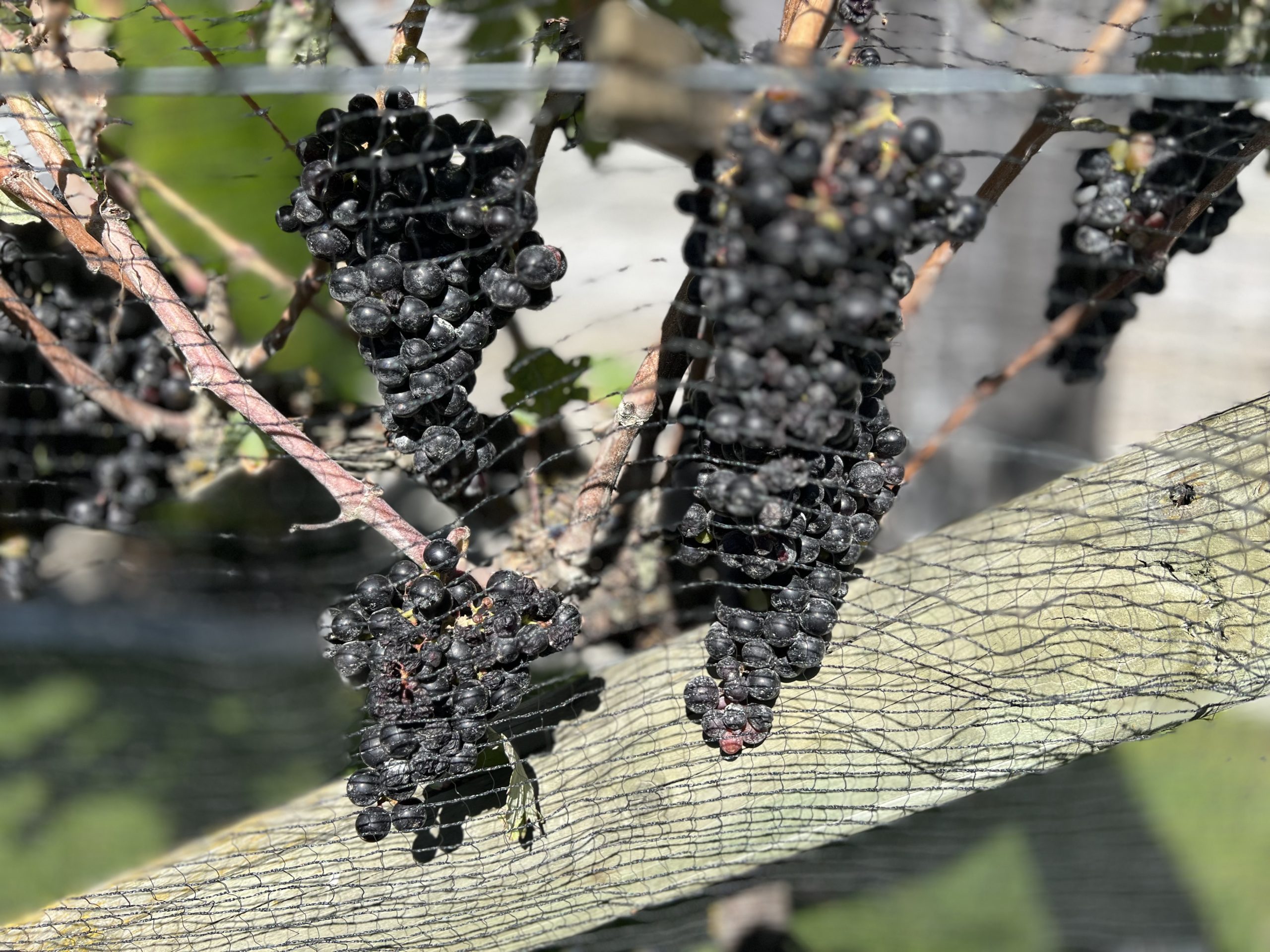
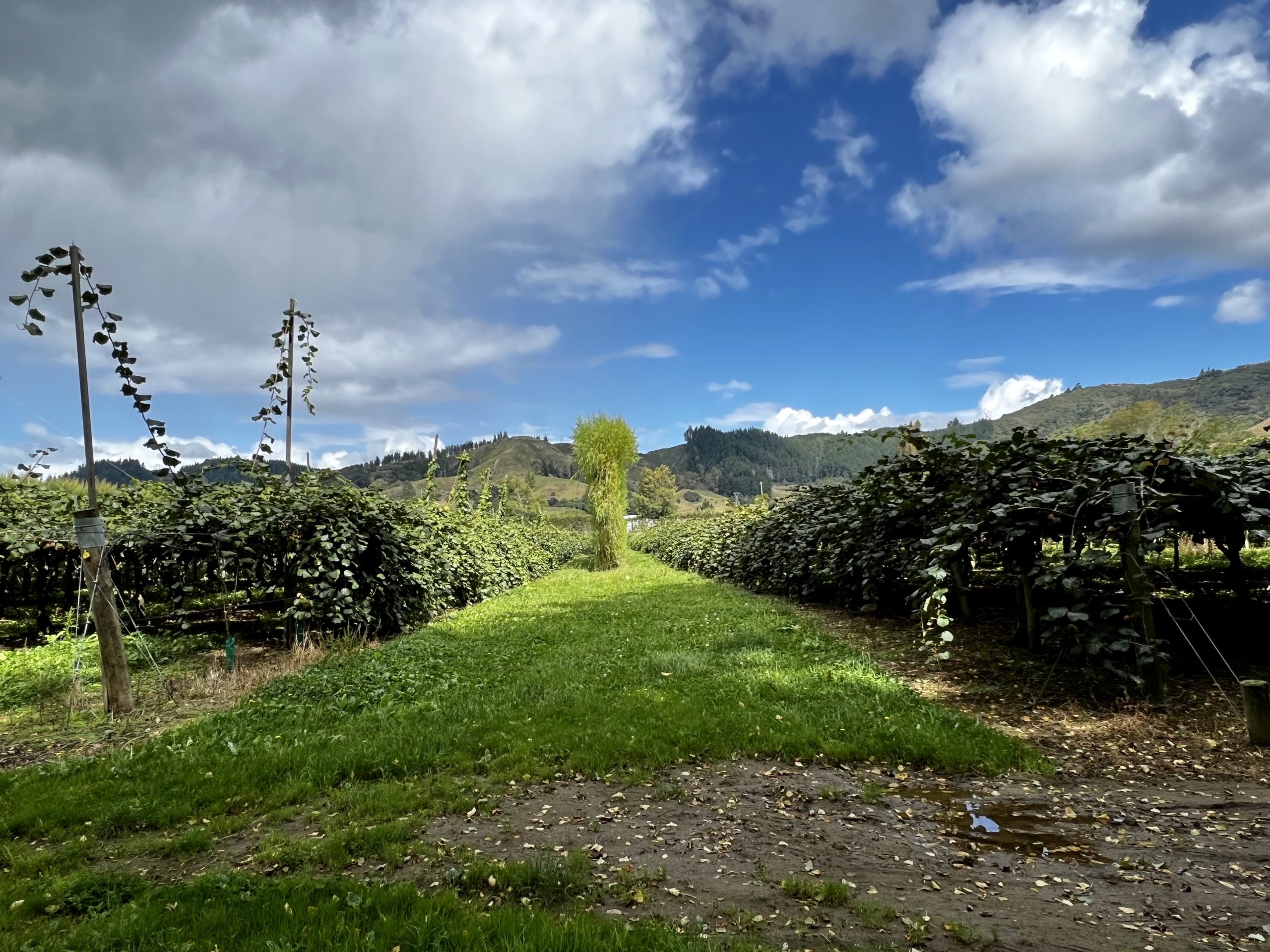
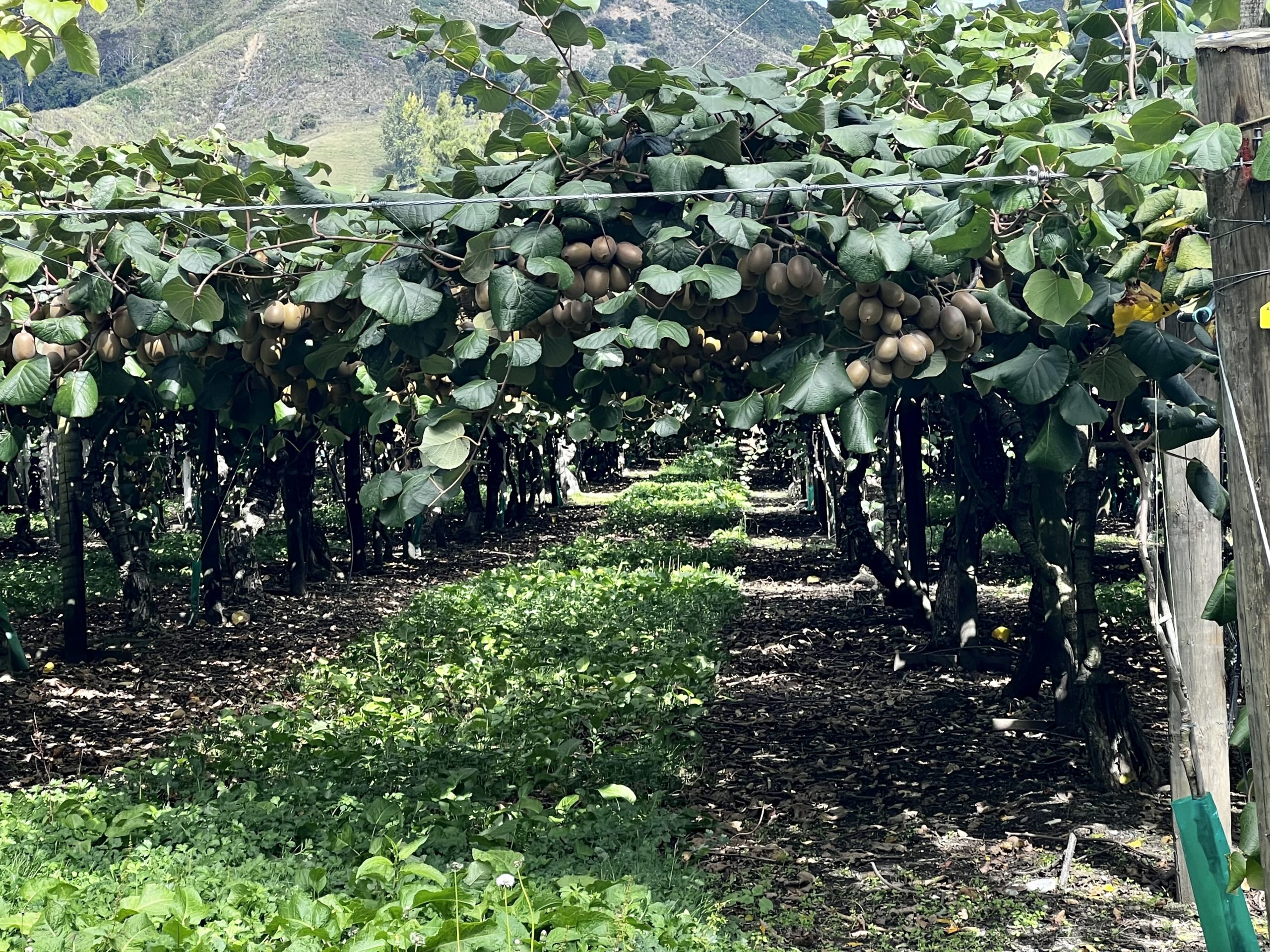
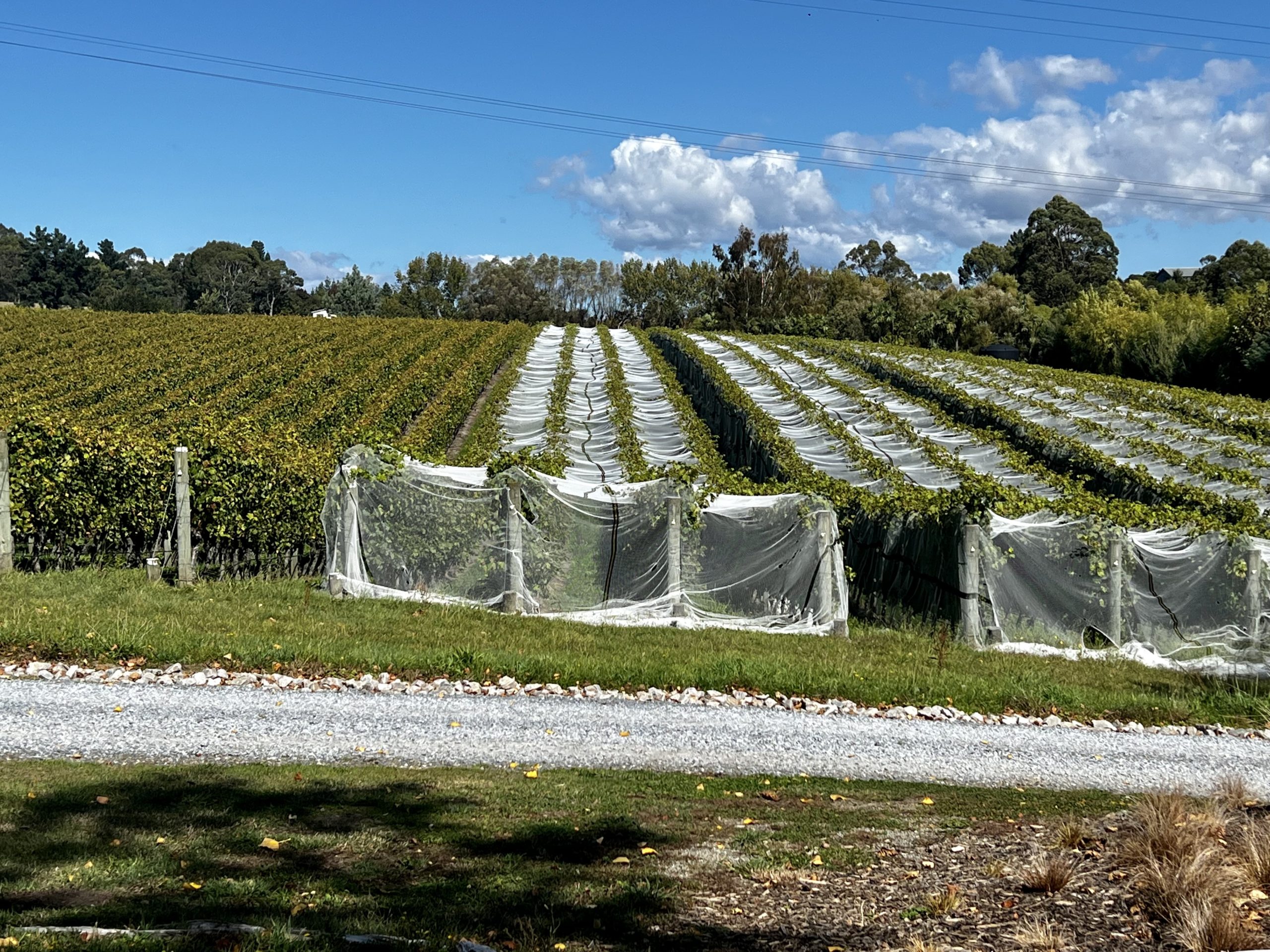
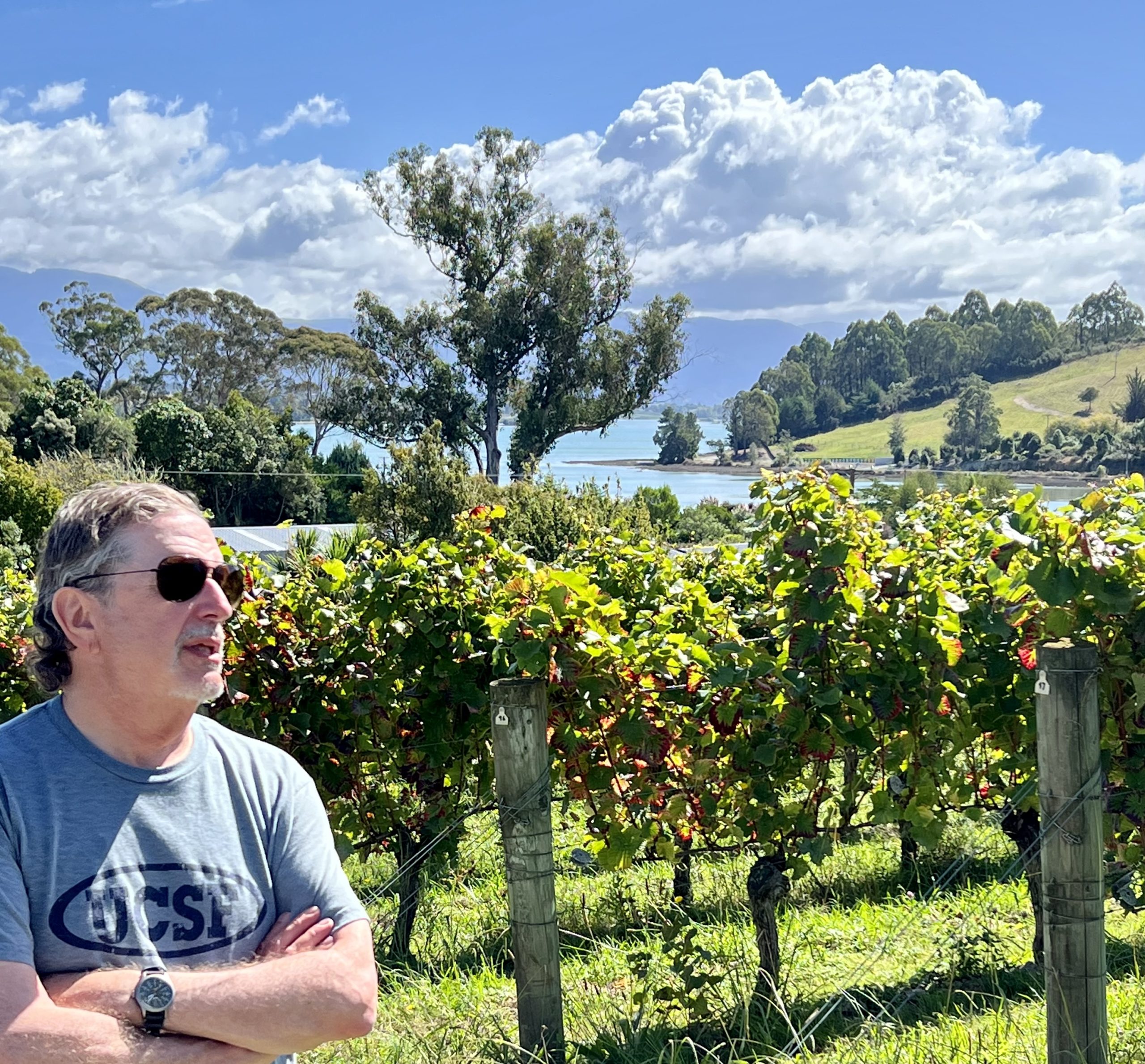
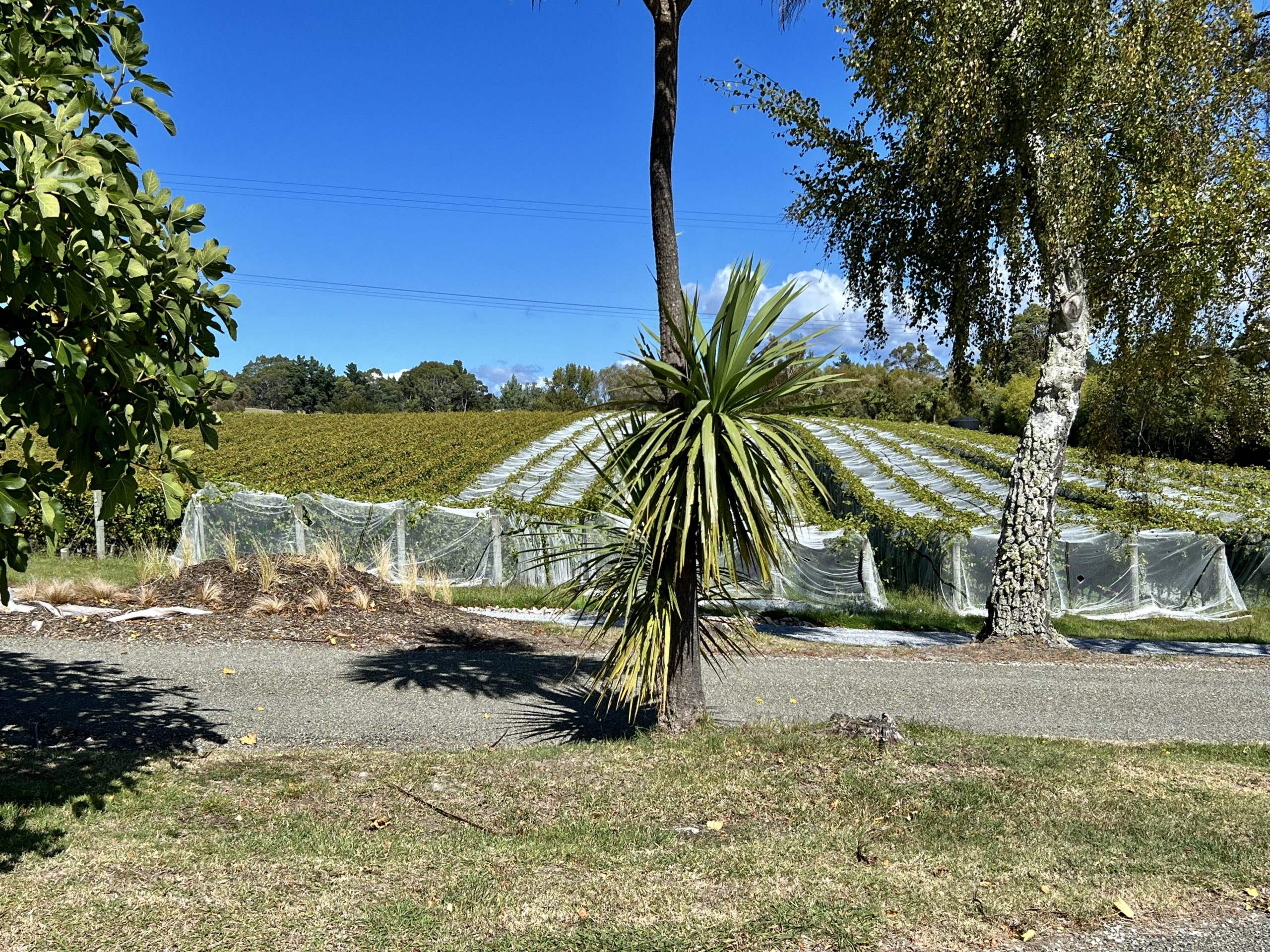
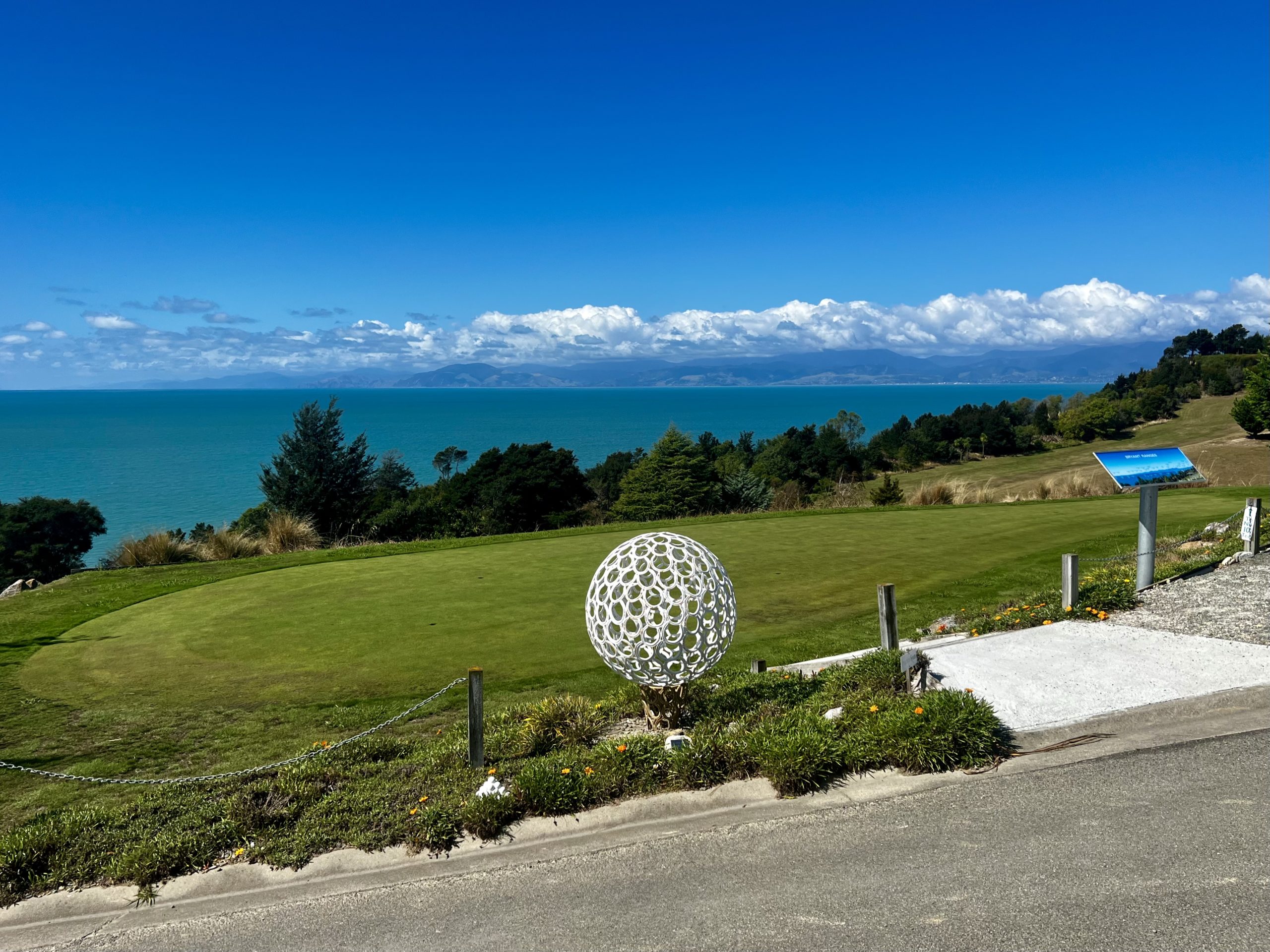
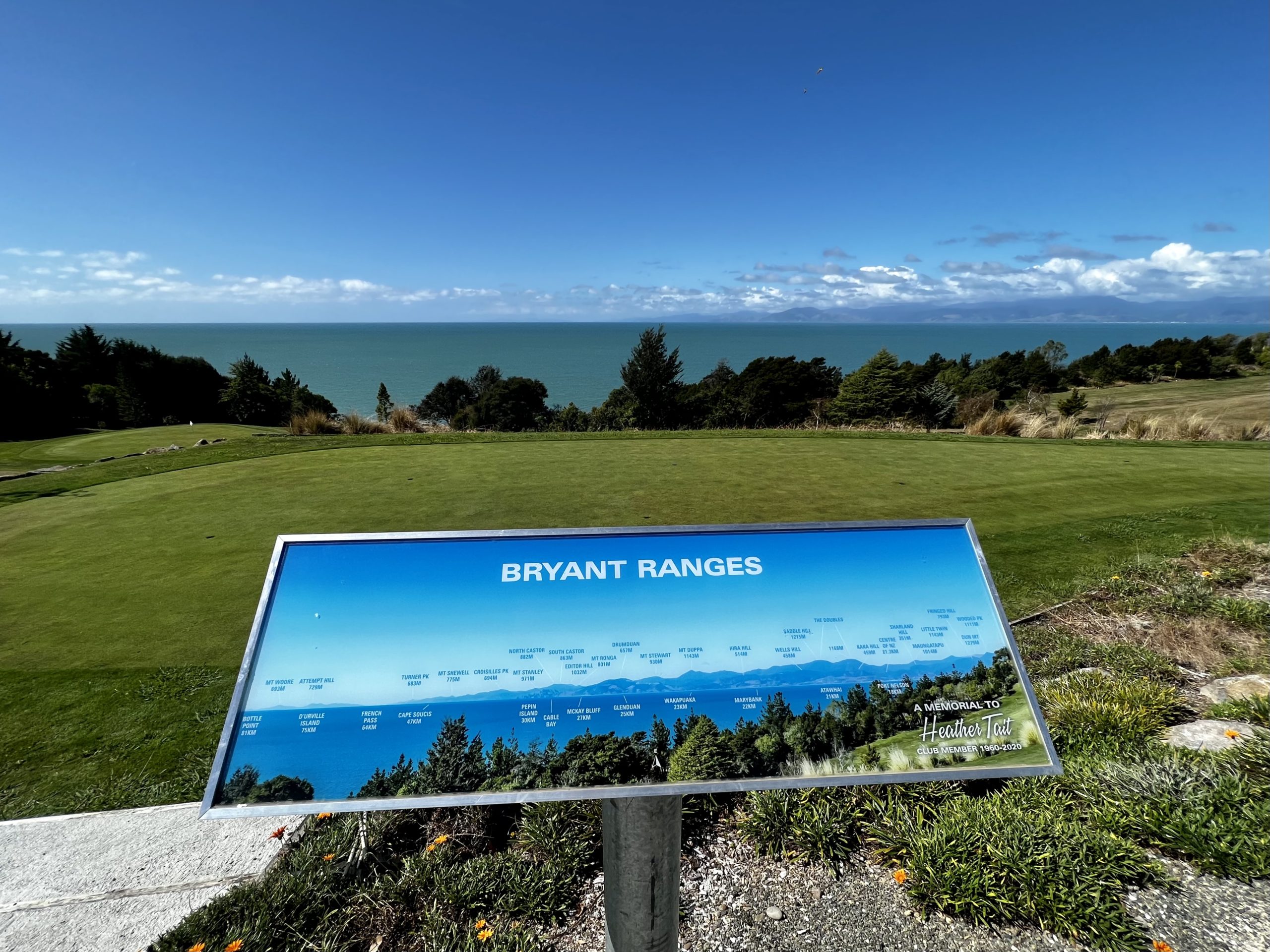
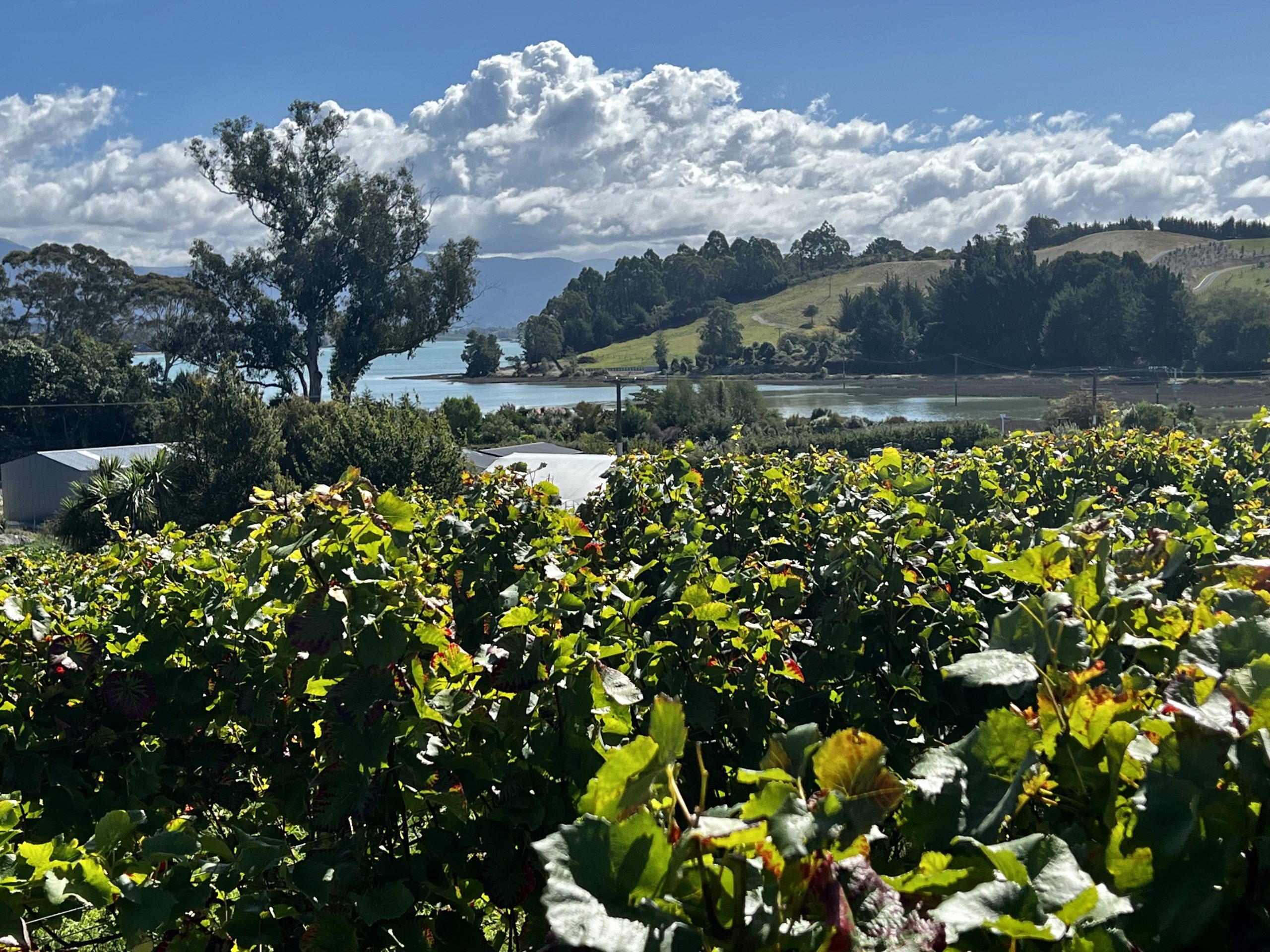
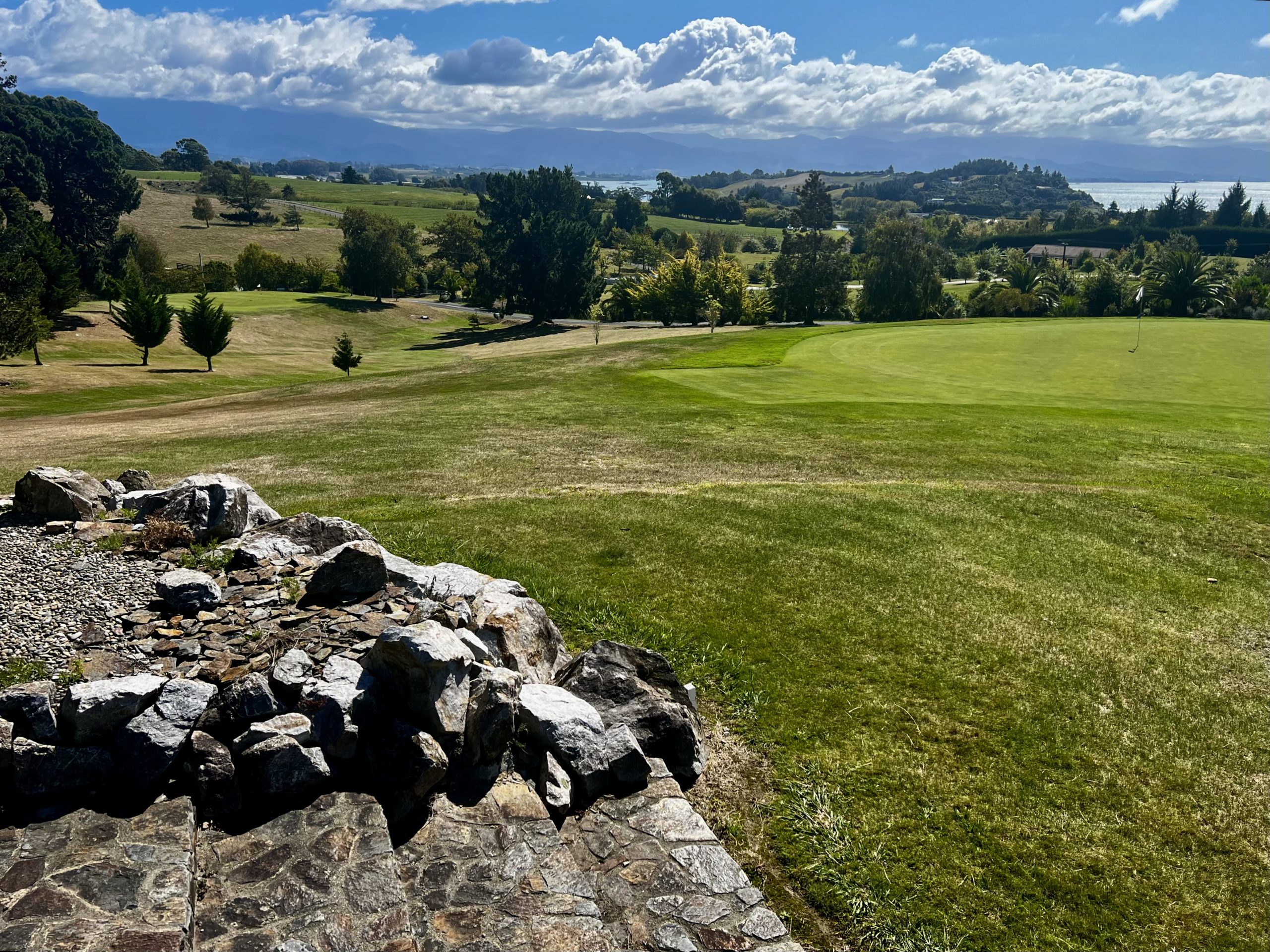
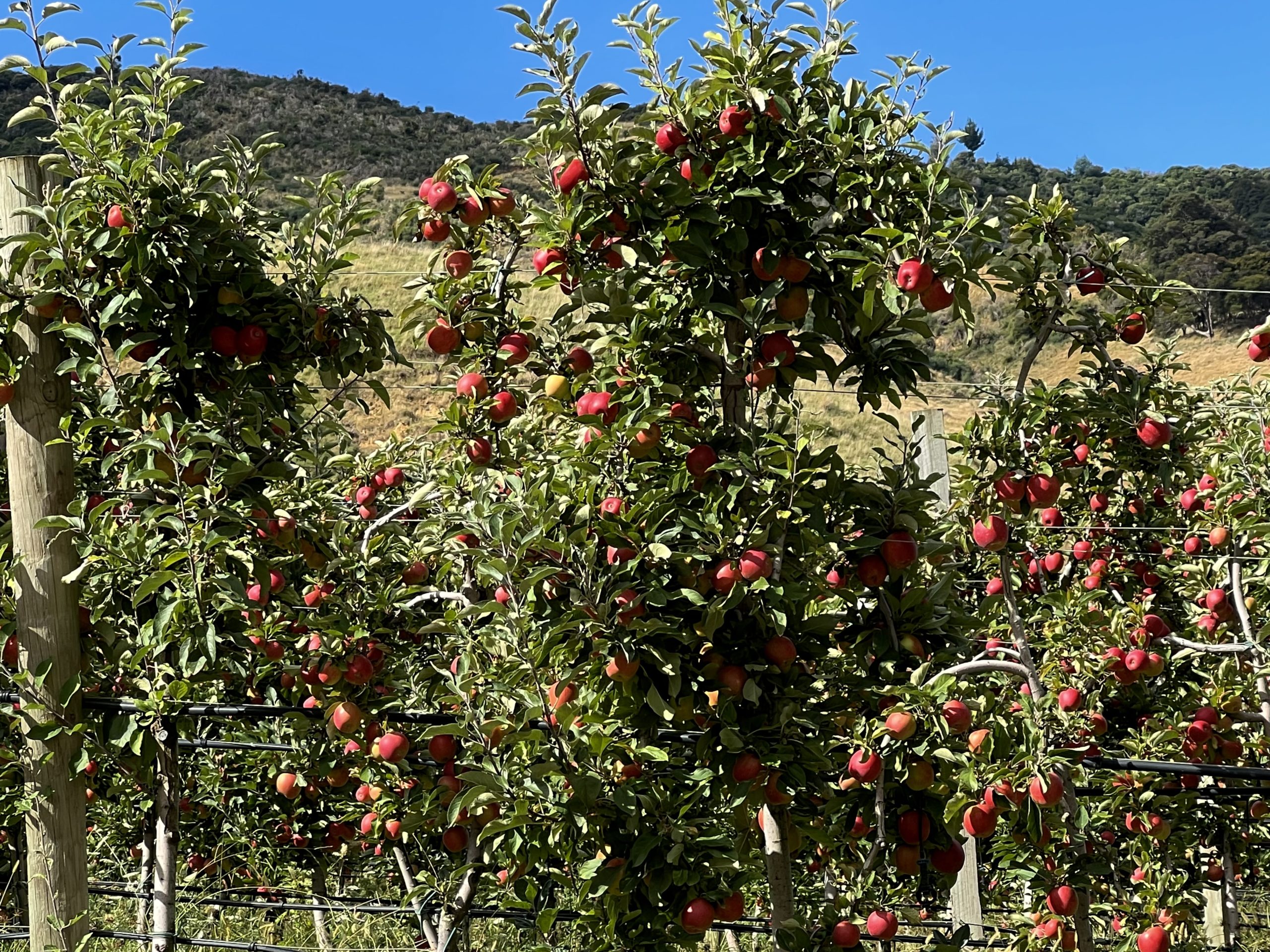
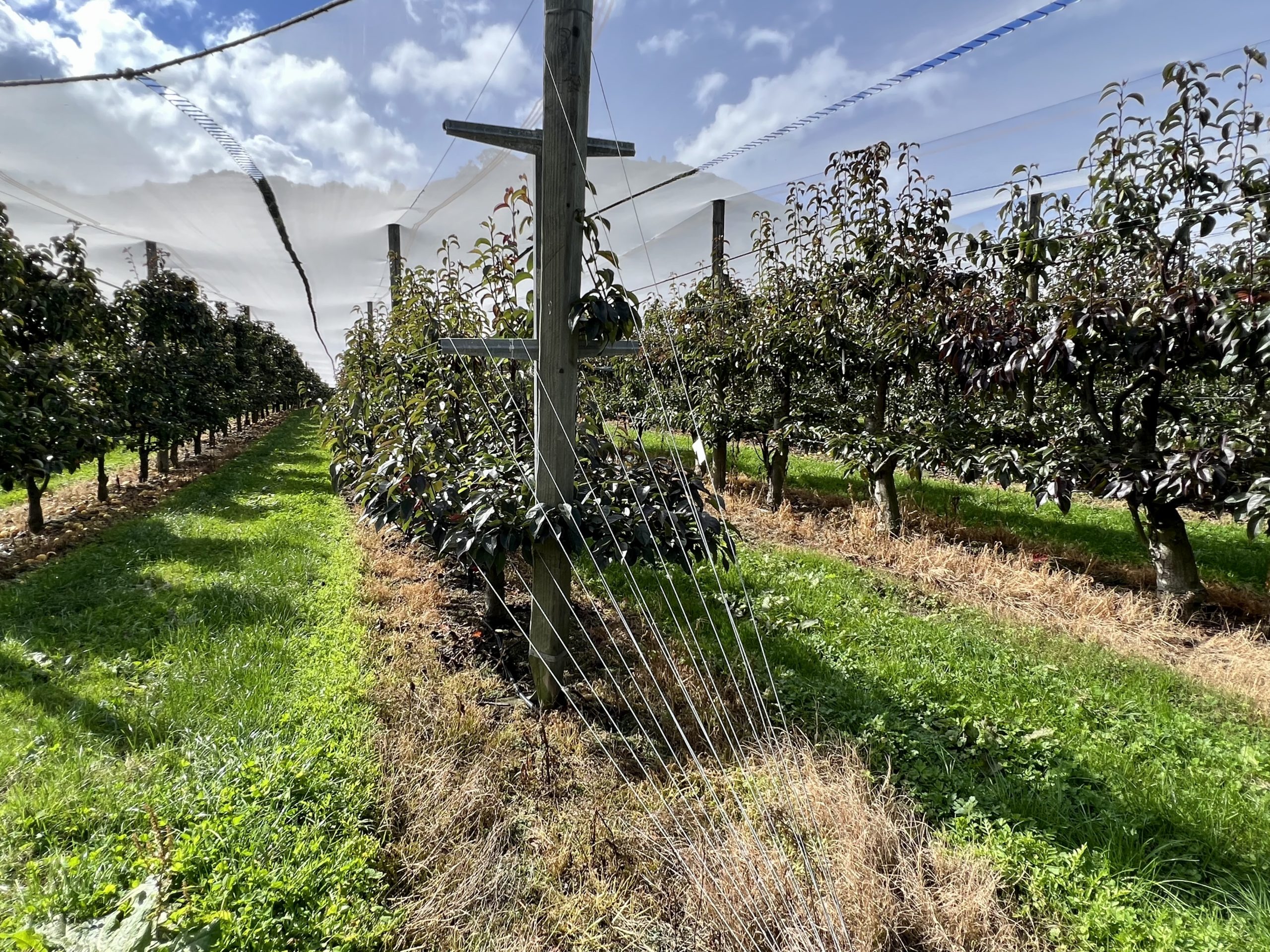
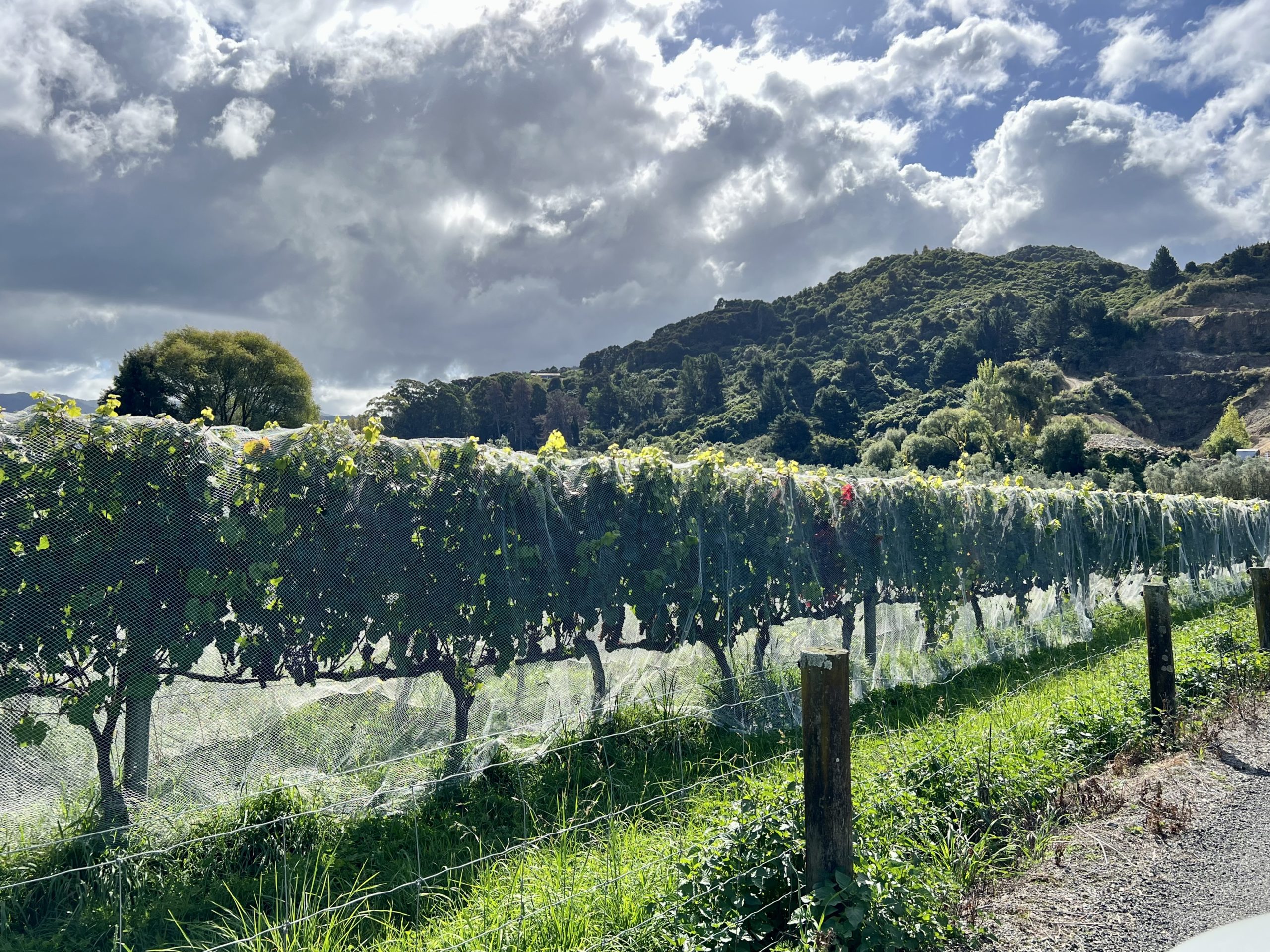
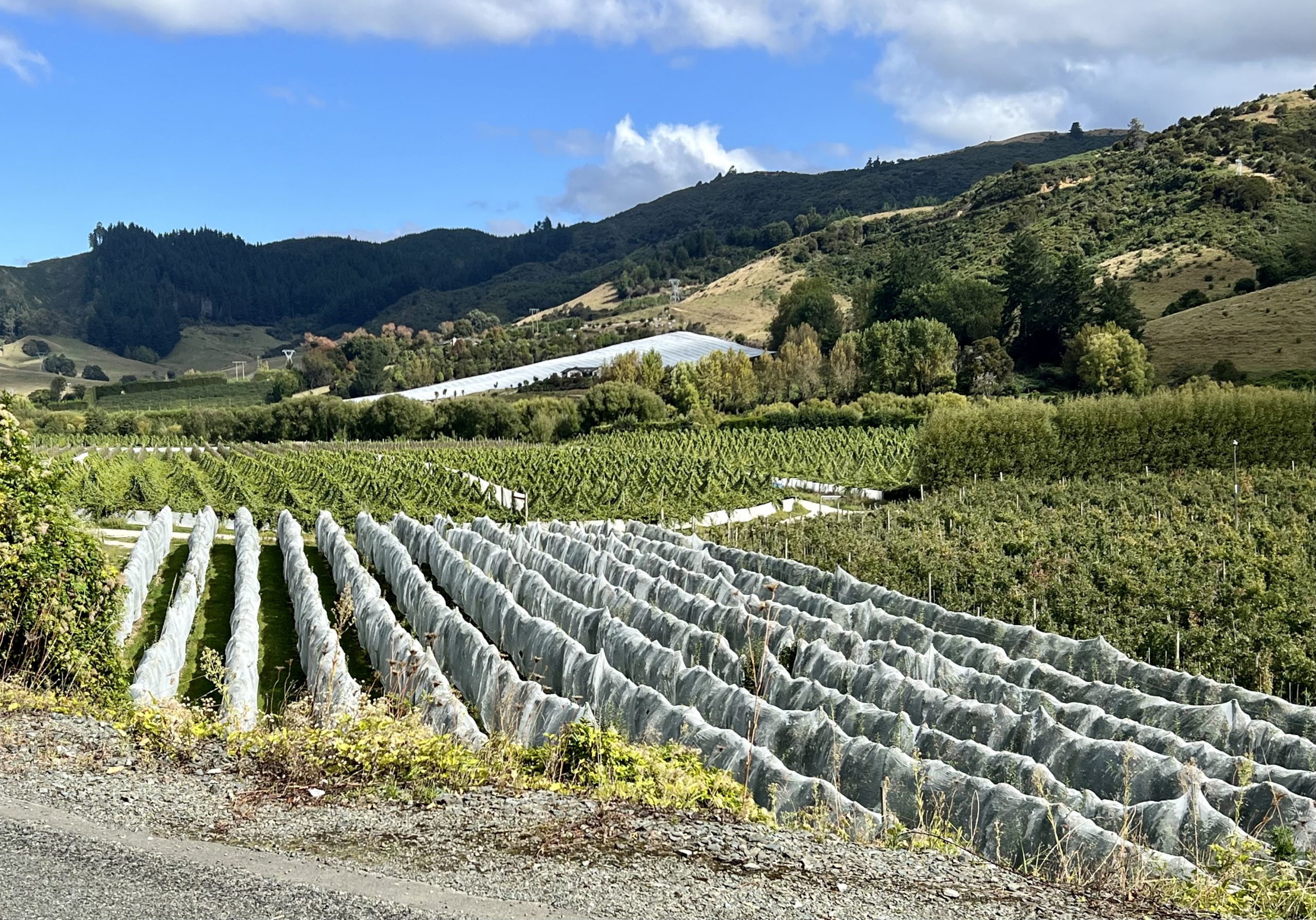
High and low tidesStopped at a winery, but no tasting that day. Then up to a nearby golf course for a view. Here they net their vines because of the birds. Last of the netted vines is merlot although the winemaker we talked to thinks they might not pick this year.Hops have been harvestedRed apples are popular in China and Japan.Layered and espaliered!Kiwi fruitNelson is surrounded by agriculture of all kinds. We finally saw produce in the fields, like lettuce and squash. Hundreds of acres of apples, kiwis, and grapes. They espalier apples and even layer some in horizontal bands. Kiwis are on trellises about five feet off the ground. Above that, you occasionally see tent forms of kiwi vines on string. They grow these vines for a period of time and then lower them onto the canopy to replace the older vines. Interesting.
As for Kiwi fruit, when Bonnie was in high school in NZ, the idea making this fruit a major export was just being explored. At the time the fruit was called Chinese gooseberry. Hmm. Not appealing. So there was a nationwide call for a new name. Thus it became a Kiwi fruit.
Forestry Harvesting
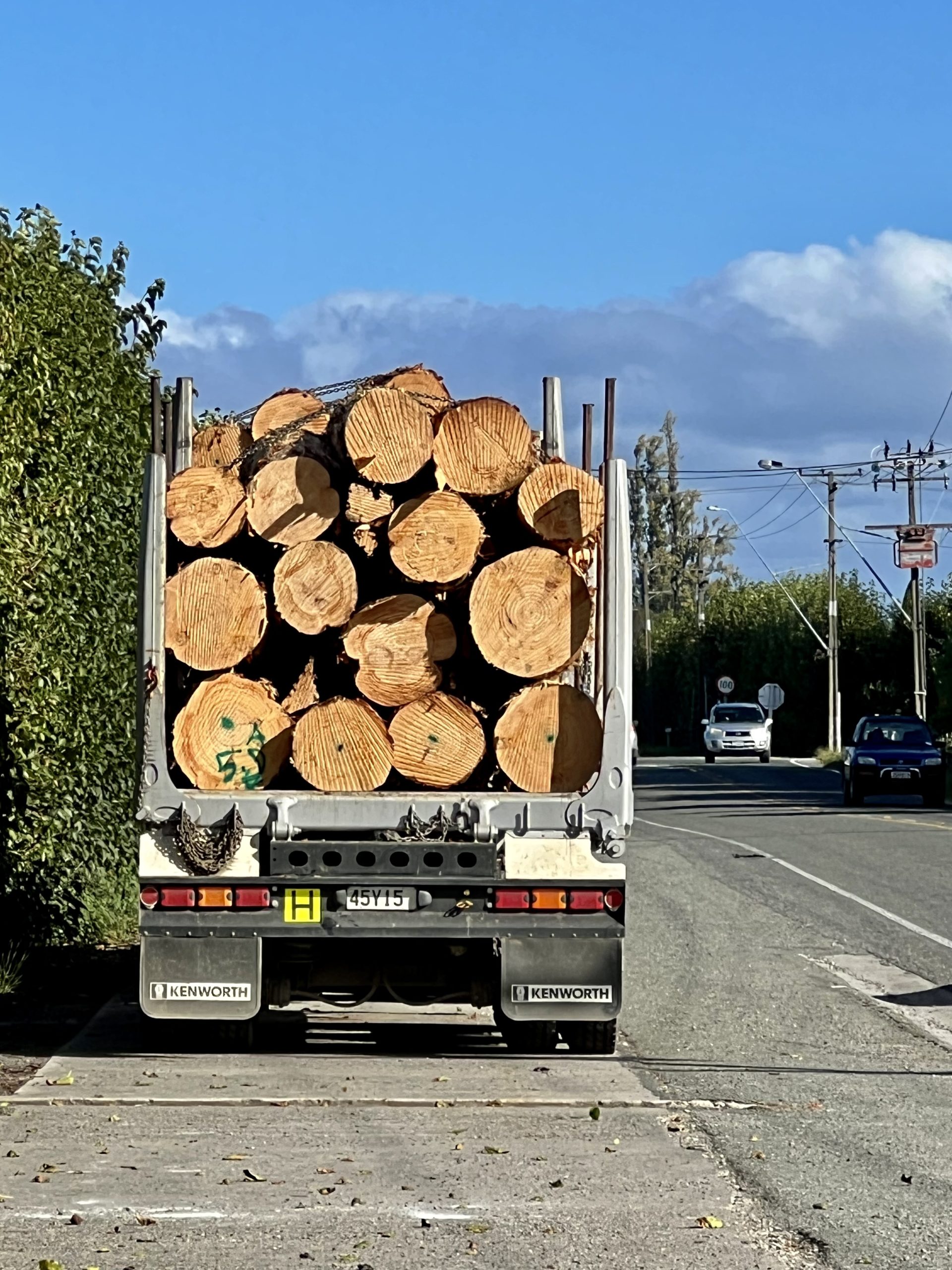
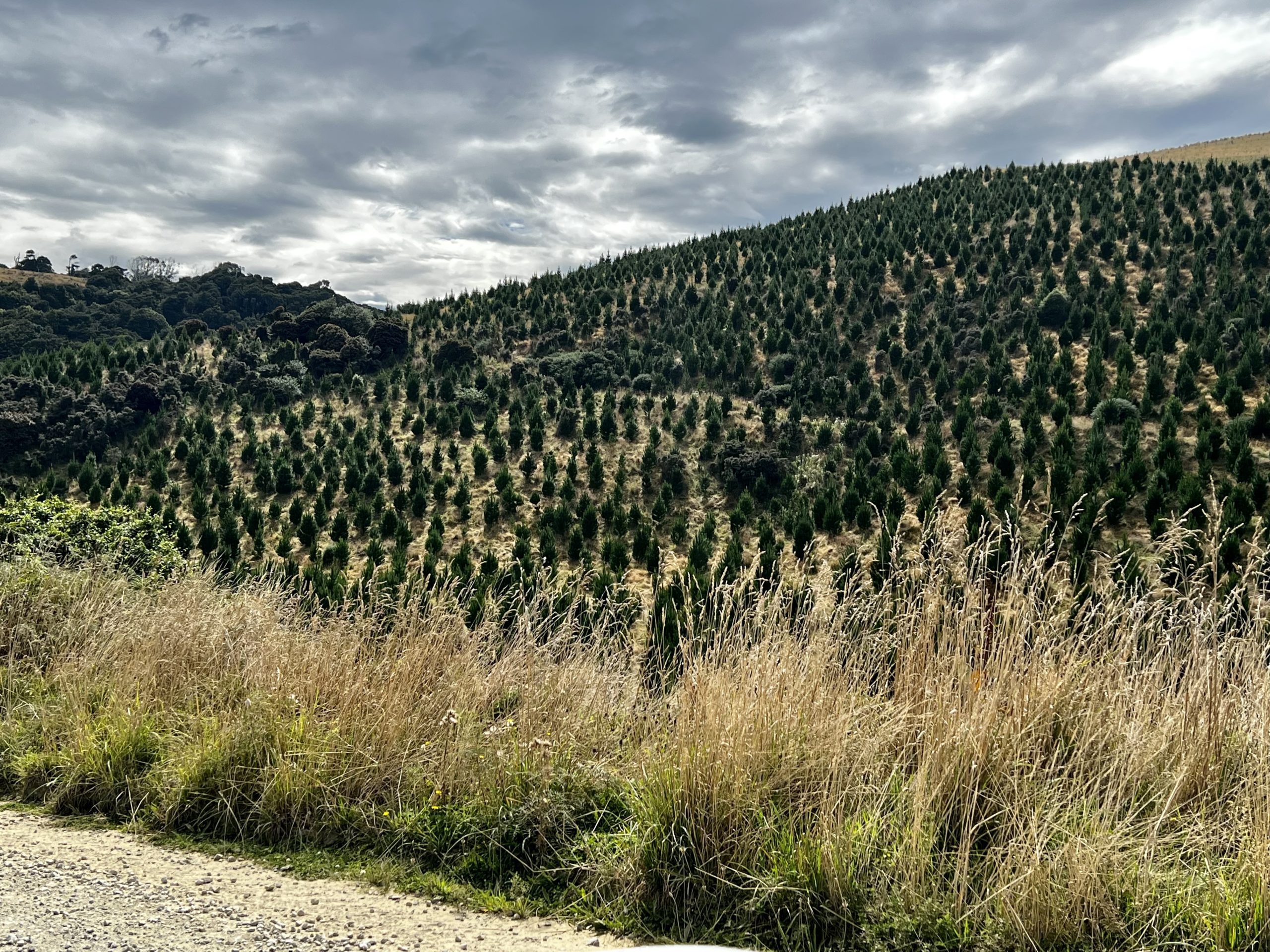
New Zealand treats its forests like we treat a field of lettuce in Salinas, California. Lots of turnover. Except their crop rotation is longer. They plant California Monterey pines by the thousands and wait twenty-five to thirty years to clear cut them. Then replant. We saw a lot of clear cutting on steep hillsides around Nelson, which was disturbing. We also saw a lot of semis loaded with timber going to nearby mills or to be shipped to other nations unmilled.
The hillsides are very steep. Kiwis apparently use some type of machine attached to cables to cut and haul the wood on the slopes. The most significant issue is controlling the slash—the leftovers. Without some type of barrier between the clear-cut area and the streams and rivers, the slash can move into the waterways during heavy storms, causing pile ups and damage to the stream beds and bridges. There is also erosion on the bare hillsides.
Robert remembers that one of his professors—Ed Stone— at UC Berkeley in the late 1960s was consulting then in New Zealand on how to best grow these pines. He had set up growing labs in the Bay Area to test different seed sources under different environmental conditions.
Large areas of clear-cut Forrest
Food and Wine on our Day Trip
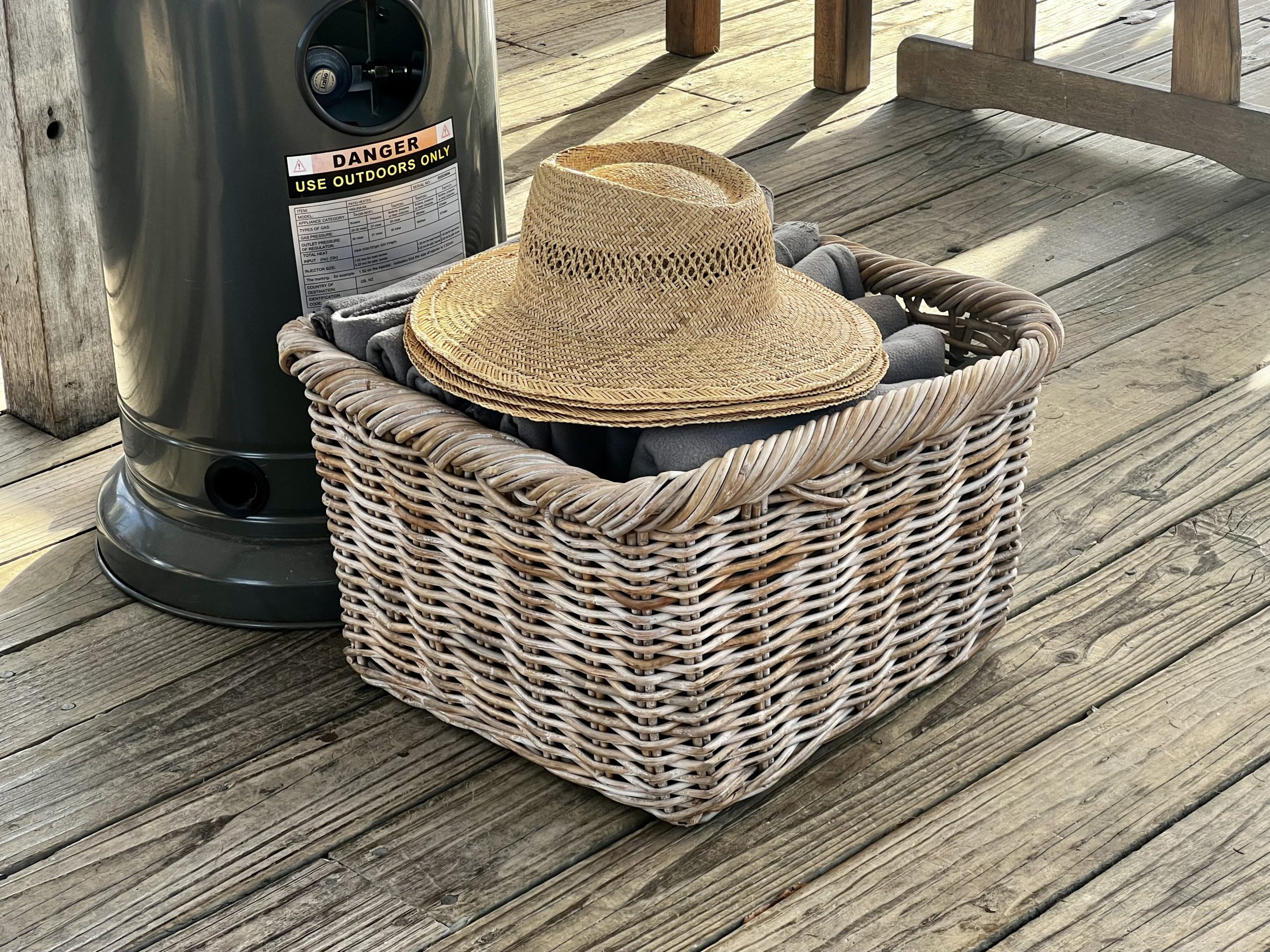
A restaurant supplies sun hats as well as blankets.
Food and Wine in Nelson
This was a hopeful destination according to Apple Maps. Not so much when Robert arrived!
The weather has been cooperative for most of the trip. Raining mostly on travel days.
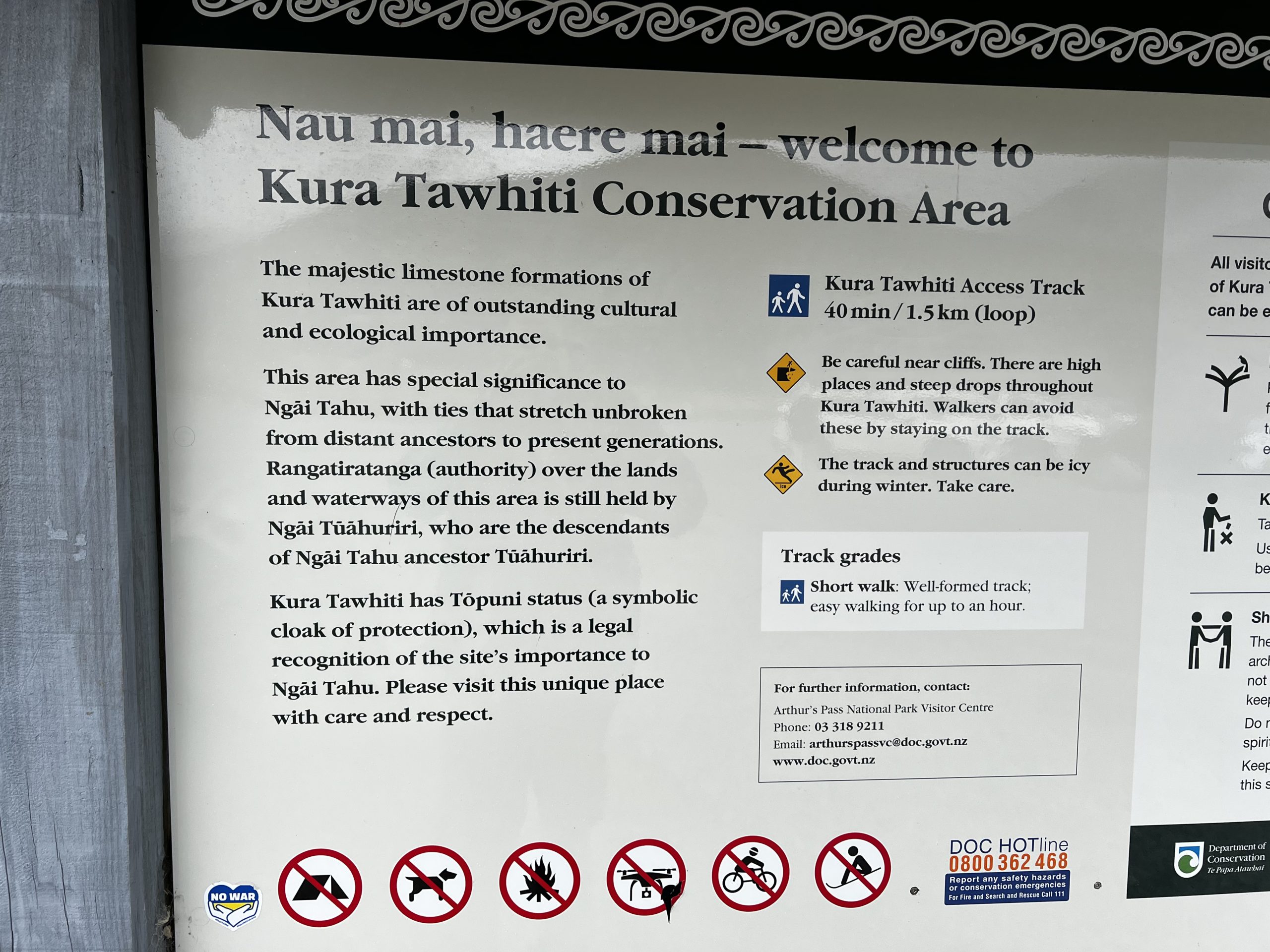
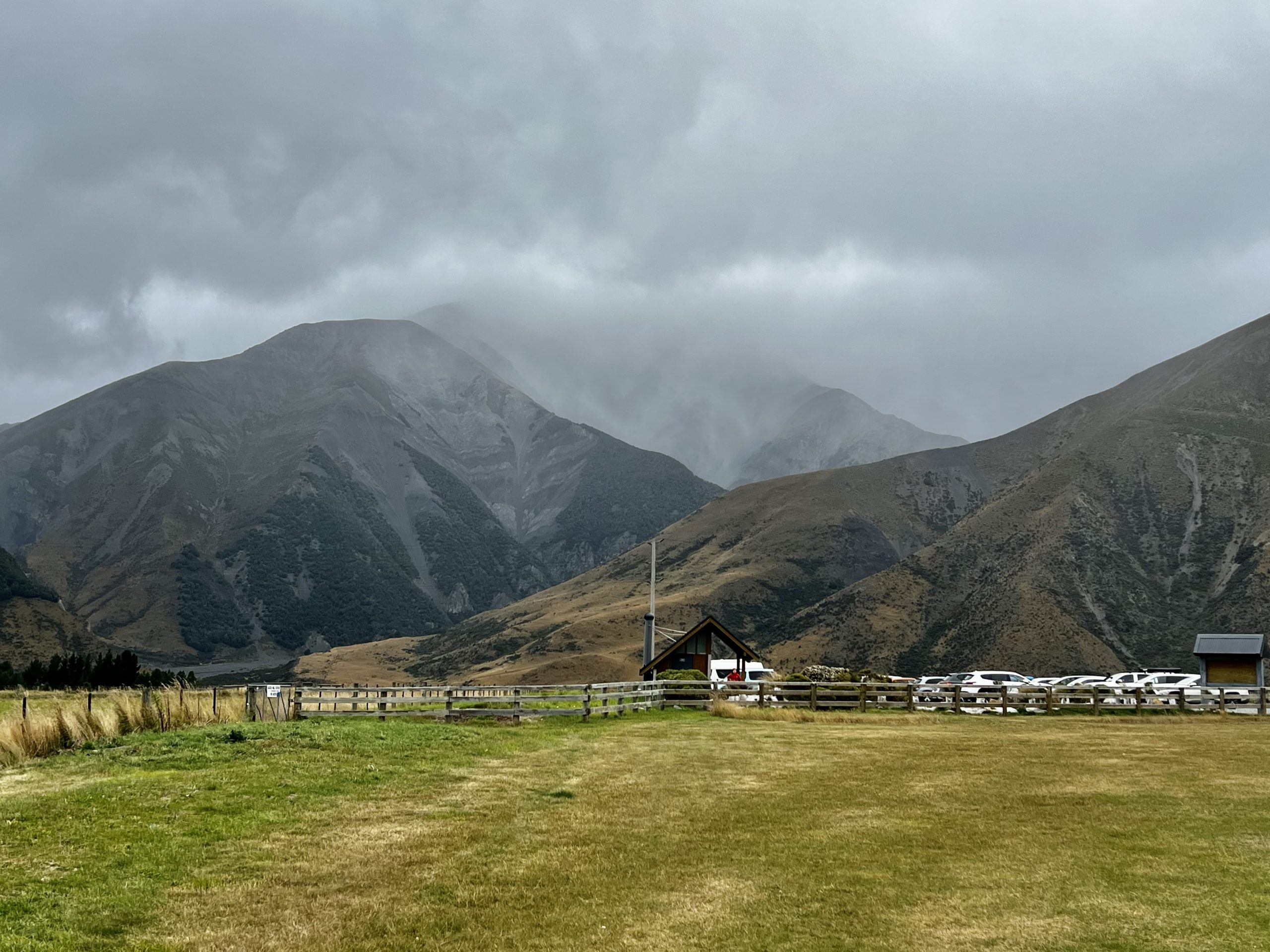
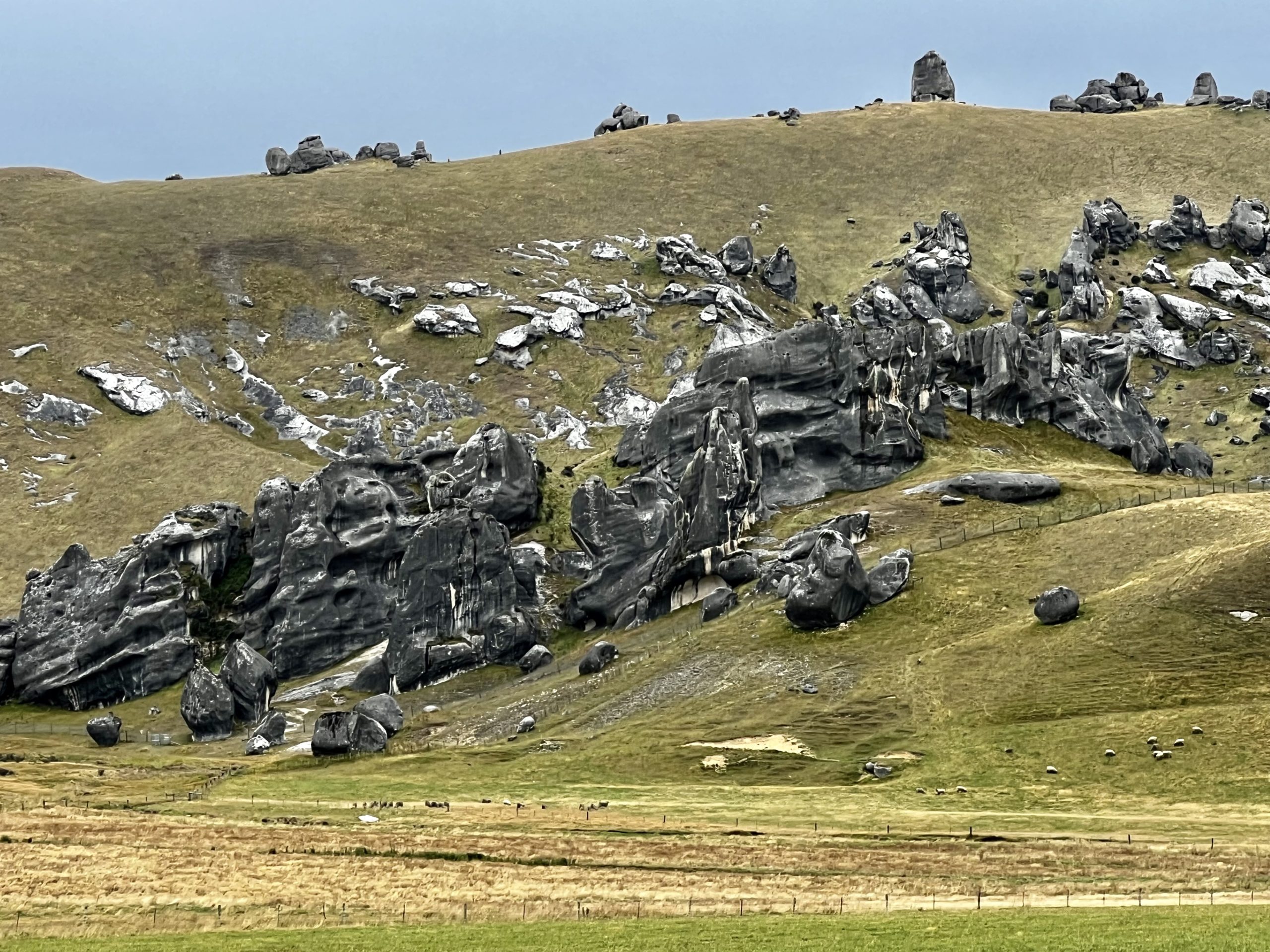
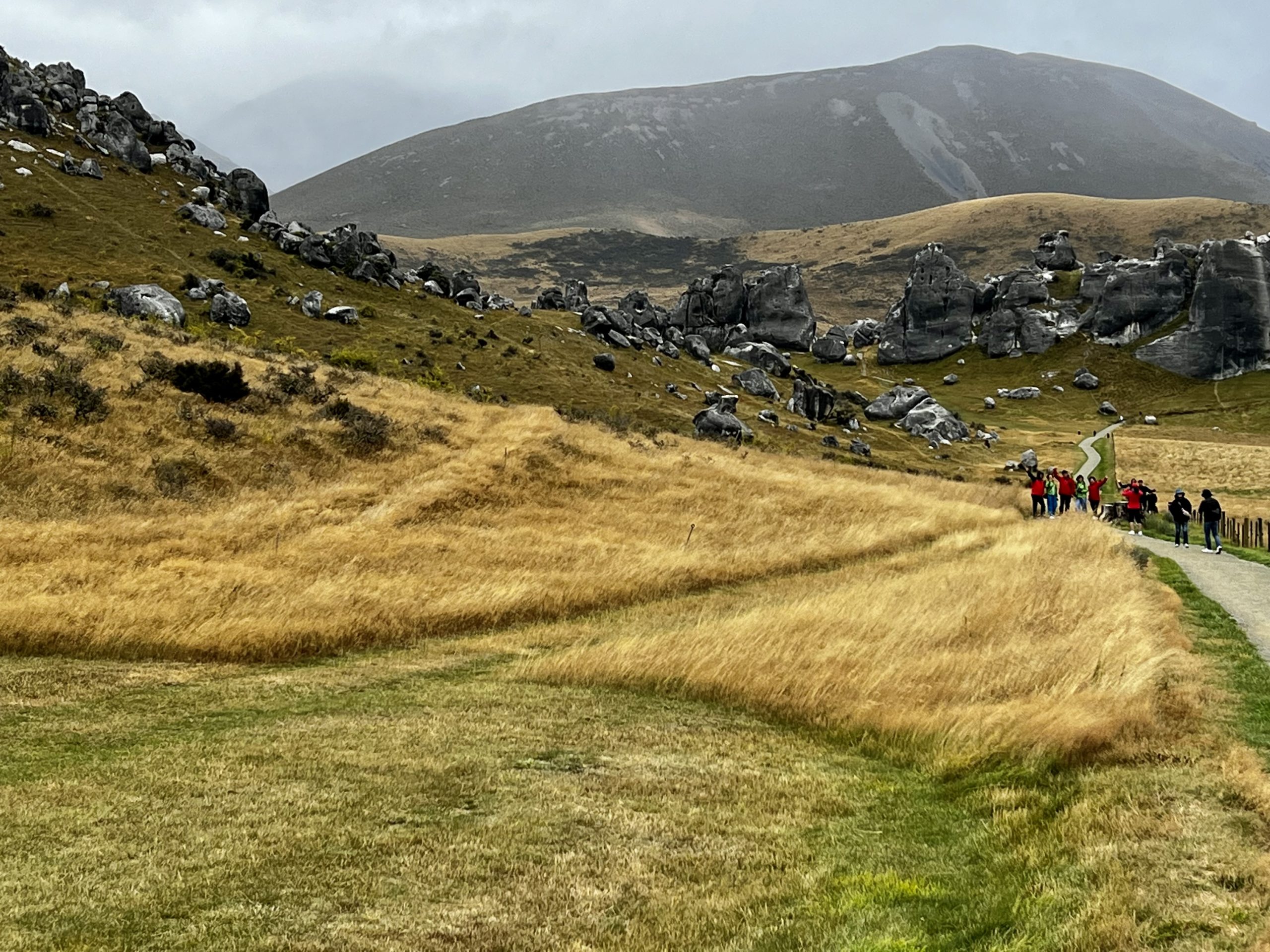
Kura Tawhiti
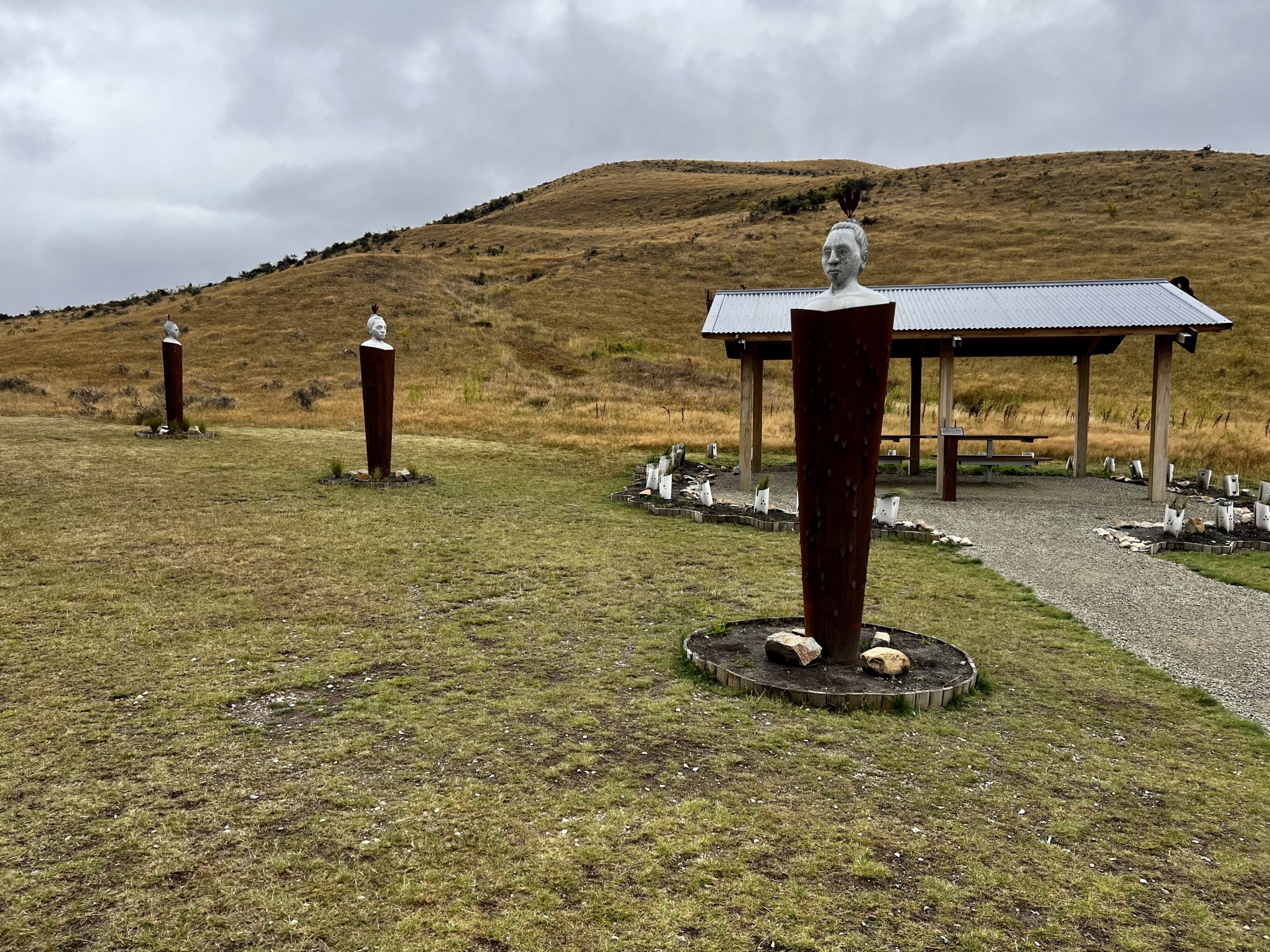
Limestone formations that are revered by the Māori. Too cold to get an close look!
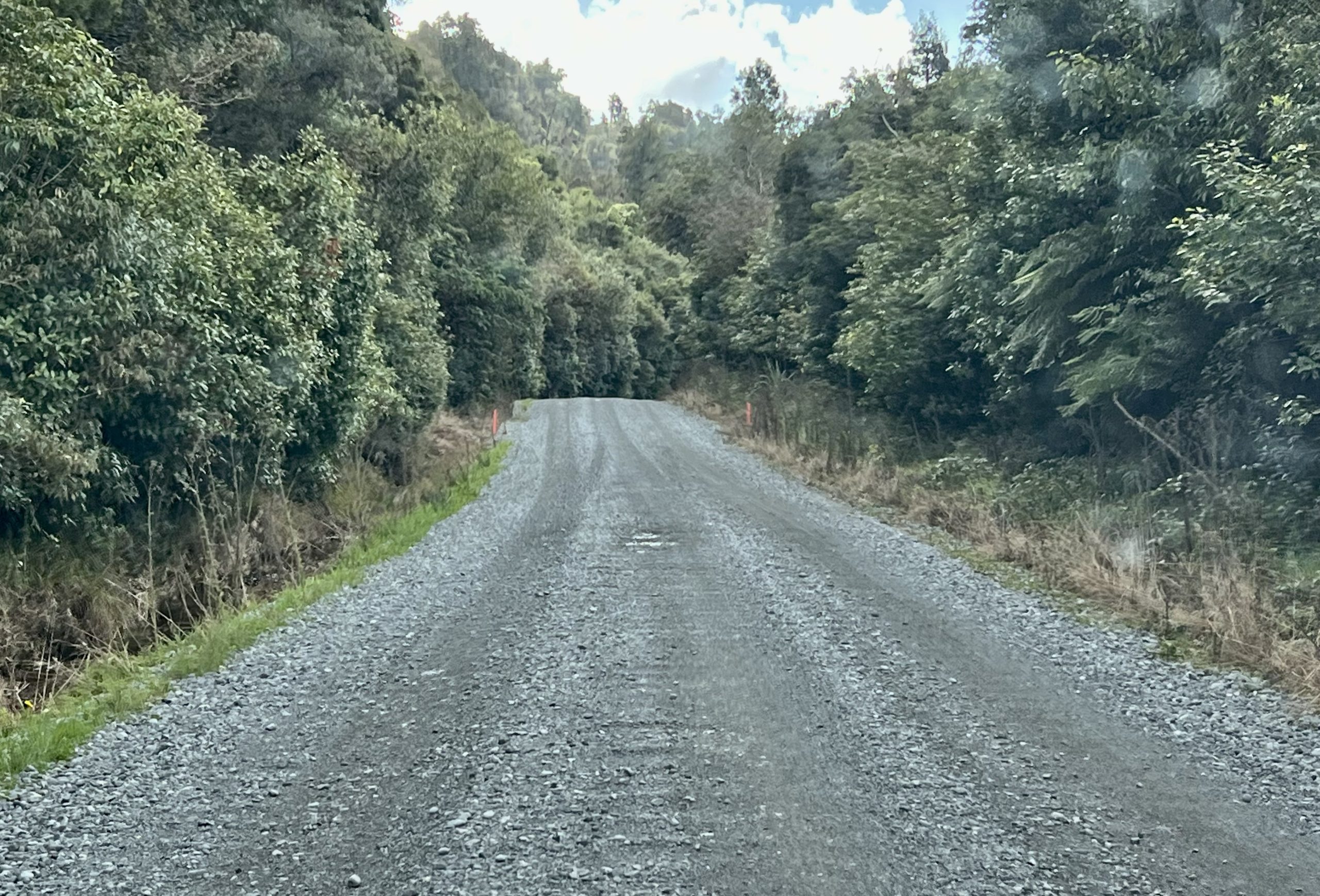
More on the Way
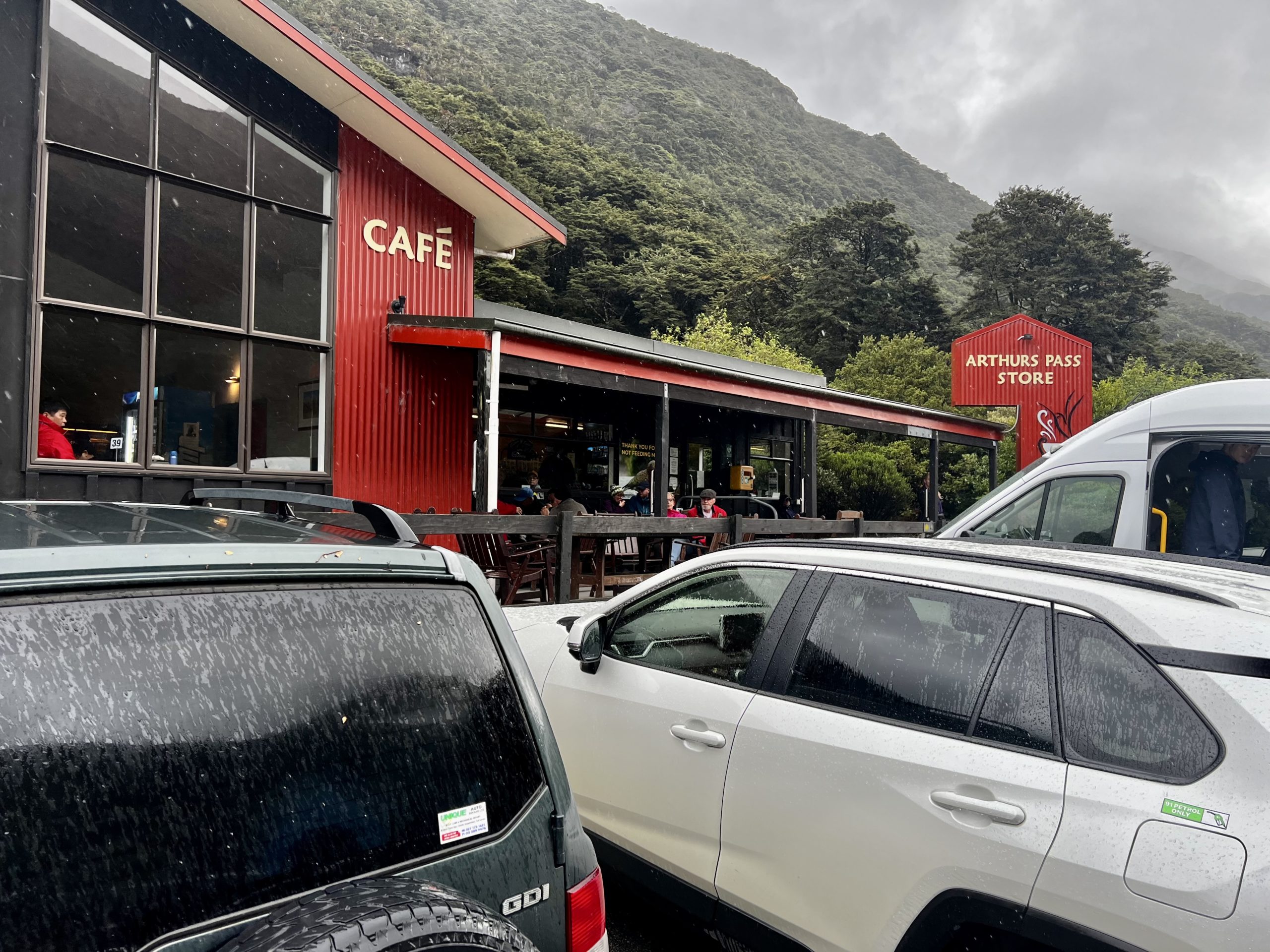
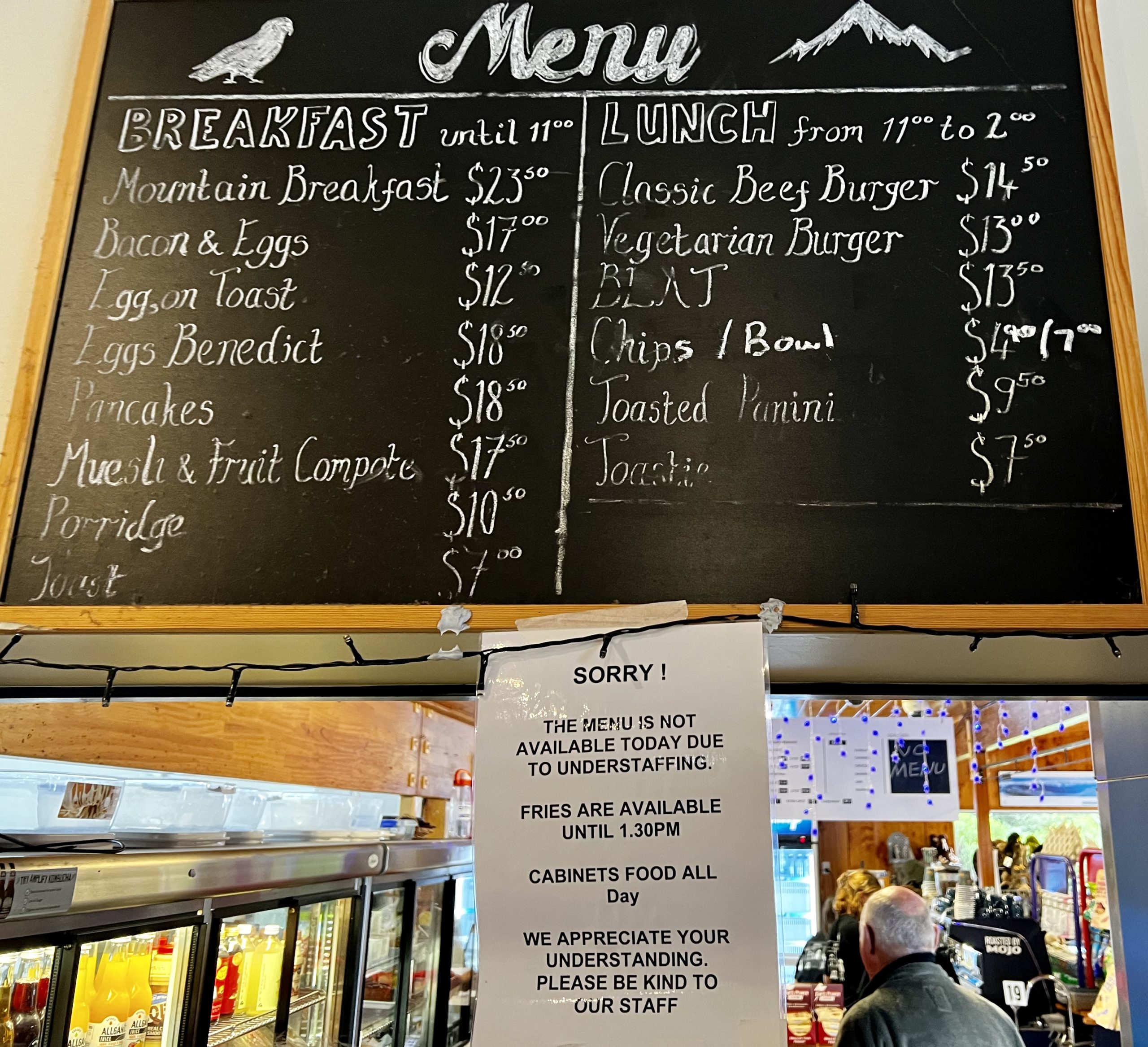
Arthur’s Pass for Lunch
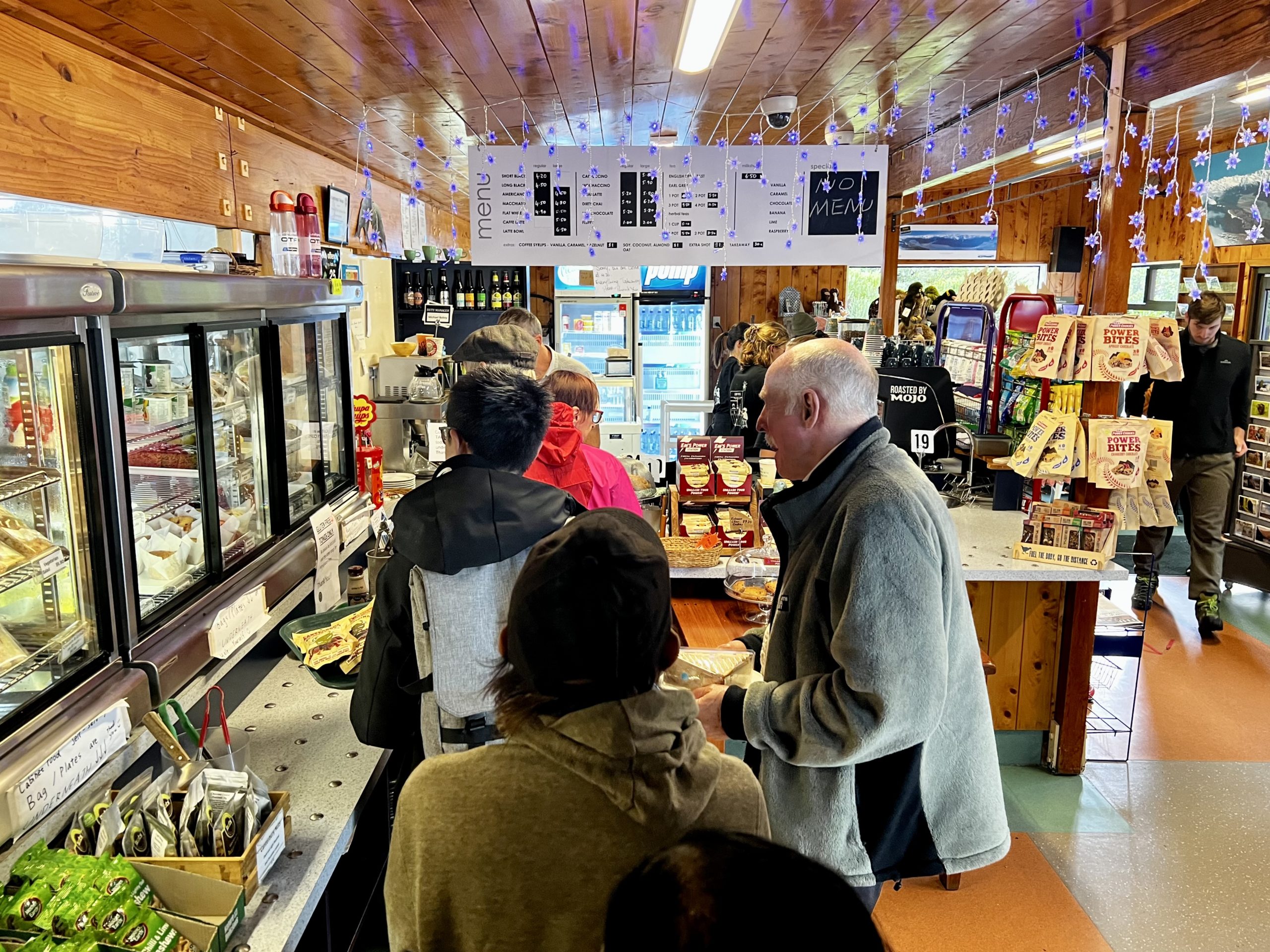
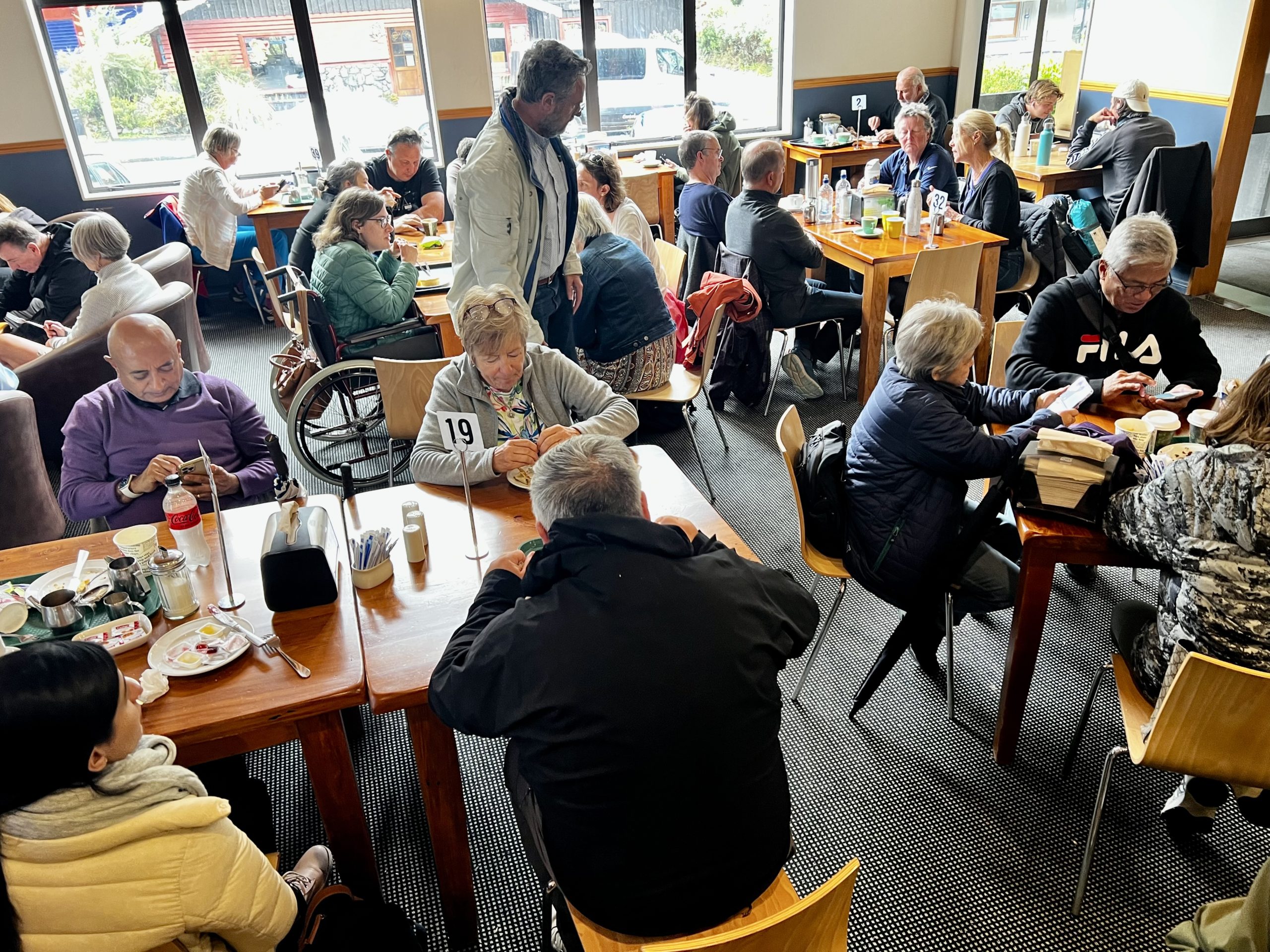
The one restaurant for many miles was jammed with travelers.
Accommodations
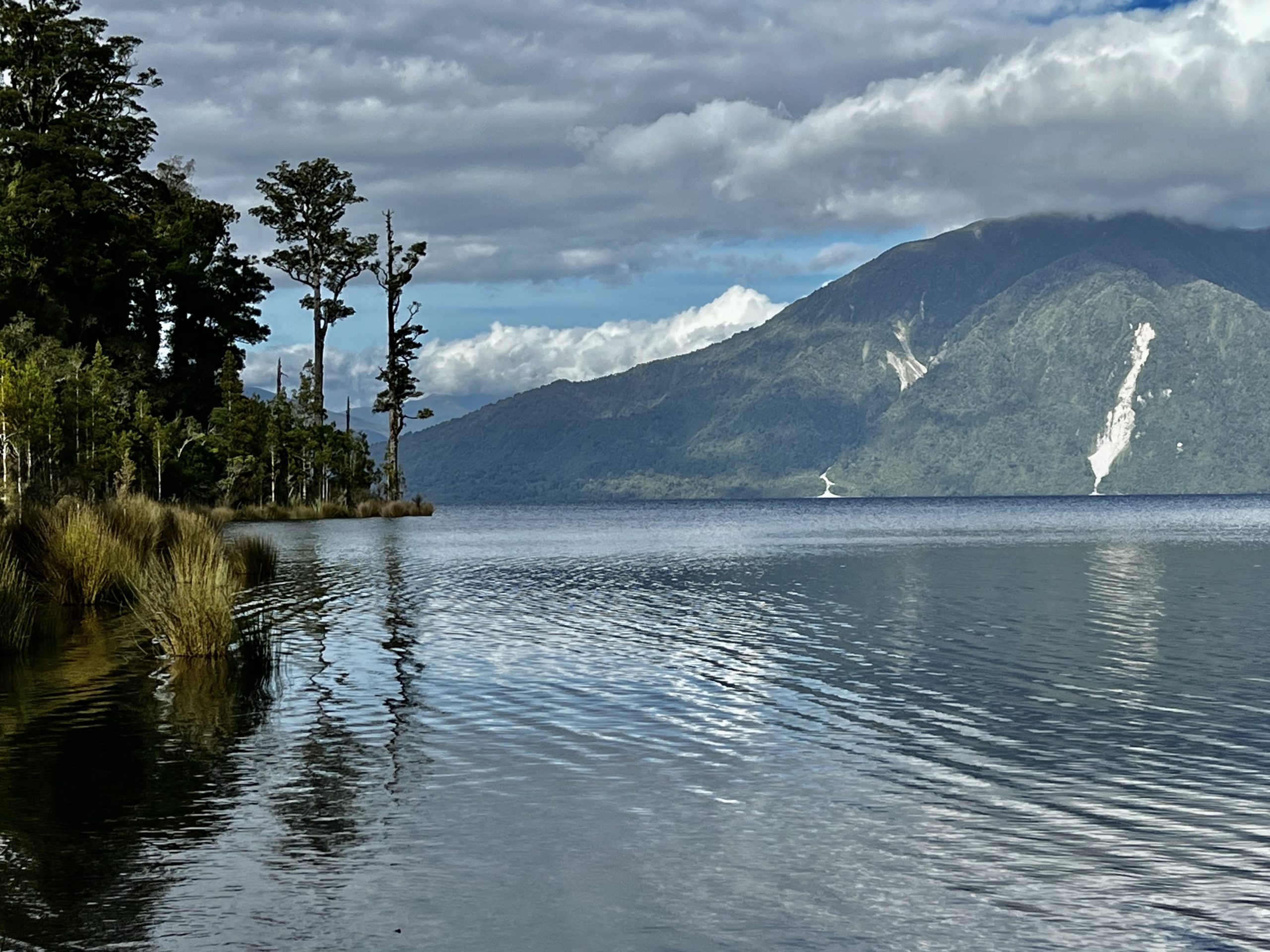
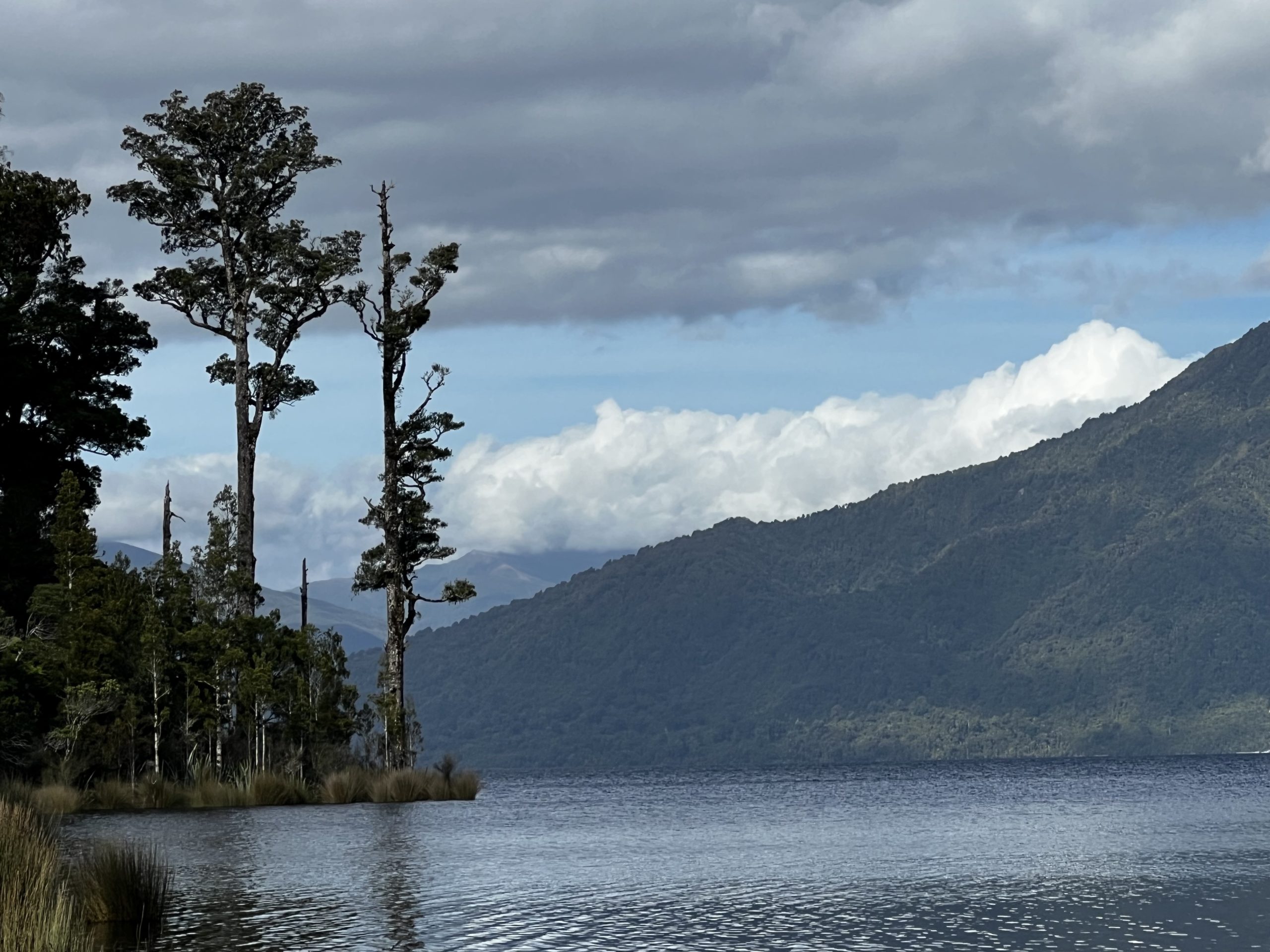
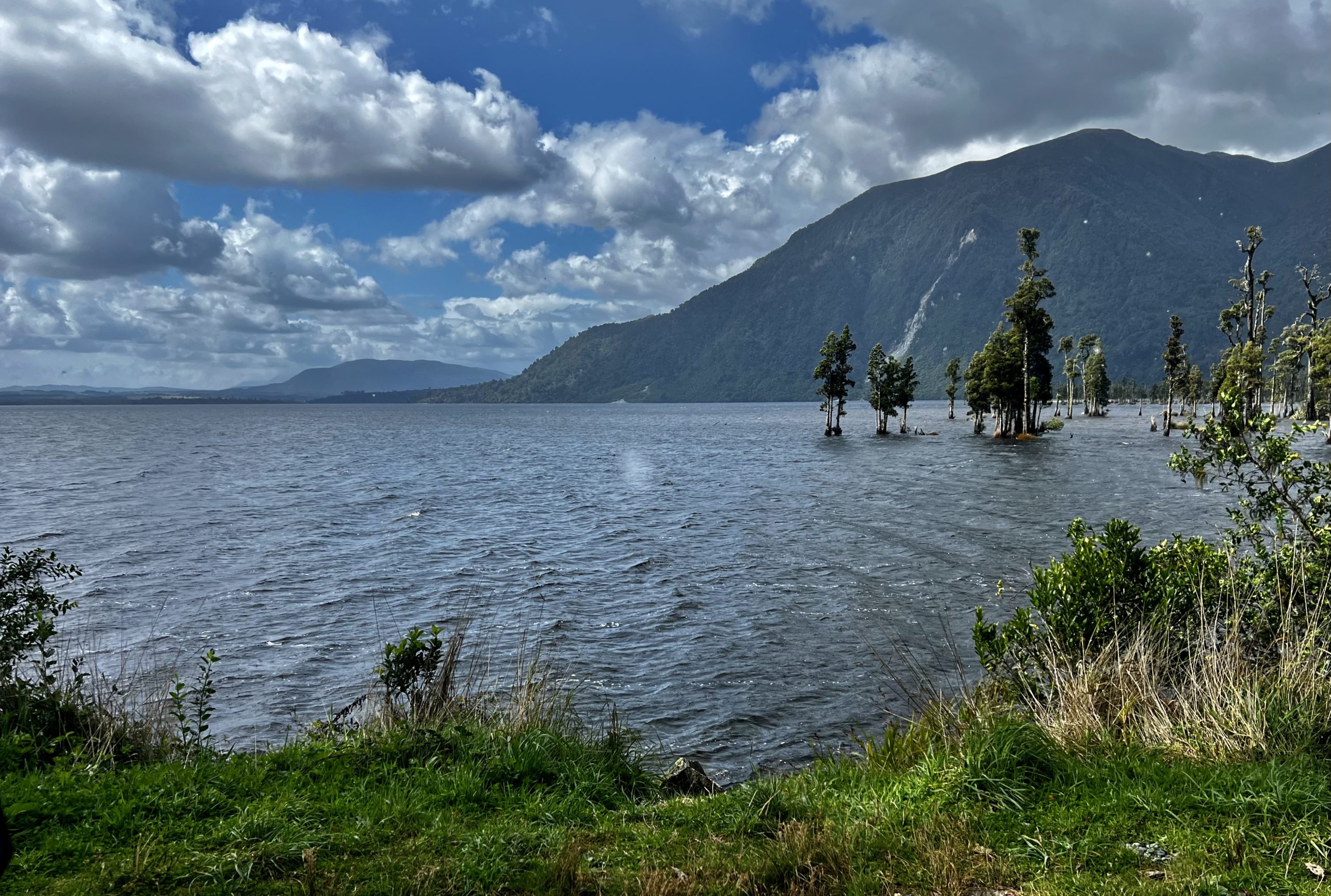
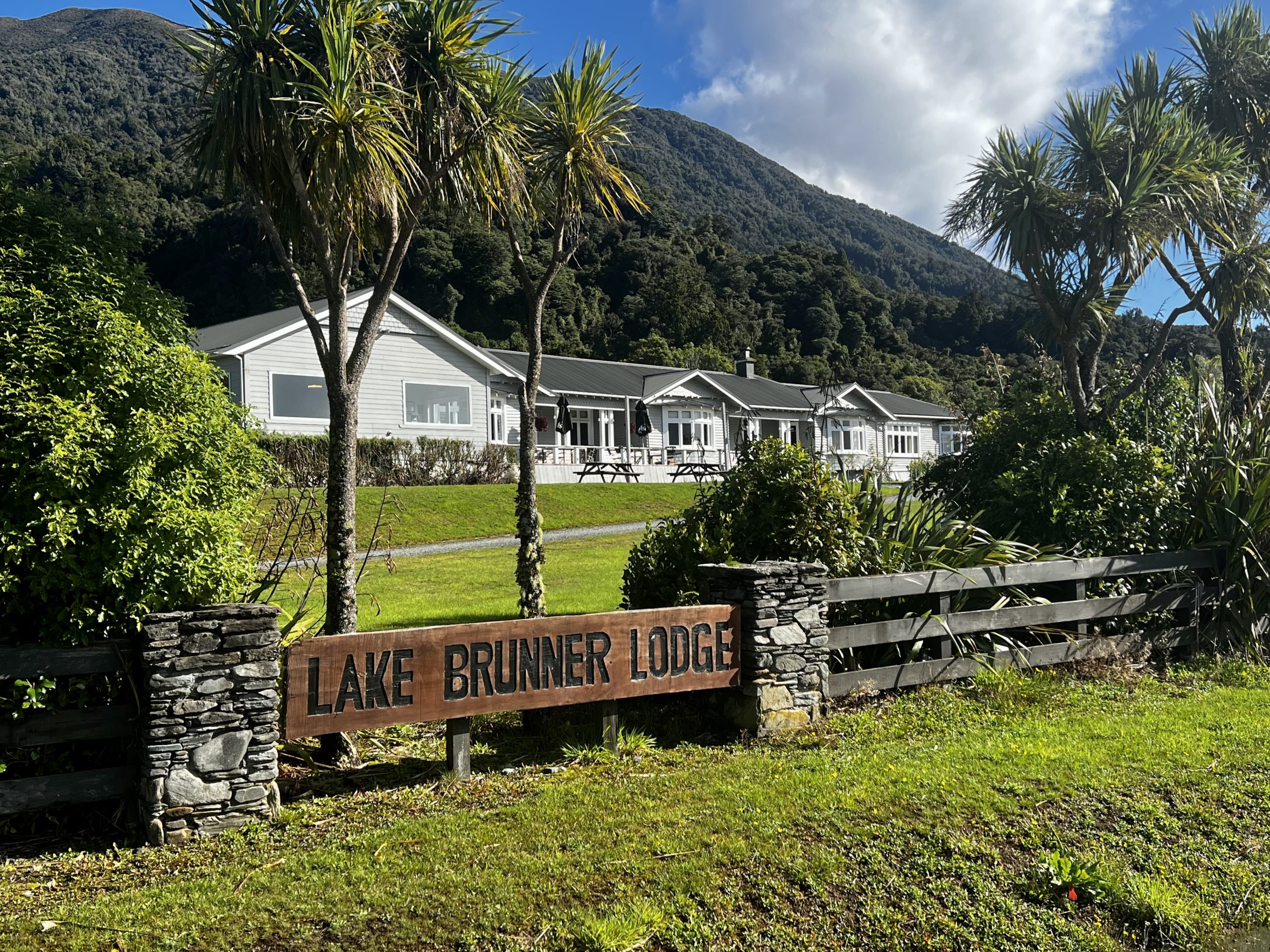
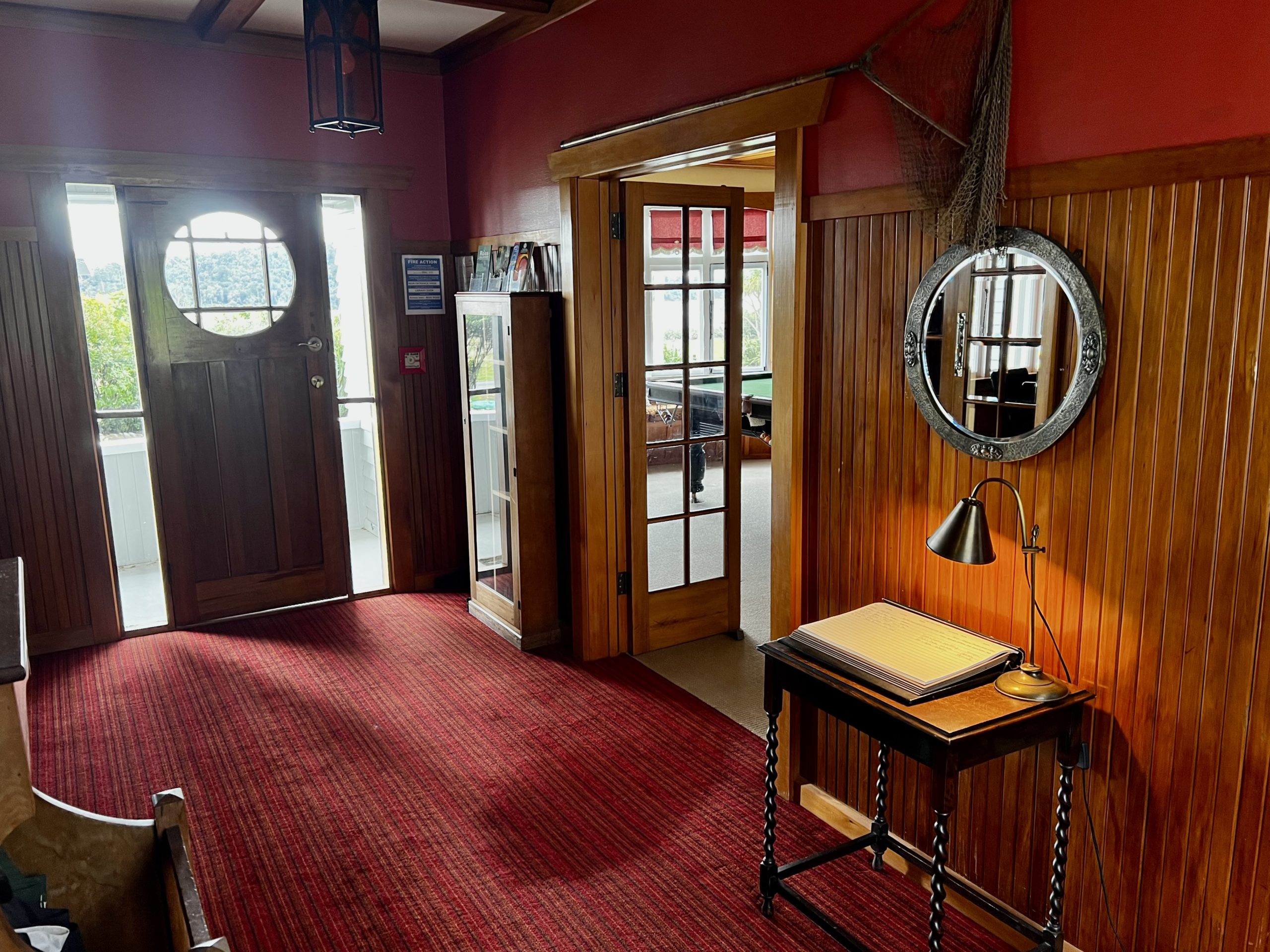
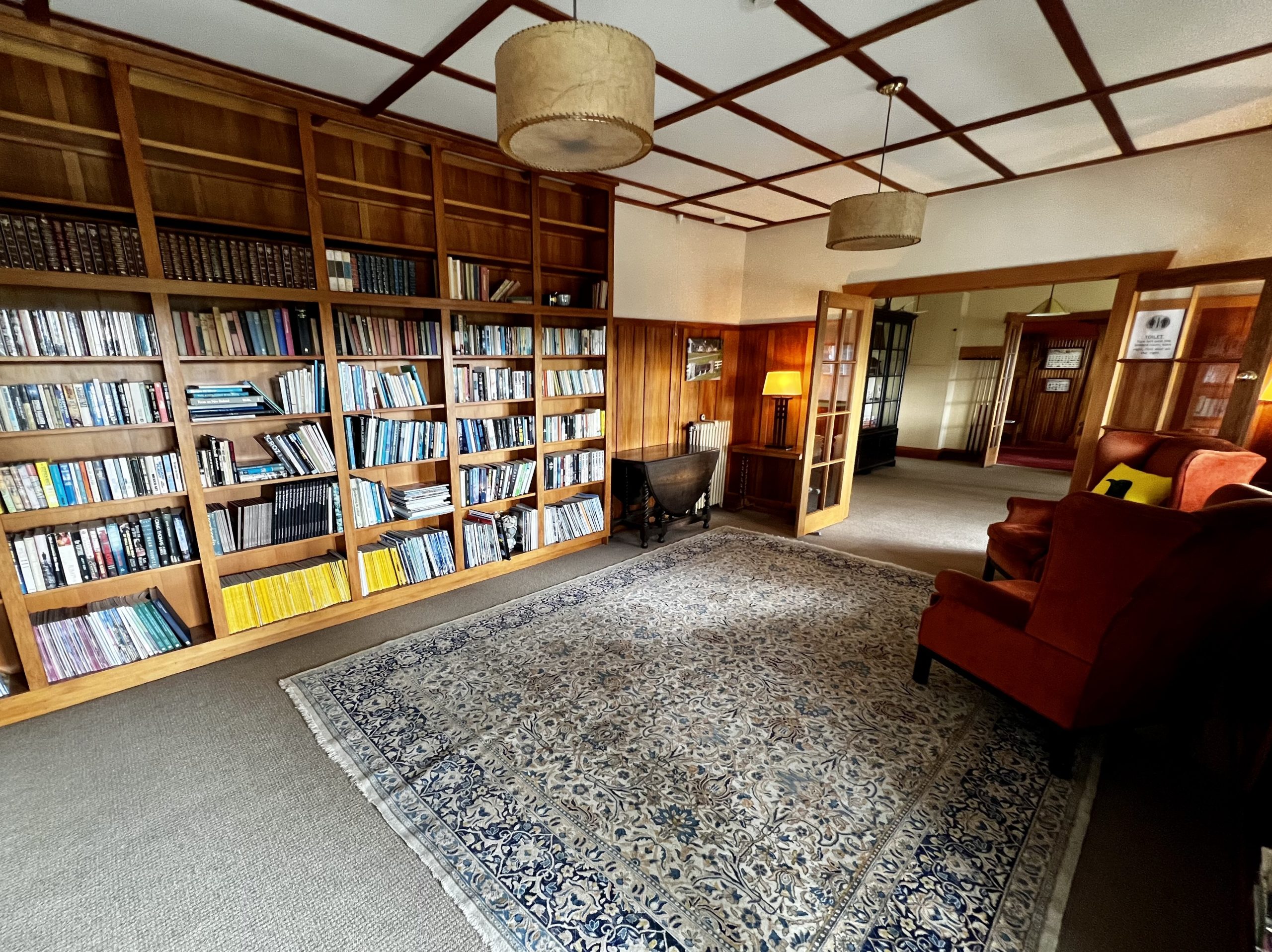
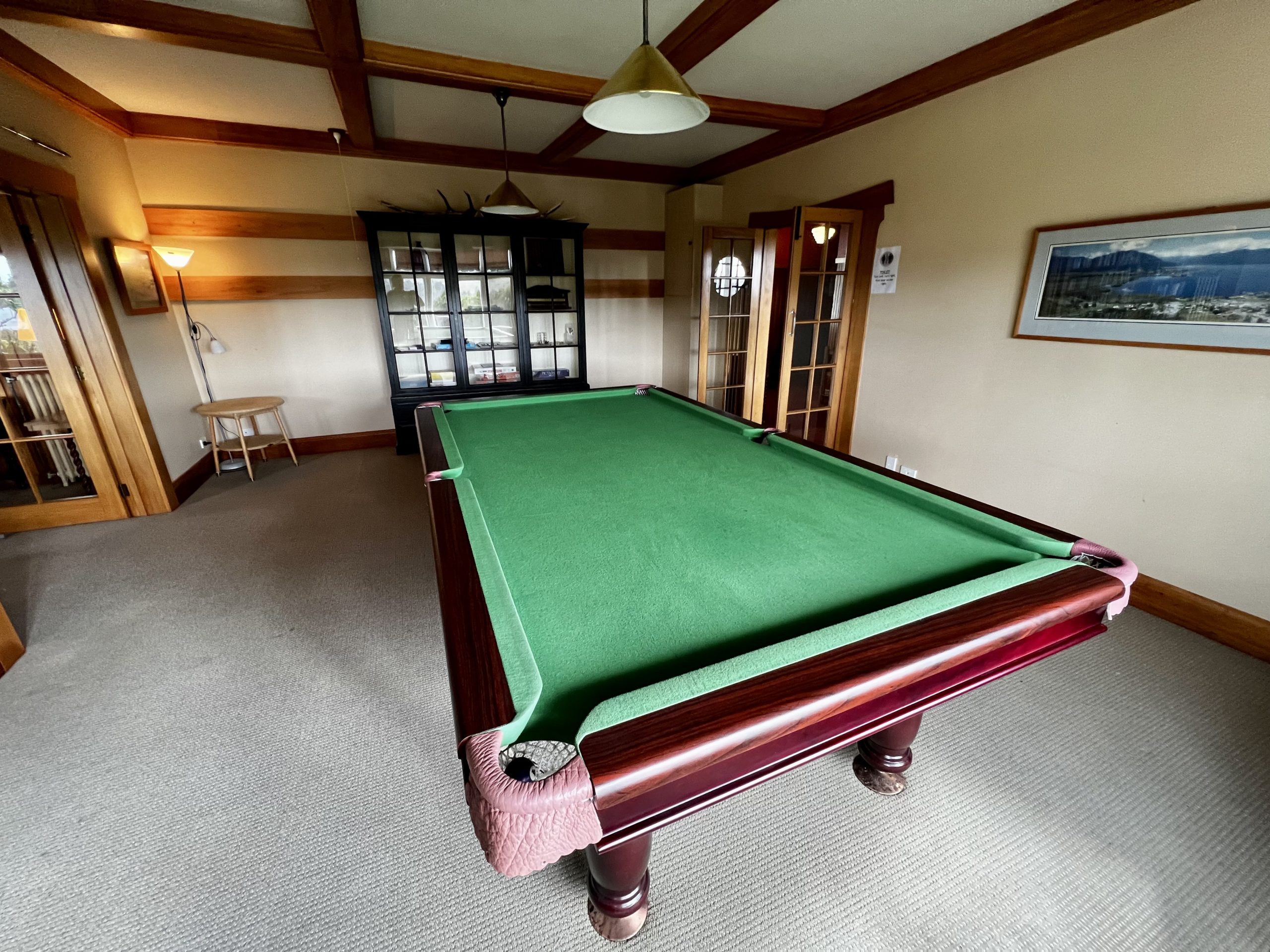
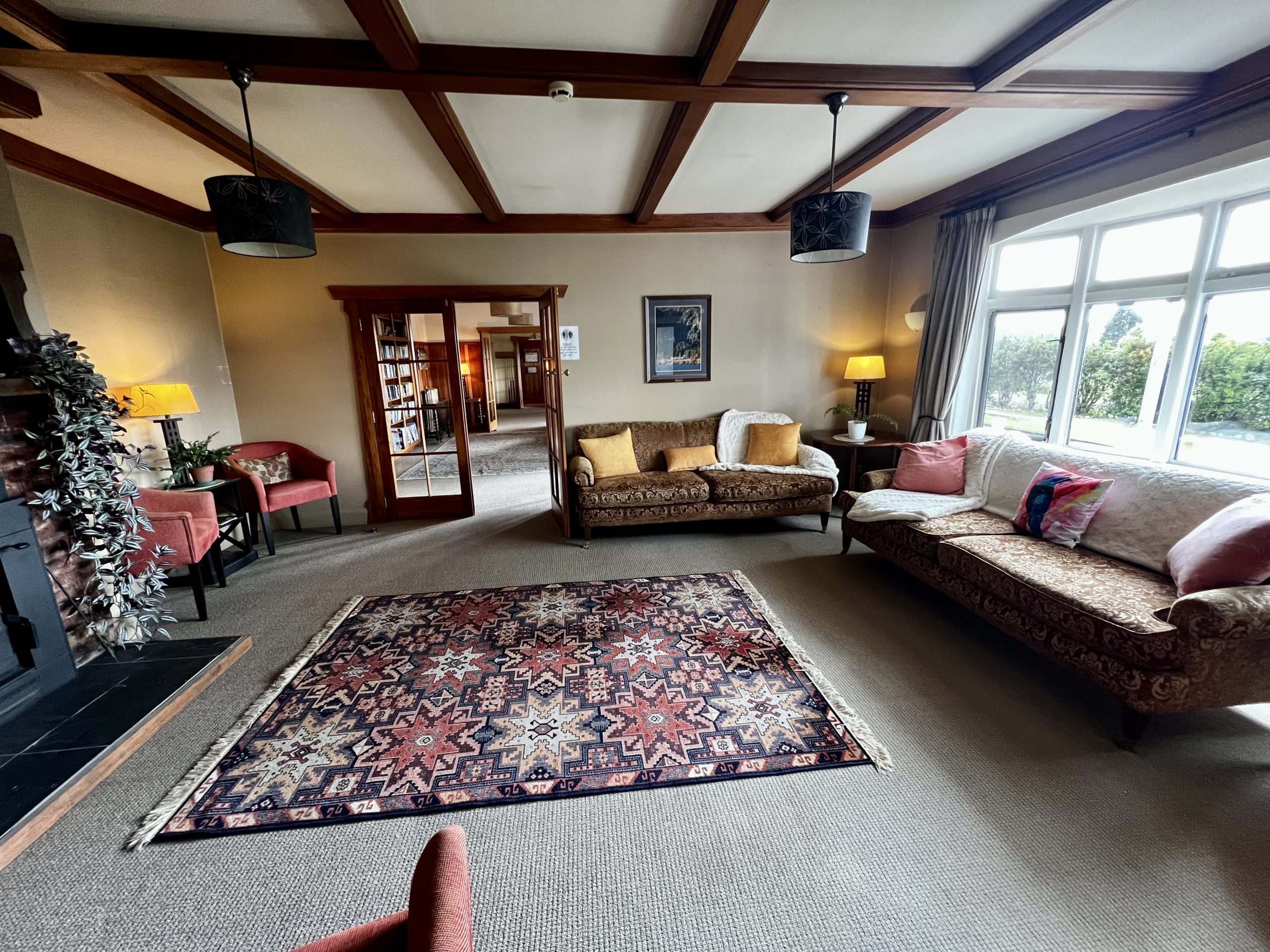
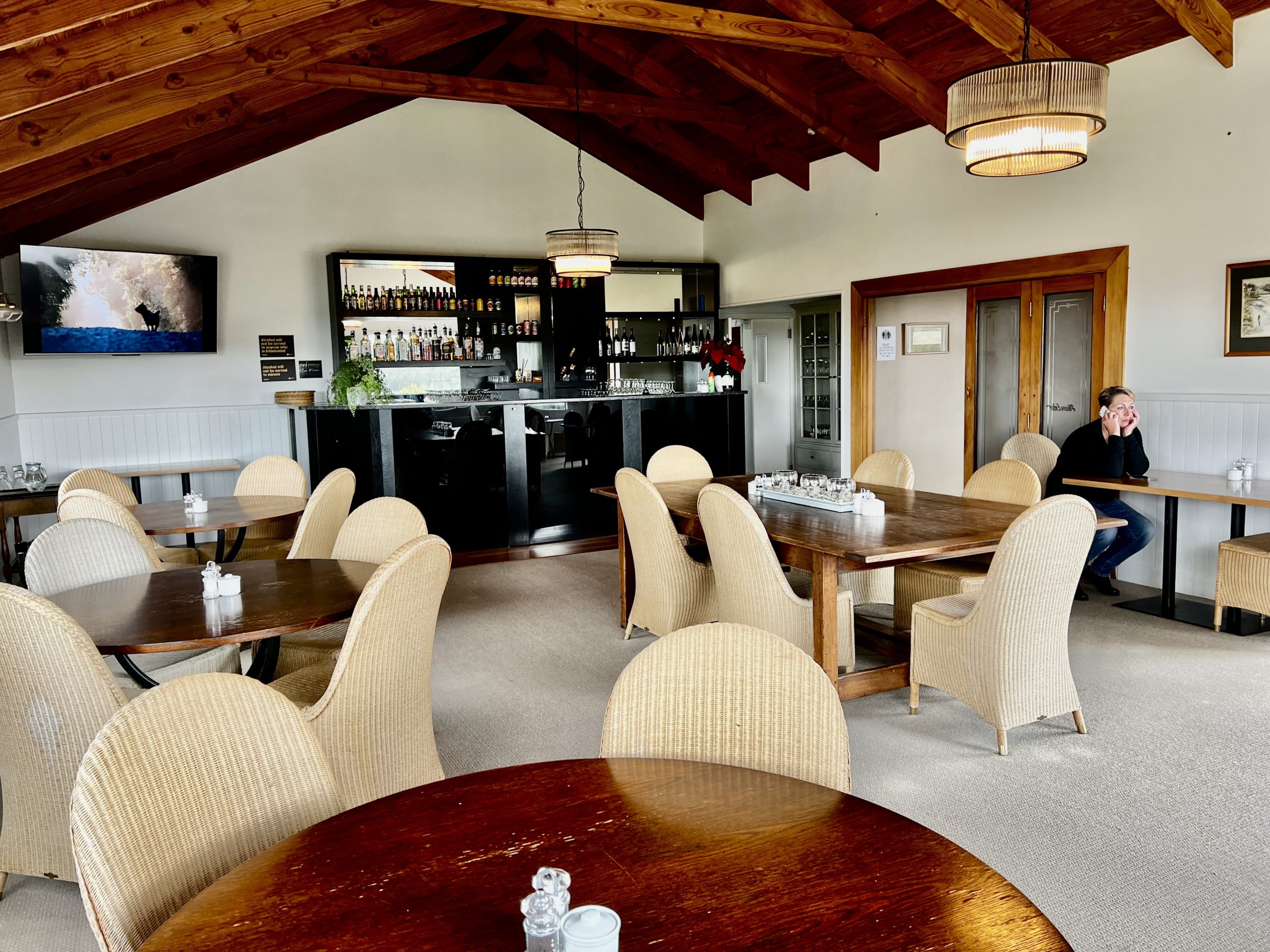
The Lake Brunner Eco Lodge was established as the Mitchell’s Lake Hotel in 1868 and rebuilt in the 1930’s in a classic arts and crafts style with wood paneling. A beautiful old place with eight guest rooms, a pool room, a library, lounge, and dining room. Because it is not close to any power grid, the early owners harnessed the hydro power of the nearby Carew Falls. The lodge, down a gravel road on the southern shore of Lake Brunner, is surrounded by some of the oldest protected podocarp rainforest in the world. When the railroad arrived at the turn of the last century, saw mills sprang up to harvest the native hardwood forest.
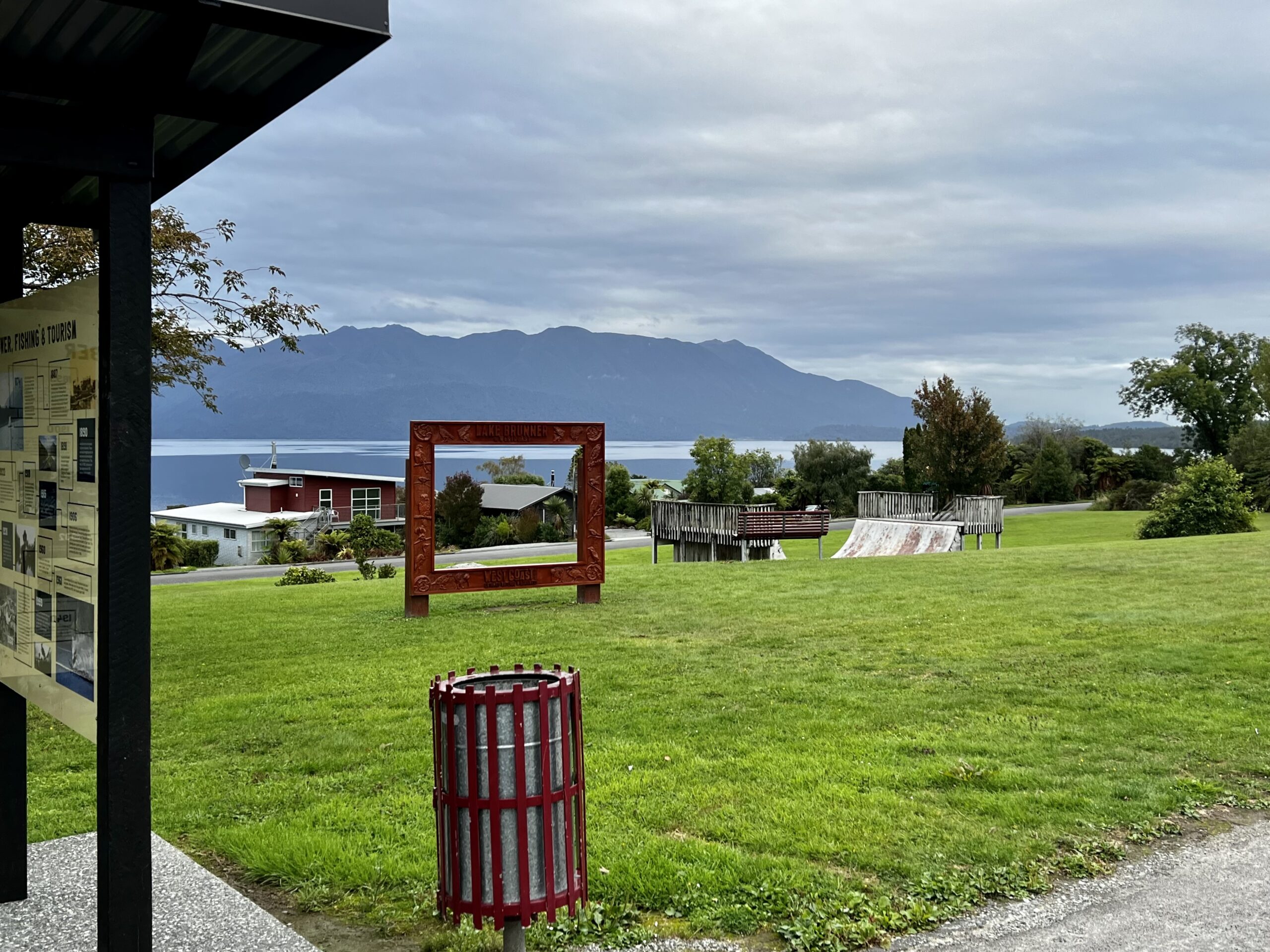
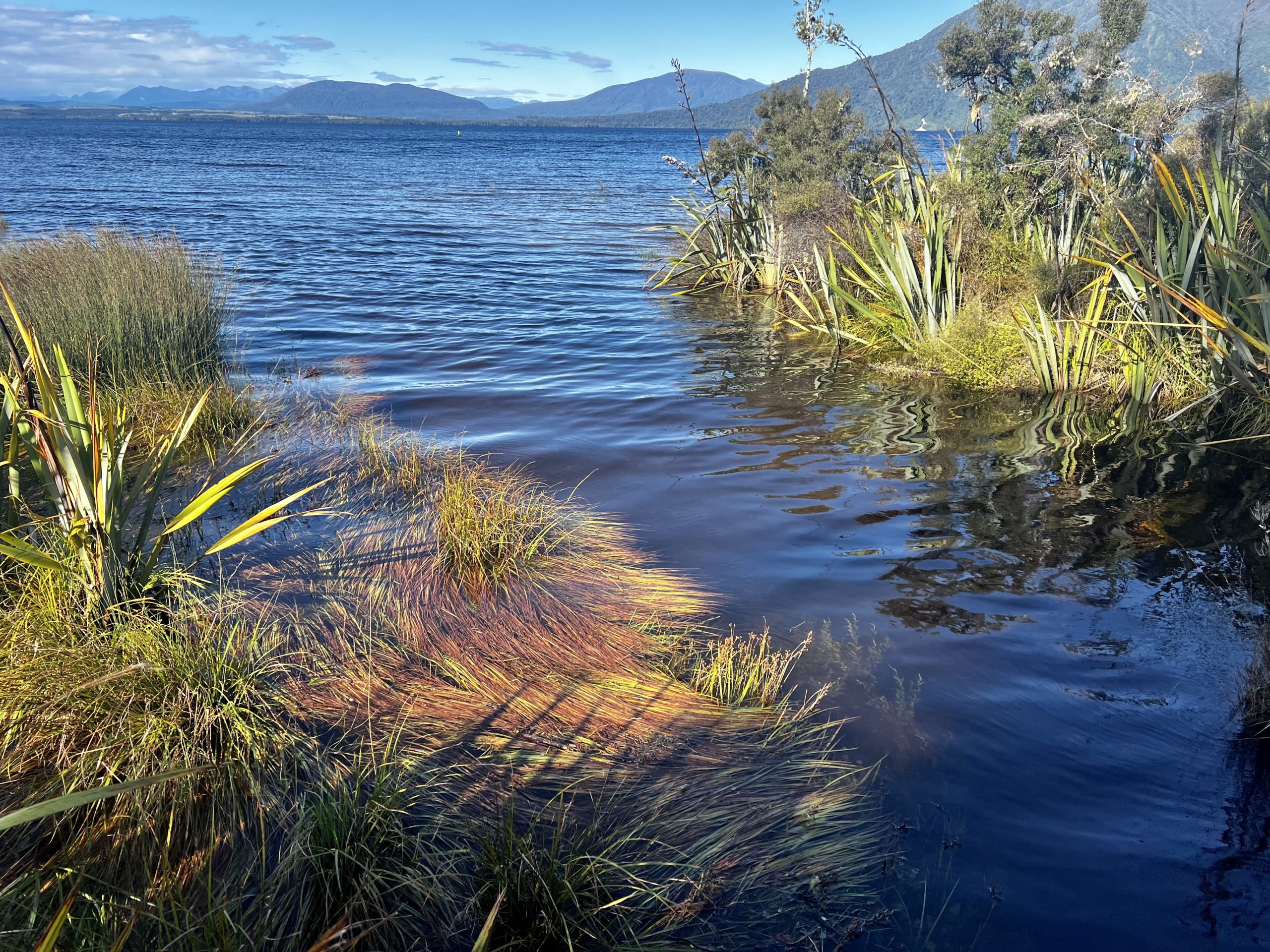
Lake Brunner is the largest lake in the region. Its outlet feeds the Arnold River. It is more than 15 square miles in size and 335 feet in depth. New Zealand lakes are deep! The area, including both lake and rivers, is known for brown trout. Of course. Why else would Robert drag Bonnie here?!
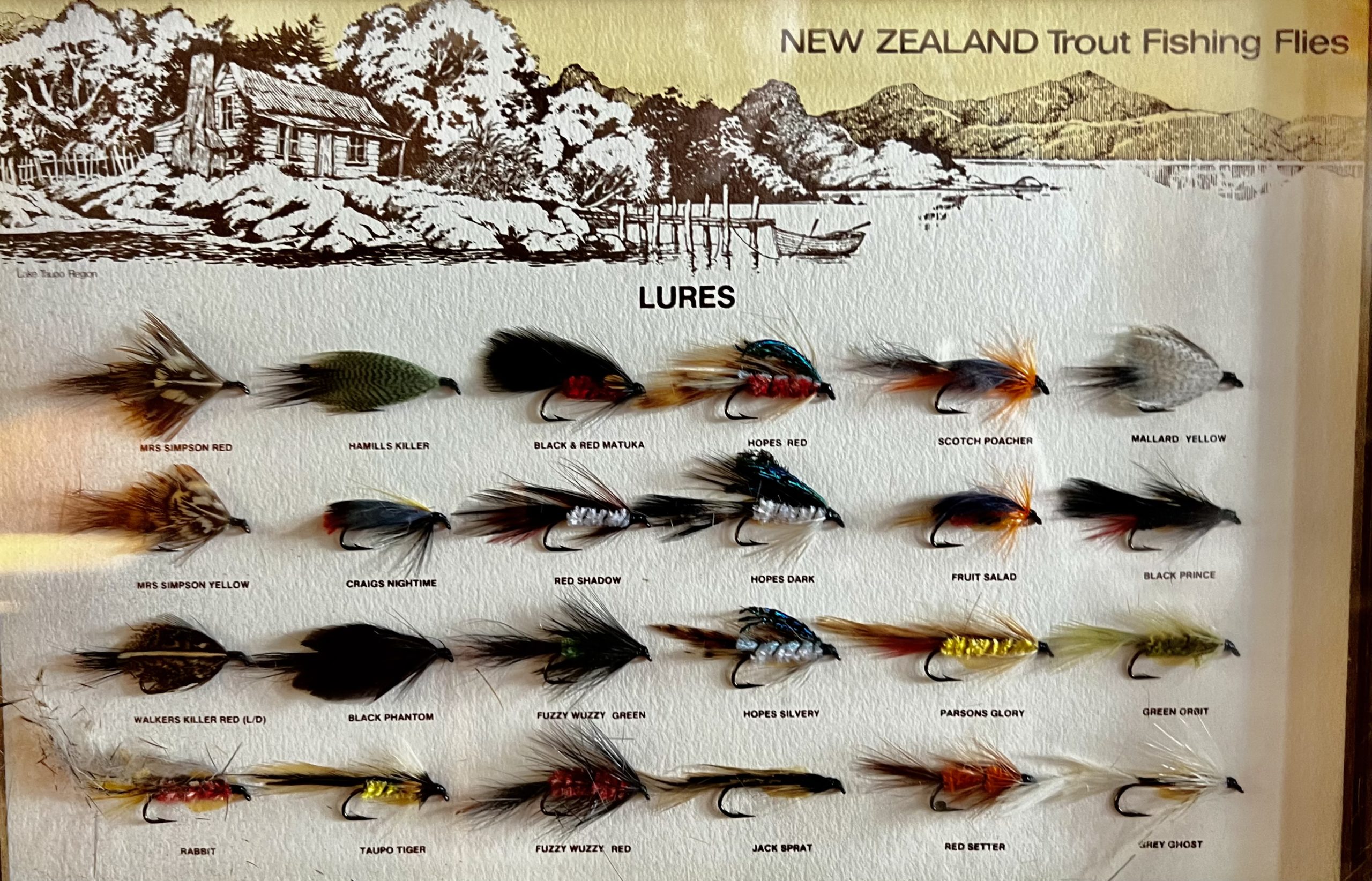
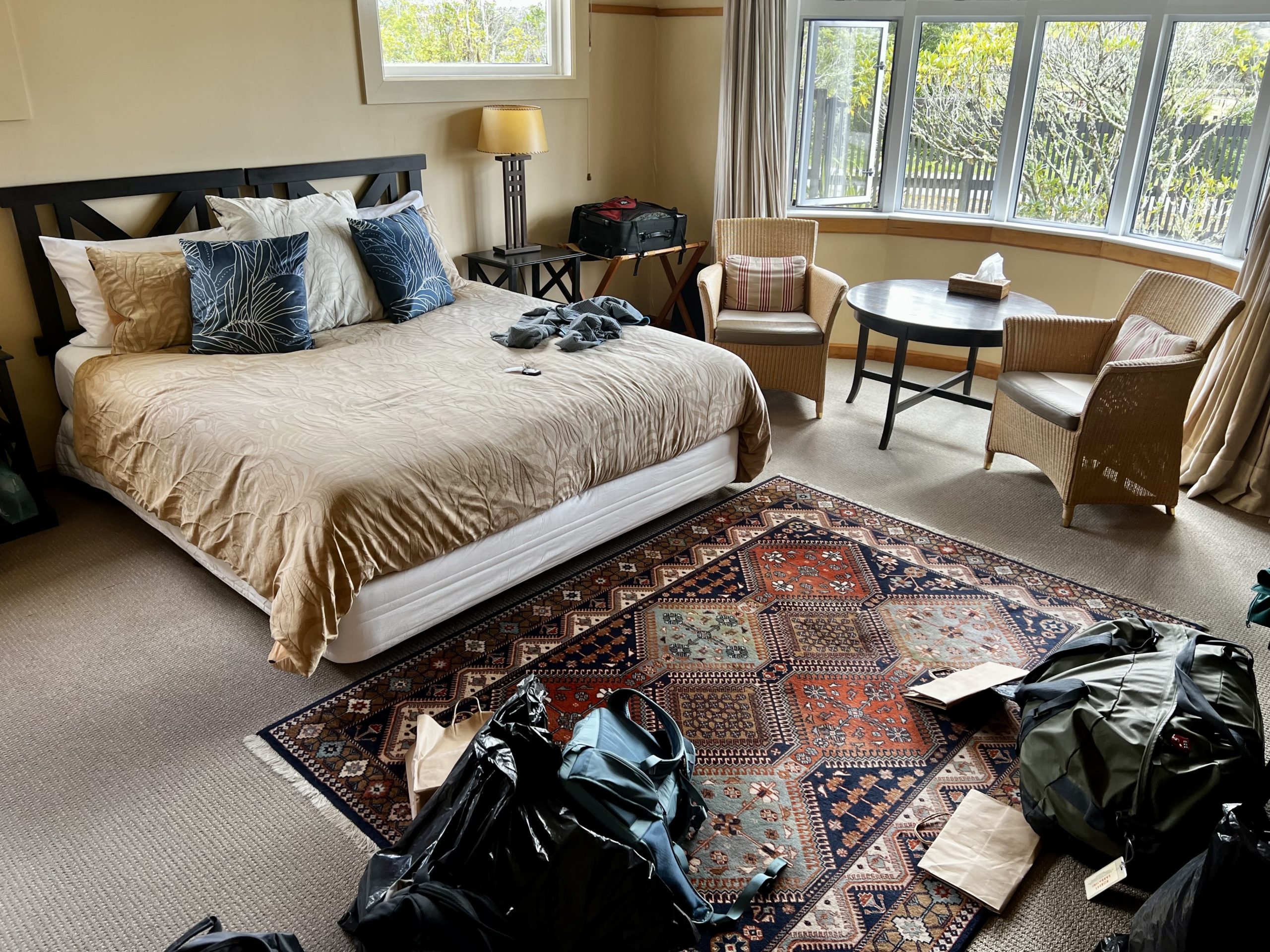
The lodge is a historic part of the lake region and once flourished as a mecca for flyfishing. A few relics of that era adorn the walls—cane poles, mounted trout, a collection of flies. Because the lodge is remote and not well known, not many tourists stop here. Ian and Marjolein, who have managed the lodge for eighteen months, have decided to move to greener pastures. We hope a new lodge manager will turn things around because the lodge’s setting and access to great fishing are terrific.
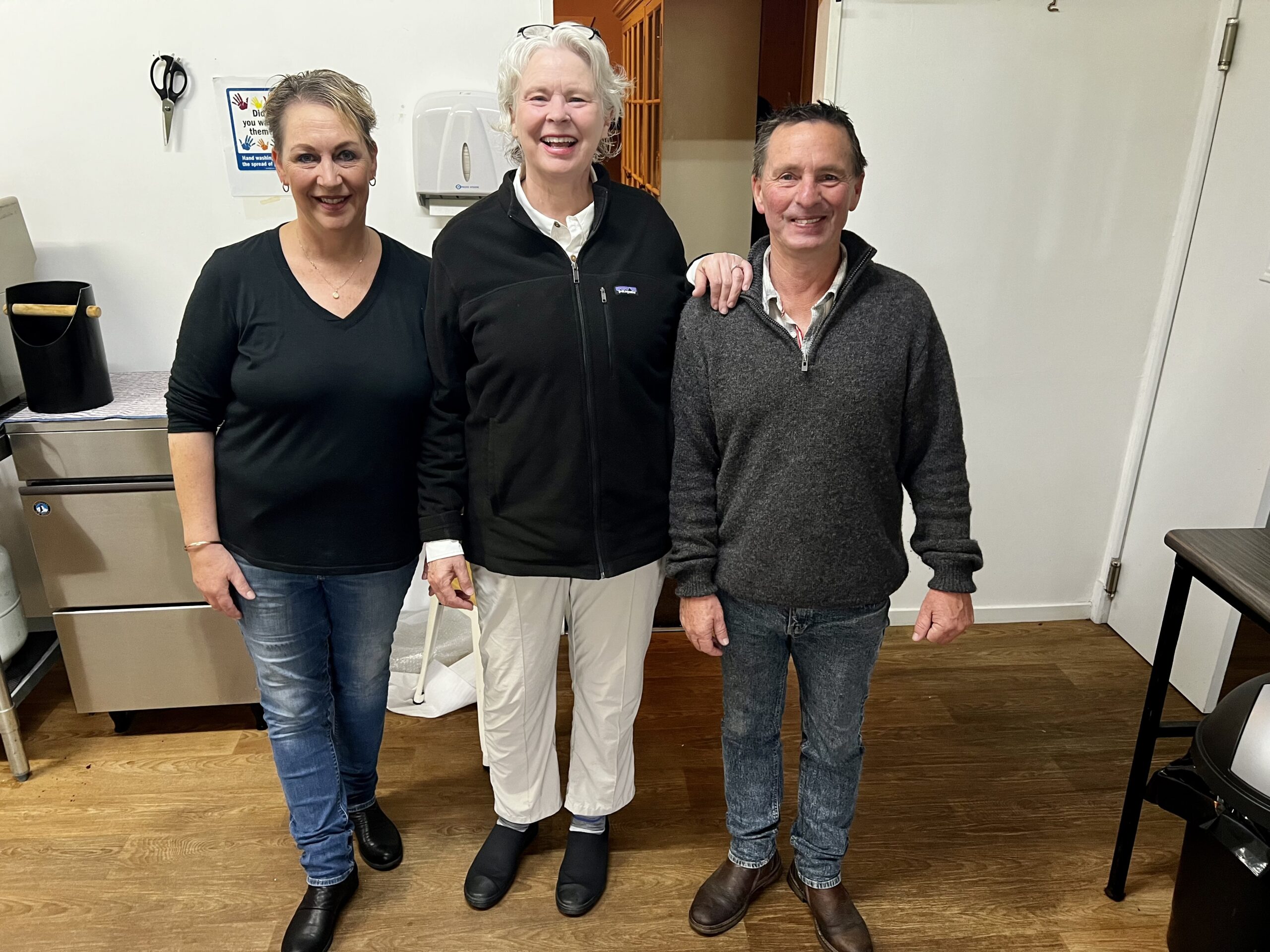
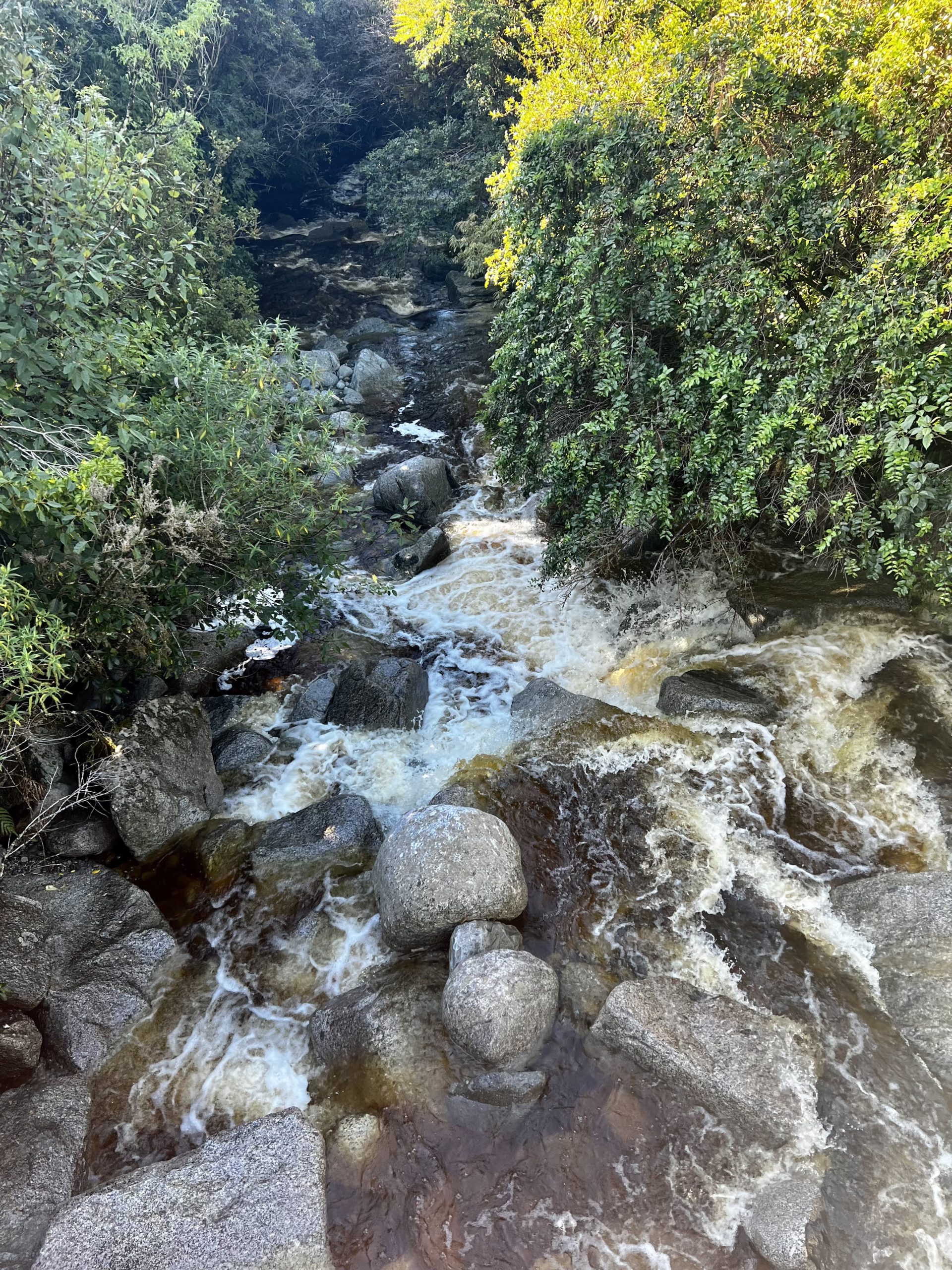
Our hosts were great. Marjolein did all the cooking, offering a wide variety of dishes. Ian is the man of all trades and maintains the property including the pelton wheel that generates electricity from the nearby waterfall. We were their last guests because they are moving to Methven to take over a Japanese restaurant. Methven is a base for skiing in the winter and is turning into a year round location for a wide range of recreation activities. Some say it has the potential to become the Whistler of New Zealand. We are sure that they will do well given their talent and kiwi can do spirit.
The other two guests at the lodge were Dave and Scott, two friends from Washington State and Florida who travel extensively to fish. It was fun to swap stories with them at dinner every night. When Scott would say he caught one fish that day, he would show Robert a photo of a five-pound brown trout. Not bad!
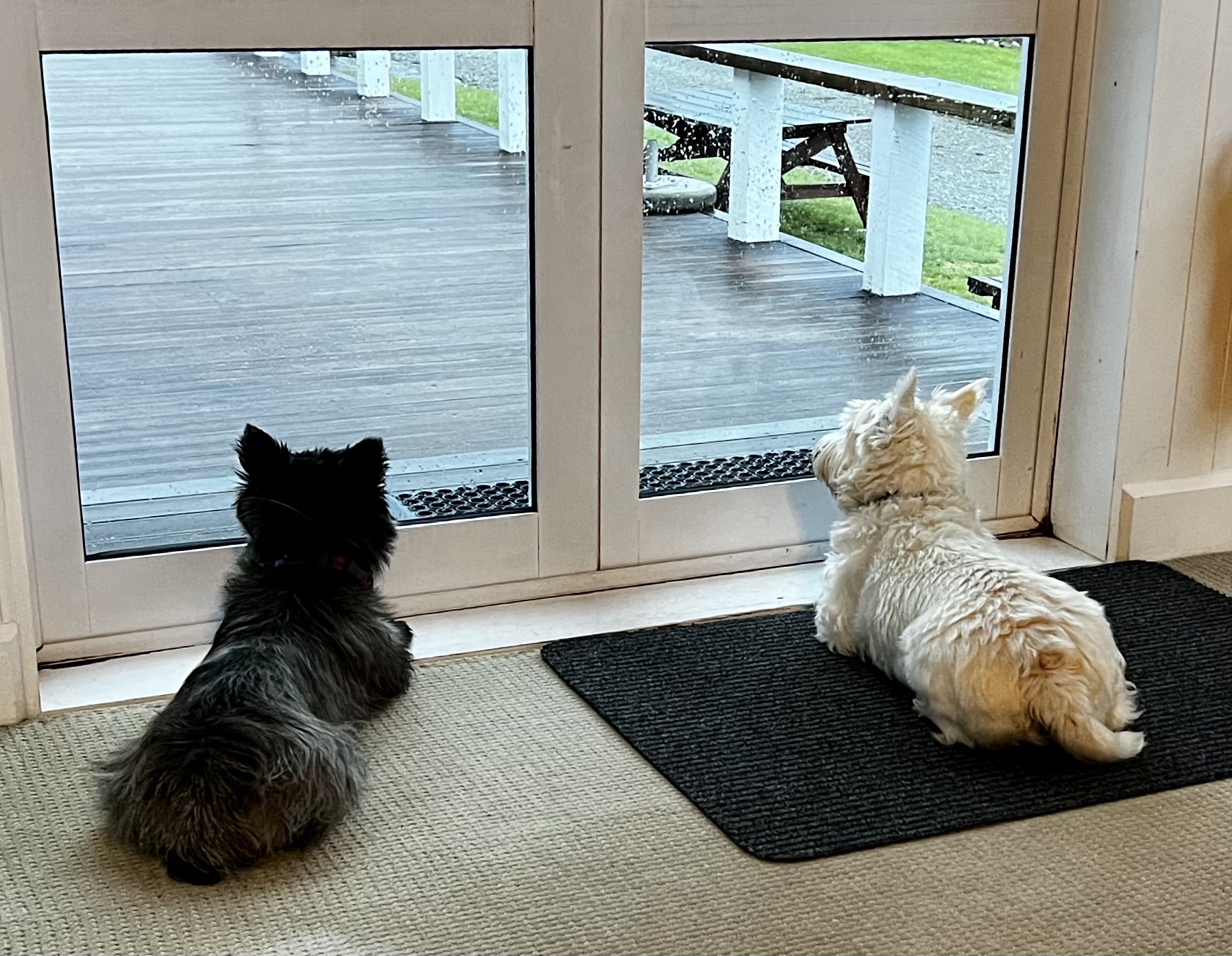
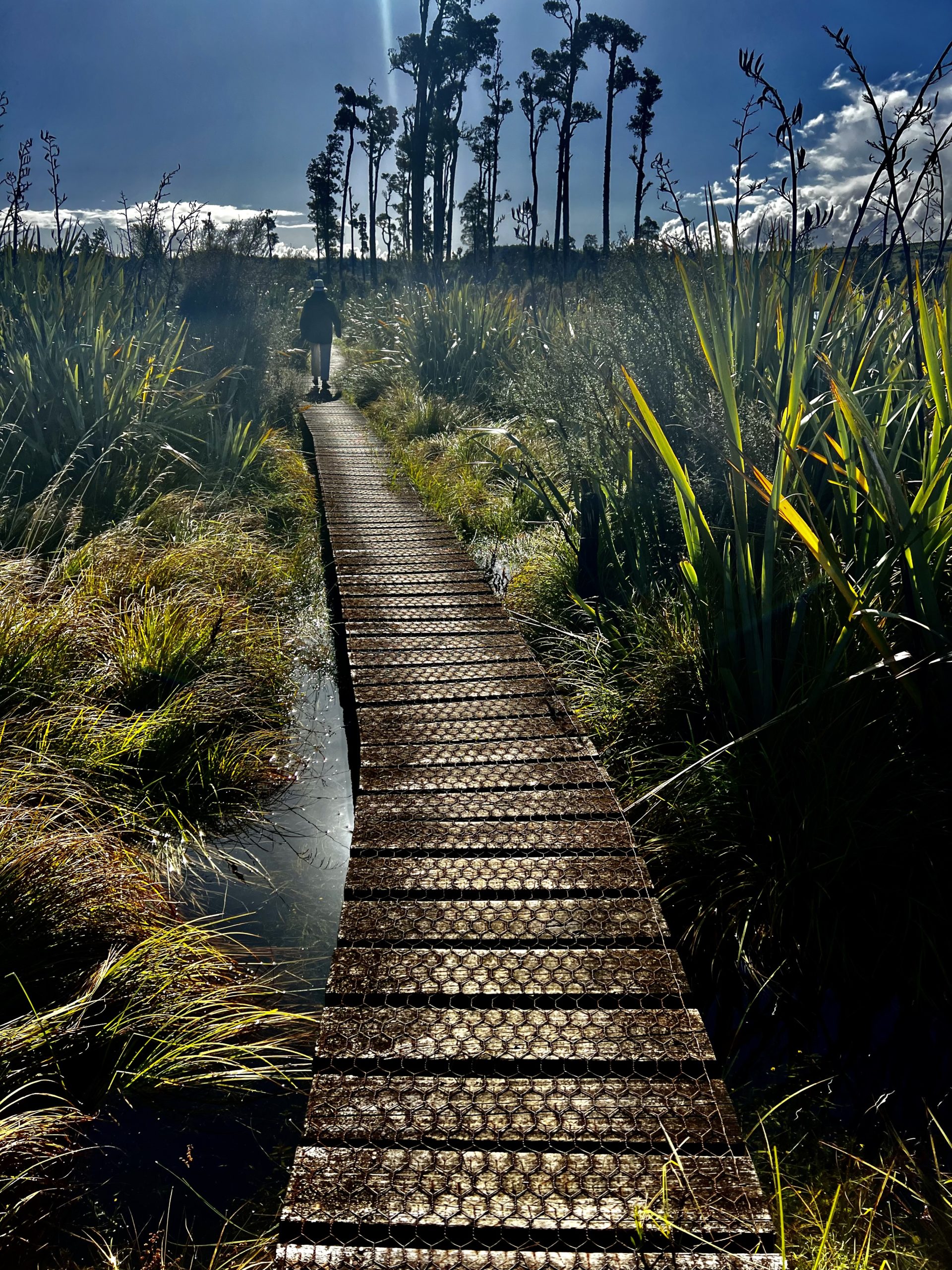
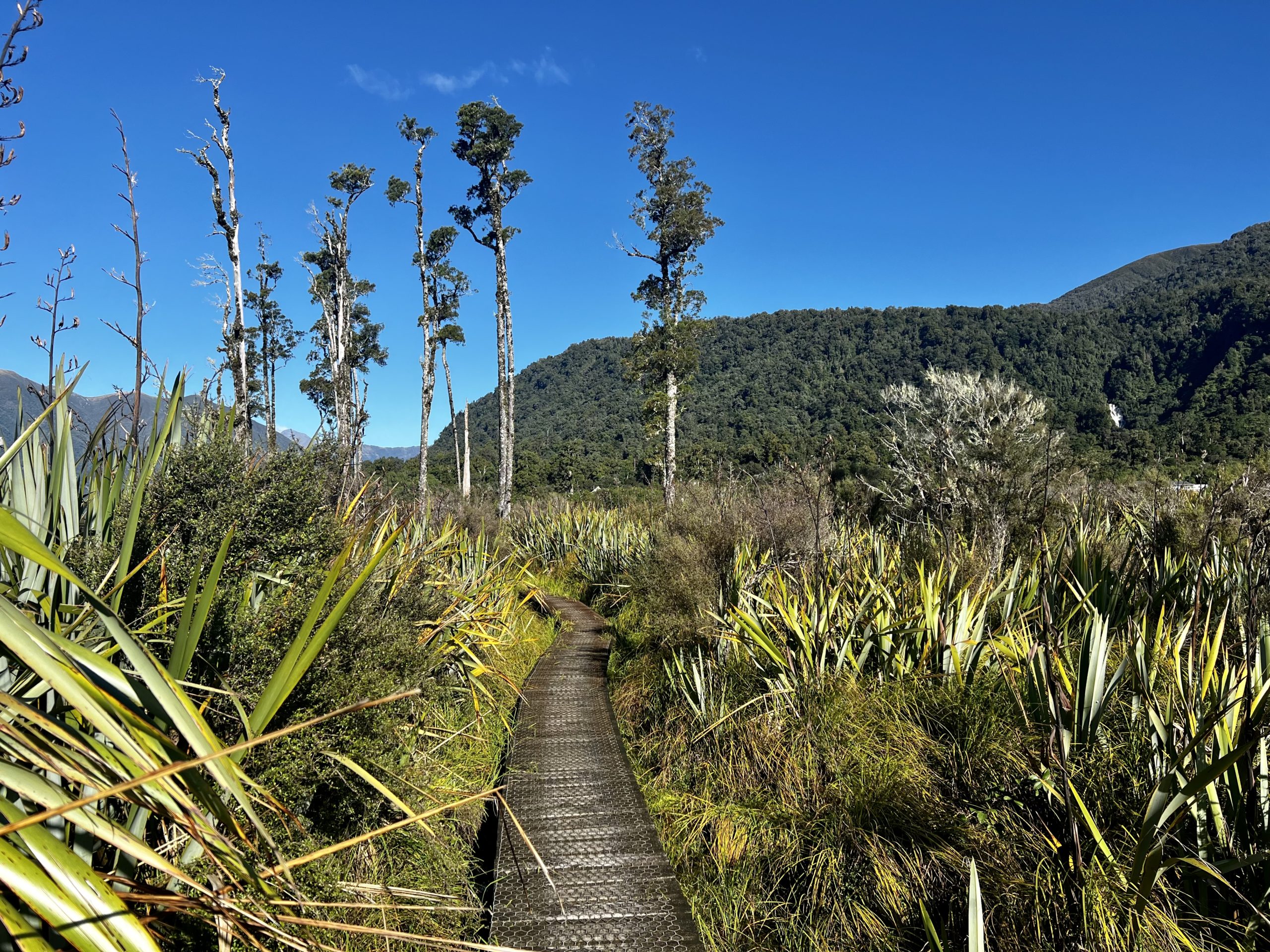
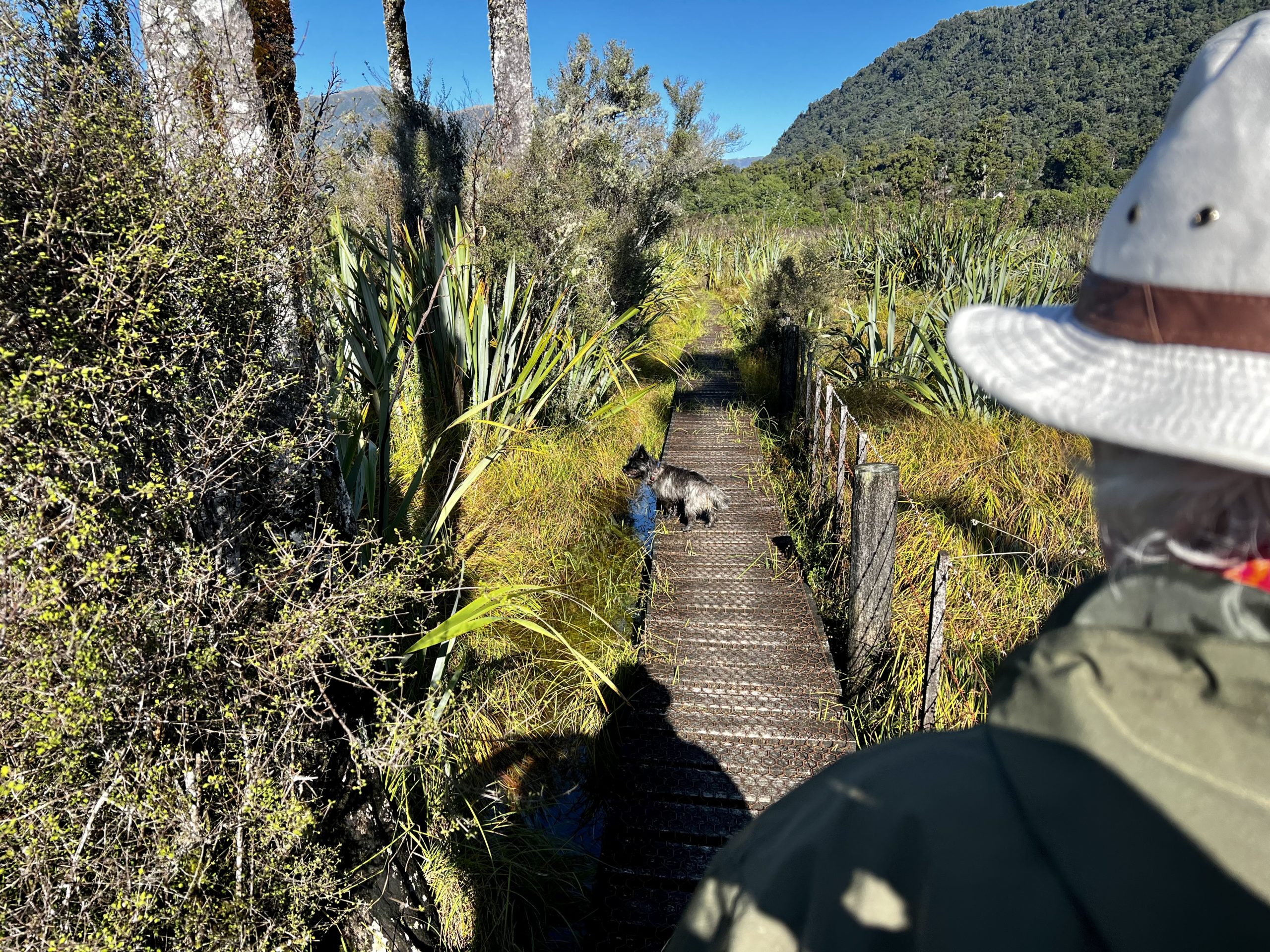
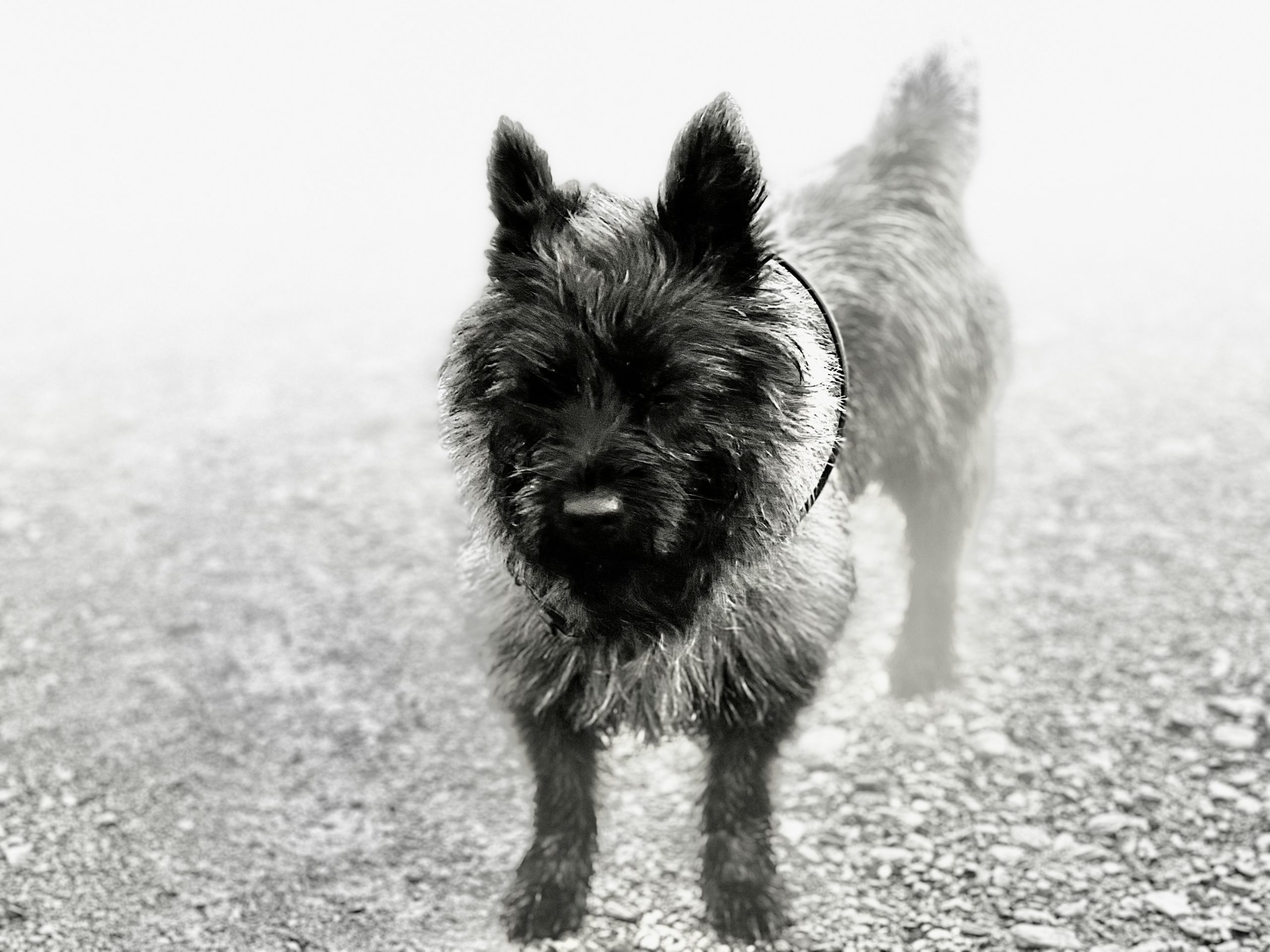
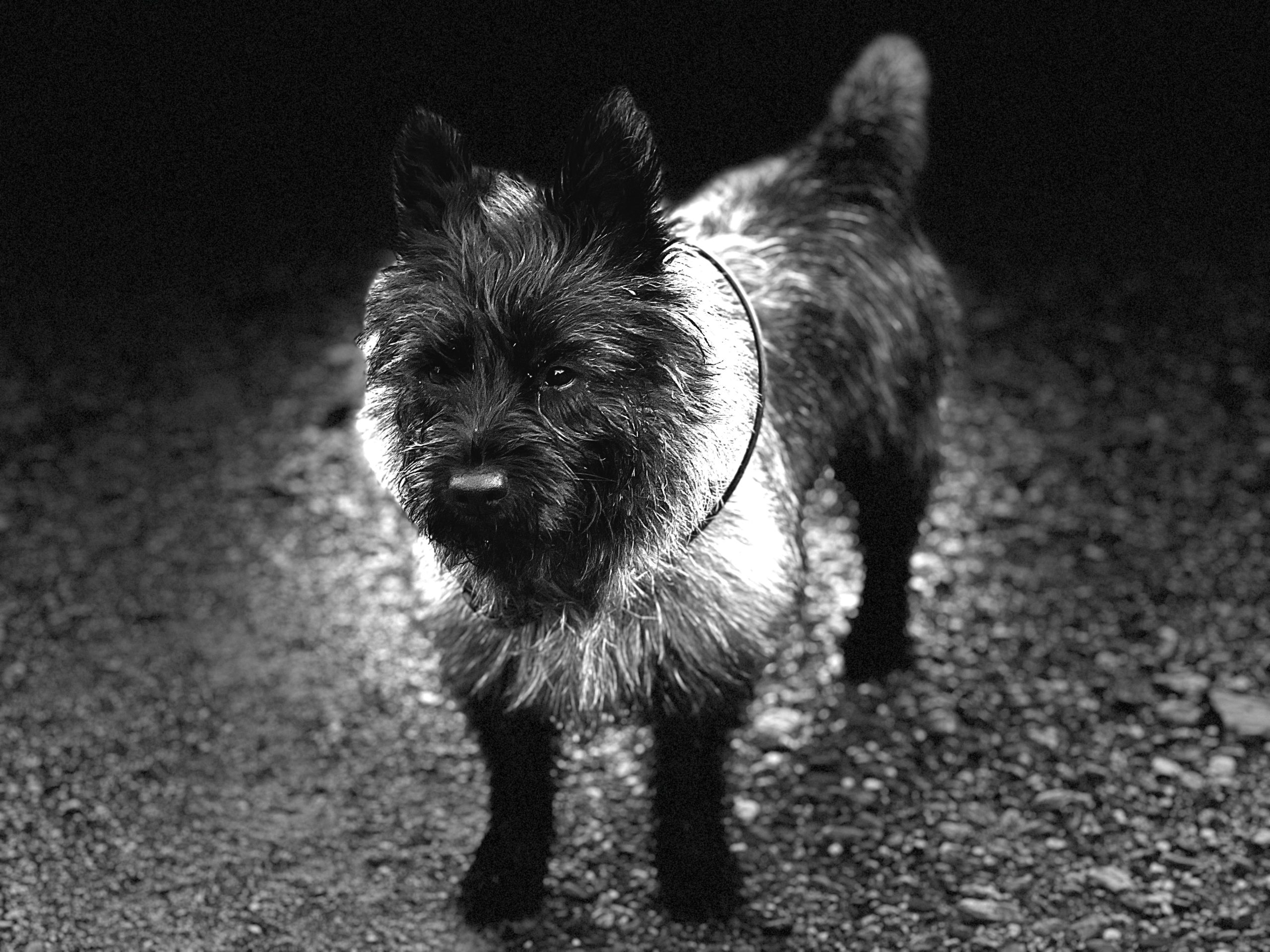
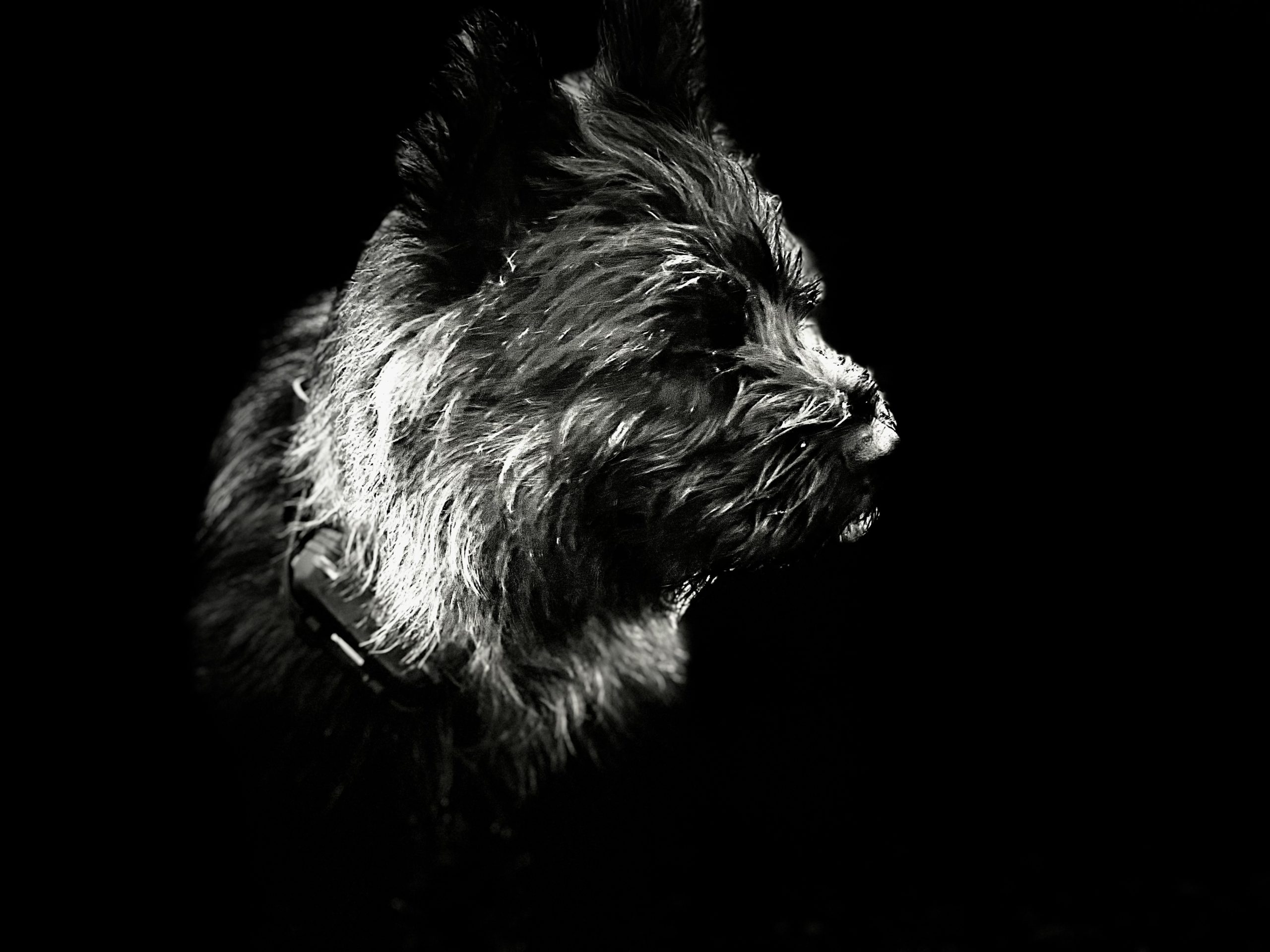
The highlight of the stay, beyond fishing, was Ian and Marjolein’s two dogs—Enzo, a Cairn terrier, and Zeke, a Westie. They stand guard on the deck outside or by looking out the door of the dining room. Their names come from the Wizard of Oz. Enzo was one of the munchkins, and Zeke was the name of the cowardly lion. We asked why not Toto? Unfortunately, their Toto died a few years ago. Enzo is a truly independent dog. He took us on a walk to the boardwalk trail through a marsh next to the lake, patiently waiting for us when we lagged behind. Bonnie thinks he is a reverse herding dog because he always wants to be out in front. After the first day, he would greet Robert every morning at his 7:00 am breakfast. He has a GPS tracking collar his owners use to check on where he is or to summon him back to the lodge. In a prior locale, they calculated that he roamed more than 30 kilometers (eighteen miles) in one day. The furry white Zeke was once lost for several days and his owners called in helicopters twice to look for him. Zeke eventually found his way home. Now he is less adventurous and sticks around the lodge unless he is on the seat of the truck when Ian goes out on errands.
Wandering About
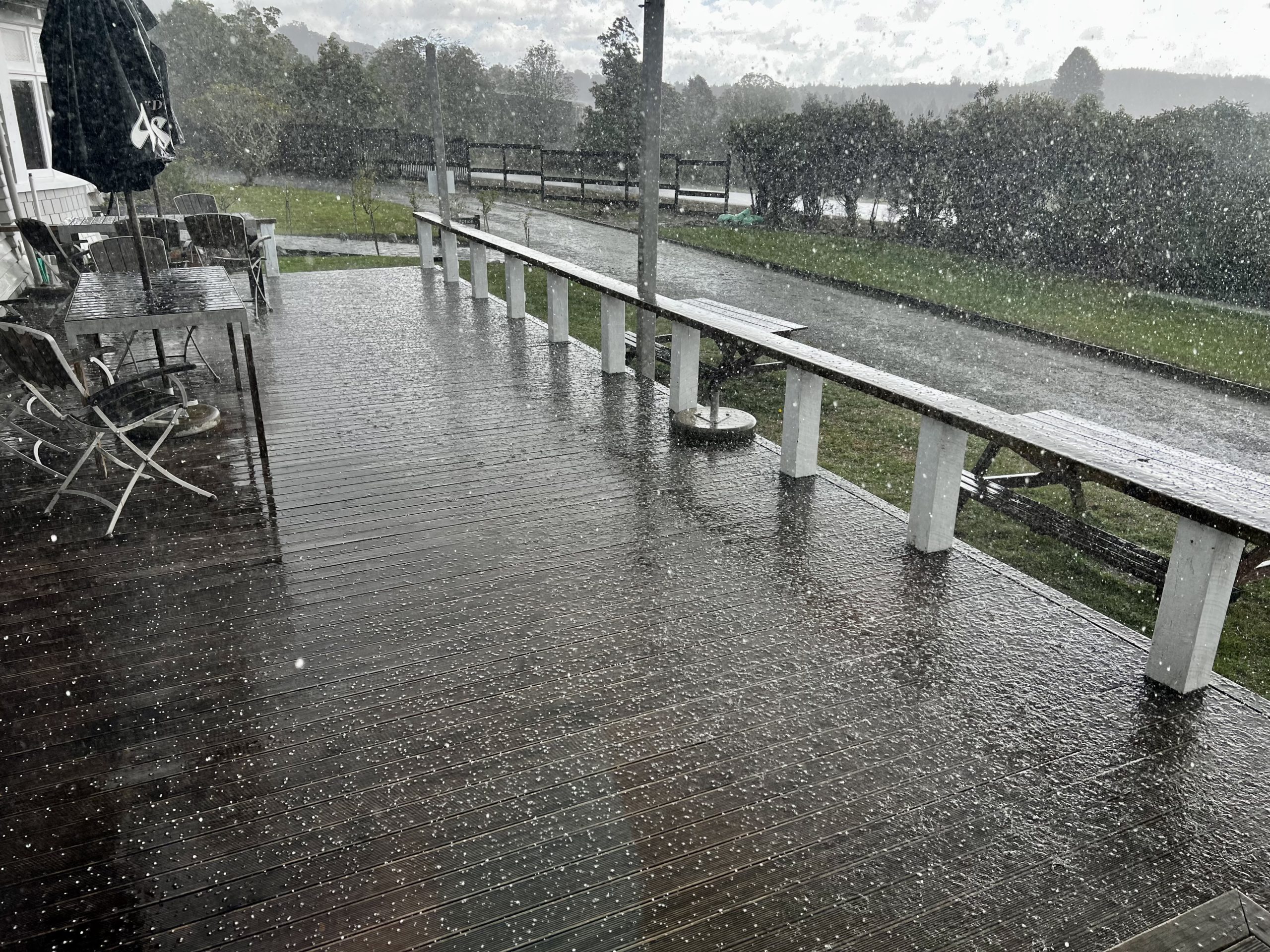
Hail storm while we were watching the Oscars
Food and Drinks
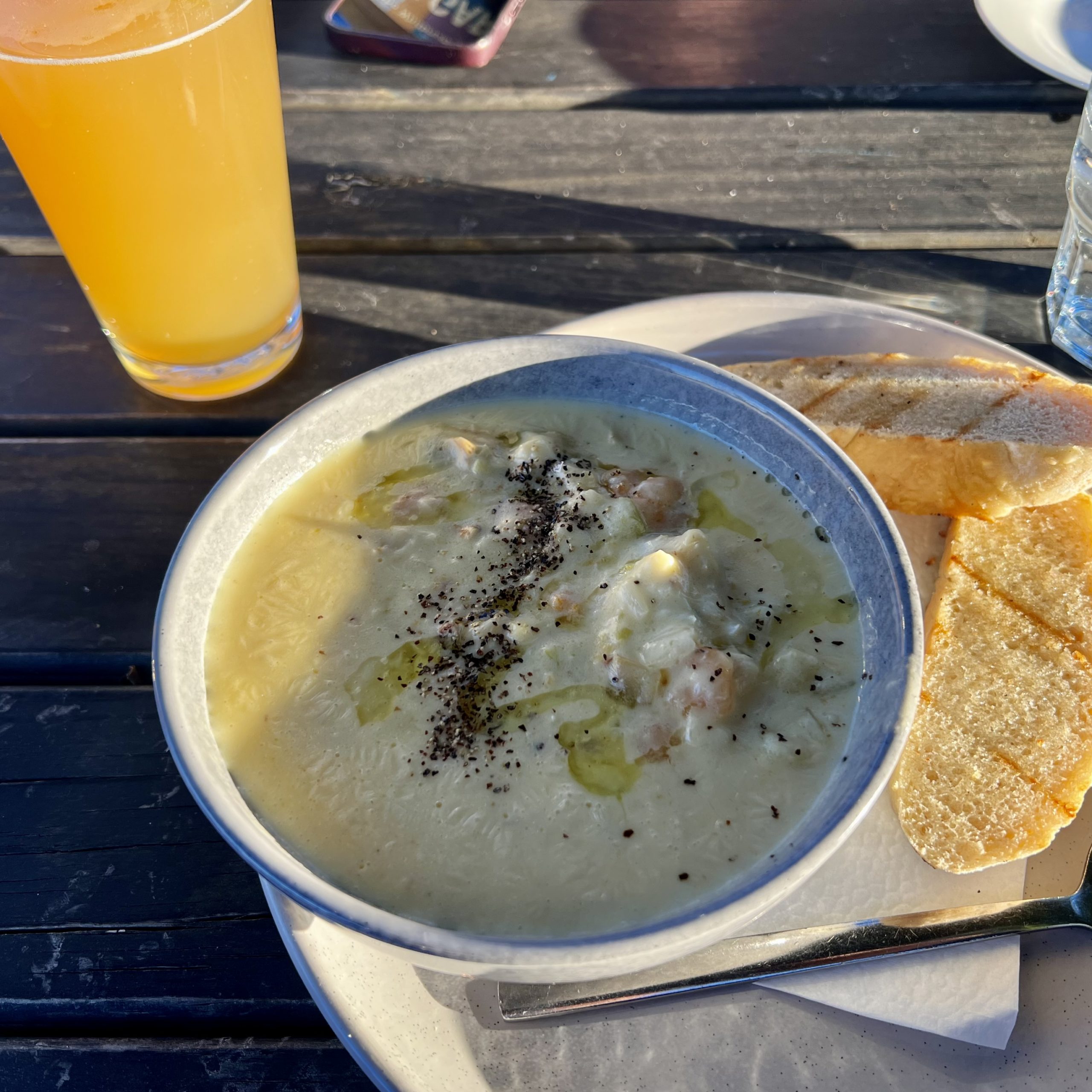
All prepared by Marjolien at the lodge. All very good.
Gloriavale
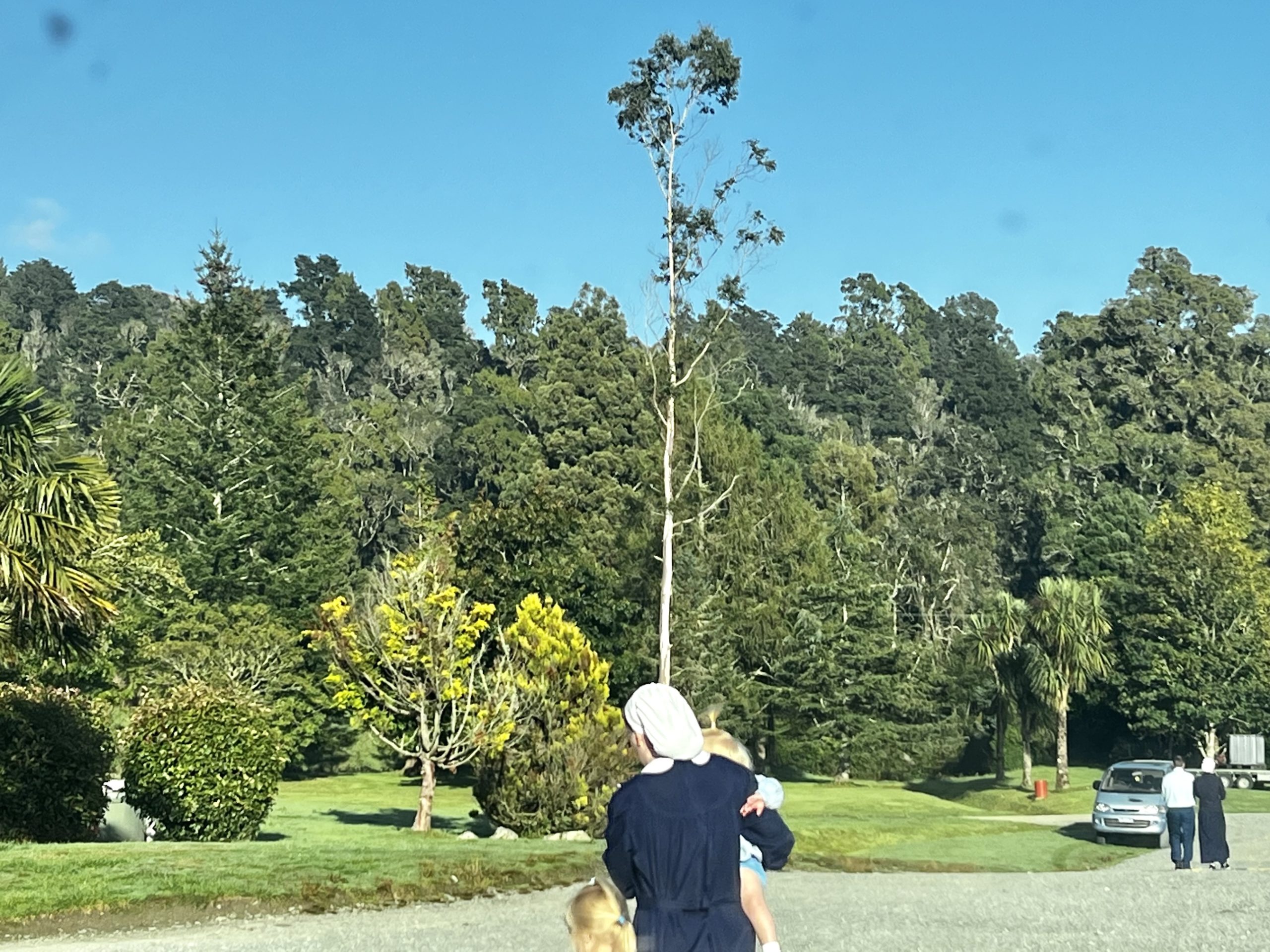
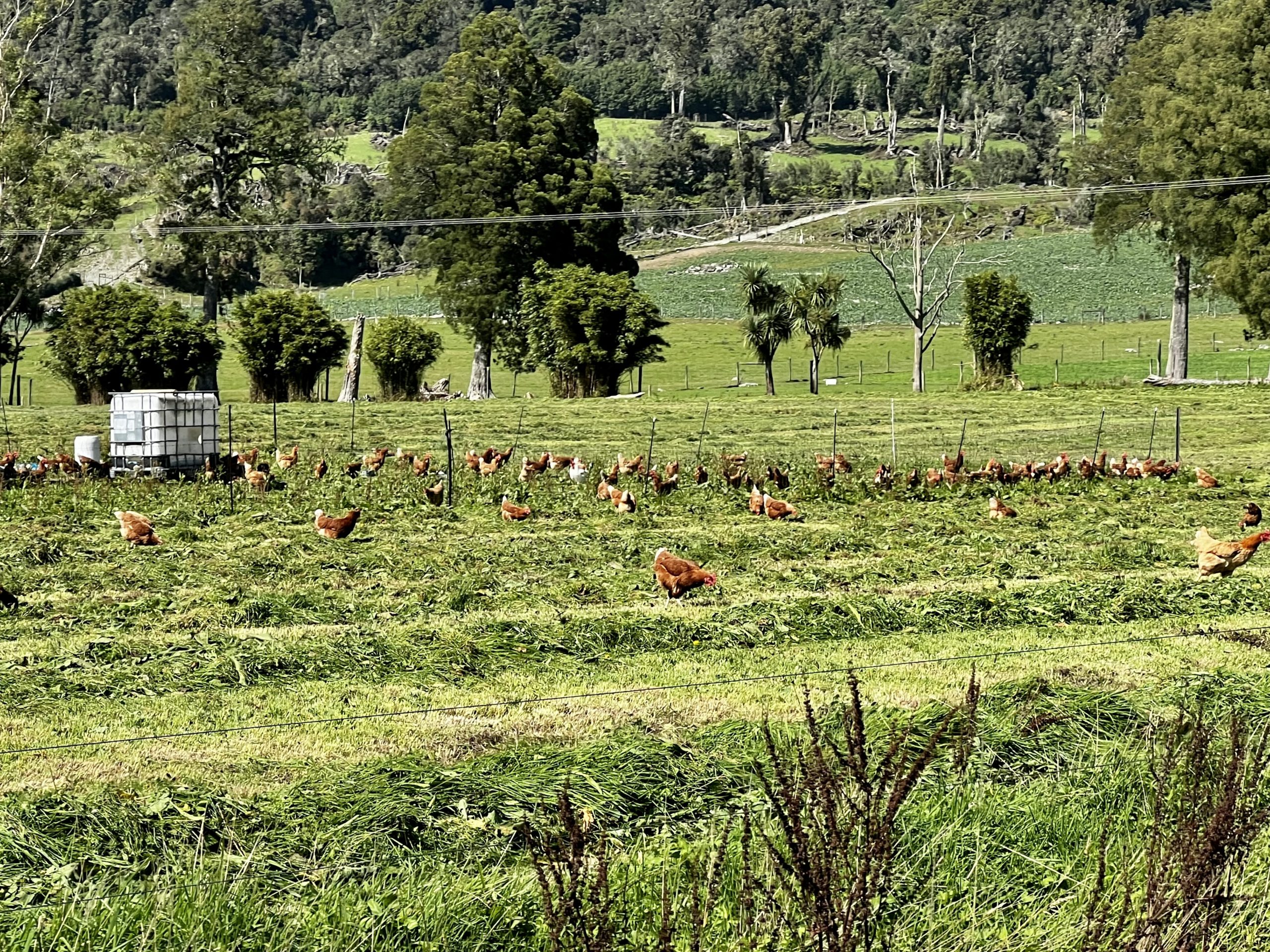
Robert and our fishing guide Charles stopped here to ask for permission from the Gloriavale community to cross the land to reach a river. Gloriavale looks like the set for a movie, but it is actually the home of a Christian cult. The clothes harken back to the Amish, but the community is shrouded in secrecy. This location houses 600 people, of which 200 are children. The school is fairly new and large. The community has been very successful in agriculture—dairy, chickens, crops—as well as servicing helicopters. But it has been embroiled in scandal for at least a decade, with charges including child labor and sexual abuse.
Punakaiki
17 – 19 March 2023
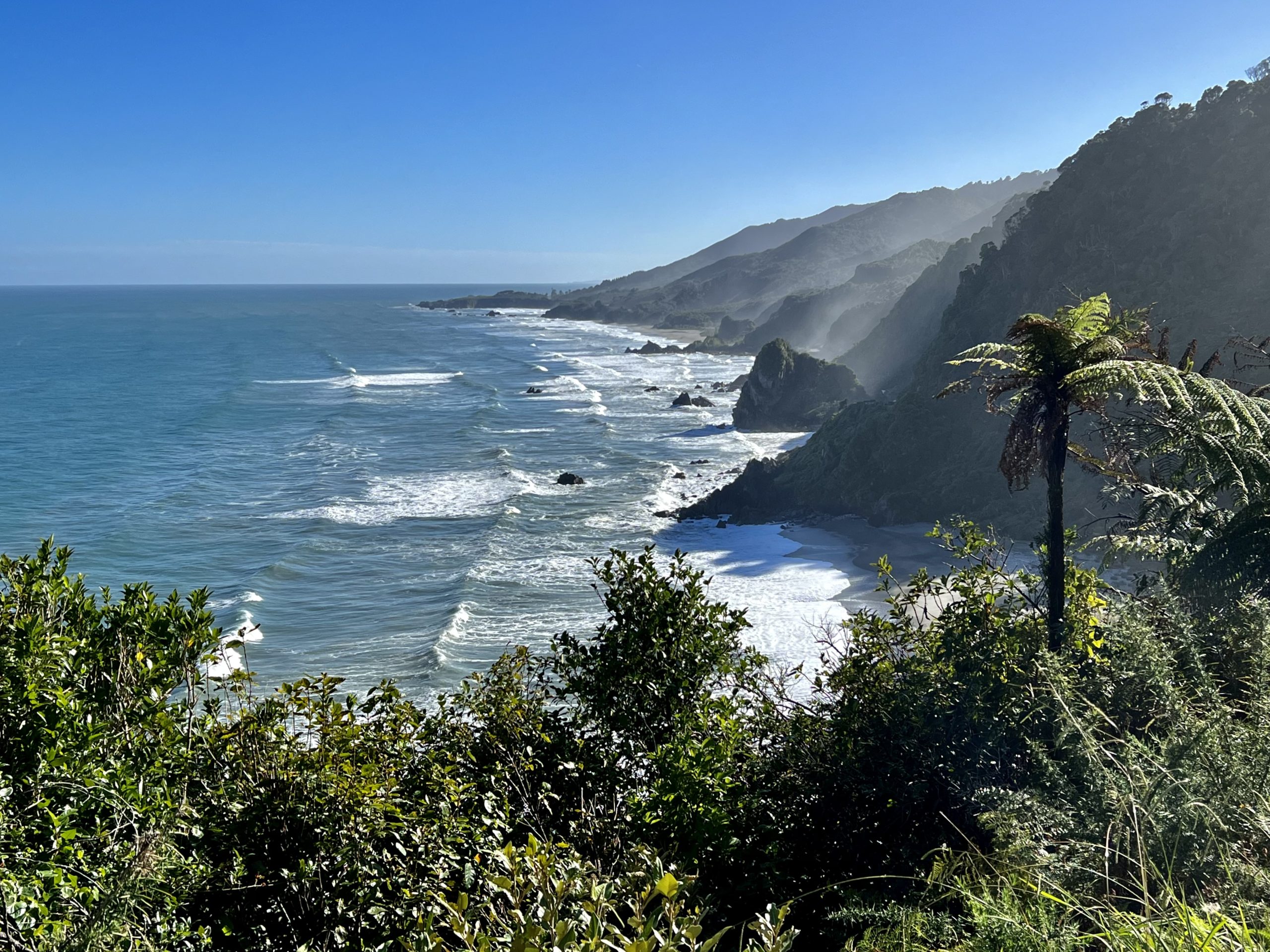
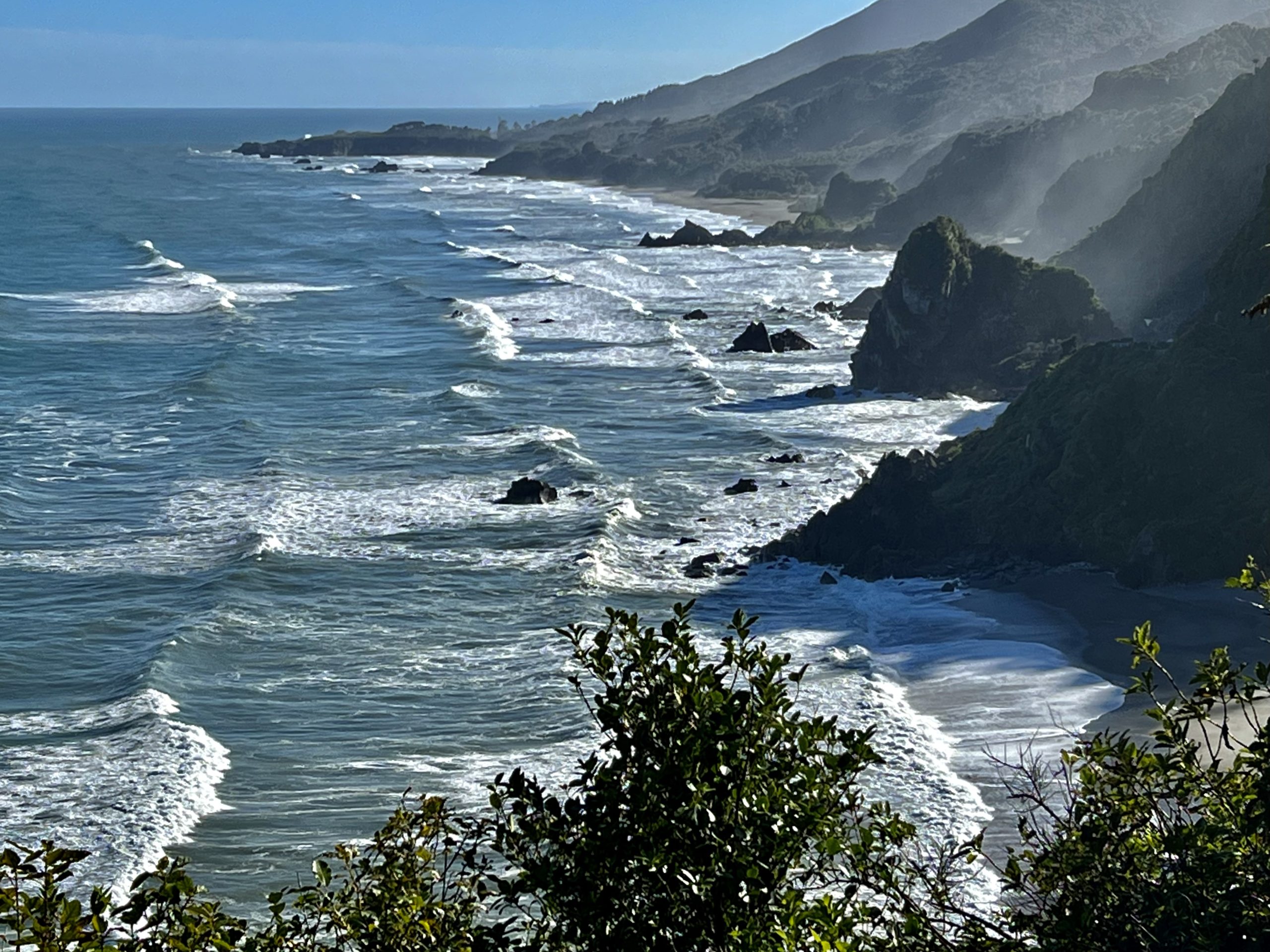
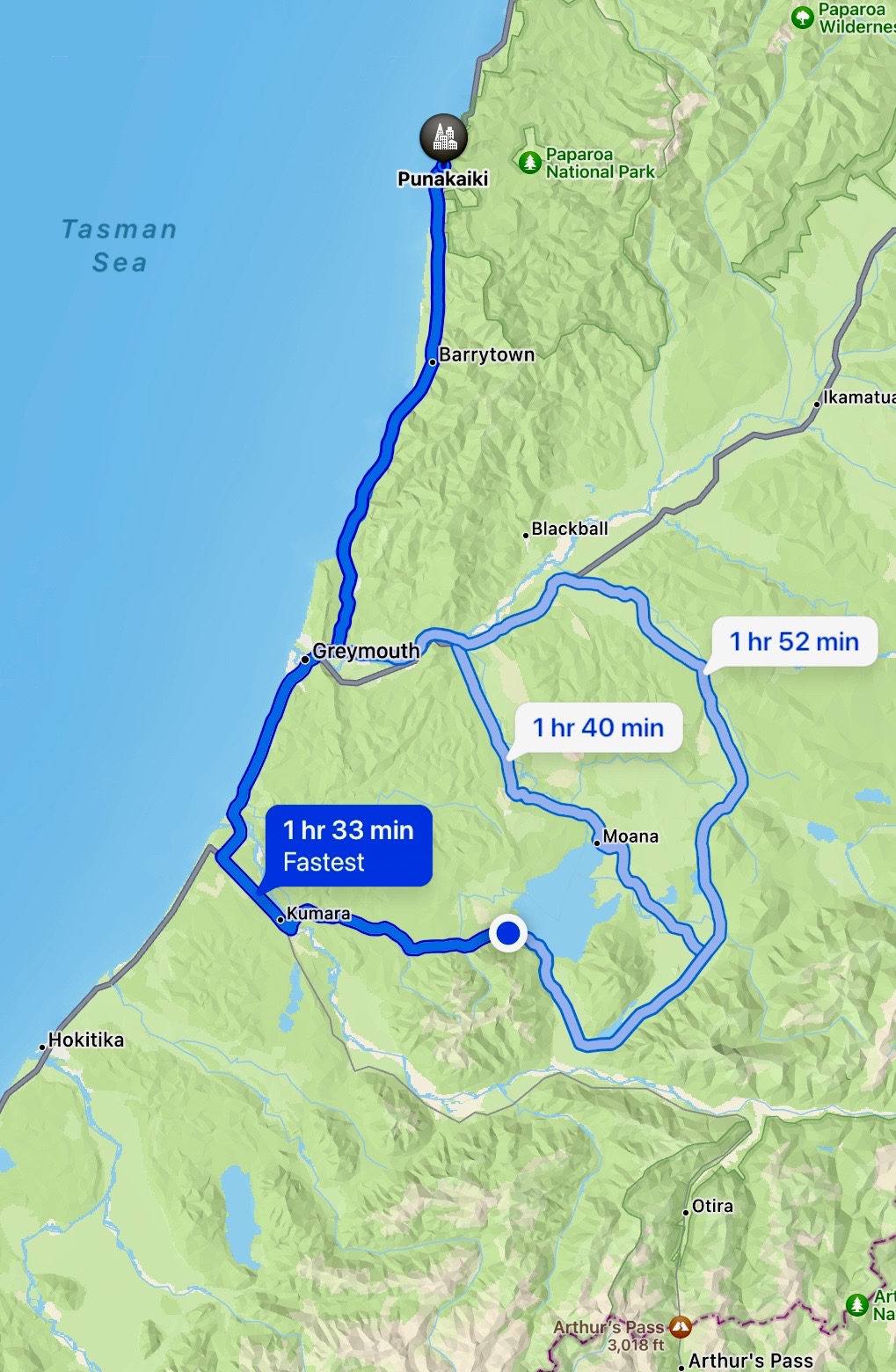
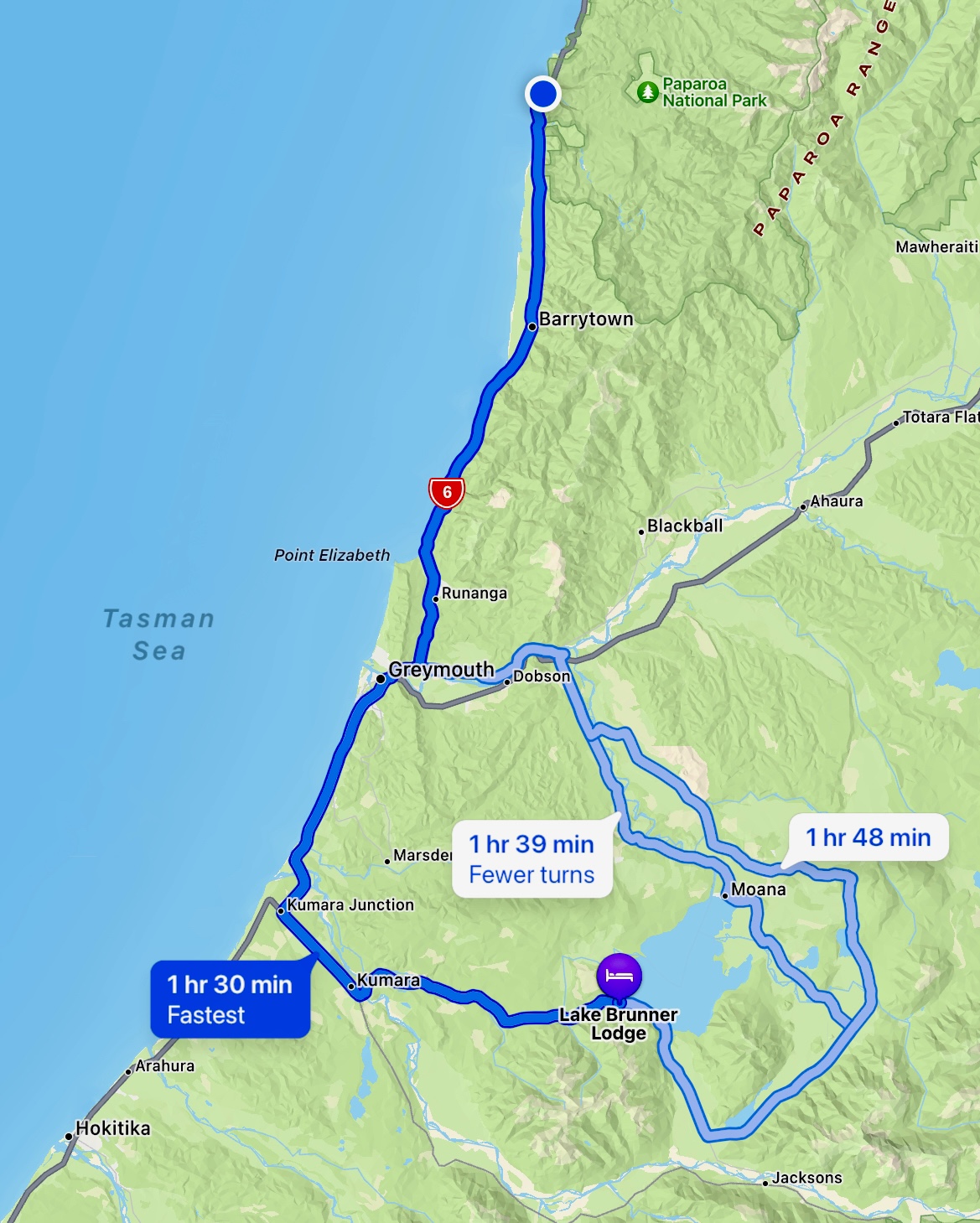
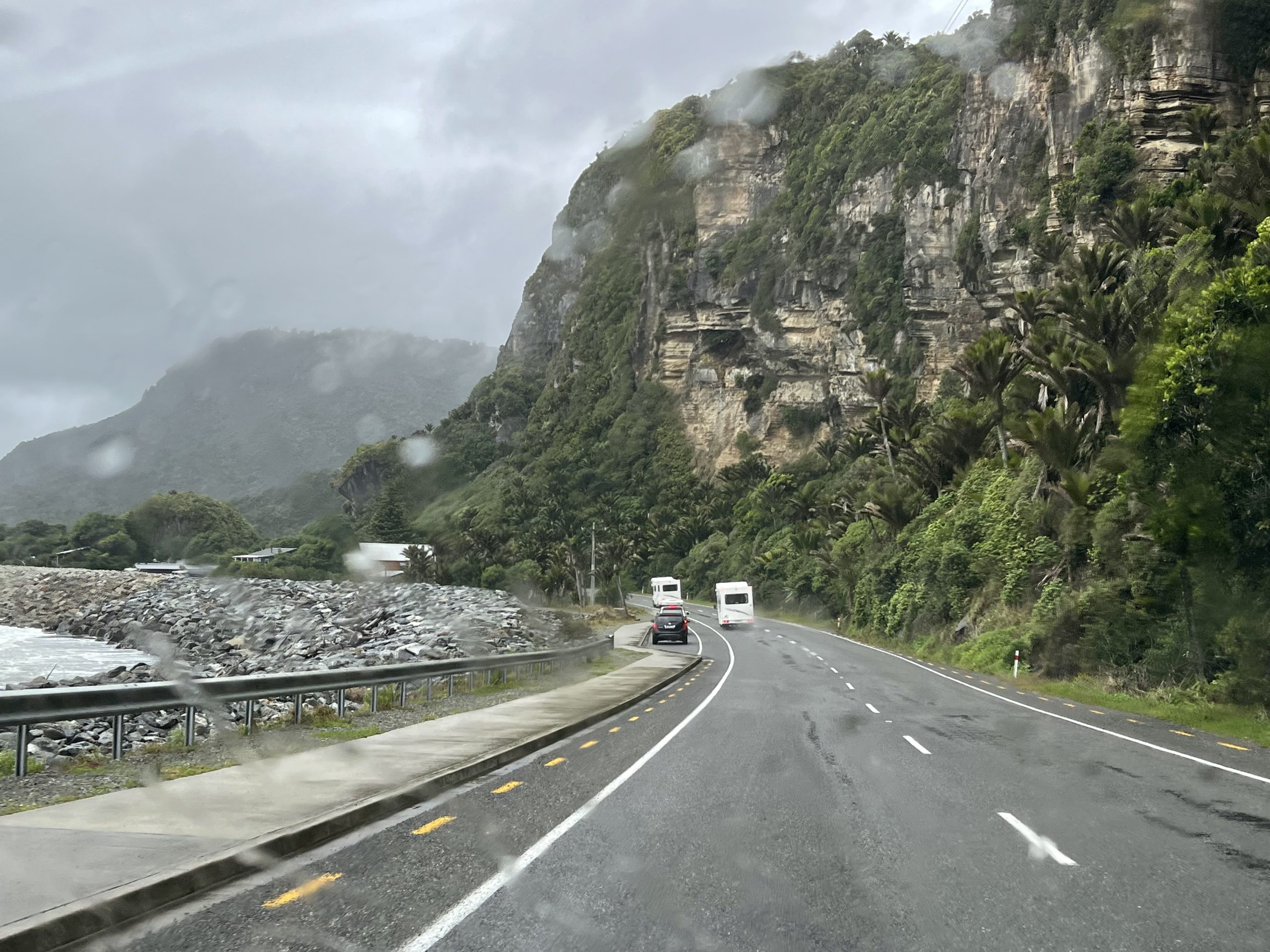
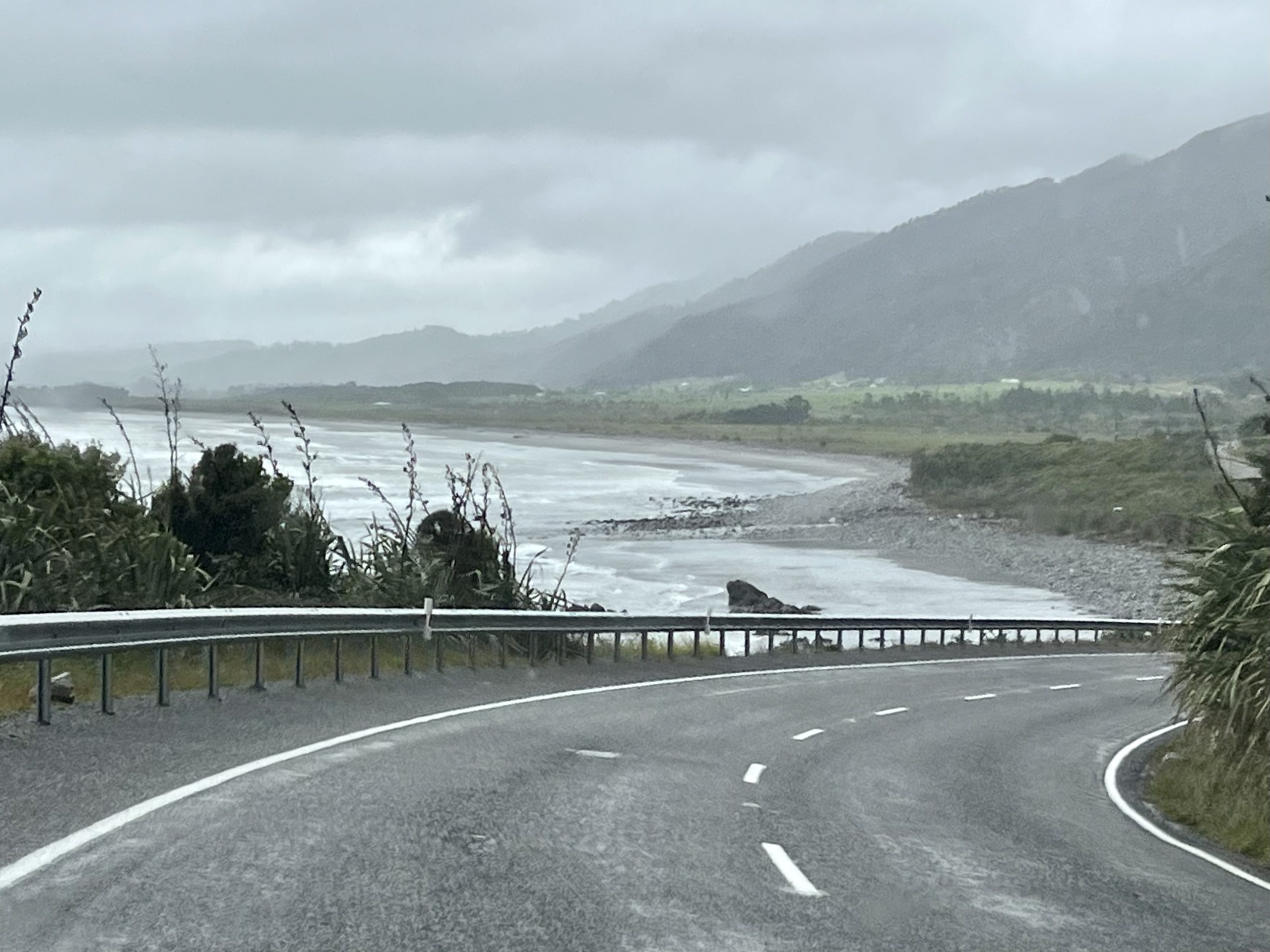
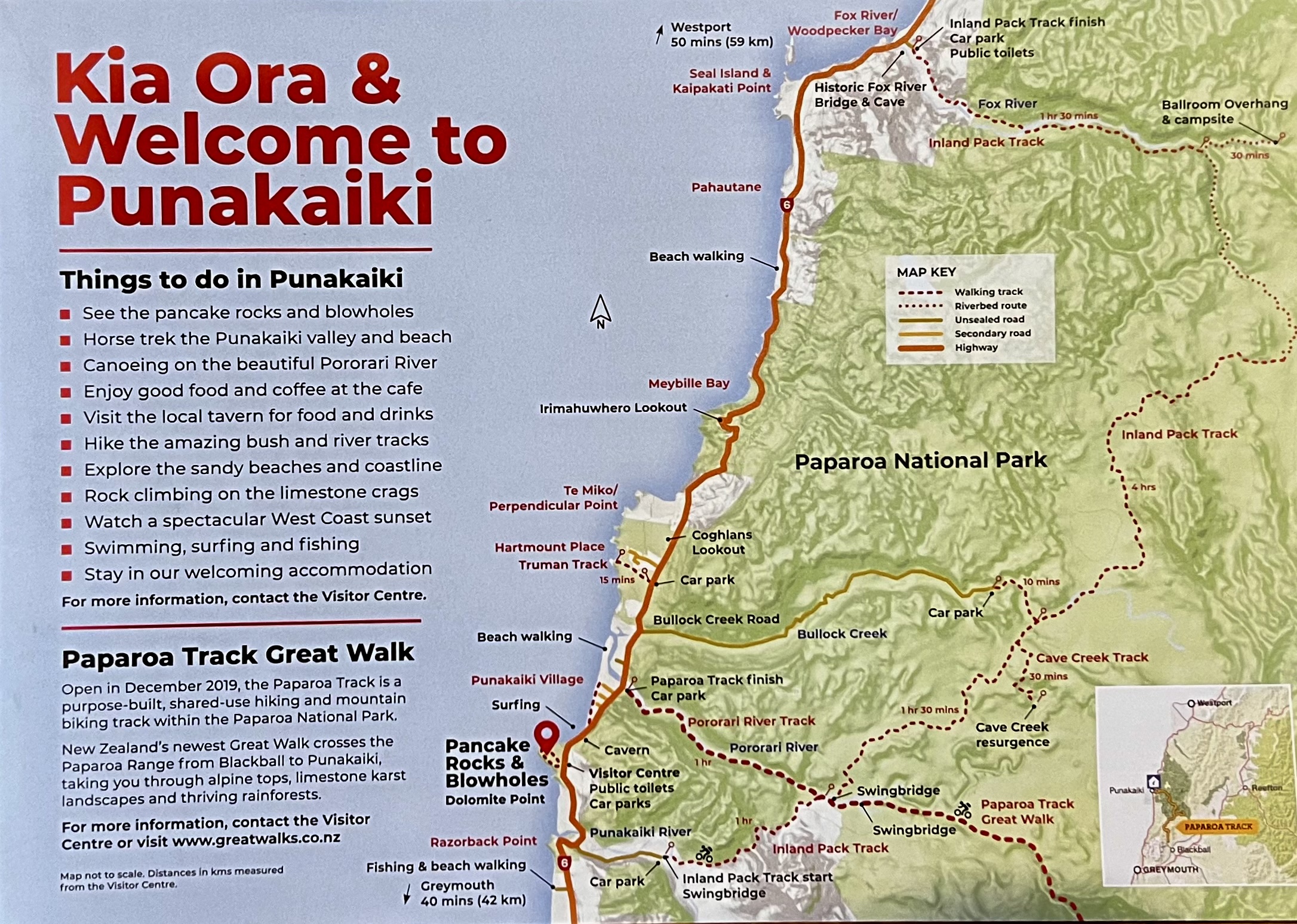
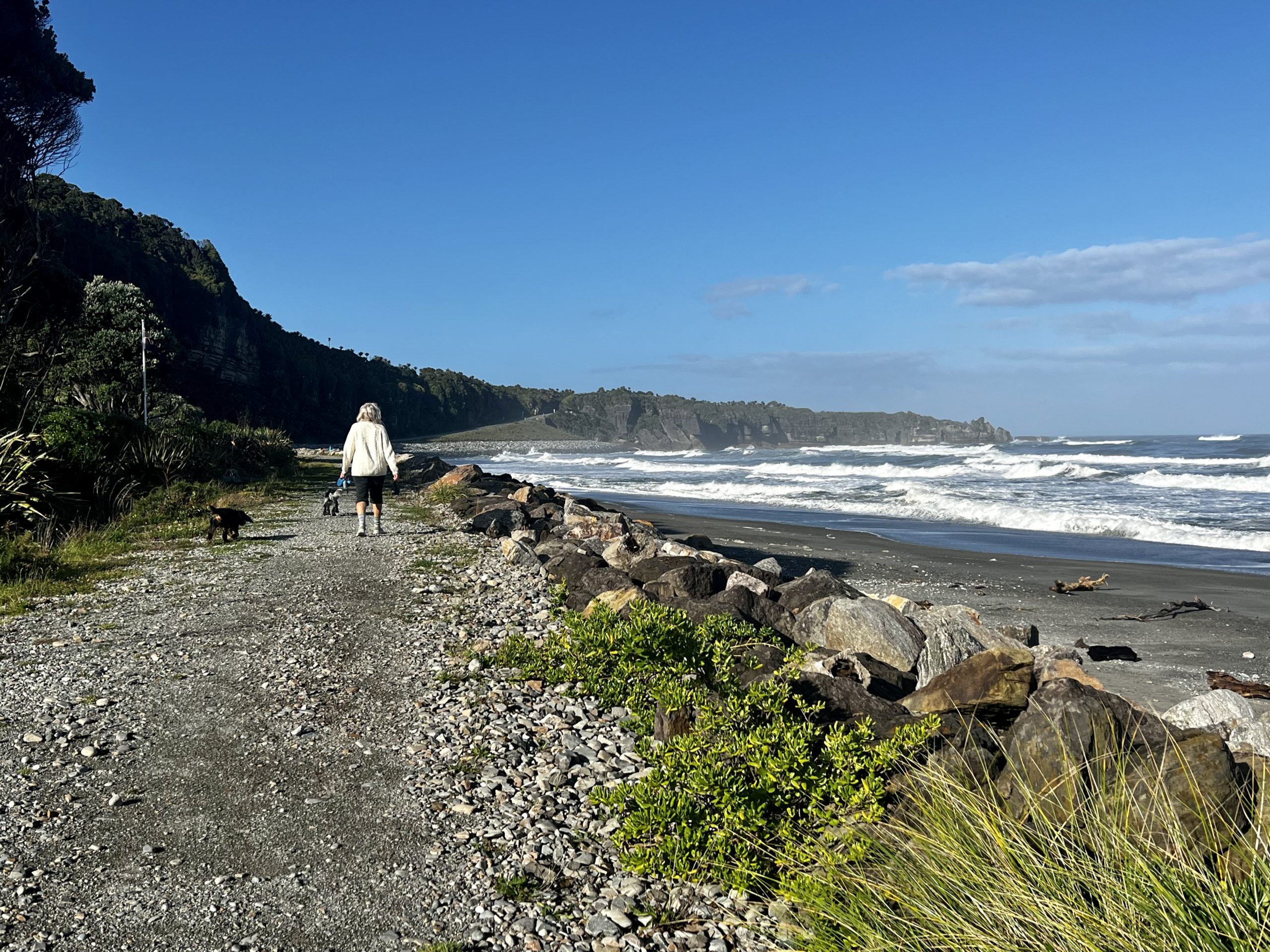
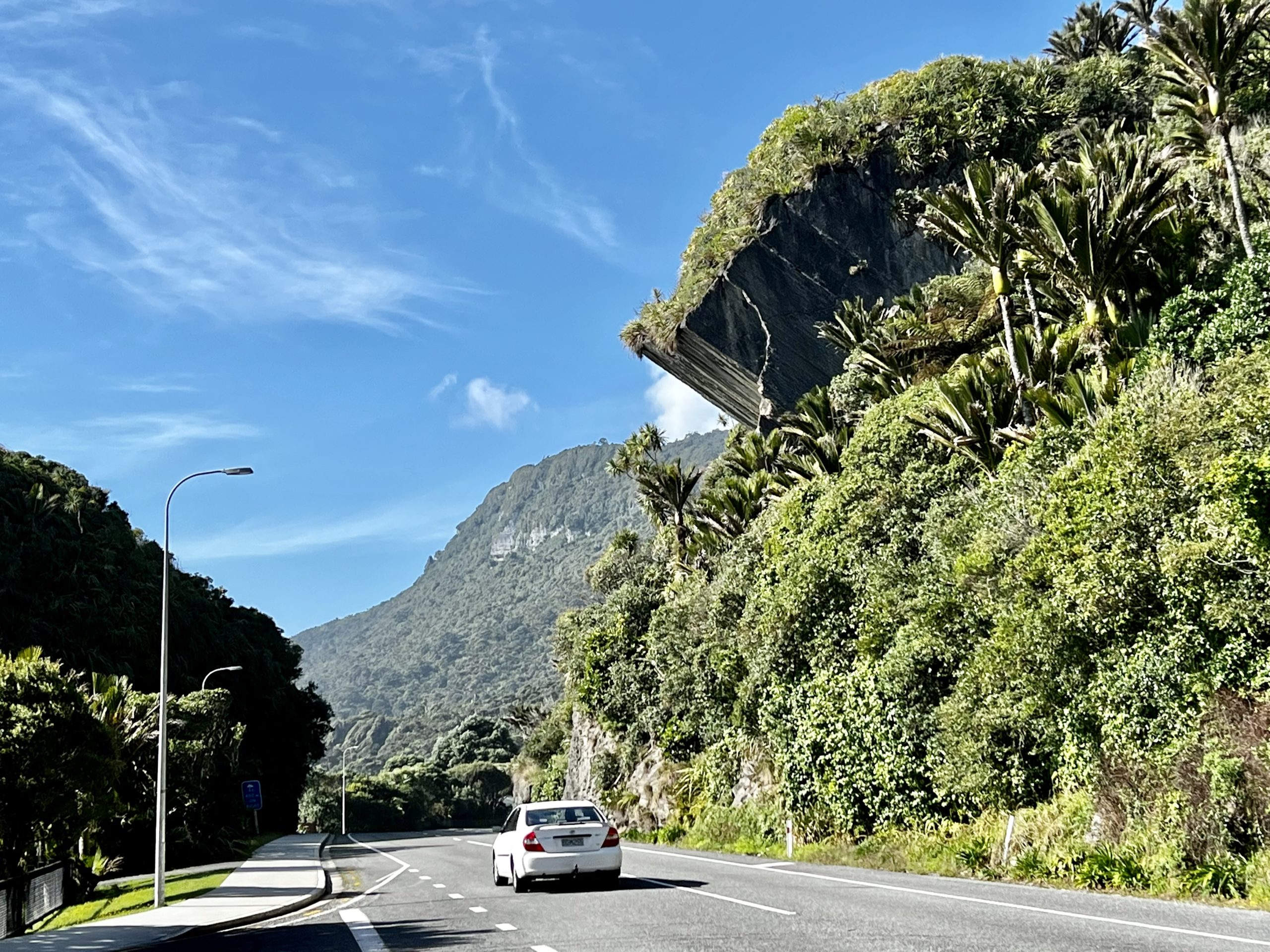
The West Coast of the South Island in another isolated spot with no grocery stores or gas stations for long stretches, so you are warned to plan ahead. This area was once known for coal mining and gold mining. Logging continues. The highway along the coast is a bit like Highway One in West Marin—winding and dramatic.
Lunch in Greymouth on the Way
Mark Nolfi!
On the Way to Punakaiki After Lunch
Accommodations
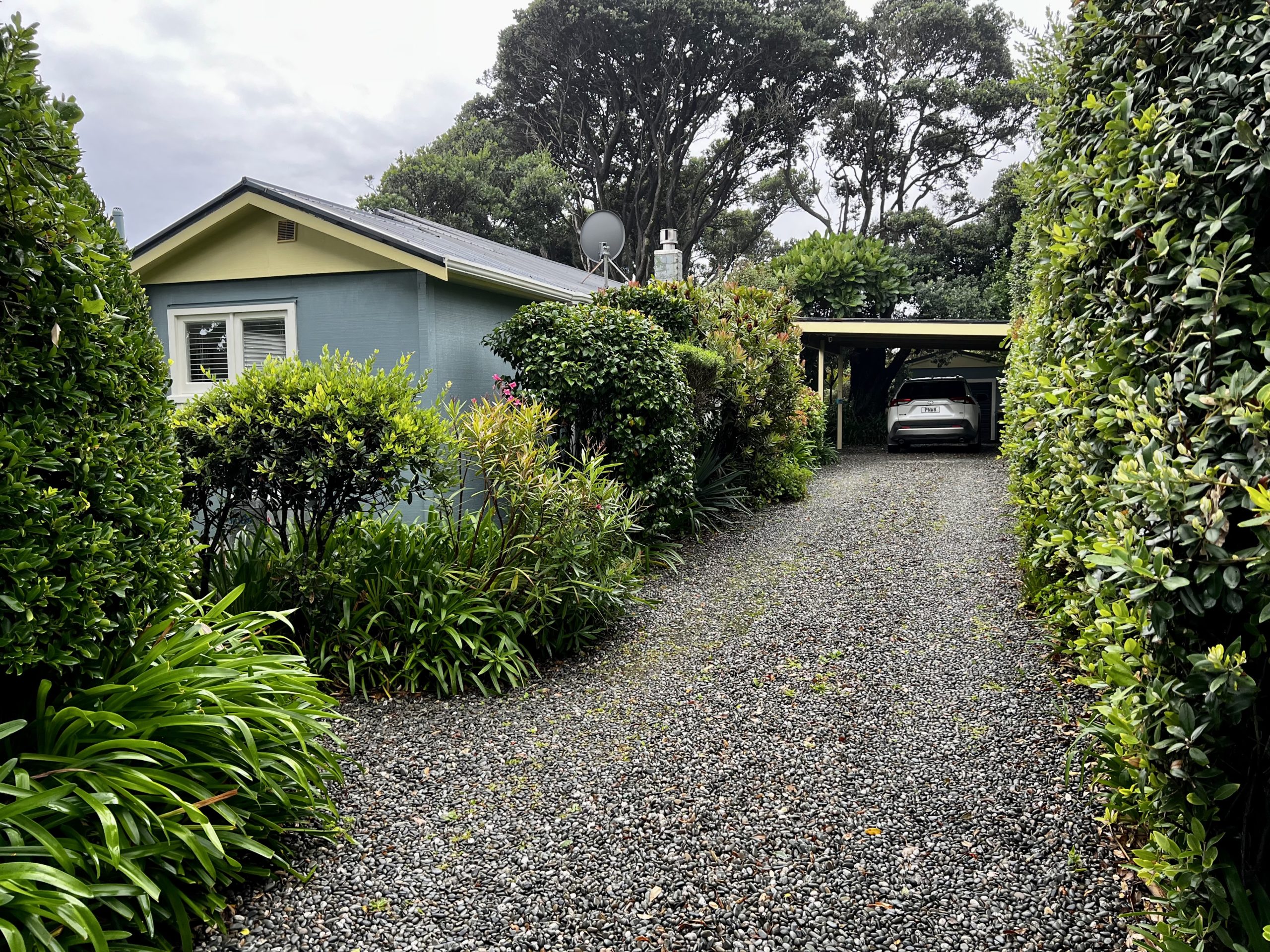
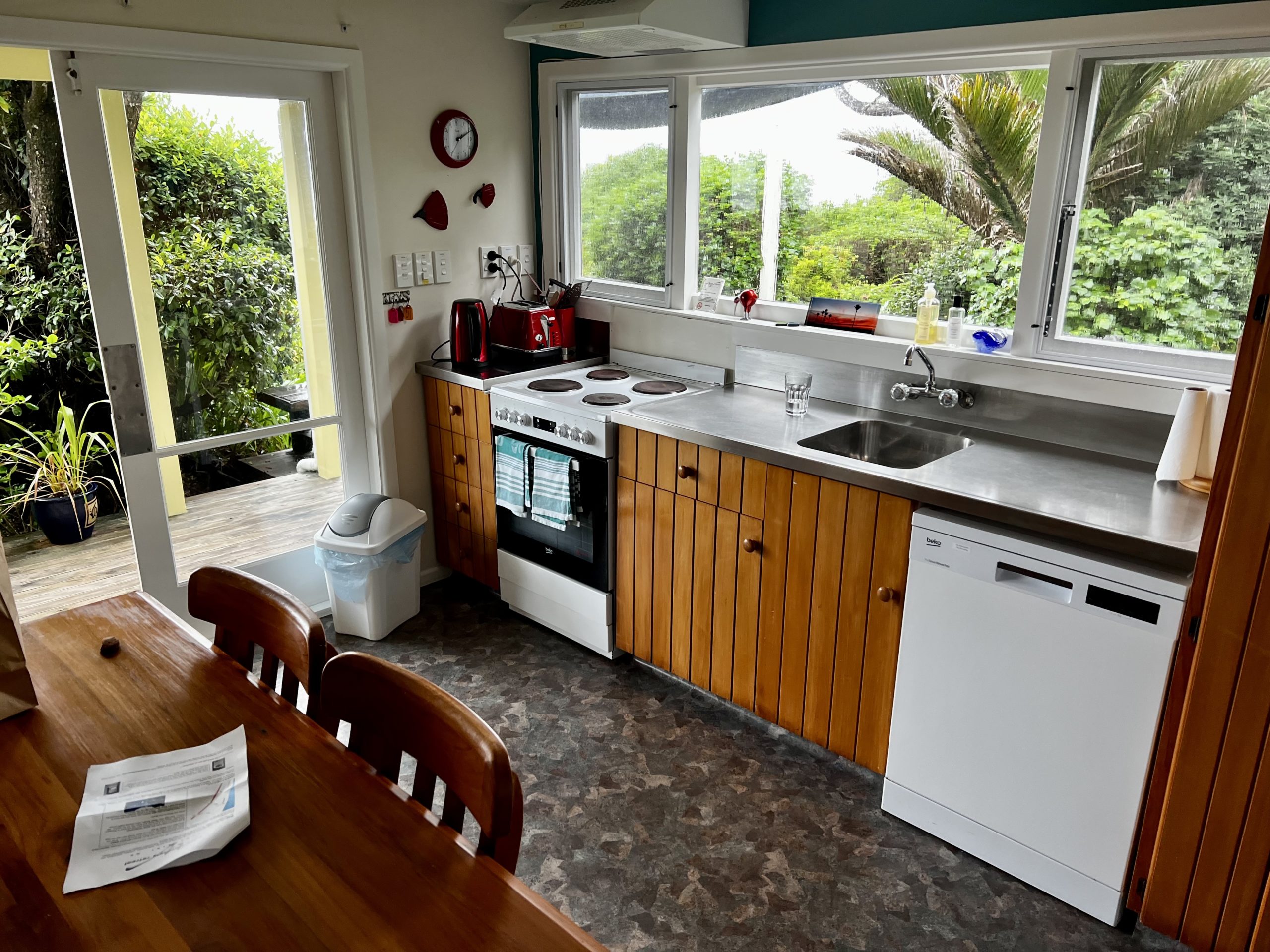
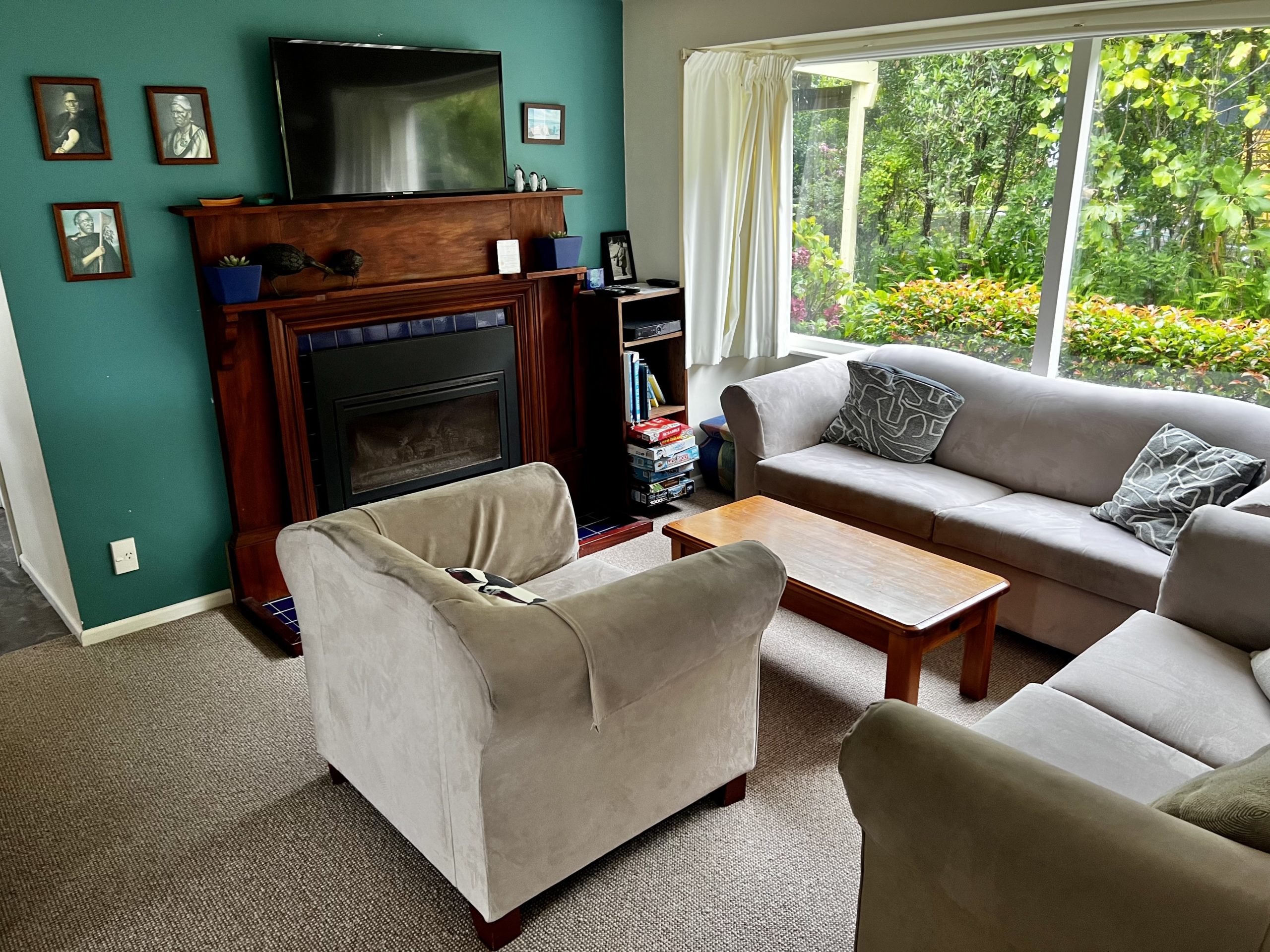
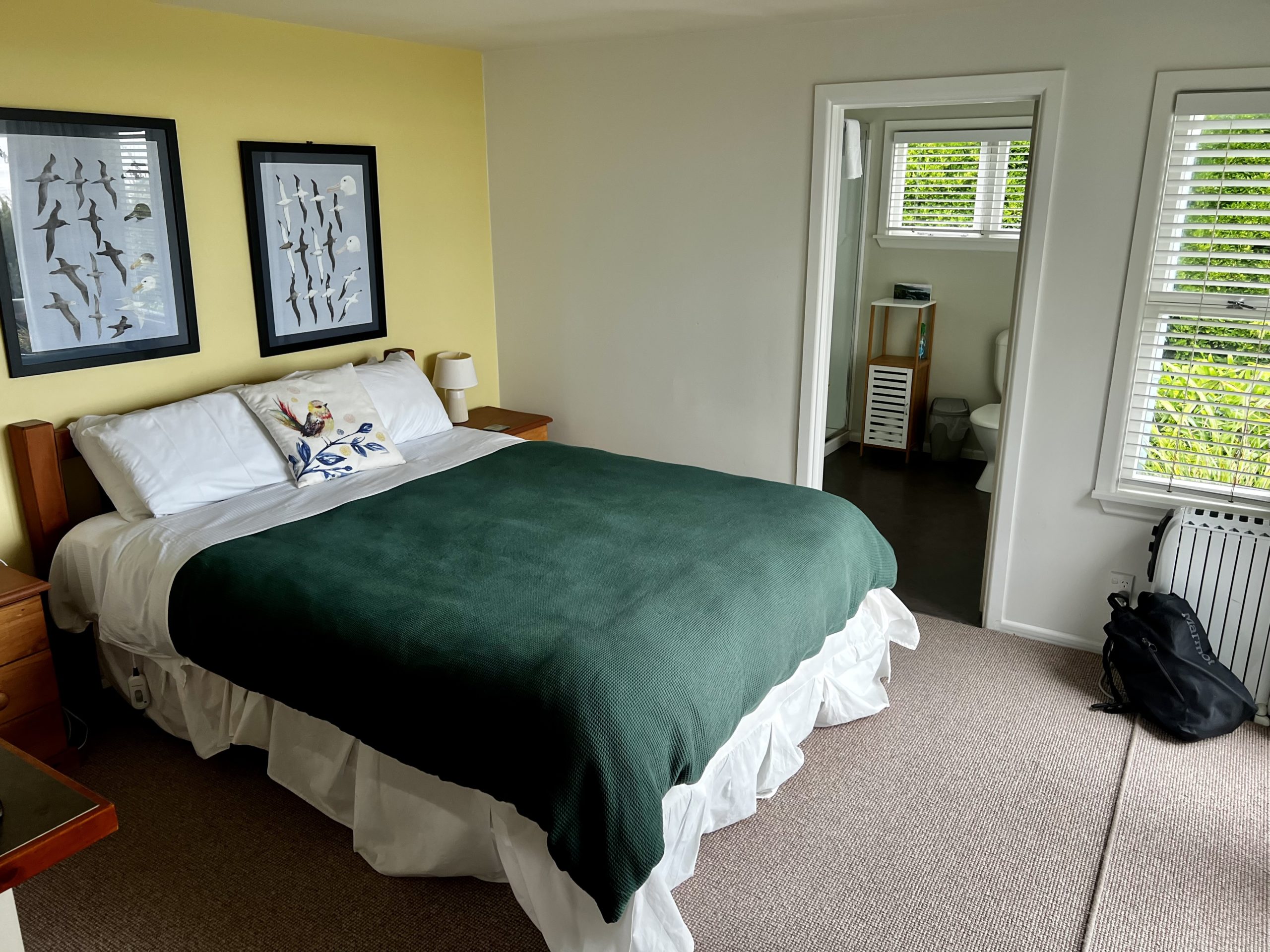
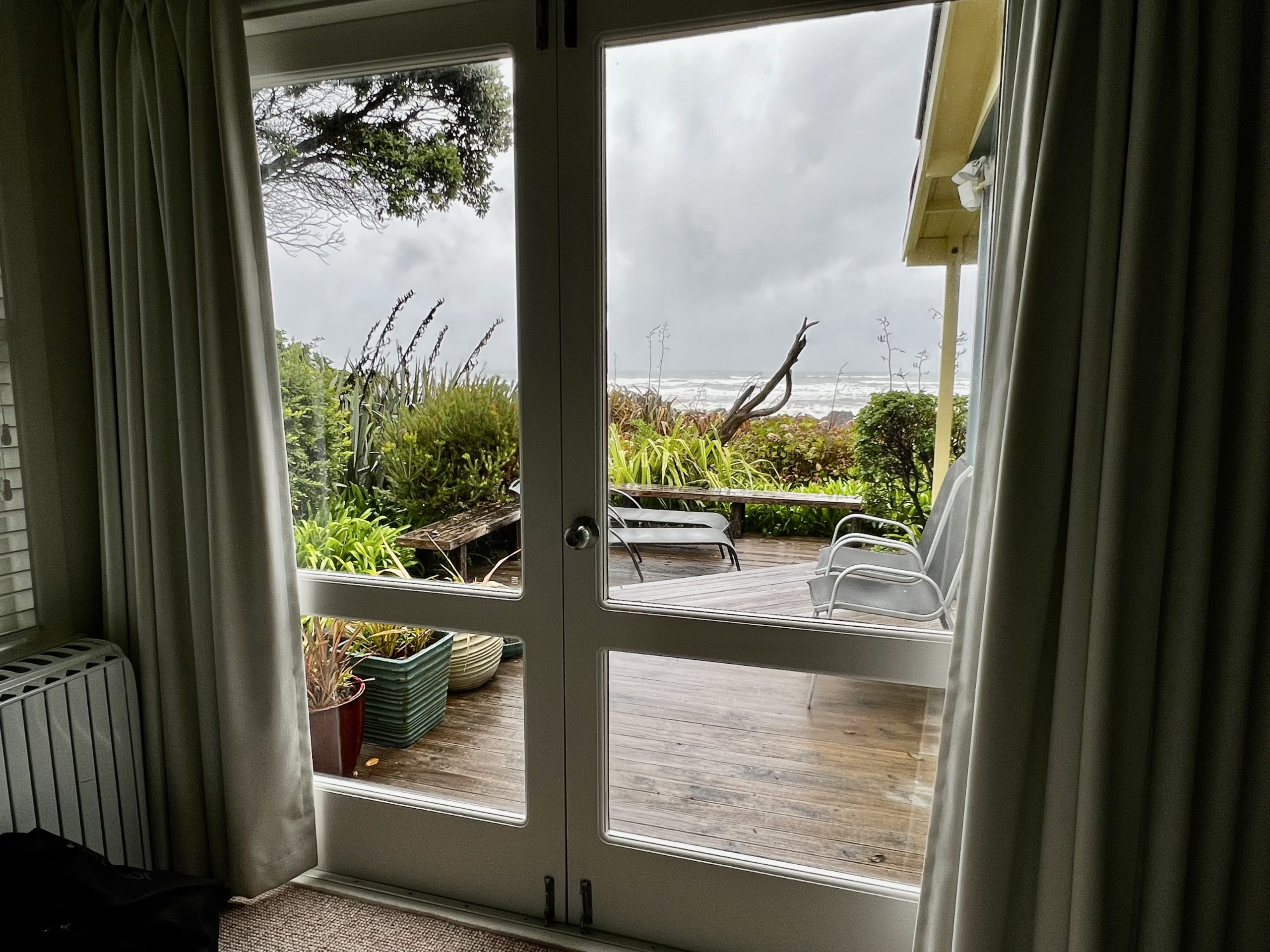
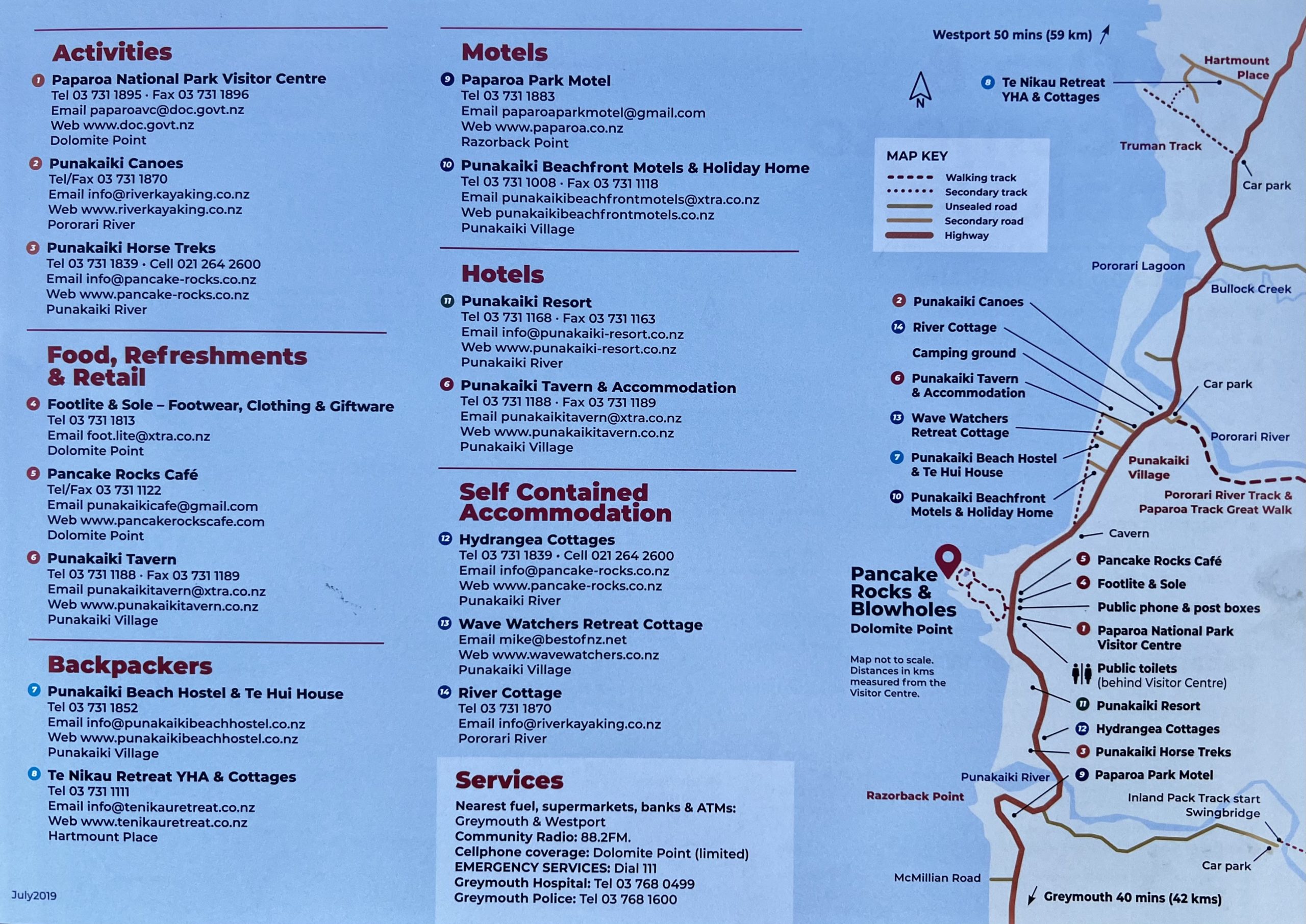
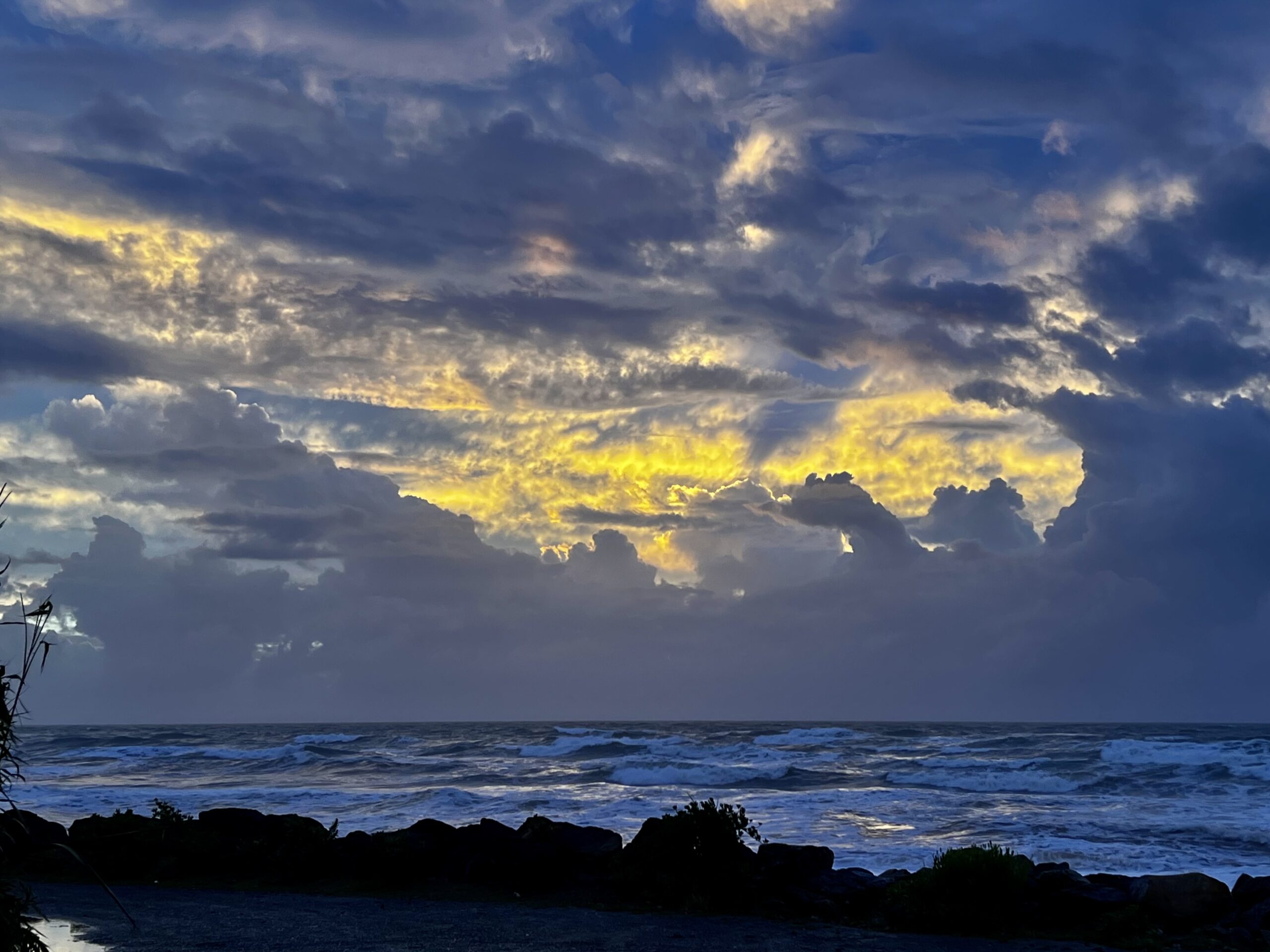
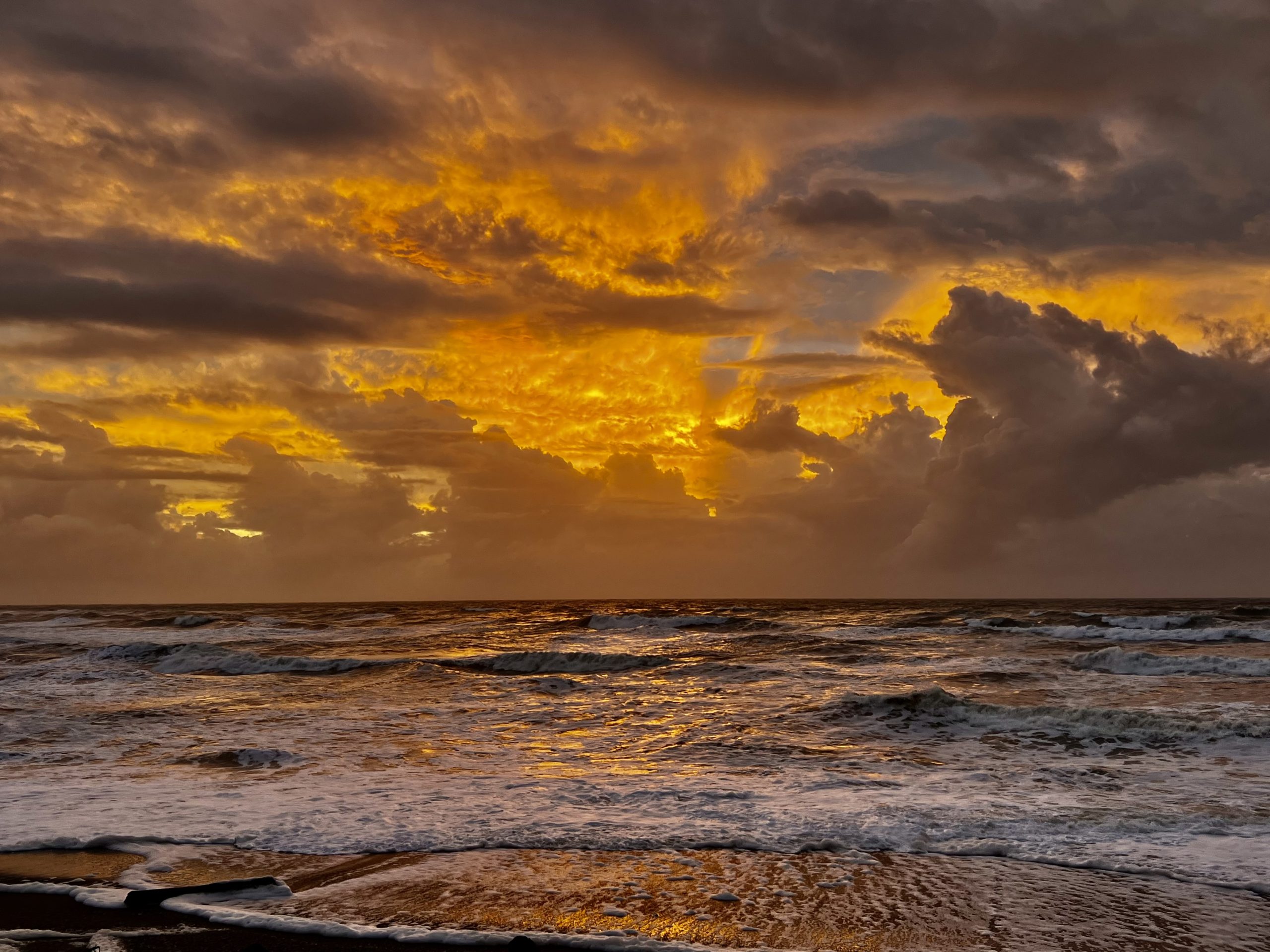
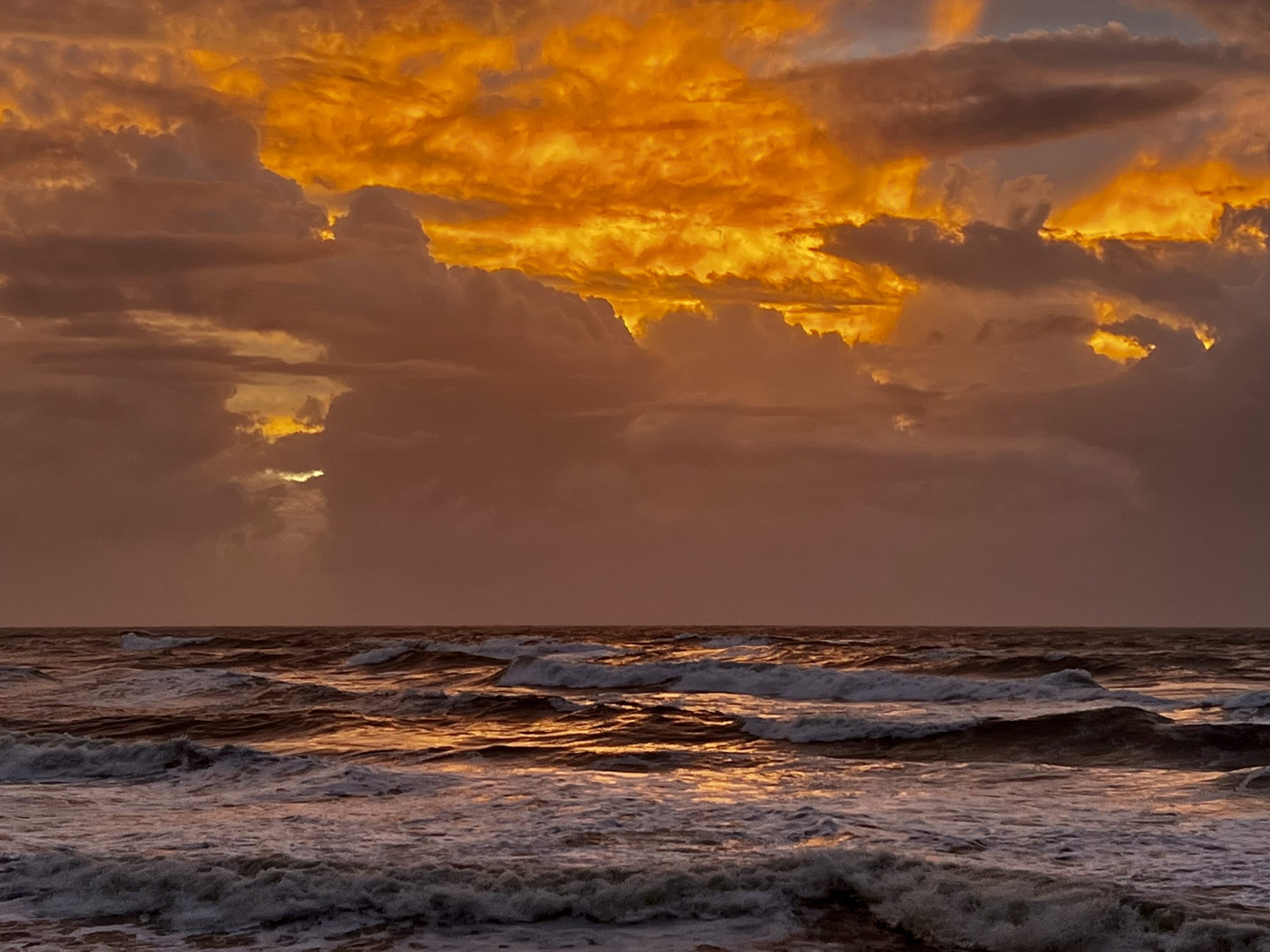
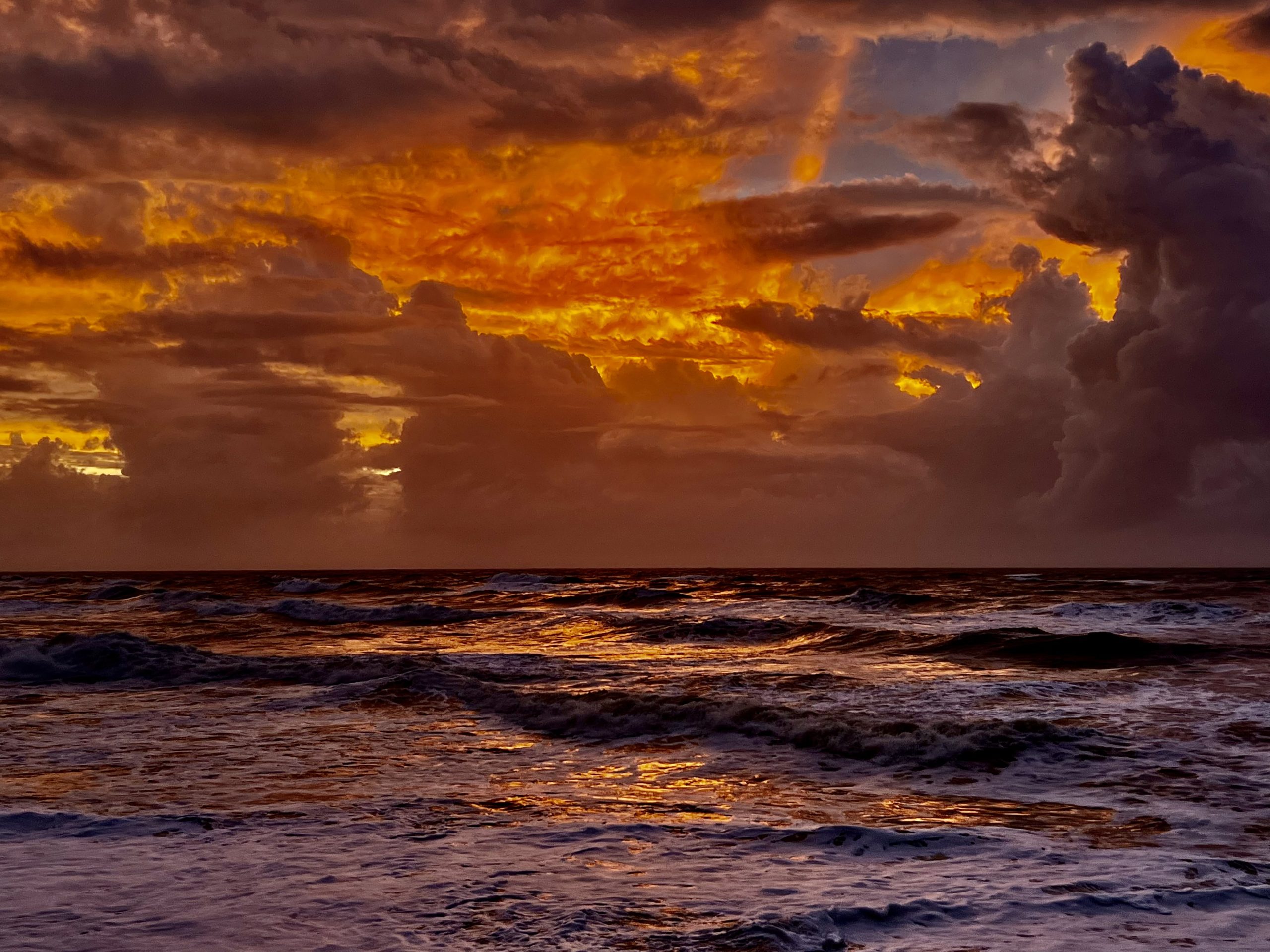
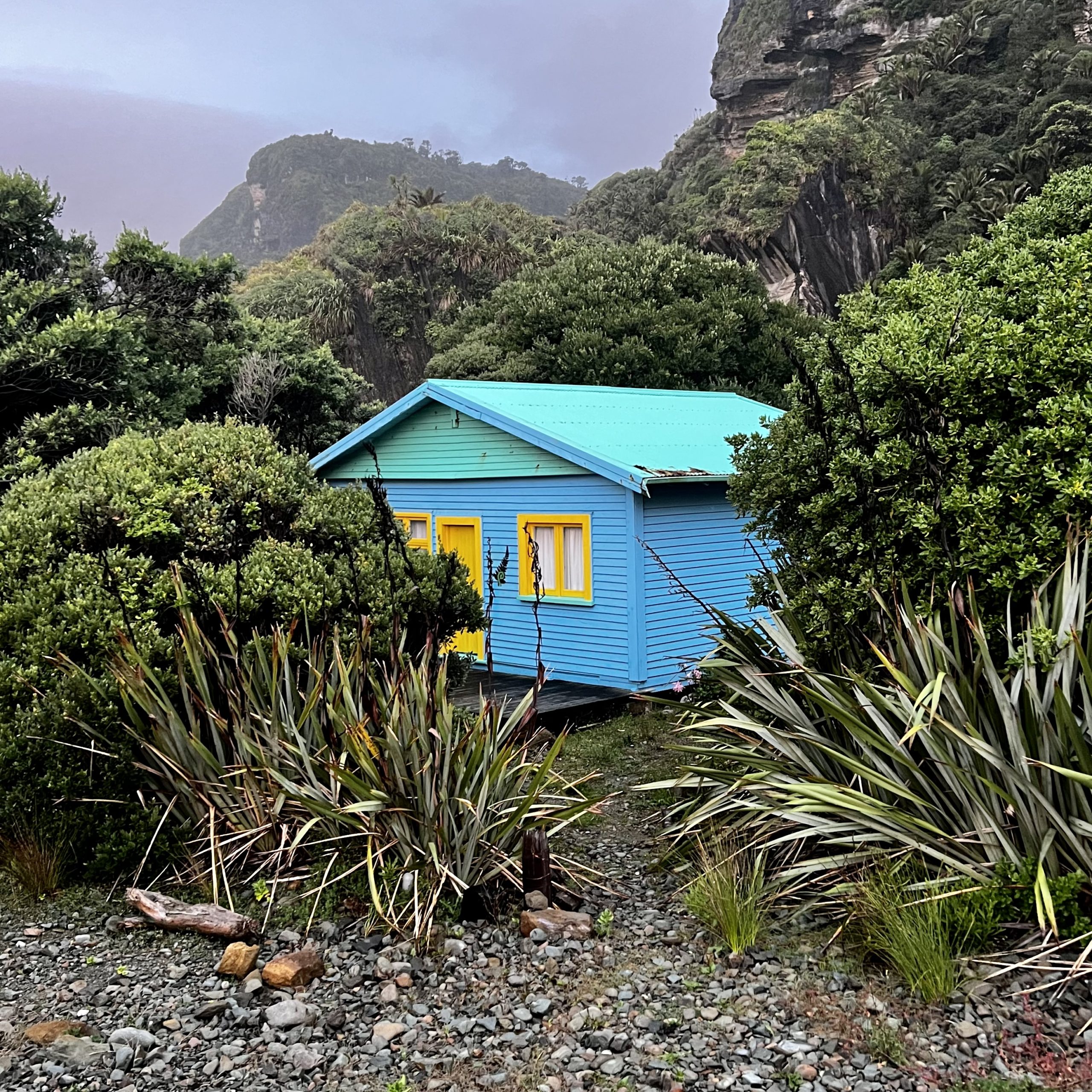
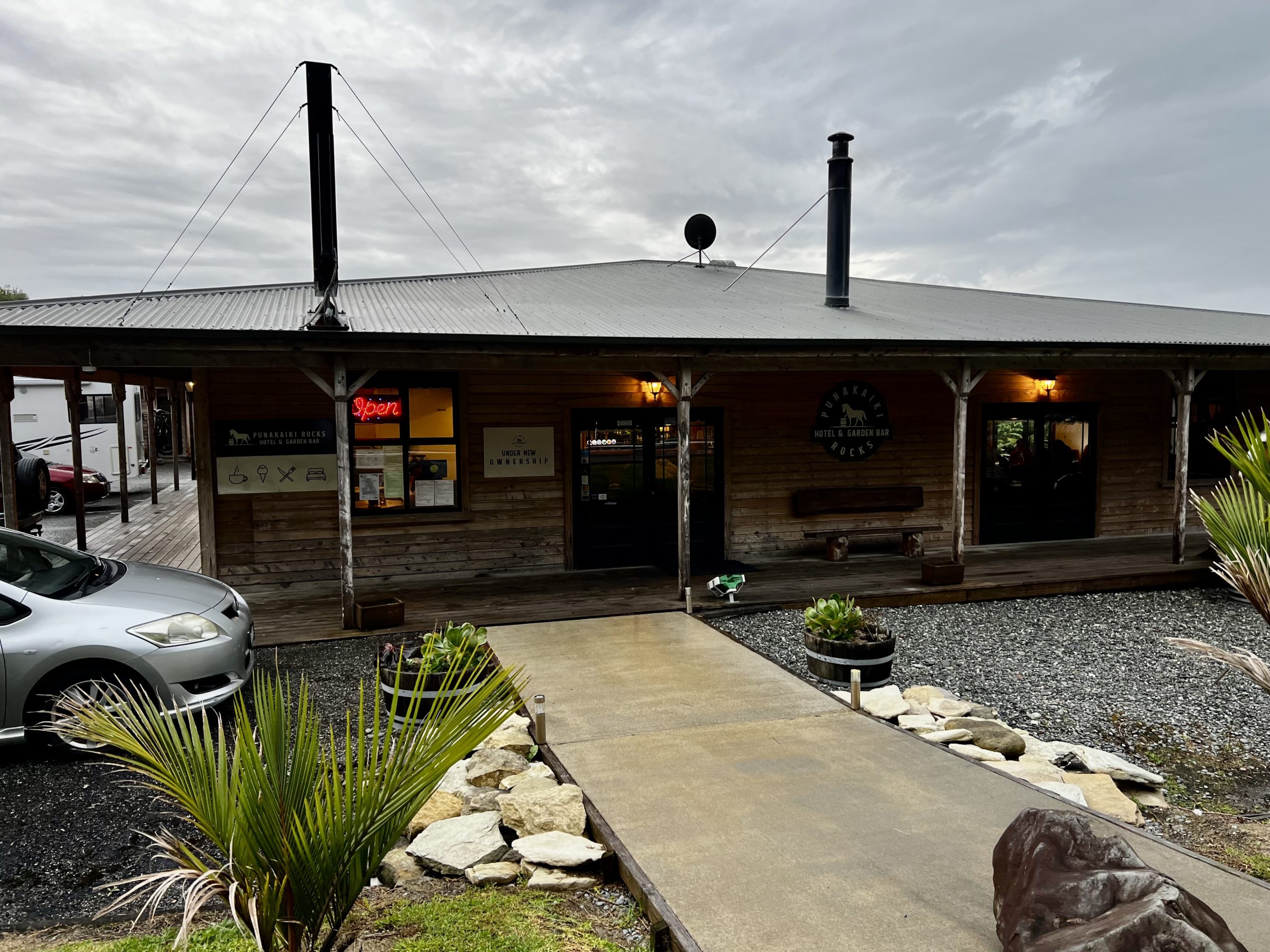
We stayed in a very nice, comfortable home that the founder of The Best of New Zealand Flyfishing owns. It sits a bit above the beach with magnificent views of the Tasman Sea, hence its name—wave watchers retreat. We had stunning sunsets the first night along with thunder and lighting. A pub restaurant was only a five-minute walk away. Plus we were able to catch up on laundry!
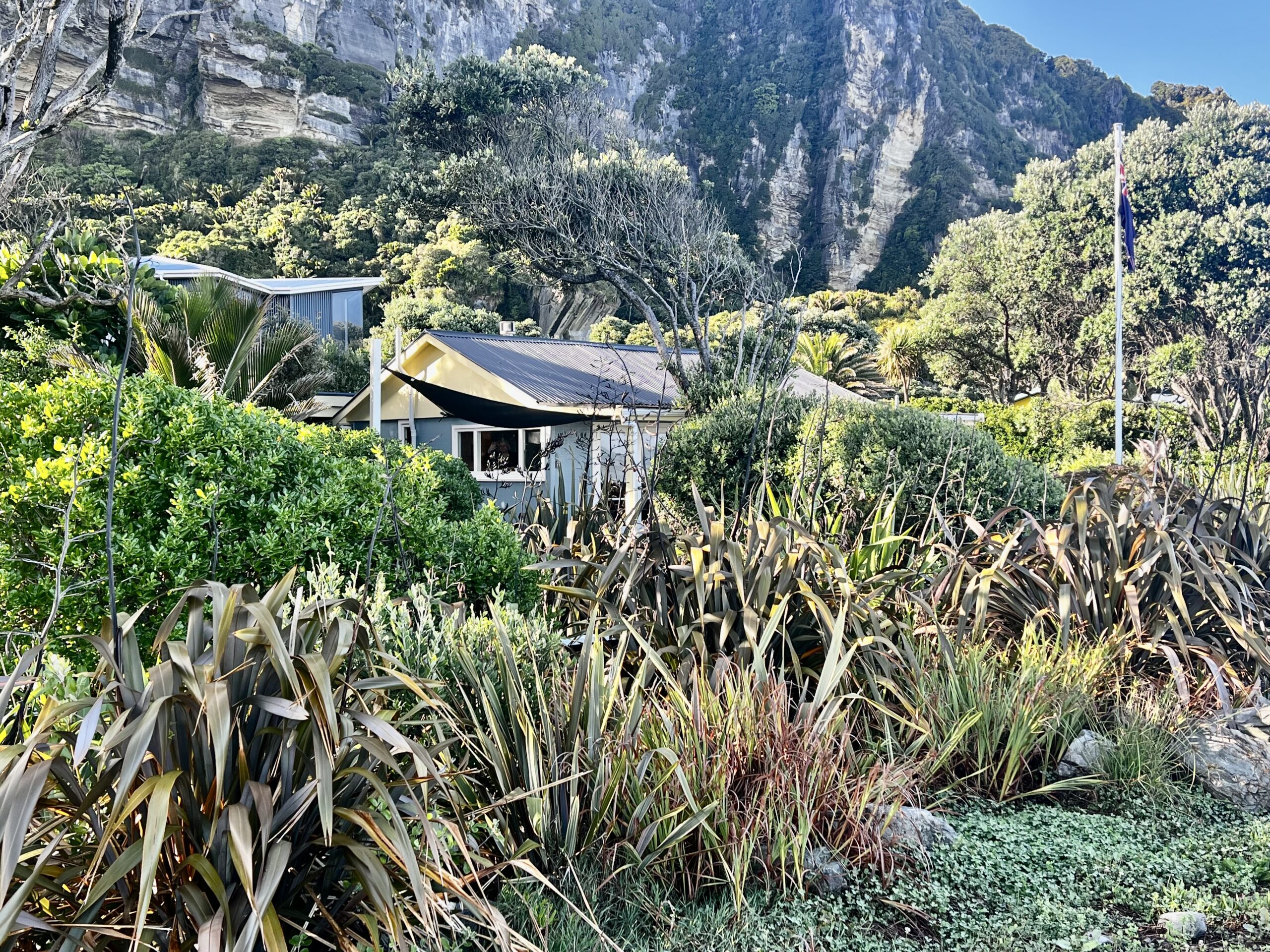
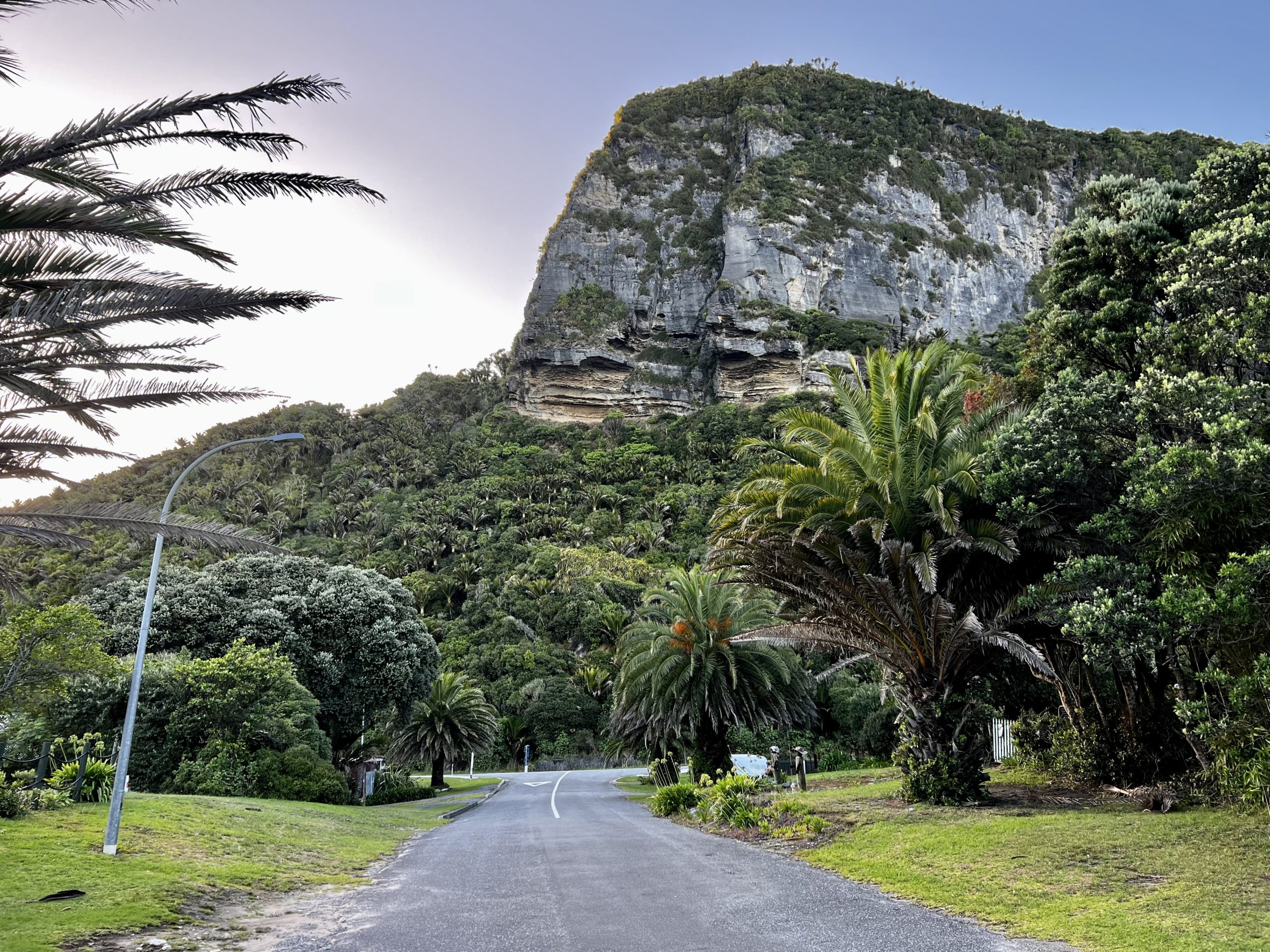
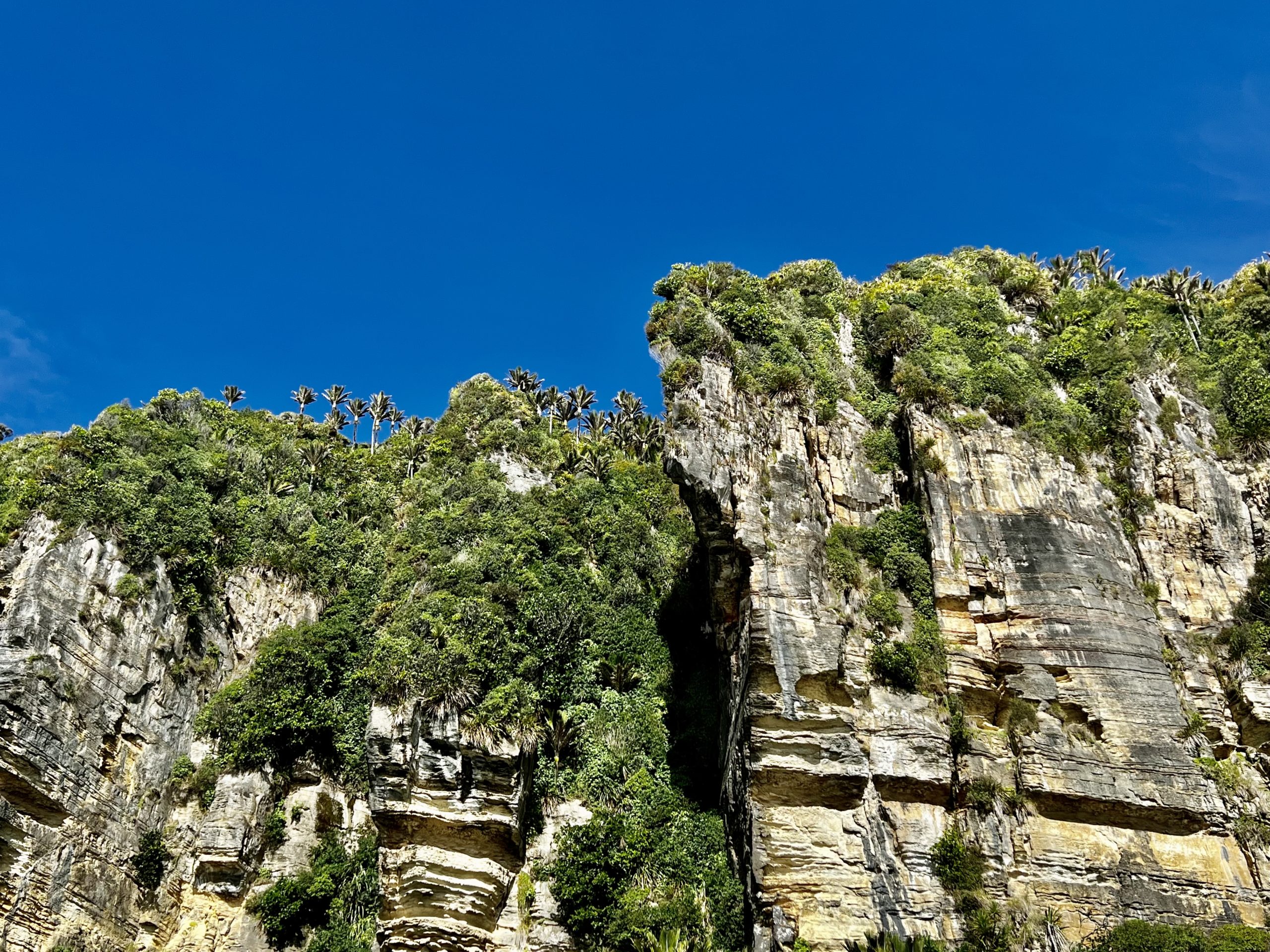
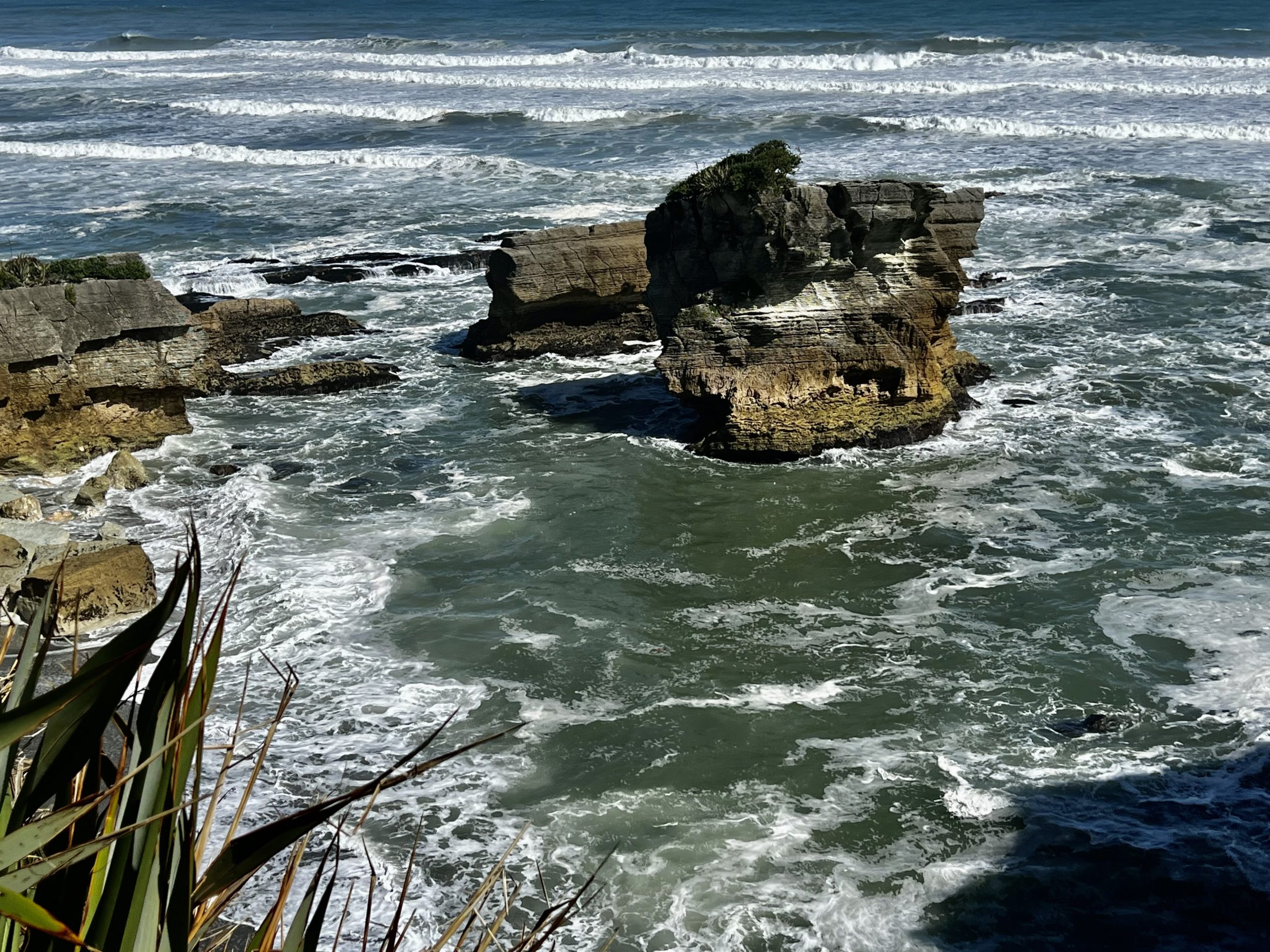
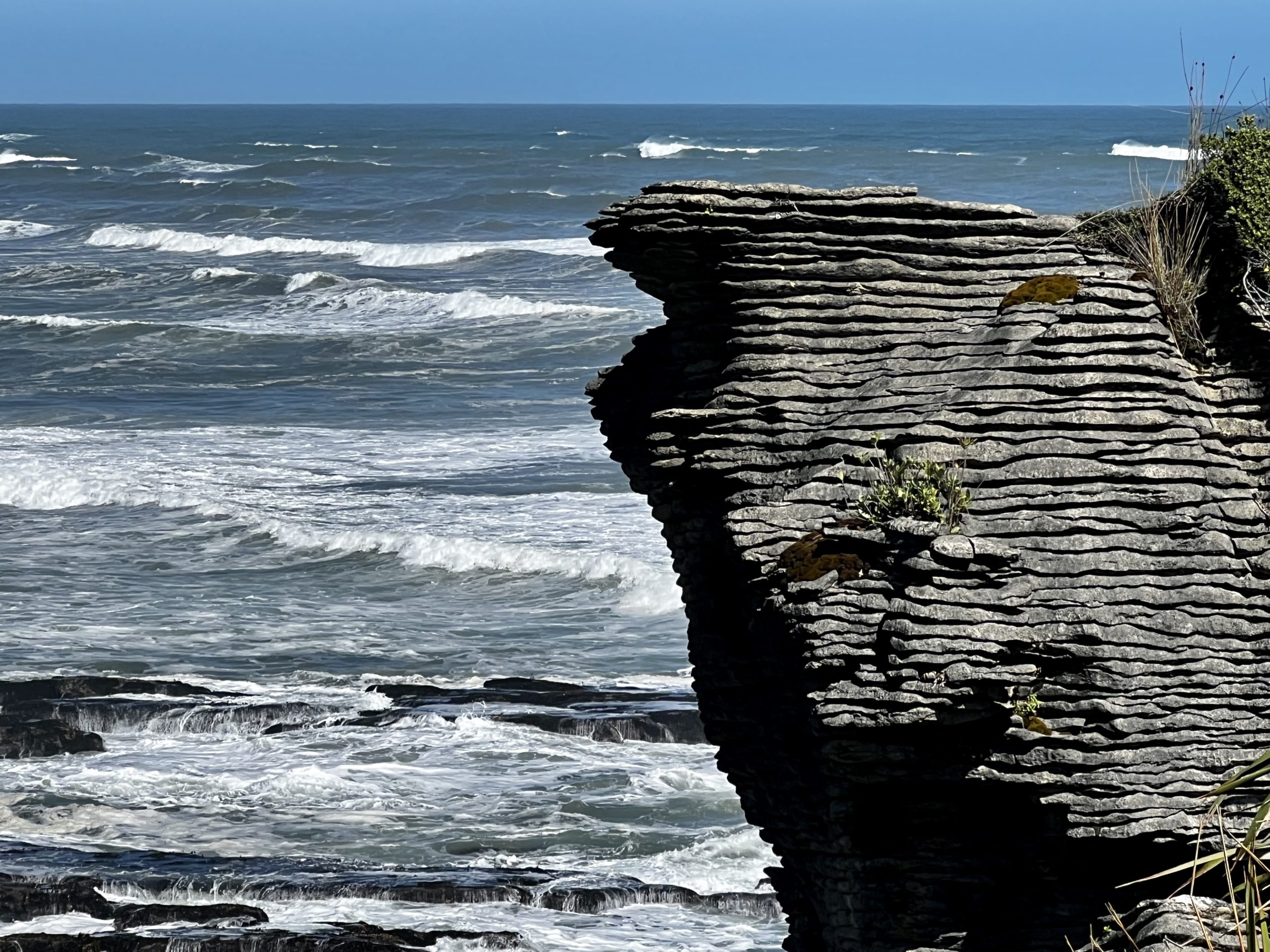
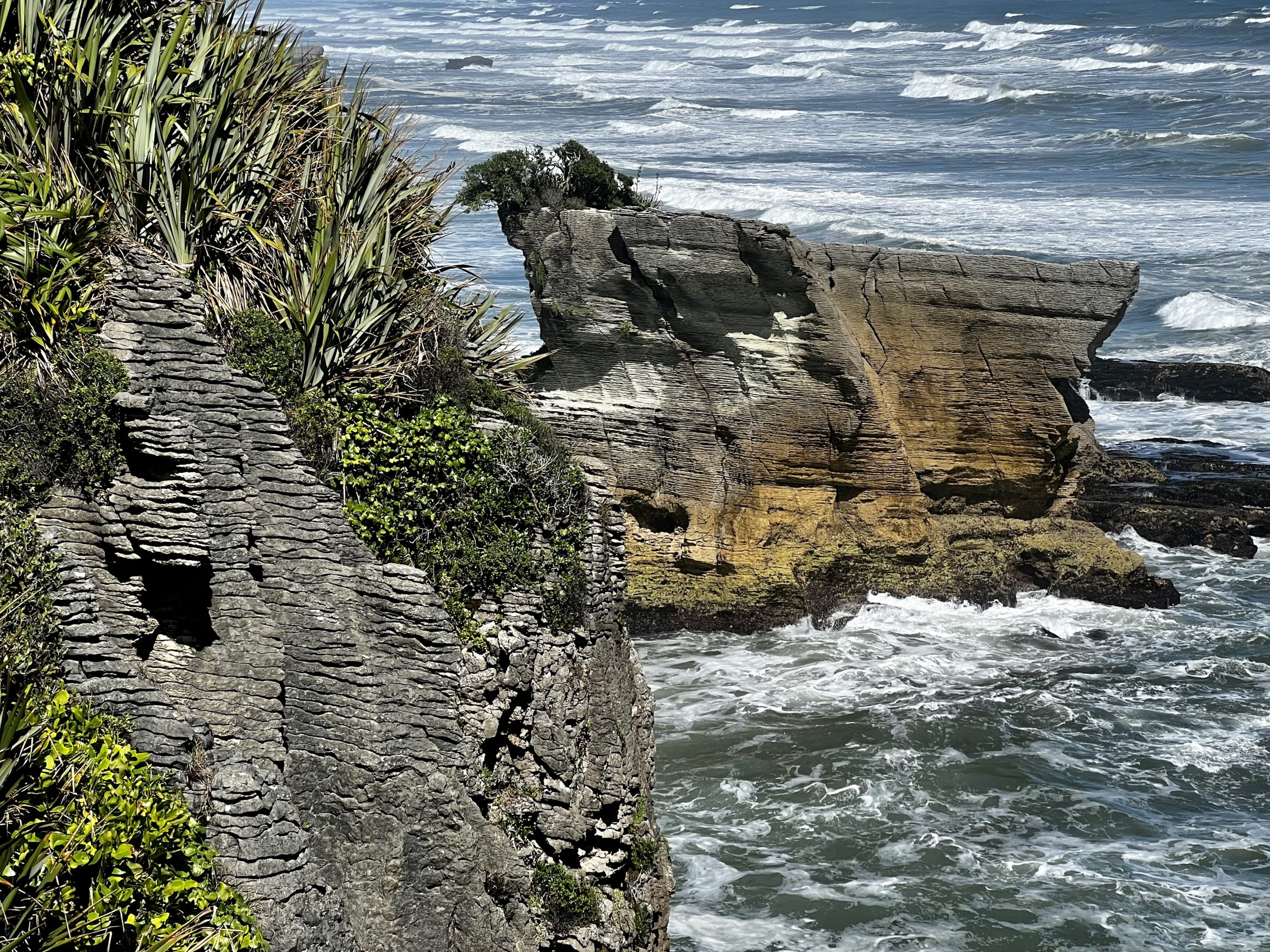
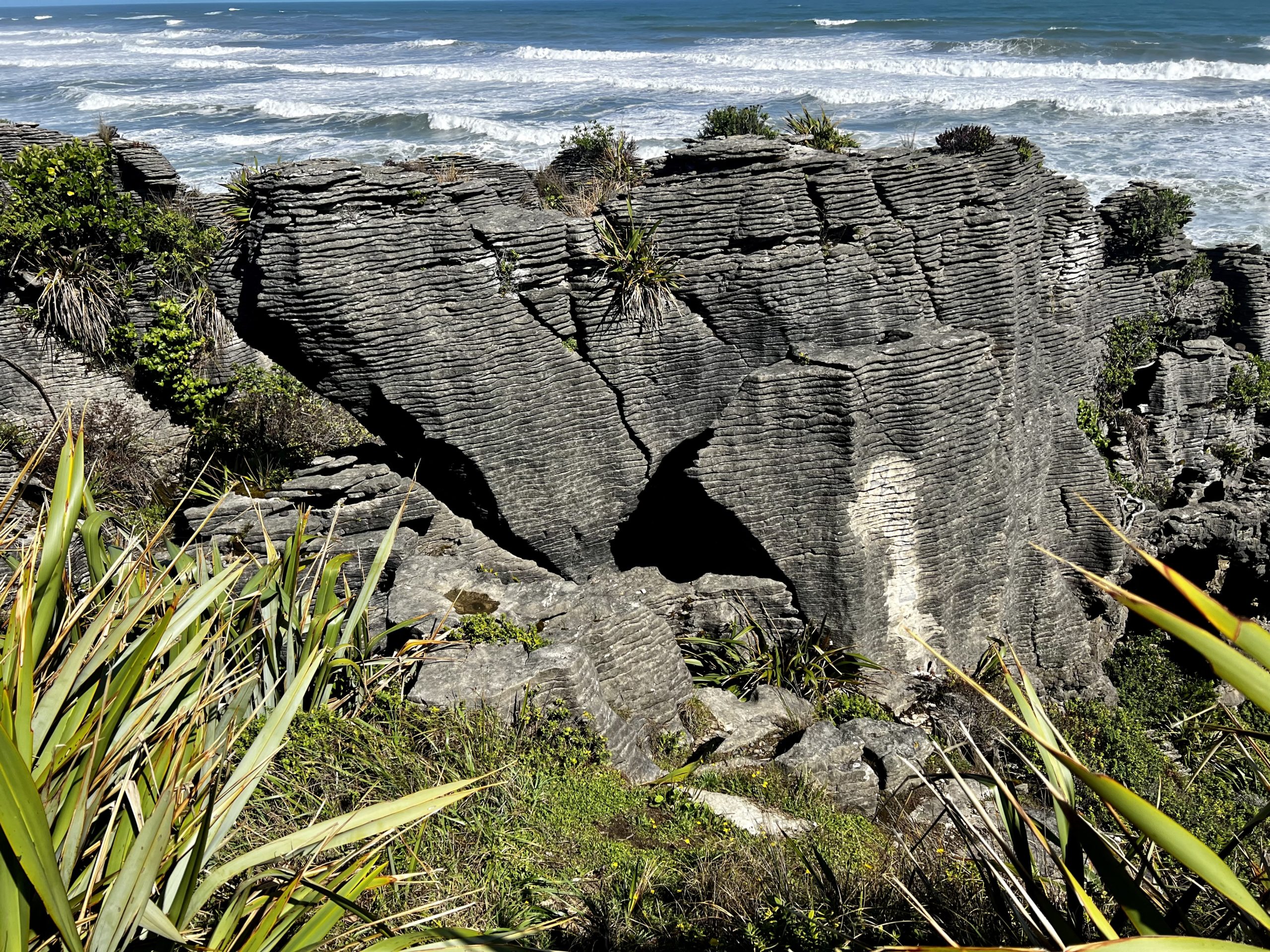
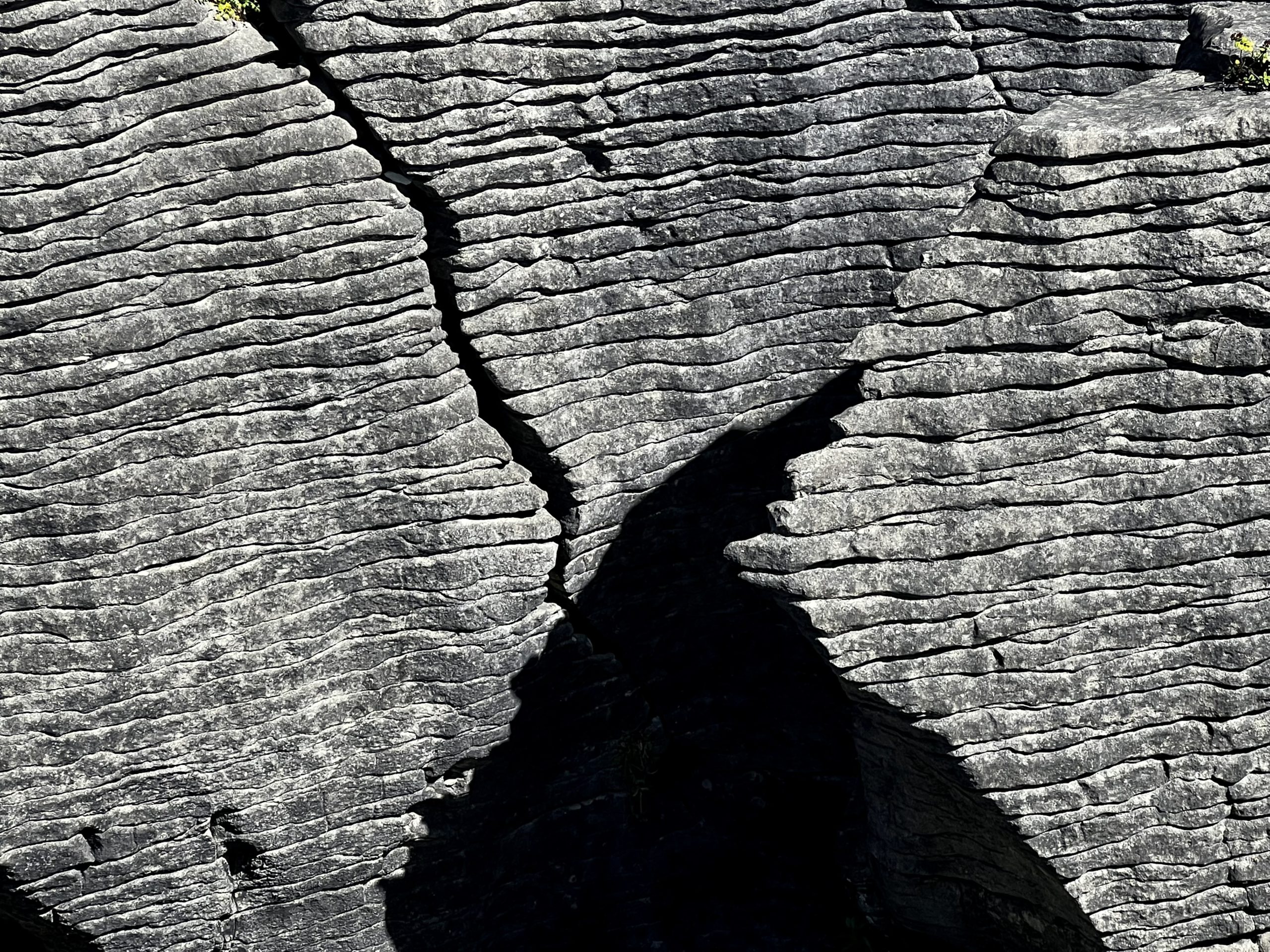
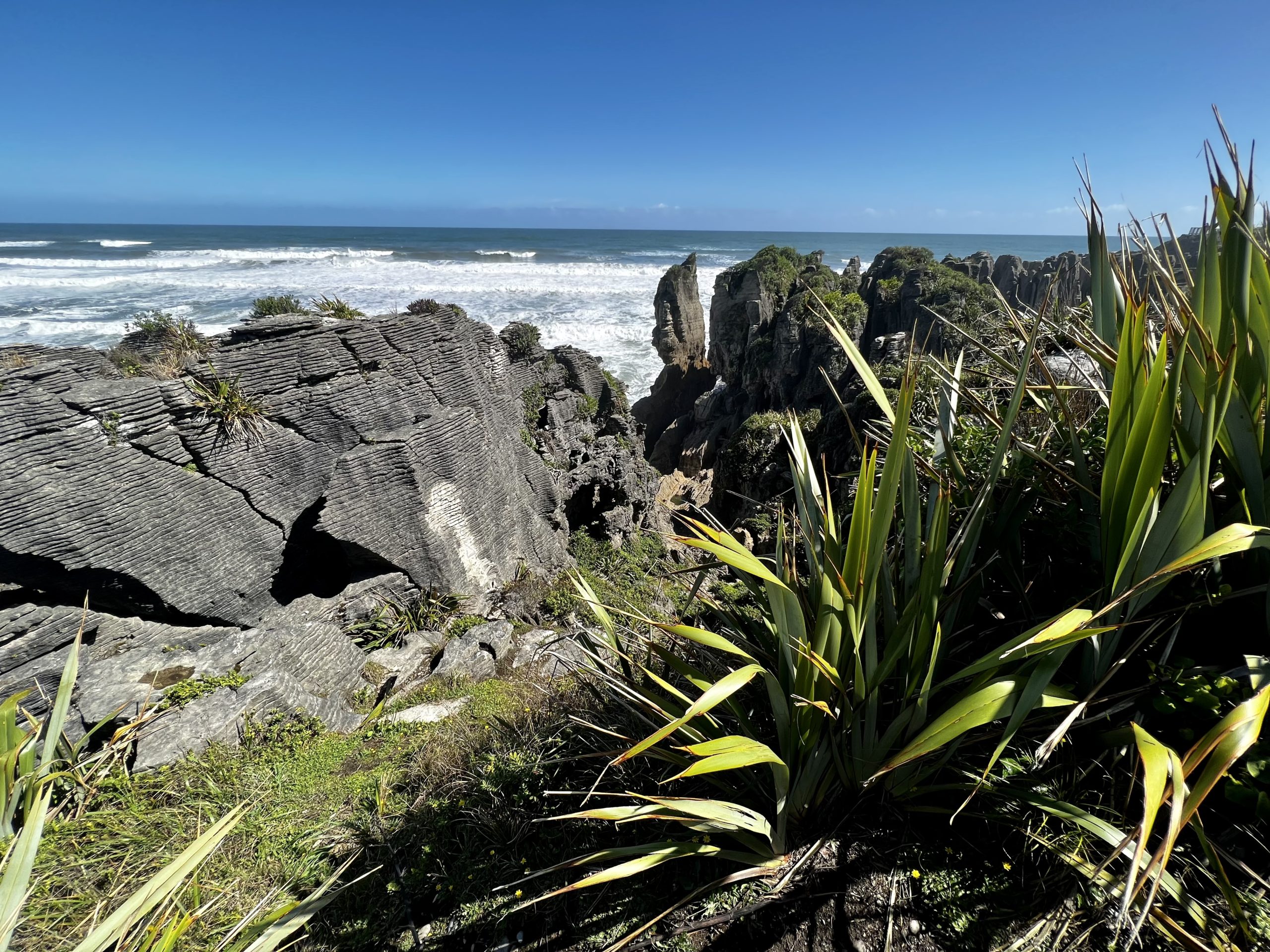
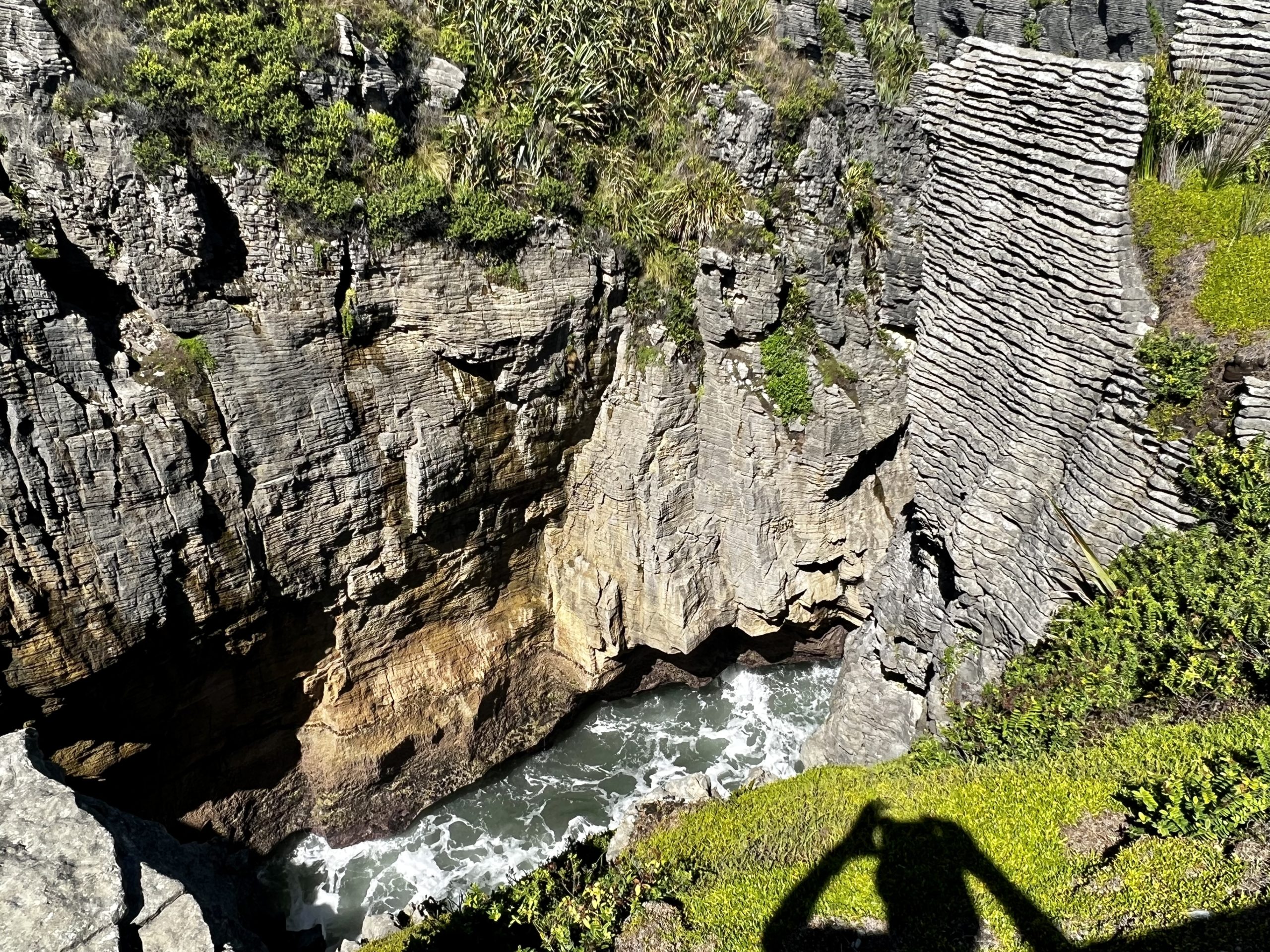
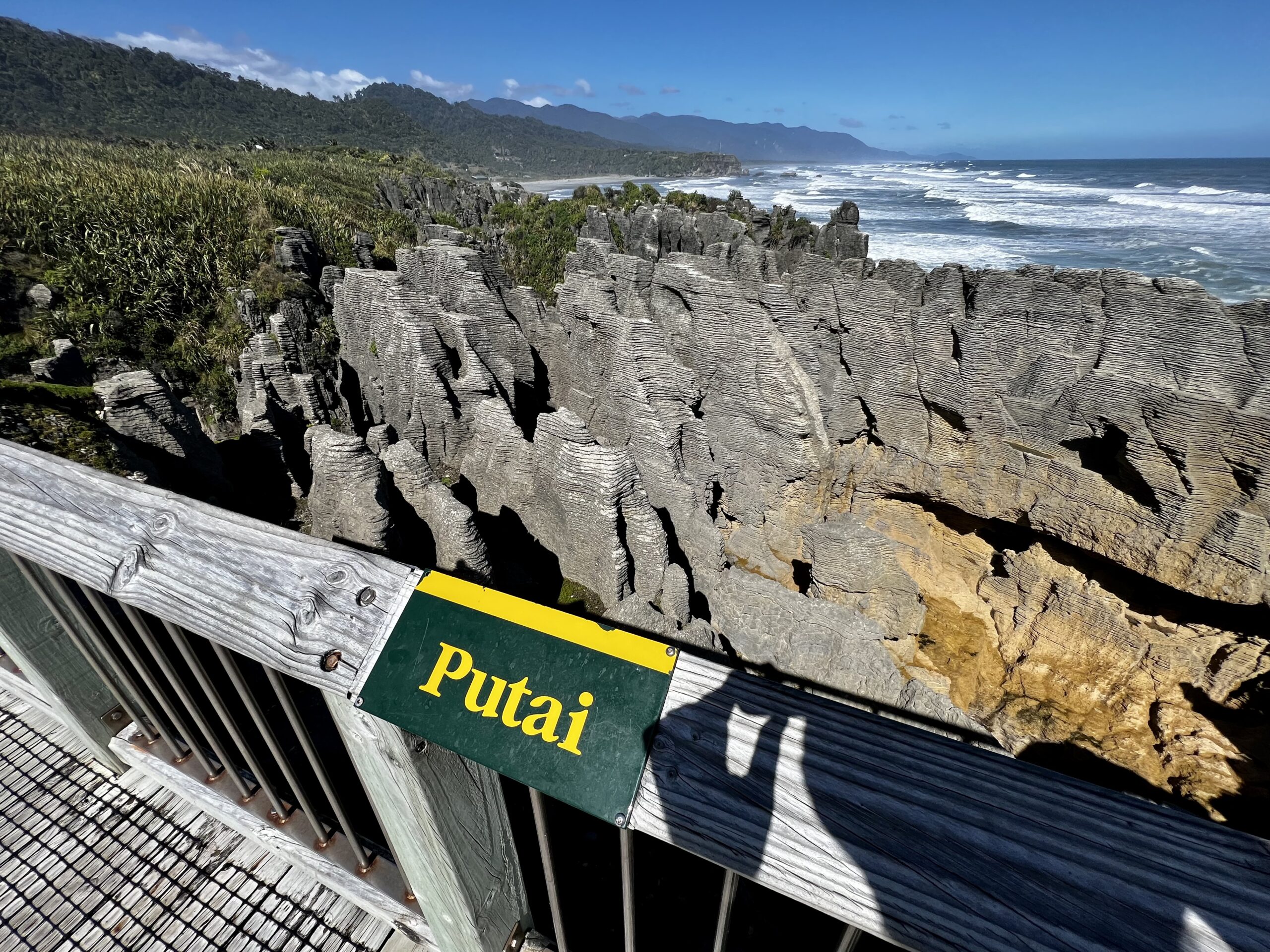
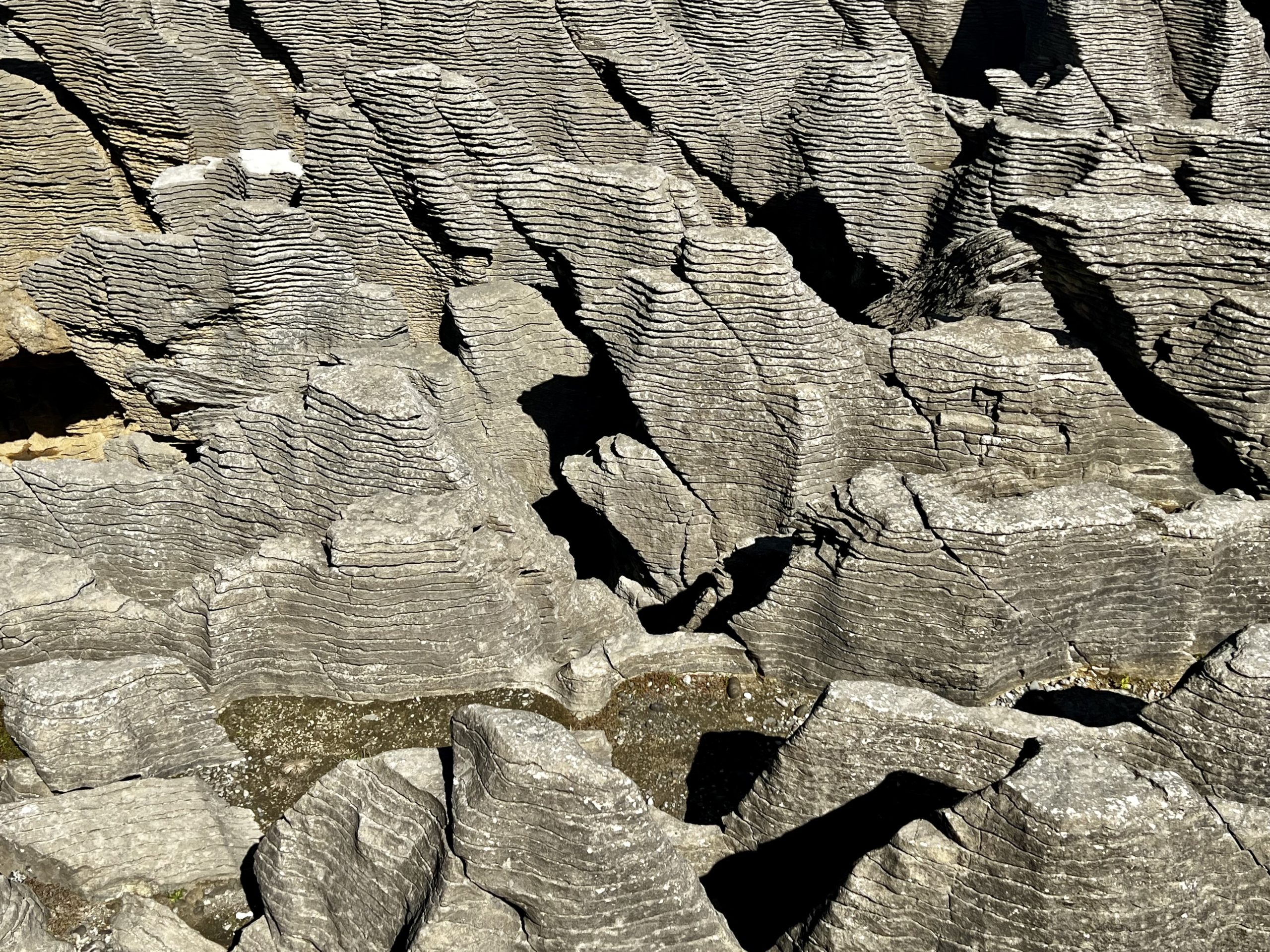
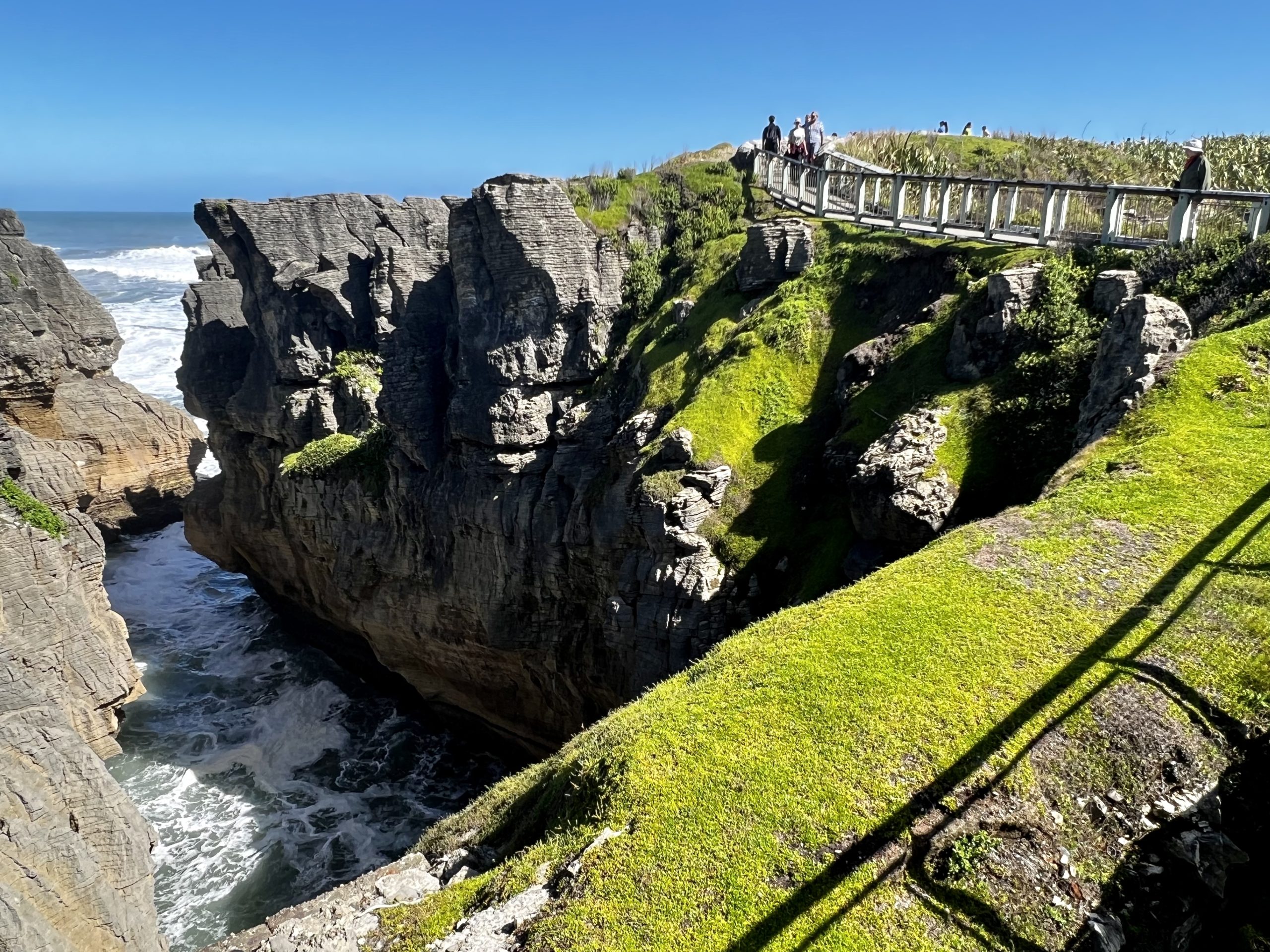
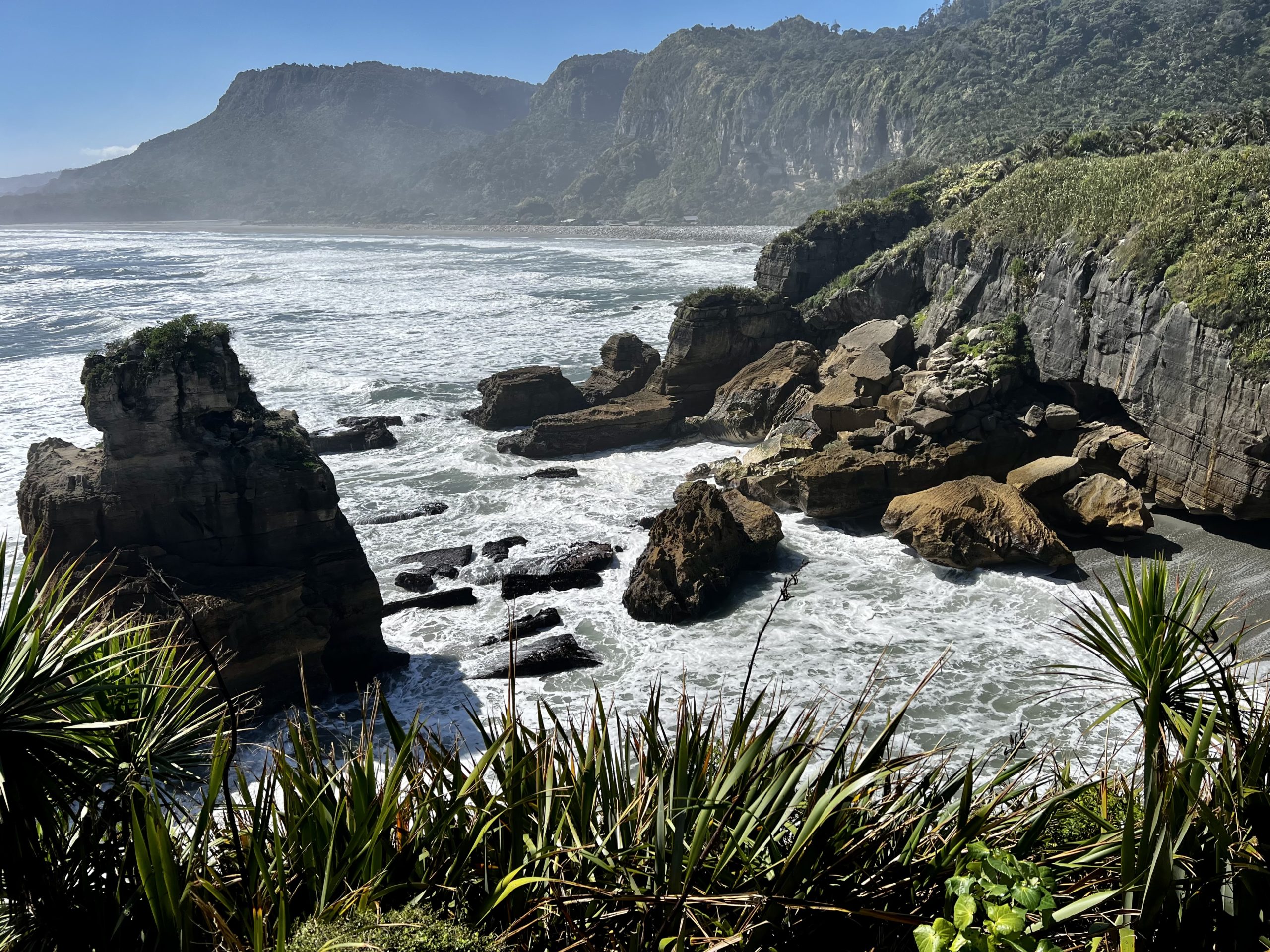
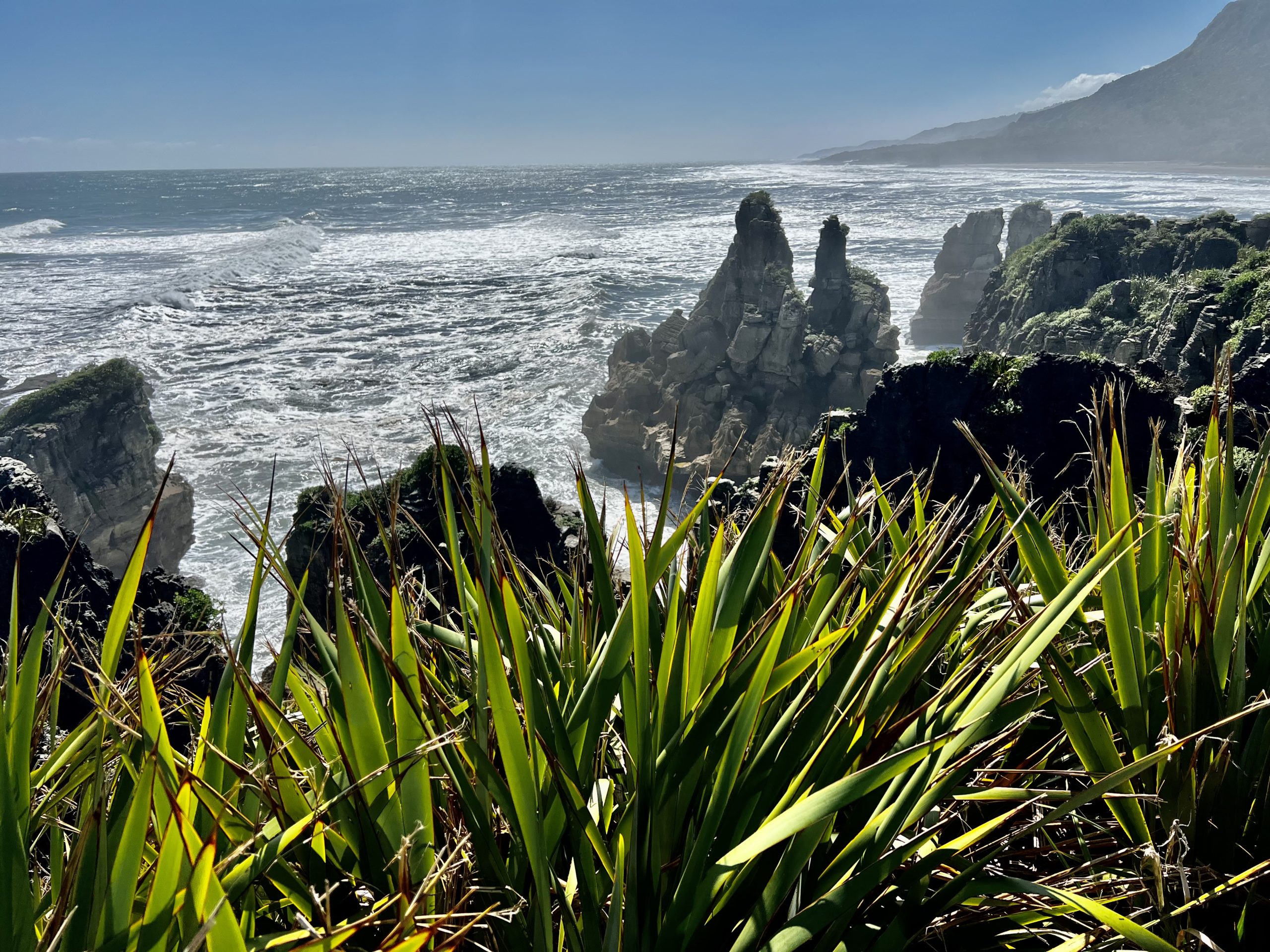
Geologically, the area has dramatic rock formations that thrust vertically out of the ground and the ocean. The heavy vegetation and the crashing waves complete the composition.
Strolling Briefly
Pancake Rocks
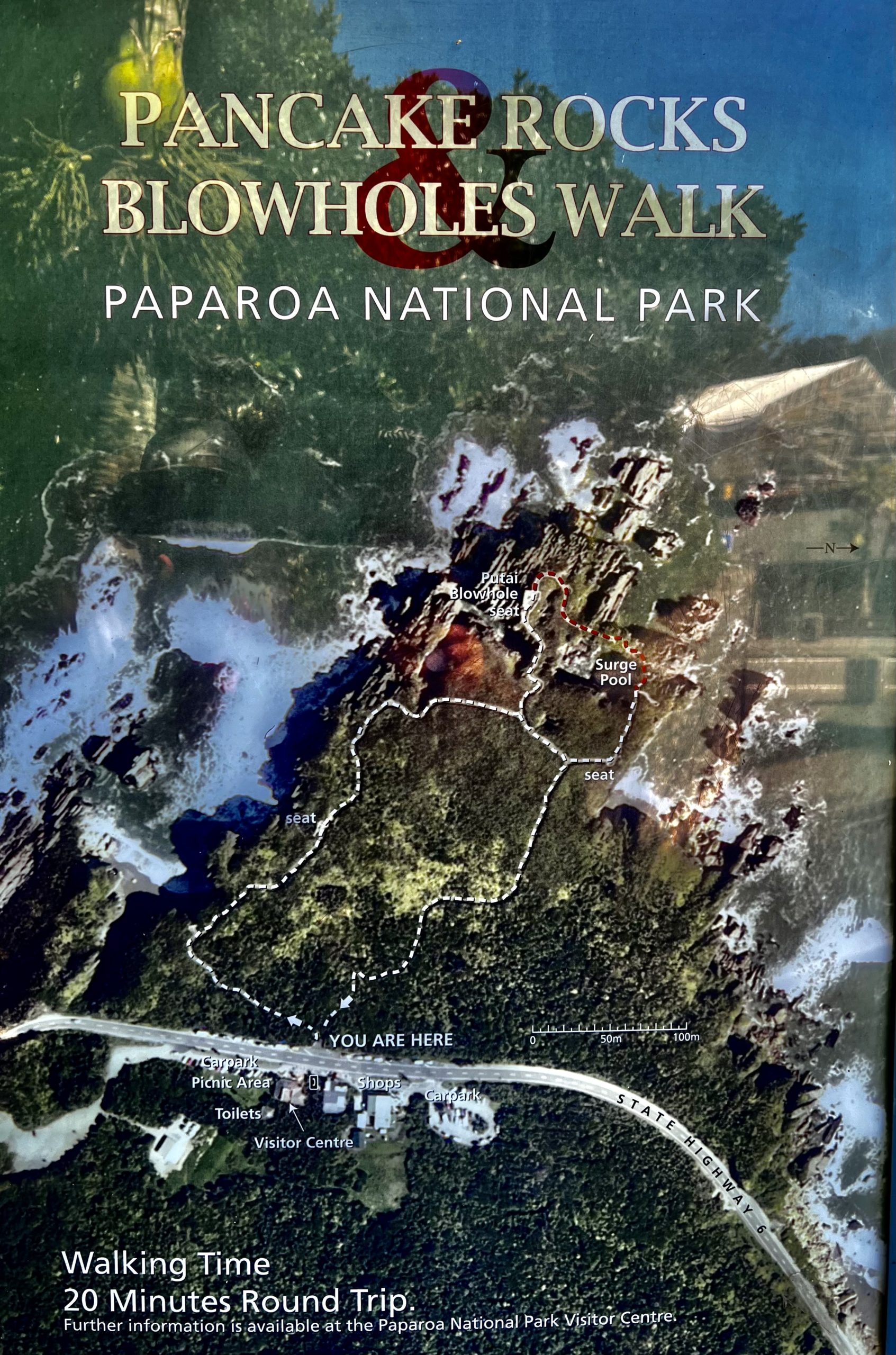
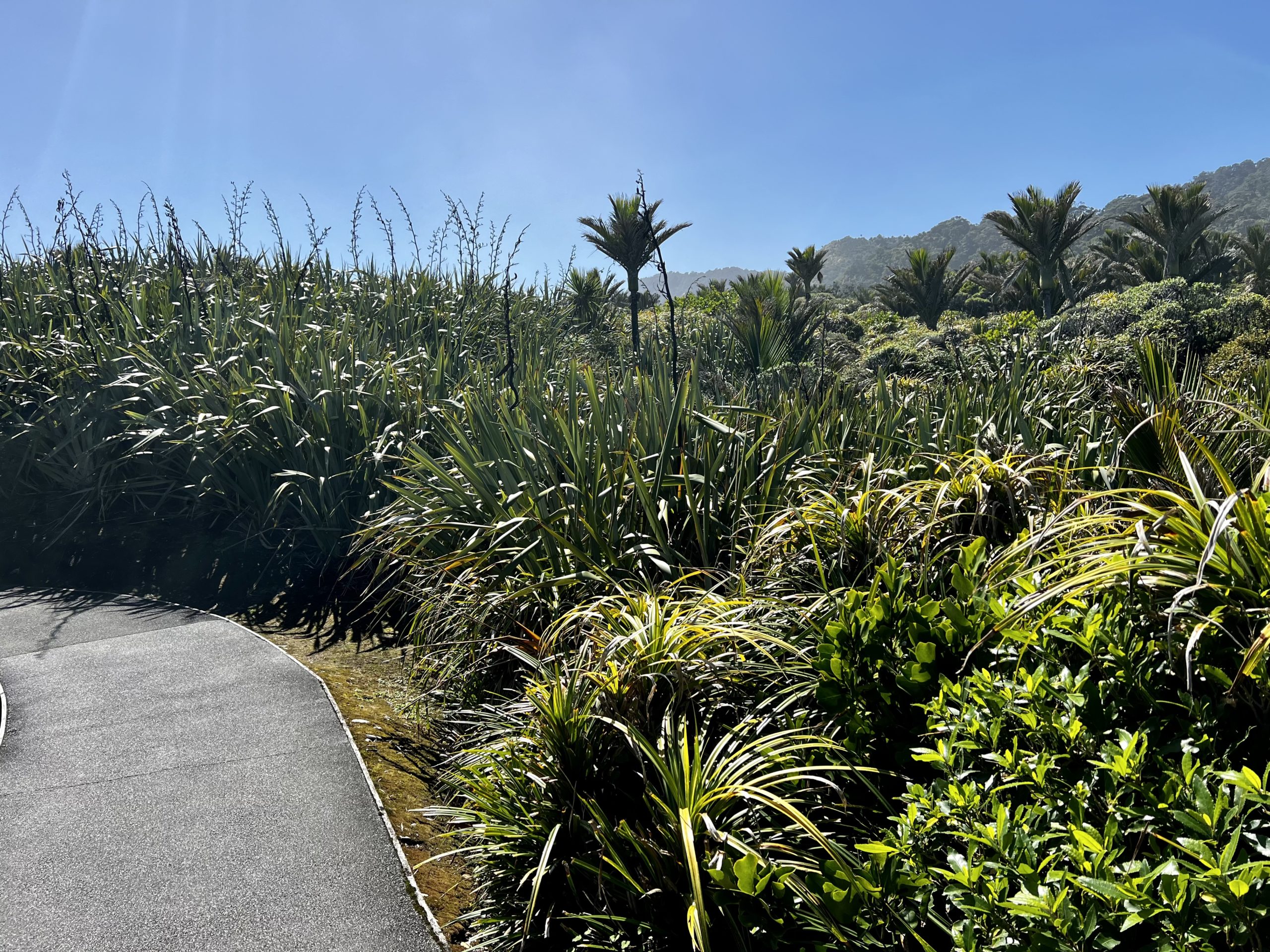
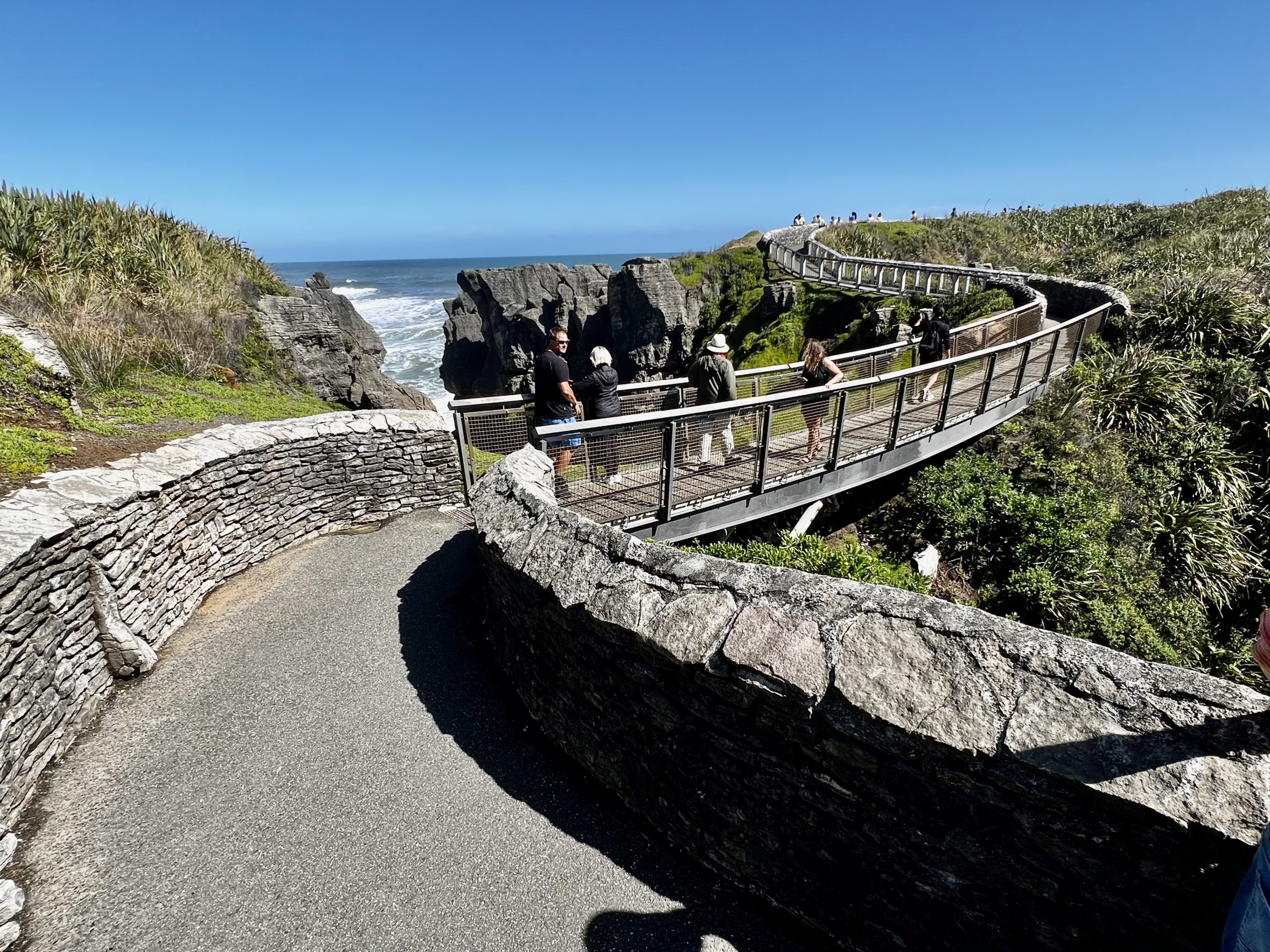
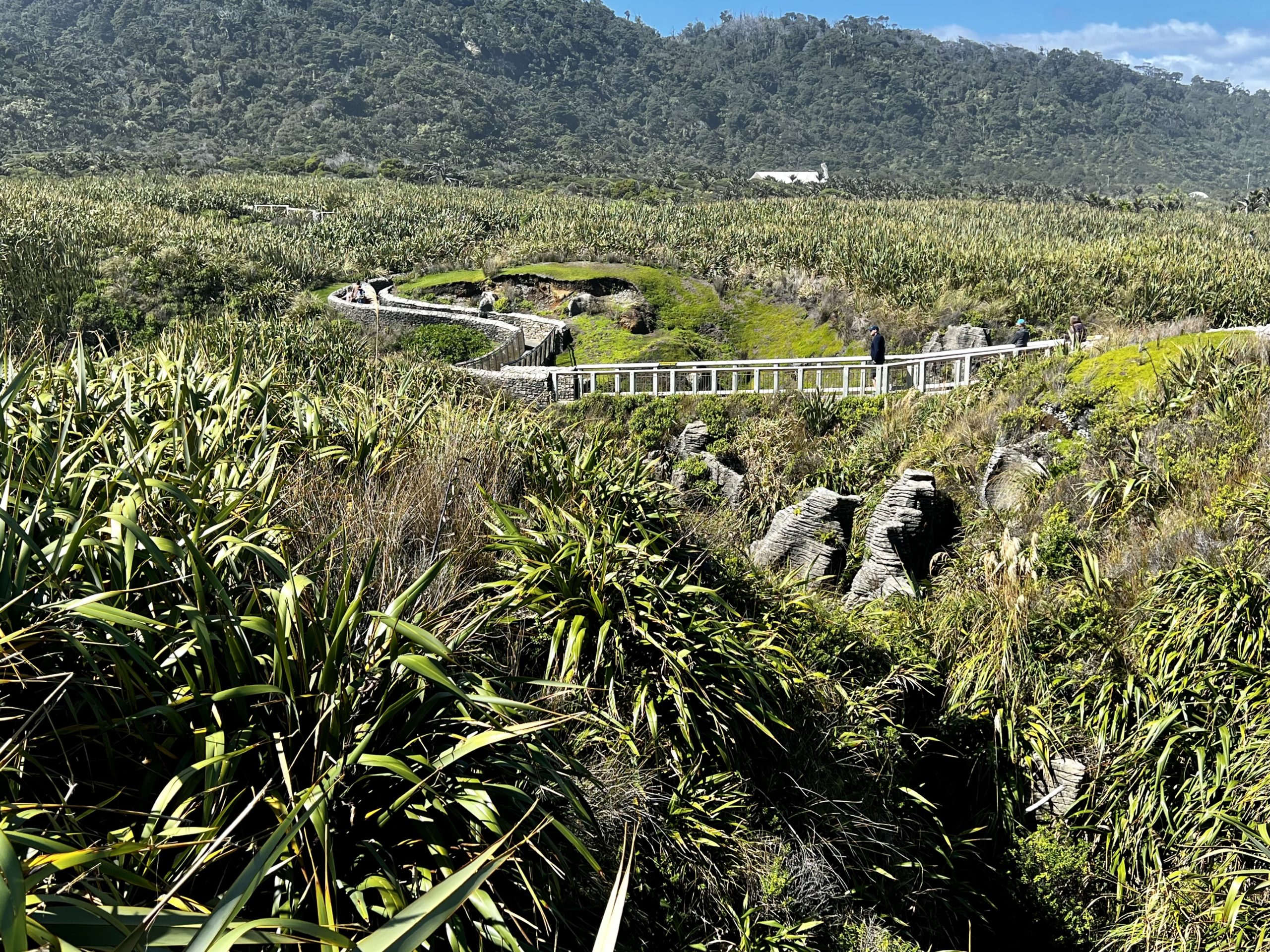
The main tourist attraction is the small national park at the Pancake Rocks. A short hike through the bush brings you to the unusual formations that emerge from the Tasman Sea.
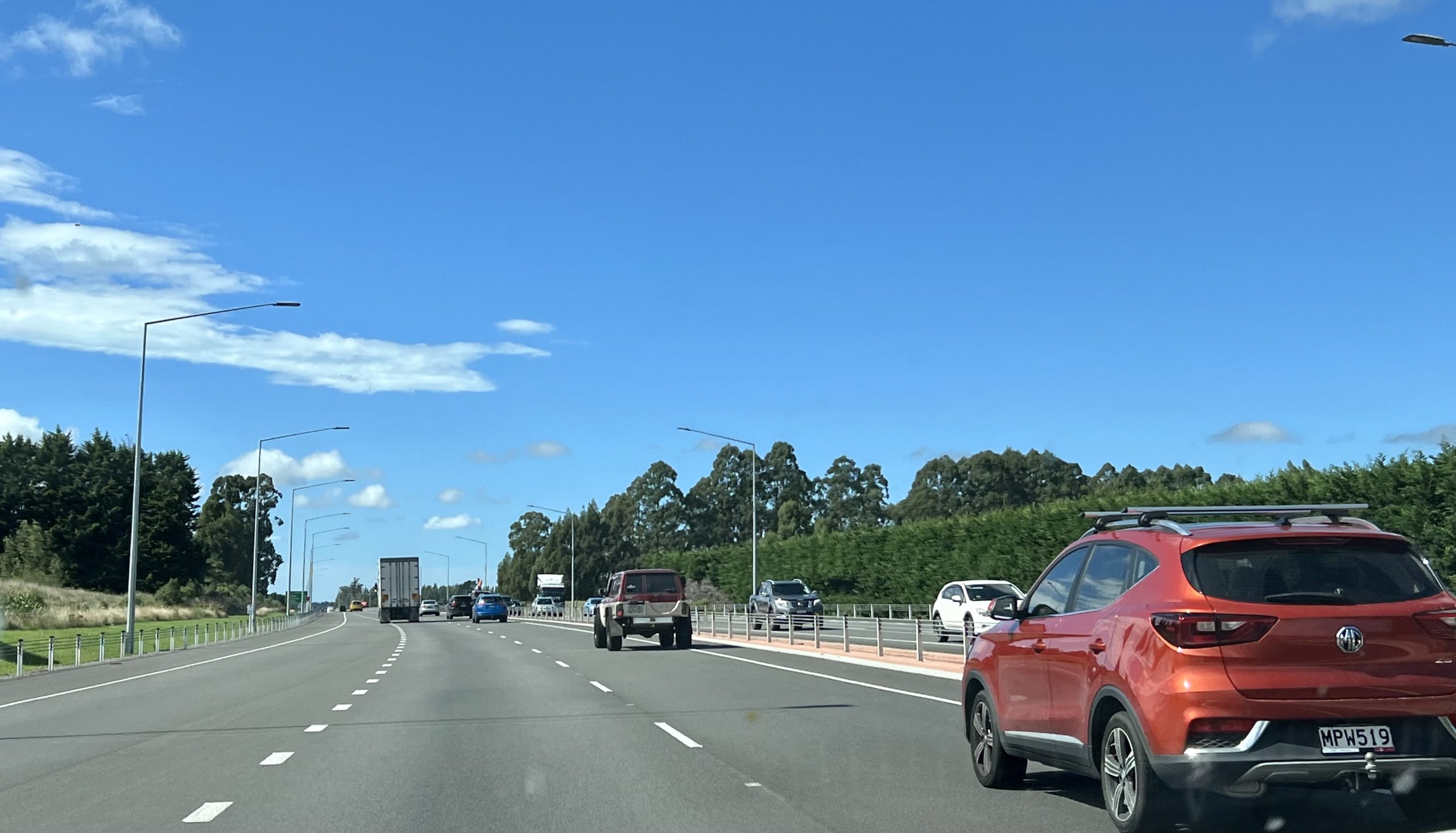
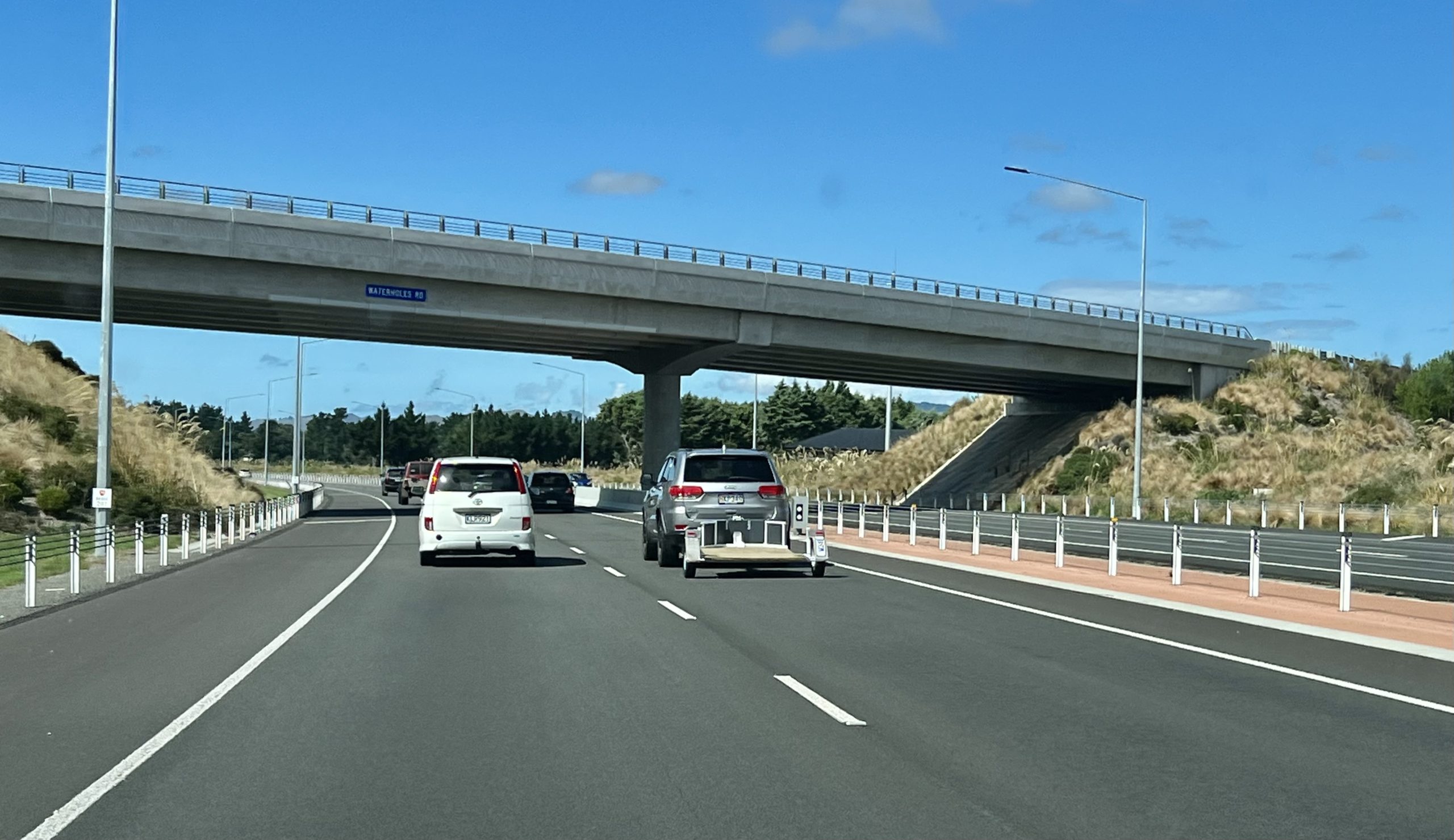
After being out in the country, approaching a city gave us a touch of culture shock. About an hour outside of Christchurch we noticed there were suddenly more cars on the road. Then we were dumped onto a four-lane divided roadway. Whoa. But not much traffic and the speed limit was only forty miles per hour! We found our hotel at the edge of the newly rebuilt central shopping area and quickly resumed tour familiar urban exploration mode.
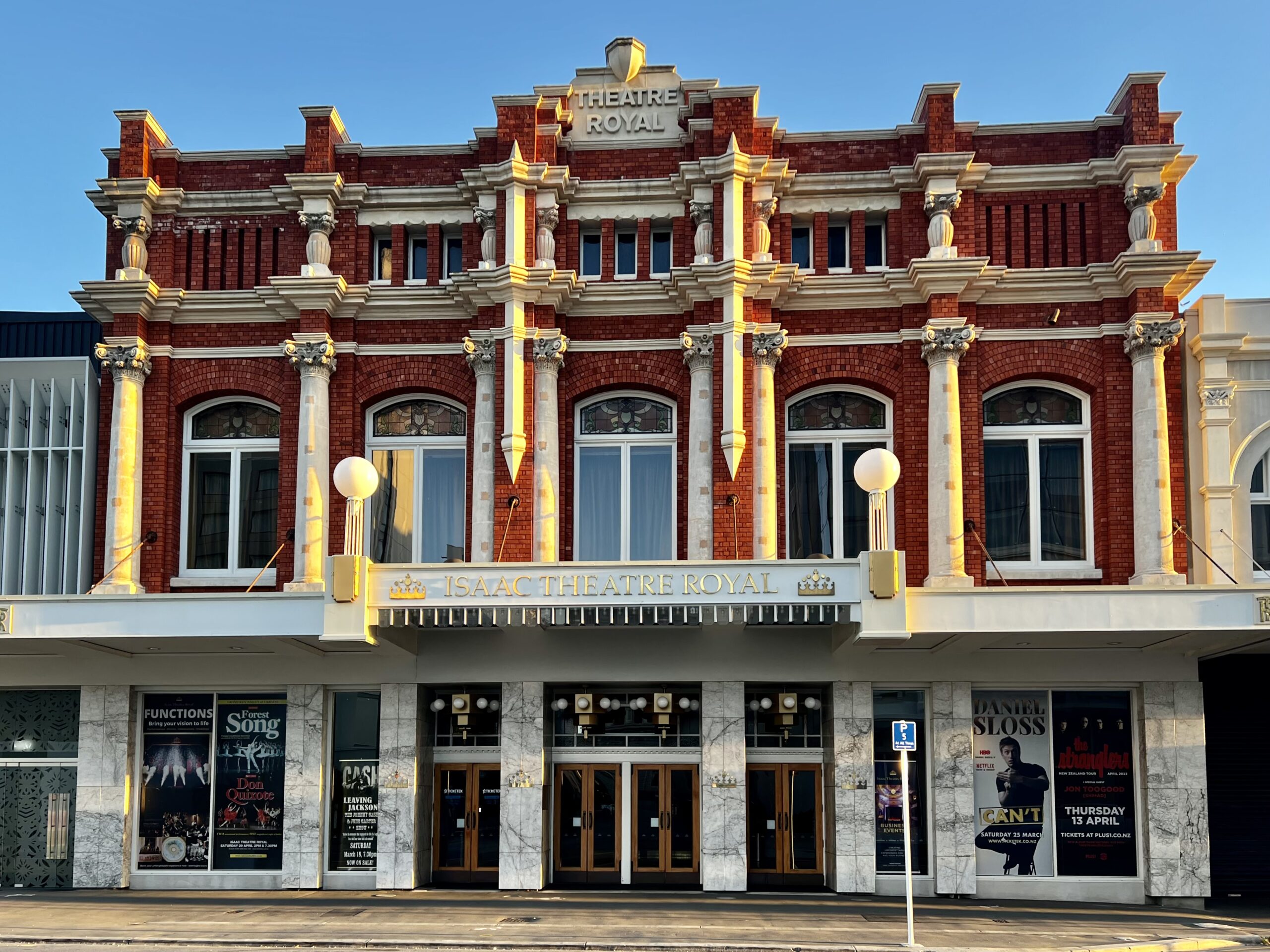
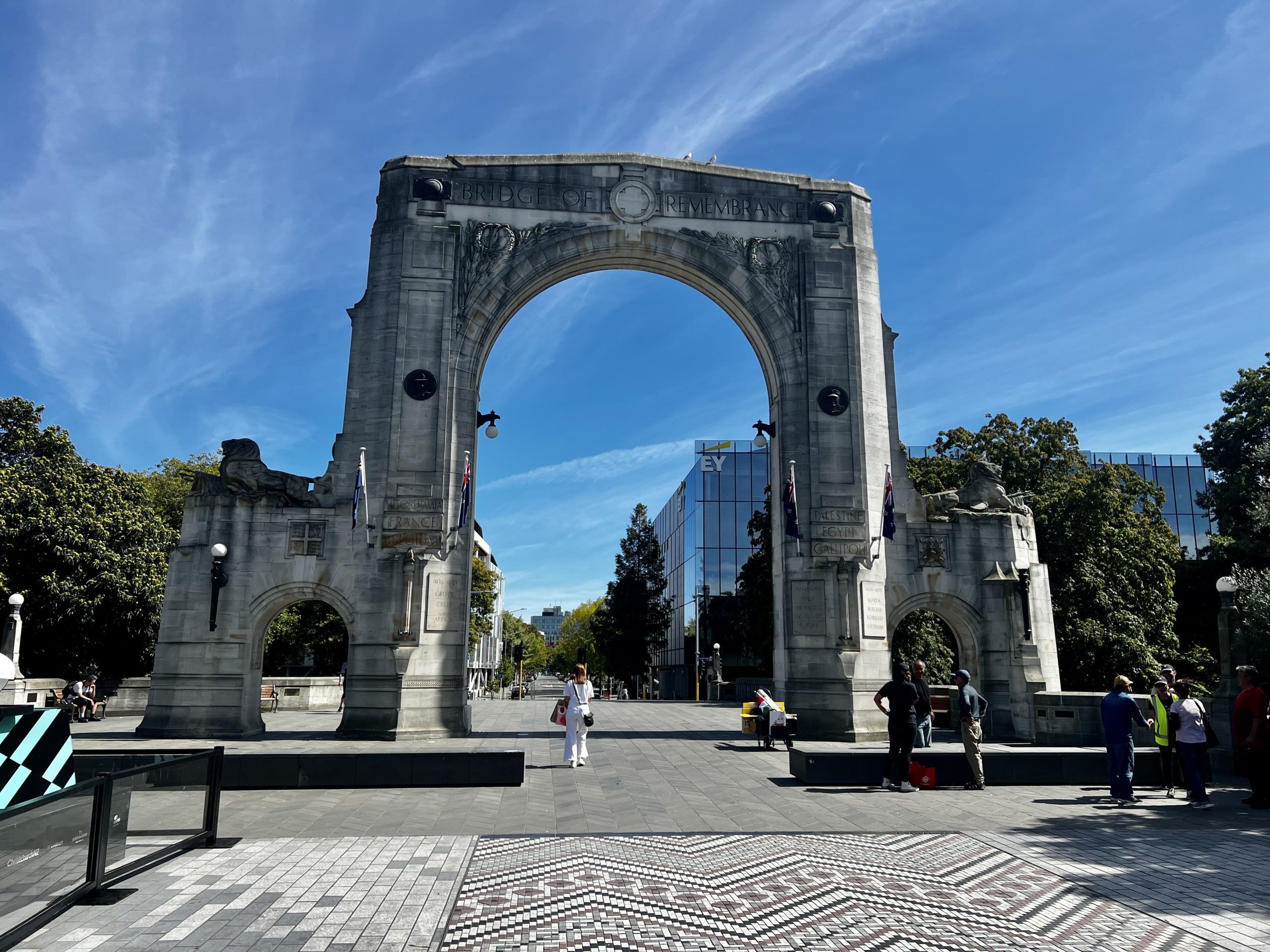
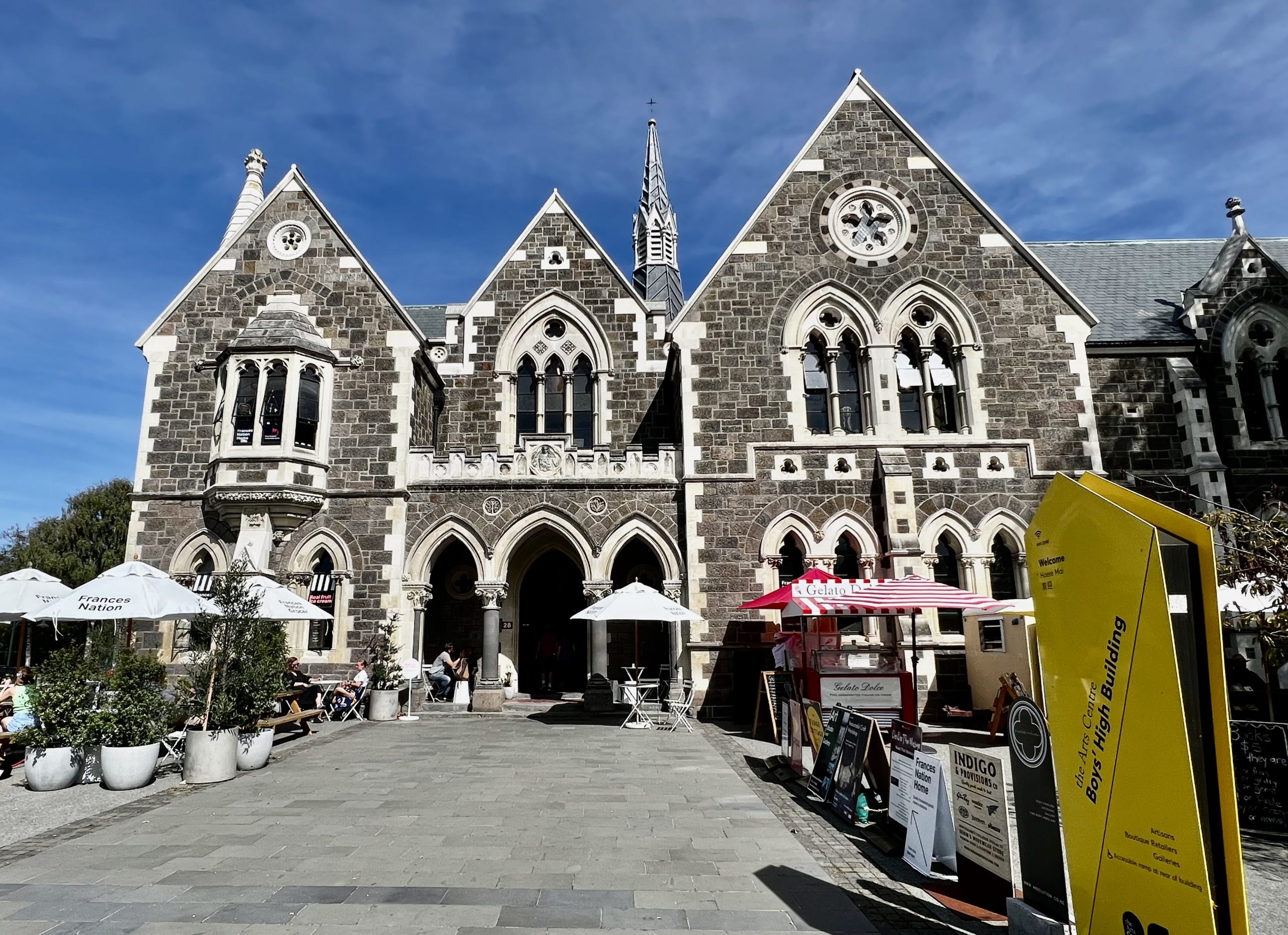
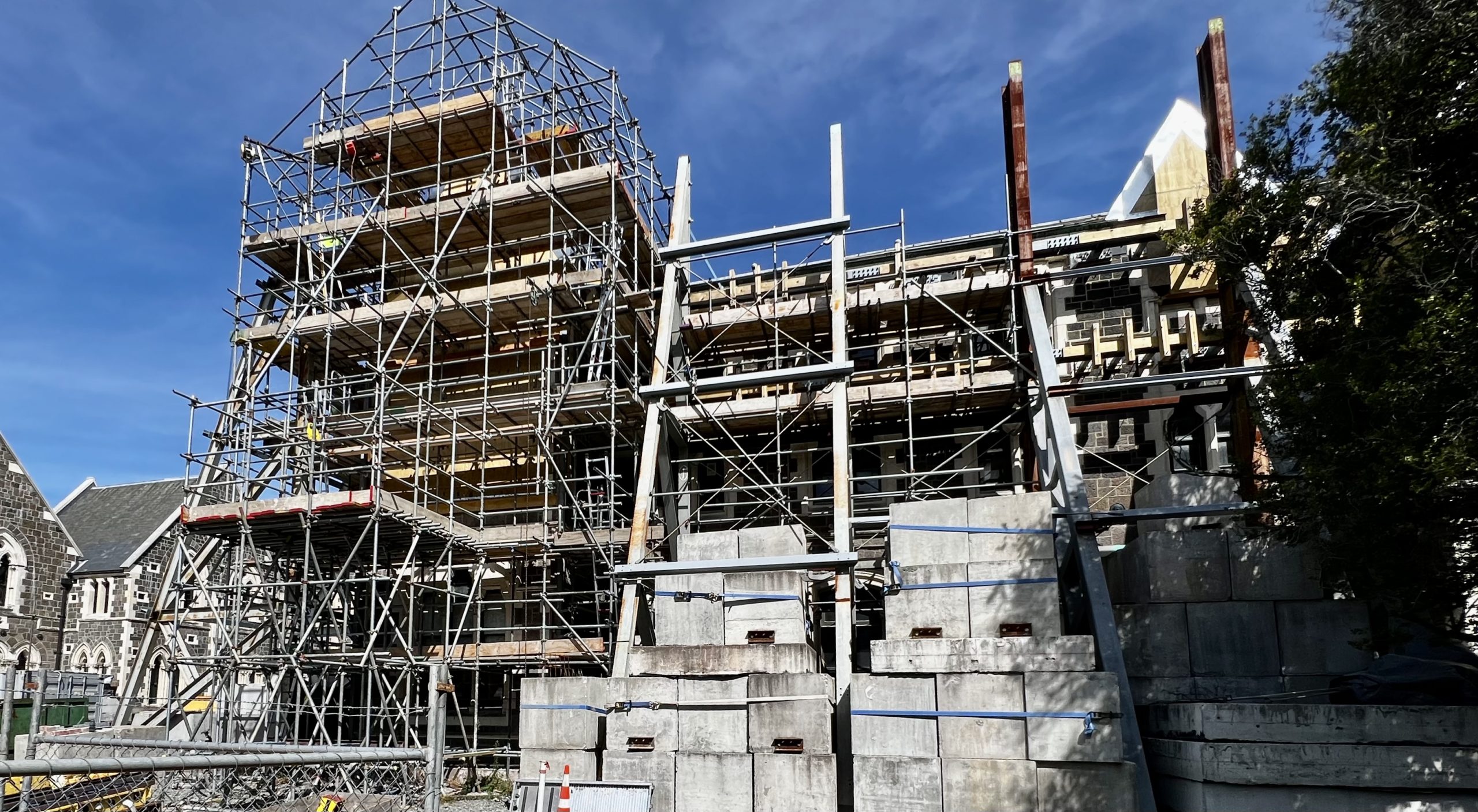
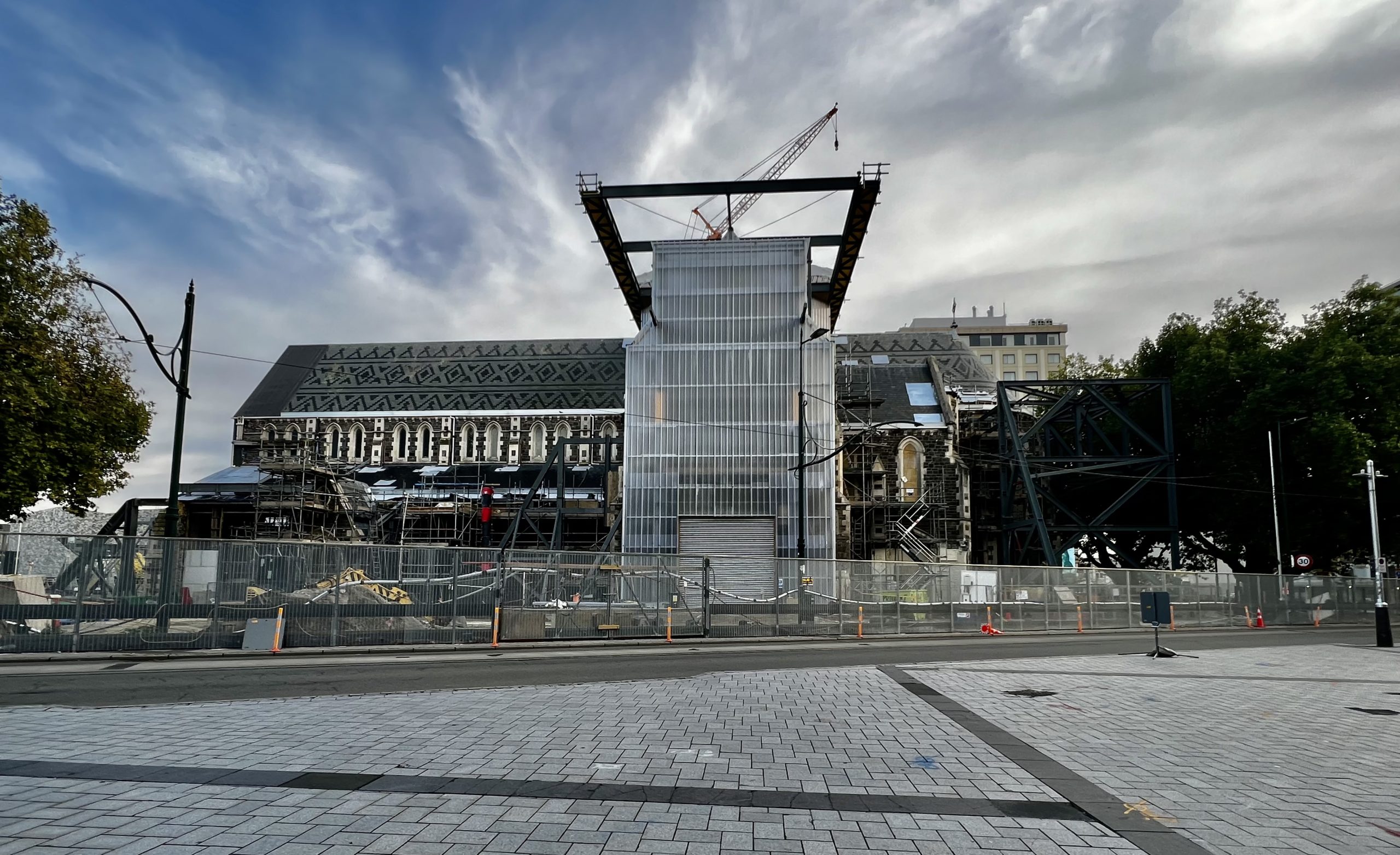
Christchurch has always been New Zealand’s most English city. The Gothic Revival architecture of the cathedral and university buildings give it a distinctive identity unlike other Kiwi cities. Although the cathedral is shrouded for reconstruction after extensive earthquake damage and the university has moved into newer buildings a few miles away, the architectural identify remains strong. Christchurch was settled by English immigrants in 1848 and named for Christ Church, Oxford. A royal charter in 1856 declared it a city, making it the oldest city in New Zealand. Although the city population is only 375,000, it punches above its weight in architecture, culture, and retail. It was the site of New Zealand’s first international airport. Its International Antarctic Centre houses the US, Italian, and New Zealand Antarctic programs.
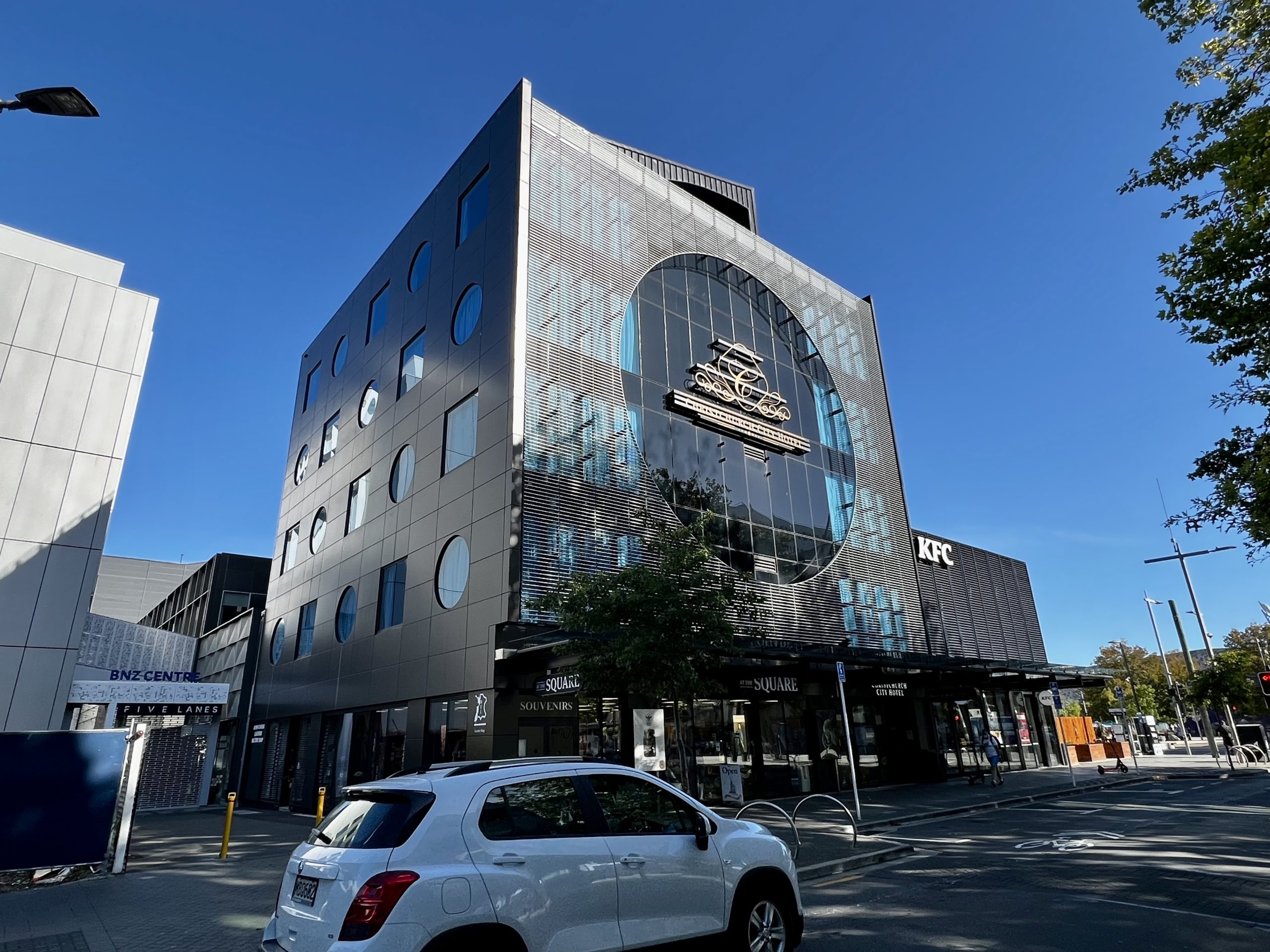
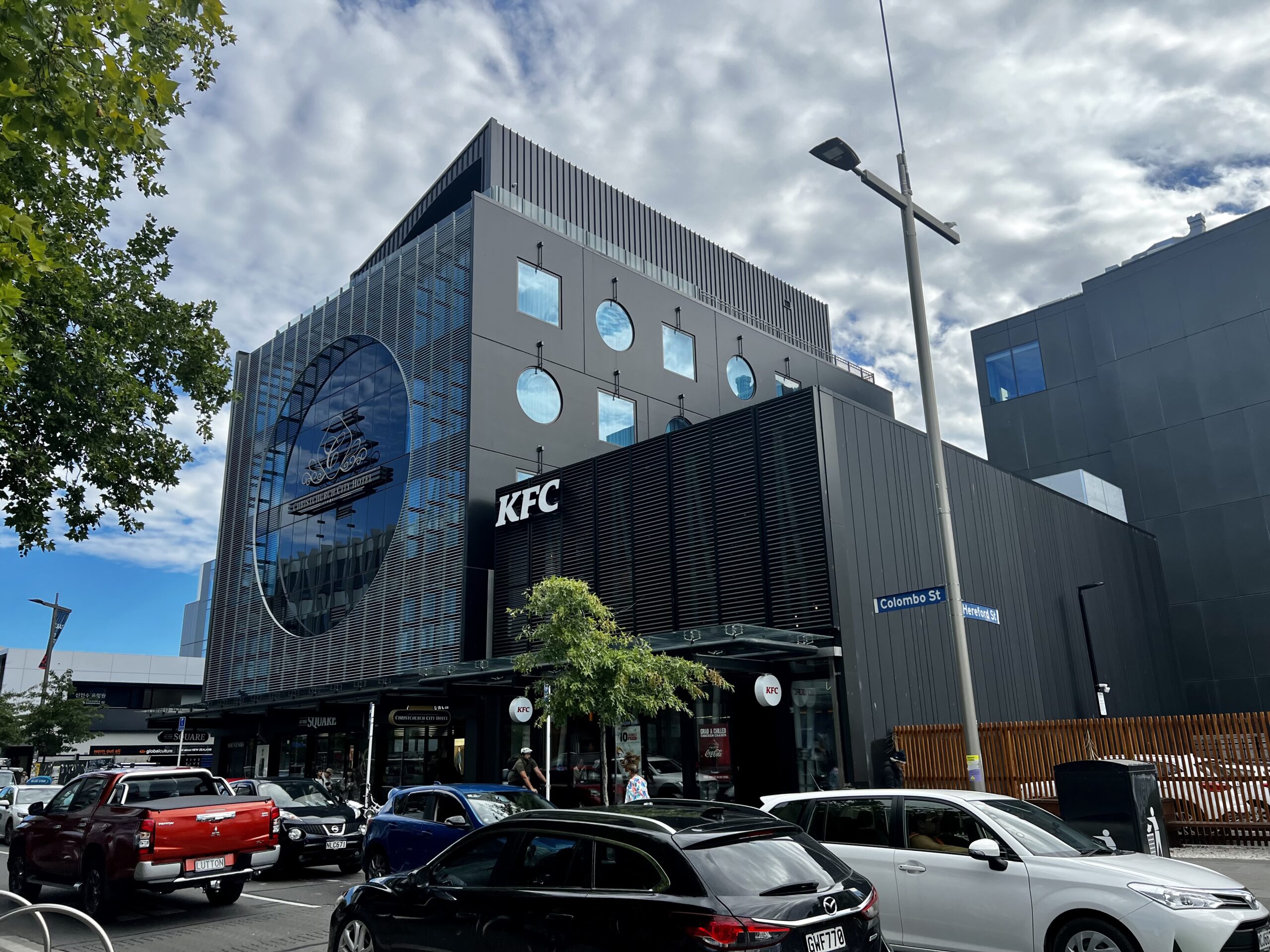
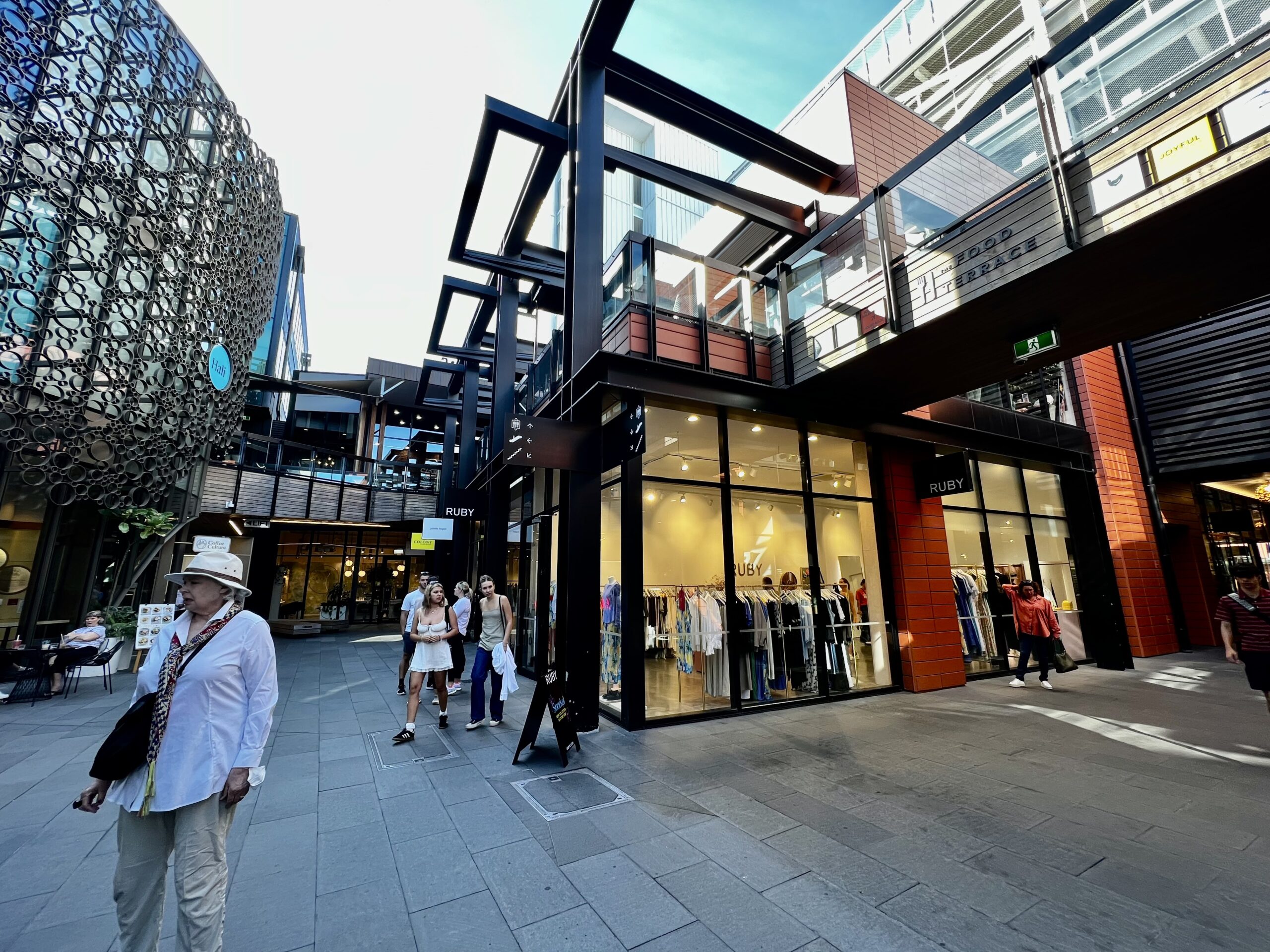
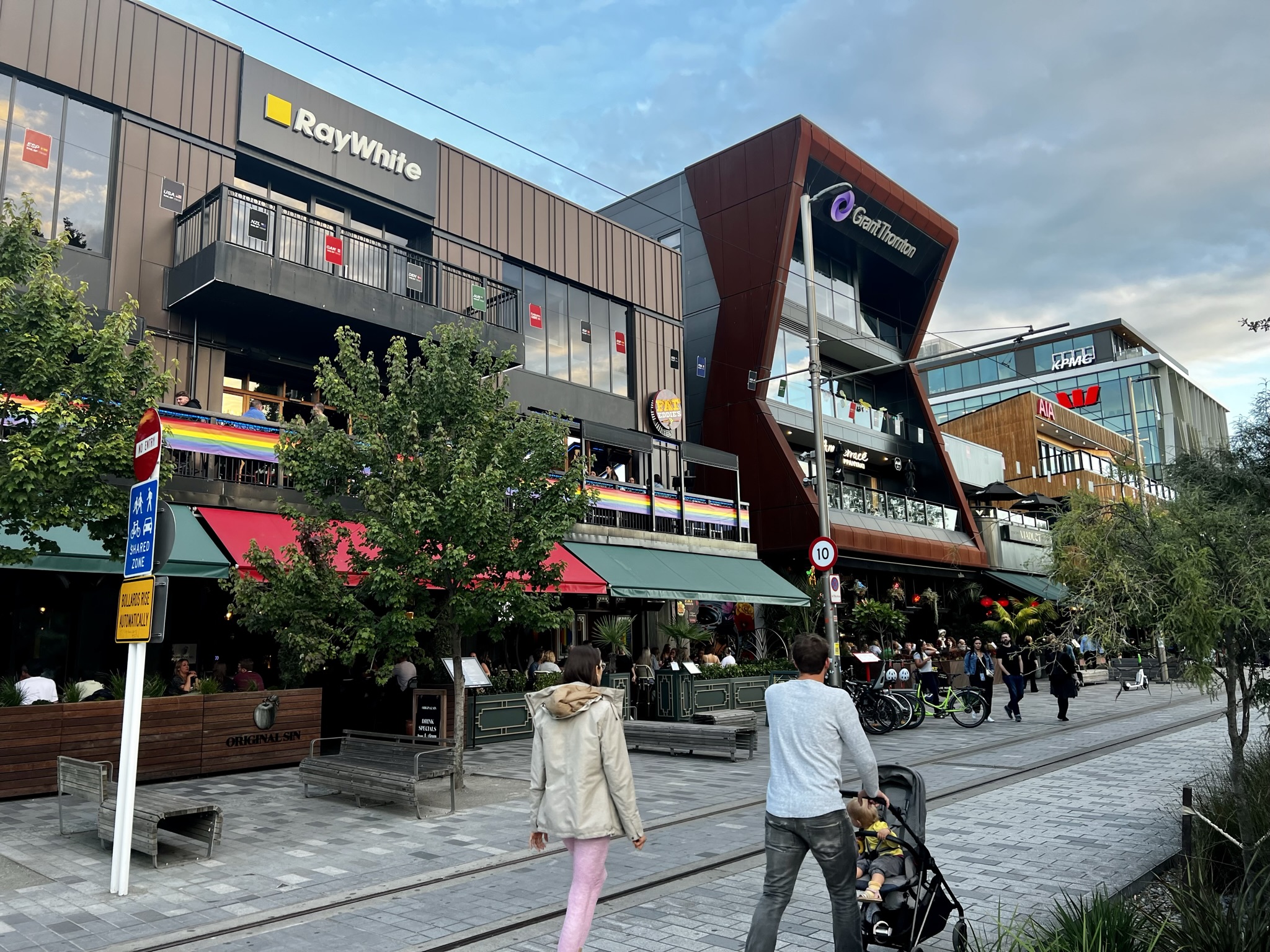
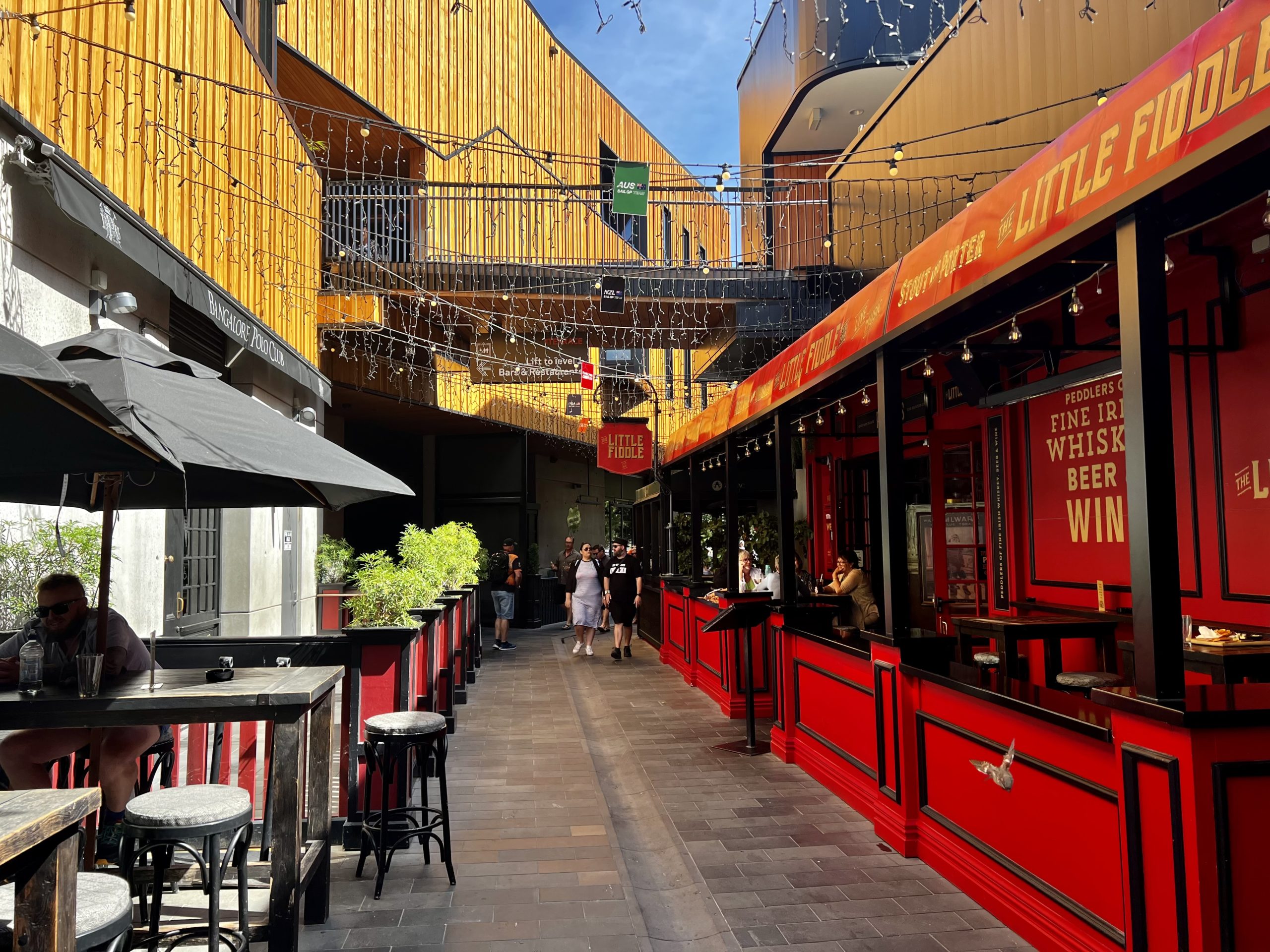
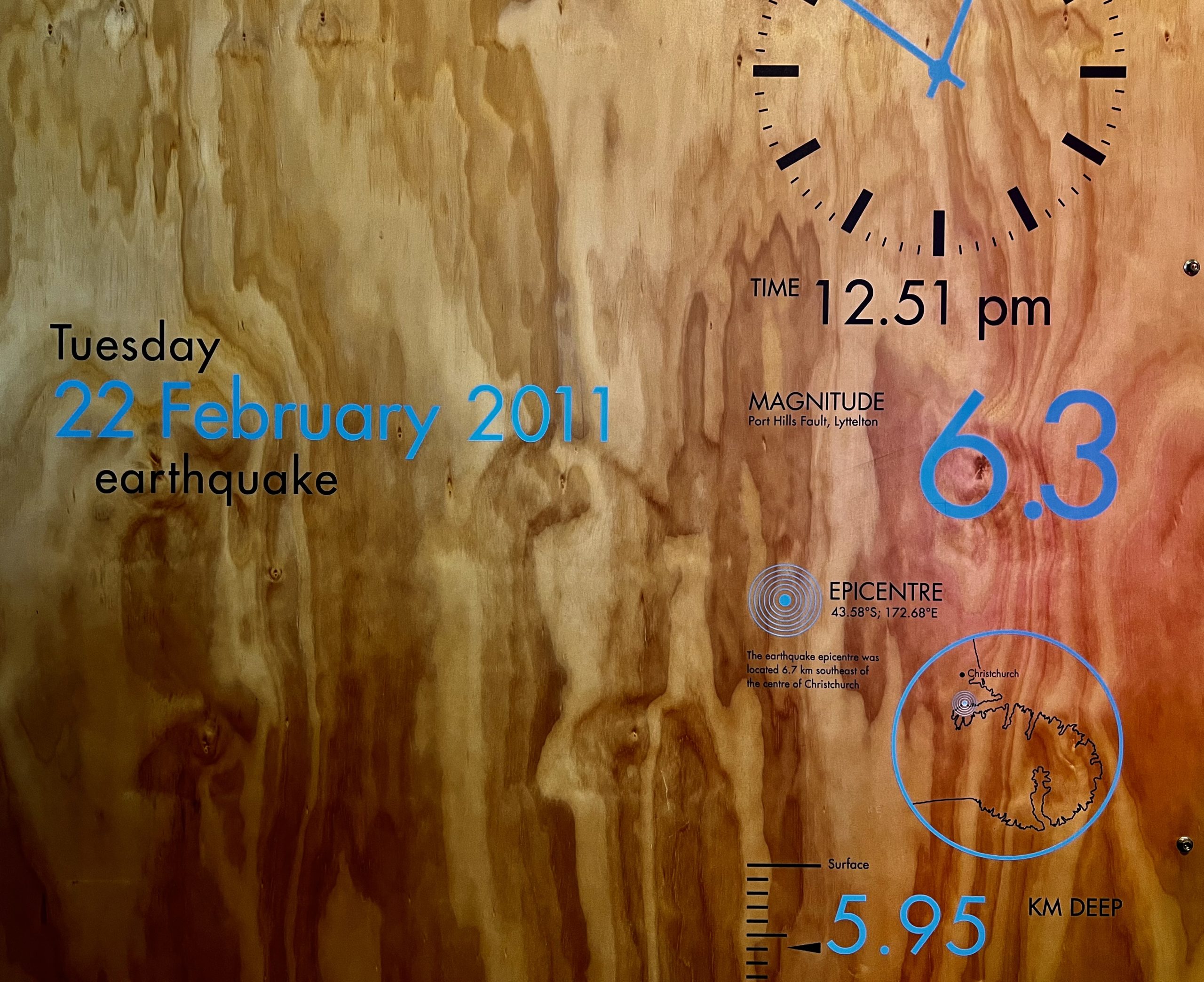
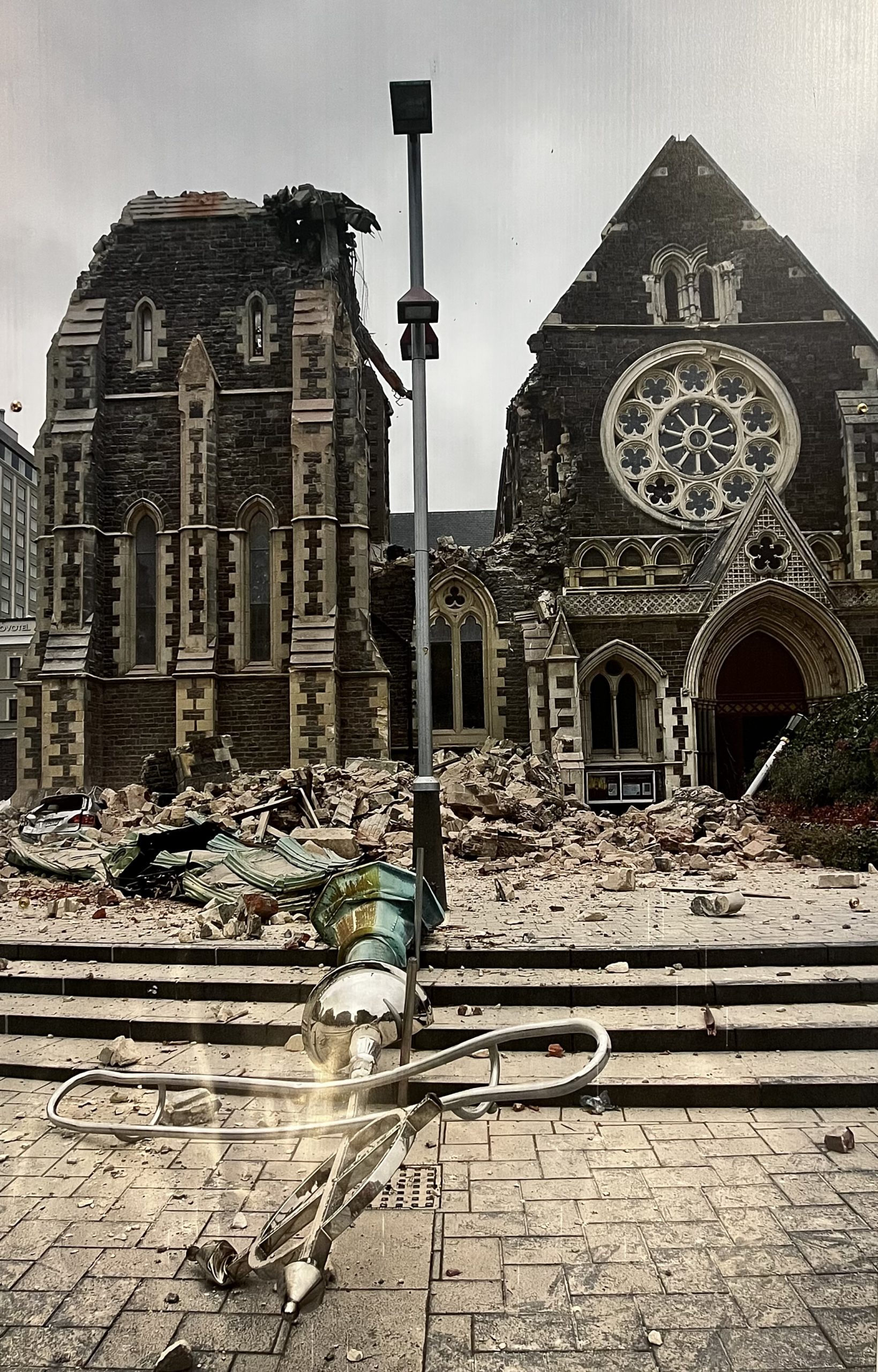
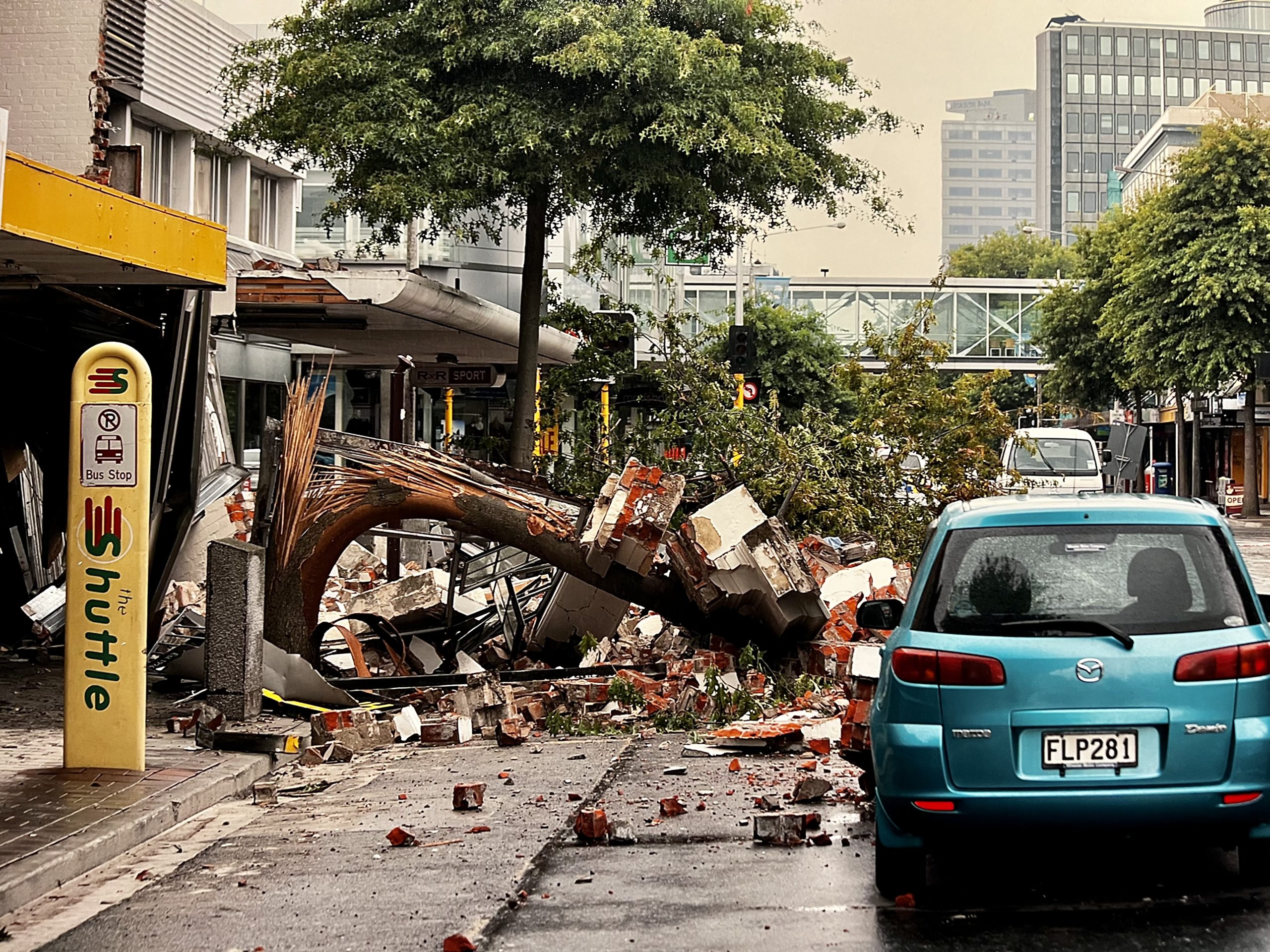
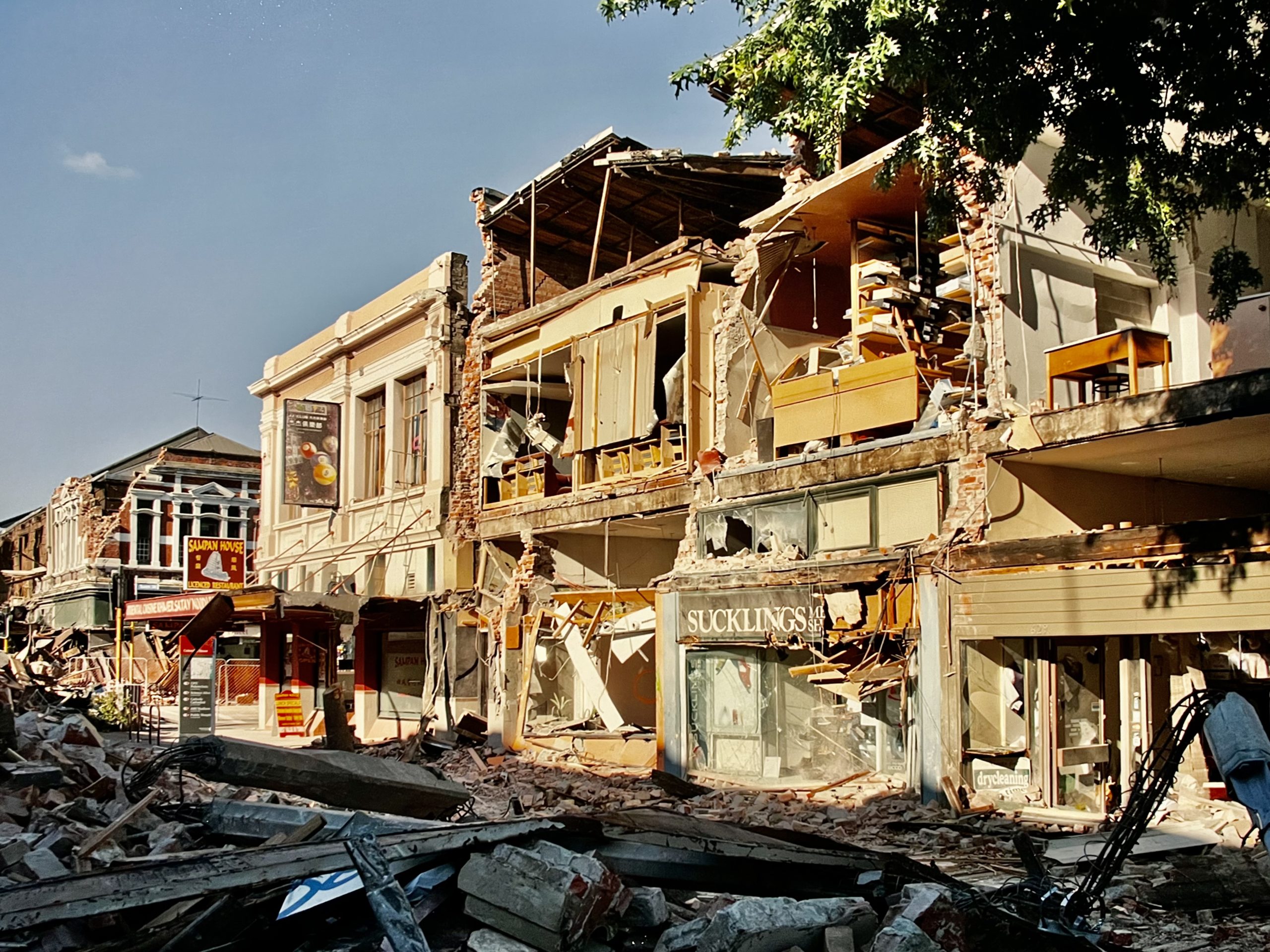
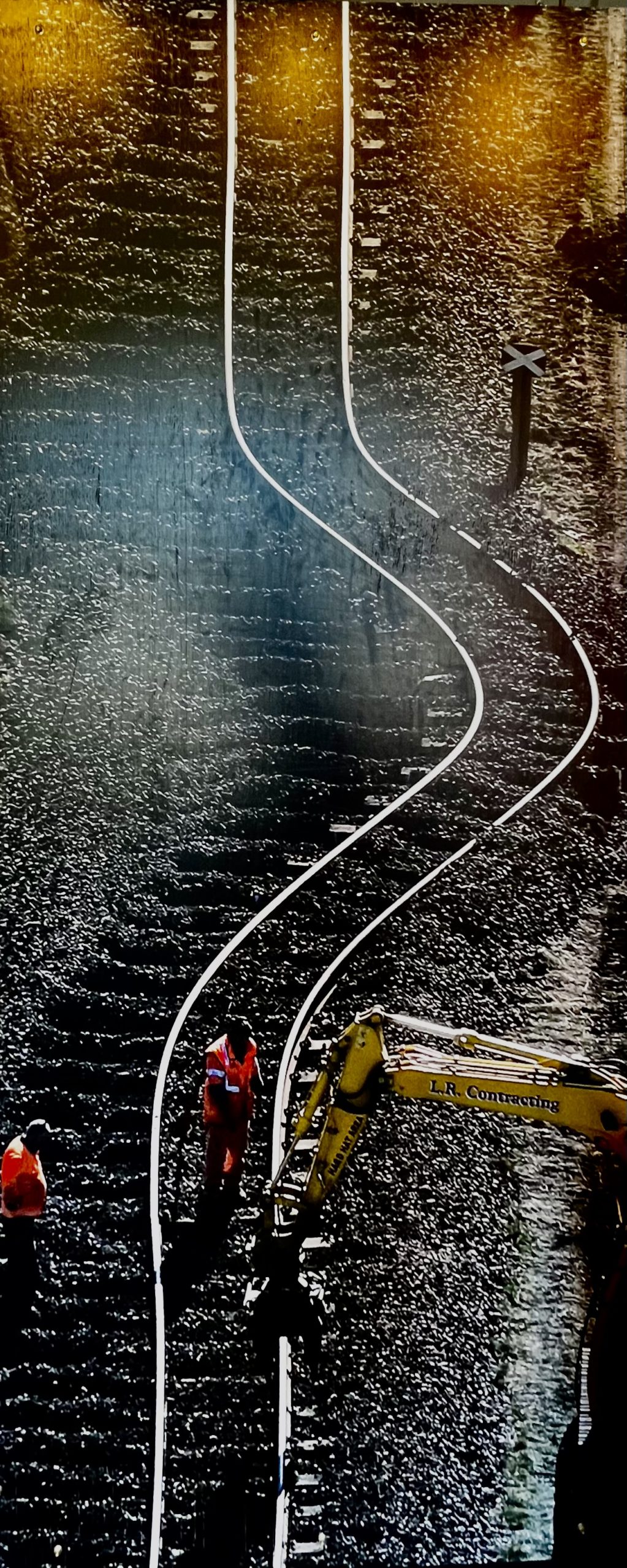
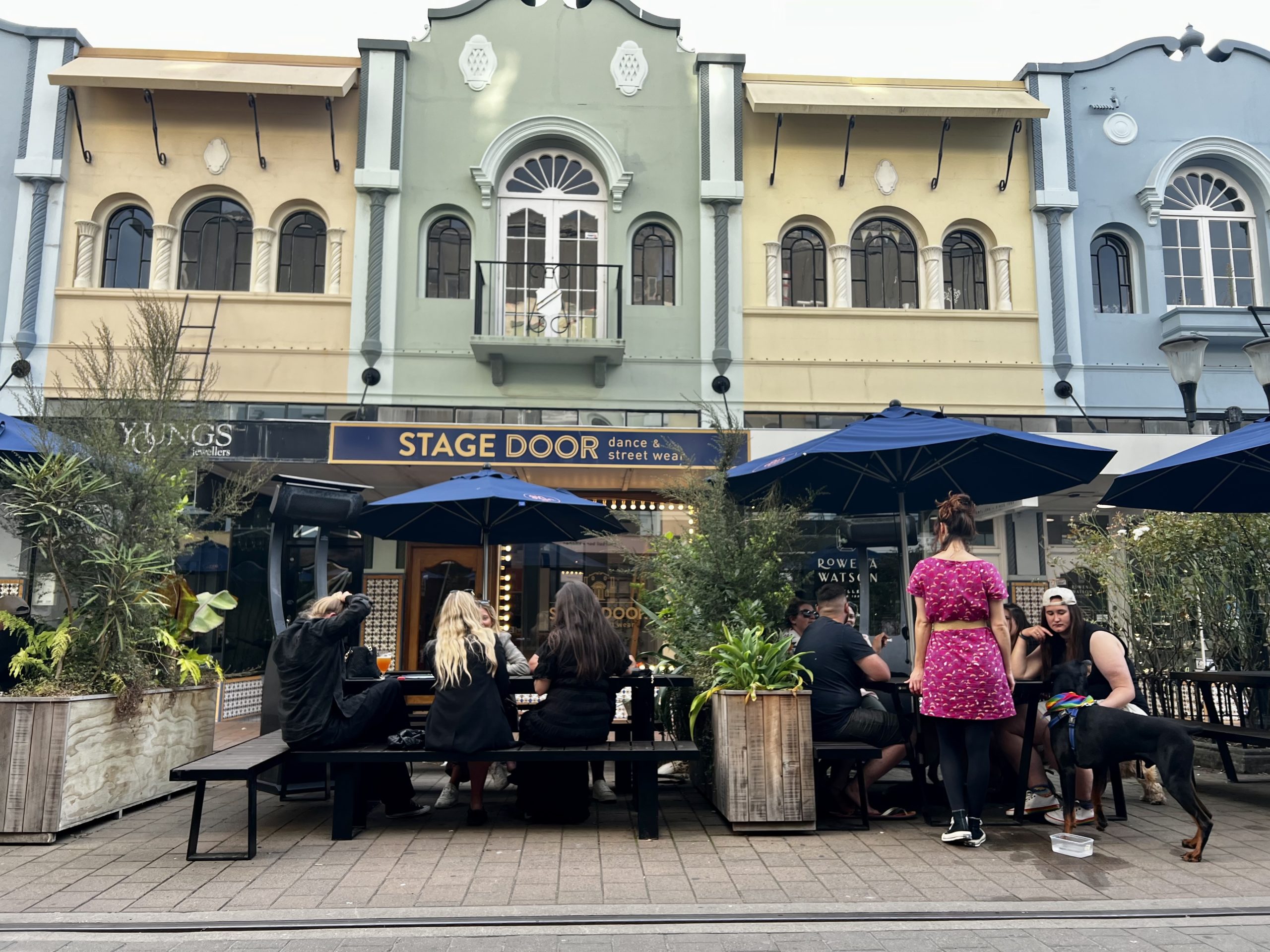
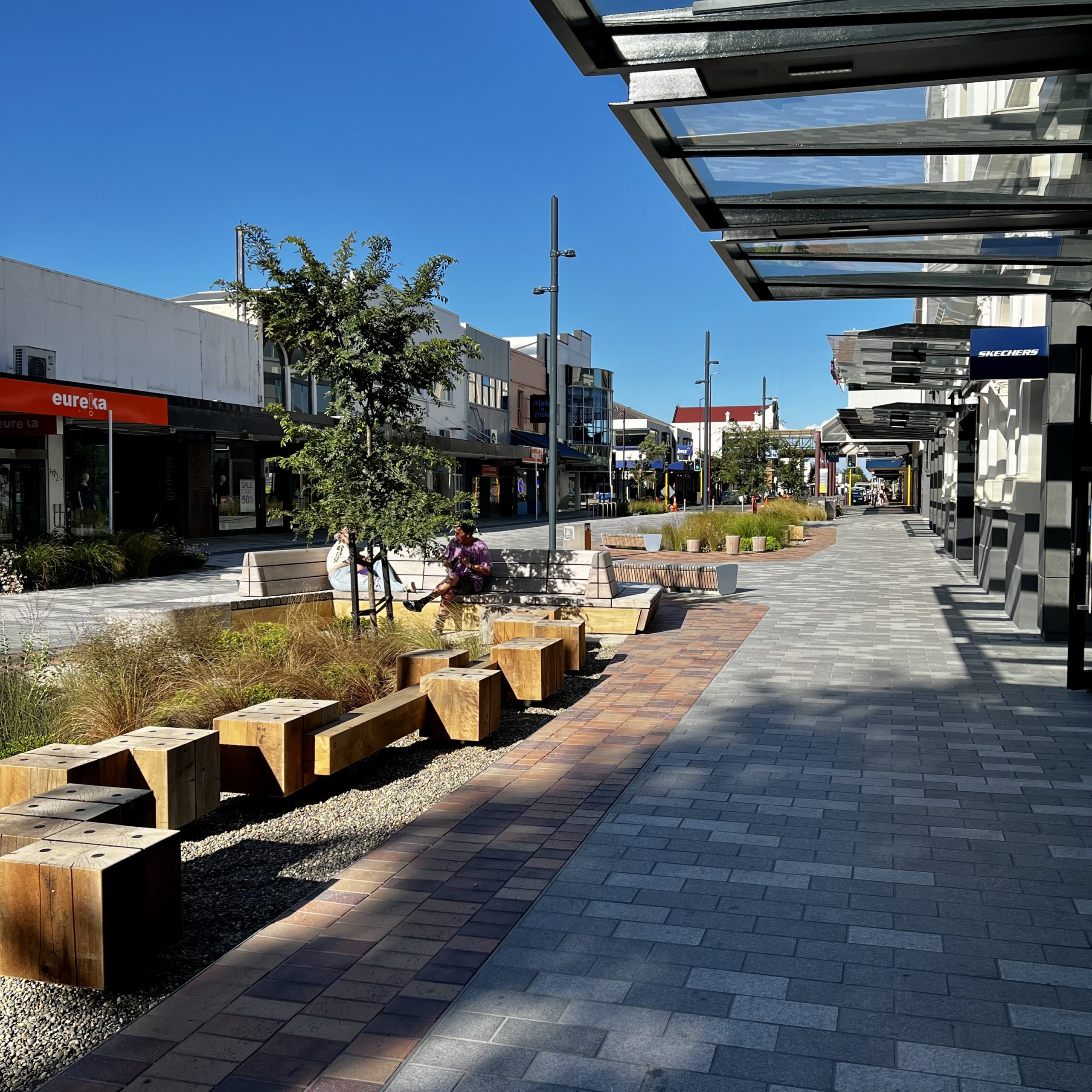
After the earthquakes of 2010 and 2011 (6.2 magnitude), eighty percent of the buildings in the downtown had to be demolished. Rebuilding has happened quickly, and we were delighted to stroll in the retail area around our hotel. (We were located at ground zero for outdoor clothing stores, with North Face up against several Kiwi brands. We made a few purchases.) Lots of pedestrian pathways and a couple of blocks filled entirely with restaurants and bars.
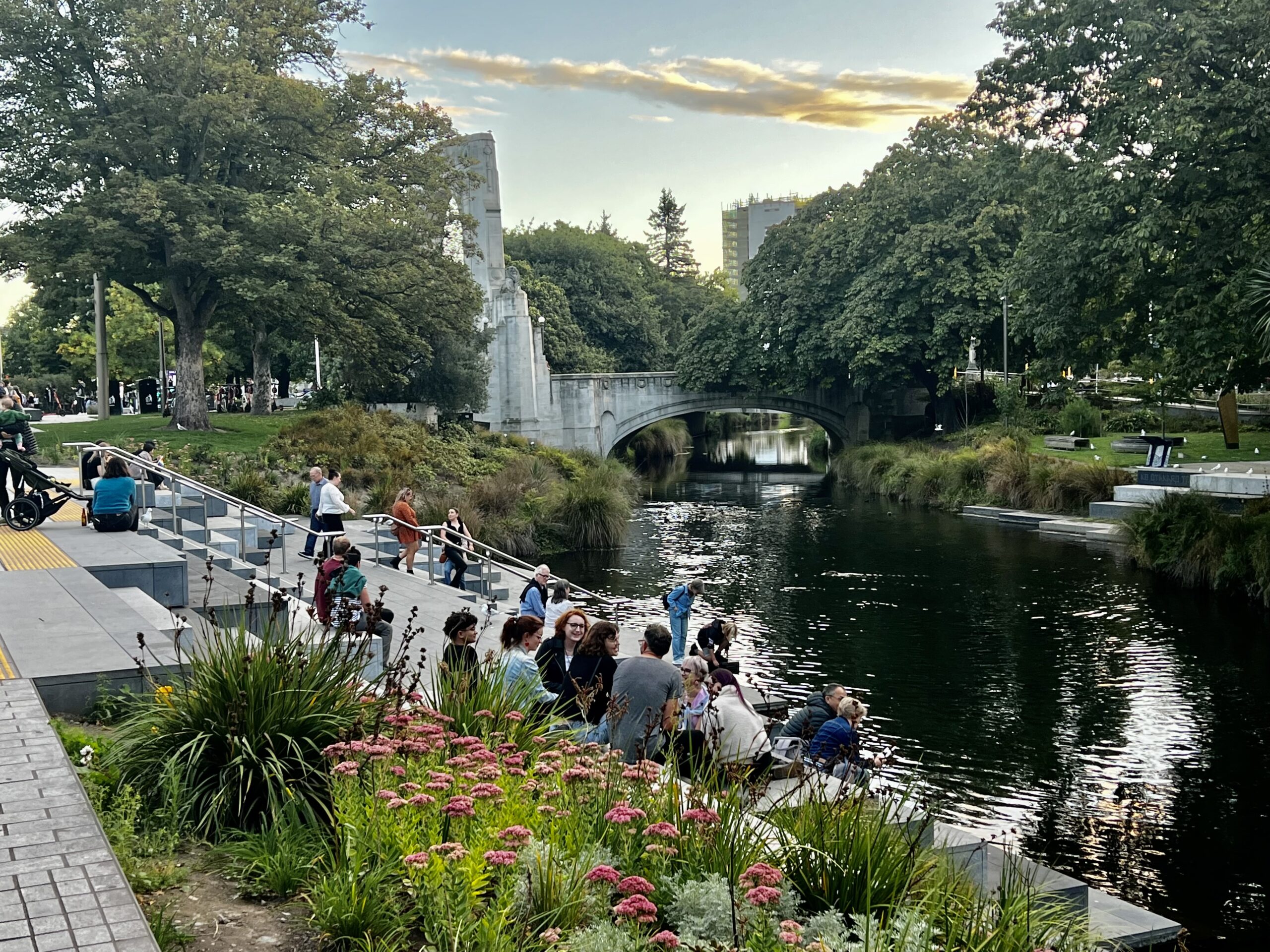
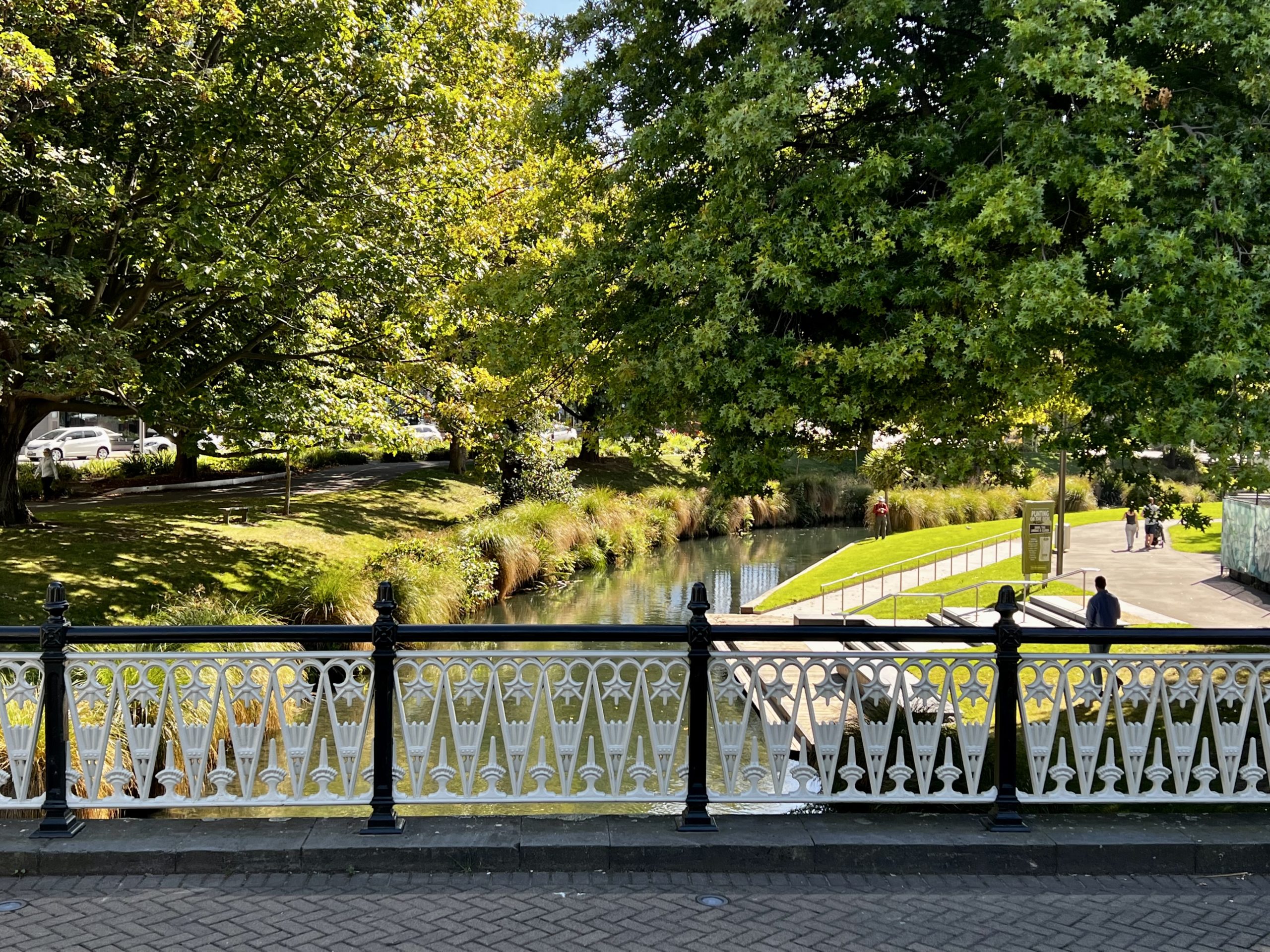
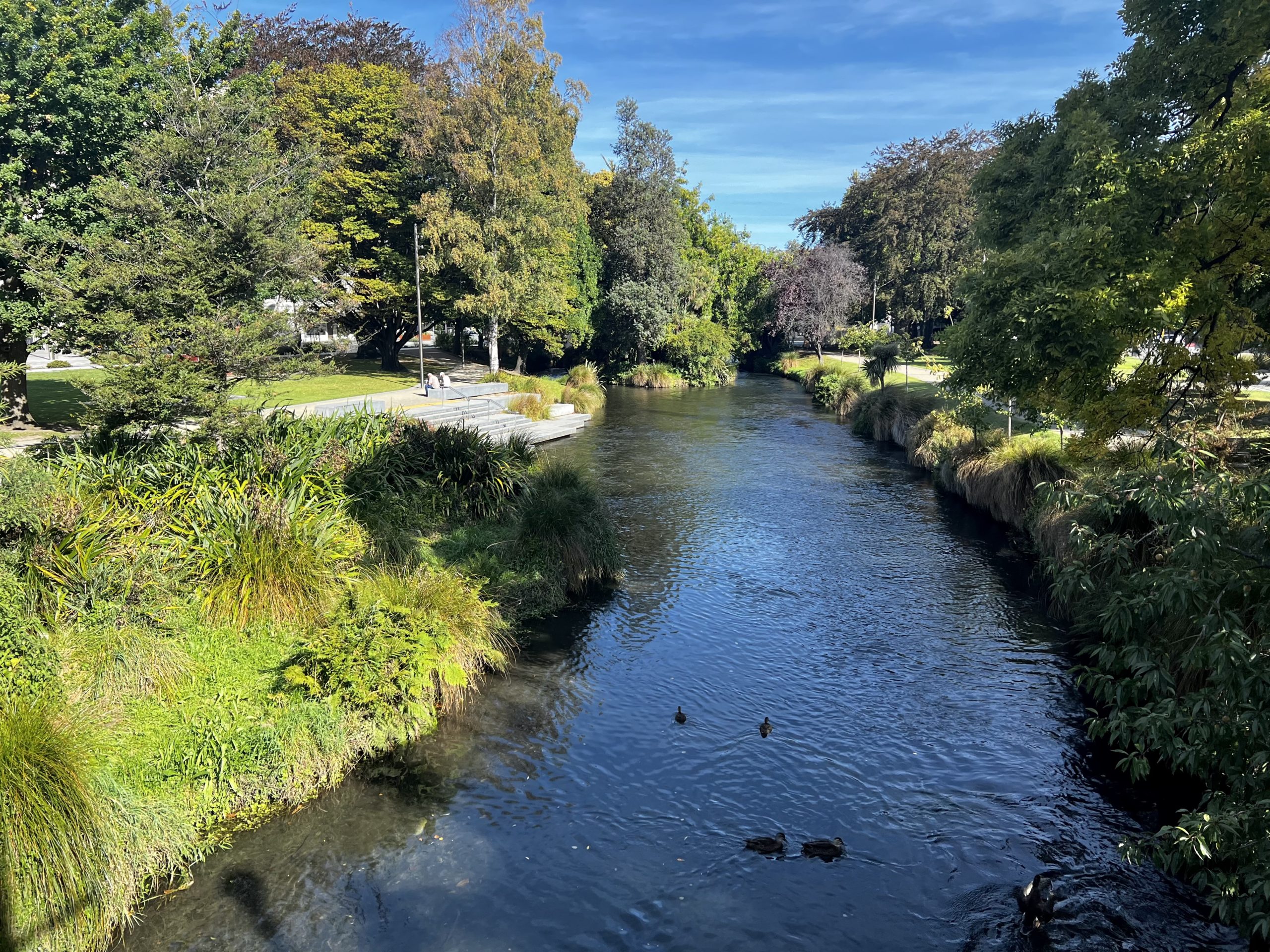
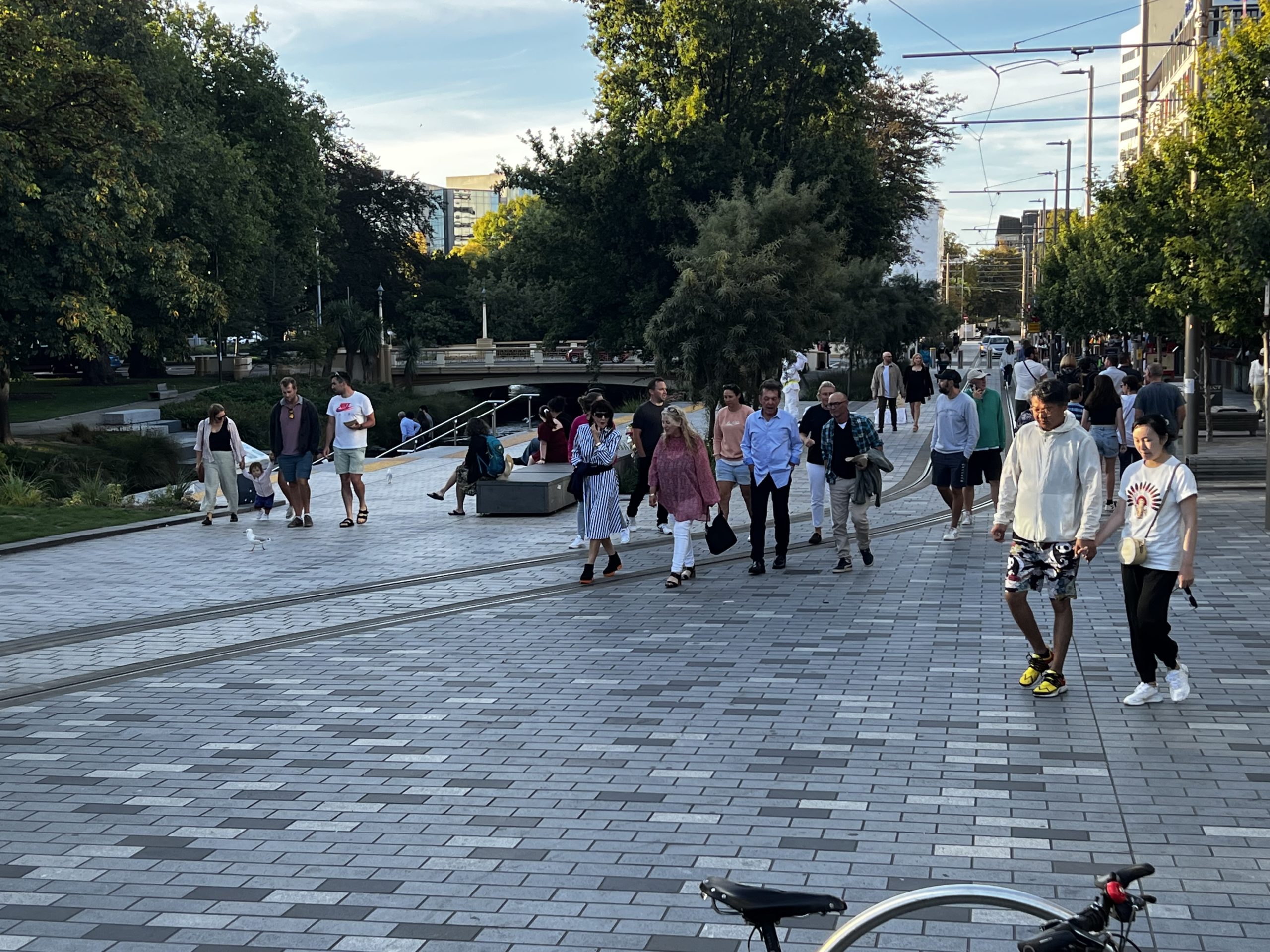
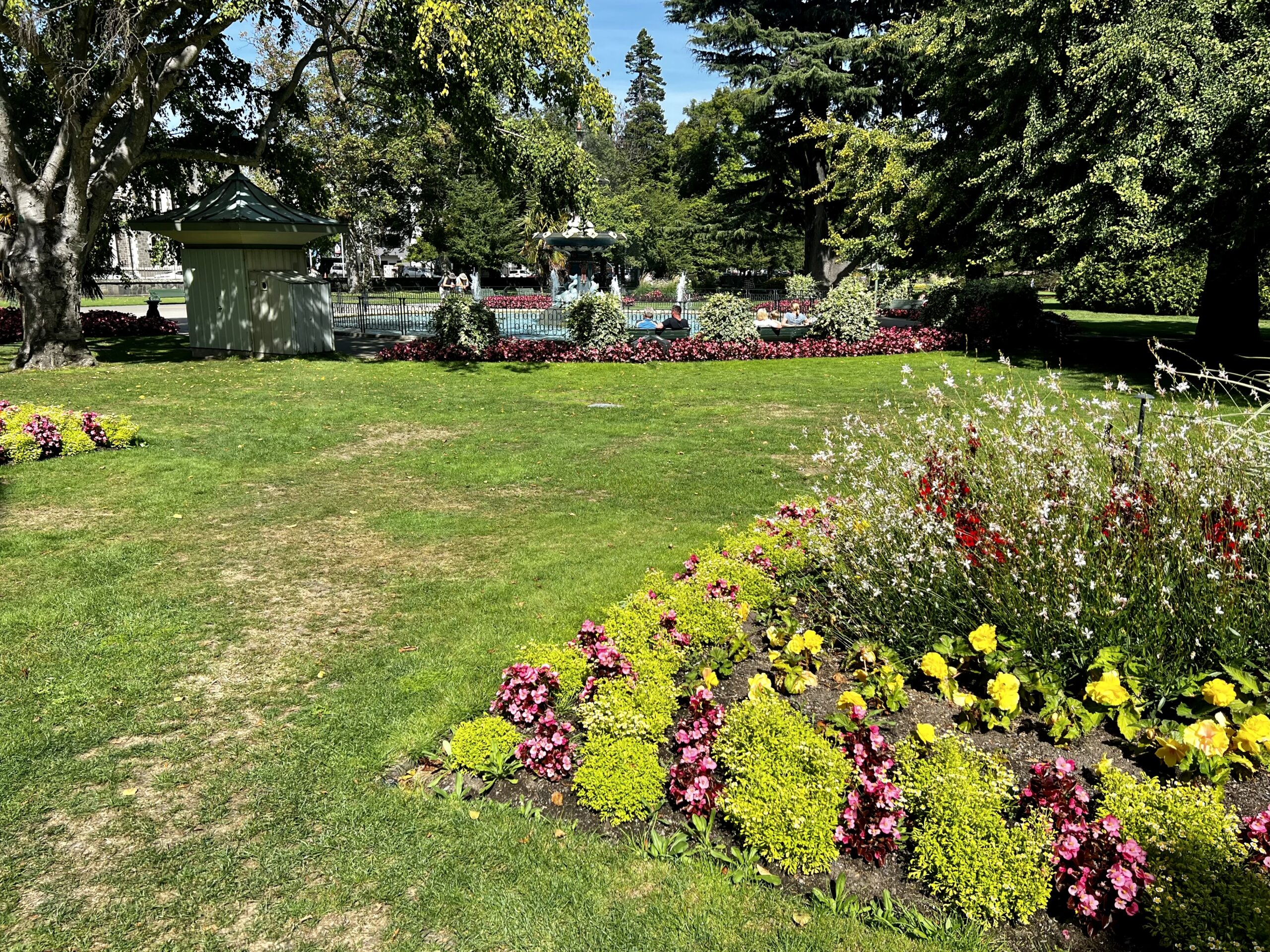
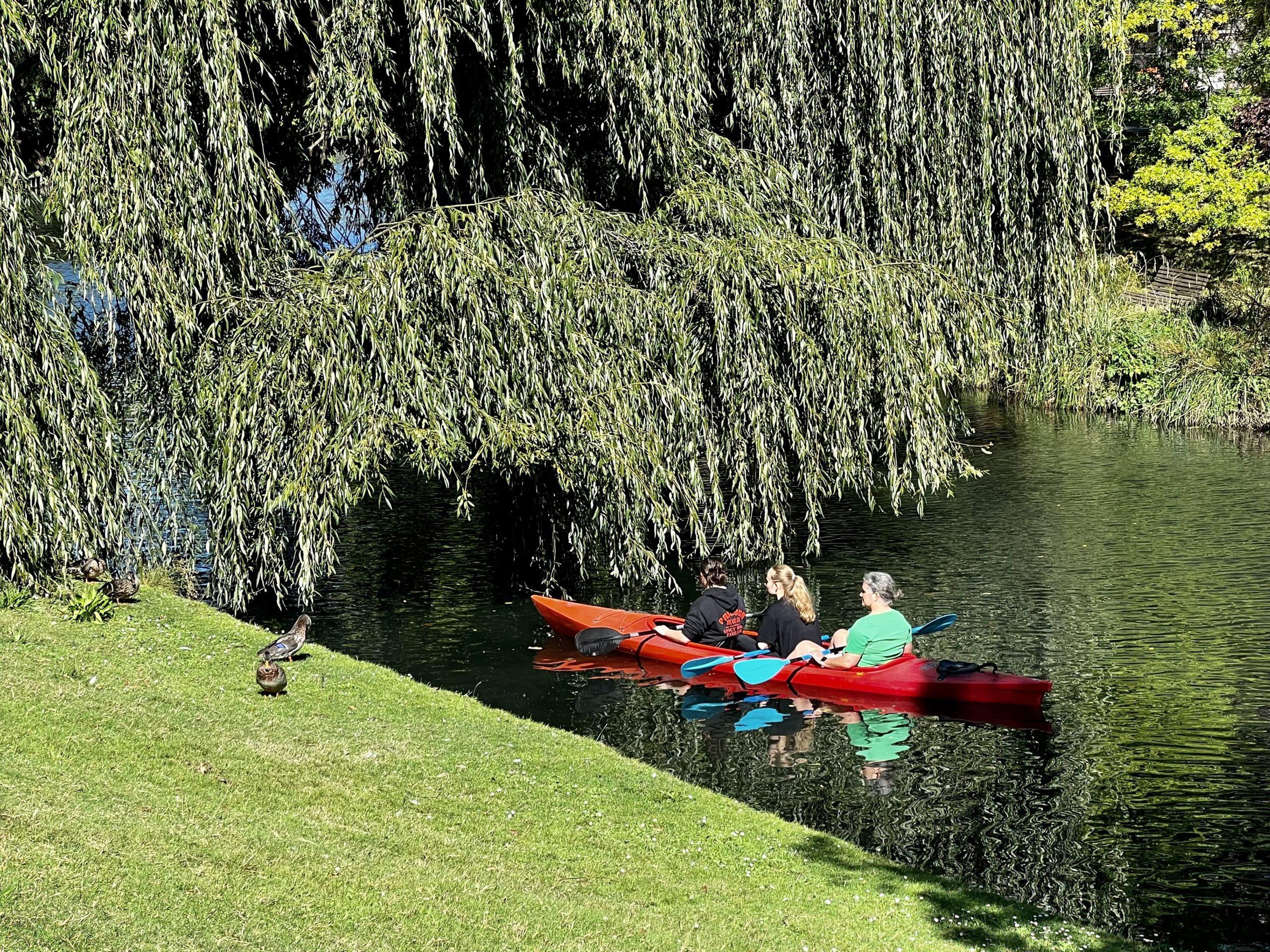
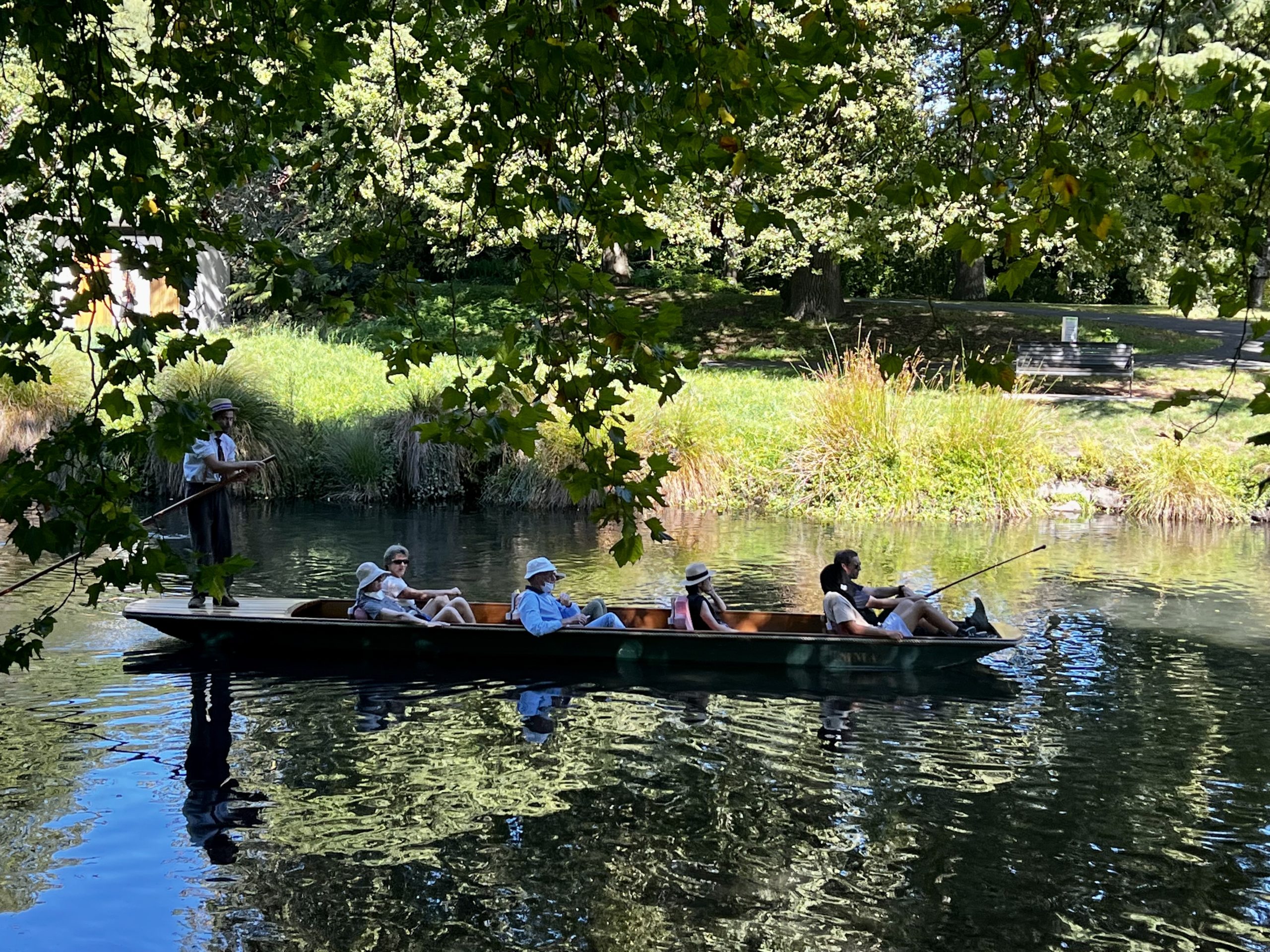
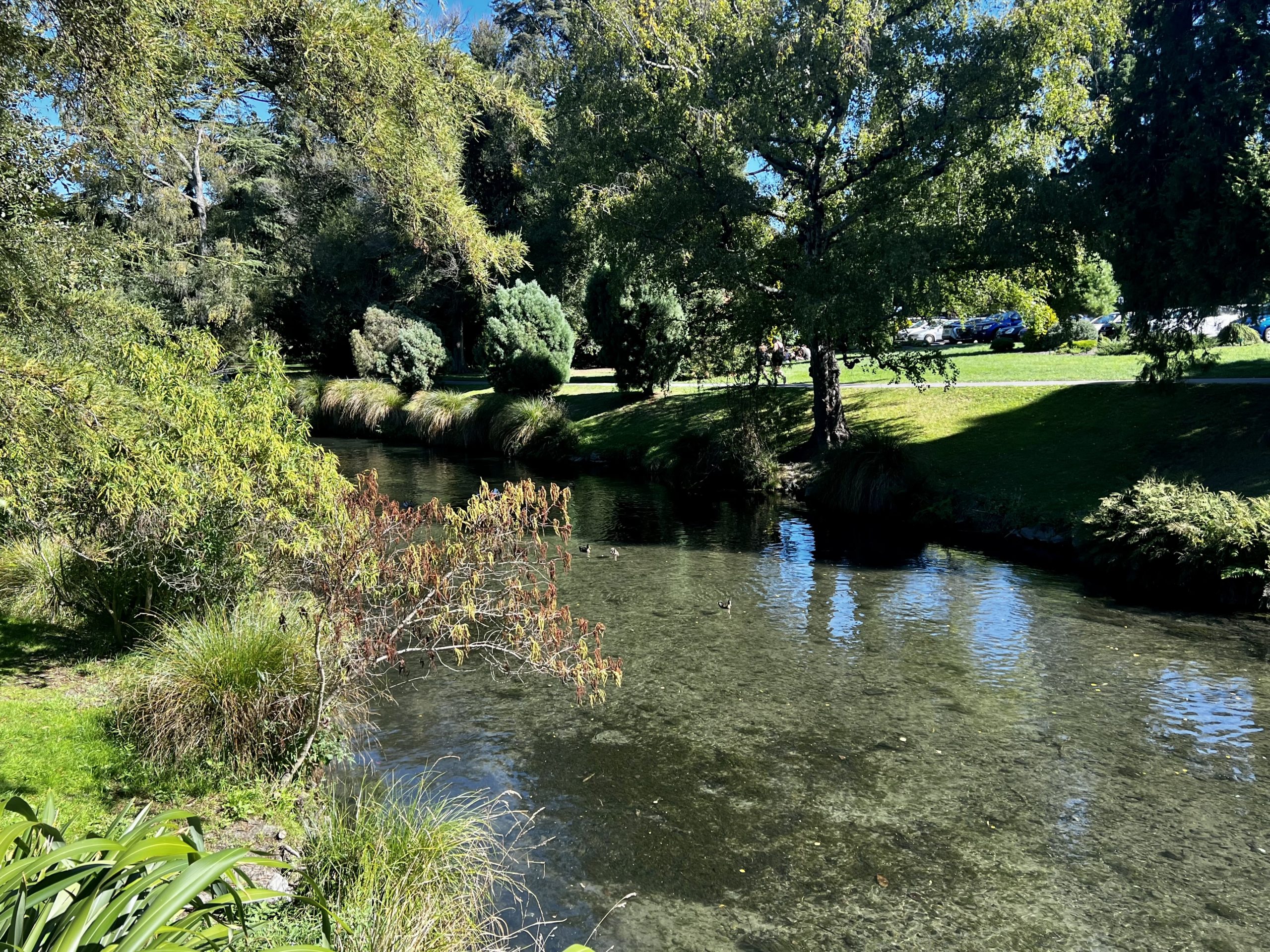
The sweet little river Avon winds around the town and offers a beautiful tree-shaded walkway along its grassy banks. The city celebrates the river and its adjoining open space unlike many many cities in the US or abroad. Together with its adjoining open space, it offers a green band that meanders through its urban setting. There are places to stroll and sit—some near bustling bars and restaurants. Others are more tranquil. They even offer kayak, canoe, and punting if you like!
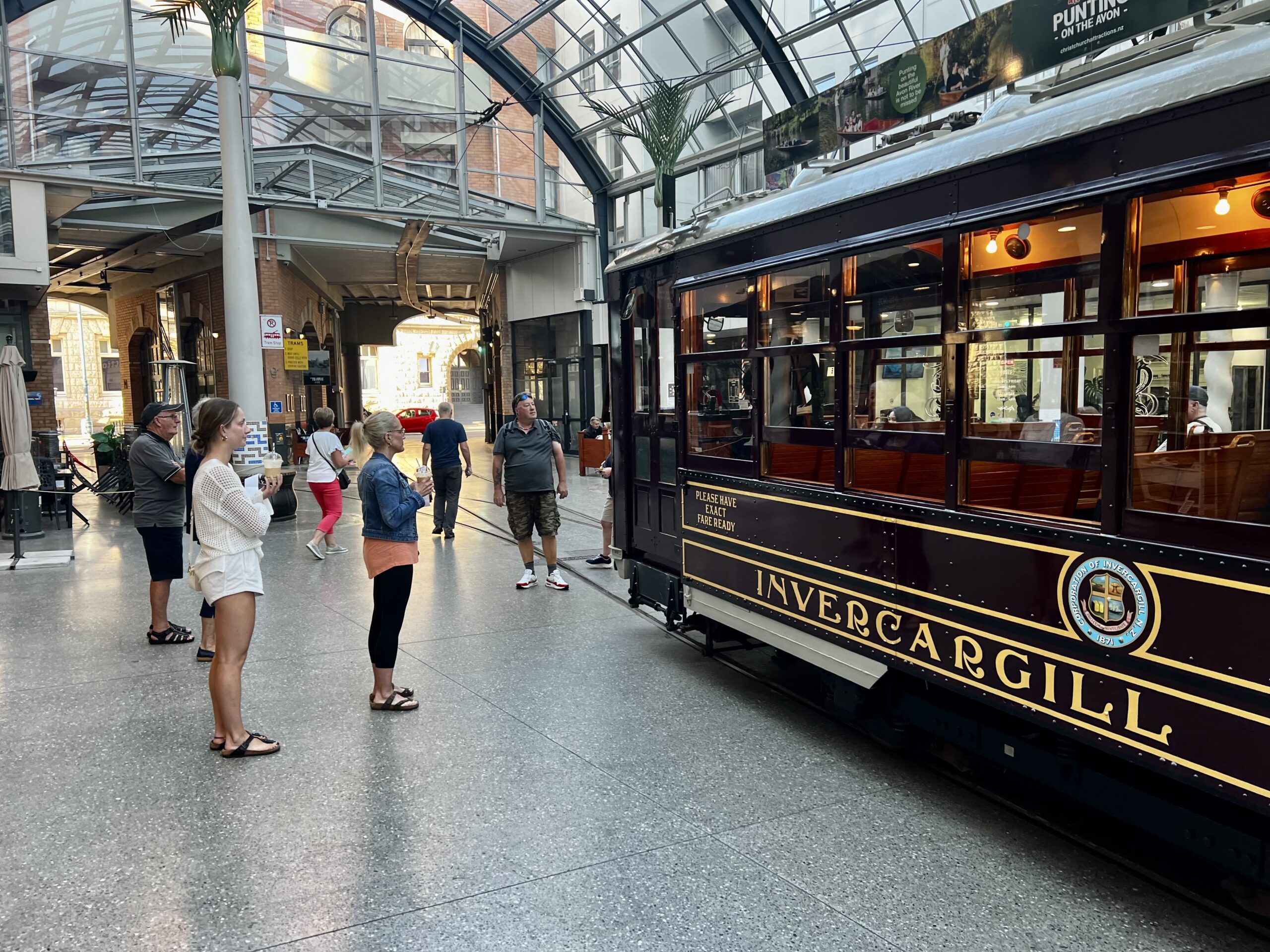
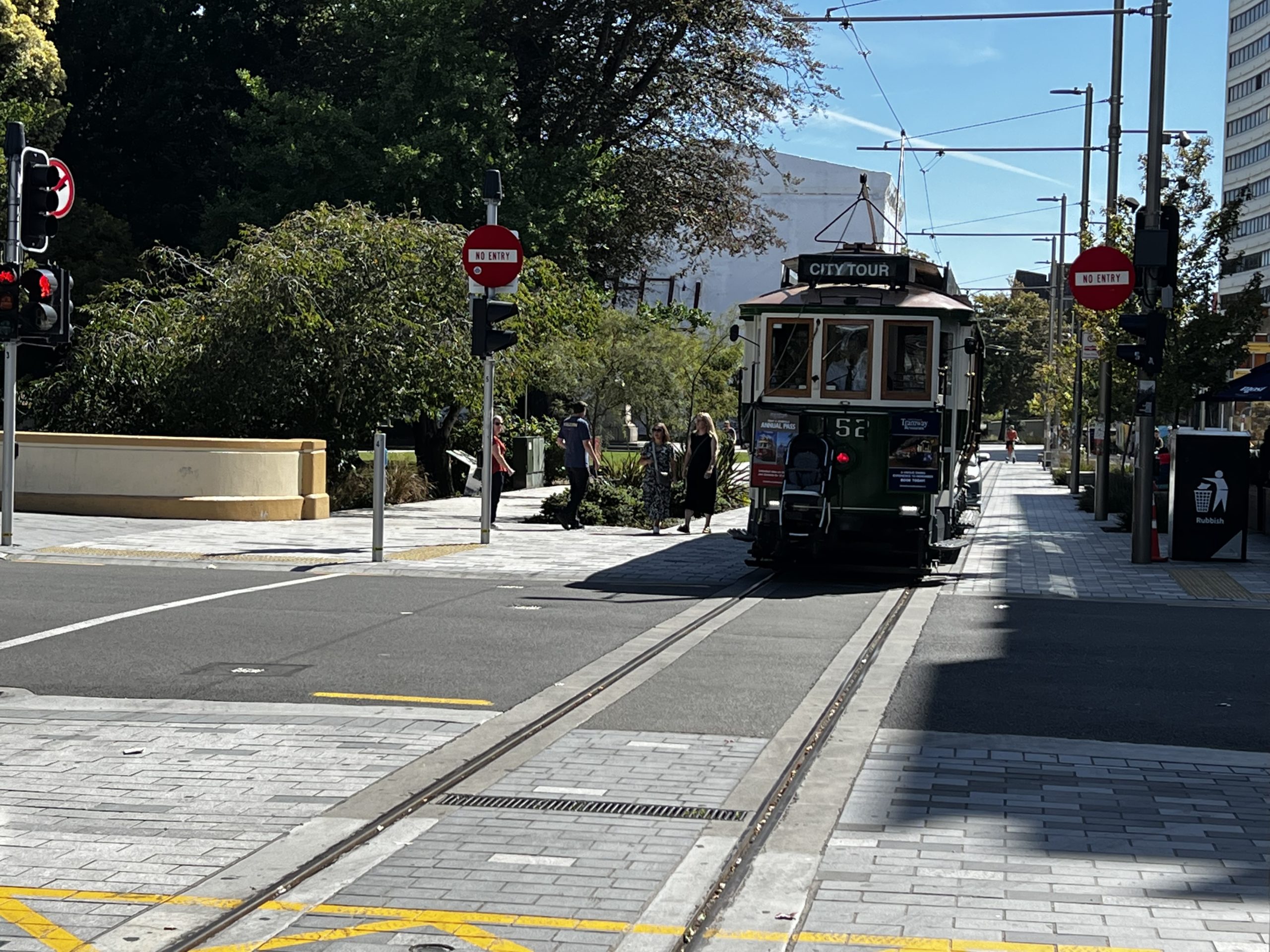
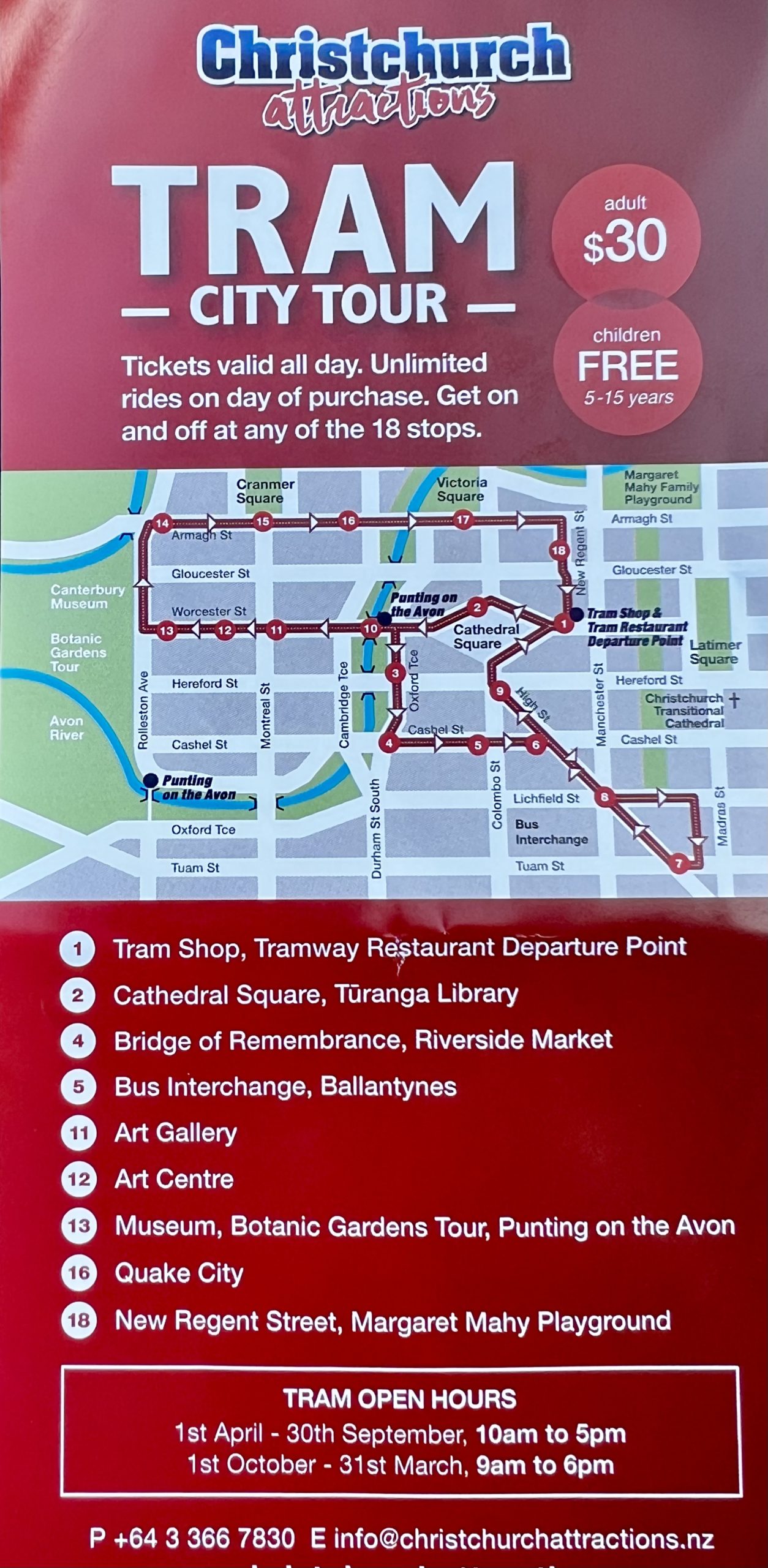
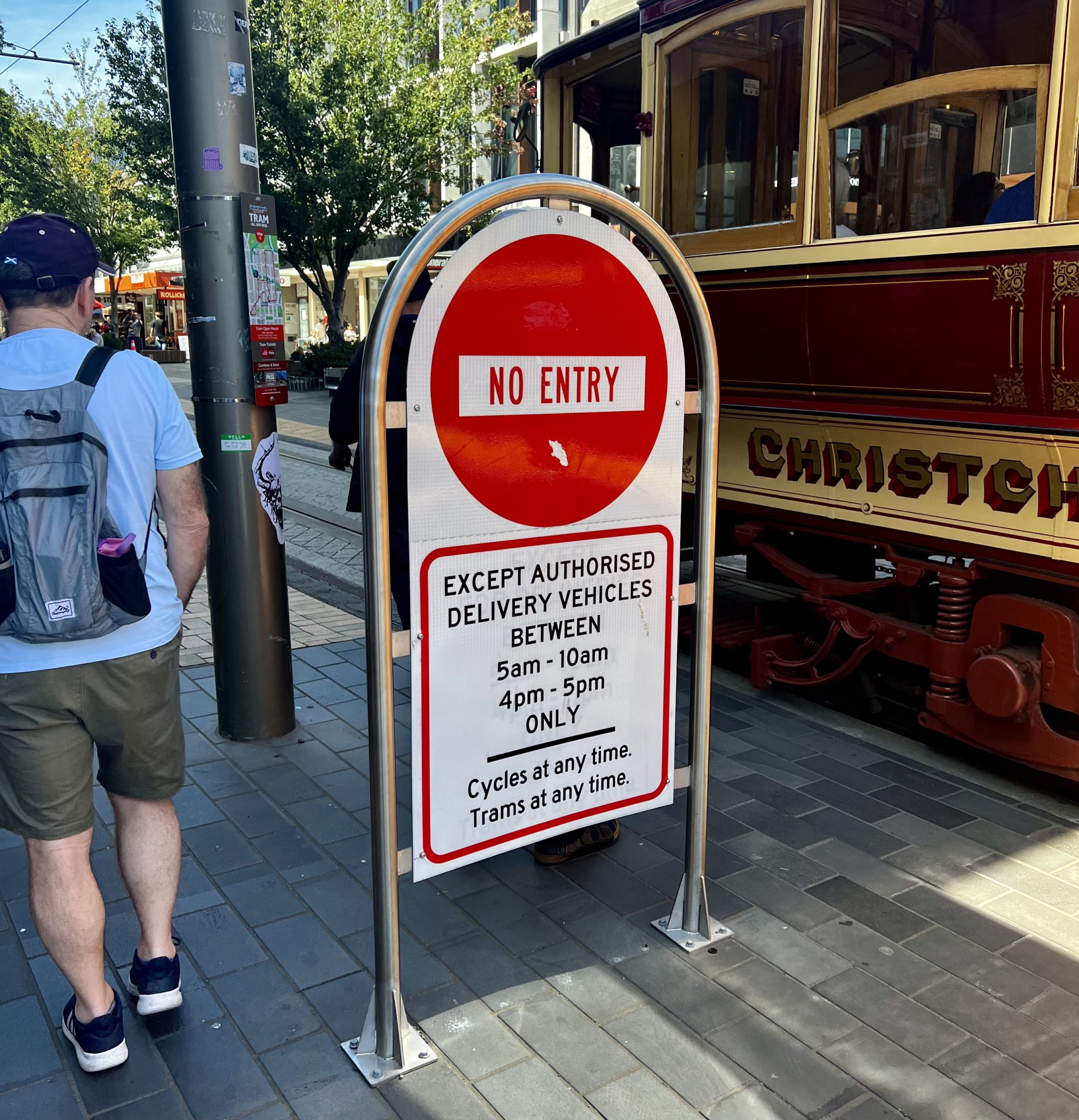
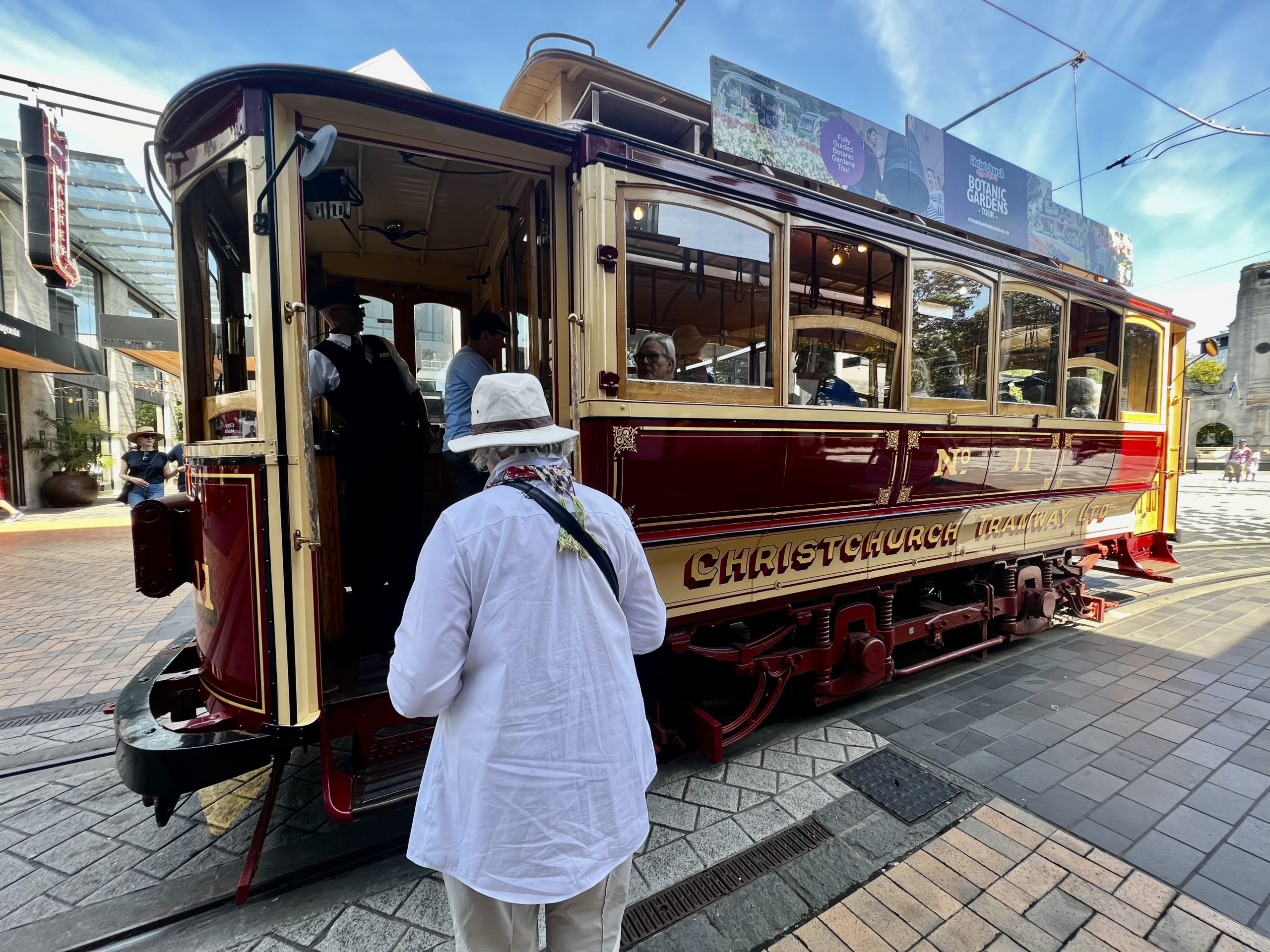
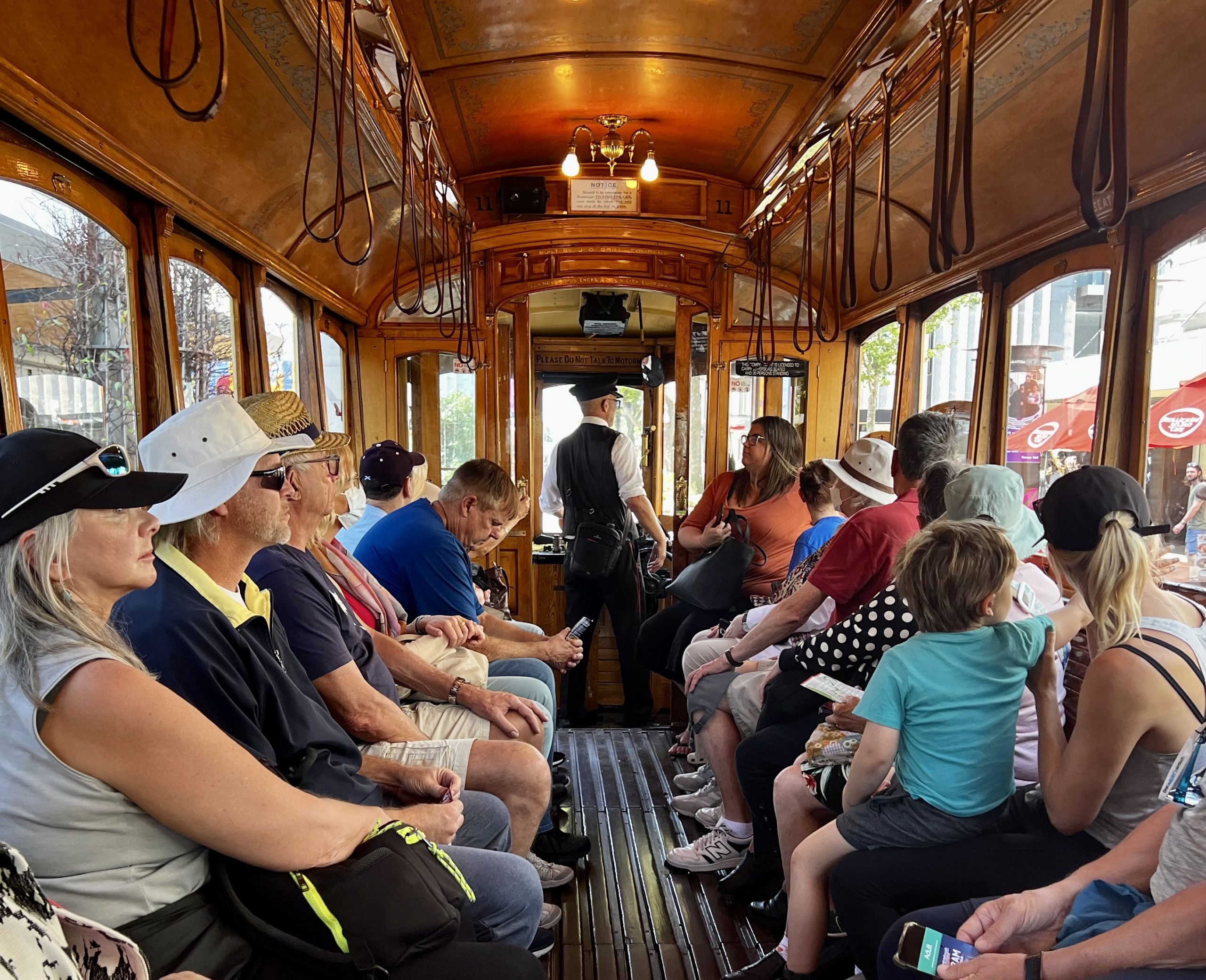
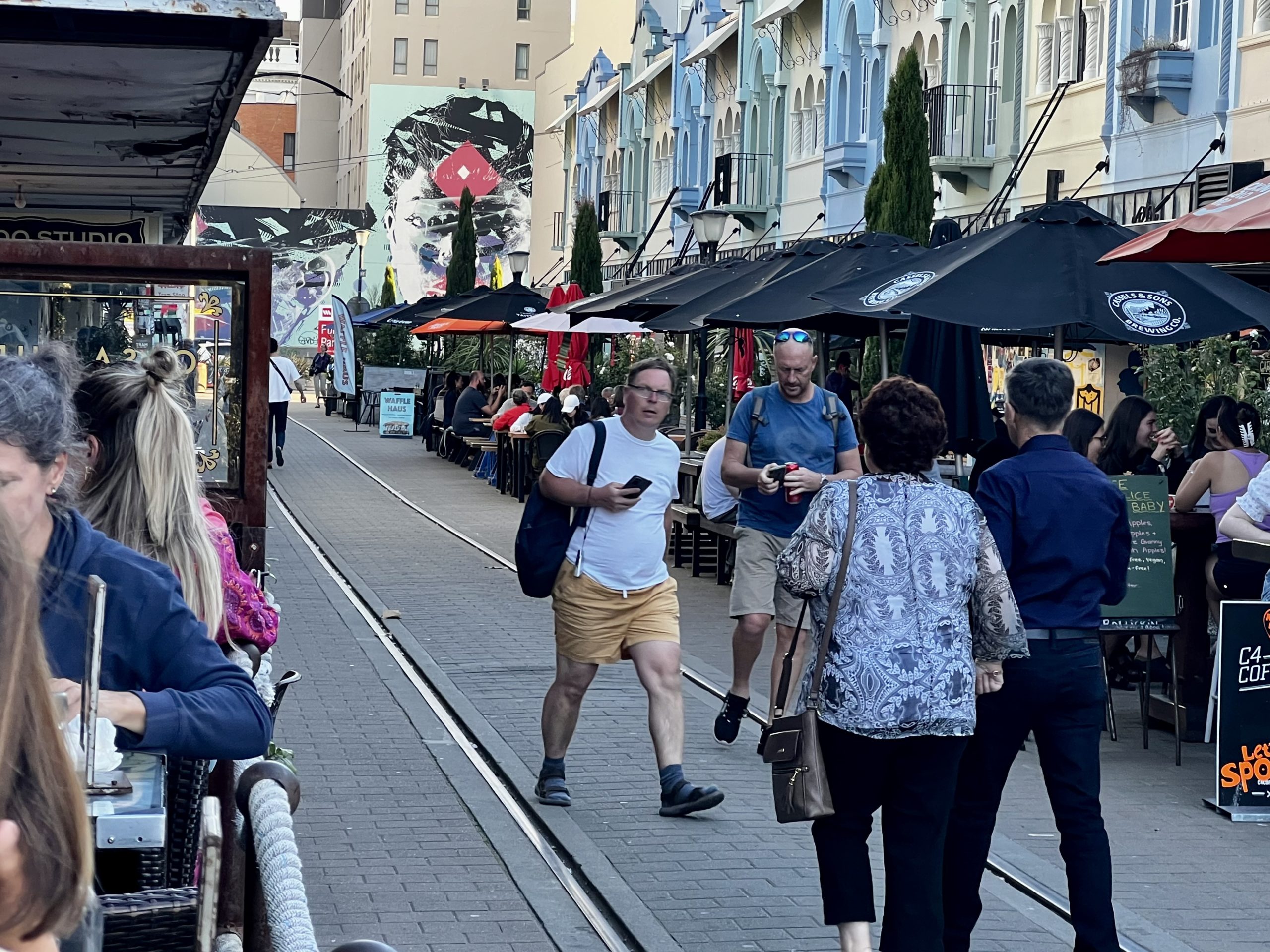
But to loop around the downtown we took the electric trolley. A group of citizens collected a few antique tram cars from throughout New Zealand and in the 1990s carved a figure-eight route for the tracks through the densest part of the city, hiring entertaining drivers to deliver commentary along the way. For example, we learned that all new construction meets there standards for 8.5 earthquakes. They plan to expand the routes in the future.
There are still gaps in the urban fabric, historic buildings being reconstructed, and newly opened structures looking raw, but we found the city very appealing. On a weekend with pleasant temperatures it was full of people.
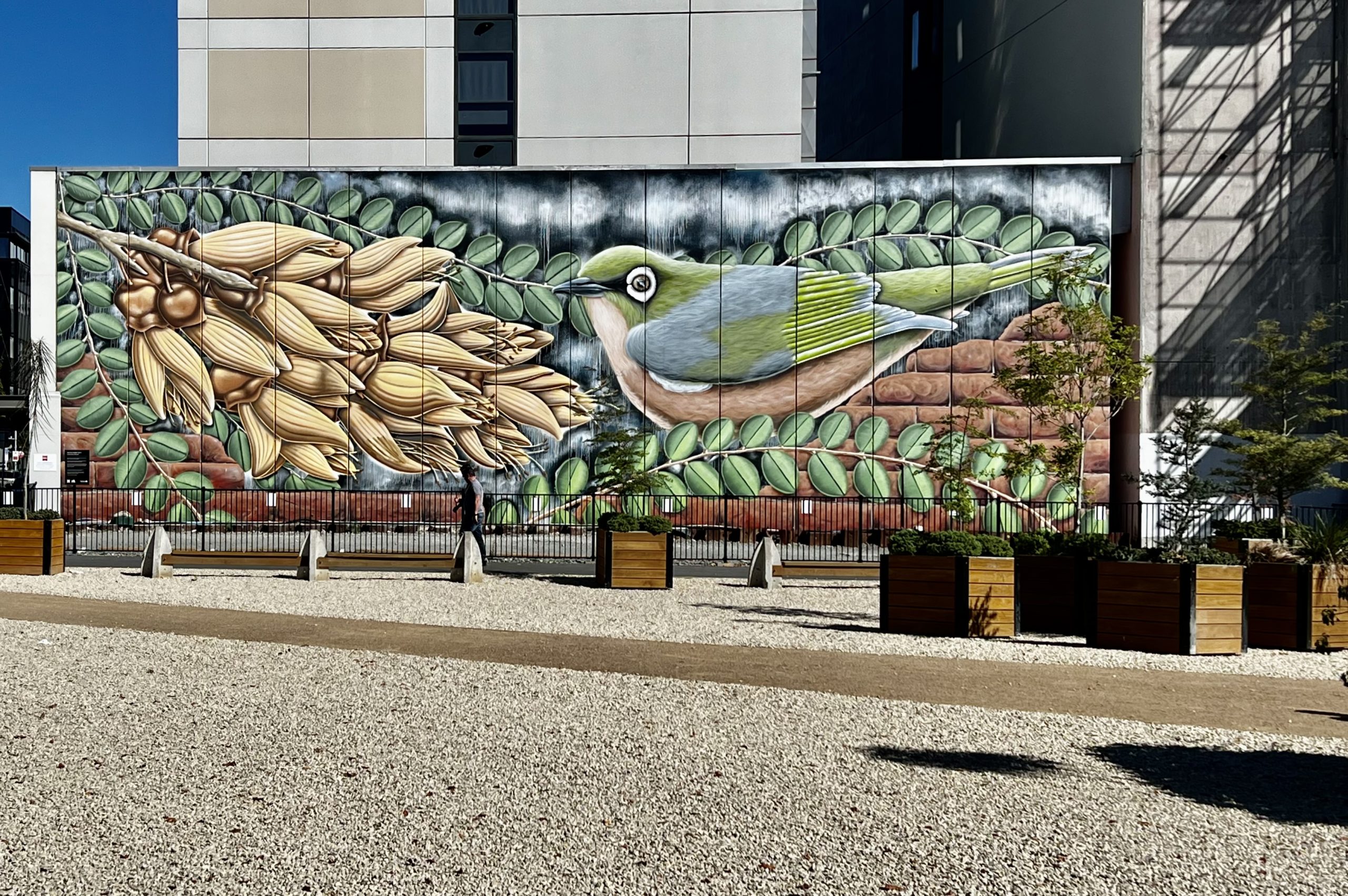
In the past Christchurch was a city of only single-family homes with no apartments. Despite objections, we saw many low-rise apartment buildings newly built or under construction just a few blocks beyond the central city. This will greatly impact the city by bring a higher density of population to the city’s center. We liked the architecture. Bold. Interesting. Uncluttered. Often using corrugated iron, which seems to us an unofficial symbol of New Zealand, along with the fern leaf, of course.
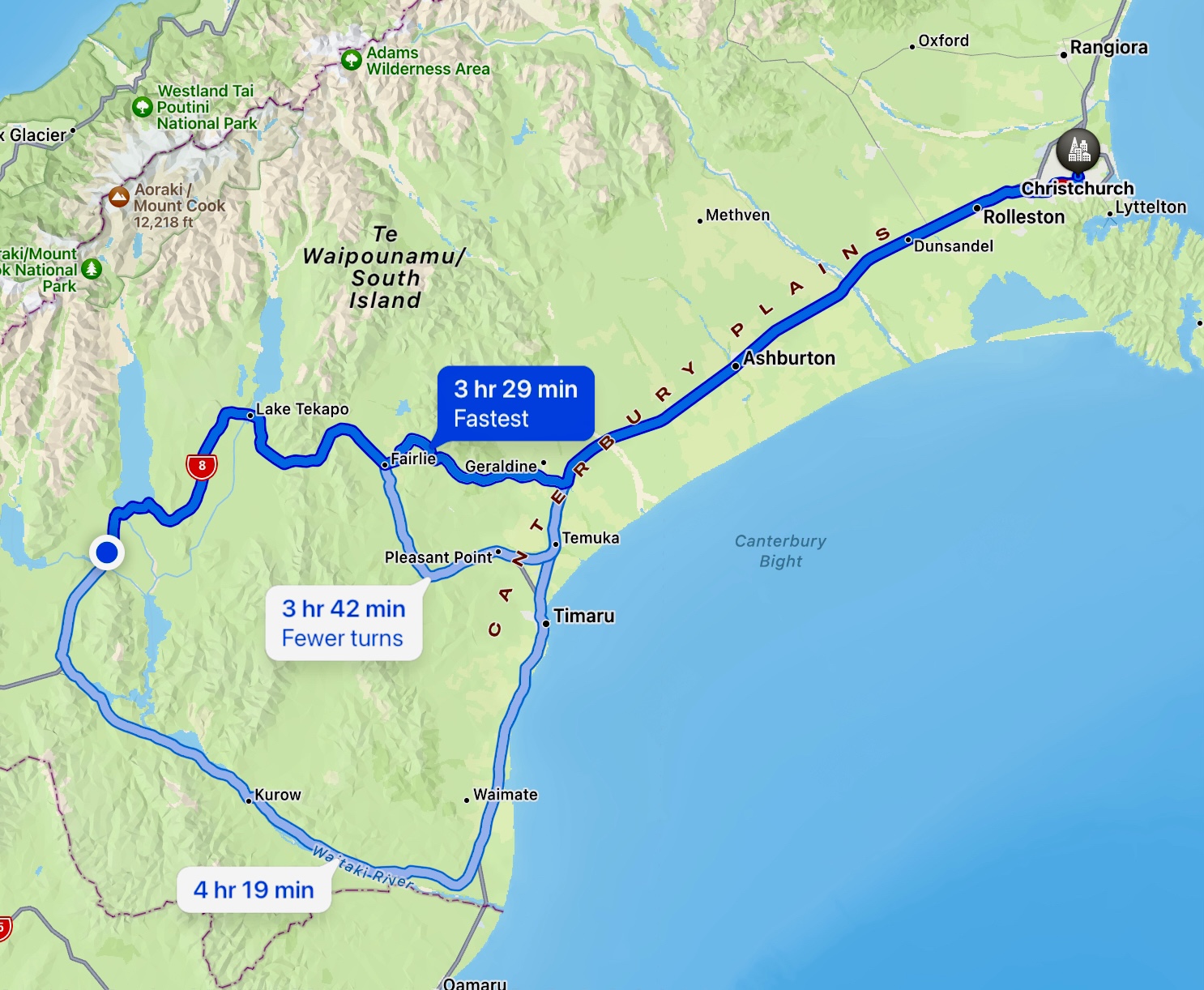
On the Way
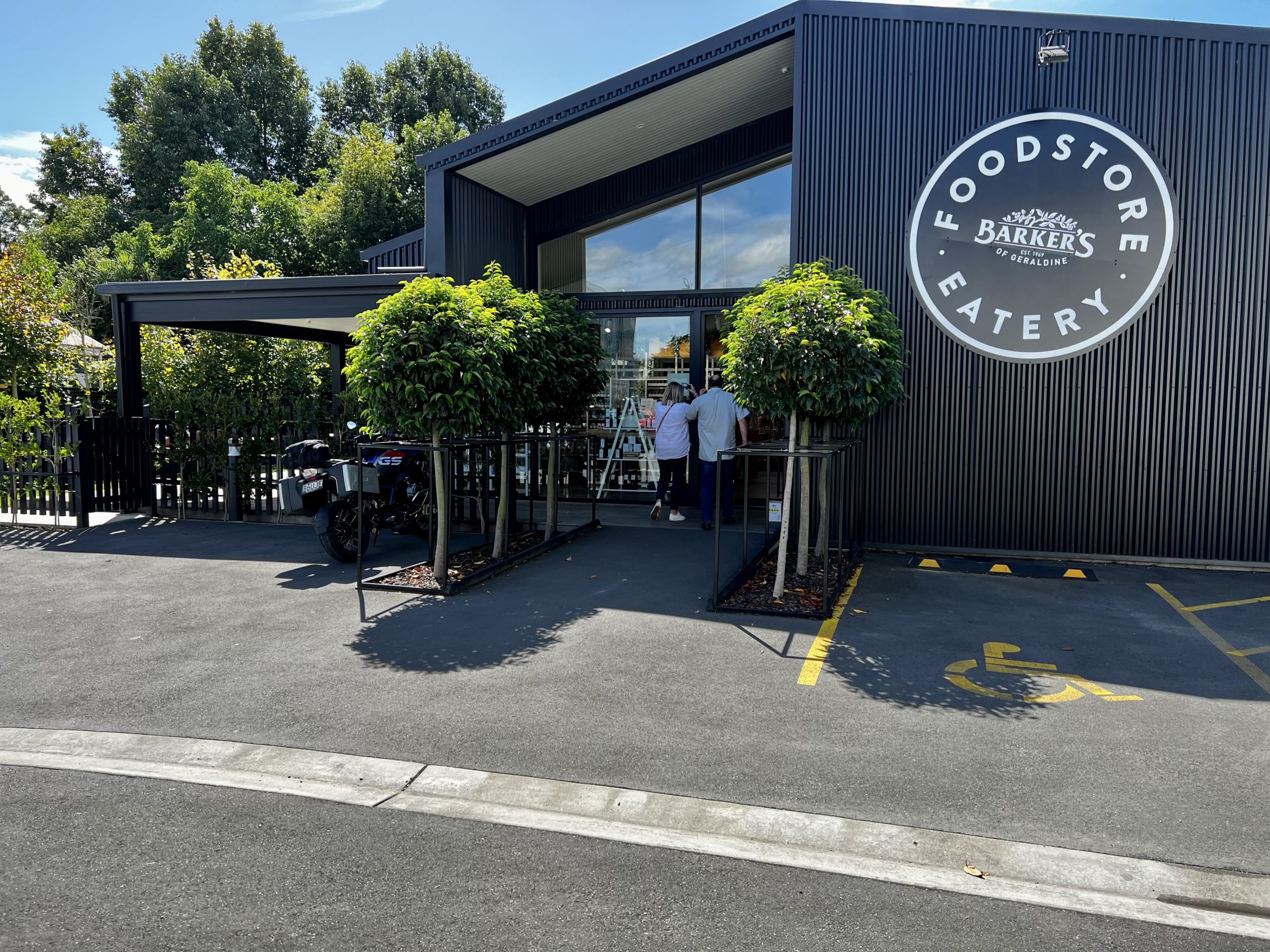
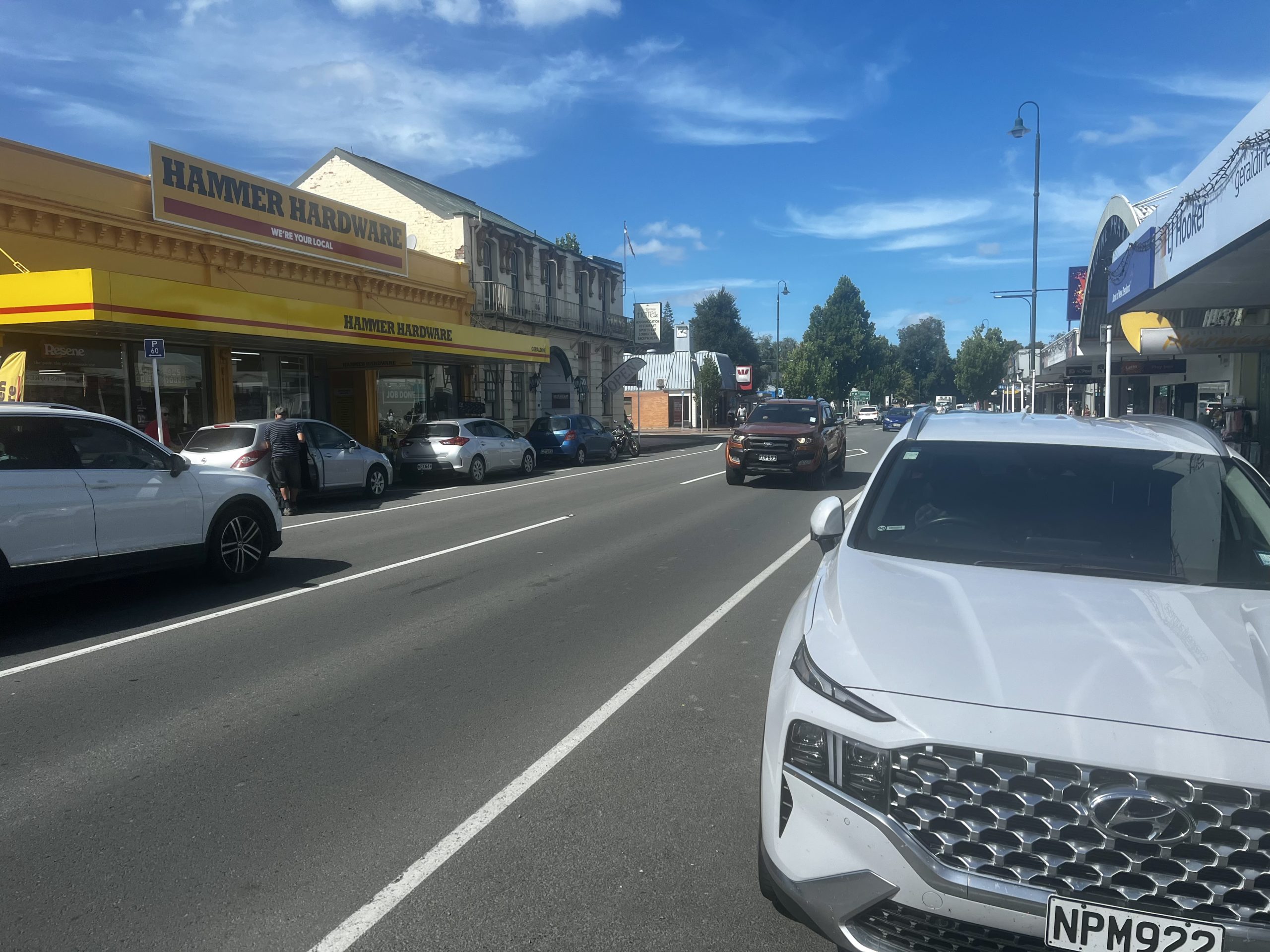
Geraldine for Lunch
Geraldine to Christchurch
Accommodations
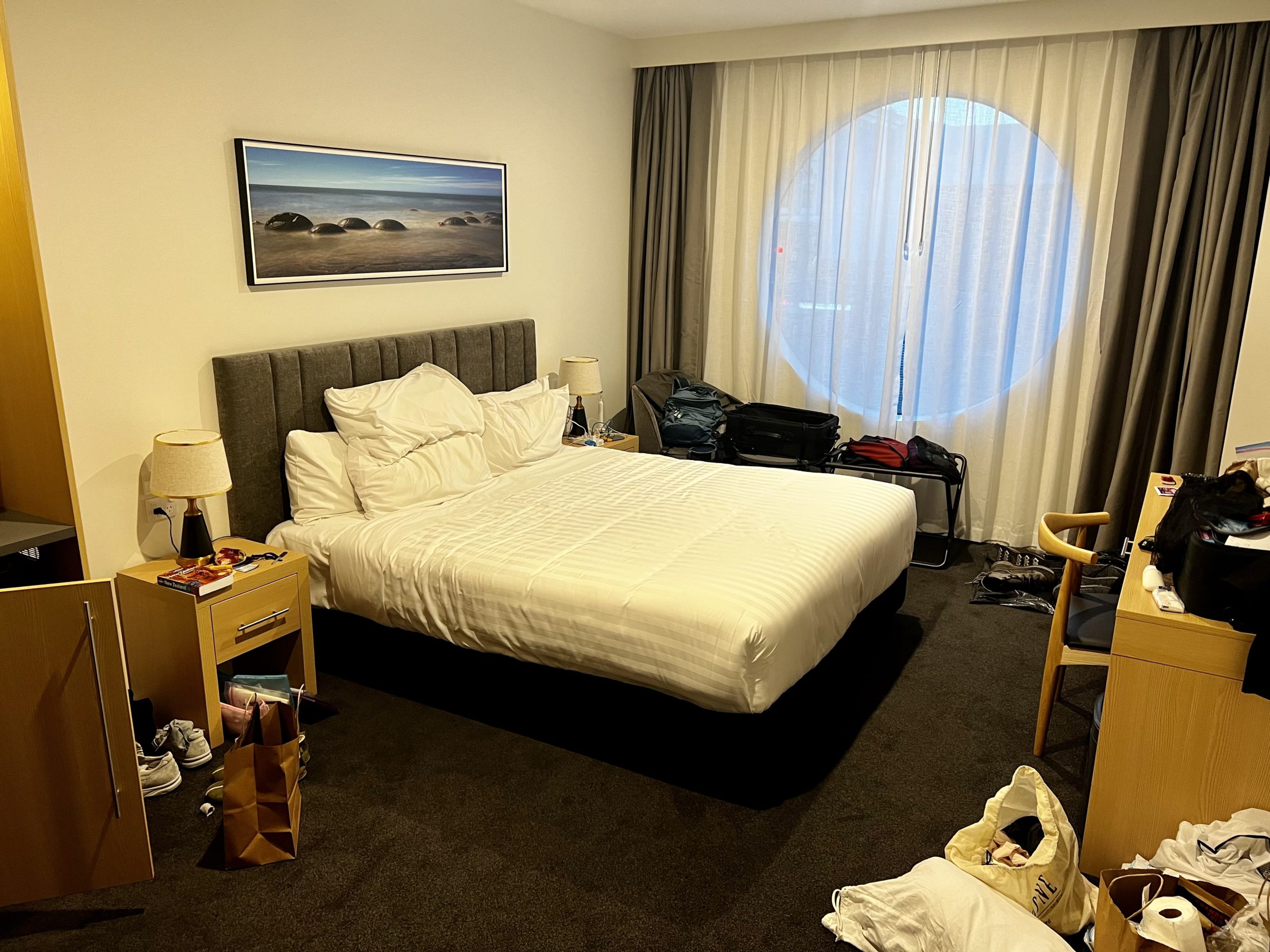
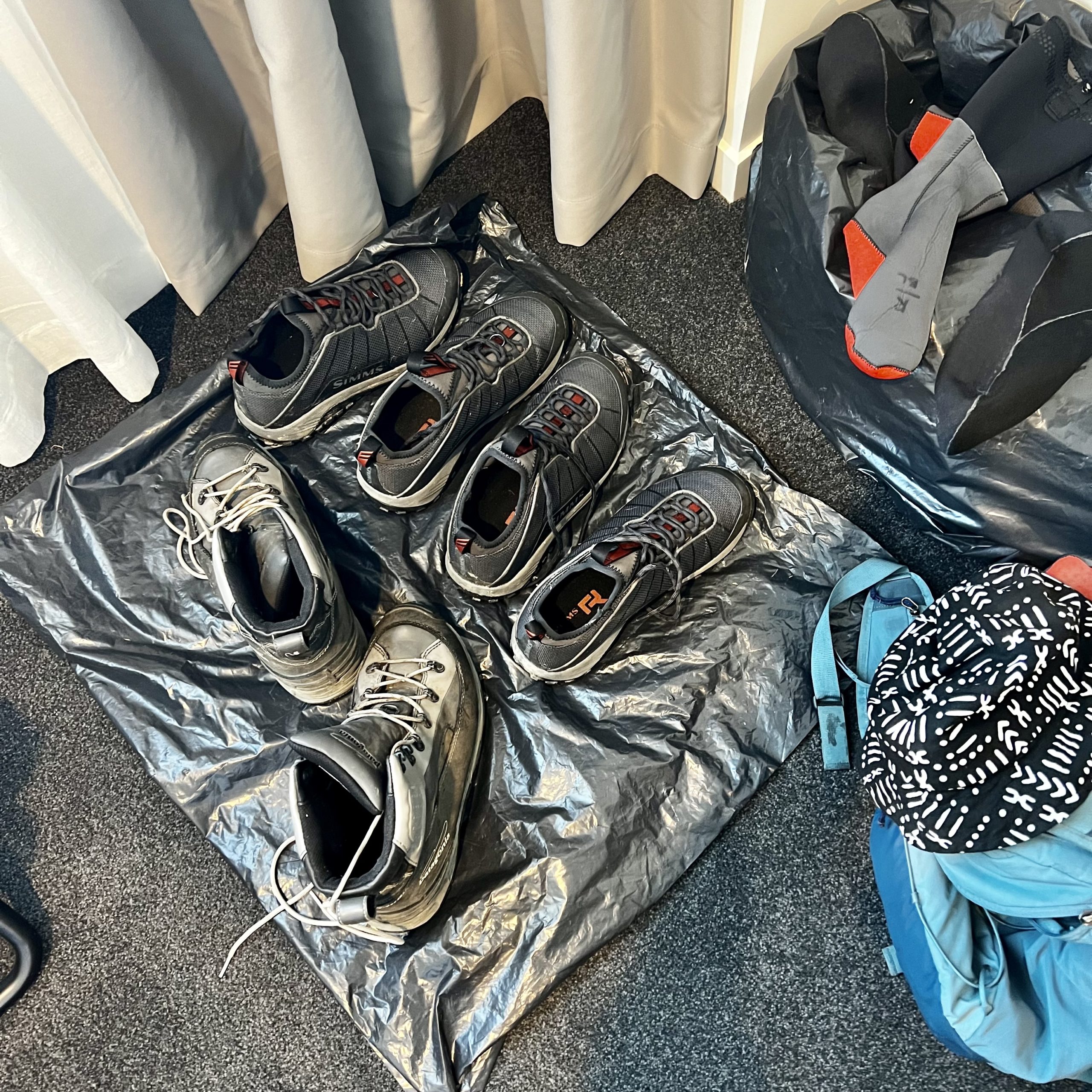
New hotel in the heart of the city. Had to park in a structure nearby but very convenient. No balcony to dry out the fishing gear, but we made do.
Strolling
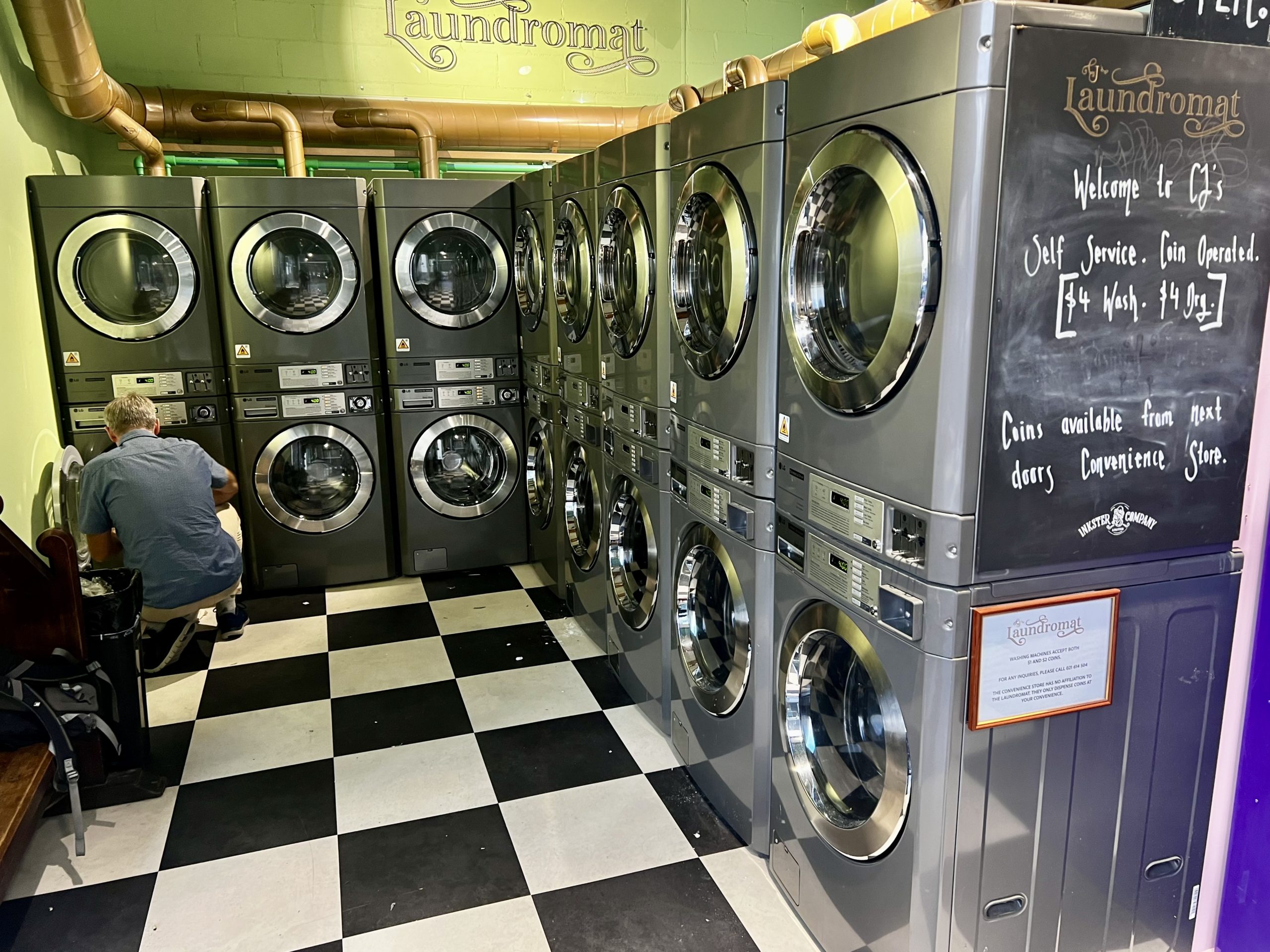
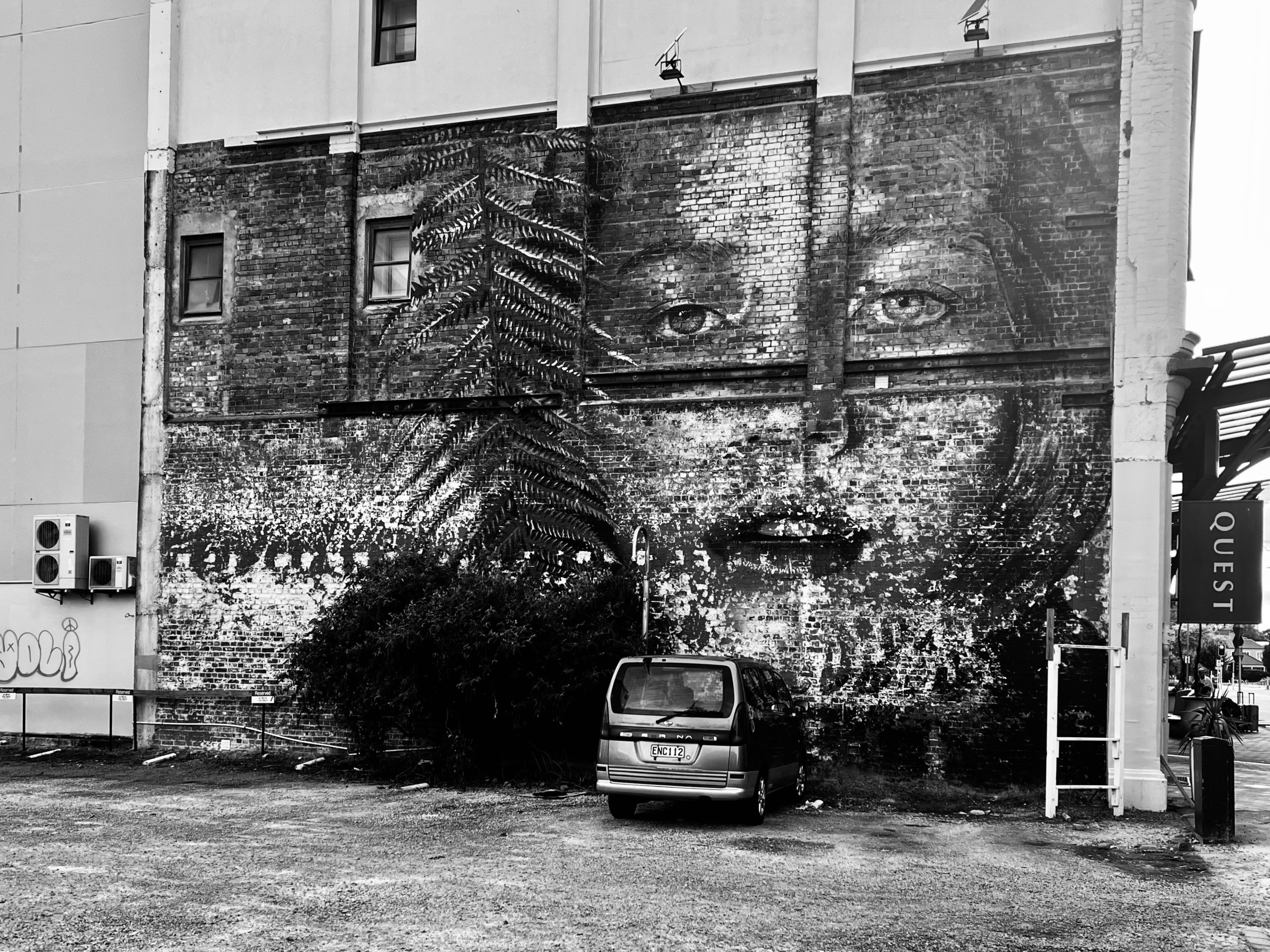
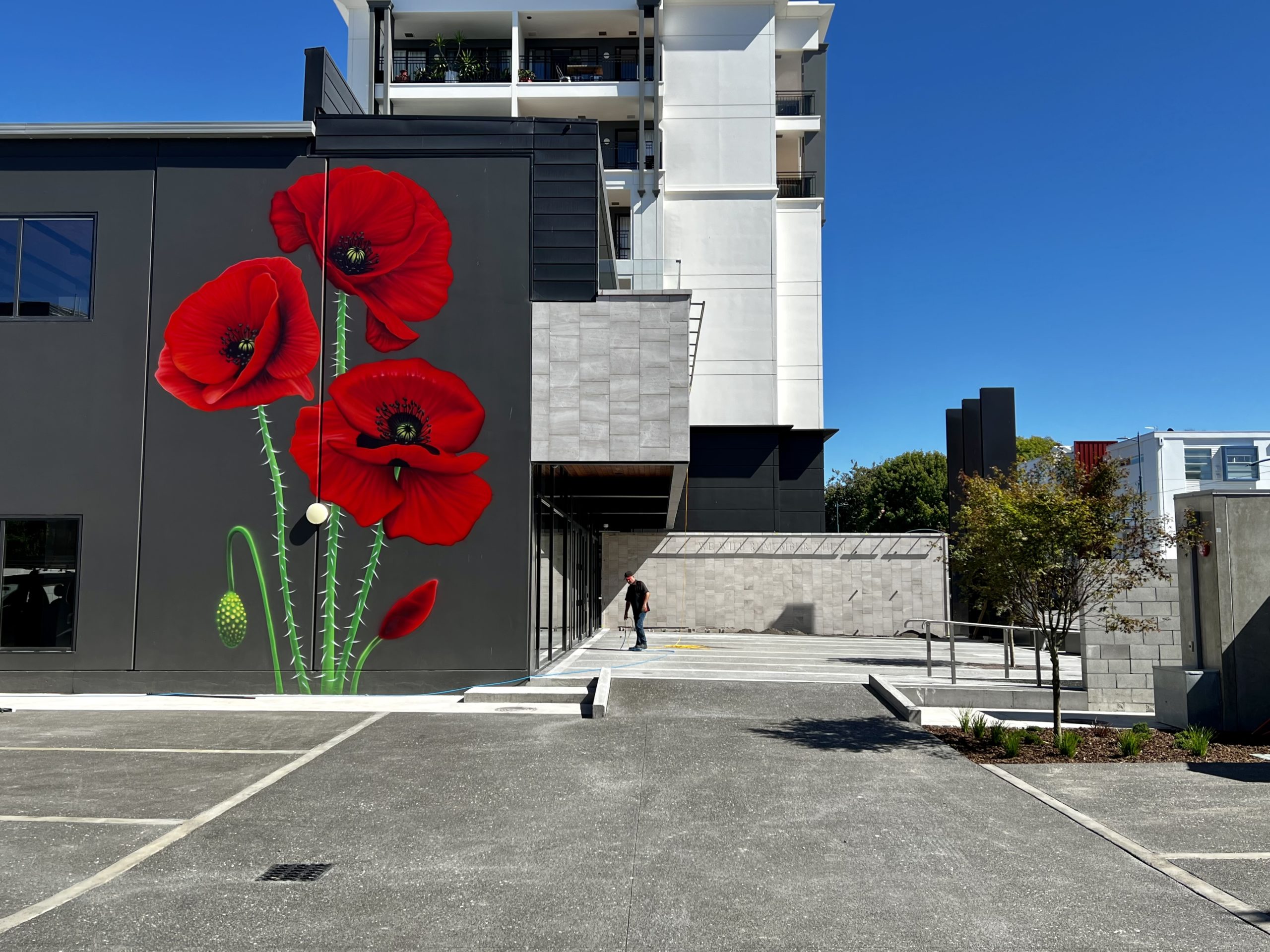
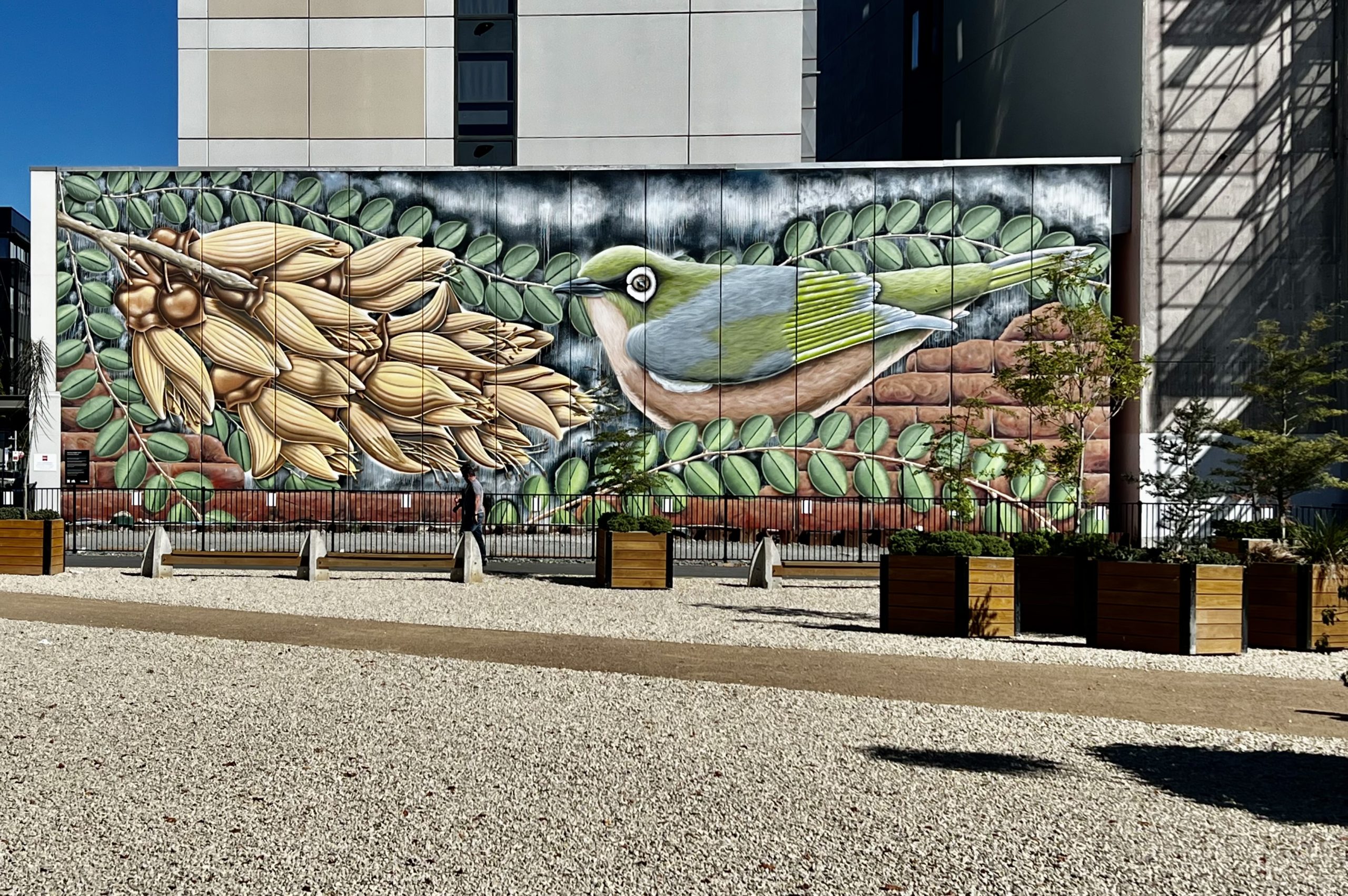
Laundromat close by made for a quick session for RobertLots of muralsCatherdral under restoration
Tram Ride
Cardboard Cathedral
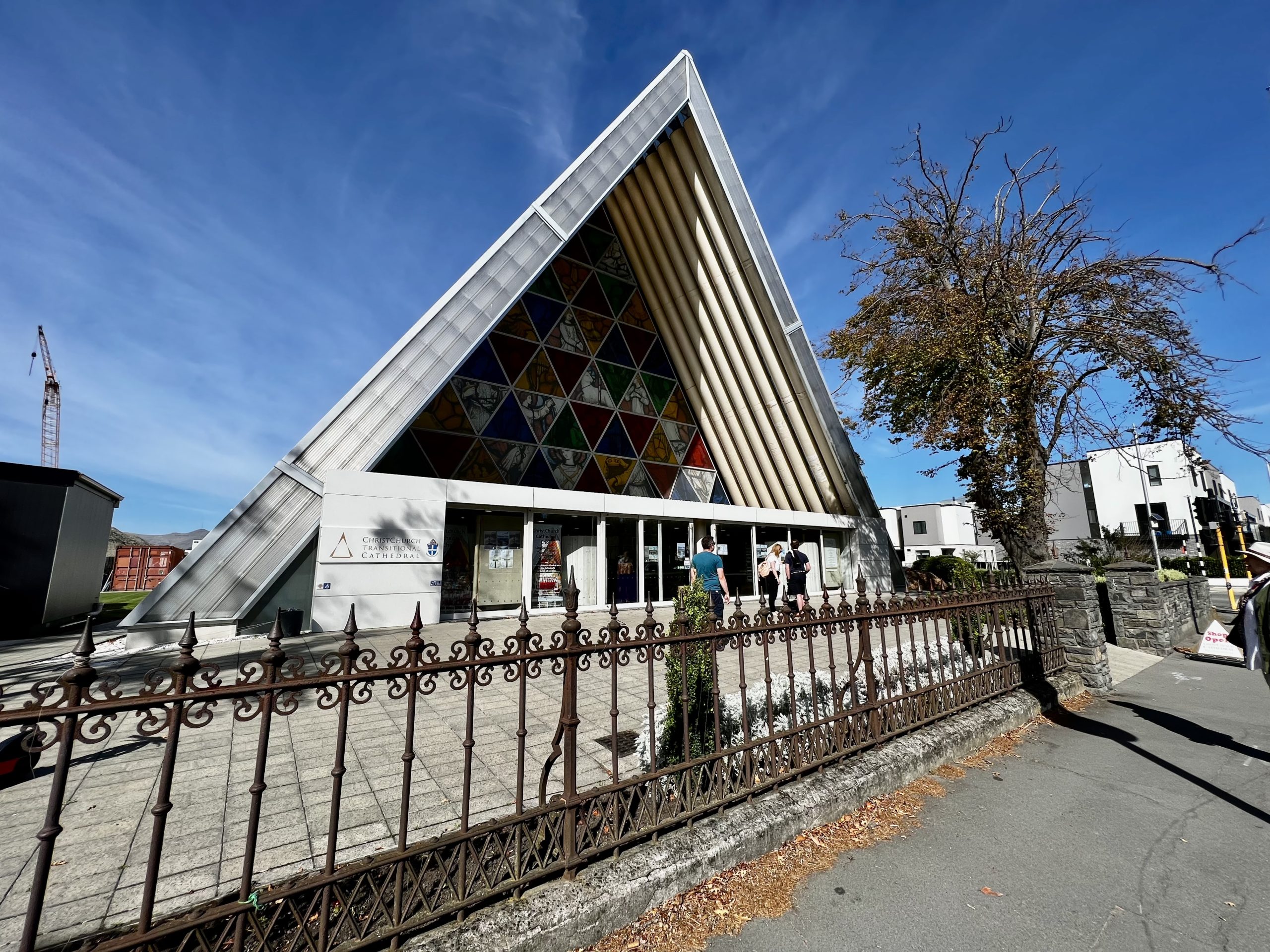
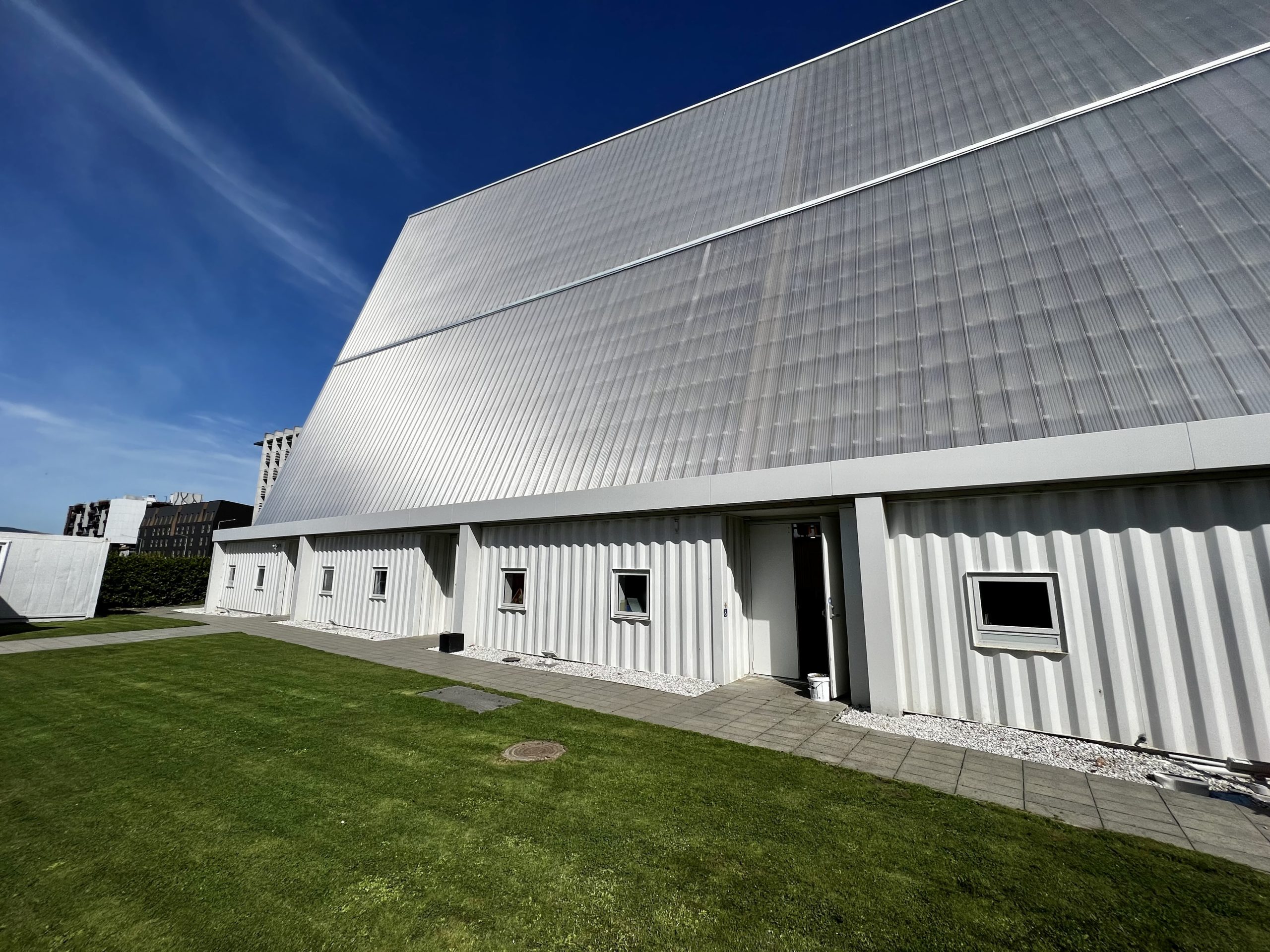
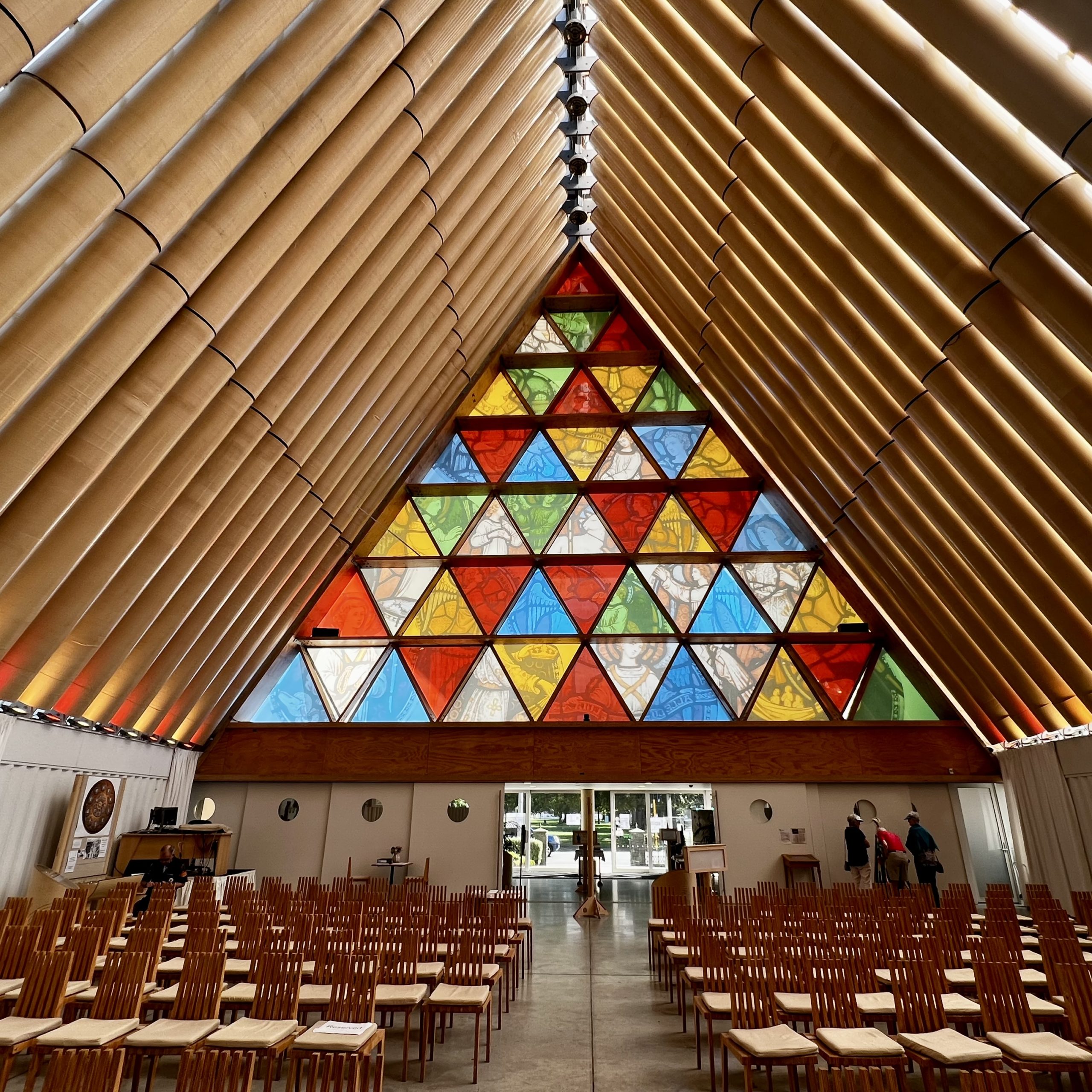
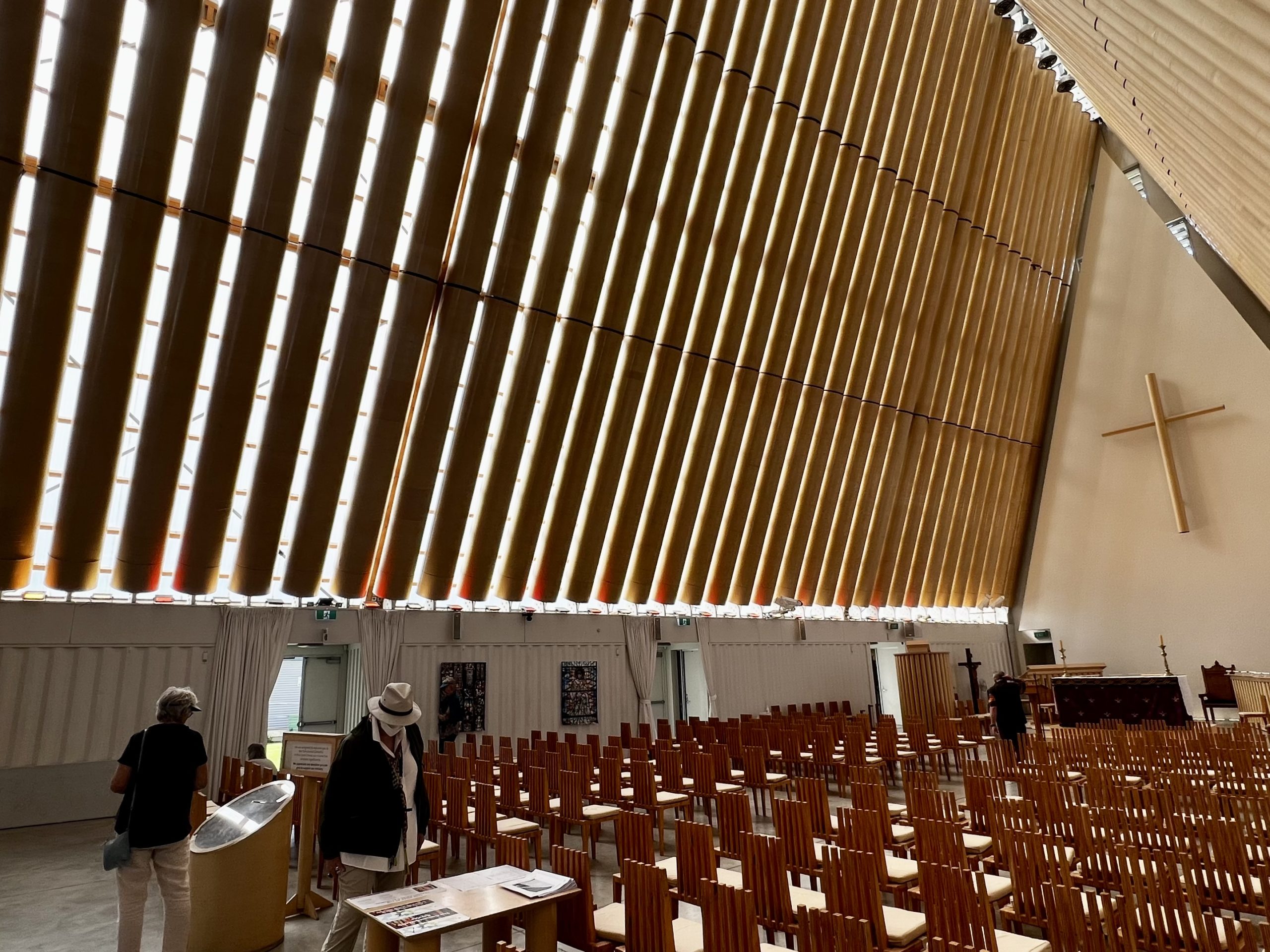
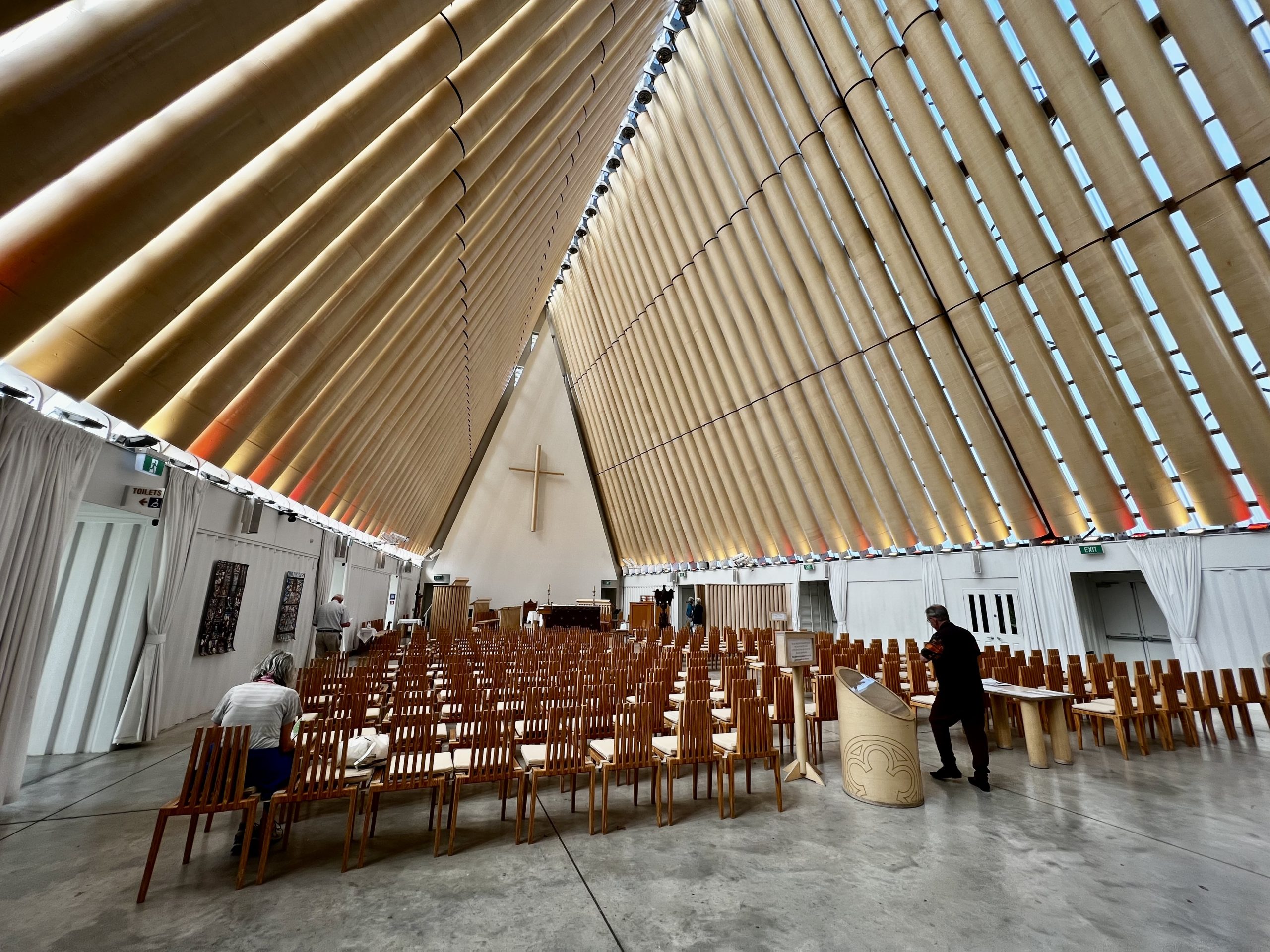
The most iconic building in the city, the Anglican Christchurch Cathedral is still under reconstruction at the city center—Cathedral Square. In the meantime the “Cardboard Cathedral” is taking its place. This structure, opened two years after the earthquake, was designed by the Japanese architect Shigeru Ban as a transitional replacement, and uses large cardboard tubes as the primary building material.
Botanic Gardens
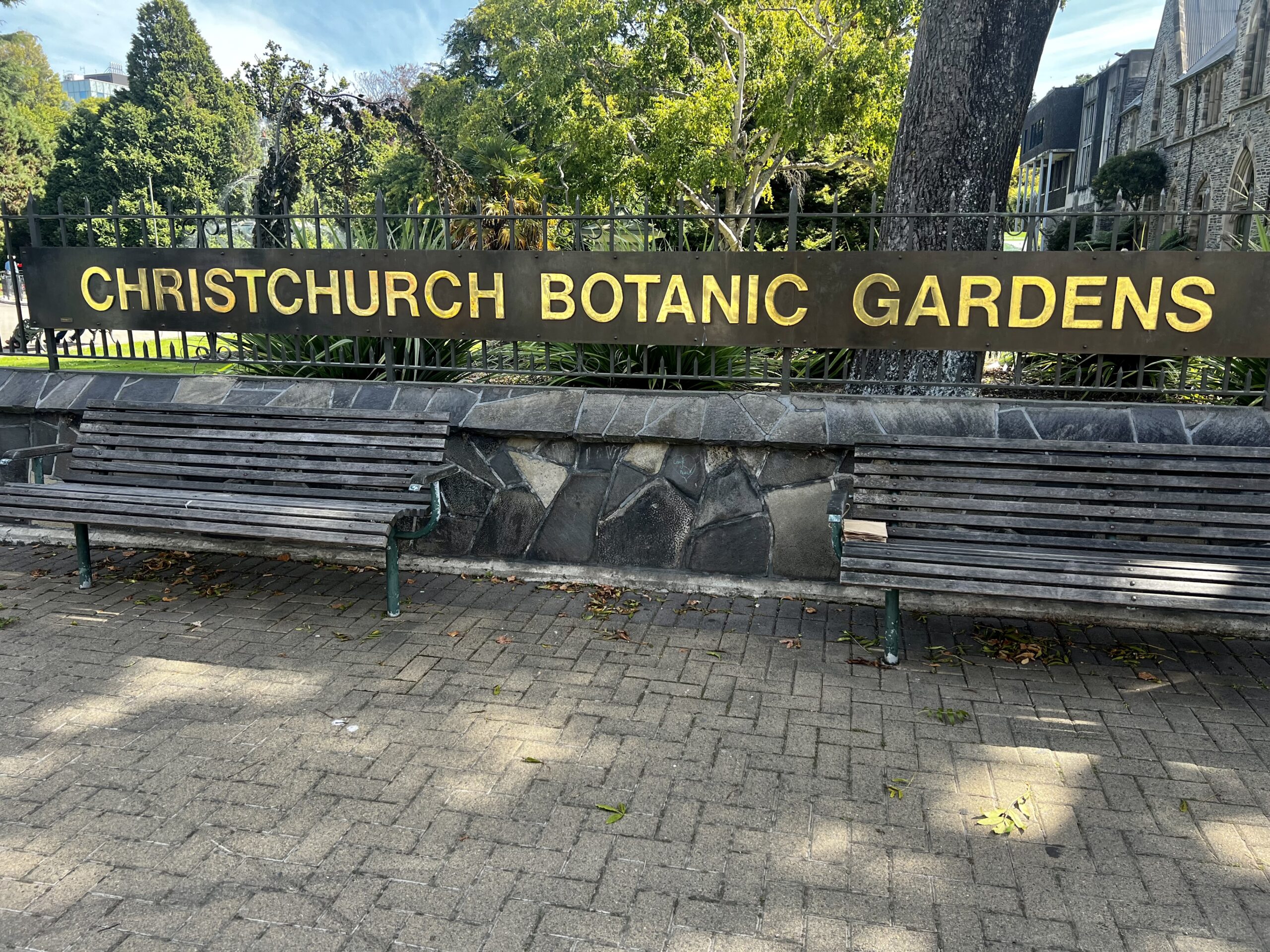
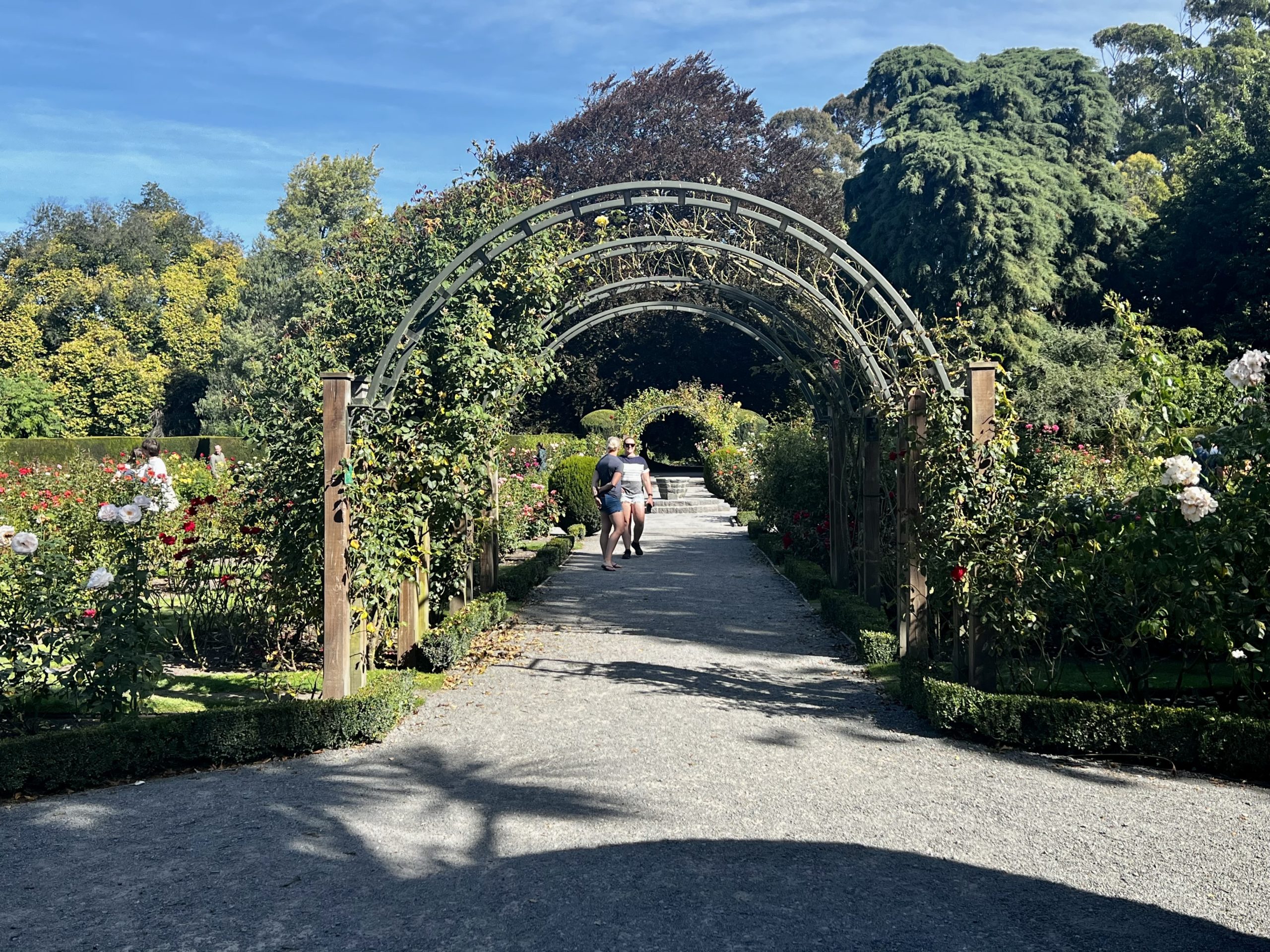
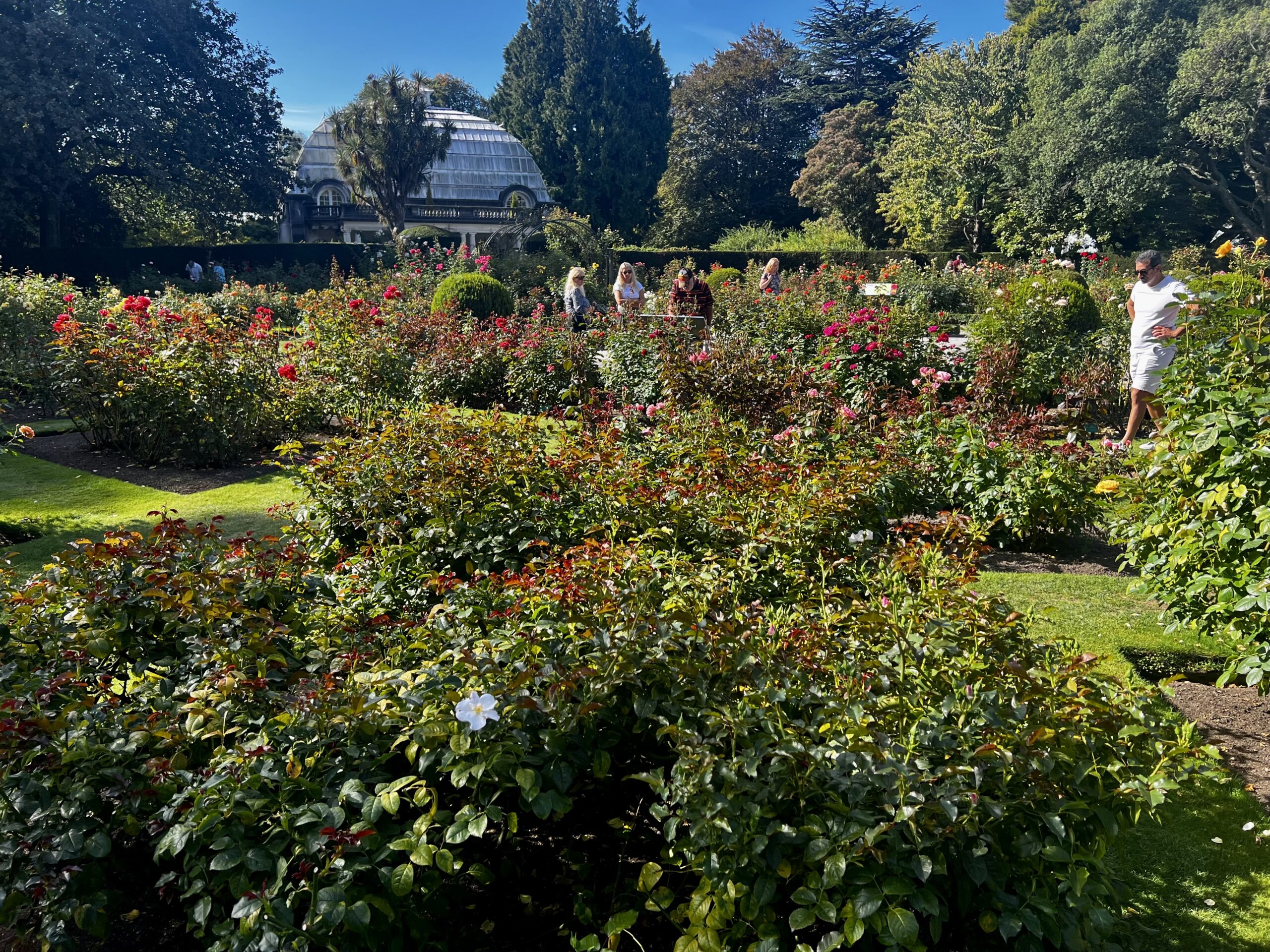
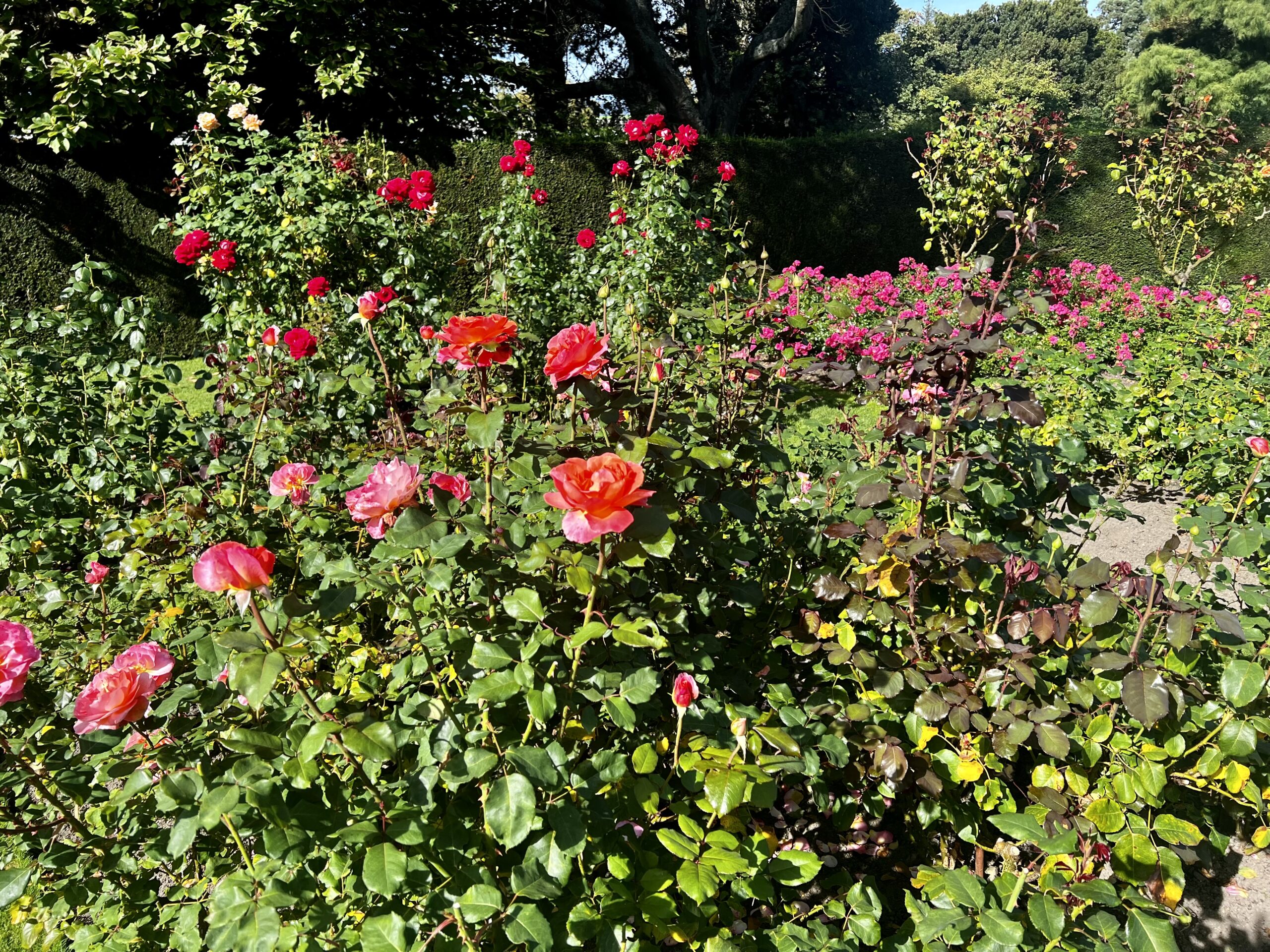
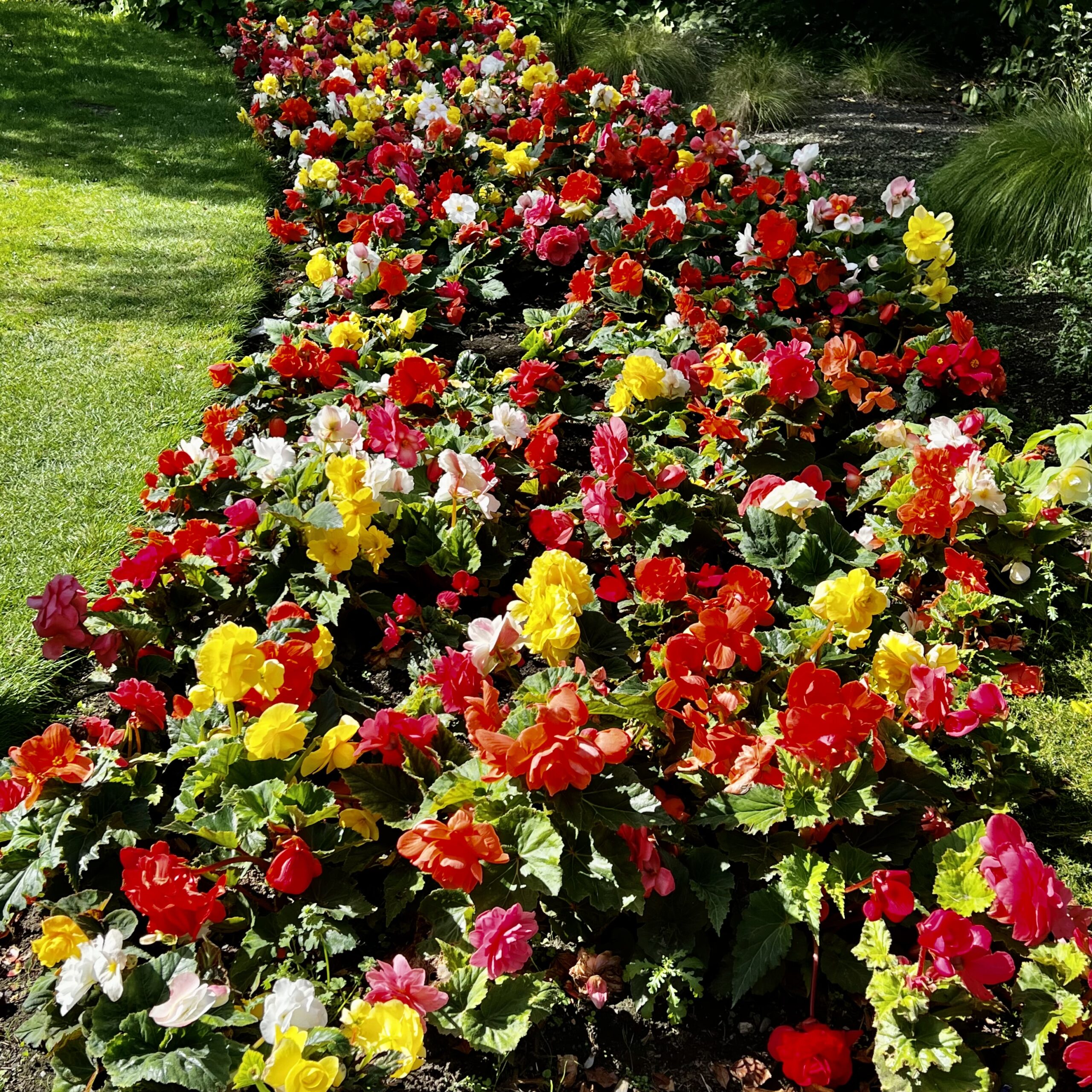
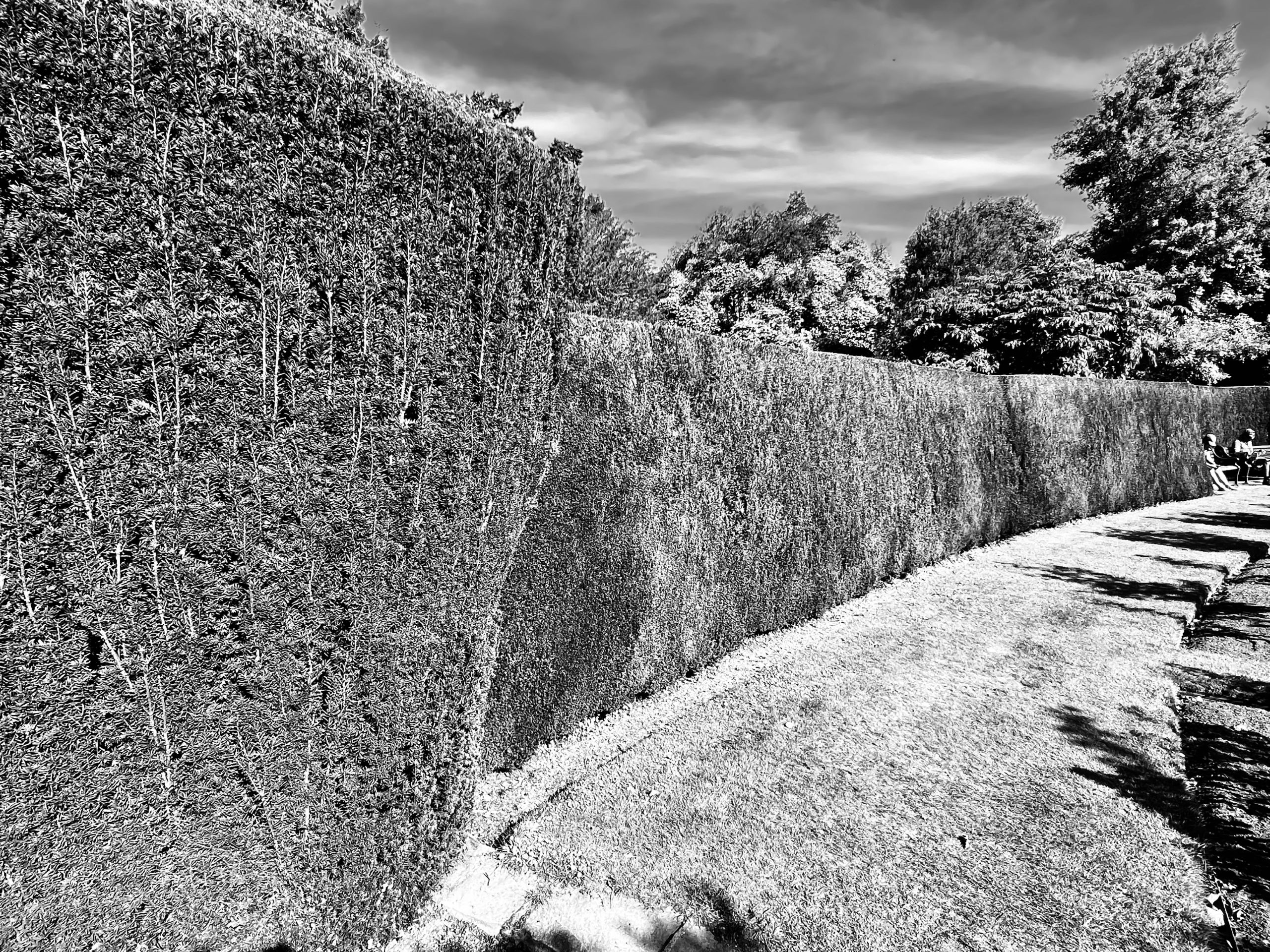
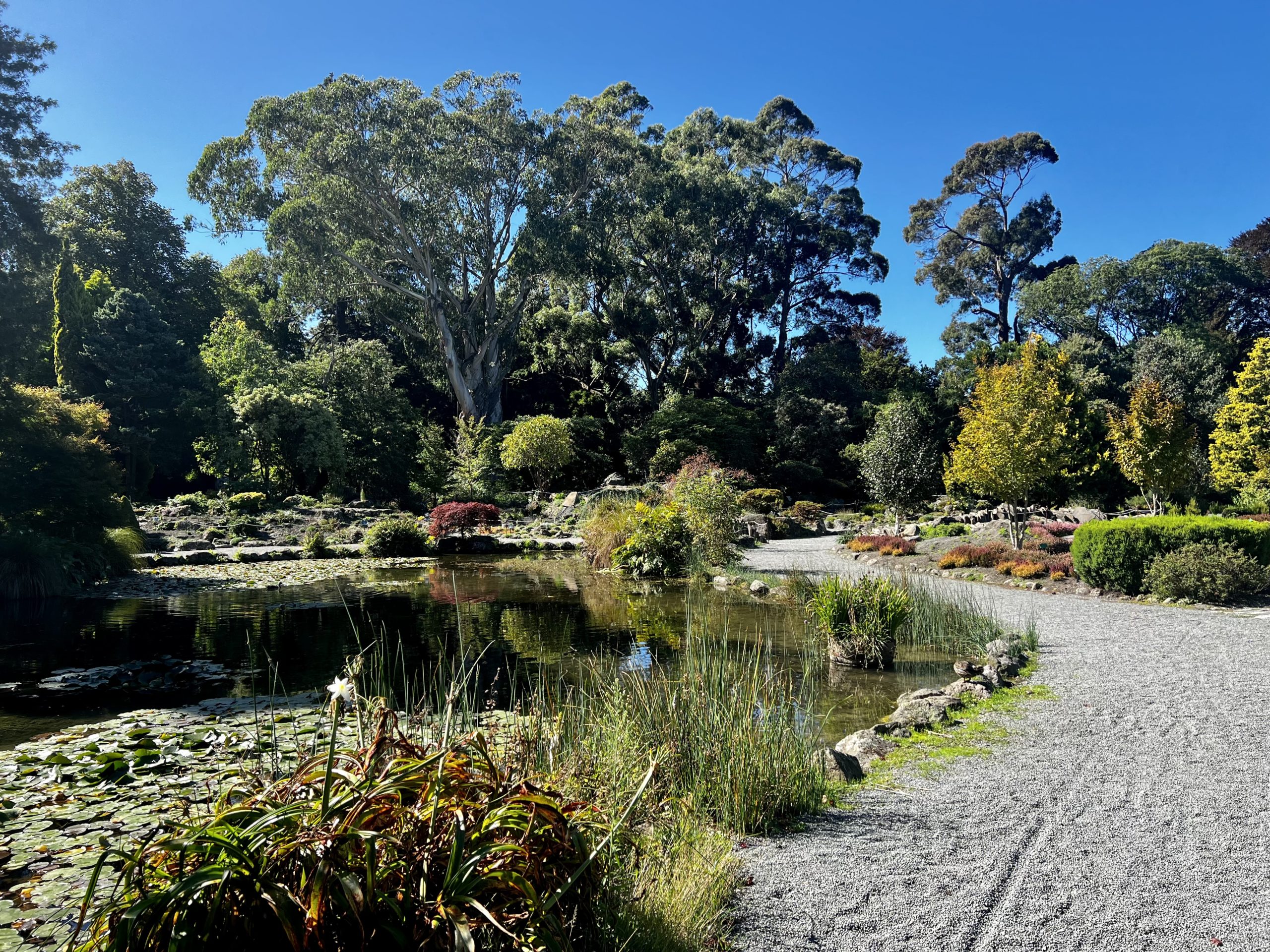
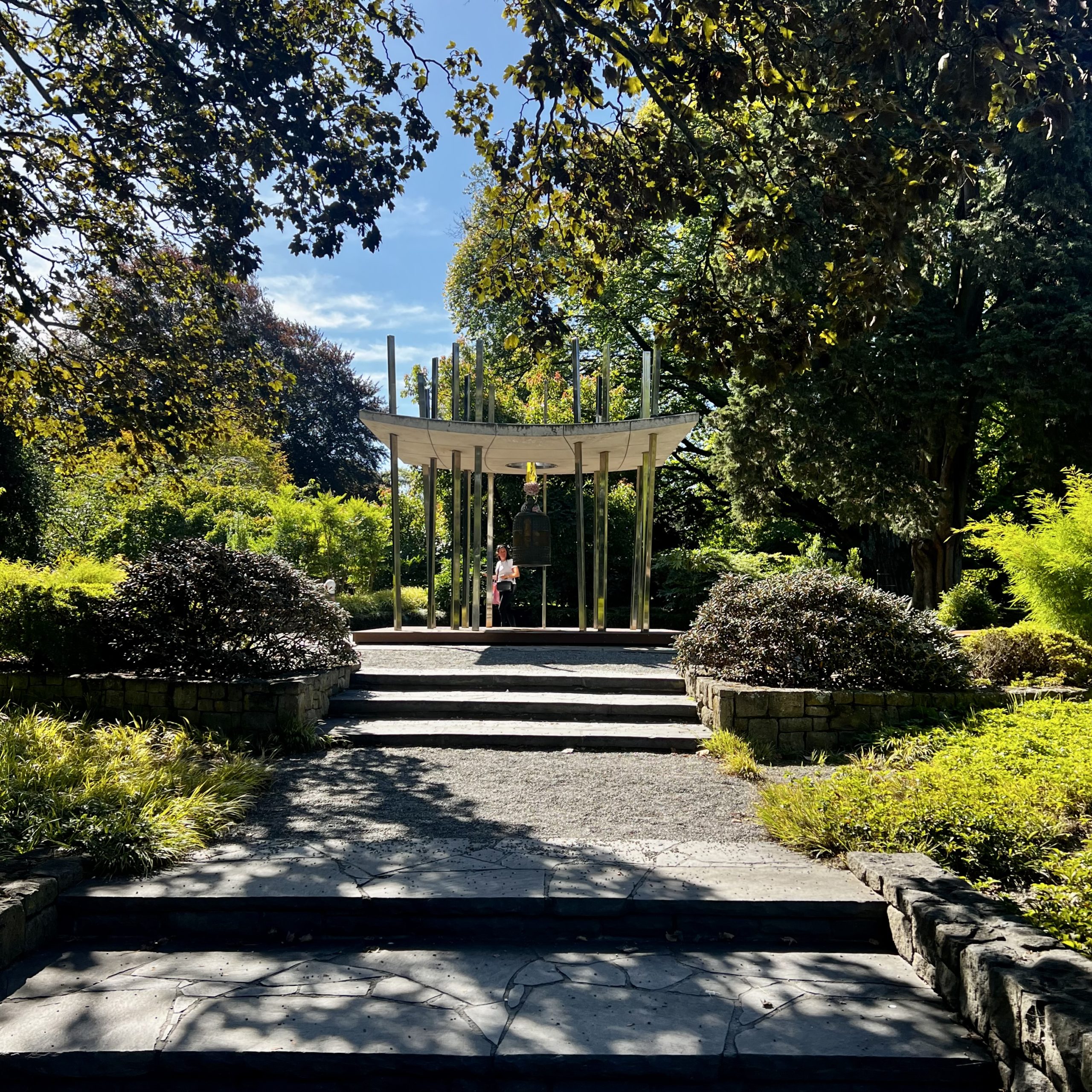
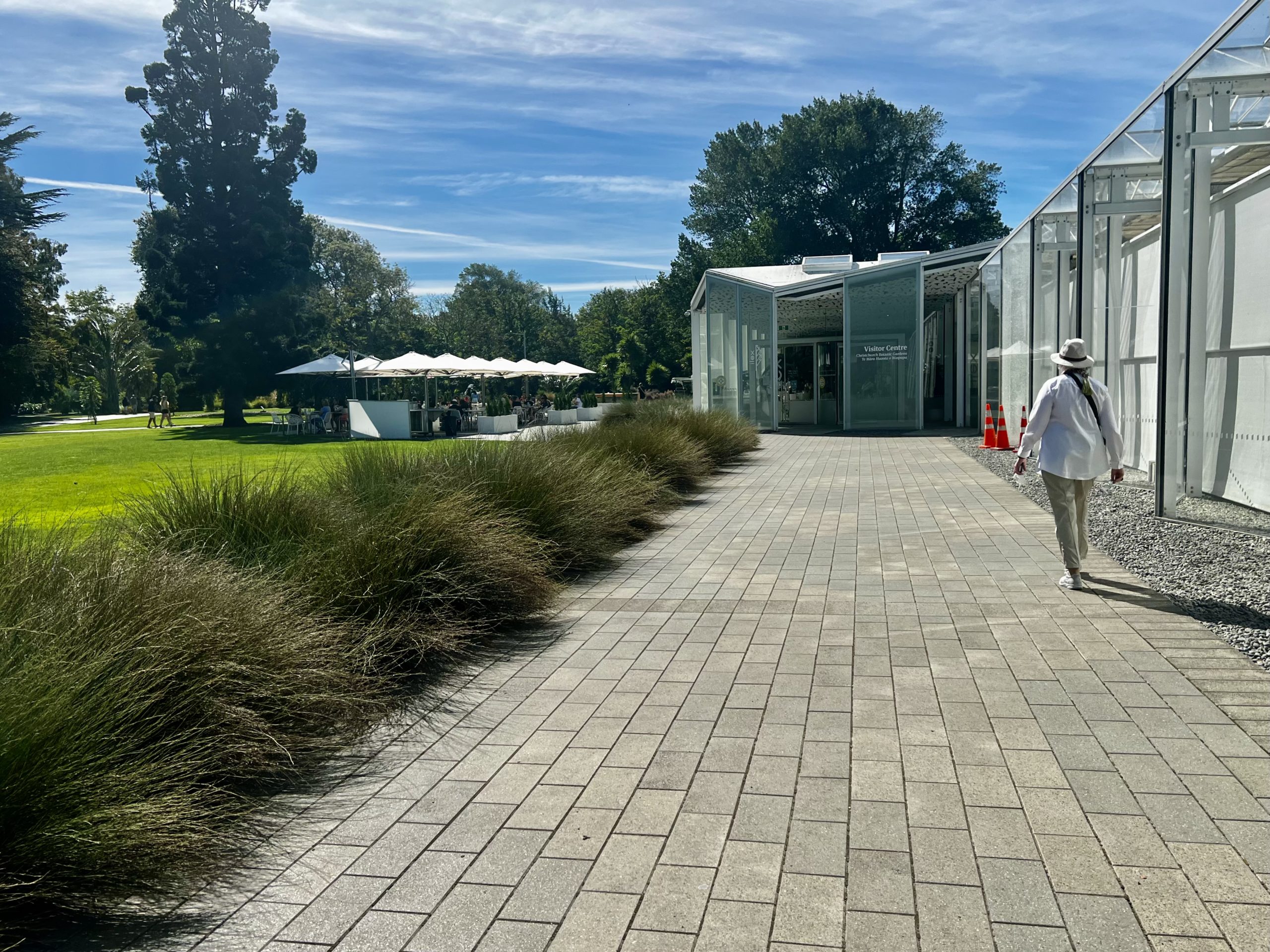
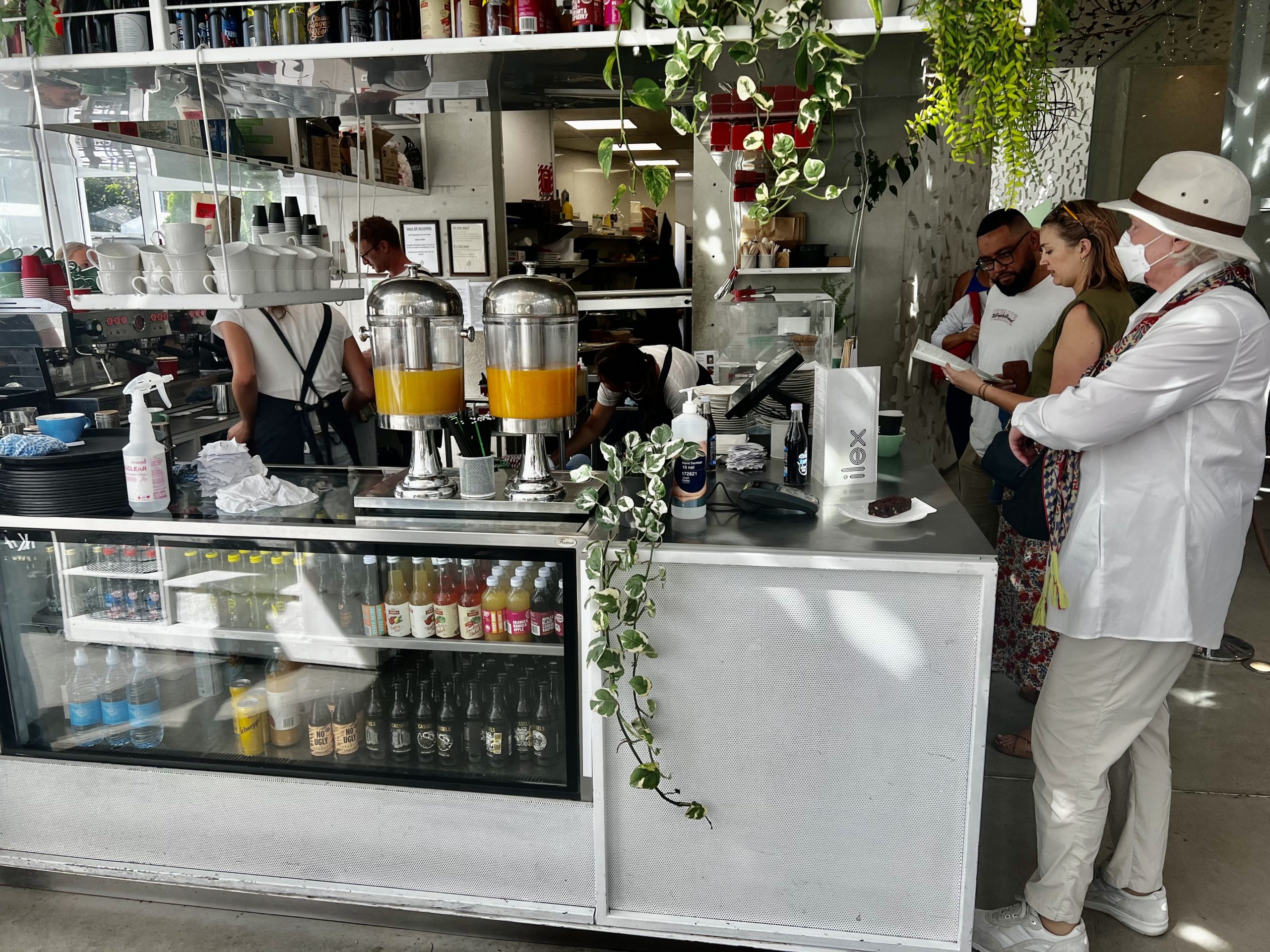
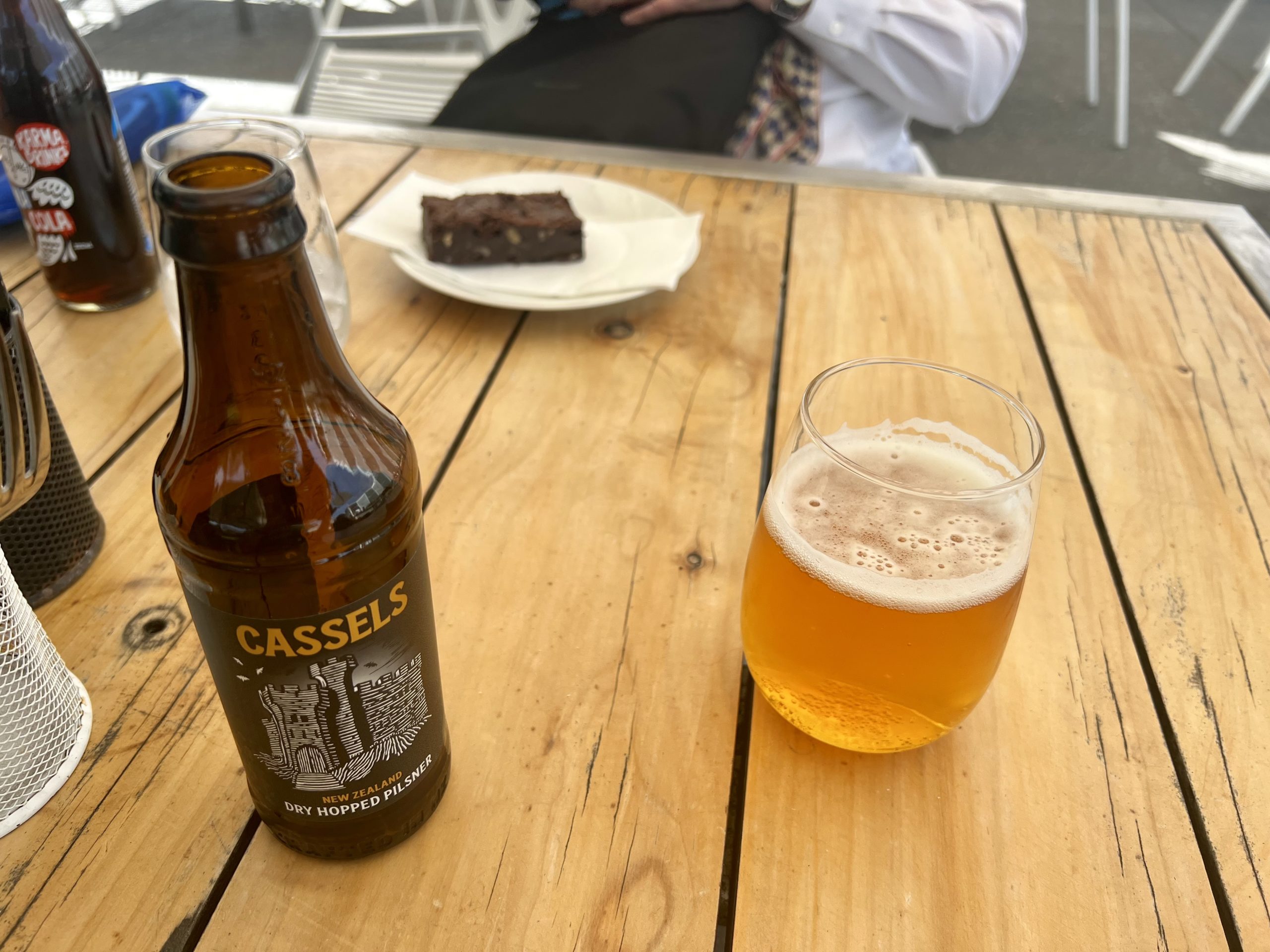
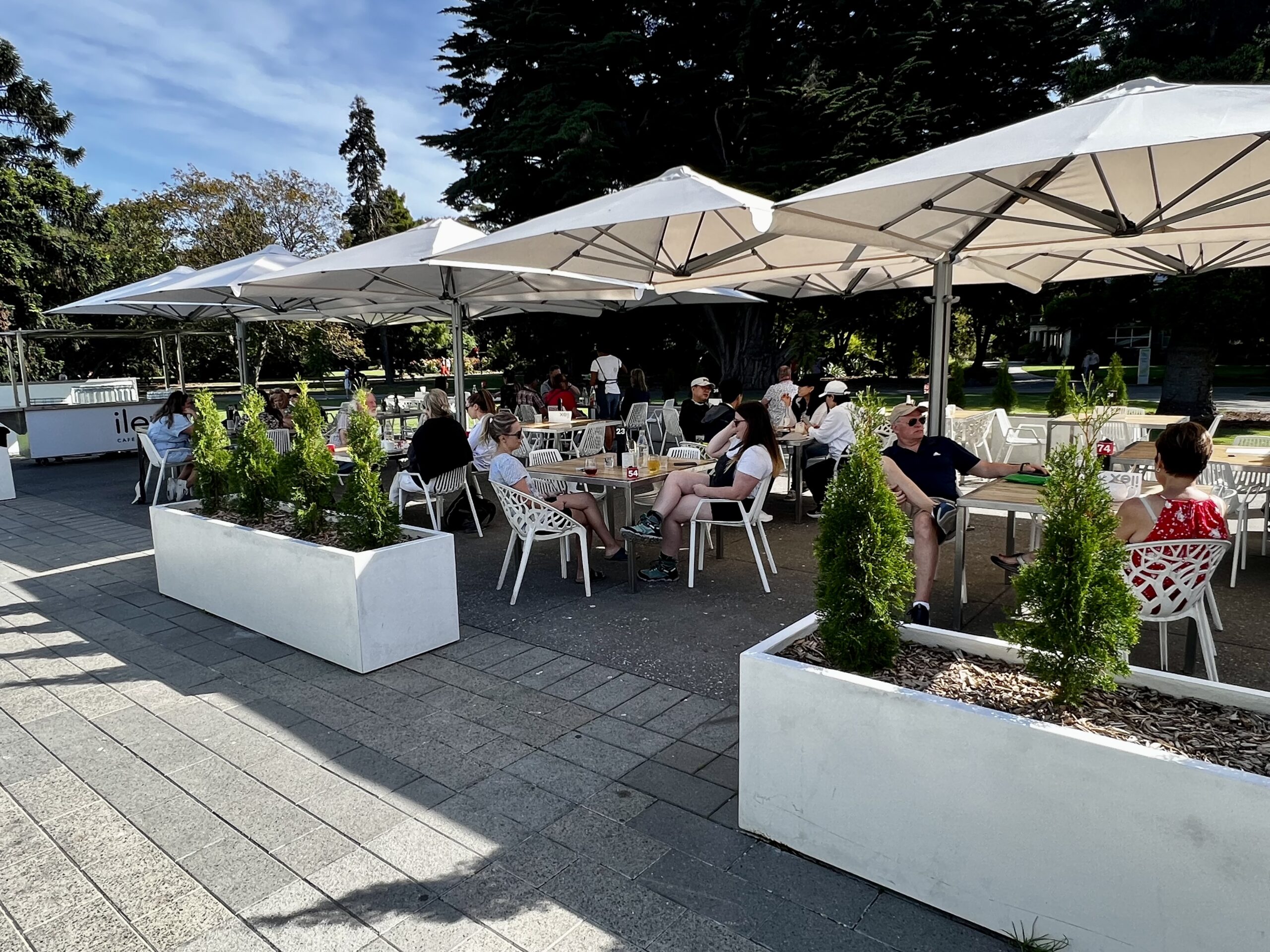
Bonnie thinks the botanic garden is the loveliest she has ever seen. It combines the best of plant collections with the feel of a London park. Broad pathways, green lawns, enormous trees, water features, all beautifully maintained. We spent a couple of afternoons there, with stops in the cafe for chocolate dessert and a beer.
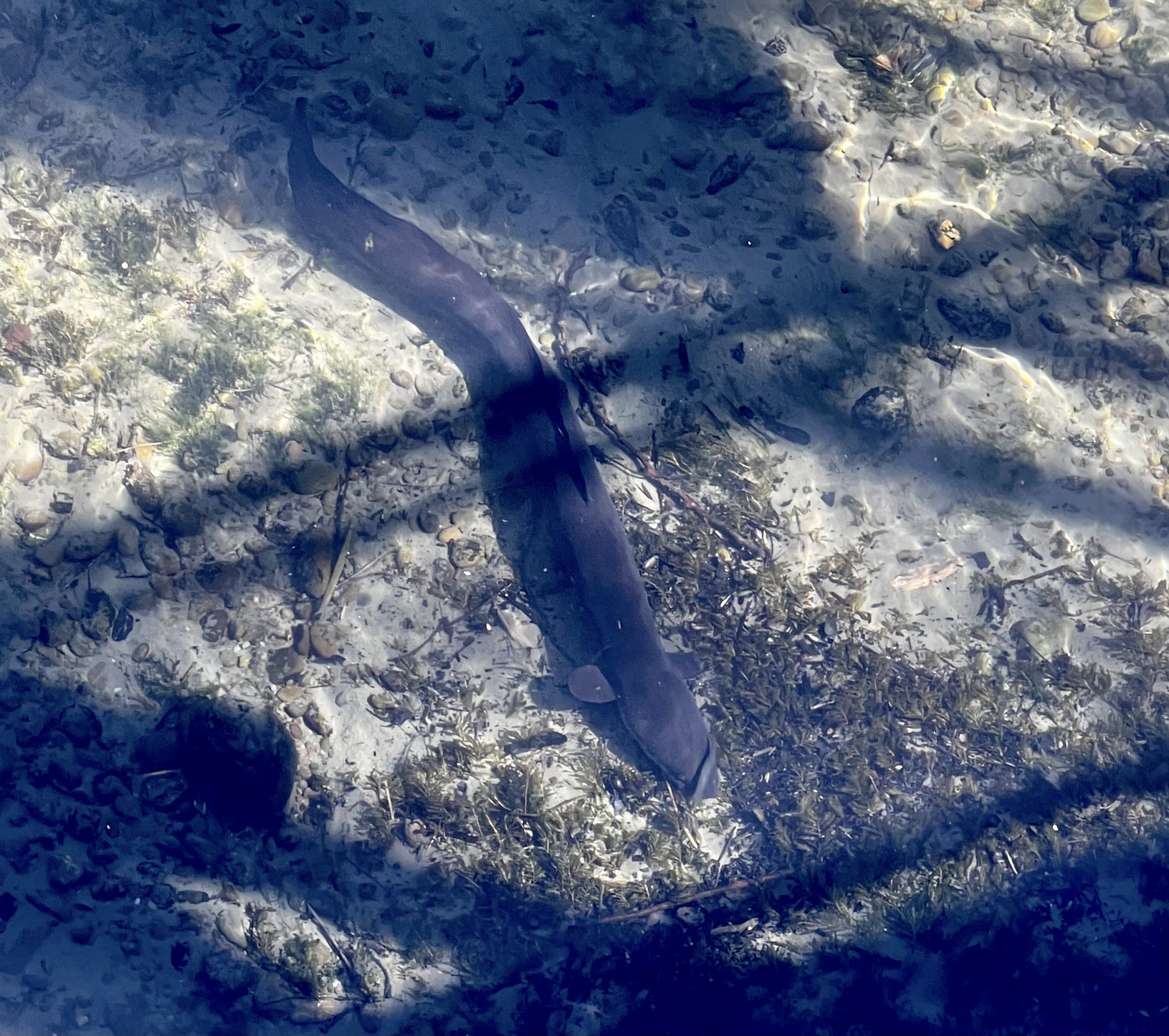
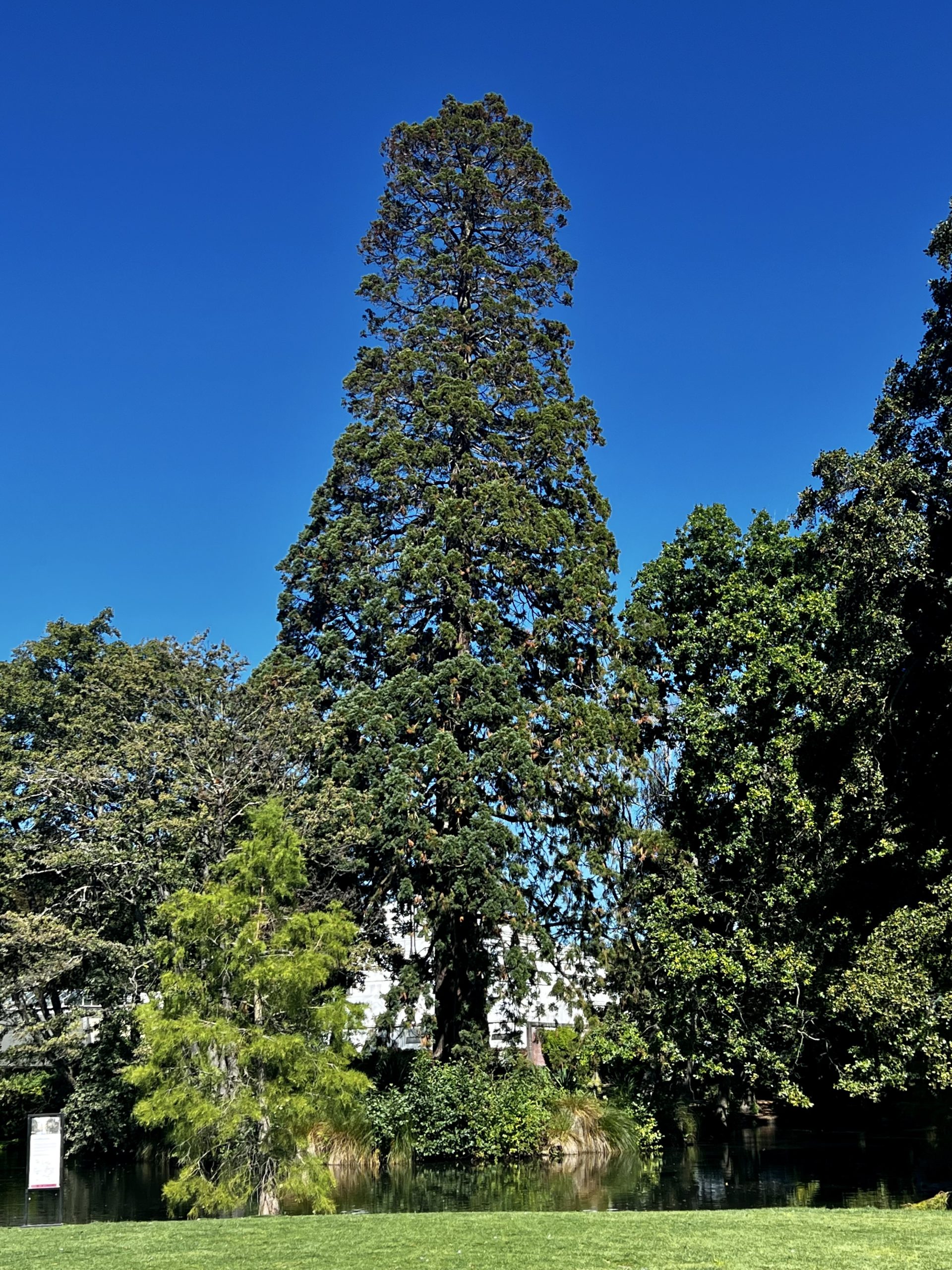
Robert had not seen so many tuberous begonias used before like this.Freshwater eelGiant sequoia redwood. Probably 150 years old. There are many in the gardens.
Quake City Museum
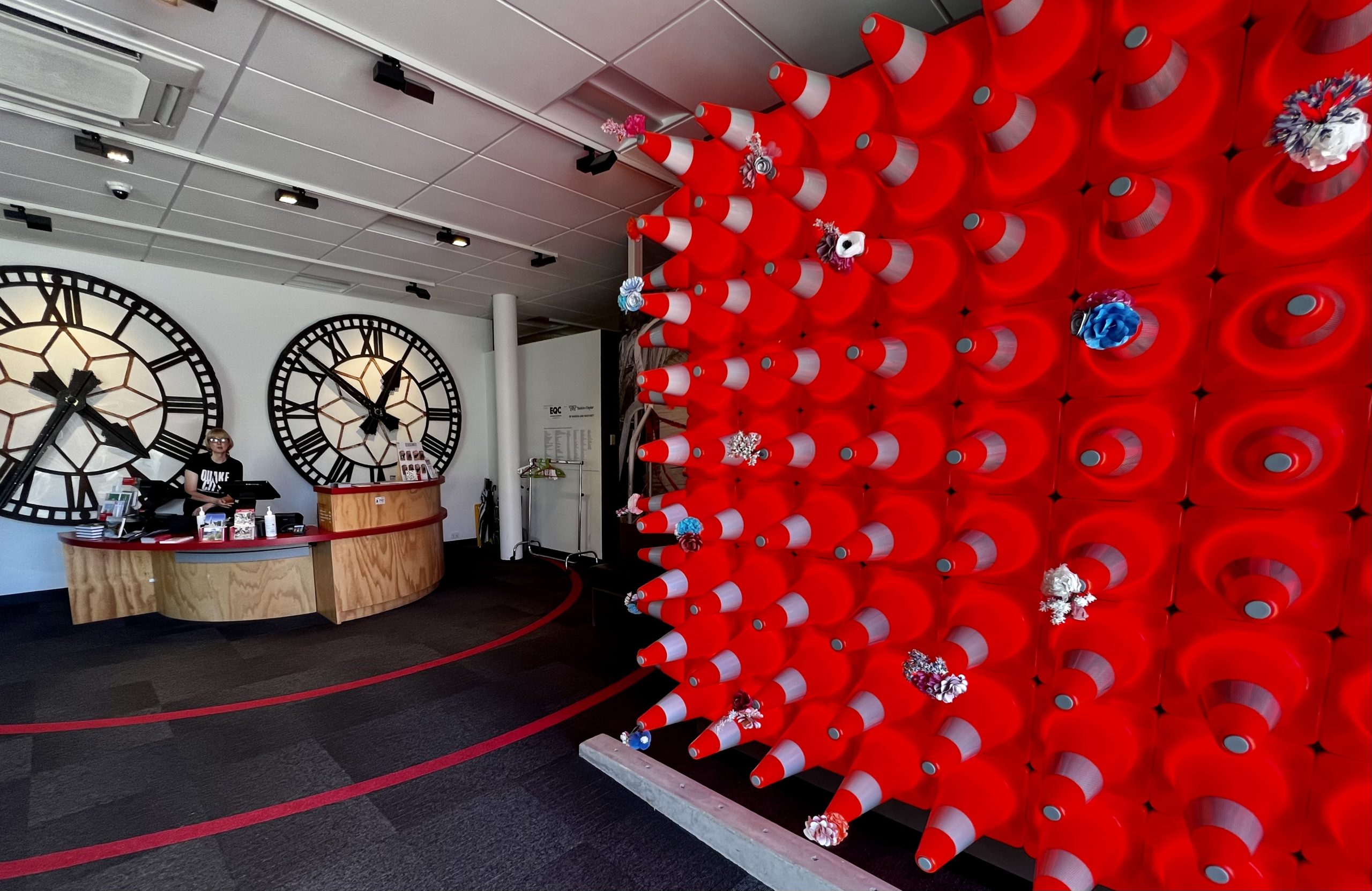
Quake City, the small museum documenting the earthquakes is excellent. The area has been hit by earthquakes in the past up to an estimated 8.0+ magnitude.
The CathedralVideo!
Christchurch Art Gallery
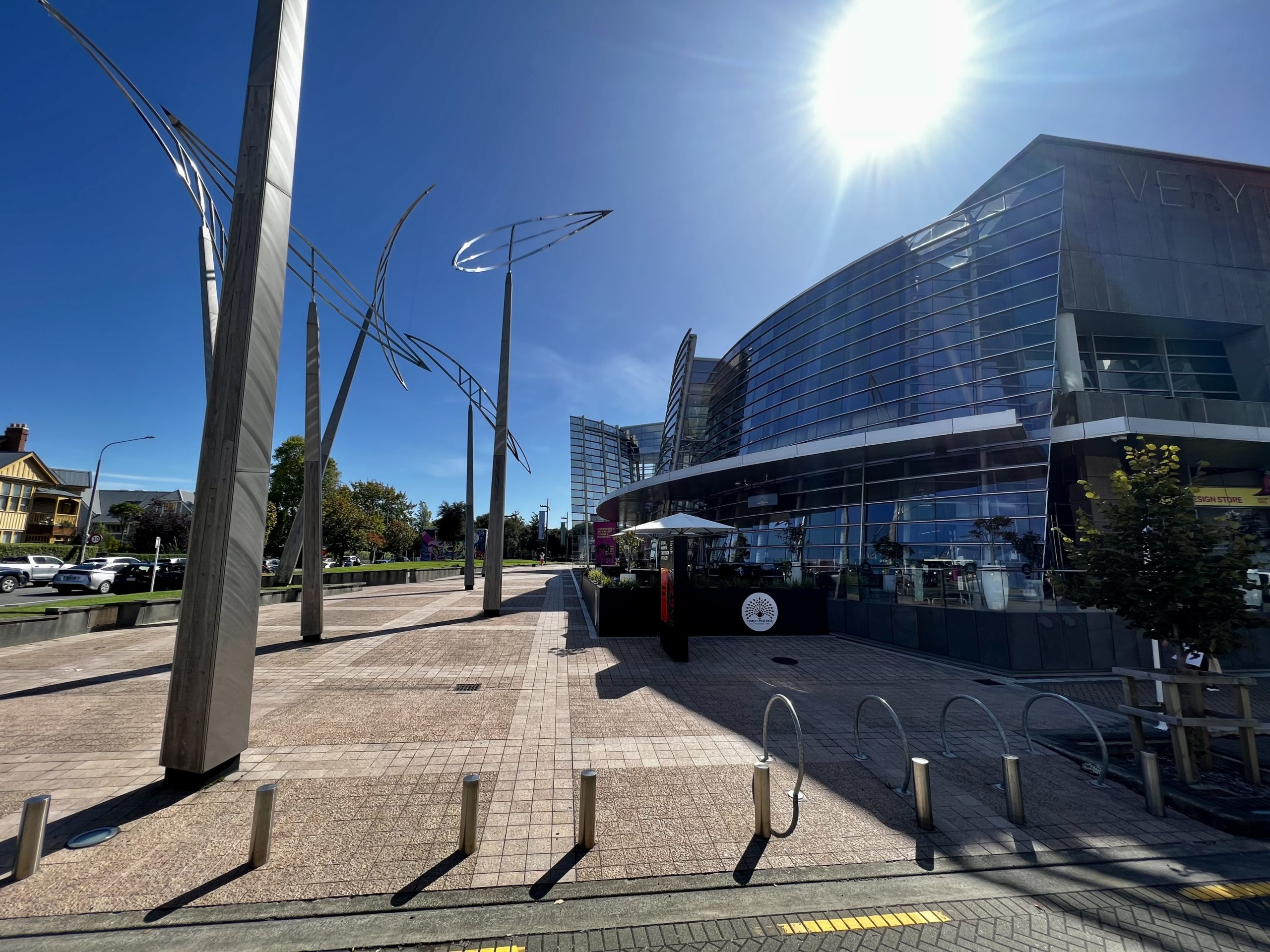
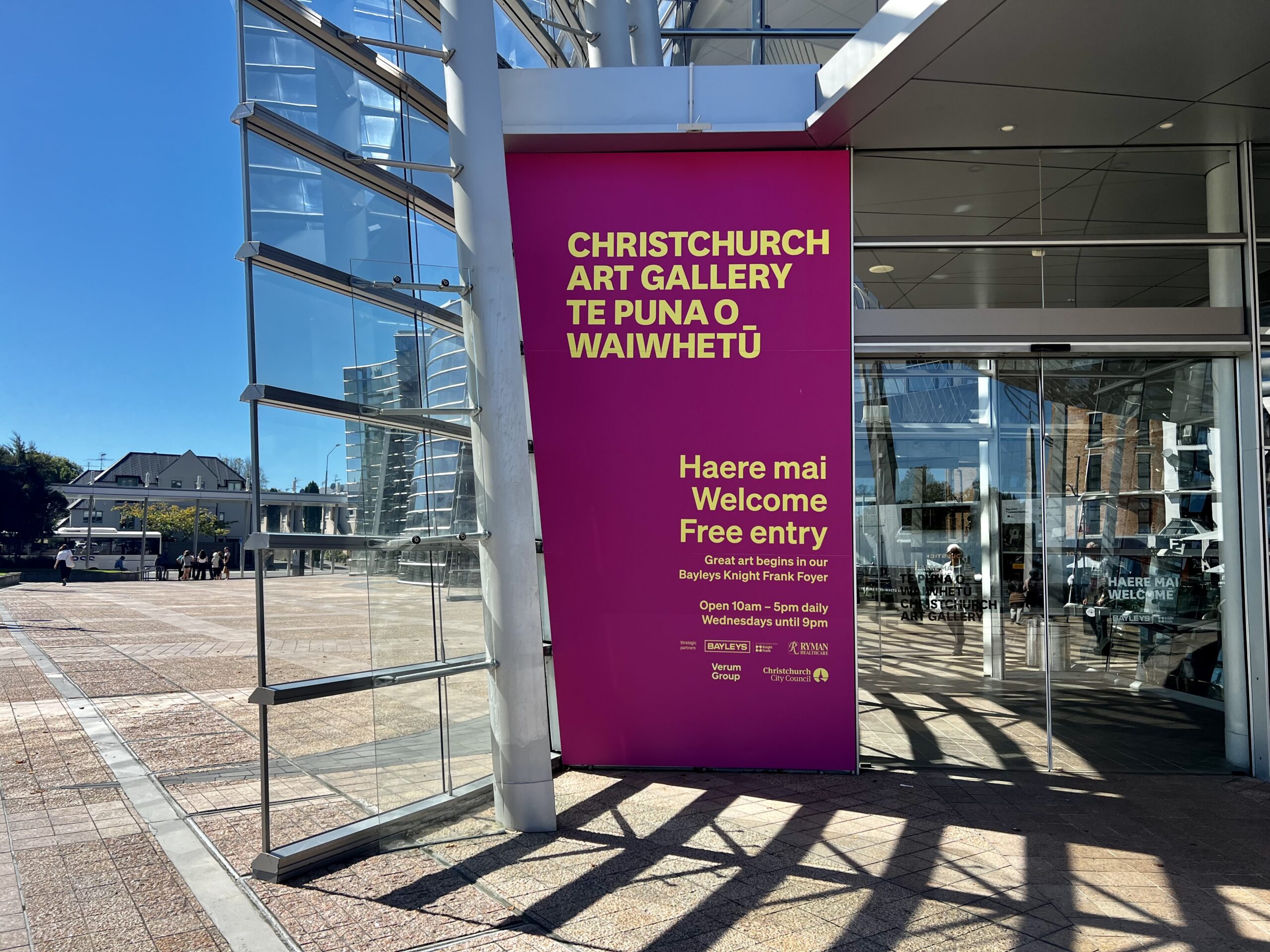
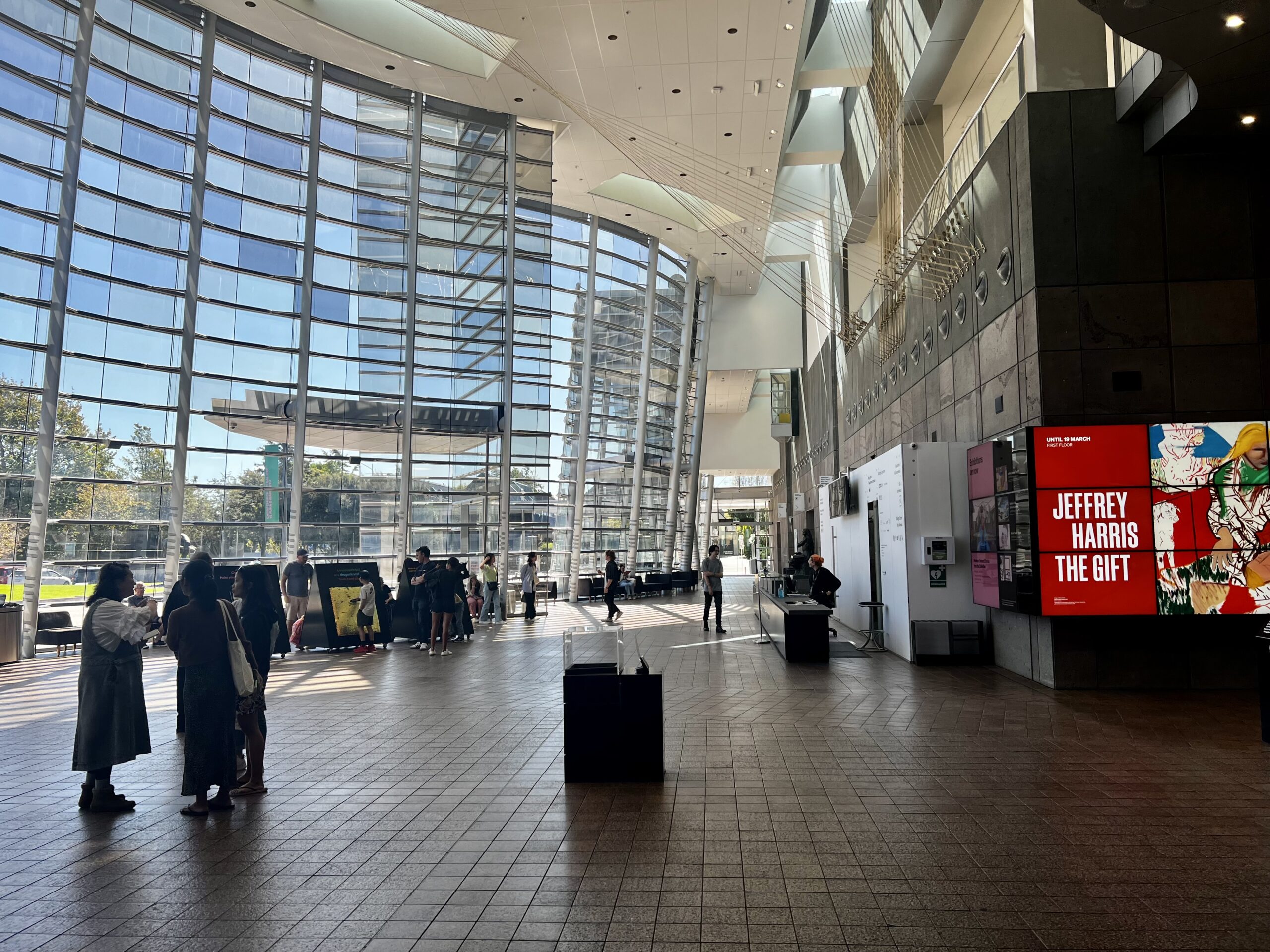
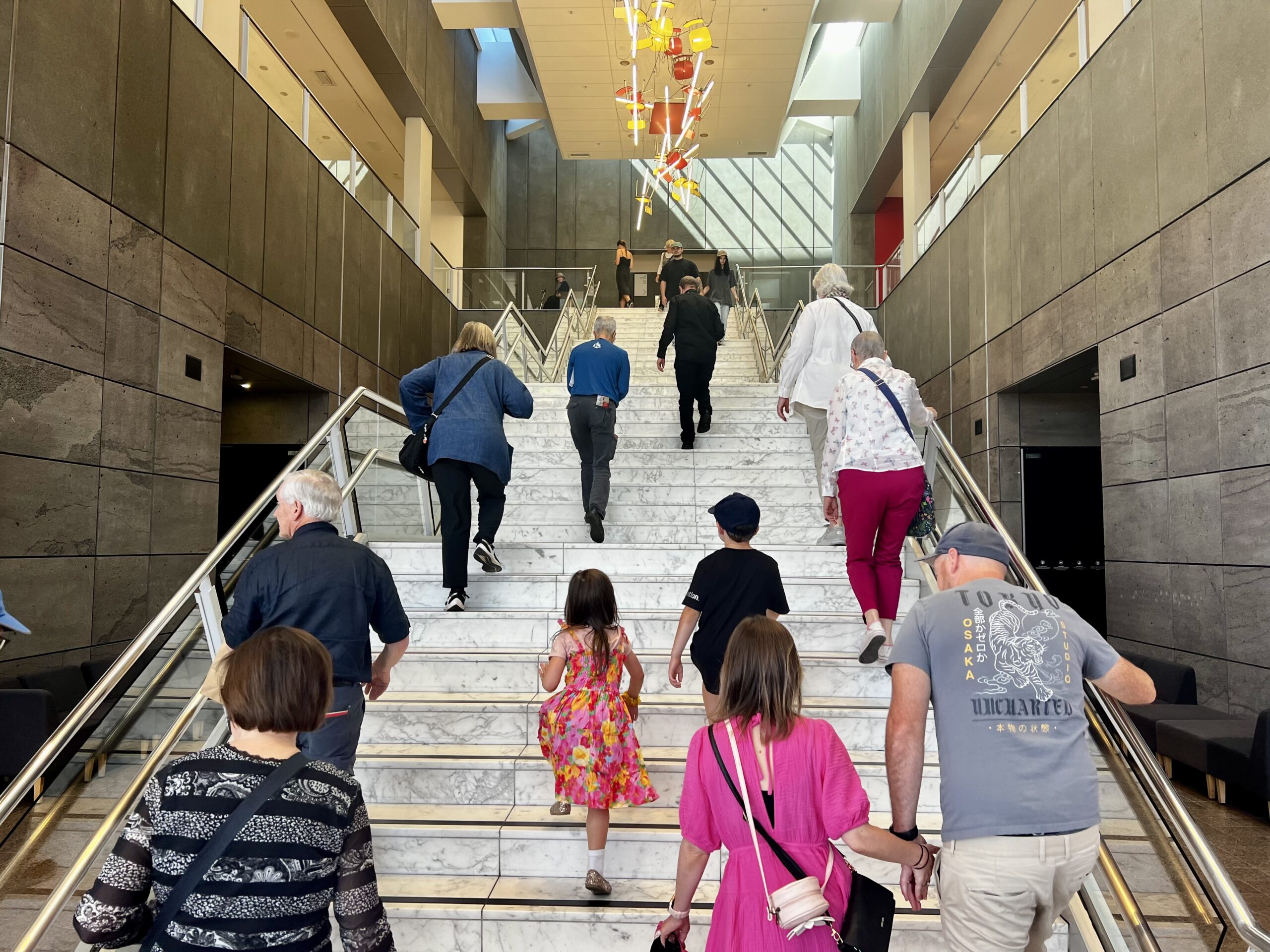
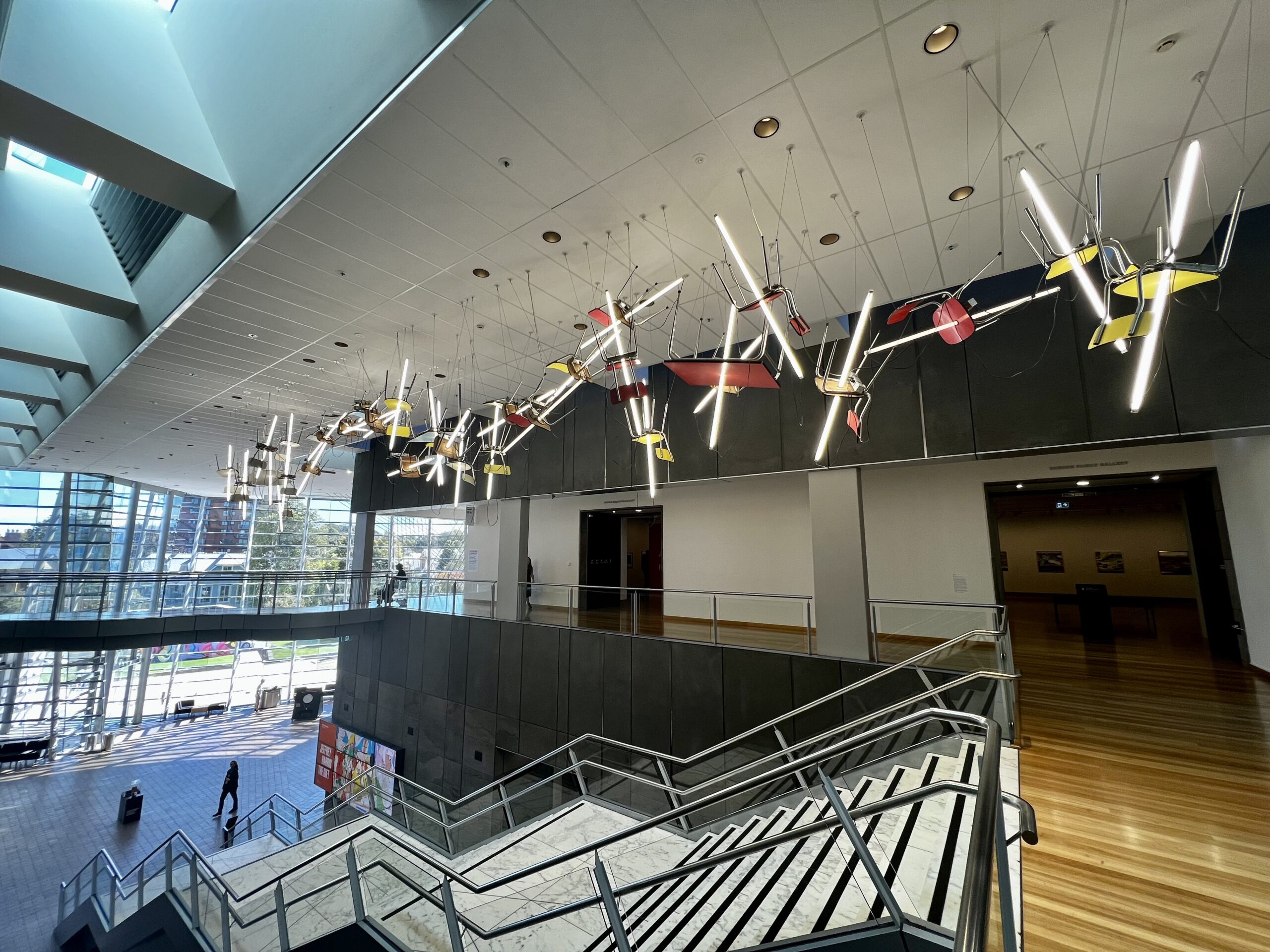
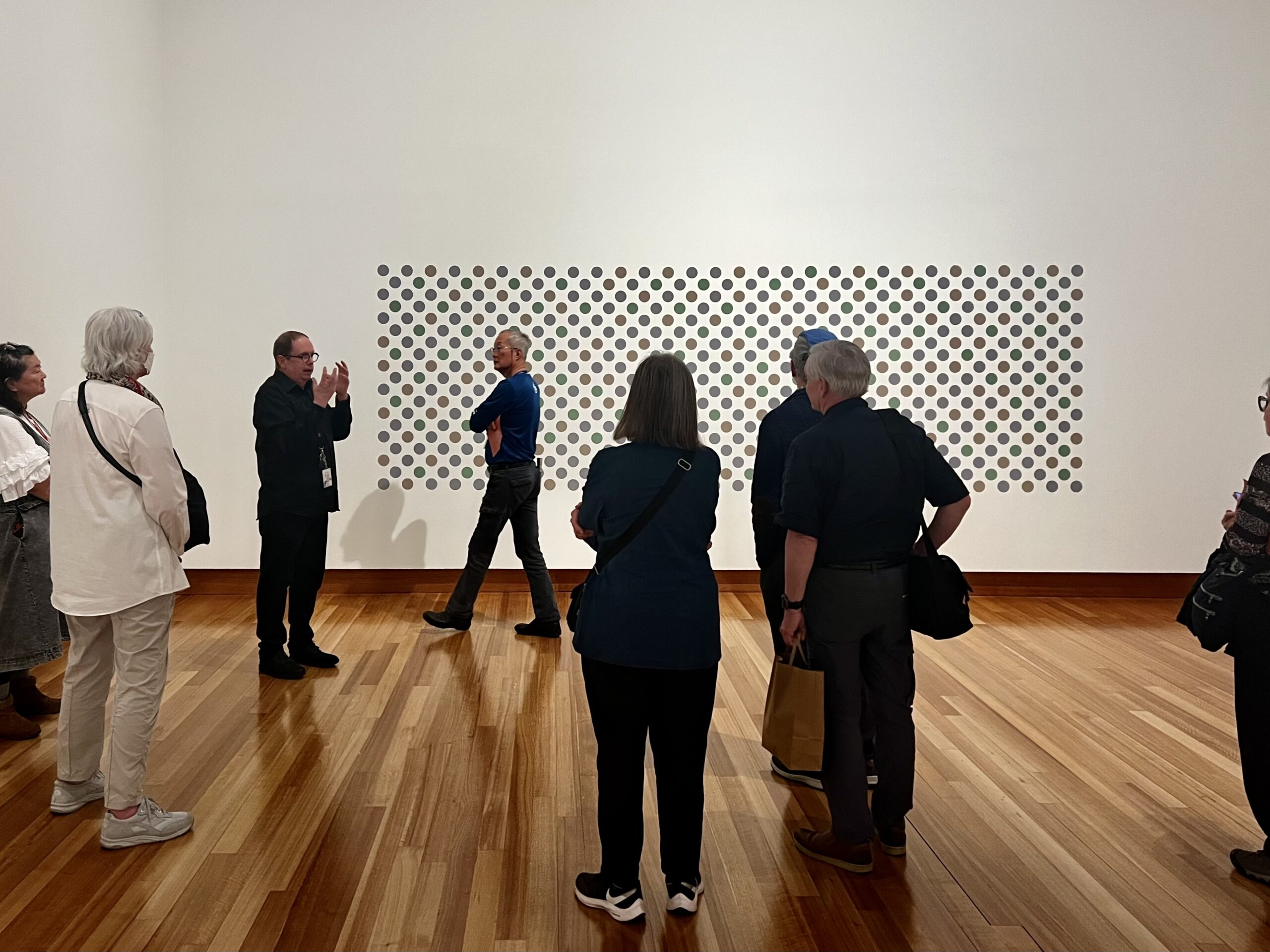
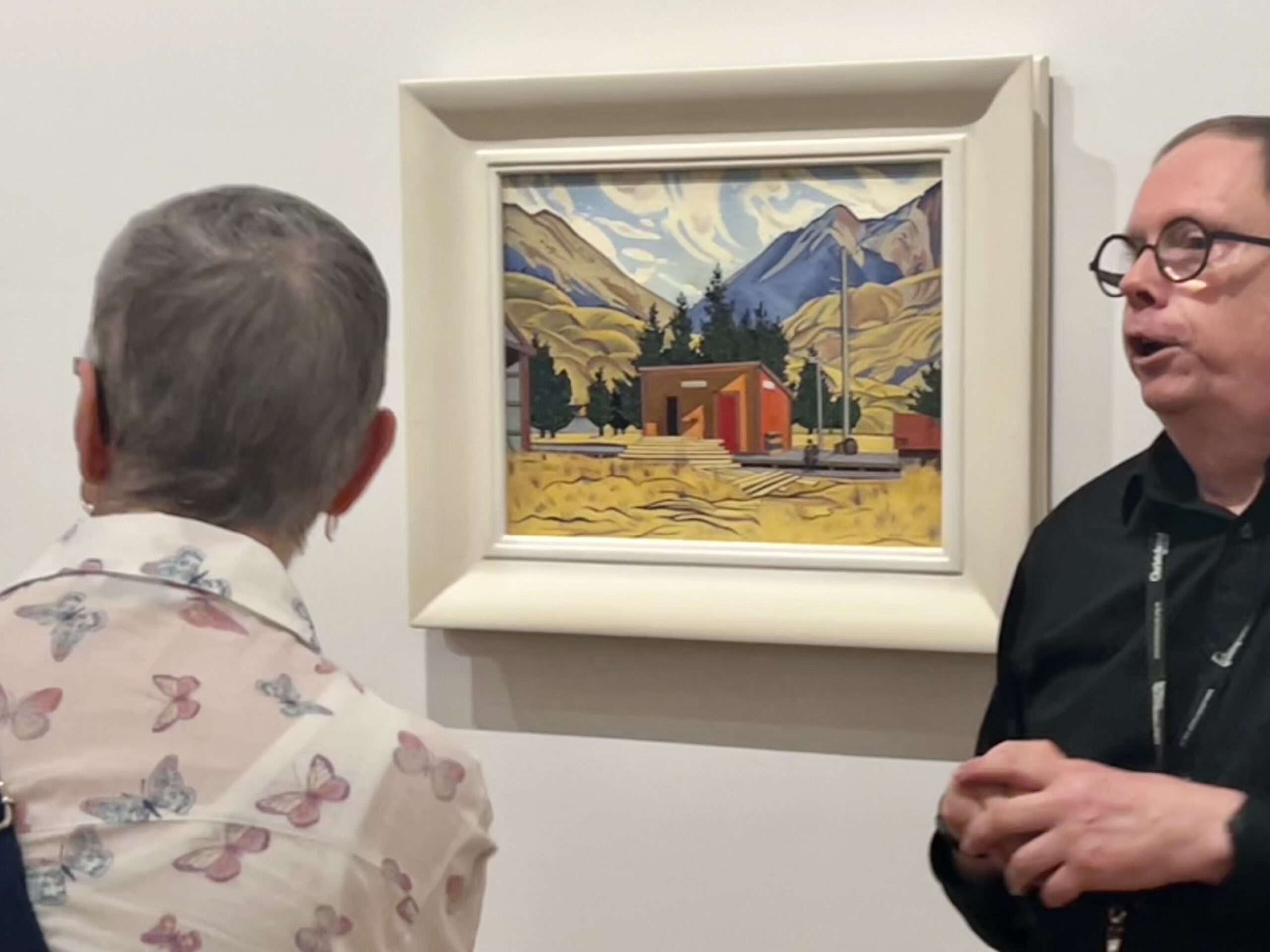
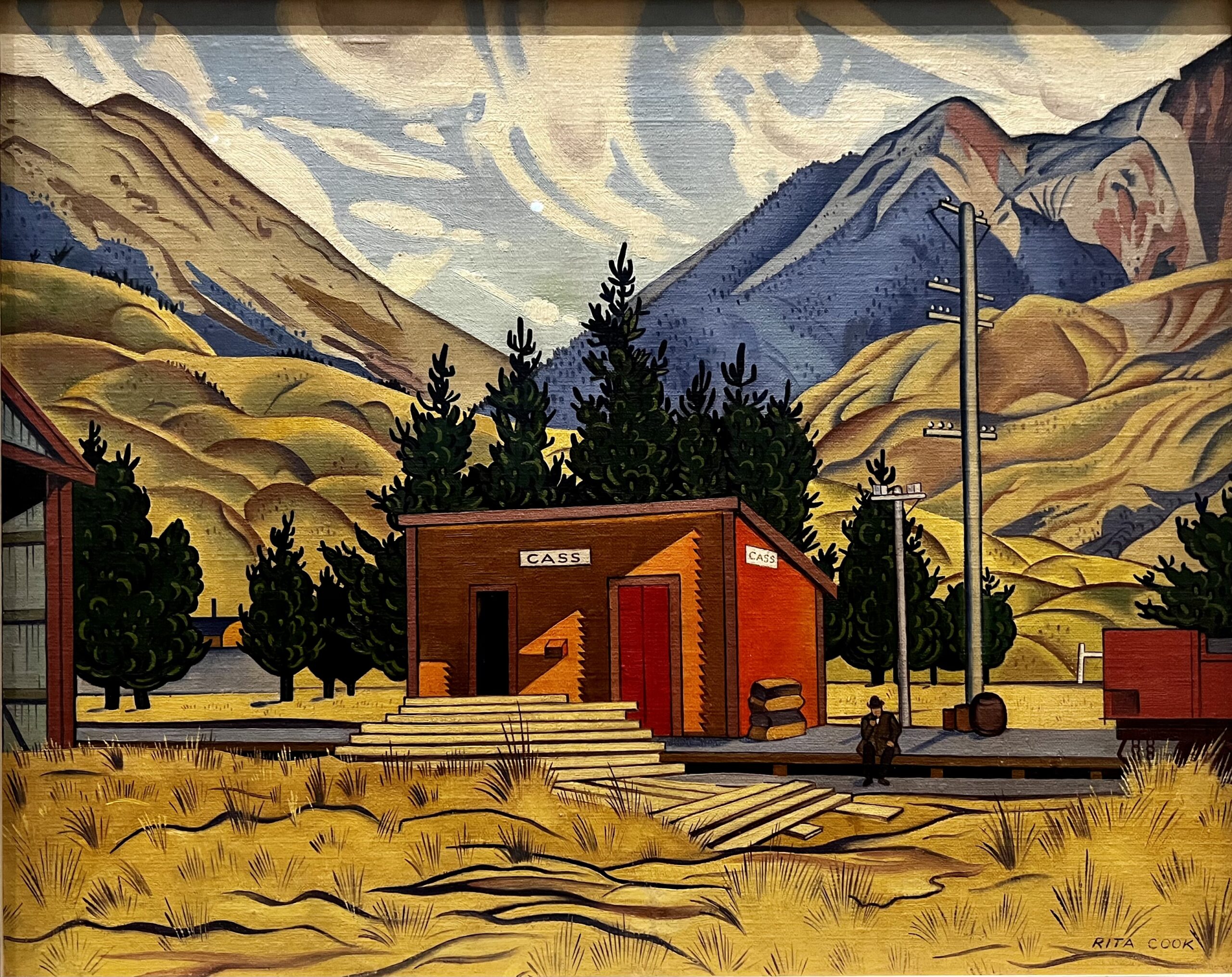
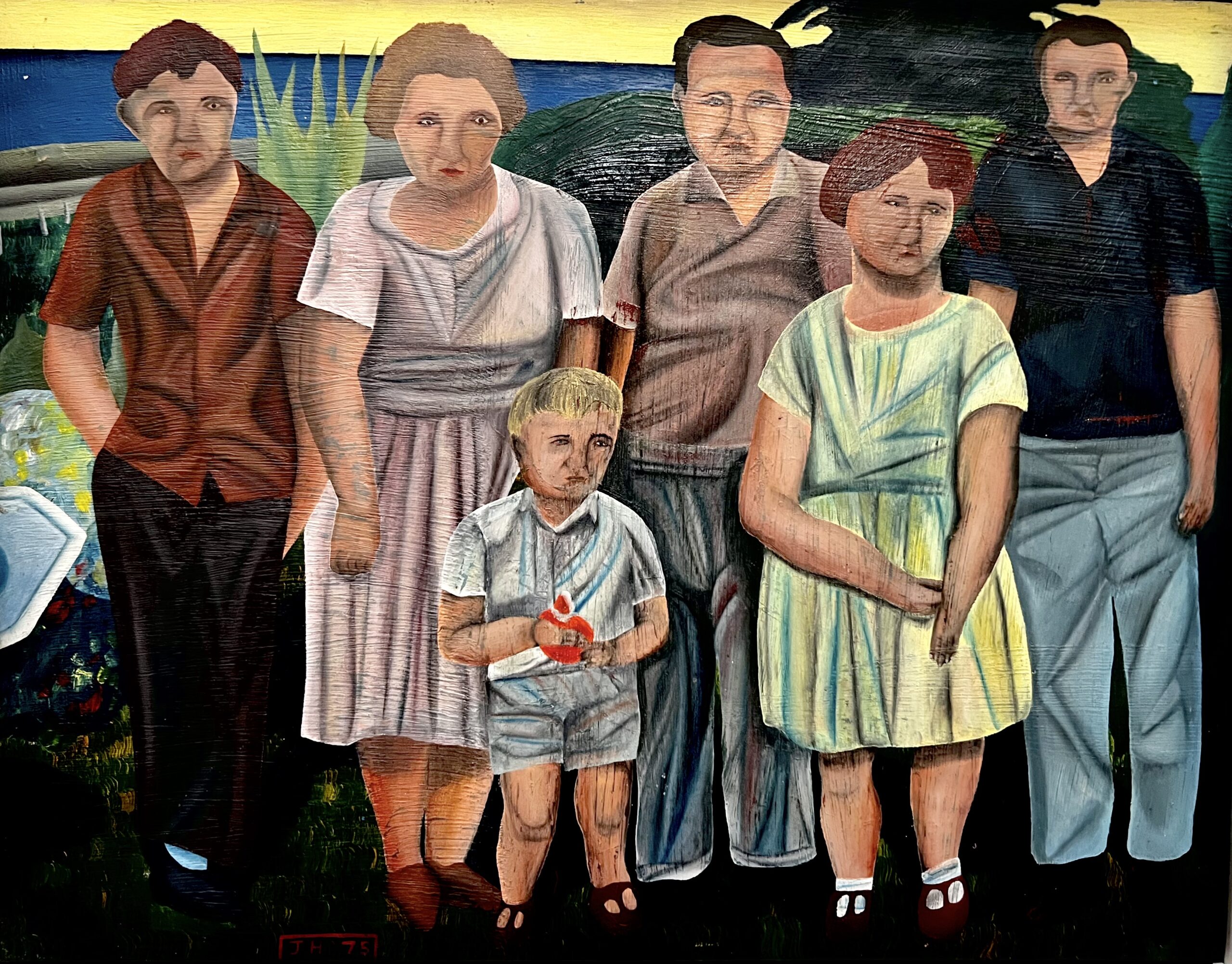
Bonnie was skeptical about the art gallery in such a small city, but we joined one of the daily curator tours and were immediately won over. Much of the art in New Zealand over the past century and a half has focused on the landscape. The collection of prints and paintings is less experimental than what we see at SFMOMA but much more approachable. In addition we saw an overhead installation of kitchen chairs and tables pierced with neon tubes that had been created for the Venice Biennale. Delightful.
Aoteroa New Zealand – 1936 -Rital AngusFamily at Christmas – 1975
Fashion Report
Saturday night in downtown Christchurch: dresses, dresses, dresses. Long and short. Lot of flowered fabrics. Lots of cleavage. Loose tiered dresses are especially popular in this mild weather at the end of summer. Black and white gingham is everywhere; in one busy block Bonnie saw three gingham dresses at the same time. Absolutely no high heels except in store windows. Some Birkenstocks and a few other sandals, but mostly sneakers of all kinds.
Downtown Christchurch is also a good place to load up on New Zealand brands. In California we know Smartwool and Icebreaker. Here there is also Mons Royals, Kathmandu (with an H), Macpac, and probably many more. They all carry a full array of nicely designed outdoor clothes in fleece and goretex. They have backpacks, hiking shoes, water bottles, and everything you would find at REI. Robert bought some more fishing shirts—one in aqua. Bonnie got a quarter-zip fleece in dark sage.
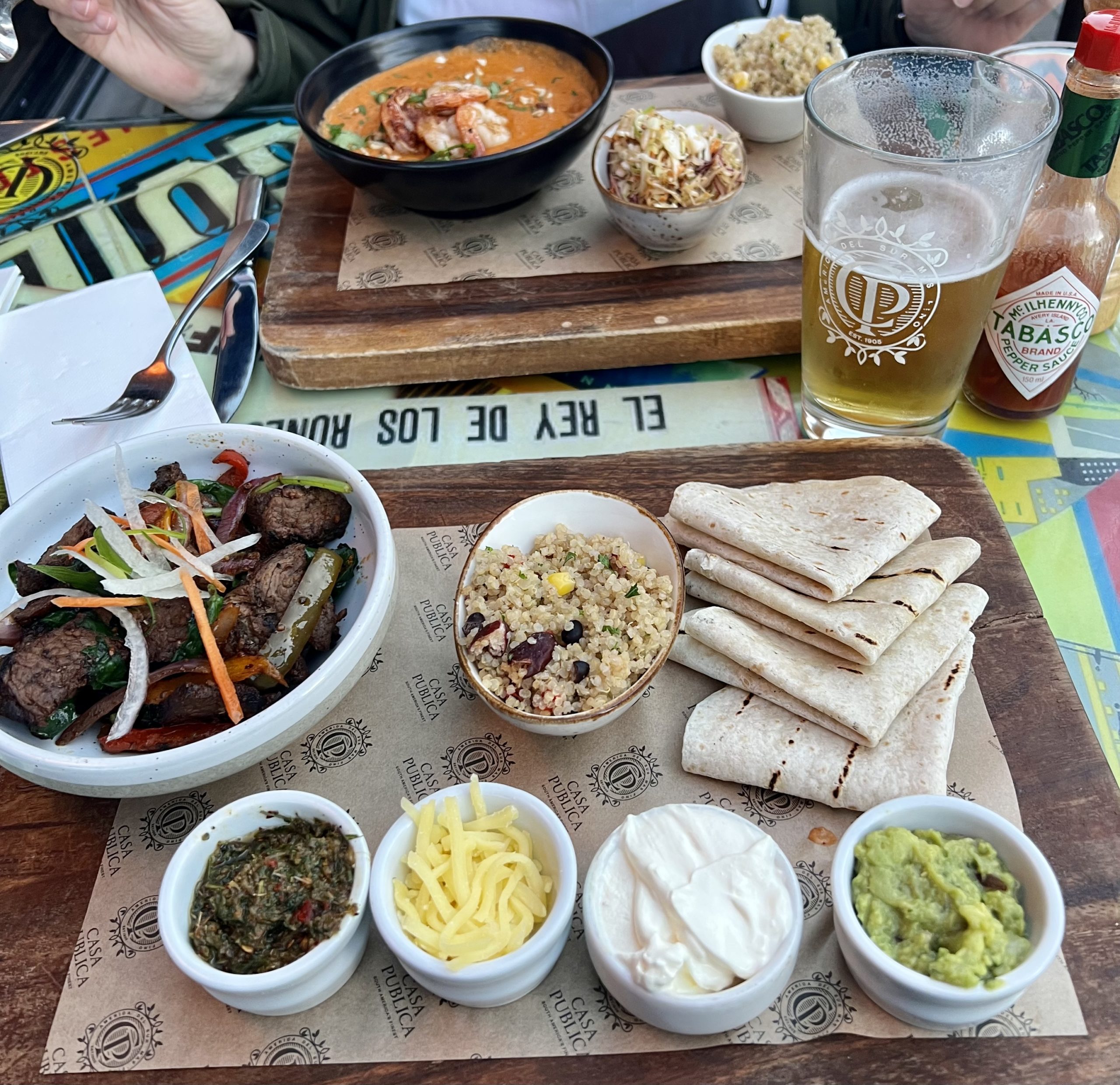
Food and Beer
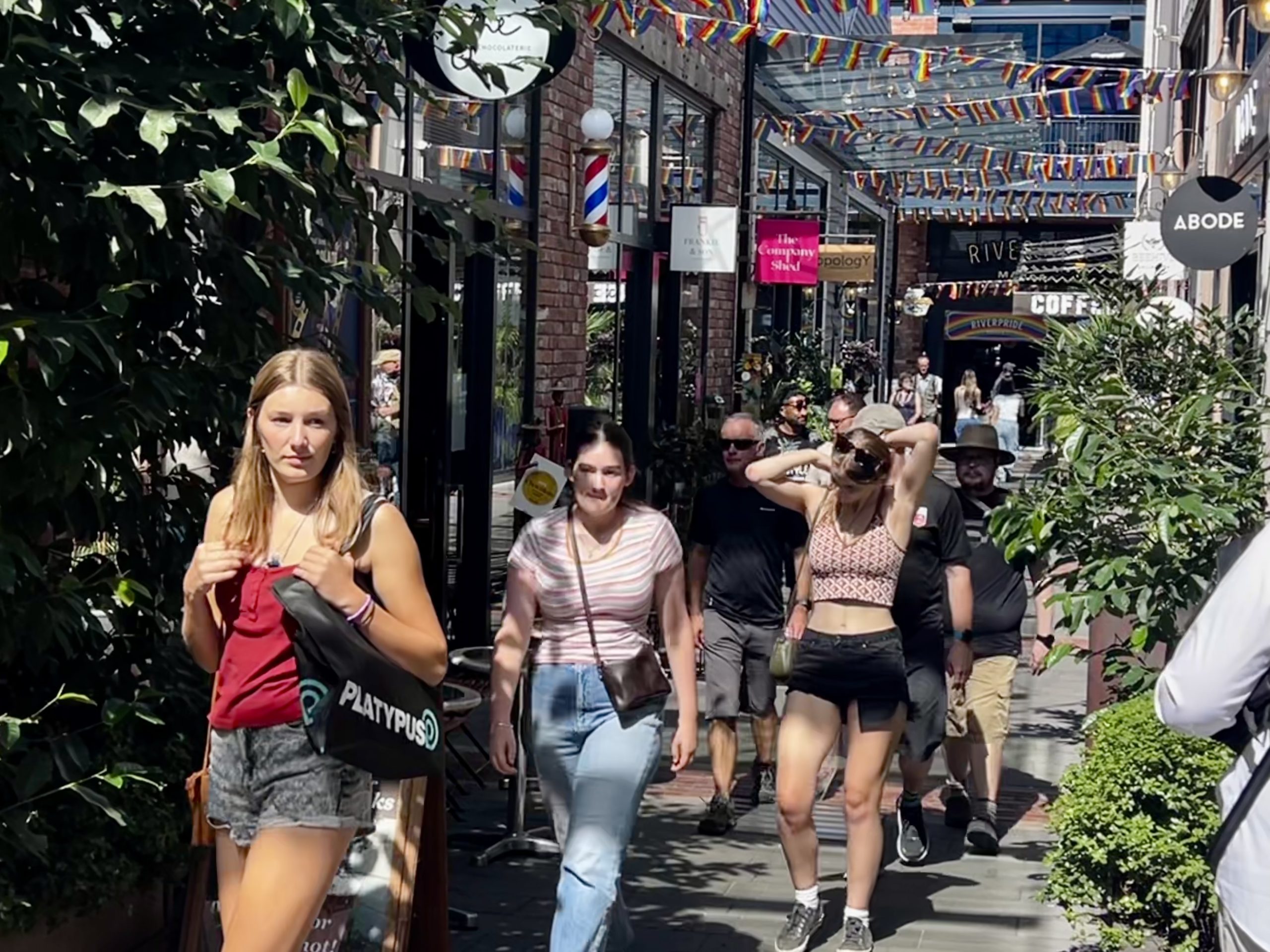
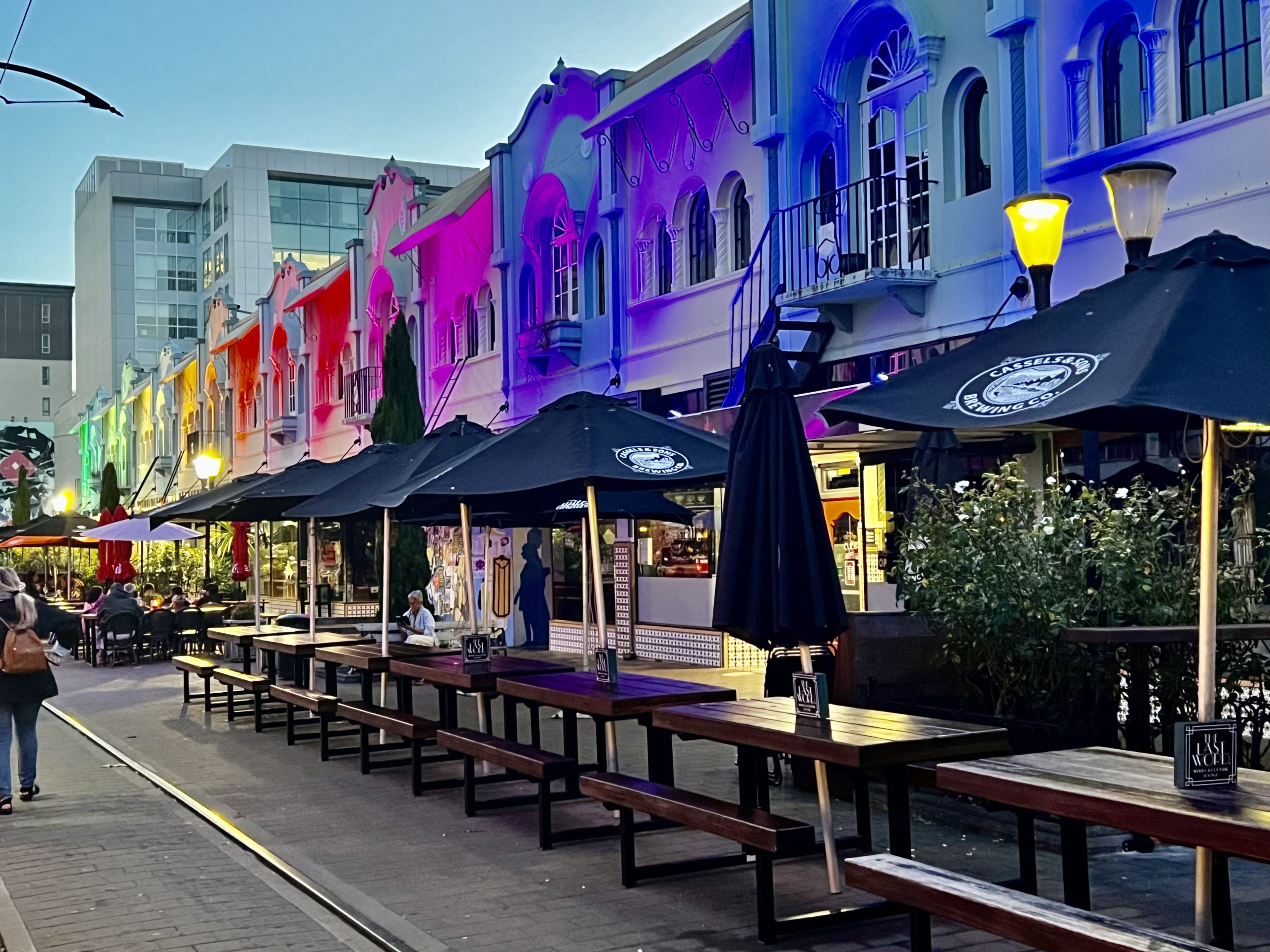
It was Gay Pride Week too! Colorful lights and banners everywhere
03 – 09 March 2023 We fished rivers in two more locations: near the towns of Gore and Twizel.
On the phone we asked Bonnie’s brother Richard if he had seen the first fishing post, and he said Yes. It was full of fish. Our work is done. Actually, for Robert, each fishing post is way to record his thoughts on the styles and techniques each guide offers, what casting, playing, and retrieving habits he should correct, learn, and improve upon. Also, every post records the scenery of each location because the New Zealand landscape is magnificent and varied.
Gore
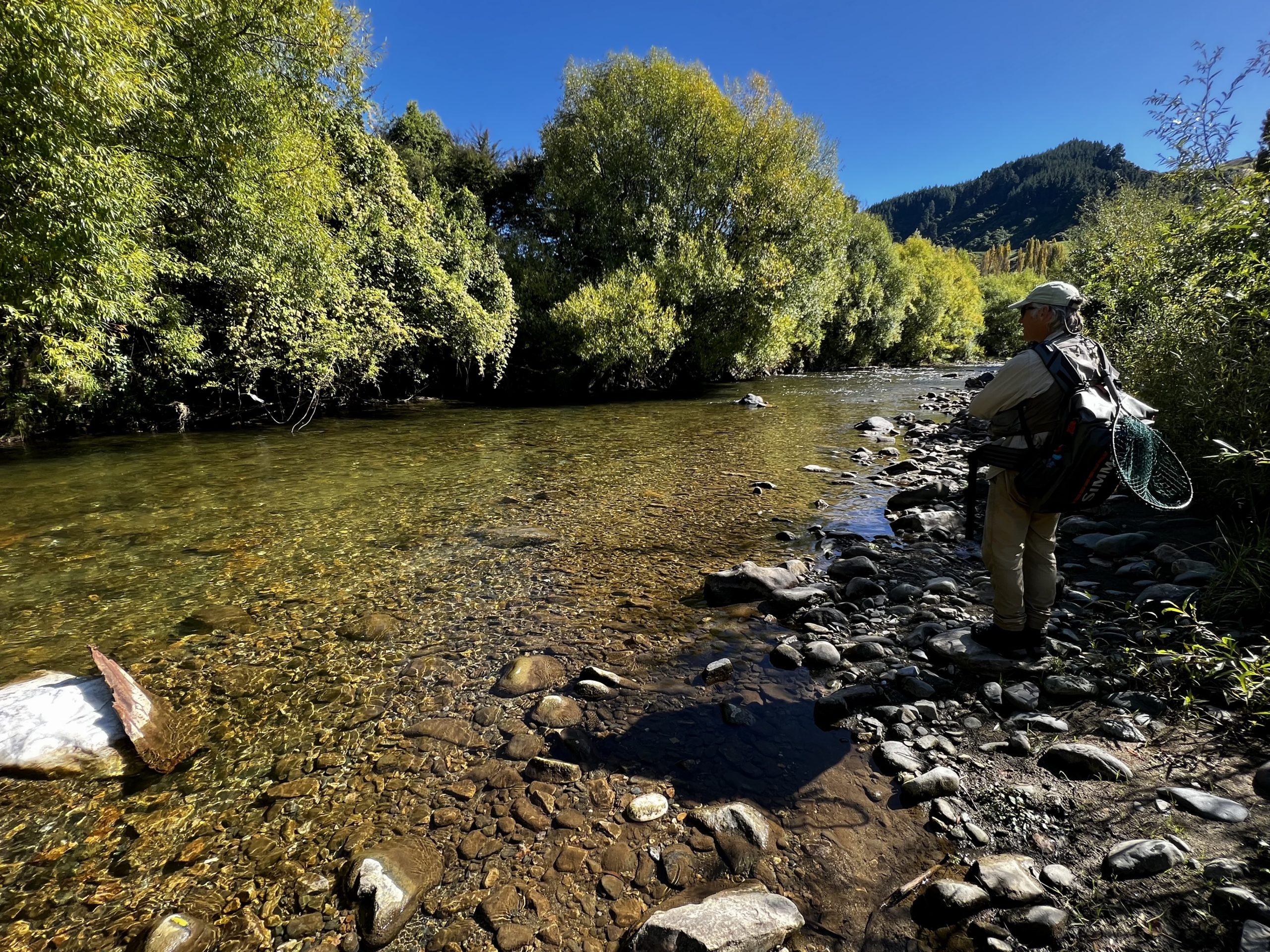
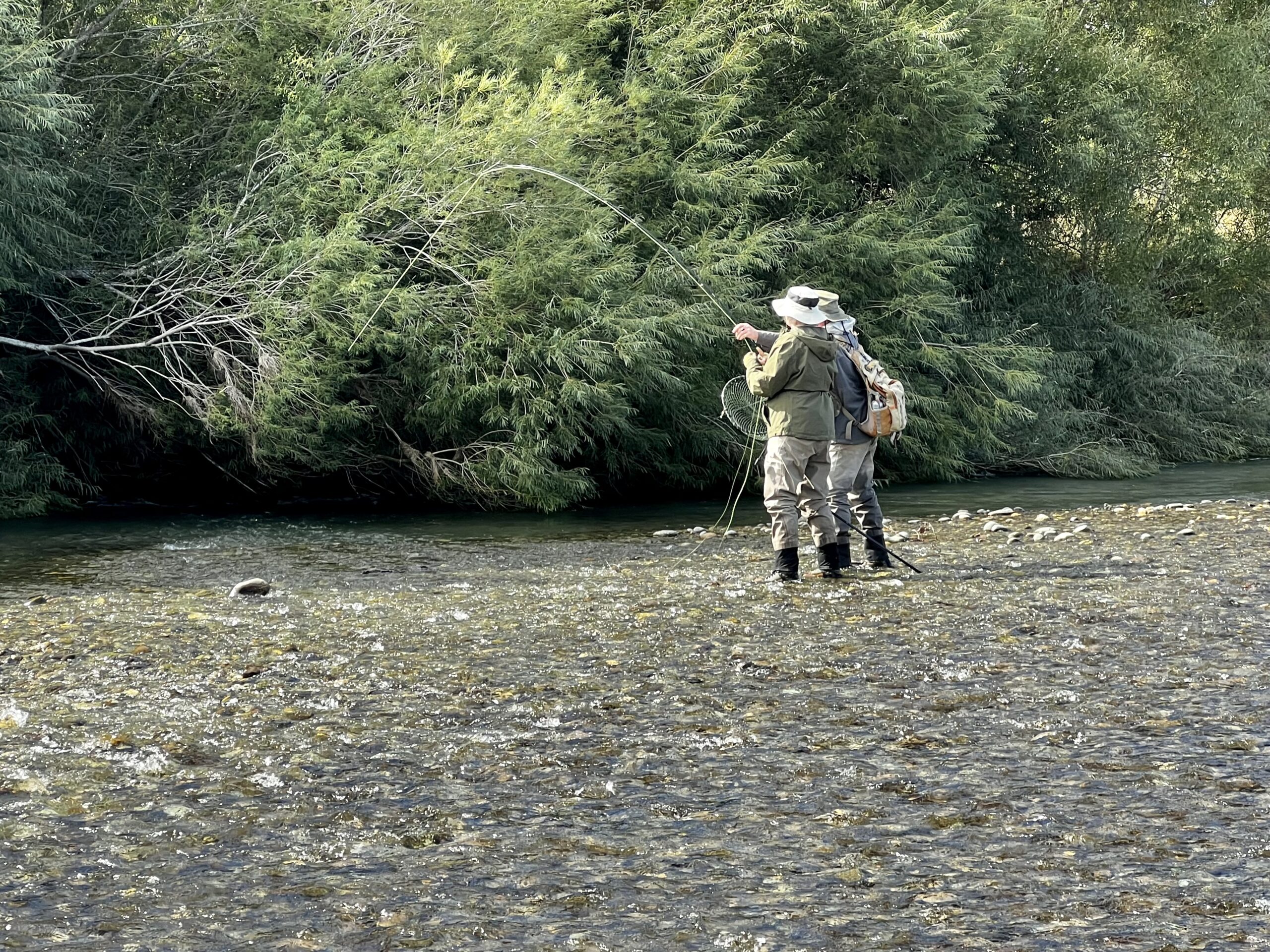
Our guide in Gore was Daryl Paskell. He is a man on the hunt—for fish. He is constantly peering beyond the glare of the water to spot a black or grey smudge that turns out to be a brown trout of eighteen plus inches. His favorite word is “Yip,” which he shouts when he sees a trout take a fly. At times Robert overreacts to his enthusiastic shout and either launches the fish out of water or breaks the line. In one case, Robert lost the complete leader, something Daryl has never seen in forty-seven years of fishing.
We were lucky to secure him as our guide. He took on only three new clients this year. Some regulars fish with him for twelve days or twenty days at a stretch. Like many of his colleagues, he does not only make his living as a fishing guide. He is also a wool broker, helping farmers sell their wool through auction or directly to offshore clients. Some distinguished fly fishers use his services. The next day he was guiding Nelson Ishiyama, an avid fly fisher, owner of a well-known fishing lodge in Montana, and a member of the Golden Gate Angling and Casting Club in Golden Gate Park where we have run into him. Nelson was fishing with Yvon Chouinard, the founder of Patagonia. We saw both of them eating dinner at the Howling Moon in Gore. Seeing these two world-class fly fishers confirmed that we are fishing in the right location at the right time of the year.
Daryl is precise in his directions. Fish a bit more to the left. Now, land your fly two feet up stream and one foot to the right—to the right! Nice cast. He likes a sparse fly and will consistently trim off excess foam or feather. Robert noted that New Zealand guides mostly favor natural-looking flies. No glitter or flash that you often see in the USA.
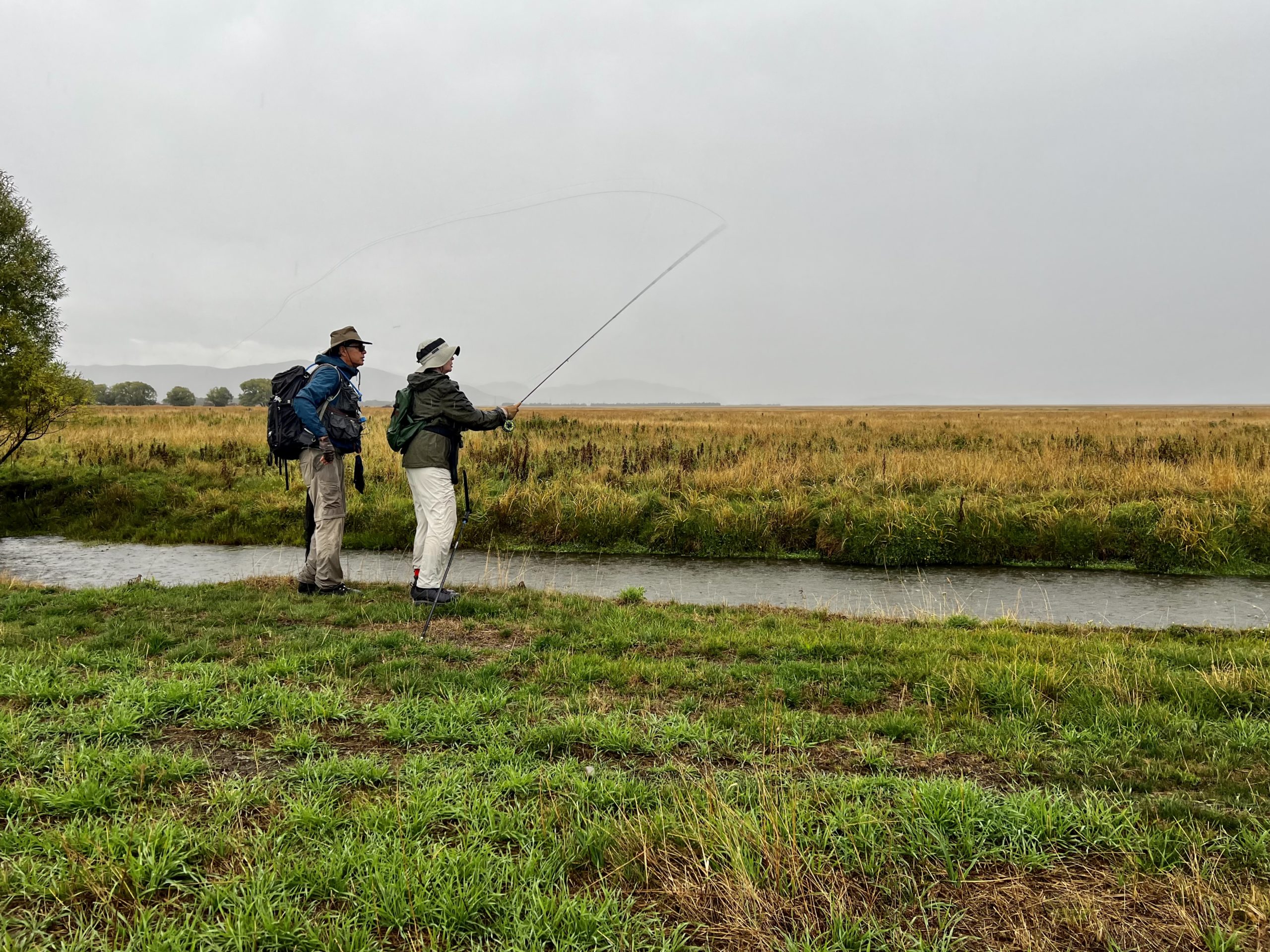
Daryl is also one patient guy, sustaining Robert’s multiple tangled nymphs and hook ups in trees. He is a very keen instructor too, providing tips on how to cast multiple nymphs by roll casting before they come downstream to you and using one false cast before landing them in the location he directs you to. It is similar to spey casting. As Daryl says The more time the fly is in the water, the more chance you have of hooking a fish.
Daryl helped Robert a lot on how to play and land a large fish. Robert is not used to hooking a fish in excess of two pounds. As Daryl said, Robert will gain confidence on how much power to put onto a fish to lead them to the net, keeping the fish out of the fast current, playing them to the bank, holding the rod horizontally to maximize the pressure on the fish, etc. Whatever bad habits Daryl drilled out of us and instructions he provided will surely help us fish with future guides on this trip.
Also, you never know when you might assist your guide in freeing a sheep from a tangled wire. Daryl spotted one and untangled it while Robert held it down. They are frisky critters and don’t stay around to say thank you.
Daryl likes to use 5 wt. rods and says they can handle large fish. He uses a 10-foot 5x leader and adds an additional 4.5 feet of tippet with additional tippet for the flies. We used the 5 wt. rod the first two days and the 6 wt. on the last.
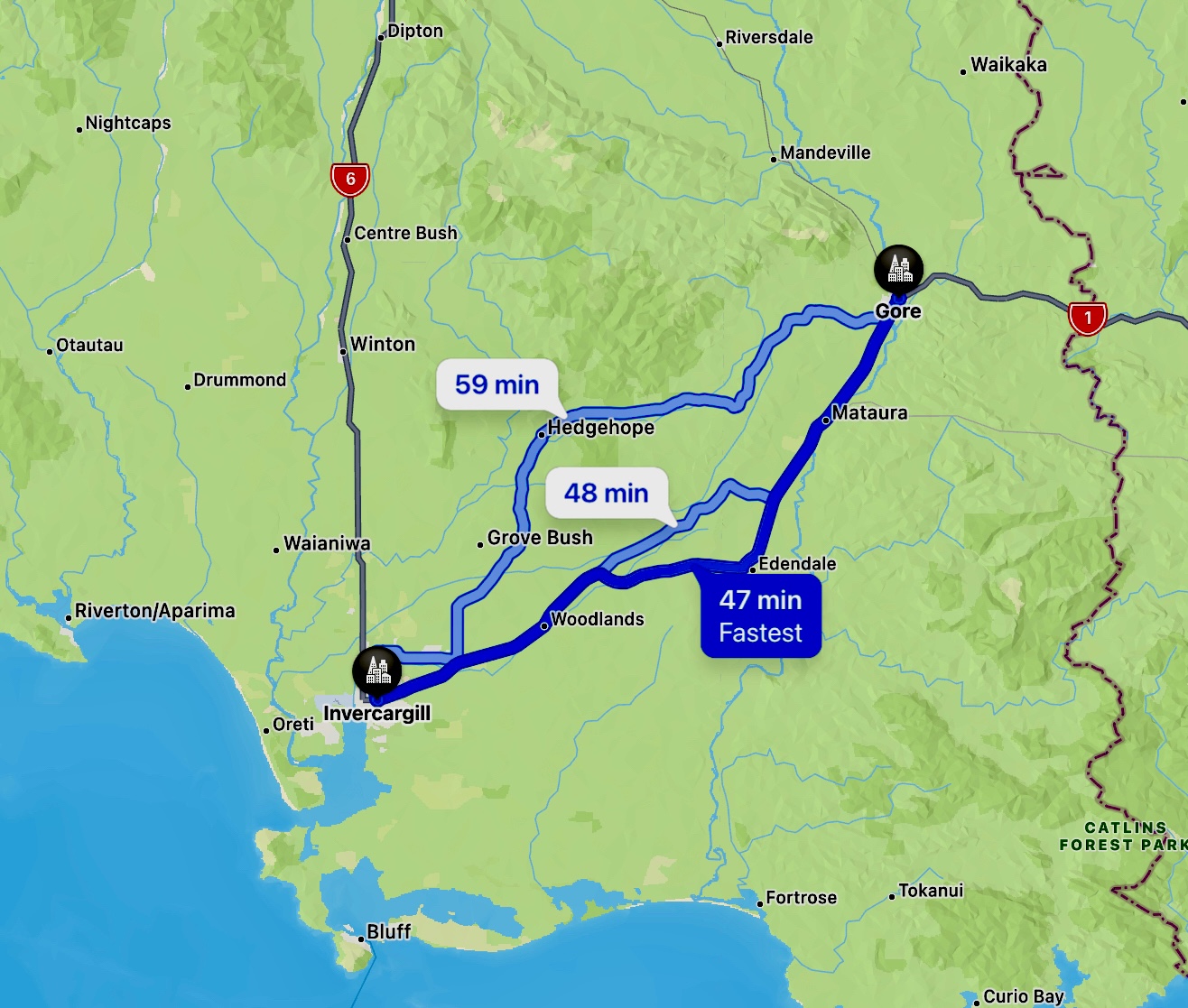
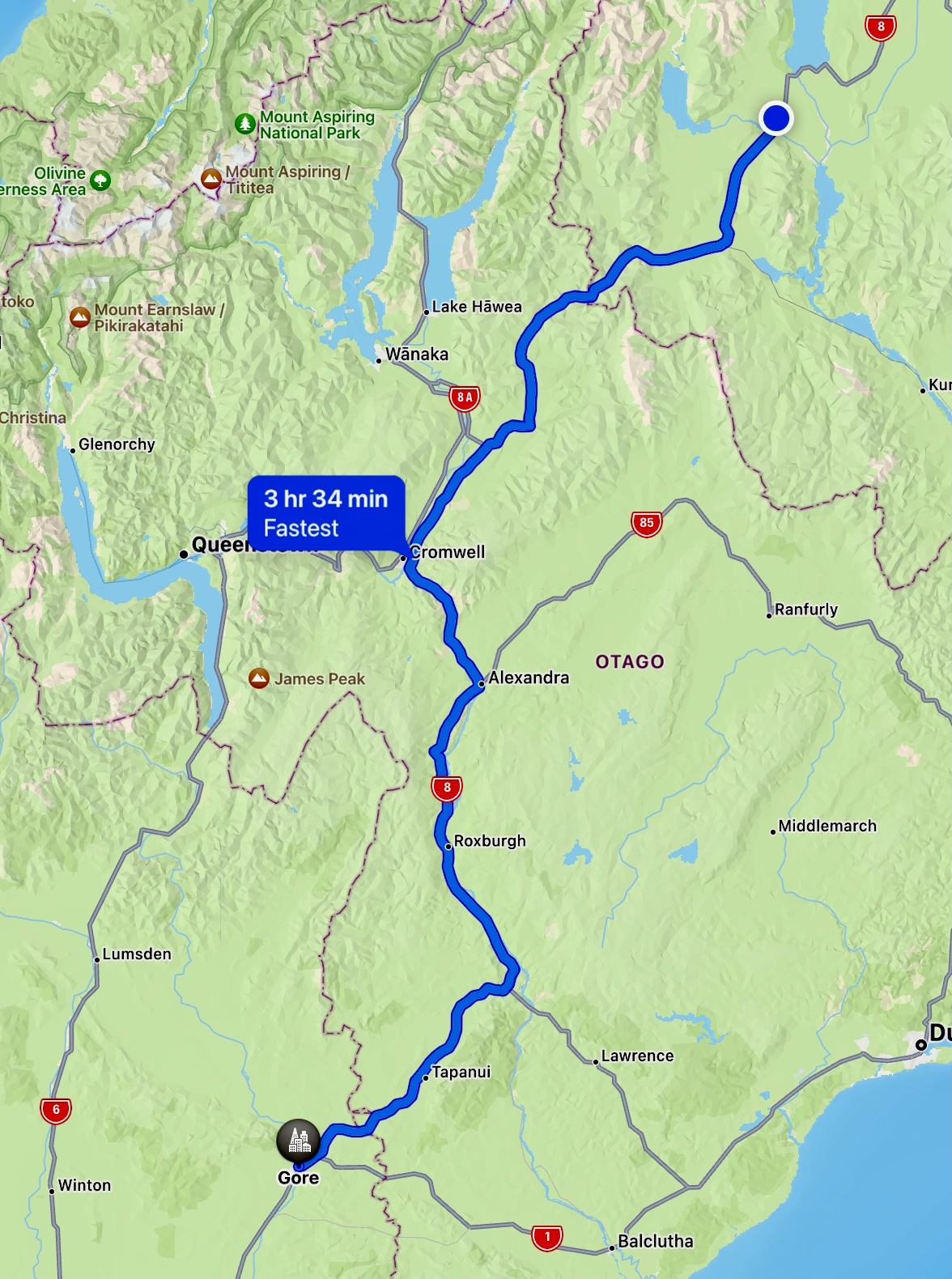
Robert drove about thirty minutes north from Gore each day to Balfour to meet Daryl. They fished the Waikaia River the first day and the Mataura River the following two days, one day with Bonnie. Daryl wants you to catch fish and keeps a tally of the number of fish landed and the number of strikes you had. Here’s how we did:
Day One: 3/11–17, 20, 22 inches
Day Two: 2/14–17 + 1@20 inches
Day Three: 6/10–16-18 inches + 1@22 inches
Waikaia River
Yes, these are different fish!Video! Daryl trying to help Bonnie land a big fish!
Mataura River
Grubs lay eggs in one type of willow tree that lines the river banks. When the grubs hatch, their yellow larva fall into the water and are food for trout. Although this hatch peaked a month or so ago, there was still some going on and the memory of the trout made this fly effective.
Twizel
08 – 09 March 2023
Our guide for two days was Declan Wong. Like the rainbow trout in New Zealand, Declan is a transplant from the US, born in Upstate New York. Like other guides, he is a man of many professions, expanding widely on what we have heard to date. He is a filmmaker, magician, and actor. He once appeared at the Oscars, doing a shitck with Pee Wee Herman. Declan was the robot. Yes, it’s true. We looked it up on YouTube. He and his partner offer an Airbnb Experience in Queenstown—dinner and a magic show at their home and an introduction to fly fishing. Had we known!
His demeanor is very calm and thoughtful (until you hook a fish!), characteristics needed when he guided Robert and Bonnie. He lives in Queenstown and goes to Twizel on extended stays to guide.
Robert believes you need at least two days with any guide. Three is. better. The first day is for the guide to understand your abilities—what you do right, what you do wrong, and how to correct you. It gives the guide time to give you some instruction, which they are happy to do. This time also allows us to understand their demeanor and style of casting, which varies guide to guide. As an example, a prior guide had Robert shift his rod to be parallel to the shoreline in a bent form to play a fish to the bank. When Robert did this with Declan, he asked why Robert was not playing the fish with the rod bent in the vertical position. Styles differ.
Ahuriri River
The water level moved up in the past few weeks creating a shallow lake near the river’s mouth. We fished that first by sighting fish in the shallows. Only one hookup, but it snapped off. We then moved to faster water and were more successful. An additional four strikes and two landed—one fish about ten inches and the other about twenty-two inches. Declan says that in New Zealand, they compare trout by weight, not length.
We fished a variety of flies—midges, emergers, and dries. Some of the spots were technically challenging. One required a snap cast in which you hold the fly to form a bow in the rod and then let it sail over the water on rod length. Something like a bow and arrow. We hooked the larger fish this way. In another case, after hearing Declan’s exclamation on one cast, Robert stripped in the fly too soon from what was about a five-pound trout.
Grays River
Like the Ahuriri River, the Grays River is an hour’s drive from Twizel. It is small but technically challenging. So much so that Robert, although hooking two to three fish, got none into the net. In addition, Robert’s fly line broke during the day. Brand new. Declan pointed Robert to the Fisherman’s Loft in Christchurch for a replacement fly line—our first stop the next day.
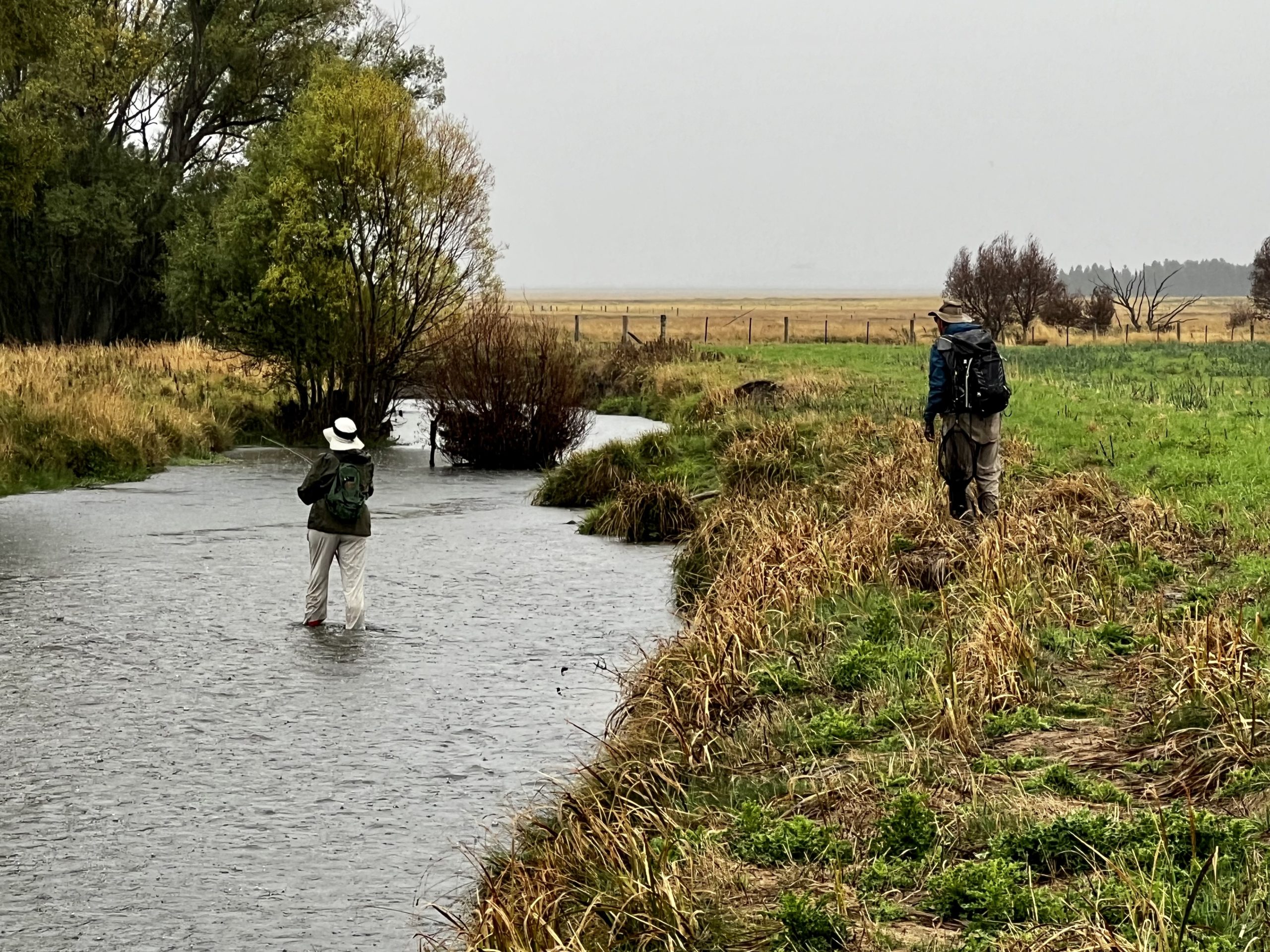
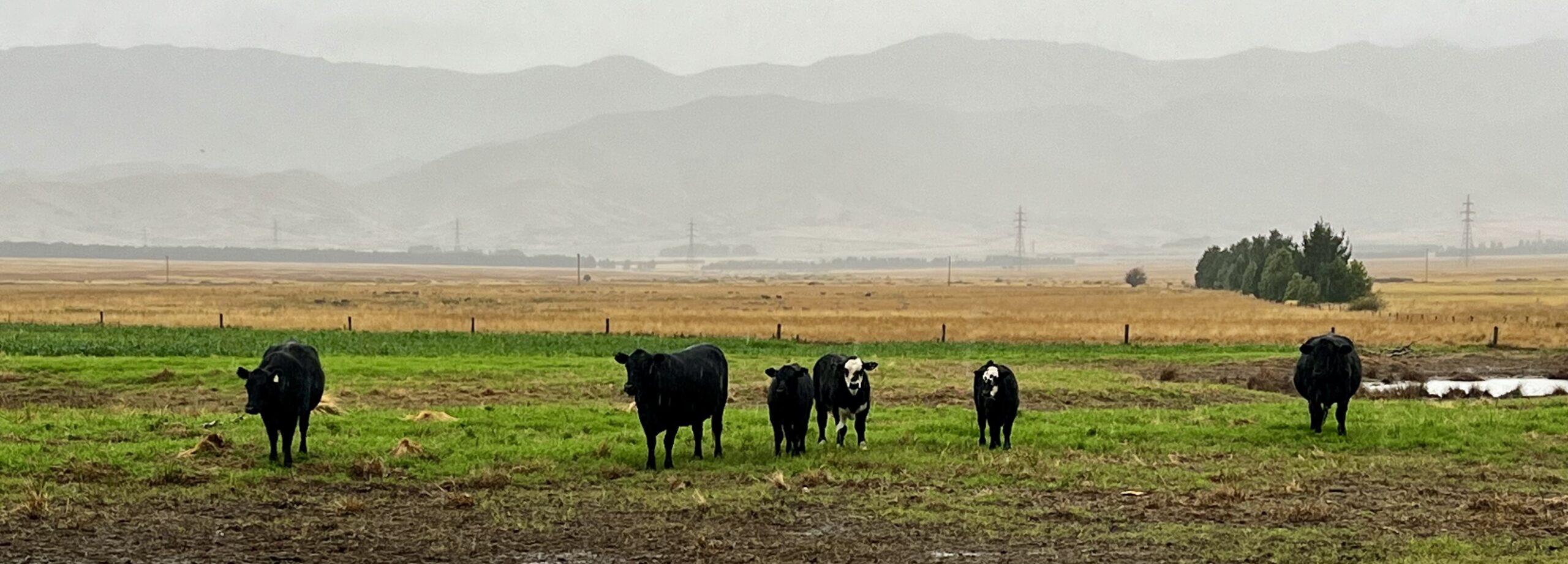
It rained most of the day. Bonnie headed back to the truck to read and nap while Robert and Declan proceeded onward. The cows seemed to be staring at us but it turned out they wanted to shelter from the rain under a nearby tree and we were in their way.
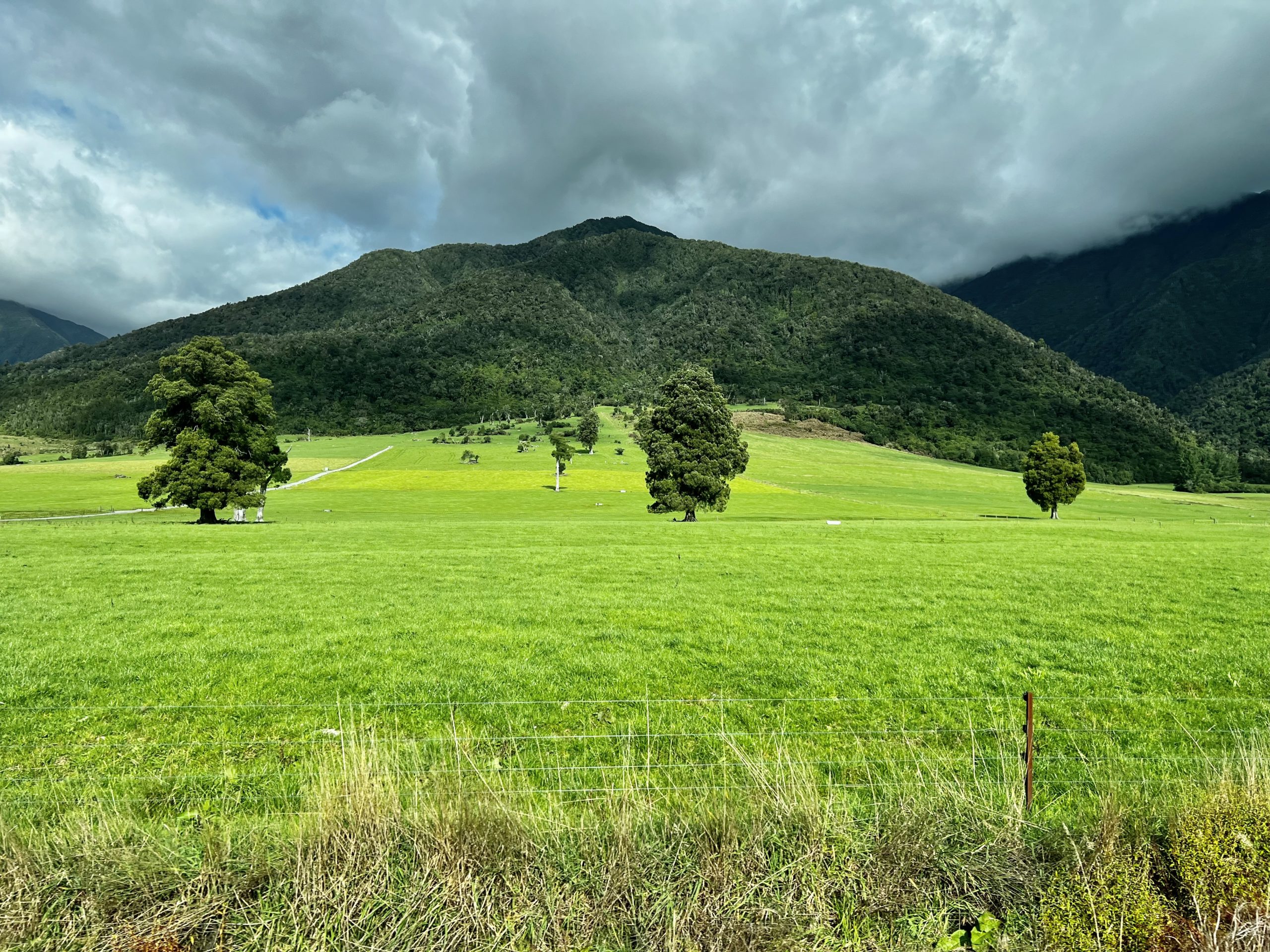
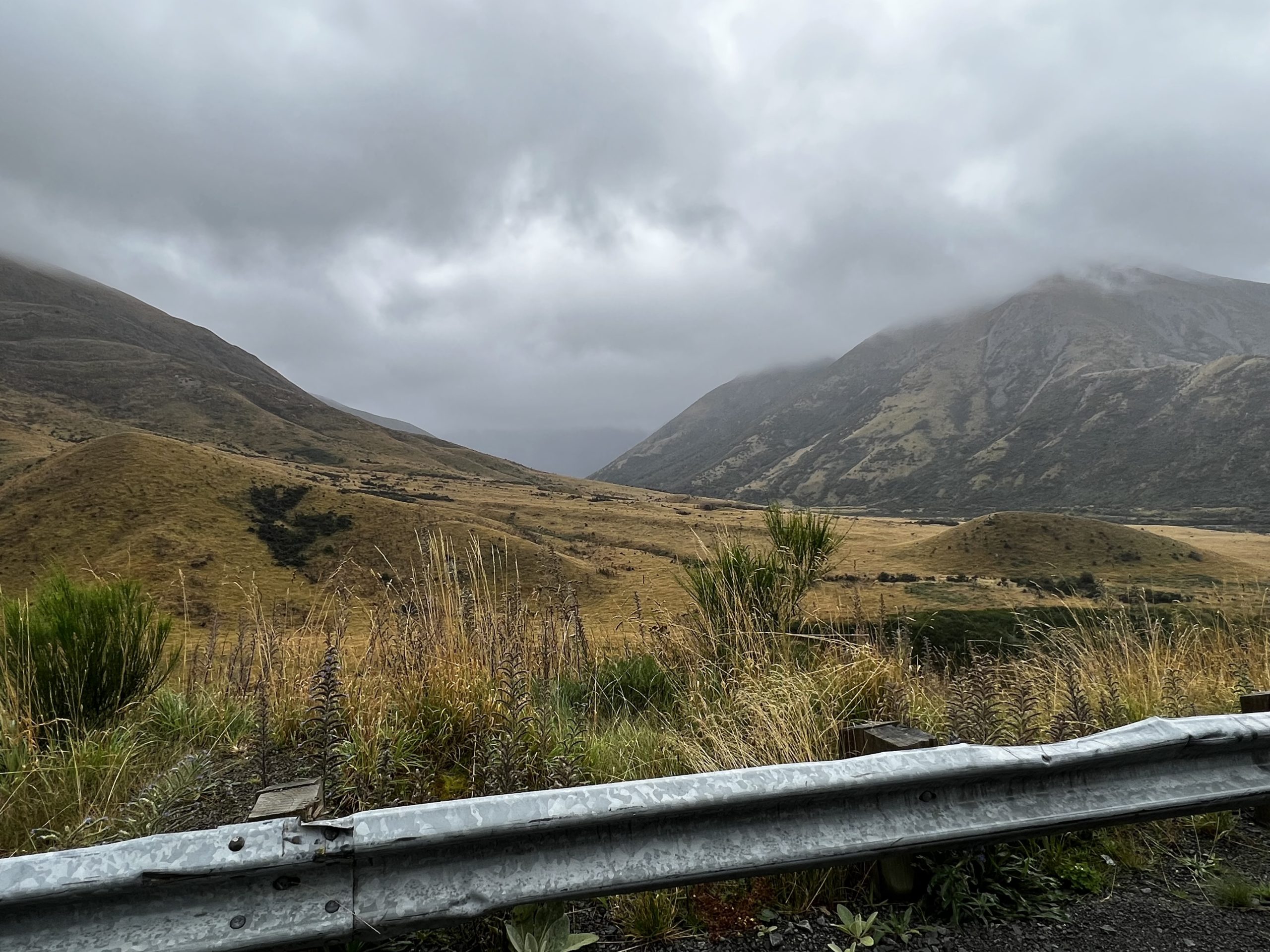
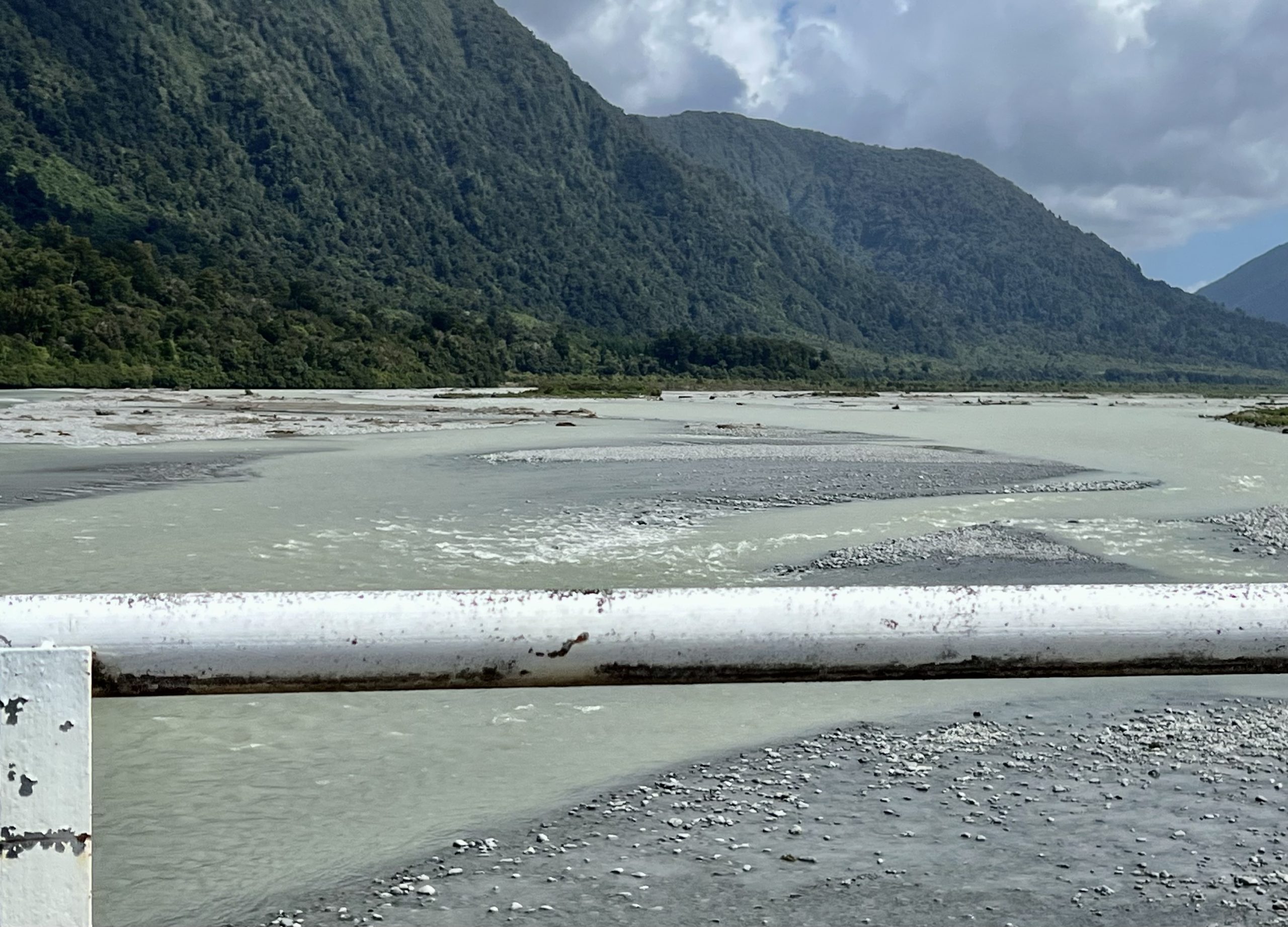
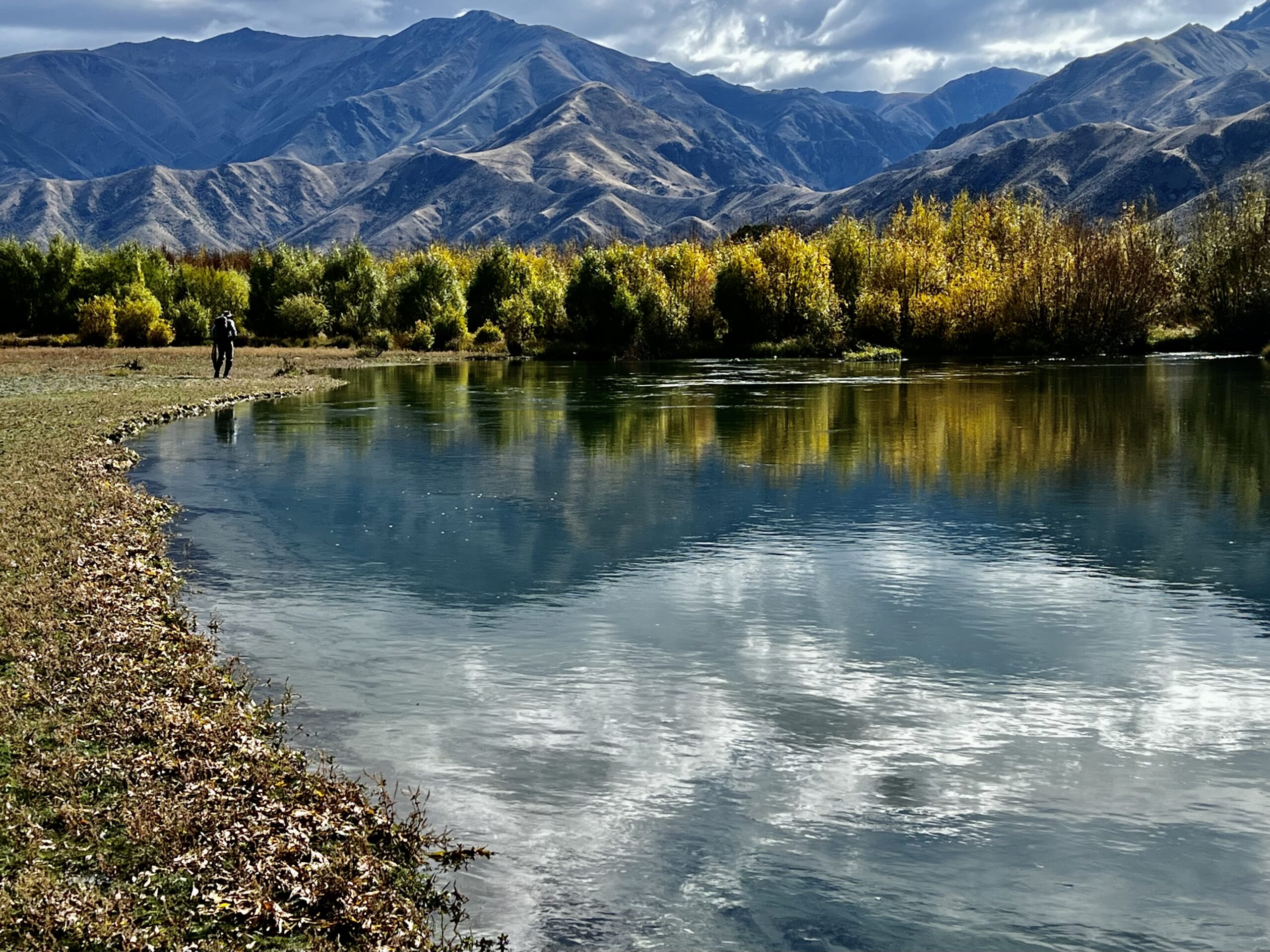
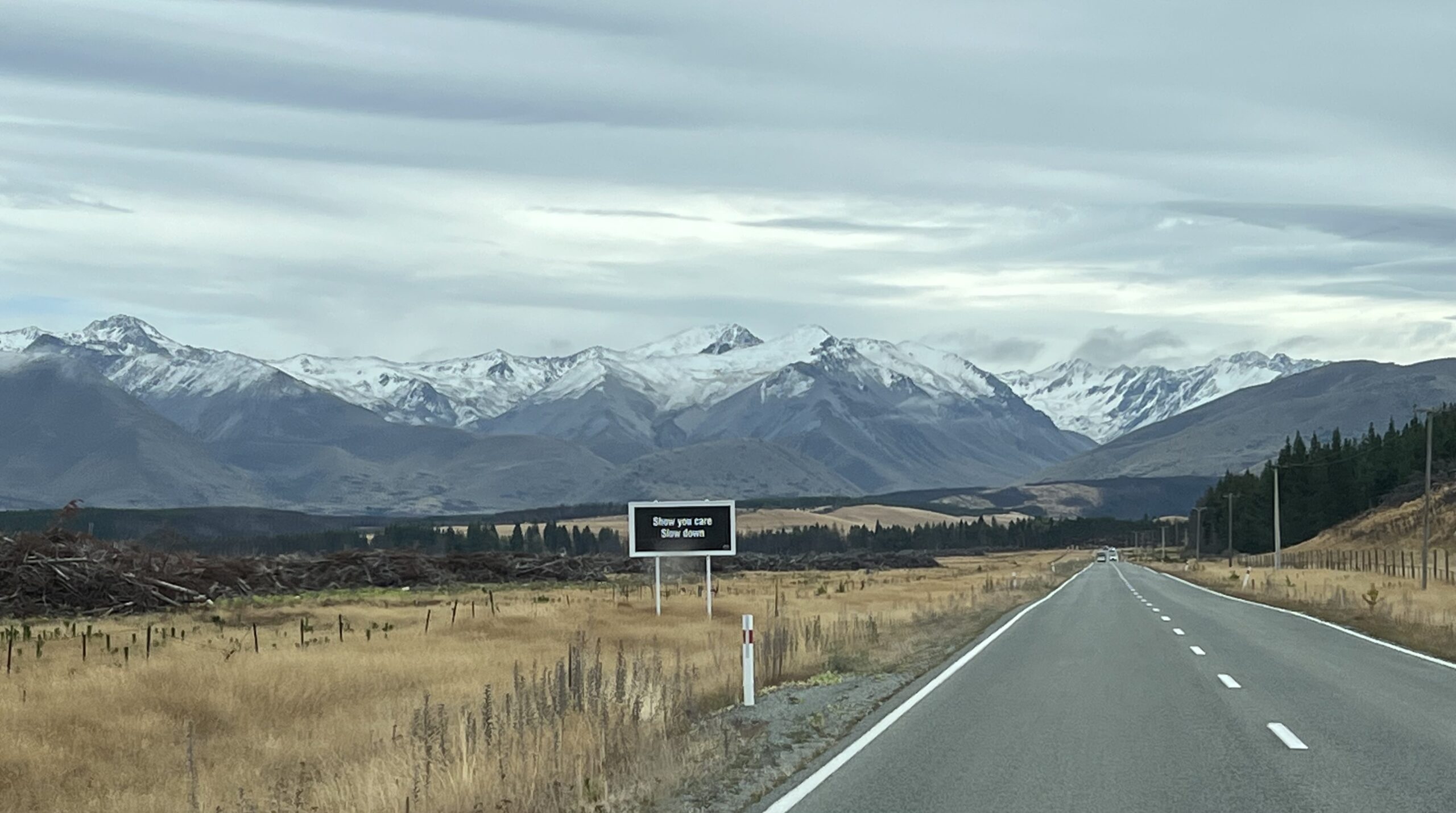
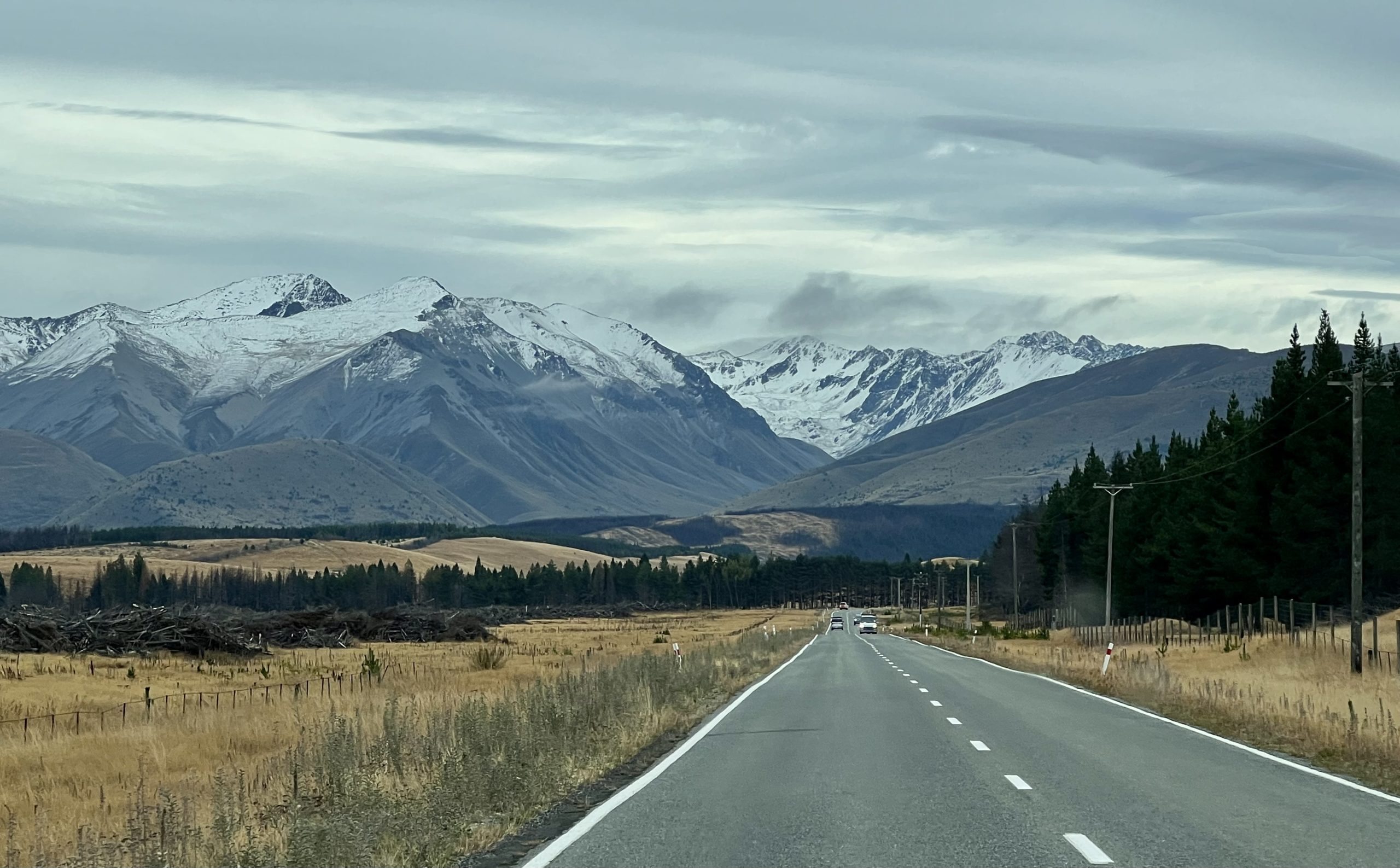
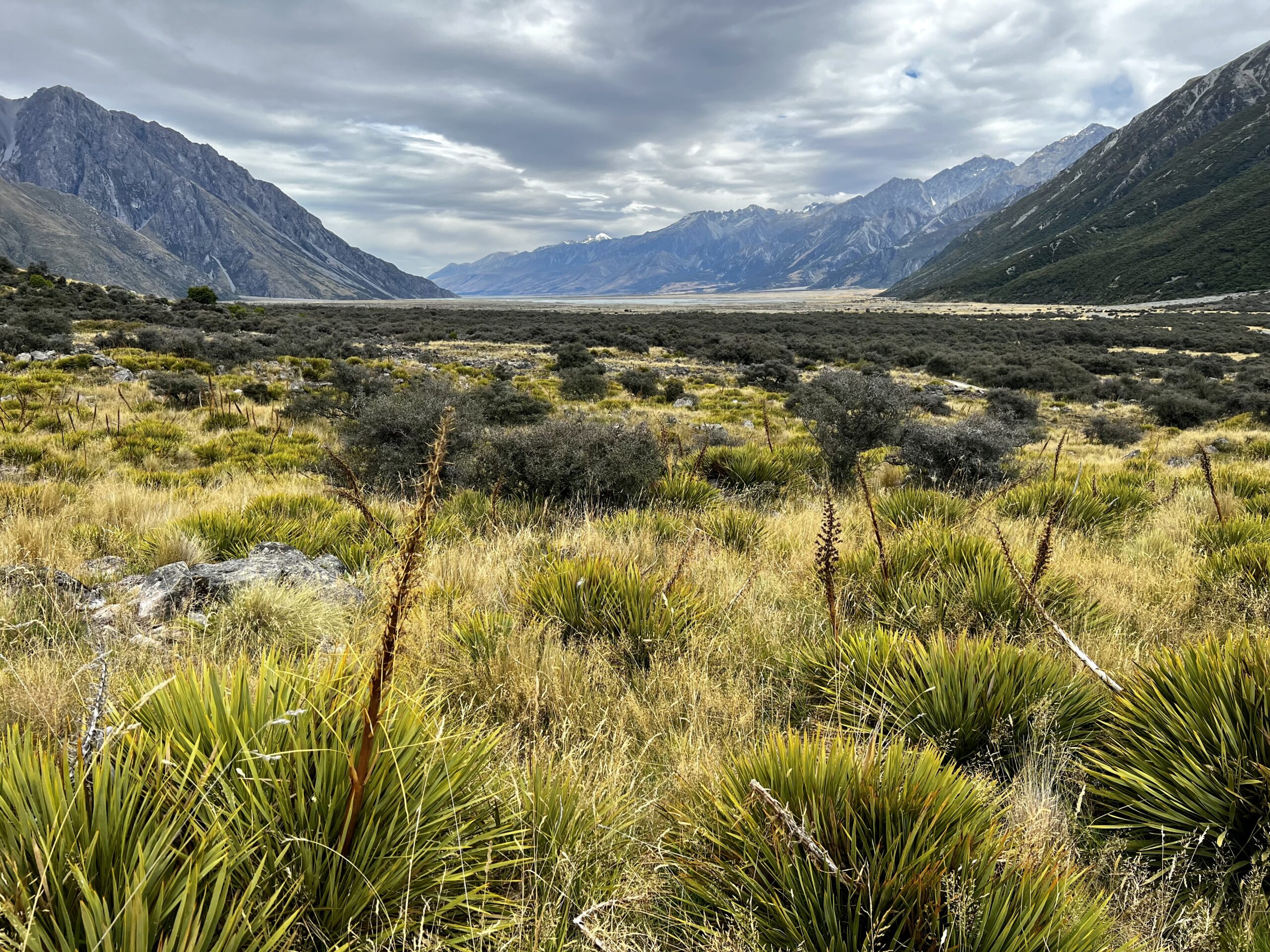
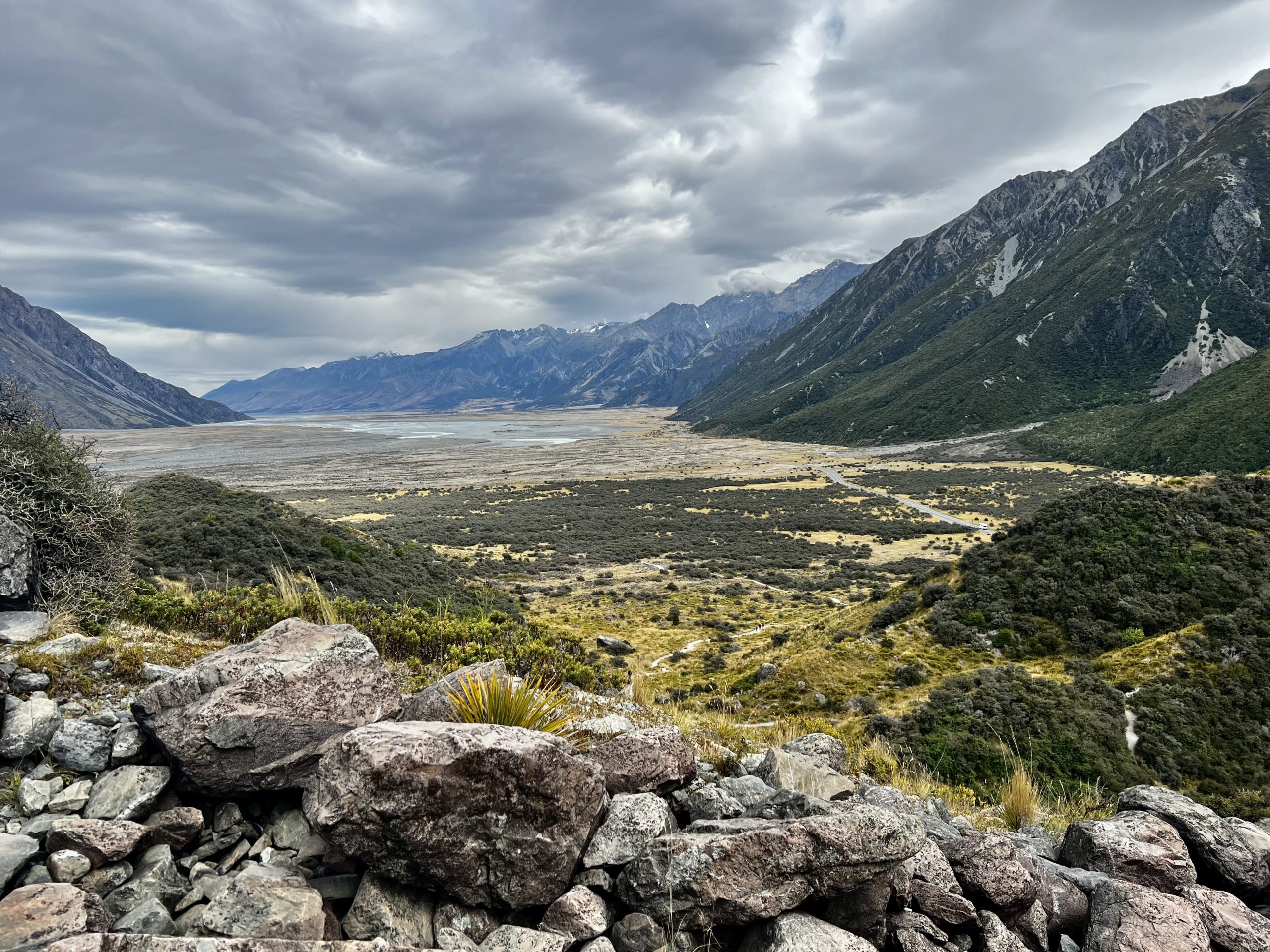
Between our three- or four-day stops for fishing are days driving through the landscape to the next destination. Our drives are typically three hours or less plus a stop in some random small town for lunch. The landscape is fascinating and difficult to capture with a camera. Pull back the focus to get the broad sweep but you miss all the interesting layers and textures. Focus in and you miss the vastness and the dramatic mountain elevation. Much of the sharp hilly land is forested or in bush (wild and uncultivated), some old forest plantations and some newly planted, and held by the Department of Conservation in reserves and national parks.
The weather has been great for traveling. The highs range from 65 to 70 degrees. The occasional rain hasn’t been a problem. During one intense hail storm we were inside watching the Oscars.
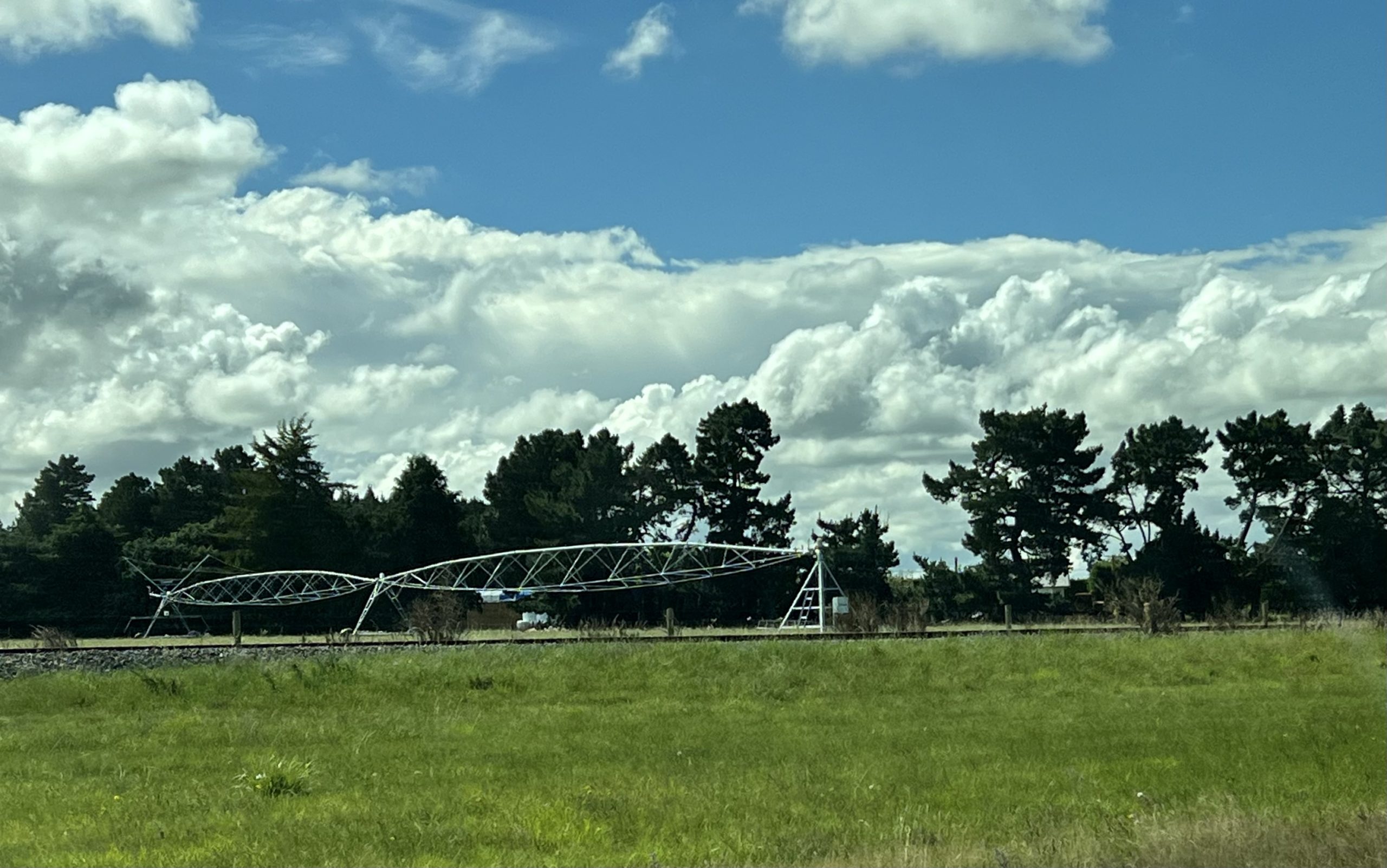
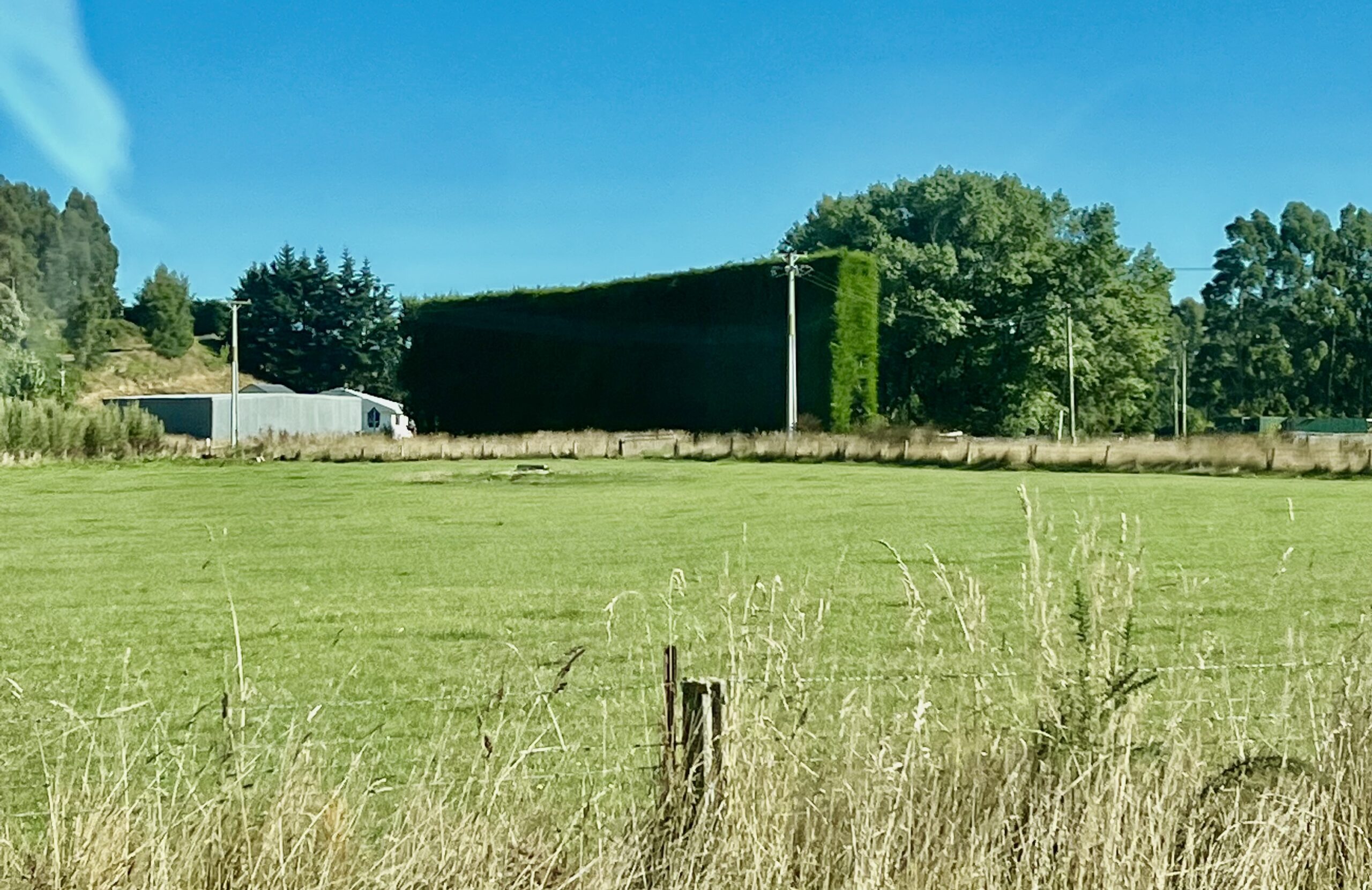
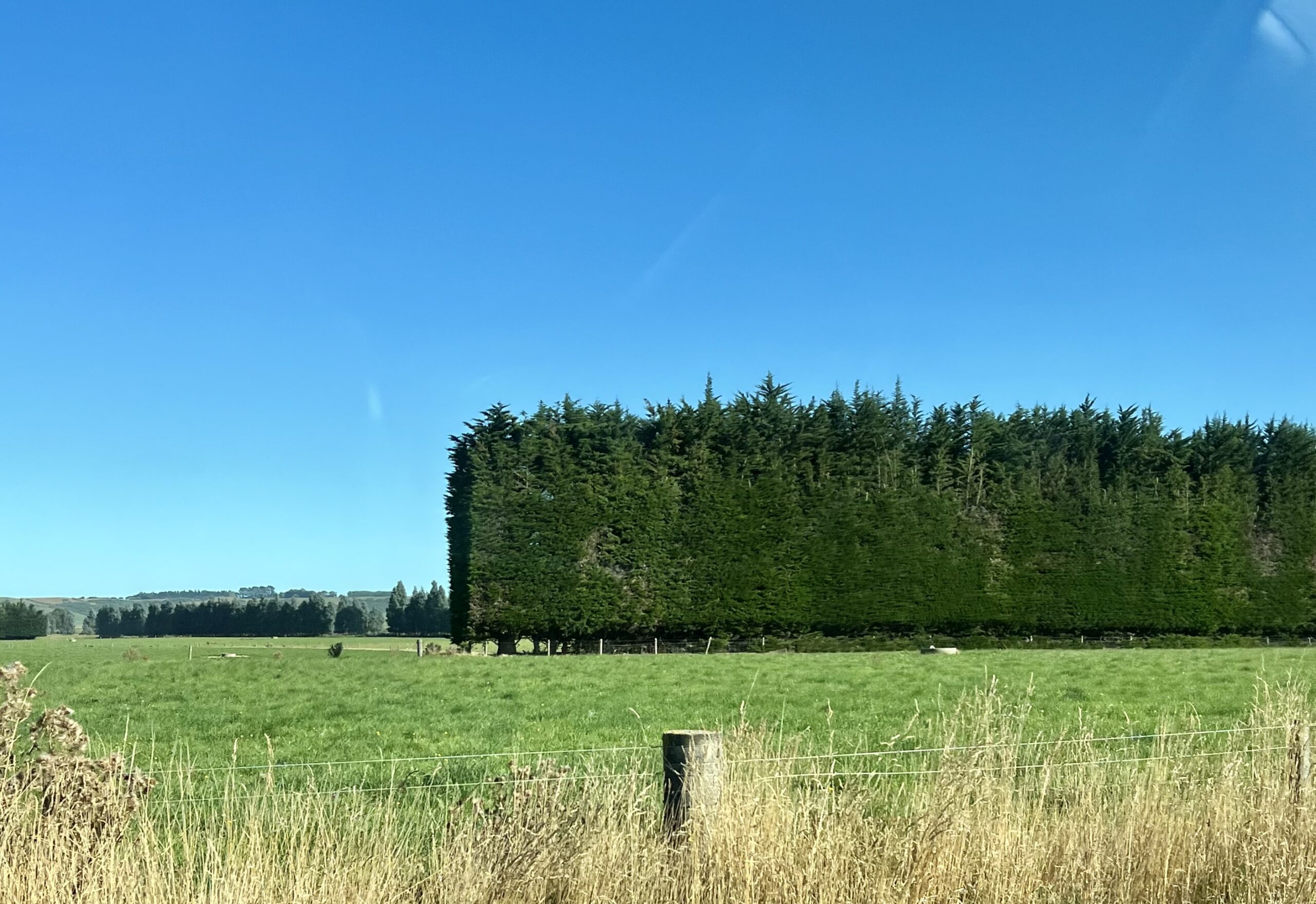
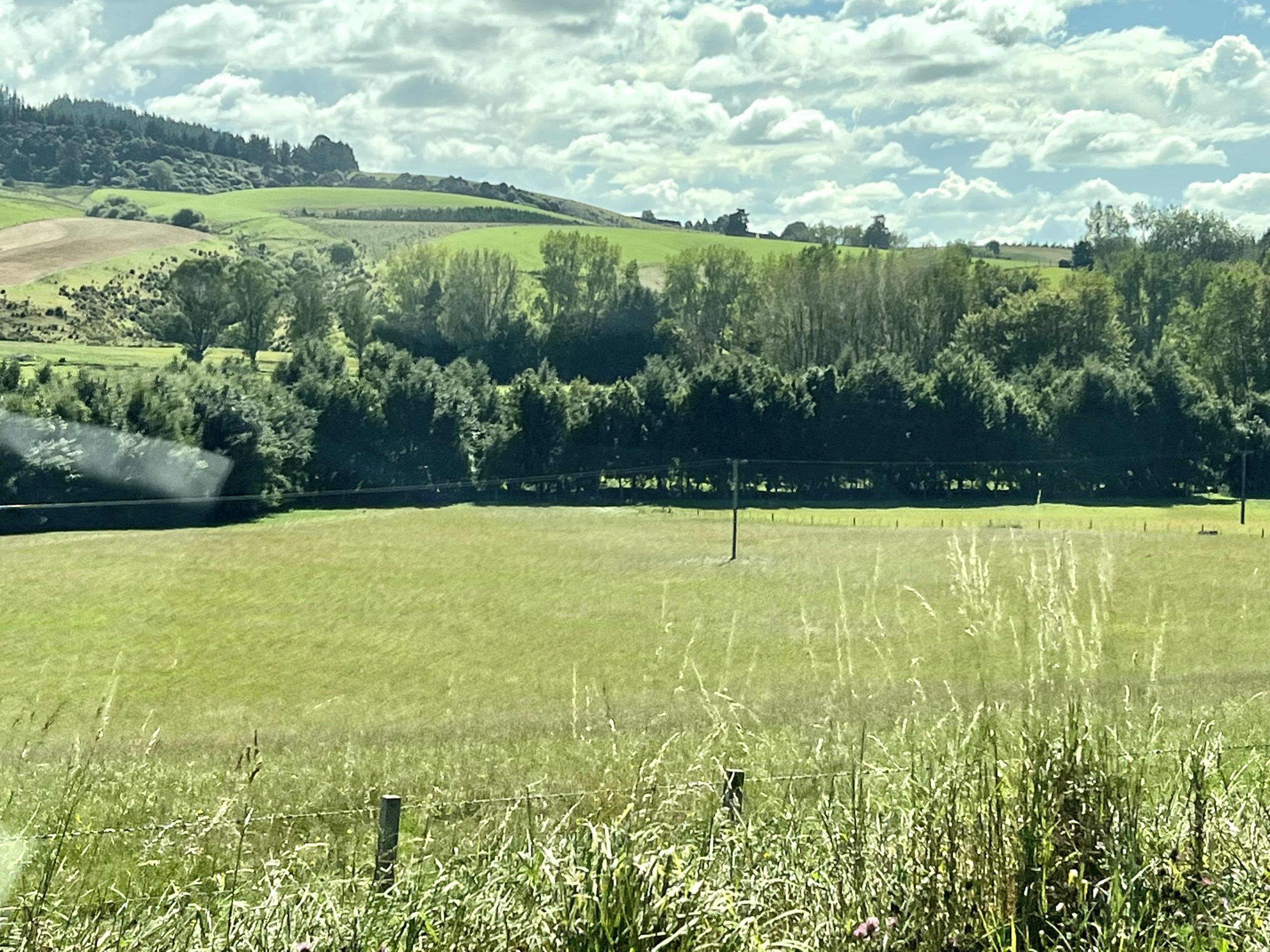
The South Island has suffered a drought this summer so long stretches of the drive are through dull gold grass as you might see in California. Desert conditions. But closer to Christchurch where irrigation in common, everything is bright green. The most intensely green fields are alfalfa—called lucerne here and erba medica in Italy where we saw it carpeting the central part of the country. It is low growing and curly with very deep roots to reach water. It is feed for cattle and sheep when they aren’t out grazing in the winter, so lots of it is needed here. Undoubtedly some is exported to Asia. The bales out in the fields are wrapped in light green plastic, and we see lots of them. Another striking feature in the farmland is the wind breaks. Lines of trees planted decades ago to protect crops from strong winds. Many of these are thirty- or forty-feet tall and very dense. We are surprised to see them trimmed like hedges in precise rectangular blocks. Probably to encourage growth that increases the density. Orchards are not common, but we drove through one narrow valley about forty miles long that was all about fruit. Apples, cherries, peaches, plums. Trees laden with apples and shaped like Christmas trees. Lots of roadside fruit stands.
Most fields are empty, but turn a corner and you see a few hundred sheep crowded into a paddock. Or several hundred cattle. We check to see if the sheep have been sheared recently, and in this season about half have already been sheared and the rest are shaggy and often brown with mud and dust. The sheep in remote areas don’t see many cars and are quite skittish. If we pull over to the side of the road, they scurry away to the other side of the pasture. Robert likes to beep on occasion as we are driving to see which animals will look up. It’s the sheep. Cattle couldn’t could care less. Bonnie is disappointed that we haven’t encountered a big flock of sheep crossing the road. This used to be a regular feature of New Zealand. We’ve heard that for health and safety reasons, farmers must now file paperwork on when they plan to move the animals, so movement is highly regulated.
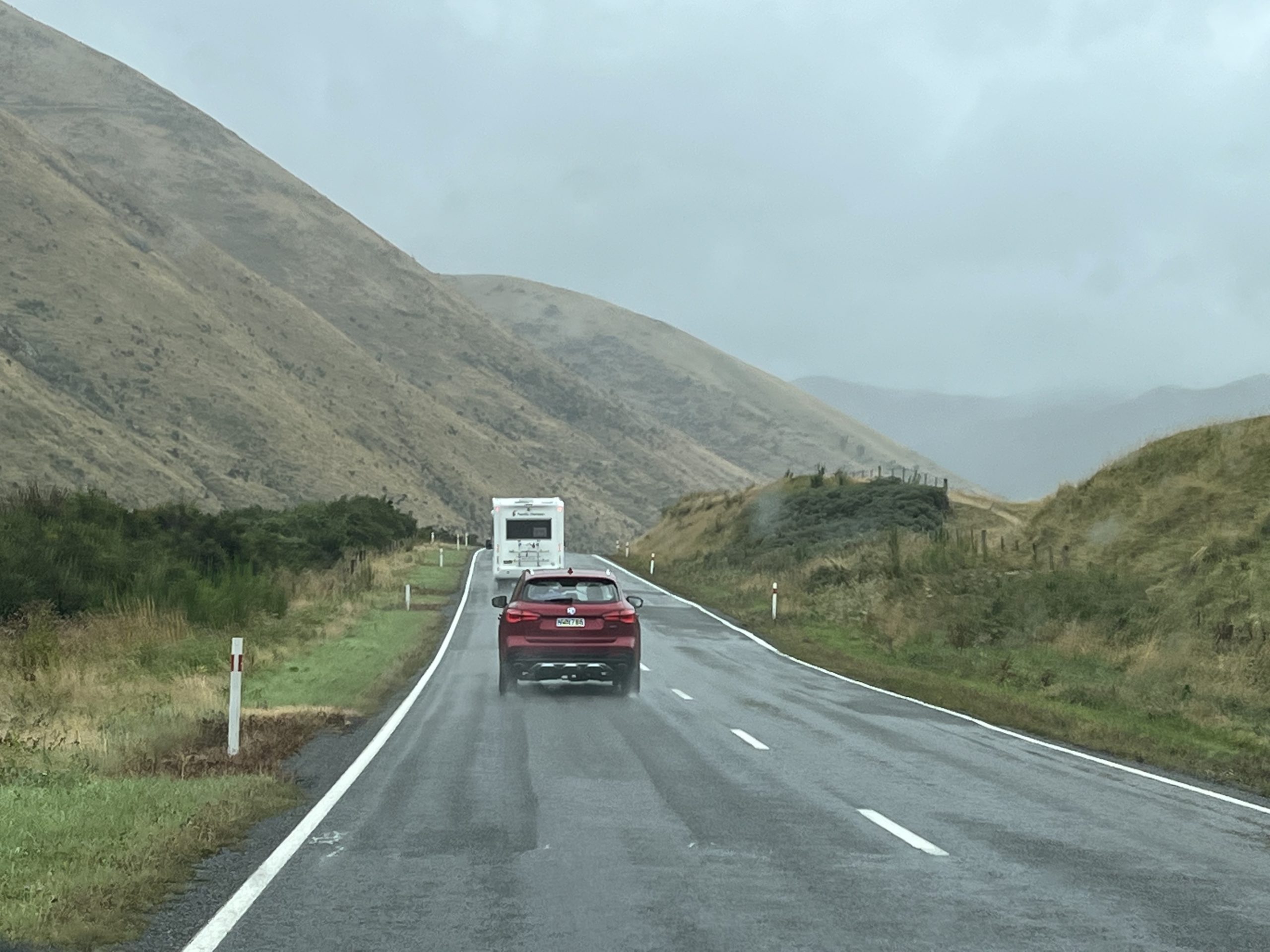
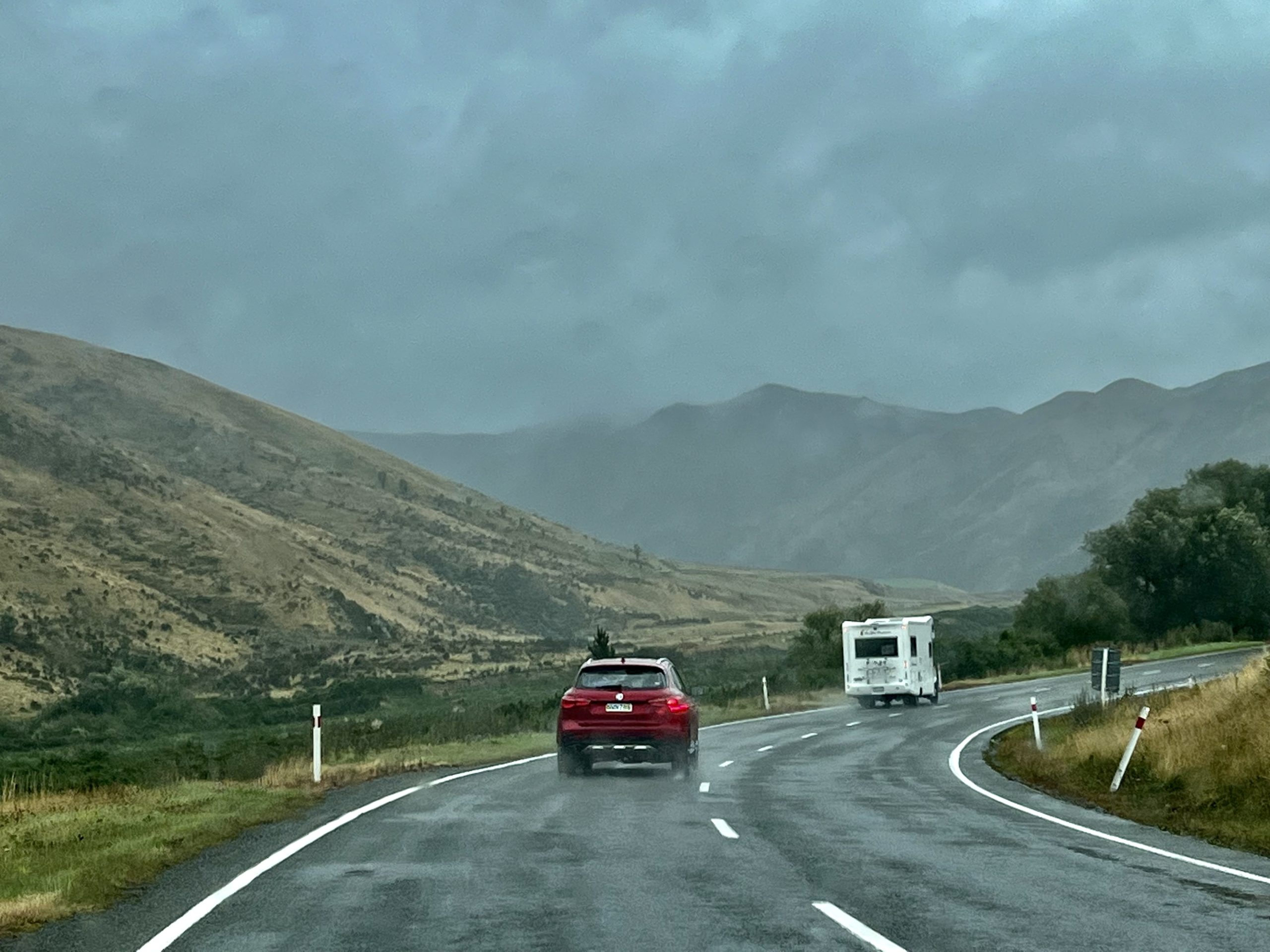
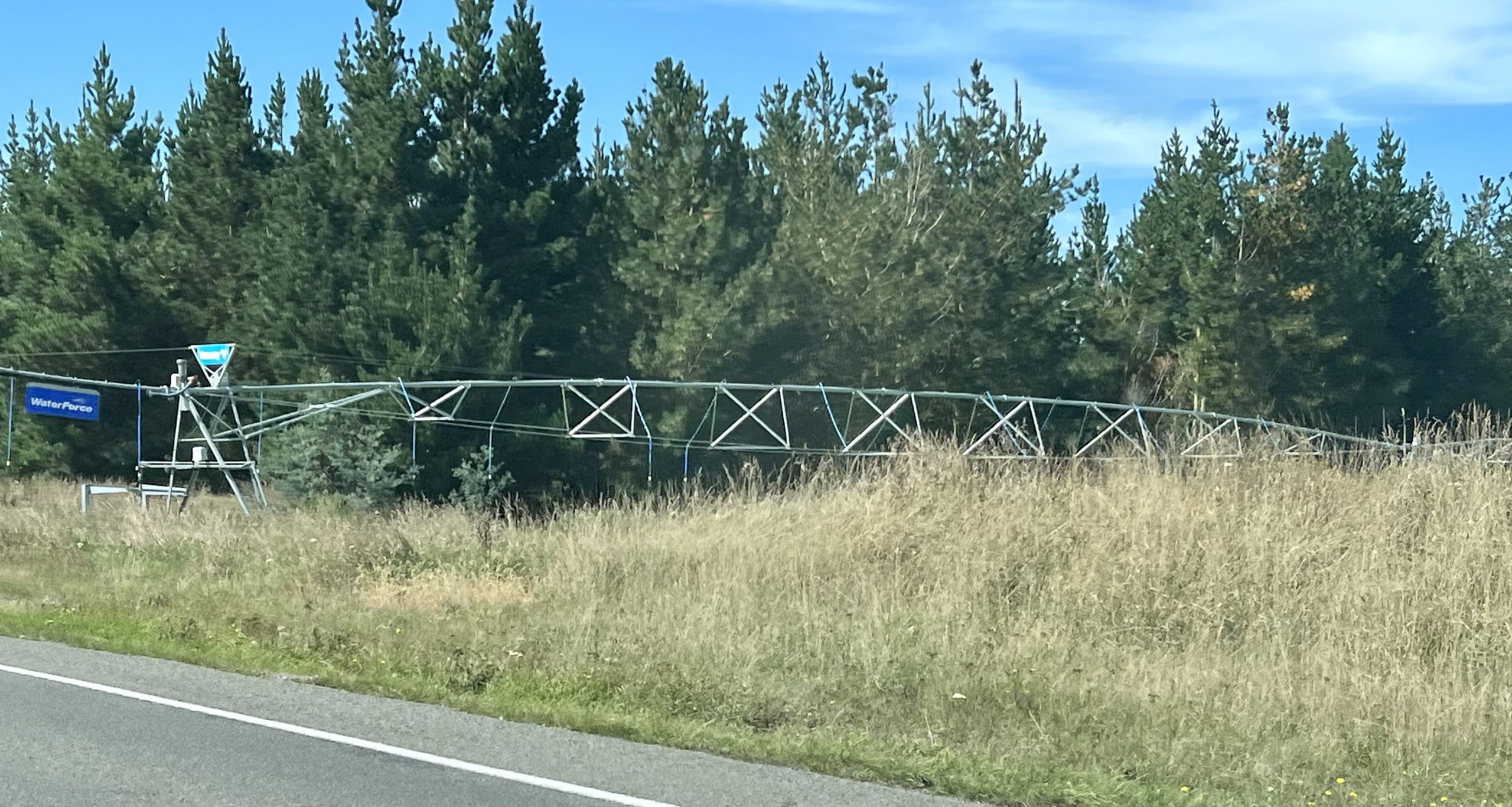
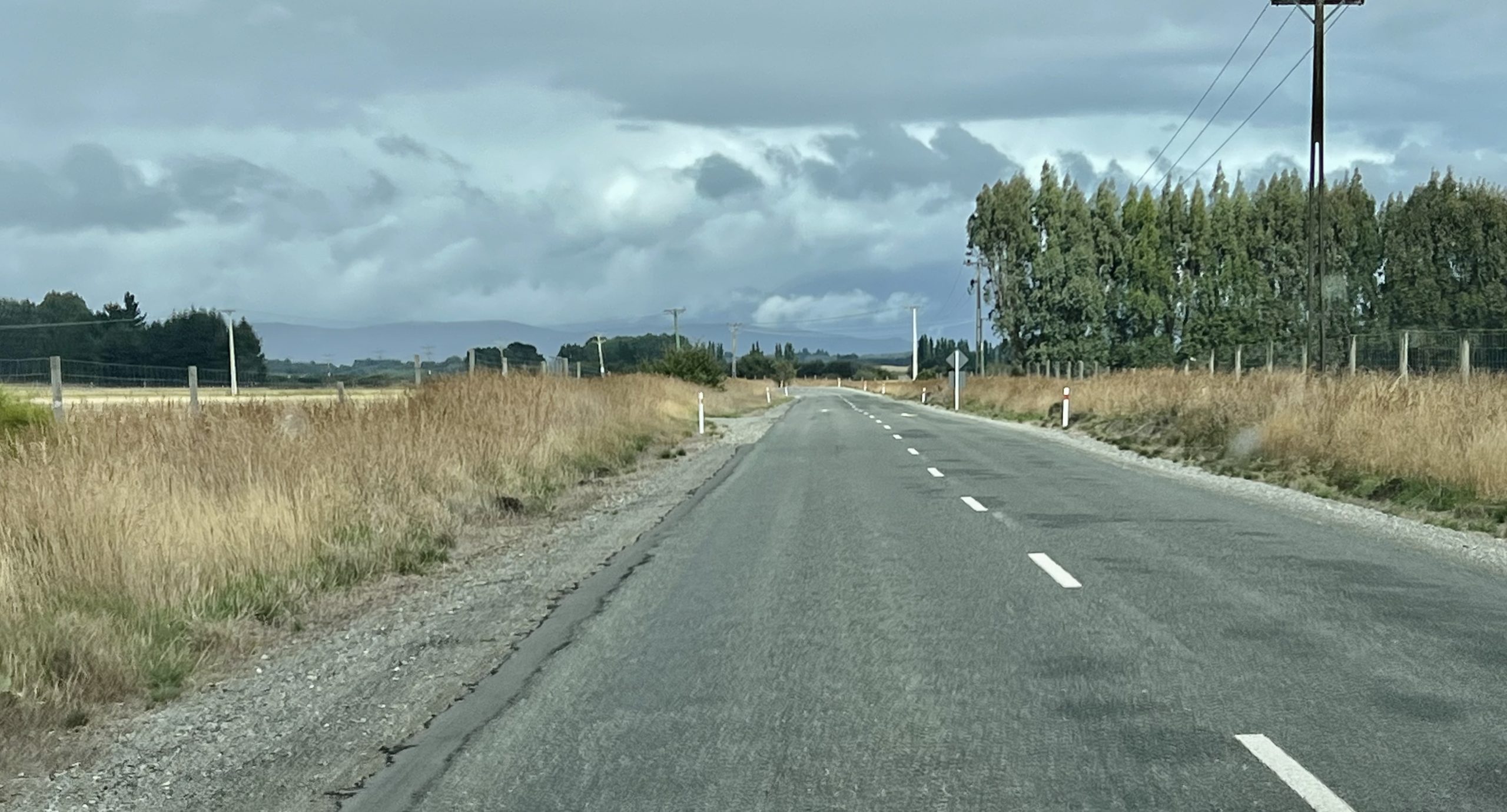
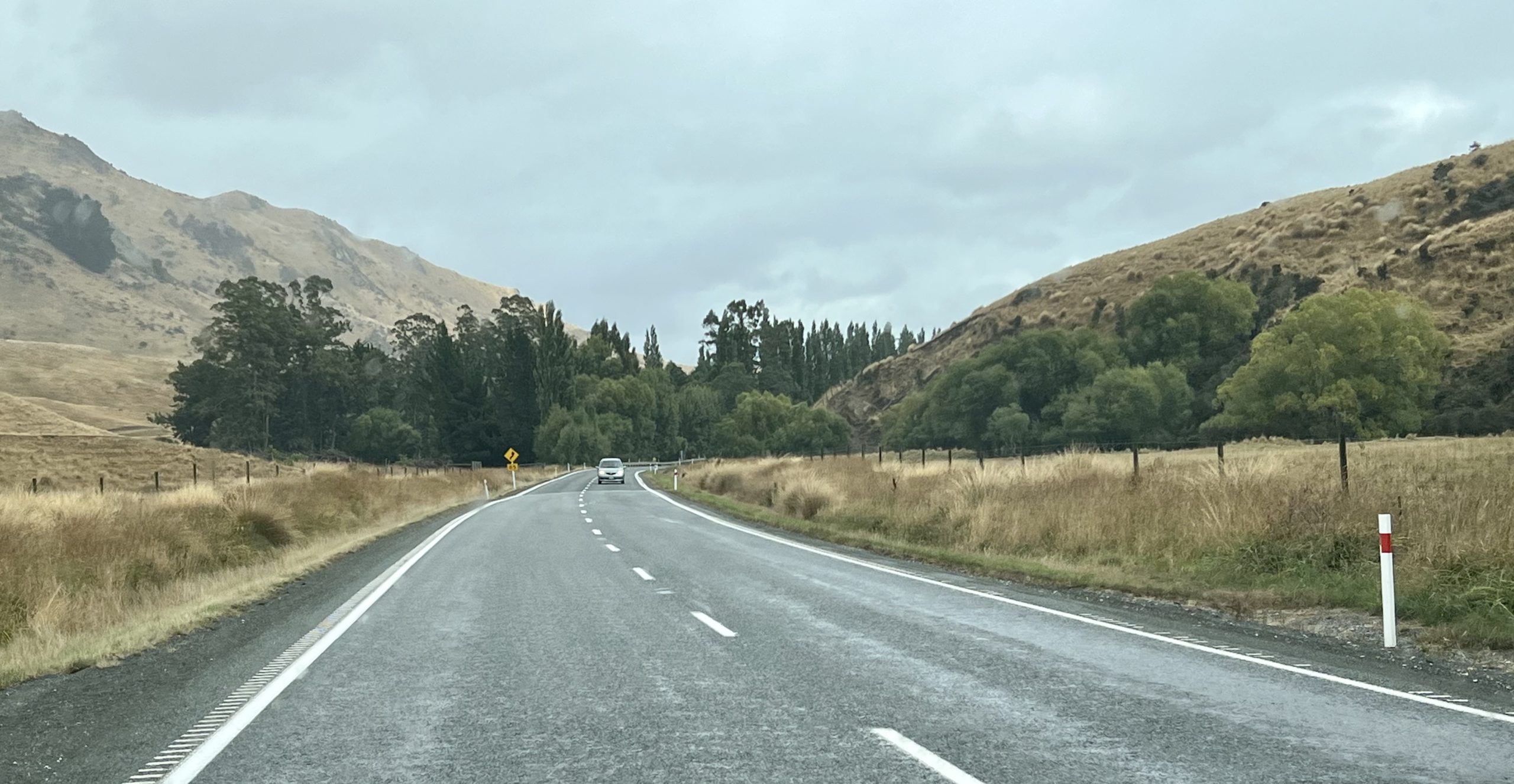
The main highways are just two lanes, but in excellent condition. Little harsh weather and little traffic must make it easier to keep them in shape. Every few miles your see a large white arrow painted in your lane. Just a reminder to all of us visiting drivers to keep to the left. Camper vans are very popular and often outnumber cars, but we seldom see much traffic as you’ll see in our photographs. Cell reception out in the country is spotty or might not exist at all; we might wait an hour to get a signal. It feels like our drive in the Yukon.
Robert is not happy with the Toyota navigation. It is awkward to enter an address, and the arrows on the screen are not always clear. We use google maps on Bonnie’s phone as a backup. Fortunately most destinations on the South Island don’t require intricate routes. There just aren’t a lot of roads.
People everywhere are polite. Like Canadians but with more rambunctious energy. One Saturday night in Gore we ate dinner outside on the restaurant’s patio. This was clearly the bar area for the restaurant, and the groups at the other six tables were all drinking beer. The dozen rugby guys at the table next to us were extra loud, but otherwise perfectly civilized. As the group left, two different guys stopped to apologize to us for the noise. Very thoughtful.
On the Way to Gore
We see many wind breaks throughout the South Island. Some are planted with two types of trees to create both dense under and upper stories. Many are clipped like hedges. You can often make out the marks of the circular blades used to trim them.
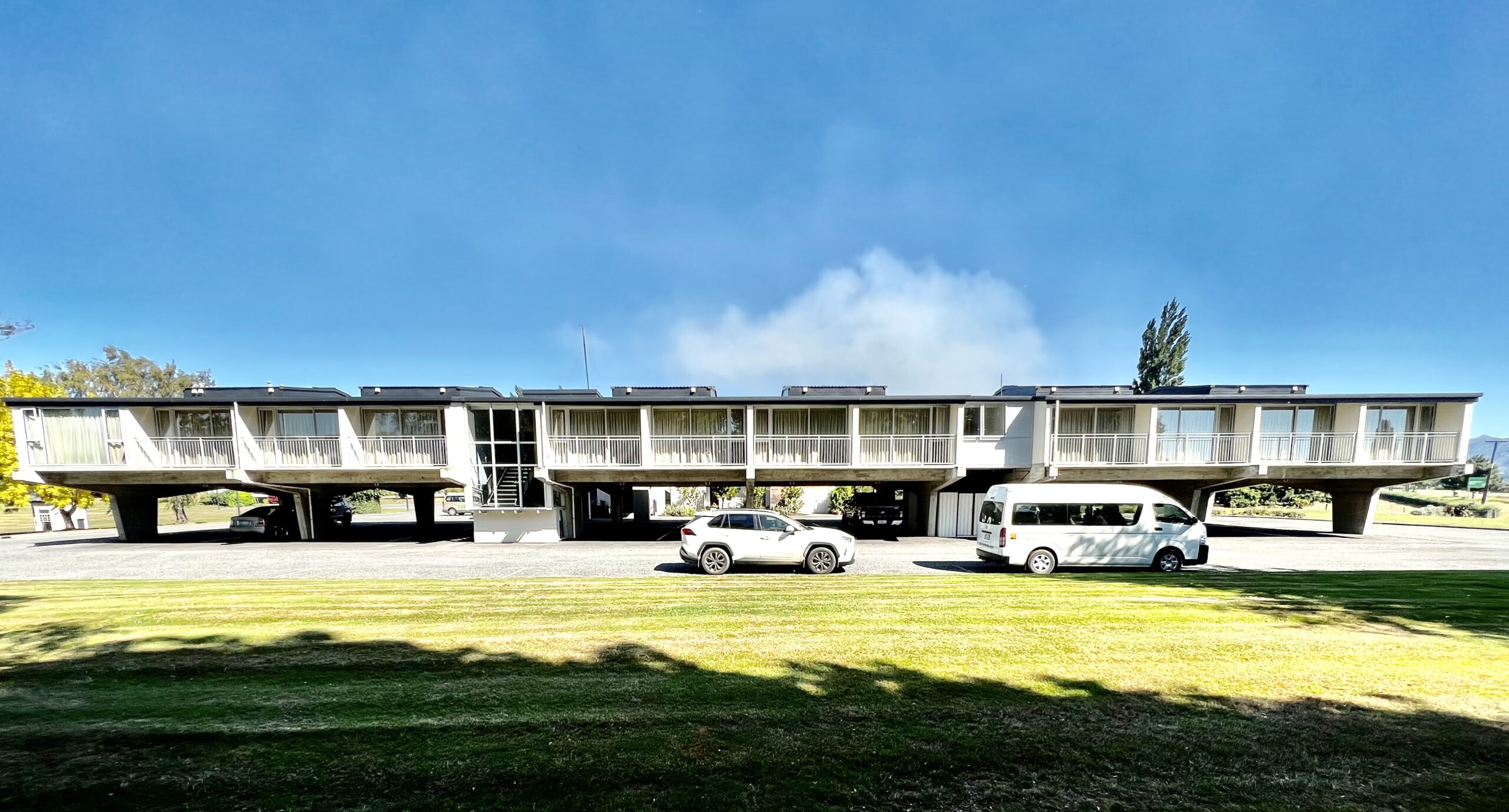
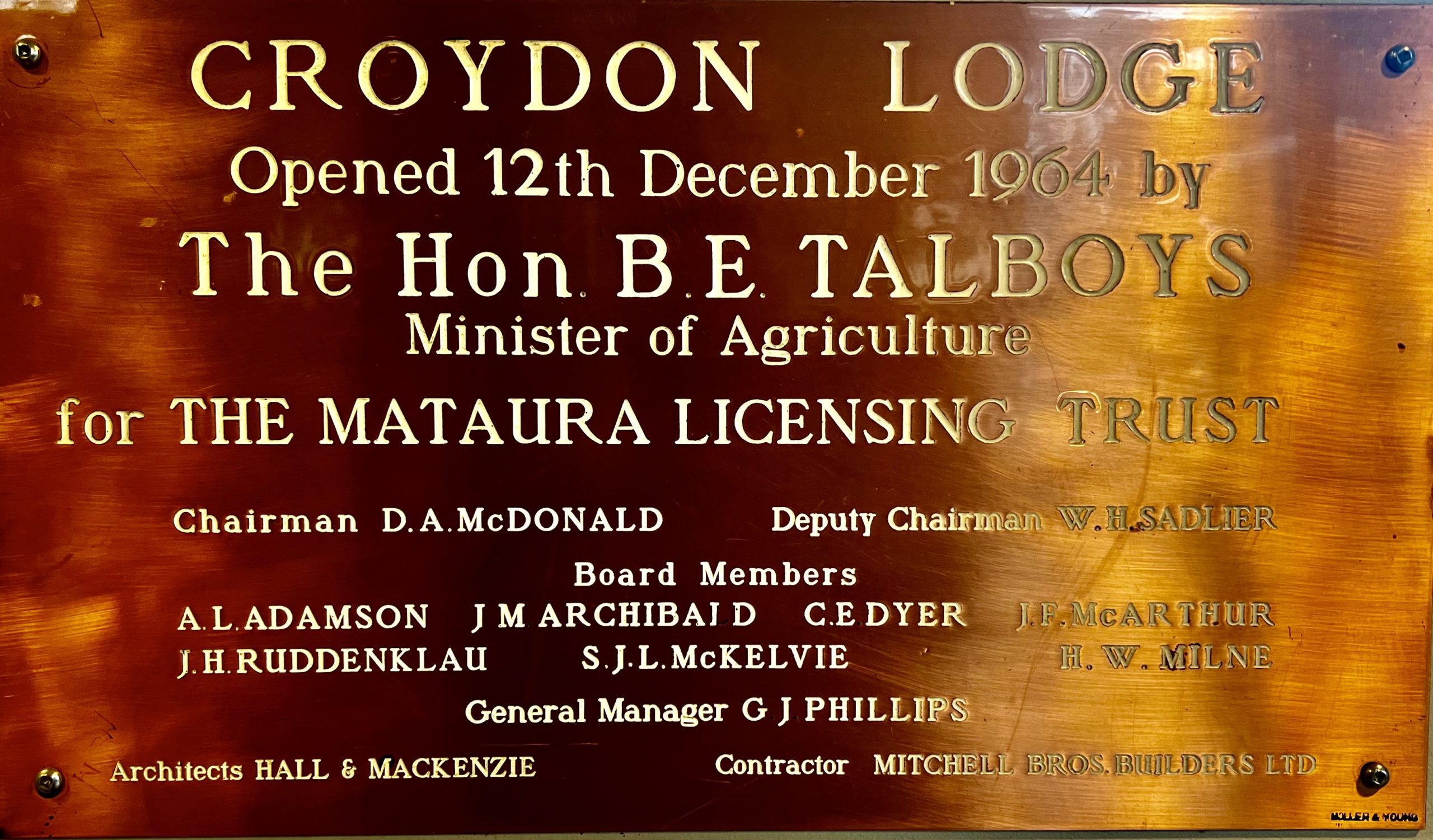
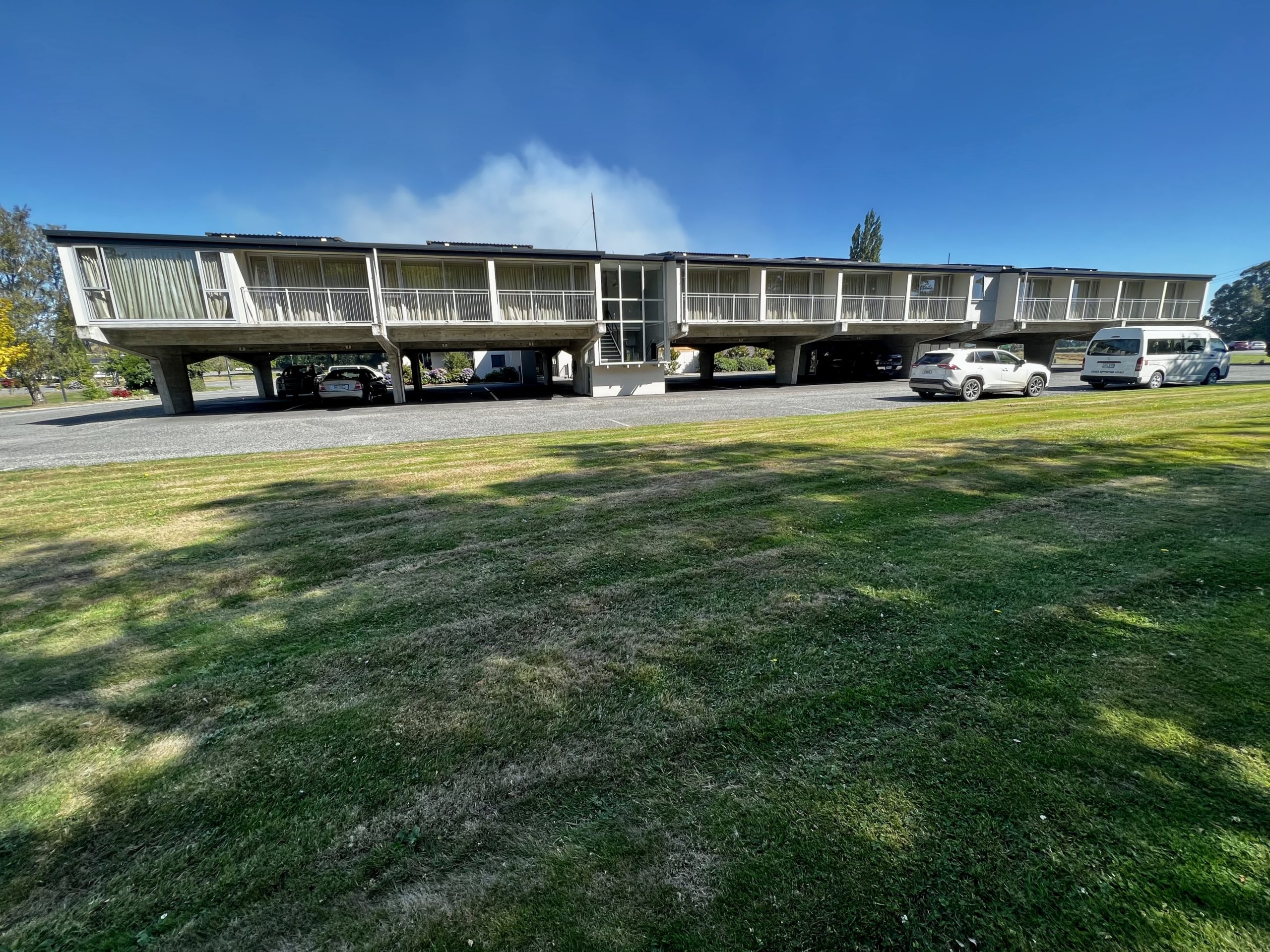
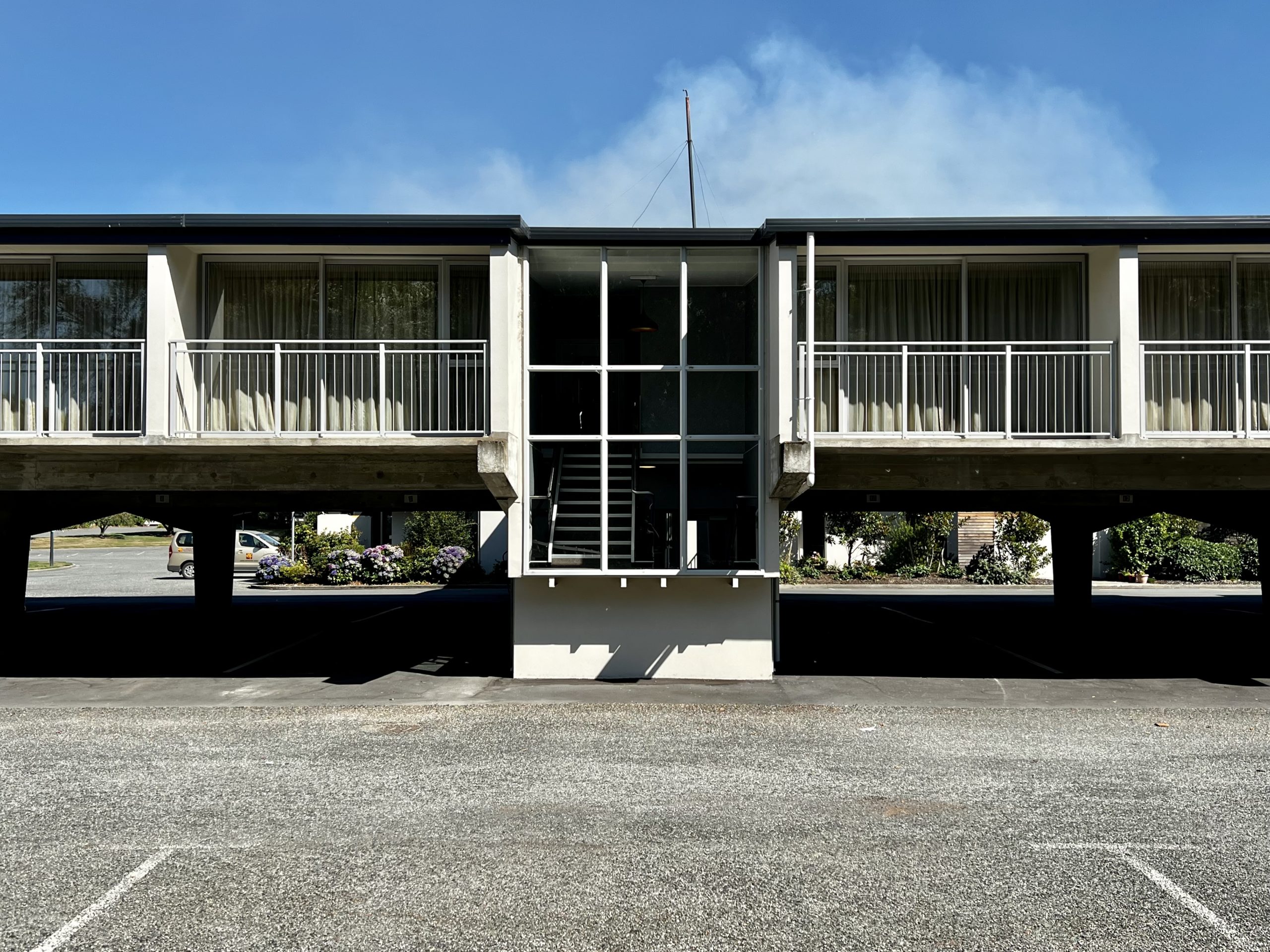
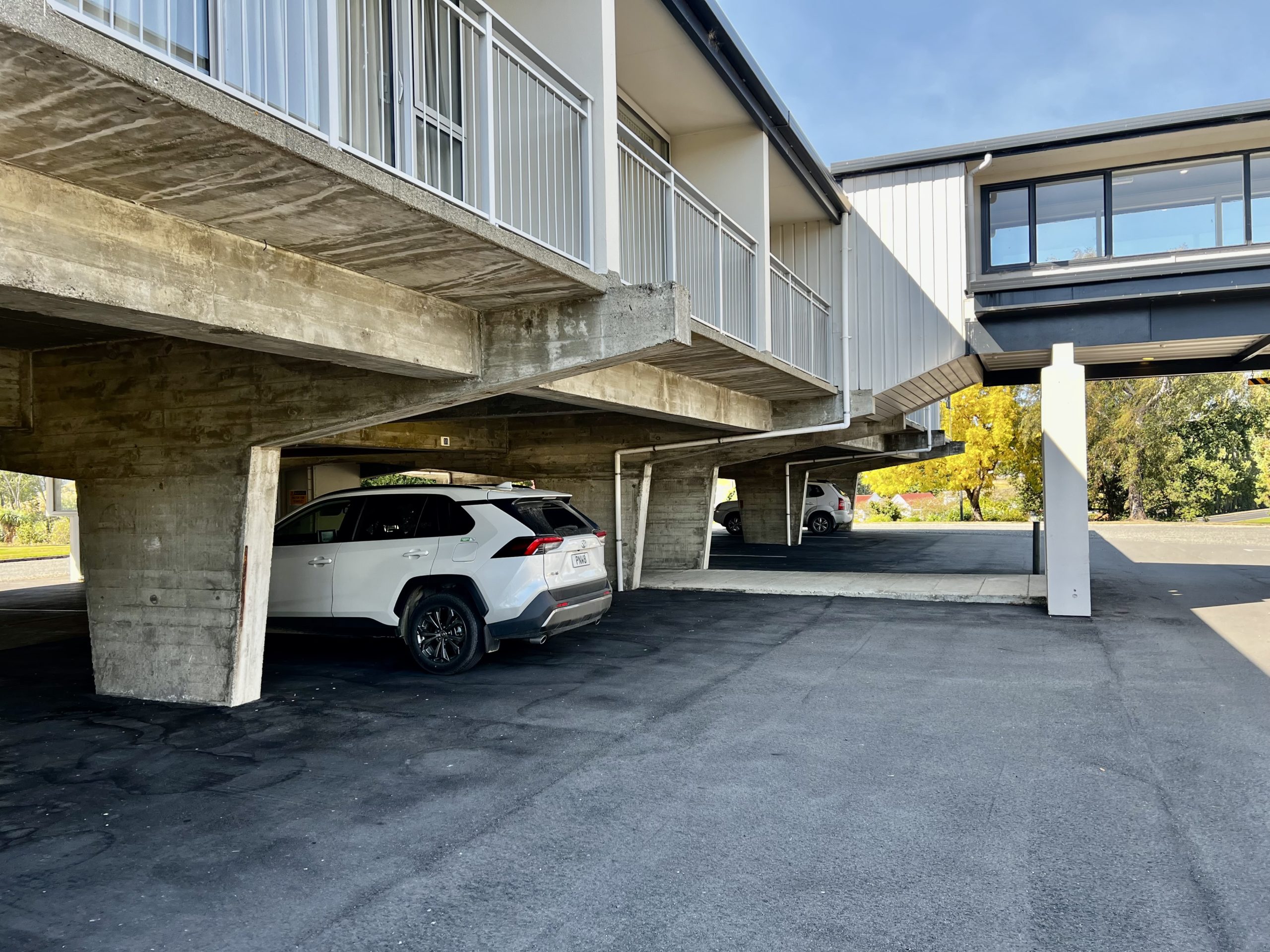
Croydon Lodge in Gore
Can’t get more Corbusier than this!Before seeing this plaque, Robert guessed the year the hotel was built. He was only one year off!
Walking Around Gore
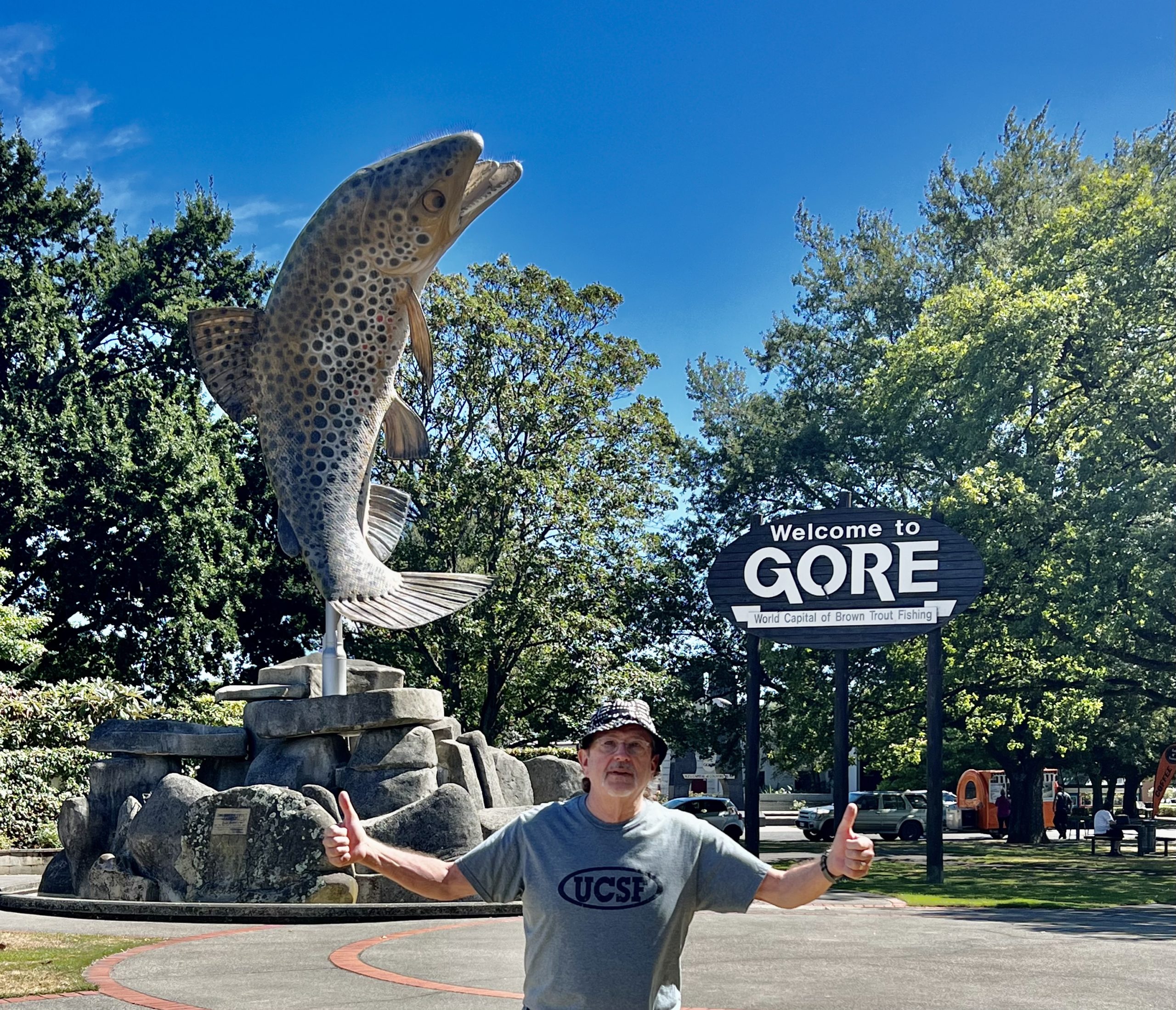
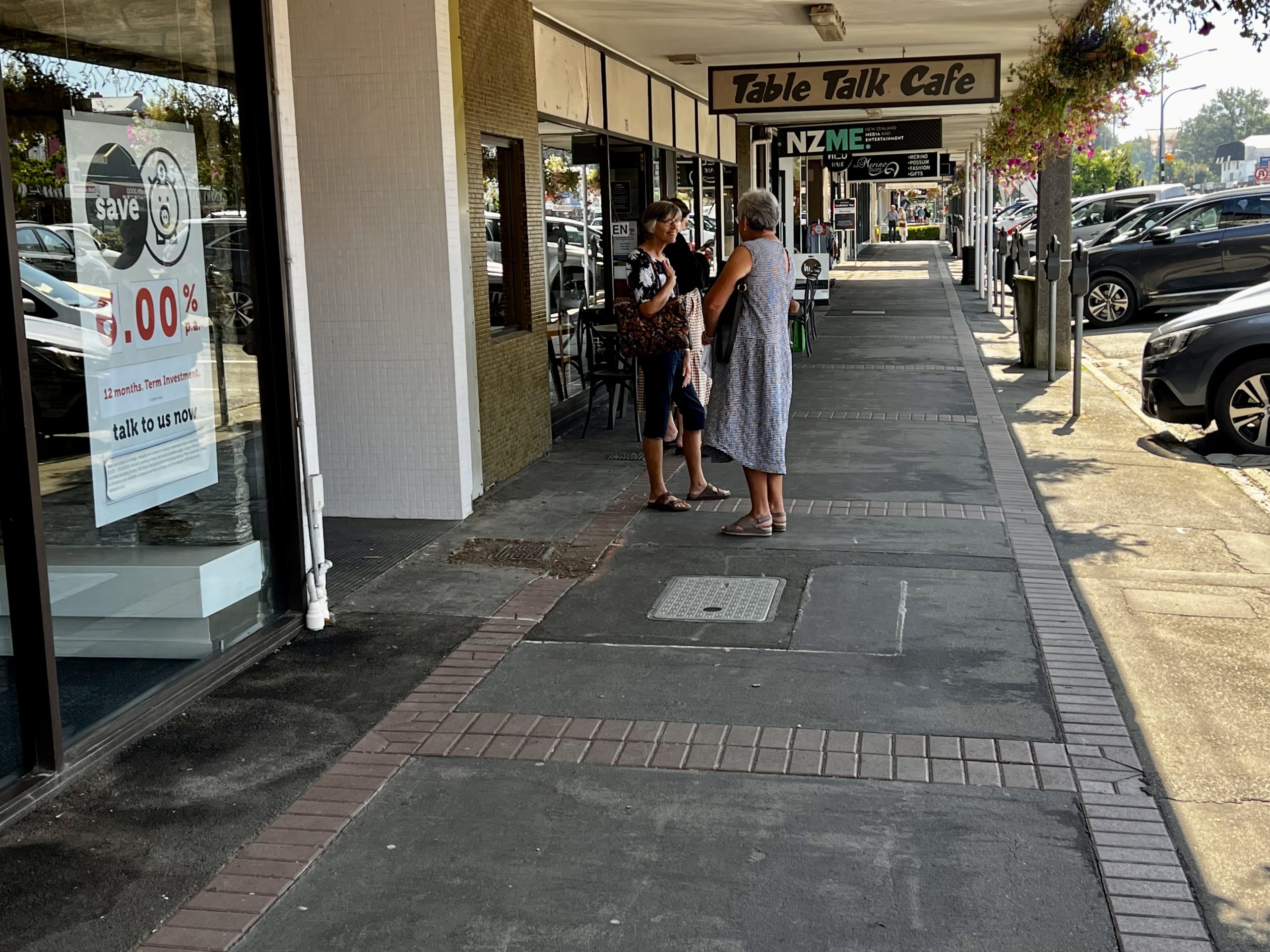
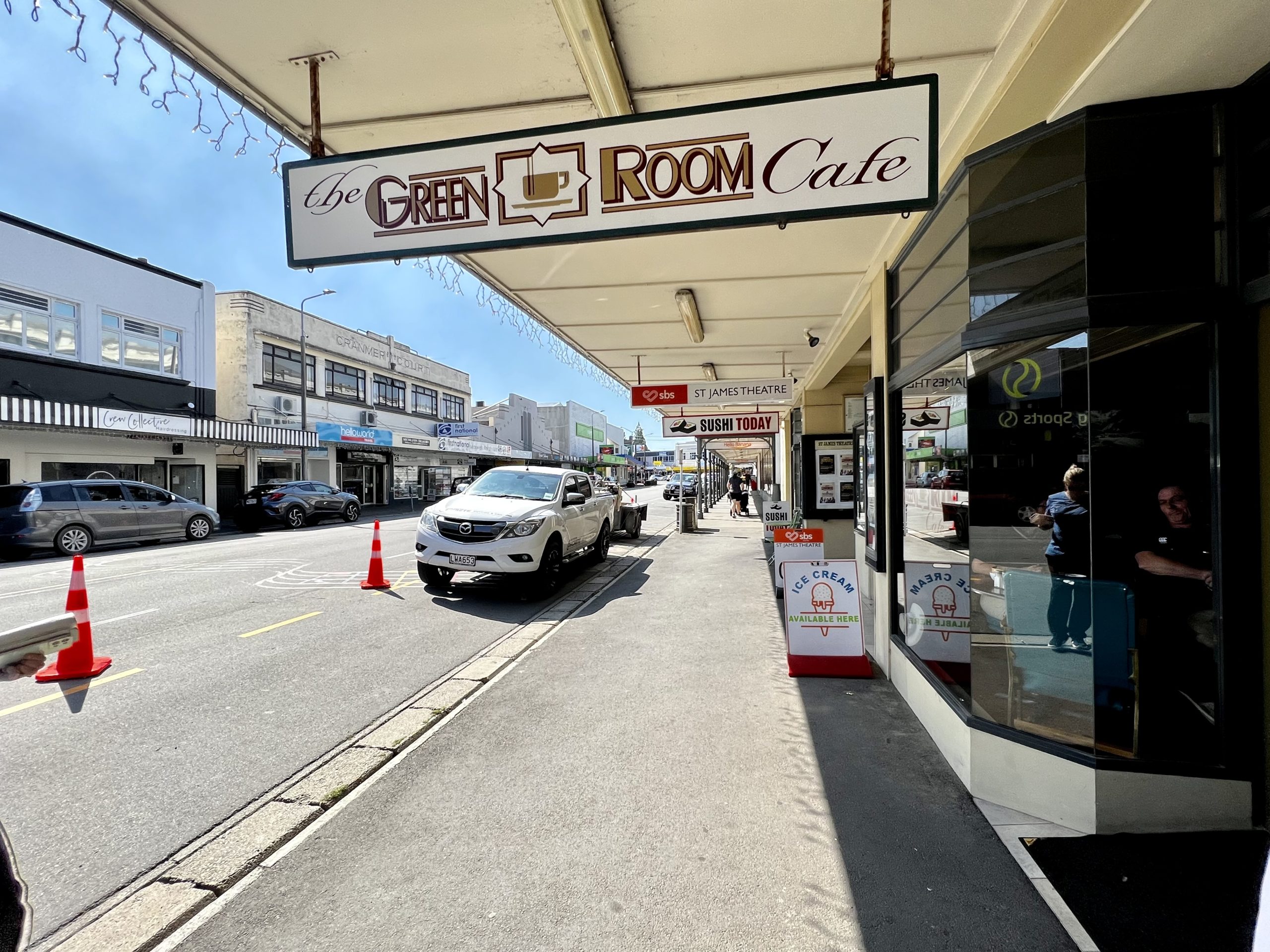
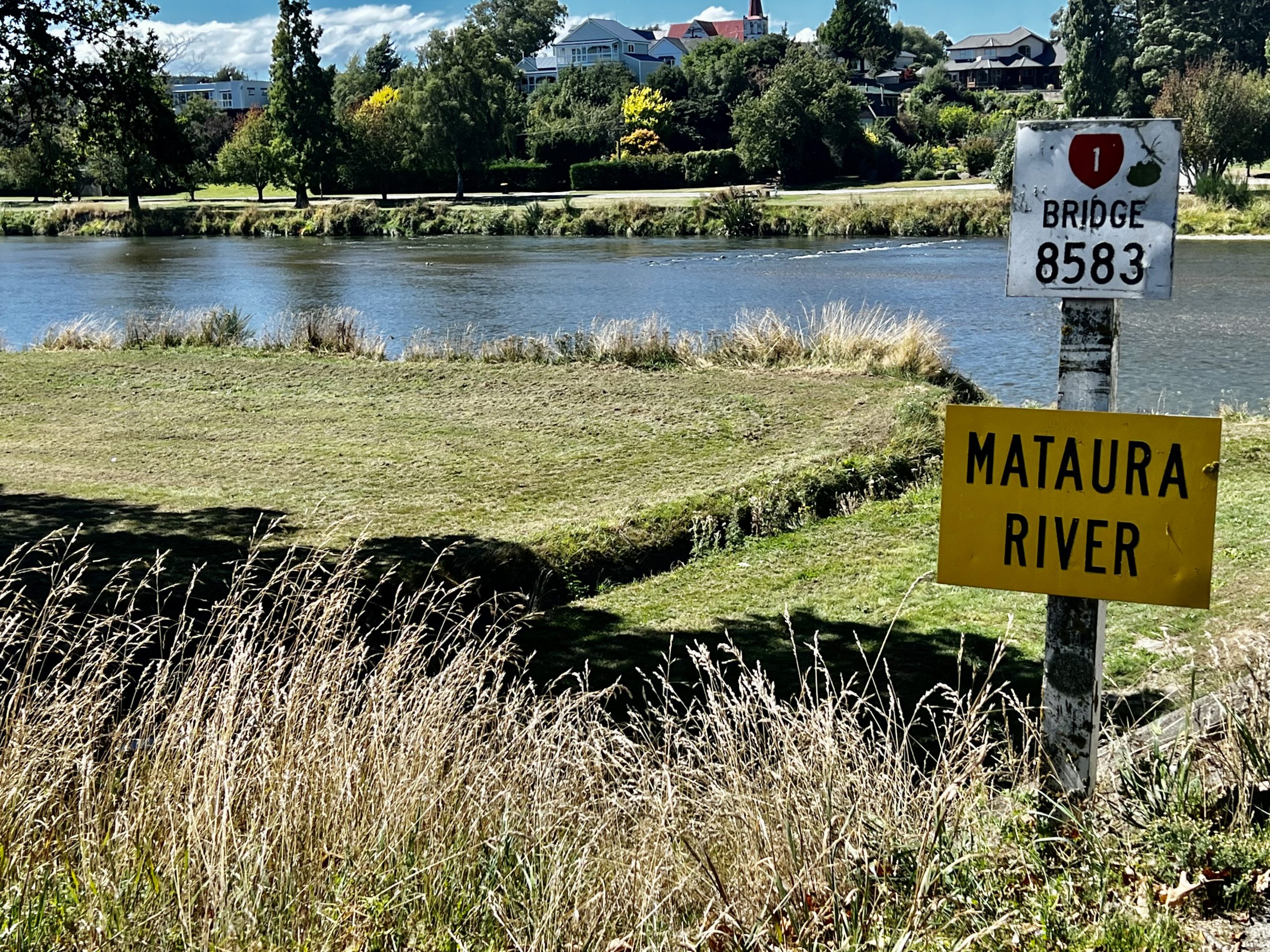
Gore is a pleasant surprise. We did not know what to expect of this rather remote rural town of 8,000, deep in the South Island. Turns out it has a thriving downtown. The main street of two blocks is lined with shops and restaurants, all under a continuous arcade. As in other parts of the South Island, Europeans purchased land here from the Māoris in the mid 1850s and converted large tracts into sheep runs. The long Mataura River, famous for trout fishing, flows nearby. Gore is an agricultural center whose economy has swung with the success or failure of the market. In the 1960s, it had the highest per capita retail of any New Zealand town. (It has a very nice jewelry store.) This dropped as the wool market lost ground. Recently the conversion of farms from sheep to dairy has returned economic prosperity here. We heard locals downtown talking about expensive new homes being built nearby.
Along with experiencing weaker drinks, Robert had his first breathalyzer test in Gore. As we were driving after lunch, the police stopped us at a check point on the edge of town. Robert passed.
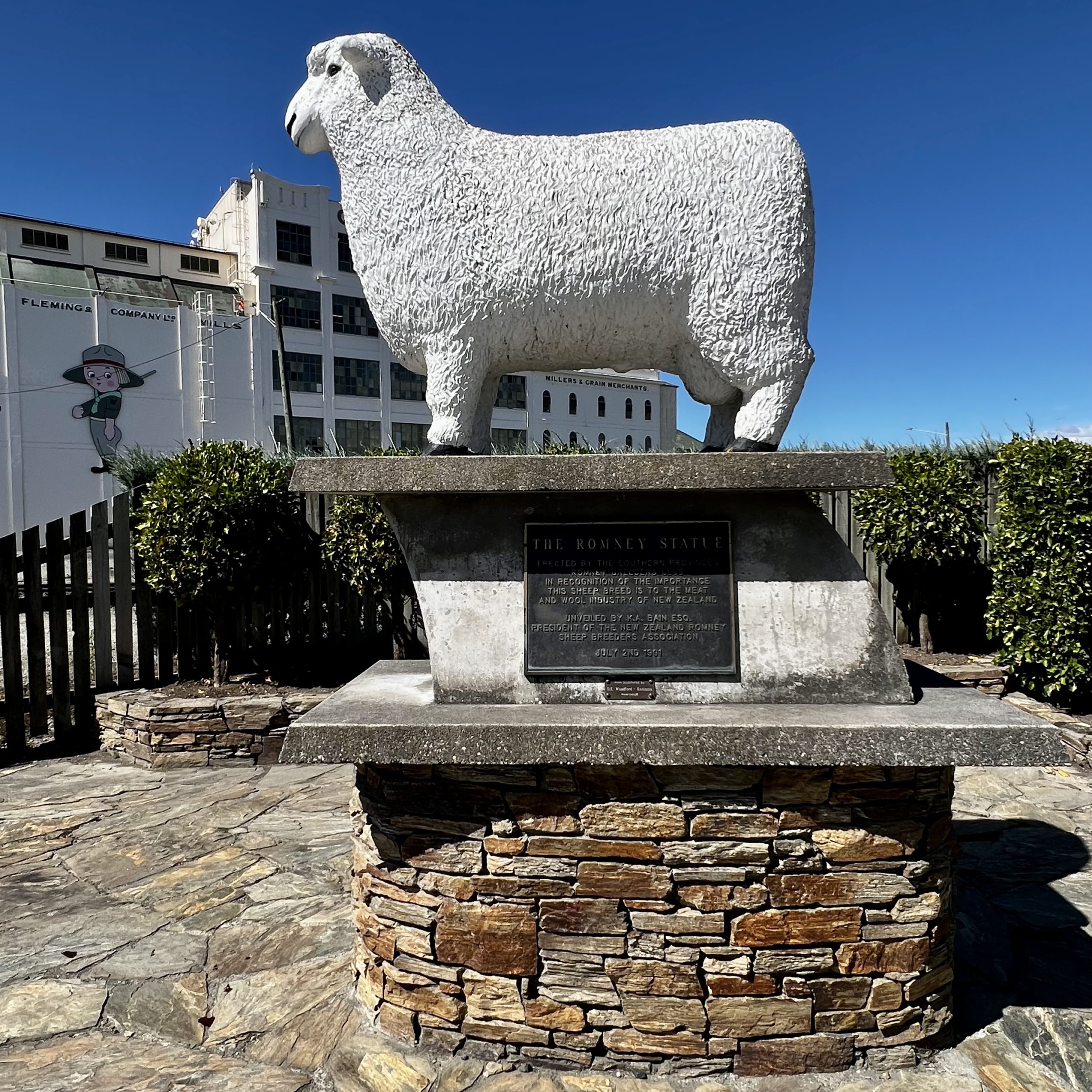
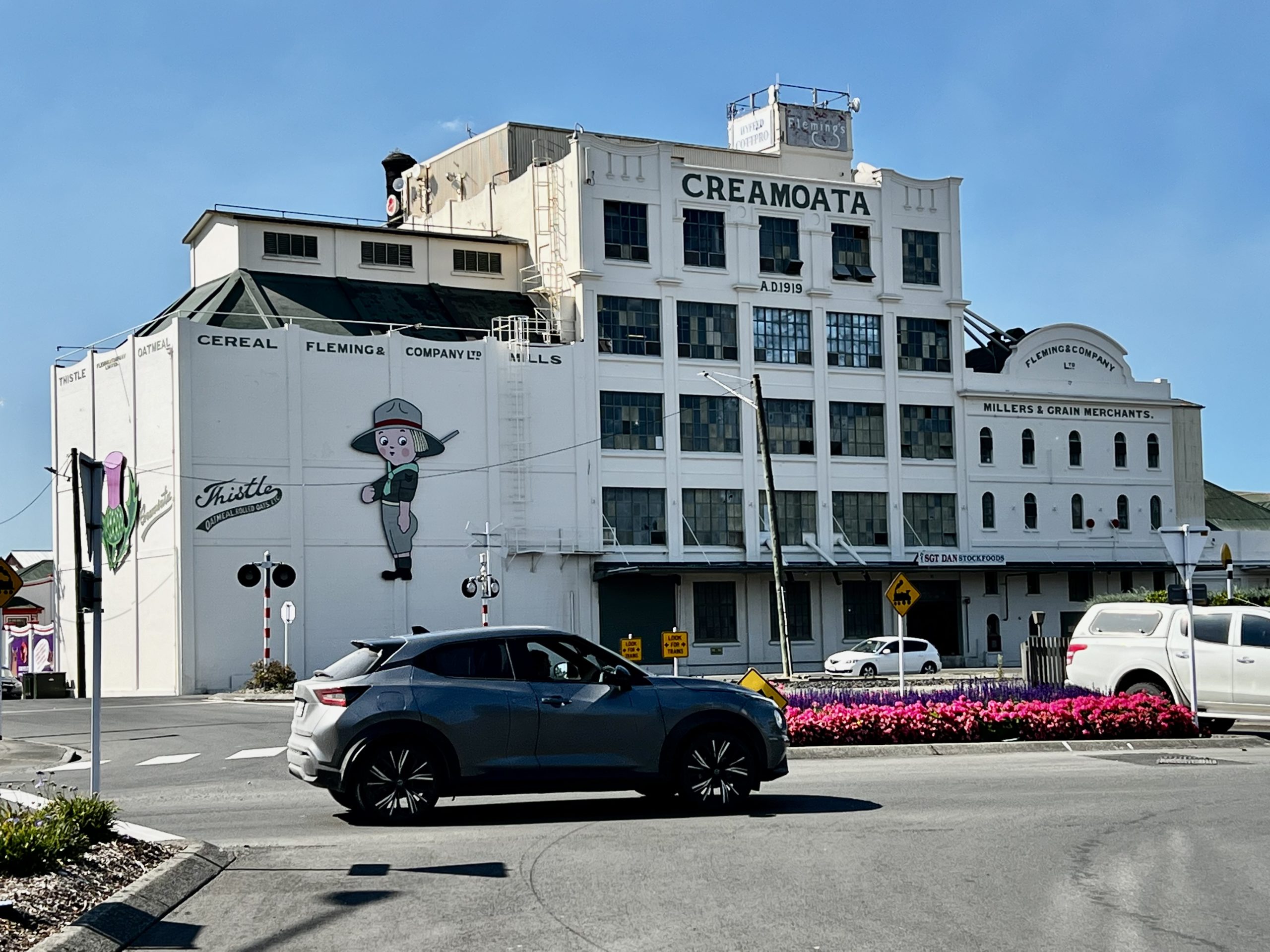
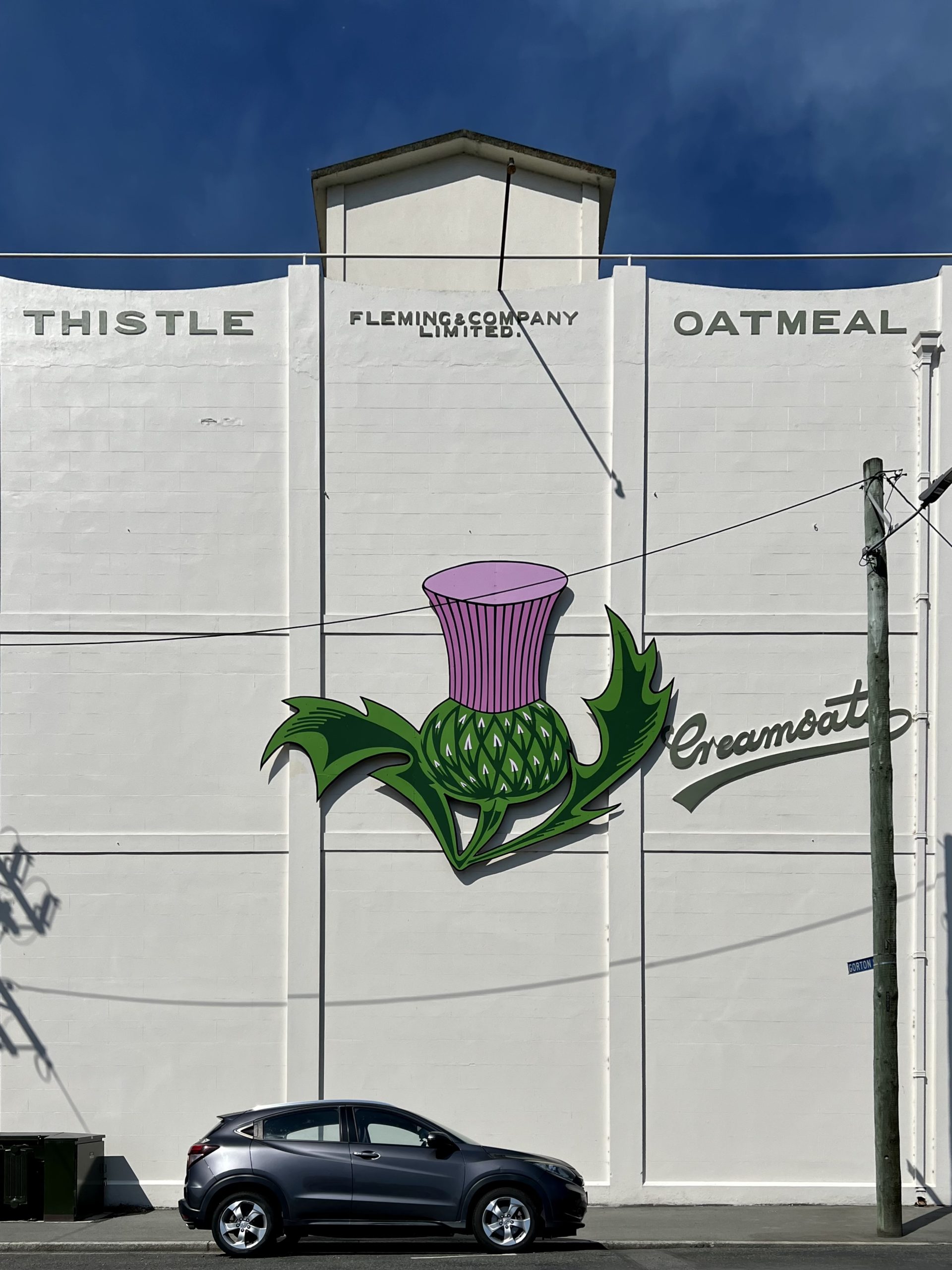
A terrific statue. At least Robert thinks so.Saw this on several buildings. Won’t see this in San Francisco.New Zealand cream of oats. Factory now abandoned.
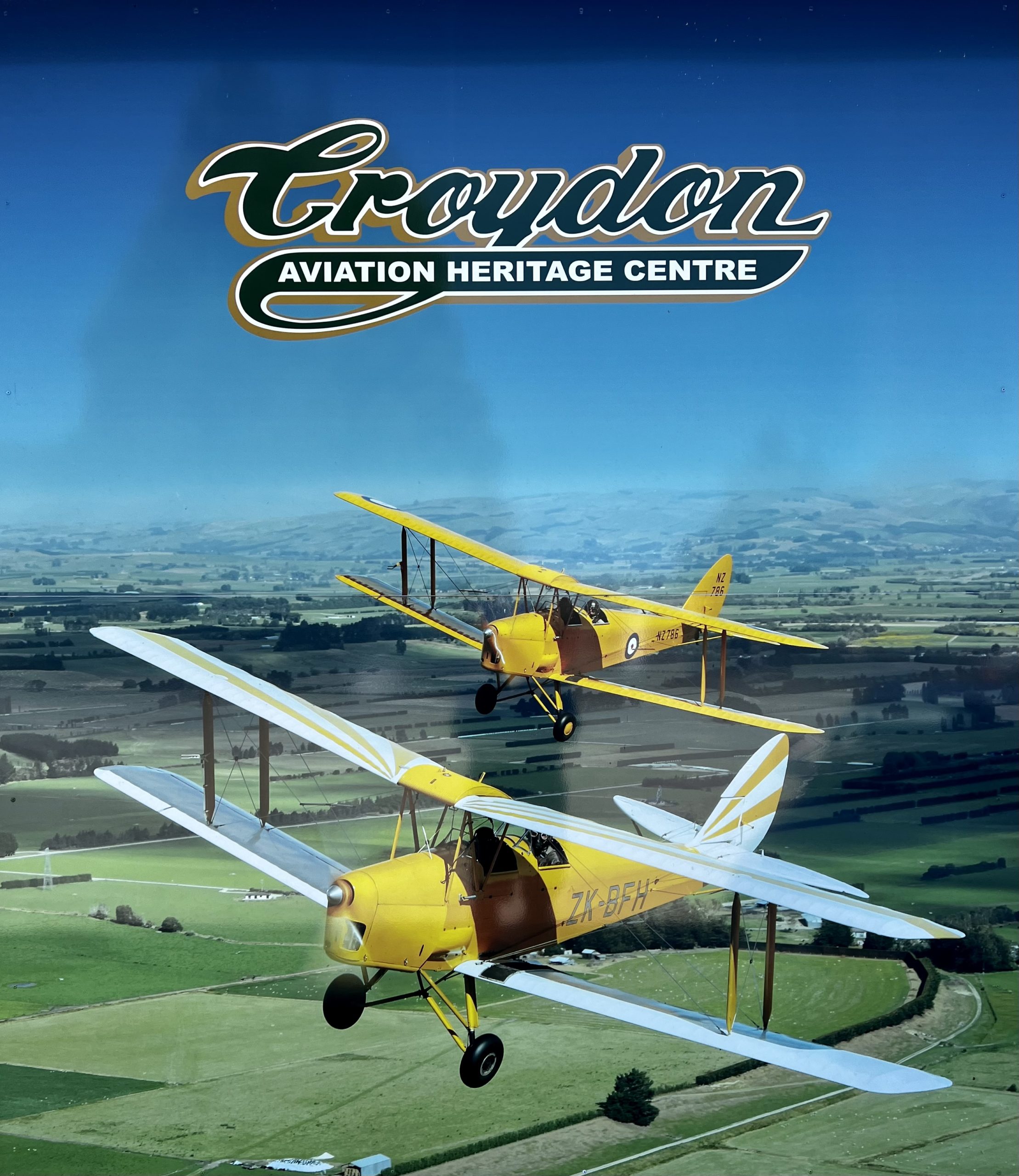
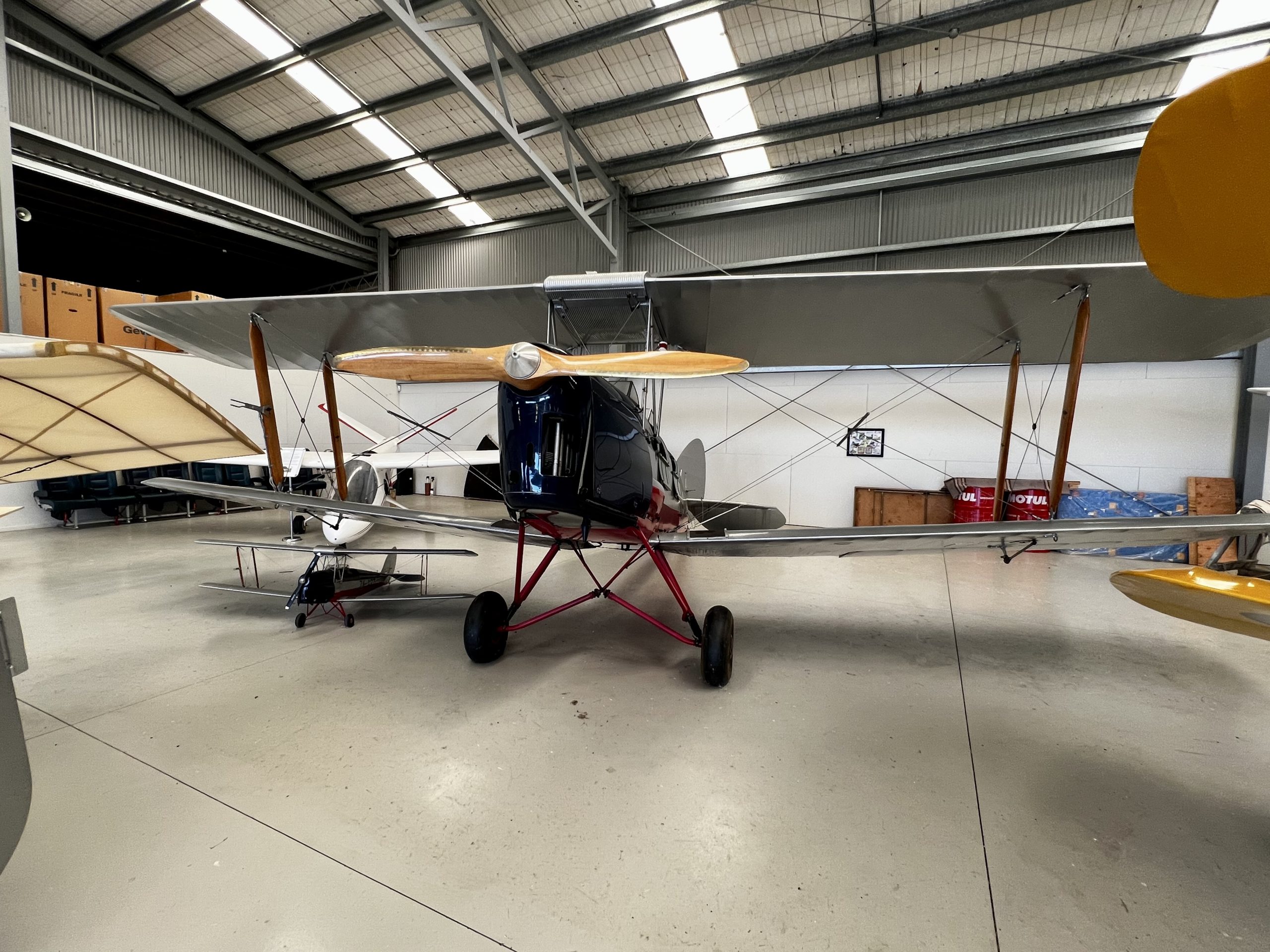
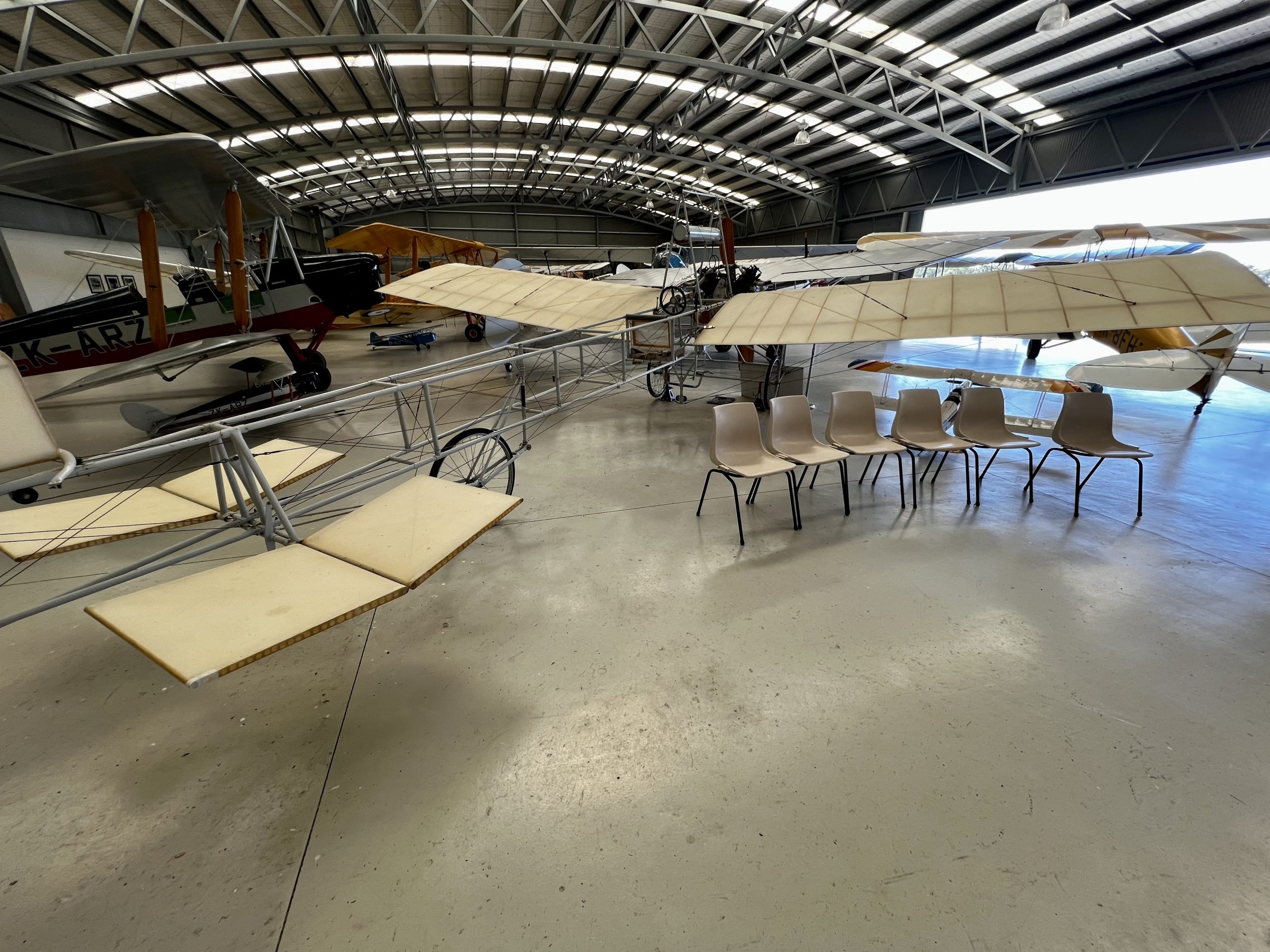
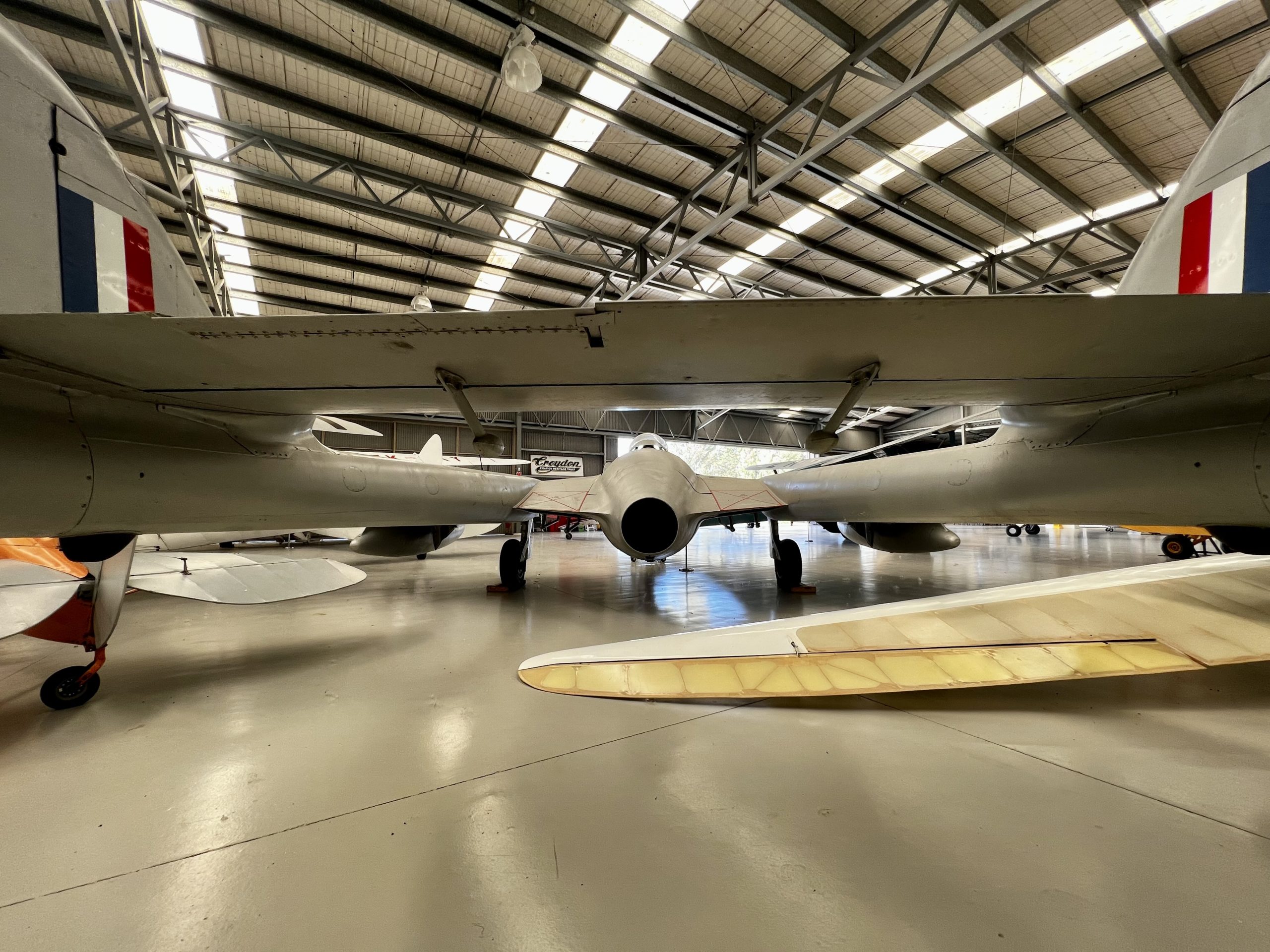
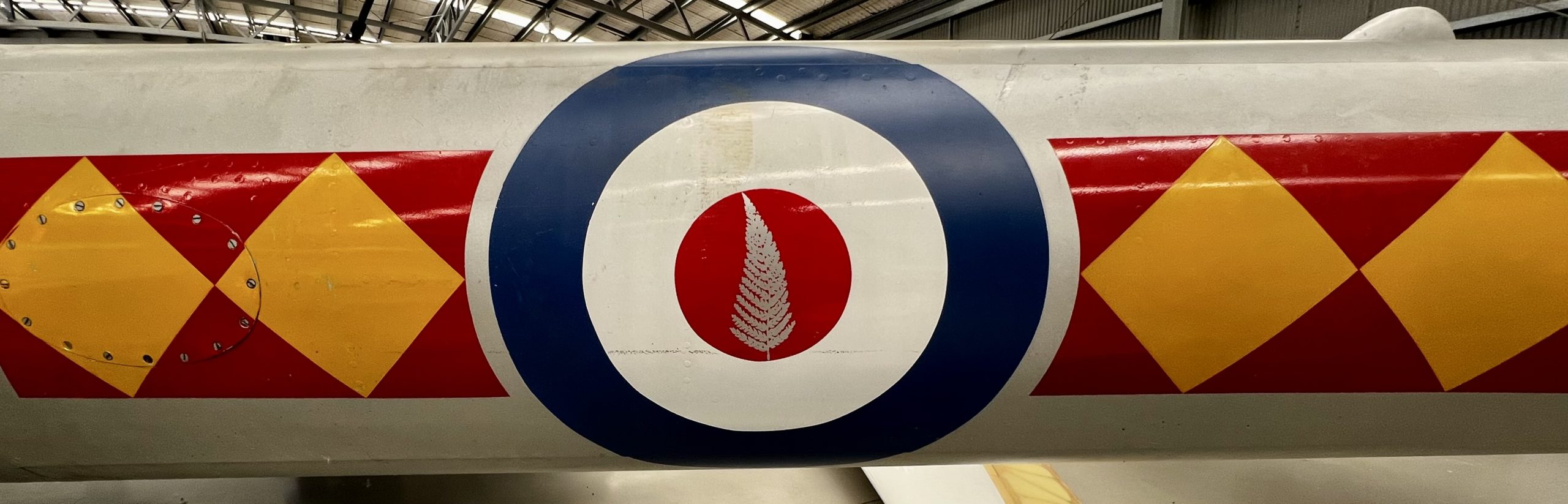
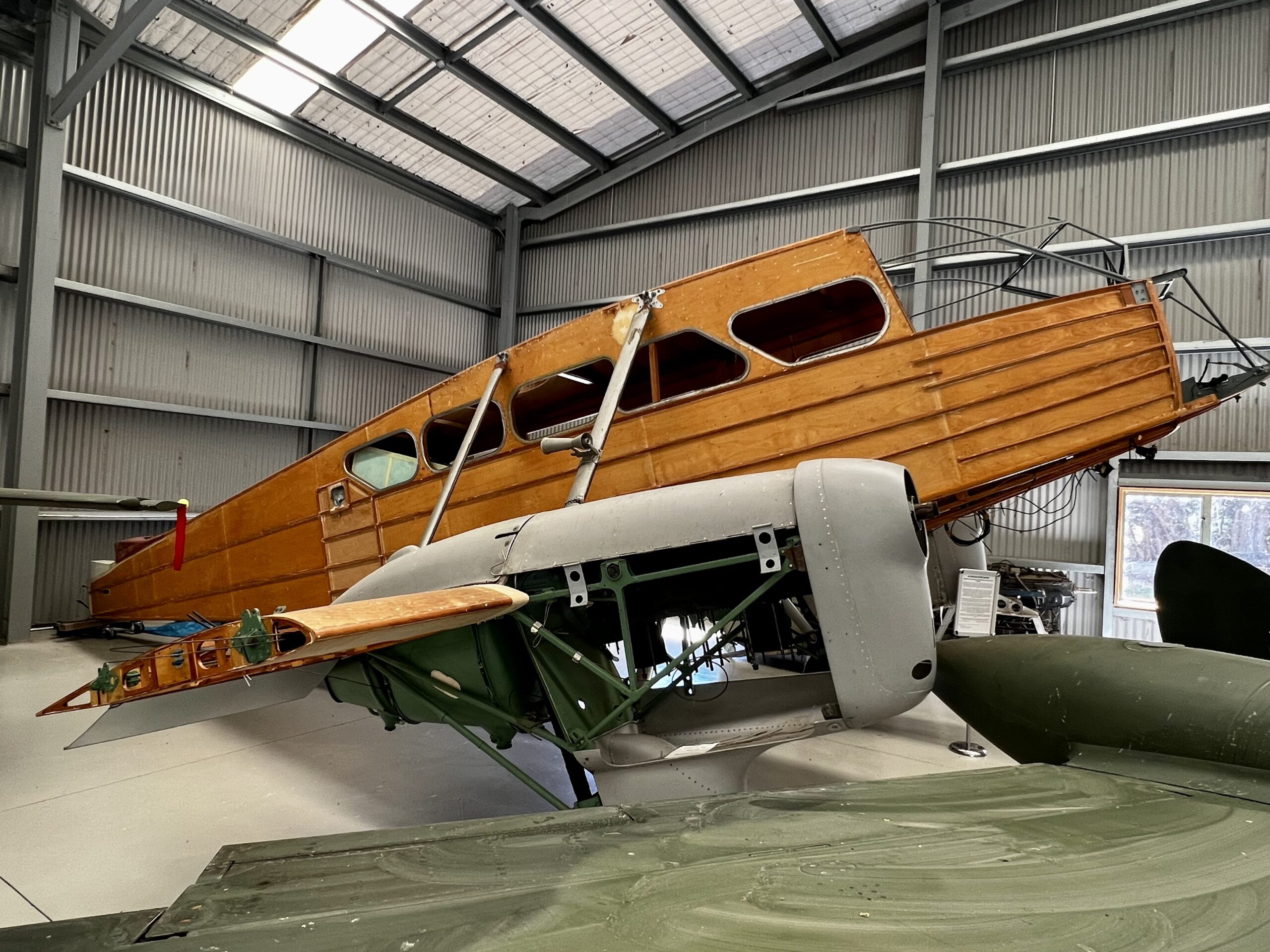
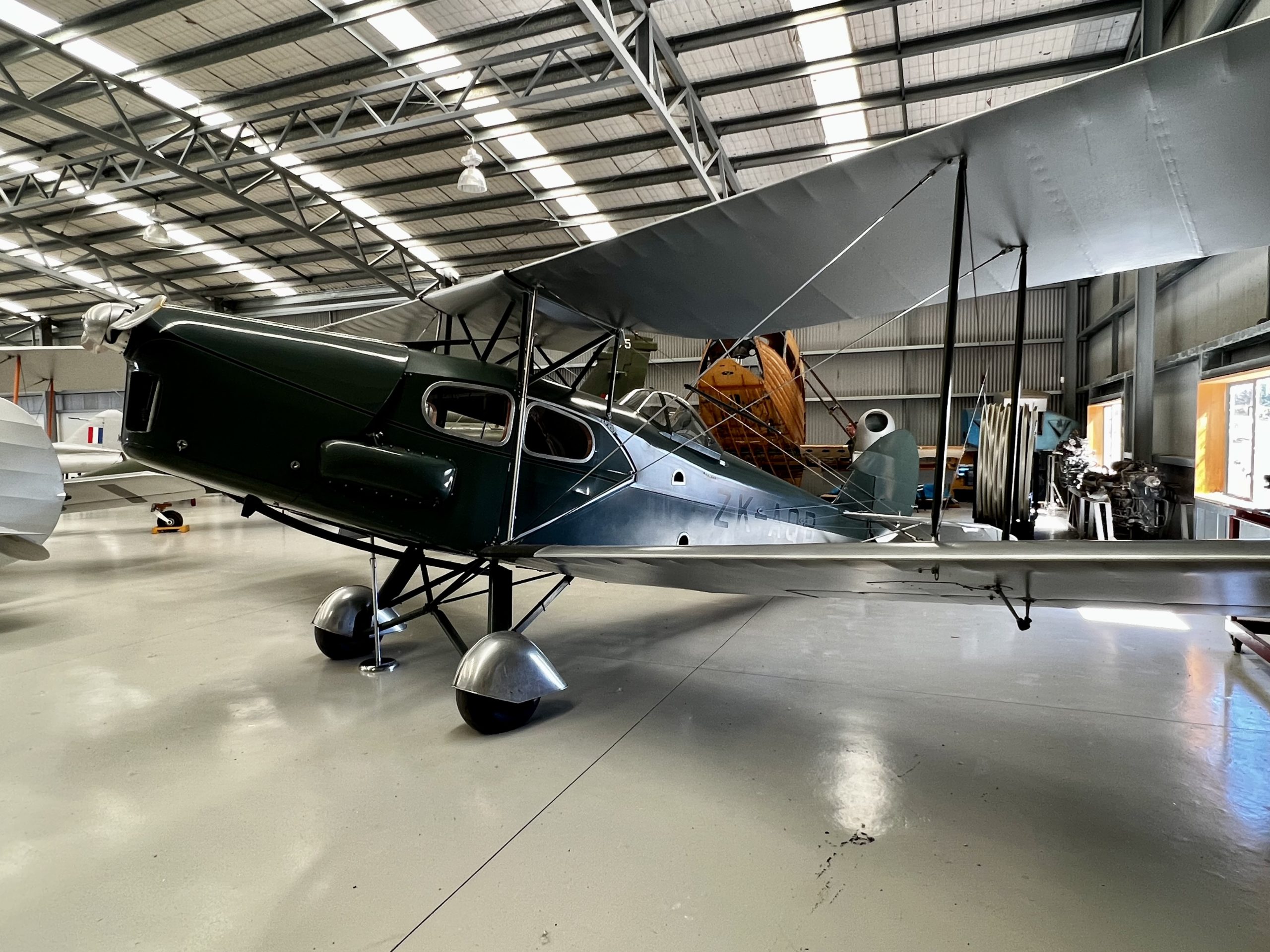
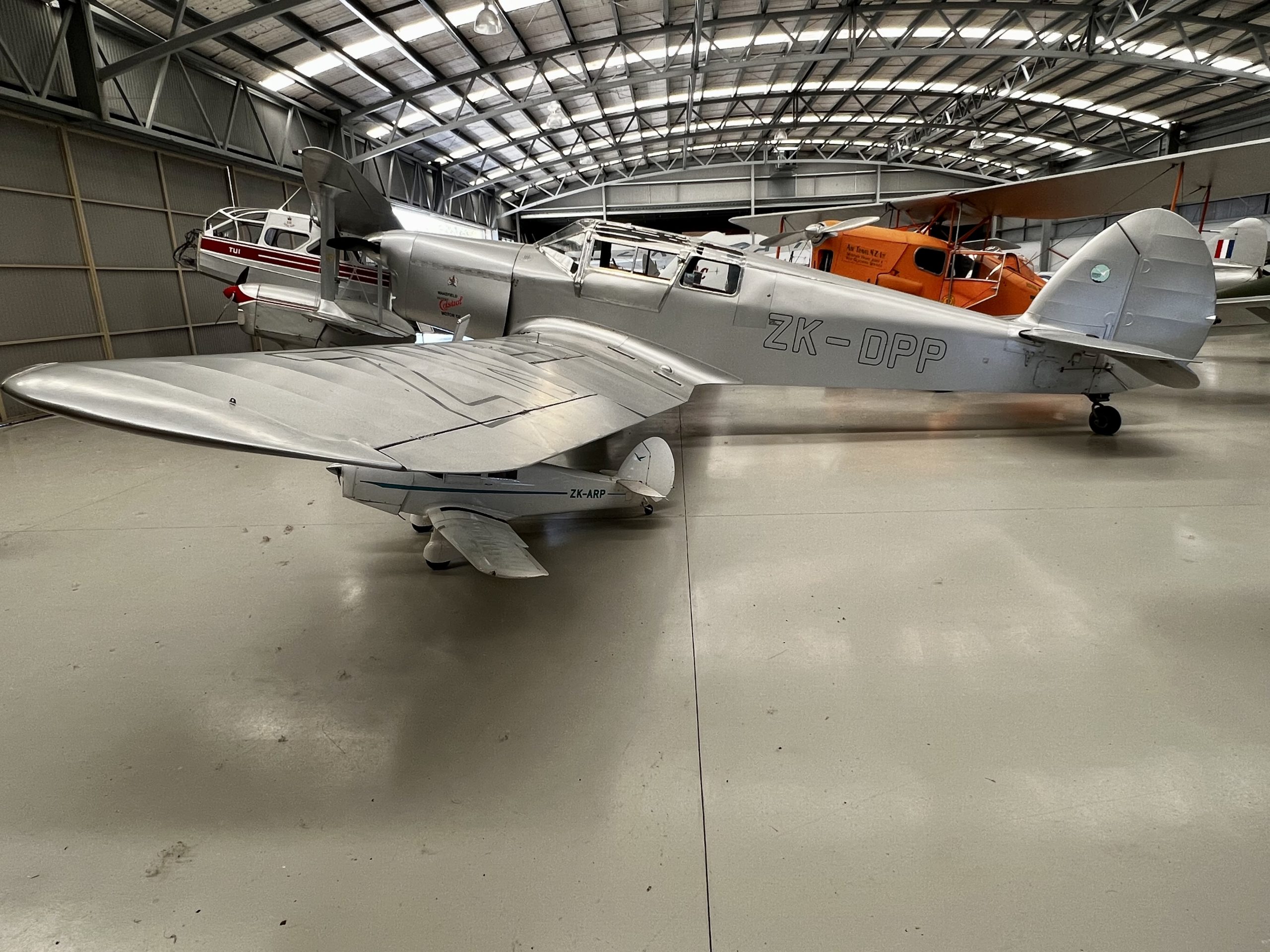
Croydon Aviation Heritage Centre
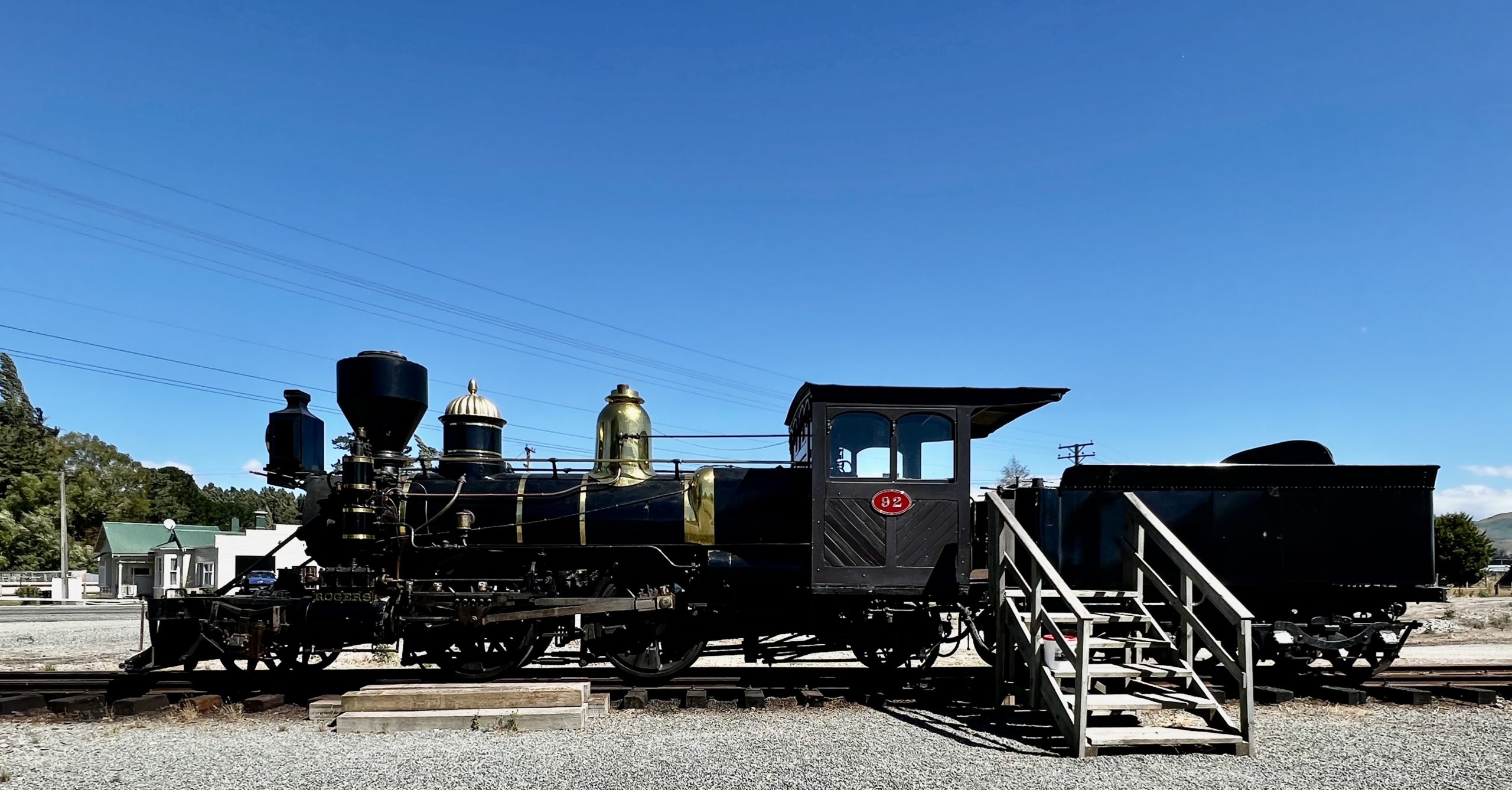
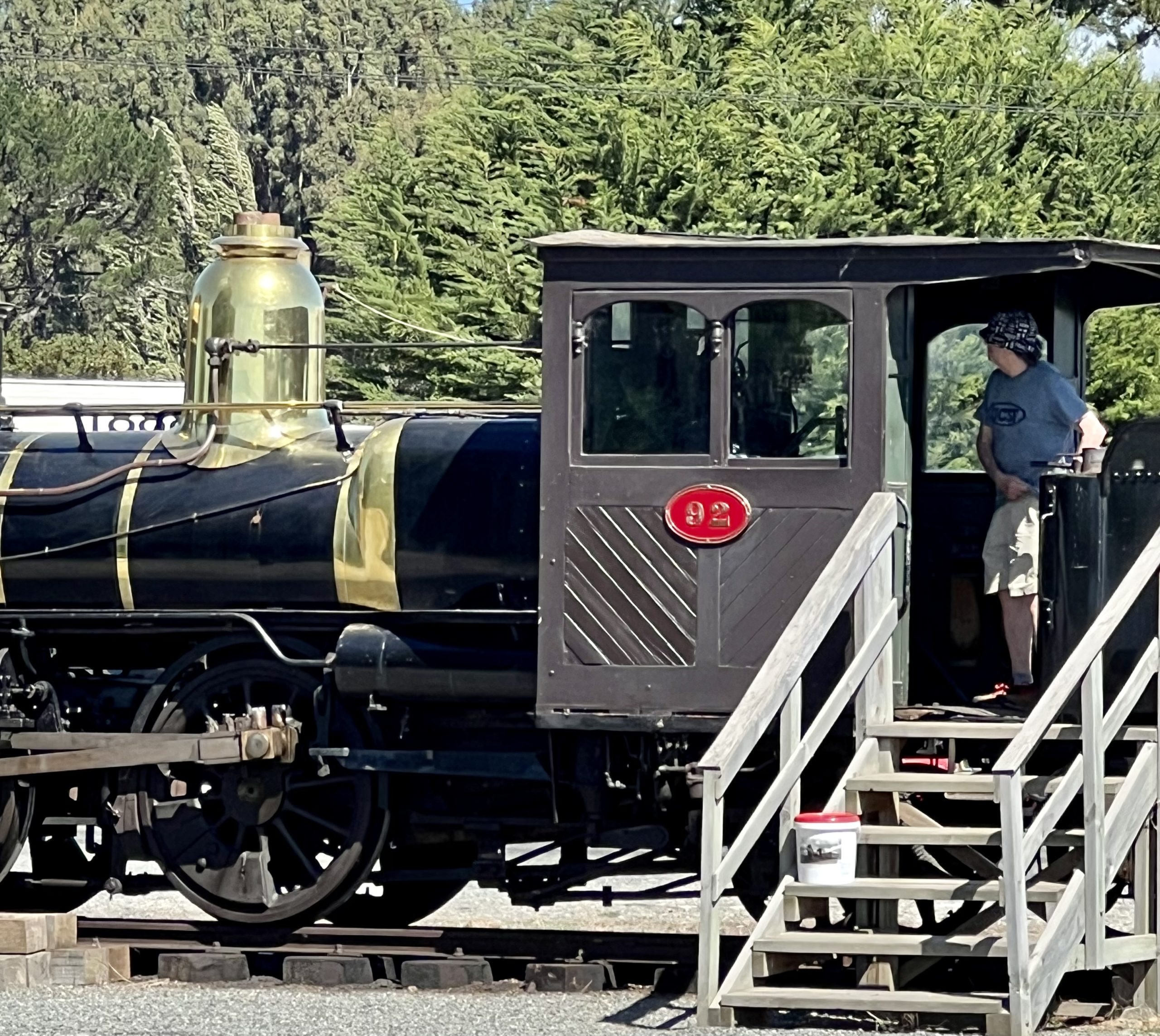
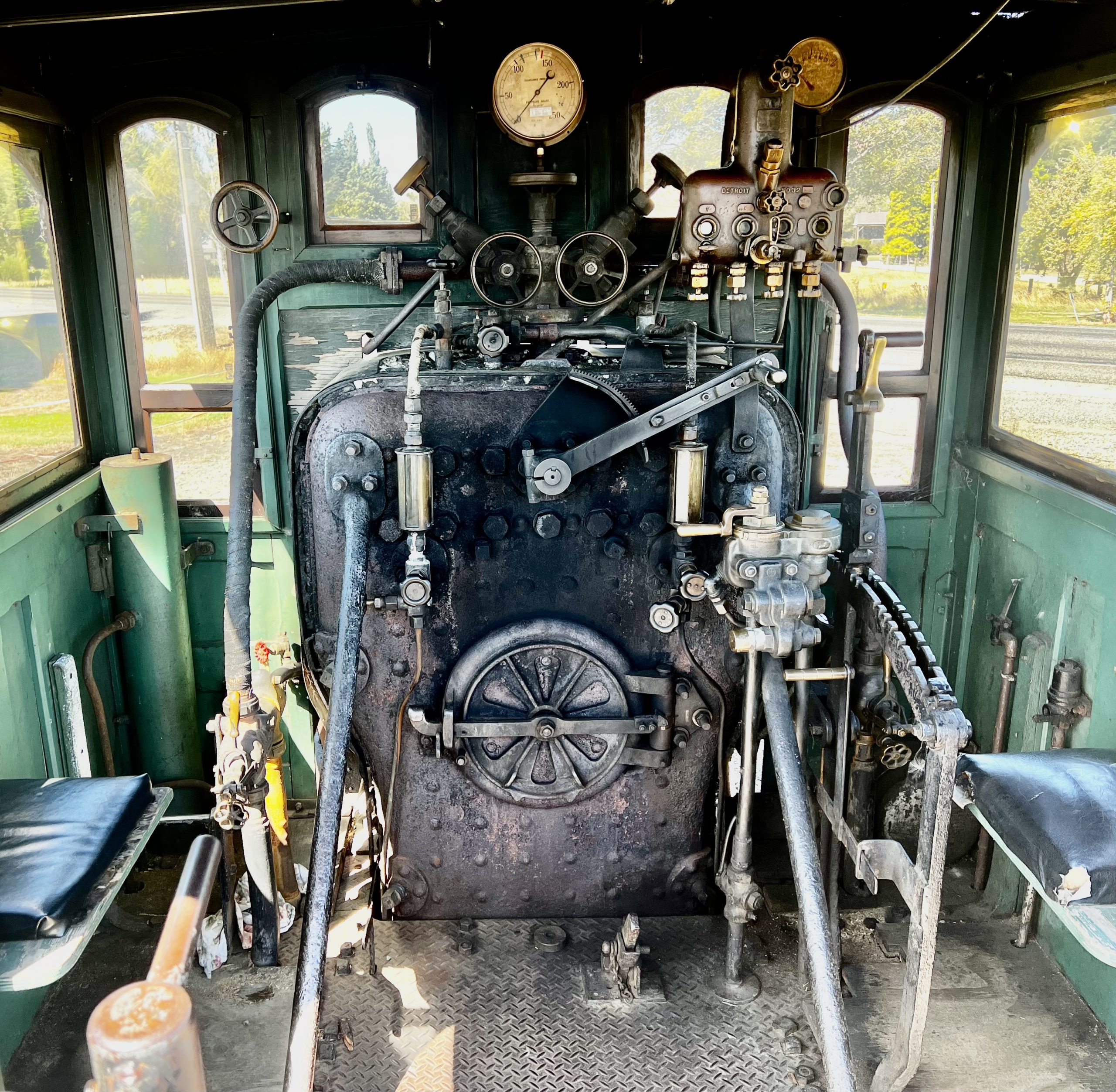
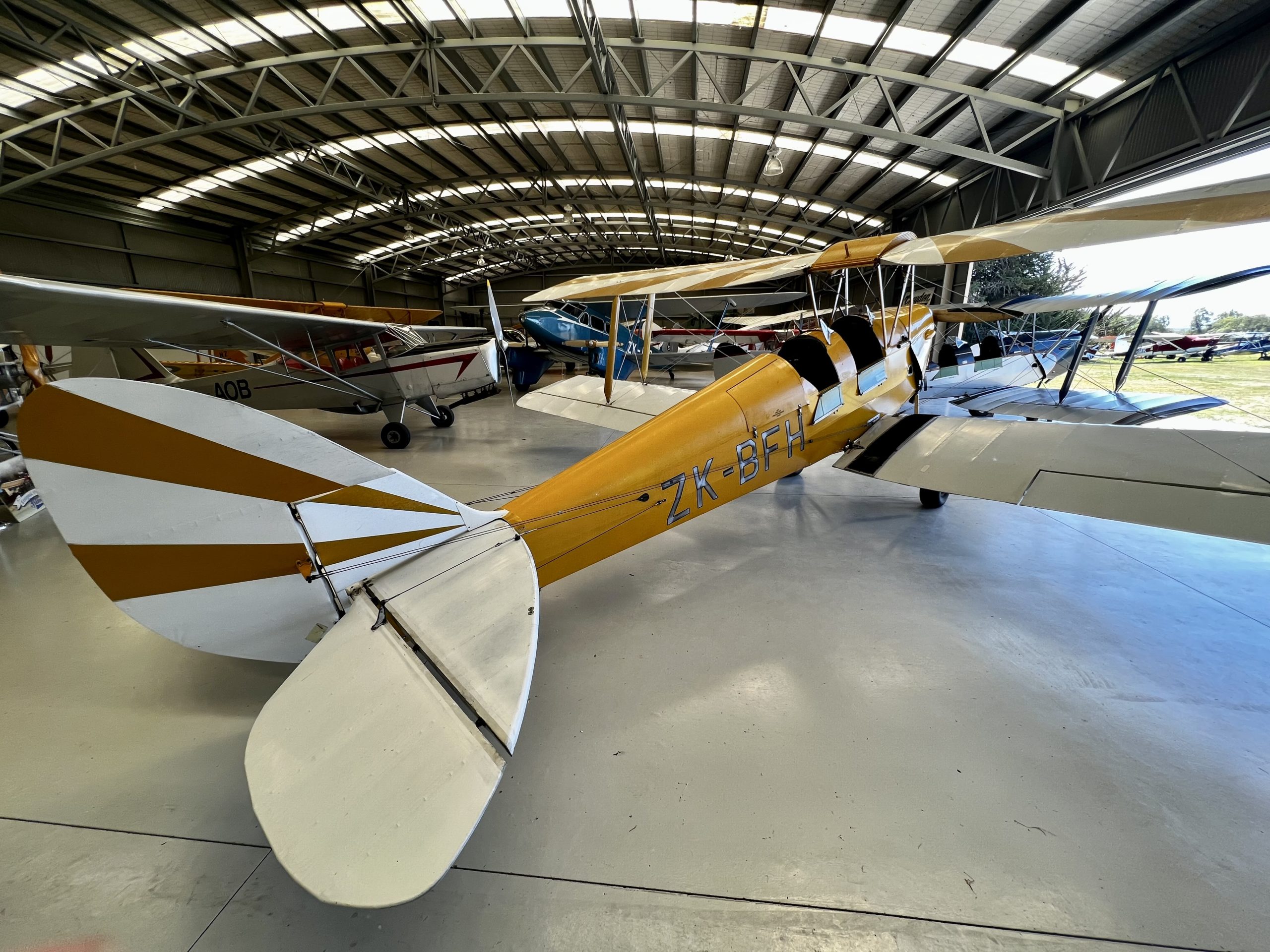
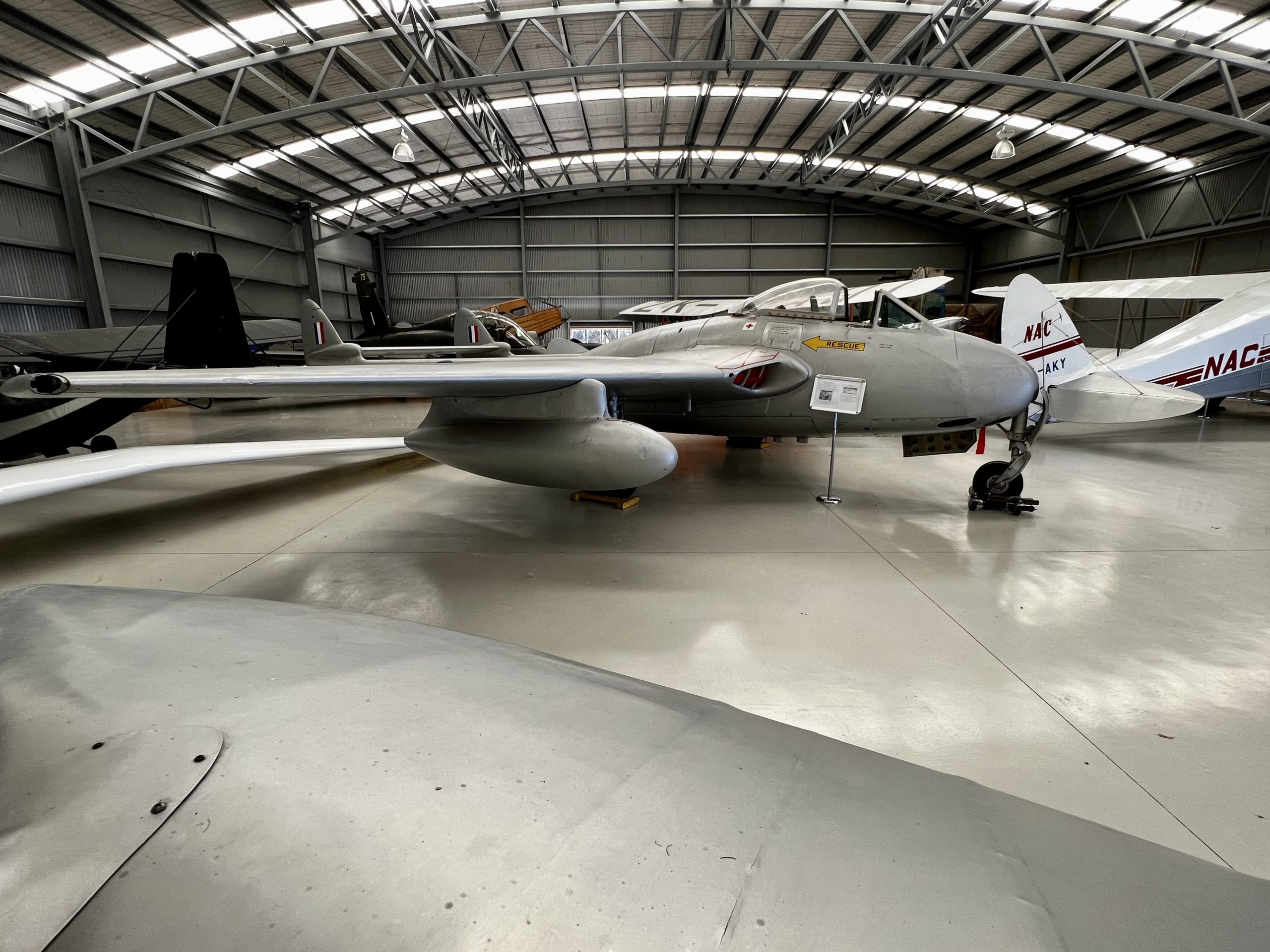
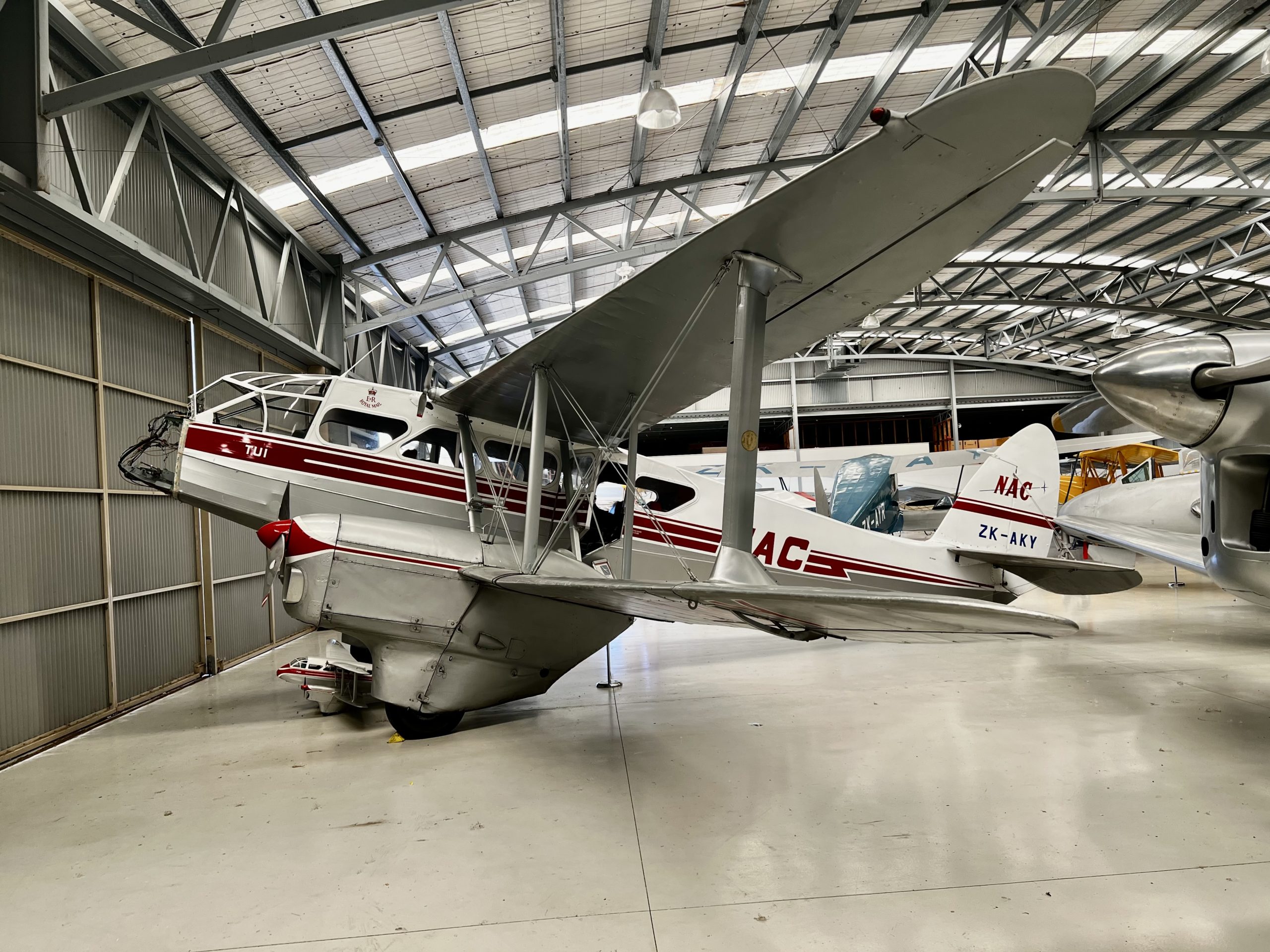
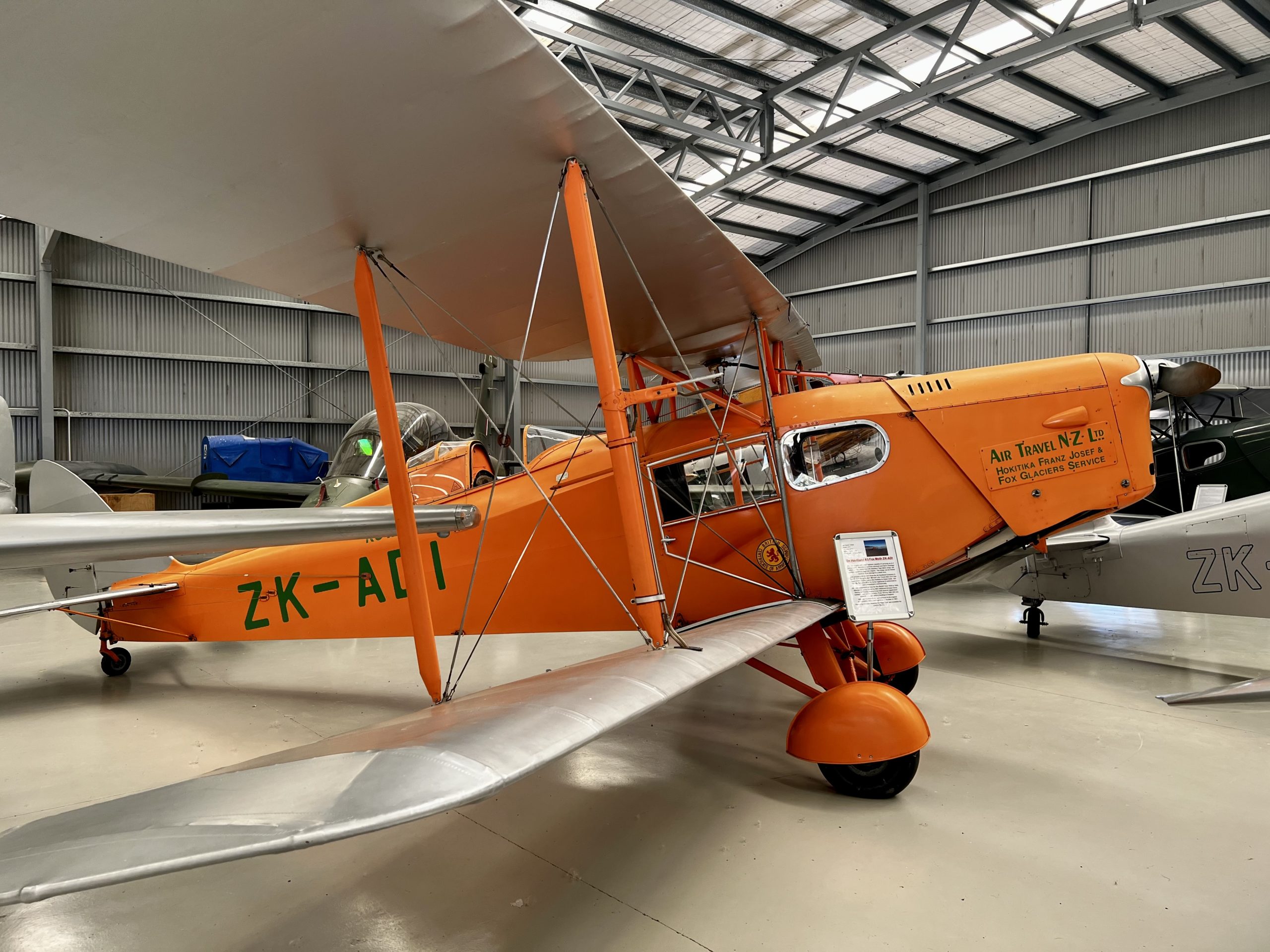
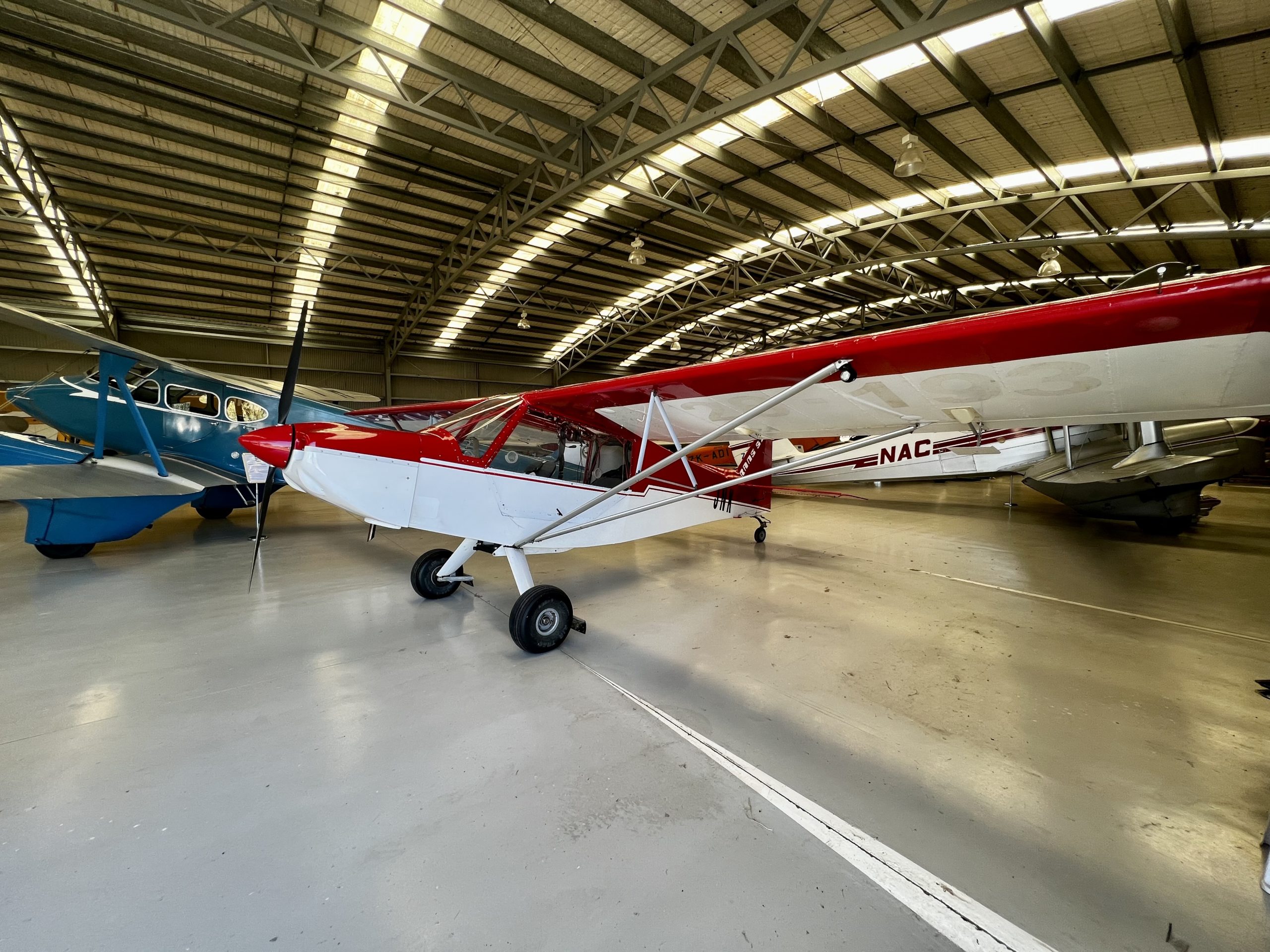
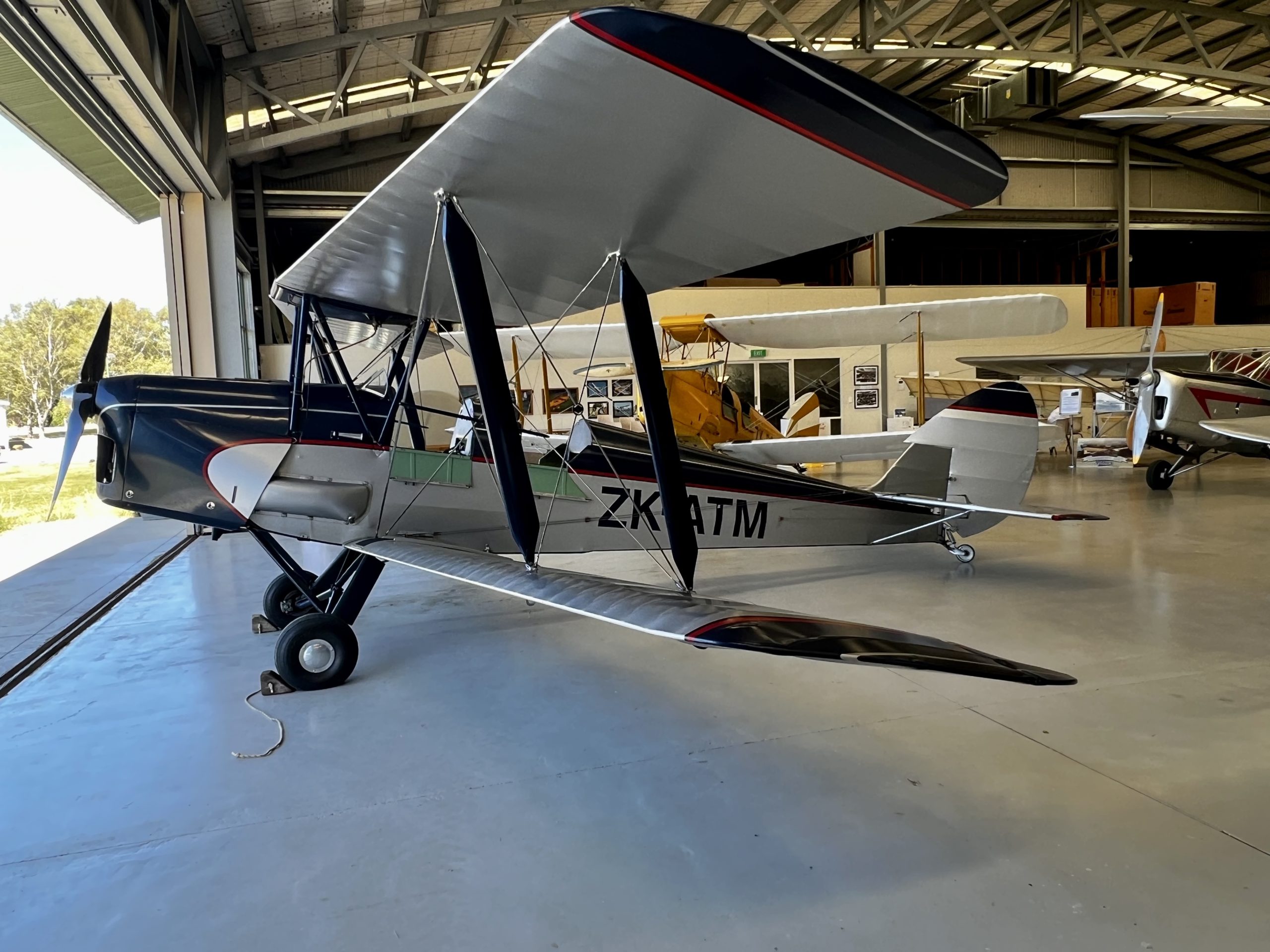
This tiny museum with one large airplane hangar and a grassy field was recommended to us by a woman in Gore who roams the downtown to promote local tourism and works as a meter maid. The aviation center has a great train like many Robert has seen in cowboy movies. But the main feature is the collection of antique airplanes, which is spectacular and includes a few jets. A local company specializes in restoring them. The company even has a plane under restoration from Reno, Nevada. When completed, the owner plans to fly it back to Reno, via Europe, which will take several years. Some of the planes here are for hire too!
Food and Beer
Twizel
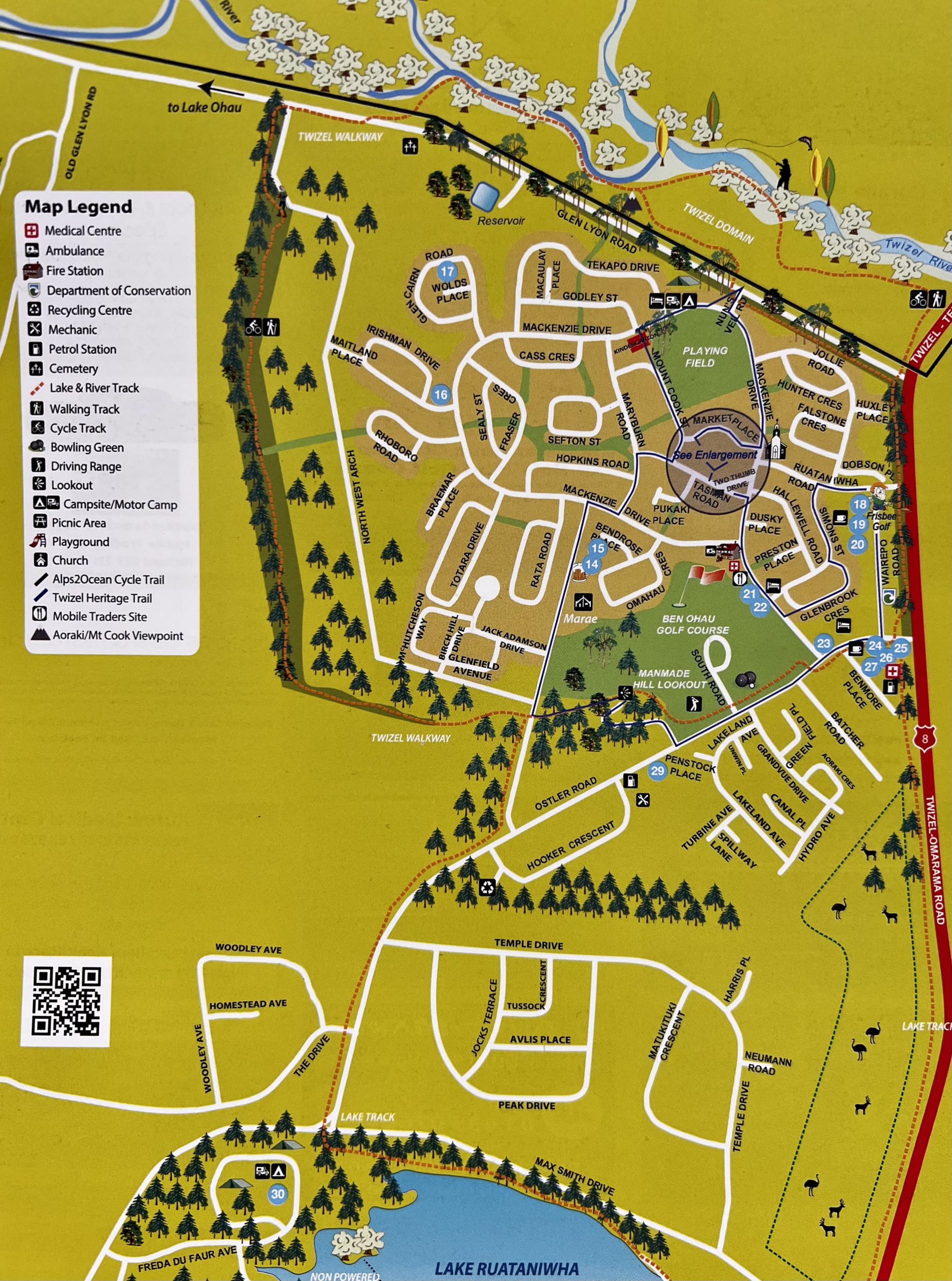
Twizel (pronounced Twhy–zel) is the remains of a company town resurrected as a small tourist mecca for cycling, fishing, mountaineering, and a stop for numerous tour buses that take people to Mount Cook. Some tourists head to the dark skies at Tekapo, an hour’s drive away in the Aorangi Mackenzie International Dark Sky Reserve; at 4,367 square kilometers (1,686 square miles), this is the largest such reserve in the Southern Hemisphere. We did not participate in nighttime stargazing, because after a day of fishing Robert demanded a beer and Bonnie needed her sleep.
Twizel was built by the New Zealand Ministry of Works in 1968 to house construction workers on the Upper Waitaki Hydroelectric Project. The plan was to dismantle the town once the project was complete, but some residents wanted to stay. The population peaked at 6,000 in the 1970s. From that busy period there are still two supermarkets of the same chain a block apart even though the population has dwindled to 1,700. But summer vacationers triple that number.
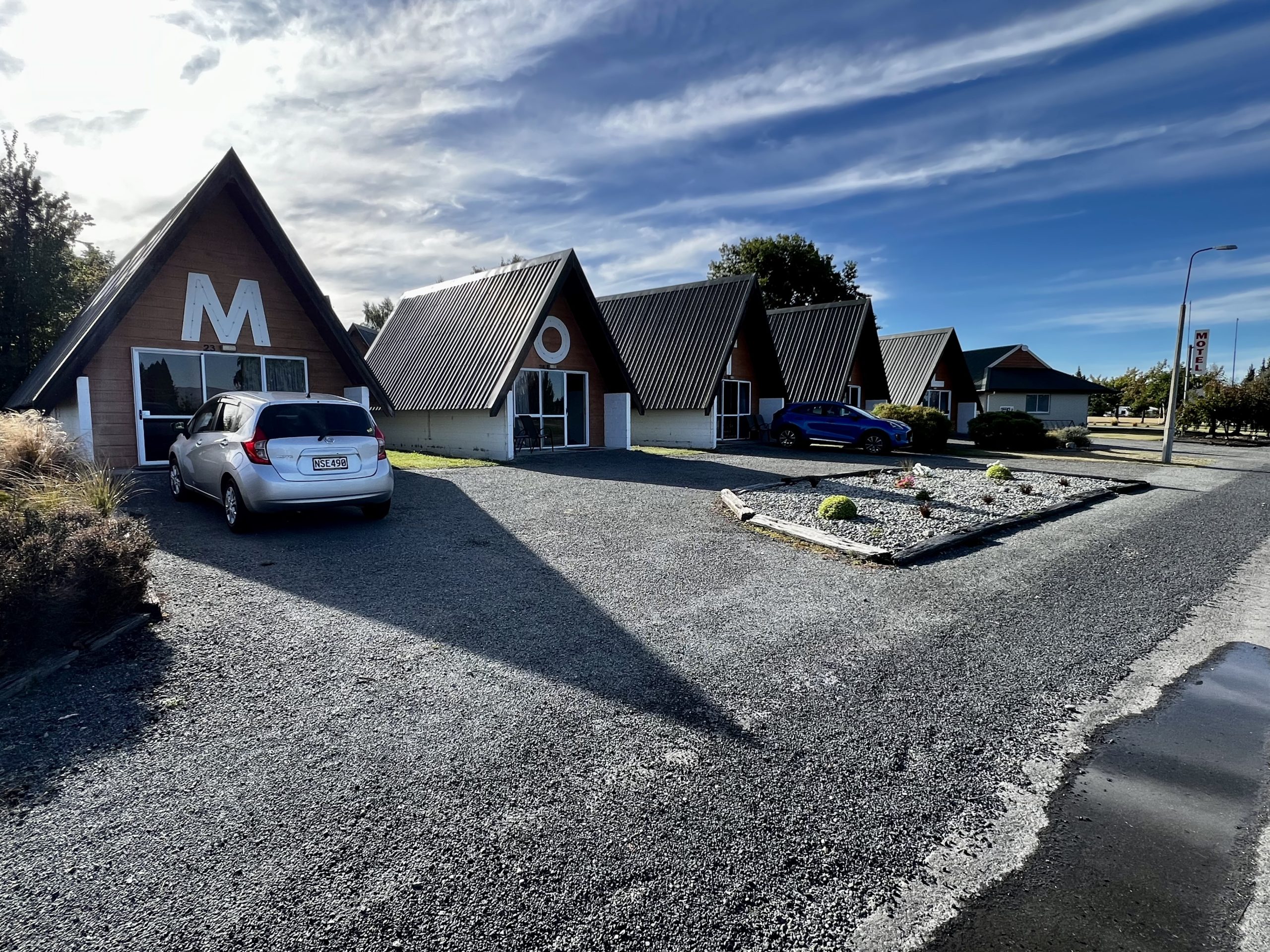
We found the town filled with all sizes of hotels and motels. Some are converted and expanded from single-family homes. Some were constructed new as mega hotels to handle the loads of the bused tourists who stay only one night.
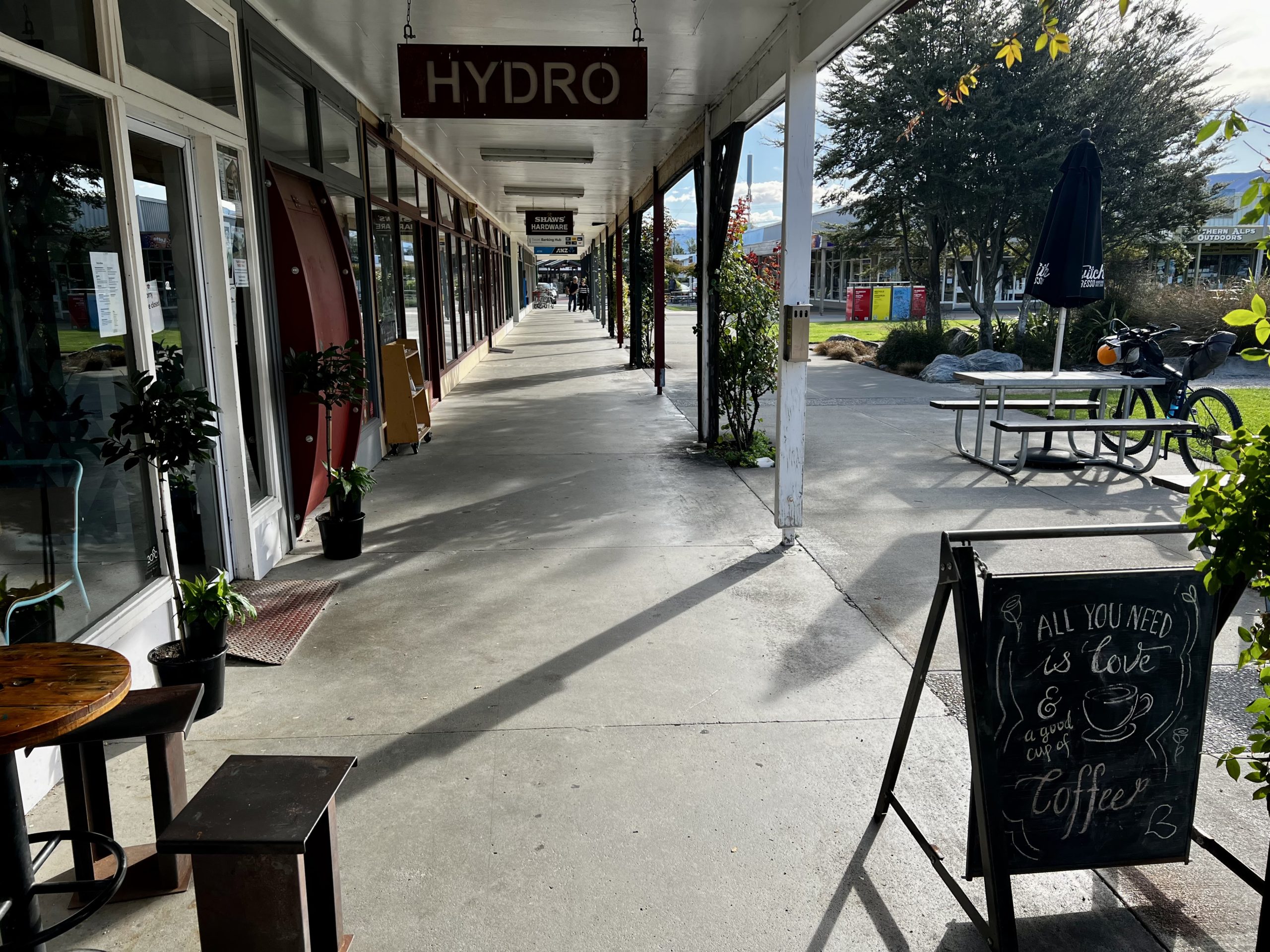
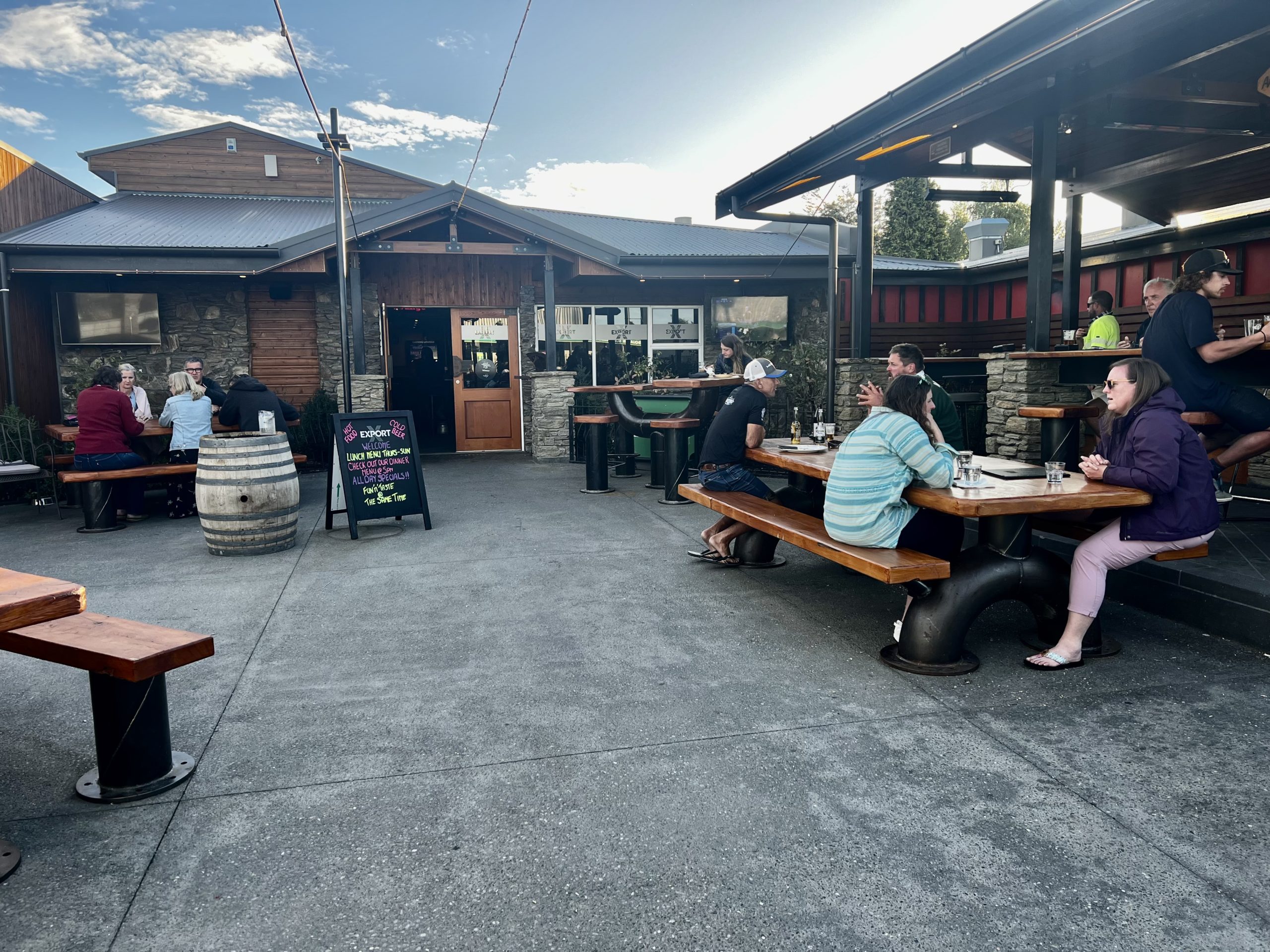
Twizel is quaint. It was a nice stroll to and from our hotel to shops and restaurants that form a tight cluster in the town’s center. You can thoroughly explore the shops in this center in twenty minutes. Twizel is a great home base to reach the many rivers with large brown trout that are within an hour’s drive. That discussion is for another post.
On the Way to Twizel
Random Stop for Dairy-Free Ice Cream
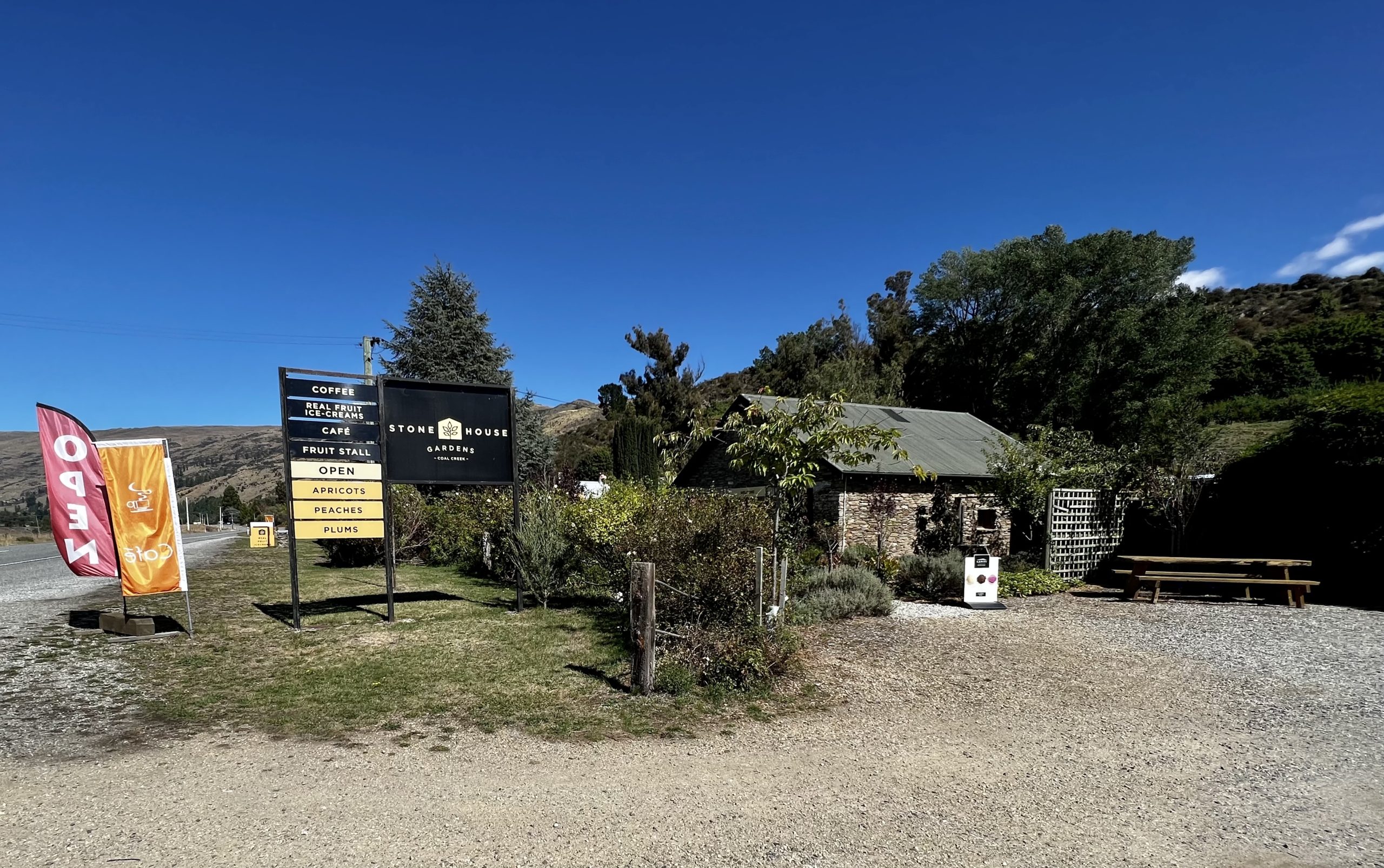
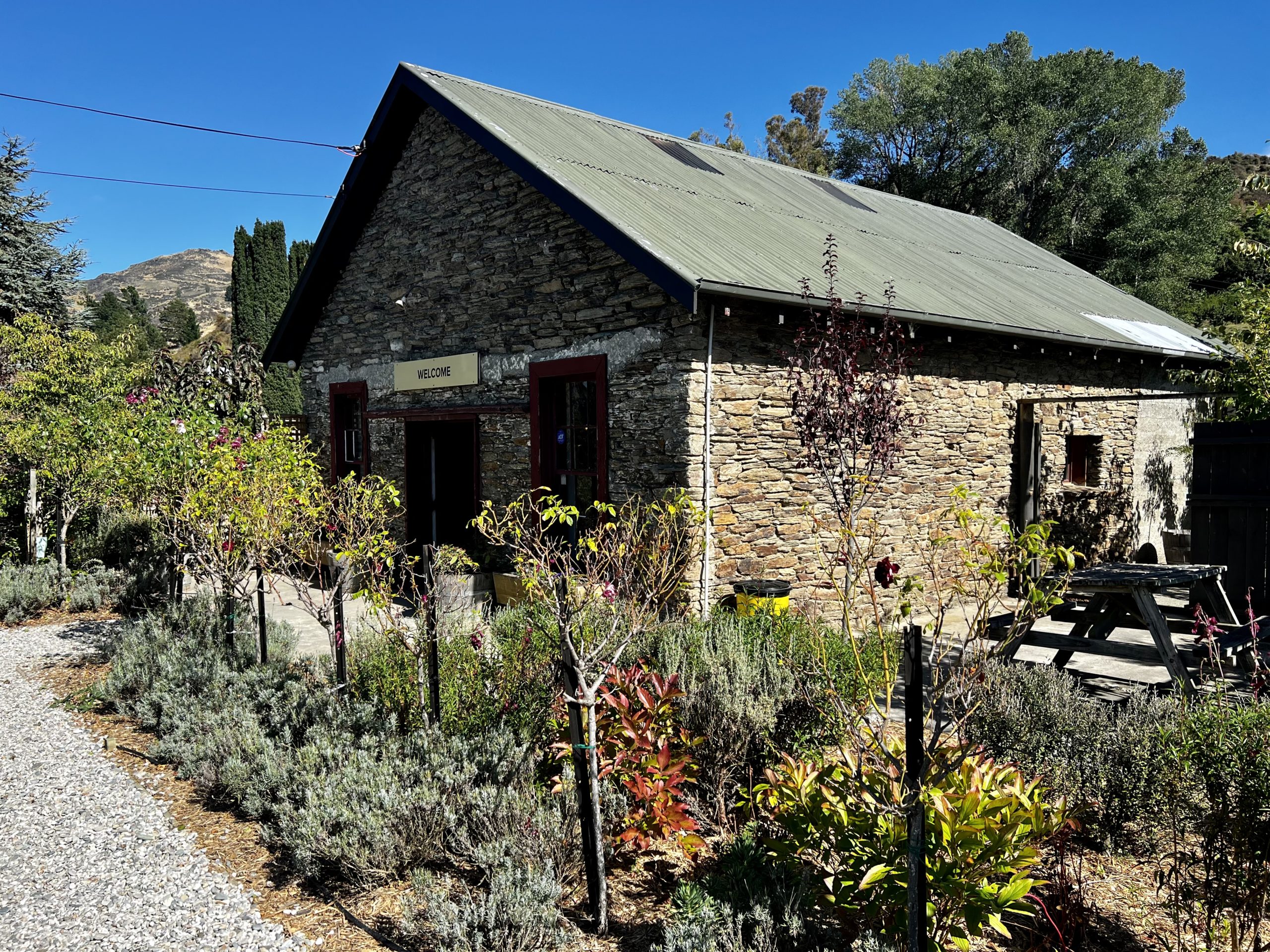
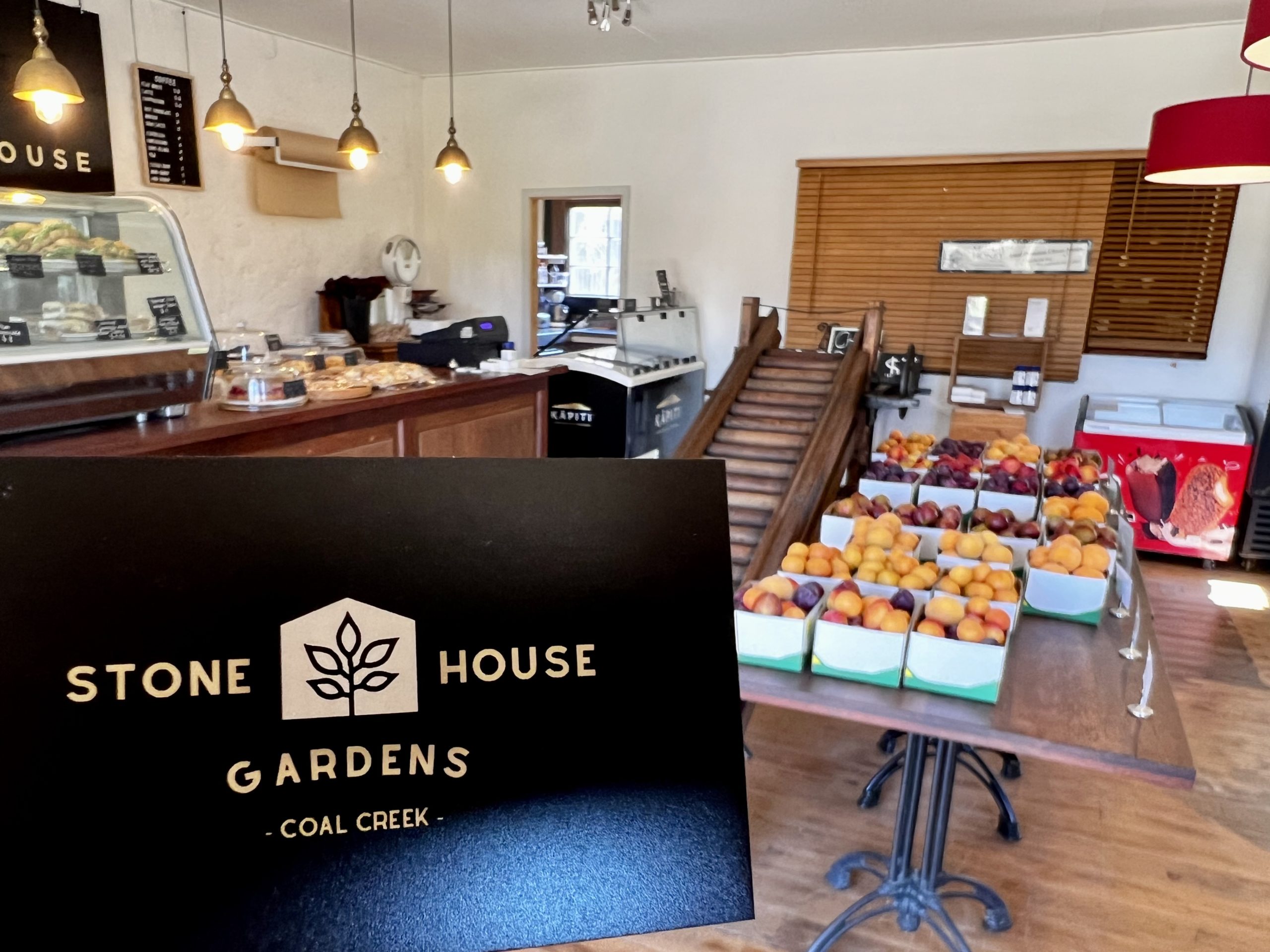
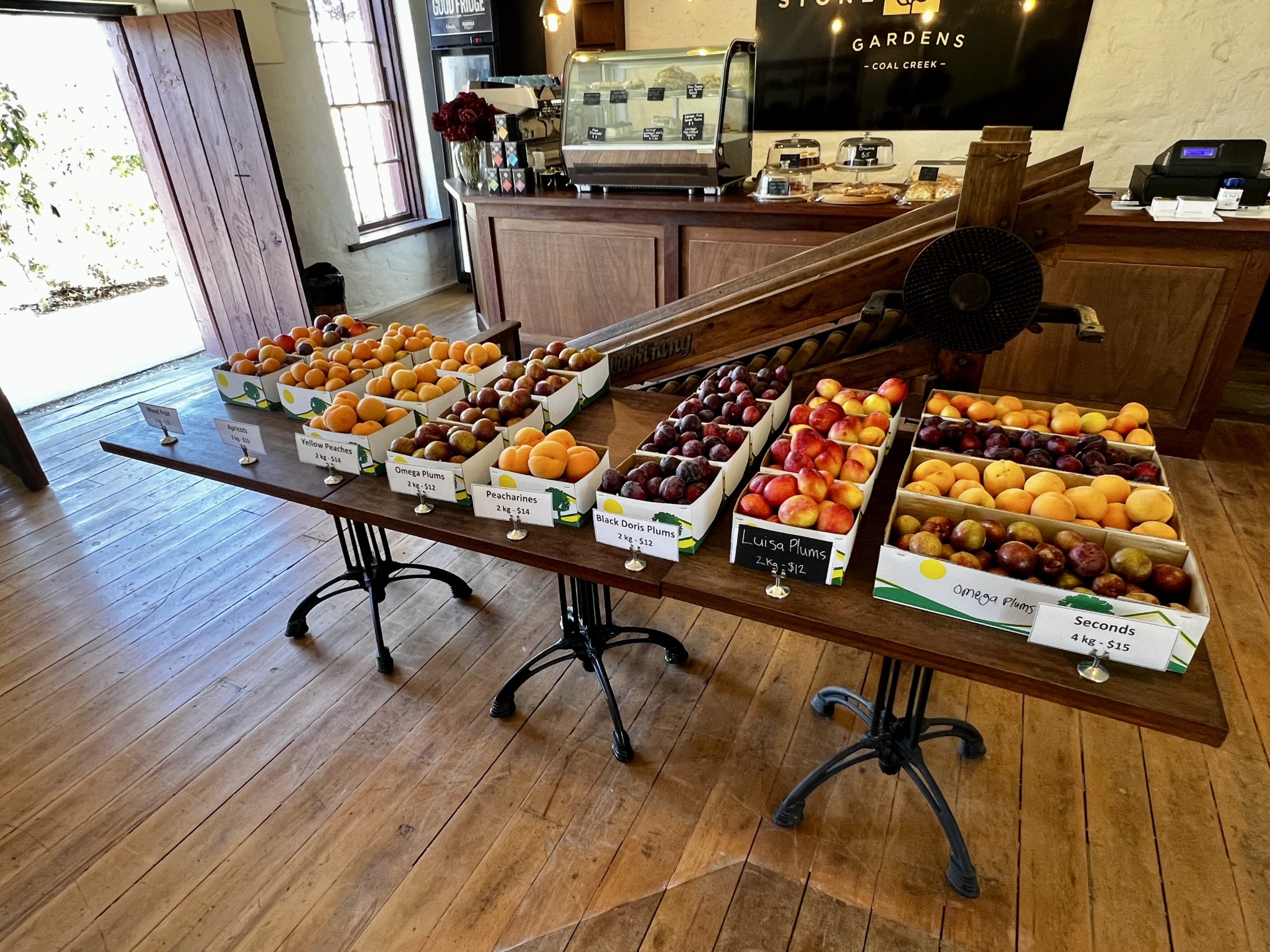
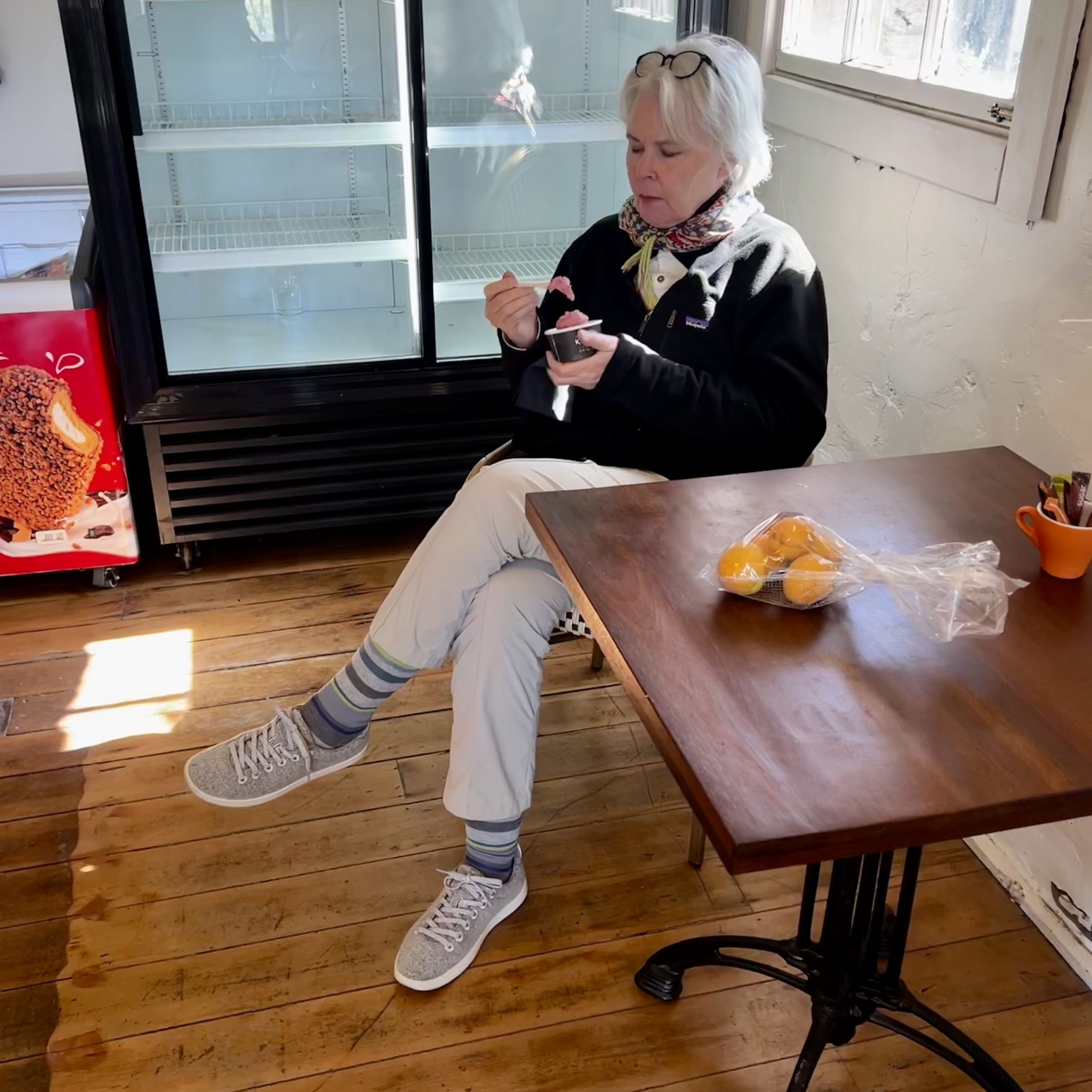
There are always surprises in the middle of the countryside. When traveling, it is important for Bonnie to have a vegan ice cream fix regularly, so one day on a long drive through very rural New Zealand we saw a sign for roadside ice cream. We took a chance to see if they had any dairy free, and they did! The family running the charming shop had only been only open a few weeks after acquiring the property a year ago. From the old, stone fruit-packing building, they sell fresh fruit, coffee, sweets, and ice cream. The place had been set up as a party/wedding venue by the prior owner with gorgeous gardens. They also have two fields with more than 60,000 bush peonies! They hope to make good use of these next year once they have figured out to manage the weeds that have taken over. Future plans include some small cottages. When Robert told the husband that he was going to Twizel to fish, the guy showed him a photo of a twenty-two-pound lake trout his son had caught there!
Lunch in Clyde
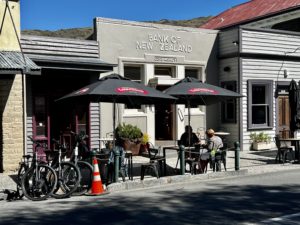
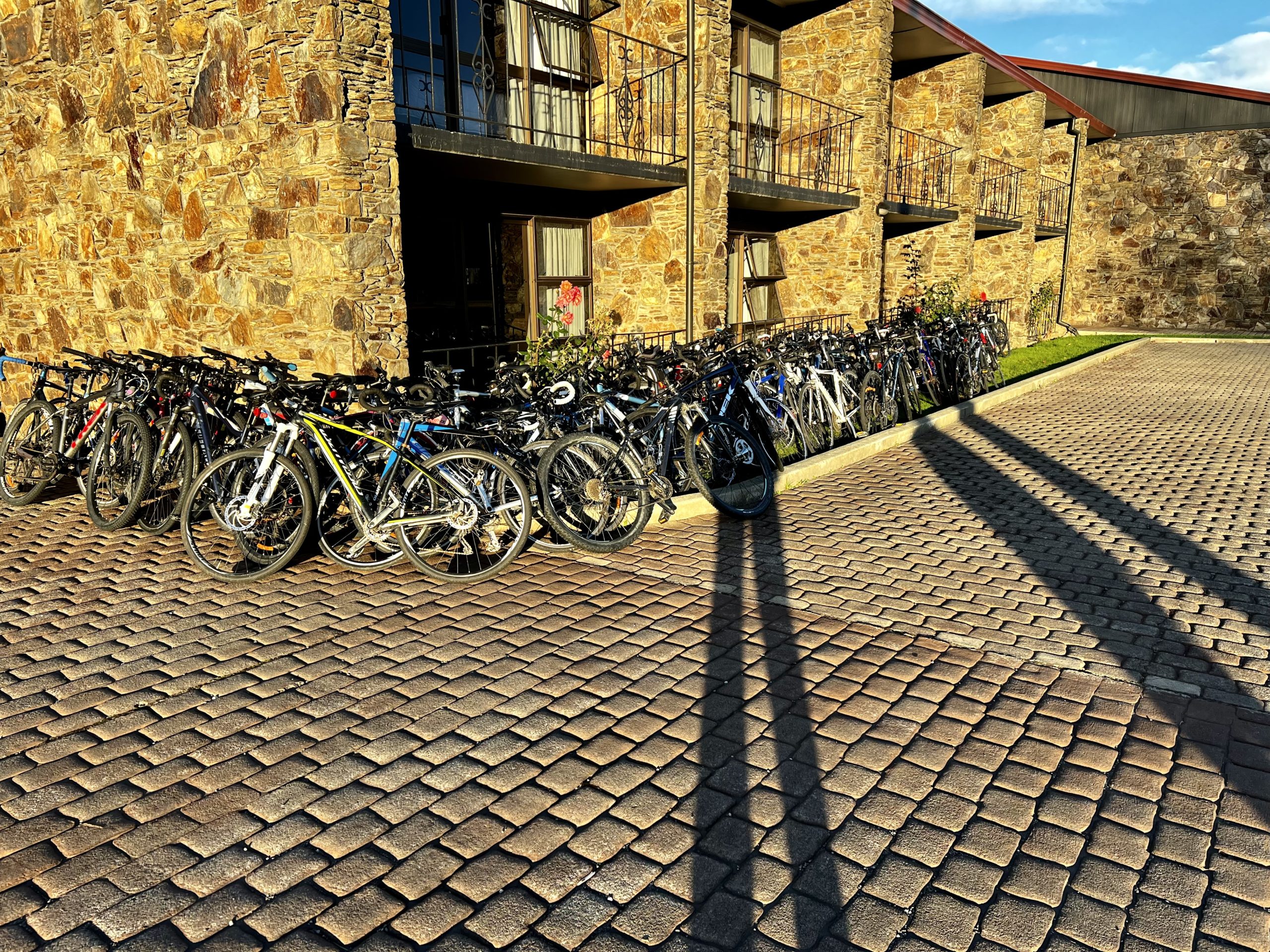
A nice stop. The bicycle rental shop had at least 200 bikes to rent. This area of the town is dotted with buildings dating back to New Zealand’s gold rush in the 1880s. It is a stylish mix of Nevada City and Yountville, but very small.
Rest of the Way to Twizel
Accommodations
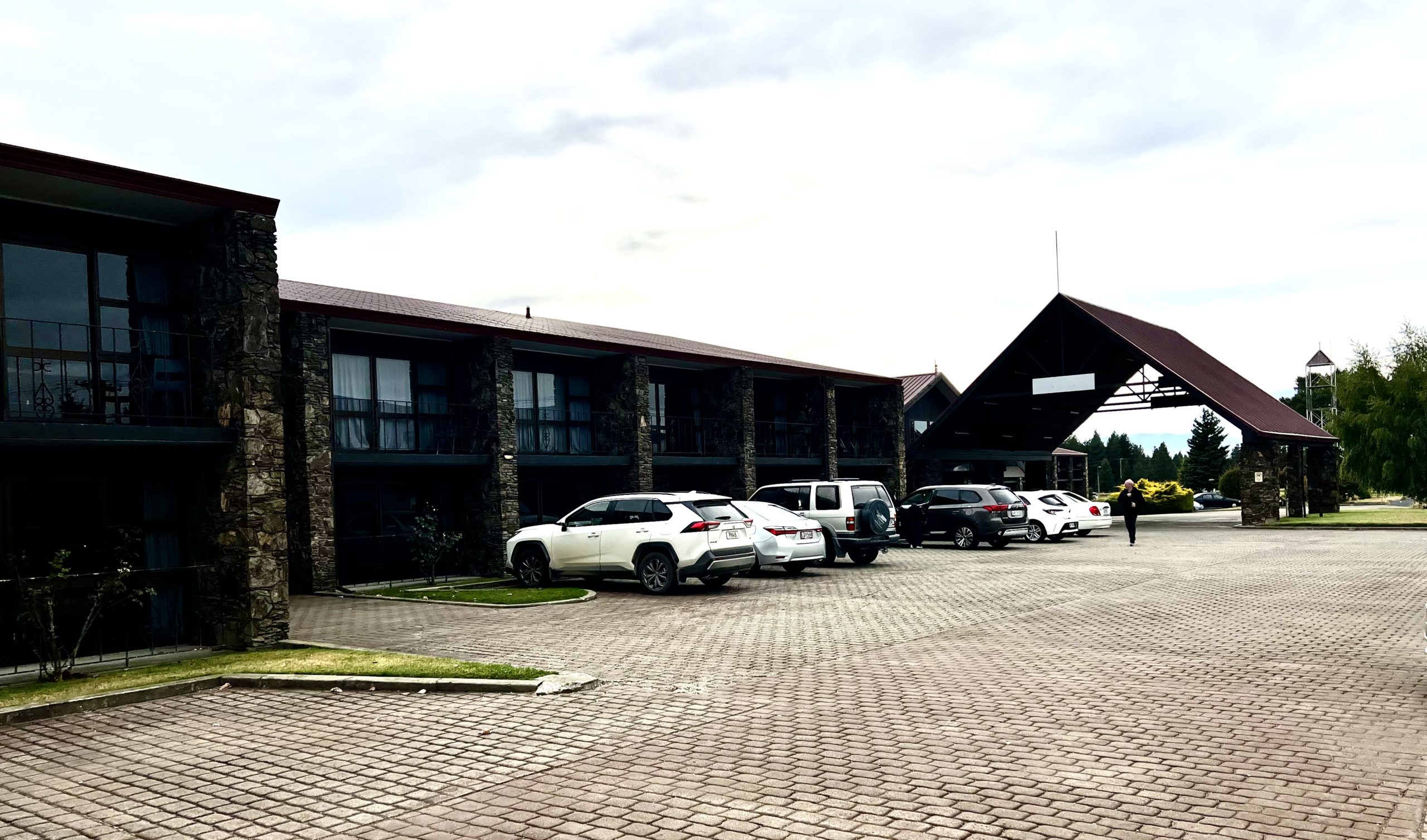
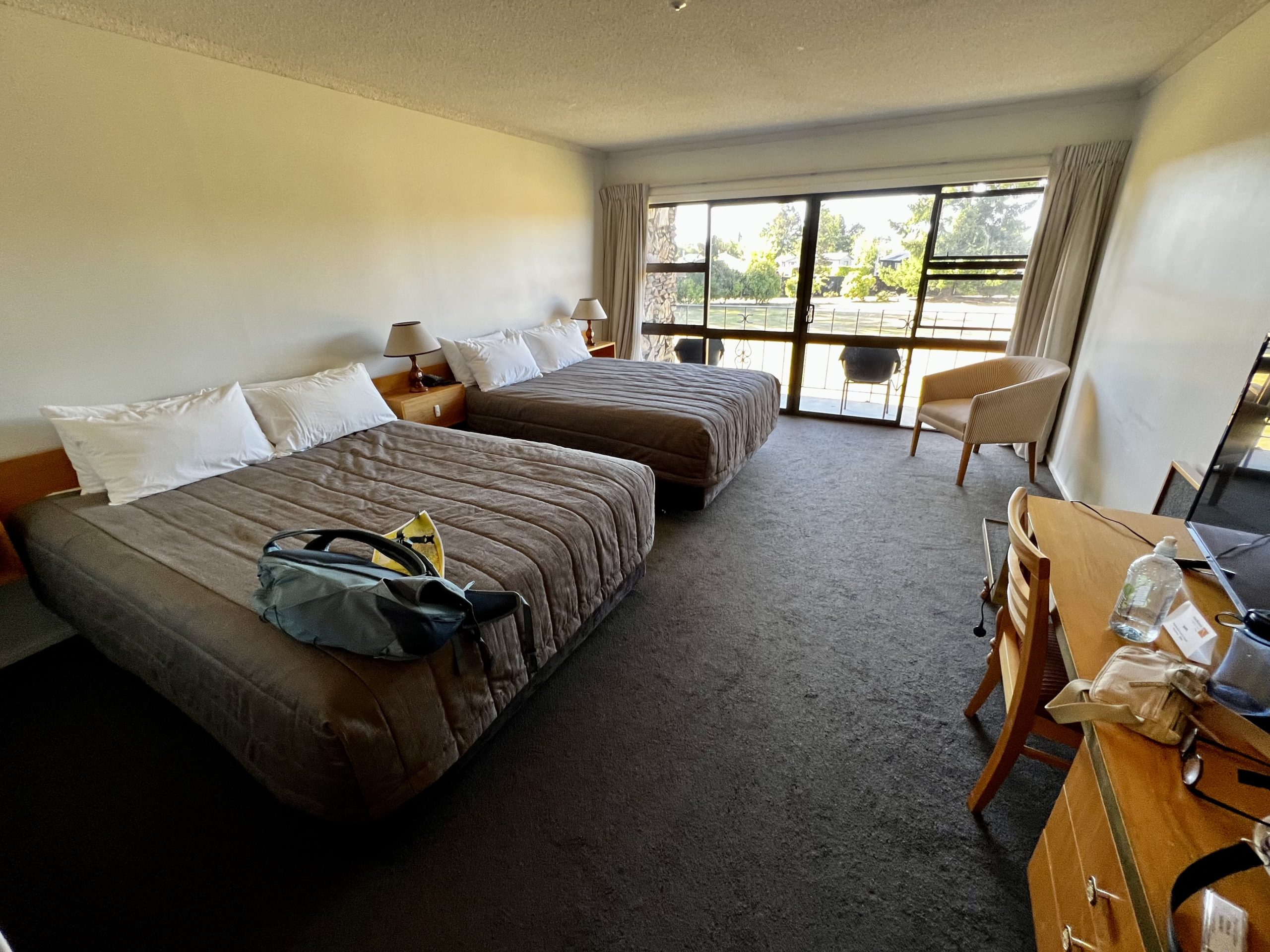
In Twizel, we stayed at the Mackenzie Country Hotel. As Kiwis would say, The place is a little long in the tooth. (Worn and outdated.) It needs a gentle but thorough redo. Beyond the fact that the Wi-Fi measured 0.15 mbs in our room, they serve INSTANT COFFEE at breakfast. Can you imagine this in New Zealand where coffee is as popular as beer? Our fishing guide was astonished. The hotel has more than 150 rooms, the majority of which turn over every night as bus loads of tourists come for their day trip to Mount Cook. And although the hotel staff are friendly, we did not have daily service of our room for the four days we were there except for one day when we asked. Robert posted his review in Trip Advisor. There have to be better places to stay.
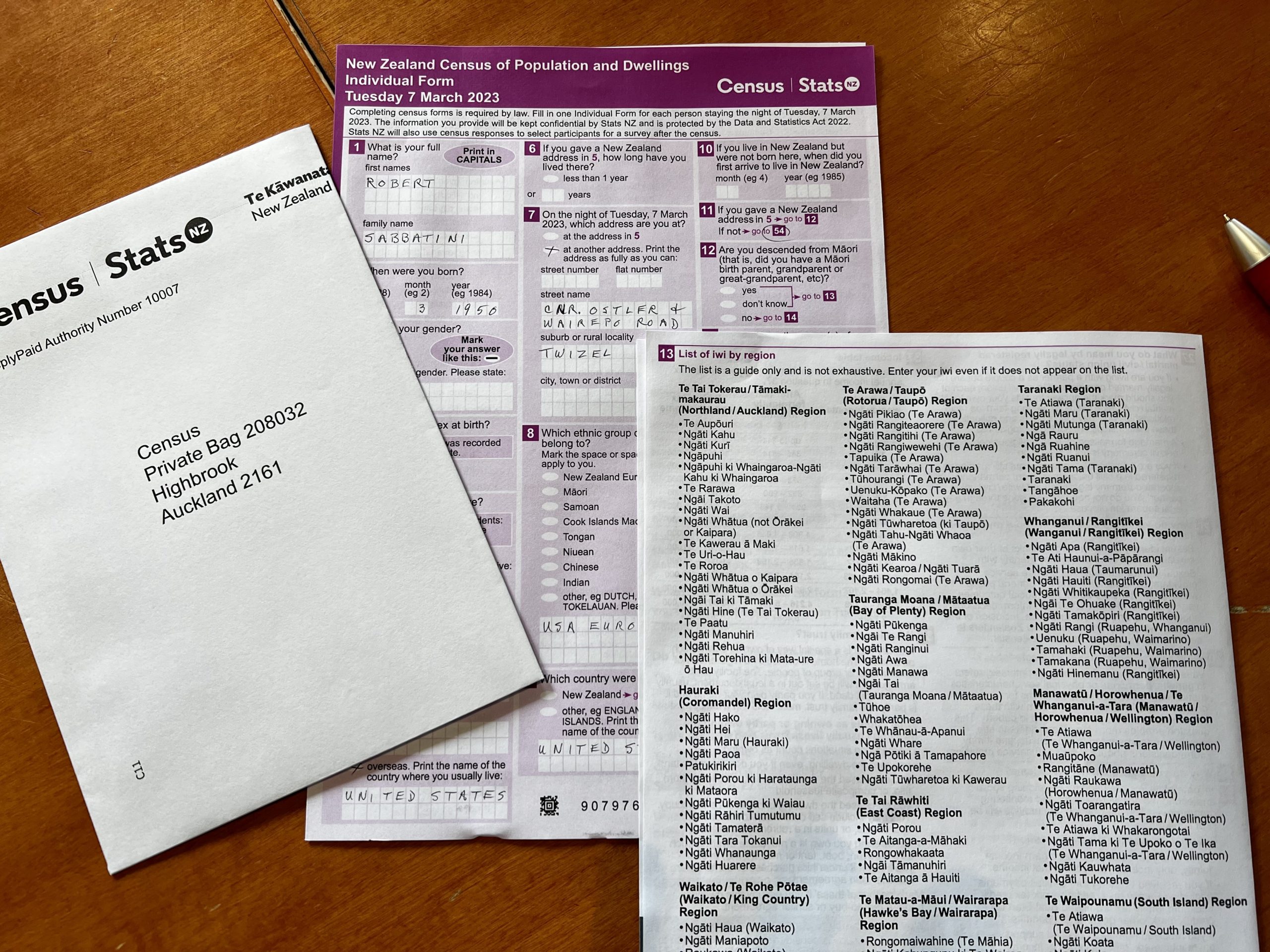
The New Zealand census counts everyone present in the country on one night every four years. We were delighted to be part of it.
Strolling Twizel
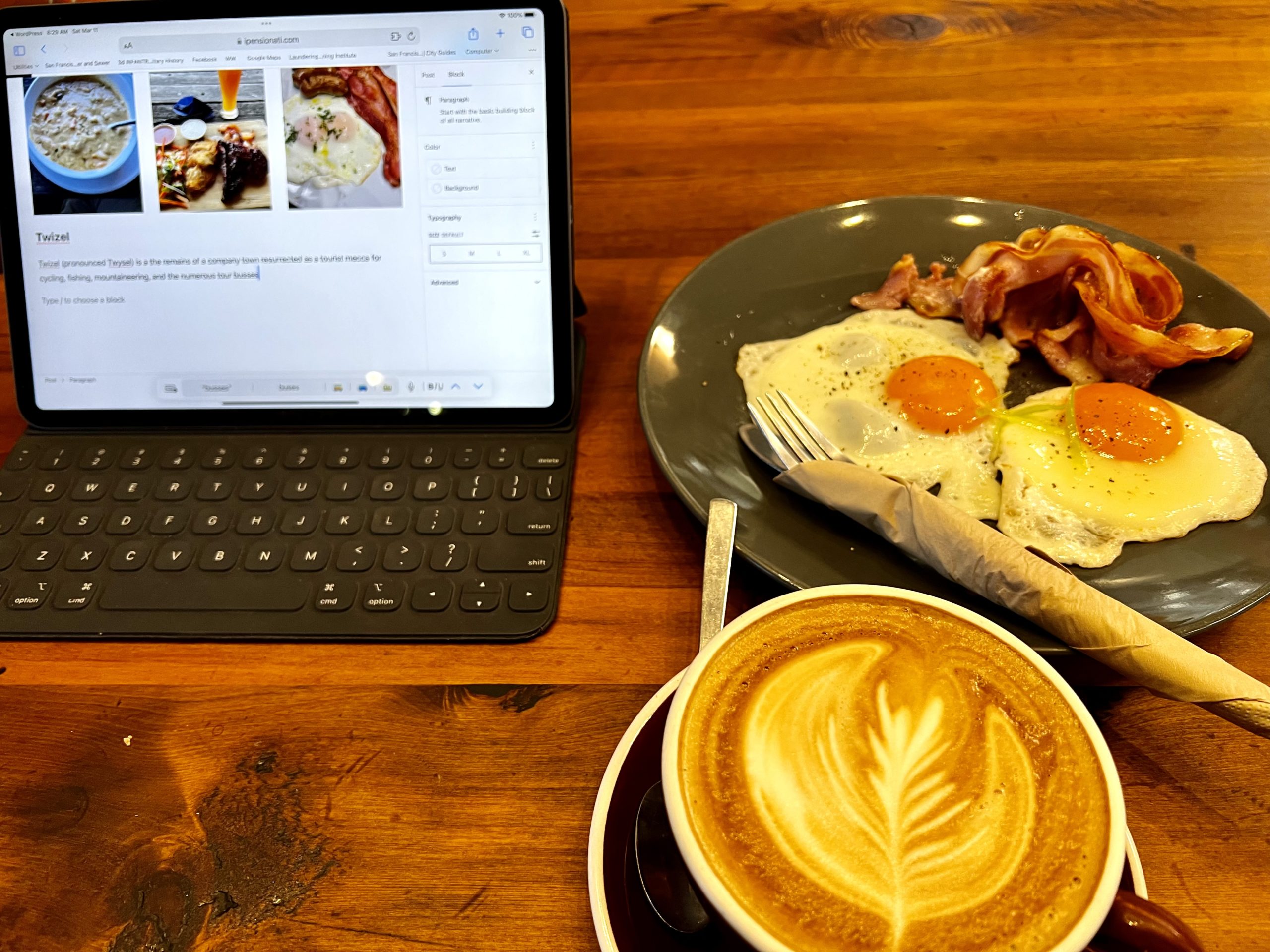
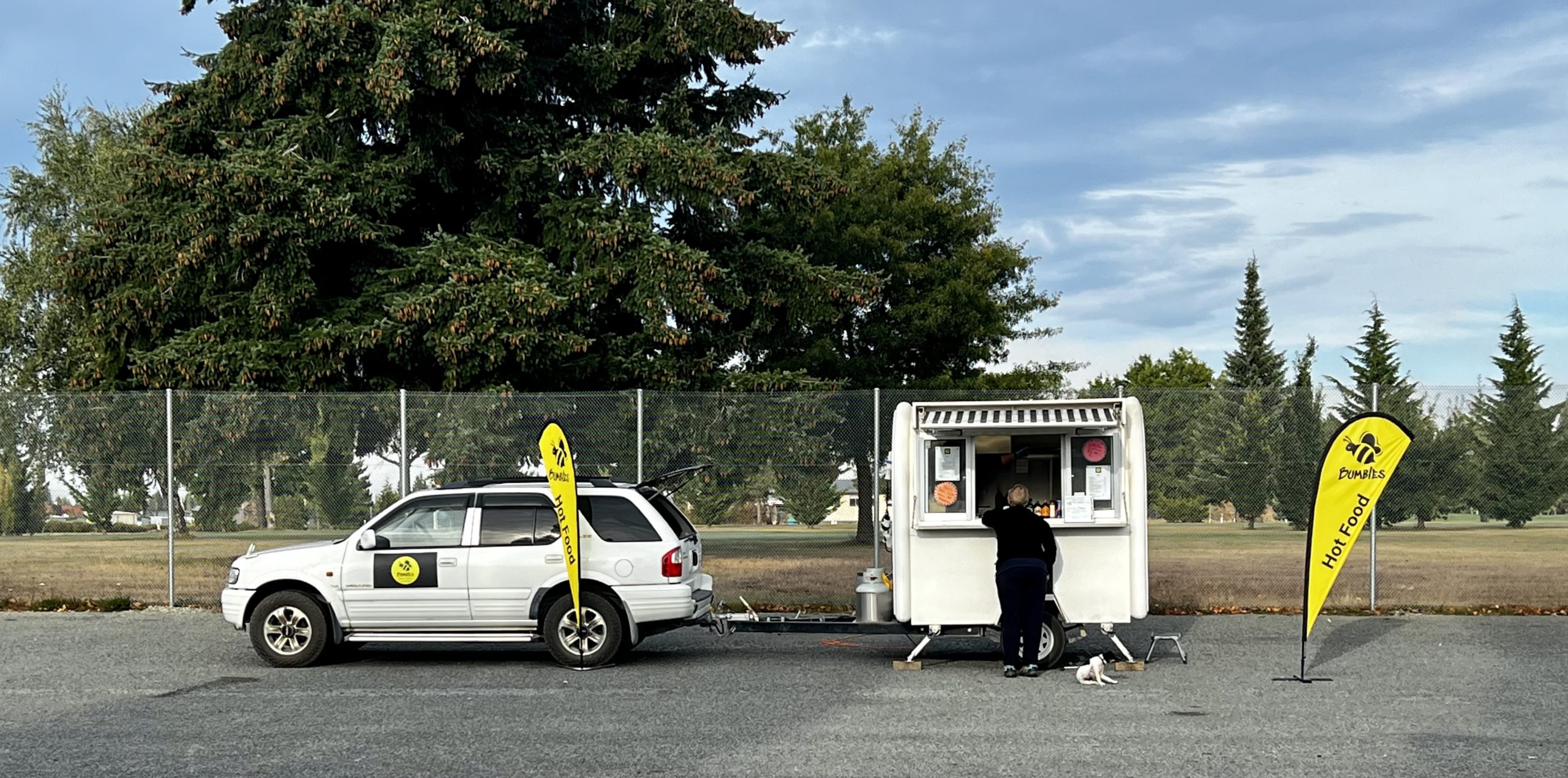
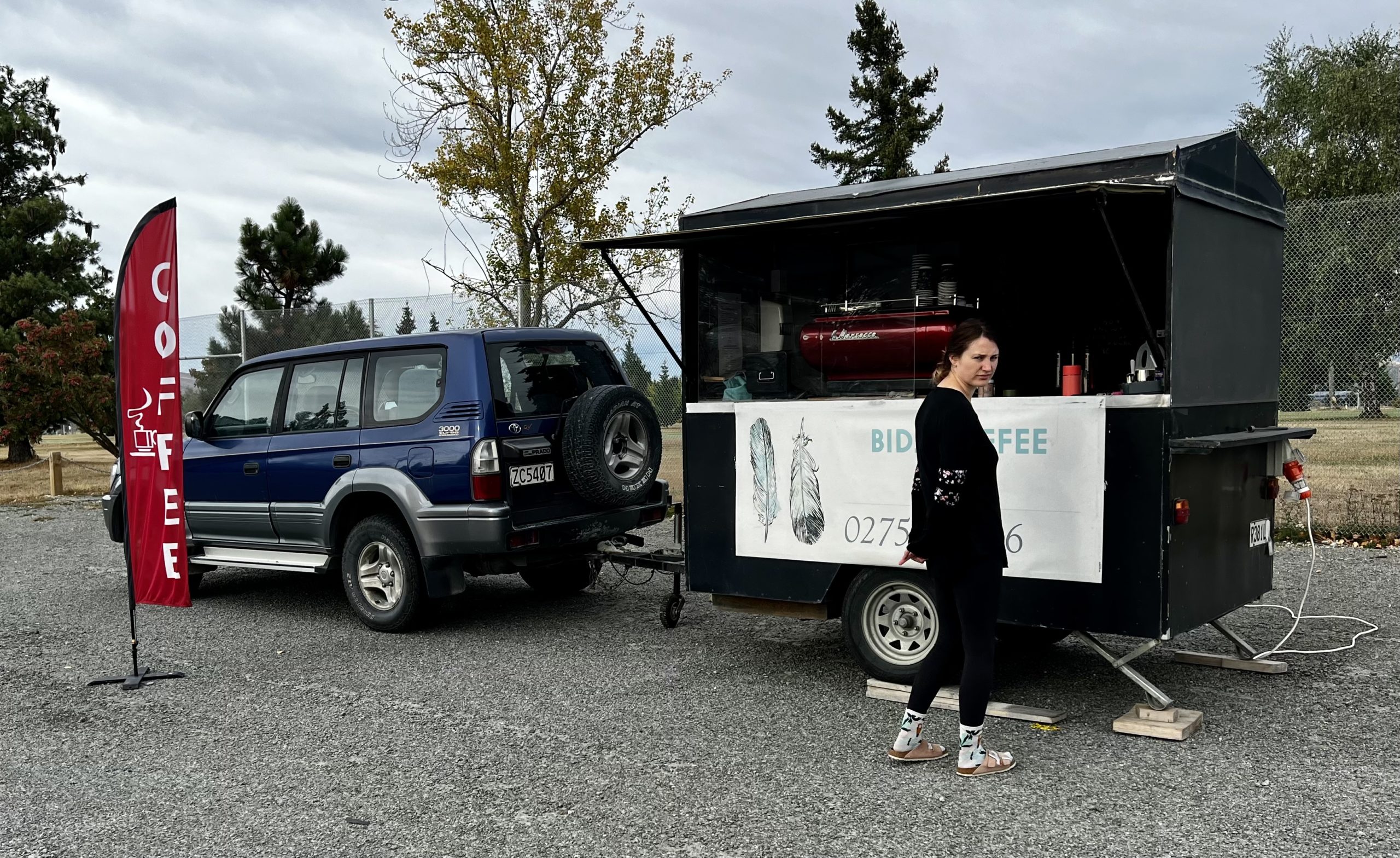
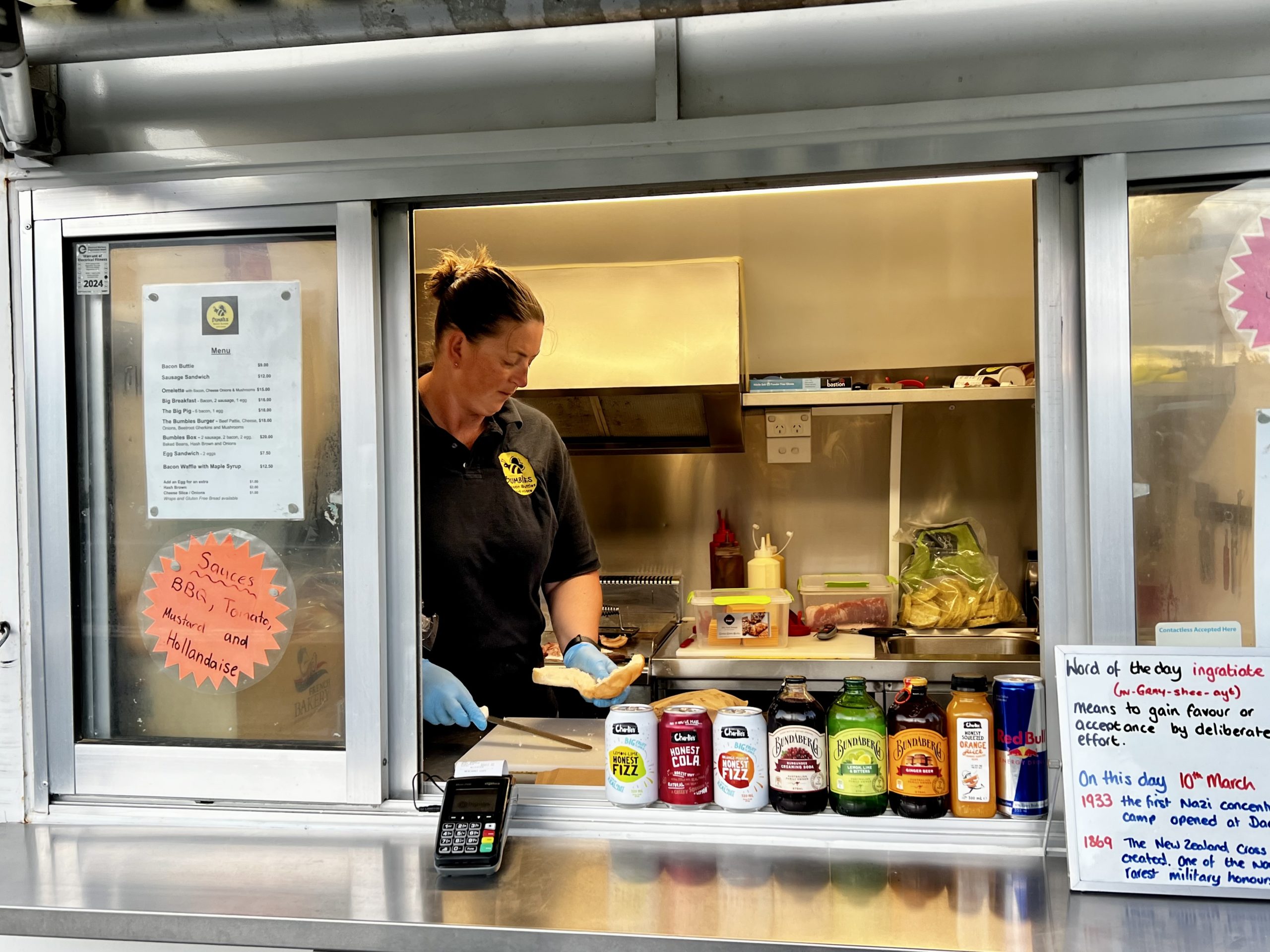
These two trailers work in tandem. One serves coffee. The other offers a wide range of breakfasts. Robert chose a flat white and a sausage sandwich.
Anoraki/Mount Cook
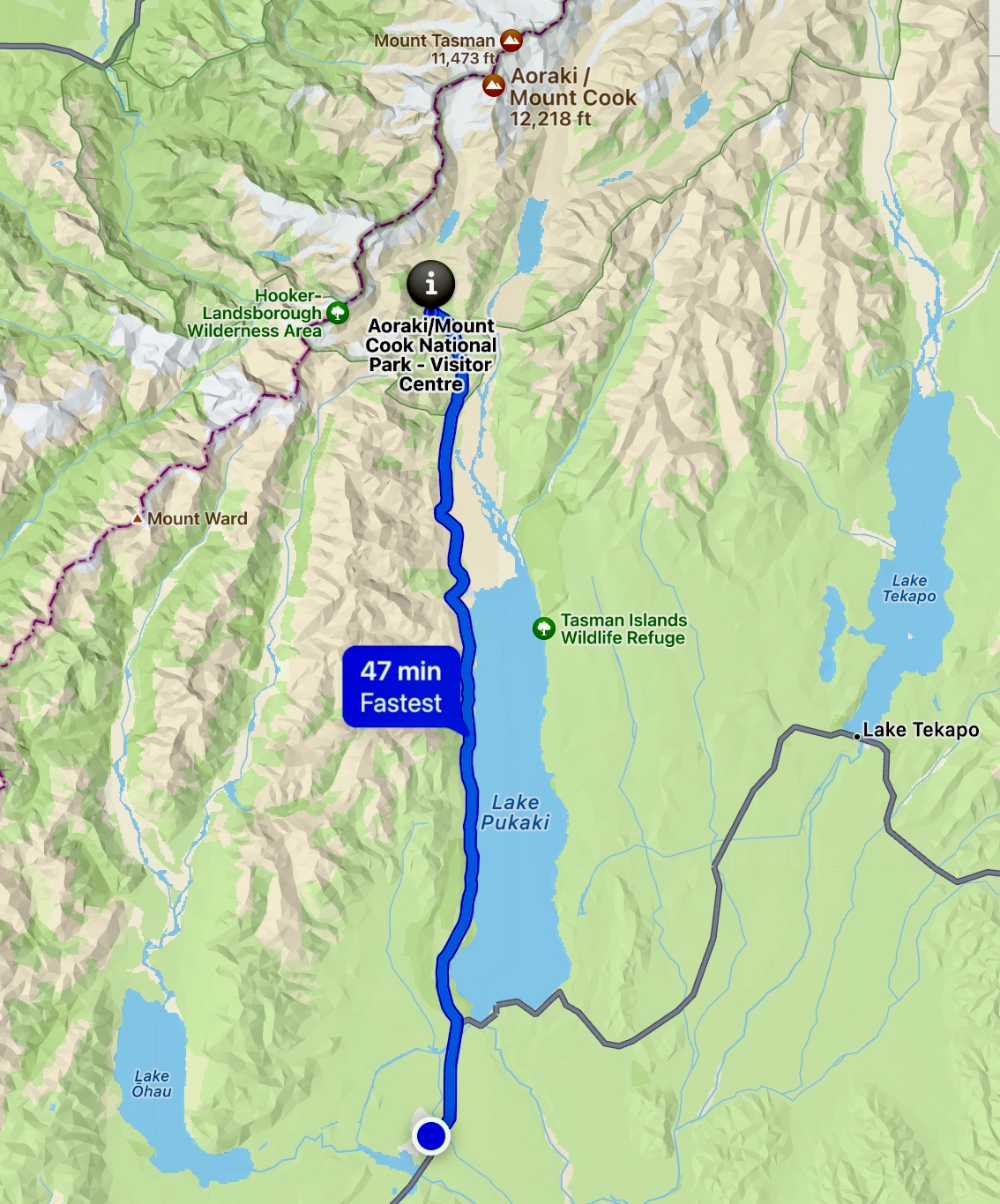
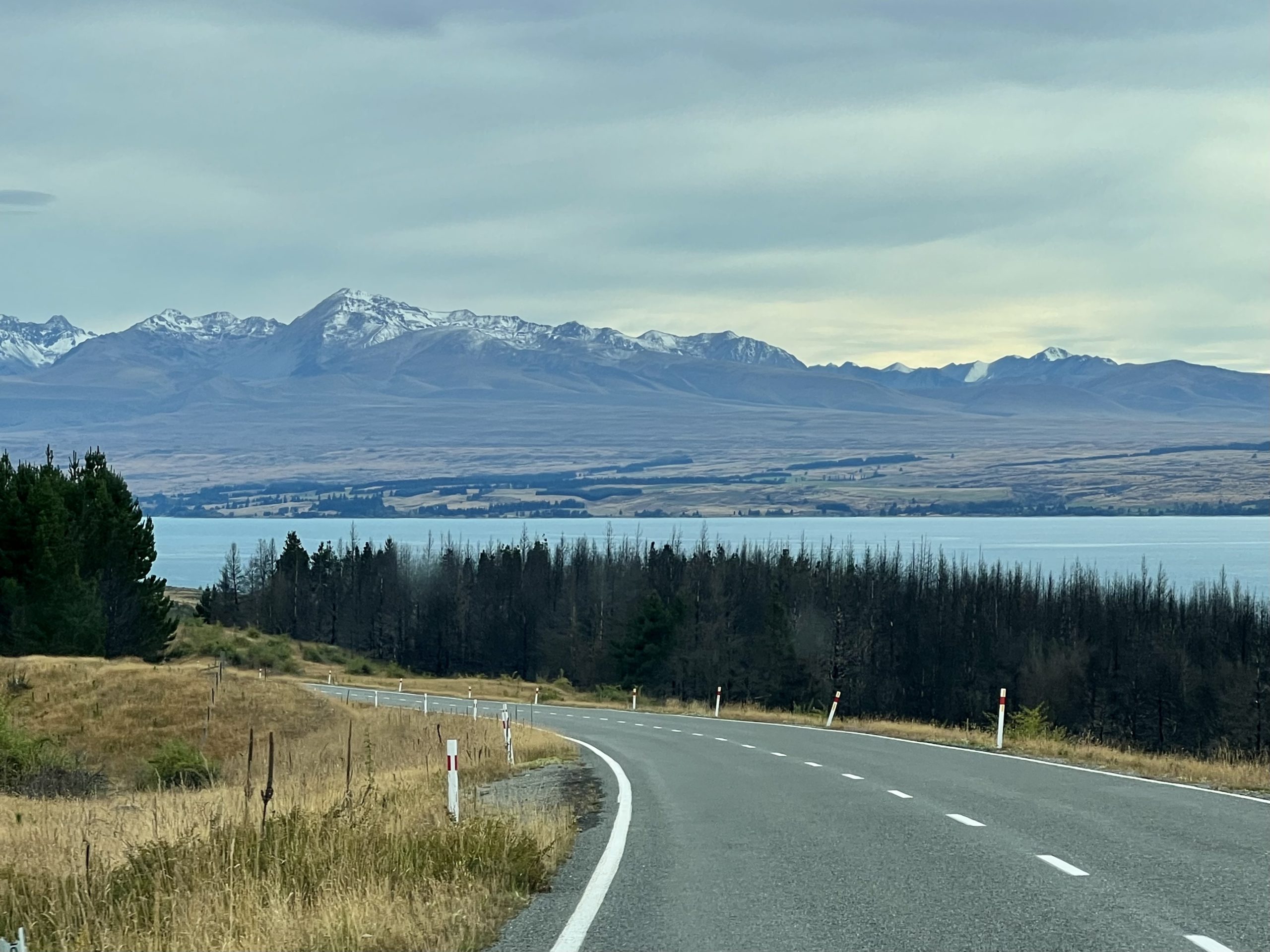
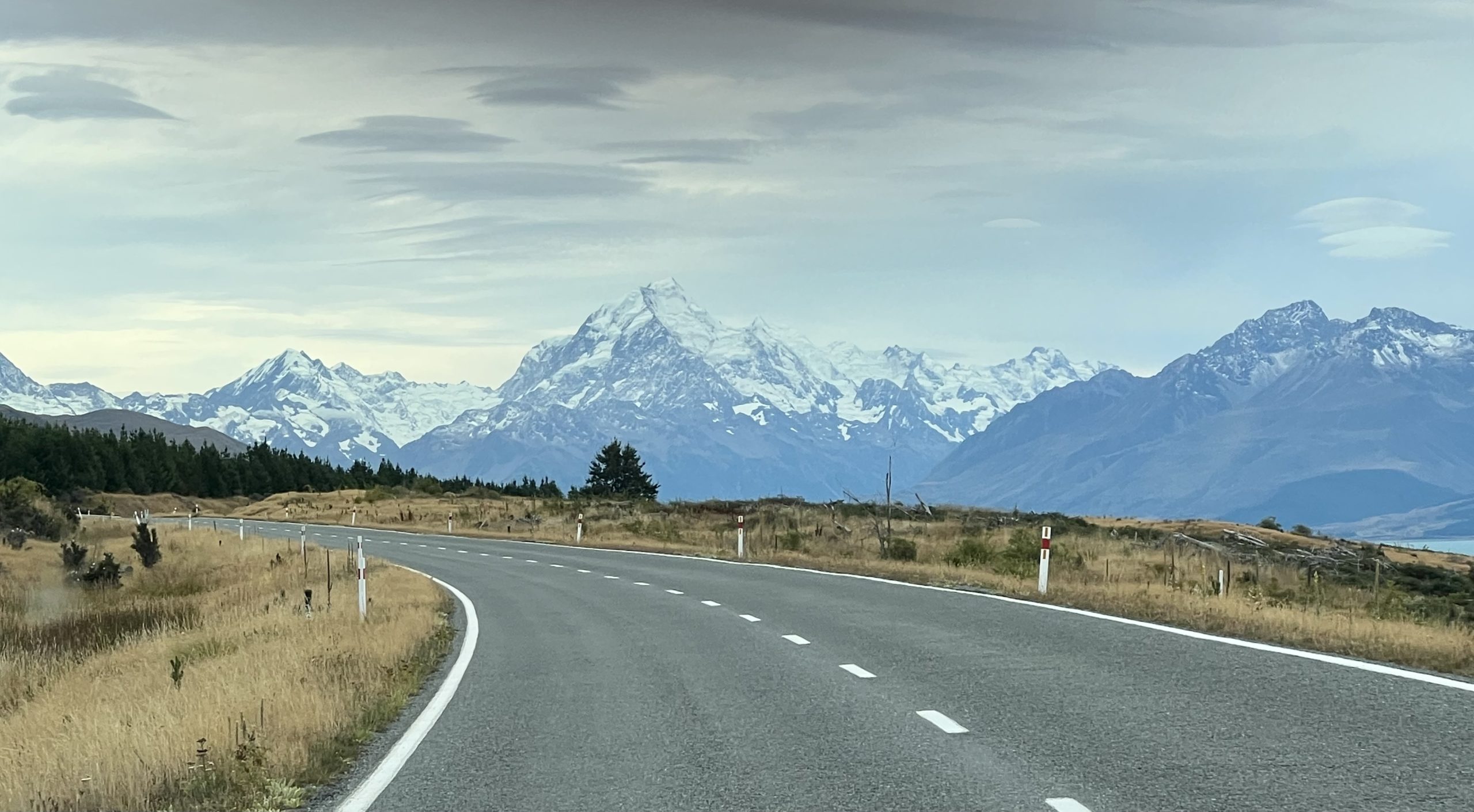
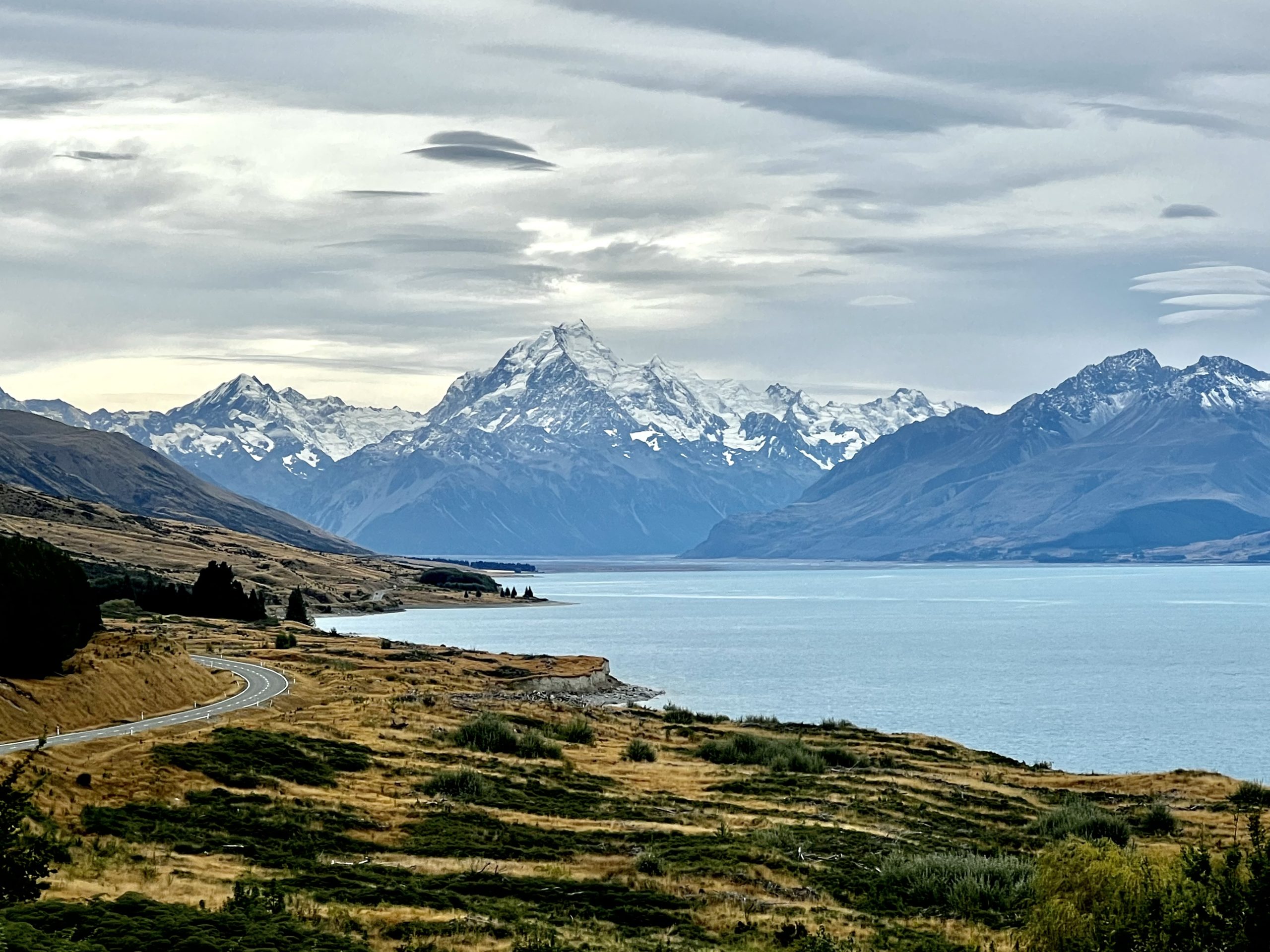
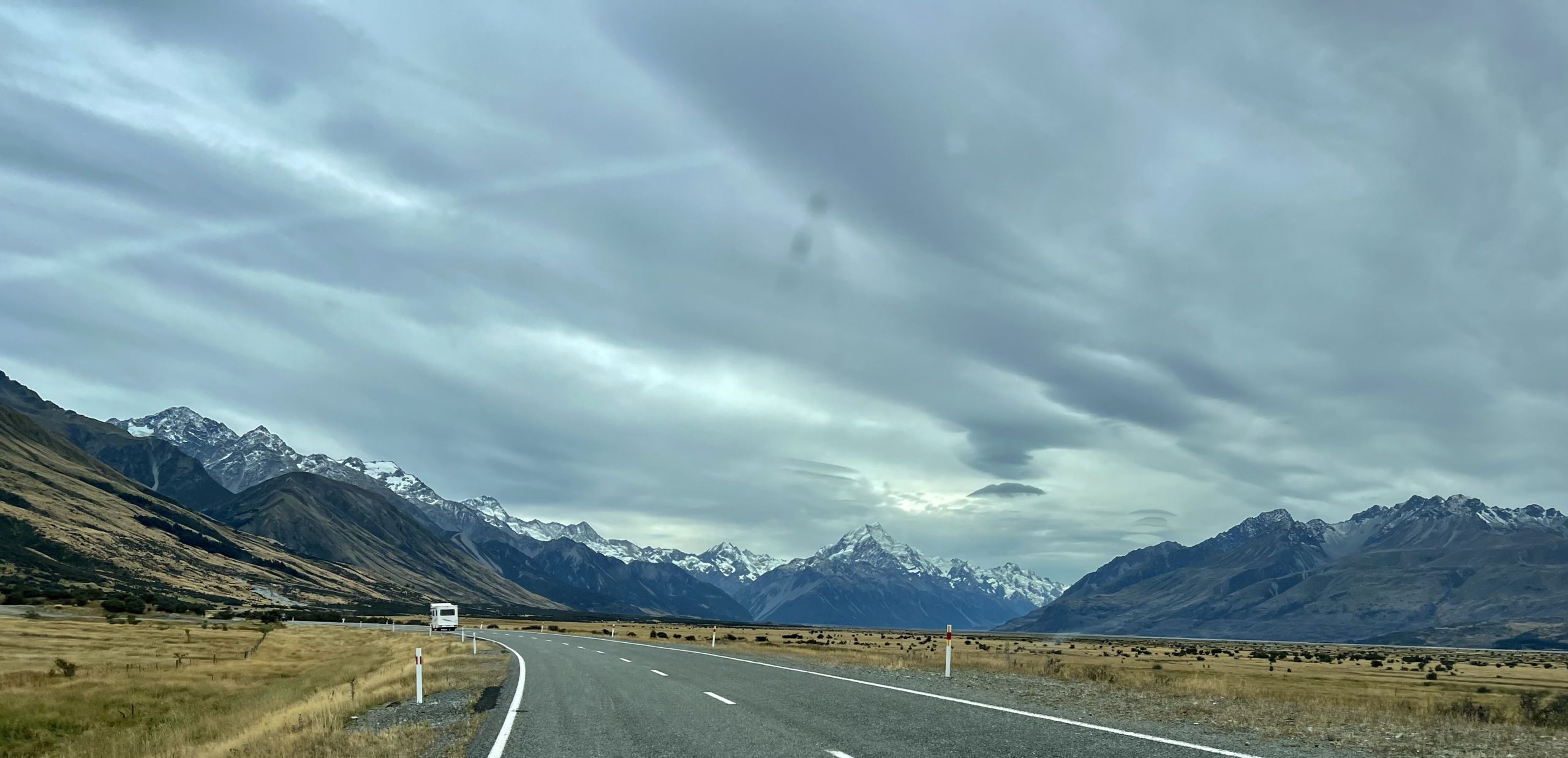
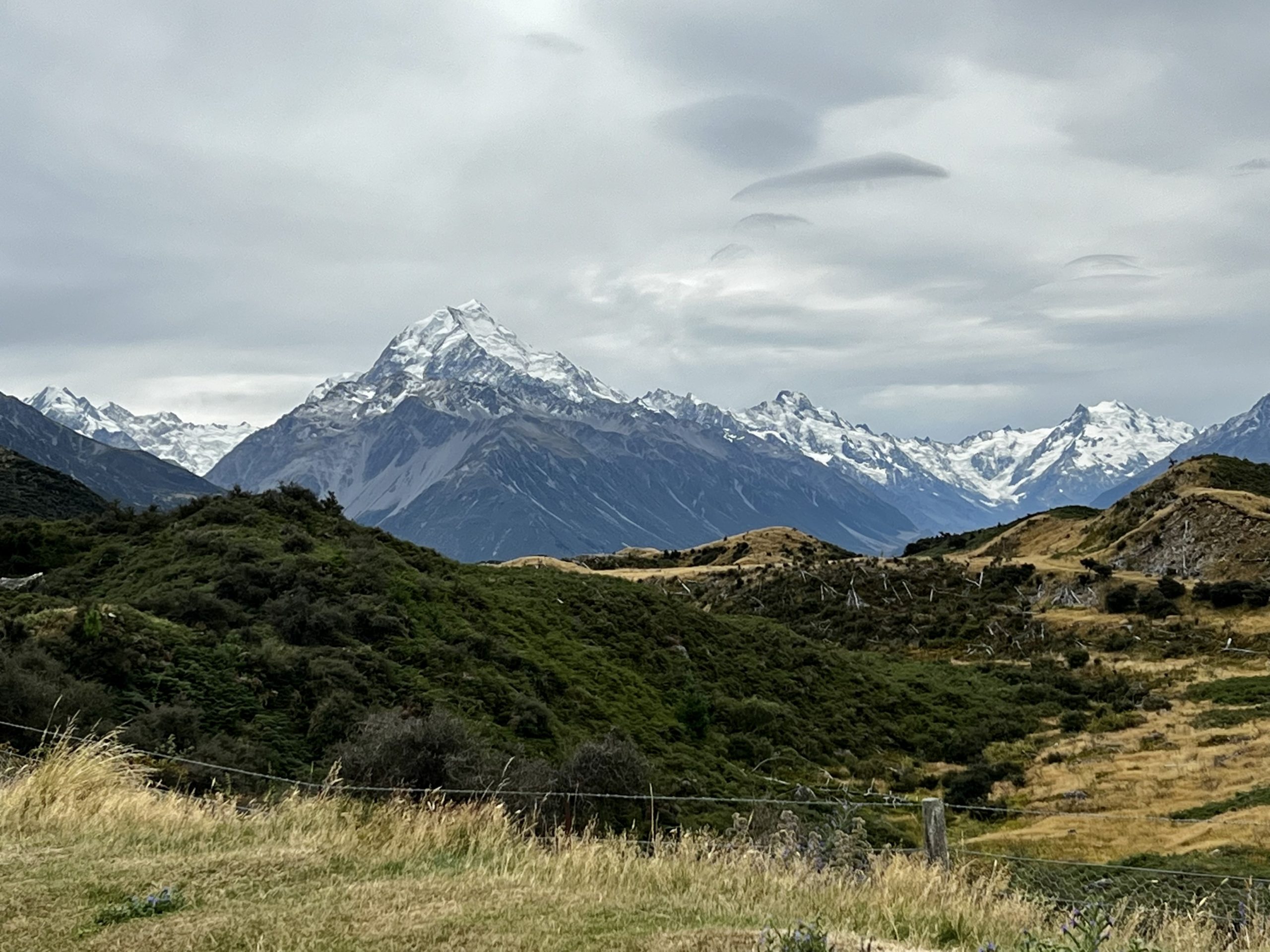
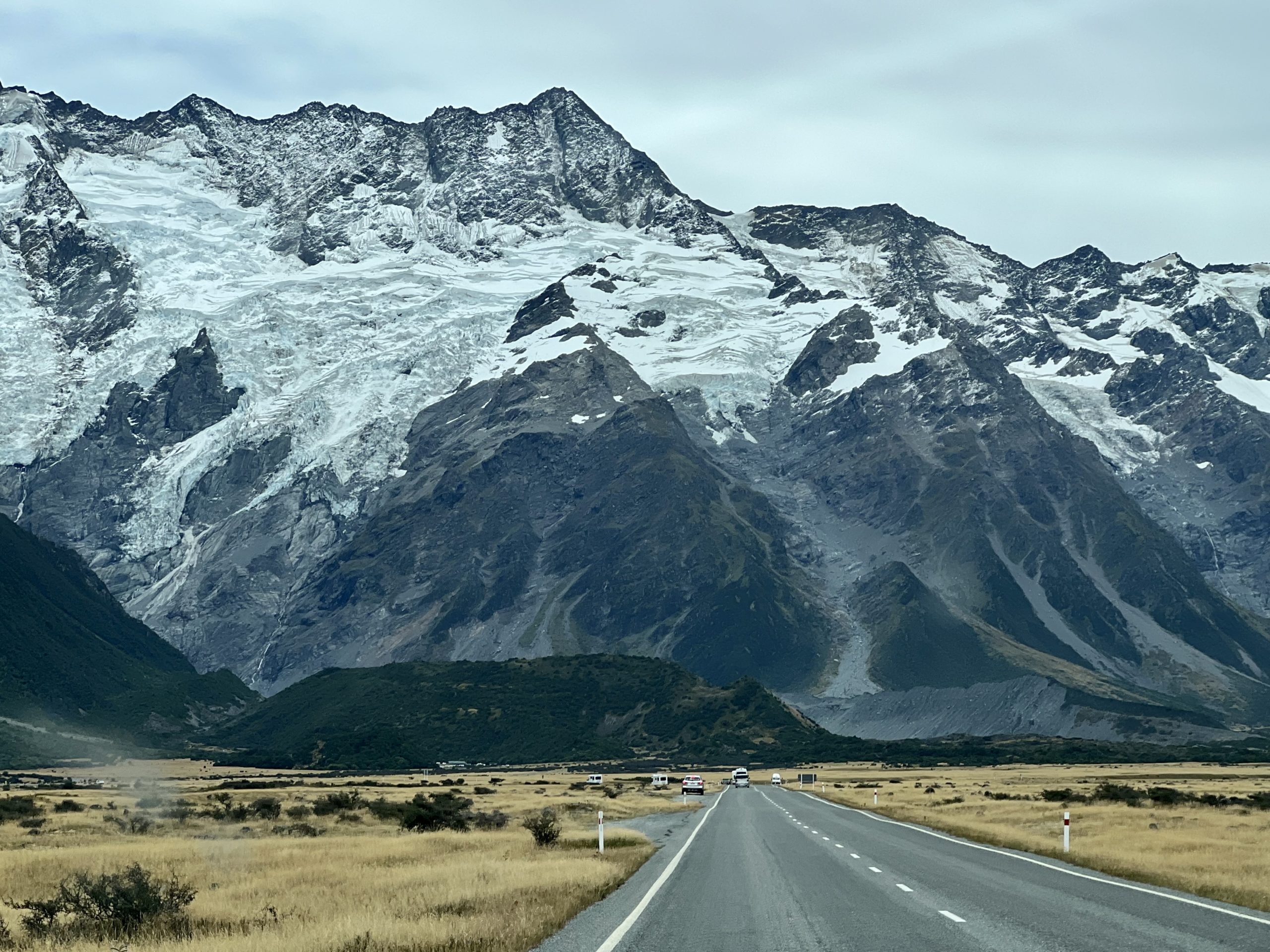
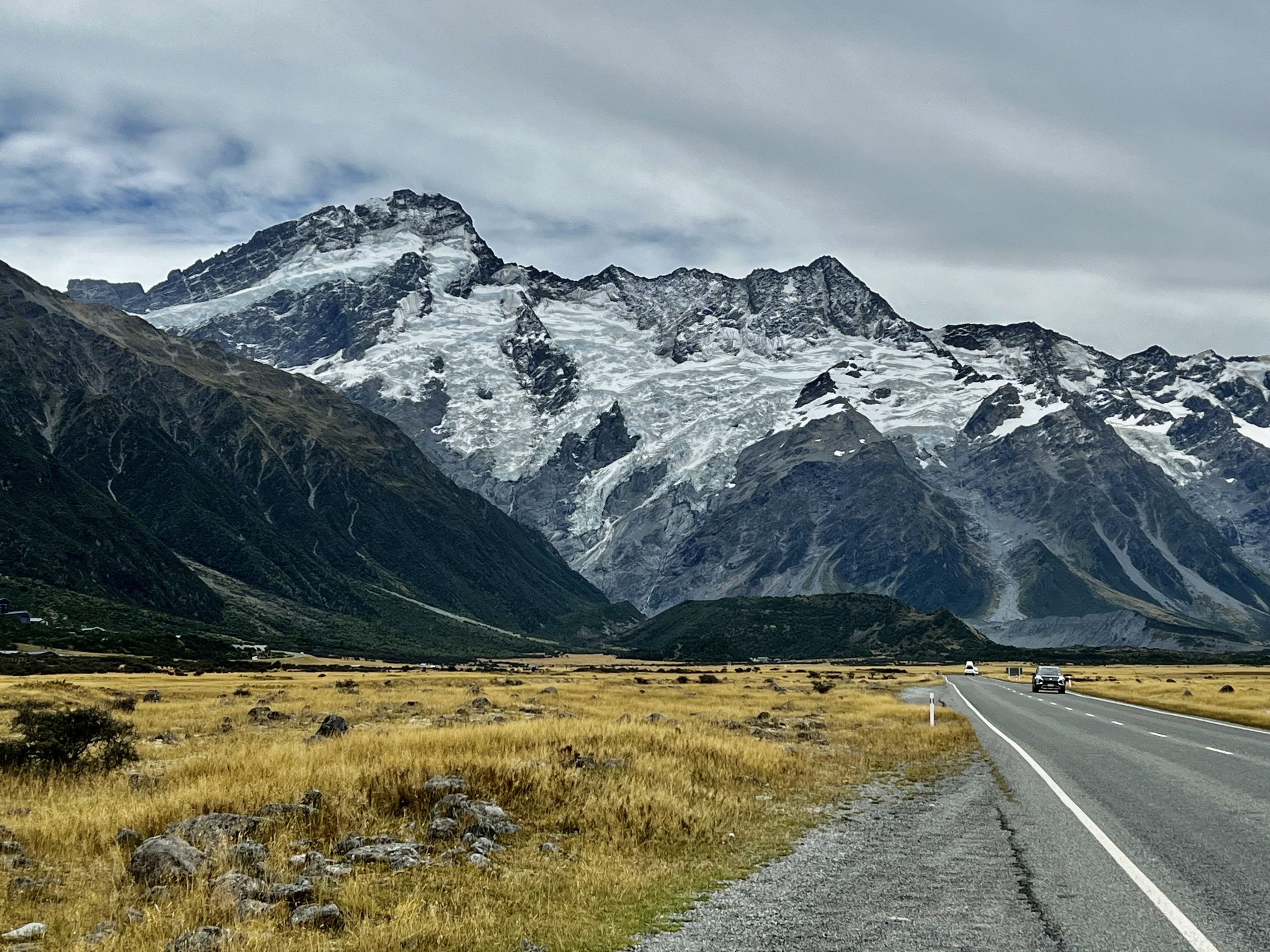
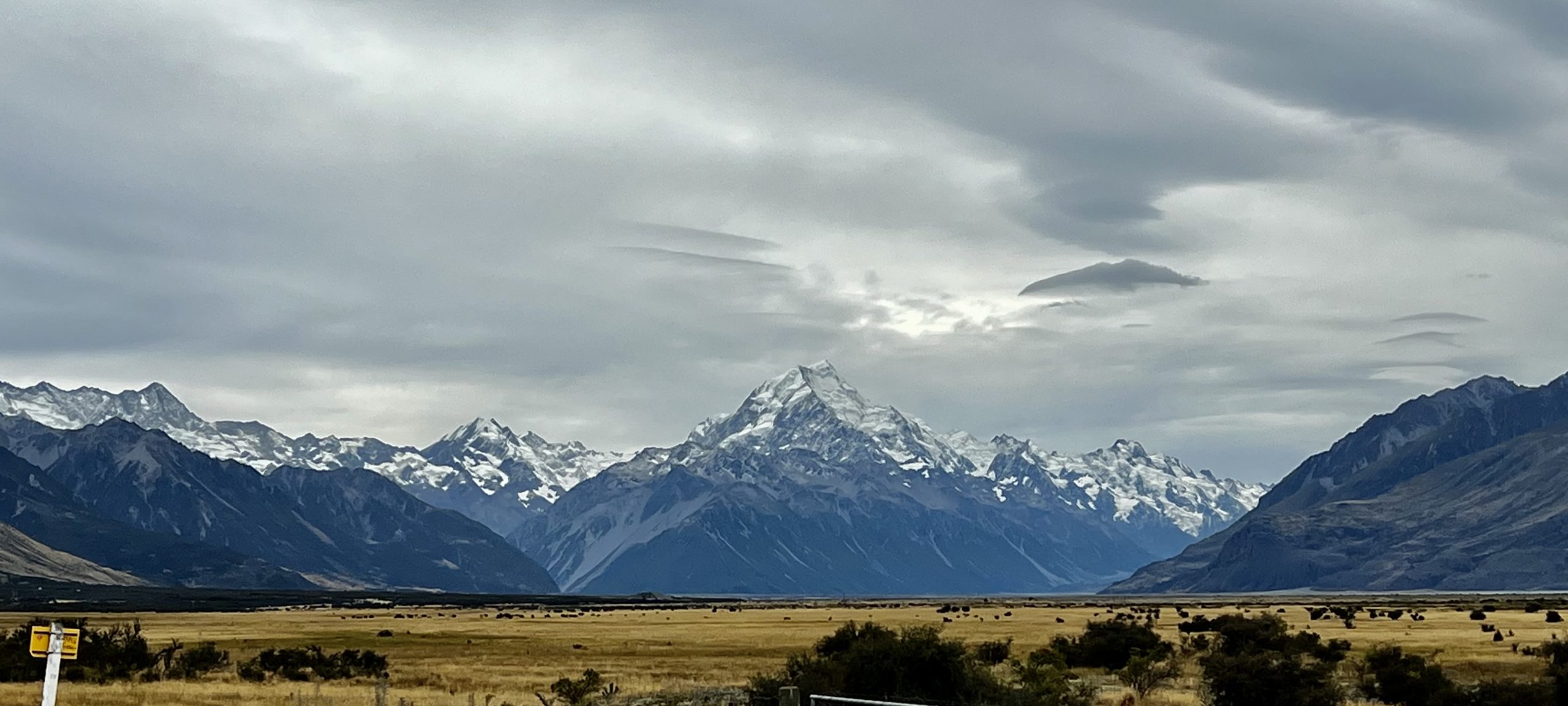
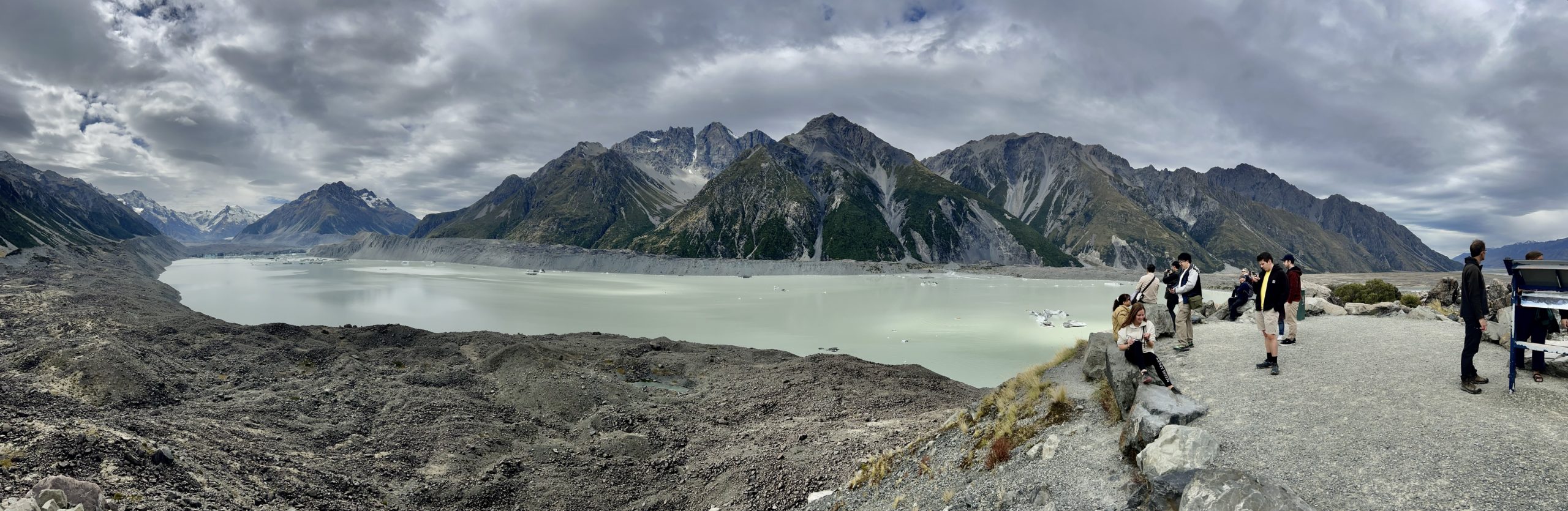
Mount Cook, in New Zealand’s Southern Alps, is the tallest mountain in Australasia at 12,218 feet. It is spectacularly beautiful. Bonnie remembers being wowed by it when she was a teenager. Mount Cook offers a magnificent scene that unveils itself as you make the journey. In the traditions of the Ngāi Tahu Māoris, the mountain was named Te Waka o Aoraki (“Aoraki’s Canoe”). Others romantically interpret the mountain’s name as “Cloud Piercer.” The underlying tectonic plates continue to lift the mountain at a rate of more than a quarter inch a year. We spent a day driving to the tourist village and visitor center.
The Mount Cook National Park is an immense property managed by the New Zealand Department of Conservation. Everyone refers to it as “doc.” DOC manages a full thirty percent of the land in the country. This includes some grazing and timber properties as well as nature reserves and national parks.
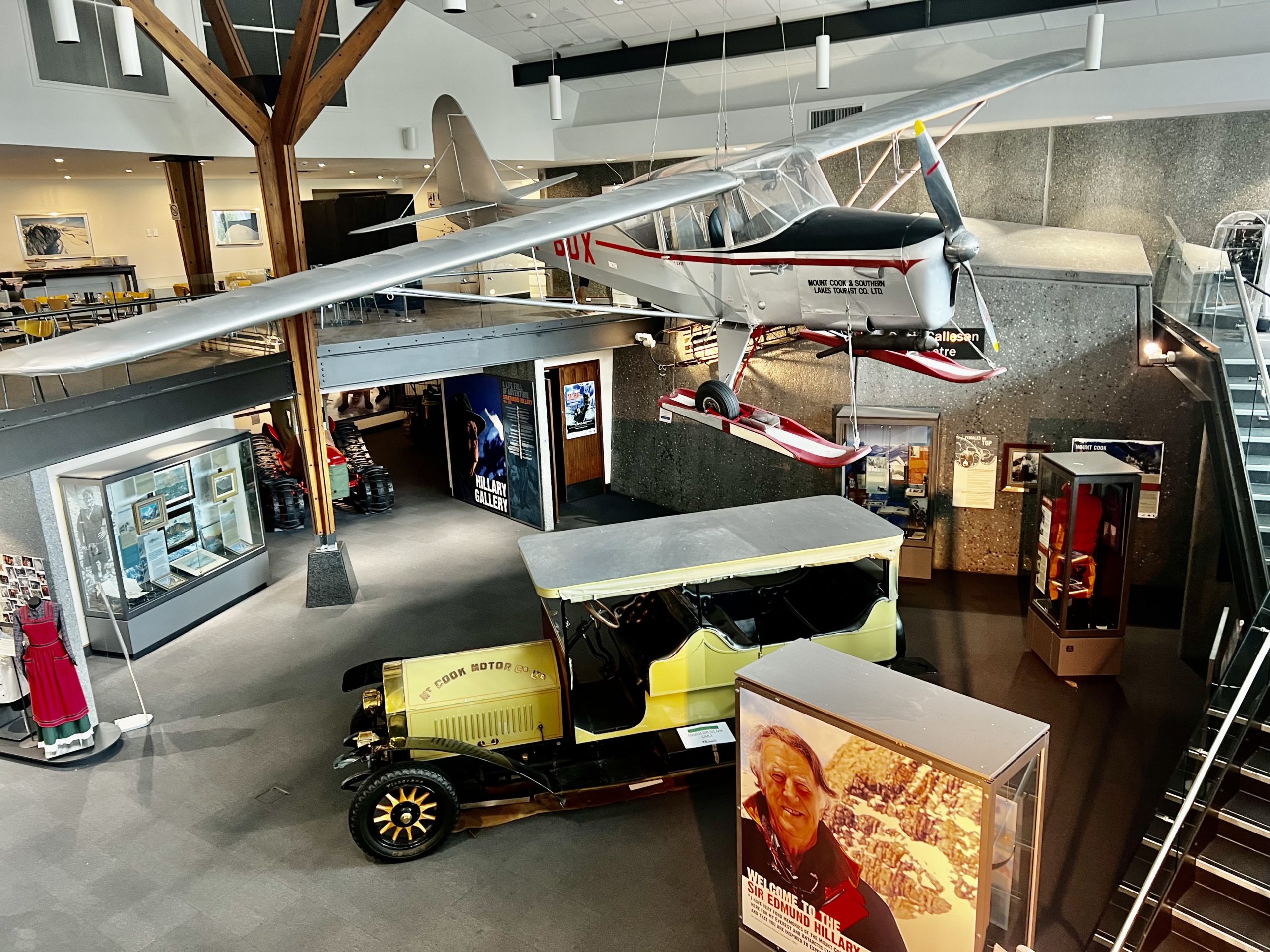
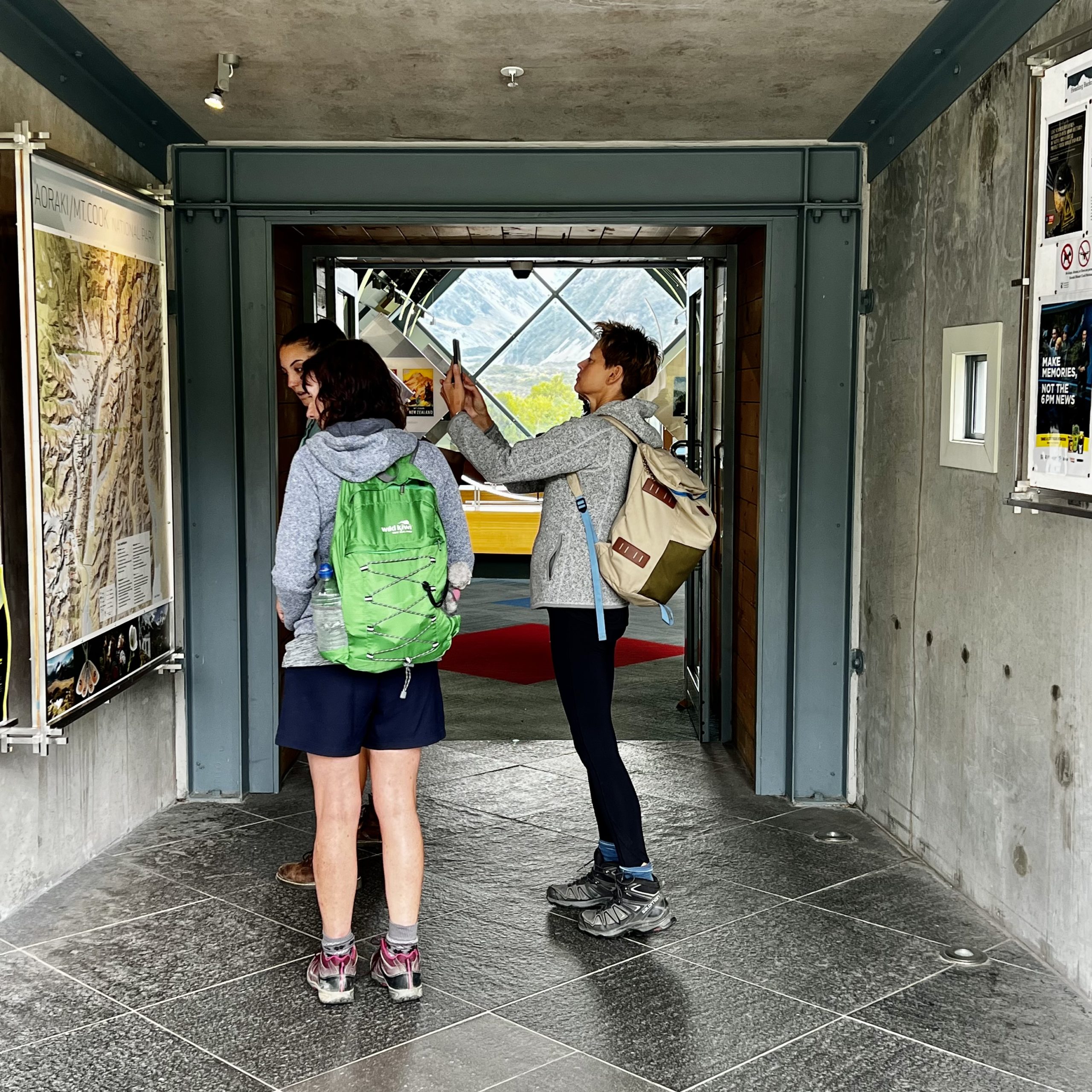
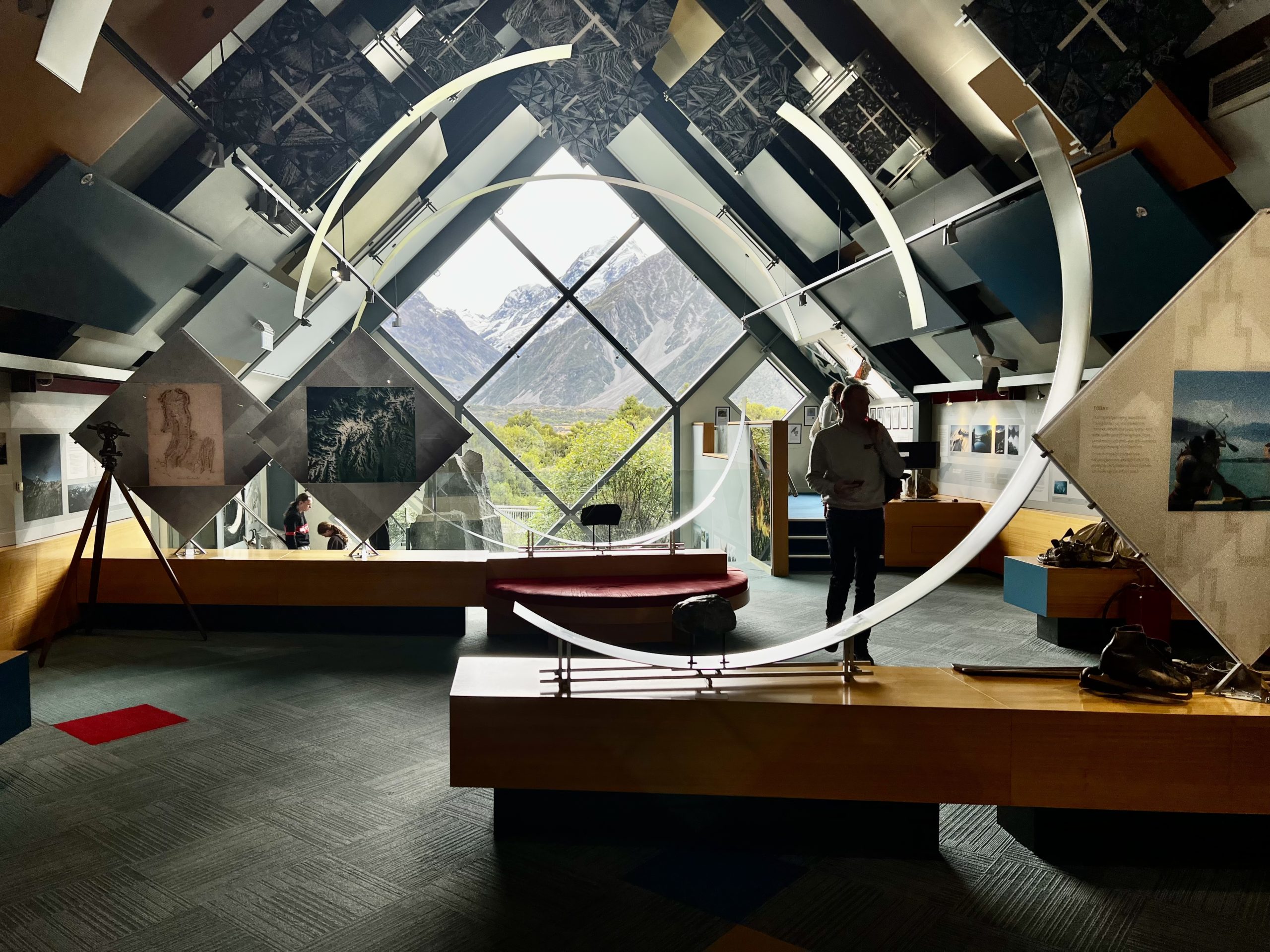
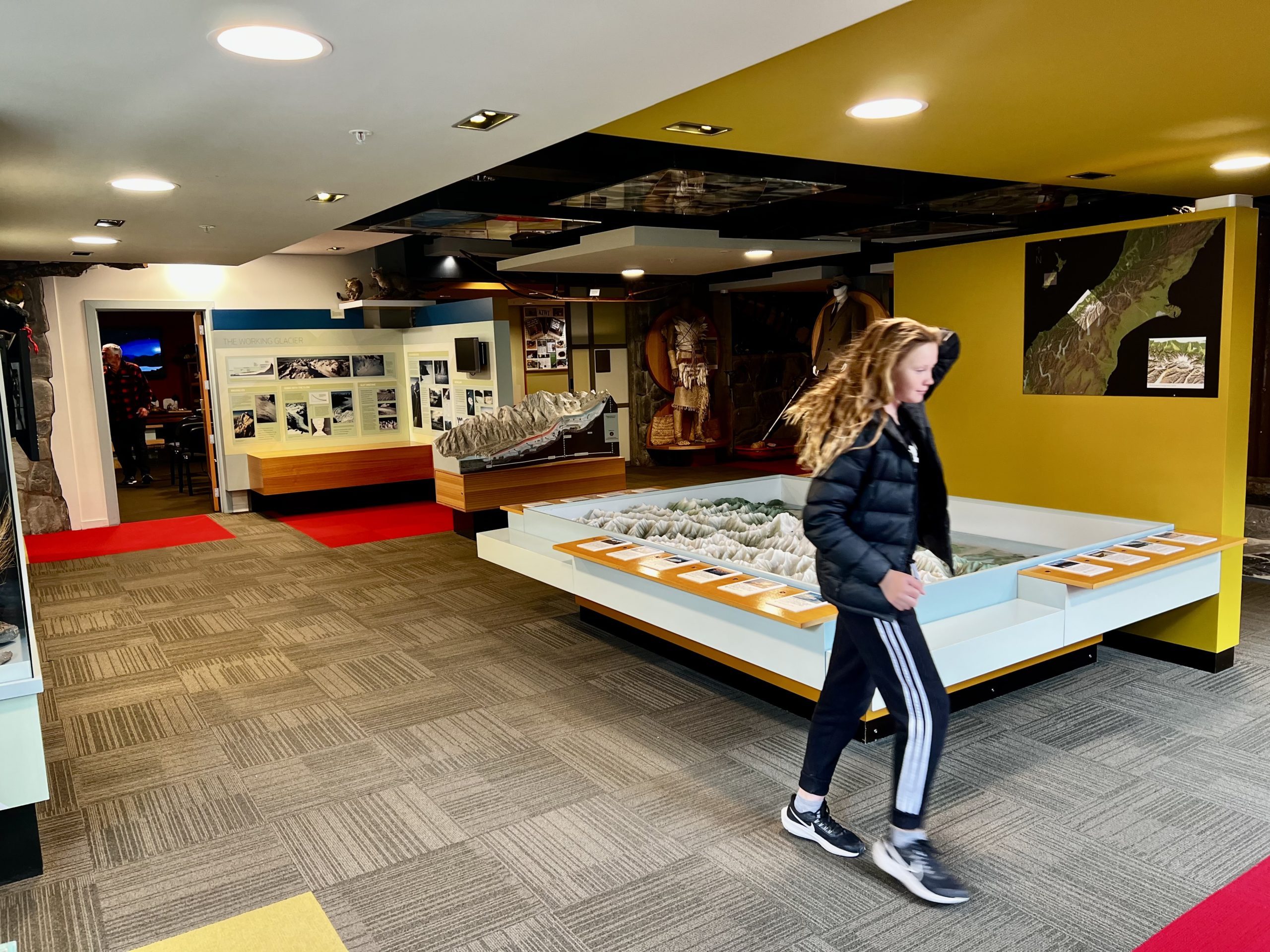
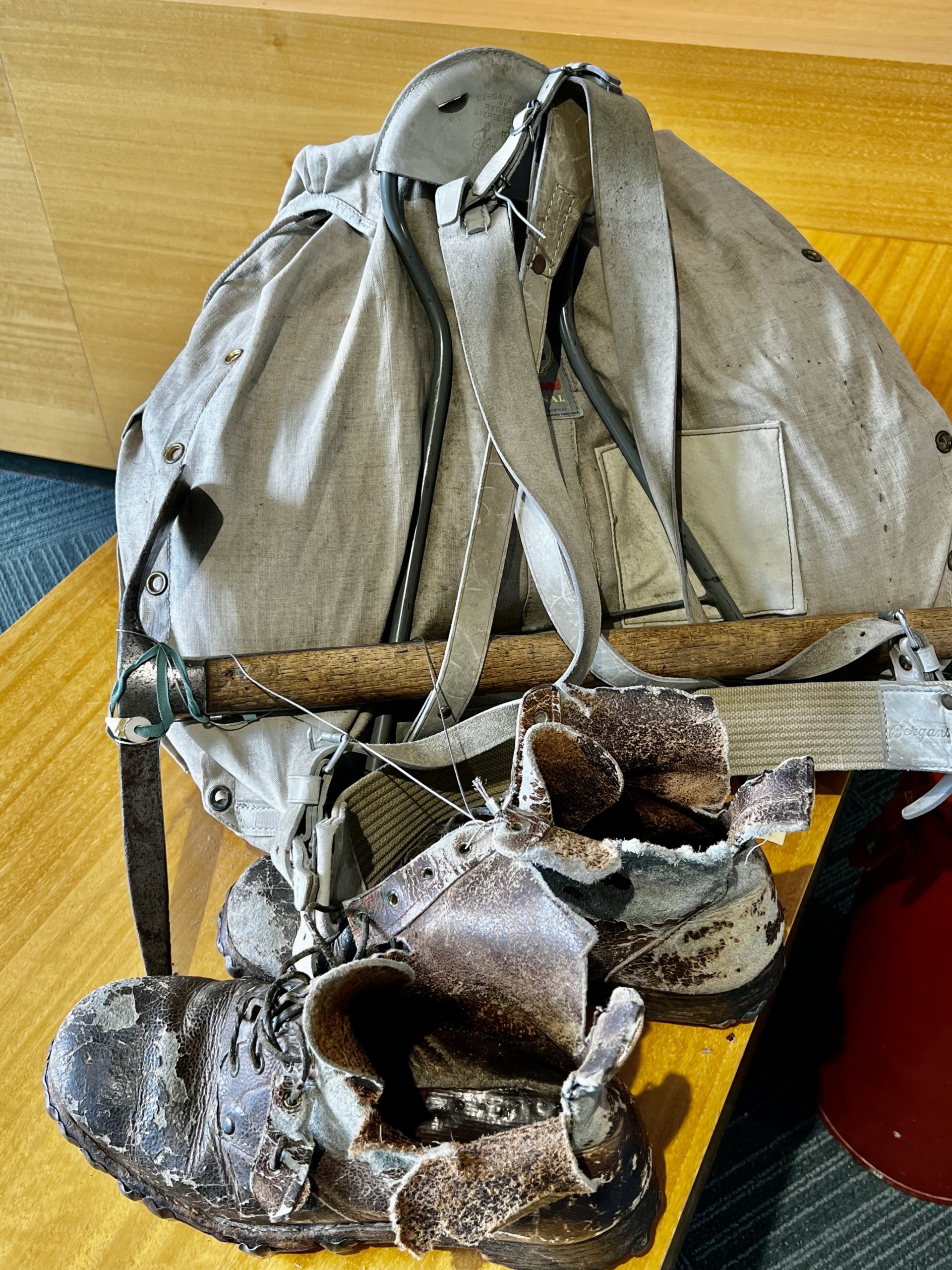
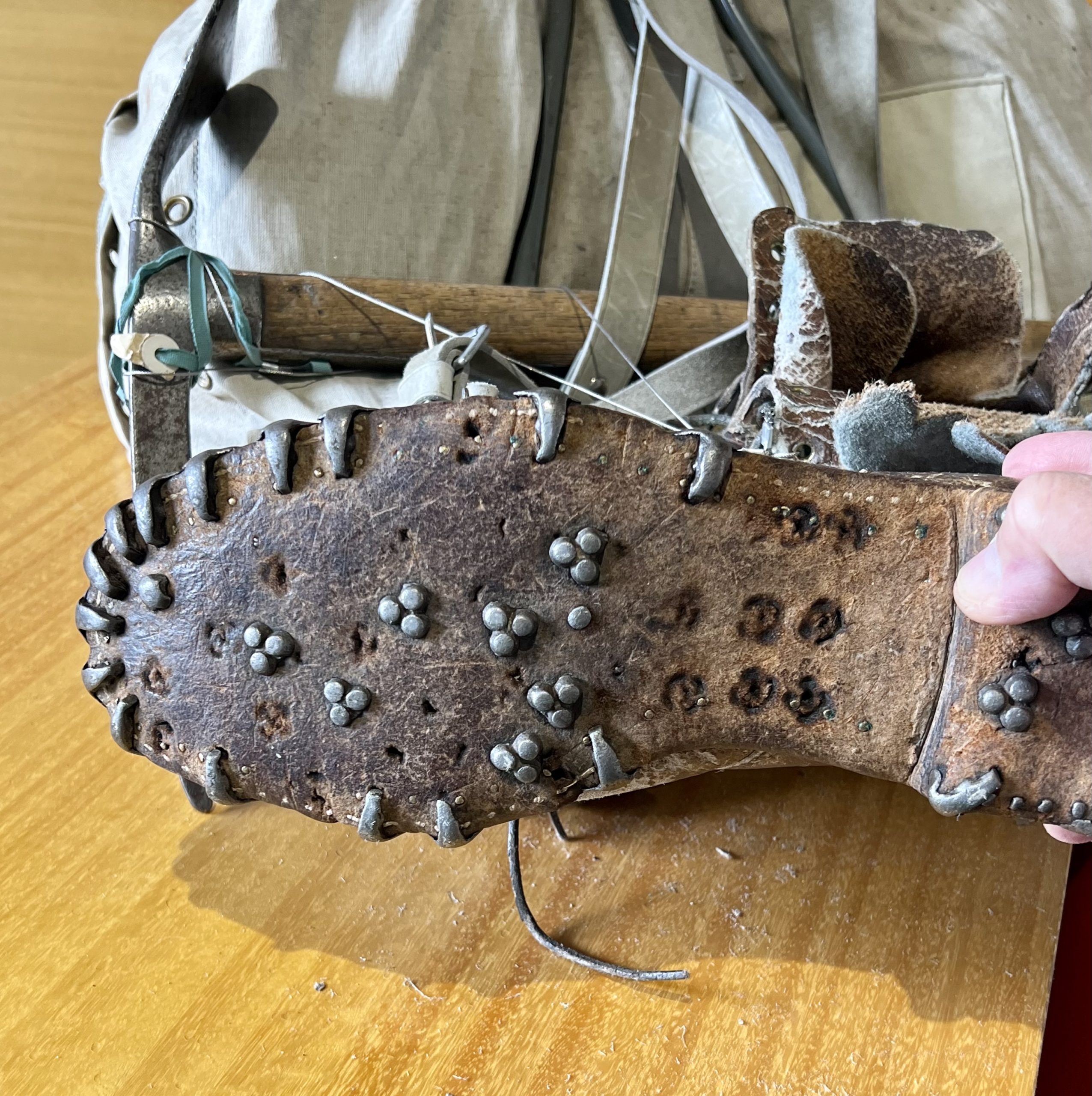
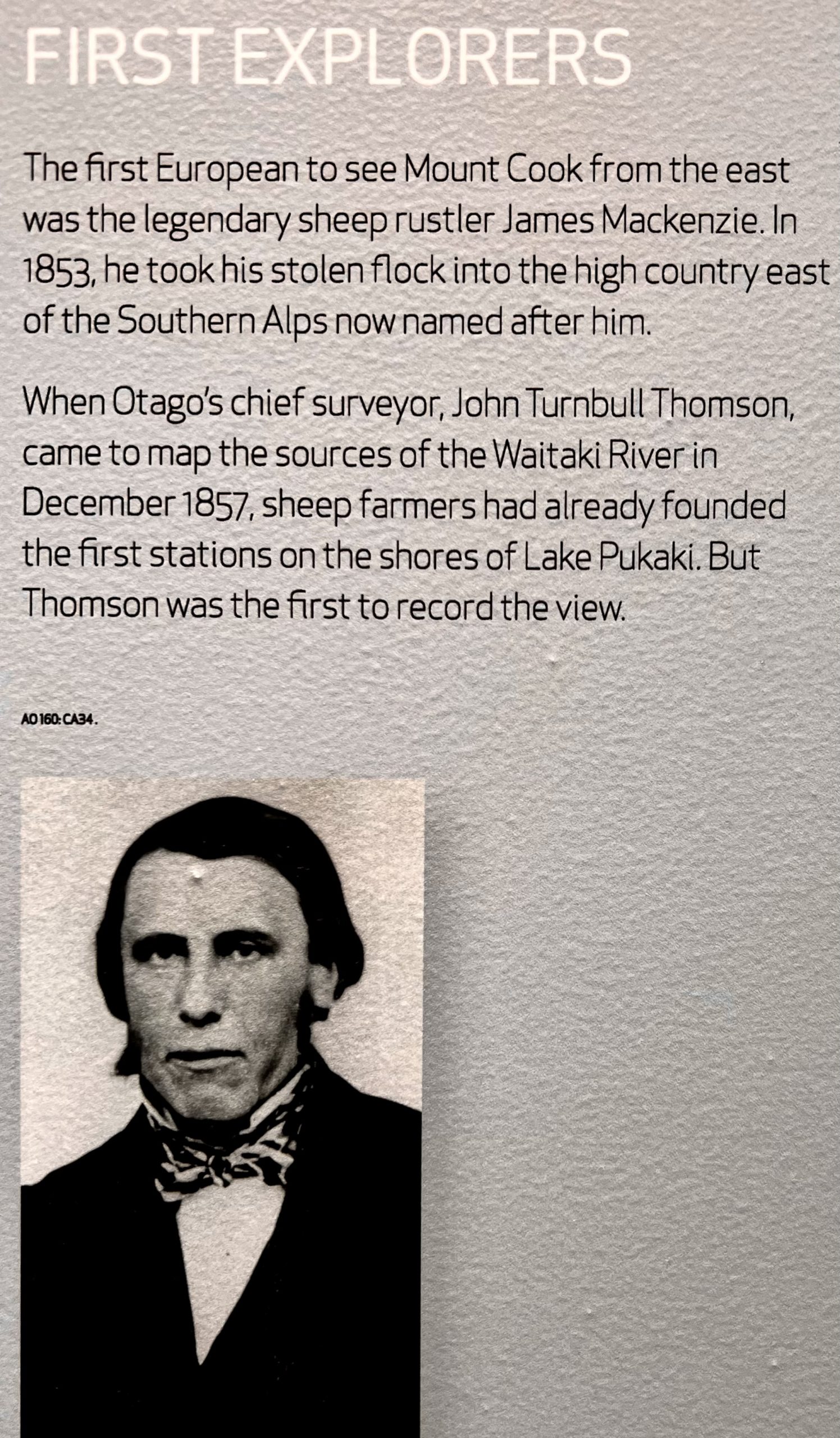
The Mount Cook visitor center lived up to the glowing reviews Bonnie read online. You enter the modest building through a narrow entryway. The passage then abruptly opens up to spectacular view of Mount Cook through a window on the far wall. Circular sweeps of metal embrace the view. Very dramatic. Perfectly executed. The center’s excellent exhibits range from the culture of those who inhabited the area prior to the British, the British who explored the area, those who climbed the mountain at the turn of the last century, and the dramatic rescues over the past hundred years. The museum also contains exhibits on geology, flora, and fauna of the area. In one room, about ten black books lie on a shelf waiting for you to investigate. They give no clue to the contents except for a range of years on the cover. Each page inside commemorates a person who lost their life on the mountain. There is a description of the person, often with a photograph. Some died in climbing accidents, some were hit by falling rocks, others simply disappeared and were never found. Robert noted that most of those in the book for the 1970s were 20 to 28 years old. A thirty-year old woman who was hit by falling rock in 2007 was a graduate of UC Berkeley in urban planning. We felt we might have met her.
The Drive to Mount Cook
The drama is dimmed a bit by the overcast sky.
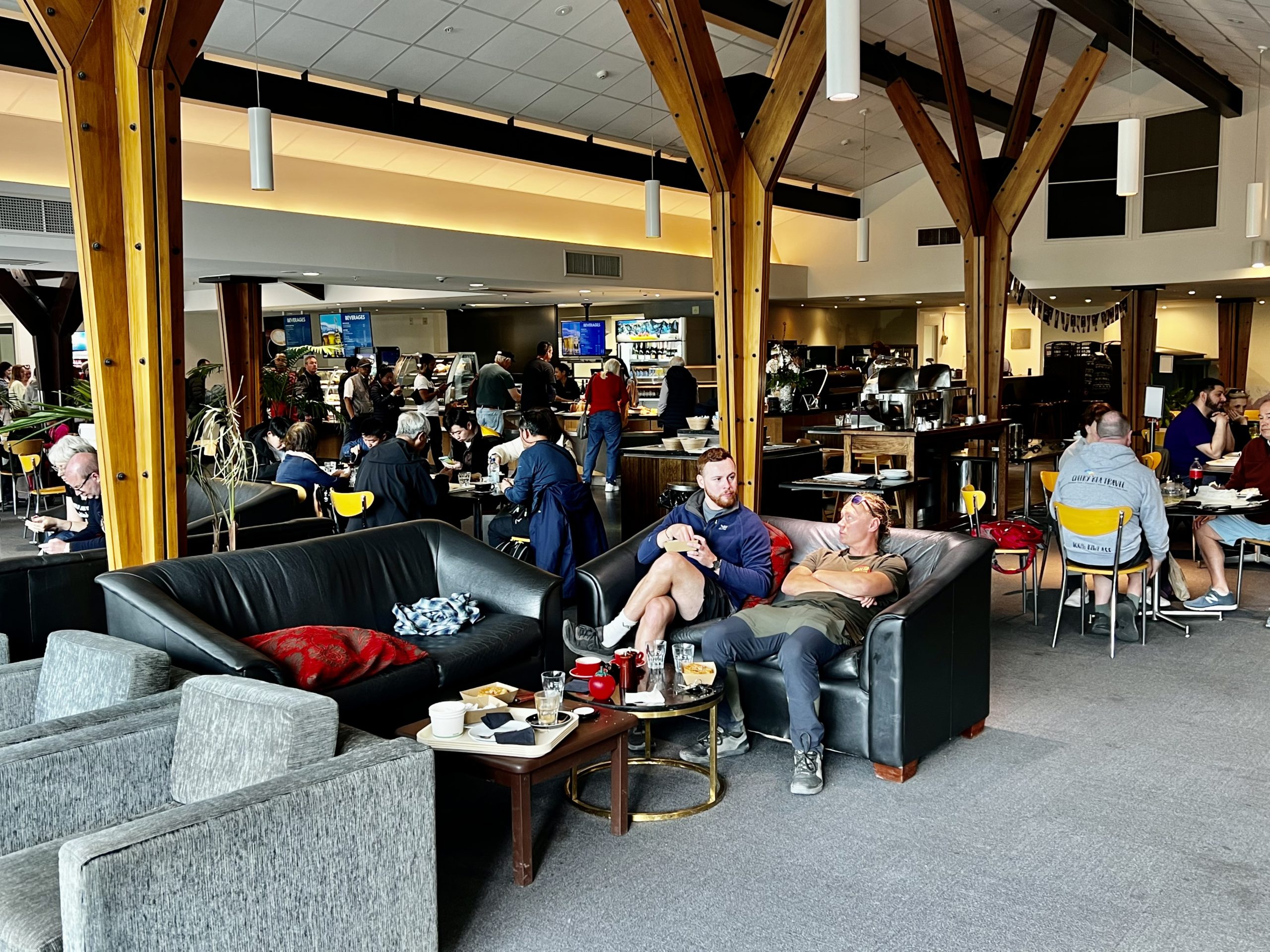
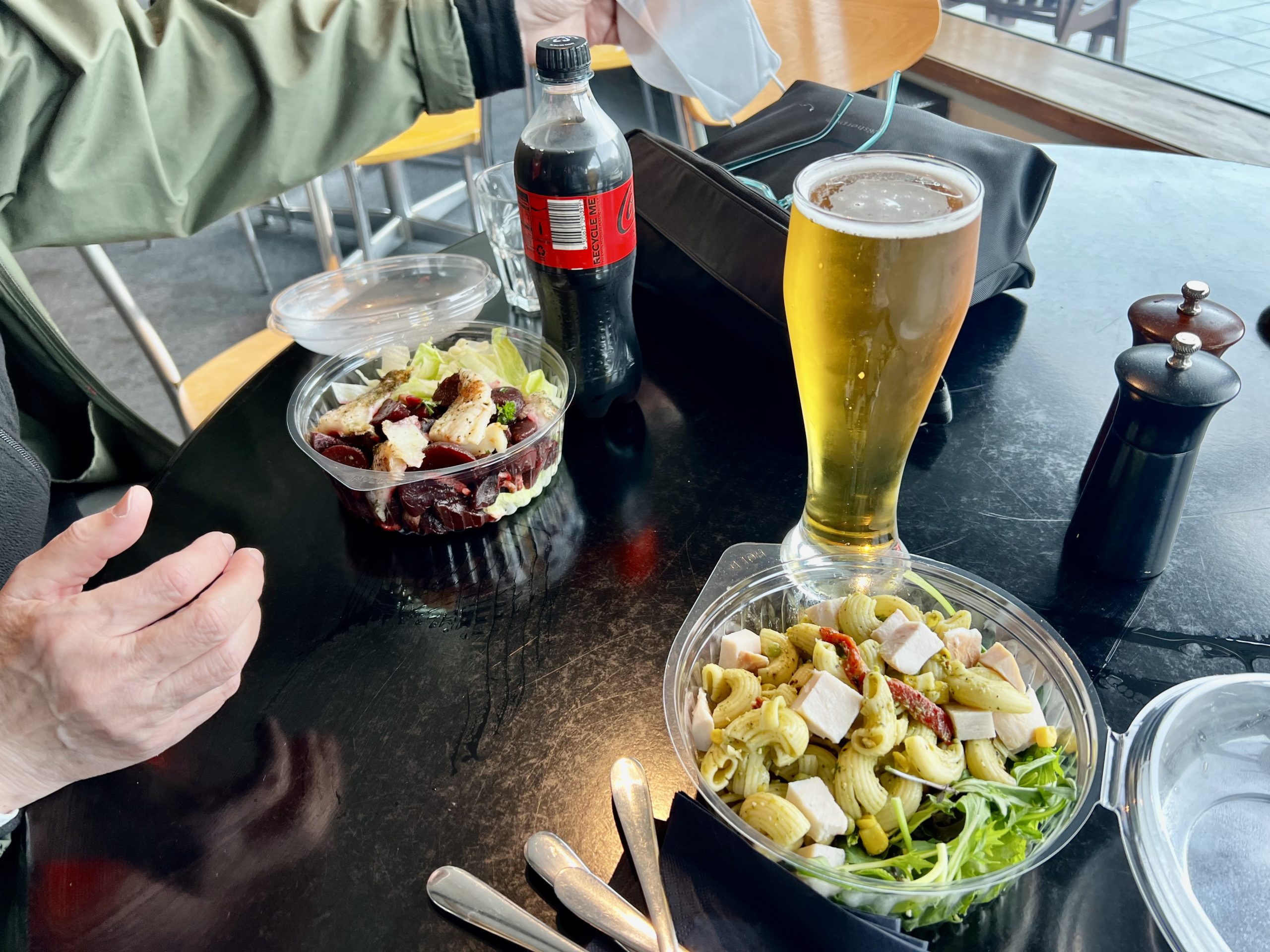
Lunch at the Hotel
Visitor Center
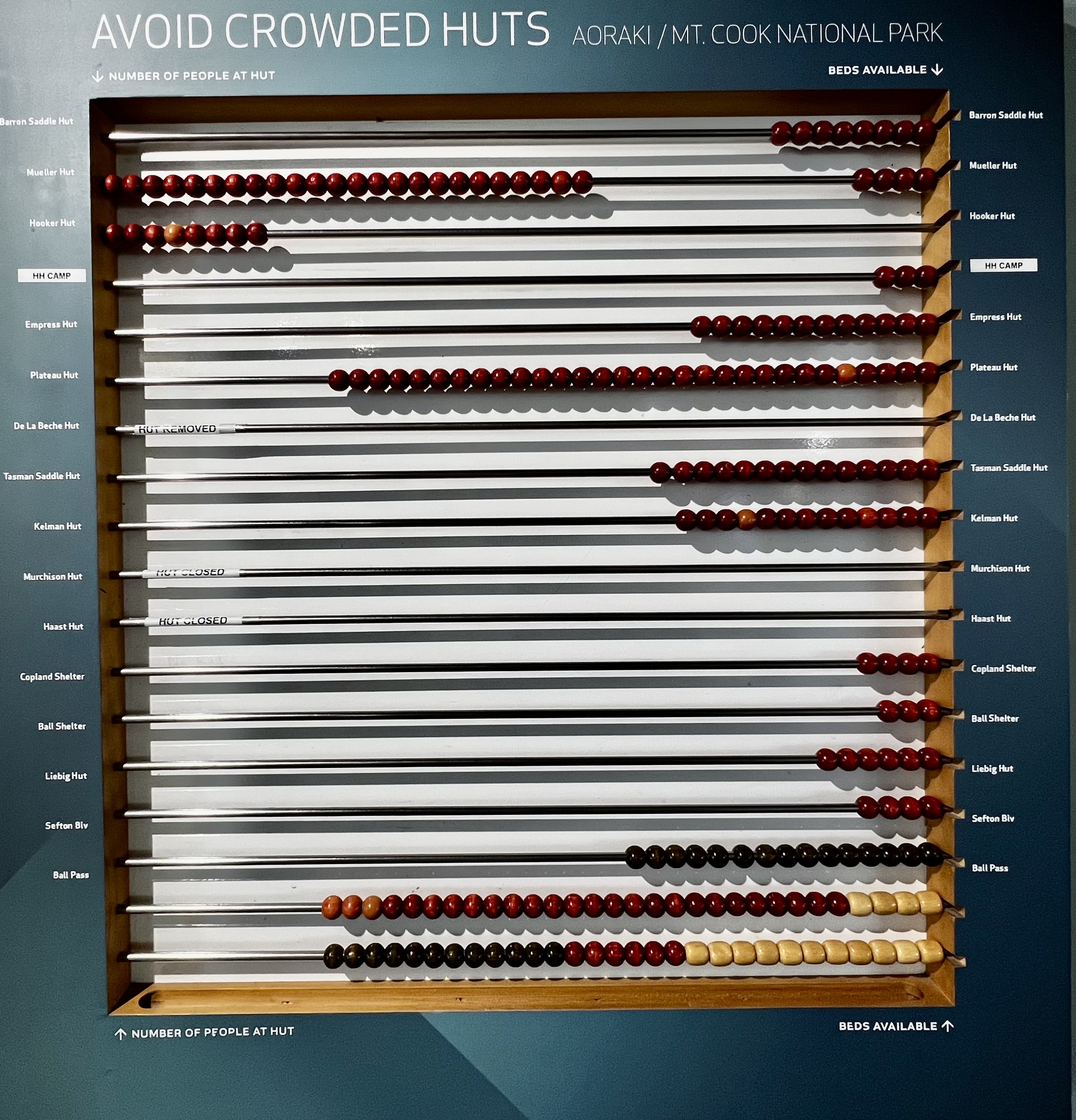
Listing of huts for hikers and the number of current occupants.
Tasman Glacier
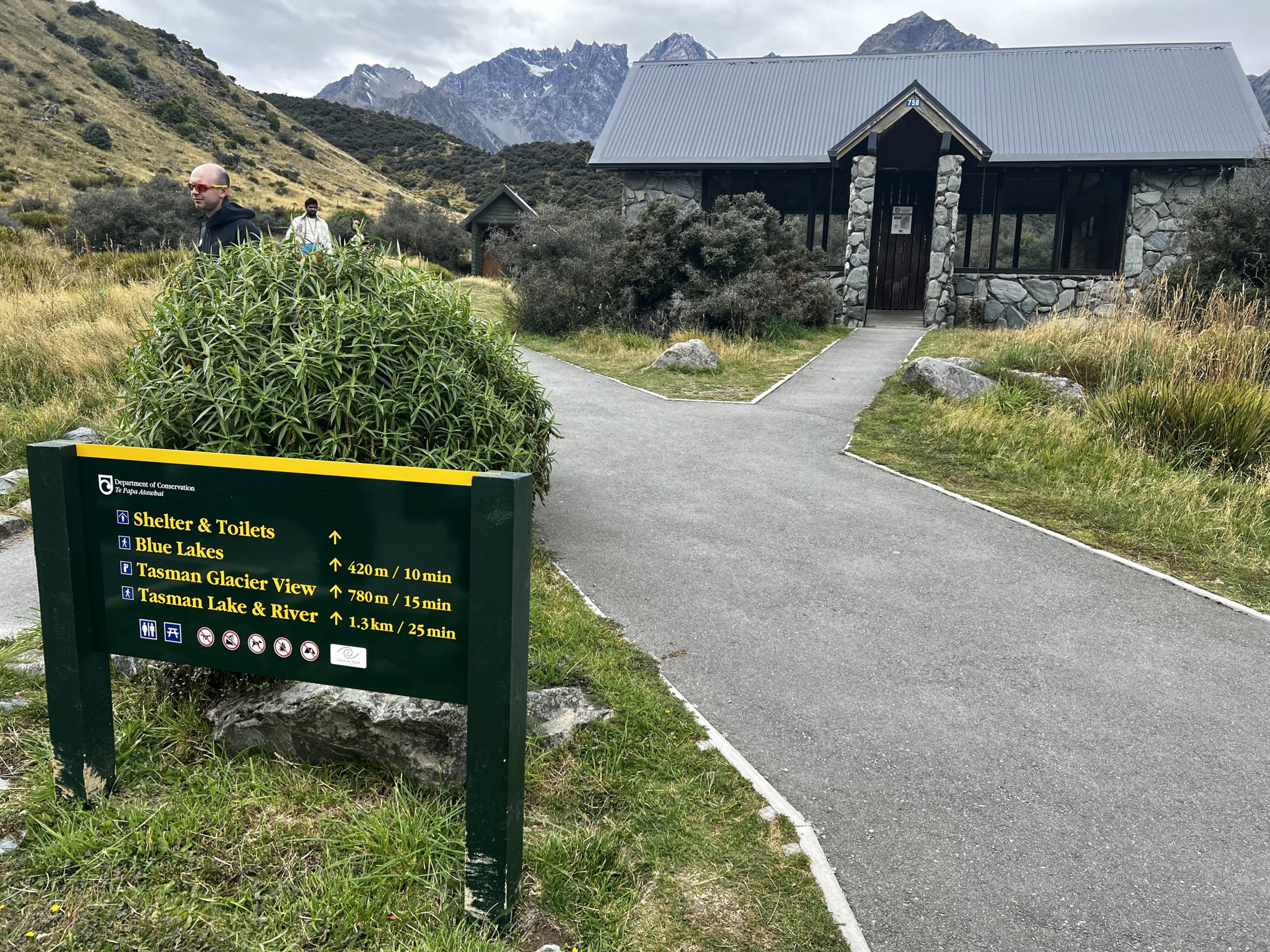
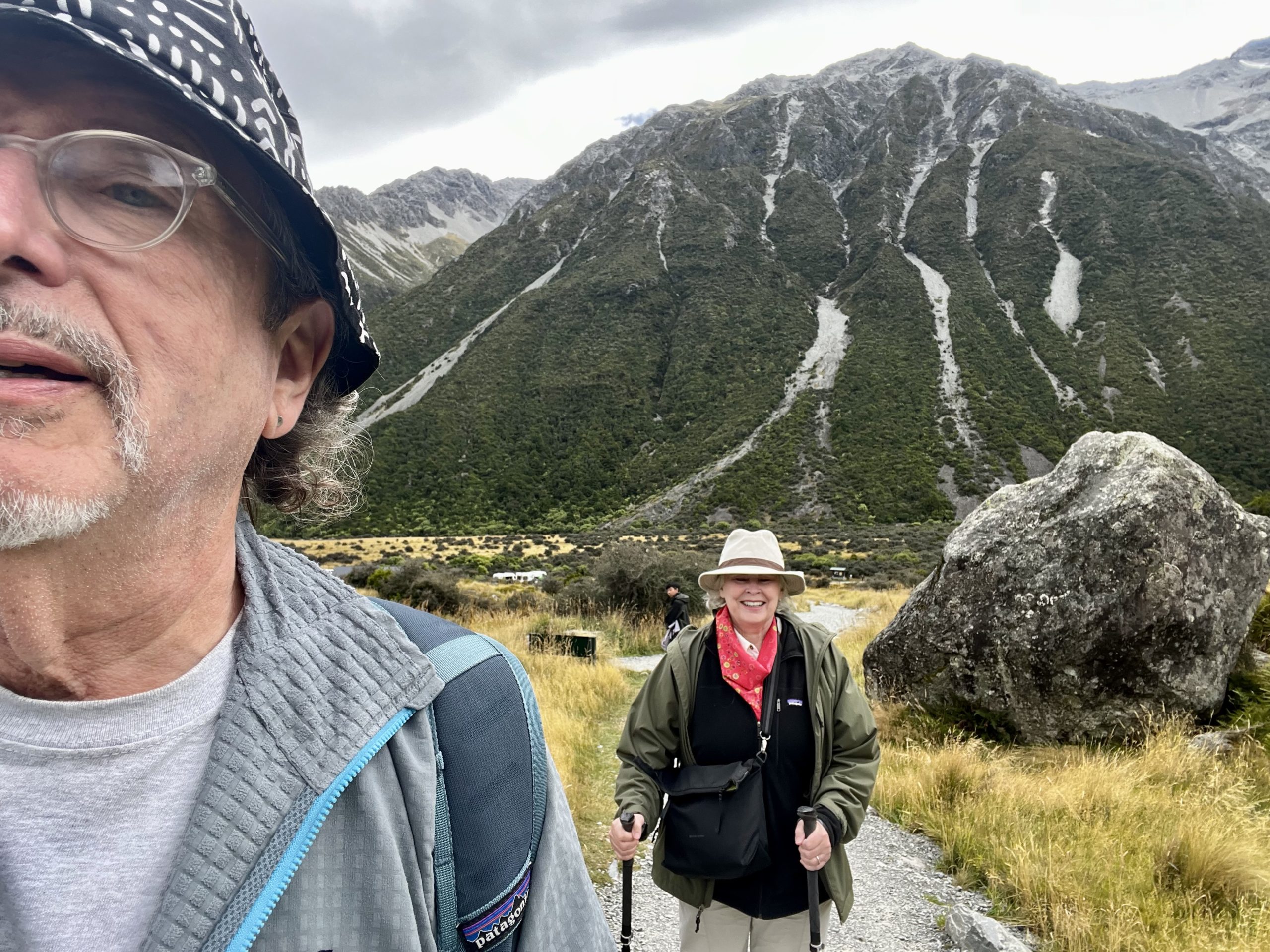
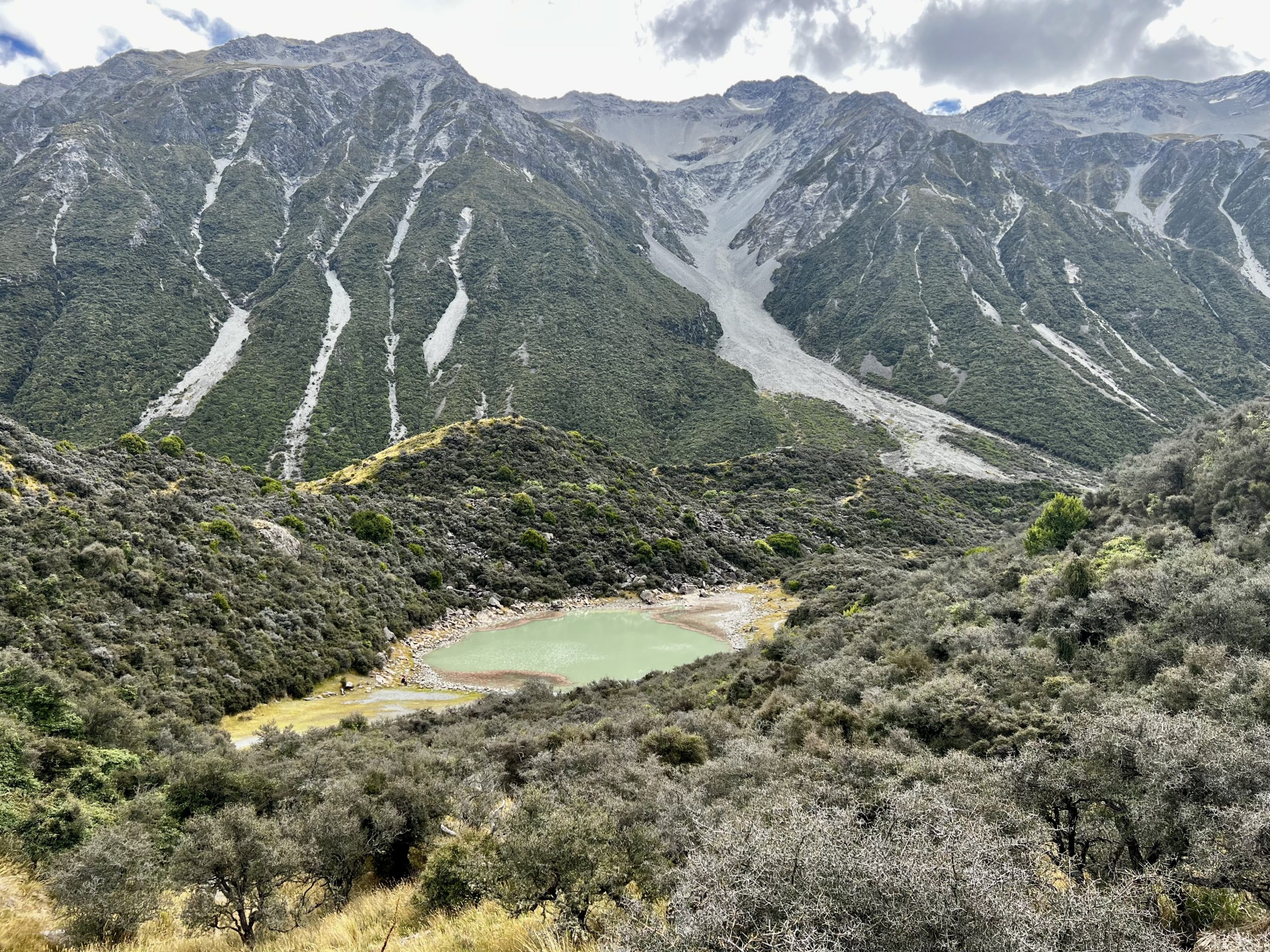
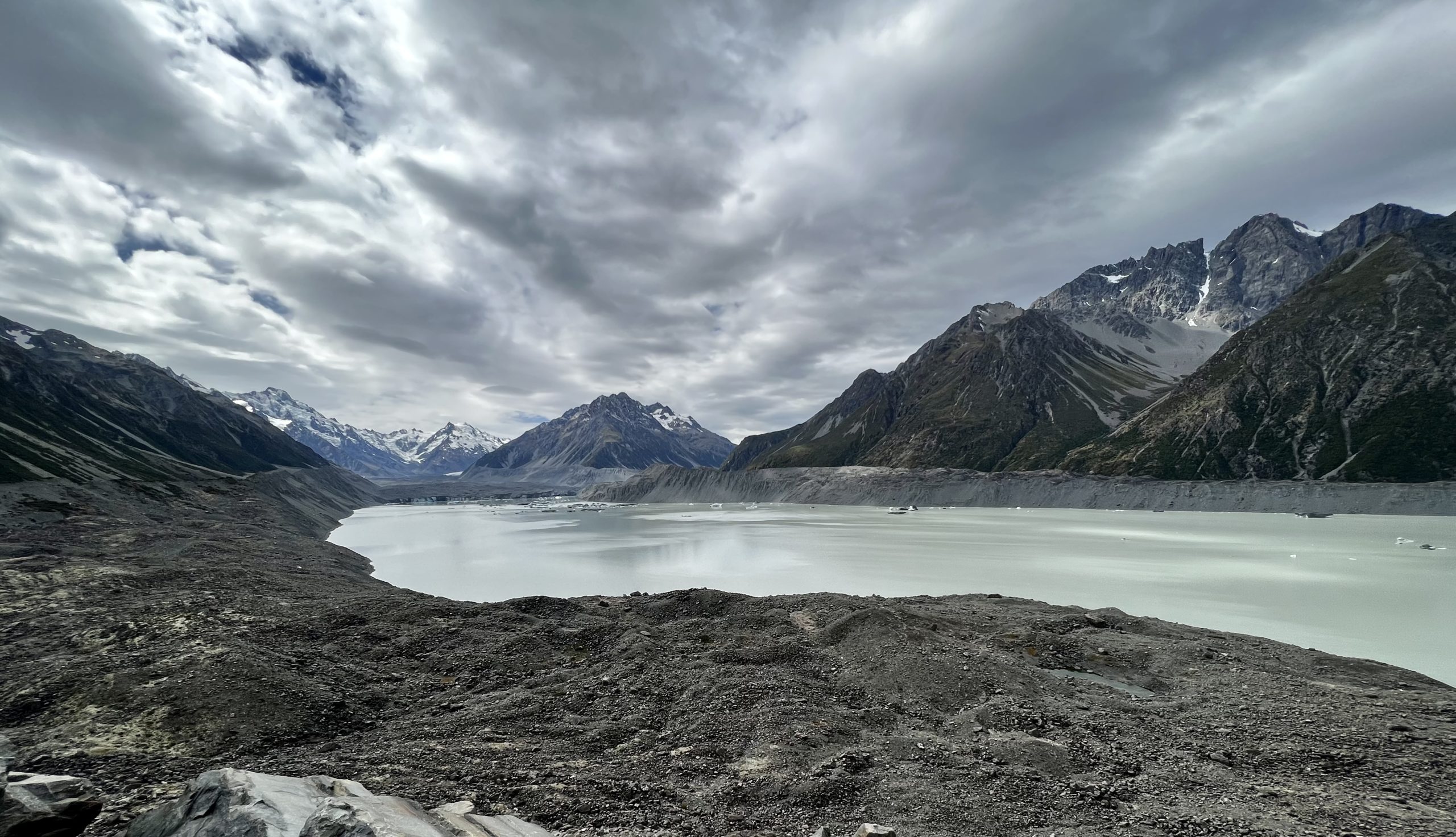
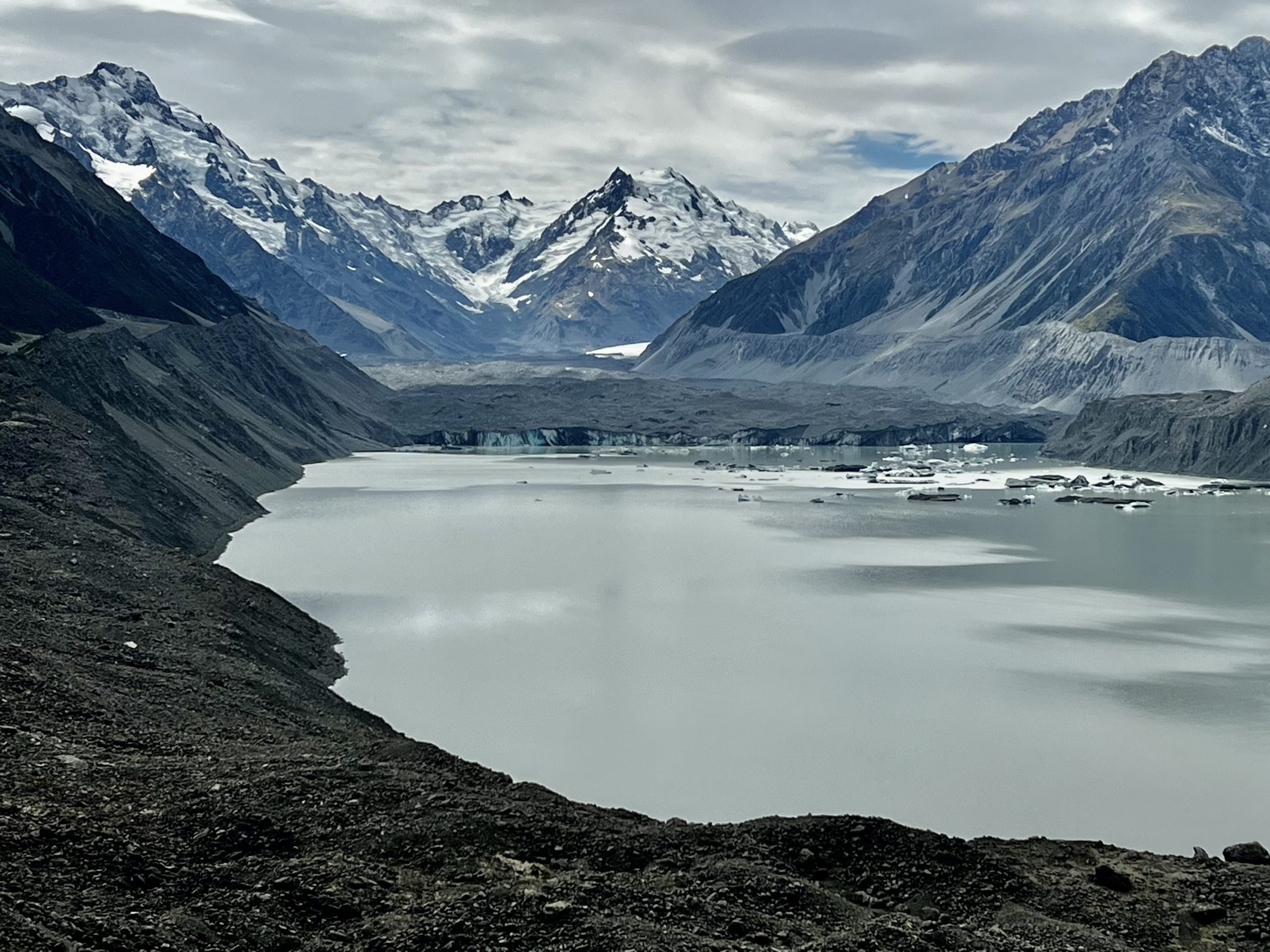
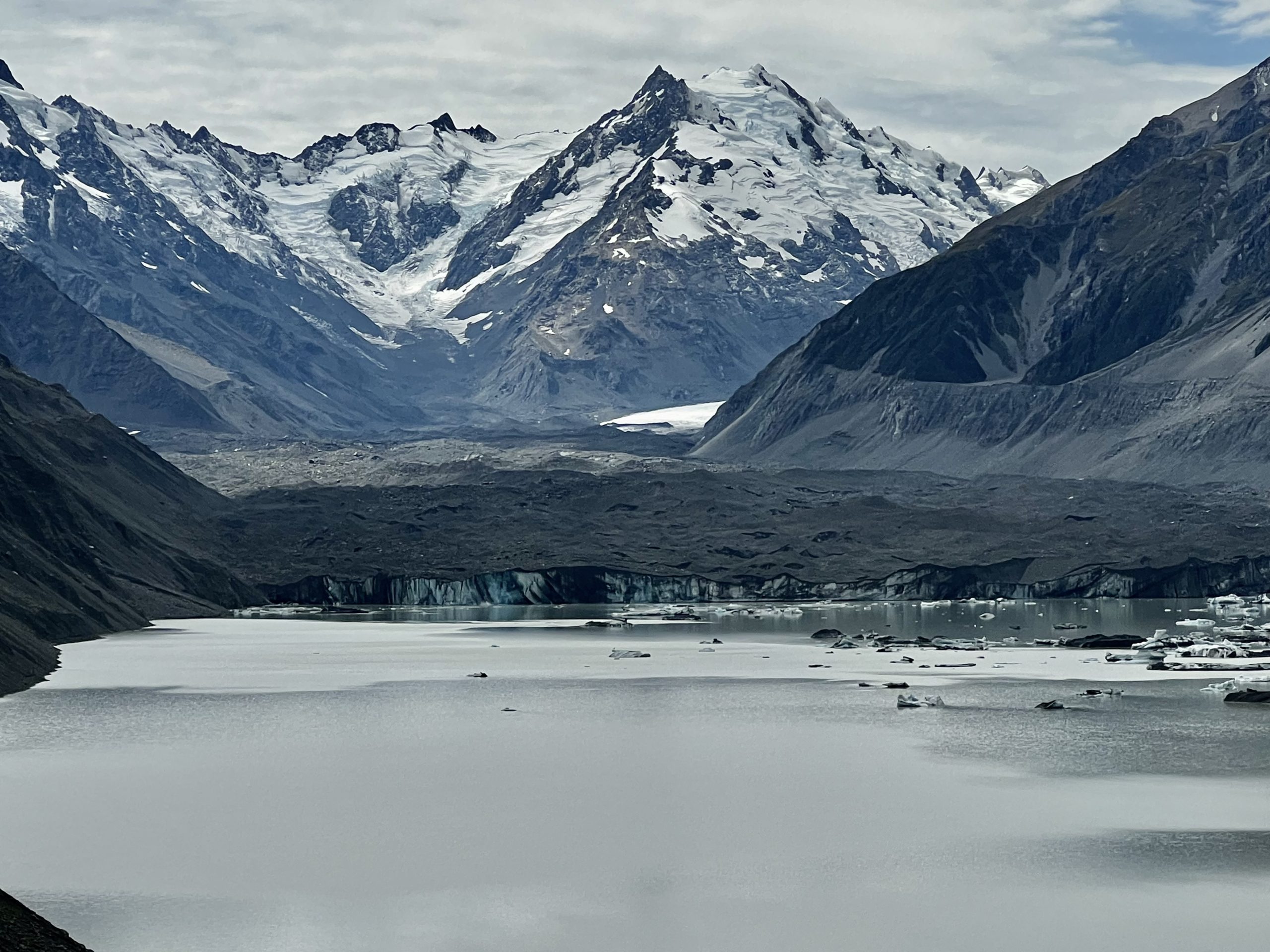
We took a short hike in the national park to a see a glacier at a distance.
The glacier is to the left of the photo. The ice is covered in debris.
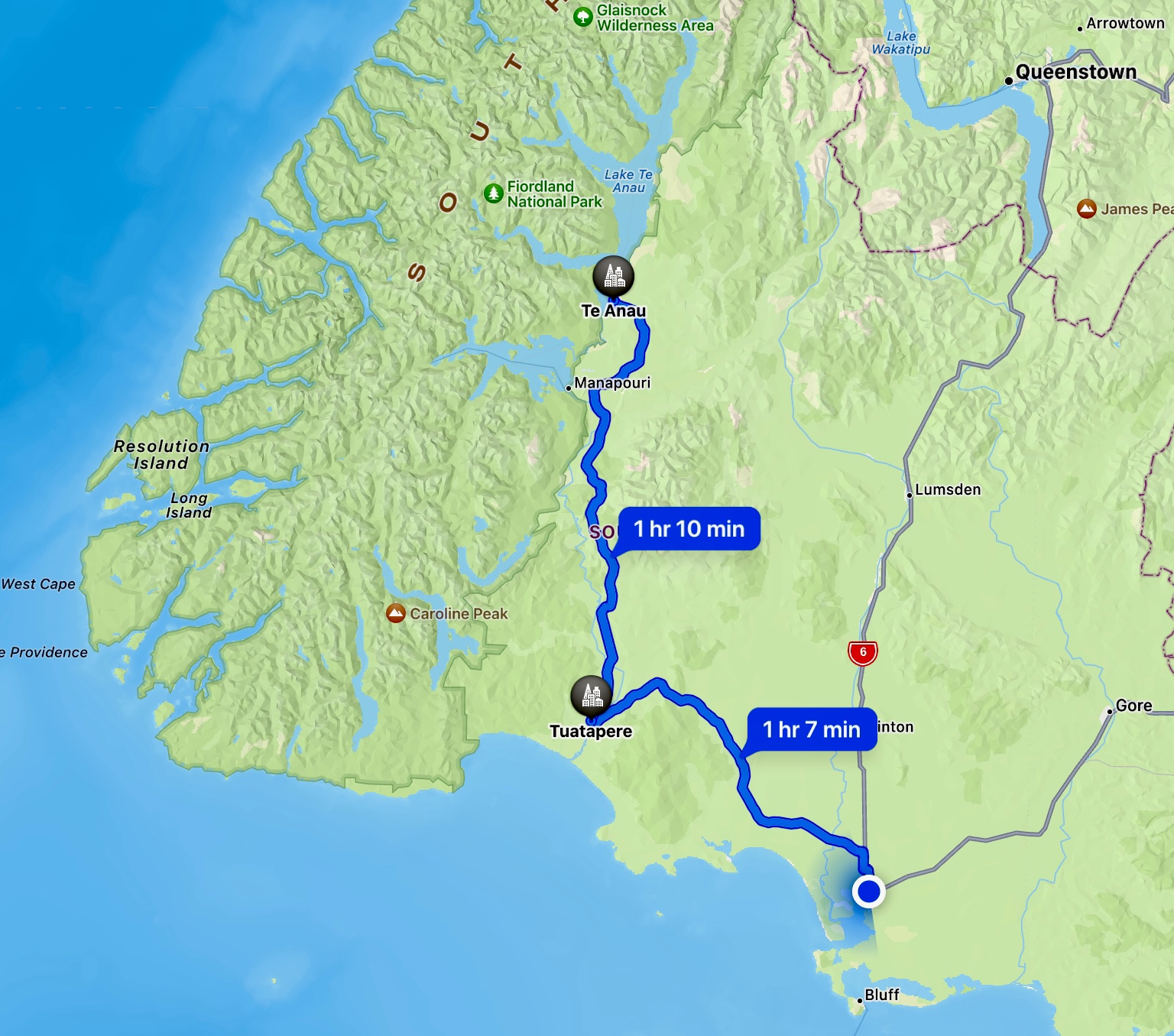
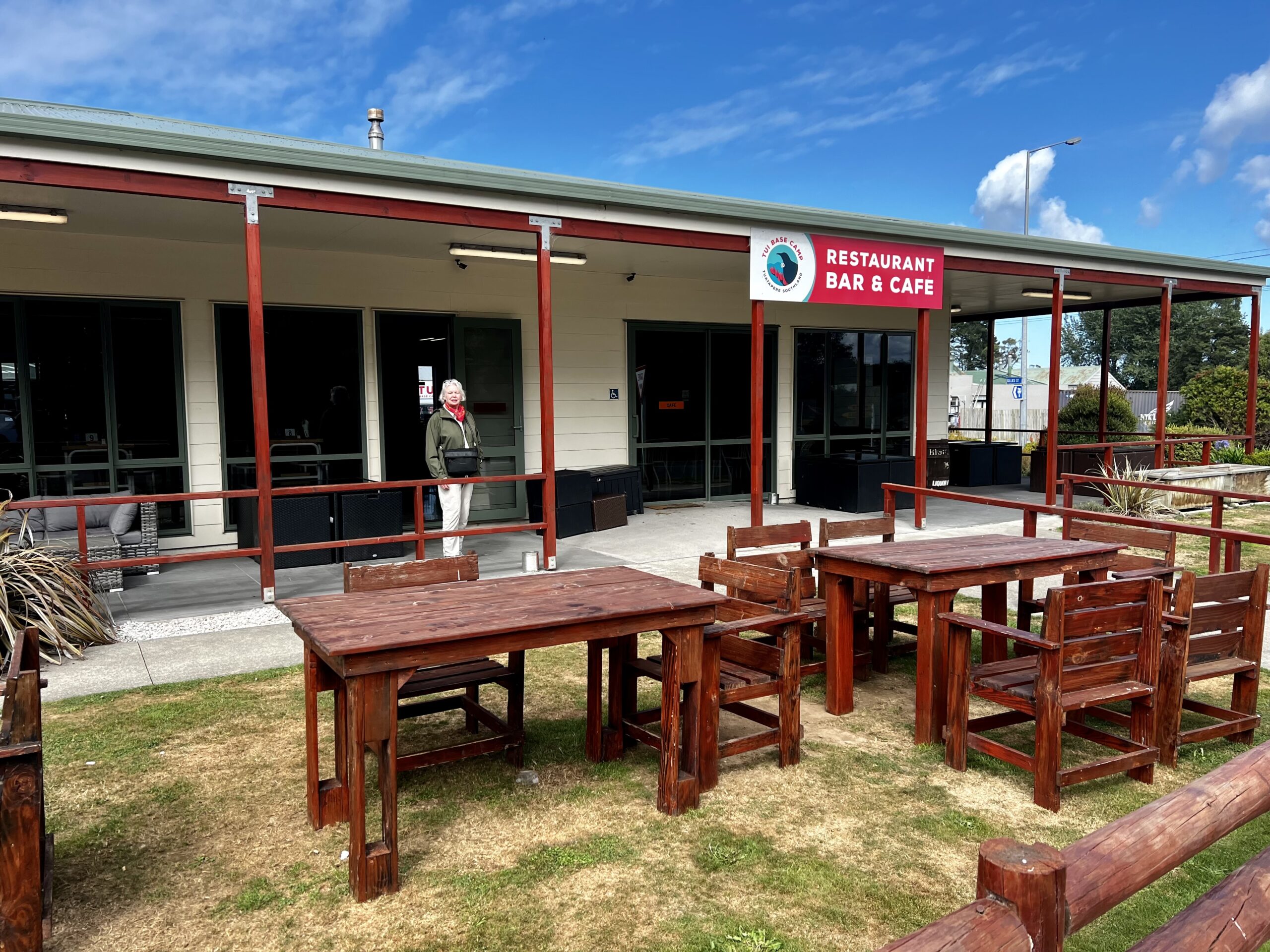
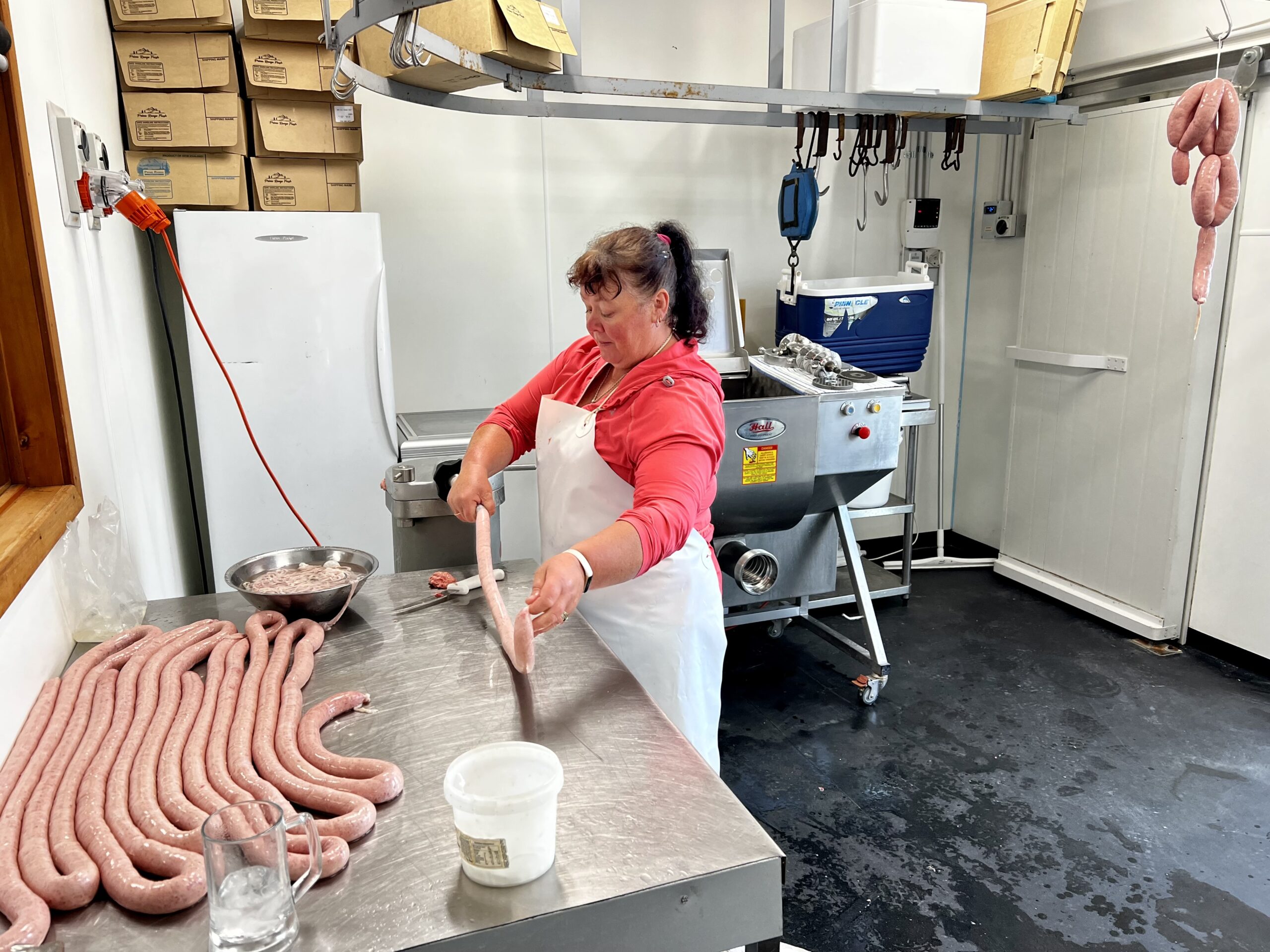
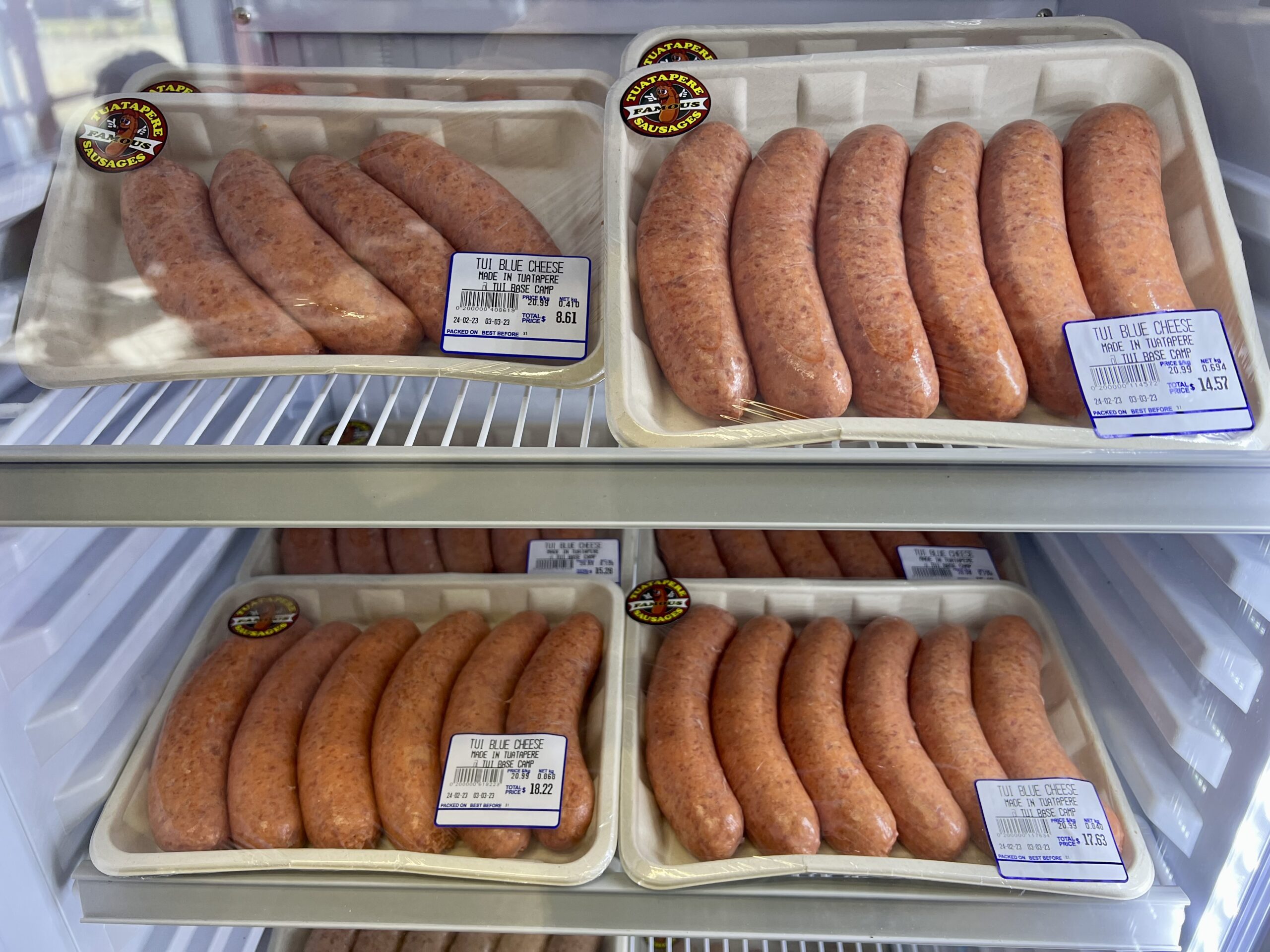
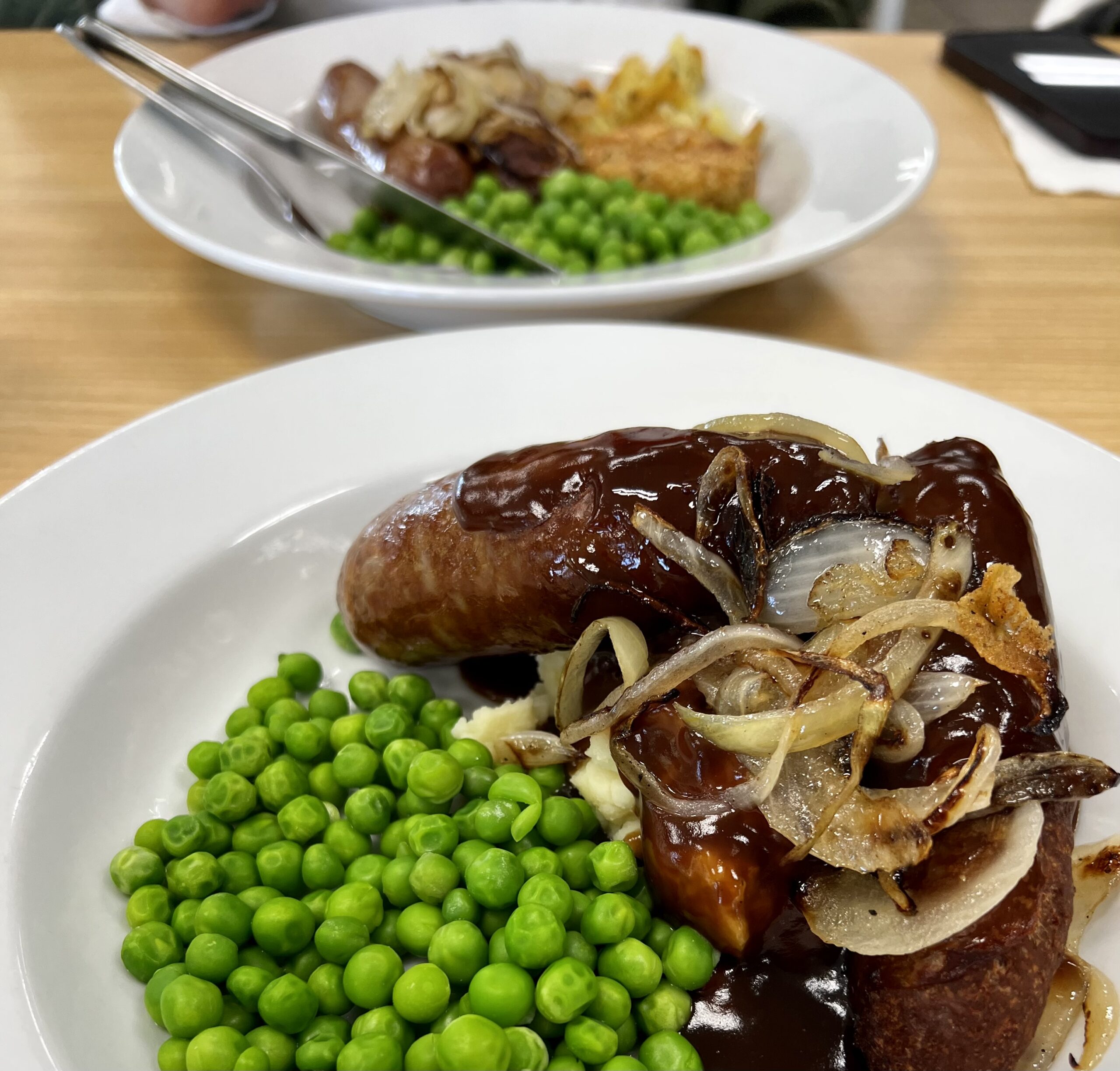
Bonnie’s extensive research of all things New Zealand found that with a slight detour we could stop for lunch in Tuatapere—the Sausage Capital of New Zealand! Tui Base Camp was awarded the title in 1982 in a radio contest and they have held onto it ever since. (We do not know if there was a subsequent contest.) The two women who operate the business bought it several years ago and have religiously followed the winning recipe. Only difference is that they no longer need to add ice to the mix because newer machinery does not heat up like the old stuff. Their sausage is like a British banger—finely ground. After her lunch break, one of the owners let Robert see how she stuffed and hung the sausage. They bonded after Robert showed her a photo of his sausage making.
Video!
Accommodations
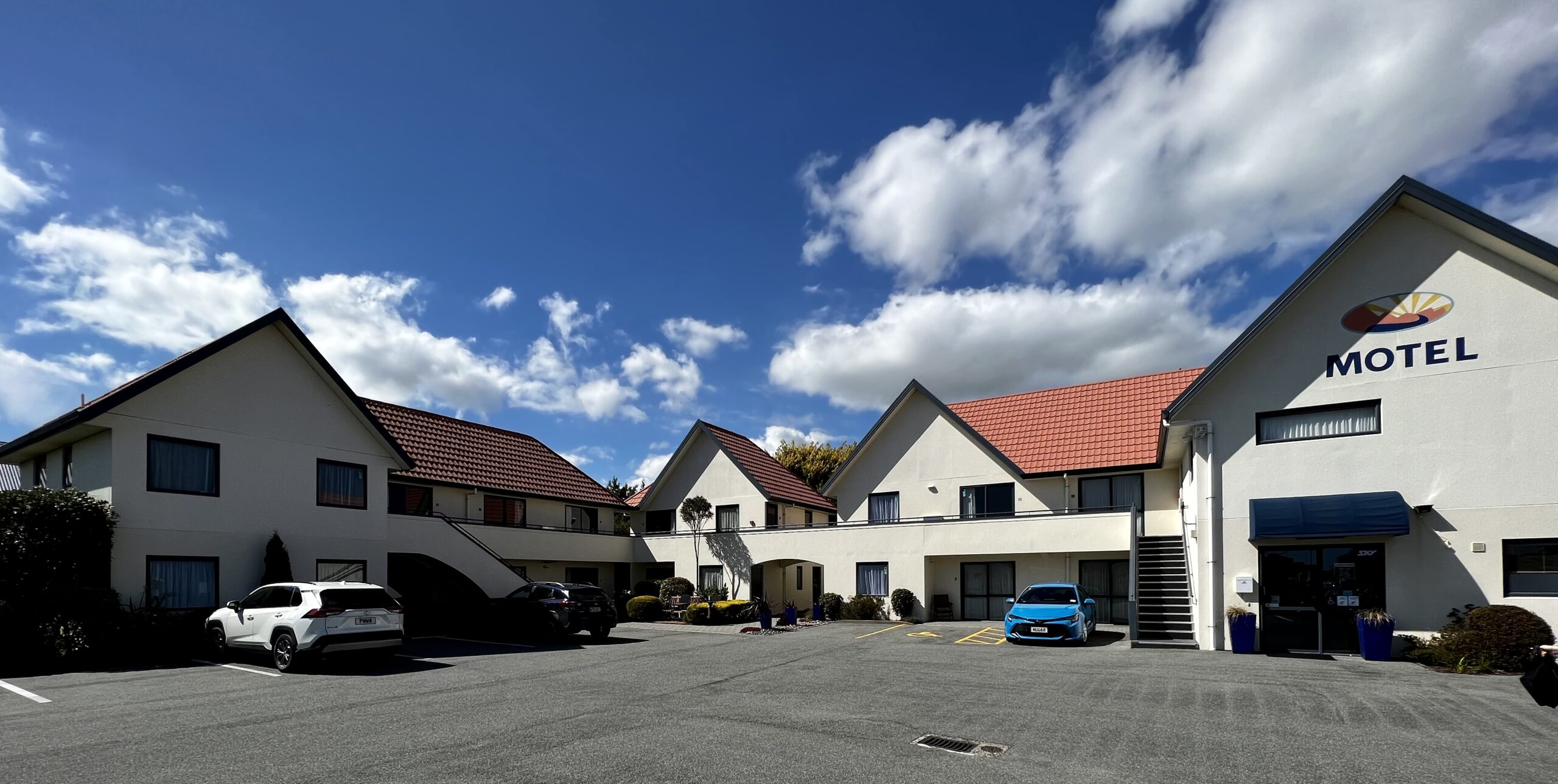
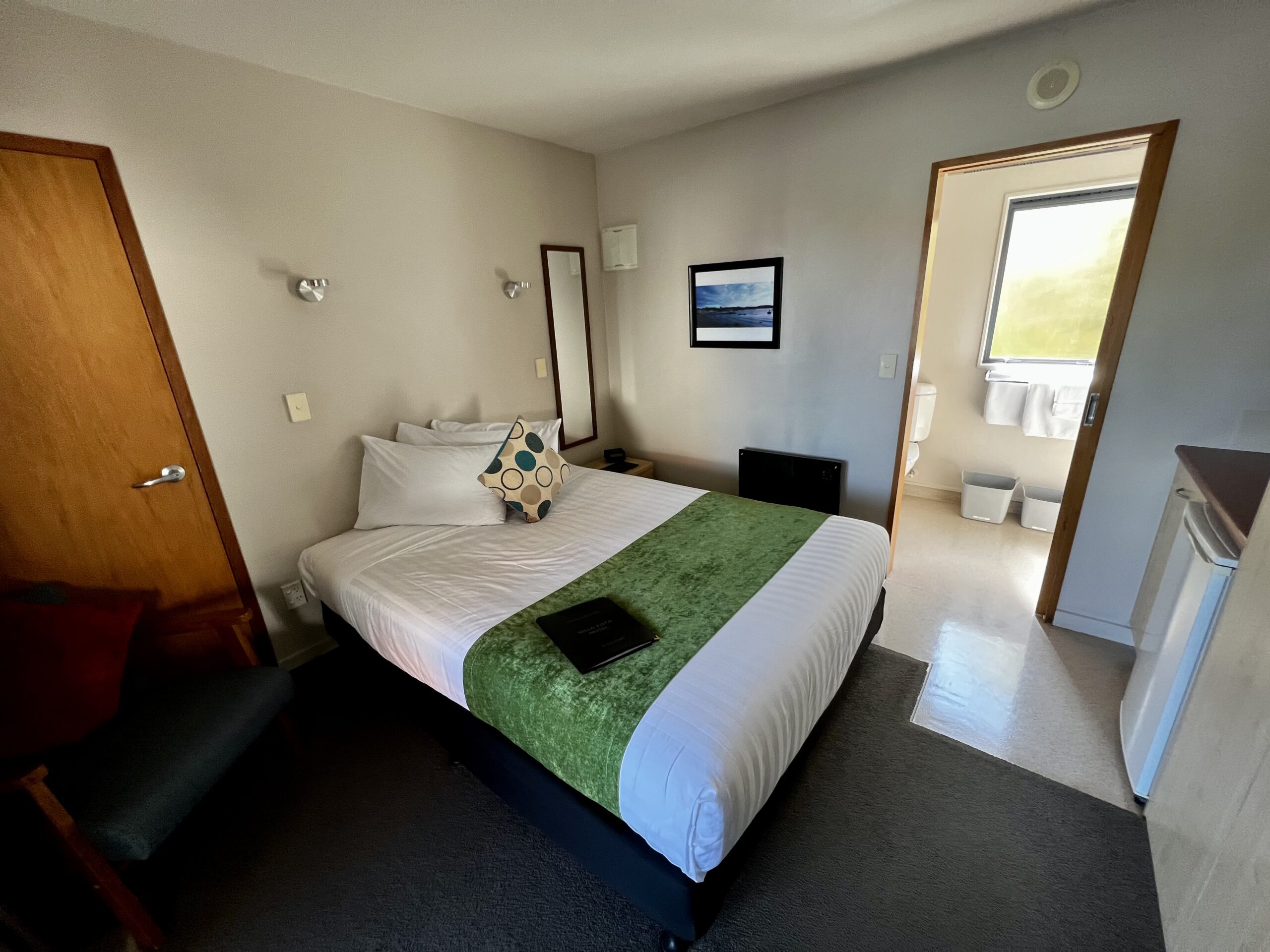
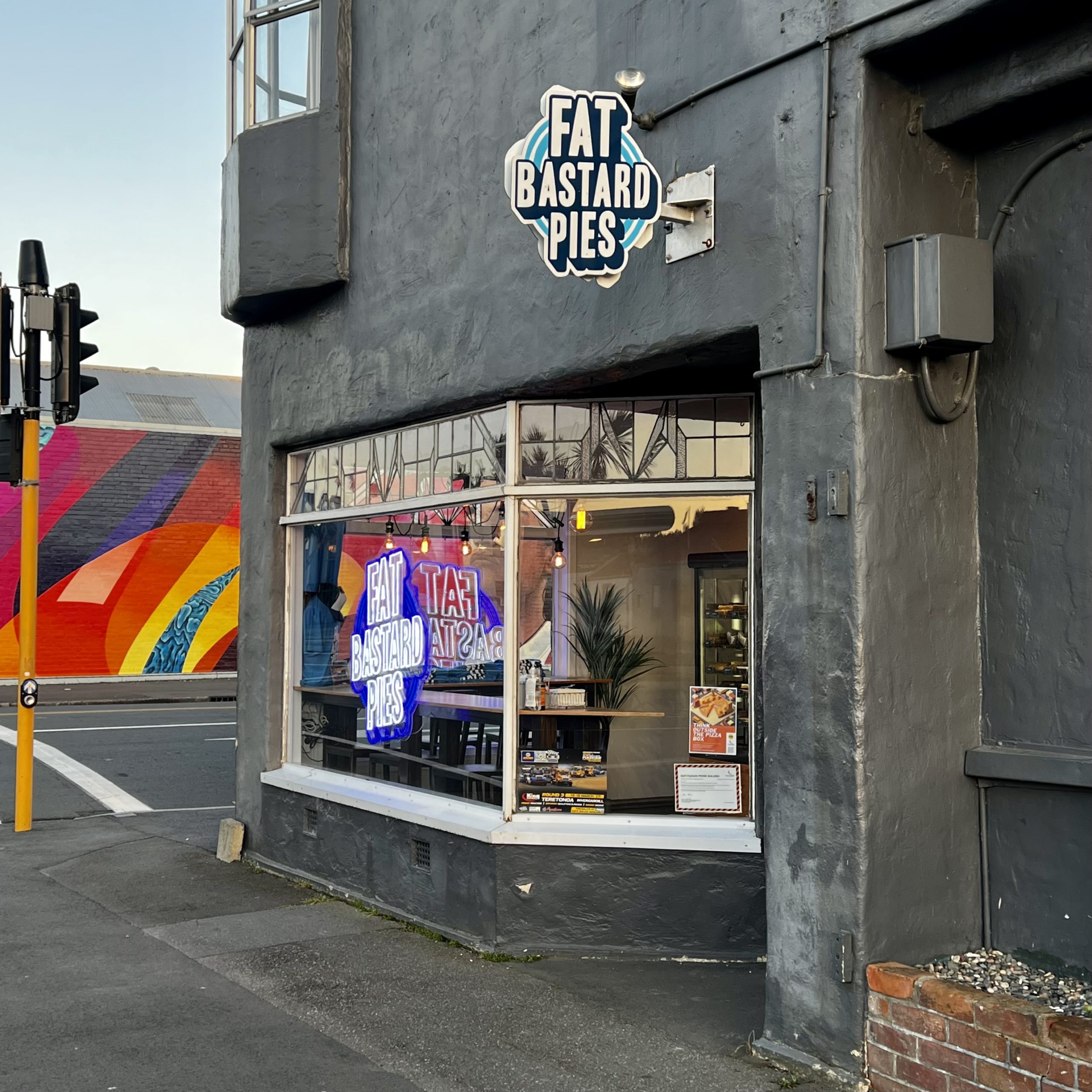
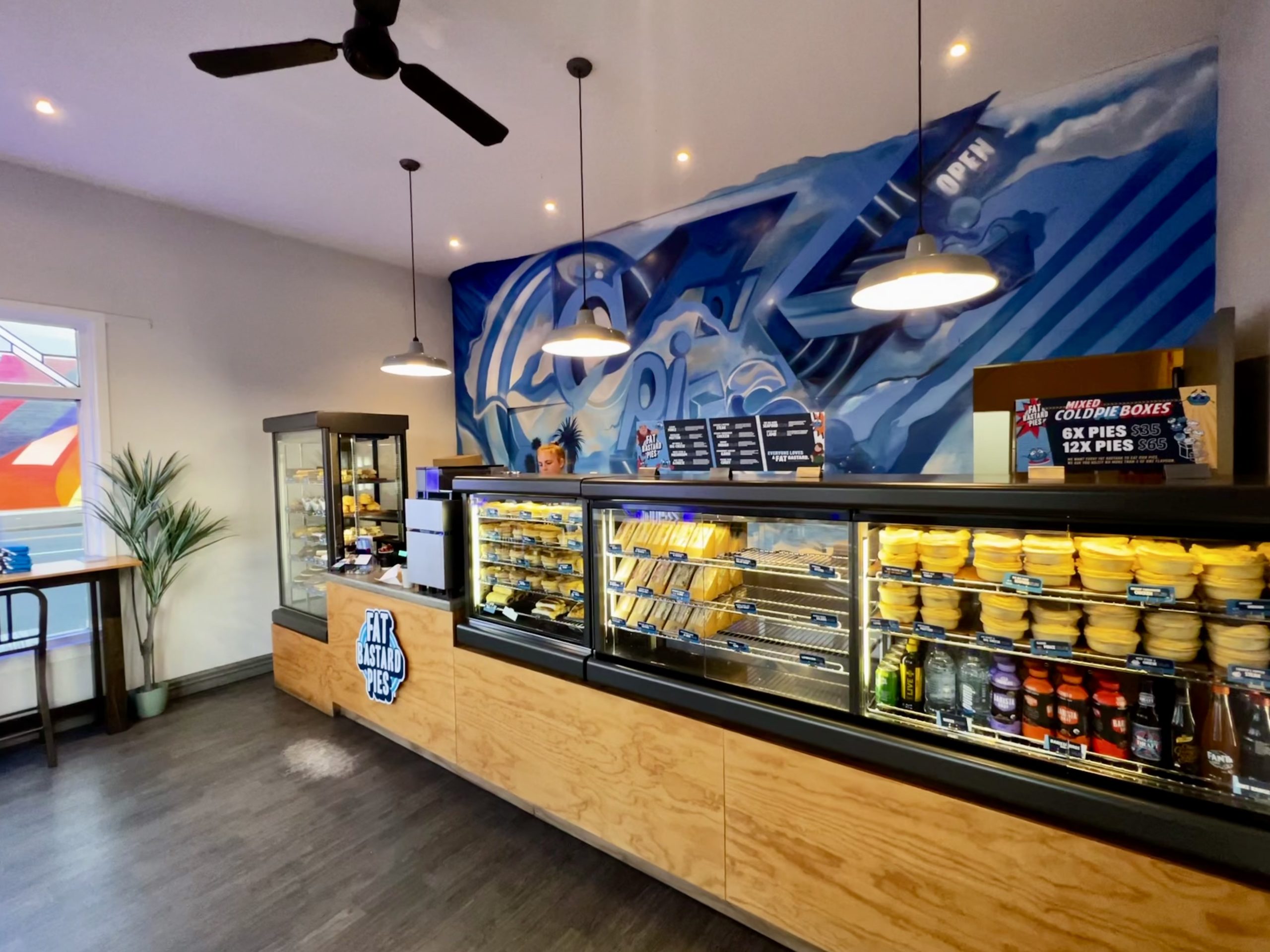
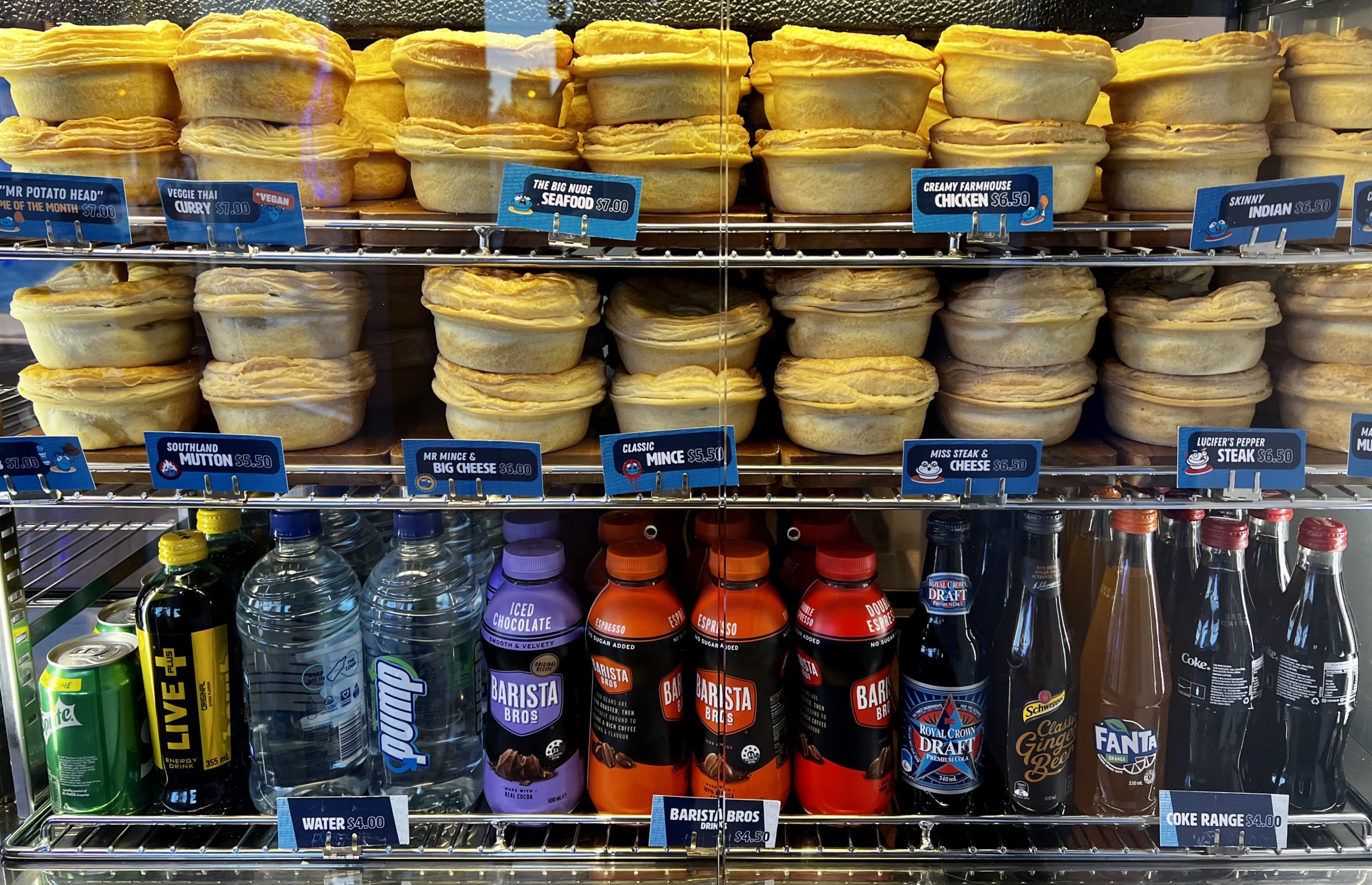
This might look like a duplicate of a photo from Te Anau . . . but it is NOT! This Bella Vista motel is not far from the city center—a ten-minute walk to shops and a few pubs. But most importantly it is a short walk to Fat Bastard Pies that Robert frequented for his morning breakfast. Bonnie even tried one of their vegan pies.
Strolling
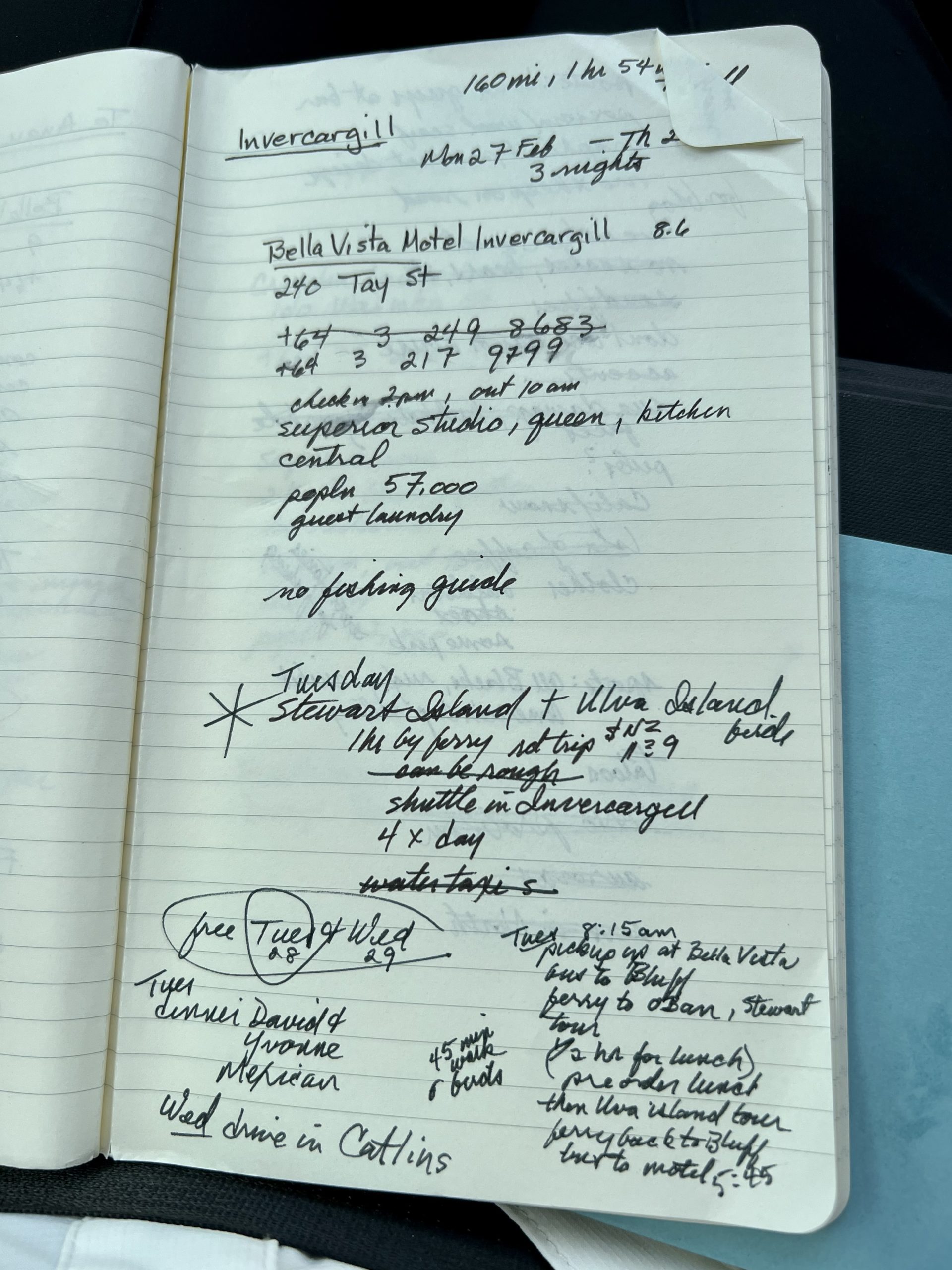
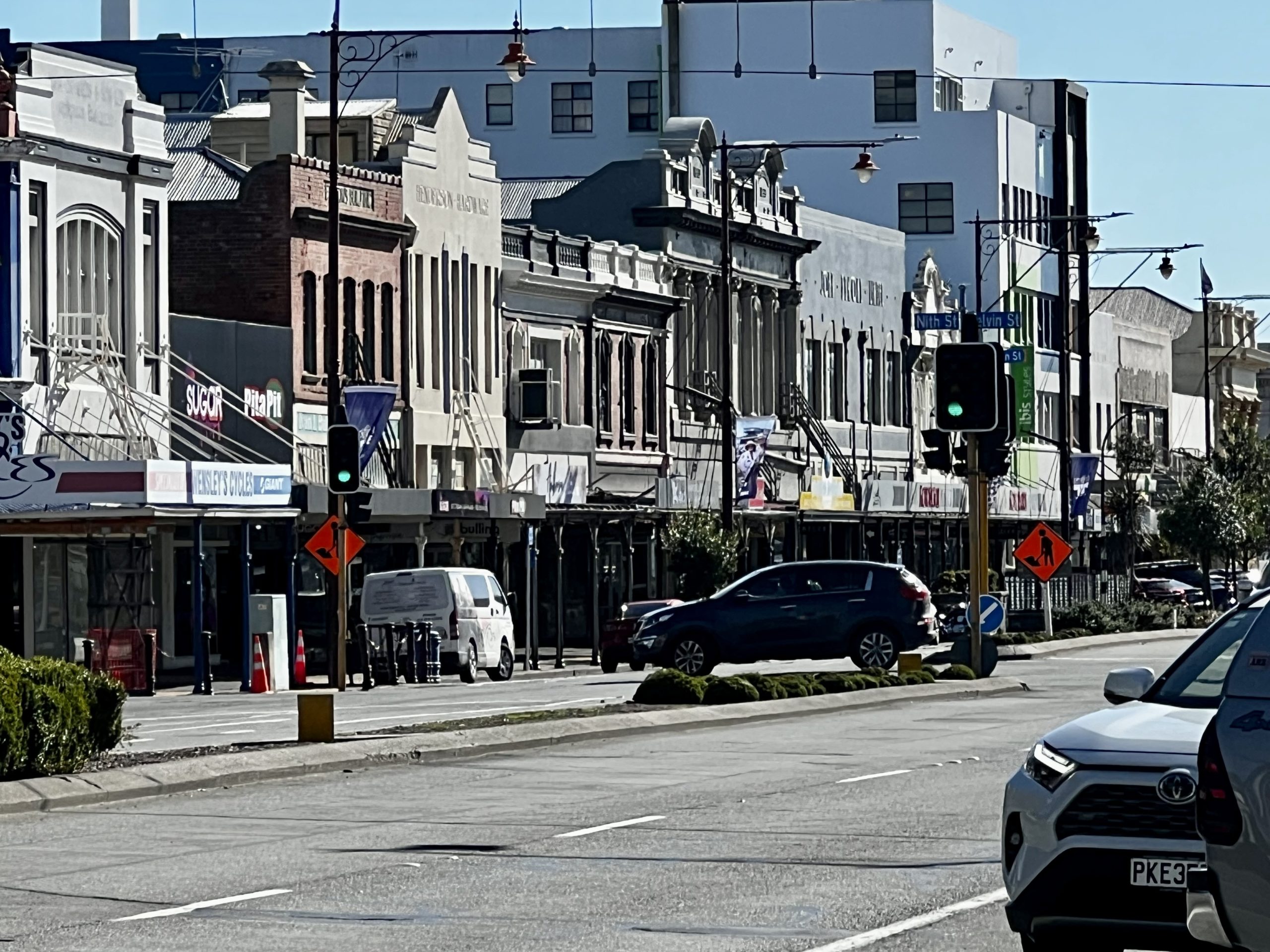
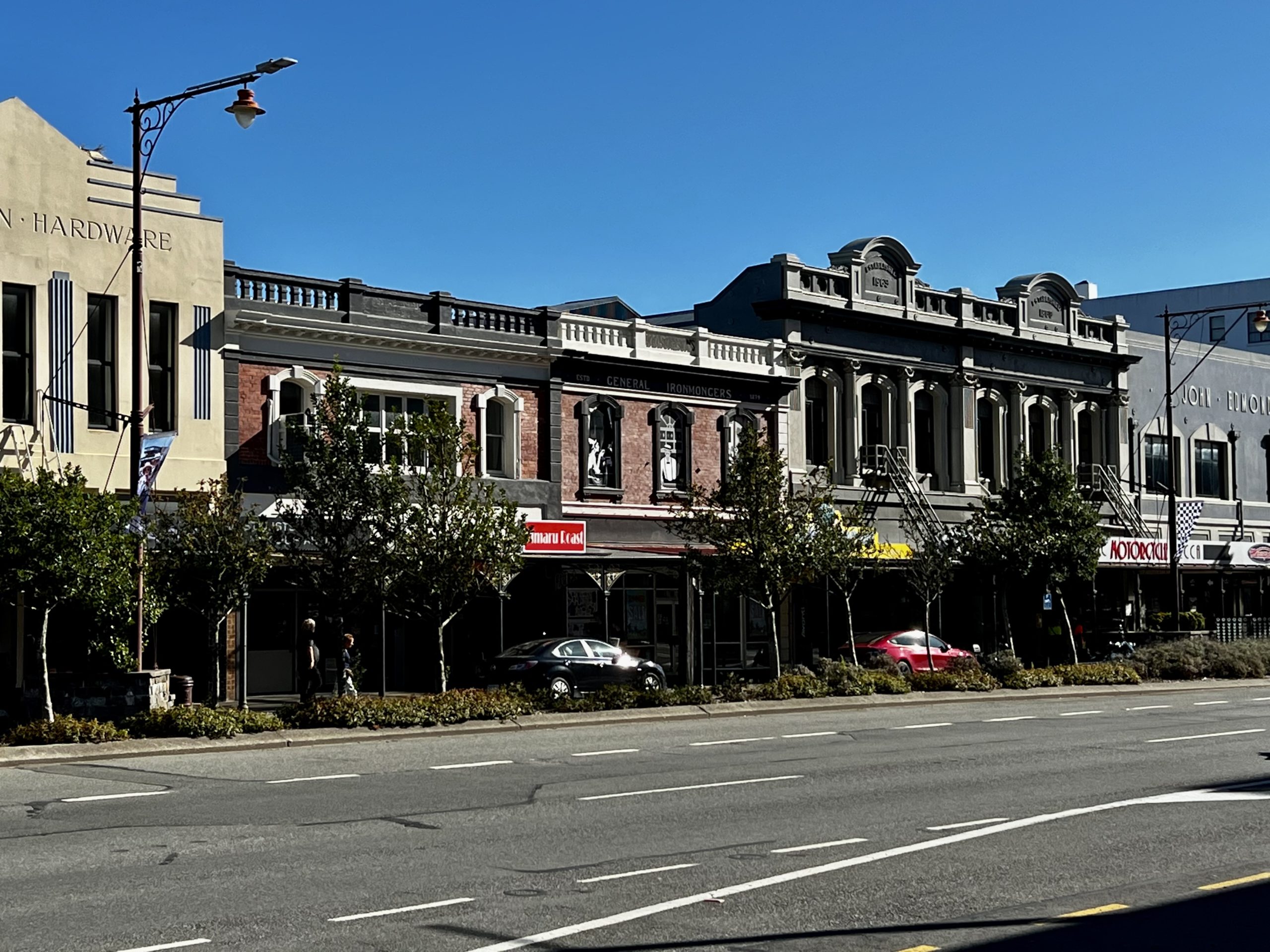
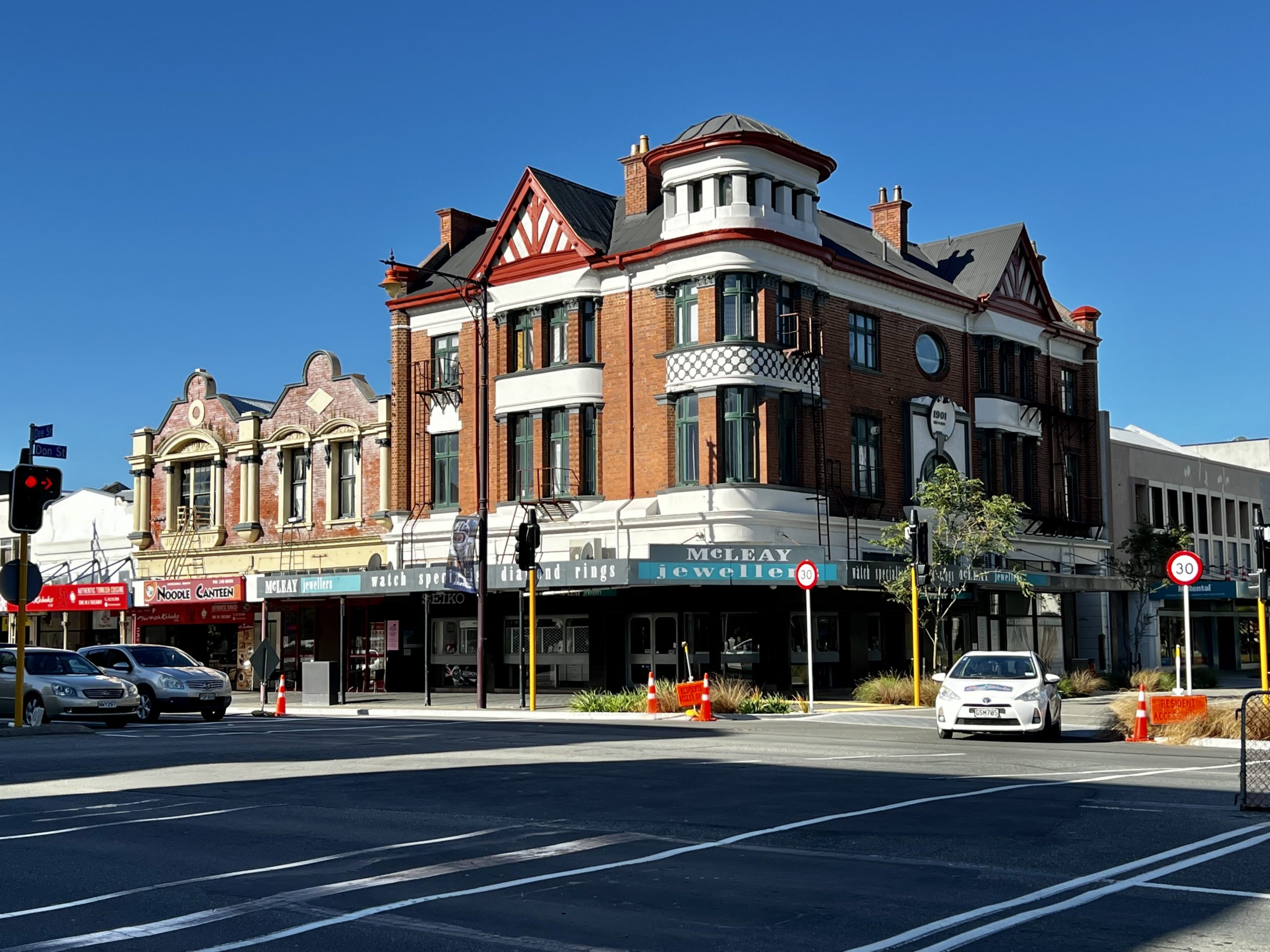
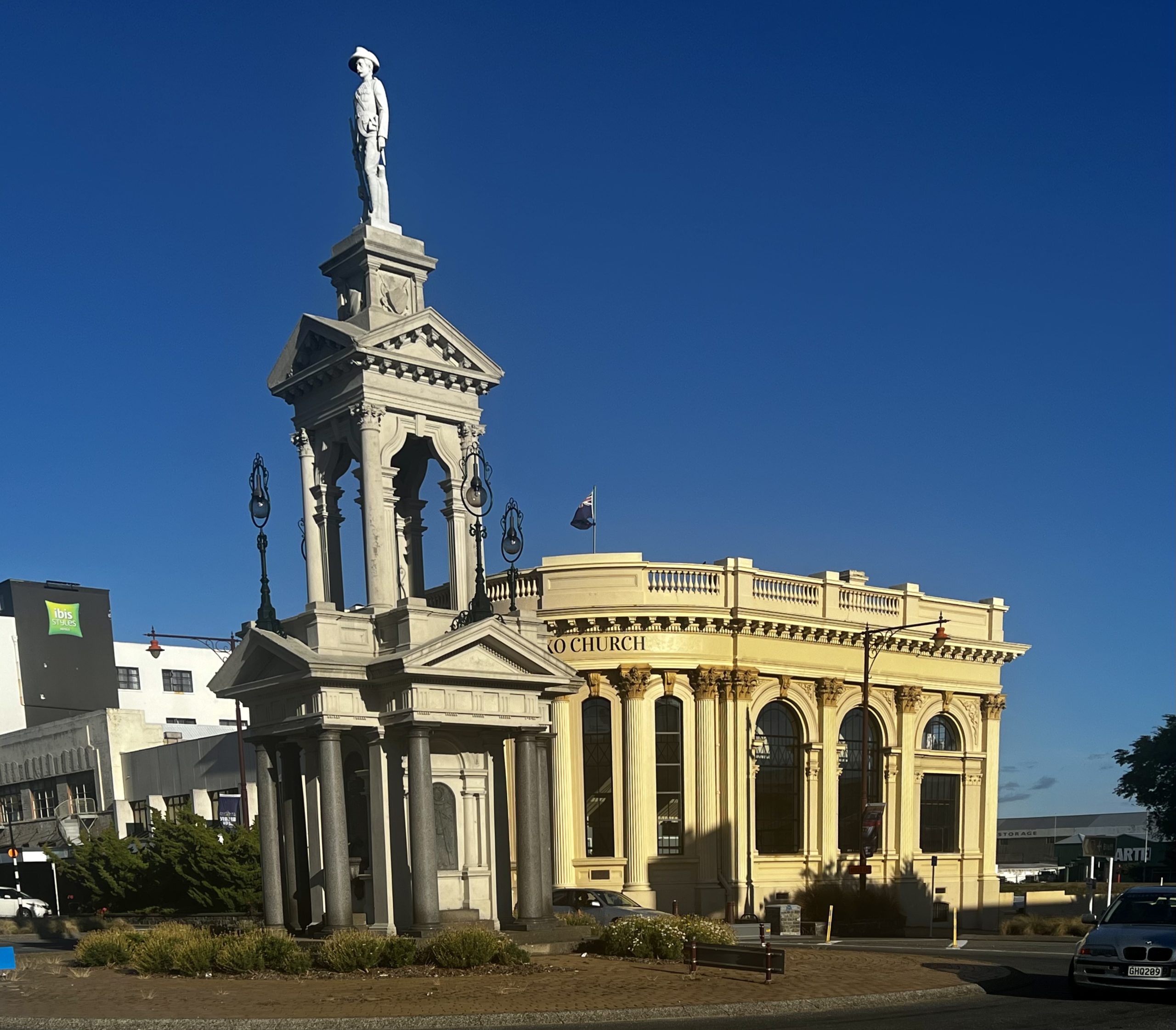
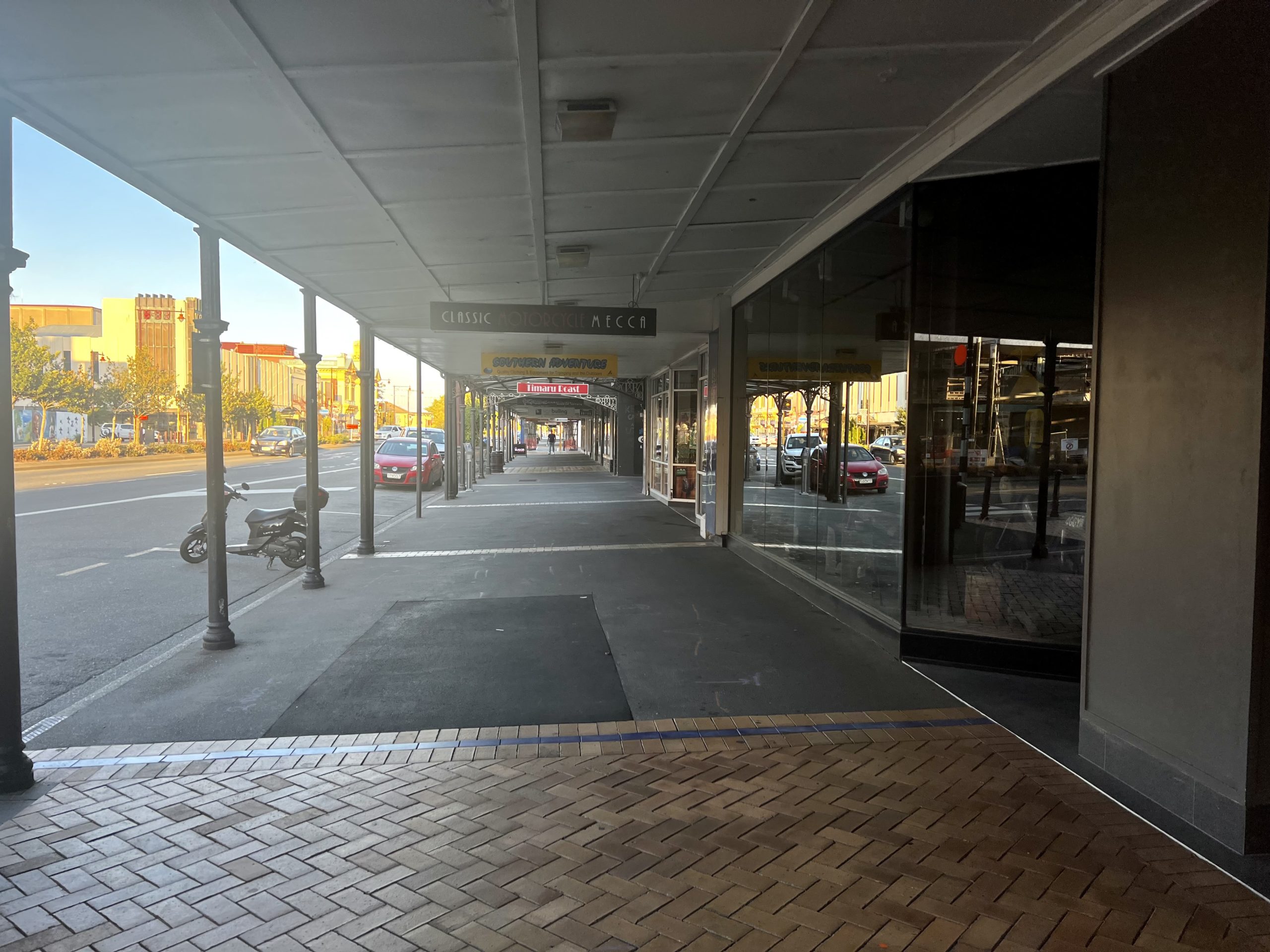
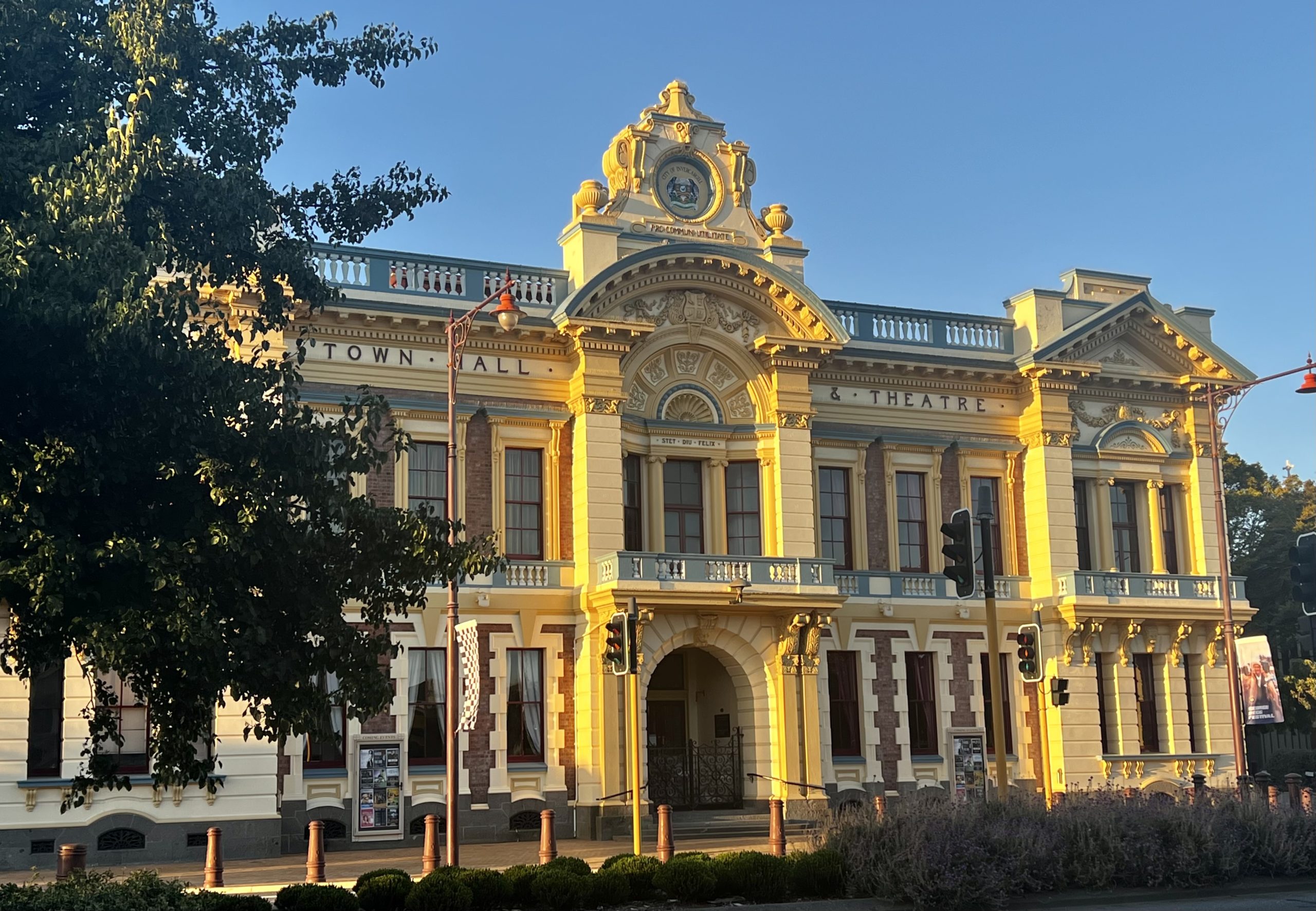
We were gently discouraged from stopping in Invercargill because it is not a scenic tourist destination. It feels a bit like Anchorage. But Bonnie was curious to go all the way to the bottom of the South Island, and Invercargill has excursions by boat to Stewart Island. Invercargill, population of 57,000, has a downtown mix of very old buildings from the 1860s to the 1920s. Most are occupied with a variety of uses. There are a lot of arcades to shelter pedestrians from frequent rains. A new downtown mall is near completion with stores that front on the street with parking on top. It is next to a new high-end hotel. As in Queenstown, the city is finishing up on pedestrian streets near the new development in an effort to rejuvenate the surrounding retail. The design ethic is clean with a bit of whimsy. Nicely done.
We were surprised to learn that this far south area was the first in New Zealand settled by Europeans. Whalers from England and Norway came early, and some built houses and had families.
Interesting use of old bricksOn Sunday evening it is very quiet.Lots of arcades to shelter from the rain and the sun
On the Way to Stewart Island/Rakiura
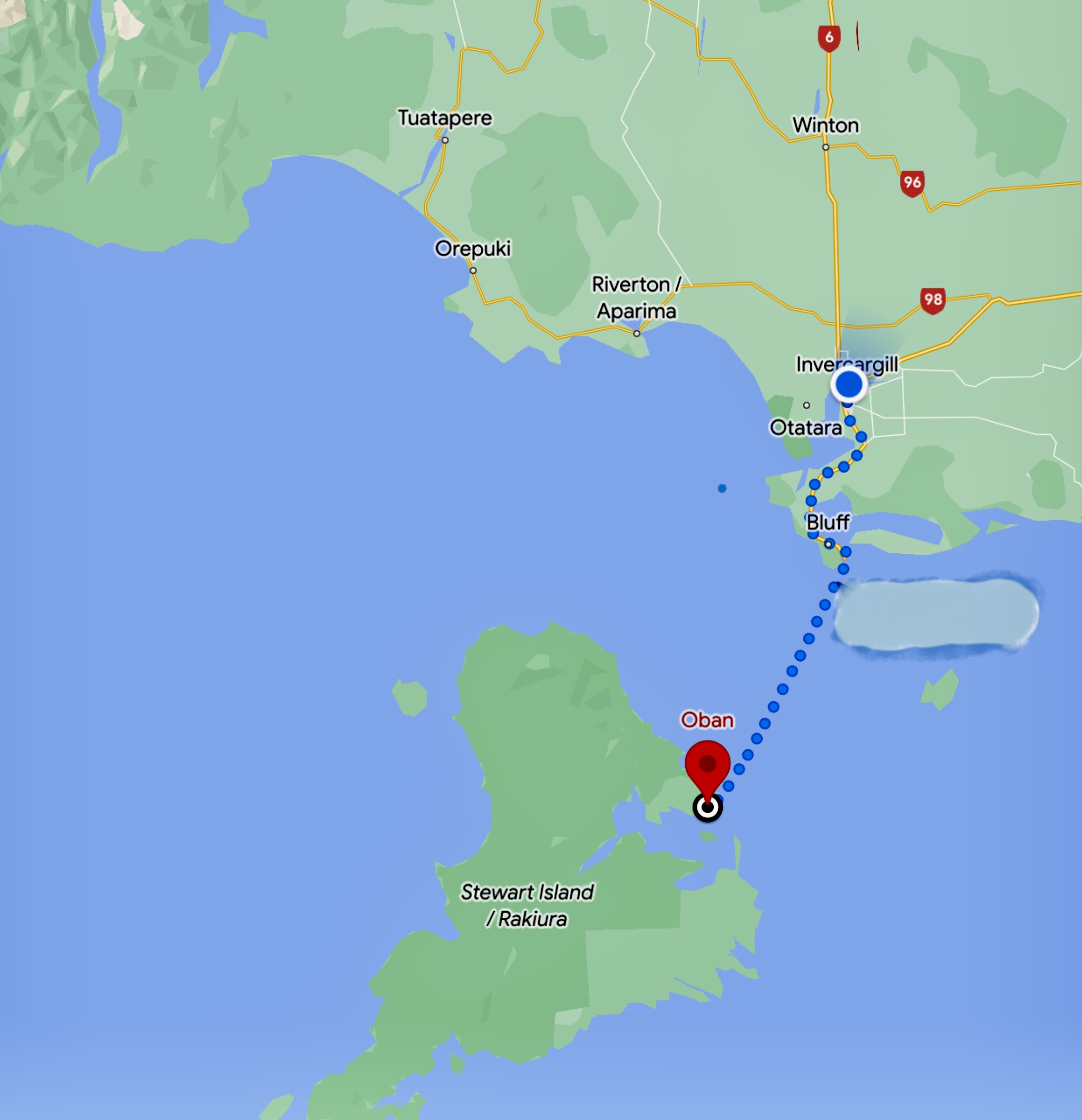
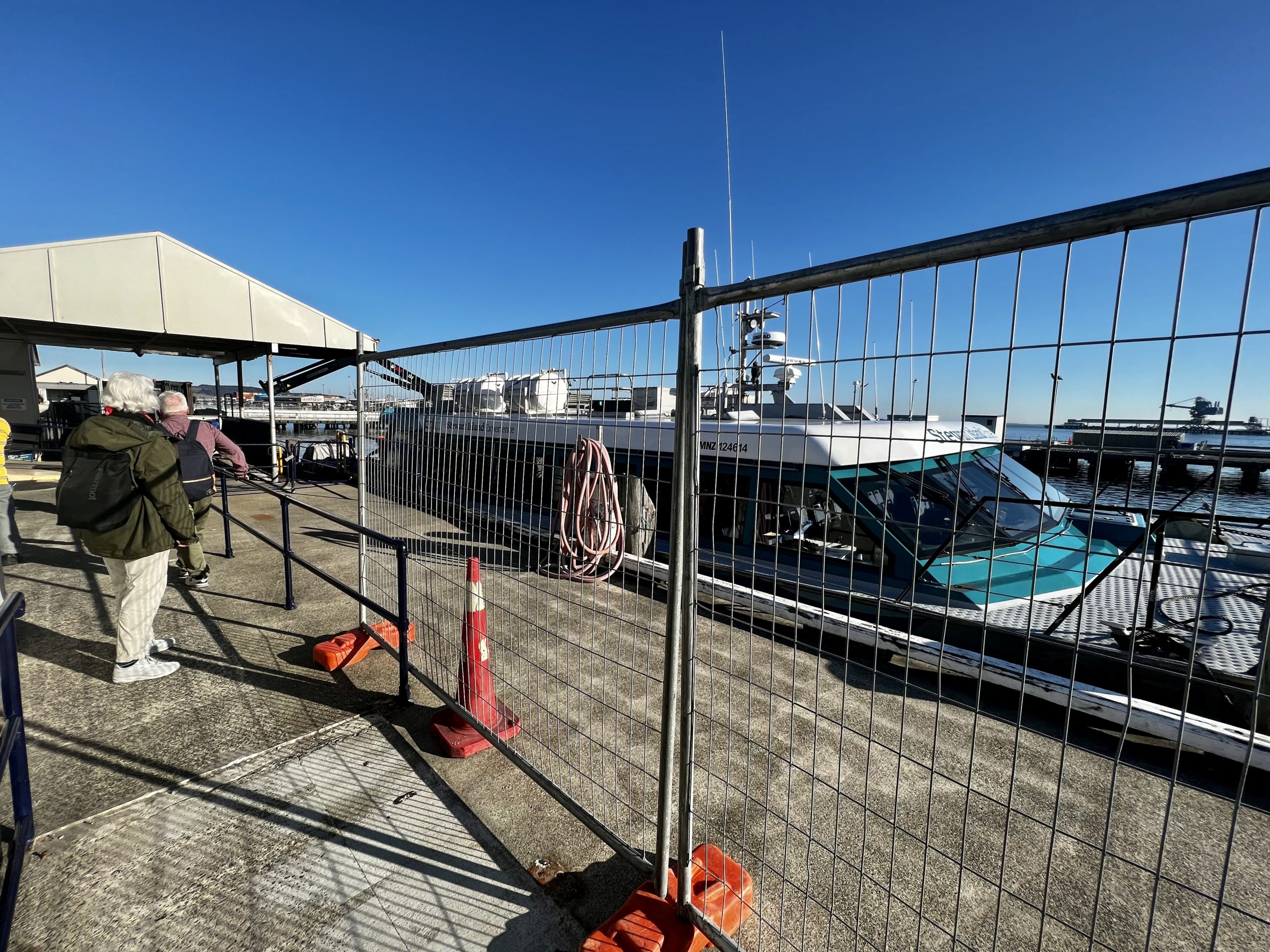
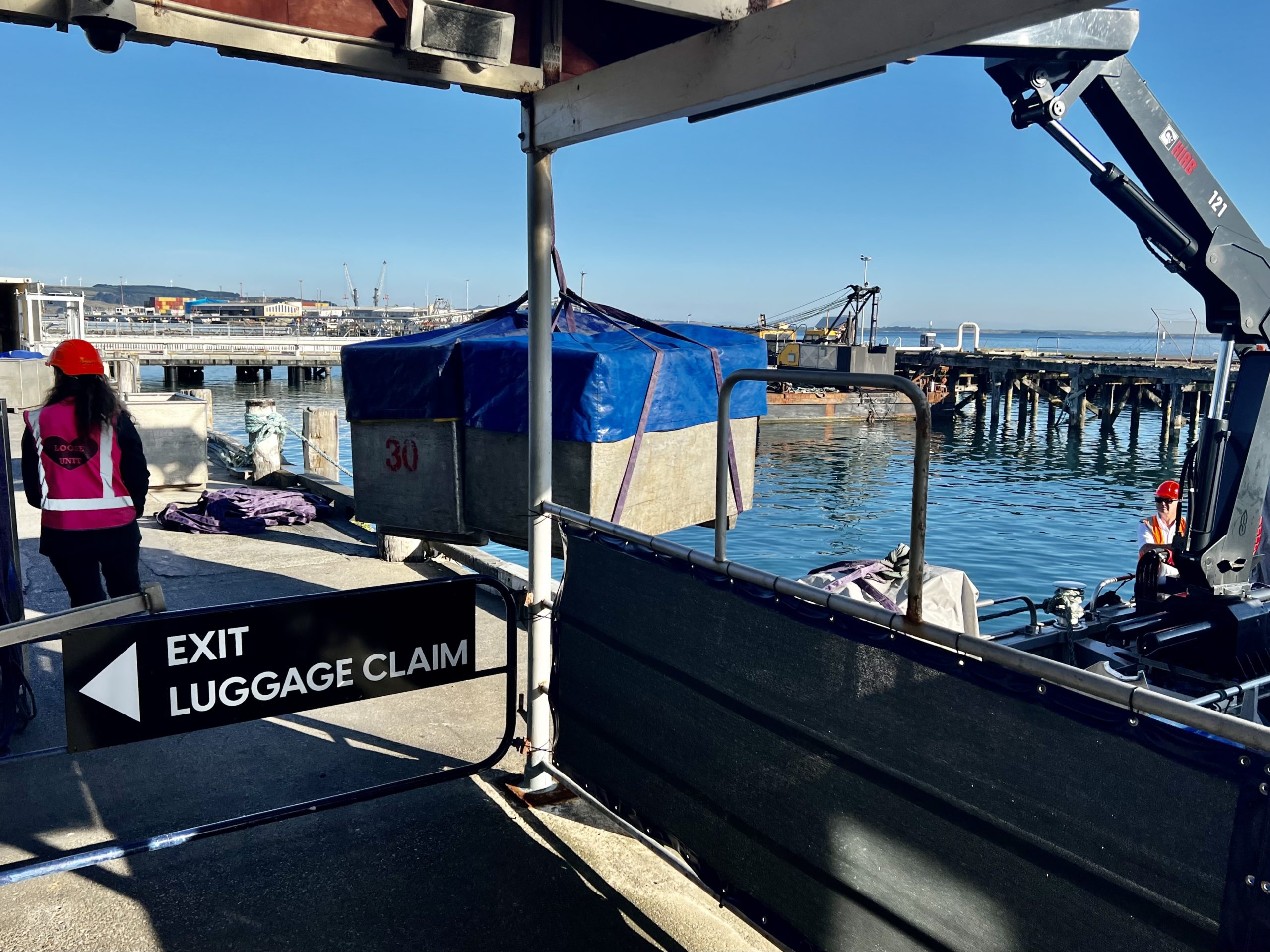
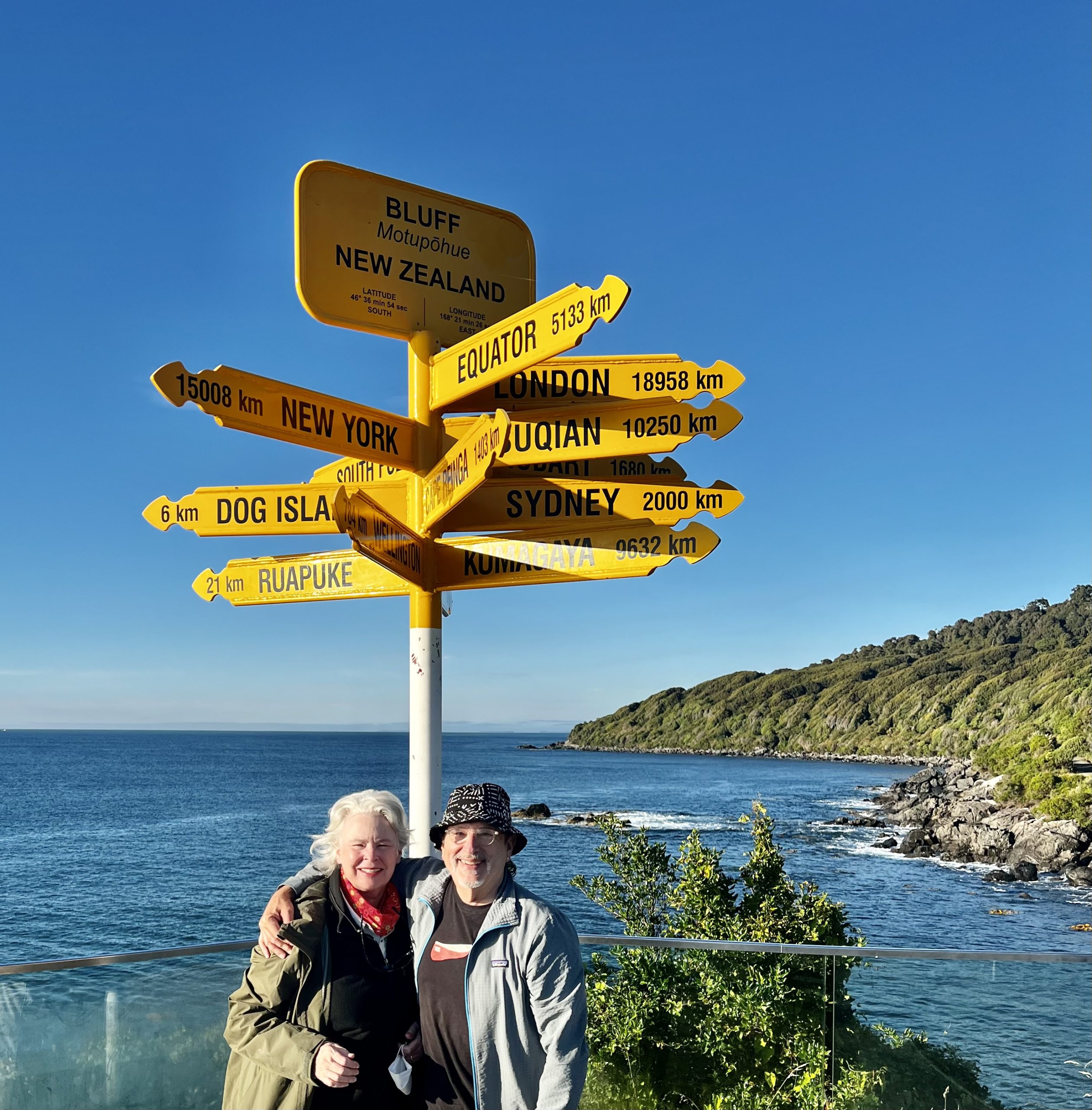
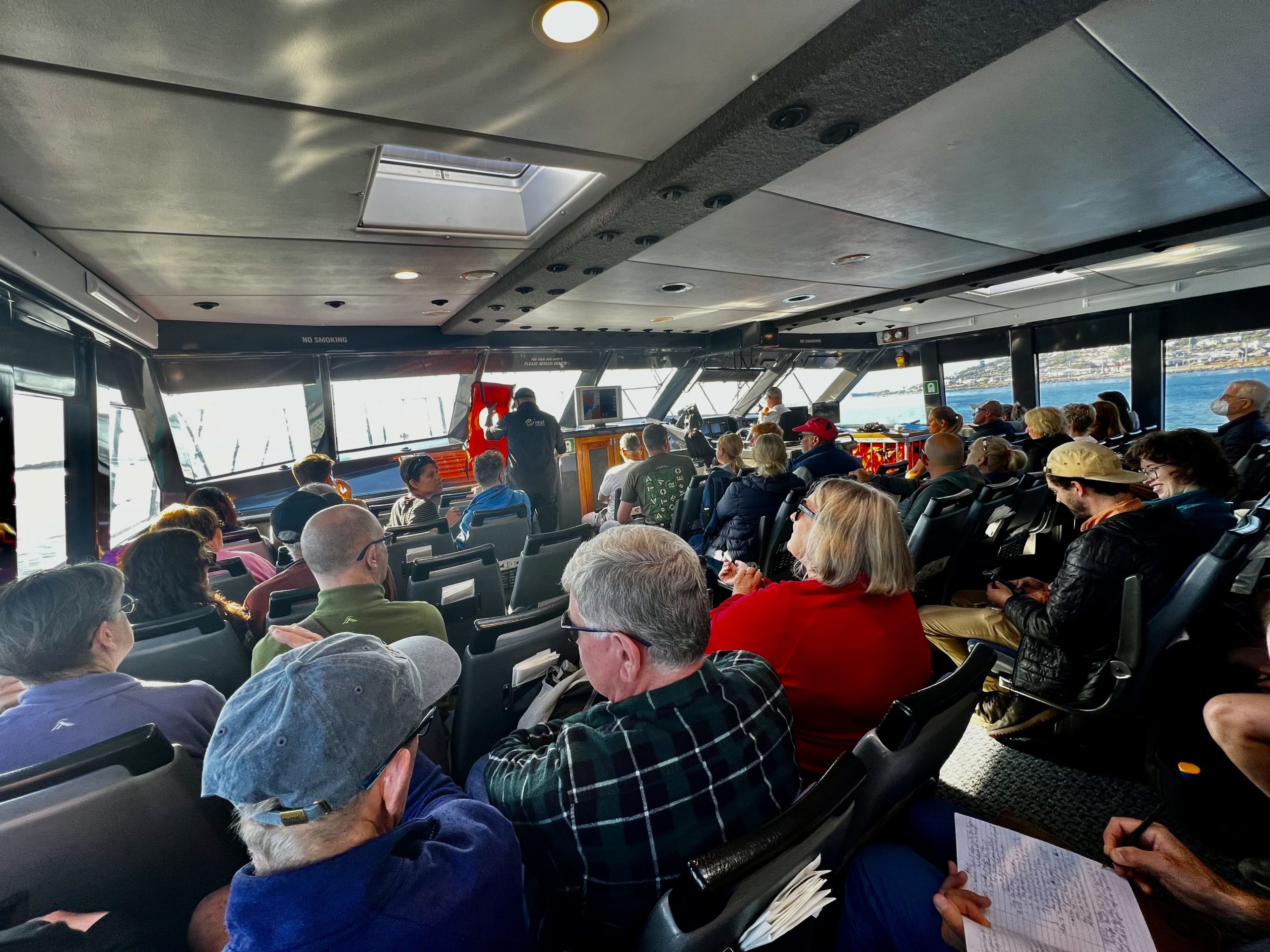
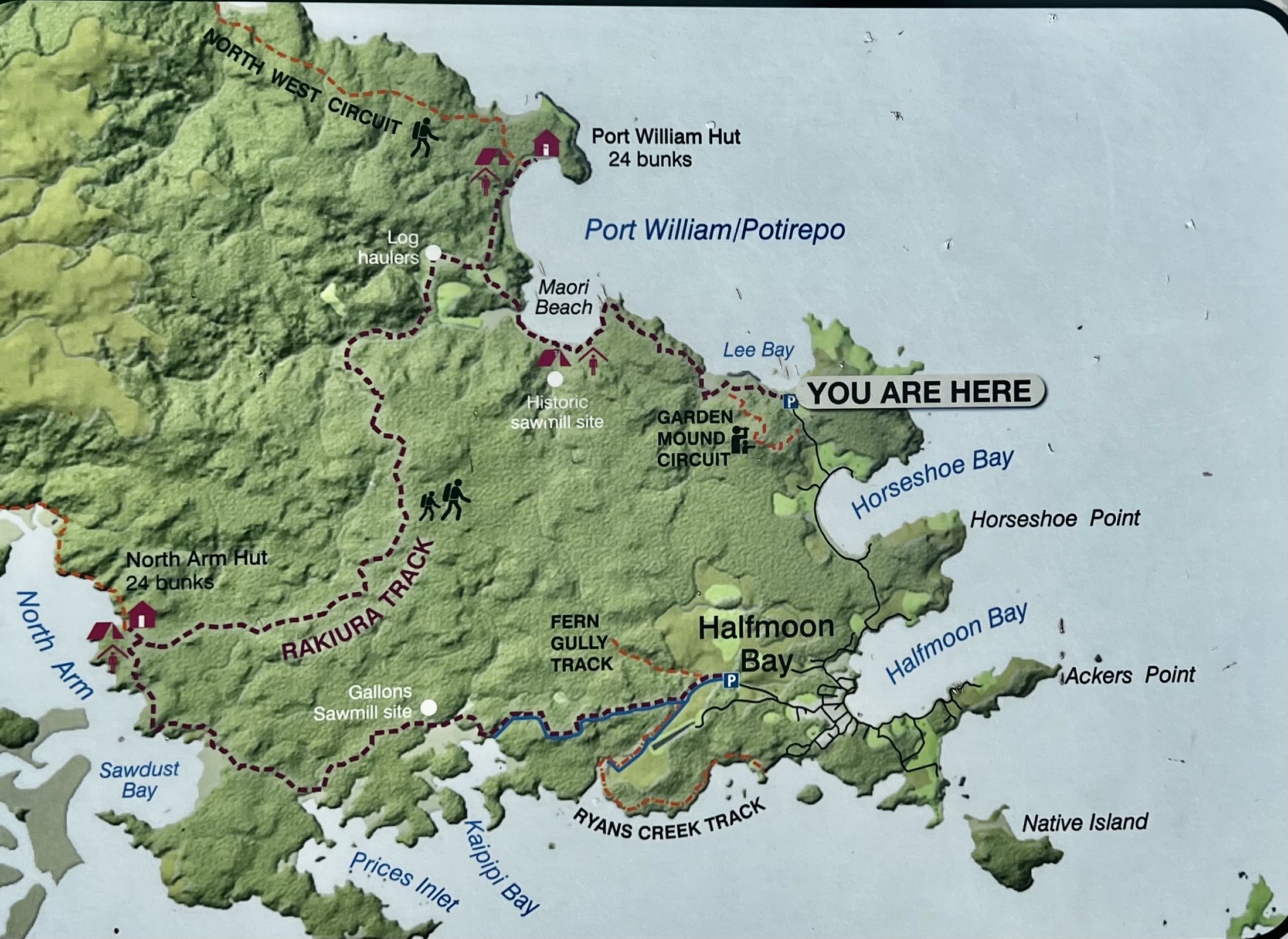
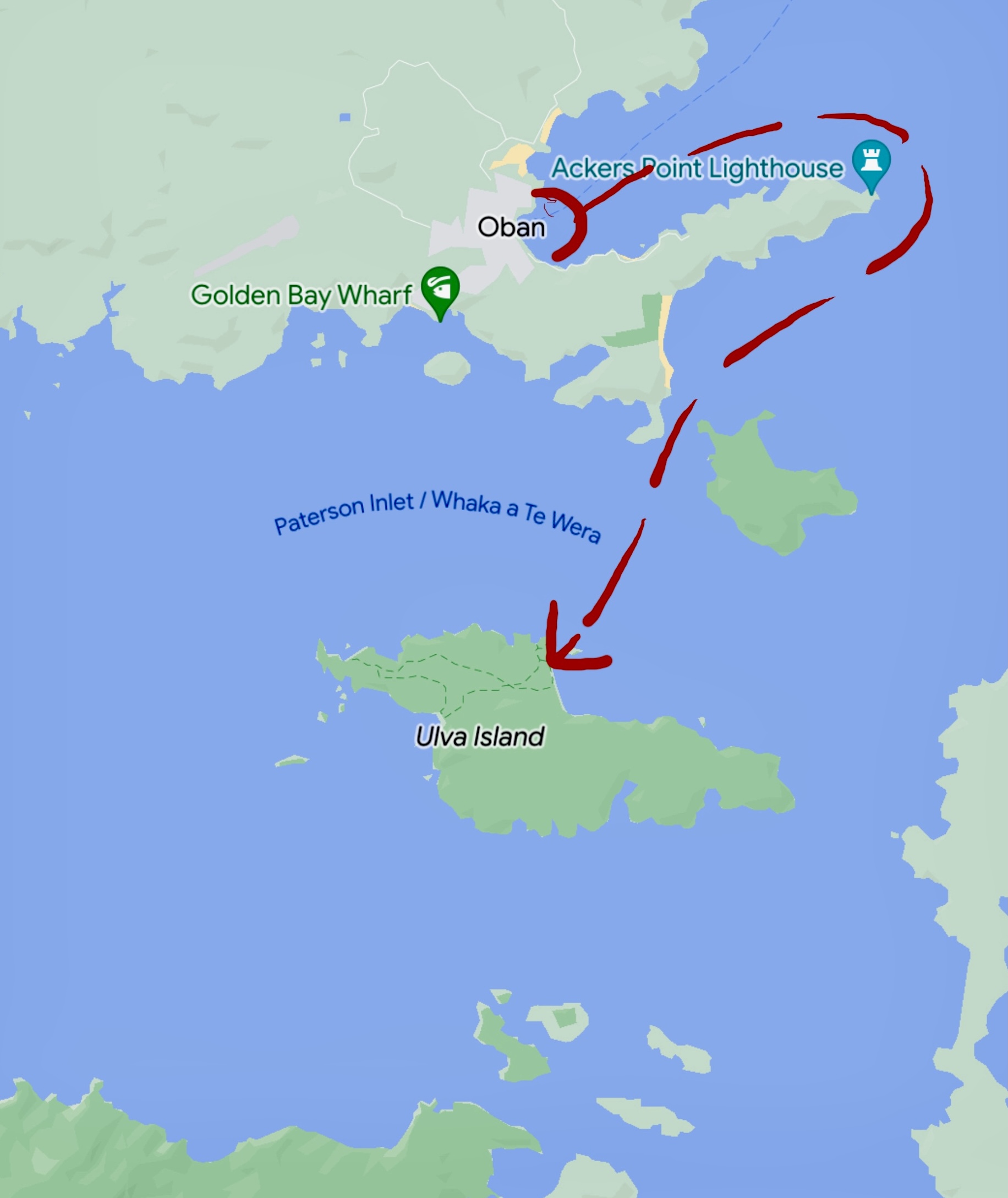
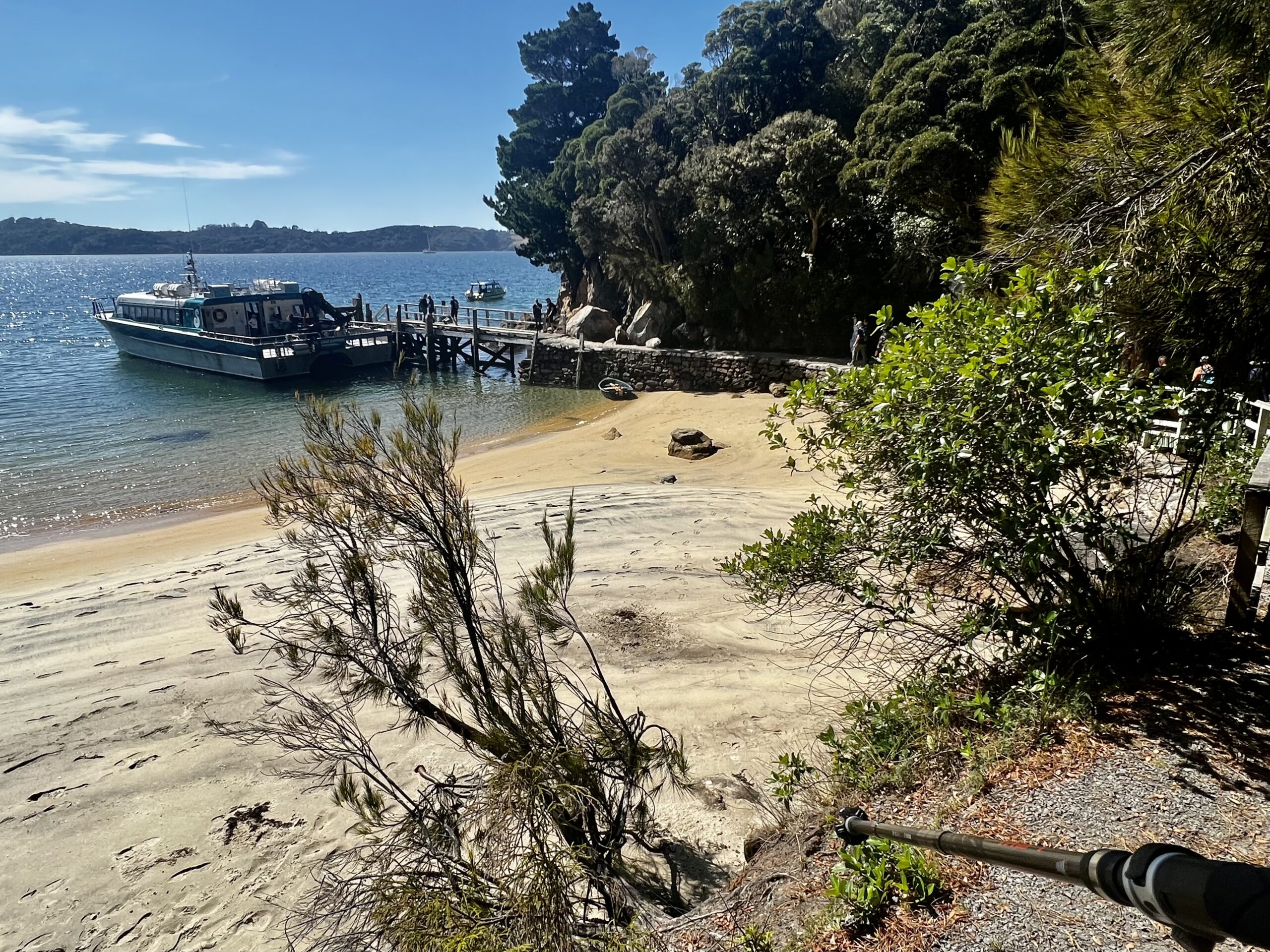
We signed up for an all-day series of tours, once again by RealNZ, without understanding exactly how they connected. We set up the tours by phone and they assured us that we would make all the connections because they run all the transport. Indeed it worked smoothly. This group is organized. A mini bus picked us up at our hotel in Invercargill and drove us to the port town of Bluff where we boarded a catamaran for the one-hour trip to Stewart Island. Bluff is famous for oysters. The season opened the NEXT day. Oh, well. The bus driver got us to Bluff early, so she took us to see a few scenic spots and pointed out the local cafe for coffee, which Robert visited before we boarded the boat to Stewart Island.
Lots of folks come to Stewart Island to backpack or stay the night in one of the few hotels. There are two tramps (hikes) on the island – one three days, and the other nine to eleven days. We met a couple on the boat who left their teenage boys in Auckland to do the three-day hike. The husband was very enthused. The wife seemed calm. Resigned? Robert was surprised that they did not know the length of their hike. The enthusiastic husband estimated it to be twenty-four kilometers. It is actually thirty-six kilometers. Robert encountered them again at the trail head and wished them luck.
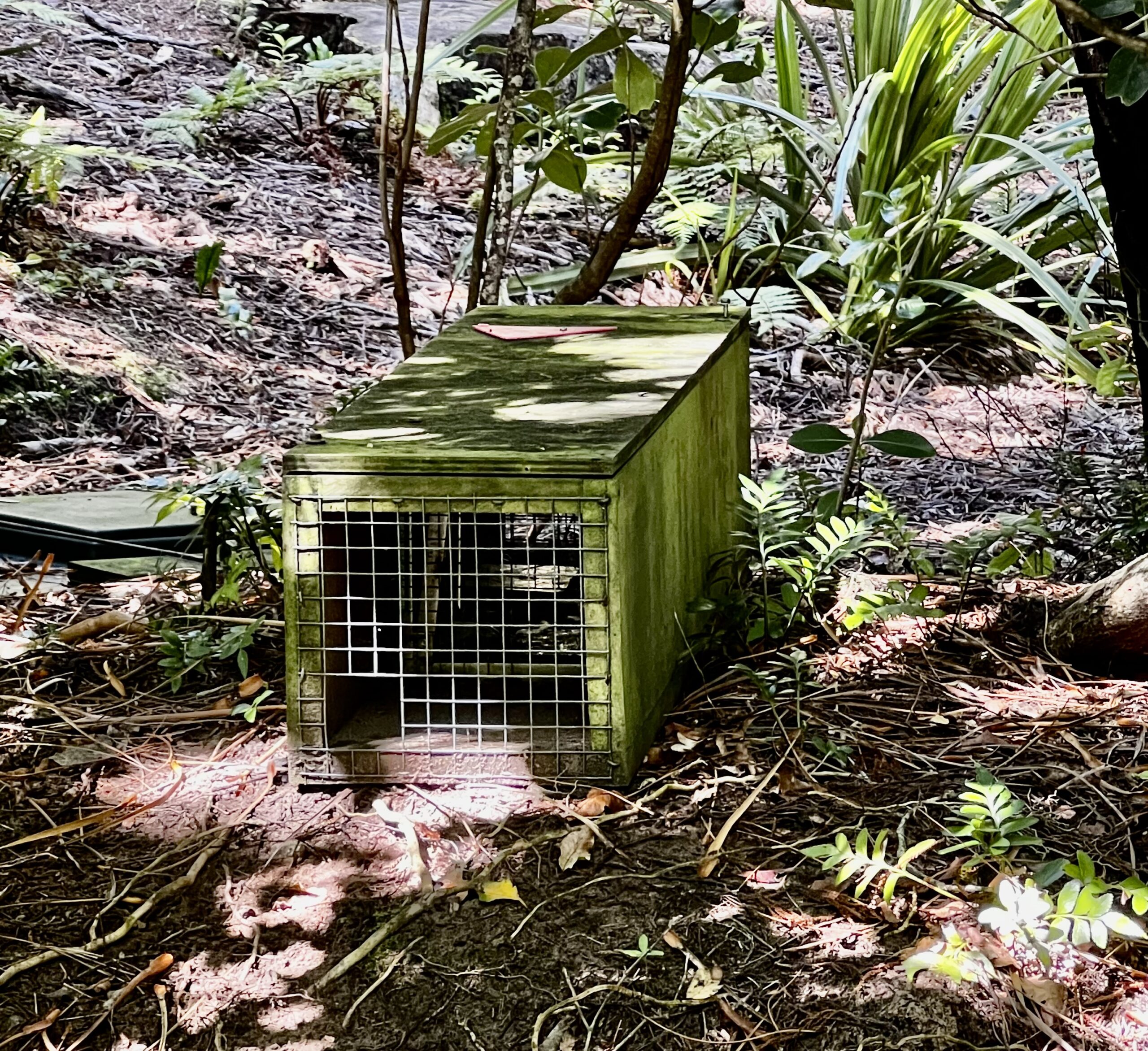
One reason hiking is so popular in New Zealand is that there are no dangerous animals. No snakes. No bears. One of the early European explorers reported back that it was “all birds.” Thus the name of Bonnie’s favorite shoes. Animals introduced from abroad are problems, especially deer, possums, weasels, ferrets, rats, and rabbits. There are periodic campaigns to eradicate them or at least reduce the numbers, particularly where they threaten birds. The Department of Conservation uses poison dropped from helicopters and traps. A homeowner on Stewart has pest-proof fence, so birds thrive on his large property and insure birds for the rest of the island. The only bothersome animals in the New Zealand wild are the sandflies near water. Much more uncomfortable bites than from mosquitoes.
Oban, Stewart Island
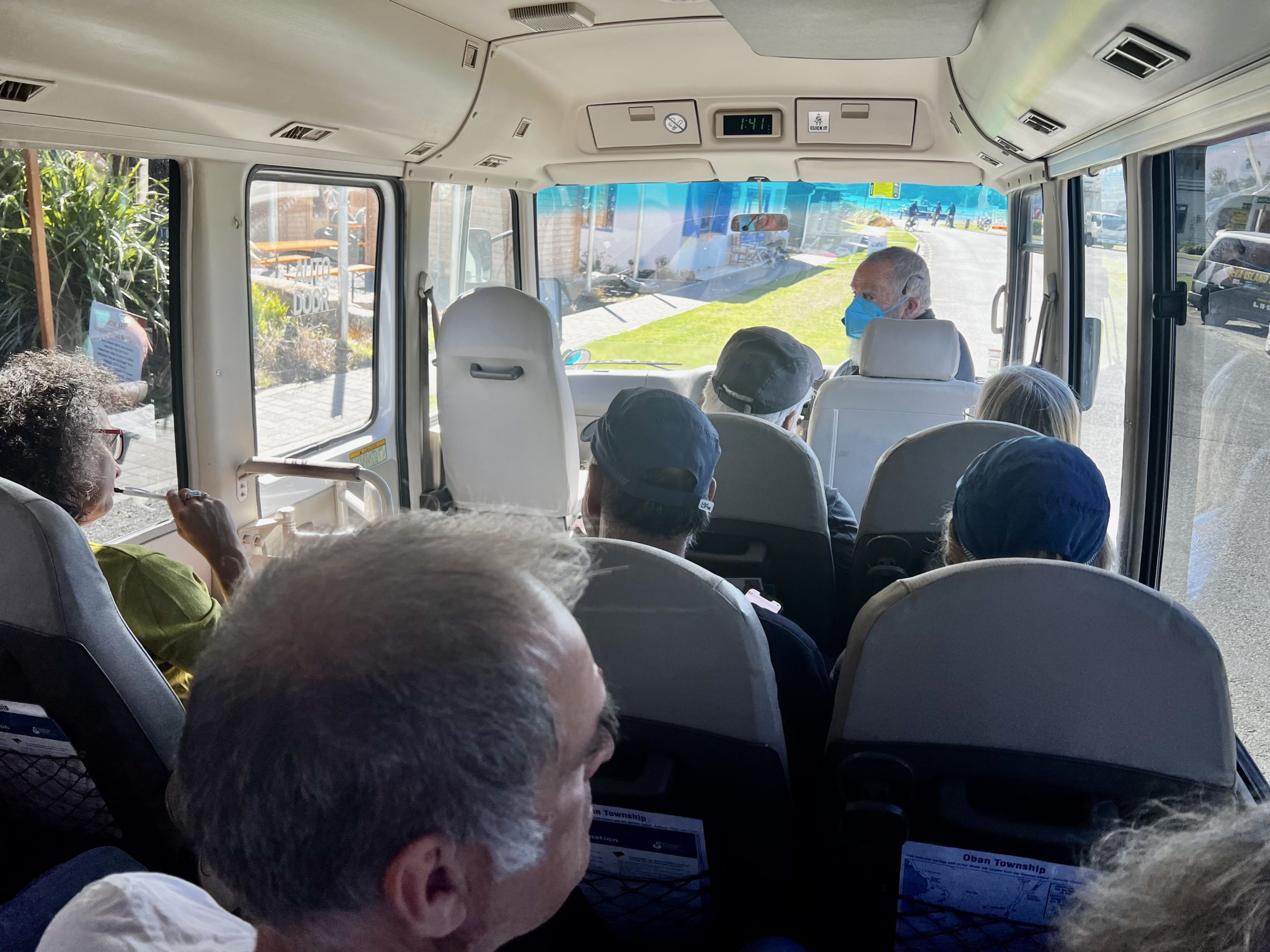
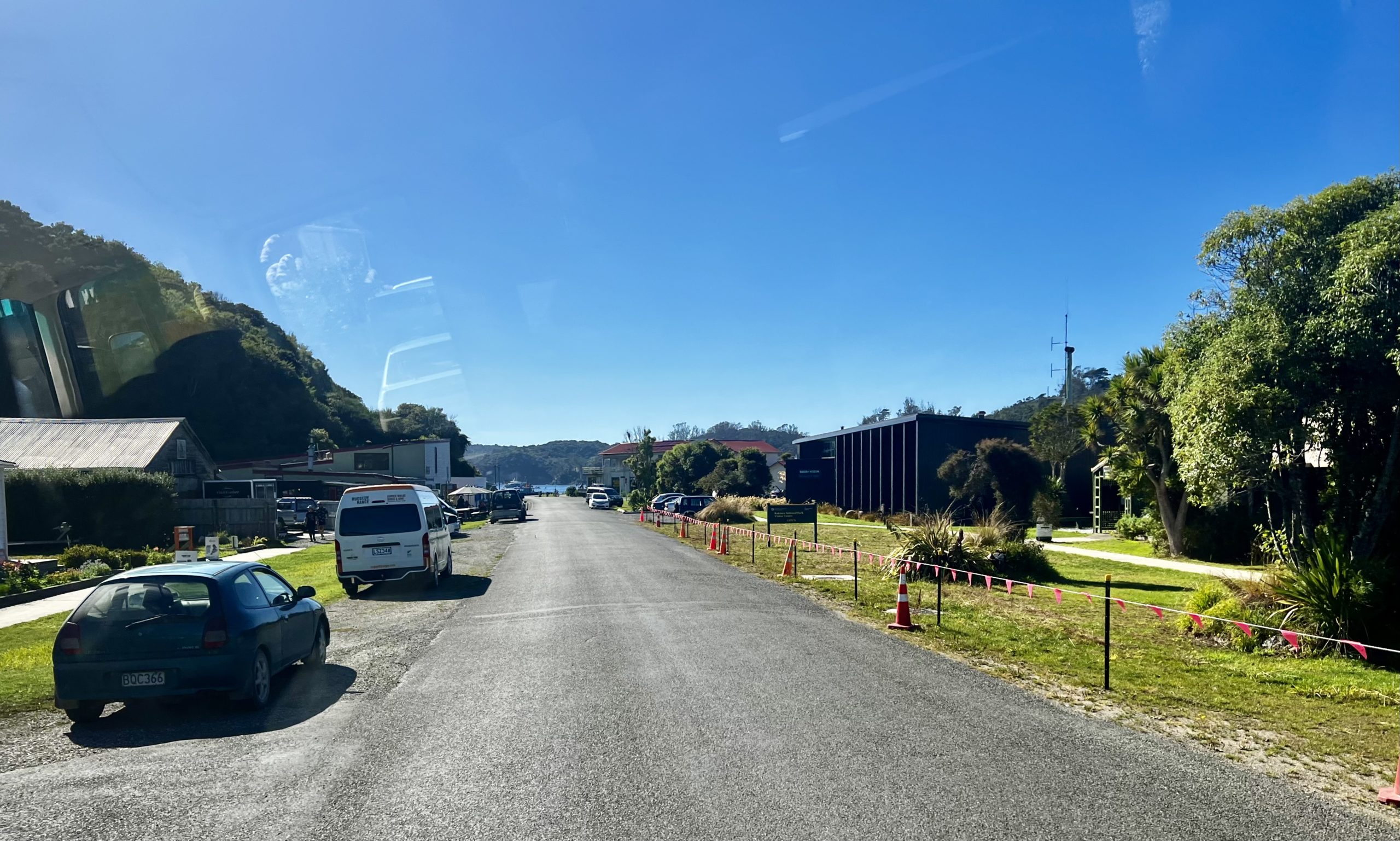
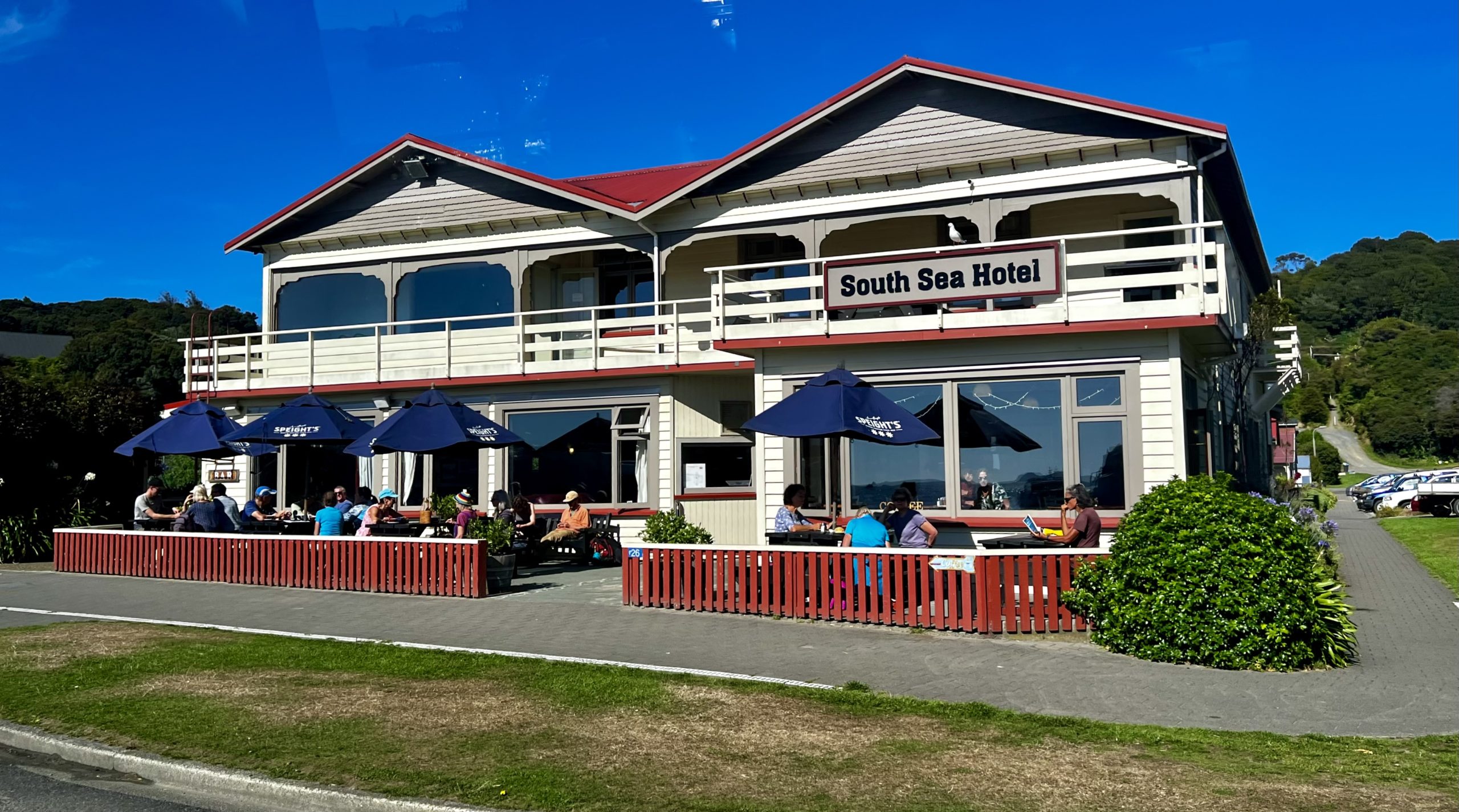
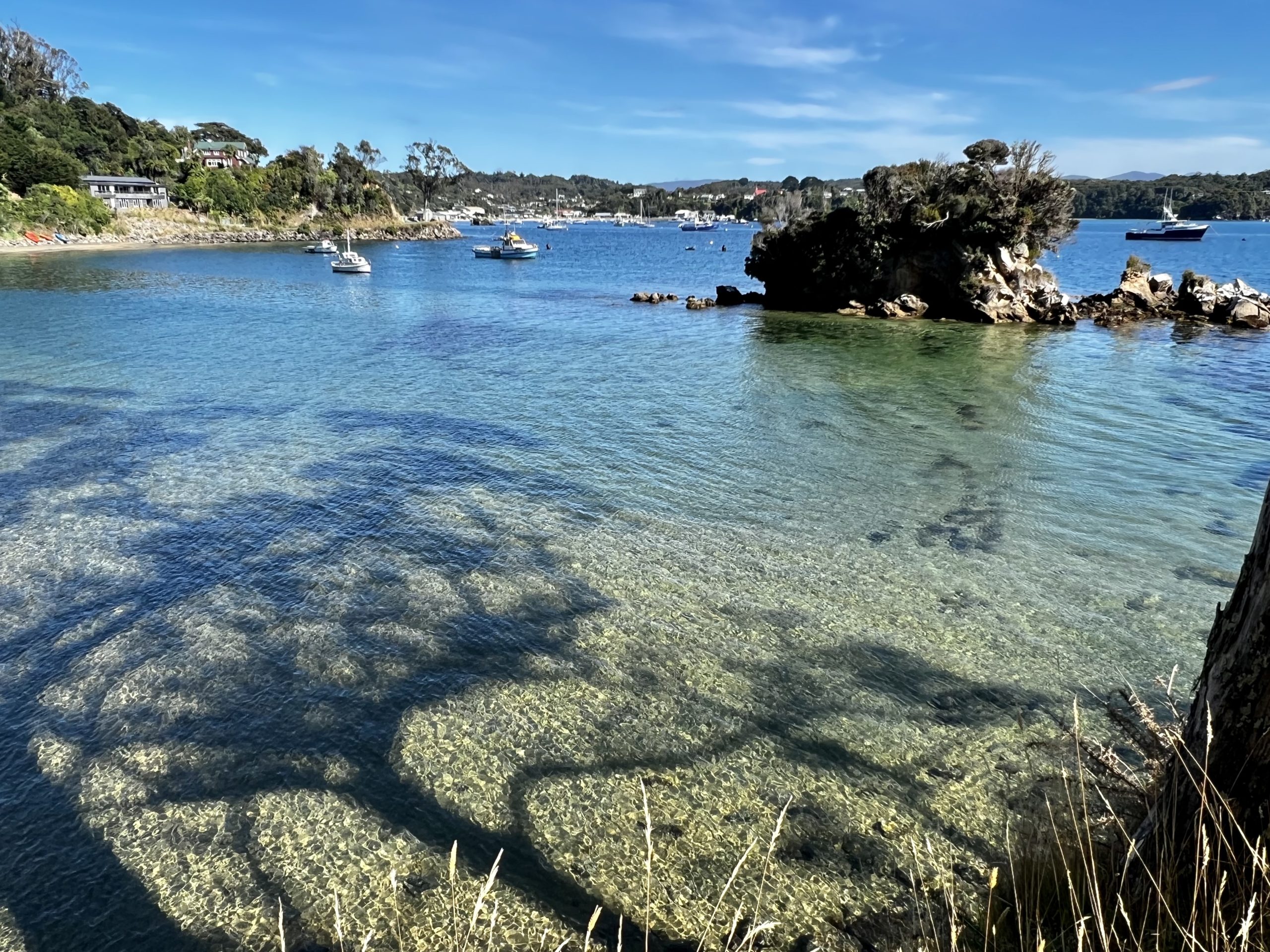
This community is SMALL—400 people total—the only town on a large island nature reserve. The roads on the island amount to 27 kilometers (17 miles) in all. Residents really do not need their cars much. Oban became popular in the past few years, so now holiday homes purchased there are used year round and there is a four-year wait for contractors to build new homes. The community is strongly bonded. They raise funds to hire an extra teacher for their primary school of thirty-eight students, bringing the total number of teachers to three. Felled trees are cut for wood burning stoves and delivered to the elderly. Residences use rainwater that flows off their roofs into tanks. Because they are experiencing a drought, people who run out of water call the fire department to pump water from a nearby stream and hose onto the roof to fill the tanks. This water is fine for showers, but must be boiled for drinking. We learned all this from our van driver, who pointed out that he had to drive slowly and make lots of stops for photos and hikes or he would cover all the roads in fifteen minutes!
Ulva Island
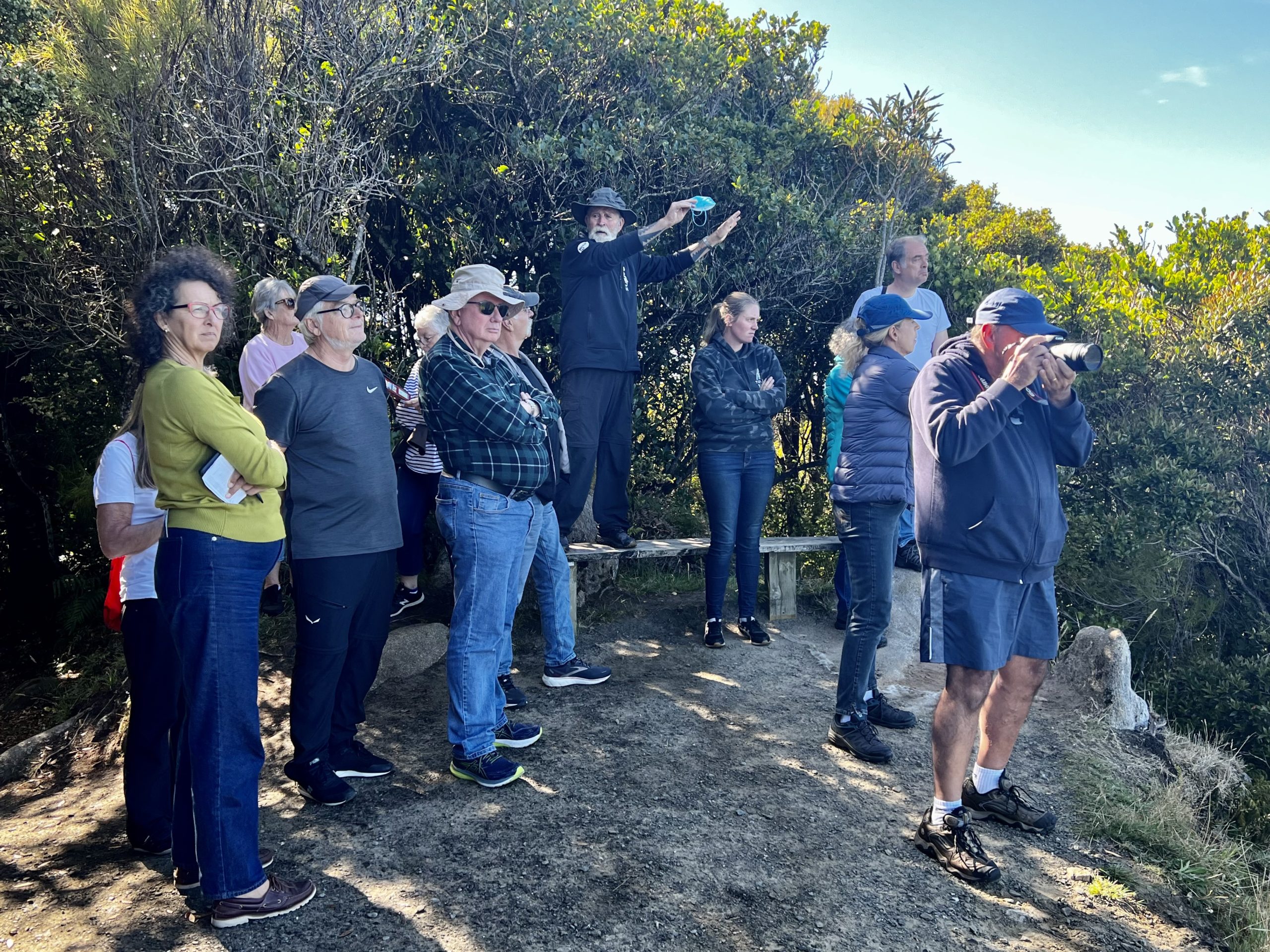
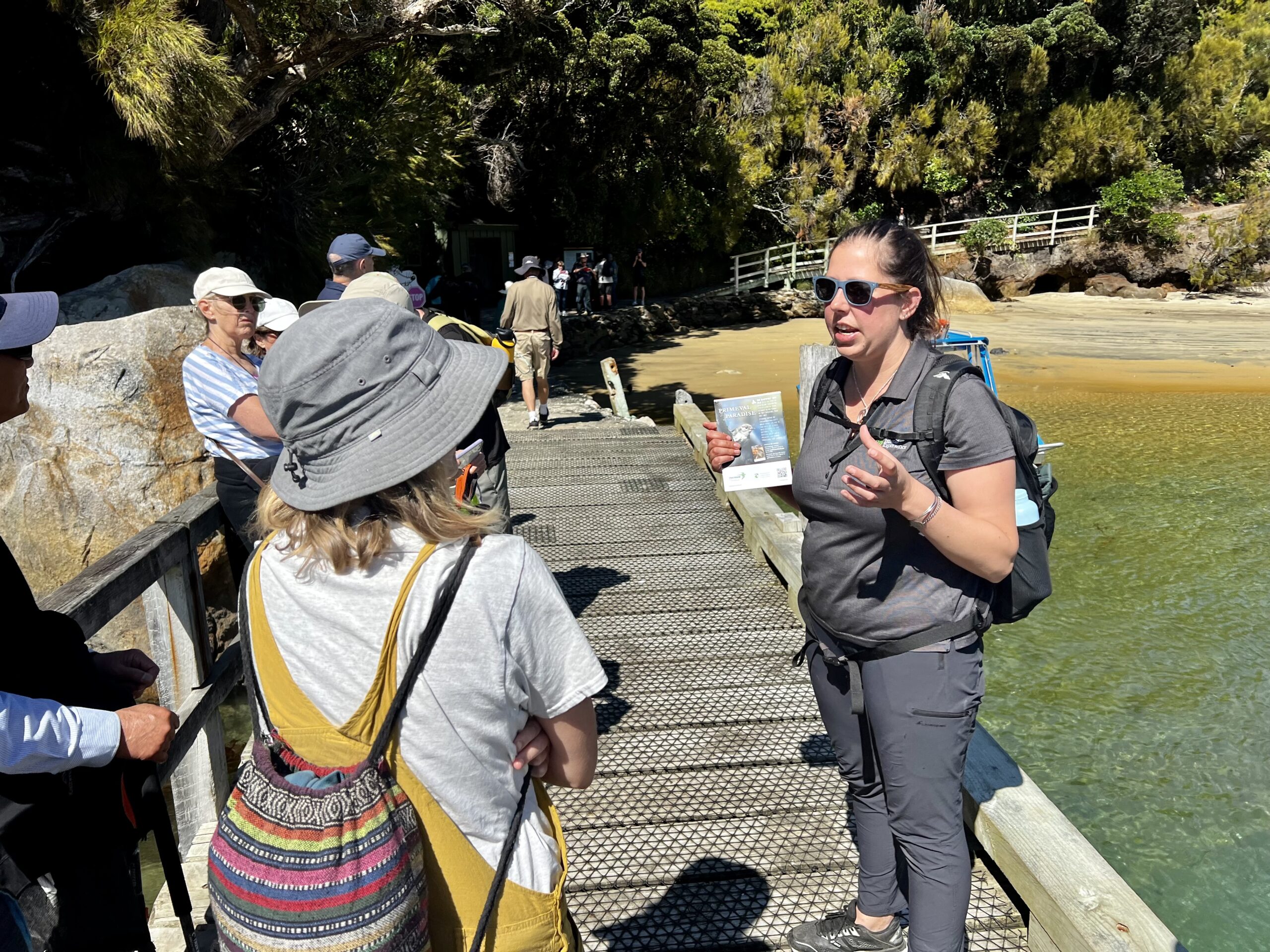
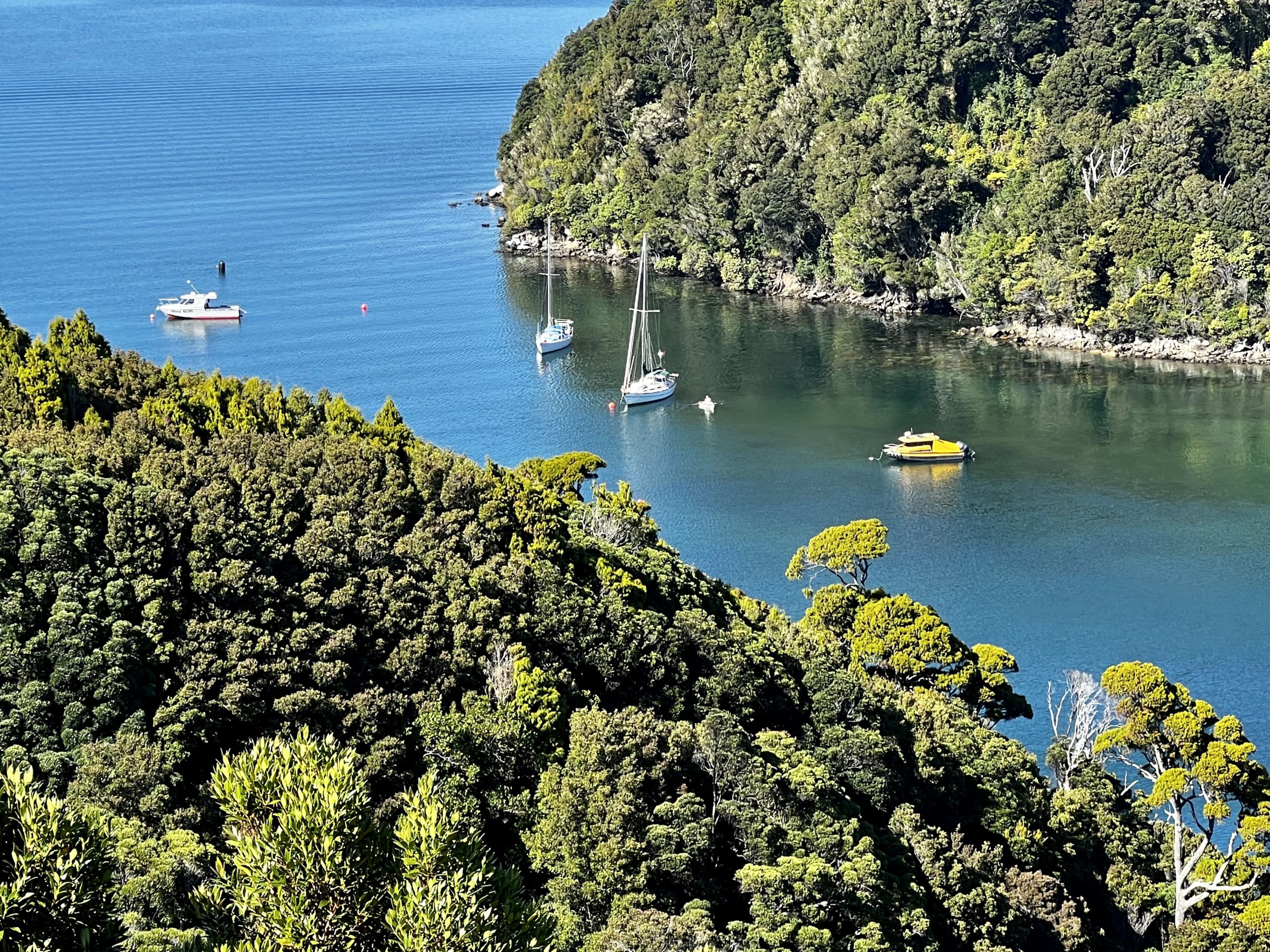
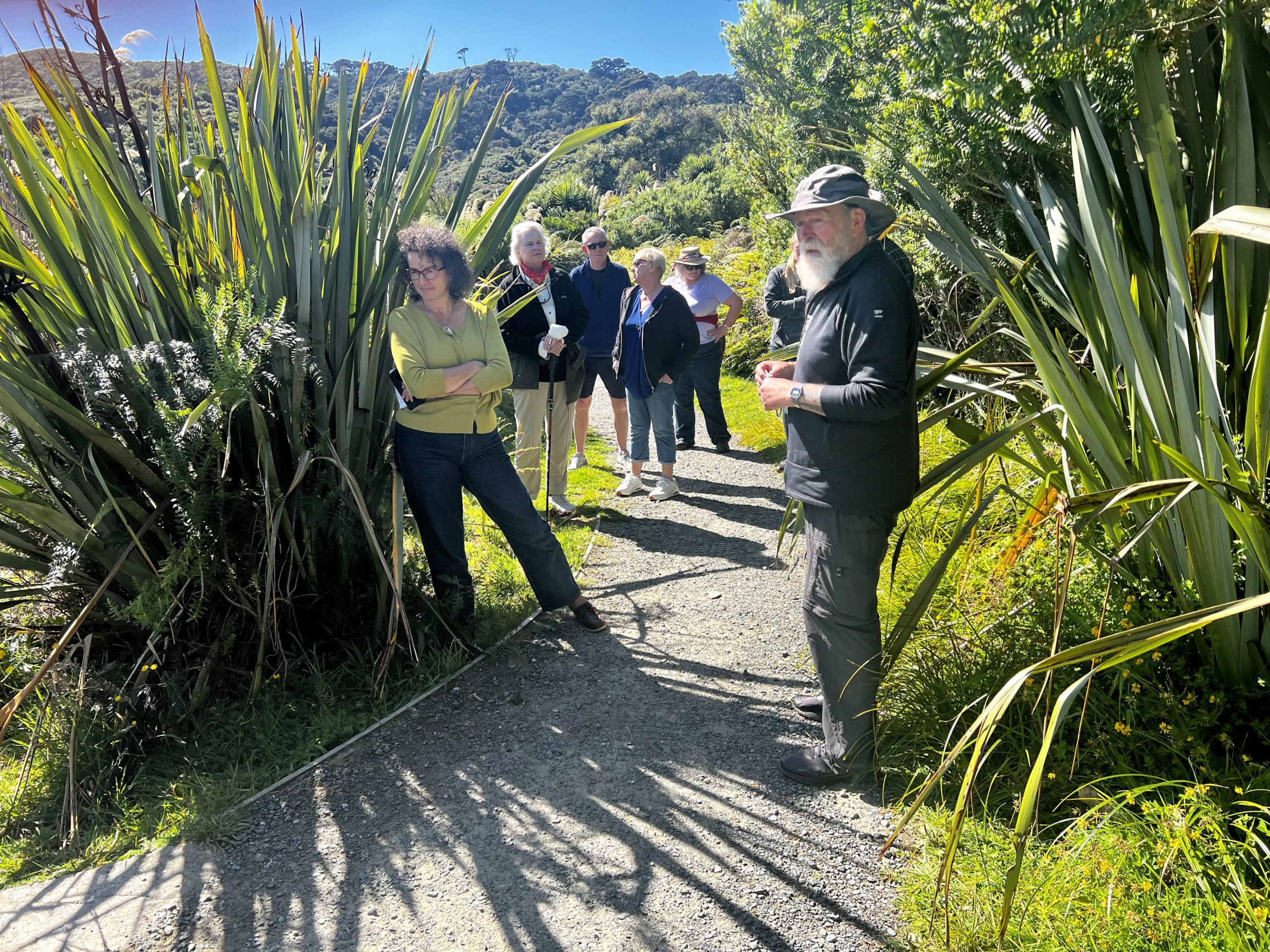
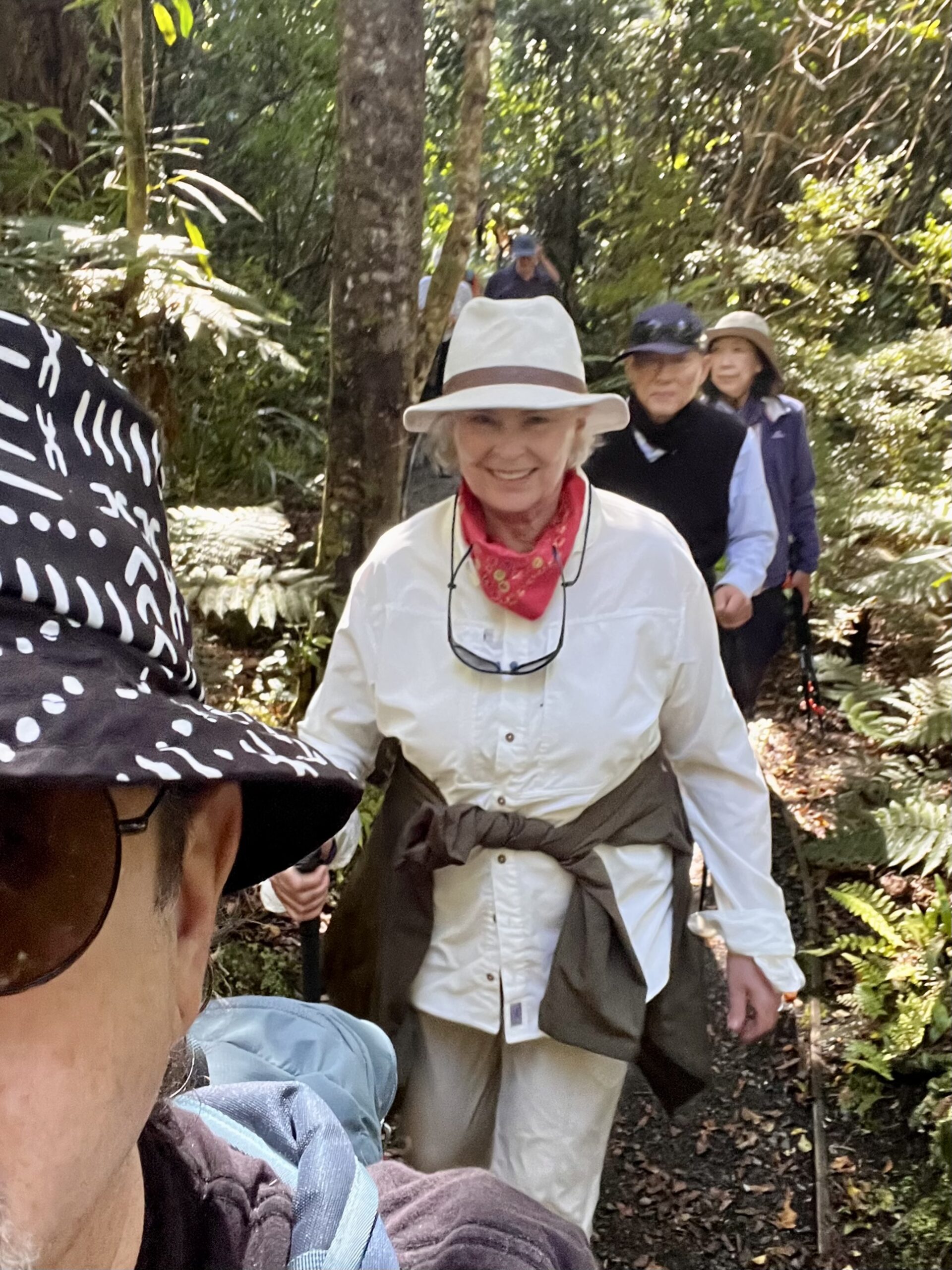
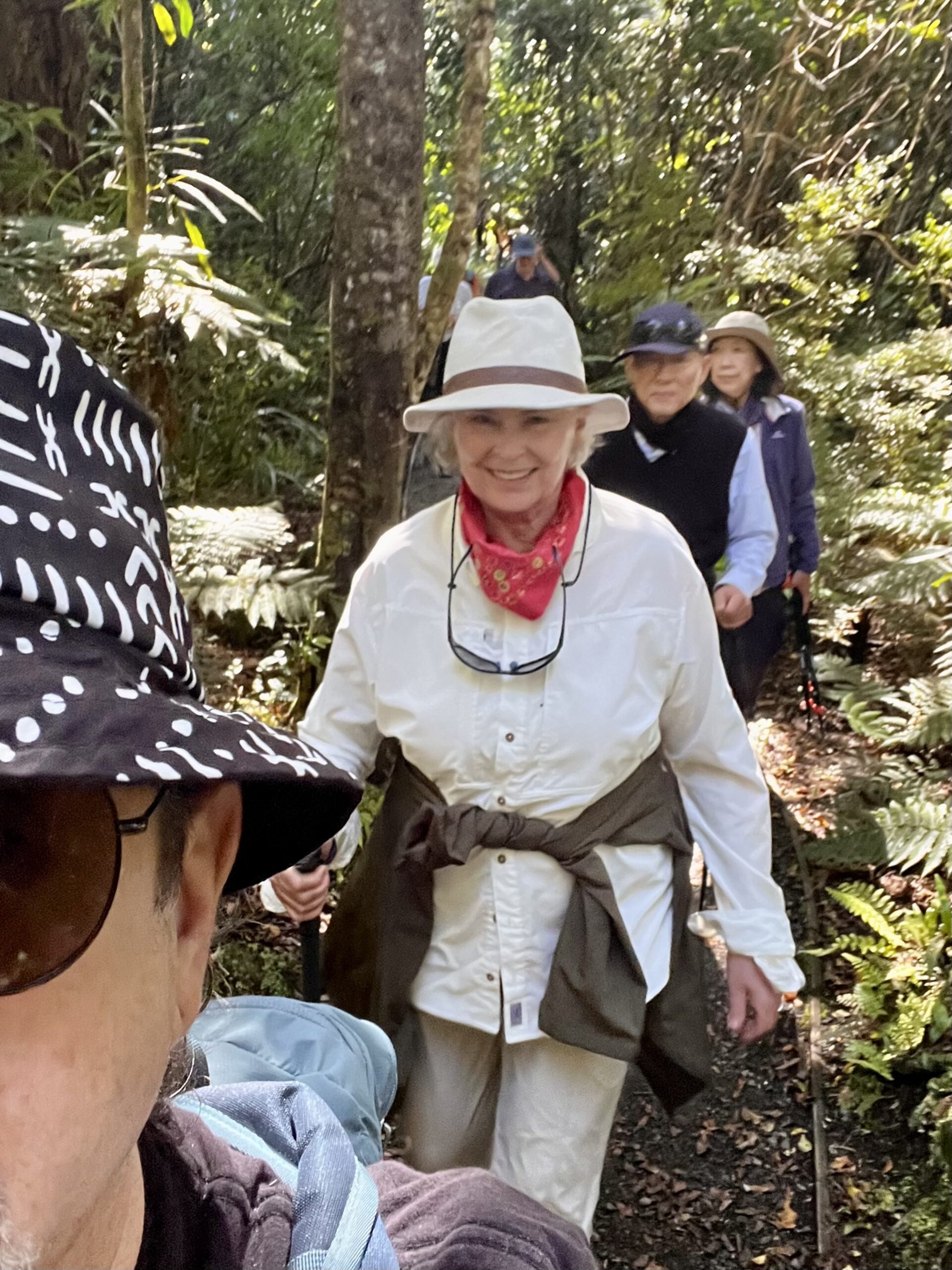
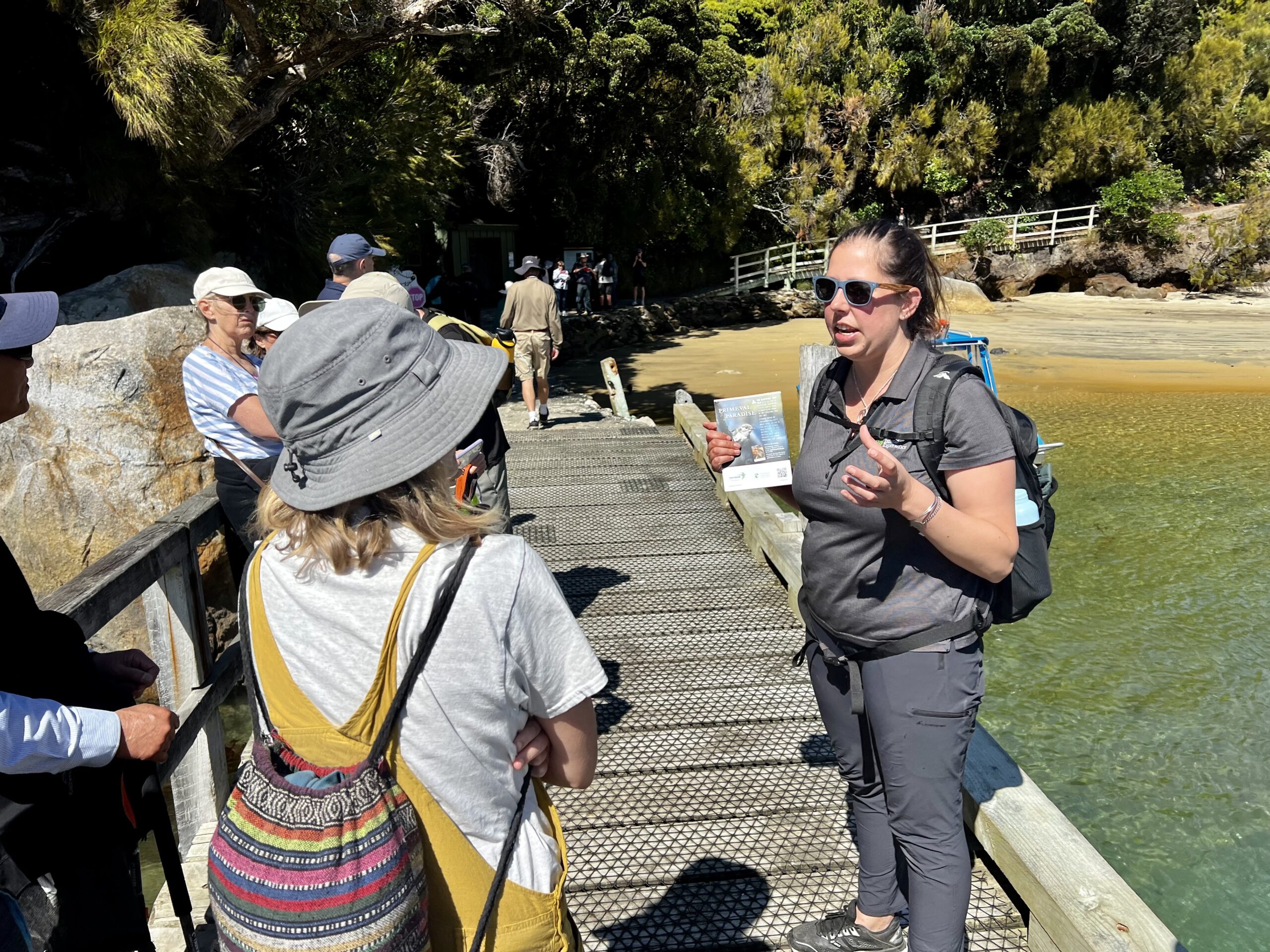
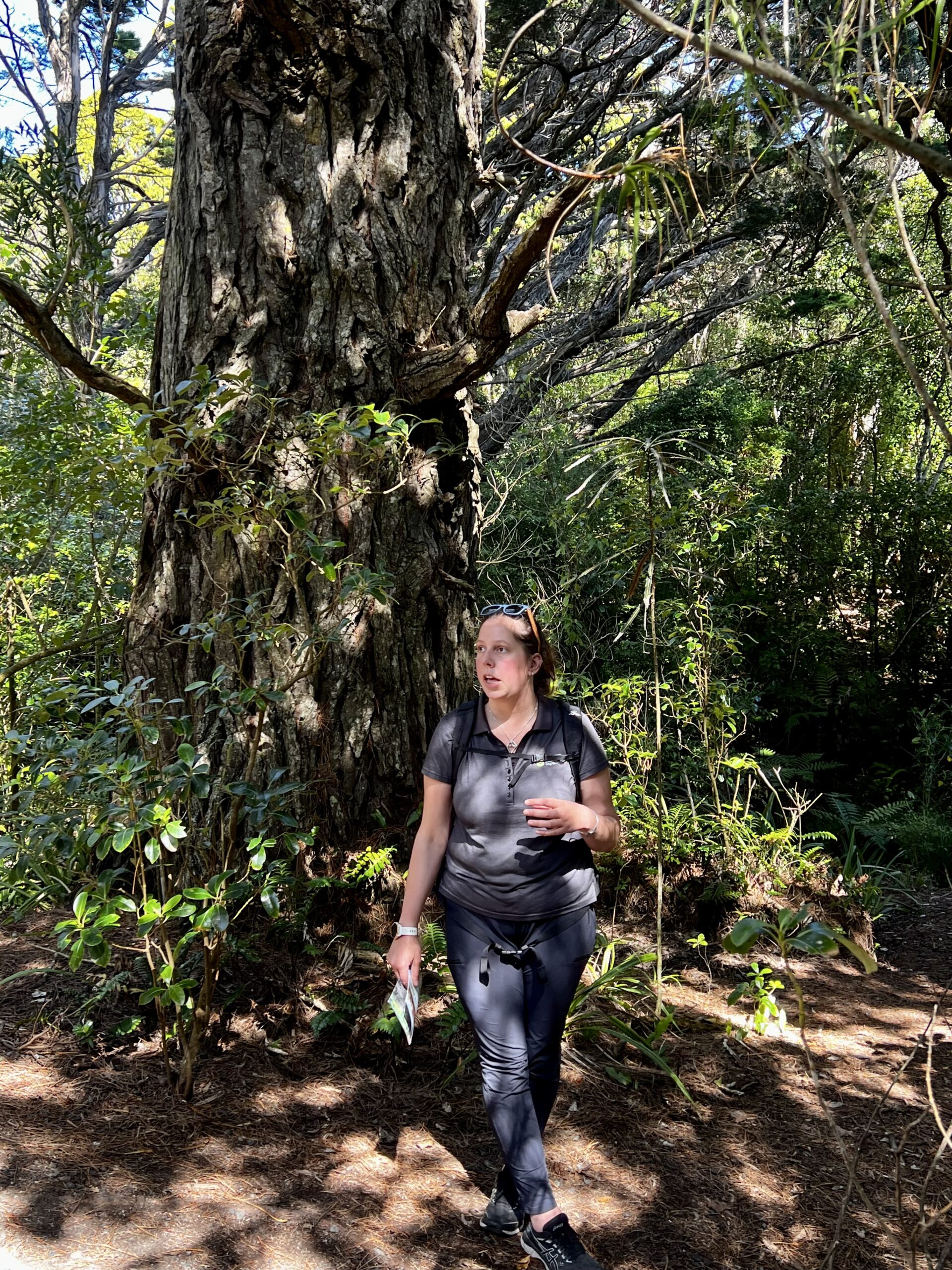
Still on the same day, we took a one-hour boat ride from Stewart Island to Ulva Island, known for birds. Along the way, the boat would pause so we could look at historic or scenic sites. One building built in the mid 1800s housed one of the first European families to live on the island. The father was more than six feet tall. A giant in those days. Once we arrived on Ulva Island, we split into two groups of a dozen each for a guided hike through the dense, leafy bush.
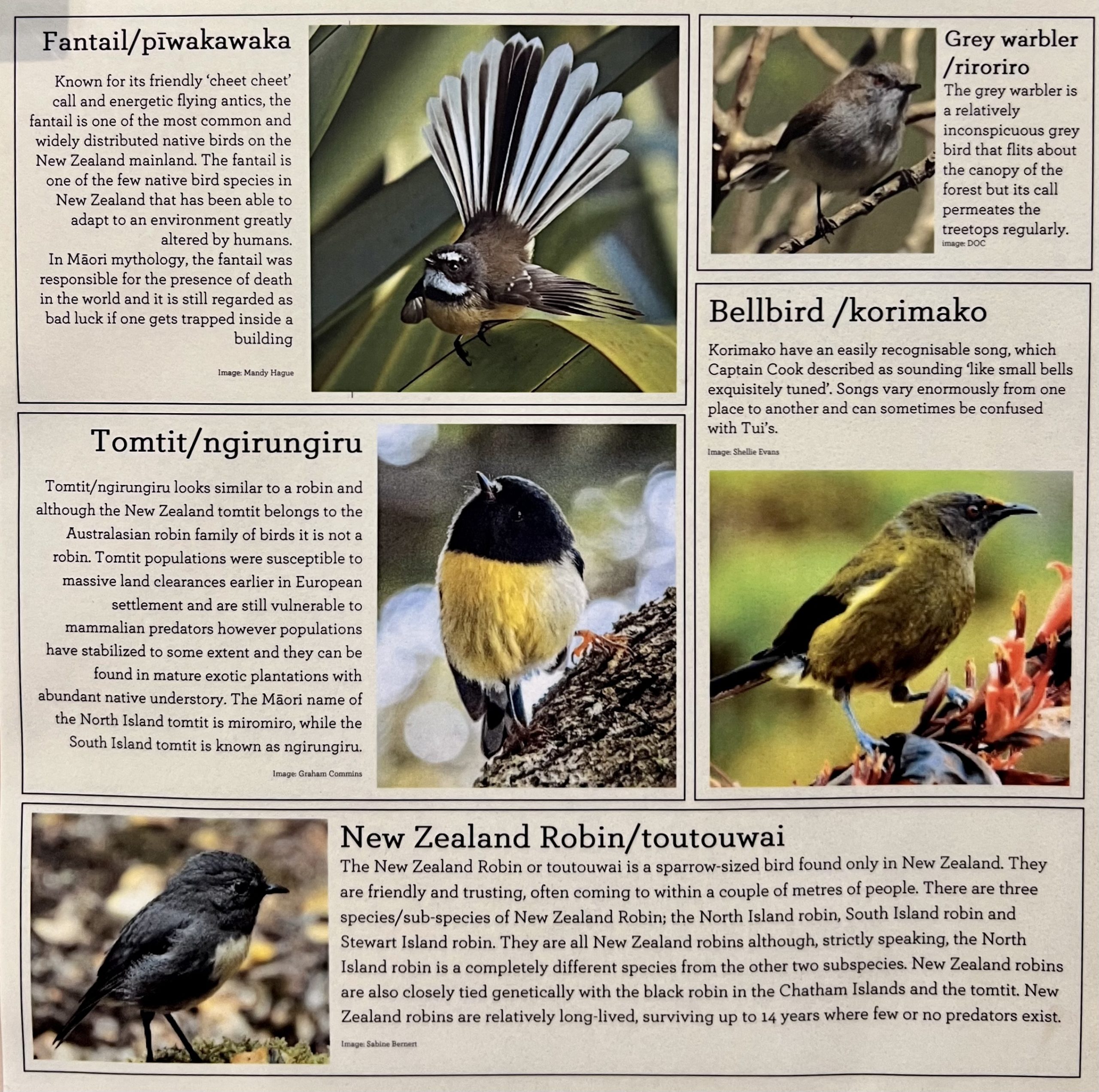
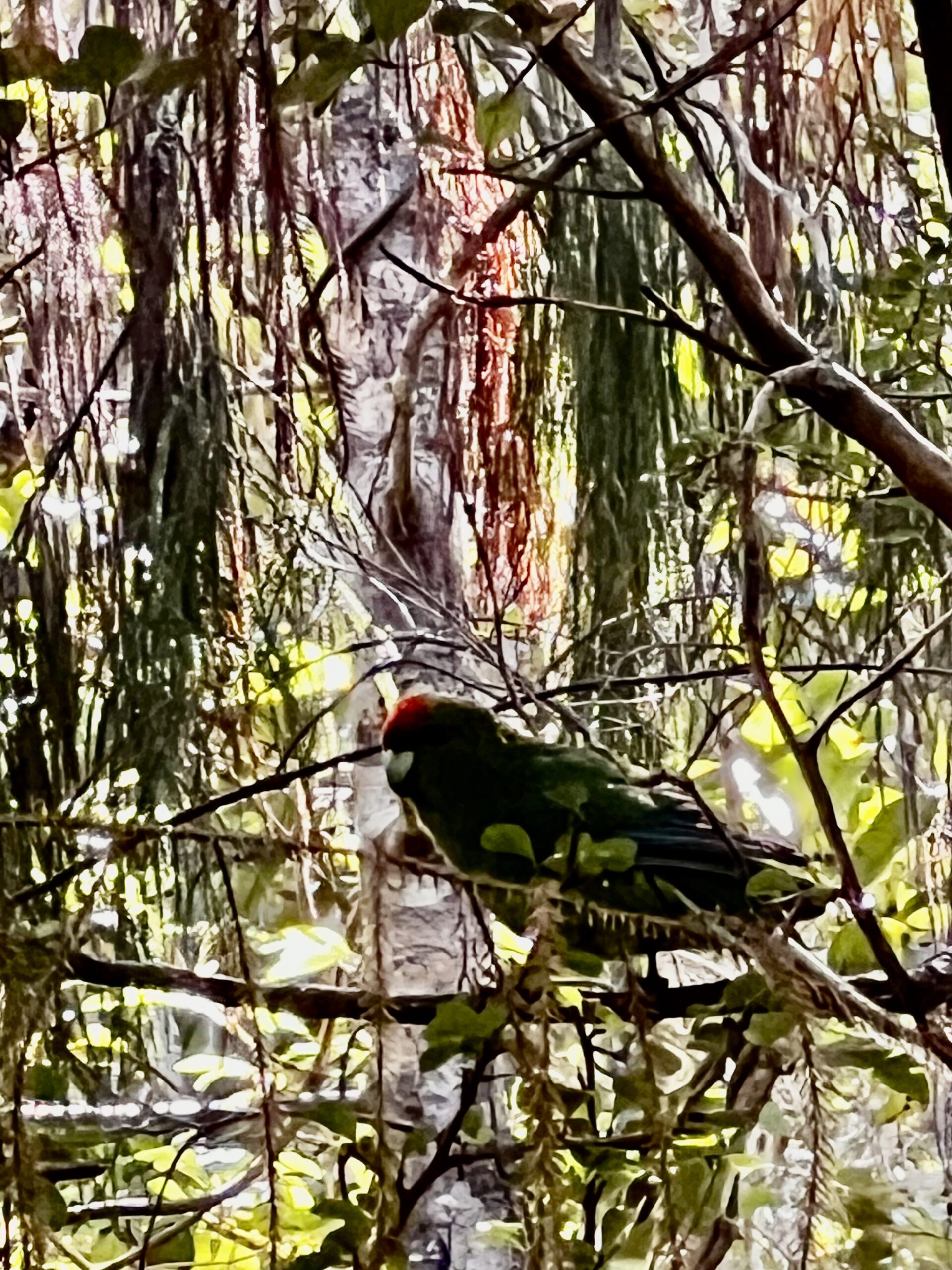
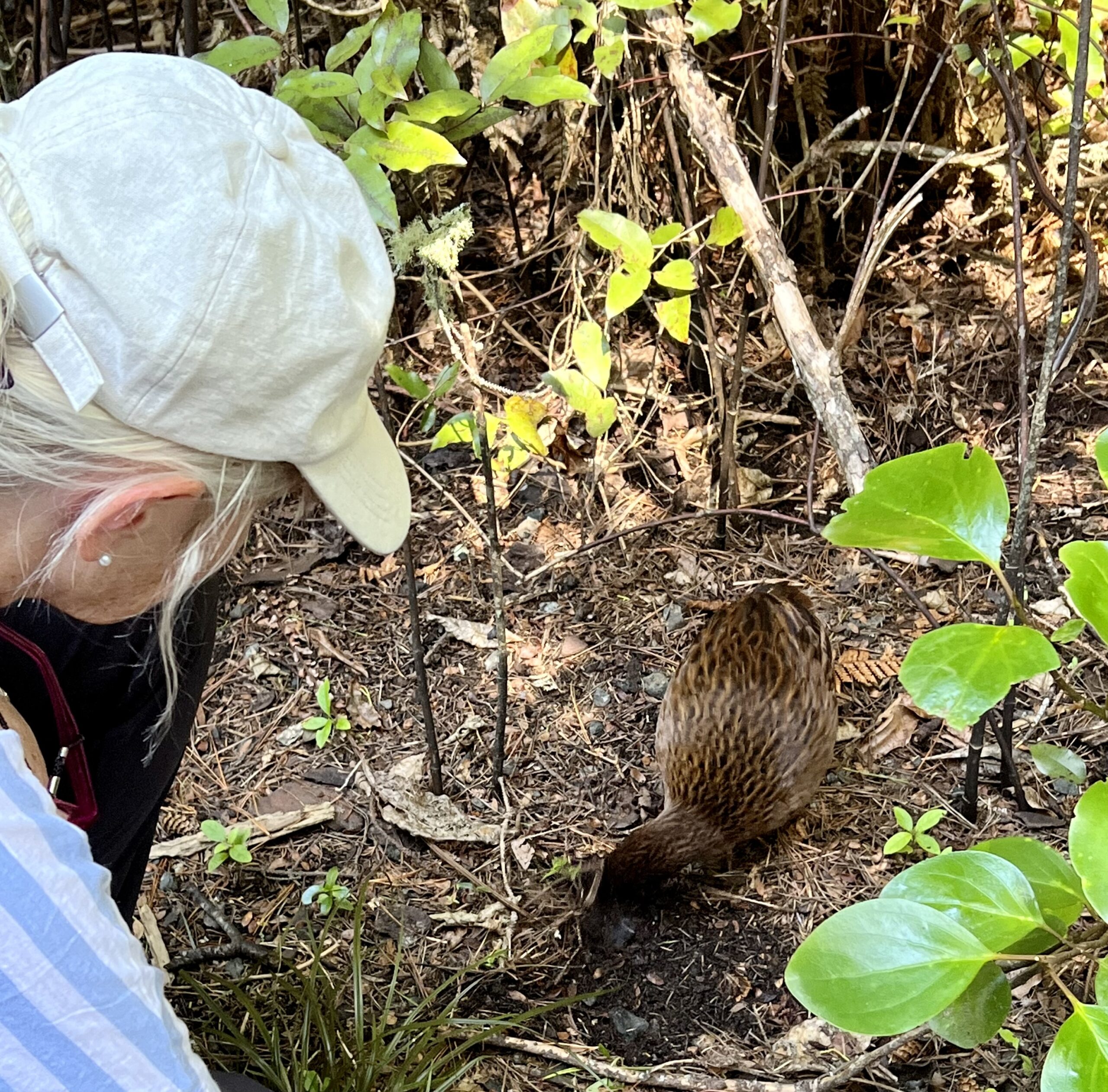
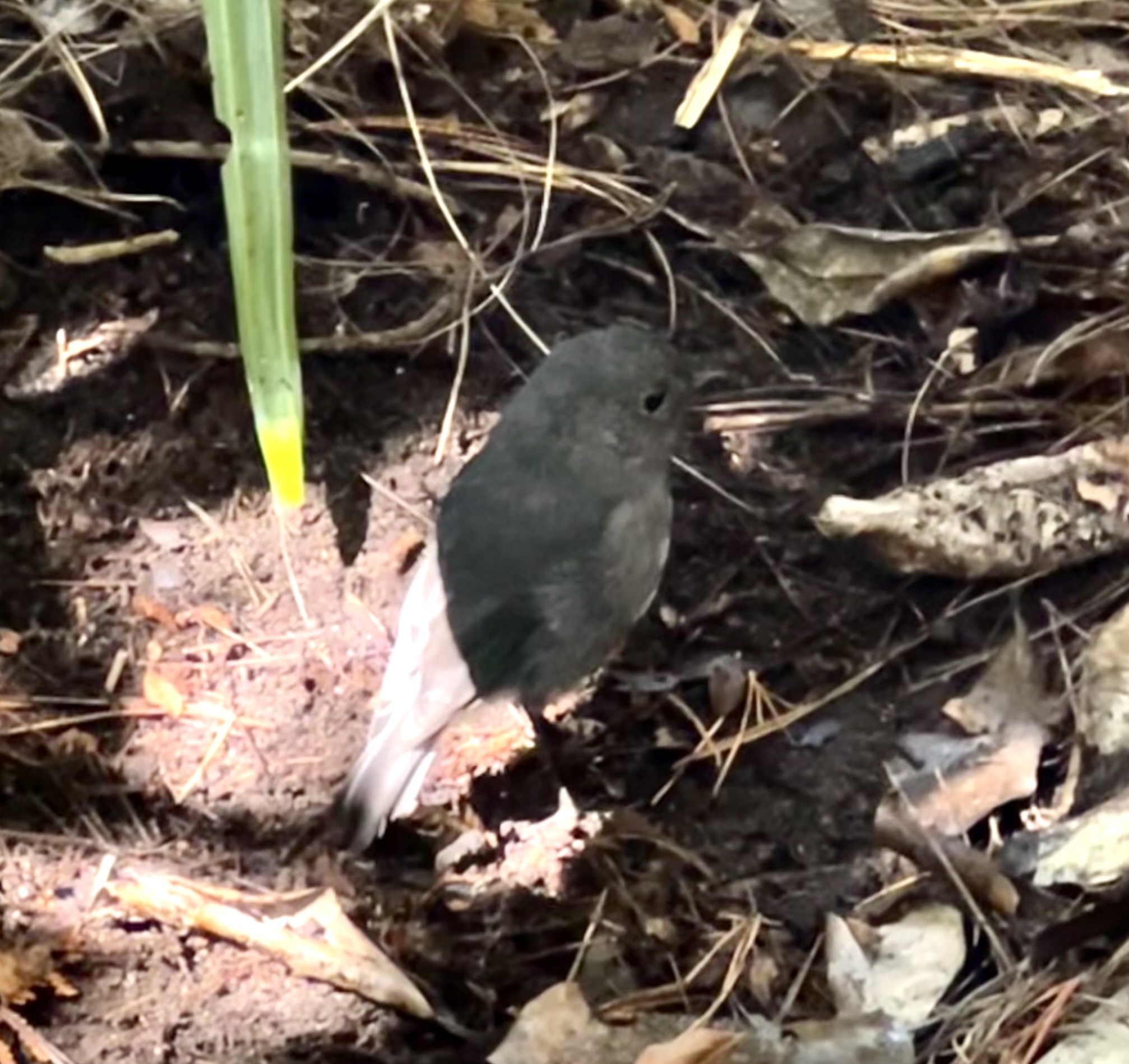
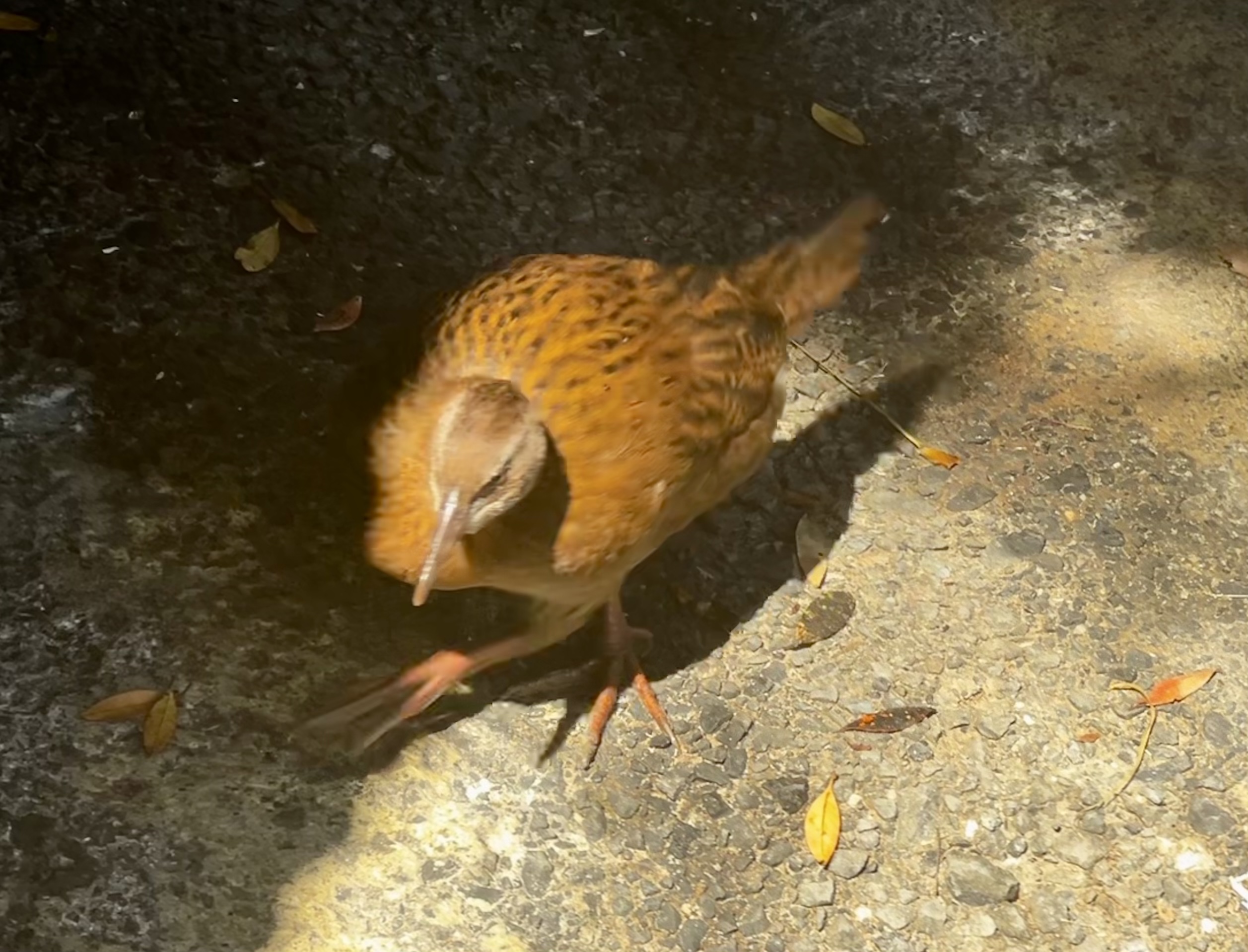
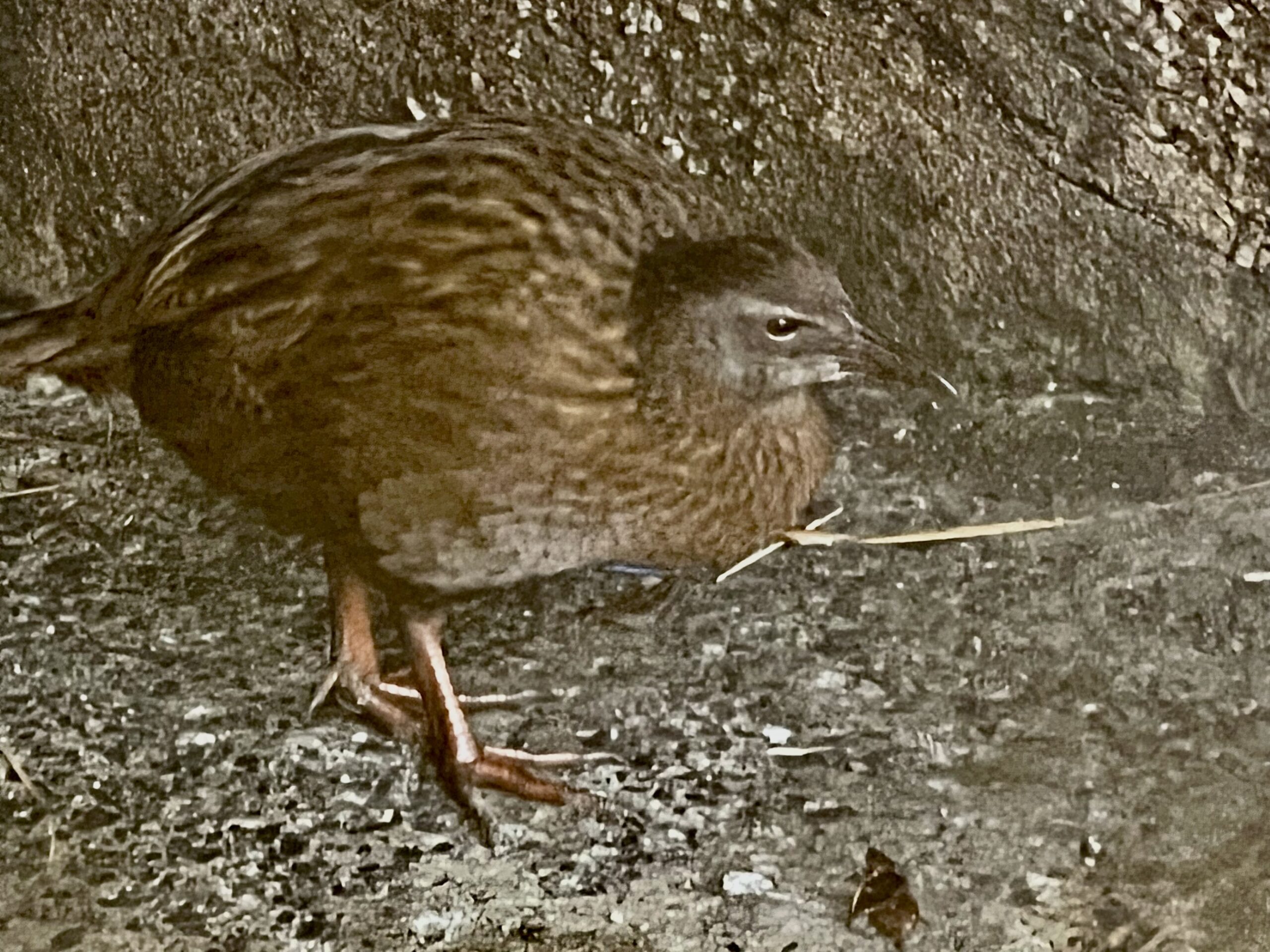
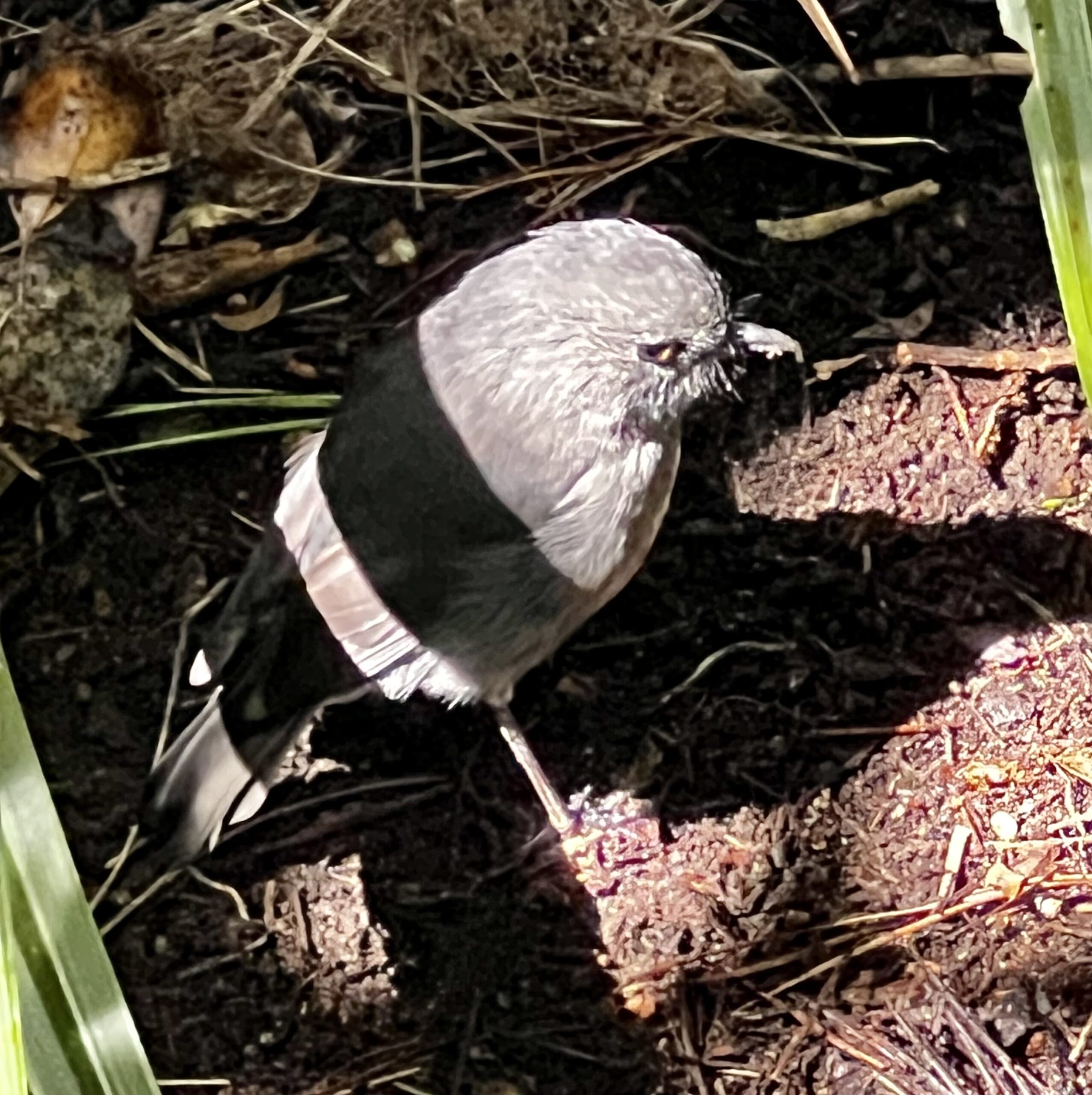
Our guide focused on plants and the birds, pausing at places to point out a specific bird. These birds have no predators so they are not shy and often get quite close. Many of the birds are endangered because they lack the ability to fly or only fly short distances as they historically did not have any predators until the Europeans introduced rats, mice, feral cats, and possums. There is a strong ongoing eradication program in process that probably will never stop.
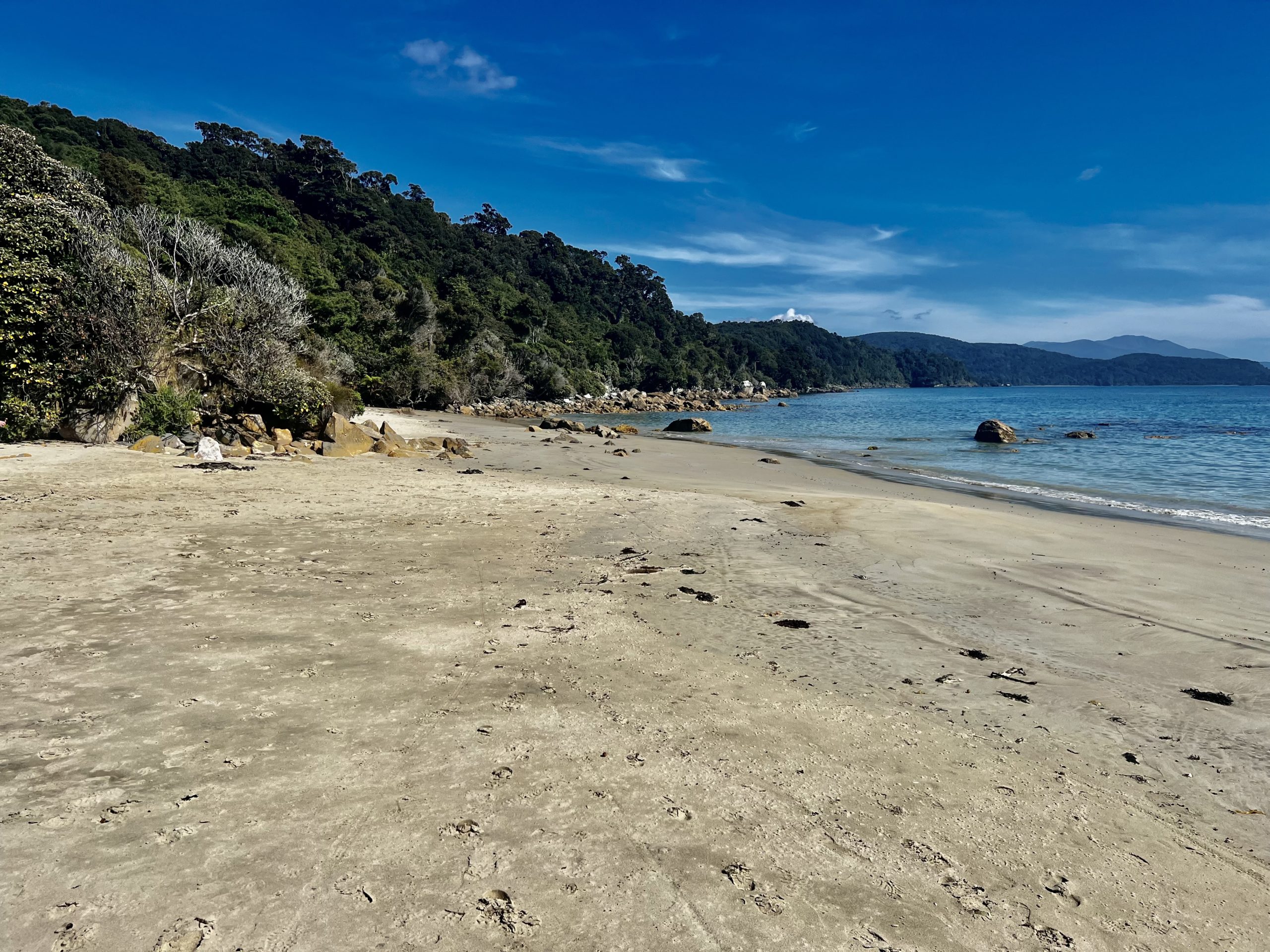
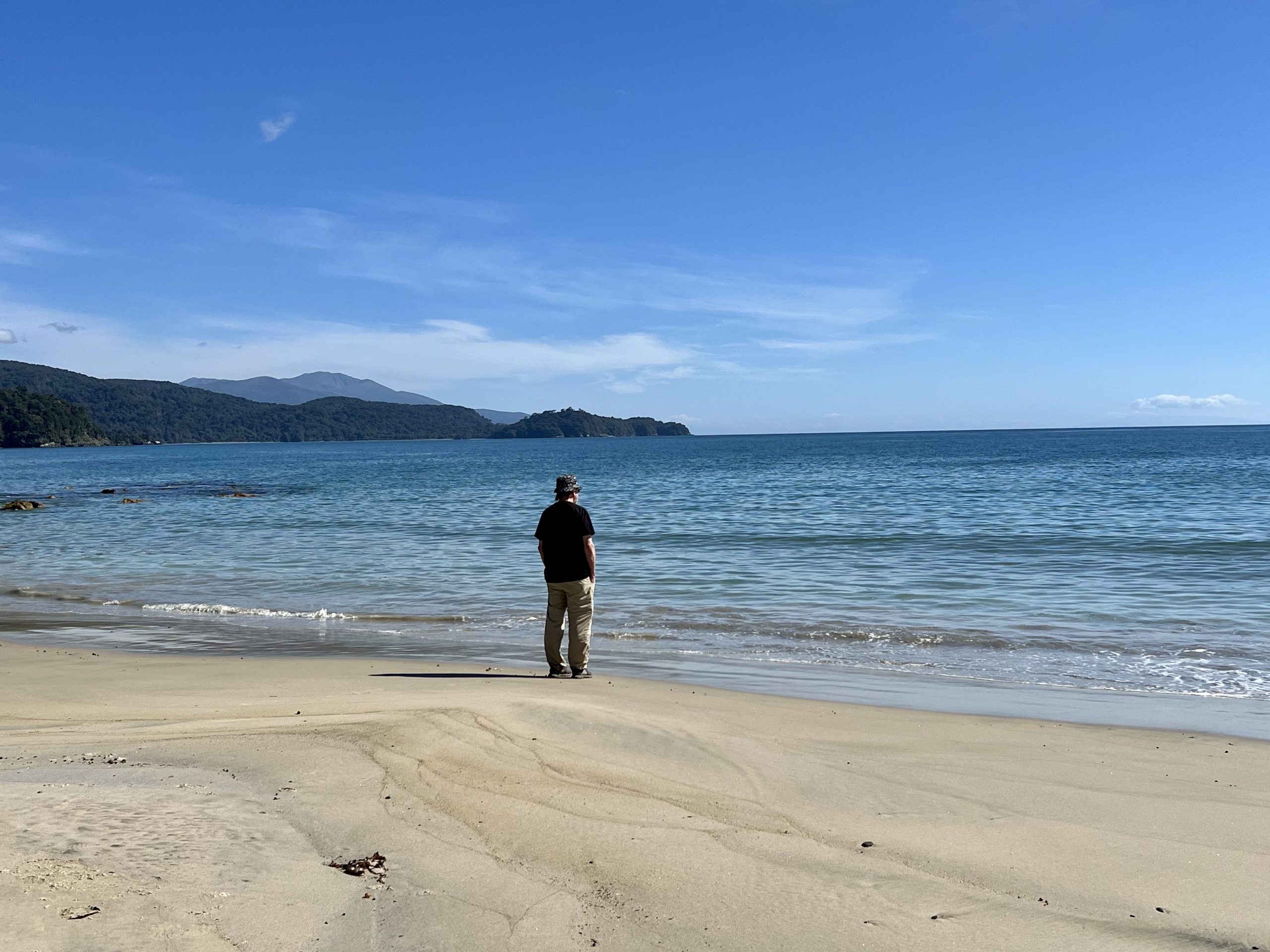
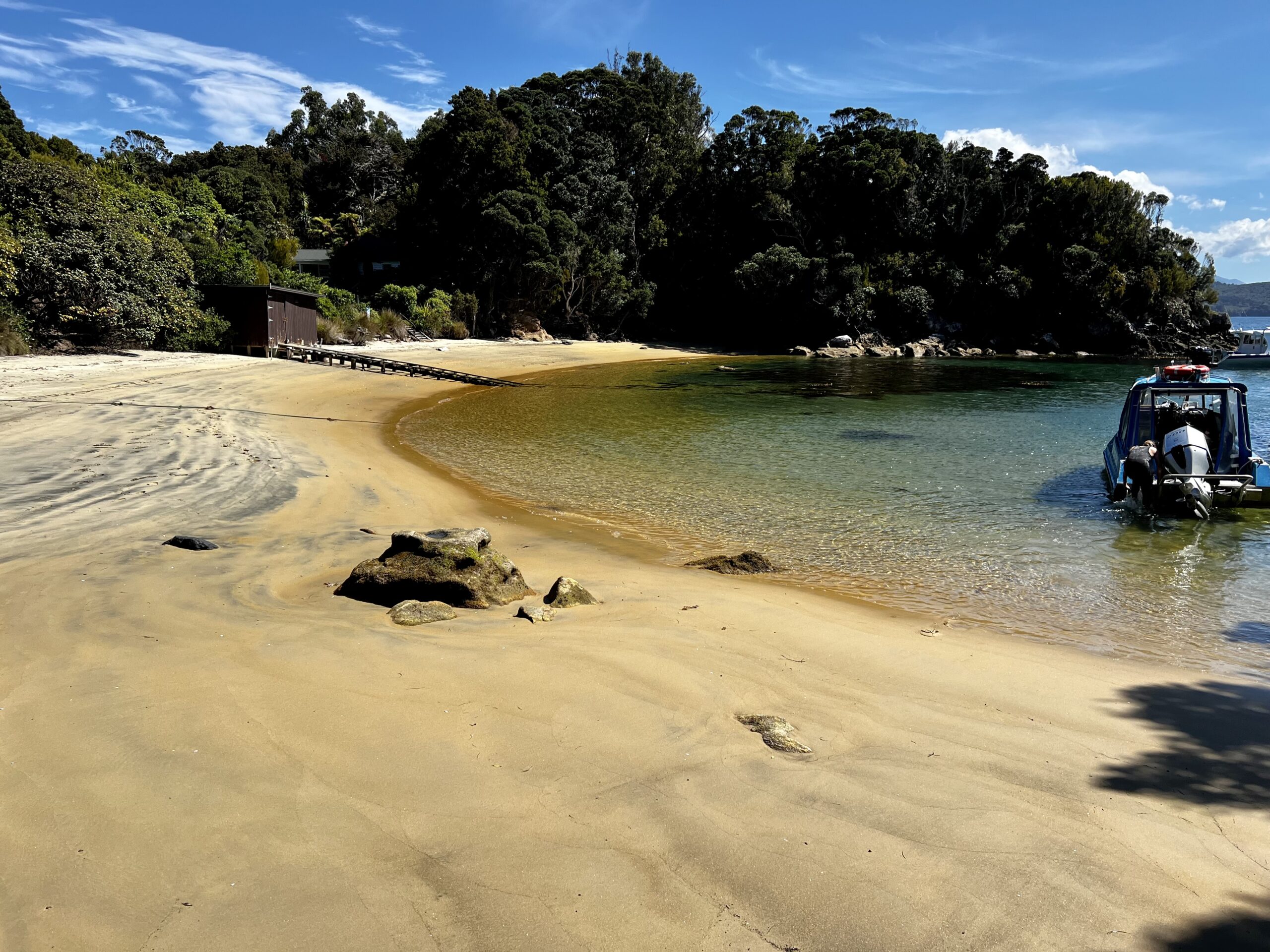
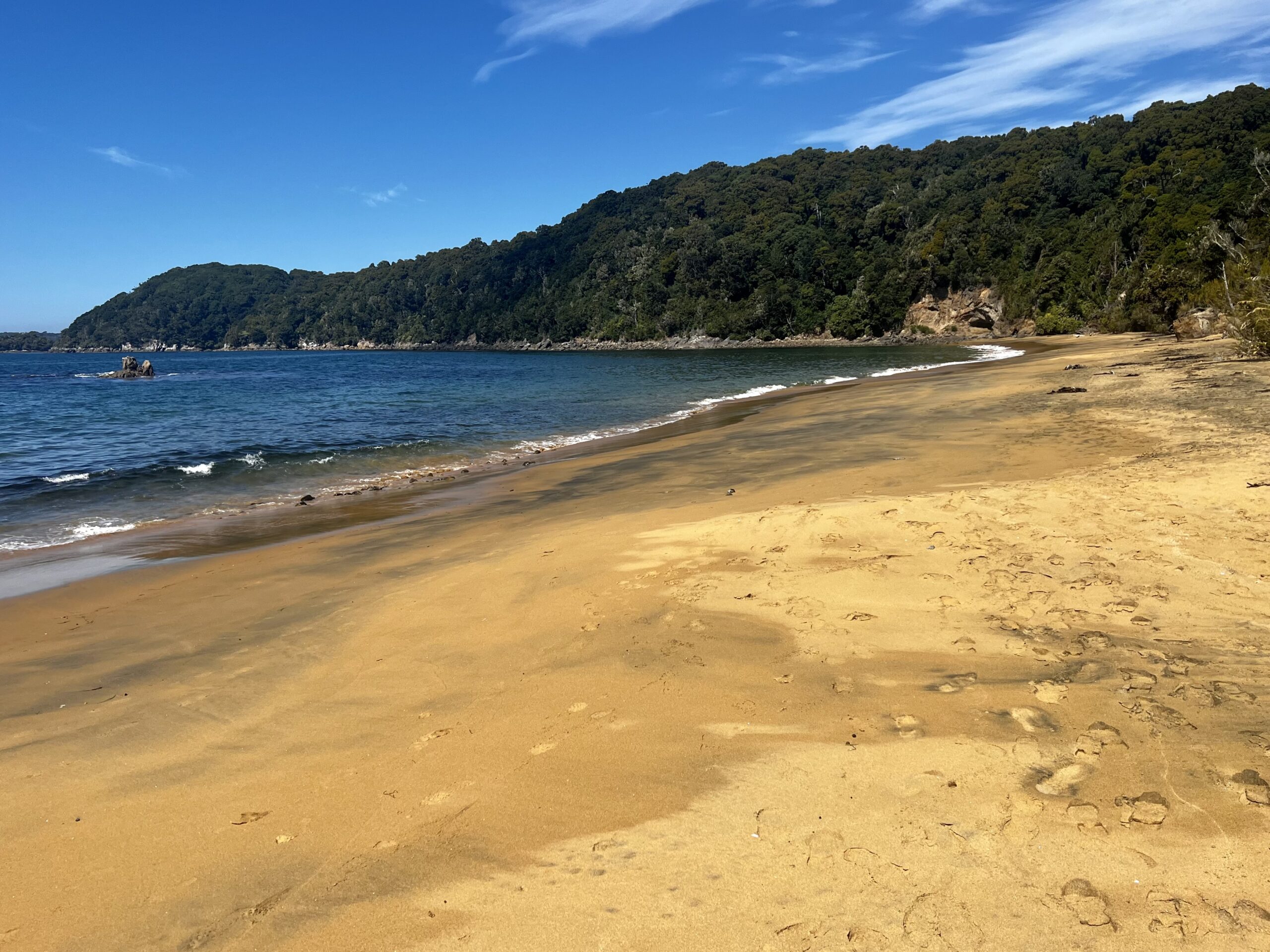
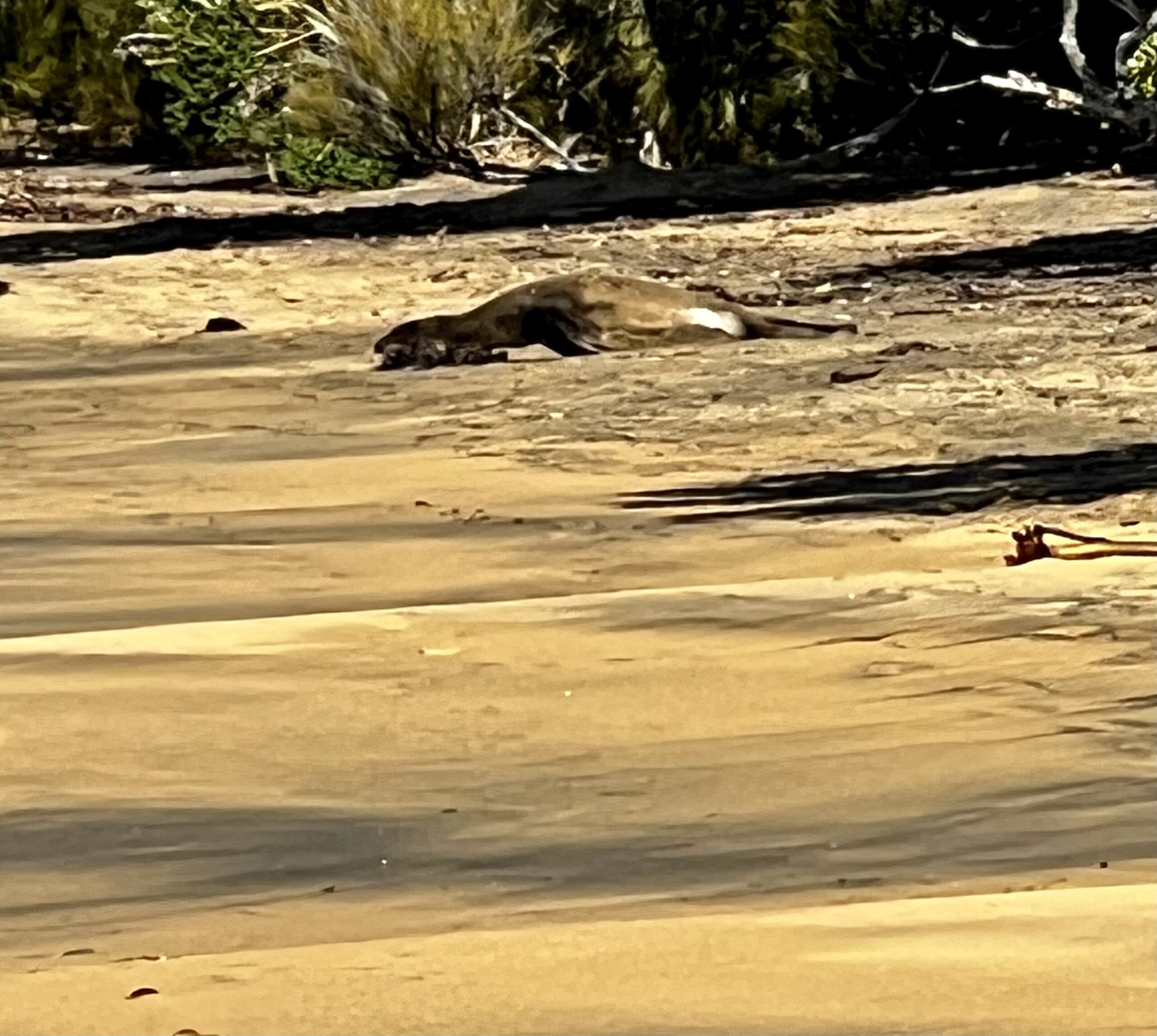
Our island hike ended on a beach frequented by sea lions. We saw one in the distance. On the way to the beach, the tour guide warned us to be aware of female sea lions lying in the bush, sheltering with their young. They do this to avoid the male sea lions on the beach who go after and kill the young sea lions. Ahhh, nature.
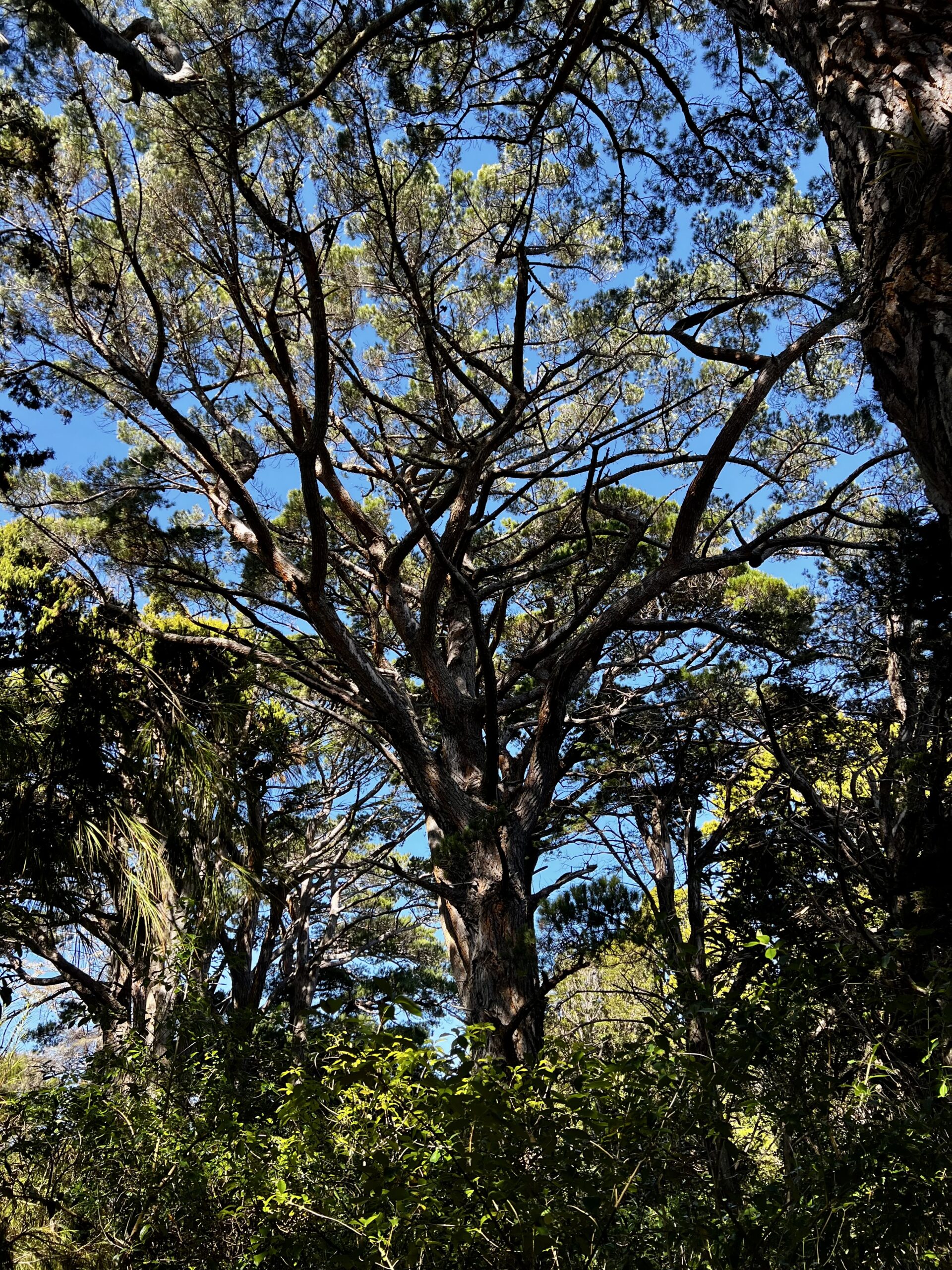
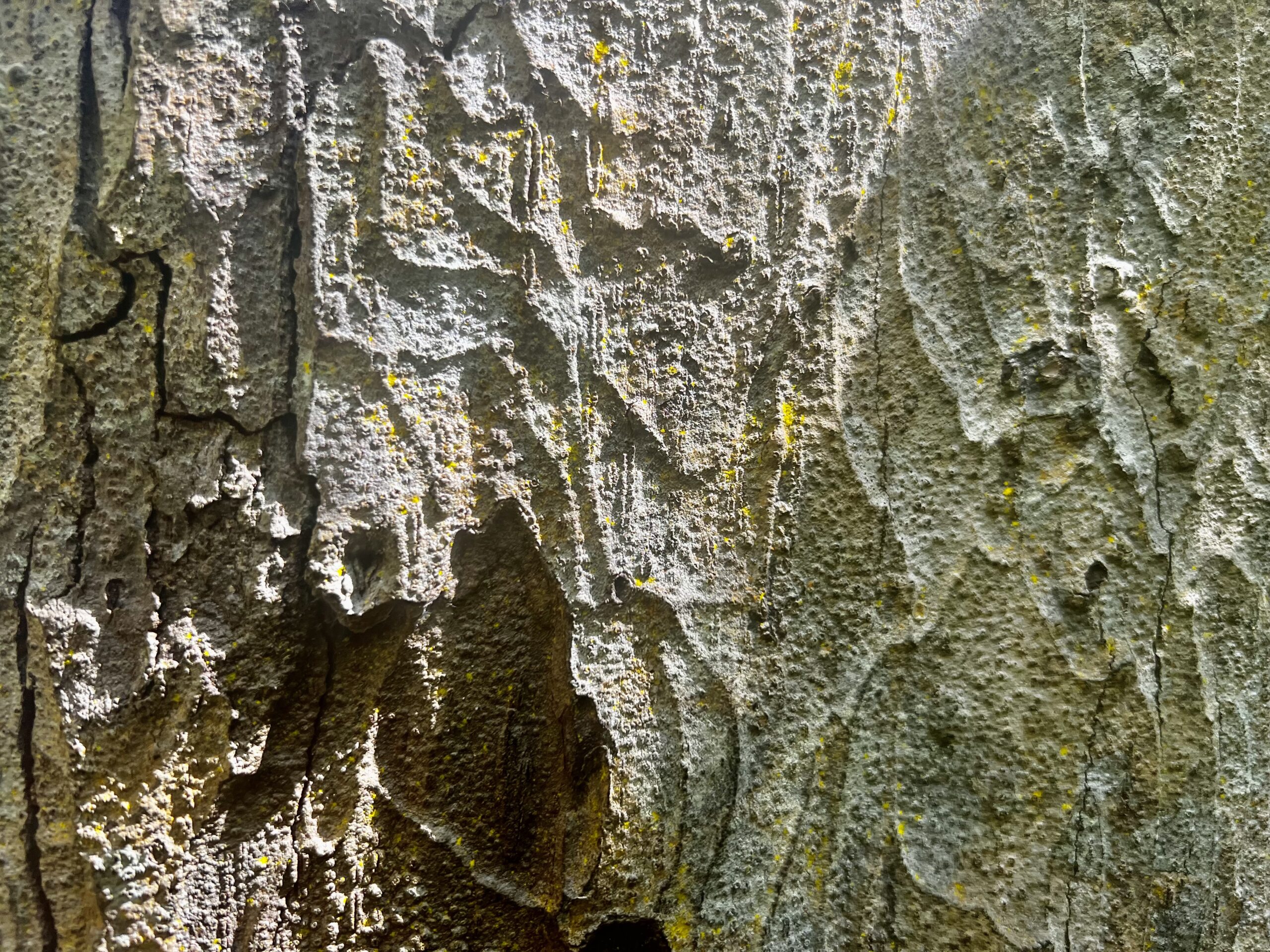
At the base of a California Monterey Pine planted 150 years ago. The oldest and largest Robert has ever seen.Predator trapLocal robinSea lion
Day Trip East
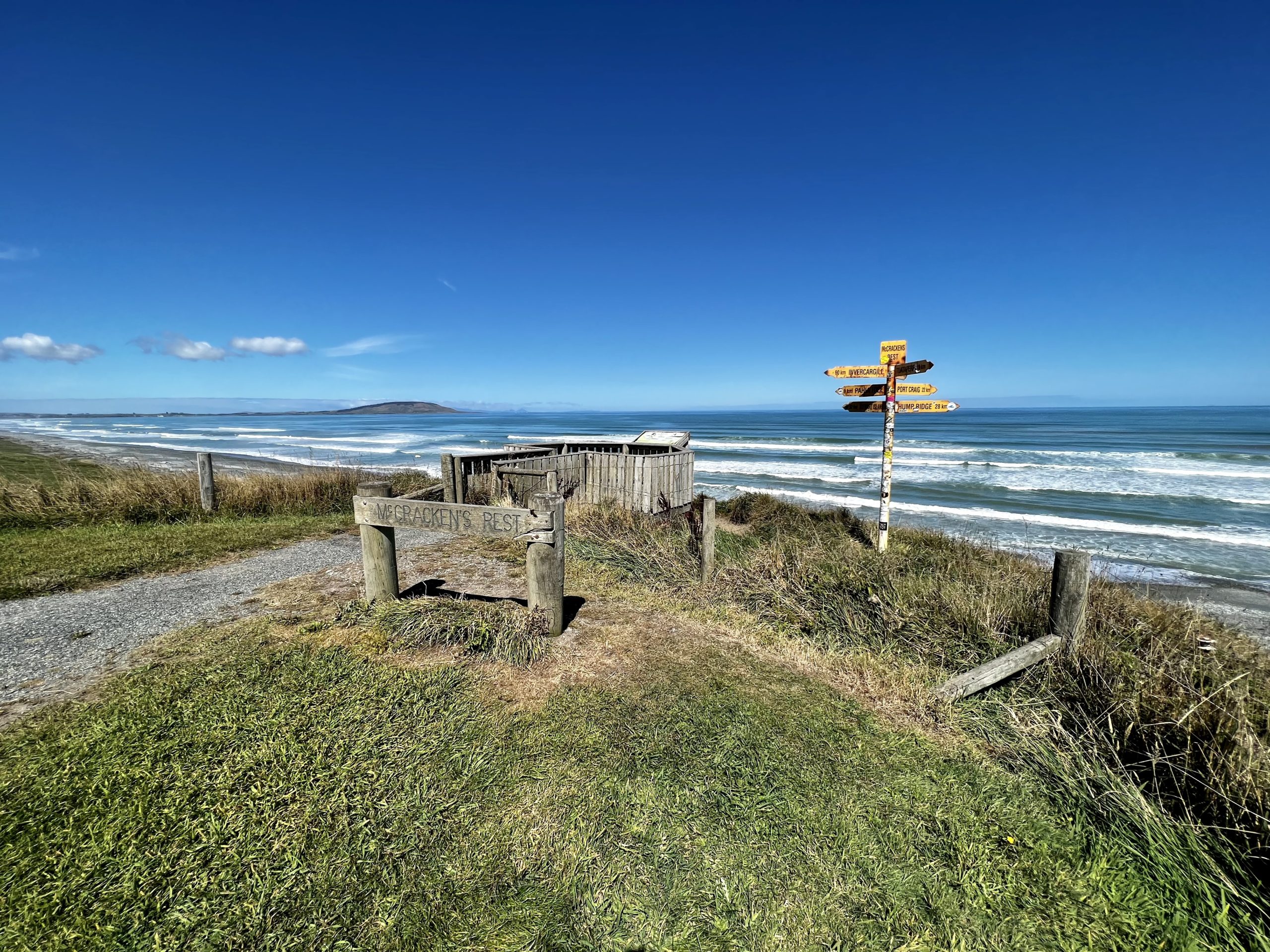
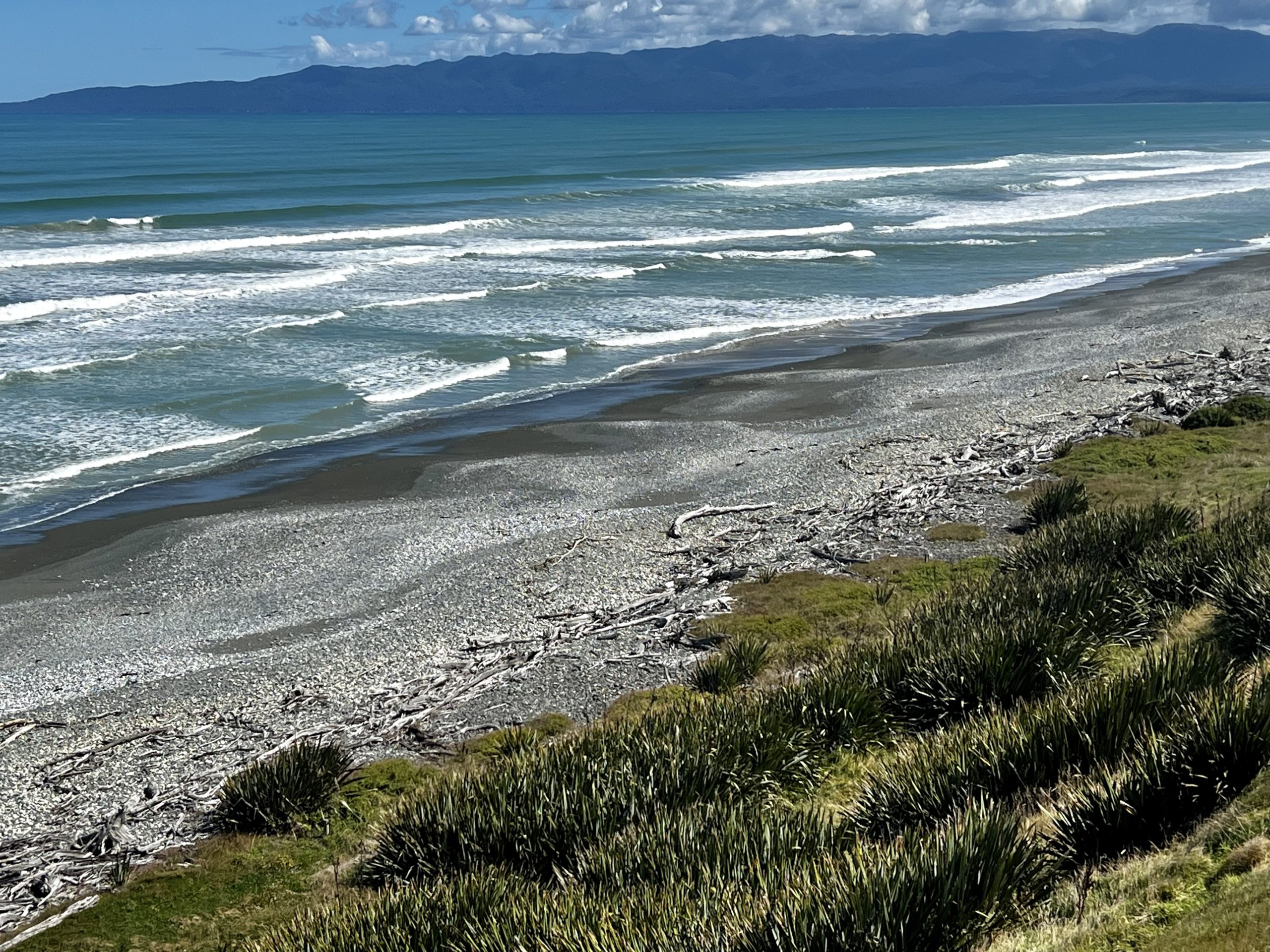
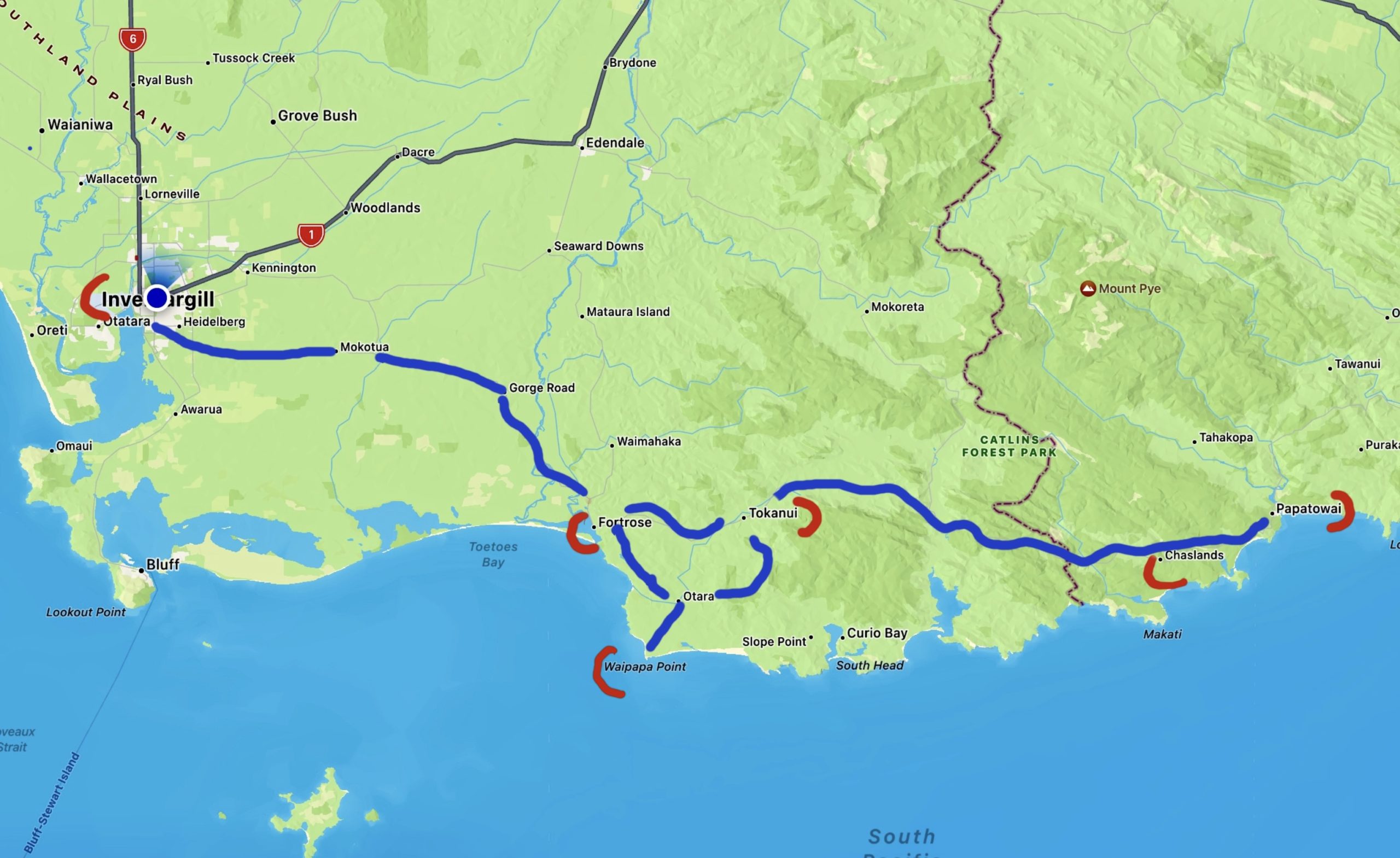
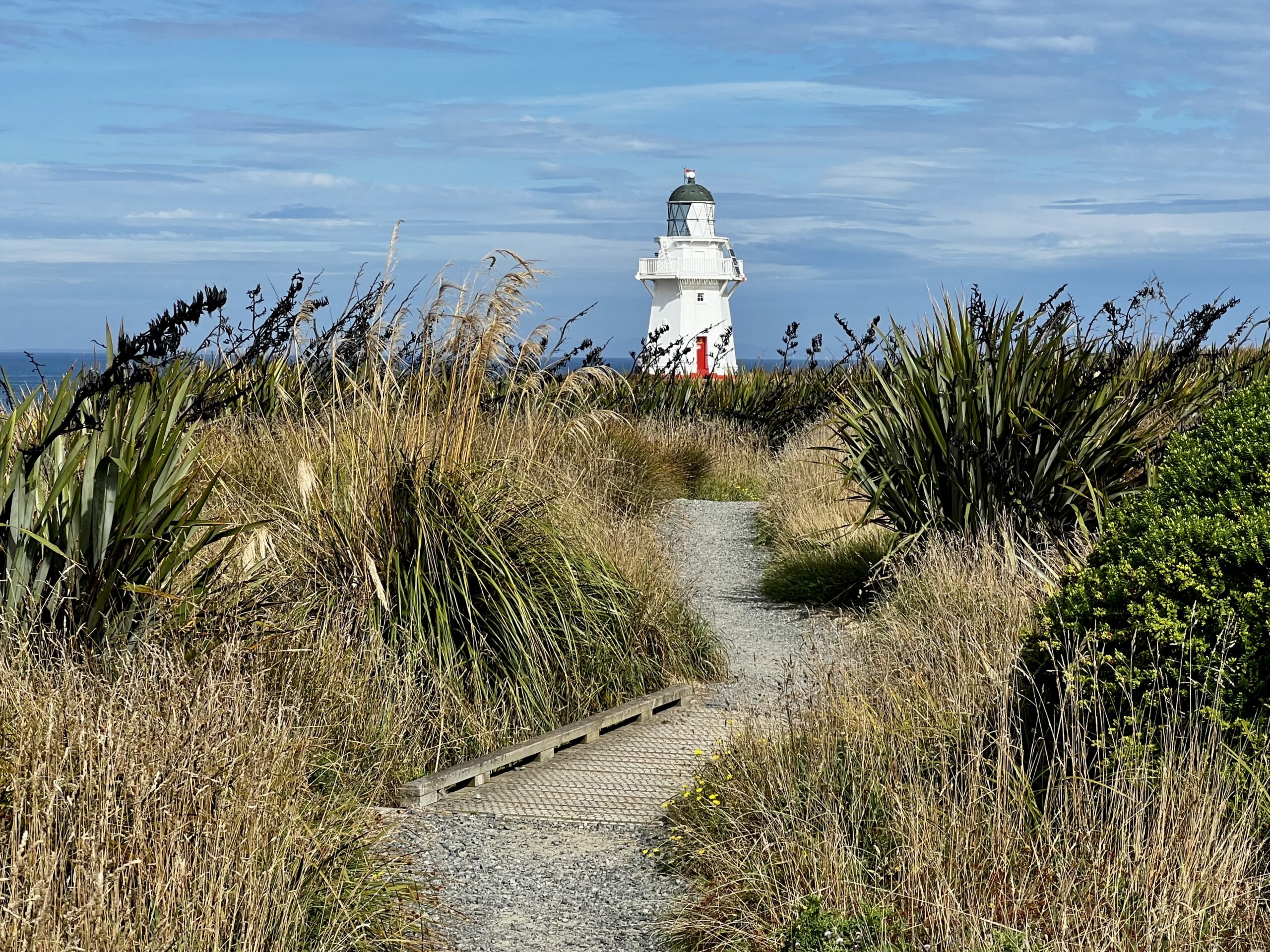
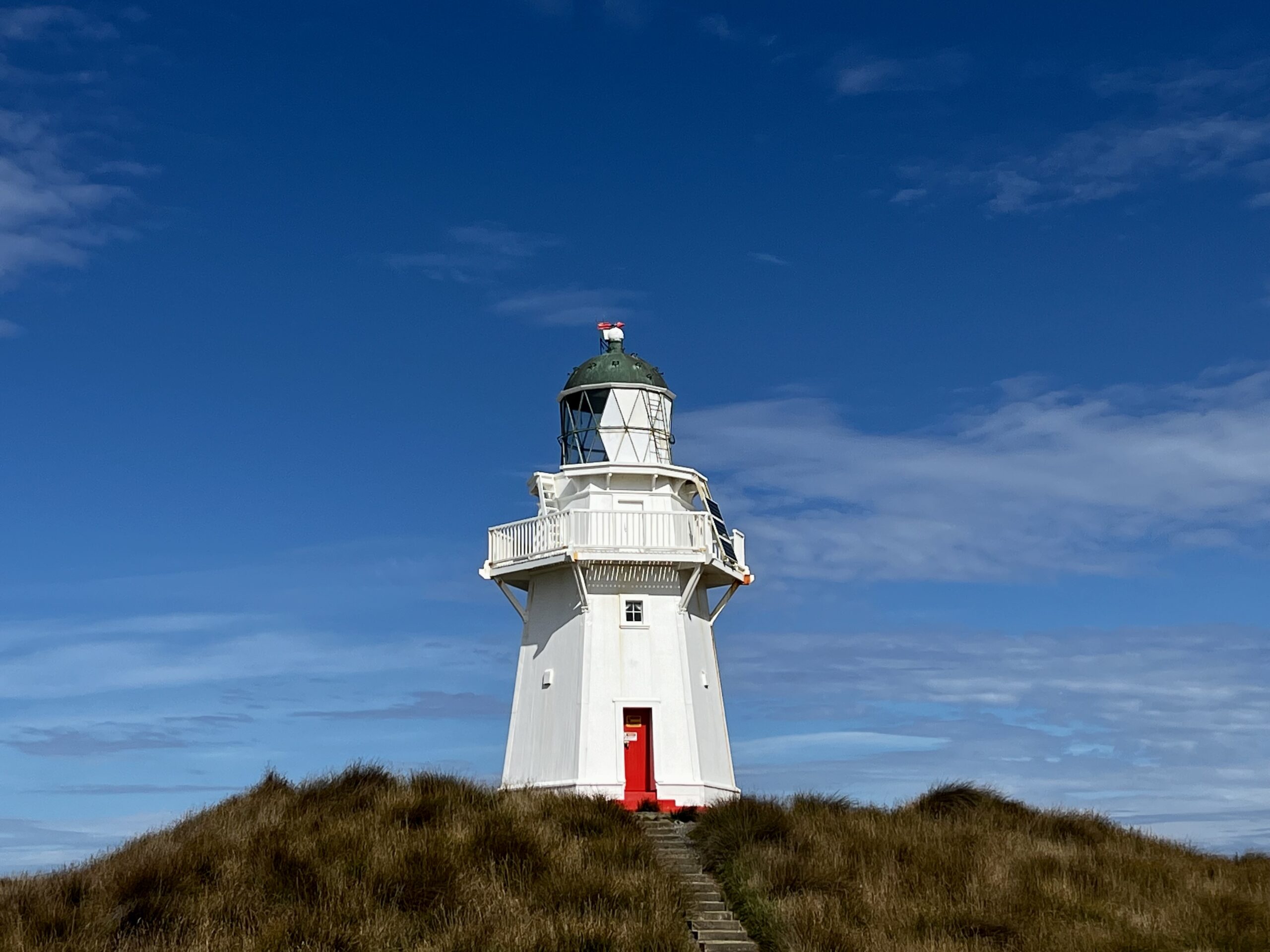
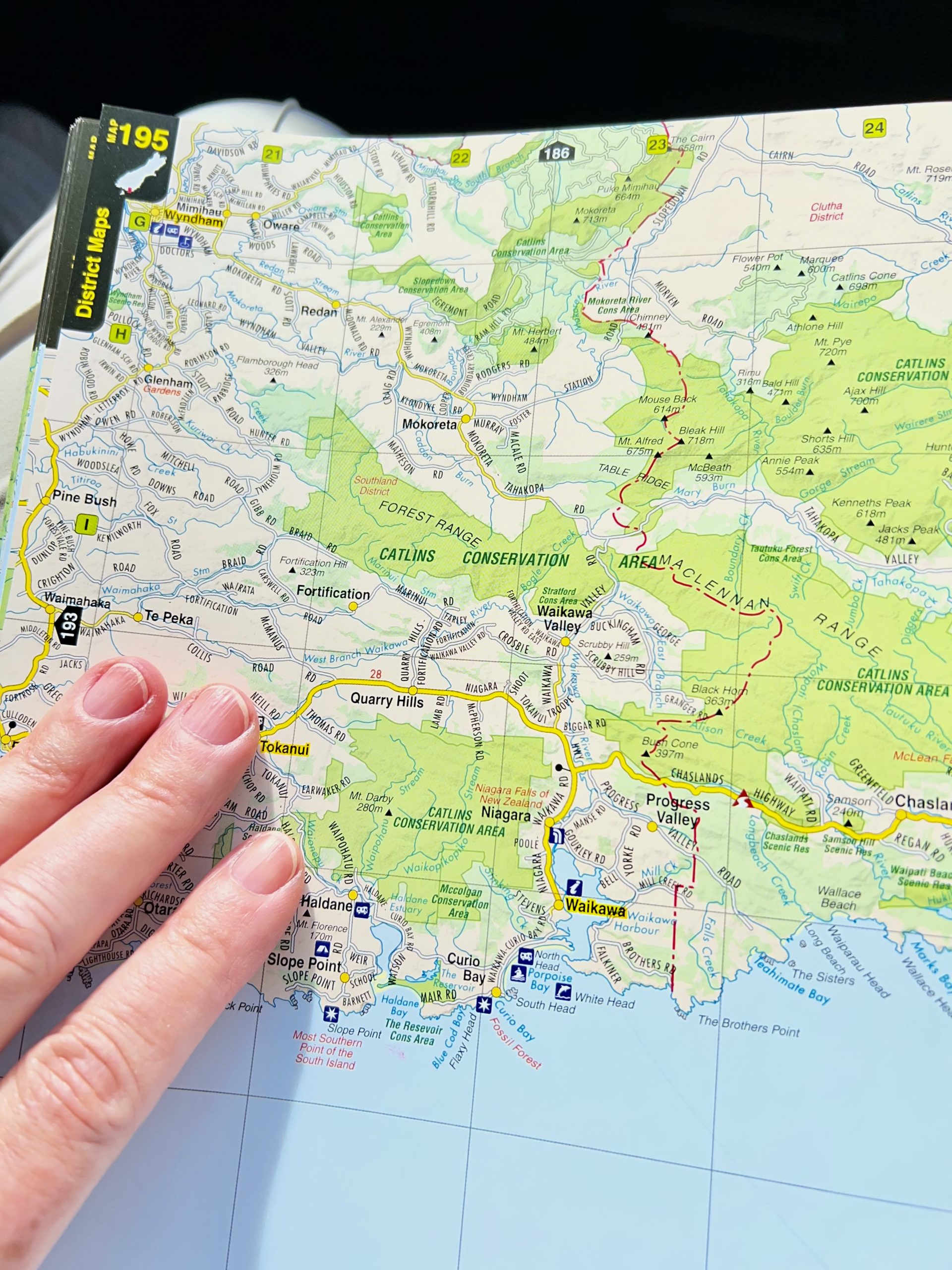
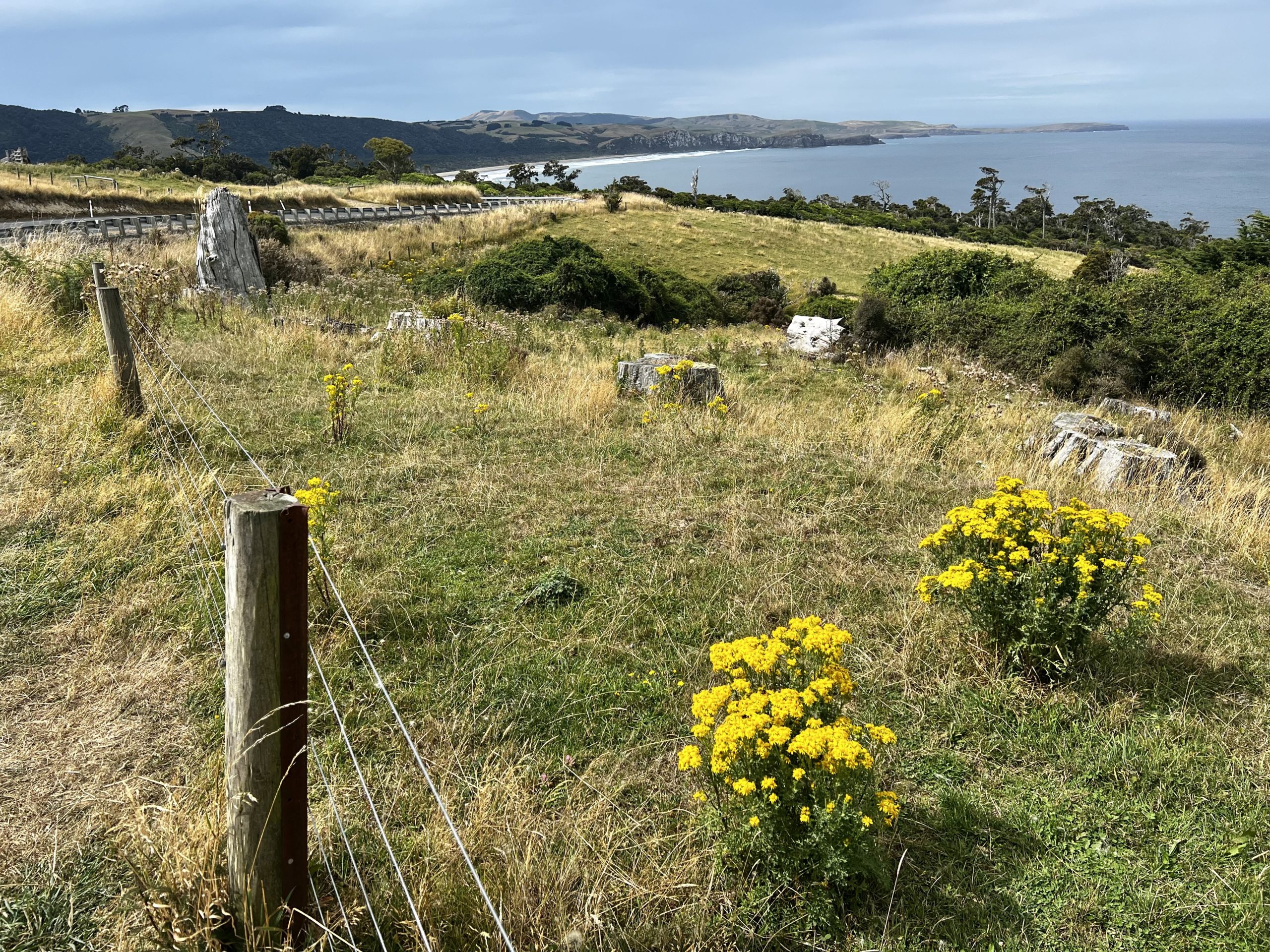
On a free day (no fishing), we headed east for more of New Zealand’s spectacular landscape in an area called the Catlins. We stopped along the way to see a lighthouse constructed in the mid 1800s after a ship struck a reef and lost more than 100 people, the bodies washing on shore for weeks afterwards. A cemetery nearby holds numerous remains.
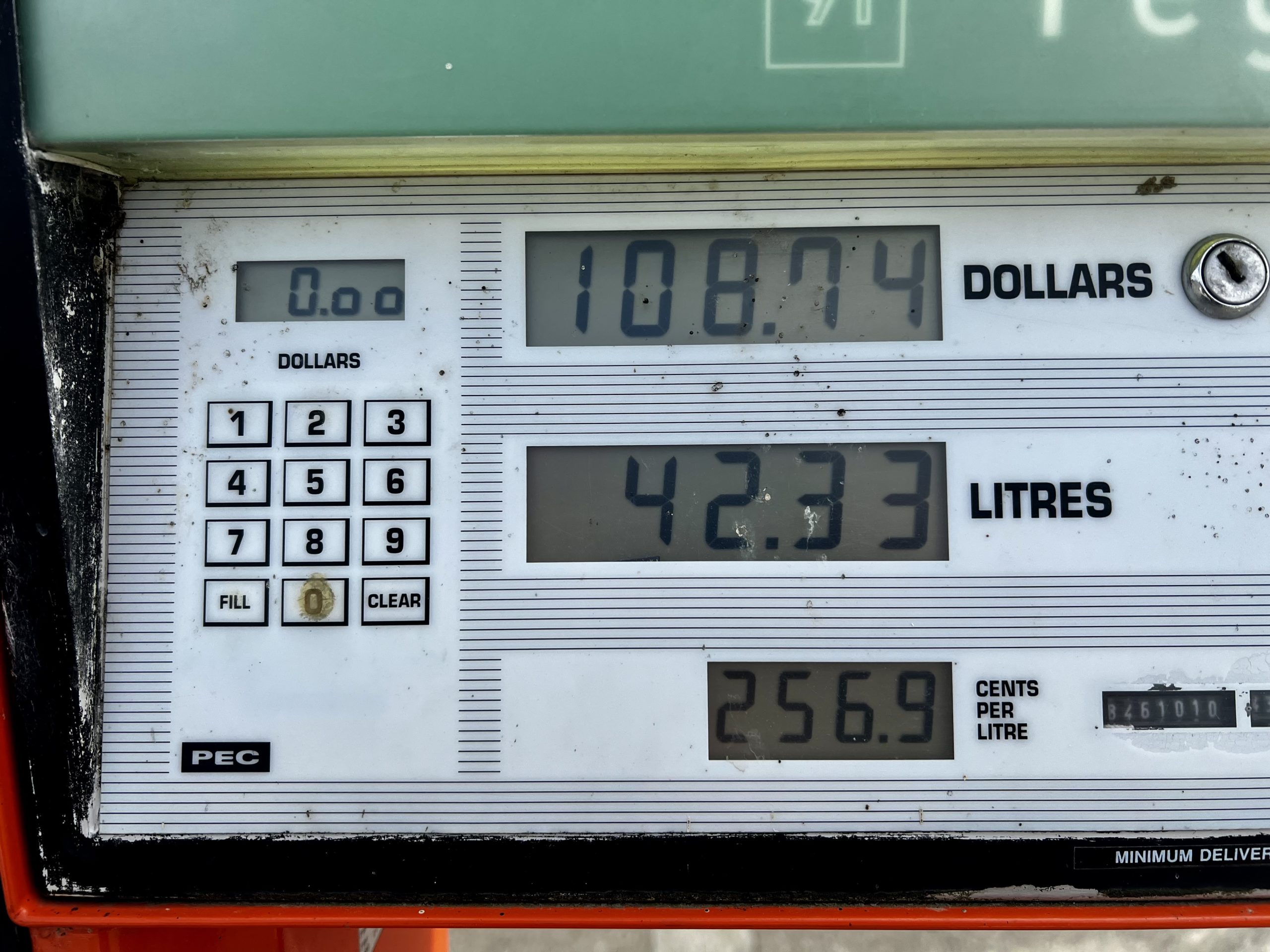
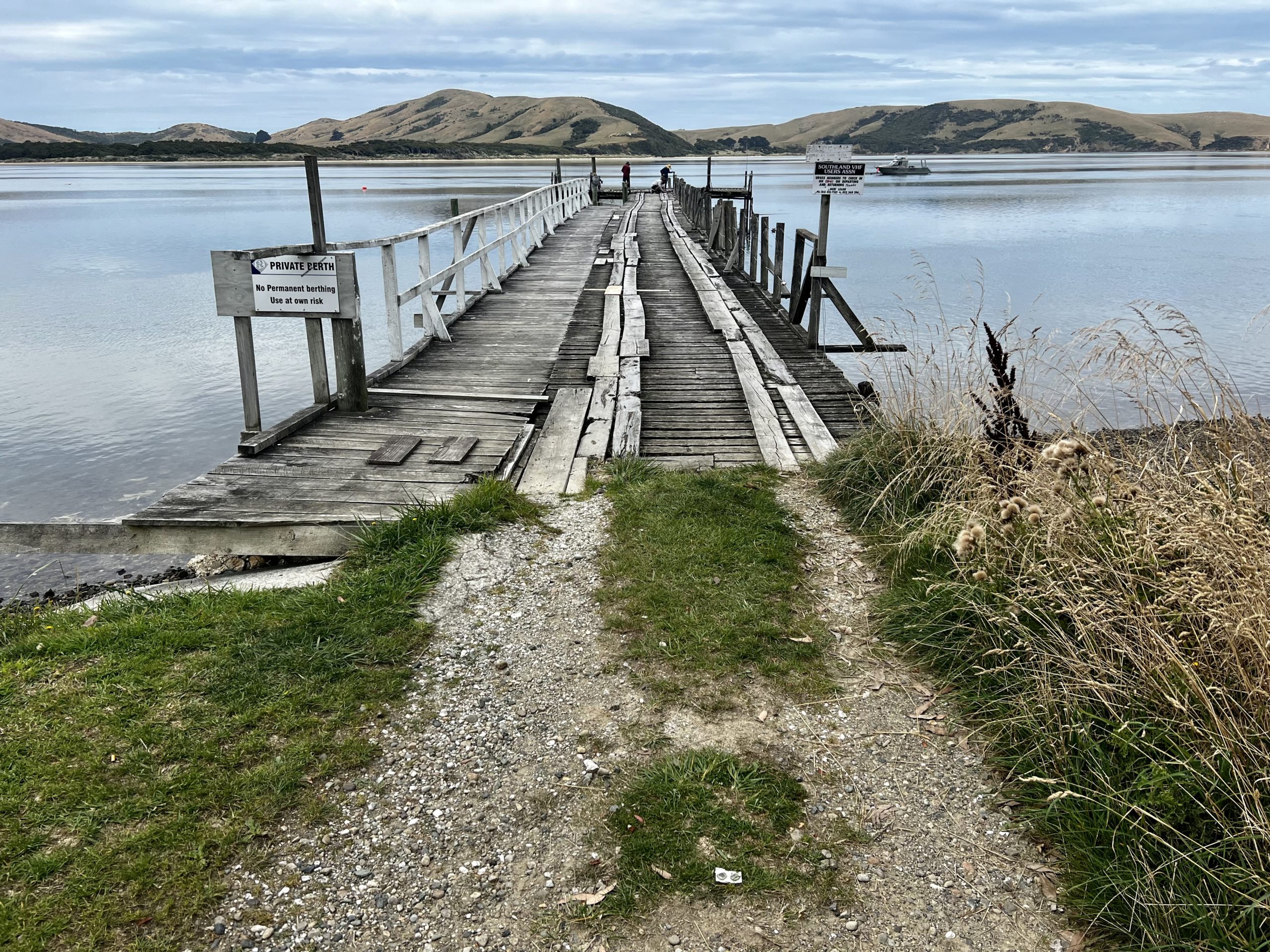
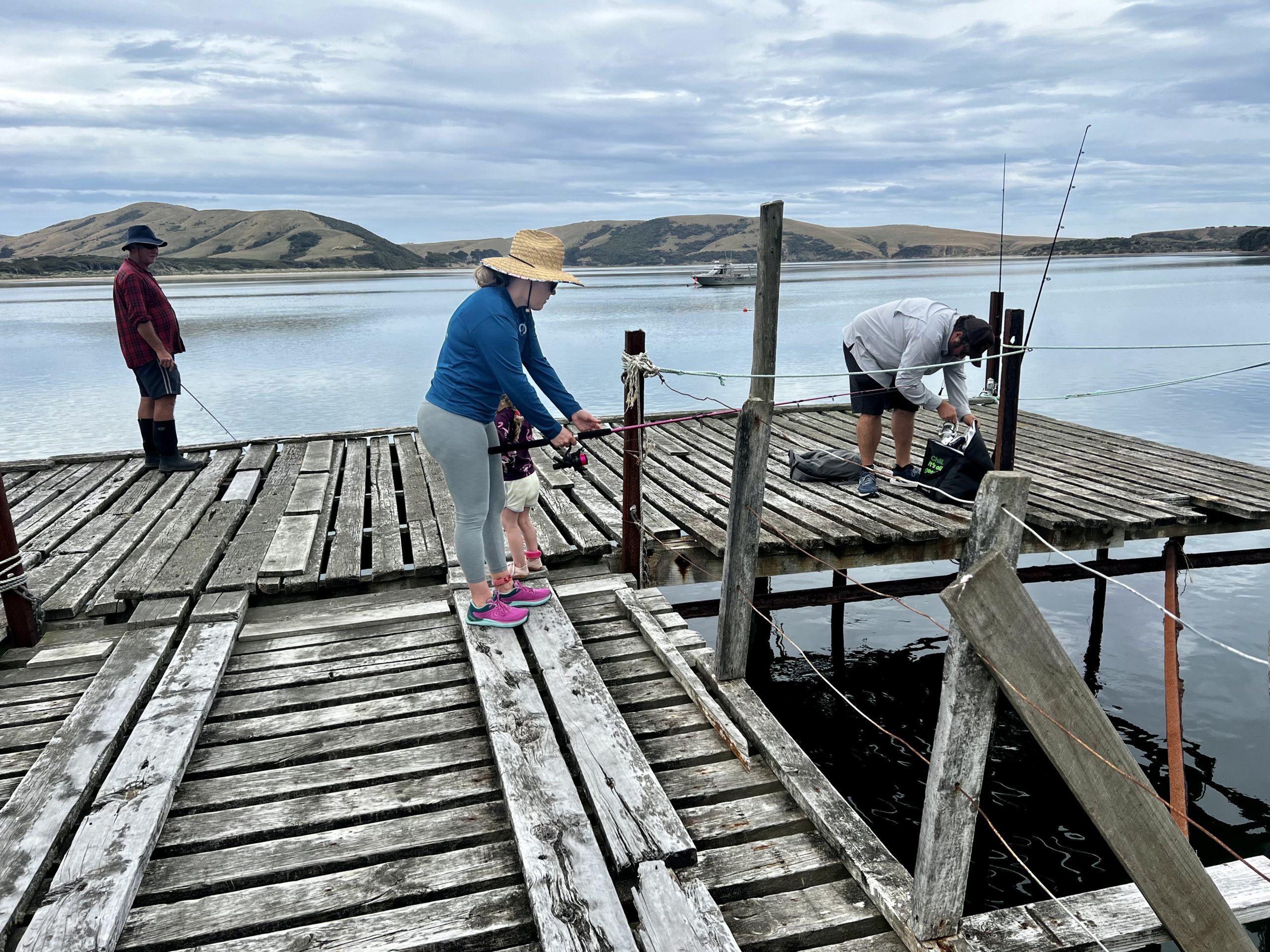
Vegetation lines the roads here frequently. We see a lot of reforestation, some newly planted like this and others with decades of growth.First fill up of the trip. About $6.10 US per gallon.Stopped along the way for lunchA few folks and a child fishing
Can Do Kiwis and Other Observations
We love the “can do” attitude in New Zealand. In Italy if you ask for a change of some kind, the answer is usually, “No. Not possible.” But in New Zealand the answer is “No problem.” To be fair, we learned that in Italy the negative answer is simply the beginning of a longer conversation with lots of back and forth that usually ends well because engaging in conversation is important. But in New Zealand everything seems easy. We have had airline tickets changed on the spot with no charge and a car rental agreement corrected with no question. When Robert called a local store to ask about getting fishing licenses, the clerk said they didn’t have them but he stayed on the line patiently to see if he could help find the right place.
We are hearing that auroras have been visible in the past couple of weeks down here in the south of the South Island, but so far we have not spotted one. Bonnie isn’t good at getting up in the middle of the night to look south.
Sun protection is serious business down here. The fishing guides remind us about sunscreen, and they put on another layer at midday. For kids, hats are part of the school uniform. Bonnie saw a whole primary school at recess, all in bucket hats. The problem is the Antarctic ozone hole, which expands in some years. The genetics of the pale-skinned population from England and Scotland must add to the problem. We see lots of pale Kiwis with bright red cheeks from the ongoing sun damage.
In the first week of the trip, while fishing all day on a crooked river, Bonnie was trying to use the sun to orient herself, without much success. Oops. Down here the sun is in the north.
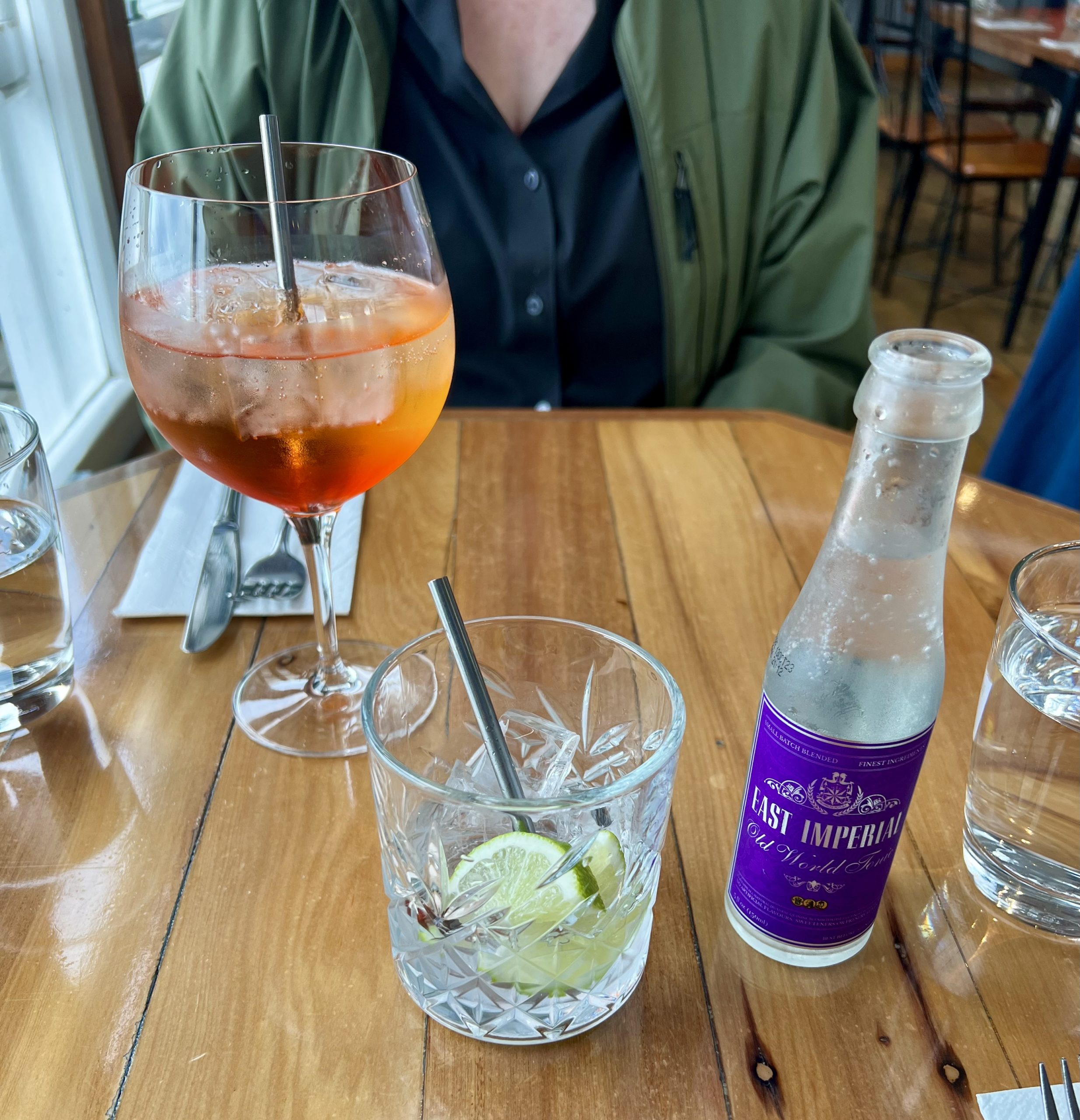
Drinks. Coffee everywhere. Lots of coffee shops. More coffee shops than pubs. And after a slow start, craft beer has emerged with vigor. David Banks thinks it is because once Kiwis started traveling more, they saw how they could amp up their beer making back home. But Kiwis haven’t really picked up on cocktails. Bonnie asked about vermouth from a lovely middle-aged woman bartender at a restaurant, and she had never heard of it. When we explained it was used in many cocktails, that didn’t help. Robert found his first gin and tonics very weak. He learned we have to ask for a “double pour” to get closer to the strength we are used to. Apparently the NZ government would like to cut back on alcohol consumption among young people.
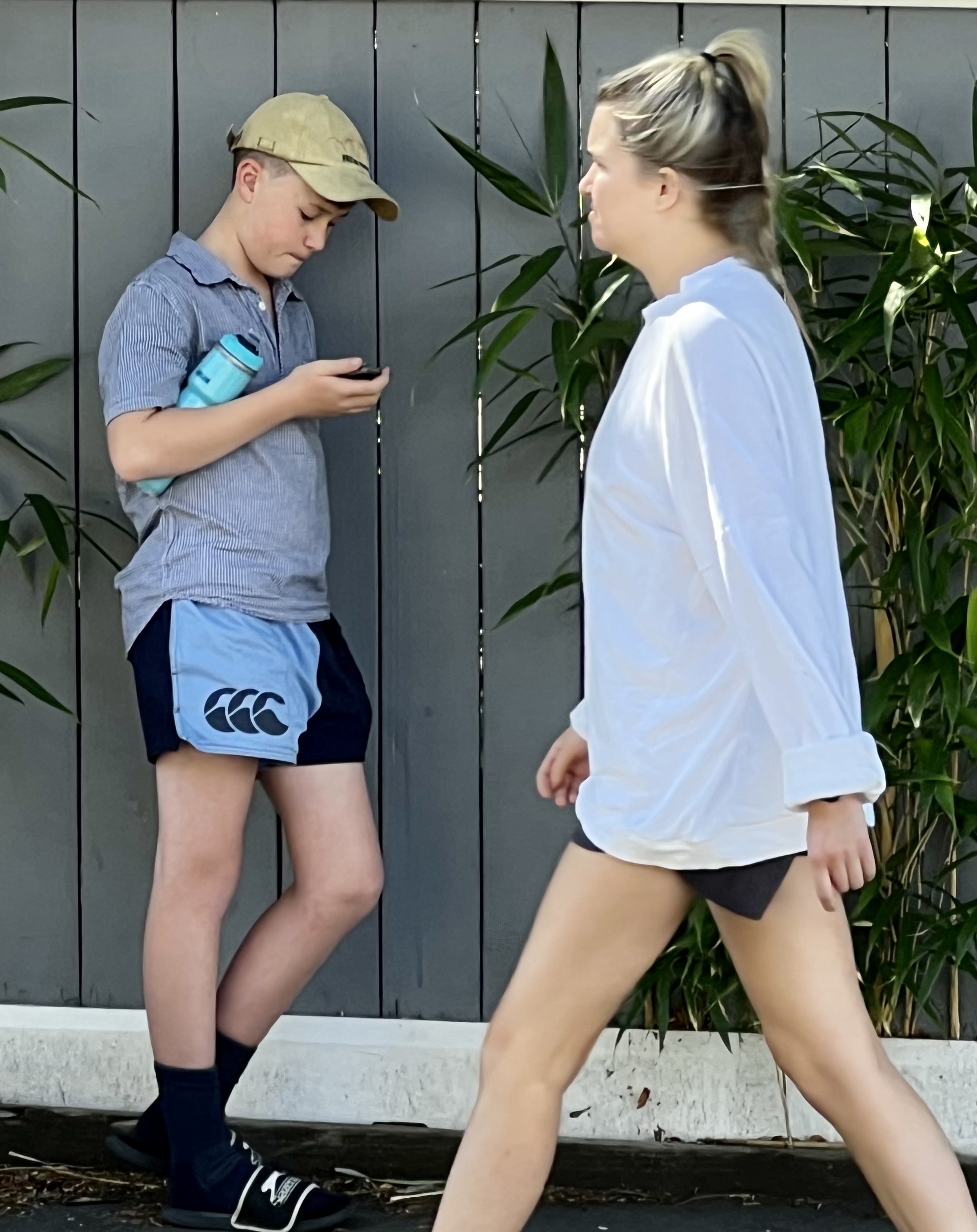
Fashion report. Hmmm. Most people look like they shopped at REI, Patagonia, or some other outdoor store. Even in downtown Auckland. People look just fine, but casual and ready for the outdoors. We see every kind of outdoor sneaker. No particular color. The few neon sneakers in the wild may have come from the US.
A young grocery clerk immediately identified Robert as American. Robert said: “The accent.” He said: “No. Before I heard you I saw the covid mask.”
Food and Friends
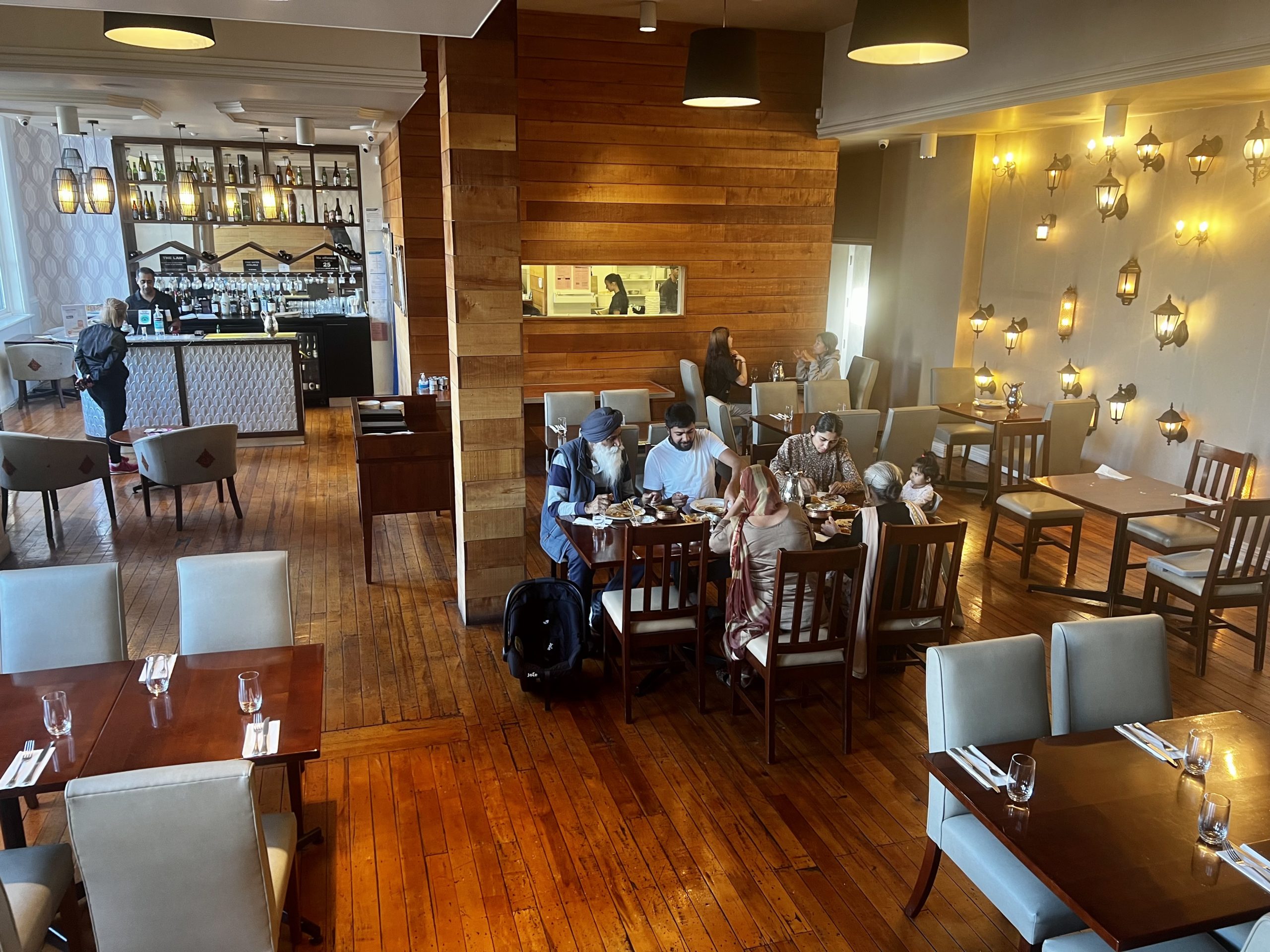
Robert had lamb sweetbreads.We were able to rendezvous in Invercargill with Bonnie’s “brother” David and his wife Yvonne for a few beers and dinner.